2 Kings 12:6

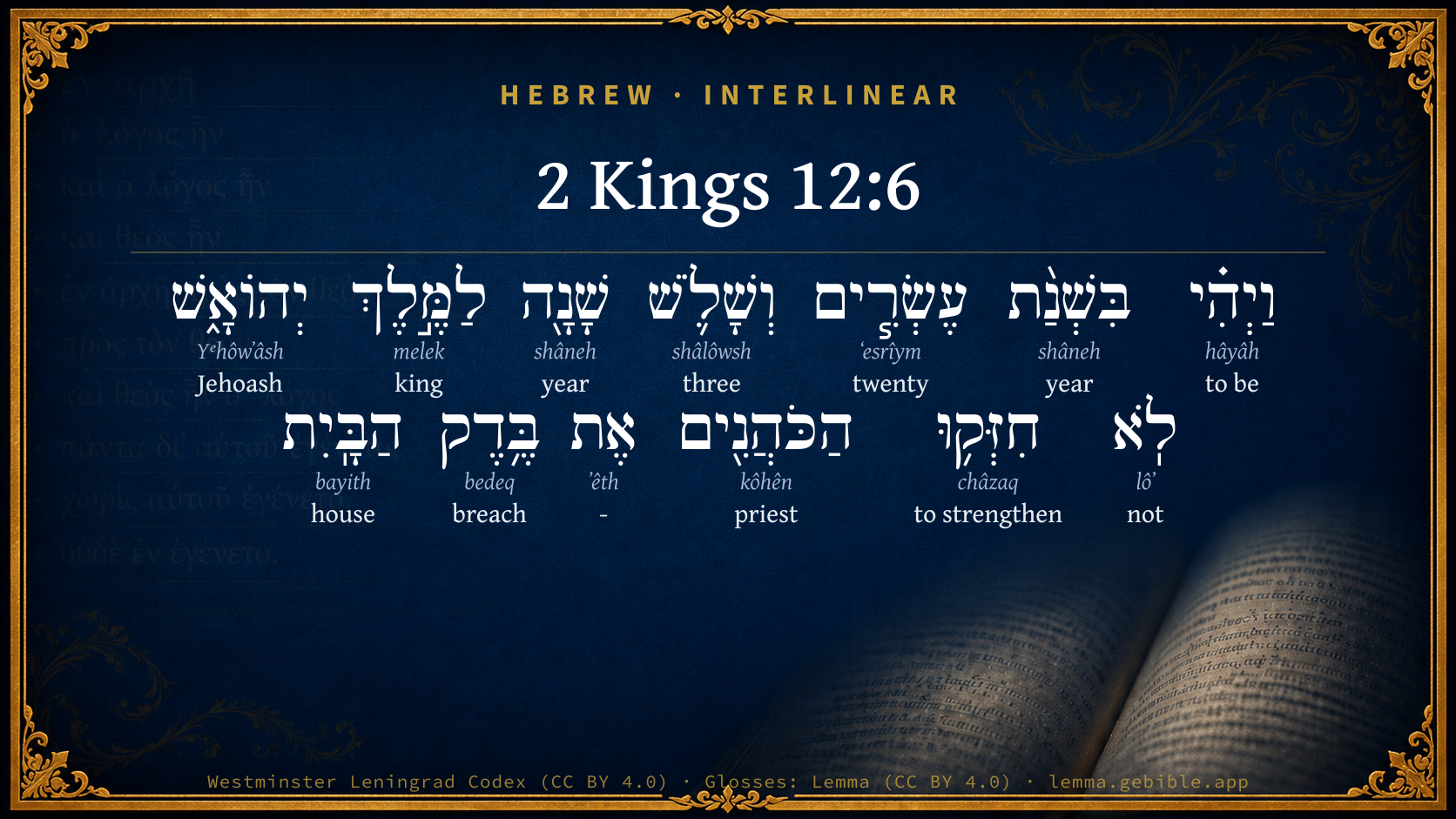
Hebrew (Westminster Leningrad Codex) 2 Kings 12:6 appears in the Hebrew Old Testament. The text above is from the Westminster Leningrad Codex. Each word links to its Strong’s number, a concise gloss, and parsing drawn from the Open Scriptures Hebrew Bible morphology. Click any word for its full Brown-Driver-Briggs (BDB) entry.
Download image
Cite this verse

2 Kings 12:6 (World English Bible). Public Domain. Lemma interlinear Bible study tool, https://lemma.gebible.app/v/2-kings/12/6.

Show BibTeX & RIS
BibTeX
RIS
English Translation
But it was so, that in the three and twentieth year of king Jehoash the priests had not repaired the breaches of the house.
World English Bible · Public Domain
Download a study sheet

One document with this verse’s original text, its word-by-word gloss line, the meaning frame, cross-references with their text, attributed commentary, and full source and license credits — printable, and it pastes into notes with its structure intact.

This verse Autodidact and up

Study sheet (.html) Plain text (.txt)

A passage Seminary Student

Up to 50 verses in one chapter. A passage sheet keeps up to 6 commentary sources and 12 cross-references per verse, in the order this page ranks them, and says so on the sheet whenever that leaves anything out. Ask for a single verse and you get the Autodidact verse sheet above.

Everything on this page stays free to read, with no account — the sheet is a download of what is already on screen, not access to it.

Want to remove ads? Support Godless Engineer
Compare translations 3

The same verse in 3 English versions, stacked beneath the original-language interlinear above. Click any original word for its lexicon entry.

Each is an independent rendering of the whole verse — the interlinear is not word-aligned to these translations.

Highlighted words mark where these versions differ — a whole-verse word diff, not a word-by-word alignment.

  • World English Bible Public Domain
    But it was so, that in the three and twentieth year of king Jehoash the priests had not repaired the breaches of the house.
  • King James Version Public Domain
    But it was so, that in the three and twentieth year of king Jehoash the priests had not repaired the breaches of the house.
  • unfoldingWord Literal Text CC BY-SA 4.0
    And it happened in the year of 23, the year to King Joash, the priests had not strengthened the damage of the house.

unfoldingWord Literal Text — © unfoldingWord, licensed CC BY-SA 4.0. Word-aligned USFM3 via Door43 (git.door43.org/unfoldingWord/en_ult).

Versions to compare (up to 4)

3 of 4 selected

Show all 18 translations

Every available English version of this verse, each an independent rendering of the whole verse.

  • World English Bible Public Domain
    But it was so, that in the three and twentieth year of king Jehoash the priests had not repaired the breaches of the house.
  • Berean Standard Bible Public Domain
    By the twenty-third year of the reign of Joash, however, the priests had not yet repaired the damage to the temple.
  • Majority Standard Bible Public Domain
    By the twenty-third year of the reign of Joash, however, the priests had not yet repaired the damage to the temple.
  • King James Version Public Domain
    But it was so, that in the three and twentieth year of king Jehoash the priests had not repaired the breaches of the house.
  • American Standard Version (1901) Public Domain
    But it was so, that in the three and twentieth year of king Jehoash the priests had not repaired the breaches of the house.
  • Revised Version (1885) Public Domain
    But it was so, that in the three and twentieth year of king Jehoash the priests had not repaired the breaches of the house.
  • Geneva Bible (1599) Public Domain
    Yet in the three and twentieth yeere of King Iehoash the Priestes had not mended that which was decayed in the Temple.
  • Douay-Rheims (1899) Public Domain
    Now till the three and twentieth year of king Joas, the priests did not make the repairs of the temple.
  • Young's Literal Translation Public Domain
    And it cometh to pass, in the twenty and third year of king Jehoash, the priests have not strengthened the breach of the house,
  • Literal Standard Version CC BY-SA 4.0
    And it comes to pass, in the twenty-third year of King Jehoash, the priests have not strengthened the breach of the house,
  • Unlocked Literal Bible CC BY-SA 4.0
    But by the twenty-third year of King Joash, the priests had not repaired anything in the temple.
  • unfoldingWord Literal Text CC BY-SA 4.0
    And it happened in the year of 23, the year to King Joash, the priests had not strengthened the damage of the house.
  • Darby Bible Public Domain
    And it was [so that] in the twenty-third year of king Jehoash, the priests had not repaired the breaches of the house.
  • World Messianic Bible Public Domain
    But it was so, that in the twenty-third year of King Jehoash the priests had not repaired the damage to the house.
  • Webster's Bible Public Domain
    But it was so, that in the three and twentieth year of king Jehoash the priests had not repaired the breaches of the house.
  • Free Bible Version CC BY-SA 4.0
    But by the twenty-third year of the reign of Joash, the priests still had not repaired the damage to the Temple.
  • Bible in Basic English Public Domain
    But in the twenty-third year of King Jehoash, the priests had not made good the damaged parts of the house.
  • JPS Tanakh (1917) Public Domain
    (12-7) But it was so, that in the three and twentieth year of king Jehoash the priests had not repaired the breaches of the house.

Literal Standard Version (2020), Covenant Press — licensed CC BY-SA 4.0. Text via the HelloAO Bible API (eBible.org). Unlocked Literal Bible (unfoldingWord) — licensed CC BY-SA 4.0. Text via the HelloAO Bible API (eBible.org). unfoldingWord Literal Text — © unfoldingWord, licensed CC BY-SA 4.0. Word-aligned USFM3 via Door43 (git.door43.org/unfoldingWord/en_ult). Free Bible Version, Dr. Jonathan Gallagher — licensed CC BY-SA 4.0. Text via the HelloAO Bible API (eBible.org).

Word by word

More ways to search: Search by grammar → Find every occurrence → Compare this word →

Practice this passage: Drill this verse → Learn its vocabulary →

בֶּ֥דֶק
bedeq
H919
“breach of”
Noun, Common, Masculine, Singular, Construct
Part of Speech
Noun
Type
Common
Gender
Masculine
Number
Singular
State
Construct
Full BDB Definition

Origin: from H918

TWOT: 204a

fissure, rent, breach, leak (in a building)
  1. וַיְהִ֗י hâyâh H1961 “and · to be” Conjunction + Verb, Qal, Sequential Imperfect, 3rd Person, Masculine, Singular
  2. בִּשְׁנַ֨ת shâneh H8141 “in/at · year of” Preposition + Noun, Common, Feminine, Singular, Construct
  3. עֶשְׂרִ֧ים ʻesrîym H6242 “twenty” Adjective, Cardinal number, Both, Plural, Absolute
  4. וְשָׁלֹ֛שׁ shâlôwsh H7969 “and · three” Conjunction + Adjective, Cardinal number, Feminine, Singular, Absolute
  5. שָׁנָ֖ה shâneh H8141 “year” Noun, Common, Feminine, Singular, Absolute
  6. לַמֶּ֣לֶךְ melek H4428 “to/for the · king” Preposition, Determined + Noun, Common, Masculine, Singular, Absolute
  7. יְהוֹאָ֑שׁ Yᵉhôwʼâsh H3060 “Jehoash” Noun, Proper
  8. לֹֽא lôʼ H3808 “not” Particle, Negative
  9. חִזְּק֥וּ châzaq H2388 “to strengthen” Verb, Piel, Perfect, 3rd Person, Common, Plural
  10. הַכֹּהֲנִ֖ים kôhên H3548 “the · priests” Particle, Definite Article + Noun, Common, Masculine, Plural, Absolute
  11. אֶת ʼêth H853 “-” Particle, Direct Object
  12. הַבָּֽיִת bayith H1004 “the · house” Particle, Definite Article + Noun, Common, Masculine, Singular, Absolute

About this verse

These counts appear in no published source. They are computed here, from the morphology-tagged text and Lemma’s own curated glosses. What Lemma adds →

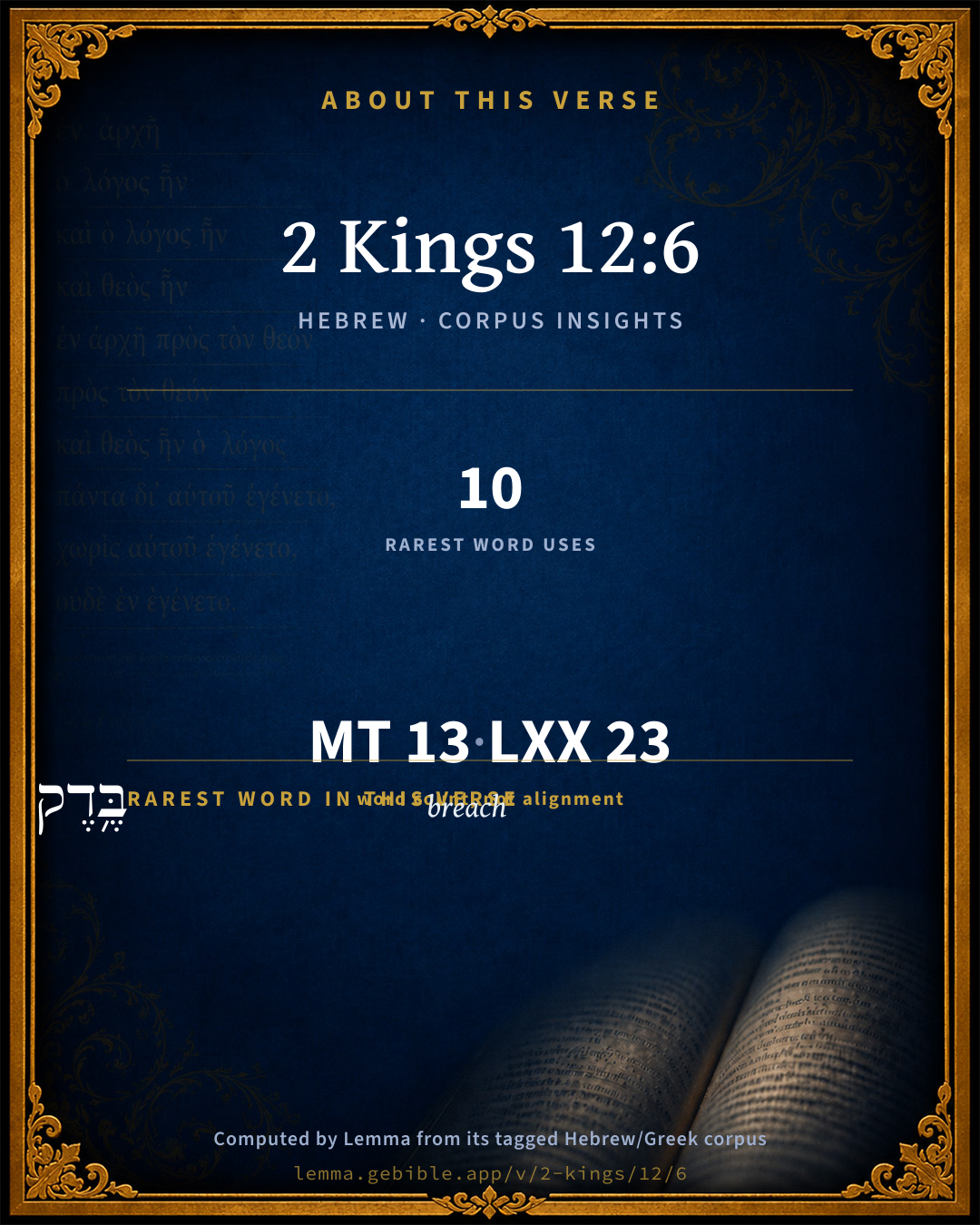
13
words
12
distinct lemmas
Historical
section

Notable vocabulary

The rarest word here is בֶּ֥דֶק breach H919 — appearing just 10 times in the whole Hebrew Bible.

Shared distinctive vocabulary

בֶּ֥דֶק breach H919 occurs in 8 verses of the Hebrew Bible. Also found in:

Grammatical profile

  • 2 verbs
  • 7 nouns
  • 2 adjectives
  • 2 particles

Verb forms

  • וַיְהִ֗י Qal · Sequential Imperfect
  • חִזְּק֥וּ Piel · Perfect

Repetition

A word recurs within this verse — often emphatic in Hebrew:

  • בִּשְׁנַ֨ת year H8141 ×2

Hebrew & Septuagint length

In English translation the verse runs 24 words from the Hebrew and 22 from the Septuagint (LXX English) — closely comparable.

A rough comparison of the two English renderings, which tokenize alike — not a word-level alignment.

Word counts can differ between the Hebrew and the Greek without any difference in meaning — e.g. the Hebrew direct-object marker אֵת has no separate Greek word, and Greek often adds the article ὁ.

In the original languages it is 13 Hebrew tokens and 23 Greek tokens — but the two are counted differently (Hebrew bundles its prefixes and suffixes into one token; the Greek is in lemma form), so that isn’t a like-for-like length.

Cross-references

6

Topical passages linked to 2 Kings 12:6 in the Treasury of Scripture Knowledge — connected by theme and wording, ordered by reader-vote popularity; previews shown in the World English Bible.

  • 1 Samuel 2:29–30 Why kick you at my sacrifice and at my offering, which I have commanded in [my] habitation, and honor your sons above me, to make yourselves fat with the best of all the offerings of Israel my people?
  • 2 Chronicles 29:34 But the priests were too few, so that they could not flay all the burnt offerings: therefore their brothers the Levites helped them, until the work was ended, and until the priests had sanctified themselves; for the Levites were more upright in heart to sanctify themselves than the priests.
  • Isaiah 56:10–12 His watchmen are blind, they are all without knowledge; they are all mute dogs, they can't bark; dreaming, lying down, loving to slumber.
  • Malachi 1:10 "Oh that there were one among you who would shut the doors, that you might not kindle fire on my altar in vain! I have no pleasure in you," says Yahweh of hosts, "neither will I accept an offering at your hand.
  • Philippians 2:21 For they all seek their own, not the things of Jesus Christ.
  • 1 Peter 5:2 Shepherd the flock of God which is among you, exercising the oversight, not under compulsion, but voluntarily, not for dishonest gain, but willingly;

Cross-references courtesy of OpenBible.info (CC BY 4.0).

Hebrew and Greek witnesses Masoretic Hebrew ↔ Greek Septuagint

The same verse in the two great witnesses to the Old Testament, shown verse-for-verse.

These are two independent witnesses, not word-aligned to each other, and the Septuagint is shown in lemma (dictionary) form.

Hebrew 2 Kings 12:6 Masoretic · Westminster Leningrad Codex

וַיְהִ֗י בִּשְׁנַ֨ת עֶשְׂרִ֧ים וְשָׁלֹ֛שׁ שָׁנָ֖ה לַמֶּ֣לֶךְ יְהוֹאָ֑שׁ לֹֽא חִזְּק֥וּ הַכֹּהֲנִ֖ים אֶת בֶּ֥דֶק הַבָּֽיִת

But it was so, that in the three and twentieth year of king Jehoash the priests had not repaired the breaches of the house.

World English Bible · Public Domain

Greek LXX 2 Kings 12:6 Septuagint · lemma form

λαμβάνω ἑαυτοῦ ὁ ἱερεύς ἀνήρ ἀπό ὁ πρᾶσις αὐτός καί αὐτός κρατέω ὁ βεδεκ ὁ οἶκος εἰς πᾶς ὅς ἐάν εὑρίσκω ἐκεῖ βεδεκ

And it came to pass in the twenty-third year of king Joas the priests had not repaired the breaches of the house.

LXX2012 (modern English Septuagint) · Public Domain

Hebrew: Westminster Leningrad Codex (CC BY 4.0). Greek: Septuagint (public domain); English from LXX2012 (modern English Septuagint) (Public Domain). How the Septuagint differs from the Hebrew →

Targum (Aramaic paraphrase)

1

The Targum is the ancient Jewish Aramaic paraphrase of the Hebrew Scriptures — an interpretive translation, not the Hebrew text itself. Onkelos (literal) and Pseudo-Jonathan (expansive) render the Torah, and Jonathan the Prophets. Coverage is partial: where no permissively-licensed English translation exists for a verse, only the Aramaic is shown. This is verse-level text, not a word-by-word alignment to the Hebrew.

  1. Targum Jonathan Prophets (Joshua–Malachi)
    יַסְבוּן לְהוֹן כַּהֲנַיָא גְבַר מִן מַכָּרֵיהּ וְאִינוּן יִתְקְפוּן יַת בִּדְקָא דְבֵיתָא לְכָל אֲתַר דִי יִשְׁתְּכַח תַּמָן בִּדְקָא:

    (no public-domain English translation for this verse)

    Targum Jonathan — Aramaic: “Mikraot Gedolot” (public domain). English: “Sefaria Community Translation” (CC0 1.0 (public-domain dedication)); “London "Chaldee Paraphrase," 1871” (public domain). Text via Sefaria.

Commentary

Notes on 2 Kings 12:6 from classic Christian and Jewish commentators (each source and its license shown beneath its notes). The classic Christian expositions comment on the surrounding passage and are grouped to its opening verse, so a note may address several verses; the Jewish commentaries on the Tanakh (Rashi and others) are per-verse, so they appear only where the commentator wrote on this verse.

Lemma curates 59 commentaries, every one of them public domain or Creative Commons licensed, each selected and text-cleaned for this edition rather than reprinted as found. About our sources →

Trapp's Complete Commentary

John Trapp

2Ki 12:6 But it was [so, that] in the three and twentieth year of king Jehoash the priests had not repaired the breaches of the house.

Ver. 6. The priests had not repaired.] Perhaps because themselves should have no benefit thereby; they should have but their labour for their pains; receiving the money with one hand and paying it out with another. We love to see somewhat coming toward us of our labour; which else hath little life in it.

John Trapp, A Commentary or Exposition upon All the Books of the Old and New Testament (1647–1656) — public domain. Text from a community e-Sword module.

Joseph Benson's Commentary

2Ki 12:6-8. In the three and twentieth year of Jehoash, the priests had not repaired, &c. — They were both dilatory and careless in collecting the money, 2Ch 24:5; and did not bring in what they had gathered to begin the work, whereupon the king revoked his former order, and intrusted other men, as it here follows, with this work. Thus are things seldom done well that are committed to the care of many. Now therefore receive no more money, &c. — Jehoash ordered two things, 1st, That they should gather no more money of the people. 2d, That they should not have the care of seeing the temple repaired, but pay what had been collected into other hands. The priests consented — They submitted to the king’s new orders, and wholly committed the business to those whom he thought fit to employ. But it does not appear that they restored the money which they had received for twenty-three years past.

Joseph Benson's Commentary on the Old and New Testaments (1811–1818) — public domain. Text from a community e-Sword module.

Adam Clarke's Commentary

Verse 6. In the three and twentieth year] In what year Jehoash gave the orders for these repairs, we cannot tell; but the account here plainly intimates that they had been long given, and that nothing was done, merely through the inactivity and negligence of the priests; see 2Ch 24:6.

It seems that the people had brought money in abundance, and the pious Jehoiada was over the priests, and yet nothing was done! Though Jehoiada was a good man, he does not appear to have had much of the spirit of an active zeal; and simple piety, without zeal and activity, is of little use when a reformation in religion and manners is necessary to be brought about. Philip Melancthon was orthodox, pious, and learned, but he was a man of comparative inactivity. In many respects Martin Luther was by far his inferior, but in zeal and activity he was a flaming and consuming fire; and by him, under God, was the mighty Reformation, from the corruptions of popery, effected. Ten thousand Jehoiadas and Melancthons might have wished it in vain; Luther worked, and God worked by him, in him, and for him.

Adam Clarke's Commentary on the Bible (1810–1826) — public domain. Text from a community e-Sword/MySword module.

Ellicott's Commentary for English Readers

(6) In the three and twentieth year.—Jenoash may have ordered the restoration in his twentieth year, when he came of age. It is noticeable that he and not Jehoiada takes the initiative in the matter. The chronicler states that the king had ordered the priests and the Levites “to hasten the matter,” but that “the Levites hastened it not.”

A Bible Commentary for English Readers, edited by Charles John Ellicott (1878–1897) — public domain. Text from a community e-Sword module.

The Cambridge Bible for Schools and Colleges

gen. ed. J. J. S. Perowne

6. In the three and twentieth year of king Jehoash] By which time he must have attained the age of thirty and was able to act with decision. According to the Chronicler the first order had been, ‘See that ye hasten the matter. Howbeit the Levites hastened it not’. That account also makes Jehoiada more personally responsible than he is here represented to have been. ‘The king called for Jehoiada the chief, and said unto him, Why hast thou not required of the Levites to bring in out of Judah and out of Jerusalem the collection?’

the priests had not repaired the breaches] We are not told why this was so, though the king asked the question. They had evidently been receiving the money, for the king’s order in the next verse is ‘Take no more money’.

The Cambridge Bible for Schools and Colleges (gen. ed. J. J. S. Perowne; Cambridge University Press, 1878–1918) — public domain. Text from a community e-Sword module.

John Gill's Exposition

And the priests consented to receive no more money of the people,.... And delivered up what they had:

neither to repair the breaches of the house; being very willing to be stop both services, and especially since they seemed to be suspected.

John Gill's Exposition of the Whole Bible (1746–1763) — public domain (CC PDM 1.0). Text via the HelloAO Bible API.

Albert Barnes' Notes on the Bible

No money had for some time been brought in (marginal reference “g”). Perhaps it was difficult for the priests and Levites to know exactly what proportion of the money paid to them was fairly applicable to the temple service and to their own support; and what, consequently, was the balance which they ought to apply to the repairs.

Albert Barnes' Notes on the Bible (1834–1885) — public domain. Text from a community e-Sword/MySword module.

Haydock's Catholic Bible Commentary

Temple. It is not known when the king gave his orders; but they were executed with negligence, as they seemed to interfere (Calmet) with the emoluments assigned by the law to the Levites, 2 Paralipomenon xxiv. 5. (Haydock) --- The latter Jews were obliged to pay half a sicle towards the repairs of the temple. (Tirinus)

George Leo Haydock (1774–1849), Haydock's Catholic Family Bible and Commentary, 1859 edition — public domain. Excludes Psalms (Douay-Rheims chapter numbering differs from Protestant) and Deuterocanonical books (Catholic canon only).

Matthew Poole's English Annotations

Either because the people were generally corrupt and backward to the worship of God, especially where it cost them any thing; or because the persons employed in making the collections were negligent, or unfaithful, perverting the money received to their own uses, as may seem probable from the contrary character of other persons, of whom it is noted that they dealt faithfully, below, 2Ki 12:15; or because the people did not like this way of collection, and had no good opinion of the collectors’ faithfulness.

Matthew Poole's English Annotations on the Holy Bible (1683–1685) — public domain. Text from a community e-Sword/MySword module.

The Pulpit Commentary

But it was so, that in the three and twentieth year of King Jehoash the priests had not repaired the breaches of the house. No charge is made against the priests of malversation or embezzlement. They had simply been negligent. Probably very little money had come in; and they had not been very active in their endeavors to obtain larger contributions. It must be remembered that what went to the fabric fund would, for the most part, be a deduction from the ordinary revenue of the temple, which was not, perhaps, much in excess of the ordinary demands upon it. We can, therefore, quite understand that the king"s policy would not be popular with the priests. (see 2Ch_24:5) Still, it is to be observed that they are not said to have executed no repairs, but only not to have "made haste" and completed their task by the time that the king looked for its completion.

The Pulpit Commentary (1880–1919), ed. H.D.M. Spence-Jones & Joseph S. Exell — public domain. Text from a community e-Sword module.

Keil & Delitzsch

C. F. Keil & F. Delitzsch

But when the twenty-third year of the reign of Joash arrived, and the dilapidations had not been repaired, the king laid the matter before the high priest Jehoiada and the priests, and directed them not to take the money any more from their acquaintance, but to give it for the dilapidations of the temple; "and the priests consented to take no money, and not to repair the dilapidations of the house," i.e., not to take charge of the repairs. We may see from this consent how the command of the king is to be understood. Hitherto the priests had collected the money to pay for the repairing of the temple; but inasmuch as they had not executed the repairs, the king took away from them both the collection of the money and the obligation to repair the temple. The reason for the failure of the first measure is not mentioned in our text, and can only be inferred from the new arrangement made by the king (Kg2 12:9): "Jehoiada took a chest-of course by the command of the king, as is expressly mentioned in Ch2 24:8, - bored a hole in the door (the lid) thereof, and placed it by the side of the altar (of burnt-offering) on the right by the entrance of every one into the house of Jehovah, that the priests keeping the threshold might put thither (i.e., into the chest) all the money that was brought into the house of Jehovah."

Keil & Delitzsch — Biblical Commentary on the Old Testament (1861–1891) — public domain (CC PDM 1.0). Text via the HelloAO Bible API. (Old Testament only.)

unfoldingWord translationNotes

Door43 World Missions Community

by the twenty-third year of King Joash

"when Joash had been king for twenty three years"

Why have you not repaired anything in the temple?

Joash asks this question to rebuke the priests. AT: "You should have been repairing the temple!" (See: Rhetorical Question)

give it to those who can make the repairs

"pay workers who will do the repairs"

unfoldingWord translationNotes — © Distant Shores Media and the Door43 World Missions Community, licensed CC BY-SA 4.0. Source: git.door43.org/Door43/en_tn.

Rashi

Rabbi Shlomo Yitzchaki (Rashi)

Let take [the money] for themselves—the kohanim. [I.e.,] it will be theirs, and [in return] they will obligate themselves to make the [necessary] repairs to the Beis [Hamikdosh] from their own [funds].

From his friend. From his acquaintance who frequently visits him.

Restoration. Split[s] and crack[s] in the wall.

Rashi on the Tanakh — English translations: “The Judaica Press complete Tanach with Rashi, translated by A. J. Rosenberg” (CC BY 4.0); “Pentateuch with Rashi's commentary by M. Rosenbaum and A.M. Silbermann, 1929-1934” (public domain); “The Metsudah Tanach series, Lakewood, N.J” (CC BY 4.0); and “The Book of Joshua, Metsudah Publications, 1997” (CC BY 4.0). Text via Sefaria.

Lesson kit

Teaching starters — assembled from the data on this page, not authored interpretation. Every prompt links to the verse data it draws on. Edit before teaching.

2 Kings, in the Historical, opens this verse with 13 words (12 distinct Hebrew lemmas). Its most distinctive word is bedeq (“breach”). A historical commentator’s framing appears above. Read the whole chapter for the surrounding context.

Discussion questions

  1. What does “breach” (bedeq) contribute to the verse as a whole?
  2. How does 2 Kings 12:5, which shares the word «breach», read alongside this verse?
  3. What does the repetition of “year” (2× in this one verse) do in this verse?
  4. These translations render this verse differently; the difference is in the English rendering, not the original. What questions does that raise?
  5. «וַיְהִ֗י» is a Qal Sequential Imperfect verb. How does that grammatical form shape the action described?
  6. Compare how Trapp's Complete Commentary and Joseph Benson's Commentary read this verse. Where do they agree or differ?

Things to notice

Reading settings

Reading text

Shown beneath each verse's original-language words.

Old Testament
Old Testament edition

Read the OT as the Masoretic Hebrew (MT) or the Greek Septuagint (LXX).

English shown for the Greek Septuagint (in the Hebrew ↔ Greek comparison).

Comparing translations? Open the Compare panel on any verse page to stack up to four side by side.