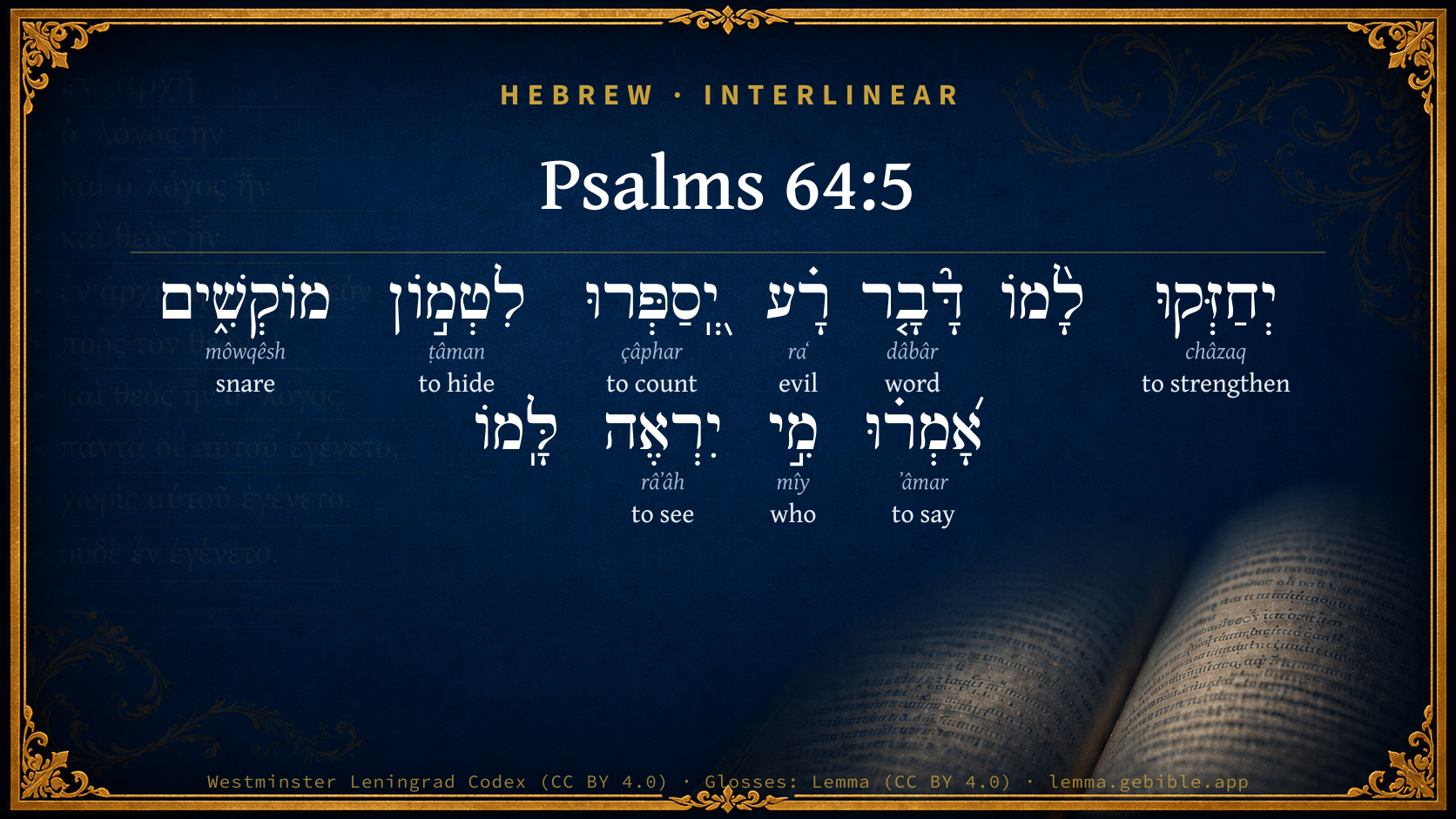
Psalms 64:5

Hebrew (Westminster Leningrad Codex) Psalms 64:5 appears in the Hebrew Old Testament. The text above is from the Westminster Leningrad Codex. Each word links to its Strong’s number, a concise gloss, and parsing drawn from the Open Scriptures Hebrew Bible morphology. Click any word for its full Brown-Driver-Briggs (BDB) entry.
Download image
Cite this verse

Psalms 64:5 (World English Bible). Public Domain. Lemma interlinear Bible study tool, https://lemma.gebible.app/v/psalms/64/5.

Show BibTeX & RIS
BibTeX
RIS
English Translation
They encourage themselves in evil plans. They talk about laying snares secretly. They say, "Who will see them?"
World English Bible · Public Domain
Download a study sheet

One document with this verse’s original text, its word-by-word gloss line, the meaning frame, cross-references with their text, attributed commentary, and full source and license credits — printable, and it pastes into notes with its structure intact.

This verse Autodidact and up

Study sheet (.html) Plain text (.txt)

A passage Seminary Student

Up to 50 verses in one chapter. A passage sheet keeps up to 6 commentary sources and 12 cross-references per verse, in the order this page ranks them, and says so on the sheet whenever that leaves anything out. Ask for a single verse and you get the Autodidact verse sheet above.

Everything on this page stays free to read, with no account — the sheet is a download of what is already on screen, not access to it.

Want to remove ads? Support Godless Engineer
Compare translations 3

The same verse in 3 English versions, stacked beneath the original-language interlinear above. Click any original word for its lexicon entry.

Each is an independent rendering of the whole verse — the interlinear is not word-aligned to these translations.

Highlighted words mark where these versions differ — a whole-verse word diff, not a word-by-word alignment.

  • World English Bible Public Domain
    They encourage themselves in evil plans. They talk about laying snares secretly. They say, "Who will see them?"
  • King James Version Public Domain
    They encourage themselves in an evil matter: they commune of laying snares privily; they say, Who shall see them?
  • unfoldingWord Literal Text CC BY-SA 4.0
    They strengthen for themselves an evil matter; they recount hiding snares. They say, “Who will see them?”

unfoldingWord Literal Text — © unfoldingWord, licensed CC BY-SA 4.0. Word-aligned USFM3 via Door43 (git.door43.org/unfoldingWord/en_ult).

Versions to compare (up to 4)

3 of 4 selected

Show all 18 translations

Every available English version of this verse, each an independent rendering of the whole verse.

  • World English Bible Public Domain
    They encourage themselves in evil plans. They talk about laying snares secretly. They say, "Who will see them?"
  • Berean Standard Bible Public Domain
    They hold fast to their evil purpose; they speak of hiding their snares. “Who will see them?” they say.
  • Majority Standard Bible Public Domain
    They hold fast to their evil purpose; they speak of hiding their snares. “Who will see them?” they say.
  • King James Version Public Domain
    They encourage themselves in an evil matter: they commune of laying snares privily; they say, Who shall see them?
  • American Standard Version (1901) Public Domain
    They encourage themselves in an evil purpose; They commune of laying snares privily; They say, Who will see them?
  • Revised Version (1885) Public Domain
    They encourage themselves in an evil purpose; they commune of laying snares privily; they say, Who shall see them?
  • Geneva Bible (1599) Public Domain
    They encourage themselues in a wicked purpose: they commune together to lay snares priuilie, and say, Who shall see them?
  • Douay-Rheims (1899) Public Domain
    to shoot in secret the undefiled.
  • Young's Literal Translation Public Domain
    They strengthen for themselves an evil thing, They recount of the hiding of snares, They have said, `Who doth look at it?'
  • Literal Standard Version CC BY-SA 4.0
    They strengthen an evil thing for themselves, || They recount of the hiding of snares, || They have said, “Who looks at it?”
  • Unlocked Literal Bible CC BY-SA 4.0
    They encourage themselves in an evil plan; they consult privately together in order to set traps; they say, “Who will see us?”
  • unfoldingWord Literal Text CC BY-SA 4.0
    They strengthen for themselves an evil matter; they recount hiding snares. They say, “Who will see them?”
  • Darby Bible Public Domain
    They encourage themselves in an evil matter, they concert to hide snares; they say, Who will see them?
  • World Messianic Bible Public Domain
    They encourage themselves in evil plans. They talk about laying snares secretly. They say, “Who will see them?”
  • Webster's Bible Public Domain
    \\64:4\\That they may shoot in secret at the perfect: suddenly do they shoot at him, and fear not.
  • Free Bible Version CC BY-SA 4.0
    They encourage one another to do evil, planning how to secretly trap people, telling themselves, “Nobody will notice.”
  • Bible in Basic English Public Domain
    They make themselves strong in an evil purpose; they make holes for secret nets; they say, Who will see it,
  • JPS Tanakh (1917) Public Domain
    (64-6) They encourage one another in an evil matter; they converse of laying snares secretly; they ask, who would see them.

Literal Standard Version (2020), Covenant Press — licensed CC BY-SA 4.0. Text via the HelloAO Bible API (eBible.org). Unlocked Literal Bible (unfoldingWord) — licensed CC BY-SA 4.0. Text via the HelloAO Bible API (eBible.org). unfoldingWord Literal Text — © unfoldingWord, licensed CC BY-SA 4.0. Word-aligned USFM3 via Door43 (git.door43.org/unfoldingWord/en_ult). Free Bible Version, Dr. Jonathan Gallagher — licensed CC BY-SA 4.0. Text via the HelloAO Bible API (eBible.org).

Word by word

More ways to search: Search by grammar → Find every occurrence → Compare this word →

Practice this passage: Drill this verse → Learn its vocabulary →

About this verse

These counts appear in no published source. They are computed here, from the morphology-tagged text and Lemma’s own curated glosses. What Lemma adds →

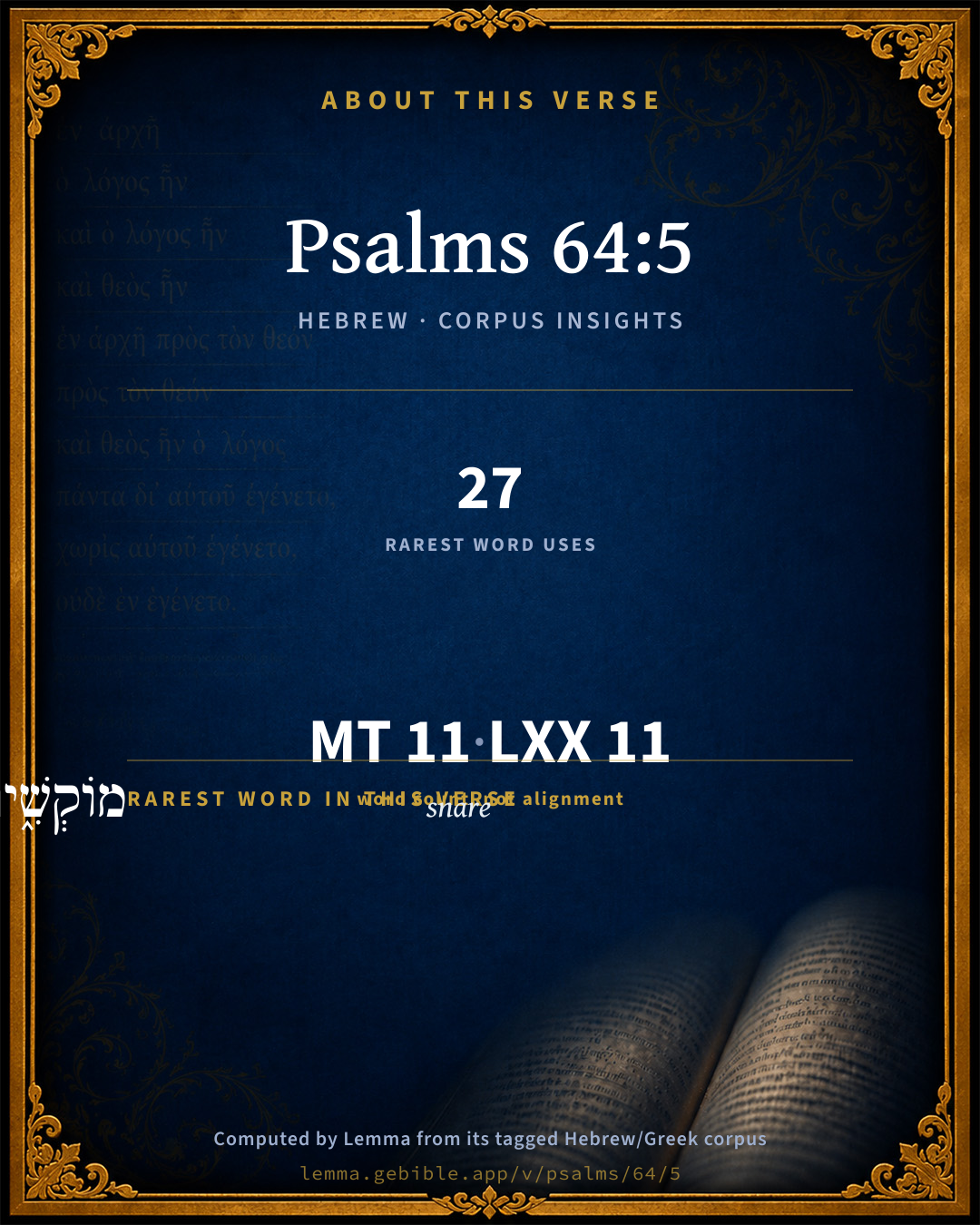
11
words
9
distinct lemmas
Wisdom
section

Shared distinctive vocabulary

מוֹקְשִׁ֑ים snare H4170 occurs in 27 verses of the Hebrew Bible. Also found in:

Grammatical profile

  • 5 verbs
  • 2 nouns
  • 1 adjective
  • 2 prepositions
  • 1 particle

Verb forms

  • יְחַזְּקוּ Piel · Imperfect
  • יְֽ֭סַפְּרוּ Piel · Imperfect
  • לִטְמ֣וֹן Qal · Infinitive Construct
  • אָ֝מְר֗וּ Qal · Perfect
  • יִרְאֶה Qal · Imperfect

Hebrew & Septuagint length

In English translation the verse runs 18 words from the Hebrew and 23 from the Septuagint (LXX English) — closely comparable.

A rough comparison of the two English renderings, which tokenize alike — not a word-level alignment.

Word counts can differ between the Hebrew and the Greek without any difference in meaning — e.g. the Hebrew direct-object marker אֵת has no separate Greek word, and Greek often adds the article ὁ.

In the original languages it is 11 Hebrew tokens and 11 Greek tokens — but the two are counted differently (Hebrew bundles its prefixes and suffixes into one token; the Greek is in lemma form), so that isn’t a like-for-like length.

Cross-references

15

Topical passages linked to Psalms 64:5 in the Treasury of Scripture Knowledge — connected by theme and wording, ordered by reader-vote popularity; previews shown in the World English Bible.

  • Psalms 140:5 The proud have hidden a snare for me, They have spread the cords of a net by the path. They have set traps for me. Selah.
  • Psalms 10:11 He says in his heart, "God has forgotten. He hides his face. He will never see it."
  • Job 22:13 You say, 'What does God know? Can he judge through the thick darkness?
  • Ezekiel 8:12 Then said he to me, Son of man, have you seen what the elders of the house of Israel do in the dark, every man in his chambers of imagery? for they say, Yahweh doesn't see us; Yahweh has forsaken the land.
  • Psalms 59:7 Behold, they spew with their mouth. Swords are in their lips, "For," they say, "who hears us?"
  • Psalms 94:7 They say, "Yah will not see, Neither will Jacob's God consider."
  • Exodus 15:9 The enemy said, 'I will pursue, I will overtake, I will divide the spoil. My desire shall be satisfied on them. I will draw my sword, my hand shall destroy them.'
  • Numbers 22:6 Please come now therefore curse me this people; for they are too mighty for me: peradventure I shall prevail, that we may strike them, and that I may drive them out of the land; for I know that he whom you bless is blessed, and he whom you curse is cursed.
  • 1 Samuel 23:19–23 Then came up the Ziphites to Saul to Gibeah, saying, Doesn't David hide himself with us in the strongholds in the wood, in the hill of Hachilah, which is on the south of the desert?
  • Psalms 124:7 Our soul has escaped like a bird out of the fowler's snare. The snare is broken, and we have escaped.
  • Proverbs 1:11–14 If they say, "Come with us, Let's lay in wait for blood; Let's lurk secretly for the innocent without cause;
  • Isaiah 41:6 They help everyone his neighbor; and [every one] says to his brother, Be of good courage.
  • Matthew 26:3–4 Then the chief priests, the scribes, and the elders of the people were gathered together in the court of the high priest, who was called Caiaphas.
  • Matthew 23:15 Woe to you, scribes and Pharisees, hypocrites! For you travel around by sea and land to make one proselyte; and when he becomes one, you make him twice as much of a son of Gehenna as yourselves.
  • Revelation 11:10 Those who dwell on the earth rejoice over them, and they will be glad. They will give gifts to one another, because these two prophets tormented those who dwell on the earth.

Cross-references courtesy of OpenBible.info (CC BY 4.0).

Hebrew and Greek witnesses Masoretic Hebrew ↔ Greek Septuagint

The same verse in the two great witnesses to the Old Testament, shown verse-for-verse.

You’re reading Greek Psalm 63 (Hebrew Psalm 64). The Septuagint counts the superscription, so verse numbers can differ from the Hebrew — chapter-level alignment, not verse-by-verse. Numbering follows Rahlfs.

These are two independent witnesses, not word-aligned to each other, and the Septuagint is shown in lemma (dictionary) form.

Hebrew Psalms 64:5 Masoretic · Westminster Leningrad Codex

יְחַזְּקוּ לָ֨מוֹ דָּ֘בָ֤ר רָ֗ע יְֽ֭סַפְּרוּ לִטְמ֣וֹן מוֹקְשִׁ֑ים אָ֝מְר֗וּ מִ֣י יִרְאֶה לָּֽמוֹ

They encourage themselves in evil plans. They talk about laying snares secretly. They say, "Who will see them?"

World English Bible · Public Domain

Greek LXX Greek Psalm 63:5 Septuagint · lemma form

ὁ κατατοξεύω ἐν ἀπόκρυφος ἄμωμος ἐξάπινα κατατοξεύω αὐτός καί οὐ φοβέω

They have set up for themselves an evil matter, they have given counsel to hide snares; they have said, Who shall see them?

LXX2012 (modern English Septuagint) · Public Domain

On this verse, Ellicott's Commentary for English Readers discusses the Septuagint’s reading. Read the note in Commentary ↓

Hebrew: Westminster Leningrad Codex (CC BY 4.0). Greek: Septuagint (public domain); English from LXX2012 (modern English Septuagint) (Public Domain). How the Septuagint differs from the Hebrew →

Commentary

Notes on Psalms 64:5 from classic Christian and Jewish commentators (each source and its license shown beneath its notes). The classic Christian expositions comment on the surrounding passage and are grouped to its opening verse, so a note may address several verses; the Jewish commentaries on the Tanakh (Rashi and others) are per-verse, so they appear only where the commentator wrote on this verse.

Lemma curates 59 commentaries, every one of them public domain or Creative Commons licensed, each selected and text-cleaned for this edition rather than reprinted as found. About our sources →

Trapp's Complete Commentary

John Trapp

Psa 64:5 They encourage themselves [in] an evil matter: they commune of laying snares privily; they say, Who shall see them?

Ver. 5. They encourage themselves in an evil matter] Thus he riseth in his complaint, and showeth how, by the neglect of piety and humanity, they were grown obdurate and obstinate, yea, confident, or rather impudent, in their evil practices.

They commune of laying snares privily] viz. To entangle and entrap me. See Neh 4:11, {See Trapp on "Neh 4:11"}

They say, Who shall see them?] God, who is all eye, shall, but they, having hid God from themselves, think they can likewise hide themselves and their snares from God. But

- εχει θεος εκδικον ομμα

John Trapp, A Commentary or Exposition upon All the Books of the Old and New Testament (1647–1656) — public domain. Text from a community e-Sword module.

The Biblical Illustrator

Joseph S. Exell

Psa_64:5

They say, Who shall see them?

Omniscience ignored

I. It is a fact that this notion has great influence upon the conduct of man. They like to cherish such notion, finding it convenient. Because they sometimes escape the eye of man, they think it possible to escape the eye of God. The sinner persuades himself that he has gained his end, escaped observation and avoided the punishment.

II. It is a fact that this notion is utterly untruthful and delusive. If God exist, this must be so. The spirituality of His nature makers possible His onmipresence and omniscience.

III. God has often exposed this delusion, and the time is fixed for the complete demonstration.

1. Character is often seen through by man.

2. Retribution often follows mens deeds here and now.

3. The future state will show that God saw all. (Homiletic Magazine.)

The Biblical Illustrator, edited by Joseph S. Exell (c. 1880s–1900s) — public domain. Text from a community e-Sword module.

Joseph Benson's Commentary

Psa 64:5-6. They encourage themselves — Hebrew, יחזקו, jechazeku, they strengthen, or fortify themselves, by firm resolutions, by assured confidence of success, by uniting their counsels and forces together, and by mutual encouragements and exhortations. They say, Who shall see them — Their snares are so secretly laid, that they think David cannot discern, nor therefore avoid them. They search out iniquities — They study diligently and constantly to find out either matter which they may lay to my charge, or new ways and means of doing mischief. They accomplish a diligent search — They have long and accurately searched, till at last they have ripened and perfected their thoughts, and contrived a very cunning and deep plot. Or, they say, We have accomplished our accurate search. By long searching we have at last found what we desired. And the heart is deep — Deep as hell, desperately wicked, who can know it? By their unaccountable wickedness, they show themselves to be, both in subtlety and malignity, the genuine offspring of the old serpent.

Joseph Benson's Commentary on the Old and New Testaments (1811–1818) — public domain. Text from a community e-Sword module.

J. A. Alexander on Psalms

Joseph Addison Alexander

6. (Psa 64:5). They will strengthen for themselves an evil word; they will tell abouthiding snares; they have said, who will see to them? To strengthen is to make strong, to construct so as to be strong. An evil word is an idiomatic phrase for a malignant plot, so called because it is the fruit of mutual discourse and consultation. See above, on Psa 41:8. Tell about, count and recount their various devices, past and present. See above, on Psa 59:12. The interrogation in the last clause is an indirect one; the equi valent direct form would be, who will see to us, i.e. regard us? Compare Psa 10:11; Psa 39:7.

Joseph Addison Alexander, The Psalms Translated and Explained (1850) — public domain. Text from a community e-Sword module.

Geneva Bible (1599)

Geneva Bible translators

The more that the wicked see God’s children in misery, the more bold and impudent are they in oppressing them.

Geneva Bible (1599) marginal notes — public domain. Text via Bolls.life.

Jamieson, Fausset & Brown

Robert Jamieson, A. R. Fausset & David Brown

A sentiment here more fully presented, by depicting their deliberate malice.

Jamieson, Fausset & Brown — Commentary Critical and Explanatory on the Whole Bible (1871) — public domain (CC PDM 1.0). Text via the HelloAO Bible API.

Adam Clarke's Commentary

Verse 5. They commune of laying snares] They lay snares to entrap those whom they cannot slay by open attack or private ambush.

Adam Clarke's Commentary on the Bible (1810–1826) — public domain. Text from a community e-Sword/MySword module.

John Calvin's Commentaries

5 They assure themselves in an evil work. He proceeds to complain of the perverse determination with which they pursued their wickedness, and of their combinations amongst themselves; remarking, at the same time, upon the confidence with which they stirred one another up to the most daring acts of iniquity. In this there can be little doubt that they were encouraged by the present state of weakness to which David was reduced in his circumstances, taking occasion, when they found him in poverty and exile, and without means of resistance, to persecute him with the greater freedom. Having adverted to them as being beyond hope of amendment, and incapable of any impressions of humanity, he speaks of their meeting together to plot his destruction; and, in connection with this, of the unbounded confidence which they were led to display, from a belief that their designs were not seen. It is well known that one circumstance which strengthens the false security of the wicked, and encourages them to triumph in their crafty policy towards the simple and upright in heart, is their thinking that they can cover their crimes by such pretexts as they have always at hand. They say, Who shall see them? The word למו, lamo, them, may refer either to the workers of iniquity themselves, or to the snares spoken of in the preceding clause. The first seems the preferable meaning. They run recklessly, and without restraint, in the ways of sin, blinded by their pride, and influenced neither by the fear of God nor a sense of shame.

In the verse which follows, he animadverts severely upon the deceit which they practiced. He speaks of their having exhausted all the arts of mischief, so as to have left nothing in this department to be discovered. The search referred to has relation to the secret methods of doing evil. He adds, that their malice was deep. By the inward part and the heart, which was deep, he means the hidden devices to which the wicked have recourse for concealment. Some, instead of translating the words, the inward part of each, etc., give a more indefinite sense to איש, ish, and read, the inward part, and deep heart, of every one, is found in them; that is, his enemies contrived to comprise in themselves all that men have ever displayed in the shape of craft and subtilty. Either rendering may be adopted; for it is evidently David’s meaning that his enemies practiced secret stratagem as well as open violence, to compass his ruin, and showed themselves to be possessed of the deepest penetration in discovering dark and unimagined methods of doing mischief.

John Calvin's Commentaries (1540-1563) — public domain. Text from the Calvin Translation Society English edition (1840s-50s) via the Christian Classics Ethereal Library (ccel.org). Calvin's coverage is partial (roughly two-thirds of the Bible); uncommented books and verses are honest gaps, never fabricated. The 19th-century editor's footnotes and remarks are omitted so the notes are faithfully Calvin's own voice.

Ellicott's Commentary for English Readers

(5) They encourage themselves.—Literally, they strengthen for themselves an evil thing (or “word,” margin, LXX., and Vulg.,) which evidently means that they take their measures carefully, and are prepared to carry them out resolutely.

They commune . . .—Better, they calculate how they may lay snares privily. The conspirators carefully and in secret go over every detail of their plot.

Who shall see them?—Literally, who shall look to them? which seems at first glance to mean, “who will see the snares?” but this is weak. It may be equivalent to, “who is likely to see us?” the question being put indirectly. But in 1Sa_16:7, the expression, “looketh on,” implies “regard for,” which may possibly be the meaning here, “who careth for them?”

A Bible Commentary for English Readers, edited by Charles John Ellicott (1878–1897) — public domain. Text from a community e-Sword module.

The Cambridge Bible for Schools and Colleges

gen. ed. J. J. S. Perowne

5. They encourage &c.] Lit., They make strong for themselves an evil scheme, sparing no pains to make their plot successful.

they say] Lit. they have said, i.e. to themselves; they have made up their minds that there is no retributive Providence in the world. This is the reason of their unrestrained wickedness.

Who shall see them?] An indirect form of speech in place of the direct Who will see us? More exactly the Heb. means, Who will see to them? They have persuaded themselves that there is no God who will take any account of their proceedings. Cp. Psa_10:11; Psa_10:13; Psa_12:4; Psa_59:7; Isa_29:15, &c.

The Cambridge Bible for Schools and Colleges (gen. ed. J. J. S. Perowne; Cambridge University Press, 1878–1918) — public domain. Text from a community e-Sword module.

John Gill's Exposition

They encourage themselves in an evil matter,.... Or "strengthen him" (c); that is, Saul, by making use of arguments and reasonings to induce him to go on in his wicked persecution of David; or they strengthened and hardened themselves in their wickedness, as Saul's courtiers and the enemies of Christ did, and as all wicked men do, when they observe the sentence against them is not speedily executed, Ecc 8:11;

they commune of laying snares privily; that is, they conversed together, and consulted how to lay snares for the perfect man in the most private manner, that they might entrap him and destroy him;

they say, who shall see them? either the snares laid, or the persons that laid them? None; no, not even God himself; see Psa 10:11.

(c) "firmant illi", Muis.

John Gill's Exposition of the Whole Bible (1746–1763) — public domain (CC PDM 1.0). Text via the HelloAO Bible API.

Albert Barnes' Notes on the Bible

They encourage themselves - literally, they strengthen themselves, or make themselves strong. That is, they take counsel; they encourage each other; they urge one another forward; they suggest to each other methods by which what they purpose may be done, and by which difficulties may be overcome. This was a part of their “secret counsel” or their consultation, Psa 64:2.

In an evil matter - Margin, as in Hebrew, speech. The reference is to their purpose or plan. They strengthen themselves for doing what they know to be a wrong or wicked thing.

They commune - literally, they tell or speak. That is, they tell each other how it may be done, or suggest different methods by which it may be successfully accomplishled. They compare views, that they may select that which will be most likely to be successful. All this indicates plan, consultation, design.

Of laying snares privily - Margin, as in Hebrew, to hide snares. This is a figure derived from the method of taking wild beasts. See Psa 7:15, note; Psa 38:12, note. The reference here is to some secret plan by which they intended that the author of the psalm should be entrapped and ruined. It was not a plan of open and manly warfare, but a purpose to destroy him when he would have no opportunity of defense.

They say, Who shall see them? - That is, who will see the snares or pit-falls? Who will be aware of their existence? They sought to make the plan so secret that no one could discover it, or even suspect it; to keep it so concealed that he for whom it was intended could not be put on his guard. Compare Psa 10:8-9.

Albert Barnes' Notes on the Bible (1834–1885) — public domain. Text from a community e-Sword/MySword module.

Matthew Poole's English Annotations

They encourage themselves, Heb. they strengthen or fortify themselves, by firm resolutions, by assured confidence of success, by uniting their counsels and forces together, and by mutual encouragements and exhortations.

Who shall see them? their snares are so secretly laid that David cannot discern, and therefore not avoid them.

Matthew Poole's English Annotations on the Holy Bible (1683–1685) — public domain. Text from a community e-Sword/MySword module.

The Treasury of David

Charles H. Spurgeon

Ver. 5. They encourage themselves in an evil matter. Good men are frequently discouraged, and not infrequently discourage one another, but the children of darkness are wise in their generation and keep their spirits up, and each one has a cheering word to say to his fellow villain. Anything by which they can strengthen each other's hands in their one common design they resort to; their hearts are thoroughly in their black work.

They commune of laying snares privily. Laying their heads together they count and recount their various devices, so as to come at some new and masterly device. They know the benefit of cooperation, and are not sparing in it; they pour their experience into one common fund, they teach each other fresh methods.

They say, Who shall see them? So sedulously do they mask their attacks, that they defy discovery; their pitfalls are too well hidden, and themselves too carefully concealed to be found out. So they think, but they forget the all seeing eye, and the all discovering hand, which are ever hard by them. Great plots are usually laid bare. As in the Gunpowder Plot, there is usually a breakdown somewhere or other; among the conspirators themselves truth finds an ally, or the stones of the field cry out against them. Let no Christian be in bondage through fear of deep laid Jesuitical schemes, for surely there is no enchantment against Jacob, nor divination against Israel; the toils of the net are broken, the arrows of the bow are snapped, the devices of the wicked are foiled. Therefore, fear not, ye tremblers; for the Lord is at your right hand, and ye shall not be hurt of the enemy.

None.

Ver. 5. The mutual encouragements of sinners a rebuke to professors who dishearten each other.

Psalms 64:6*

Charles H. Spurgeon's The Treasury of David (1869–1885) — public domain. Psalms only. Text from a community e-Sword/MySword module.

Whedon's Commentary on the Bible

Daniel D. Whedon

5. They encourage themselves—They strengthen themselves in an evil plot or counsel. This “hand to hand” wickedness, (Pro_11:21,) this emboldening each other by mutual vows of support in crime, is the last degree of depravity.

They commune—They reckon. “Each part of their evil plot being, as it were, carefully gone over and enumerated.”— Perowne.

They say—They say “in their heart,” within themselves, as Psa_10:6.

Who shall see them—Literally, Who will look to it; that is, judicially, in order to punish it. See Psa_10:11; Psa_10:13; Psa_73:11; Psa_94:7

Daniel D. Whedon (gen. ed.), Commentary on the Old and New Testaments (1874–1909) — public domain. Text from a community e-Sword module.

The Pulpit Commentary

They encourage themselves in an evil matter; or, in an evil scheme the plan of making David unpopular, and then raising the standard of open revolt against him. (2Sa_15:1-12) They commune of laying snares privily. The ungodly continually set traps for the righteous, who are so simple that they often fall into them. We do not know the exact proceedings of his enemies against David at the time, the narrative of 2Sa 15 being so brief; but it was probably by some trickery that David was induced to quit the stronghold of Jerusalem, and so yield the seat of government, and many other advantages, to his rival. They say, Who shall see them?. (comp. Psa_10:11 Psa_59:7 Psa_94:7) It is an inveterate folly for men to imagine, either that God will not see their actions, or that he will pay no heed to them. A spurious humility is brought into play in the latter case How can it be supposed that God will note the doings of such worms as men?

The Pulpit Commentary (1880–1919), ed. H.D.M. Spence-Jones & Joseph S. Exell — public domain. Text from a community e-Sword module.

Keil & Delitzsch

C. F. Keil & F. Delitzsch

The evil speech is one with the bitter speech in Psa 64:4, the arrow which they are anxious to let fly. This evil speech, here agreement or convention, they make firm to themselves (sibi), by securing, in every possible way, its effective execution. ספּר (frequently used of the cutting language of the ungodly, Psa 59:13; Psa 69:27; cf. Talmudic ספּר לשׁון שׁלישׁי, to speak as with three tongues, i.e., slanderously) is here construed with ל of that at which their haughty and insolent utterances aim. In connection therewith they take no heed of God, the all-seeing One: they say (ask), quis conspiciat ipsis. There is no need to take למו as being for לו (Hitzig); nor is it the dative of the object instead of the accusative, but it is an ethical dative: who will see or look to them, i.e., exerting any sort of influence upon them? The form of the question is not the direct (Psa 59:8), but the indirect, in which מי, seq. fut., is used in a simply future (Jer 44:28) or potential sense (Job 22:17; Kg1 1:20). Concerning עולת, vid., Psa 58:3. It is doubtful whether תּמּנוּ

(Note: תּמּנוּ in Baer's Psalterium is an error that has been carried over from Heidenheim's.)

is the first person (= תּמּונוּ) as in Num 17:13, Jer 44:18, or the third person as in Lam 3:22 (= תּמּוּ, which first of all resolved is תּנמוּ, and then transposed תּמּנוּ, like מעזניה = מענזיה = מעזּיה, Isa 23:11). The reading טמנוּ, from which Rashi proceeds, and which Luther follows in his translation, is opposed by the lxx and Targum; it does not suit the governing subject, and is nothing but an involuntary lightening of the difficulty. If we take into consideration, that תּמם signifies not to make ready, but to be ready, and that consequently חפשׂ מחפּשׂ is to be taken by itself, then it must be rendered either: they excogitate knavish tricks or villainies, "we are ready, a clever stroke is concocted, and the inward part of man and the heart is deep!" or, which we prefer, since there is nothing to indicate the introduction of any soliloquy: they excogitate knavish tricks, they are ready - a delicately devised, clever stroke (nominative of the result), and (as the poet ironically adds) the inward part of man and the heart is (verily) deep. There is nothing very surprising in the form תּמּנוּ for תּמּוּ, since the Psalms, whenever they depict the sinful designs and doings of the ungodly, delight in singularities of language. On ולב (not ולב) = (אישׁ) ולב = ולבּו, cf. Psa 118:14.

Keil & Delitzsch — Biblical Commentary on the Old Testament (1861–1891) — public domain (CC PDM 1.0). Text via the HelloAO Bible API. (Old Testament only.)

unfoldingWord translationNotes

Door43 World Missions Community

Who will see us?

The evildoers do not expect an answer to their question because they think no one will see them. AT: "No one will see what we are doing" (See: Rhetorical Question)

The inner thoughts and hearts of man are deep

The writer speaks of man's "inner thoughts" and "hearts of man" as if they were a deep body of water that no one can explore all the way to the bottom. (See: Metaphor)

inner thoughts ... hearts of man

Both of these phrases refer to man's private or inner thoughts. (See: Doublet)

translationWords

courage

sin

heart

unfoldingWord translationNotes — © Distant Shores Media and the Door43 World Missions Community, licensed CC BY-SA 4.0. Source: git.door43.org/Door43/en_tn.

Rashi

Rabbi Shlomo Yitzchaki (Rashi)

To shoot at the innocent in secret places They will shoot him with their arrows.

Rashi on the Tanakh — English translations: “The Judaica Press complete Tanach with Rashi, translated by A. J. Rosenberg” (CC BY 4.0); “Pentateuch with Rashi's commentary by M. Rosenbaum and A.M. Silbermann, 1929-1934” (public domain); “The Metsudah Tanach series, Lakewood, N.J” (CC BY 4.0); and “The Book of Joshua, Metsudah Publications, 1997” (CC BY 4.0). Text via Sefaria.

Lesson kit

Teaching starters — assembled from the data on this page, not authored interpretation. Every prompt links to the verse data it draws on. Edit before teaching.

Psalms, in the Wisdom, opens this verse with 11 words (9 distinct Hebrew lemmas). Its most distinctive word is môwqêsh (“snare”). A historical commentator’s framing appears above. Read the whole chapter for the surrounding context.

Discussion questions

  1. What does “snare” (môwqêsh) contribute to the verse as a whole?
  2. How does Exodus 10:7, which shares the word «snare», read alongside this verse?
  3. These translations render this verse differently; the difference is in the English rendering, not the original. What questions does that raise?
  4. «יְחַזְּקוּ» is a Piel Imperfect verb. How does that grammatical form shape the action described?
  5. Compare how Trapp's Complete Commentary and The Biblical Illustrator read this verse. Where do they agree or differ?

Things to notice

Reading settings

Reading text

Shown beneath each verse's original-language words.

Old Testament
Old Testament edition

Read the OT as the Masoretic Hebrew (MT) or the Greek Septuagint (LXX).

English shown for the Greek Septuagint (in the Hebrew ↔ Greek comparison).

Comparing translations? Open the Compare panel on any verse page to stack up to four side by side.