
Isaiah 41:7

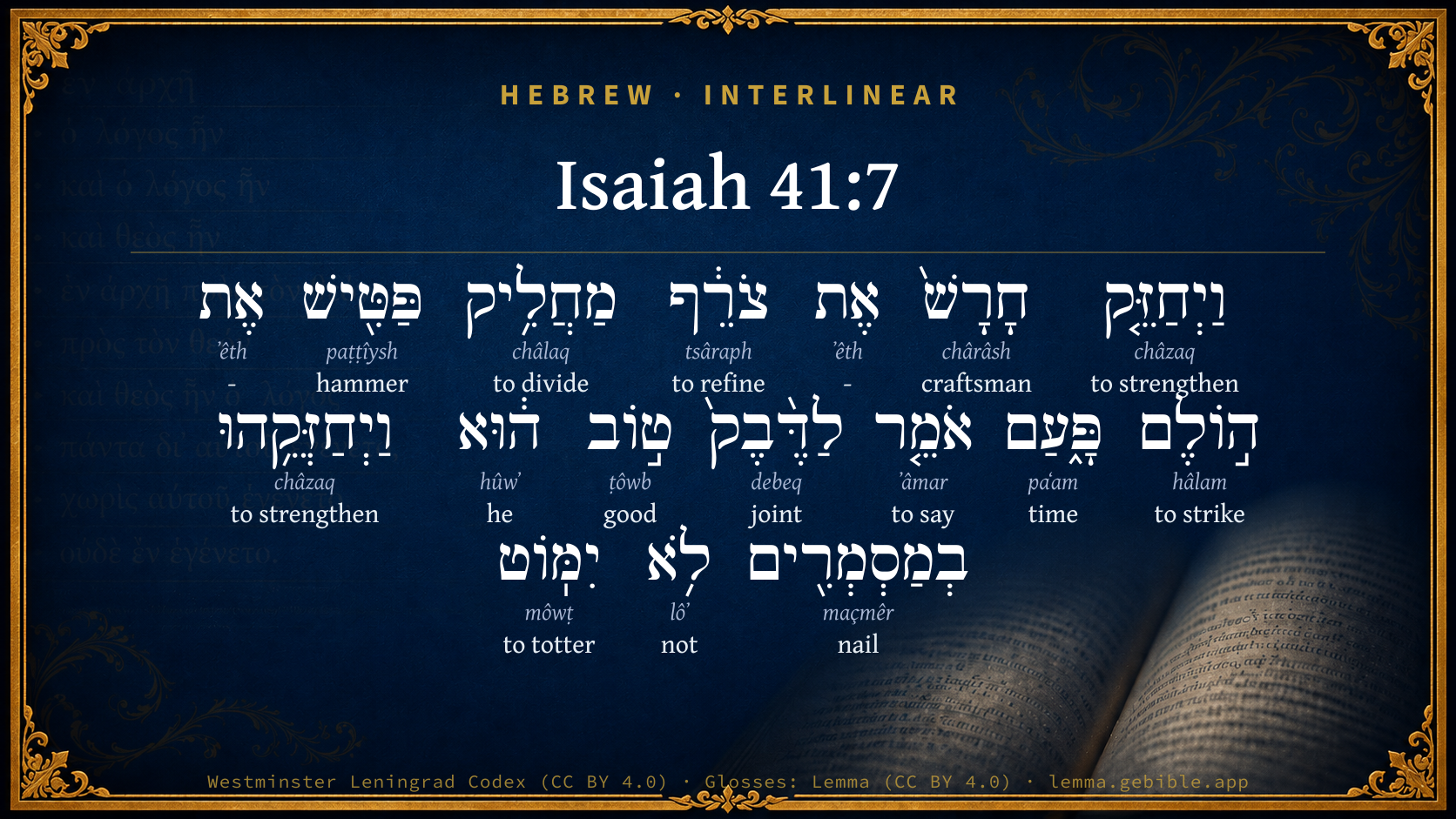
Hebrew (Westminster Leningrad Codex) Isaiah 41:7 appears in the Hebrew Old Testament. The text above is from the Westminster Leningrad Codex. Each word links to its Strong’s number, a concise gloss, and parsing drawn from the Open Scriptures Hebrew Bible morphology. Click any word for its full Brown-Driver-Briggs (BDB) entry.
Download image
Cite this verse

Isaiah 41:7 (World English Bible). Public Domain. Lemma interlinear Bible study tool, https://lemma.gebible.app/v/isaiah/41/7.

Show BibTeX & RIS
BibTeX
RIS
English Translation
So the carpenter encourages the goldsmith, [and] he who smoothes with the hammer him who strikes the anvil, saying of the soldering, It is good; and he fastens it with nails, that is should not be moved.
World English Bible · Public Domain
Highlights
  • 1 first appearance in the Hebrew Bible
Full analysis ↓
Download a study sheet

One document with this verse’s original text, its word-by-word gloss line, the meaning frame, cross-references with their text, attributed commentary, and full source and license credits — printable, and it pastes into notes with its structure intact.

This verse Autodidact and up

Study sheet (.html) Plain text (.txt)

A passage Seminary Student

Up to 50 verses in one chapter. A passage sheet keeps up to 6 commentary sources and 12 cross-references per verse, in the order this page ranks them, and says so on the sheet whenever that leaves anything out. Ask for a single verse and you get the Autodidact verse sheet above.

Everything on this page stays free to read, with no account — the sheet is a download of what is already on screen, not access to it.

Want to remove ads? Support Godless Engineer
Compare translations 3

The same verse in 3 English versions, stacked beneath the original-language interlinear above. Click any original word for its lexicon entry.

Each is an independent rendering of the whole verse — the interlinear is not word-aligned to these translations.

Highlighted words mark where these versions differ — a whole-verse word diff, not a word-by-word alignment.

  • World English Bible Public Domain
    So the carpenter encourages the goldsmith, [and] he who smoothes with the hammer him who strikes the anvil, saying of the soldering, It is good; and he fastens it with nails, that is should not be moved.
  • King James Version Public Domain
    So the carpenter encouraged the goldsmith, and he that smootheth with the hammer him that smote the anvil, saying, It is ready for the sodering: and he fastened it with nails, that it should not be moved.
  • unfoldingWord Literal Text CC BY-SA 4.0
    And the craftsman strengthens the metalworker, the one smoothing a hammer, the one striking the anvil, saying about the soldering, “It good.” And they strengthen it with nails, that it may not be moved. q1

unfoldingWord Literal Text — © unfoldingWord, licensed CC BY-SA 4.0. Word-aligned USFM3 via Door43 (git.door43.org/unfoldingWord/en_ult).

Versions to compare (up to 4)

3 of 4 selected

Show all 18 translations

Every available English version of this verse, each an independent rendering of the whole verse.

  • World English Bible Public Domain
    So the carpenter encourages the goldsmith, [and] he who smoothes with the hammer him who strikes the anvil, saying of the soldering, It is good; and he fastens it with nails, that is should not be moved.
  • Berean Standard Bible Public Domain
    The craftsman encourages the goldsmith, and he who wields the hammer cheers him who strikes the anvil, saying of the welding, “It is good.” He nails it down so it will not be toppled.
  • Majority Standard Bible Public Domain
    The craftsman encourages the goldsmith, and he who wields the hammer cheers him who strikes the anvil, saying of the welding, “It is good.” He nails it down so it will not be toppled.
  • King James Version Public Domain
    So the carpenter encouraged the goldsmith, and he that smootheth with the hammer him that smote the anvil, saying, It is ready for the sodering: and he fastened it with nails, that it should not be moved.
  • American Standard Version (1901) Public Domain
    So the carpenter encourageth the goldsmith, `and' he that smootheth with the hammer him that smiteth the anvil, saying of the soldering, It is good; and he fasteneth it with nails, that is should not be moved.
  • Revised Version (1885) Public Domain
    So the carpenter encouraged the goldsmith, and he that smootheth with the hammer him that smiteth the anvil, saying of the soldering, It is good: and he fastened it with nails, that it should not be moved.
  • Geneva Bible (1599) Public Domain
    So the workeman comforted the founder, and he that smote with ye hammer, him that smote by course, saying, It is ready for the sodering, and he fastened it with nayles that it shoulde not be mooued.
  • Douay-Rheims (1899) Public Domain
    The coppersmith striking with the hammer encouraged him that forged at that time, saying: It is ready for soldering: and he strengthened it with nails, that it should not be moved.
  • Young's Literal Translation Public Domain
    And strengthen doth an artizan the refiner, A smoother `with' a hammer, Him who is beating `on' an anvil, Saying, `For joining it `is' good,' And he strengtheneth it with nails, it is not moved!
  • Literal Standard Version CC BY-SA 4.0
    And an artisan strengthens the refiner, || A smoother [with] a hammer, || Him who is beating [on] an anvil, saying, “For joining it [is] good,” || And he strengthens it with nails, it is not moved!
  • Unlocked Literal Bible CC BY-SA 4.0
    So the carpenter encourages the goldsmith, and he who works with the hammer encourages him who works with an anvil, saying of the welding, 'It is good.' They fasten it with nails so it will not topple over.
  • unfoldingWord Literal Text CC BY-SA 4.0
    And the craftsman strengthens the metalworker, the one smoothing a hammer, the one striking the anvil, saying about the soldering, “It good.” And they strengthen it with nails, that it may not be moved. q1
  • Darby Bible Public Domain
    And the artizan encouraged the founder, he that smootheth [with] the hammer him that smiteth on the anvil, saying of the soldering, It is good; and he fasteneth it with nails, that it be not moved.
  • World Messianic Bible Public Domain
    So the carpenter encourages the goldsmith. He who smooths with the hammer encourages him who strikes the anvil, saying of the soldering, “It is good;” and he fastens it with nails, that it might not totter.
  • Webster's Bible Public Domain
    So the carpenter encouraged the goldsmith, and he that smootheth with the hammer him that smote the anvil, saying, It is ready for the sodering: and he fastened it with nails, that it should not be moved.
  • Free Bible Version CC BY-SA 4.0
    The craftsman encourages the goldsmith; the one who beats out the metal with a hammer encourages the one hitting the anvil, saying the soldering is good. They nail the idol down so it won't fall over.
  • Bible in Basic English Public Domain
    So the metal-worker put heart into the gold-worker, and he who was hammering the metal smooth said kind words to the iron-worker, saying of the plate, It is ready: and he put it together with nails, so that there might be no slipping.
  • JPS Tanakh (1917) Public Domain
    So the carpenter encouraged the goldsmith, and he that smootheth with the hammer him that smiteth the anvil, saying of the soldering: 'It is good'; and he fastened it with nails, that it should not be moved.

Literal Standard Version (2020), Covenant Press — licensed CC BY-SA 4.0. Text via the HelloAO Bible API (eBible.org). Unlocked Literal Bible (unfoldingWord) — licensed CC BY-SA 4.0. Text via the HelloAO Bible API (eBible.org). unfoldingWord Literal Text — © unfoldingWord, licensed CC BY-SA 4.0. Word-aligned USFM3 via Door43 (git.door43.org/unfoldingWord/en_ult). Free Bible Version, Dr. Jonathan Gallagher — licensed CC BY-SA 4.0. Text via the HelloAO Bible API (eBible.org).

Word by word

More ways to search: Search by grammar → Find every occurrence → Compare this word →

Practice this passage: Drill this verse → Learn its vocabulary →

פַּטִּ֖ישׁ
paṭṭîysh
H6360
“hammer”
Noun, Common, Masculine, Singular, Absolute
Part of Speech
Noun
Type
Common
Gender
Masculine
Number
Singular
State
Absolute
Full BDB Definition

Origin: intensively from an unused root meaning to pound

TWOT: 1763

forge hammer, hammer
  1. וַיְחַזֵּ֤ק châzaq H2388 “and · to strengthen” Conjunction + Verb, Piel, Sequential Imperfect, 3rd Person, Masculine, Singular
  2. חָרָשׁ֙ chârâsh H2796 “craftsman” Noun, Common, Masculine, Singular, Absolute
  3. אֶת ʼêth H853 “-” Particle, Direct Object
  4. צֹרֵ֔ף tsâraph H6884 “refining” Verb, Qal, Participle Active, Masculine, Singular, Absolute
  5. מַחֲלִ֥יק châlaq H2505 “dividing” Verb, Hiphil, Participle Active, Masculine, Singular, Construct
  6. אֶת ʼêth H853 “-” Particle, Direct Object
  7. ה֣וֹלֶם hâlam H1986 “striking” Verb, Qal, Participle Active, Masculine, Singular, Construct
  8. פָּ֑עַם paʻam H6471 “time” Noun, Common, Feminine, Singular, Absolute
  9. אֹמֵ֤ר ʼâmar H559 “saying” Verb, Qal, Participle Active, Masculine, Singular, Absolute
  10. לַדֶּ֨בֶק֙ debeq H1694 “to/for the · joint” Preposition, Determined + Noun, Common, Masculine, Singular, Absolute
  11. ט֣וֹב ṭôwb H2896 “good” Adjective, Adjective, Masculine, Singular, Absolute
  12. ה֔וּא hûwʼ H1931 “he” Pronoun, Personal, 3rd Person, Masculine, Singular
  13. וַיְחַזְּקֵ֥הוּ châzaq H2388 “and · to strengthen · him” Conjunction + Verb, Piel, Sequential Imperfect, 3rd Person, Masculine, Singular + Suffix, Personal, 3rd Person, Masculine, Singular
  14. בְמַסְמְרִ֖ים maçmêr H4548 “in/at · nails” Preposition + Noun, Common, Both, Plural, Absolute
  15. לֹ֥א lôʼ H3808 “not” Particle, Negative
  16. יִמּֽוֹט môwṭ H4131 “to totter” Verb, Niphal, Imperfect, 3rd Person, Masculine, Singular

About this verse

These counts appear in no published source. They are computed here, from the morphology-tagged text and Lemma’s own curated glosses. What Lemma adds →

17
words
15
distinct lemmas
Prophets
section

Notable vocabulary

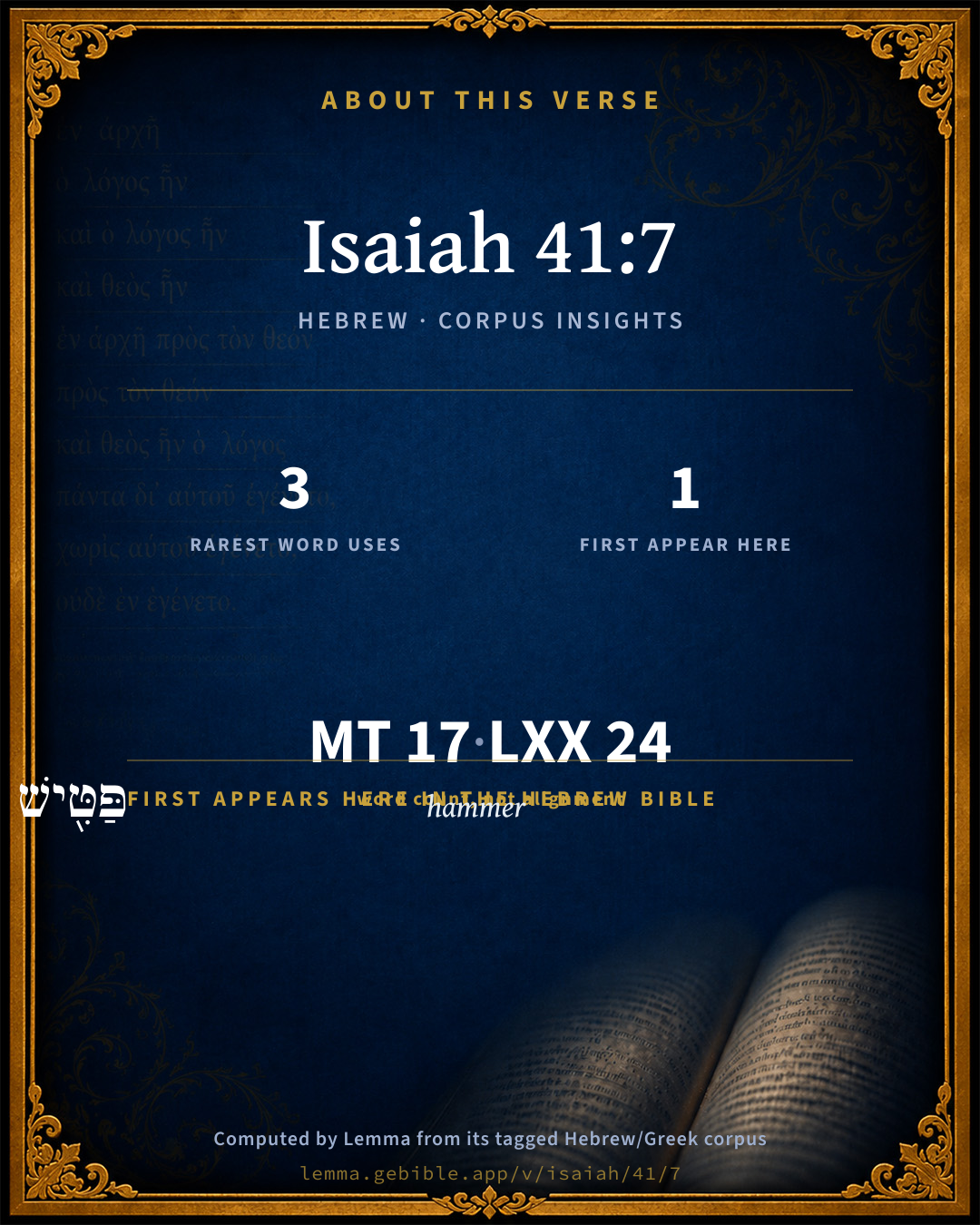
The rarest word here is פַּטִּ֖ישׁ hammer H6360 — appearing just 3 times in the whole Hebrew Bible.

First appearance in Scripture

This word makes its first canonical appearance in the Hebrew Bible here:

  • פַּטִּ֖ישׁ hammer H6360

Shared distinctive vocabulary

פַּטִּ֖ישׁ hammer H6360 occurs in 3 verses of the Hebrew Bible. Also found in:

Grammatical profile

  • 7 verbs
  • 5 nouns
  • 1 adjective
  • 1 pronoun
  • 3 particles

Verb forms

  • וַיְחַזֵּ֤ק Piel · Sequential Imperfect
  • צֹרֵ֔ף Qal · Participle Active
  • מַחֲלִ֥יק Hiphil · Participle Active
  • ה֣וֹלֶם Qal · Participle Active
  • אֹמֵ֤ר Qal · Participle Active
  • וַיְחַזְּקֵ֥הוּ Piel · Sequential Imperfect
  • יִמּֽוֹט Niphal · Imperfect

Repetition

A word recurs within this verse — often emphatic in Hebrew:

  • וַיְחַזֵּ֤ק to strengthen H2388 ×2

Hebrew & Septuagint length

In English translation the verse runs 37 words from the Hebrew and 42 from the Septuagint (LXX English) — closely comparable.

A rough comparison of the two English renderings, which tokenize alike — not a word-level alignment.

Word counts can differ between the Hebrew and the Greek without any difference in meaning — e.g. the Hebrew direct-object marker אֵת has no separate Greek word, and Greek often adds the article ὁ.

In the original languages it is 17 Hebrew tokens and 24 Greek tokens — but the two are counted differently (Hebrew bundles its prefixes and suffixes into one token; the Greek is in lemma form), so that isn’t a like-for-like length.

Cross-references

8

Topical passages linked to Isaiah 41:7 in the Treasury of Scripture Knowledge — connected by theme and wording, ordered by reader-vote popularity; previews shown in the World English Bible.

  • Isaiah 40:19–20 The image, a workman has cast [it], and the goldsmith overlays it with gold, and casts [for it] silver chains.
  • Daniel 3:1–7 Nebuchadnezzar the king made an image of gold, whose height was sixty cubits, and the breadth of it six cubits: he set it up in the plain of Dura, in the province of Babylon.
  • Judges 18:17–18 The five men who went to spy out the land went up, and came in there, and took the engraved image, and the ephod, and the teraphim, and the molten image: and the priest stood by the entrance of the gate with the six hundred men girt with weapons of war.
  • Judges 18:24 He said, you have taken away my gods which I made, and the priest, and are gone away, and what have I more? and how then say you to me, What ails you?
  • Isaiah 44:12–15 The smith [makes] an axe, and works in the coals, and fashions it with hammers, and works it with his strong arm: yes, he is hungry, and his strength fails; he drinks no water, and is faint.
  • Isaiah 46:6–7 Some pour out gold from the bag, and weigh silver in the balance. They hire a goldsmith, and he makes it a god. They fall down--yes, they worship.
  • Jeremiah 10:3–5 For the customs of the peoples are vanity; for one cuts a tree out of the forest, the work of the hands of the workman with the axe.
  • Jeremiah 10:9 There is silver beaten into plates, which is brought from Tarshish, and gold from Uphaz, the work of the artificer and of the hands of the goldsmith; blue and purple for their clothing; they are all the work of skillful men.

Cross-references courtesy of OpenBible.info (CC BY 4.0).

Hebrew and Greek witnesses Masoretic Hebrew ↔ Greek Septuagint

The same verse in the two great witnesses to the Old Testament, shown verse-for-verse.

These are two independent witnesses, not word-aligned to each other, and the Septuagint is shown in lemma (dictionary) form.

Hebrew Isaiah 41:7 Masoretic · Westminster Leningrad Codex

וַיְחַזֵּ֤ק חָרָשׁ֙ אֶת צֹרֵ֔ף מַחֲלִ֥יק פַּטִּ֖ישׁ אֶת ה֣וֹלֶם פָּ֑עַם אֹמֵ֤ר לַדֶּ֨בֶק֙ ט֣וֹב ה֔וּא וַיְחַזְּקֵ֥הוּ בְמַסְמְרִ֖ים לֹ֥א יִמּֽוֹט

So the carpenter encourages the goldsmith, [and] he who smoothes with the hammer him who strikes the anvil, saying of the soldering, It is good; and he fastens it with nails, that is should not be moved.

World English Bible · Public Domain

Greek LXX Isaiah 41:7 Septuagint · lemma form

ἰσχύω ἀνήρ τέκτων καί χαλκεύς τύπτω σφύρα ἅμα ἐλαύνω ποτέ μέν εἶπον σύμβλημα καλός εἰμί ἰσχυρόω αὐτός ἐν ἧλος τίθημι αὐτός καί οὐ κινέω

The artificer has become strong, and the coppersmith that smites with the hammer, and forges also: sometimes he will say, It is a piece well joined: they have fastened them with nails; they will fix them, and they shall not be moved.

LXX2012 (modern English Septuagint) · Public Domain

Hebrew: Westminster Leningrad Codex (CC BY 4.0). Greek: Septuagint (public domain); English from LXX2012 (modern English Septuagint) (Public Domain). How the Septuagint differs from the Hebrew →

Targum (Aramaic paraphrase)

1

The Targum is the ancient Jewish Aramaic paraphrase of the Hebrew Scriptures — an interpretive translation, not the Hebrew text itself. Onkelos (literal) and Pseudo-Jonathan (expansive) render the Torah, and Jonathan the Prophets. Coverage is partial: where no permissively-licensed English translation exists for a verse, only the Aramaic is shown. This is verse-level text, not a word-by-word alignment to the Hebrew.

  1. Targum Jonathan Prophets (Joshua–Malachi)
    הֲלָא יְבַהֲתוּן בְּעוֹבָדֵיהוֹן דְמַתְקֵיף נַגָרָא עִם קֵינָאָה מָחֵי בְּפַטִישָׁא עִם דִמְטַפַּח בְקוּרְנְסָא זִמְנָא אֲמַר עַל דִבְקָא תַּקִין הוּא וּמַתְקֵיף לֵיהּ בְמַסְמְרִין דְלָא יִצְטְלֵי:

    Shall they not be confounded in their works? Because the artificer encourageth the silversmith, and he that smiteth with the great hammer him that smiteth with the small: It is time, one saith, for the soldering, it is ready; he fasteneth it with nails, that it may not be moved.

    Targum Jonathan — Aramaic: “Mikraot Gedolot” (public domain). English: “Sefaria Community Translation” (CC0 1.0 (public-domain dedication)); “London "Chaldee Paraphrase," 1871” (public domain). Text via Sefaria.

Commentary

Notes on Isaiah 41:7 from classic Christian and Jewish commentators (each source and its license shown beneath its notes). The classic Christian expositions comment on the surrounding passage and are grouped to its opening verse, so a note may address several verses; the Jewish commentaries on the Tanakh (Rashi and others) are per-verse, so they appear only where the commentator wrote on this verse.

Lemma curates 59 commentaries, every one of them public domain or Creative Commons licensed, each selected and text-cleaned for this edition rather than reprinted as found. About our sources →

Trapp's Complete Commentary

John Trapp

Isa 41:7 So the carpenter encouraged the goldsmith, [and] he that smootheth [with] the hammer him that smote the anvil, saying, It [is] ready for the sodering: and he fastened it with nails, [that] it should not be moved.

Ver. 7. So the carpenter encouraged the goldsmith.] Because no small gain was brought hereby unto these craftsmen. {Act 19:24-25} The Jewish doctors tell us that Terah, the father of Abraham, was an image maker at Ur of the Chaldees, till God called him thence. Hyperius saith, that all these words are to be taken as pronounced with derision and contempt, that so the vanity of idols may the more plainly be perceived, since they have no more worth than is given them by their worshippers.

John Trapp, A Commentary or Exposition upon All the Books of the Old and New Testament (1647–1656) — public domain. Text from a community e-Sword module.

The Biblical Illustrator

Joseph S. Exell

Isa_41:7

So the carpenter encouraged the goldsmith

The hardships of working men

If men in bad work can encourage each other, should not men engaged in honest artisanship and mechanism speak words of good cheer?

1. Men see in their own work hardships and trials, while they recognise no hardships or trials in anybody elses occupation. Every mans burden is the heaviest, and every womans task is the hardest. We find people wanting to get other occupations and professions. Now, the beauty of our holy religion is that God looks down upon all the occupations and professions; and while I cannot understand your annoyances, and you cannot understand mine, God understands them all. I will speak this warning of the general hardships of the working classes. You may not belong to this class, but you are bound as Christian men and women to know their sorrows and sympathise with them, and as political economists to come to their rescue. You do a great wrong to the labouring classes if you hold them responsible for the work of the scoundrelly anarchists. You may do your duty toward your employes, but many do not, and the biggest business firm to-day is Grip, Gouge, Grind and Company. By what principle of justice is it that women in many of our cities get only two-thirds as much as men, and in many cases only half? Here is the gigantic injustice, that for work equally well, if not better, done woman receives far less compensation than man. Has toil frosted the colour of your cheeks? Has it taken all spontaneity from your laughter? Has it subtracted the spring from your step, and the lustre from your eye, until it has left you only half the man you were when you first put your hand on the hammer and your foot on the wheel? To-morrow in your place of toil, listen, and you will hear a voice above the hiss of the furnace, and the groan of the foundry, and the clatter of the shuttle--a voice not of machinery, nor of the task-master, but the voice of an all-sympathetic God, as He says, Come unto Me, all ye that labour and are heavy-laden, and I will give you rest. Let all men and women of toil remember that this work will soon be over. Have they not heard that there is a great holiday coming? Oh, that home, and no long walk to get to it! I wish they would put their head on this pillow stuffed with the down from the wing of all Gods promises. There remains a rest for the people of God.

2. Another great trial is privation of taste and sentiment. I do not know of anything much more painful than to have a fine taste for painting and sculpture and music and glorious sunsets and the expanse of the blue sky, and yet, not to be able to get the dollar for the oratorio, or to get a picture, or to buy ones way into the country to look at the setting sun and at the bright heavens.

3. Then there are a great many who suffer not only in the privation of their tastes, but in the apprehension and the oppressive surroundings of life. (T. DeWitt Talmage, D. D.)

Encouragements for working men

1. One of the greatest safeguards against evil is plenty to do. I see a pool of water in the country, and I say, Thou slimy fetid thing, what does all this mean? Didnt I see you playing with those shuttles and turning that grist-mill? Oh yes, says the water, I used to earn my living. I say again, Then what makes you look so sick? Why are you covered with this green scum? Why is your breath so vile? Oh, says the water, I have nothing to do. I am disgusted with shuttles and wheels. I am going to spend my whole lifetime here, and while yonder stream sings on its way down the mountain-side, here I am left to fester and die accursed of God because I have nothing to do! Sin is an old pirate that bears down on vessels whose sails are flapping idly in the wind. The arrow of sin has hard work to puncture the leather of an old working-apron.

2. Another encouragement is the fact that their families are going to have the very best opportunity for development and usefulness. That may sound strange to you, but the children of fortune are very apt to turn out poorly. The son of the porter that kept the gate learns his trade, gets a robust physical constitution, achieves high moral culture, and stands in the front rank of Church and State.

3. Again, I offer as encouragement that you have so many opportunities of gaining information. The Countess of Anjou gave two hundred sheep for one volume. Jerome ruined himself financially by buying one copy of Origen. Oh, the contrast!

4. Your toils in this world are only intended to be a discipline by which you shall be prepared for heaven. (T. De Witt Talmage, D. D.)

A call to action

I propose to address myself--

I. TO THOSE WHO PROFESS THE FAITH OF CHRIST. Is there no work for you to do? Join some of the regiments; belong to the artillery, or the cavalry, or the infantry of the Church. Woe unto them that are at ease in Zion.

II. TO THOSE WHO PROFESS NOT TO BE CHRISTIANS.

1. There are some of you who say you are kept back by your worldly engagements. Will you let your store, your office, your shop, stand between you and heaven?

2. There is somebody who says: I am afraid someone will laugh at me if I become a Christian. Will you allow your soul to be caught in such a thin trap as human scorn? Can these people who laugh at your seriousness insure you for the future?

3. There may be young people who say, We are too young yet. Wait a little while, after we have enjoyed the world more; and then we will become Christians. I ask any young man if that is fair--to sit down at a banquet all your life long, and have everything you want, and then at the close, when you are utterly exhausted, say, Lord Jesus, there are dregs in that cup; you may drink them. Lord Jesus, there are crumbs under that table; you may take them up?

4. I heard some say, I am too old. If thou canst not do any more than tremble towards the Cross, if thou art too weak to-night to hold the staff, if all thy soul seems to be bowed down with sorrow, just stumble the way, and put thy withered arms around that Cross, and life, and joy, and pardon, and salvation will come to you.

5. I hear someone say, Give me more time to think of this! What is time? (T. DeWitt Talmage, D. D.)

A model Church

I. It is a scene of ACTIVITY. We all enjoy activity in the natural world. When the winter frosts have melted, and the streams gush down the mountain-side, and the trees begin to put out their livery of green, we enjoy it. Life is a scene of activity in the physical universe. So it is in the business world. So it is with intellectual activity. The long years of the Middle Ages have passed, and the darkness enveloping Europe lifts up. The printing-press is doing a work beyond that of the old feudal castle. Still more is it the case when there comes spiritual life in a church or in a parish; everybody feels happy.

II. It is a scene of CHEERFUL, COURAGEOUS TOIL. The carpenter encourages the goldsmith. Many people discourage. The carpenter is querulous, and he says, Look here, Mr. Goldsmith, I think you had better do your work so. What do you know about goldsmithing? says the other; you are a carpenter; attend to your own business, and thus angry words pass between them. It is so in our churches. Singing, says one; what do you know about singing? You dont preach quite right, says one. Would you like to try? A sensible man says, I cannot preach; I think my minister knows how to preach, and I will pray for him if he makes a mistake now and then. He knows how to encourage him.

III. It is a scene of PROMPT INDUSTRY AND THOROUGH WORK. When a man gets a reputation for dilatoriness his fate is sealed. The model Church does thorough work, and does it promptly.

IV. THEY ARE ALL WORKING FOR ONE COMMON END. The Church has one end. This man attends to the singing; this man to the children; this man looks after the working mens class; this man attends to outdoor relief; another visits the mothers; others attend to this, that, and the other, but they are all working for one end. The Church is a unity--a unity in spirit, in aim, in end. (E. P. Thwing.)

All at work

I. THEY WERE ALL AT WORK. Many of us like activity. In the intellectual world all is life and go. In the political world it is the same. Rest and be thankful belongs to other days. It should be just like that in the Church of Jesus Christ. Here, stagnation means death.

II. THE ENCOURAGEMENT WHICH THEY GAVE EACH OTHER. Men will work, and work well, when their efforts are appreciated. Even the dumb animals which have become the companion and worker for man seem to understand encouragement, and will, in many ways, show their appreciation of it.

III. THE QUALITY OF THEIR WORK. It was fastened with nails, and could not be moved. Work done under the circumstances of the text was sure to be good--do your work well. Do not catch the spirit of the age. This is the day of the jerry builder. Quantity is often considered rather than quality. Outward show is the order of the day. It is important for us all to remember that what we can do for God depends upon what we are before God. We can only teach what we know. (C. Leach, D. D.)

A society of encouragers

Societies already exist in multitude--societies religious, political, social, literary, etc; but there is room for another. It need not displace any existing ones that are worthy of continuance; it can fulfil its purpose by infusing into them all a new spirit--a spirit of brightness, of good cheer, and strengthening comradeship. Ipropose to call it The Society of Encouragers.

I. ITS BASIS IS LAID IN NEIGHBOURLINESS AND BROTHERLINESS. Does anyone ask, Who is my neighbour? Let him read again the parable of the Good Samaritan. In that story neighbourliness stands for love, sympathy, kindness, help, and all those qualities that constitute practical religion. It bridges, at a leap, the chasm of national distinctions. My neighbours house may be near or far in situation, his rental may stand at £80 a year, and mine at £20. His walls may be adorned with the costliest pictures, and I may be indebted to the enterprising activity of tradesmen at Christmas-time for any adornment on mine; or the financial positions of each may be transposed, but we are neighbours. We live to help each other. Is there trouble anywhere? That is enough, my place is there; and when the hour of distress comes for me, I shall not be without a friend. But there is a deeper word still In the new society, we are brothers. Every one said to his brother, Be of good cheer. This strikes a yet tenderer chord. Have we not all one Father? This will settle the relations between capital and labour by uniting master and man in a common bond of reciprocal interest. Carry it to its furthest issue, and it will solve all questions of national and international strife by brining in the reign of Peace on earth and goodwill to men.

II. AS TO ITS RAISON DETRE.

1. The new society exists for kindly speech to one another. Every one said to his brother, Be of good courage. A word in season, how good it is! There is helpfulness and inspiration in kindly, encouraging speech. The ministry that never fails is the ministry of encouragement.

2. It exists for kindly speech of one another. In the new society we pledge ourselves to think and act towards the living as we do for those who have passed into the Great Silence. Many have died before their time for want of a Society of Encouragers. Sympathy is vain that is reserved for the eulogy of the dead or flower-wreaths for the coffin-lid. Expend it now.

3. The new society exists also for mutual effort. They helped every one his neighbour. The kindly word is valuable and precious, but it is better still when crystalised into action. What the world wants is the practical application of the religion of Jesus Christ, whose human life is summed up in the brief sentence: Who went about doing good.

4. The new society is a society of workers The carpenter encouraged the goldsmith. You can put your own trade or profession in. All may be included whose calling is honest, just, and pure. What is wanted is a sense of comradeship, and this the new society provides. The isolation is removed. We no longer work alone, but side by side, in the worlds great workshop.

III. THE UNITING BOND OF ALL IS LOVE. Love is the common bond that unites man to man, neighbour to neighbour, brother to brother, and all together to Him who is Love s primal fount and source. (A. Hancock.)

Humble co-operation

A traveller, standing outside Cologne Cathedral, expressed his admiration of its beauty. Yes, said a labourer, who was near; its a fine building, and took us many a year to finish. Took you! exclaimed the tourist; why, what have you to do with it? I mixed the mortar, sir, was the modest yet proud reply. (Home Magazine.)

The Biblical Illustrator, edited by Joseph S. Exell (c. 1880s–1900s) — public domain. Text from a community e-Sword module.

Jamieson, Fausset & Brown

Robert Jamieson, A. R. Fausset & David Brown

One workman encourages the other to be quick in finishing the idol, so as to avert the impending danger.

nails--to keep it steady in its place. Wisdom 13:15, 16, gives a similar picture of the folly of idolatry.

Jamieson, Fausset & Brown — Commentary Critical and Explanatory on the Whole Bible (1871) — public domain (CC PDM 1.0). Text via the HelloAO Bible API.

Adam Clarke's Commentary

Verse 7. That it should not be moved - "That it shall not move."] Five MSS., (two ancient,) and the ancient Versions, add the conjunction ו vau, "and," reading ולא velo, "and not," which seems to be right.

Adam Clarke's Commentary on the Bible (1810–1826) — public domain. Text from a community e-Sword/MySword module.

Ellicott's Commentary for English Readers

(7) So the carpenter.—The process is described even more vividly than in Isa_40:19. For “the carpenter,” read the caster, the idol being a metal one. The image of lead or copper is then covered with gold plates, which are laid on the anvil, and are smoothed with the hammer; the soldering is approved by the artist, and then (supreme touch of irony) the guardian deity is fixed with nails, that it may not totter and fall.

A Bible Commentary for English Readers, edited by Charles John Ellicott (1878–1897) — public domain. Text from a community e-Sword module.

The Cambridge Bible for Schools and Colleges

gen. ed. J. J. S. Perowne

7. the carpenter] stands here for the same word as workman in Isa_40:19 : it denotes an “artificer” either in metal or wood or stone.

he that smootheth with the hammer] probably the man who fits on the golden covering (Isa_40:19). The translation anvil is doubtful, the Targ. has “him that striketh with the mallet.”

saying … sodering] Render as R.V.: saying of the soldering, It is good. that it should not be moved] See ch. Isa_40:20.

8–20, coming between Isa_41:1-4; Isa_41:21 ff., reads like a digression or an “aside.” But beneath the apparent disconnectedness there is a real continuity of thought running through the chapter. It opens with a discussion between Jehovah and the nations, and closes with another between Jehovah and the heathen gods. But these ideal representations have no reality except in so far as they take concrete form in history; and the historical process of which they are the expression is suggested by Isa_41:8-20. Jehovah’s controversy with heathenism is carried on in His Providence, and especially in His vindication of the “right” of Israel against the world. The opposition which Israel encounters from the heathen (Isa_41:11 f.) is a reflection of the antagonism between the true religion and idolatry; and the essential identity of interest between Jehovah and Israel in this conflict of principles is the basis of the message of consolation which these verses convey. Thus we have the true God and His people over against the false gods and their peoples, and there is a fitness in the introduction at this point of Israel in its ideal functions as the organ of Jehovah’s historical purpose. His victory must issue in the redemption of His people, and therefore Israel has no reason to fear the advance of Cyrus, who is God’s chosen instrument for the overthrow of idolatry.

The Cambridge Bible for Schools and Colleges (gen. ed. J. J. S. Perowne; Cambridge University Press, 1878–1918) — public domain. Text from a community e-Sword module.

John Gill's Exposition

So the carpenter encouraged the goldsmith,.... The carpenter, when he had made a wooden image, encouraged and hastened the goldsmith, or the "finer", as some render it, to do his part, in covering it with plates of gold or silver:

and he that smootheth with the hammer him that smote the anvil; he that beat out thin plates of gold and silver with the hammer, in order to decorate the wooden god, encouraged the smith at the forge, that smote on the anvil, there making nails for the fastening it to a pillar or wall, to hasten his work:

saying, it is ready for the sodering; for the several joints to be put together, by sodering them:

and he fastened it with nails, that it should not be moved; either the goldsmith and finer fastened the plates of gold and silver with nails, that they might be kept fast and close to it; or the smith that smote on the anvil, and made the nails, he fastened the image with them at some proper place, that so it might not fall, or be taken away. All which, as it represents the hurry and solicitude idolaters were in to keep up their craft and religion, so it exposes them to ridicule and contempt.

John Gill's Exposition of the Whole Bible (1746–1763) — public domain (CC PDM 1.0). Text via the HelloAO Bible API.

Albert Barnes' Notes on the Bible

So the carpenter - (See the note at Isa 40:19).

Encouraged the goldsmith - Margin, ‘The founder’ (see the note at Isa 40:19). The word properly means one who melts or smelts metals of any kind; and may be applied either to one who works in gold, silver, or brass. The image here is that of haste, anxiety, solicitude. One workman in the manufacture of idols encouraged another, in order that the idols might be finished as soon as possible, and that thus the favor of the gods might be propitiated, and the impending danger averted.

He that smootheth with the hammer - That is, he encourages or strengthens him that smites on the anvil. The idol was commonly cast or founded, and of course was in a rough state. This required to be smoothed, or polished, and this was in part done doubtless by a small hammer.

Him that smote the anvil - The workman whose office it was to work on the anvil - forming parts of the idol, or perhaps chain.

It is ready for the sodering - The parts are ready to be welded, or soldered together. All this is descriptive of haste and anxiety to have the work done; and the object of the prophet is evidently to ridicule their vain solicitude to defend themselves against the plans and purposes of God by efforts of this kind.

And he fastened it with nails - He fixed it to its place in the temple, or in the dwelling; and thus showed a purpose that the worship of the idol should be permanent, and fixed. Hooks, or nails, were necessary to keep it in its place, and secure it from falling down. When the idol was thus fixed, they supposed that their kingdoms were safe. They judged that the gods would interpose to protect and defend them from their foes. This is a beautiful descrip tion of the anxiety, and pains, and consternation of sinners when calamity is coming upon them, and of the nature of their reliances. What could these dumb idols - these masses of brass, or silver, or stone, do to protect them? And in like manner what can all the refuges of sinners do when God comes to judge them, and when the calamities connected with death and the judgment shall overtake them? They are just as full of consternation as were the pagan who are here described; and all their refuges will be just as little to be relied on as were the senseless images which the pagan had made for their defense.

Albert Barnes' Notes on the Bible (1834–1885) — public domain. Text from a community e-Sword/MySword module.

Haydock's Catholic Bible Commentary

Moved. Thus the nations conspire against Cyrus (Calmet) and the Messias. (Haydock)

George Leo Haydock (1774–1849), Haydock's Catholic Family Bible and Commentary, 1859 edition — public domain. Excludes Psalms (Douay-Rheims chapter numbering differs from Protestant) and Deuterocanonical books (Catholic canon only).

Matthew Poole's English Annotations

The carpenter, who brought wood to compose the body of the idol.

The goldsmith, who was to prepare golden plates for covering and adorning of the image, which some of them beat out upon the anvil, and others smoothed or polished, as it follows.

It is ready for the sodering; that we may put the several parts together, and set it up to be worshipped.

He fastened it to the wall or pillar, lest it should fall down, or go, or be carried away from them. See Isa 40:19,20.

Matthew Poole's English Annotations on the Holy Bible (1683–1685) — public domain. Text from a community e-Sword/MySword module.

The Pulpit Commentary

The carpenter, etc. (comp. Isa_40:19, 20 for the variety of workmen employed in the production of idols) Each encourages the others to manufacture a right good god. When all is done, there is, however, need of soldering, and of nails, that the wretched object may be kept erect, and not show its weakness by falling, like Dagon, upon its own threshold. (1Sa_5:4)

The Pulpit Commentary (1880–1919), ed. H.D.M. Spence-Jones & Joseph S. Exell — public domain. Text from a community e-Sword module.

John Wesley's Explanatory Notes

Fastened it - To the wall or pillar.

John Wesley, Explanatory Notes Upon the Whole Bible (1754–1765) — public domain. Text via the GEBible commentary corpus.

J. A. Alexander on Isaiah

Joseph Addison Alexander

“And the carver has strengthened the gilder, the smoother with the hammer the smiter on the anvil; he says (or is saying) of the solder, It is good; and he hath strengthened it with nails; it shall not be moved.” The sarcasm consists in making the idolaters dependent upon idols which are themselves dependent upon common workmen and the most trivial mechanical operations for their form and their stability. Hence the particular enumeration of the different artificers employed in the manufacture of these deities. The text of the English Version has ‘it is ready for the soldering’; but the other construction is now universally adopted. The last clause implies that the strength of the idol is not in itself, but in the nails that keep it in its place or hold its parts together.

Joseph Addison Alexander, The Prophecies of Isaiah (1846–1847; New York: Scribner, 1870–1878) — public domain. Text from a community e-Sword module.

Rashi

Rabbi Shlomo Yitzchaki (Rashi)

And the craftsman strengthened [i.e.,] the one who molds the idol.

the smith who plates it with gold.

the one who smoothes with the hammer The final stage, when he taps lightly to flatten out the work.

the one who wields the sledge hammer He is the one who commences on it when it is a block, and beats it with all his might.

he says of the cement, “It is good,” Heb. דֶּבֶק. He alludes to those who seek suitable ground upon which to adhere iron plates.

דֶּבֶק is soudure in French, weld.

and he strengthened it The idol.

with nails that it should not move All of them will strengthen each other.

Rashi on the Tanakh — English translations: “The Judaica Press complete Tanach with Rashi, translated by A. J. Rosenberg” (CC BY 4.0); “Pentateuch with Rashi's commentary by M. Rosenbaum and A.M. Silbermann, 1929-1934” (public domain); “The Metsudah Tanach series, Lakewood, N.J” (CC BY 4.0); and “The Book of Joshua, Metsudah Publications, 1997” (CC BY 4.0). Text via Sefaria.

Ibn Ezra

Rabbi Abraham ibn Ezra

מחליק He that smootheth. Comp. חלק smooth (Gen. 27:11).

פטיש Hammer. A well known instrument Comp. Jer. 23:29.

הלם It is a noun derived from הלם to beat; comp. והלמה and she smote; it signifies the iron which is wrought by beating with the hammer. פעם The iron block, upon which the iron is hammered: the anvil; it is called פַעַם because of the beating upon it. It is also possible that the two words פעם הלם together signify one instrument.

אמר לדבק טוב הוא Saying of the joining, It is good. Till the joining is good.

Ibn Ezra on the Tanakh — English translations: “Sefaria Community Translation” (CC0 1.0 (public-domain dedication)); “Yalkut, Sifsei Chachomim Chumash, Metsudah Publications, 2009” (CC BY 4.0); and “Commentary of Ibn Ezra on Isaiah - trans. by M. Friedlander, 1873” (public domain). Text via Sefaria.

Lesson kit

Teaching starters — assembled from the data on this page, not authored interpretation. Every prompt links to the verse data it draws on. Edit before teaching.

Isaiah, in the Prophets, opens this verse with 17 words (15 distinct Hebrew lemmas). Its most distinctive word is paṭṭîysh (“hammer”). A historical commentator’s framing appears above. Read the whole chapter for the surrounding context.

Discussion questions

  1. The word paṭṭîysh carries the sense “hammer.” How does it shape the verse?
  2. This is the first place “hammer” appears in Scripture (first appears here). What does its debut here establish?
  3. How does Jeremiah 23:29, which shares the word «hammer», read alongside this verse?
  4. What does the repetition of “to strengthen” (2× in this one verse) do in this verse?
  5. These translations render this verse differently. What is at stake in choosing one wording over another?
  6. «וַיְחַזֵּ֤ק» is a Piel Sequential Imperfect verb. How does that grammatical form shape the action described?
  7. Compare how Trapp's Complete Commentary and The Biblical Illustrator read this verse. Where do they agree or differ?

Things to notice

Reading settings

Reading text

Shown beneath each verse's original-language words.

Old Testament
Old Testament edition

Read the OT as the Masoretic Hebrew (MT) or the Greek Septuagint (LXX).

English shown for the Greek Septuagint (in the Hebrew ↔ Greek comparison).

Comparing translations? Open the Compare panel on any verse page to stack up to four side by side.