
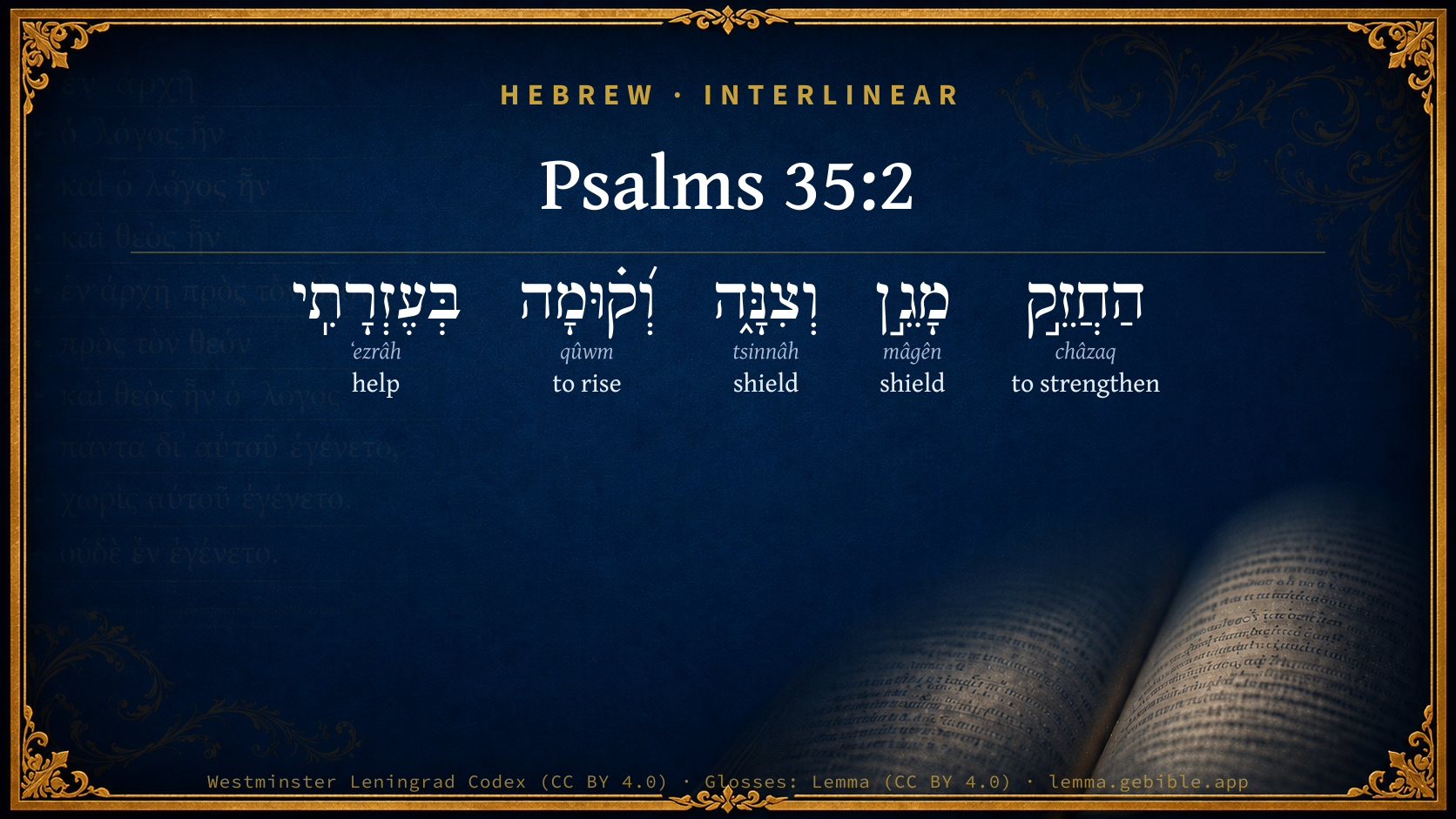
Psalms 35:2

Hebrew (Westminster Leningrad Codex) Psalms 35:2 appears in the Hebrew Old Testament. The text above is from the Westminster Leningrad Codex. Each word links to its Strong’s number, a concise gloss, and parsing drawn from the Open Scriptures Hebrew Bible morphology. Click any word for its full Brown-Driver-Briggs (BDB) entry.
Download image
Cite this verse

Psalms 35:2 (World English Bible). Public Domain. Lemma interlinear Bible study tool, https://lemma.gebible.app/v/psalms/35/2.

Show BibTeX & RIS
BibTeX
RIS
English Translation
Take hold of shield and buckler, And stand up for my help.
World English Bible · Public Domain
Download a study sheet

One document with this verse’s original text, its word-by-word gloss line, the meaning frame, cross-references with their text, attributed commentary, and full source and license credits — printable, and it pastes into notes with its structure intact.

This verse Autodidact and up

Study sheet (.html) Plain text (.txt)

A passage Seminary Student

Up to 50 verses in one chapter. A passage sheet keeps up to 6 commentary sources and 12 cross-references per verse, in the order this page ranks them, and says so on the sheet whenever that leaves anything out. Ask for a single verse and you get the Autodidact verse sheet above.

Everything on this page stays free to read, with no account — the sheet is a download of what is already on screen, not access to it.

Want to remove ads? Support Godless Engineer
Compare translations 3

The same verse in 3 English versions, stacked beneath the original-language interlinear above. Click any original word for its lexicon entry.

Each is an independent rendering of the whole verse — the interlinear is not word-aligned to these translations.

Highlighted words mark where these versions differ — a whole-verse word diff, not a word-by-word alignment.

  • World English Bible Public Domain
    Take hold of shield and buckler, And stand up for my help.
  • King James Version Public Domain
    Take hold of shield and buckler, and stand up for mine help.
  • unfoldingWord Literal Text CC BY-SA 4.0
    Grab the small shield and large shield; rise up as my helper!

unfoldingWord Literal Text — © unfoldingWord, licensed CC BY-SA 4.0. Word-aligned USFM3 via Door43 (git.door43.org/unfoldingWord/en_ult).

Versions to compare (up to 4)

3 of 4 selected

Show all 18 translations

Every available English version of this verse, each an independent rendering of the whole verse.

  • World English Bible Public Domain
    Take hold of shield and buckler, And stand up for my help.
  • Berean Standard Bible Public Domain
    Take up Your shield and buckler; arise and come to my aid.
  • Majority Standard Bible Public Domain
    Take up Your shield and buckler; arise and come to my aid.
  • King James Version Public Domain
    Take hold of shield and buckler, and stand up for mine help.
  • American Standard Version (1901) Public Domain
    Take hold of shield and buckler, And stand up for my help.
  • Revised Version (1885) Public Domain
    Take hold of shield and buckler, and stand up for mine help.
  • Geneva Bible (1599) Public Domain
    Lay hand vpon the shielde and buckler, and stand vp for mine helpe.
  • Douay-Rheims (1899) Public Domain
    Take hold of arms and shield: and rise up to help me.
  • Young's Literal Translation Public Domain
    Take hold of shield and buckler, and rise for my help,
  • Literal Standard Version CC BY-SA 4.0
    Take hold of shield and buckler, and rise for my help,
  • Unlocked Literal Bible CC BY-SA 4.0
    Grab your small shield and large shield; rise up and help me.
  • unfoldingWord Literal Text CC BY-SA 4.0
    Grab the small shield and large shield; rise up as my helper!
  • Darby Bible Public Domain
    Take hold of shield and buckler, and stand up for my help;
  • World Messianic Bible Public Domain
    Take hold of shield and buckler, and stand up for my help.
  • Webster's Bible Public Domain
    Take hold of shield and buckler, and stand up for my help.
  • Free Bible Version CC BY-SA 4.0
    Put your armor on, and pick up your shield. Get ready, come and help me.
  • Bible in Basic English Public Domain
    Be a breastplate to me, and give me your help.
  • JPS Tanakh (1917) Public Domain
    Take hold of shield and buckler, and rise up to my help.

Literal Standard Version (2020), Covenant Press — licensed CC BY-SA 4.0. Text via the HelloAO Bible API (eBible.org). Unlocked Literal Bible (unfoldingWord) — licensed CC BY-SA 4.0. Text via the HelloAO Bible API (eBible.org). unfoldingWord Literal Text — © unfoldingWord, licensed CC BY-SA 4.0. Word-aligned USFM3 via Door43 (git.door43.org/unfoldingWord/en_ult). Free Bible Version, Dr. Jonathan Gallagher — licensed CC BY-SA 4.0. Text via the HelloAO Bible API (eBible.org).

Word by word

More ways to search: Search by grammar → Find every occurrence → Compare this word →

Practice this passage: Drill this verse → Learn its vocabulary →

About this verse

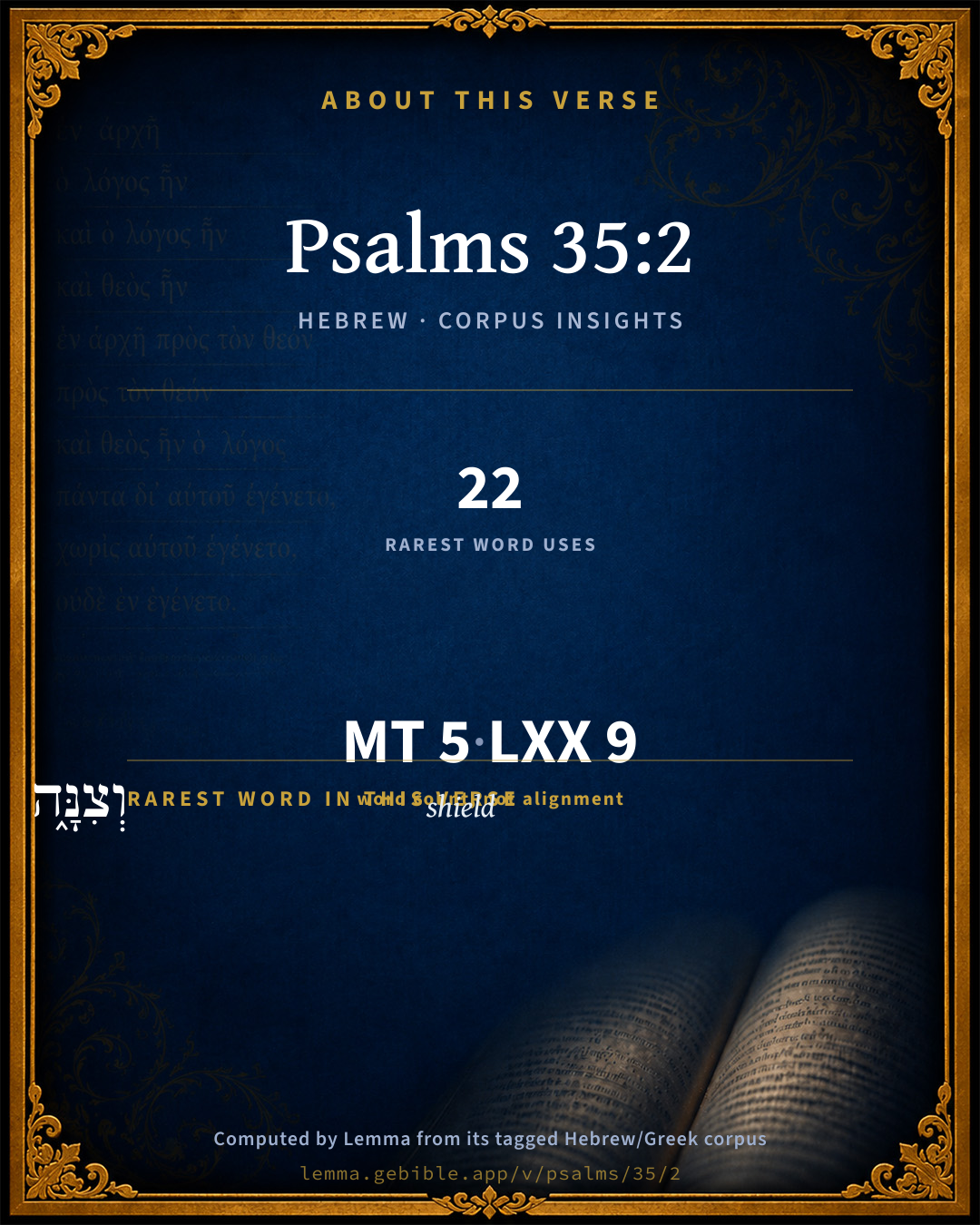
These counts appear in no published source. They are computed here, from the morphology-tagged text and Lemma’s own curated glosses. What Lemma adds →

5
words
5
distinct lemmas
Wisdom
section

Notable vocabulary

The rarest word here is וְצִנָּ֑ה shield H6793 — appearing just 22 times in the whole Hebrew Bible.

Shared distinctive vocabulary

וְצִנָּ֑ה shield H6793 occurs in 20 verses of the Hebrew Bible. Also found in:

Grammatical profile

  • 2 verbs
  • 3 nouns

Verb forms

  • הַחֲזֵ֣ק Hiphil · Imperative
  • וְ֝ק֗וּמָה Qal · Imperative

Hebrew & Septuagint length

In English translation the verse runs 12 words from the Hebrew and 11 from the Septuagint (LXX English) — closely comparable.

A rough comparison of the two English renderings, which tokenize alike — not a word-level alignment.

Word counts can differ between the Hebrew and the Greek without any difference in meaning — e.g. the Hebrew direct-object marker אֵת has no separate Greek word, and Greek often adds the article ὁ.

In the original languages it is 5 Hebrew tokens and 9 Greek tokens — but the two are counted differently (Hebrew bundles its prefixes and suffixes into one token; the Greek is in lemma form), so that isn’t a like-for-like length.

Cross-references

6

Topical passages linked to Psalms 35:2 in the Treasury of Scripture Knowledge — connected by theme and wording, ordered by reader-vote popularity; previews shown in the World English Bible.

  • Psalms 91:4 He will cover you with his feathers. Under his wings you will take refuge. His faithfulness is your shield and rampart.
  • Exodus 15:3 Yahweh is a man of war. Yahweh is his name.
  • Isaiah 42:13 Yahweh will go forth as a mighty man; he will stir up [his] zeal like a man of war: he will cry, yes, he will shout aloud; he will do mightily against his enemies.
  • Deuteronomy 32:41–42 If I whet my glittering sword, My hand take hold on judgment; I will render vengeance to my adversaries, Will recompense those who hate me.
  • Psalms 7:12–13 If a man doesn't relent, he will sharpen his sword; He has bent and strung his bow.
  • Isaiah 13:5 They come from a far country, from the uttermost part of heaven, even Yahweh, and the weapons of his indignation, to destroy the whole land.

Cross-references courtesy of OpenBible.info (CC BY 4.0).

Hebrew and Greek witnesses Masoretic Hebrew ↔ Greek Septuagint

The same verse in the two great witnesses to the Old Testament, shown verse-for-verse.

You’re reading Greek Psalm 34 (Hebrew Psalm 35). The Septuagint counts the superscription, so verse numbers can differ from the Hebrew — chapter-level alignment, not verse-by-verse. Numbering follows Rahlfs.

These are two independent witnesses, not word-aligned to each other, and the Septuagint is shown in lemma (dictionary) form.

Hebrew Psalms 35:2 Masoretic · Westminster Leningrad Codex

הַחֲזֵ֣ק מָגֵ֣ן וְצִנָּ֑ה וְ֝ק֗וּמָה בְּעֶזְרָתִֽי

Take hold of shield and buckler, And stand up for my help.

World English Bible · Public Domain

Greek LXX Greek Psalm 34:2 Septuagint · lemma form

ἐπιλαμβάνω ὅπλον καί θυρεός καί ἀναἵστημι εἰς βοήθεια ἐγώ

Take hold of shield and buckler, and arise for my help.

LXX2012 (modern English Septuagint) · Public Domain

Hebrew: Westminster Leningrad Codex (CC BY 4.0). Greek: Septuagint (public domain); English from LXX2012 (modern English Septuagint) (Public Domain). How the Septuagint differs from the Hebrew →

Commentary

Notes on Psalms 35:2 from classic Christian and Jewish commentators (each source and its license shown beneath its notes). The classic Christian expositions comment on the surrounding passage and are grouped to its opening verse, so a note may address several verses; the Jewish commentaries on the Tanakh (Rashi and others) are per-verse, so they appear only where the commentator wrote on this verse.

Lemma curates 59 commentaries, every one of them public domain or Creative Commons licensed, each selected and text-cleaned for this edition rather than reprinted as found. About our sources →

Trapp's Complete Commentary

John Trapp

Psa 35:2 Take hold of shield and buckler, and stand up for mine help.

Ver. 2. Take hold of shield and buckler] Jehovah is a man of war, Exo 15:3, and so he is here stirred up to harness himself; not that he needeth weapons defensive, as here, or offensive, as Psa 35:3, for he can destroy his enemies, solo nutu ac flatu, with a nod, or a blast; but this is spoken after the manner of men, and for our better apprehension of God’s readiness to relieve his distressed ones.

John Trapp, A Commentary or Exposition upon All the Books of the Old and New Testament (1647–1656) — public domain. Text from a community e-Sword module.

J. A. Alexander on Psalms

Joseph Addison Alexander

2. (Psa 35:2) Lay hold of shield and buckler; and stand up in my defence (or for my help). The manifestation of God's saving and protecting power is described in Scripture under various figures corresponding to the form of the particular suffering or danger. Against injustice he appears as an advocate or judge (see Psa 35:23 below); against violence as a warrior (see Deu 32:41-42). In this character the Psalmist here entreats him to appear, and for that end to seize, grasp, or lay hold of his weapons of defence. The shield and buckler seem to have been different in size (1Ki 10:16-17), though not in use.—Arise, address thyself to action. See above, on Psa 3:8 (7).—In my help is by some explained to mean as my help, i.e. my helper; but the Hebrew idiom seems to be identical with our phrase in my defence.

Joseph Addison Alexander, The Psalms Translated and Explained (1850) — public domain. Text from a community e-Sword module.

Geneva Bible (1599)

Geneva Bible translators

Albeit God can with his breath destroy all his enemies, yet the holy Ghost attributeth unto him these outward weapons to assure us of his present power.

Geneva Bible (1599) marginal notes — public domain. Text via Bolls.life.

Adam Clarke's Commentary

Verse 2. Take hold of shield and buckler] Let them be discomfited in battle who are striving to destroy my life. It is by the shield and buckler of others, not any of his own, that God overthrows the enemies of his people. This is spoken merely after the manner of men.

Adam Clarke's Commentary on the Bible (1810–1826) — public domain. Text from a community e-Sword/MySword module.

John Calvin's Commentaries

2. Take the shield. These words certainly cannot be applied, in the strict and proper sense, to God, who has no need of the spear or buckler: for by the breath of his mouth alone, or merely with his nod, he is able to overthrow all his enemies. But although such figures at first sight appear rude, yet the Holy Ghost employs them in accommodation to the weakness of our understanding, for the purpose of impressing more effectually upon our minds the conviction that God is present to aid us. When troubles and dangers arise, when terrors assail us on every side, when even death presents itself to our view, it is difficult to realize the secret and invisible power of God, which is able to deliver us from all anxiety and fear; for our understandings, which are gross and earthly, tend downward to the earth. That our faith, therefore, may ascend by degrees to the heavenly power of God, he is here introduced armed, after the manner of men, with sword and shield. In the same way, also, when he is in another place termed “a man of war,” it is doubtless in adaptation to the imperfection of our present state, because our minds, from their limited capacity, could in no other way comprehend the extent of that infinite power, which contains in itself every form of help, and has no need of aid from any other quarter. This, therefore, is a prayer that God, by the exercise of his secret and intrinsic power, would show that he alone is able to encounter the whole strength and forces of the ungodly. Some suppose that the Hebrew word צנה, tsinnah, here used, means a dart, or some other kind of weapon; but as we have already seen, in the fifth psalm, that it properly signifies a buckler, I see no reason why it should be differently interpreted in this place. Nor is there any thing at all inconsistent in connecting here, as is often done in other places, the buckler and the shield. The word rendered shield is in the Hebrew text מגך, magen, which was a short buckler intended merely for defense. The word rendered buckler is צנה, tsinnah, for an account of which see note, p. 64. The tsinnah was double the weight of the magen, and was carried by the infantry; the magen, being lighter and more manageable, was used by the cavalry. The tsinnah answered to the scutum, and the magen to the clypeus, among the Romans. — See Paxton’s Illustrations of Scripture, vol. 3, pp. 866, 867.

Those who are of opinion that סגור, segor, is a noun, translate it “the scymitar,” and read, “Draw out the spear, and the scymitar, to oppose my persecutors.” According to Drusius, Vitringa, Michaelis, Dr Kennicott, and others, the word means σαγαρις, or scymitar, a sort of battle-axe, which was used by the Persians, Scythians, and other nations in ancient times.

John Calvin's Commentaries (1540-1563) — public domain. Text from the Calvin Translation Society English edition (1840s-50s) via the Christian Classics Ethereal Library (ccel.org). Calvin's coverage is partial (roughly two-thirds of the Bible); uncommented books and verses are honest gaps, never fabricated. The 19th-century editor's footnotes and remarks are omitted so the notes are faithfully Calvin's own voice.

Ellicott's Commentary for English Readers

(2) Shield and buckler.—Better, buckler and shield, as the first (Heb., magen) suggests a small, the latter (tsinnah) a large shield covering the whole body. Greek, θυρεός (see Note, Psa_5:12.) Notice that the poet, in the intensity of his purpose, overlooks the anomaly of arming a warrior with two shields at once. The bold flight of imagination that could picture the Divine Being as a warrior, a picture common in Hebrew poetry, but here more vividly realised than anywhere else except Isa_63:1, may well excuse such a lapse.

A Bible Commentary for English Readers, edited by Charles John Ellicott (1878–1897) — public domain. Text from a community e-Sword module.

The Cambridge Bible for Schools and Colleges

gen. ed. J. J. S. Perowne

2, 3. ‘Anthropomorphic’ language of remarkable boldness, expanding the idea of Jehovah as “a man of war” (Exo_15:3 : cp. Deu_32:41 f.).

shield and buckler] See note on Psa_5:12. The mention of both together is part of the poetical picture.

stand up for mine help] Rather, Arise as my help. Arise (see notes on Psa_3:7; Psa_7:6) in the character and capacity of my helper (Psa_27:9).

Draw out] From the armoury, or more probably from the spear-holder in which it was kept when not in use (Gr. δουροδόκη, Hom. Od. i. 128). The word is used of drawing a sword from its sheath (Exo_15:9).

stop the way] All the ancient versions render the word s’gor as an imperative; and this gives a good sense. First the enemy are checked in their pursuit; then (Psa_35:4 ff.) put to flight. But an ellipse of the way is harsh; the verb shut is not so used elsewhere; and the preposition against seems to imply attack. Hence many modem commentators regard the word as the name of a weapon not mentioned elsewhere in the O.T., battle-axe (R.V. marg.) or, dirk (Cheyne); the equivalent of the sagaris mentioned by Greek historians as the characteristic weapon of Persians, Scythians, and other Asiatics.

that persecute me] Rather, that pursue me (R.V.). Cp. 1Sa_24:14; &c.

say unto my soul &c.] Give me the comforting assurance of thy interposition for my deliverance. Cp. Psa_3:2; Psa_3:8 and notes there. The primary meaning of the words is of course temporal not spiritual.

The Cambridge Bible for Schools and Colleges (gen. ed. J. J. S. Perowne; Cambridge University Press, 1878–1918) — public domain. Text from a community e-Sword module.

John Gill's Exposition

Take hold of shield and buckler,.... Defensive weapons; not that the Lord stands in need of any of these to defend himself with: but the sense is, that he would be as these to David; as he was to him, and is to all his people; namely, their shield and buckler: he gives unto them the shield of salvation; he encompasses them about with his favour as with a shield, and keeps them by his power safe from all their enemies;

and stand up for mine help; for which the Lord arises, and stands by his people, and against their enemies, delivering them out of their hands.

John Gill's Exposition of the Whole Bible (1746–1763) — public domain (CC PDM 1.0). Text via the HelloAO Bible API.

Albert Barnes' Notes on the Bible

Take hold of shield and buckler - That is, Arm thyself as if for the contest. It is a prayer, in a new form, that God would interpose, and that he would go forth as a warrior against the enemies of the psalmist. On the word “shield,” see the notes at Psa 5:12. Compare the notes at Eph 6:16. On the word “buckler,” see the notes at Psa 18:2. These terms are derived from the armor of a warrior, and the prayer here is that God would appear in that character for his defense.

And stand up for my help - As a warrior stands up, or stands firm, to arrest the attack of an enemy.

Albert Barnes' Notes on the Bible (1834–1885) — public domain. Text from a community e-Sword/MySword module.

Matthew Poole's English Annotations

Take hold of shield and buckler; therewith to cover and defend me. Compare Psa 91:4; Pro 2:7.

Matthew Poole's English Annotations on the Holy Bible (1683–1685) — public domain. Text from a community e-Sword/MySword module.

The Treasury of David

Charles H. Spurgeon

Ver. 2. Take hold of shield and buckler, and stand up for mine help. In vivid metaphor the Lord is pictured as coming forth armed for battle, and interposing himself between his servant and his enemies. The greater and lesser protections of providence may be here intended by the two defensive weapons, and by the Lord's standing up is meant his active and zealous preservation of his servant in the perilous hour. This poetic imagery shows how the psalmist realised the existence and power of God; and thought of him as a real and actual personage, truly working for his afflicted.

Ver. 2. Shield and buckler. The word rendered shield is in the Hebrew text (Ngm), magen, which was a short buckler intended merely for defence. The word rendered buckler is (hnu) tsinnah; it was double the weight of the magen, and was carried by the infantry; the magen, being lighter and more manageable, was used by the calvary. The tsinnah answered to the scutum, and the magen to the clypeus, among the Romans. The word tsinnah, means that kind of shield from the middle of which there arose a large boss, surmounted by a dagger, and which was highly useful both as a defensive and an offensive weapon in ancient warfare. James Anderson, note to Calvin in loc.

Ver. 2. Jesus armed as the defender of the faithful.

Psalms 35:3*

Charles H. Spurgeon's The Treasury of David (1869–1885) — public domain. Psalms only. Text from a community e-Sword/MySword module.

Whedon's Commentary on the Bible

Daniel D. Whedon

2. Take hold of shield and buckler— “Shield” and “buckler” are not synonymous terms. The former was smaller, used mainly for the defence of the head, the latter covered the whole body. To “take hold,” or take strong hold, of these, indicates strength and resolution for the defence.

Daniel D. Whedon (gen. ed.), Commentary on the Old and New Testaments (1874–1909) — public domain. Text from a community e-Sword module.

The Pulpit Commentary

Take hold of shield and buckler. "The shield (magen) was a smaller hand-weapon; the buckler (tsinnah) covered the whole body" (Kay). The "shield and buckler" are put forward first, because it is primarily defence and protection that David needs. His adversaries are the aggressors; he is on the defensive; Saul is hunting him upon the mountains. And stand up for mine help. (comp. Psa_7:6) Standing is the natural posture of one who interposes to help another.

The Pulpit Commentary (1880–1919), ed. H.D.M. Spence-Jones & Joseph S. Exell — public domain. Text from a community e-Sword module.

Lesson kit

Teaching starters — assembled from the data on this page, not authored interpretation. Every prompt links to the verse data it draws on. Edit before teaching.

Psalms, in the Wisdom, opens this verse with 5 words (5 distinct Hebrew lemmas). Its most distinctive word is tsinnâh (“shield”). A historical commentator’s framing appears above. Read the whole chapter for the surrounding context.

Discussion questions

  1. How does “shield” (tsinnâh) shape what this verse is saying?
  2. 1 Samuel 17:7 shares the word «shield» with this verse. How do the two illuminate each other?
  3. These translations render this verse differently. What is at stake in choosing one wording over another?
  4. The verb «הַחֲזֵ֣ק» is Hiphil Imperative. How does its form color the action?
  5. Reading how Trapp's Complete Commentary and J. A. Alexander on Psalms read this verse, where do the two commentators agree and where do they part?

Things to notice

Reading settings

Reading text

Shown beneath each verse's original-language words.

Old Testament
Old Testament edition

Read the OT as the Masoretic Hebrew (MT) or the Greek Septuagint (LXX).

English shown for the Greek Septuagint (in the Hebrew ↔ Greek comparison).

Comparing translations? Open the Compare panel on any verse page to stack up to four side by side.