
2 Kings 4:27

Hebrew (Westminster Leningrad Codex) 2 Kings 4:27 appears in the Hebrew Old Testament. The text above is from the Westminster Leningrad Codex. Each word links to its Strong’s number, a concise gloss, and parsing drawn from the Open Scriptures Hebrew Bible morphology. Click any word for its full Brown-Driver-Briggs (BDB) entry.
Download image
Cite this verse

2 Kings 4:27 (World English Bible). Public Domain. Lemma interlinear Bible study tool, https://lemma.gebible.app/v/2-kings/4/27.

Show BibTeX & RIS
BibTeX
RIS
English Translation
When she came to the man of God to the hill, she caught hold of his feet. Gehazi came near to thrust her away; but the man of God said, Let her alone: for her soul is vexed within her; and Yahweh has hid it from me, and has not told me.
World English Bible · Public Domain
Download a study sheet

One document with this verse’s original text, its word-by-word gloss line, the meaning frame, cross-references with their text, attributed commentary, and full source and license credits — printable, and it pastes into notes with its structure intact.

This verse Autodidact and up

Study sheet (.html) Plain text (.txt)

A passage Seminary Student

Up to 50 verses in one chapter. A passage sheet keeps up to 6 commentary sources and 12 cross-references per verse, in the order this page ranks them, and says so on the sheet whenever that leaves anything out. Ask for a single verse and you get the Autodidact verse sheet above.

Everything on this page stays free to read, with no account — the sheet is a download of what is already on screen, not access to it.

Want to remove ads? Support Godless Engineer
Compare translations 3

The same verse in 3 English versions, stacked beneath the original-language interlinear above. Click any original word for its lexicon entry.

Each is an independent rendering of the whole verse — the interlinear is not word-aligned to these translations.

Highlighted words mark where these versions differ — a whole-verse word diff, not a word-by-word alignment.

  • World English Bible Public Domain
    When she came to the man of God to the hill, she caught hold of his feet. Gehazi came near to thrust her away; but the man of God said, Let her alone: for her soul is vexed within her; and Yahweh has hid it from me, and has not told me.
  • King James Version Public Domain
    And when she came to the man of God to the hill, she caught him by the feet: but Gehazi came near to thrust her away. And the man of God said, Let her alone; for her soul is vexed within her: and the LORD hath hid it from me, and hath not told me.
  • unfoldingWord Literal Text CC BY-SA 4.0
    And she came to the man of God, to the mountain, and she held onto his feet. And Gehazi approached to push her away, but the man of God said, “Leave her alone, for her soul bitter to her, but Yahweh has hidden from me, and he has not declared to me.”

unfoldingWord Literal Text — © unfoldingWord, licensed CC BY-SA 4.0. Word-aligned USFM3 via Door43 (git.door43.org/unfoldingWord/en_ult).

Versions to compare (up to 4)

3 of 4 selected

Show all 18 translations

Every available English version of this verse, each an independent rendering of the whole verse.

  • World English Bible Public Domain
    When she came to the man of God to the hill, she caught hold of his feet. Gehazi came near to thrust her away; but the man of God said, Let her alone: for her soul is vexed within her; and Yahweh has hid it from me, and has not told me.
  • Berean Standard Bible Public Domain
    When she reached the man of God at the mountain, she clung to his feet. Gehazi came over to push her away, but the man of God said, “Leave her alone, for her soul is in deep distress, and the LORD has hidden it from me and has not told me.”
  • Majority Standard Bible Public Domain
    When she reached the man of God at the mountain, she clung to his feet. Gehazi came over to push her away, but the man of God said, “Leave her alone, for her soul is in deep distress, and the LORD has hidden it from me and has not told me.”
  • King James Version Public Domain
    And when she came to the man of God to the hill, she caught him by the feet: but Gehazi came near to thrust her away. And the man of God said, Let her alone; for her soul is vexed within her: and the LORD hath hid it from me, and hath not told me.
  • American Standard Version (1901) Public Domain
    And when she came to the man of God to the hill, she caught hold of his feet. And Gehazi came near to thrust her away; but the man of God said, Let her alone: for her soul is vexed within her; and Jehovah hath hid it from me, and hath not told me.
  • Revised Version (1885) Public Domain
    And when she came to the man of God to the hill, she caught hold of his feet. And Gehazi came near to thrust her away; but the man of God said, Let her alone: for her soul is vexed within her; and the LORD hath hid it from me, and hath not told me.
  • Geneva Bible (1599) Public Domain
    And when shee came to the man of God vnto the moutaine, she caught him by his feete: and Gehazi went to her, to thrust her away: but the man of God said, Let her alone: for her soule is vexed within her, and the Lord hath hid it from me, and hath not told it mee.
  • Douay-Rheims (1899) Public Domain
    And when she came to the man of God to the mount, she caught hold on his feet: and Giezi came to remove her. And the man of God said: Let her alone for her soul is in anguish, and the Lord hath hid it from me, and hath not told me.
  • Young's Literal Translation Public Domain
    And she cometh in unto the man of God, unto the hill, and layeth hold on his feet, and Gehazi cometh nigh to thrust her away, and the man of God saith, `Let her alone, for her soul `is' bitter to her, and Jehovah hath hidden `it' from me, and hath not declared `it' to me.'
  • Literal Standard Version CC BY-SA 4.0
    And she comes to the man of God, to the hill, and lays hold on his feet, and Gehazi comes near to thrust her away, and the man of God says, “Leave her alone, for her soul [is] bitter to her, and YHWH has hidden [it] from me, and has not declared [it] to me.”
  • Unlocked Literal Bible CC BY-SA 4.0
    When she came to the man of God at the mountain, she caught hold of his feet. Gehazi came near to thrust her away but the man of God said, “Leave her alone, for she is very upset, and Yahweh has hidden the problem from me, and has told me nothing.”
  • unfoldingWord Literal Text CC BY-SA 4.0
    And she came to the man of God, to the mountain, and she held onto his feet. And Gehazi approached to push her away, but the man of God said, “Leave her alone, for her soul bitter to her, but Yahweh has hidden from me, and he has not declared to me.”
  • Darby Bible Public Domain
    And she came to the man of God to the mountain, and caught him by the feet; and Gehazi drew near to thrust her away; but the man of God said, Let her alone, for her soul is troubled within her, and Jehovah has hidden it from me, and has not told me.
  • World Messianic Bible Public Domain
    When she came to the man of God to the hill, she caught hold of his feet. Gehazi came near to thrust her away; but the man of God said, “Leave her alone, for her soul is troubled within her; and the LORD has hidden it from me, and has not told me.”
  • Webster's Bible Public Domain
    And when she came to the man of God to the hill, she caught him by the feet: but Gehazi came near to thrust her away. And the man of God said, Let her alone; for her soul is sorrowful within her: and the LORD hath hid it from me, and hath not told me?
  • Free Bible Version CC BY-SA 4.0
    But when she got to the man of God at the mountain, she grabbed hold of his feet. Gehazi came over to push her away, but the man of God said, “Leave her alone, for she's in terrible misery, but the Lord has hidden it from me and has not explained it to me.”
  • Bible in Basic English Public Domain
    And when she came to where the man of God was on the hill, she put her hands round his feet; and Gehazi came near with the purpose of pushing her away; but the man of God said, Let her be, for her soul is bitter in her; and the Lord has kept it secret from me, and has not given me word of it.
  • JPS Tanakh (1917) Public Domain
    And when she came to the man of God to the hill, she caught hold of his feet. And Gehazi came near to thrust her away; but the man of God said: 'Let her alone; for her soul is bitter within her; and the LORD hath hid it from me, and hath not told Me.'

Literal Standard Version (2020), Covenant Press — licensed CC BY-SA 4.0. Text via the HelloAO Bible API (eBible.org). Unlocked Literal Bible (unfoldingWord) — licensed CC BY-SA 4.0. Text via the HelloAO Bible API (eBible.org). unfoldingWord Literal Text — © unfoldingWord, licensed CC BY-SA 4.0. Word-aligned USFM3 via Door43 (git.door43.org/unfoldingWord/en_ult). Free Bible Version, Dr. Jonathan Gallagher — licensed CC BY-SA 4.0. Text via the HelloAO Bible API (eBible.org).

Word by word

More ways to search: Search by grammar → Find every occurrence → Compare this word →

Practice this passage: Drill this verse → Learn its vocabulary →

לְהָדְפָ֗הּ
Hâdaph
H1920
“to drive out · her”
Preposition + Verb, Qal, Infinitive Construct + Suffix, Personal, 3rd Person, Feminine, Singular
Part of Speech
Preposition + Verb
Stem
Qal
Form
Infinitive Construct
Full BDB Definition

Origin: a primitive root

TWOT: 476

to thrust, push, drive, cast away, cast out, expel, thrust away - (Qal) - to thrust, push - to drive out, thrust out - to depose
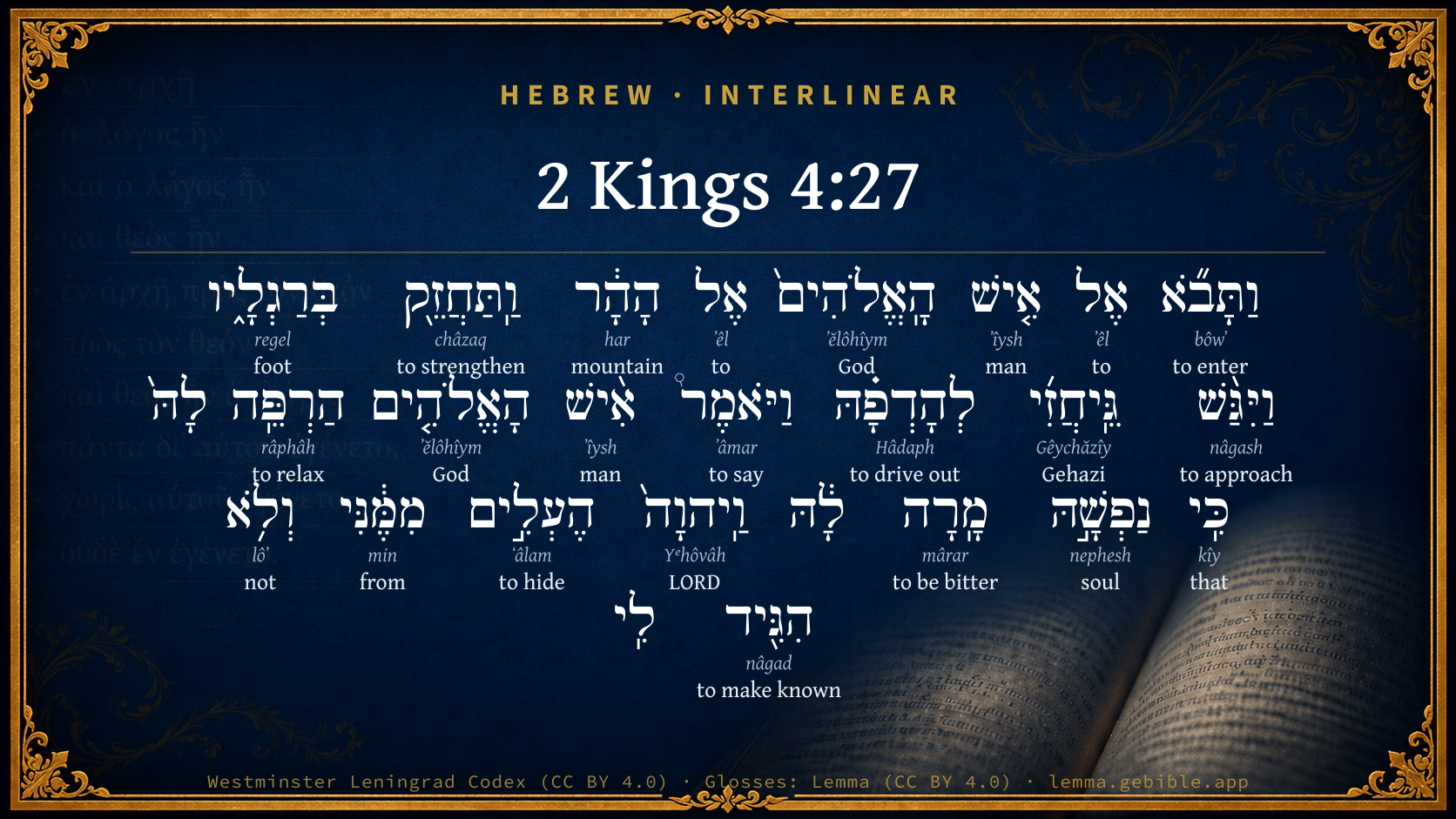
  1. וַתָּבֹ֞א bôwʼ H935 “and · to enter” Conjunction + Verb, Qal, Sequential Imperfect, 3rd Person, Feminine, Singular
  2. אֶל ʼêl H413 “to” Preposition
  3. אִ֤ישׁ ʼîysh H376 “man of” Noun, Common, Masculine, Singular, Construct
  4. הָֽאֱלֹהִים֙ ʼĕlôhîym H430 “the · God(s)” Particle, Definite Article + Noun, Common, Masculine, Plural, Absolute
  5. אֶל ʼêl H413 “to” Preposition
  6. הָהָ֔ר har H2022 “the · mountain” Particle, Definite Article + Noun, Common, Masculine, Singular, Absolute
  7. וַֽתַּחֲזֵ֖ק châzaq H2388 “and · to strengthen” Conjunction + Verb, Hiphil, Sequential Imperfect, 3rd Person, Feminine, Singular
  8. בְּרַגְלָ֑יו regel H7272 “in/at · feet · his” Preposition + Noun, Common, Feminine, Dual, Construct + Suffix, Personal, 3rd Person, Masculine, Singular
  9. וַיִּגַּ֨שׁ nâgash H5066 “and · to approach” Conjunction + Verb, Qal, Sequential Imperfect, 3rd Person, Masculine, Singular
  10. גֵּֽיחֲזִ֜י Gêychăzîy H1522 “Gehazi” Noun, Proper
  11. וַיֹּאמֶר֩ ʼâmar H559 “and · to say” Conjunction + Verb, Qal, Sequential Imperfect, 3rd Person, Masculine, Singular
  12. אִ֨ישׁ ʼîysh H376 “man of” Noun, Common, Masculine, Singular, Construct
  13. הָאֱלֹהִ֤ים ʼĕlôhîym H430 “the · God(s)” Particle, Definite Article + Noun, Common, Masculine, Plural, Absolute
  14. הַרְפֵּֽה râphâh H7503 “relax” Verb, Hiphil, Imperative, 2nd Person, Masculine, Singular
  15. כִּֽי kîy H3588 “that” Conjunction
  16. נַפְשָׁ֣הּ nephesh H5315 “soul · her” Noun, Common, Both, Singular, Construct + Suffix, Personal, 3rd Person, Feminine, Singular
  17. מָֽרָה mârar H4843 “to be bitter” Verb, Qal, Perfect, 3rd Person, Feminine, Singular
  18. וַֽיהוָה֙ Yᵉhôvâh H3068 “and · LORD” Conjunction + Noun, Proper
  19. הֶעְלִ֣ים ʻâlam H5956 “to hide” Verb, Hiphil, Perfect, 3rd Person, Masculine, Singular
  20. מִמֶּ֔נִּי min H4480 “from · me” Preposition + Suffix, Personal, 1st Person, Common, Singular
  21. וְלֹ֥א lôʼ H3808 “and · not” Conjunction + Particle, Negative
  22. הִגִּ֖יד nâgad H5046 “to make known” Verb, Hiphil, Perfect, 3rd Person, Masculine, Singular

About this verse

These counts appear in no published source. They are computed here, from the morphology-tagged text and Lemma’s own curated glosses. What Lemma adds →

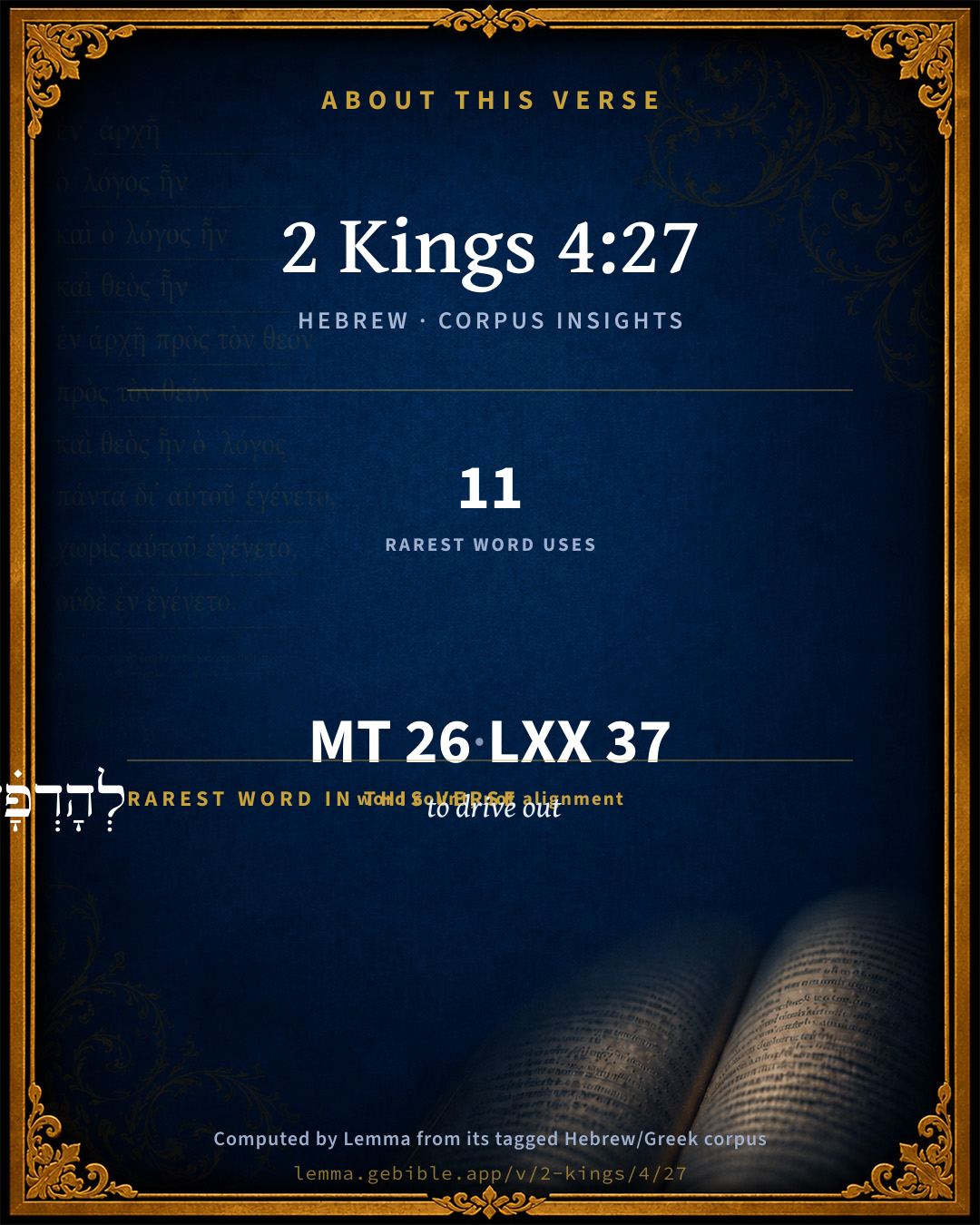
26
words
20
distinct lemmas
Historical
section

Notable vocabulary

The rarest word here is לְהָדְפָ֗הּ to drive out H1920 — appearing just 11 times in the whole Hebrew Bible.

Shared distinctive vocabulary

לְהָדְפָ֗הּ to drive out H1920 occurs in 11 verses of the Hebrew Bible. Also found in:

Grammatical profile

  • 9 verbs
  • 9 nouns
  • 6 prepositions
  • 1 conjunction
  • 1 particle

Verb forms

  • וַתָּבֹ֞א Qal · Sequential Imperfect
  • וַֽתַּחֲזֵ֖ק Hiphil · Sequential Imperfect
  • וַיִּגַּ֨שׁ Qal · Sequential Imperfect
  • לְהָדְפָ֗הּ Qal · Infinitive Construct
  • וַיֹּאמֶר֩ Qal · Sequential Imperfect
  • הַרְפֵּֽה Hiphil · Imperative
  • מָֽרָה Qal · Perfect
  • הֶעְלִ֣ים Hiphil · Perfect
  • הִגִּ֖יד Hiphil · Perfect

Repetition

Words recur within this verse — often emphatic in Hebrew:

  • אִ֤ישׁ man H376 ×2
  • הָֽאֱלֹהִים֙ God H430 ×2
  • אֶל to H413 ×2

Hebrew & Septuagint length

In English translation the verse runs 52 words from the Hebrew and 50 from the Septuagint (LXX English) — closely comparable.

A rough comparison of the two English renderings, which tokenize alike — not a word-level alignment.

Word counts can differ between the Hebrew and the Greek without any difference in meaning — e.g. the Hebrew direct-object marker אֵת has no separate Greek word, and Greek often adds the article ὁ.

In the original languages it is 26 Hebrew tokens and 37 Greek tokens — but the two are counted differently (Hebrew bundles its prefixes and suffixes into one token; the Greek is in lemma form), so that isn’t a like-for-like length.

Cross-references

18

Topical passages linked to 2 Kings 4:27 in the Treasury of Scripture Knowledge — connected by theme and wording, ordered by reader-vote popularity; previews shown in the World English Bible.

  • Genesis 18:17 Yahweh said, "Will I hide from Abraham what I do,
  • 2 Samuel 7:3 Nathan said to the king, Go, do all that is in your heart; for Yahweh is with you.
  • 1 Samuel 1:10 She was in bitterness of soul, and prayed to Yahweh, and wept sore.
  • 2 Kings 4:25 So she went, and came to the man of God to Mount Carmel. It happened, when the man of God saw her afar off, that he said to Gehazi his servant, Behold, yonder is the Shunammite:
  • 2 Kings 6:12 One of his servants said, No, my lord, O king; but Elisha, the prophet who is in Israel, tells the king of Israel the words that you speak in your bedchamber.
  • Job 10:1 "My soul is weary of my life; I will give free course to my complaint. I will speak in the bitterness of my soul.
  • Proverbs 14:10 The heart knows its own bitterness and joy; He will not share these with a stranger.
  • Proverbs 18:14 A man's spirit will sustain him in sickness, But a crushed spirit, who can bear?
  • Amos 3:7 Surely the Lord Yahweh will do nothing, Unless he reveals his secret to his servants the prophets.
  • Matthew 15:23 But he answered her not a word. His disciples came and begged him, saying, "Send her away; for she cries after us."
  • Matthew 20:31 The multitude rebuked them, telling them that they should be quiet, but they cried out even more, "Lord, have mercy on us, you son of David!"
  • Matthew 28:9 As they went to tell his disciples, behold, Jesus met them, saying, "Rejoice!" They came and took hold of his feet, and worshiped him.
  • Mark 10:13 They were bringing to him little children, that he should touch them, but the disciples rebuked those who were bringing them.
  • Mark 14:6 But Jesus said, "Leave her alone. Why do you trouble her? She has done a good work for me.
  • Luke 7:38 Standing behind at his feet weeping, she began to wet his feet with her tears, and she wiped them with the hair of her head, kissed his feet, and anointed them with the ointment.
  • John 4:27 At this, his disciples came. They marveled that he was speaking with a woman; yet no one said, "What are you looking for?" or, "Why do you speak with her?"
  • John 12:4–7 Then Judas Iscariot, Simon's son, one of his disciples, who would betray him, said,
  • John 15:15 No longer do I call you servants, for the servant doesn't know what his lord does. But I have called you friends, for everything that I heard from my Father, I have made known to you.

Cross-references courtesy of OpenBible.info (CC BY 4.0).

Hebrew and Greek witnesses Masoretic Hebrew ↔ Greek Septuagint

The same verse in the two great witnesses to the Old Testament, shown verse-for-verse.

These are two independent witnesses, not word-aligned to each other, and the Septuagint is shown in lemma (dictionary) form.

Hebrew 2 Kings 4:27 Masoretic · Westminster Leningrad Codex

וַתָּבֹ֞א אֶל אִ֤ישׁ הָֽאֱלֹהִים֙ אֶל הָהָ֔ר וַֽתַּחֲזֵ֖ק בְּרַגְלָ֑יו וַיִּגַּ֨שׁ גֵּֽיחֲזִ֜י לְהָדְפָ֗הּ וַיֹּאמֶר֩ אִ֨ישׁ הָאֱלֹהִ֤ים הַרְפֵּֽה לָהּ֙ כִּֽי נַפְשָׁ֣הּ מָֽרָה לָ֔הּ וַֽיהוָה֙ הֶעְלִ֣ים מִמֶּ֔נִּי וְלֹ֥א הִגִּ֖יד לִֽי

When she came to the man of God to the hill, she caught hold of his feet. Gehazi came near to thrust her away; but the man of God said, Let her alone: for her soul is vexed within her; and Yahweh has hid it from me, and has not told me.

World English Bible · Public Domain

Greek LXX 2 Kings 4:27 Septuagint · lemma form

καί ἔρχομαι πρός ελισαιε εἰς ὁ ὄρος καί ἐπιλαμβάνω ὁ πούς αὐτός καί ἐγγίζω γιεζι ἀποὠθέω αὐτός καί εἶπον ελισαιε ἀποἵημι αὐτός ὅτι ὁ ψυχή αὐτός κατώδυνος αὐτός καί κύριος ἀποκρύπτω ἀπό ἐγώ καί οὐ ἀναἀγγέλλω ἐγώ

And she came to Elisaie to the mountain, and laid hold of his feet; and Giezi drew near to thrust her away. And Elisaie said, Let her alone, for her soul is much grieved in her, and the Lord has hidden it from me, and has not told it me.

LXX2012 (modern English Septuagint) · Public Domain

Hebrew: Westminster Leningrad Codex (CC BY 4.0). Greek: Septuagint (public domain); English from LXX2012 (modern English Septuagint) (Public Domain). How the Septuagint differs from the Hebrew →

Targum (Aramaic paraphrase)

1

The Targum is the ancient Jewish Aramaic paraphrase of the Hebrew Scriptures — an interpretive translation, not the Hebrew text itself. Onkelos (literal) and Pseudo-Jonathan (expansive) render the Torah, and Jonathan the Prophets. Coverage is partial: where no permissively-licensed English translation exists for a verse, only the Aramaic is shown. This is verse-level text, not a word-by-word alignment to the Hebrew.

  1. Targum Jonathan Prophets (Joshua–Malachi)
    וַאֲתַת לְוַת נְבִיָא דַייָ לְטוּרָא וְאַתְקִיפַת בְּרִגְלוֹהִי וּקְרֵיב גֵיחֲזִי לְמִידְחָהּ וַאֲמַר נְבִיָא דַייָ שְׁבוֹק מִינָהּ אֲרֵי נַפְשָׁא מְרִירָא לָהּ וּמִן קֳדָם יְיָ אִתְכַּסָא מִנִי וְלָא אִתְחַוָה לִי:

    (no public-domain English translation for this verse)

    Targum Jonathan — Aramaic: “Mikraot Gedolot” (public domain). English: “Sefaria Community Translation” (CC0 1.0 (public-domain dedication)); “London "Chaldee Paraphrase," 1871” (public domain). Text via Sefaria.

Commentary

Notes on 2 Kings 4:27 from classic Christian and Jewish commentators (each source and its license shown beneath its notes). The classic Christian expositions comment on the surrounding passage and are grouped to its opening verse, so a note may address several verses; the Jewish commentaries on the Tanakh (Rashi and others) are per-verse, so they appear only where the commentator wrote on this verse.

Lemma curates 59 commentaries, every one of them public domain or Creative Commons licensed, each selected and text-cleaned for this edition rather than reprinted as found. About our sources →

Ellicott's Commentary for English Readers

(27) To the hill.—Probably to the summit.

She caught him by the feet.—She laid hold of (clasped) his feet. Assuming the posture of an humble and urgent suppliant, and no doubt pouring out a flood of passionate entreaties for help.

But (and) Gehazi came near to thrust her away.—He thought her vehemence a trespass upon the dignity of his master. (Comp. Mat_19:13; Joh_4:27.)

The Lord hath hid it from me.—Supernatural knowledge of every event was not a characteristic of the gift of prophecy. (Comp. 2Sa_7:3 seq. for a somewhat similar case of ignorance on the part of a prophet.)

A Bible Commentary for English Readers, edited by Charles John Ellicott (1878–1897) — public domain. Text from a community e-Sword module.

Trapp's Complete Commentary

John Trapp

2Ki 4:27 And when she came to the man of God to the hill, she caught him by the feet: but Gehazi came near to thrust her away. And the man of God said, Let her alone; for her soul [is] vexed within her: and the LORD hath hid [it] from me, and hath not told me.

Ver. 27. She caught him by the feet.] Which she held fast, to show the instance of her request, and the strength of her confidence, together with her firm resolution, not to leave him till she had that she came for, as 2Ki 4:30.

John Trapp, A Commentary or Exposition upon All the Books of the Old and New Testament (1647–1656) — public domain. Text from a community e-Sword module.

Joseph Benson's Commentary

2Ki 4:27. She caught him by the feet — After the manner of a most humble and earnest supplicant; intimating, what she did not dare to express in words, that she desired him to go along with her. Gehazi came near to thrust her away — Either thinking she was rude, and made too free with the prophet; or knowing his master did not expect such abasement, especially from her who had been so kind and friendly to them, and that he would not be pleased to see her lie at his feet, Gehazi would have raised her up. The man of God said, Let her alone — Disturb her not, for this gesture is a sign of some extraordinary grief. And the Lord hath hid it from me — God hath not shown me the cause of it. By this he signifies, that what he knew or did, was not by any virtue inherent in himself, but from God, who revealed to him only what he pleased, and when he pleased.

Joseph Benson's Commentary on the Old and New Testaments (1811–1818) — public domain. Text from a community e-Sword module.

Tyndale Open Study Notes

Tyndale Open Resources

4:27 caught hold of his feet: With this sign of deep respect and supplication, the woman poured out her heart to Elisha (see Matt 28:9; Luke 8:41, 47; 17:16; Rev 1:17).

Tyndale Open Study Notes — © Tyndale Open Resources, licensed CC BY-SA 4.0. Text via the HelloAO Bible API.

Geneva Bible (1599)

Geneva Bible translators

Hebrew, her soul is in bitterness.

In token of humility and joy that she had met with him.

Geneva Bible (1599) marginal notes — public domain. Text via Bolls.life.

Adam Clarke's Commentary

Verse 27. The Lord hath hid it from me, and hath not told me.] In reference to this point he had not now the discernment of spirits. This, and the gift of prophecy, were influences which God gave and suspended as his infinite wisdom saw good.

Adam Clarke's Commentary on the Bible (1810–1826) — public domain. Text from a community e-Sword/MySword module.

The Cambridge Bible for Schools and Colleges

gen. ed. J. J. S. Perowne

27. to the hill] Elisha had been standing on a height which enabled him to command a view of the road for some distance.

she caught him by the feet] She fell down, and clung to his feet in the attitude of humblest supplication. Cf. Mat_18:29, where the servant adopts this suppliant posture when appealing to his fellow for mercy.

Gehazi came near to thrust her away] The word in other places indicates a considerable degree of force. The servant thought that the dignity of his master was not sufficiently regarded by the Shunammite, and would have taken her away.

The Lord hath hid it from me] We need not conclude from these words that the prophet expected to be warned supernaturally concerning those who were likely to come to seek his help. We know from other instances that the prophets were in many cases no more enlightened than others. In 2Sa_7:3, Nathan bids David do all that is in his heart for the Lord is with him. But presently he is sent to inform the king that God will not give him leave to build the temple, as he wished. The family at Shunem had been made by the prophet a subject of intercession with the Lord. It is therefore not unnatural that Elisha should consider that their misfortunes might be specially announced. We must suppose that, after her grief had spent somewhat of its force, she opens it to Elisha, and follows her narration with the words of the next verse.

The Cambridge Bible for Schools and Colleges (gen. ed. J. J. S. Perowne; Cambridge University Press, 1878–1918) — public domain. Text from a community e-Sword module.

John Gill's Exposition

And when she came to the man of God to the hill,.... To the top of it:

she caught him by the feet; in reverence to him, and as a supplicant, she prostrated herself at his feet, and, out of affection to him, caught hold on them, and held them fast, and determined not to leave him until he had promised to go with her, see Mat 28:9. It was usual with the Jews to lay hold on and kiss the feet or knees of those to whom they did homage, or made supplication, see Mat 28:9. See Gill on Luk 7:38, and so with the Greeks, as may be observed in various passages in Homer (y) and others:

but Gehazi came near to thrust her away; as being troublesome and disagreeable to his master, and not for her honour and credit:

and the man of God said, let her alone, for her soul is vexed within her; or "is bitter" (z), full of trouble and distress, and knows not what to do, nor very well what she does:

and the Lord hath hid it from me, and hath not told me: what is the cause of this her trouble; for prophets did not know things of themselves, nor had they the vision of prophecy at their will and pleasure, but according to the will of God.

(y) Vid. Barthium ad Claudian. de Raptu Proserpin. l. 1. ver. 50. (z) "amara", Pagninus, Montanus, &c.

John Gill's Exposition of the Whole Bible (1746–1763) — public domain (CC PDM 1.0). Text via the HelloAO Bible API.

Albert Barnes' Notes on the Bible

She caught him by the feet - To lay hold of the knees or feet has always been thought in the East to add force to supplication, and is practiced even at the present day. Compare Mat 18:29; Joh 11:32.

Albert Barnes' Notes on the Bible (1834–1885) — public domain. Text from a community e-Sword/MySword module.

Haydock's Catholic Bible Commentary

CHAPTER IV.

Her. Being aware of the extreme circumspection and modesty of his master. --- Told me. Hence it appears that the prophets were not inspired at all times, 2 Kings vii. 3, "that they might be sensible that what they had was a gift of God." (St. Gregory, hom. in 11 Ezech.)

George Leo Haydock (1774–1849), Haydock's Catholic Family Bible and Commentary, 1859 edition — public domain. Excludes Psalms (Douay-Rheims chapter numbering differs from Protestant) and Deuterocanonical books (Catholic canon only).

Matthew Poole's English Annotations

She caught him by the feet; she fell at his feet, and touched them, as a most humble and earnest suppliant. Compare 1Sa 25:24; Mat 28:9. Withal, she intimated, what she durst not presume to express in words, that she desired him to go along with her. Gehazi came near to thrust her away; judging this posture indecent for her, and offensive to his master.

Let her alone, for her soul is vexed within her; disturb her not, for this uncouth gesture is a sign of some extraordinary grief.

The Lord hath hid it from me, and hath not told me; whereby he signifies that what he knew or did was not by any virtue inherent and abiding in himself, but only from God, who revealed to him only what and when he pleased. Compare 2Sa 7:3.

Matthew Poole's English Annotations on the Holy Bible (1683–1685) — public domain. Text from a community e-Sword/MySword module.

Whedon's Commentary on the Bible

Daniel D. Whedon

27. She caught him by the feet — “This scene is natural and very graphic. If you ask after a person whom you know to be sick, the reply at first will invariably be, Well, thank God, even when the very next sentence is to inform you that he is dying. Then the falling down, clasping the feet, etc., are actions witnessed every day. I have had this done to me often before I could prevent it. So, also, the officious zeal of the wicked Gehazi, who would thrust the broken-hearted mother away, probably thinking her touch pollution, agrees perfectly with what we know of the man and of the customs of the East.” — Thomson.

The Lord hath hid it from me — The prophets were not always illumined with the gift of foresight or of vision. They were not always “in the Spirit.”

Daniel D. Whedon (gen. ed.), Commentary on the Old and New Testaments (1874–1909) — public domain. Text from a community e-Sword module.

The Pulpit Commentary

And when she earns to the man of God to the hill rather, the mountain; i.e. Carmel, where Elisha"s residence wasshe caught him by the feet. (comp. Mat_18:29; Mar_5:22 7:25; Joh_11:32) It has always been usual in the East to embrace the feet or the knees, in order to add force to supplication. But Gehazi came near to thrust her away. He regarded the act as one unduly familiar or unduly importunate, and interfered to protect and release his master. And the man of God said, Let her alone; for her soul is vexed within her.

Elisha would not have the woman disturbed. He saw that she was in deep distress, and, if there was anything unseemly in her action according to the etiquette of the time, excused it to her profound grief and distraction. The ordinary mind is a slave to conventionalities; the superior mind knows when to be above them. And the Lord hath hid it from me, and hath not told me. God had not informed Elisha, by inward miraculous illumination, of the illness of the child, or its death, or the wild hopes stirring in the afflicted mother"s mind, which induced her to make her long and troublesome journey. We need not feel surprised at this. There is always a limit to the miraculous; and facts that may be learnt by a little inquiry are but rarely communicated supernaturally.

Vers. 27-31.

Limits to inspiration.

Many men seem to suppose that the prophetical inspiration, the Divine afflatus, whatever it was, which God vouchsafed in times past to his prophets, apostles, and evangelists, was absolutely unlimited a sort of omniscience, at any rate omniscience on all those subjects on which they spoke or wrote. But Scripture lends no sanction to this supposition. "Let her alone," says Elisha to Gehazi; "for her soul is vexed within her: and the Lord hath hid it from me, and hath not told me" (ver. 27). Ignorance of the future would also seem to underlie the instructions given to Gehazi in ver. 29. And there are, in point of fact, limitations to every prophet"sknowledge even with respect to the things concerning which he writes or speaks. "Now, behold," says St. Paul, "I go bound in the spirit unto Jerusalem, not knowing the things that shall befall me there". (Act_20:22) And again, "Now concerning virgins I have no commandment of the Lord: yet I give my judgment, as one that hath obtained mercy of the Lord to be faithful". (1Co_7:25) The apostles spoke much of the coming of Christ to judgment, but "of that day and of that hour knoweth no man". (Mat_24:36) Prophetic knowledge was always partial, limited. To Isaiah the return from Babylon, the establishment of Christ"s kingdom upon earth, and the final triumph of Christianity, were blended together into a single vision of glory from which the chronological idea was absent. Ezekiel probably did not know whether the temple which he described (40.- 44.) was to be spiritual or material. Zechariah knew that a day would come when there would be "a fountain opened to the house of David and to the inhabitants of Jerusalem for sin and for uncleanness;" but the nature of the fountain was, apparently, not revealed to him. The prophets always saw through a glass darkly," "knew in part" and prophesied in part; had not even a full knowledge of the meaning of their own words. We must therefore not look in the inspired writings for an exactness and accuracy and completeness to which they make no pretence; we must not claim infallibility for the obiter dicta of apostles or evangelists; we must not be surprised at occasional slips of memory, as the quotation of "Jeremy" for "Zachary", (Mat_27:9) or at little discrepancies, as the various readings of the title on the cross, or at other similar imperfections. The Divine element in Scripture does not exclude the presence also of a human element; and the human element cannot but show traces of human weakness, human ignorance, human frailty. The trifling errors that a microscopic criticism points out in the sacred volume no more interfere with its illuminating power, than do the spots seen by astronomers on its surface interfere with the light of the sun, or slight flaws with the magnificence and splendor of a unique diamond. The Bible is God"s Word, the most precious treasure that man possesses, even although it be true that "we have this treasure in earthen vessels". (2Co_4:7)

The Pulpit Commentary (1880–1919), ed. H.D.M. Spence-Jones & Joseph S. Exell — public domain. Text from a community e-Sword module.

John Wesley's Explanatory Notes

The feet - She fell at his feet and touched them, as a most humble and earnest supplicant. Withal, she intimated, what she durst not presume to express in words, that she desired him to go along with her. Let her alone - Disturb her not, for this gesture is a sign of some extraordinary grief. Hid it - Whereby he signifies, that what he knew or did, was not by any virtue inherent in himself, but from God, who revealed to him only what and when he pleased.

John Wesley, Explanatory Notes Upon the Whole Bible (1754–1765) — public domain. Text via the GEBible commentary corpus.

Scofield Reference Notes

C. I. Scofield

vexed

Heb. "bitter." 1Sa 1:10.

The Scofield Reference Bible (1917 edition), notes by C. I. Scofield — public domain. Text from a community e-Sword module.

unfoldingWord translationNotes

Door43 World Missions Community

the mountain

"Mount Carmel"

she caught hold of his feet

This implies that she knelt or laid on the ground in front of him and grabbed his feet. AT: "she dropped down on the ground in front of him and put her hands around his feet" (See: Assumed Knowledge and Implicit Information)

Yahweh has hidden the problem from me, and has told me nothing

Elisha can see that the woman is upset but Yahweh has not revealed to him the cause of her problem.

translationWords

Yahweh

unfoldingWord translationNotes — © Distant Shores Media and the Door43 World Missions Community, licensed CC BY-SA 4.0. Source: git.door43.org/Door43/en_tn.

Lesson kit

Teaching starters — assembled from the data on this page, not authored interpretation. Every prompt links to the verse data it draws on. Edit before teaching.

2 Kings, in the Historical, opens this verse with 26 words (20 distinct Hebrew lemmas). Its most distinctive word is Hâdaph (“to drive out”). A historical commentator’s framing appears above. Read the whole chapter for the surrounding context.

Discussion questions

  1. What does “to drive out” (Hâdaph) contribute to the verse as a whole?
  2. How does Numbers 35:20, which shares the word «to drive out», read alongside this verse?
  3. What does the repetition of “man” (2× in this one verse) do in this verse?
  4. These translations render this verse differently; the difference is in the English rendering, not the original. What questions does that raise?
  5. «וַתָּבֹ֞א» is a Qal Sequential Imperfect verb. How does that grammatical form shape the action described?
  6. Compare how Ellicott's Commentary for English Readers and Trapp's Complete Commentary read this verse. Where do they agree or differ?

Things to notice

Reading settings

Reading text

Shown beneath each verse's original-language words.

Old Testament
Old Testament edition

Read the OT as the Masoretic Hebrew (MT) or the Greek Septuagint (LXX).

English shown for the Greek Septuagint (in the Hebrew ↔ Greek comparison).

Comparing translations? Open the Compare panel on any verse page to stack up to four side by side.