
Job 27:6

Hebrew (Westminster Leningrad Codex) Job 27:6 appears in the Hebrew Old Testament. The text above is from the Westminster Leningrad Codex. Each word links to its Strong’s number, a concise gloss, and parsing drawn from the Open Scriptures Hebrew Bible morphology. Click any word for its full Brown-Driver-Briggs (BDB) entry.
Download image
Cite this verse

Job 27:6 (World English Bible). Public Domain. Lemma interlinear Bible study tool, https://lemma.gebible.app/v/job/27/6.

Show BibTeX & RIS
BibTeX
RIS
English Translation
I hold fast to my righteousness, and will not let it go. My heart shall not reproach me so long as I live.
World English Bible · Public Domain
Download a study sheet

One document with this verse’s original text, its word-by-word gloss line, the meaning frame, cross-references with their text, attributed commentary, and full source and license credits — printable, and it pastes into notes with its structure intact.

This verse Autodidact and up

Study sheet (.html) Plain text (.txt)

A passage Seminary Student

Up to 50 verses in one chapter. A passage sheet keeps up to 6 commentary sources and 12 cross-references per verse, in the order this page ranks them, and says so on the sheet whenever that leaves anything out. Ask for a single verse and you get the Autodidact verse sheet above.

Everything on this page stays free to read, with no account — the sheet is a download of what is already on screen, not access to it.

Want to remove ads? Support Godless Engineer
Compare translations 3

The same verse in 3 English versions, stacked beneath the original-language interlinear above. Click any original word for its lexicon entry.

Each is an independent rendering of the whole verse — the interlinear is not word-aligned to these translations.

Highlighted words mark where these versions differ — a whole-verse word diff, not a word-by-word alignment.

  • World English Bible Public Domain
    I hold fast to my righteousness, and will not let it go. My heart shall not reproach me so long as I live.
  • King James Version Public Domain
    My righteousness I hold fast, and will not let it go: my heart shall not reproach me so long as I live.
  • unfoldingWord Literal Text CC BY-SA 4.0
    I grasp my righteousness and I will not let it go; my heart will not reproach from my days.

unfoldingWord Literal Text — © unfoldingWord, licensed CC BY-SA 4.0. Word-aligned USFM3 via Door43 (git.door43.org/unfoldingWord/en_ult).

Versions to compare (up to 4)

3 of 4 selected

Show all 18 translations

Every available English version of this verse, each an independent rendering of the whole verse.

  • World English Bible Public Domain
    I hold fast to my righteousness, and will not let it go. My heart shall not reproach me so long as I live.
  • Berean Standard Bible Public Domain
    I will cling to my righteousness and never let go. As long as I live, my conscience will not accuse me.
  • Majority Standard Bible Public Domain
    I will cling to my righteousness and never let go. As long as I live, my conscience will not accuse me.
  • King James Version Public Domain
    My righteousness I hold fast, and will not let it go: my heart shall not reproach me so long as I live.
  • American Standard Version (1901) Public Domain
    My righteousness I hold fast, and will not let it go: My heart shall not reproach `me' so long as I live.
  • Revised Version (1885) Public Domain
    My righteousness I hold fast, and will not let it go: my heart shall not reproach me so long as I live.
  • Geneva Bible (1599) Public Domain
    I will keepe my righteousnesse, and wil not forsake it: mine heart shall not reprooue me of my dayes.
  • Douay-Rheims (1899) Public Domain
    My justification, which I have begun to hold, I will not forsake: for my heart doth not reprehend me in all my life.
  • Young's Literal Translation Public Domain
    On my righteousness I have laid hold, And I do not let it go, My heart doth not reproach me while I live.
  • Literal Standard Version CC BY-SA 4.0
    On my righteousness I have laid hold, || And I do not let it go, || My heart does not reproach me while I live.
  • Unlocked Literal Bible CC BY-SA 4.0
    I hold fast to my righteousness and will not let it go; my thoughts will not reproach me so long as I live.
  • unfoldingWord Literal Text CC BY-SA 4.0
    I grasp my righteousness and I will not let it go; my heart will not reproach from my days.
  • Darby Bible Public Domain
    My righteousness I hold fast, and will not let it go: my heart reproacheth [me] not one of my days.
  • World Messianic Bible Public Domain
    I hold fast to my righteousness, and will not let it go. My heart will not reproach me so long as I live.
  • Webster's Bible Public Domain
    My righteousness I hold fast, and will not let it go: my heart shall not reproach me so long as I live.
  • Free Bible Version CC BY-SA 4.0
    I'm convinced I'm right and will never give up believing this; my conscience will not condemn me as long as I live.
  • Bible in Basic English Public Domain
    I will keep it safe, and will not let it go: my heart has nothing to say against any part of my life.
  • JPS Tanakh (1917) Public Domain
    My righteousness I hold fast, and will not let it go; my heart shall not reproach me so long as I live.

Literal Standard Version (2020), Covenant Press — licensed CC BY-SA 4.0. Text via the HelloAO Bible API (eBible.org). Unlocked Literal Bible (unfoldingWord) — licensed CC BY-SA 4.0. Text via the HelloAO Bible API (eBible.org). unfoldingWord Literal Text — © unfoldingWord, licensed CC BY-SA 4.0. Word-aligned USFM3 via Door43 (git.door43.org/unfoldingWord/en_ult). Free Bible Version, Dr. Jonathan Gallagher — licensed CC BY-SA 4.0. Text via the HelloAO Bible API (eBible.org).

Word by word

More ways to search: Search by grammar → Find every occurrence → Compare this word →

Practice this passage: Drill this verse → Learn its vocabulary →

יֶחֱרַ֥ף
châraph
H2778
“to reproach”
Verb, Qal, Imperfect, 3rd Person, Masculine, Singular
Part of Speech
Verb
Stem
Qal
Form
Imperfect
Person
3rd Person
Gender
Masculine
Number
Singular
Full BDB Definition

Origin: a primitive root

TWOT: 749 , 750 , 751

to reproach, taunt, blaspheme, defy, jeopardise, rail, upbraid - (Qal) to reproach - (Piel) to reproach, defy, taunt - (Qal) to winter, spend harvest time, remain in harvest time - (Niphal) to acquire, be betrothed
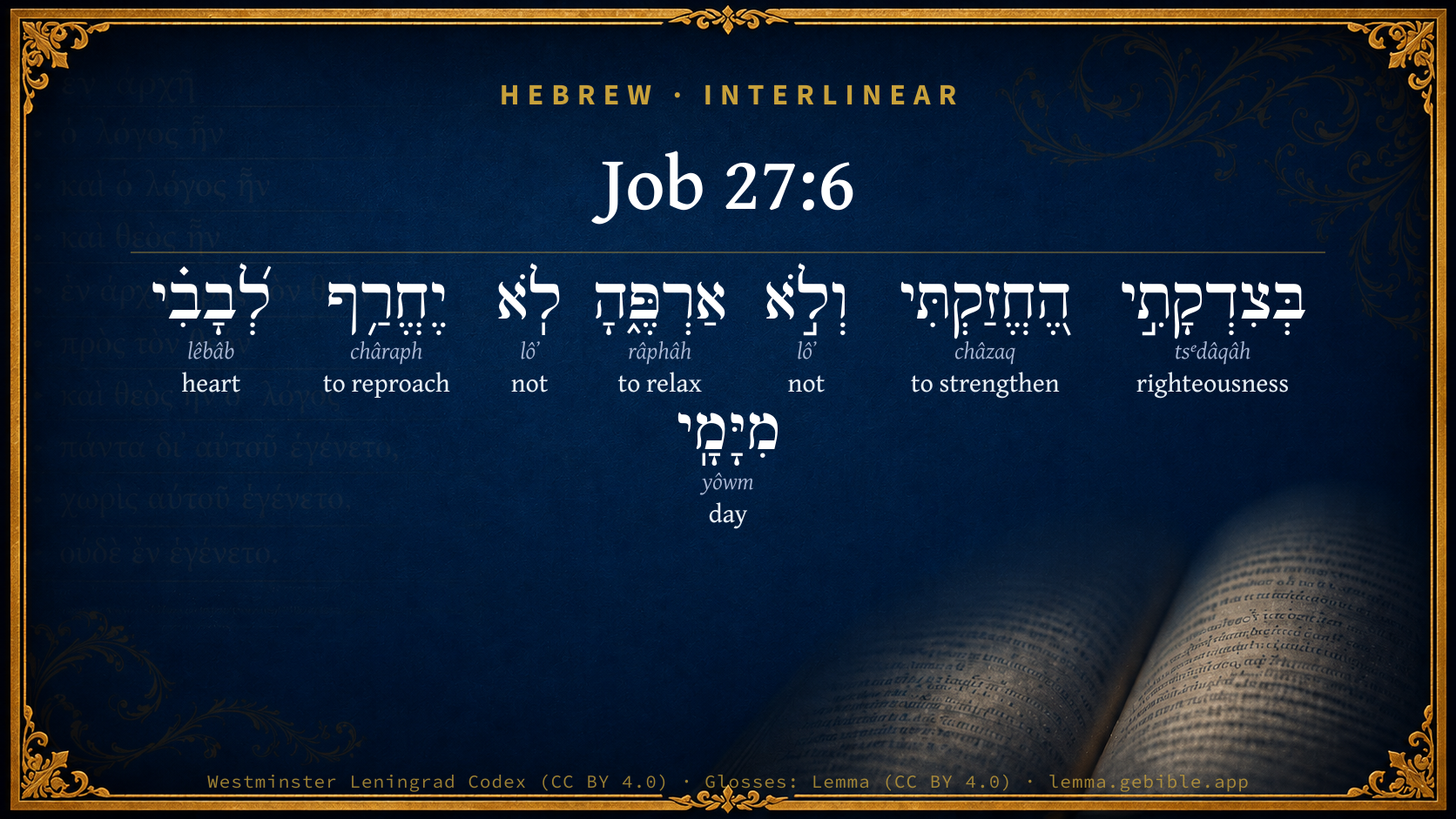
  1. בְּצִדְקָתִ֣י tsᵉdâqâh H6666 “in/at · righteousness · my” Preposition + Noun, Common, Feminine, Singular, Construct + Suffix, Personal, 1st Person, Common, Singular
  2. הֶ֭חֱזַקְתִּי châzaq H2388 “to strengthen” Verb, Hiphil, Perfect, 1st Person, Common, Singular
  3. וְלֹ֣א lôʼ H3808 “and · not” Conjunction + Particle, Negative
  4. אַרְפֶּ֑הָ râphâh H7503 “to relax · her” Verb, Hiphil, Imperfect, 1st Person, Common, Singular + Suffix, Personal, 3rd Person, Feminine, Singular
  5. לֹֽא lôʼ H3808 “not” Particle, Negative
  6. לְ֝בָבִ֗י lêbâb H3824 “heart · my” Noun, Common, Masculine, Singular, Construct + Suffix, Personal, 1st Person, Common, Singular
  7. מִיָּמָֽי yôwm H3117 “from · days · my” Preposition + Noun, Common, Masculine, Plural, Construct + Suffix, Personal, 1st Person, Common, Singular

About this verse

These counts appear in no published source. They are computed here, from the morphology-tagged text and Lemma’s own curated glosses. What Lemma adds →

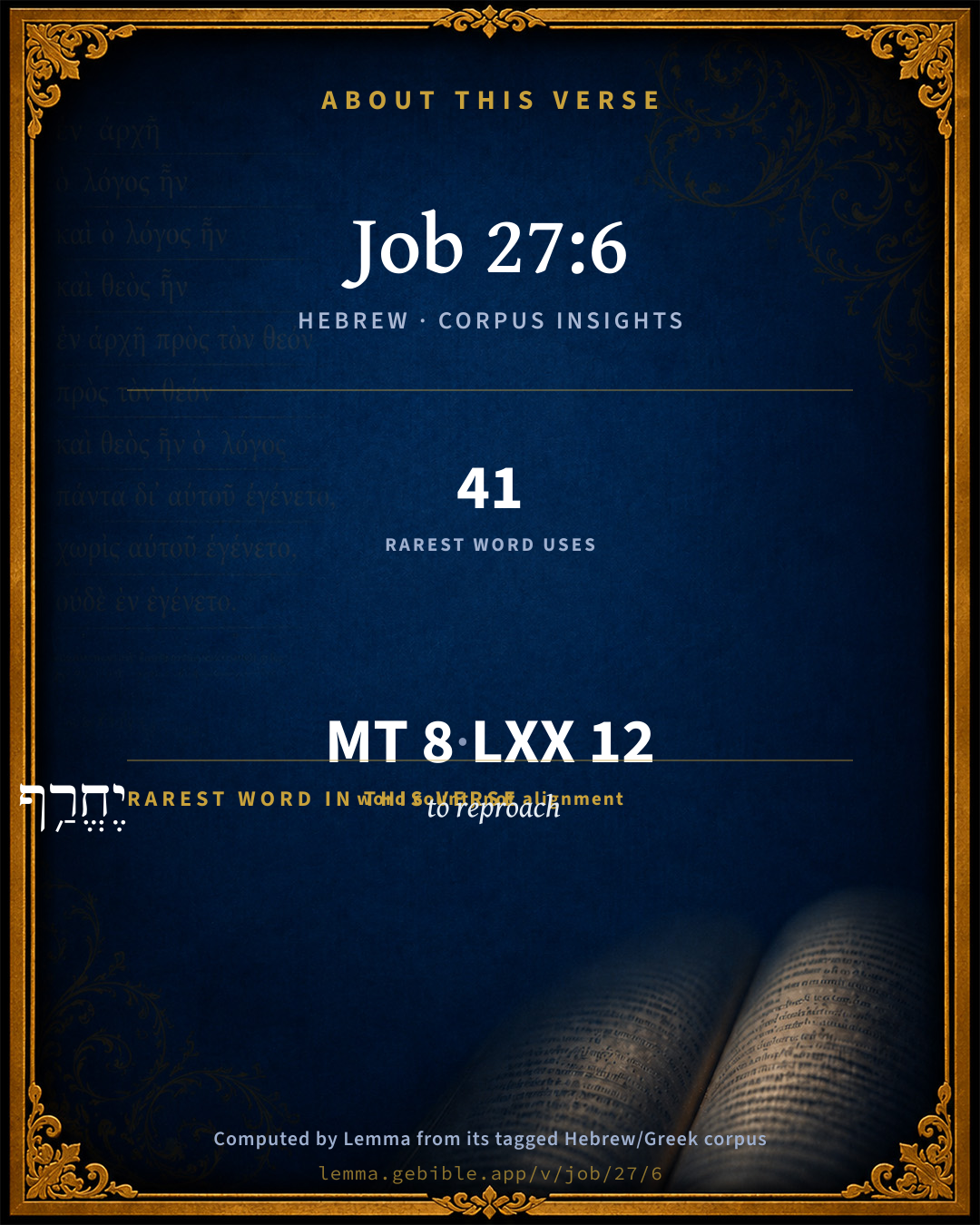
8
words
7
distinct lemmas
Wisdom
section

Shared distinctive vocabulary

יֶחֱרַ֥ף to reproach H2778 occurs in 40 verses of the Hebrew Bible. Also found in:

Grammatical profile

  • 3 verbs
  • 3 nouns
  • 2 particles

Verb forms

  • הֶ֭חֱזַקְתִּי Hiphil · Perfect
  • אַרְפֶּ֑הָ Hiphil · Imperfect
  • יֶחֱרַ֥ף Qal · Imperfect

Repetition

A word recurs within this verse — often emphatic in Hebrew:

  • וְלֹ֣א not H3808 ×2

Hebrew & Septuagint length

In English translation the verse runs 23 words from the Hebrew and 27 from the Septuagint (LXX English) — closely comparable.

A rough comparison of the two English renderings, which tokenize alike — not a word-level alignment.

Word counts can differ between the Hebrew and the Greek without any difference in meaning — e.g. the Hebrew direct-object marker אֵת has no separate Greek word, and Greek often adds the article ὁ.

In the original languages it is 8 Hebrew tokens and 12 Greek tokens — but the two are counted differently (Hebrew bundles its prefixes and suffixes into one token; the Greek is in lemma form), so that isn’t a like-for-like length.

Cross-references

6

Topical passages linked to Job 27:6 in the Treasury of Scripture Knowledge — connected by theme and wording, ordered by reader-vote popularity; previews shown in the World English Bible.

  • Job 2:3 Yahweh said to Satan, "Have you considered my servant Job? For there is none like him in the earth, a blameless and an upright man, one who fears God, and turns away from evil. He still maintains his integrity, although you incited me against him, to ruin him without cause."
  • Acts 24:16 Herein I also practice always having a conscience void of offense toward God and men.
  • 1 John 3:20–21 because if our heart condemns us, God is greater than our heart, and knows all things.
  • Proverbs 4:13 Take firm hold of instruction. Don't let her go. Keep her, for she is your life.
  • 2 Corinthians 12:11 I have become foolish in boasting. You compelled me, for I ought to have been commended by you, for in nothing was I inferior to the very best apostles, though I am nothing.
  • Psalms 18:20–23 Yahweh has rewarded me according to my righteousness. According to the cleanness of my hands has he recompensed me.

Cross-references courtesy of OpenBible.info (CC BY 4.0).

Hebrew and Greek witnesses Masoretic Hebrew ↔ Greek Septuagint

The same verse in the two great witnesses to the Old Testament, shown verse-for-verse.

These are two independent witnesses, not word-aligned to each other, and the Septuagint is shown in lemma (dictionary) form.

Hebrew Job 27:6 Masoretic · Westminster Leningrad Codex

בְּצִדְקָתִ֣י הֶ֭חֱזַקְתִּי וְלֹ֣א אַרְפֶּ֑הָ לֹֽא יֶחֱרַ֥ף לְ֝בָבִ֗י מִיָּמָֽי

I hold fast to my righteousness, and will not let it go. My heart shall not reproach me so long as I live.

World English Bible · Public Domain

Greek LXX Job 27:6 Septuagint · lemma form

δικαιοσύνη δέ προςἔχω οὐ μή προἵημι οὐ γάρ συνοἶδα ἐμαυτοῦ ἄτοπος πράσσω

but keeping fast to my righteousness I will by no means let it go: for I am not conscious to myself of having done any thing amiss.

LXX2012 (modern English Septuagint) · Public Domain

On this verse, Albert Barnes' Notes on the Bible discusses the Septuagint’s reading. Read the note in Commentary ↓

Hebrew: Westminster Leningrad Codex (CC BY 4.0). Greek: Septuagint (public domain); English from LXX2012 (modern English Septuagint) (Public Domain). How the Septuagint differs from the Hebrew →

Commentary

Notes on Job 27:6 from classic Christian and Jewish commentators (each source and its license shown beneath its notes). The classic Christian expositions comment on the surrounding passage and are grouped to its opening verse, so a note may address several verses; the Jewish commentaries on the Tanakh (Rashi and others) are per-verse, so they appear only where the commentator wrote on this verse.

Lemma curates 59 commentaries, every one of them public domain or Creative Commons licensed, each selected and text-cleaned for this edition rather than reprinted as found. About our sources →

The Cambridge Bible for Schools and Colleges

gen. ed. J. J. S. Perowne

6. The second clause of Job_27:6 reads,

My heart reproacheth not one of my days,

or, my heart reproaches (me) not since I was alive, i. e. during all my life. Of course the words have reference to the kind of charges laid against Job by his friends (e.g. ch. Job_22:6-9), and not to the sinfulness of nature common to all men, ch. Job_14:2. The “heart” in Heb. is the conscience or consciousness. Luther expresses the meaning vigorously when he translates: “My conscience bites me not in respect of my whole life.” Comp. the whole of ch. 31, which is but an expansion of these words.

The Cambridge Bible for Schools and Colleges (gen. ed. J. J. S. Perowne; Cambridge University Press, 1878–1918) — public domain. Text from a community e-Sword module.

Trapp's Complete Commentary

John Trapp

Job 27:6 My righteousness I hold fast, and will not let it go: my heart shall not reproach [me] so long as I live.

Ver. 6. My righteousness I hold fast] As with tooth and nail, yea, though it be to the loss of my teeth, Mordicus tenebo, as it befell that valiant Sir Thomas Challoner, who served, when he was young, under Charles V, in the expedition of Algiers, where, being shipwrecked, after be had swam till his strength and his arms failed him, at the length, catching hold of a cable with his teeth, he escaped, not without the loss of some of his teeth.

And will not let it go] sc. Upon your persuasions or suspicions, so long as the bird in my bosom continueth singing.

My heart shall not reproach me so long as I live] His heart must needs reproach him who habitually doth evil, what good show soever he doth make before men; and though he hide his wickedness with no less subtle sleights than once Rachel did the idols, Rahab the spies. Conscience is God’s spy, and man’s overseer. It is Index, Iudex, Vindex: neither is a body so torn with stripes as a mind with remembrance of evil actions. This Job knew, and would therefore keep his conscience clear. This was also St Paul’s greatest, both care, Act 24:16, and comfort, 2Co 1:12.

John Trapp, A Commentary or Exposition upon All the Books of the Old and New Testament (1647–1656) — public domain. Text from a community e-Sword module.

Geneva Bible (1599)

Geneva Bible translators

Of my life past.

Geneva Bible (1599) marginal notes — public domain. Text via Bolls.life.

Jamieson, Fausset & Brown

Robert Jamieson, A. R. Fausset & David Brown

Rather, my "heart" (conscience) reproaches "not one of my days," that is, I do not repent of any of my days since I came into existence [MAURER].

Jamieson, Fausset & Brown — Commentary Critical and Explanatory on the Whole Bible (1871) — public domain (CC PDM 1.0). Text via the HelloAO Bible API.

Adam Clarke's Commentary

Verse 6. My righteousness I hold fast] I stand firmly on this ground; I have endeavoured to live an upright life, and my afflictions are not the consequence of my sins.

My heart shall not reproach me] I shall take care so to live that I shall have a conscience void of offense before God and man. "Beloved, if our heart condemn us not, then have we confidence toward God;" 1Jo 3:21. This seems to be Job's meaning.

Adam Clarke's Commentary on the Bible (1810–1826) — public domain. Text from a community e-Sword/MySword module.

Ellicott's Commentary for English Readers

(6) My heart shall not reproach me.—Or, doth not reproach me for any of my days.

A Bible Commentary for English Readers, edited by Charles John Ellicott (1878–1897) — public domain. Text from a community e-Sword module.

John Gill's Exposition

My righteousness I hold fast, and will not let it go,.... Meaning not his personal righteousness, or the righteousness of his works, as his justifying righteousness before God, and for acceptance with him; which no man that is convinced of the insufficiency of, as Job was, will hold fast, but renounce, and desire, with the Apostle Paul, not to be found in it, Phi 3:9. Indeed the righteousness of his living Redeemer, which was his, and he might call so, this he knew, and knew he should be justified by it, and which he laid hold upon by faith in the strong exercise of it, and would not drop it, or become remiss in it, but retain it, and constantly make mention of it, and plead it as his justifying righteousness with God; but here he intends the righteousness of his cause, which he always maintained strongly, and was determined he ever would, and never give way, or let it drop, but continue to affirm, that he was a righteous man, and that it was not for any unrighteousness he had done to any man that God dealt thus with him; he had wronged no man, he had done justice to all men, as well as he was not devoid of the fear of God, and piety towards him; and this character of himself he would never give up, but defend to the uttermost:

my heart shall not reproach me so long as I live; not that he imagined he should or could live without sin, so that his conscience could never charge, accuse, or upbraid him with it; for there is no man, let him live a life ever so harmless and inoffensive to God and man, but his heart will smite him, and condemn him for his sins committed in thought, word, and deed: but Job's sense is, that he would never deny his integrity, or renounce the righteousness of his cause, and own himself to be an insincere and unrighteous man; should he do this, he should speak contrary to his own conscience, which would accuse and reproach him for so saying, and therefore he was determined it never should; for, as long as he lived, he neither could nor would say any such thing. Some render the last phrase, "for my days" (c), or "concerning" them; for my course of life, all my days, so Jarchi; for that my heart shall not reproach me, as being conscious to himself he had lived in all good conscience to that day, and trusted he ever should; but the sense before given is best.

(c) "propter dies meos", Munster; "vel propter dies vitae meae", Michaelis; "de diebus meis", Schultens.

John Gill's Exposition of the Whole Bible (1746–1763) — public domain (CC PDM 1.0). Text via the HelloAO Bible API.

Albert Barnes' Notes on the Bible

My righteousness I hold fast - I hold on to the consciousness of integrity and uprightness. I cannot, will not, part with that. Job had lost his property, his health, and his domestic comforts, but he had in all this one consolation - he felt that he was sincere. He had been subjected to calamity by God as if he were a wicked man, but still he was resolved to adhere to the consciousness of his uprightness. Property may leave a man; friends may forsake him; children may die; disease may attack him; slander may assail him; and death may approach him; but still he may have in his bosom one unfailing source of consolation; he may have the consciousness that his aim has been right and pure. That nothing can shake; of that, no storms or tempests, no malignant foe, no losses or disappointment, no ridicule or calumny, can deprive him.

My heart shall not reproach me - That is, as being insincere, false, hollow.

So long as I live - Margin, “from my days.” So the Hebrew - מימי mı̂yāmāy. Vulgate in omni vita mea. Septuagint, “I am not conscious to myself of having done anything amiss” - ἄτοπα τράξας atopa pracas; compare the notes at 1Co 4:4. The idea is, that he had a consciousness of integrity, and that he meant to maintain it as long as he lived.

Albert Barnes' Notes on the Bible (1834–1885) — public domain. Text from a community e-Sword/MySword module.

Matthew Poole's English Annotations

I hold fast, Heb. I have held fast, i.e., I have not only begun well, but continued in well-doing; which is a plain evidence that I am no hypocrite. Or, the past tense is put for the future, as is usual, I will hold fast, declaratively, as before, I will maintain it, that howsoever you calumniate me, I am a righteous person.

My heart, i.e. my conscience, as the heart is oft used, as 1Sa 24:5; 25:31; Eze 14:5; 1Jo 3:20,21.

Shall not reproach me; either,

1. With betraying my own cause and innocency, and speaking what I know to be false, to wit, that I am a hypocrite. Or,

2. For my former impiety or hypocrisy, wherewith you charge me.

So long as I live, Heb. from, or for, or concerning my days, i.e. the time of my life, whether past or to come. Or the course of my life; days or times being put here, as it is elsewhere, for actions done in them by a metonymy.

Matthew Poole's English Annotations on the Holy Bible (1683–1685) — public domain. Text from a community e-Sword/MySword module.

Whedon's Commentary on the Bible

Daniel D. Whedon

6. My heart shall not reproach — My heart reproaches not one of my days. (Hitzig.) Job’s heart, rendered by Luther “conscience,” was, like the apostle’s, “void of offence.” “Friends” had charged him with secret sins as the source of his woes. He assures them, in the language of the Septuagint, “I am not conscious of having done wrong, ατοπα.” See sermon of Sydney Smith in loc., on “The Reproaches of the Heart.”

b. As an incidental confirmation of his righteousness, Job adduces his triumphant religious experience, and reasons that he who possesses such, cannot be as the wicked, Job_27:7-10.

Daniel D. Whedon (gen. ed.), Commentary on the Old and New Testaments (1874–1909) — public domain. Text from a community e-Sword module.

The Pulpit Commentary

My righteousness I held fast, and will not let it go. Not only will Job never cease to maintain his integrity in the past, but he will hold fast to the same course of blameless life in the future. He will not "curse God, and die." Resolutely he will maintain his faith in God, and his dependence on him. "Though he slay me, yet will I trust in him." My heart shall not reproach me so long as I live. This is probably the true meaning, though some suggest "My heart doth not reproach me for any of my days" Job determines to "have always a conscience void of offence, both toward God and toward man". (Act_24:16; comp. Act_23:1 1Co_4:4 2Ti_1:3 1Jn_3:21)

The Pulpit Commentary (1880–1919), ed. H.D.M. Spence-Jones & Joseph S. Exell — public domain. Text from a community e-Sword module.

John Wesley's Explanatory Notes

Reproach - With betraying my own cause and innocency.

John Wesley, Explanatory Notes Upon the Whole Bible (1754–1765) — public domain. Text via the GEBible commentary corpus.

unfoldingWord translationNotes

Door43 World Missions Community

I hold fast to my righteousness

Here "hold fast" is a metaphor that represents being determined to continue to say something. The abstract noun "righteousness" can be expressed with "righteous." AT: "I am determined to continue saying that I am righteous" (See: Metaphor and Abstract Nouns)

will not let it go

Here "will not let it go" is a metaphor that represents not stopping saying something. AT: "will not stop saying that I am righteous" or "will not stop saying so" (See: Metaphor)

my thoughts will not reproach me

Here the phrase "my thoughts" represents Job. AT: "even in my thoughts, I will not reproach myself" (See: Metonymy)

Let my enemy be ... let him who rises up against me be

The two clauses that start with these words share the same meaning. They are used together to emphasize Job's strong desire that this should happen. (See: Parallelism)

Let my enemy be like a wicked man

How he wants his enemy to be like a wicked person can be stated clearly. AT: "Let my enemy be punished like a wicked man" or "Let God punish my enemy as he punishes wicked people" (See: Assumed Knowledge and Implicit Information)

let him who rises up against me be like an unrighteous man

How he wants this person to be like an unrighteous man can be stated clearly. AT: "let him who rises up against me be punished like an unrighteous man" (See: Assumed Knowledge and Implicit Information)

him who rises up against me

Here "rises up against me" is a metaphor meaning "opposes me." The whole phrase refers to Job's adversary. AT: "him who opposes me" or "my adversary" (See: Metaphor)

translationWords

righteous

reproach

life

adversary

evil

raise

righteous

unfoldingWord translationNotes — © Distant Shores Media and the Door43 World Missions Community, licensed CC BY-SA 4.0. Source: git.door43.org/Door43/en_tn.

Rashi

Rabbi Shlomo Yitzchaki (Rashi)

I have maintained my righteousness To say that I am righteous.

my heart will not reproach me because of my days, i.e., because of any manner or trait with which I deported myself in my days. Therefore, perforce, my enemy shall be like a wicked man.

Rashi on the Tanakh — English translations: “The Judaica Press complete Tanach with Rashi, translated by A. J. Rosenberg” (CC BY 4.0); “Pentateuch with Rashi's commentary by M. Rosenbaum and A.M. Silbermann, 1929-1934” (public domain); “The Metsudah Tanach series, Lakewood, N.J” (CC BY 4.0); and “The Book of Joshua, Metsudah Publications, 1997” (CC BY 4.0). Text via Sefaria.

Lesson kit

Teaching starters — assembled from the data on this page, not authored interpretation. Every prompt links to the verse data it draws on. Edit before teaching.

Job, in the Wisdom, opens this verse with 8 words (7 distinct Hebrew lemmas). Its most distinctive word is châraph (“to reproach”). A historical commentator’s framing appears above. Read the whole chapter for the surrounding context.

Discussion questions

  1. What does “to reproach” (châraph) contribute to the verse as a whole?
  2. Leviticus 19:20 shares the word «to reproach» with this verse. How do the two illuminate each other?
  3. “not” occurs 2× in this one verse. What is the effect of the repetition?
  4. These translations render this verse differently; the difference is in the English rendering, not the original. What questions does that raise?
  5. The verb «הֶ֭חֱזַקְתִּי» is Hiphil Perfect. How does its form color the action?
  6. Reading how The Cambridge Bible for Schools and Colleges and Trapp's Complete Commentary read this verse, where do the two commentators agree and where do they part?

Things to notice

Reading settings

Reading text

Shown beneath each verse's original-language words.

Old Testament
Old Testament edition

Read the OT as the Masoretic Hebrew (MT) or the Greek Septuagint (LXX).

English shown for the Greek Septuagint (in the Hebrew ↔ Greek comparison).

Comparing translations? Open the Compare panel on any verse page to stack up to four side by side.