
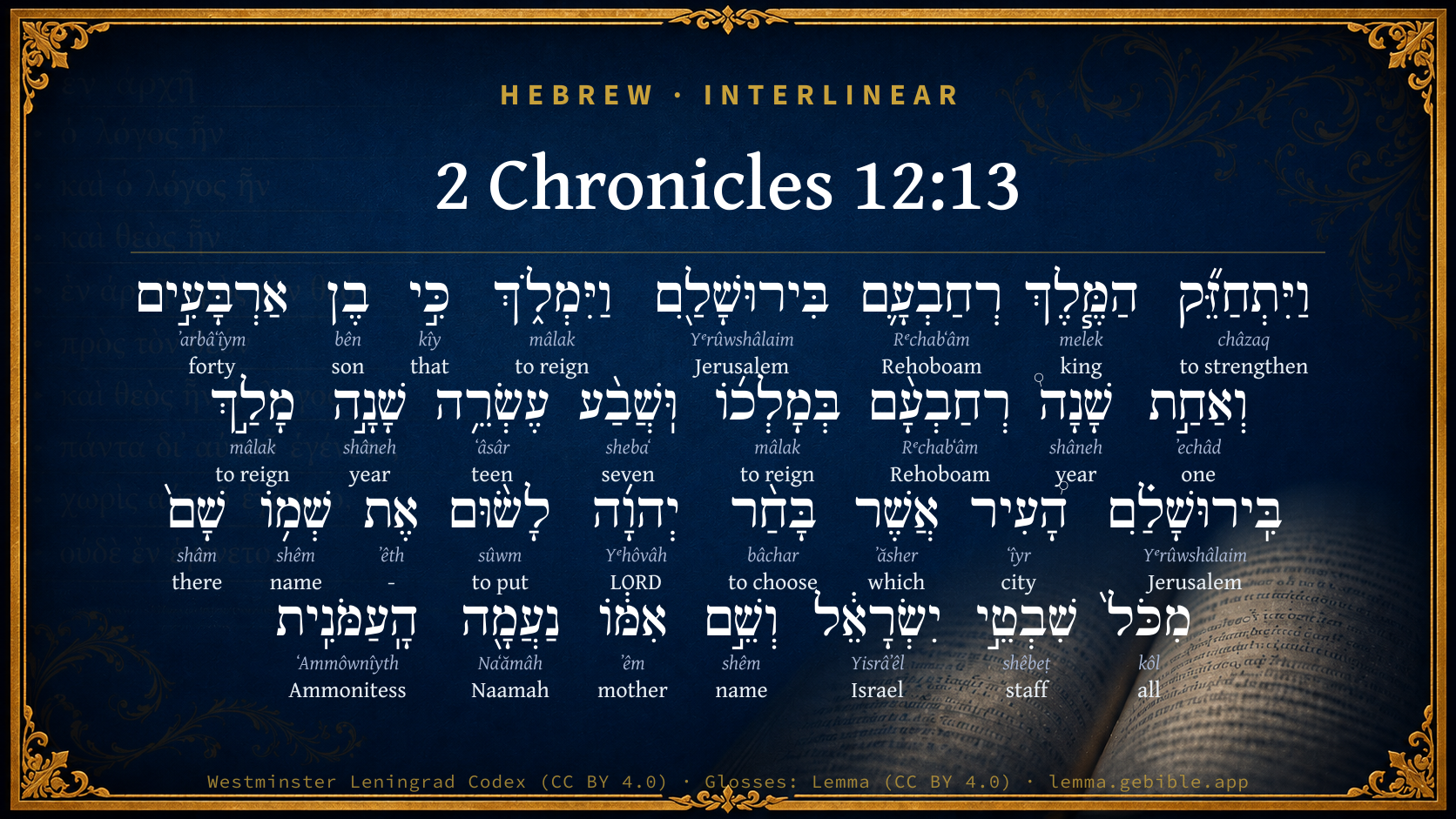
2 Chronicles 12:13

Hebrew (Westminster Leningrad Codex) 2 Chronicles 12:13 appears in the Hebrew Old Testament. The text above is from the Westminster Leningrad Codex. Each word links to its Strong’s number, a concise gloss, and parsing drawn from the Open Scriptures Hebrew Bible morphology. Click any word for its full Brown-Driver-Briggs (BDB) entry.
Download image
Cite this verse

2 Chronicles 12:13 (World English Bible). Public Domain. Lemma interlinear Bible study tool, https://lemma.gebible.app/v/2-chronicles/12/13.

Show BibTeX & RIS
BibTeX
RIS
English Translation
So king Rehoboam strengthened himself in Jerusalem, and reigned: for Rehoboam was forty-one years old when he began to reign, and he reigned seventeen years in Jerusalem, the city which Yahweh had chosen out of all the tribes of Israel, to put his name there: and his mother's name was Naamah the Ammonitess.
World English Bible · Public Domain
Download a study sheet

One document with this verse’s original text, its word-by-word gloss line, the meaning frame, cross-references with their text, attributed commentary, and full source and license credits — printable, and it pastes into notes with its structure intact.

This verse Autodidact and up

Study sheet (.html) Plain text (.txt)

A passage Seminary Student

Up to 50 verses in one chapter. A passage sheet keeps up to 6 commentary sources and 12 cross-references per verse, in the order this page ranks them, and says so on the sheet whenever that leaves anything out. Ask for a single verse and you get the Autodidact verse sheet above.

Everything on this page stays free to read, with no account — the sheet is a download of what is already on screen, not access to it.

Want to remove ads? Support Godless Engineer
Compare translations 3

The same verse in 3 English versions, stacked beneath the original-language interlinear above. Click any original word for its lexicon entry.

Each is an independent rendering of the whole verse — the interlinear is not word-aligned to these translations.

Highlighted words mark where these versions differ — a whole-verse word diff, not a word-by-word alignment.

  • World English Bible Public Domain
    So king Rehoboam strengthened himself in Jerusalem, and reigned: for Rehoboam was forty-one years old when he began to reign, and he reigned seventeen years in Jerusalem, the city which Yahweh had chosen out of all the tribes of Israel, to put his name there: and his mother's name was Naamah the Ammonitess.
  • King James Version Public Domain
    So king Rehoboam strengthened himself in Jerusalem, and reigned: for Rehoboam was one and forty years old when he began to reign, and he reigned seventeen years in Jerusalem, the city which the LORD had chosen out of all the tribes of Israel, to put his name there. And his mother's name was Naamah an Ammonitess.
  • unfoldingWord Literal Text CC BY-SA 4.0
    And King Rehoboam strengthened himself in Jerusalem, and he reigned. For a son of 41 years Rehoboam was in his reigning, and 17 years he reigned in Jerusalem, the city that Yahweh had chosen to put his name there from all the tribes of Israel. And the name of his mother, Naamah the Ammonitess.

unfoldingWord Literal Text — © unfoldingWord, licensed CC BY-SA 4.0. Word-aligned USFM3 via Door43 (git.door43.org/unfoldingWord/en_ult).

Versions to compare (up to 4)

3 of 4 selected

Show all 18 translations

Every available English version of this verse, each an independent rendering of the whole verse.

  • World English Bible Public Domain
    So king Rehoboam strengthened himself in Jerusalem, and reigned: for Rehoboam was forty-one years old when he began to reign, and he reigned seventeen years in Jerusalem, the city which Yahweh had chosen out of all the tribes of Israel, to put his name there: and his mother's name was Naamah the Ammonitess.
  • Berean Standard Bible Public Domain
    Thus King Rehoboam established himself in Jerusalem. He was forty-one years old when he became king, and he reigned seventeen years in Jerusalem, the city the LORD had chosen from all the tribes of Israel in which to put His Name. His mother’s name was Naamah the Ammonite.
  • Majority Standard Bible Public Domain
    Thus King Rehoboam established himself in Jerusalem and reigned. He was forty-one years old when he became king, and he reigned seventeen years in Jerusalem, the city the LORD had chosen from all the tribes of Israel in which to put His Name. His mother’s name was Naamah the Ammonite.
  • King James Version Public Domain
    So king Rehoboam strengthened himself in Jerusalem, and reigned: for Rehoboam was one and forty years old when he began to reign, and he reigned seventeen years in Jerusalem, the city which the LORD had chosen out of all the tribes of Israel, to put his name there. And his mother's name was Naamah an Ammonitess.
  • American Standard Version (1901) Public Domain
    So king Rehoboam strengthened himself in Jerusalem, and reigned: for Rehoboam was forty and one years old when he began to reign, and he reigned seventeen years in Jerusalem, the city which Jehovah had chosen out of all the tribes of Israel, to put his name there: and his mother's name was Naamah the Ammonitess.
  • Revised Version (1885) Public Domain
    So king Rehoboam strengthened himself in Jerusalem, and reigned: for Rehoboam was forty and one years old when he began to reign, and he reigned seventeen years in Jerusalem, the city which the LORD had chosen out of all the tribes of Israel, to put his name there: and his mother’s name was Naamah the Ammonitess.
  • Geneva Bible (1599) Public Domain
    So King Rehoboam was strong in Ierusalem and reigned: for Rehoboam was one and fourtie yere olde, when he began to reigne, and reigned seuenteene yeres in Ierusalem, the citie which the Lord had chosen out of all the tribes of Israel to put his Name there. And his mothers name was Naamah an Ammonitesse.
  • Douay-Rheims (1899) Public Domain
    King Roboam therefore was strengthened in Jerusalem, and reigned: he was one and forty years old when he began to reign, and he reigned seventeen years in Jerusalem, the city which the Lord chose out of all the tribes of Israel, to establish his name there: and the name of his mother was Naama an Ammonitess.
  • Young's Literal Translation Public Domain
    And king Rehoboam strengtheneth himself in Jerusalem, and reigneth; for a son of forty and two years `is' Rehoboam in his reigning, and seventeen years he hath reigned in Jerusalem, the city that Jehovah hath chosen to put His name there, out of all the tribes of Israel, and the name of his mother `is' Naamah the Ammonitess,
  • Literal Standard Version CC BY-SA 4.0
    And King Rehoboam strengthens himself in Jerusalem and reigns; for Rehoboam [is] a son of forty-two years in his reigning, and he has reigned seventeen years in Jerusalem, the city that YHWH has chosen to put His Name there, out of all the tribes of Israel, and the name of his mother [is] Naamah the Ammonitess,
  • Unlocked Literal Bible CC BY-SA 4.0
    So King Rehoboam made his kingship strong in Jerusalem, and thus he reigned. Rehoboam was forty-one years old when he began to reign, and he reigned for seventeen years in Jerusalem, the city that Yahweh had chosen from all the tribes of Israel so that he might put his name there. His mother's name was Naamah the Ammonite woman.
  • unfoldingWord Literal Text CC BY-SA 4.0
    And King Rehoboam strengthened himself in Jerusalem, and he reigned. For a son of 41 years Rehoboam was in his reigning, and 17 years he reigned in Jerusalem, the city that Yahweh had chosen to put his name there from all the tribes of Israel. And the name of his mother, Naamah the Ammonitess.
  • Darby Bible Public Domain
    And king Rehoboam strengthened himself in Jerusalem, and reigned; for Rehoboam was forty-one years old when he began to reign, and he reigned seventeen years in Jerusalem, the city that Jehovah had chosen out of all the tribes of Israel, to put his name there: and his mother's name was Naamah an Ammonitess.
  • World Messianic Bible Public Domain
    So King Rehoboam strengthened himself in Jerusalem and reigned; for Rehoboam was forty-one years old when he began to reign, and he reigned seventeen years in Jerusalem, the city which the LORD had chosen out of all the tribes of Israel to put his name there. His mother’s name was Naamah the Ammonitess.
  • Webster's Bible Public Domain
    So king Rehoboam strengthened himself in Jerusalem, and reigned: for Rehoboam was one and forty years old when he began to reign, and he reigned seventeen years in Jerusalem, the city which the LORD had chosen out of all the tribes of Israel, to put his name there. And his mother's name was Naamah an Ammonitess.
  • Free Bible Version CC BY-SA 4.0
    King Rehoboam became powerful in Jerusalem. He was forty-one when he became king, and he reigned seventeen years in Jerusalem, the city the Lord had chosen from all the tribes of Israel where he would be honored. The name of his mother was Naamah the Ammonite.
  • Bible in Basic English Public Domain
    So King Rehoboam made himself strong in Jerusalem and was ruling there. Rehoboam was forty-one years old when he became king, and he was ruling for seventeen years in Jerusalem, the town which the Lord had made his out of all the tribes of Israel, to put his name there; and his mother's name was Naamah, an Ammonite woman.
  • JPS Tanakh (1917) Public Domain
    So king Rehoboam strengthened himself in Jerusalem, and reigned; for Rehoboam was forty and one years old when he began to reign, and he reigned seventeen years in Jerusalem, the city which the LORD had chosen out of all the tribes of Israel, to put His name there; and his mother's name was Naamah the Ammonitess.

Literal Standard Version (2020), Covenant Press — licensed CC BY-SA 4.0. Text via the HelloAO Bible API (eBible.org). Unlocked Literal Bible (unfoldingWord) — licensed CC BY-SA 4.0. Text via the HelloAO Bible API (eBible.org). unfoldingWord Literal Text — © unfoldingWord, licensed CC BY-SA 4.0. Word-aligned USFM3 via Door43 (git.door43.org/unfoldingWord/en_ult). Free Bible Version, Dr. Jonathan Gallagher — licensed CC BY-SA 4.0. Text via the HelloAO Bible API (eBible.org).

Word by word

More ways to search: Search by grammar → Find every occurrence → Compare this word →

Practice this passage: Drill this verse → Learn its vocabulary →

הָֽעַמֹּנִֽית
ʻAmmôwnîyth
H5985
“the · Ammonitess”
Particle, Definite Article + Noun, Gentilic, Feminine, Singular, Absolute
Part of Speech
Particle + Noun
Type
Gentilic
Gender
Feminine
Number
Singular
State
Absolute
Full BDB Definition

Origin: fem of H5984

TWOT: None

Ammonitess = see Ammon " tribal" - a woman of Ammon
  1. וַיִּתְחַזֵּ֞ק châzaq H2388 “and · to strengthen” Conjunction + Verb, Hithpael, Sequential Imperfect, 3rd Person, Masculine, Singular
  2. הַמֶּ֧לֶךְ melek H4428 “the · king” Particle, Definite Article + Noun, Common, Masculine, Singular, Absolute
  3. רְחַבְעָ֛ם Rᵉchabʻâm H7346 “Rehoboam” Noun, Proper
  4. בִּירוּשָׁלִַ֖ם Yᵉrûwshâlaim H3389 “in/at · Jerusalem” Preposition + Noun, Proper
  5. וַיִּמְלֹ֑ךְ mâlak H4427 “and · to reign” Conjunction + Verb, Qal, Sequential Imperfect, 3rd Person, Masculine, Singular
  6. כִּ֣י kîy H3588 “that” Conjunction
  7. בֶן bên H1121 “son of” Noun, Common, Masculine, Singular, Construct
  8. אַרְבָּעִ֣ים ʼarbâʻîym H705 “forty” Adjective, Cardinal number, Both, Plural, Absolute
  9. וְאַחַ֣ת ʼechâd H259 “and · one” Conjunction + Adjective, Cardinal number, Feminine, Singular, Absolute
  10. שָׁנָה֩ shâneh H8141 “year” Noun, Common, Feminine, Singular, Absolute
  11. רְחַבְעָ֨ם Rᵉchabʻâm H7346 “Rehoboam” Noun, Proper
  12. בְּמָלְכ֜וֹ mâlak H4427 “in/at · to reign · him” Preposition + Verb, Qal, Infinitive Construct + Suffix, Personal, 3rd Person, Masculine, Singular
  13. וּֽשֲׁבַ֨ע shebaʻ H7651 “and · seven” Conjunction + Adjective, Cardinal number, Feminine, Singular, Absolute
  14. עֶשְׂרֵ֥ה ʻâsâr H6240 “teen” Adjective, Cardinal number, Feminine, Singular, Absolute
  15. שָׁנָ֣ה shâneh H8141 “year” Noun, Common, Feminine, Singular, Absolute
  16. מָלַ֣ךְ mâlak H4427 “to reign” Verb, Qal, Perfect, 3rd Person, Masculine, Singular
  17. בִּֽירוּשָׁלִַ֗ם Yᵉrûwshâlaim H3389 “in/at · Jerusalem” Preposition + Noun, Proper
  18. הָ֠עִיר ʻîyr H5892 “the · city” Particle, Definite Article + Noun, Common, Feminine, Singular, Absolute
  19. אֲשֶׁר ʼăsher H834 “which” Particle, Relative
  20. בָּחַ֨ר bâchar H977 “to choose” Verb, Qal, Perfect, 3rd Person, Masculine, Singular
  21. יְהוָ֜ה Yᵉhôvâh H3068 “LORD” Noun, Proper
  22. לָשׂ֨וּם sûwm H7760 “to put” Preposition + Verb, Qal, Infinitive Construct
  23. אֶת ʼêth H853 “-” Particle, Direct Object
  24. שְׁמ֥וֹ shêm H8034 “name · his” Noun, Common, Masculine, Singular, Construct + Suffix, Personal, 3rd Person, Masculine, Singular
  25. שָׁם֙ shâm H8033 “there” Adverb
  26. מִכֹּל֙ kôl H3605 “from · all of” Preposition + Noun, Common, Masculine, Singular, Construct
  27. שִׁבְטֵ֣י shêbeṭ H7626 “staffs of” Noun, Common, Masculine, Plural, Construct
  28. יִשְׂרָאֵ֔ל Yisrâʼêl H3478 “Israel” Noun, Proper
  29. וְשֵׁ֣ם shêm H8034 “and · name of” Conjunction + Noun, Common, Masculine, Singular, Construct
  30. אִמּ֔וֹ ʼêm H517 “mother · his” Noun, Common, Feminine, Singular, Construct + Suffix, Personal, 3rd Person, Masculine, Singular
  31. נַעֲמָ֖ה Naʻămâh H5279 “Naamah” Noun, Proper

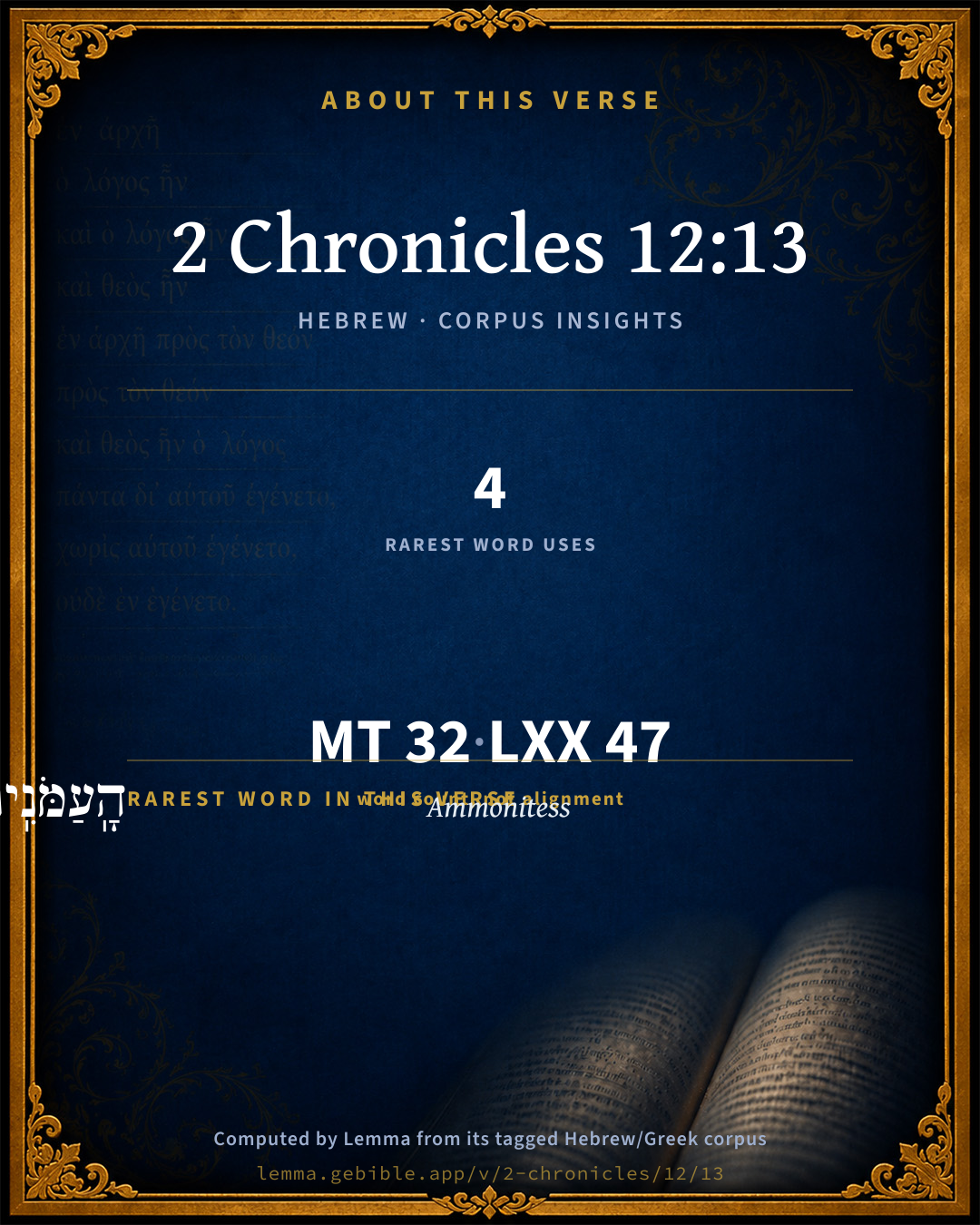
About this verse

These counts appear in no published source. They are computed here, from the morphology-tagged text and Lemma’s own curated glosses. What Lemma adds →

32
words
26
distinct lemmas
Historical
section

Notable vocabulary

The rarest word here is הָֽעַמֹּנִֽית Ammonitess H5985 — appearing just 4 times in the whole Hebrew Bible.

Shared distinctive vocabulary

הָֽעַמֹּנִֽית Ammonitess H5985 occurs in 4 verses of the Hebrew Bible. Also found in:

Grammatical profile

  • 6 verbs
  • 18 nouns
  • 4 adjectives
  • 1 conjunction
  • 1 adverb
  • 2 particles

Verb forms

  • וַיִּתְחַזֵּ֞ק Hithpael · Sequential Imperfect
  • וַיִּמְלֹ֑ךְ Qal · Sequential Imperfect
  • בְּמָלְכ֜וֹ Qal · Infinitive Construct
  • מָלַ֣ךְ Qal · Perfect
  • בָּחַ֨ר Qal · Perfect
  • לָשׂ֨וּם Qal · Infinitive Construct

Repetition

Words recur within this verse — often emphatic in Hebrew:

  • וַיִּמְלֹ֑ךְ to reign H4427 ×3
  • רְחַבְעָ֛ם Rehoboam H7346 ×2
  • בִּירוּשָׁלִַ֖ם Jerusalem H3389 ×2
  • שָׁנָה֩ year H8141 ×2
  • שְׁמ֥וֹ name H8034 ×2

Hebrew & Septuagint length

In English translation the verse runs 53 words from the Hebrew and 59 from the Septuagint (LXX English) — closely comparable.

A rough comparison of the two English renderings, which tokenize alike — not a word-level alignment.

Word counts can differ between the Hebrew and the Greek without any difference in meaning — e.g. the Hebrew direct-object marker אֵת has no separate Greek word, and Greek often adds the article ὁ.

In the original languages it is 32 Hebrew tokens and 47 Greek tokens — but the two are counted differently (Hebrew bundles its prefixes and suffixes into one token; the Greek is in lemma form), so that isn’t a like-for-like length.

Cross-references

13

Topical passages linked to 2 Chronicles 12:13 in the Treasury of Scripture Knowledge — connected by theme and wording, ordered by reader-vote popularity; previews shown in the World English Bible.

  • 1 Kings 14:21 Rehoboam the son of Solomon reigned in Judah. Rehoboam was forty-one years old when he began to reign, and he reigned seventeen years in Jerusalem, the city which Yahweh had chosen out of all the tribes of Israel, to put his name there: and his mother's name was Naamah the Ammonitess.
  • Deuteronomy 12:5 But to the place which Yahweh your God shall choose out of all your tribes, to put his name there, even to his habitation shall you seek, and there you shall come;
  • 2 Chronicles 6:6 but I have chosen Jerusalem, that my name might be there; and have chosen David to be over my people Israel.
  • Exodus 20:24 You shall make an altar of earth for me, and shall sacrifice on it your burnt offerings and your peace-offerings, your sheep and your oxen. In every place where I record my name I will come to you and I will bless you.
  • Deuteronomy 12:11 then it shall happen that to the place which Yahweh your God shall choose, to cause his name to dwell there, there shall you bring all that I command you: your burnt offerings, and your sacrifices, your tithes, and the heave-offering of your hand, and all your choice vows which you vow to Yahweh.
  • Deuteronomy 23:3 An Ammonite or a Moabite shall not enter into the assembly of Yahweh; even to the tenth generation shall none belonging to them enter into the assembly of Yahweh forever:
  • 1 Kings 11:1 Now king Solomon loved many foreign women, together with the daughter of Pharaoh, women of the Moabites, Ammonites, Edomites, Sidonians, and Hittites;
  • 2 Chronicles 13:7 There were gathered to him worthless men, base fellows, who strengthened themselves against Rehoboam the son of Solomon, when Rehoboam was young and tender-hearted, and could not withstand them.
  • Nehemiah 13:1 On that day they read in the book of Moses in the audience of the people; and therein was found written, that an Ammonite and a Moabite should not enter into the assembly of God forever,
  • Nehemiah 13:26 Did not Solomon king of Israel sin by these things? yet among many nations was there no king like him, and he was beloved of his God, and God made him king over all Israel: nevertheless even him did foreign women cause to sin.
  • Psalms 48:1–3 Great is Yahweh, and greatly to be praised, In the city of our God, in his holy mountain.
  • Psalms 78:68–69 But chose the tribe of Judah, Mount Zion which he loved.
  • Ezekiel 48:35 It shall be eighteen thousand [reeds] round about: and the name of the city from that day shall be, Yahweh is there.

Cross-references courtesy of OpenBible.info (CC BY 4.0).

Hebrew and Greek witnesses Masoretic Hebrew ↔ Greek Septuagint

The same verse in the two great witnesses to the Old Testament, shown verse-for-verse.

These are two independent witnesses, not word-aligned to each other, and the Septuagint is shown in lemma (dictionary) form.

Hebrew 2 Chronicles 12:13 Masoretic · Westminster Leningrad Codex

וַיִּתְחַזֵּ֞ק הַמֶּ֧לֶךְ רְחַבְעָ֛ם בִּירוּשָׁלִַ֖ם וַיִּמְלֹ֑ךְ כִּ֣י בֶן אַרְבָּעִ֣ים וְאַחַ֣ת שָׁנָה֩ רְחַבְעָ֨ם בְּמָלְכ֜וֹ וּֽשֲׁבַ֨ע עֶשְׂרֵ֥ה שָׁנָ֣ה מָלַ֣ךְ בִּֽירוּשָׁלִַ֗ם הָ֠עִיר אֲשֶׁר בָּחַ֨ר יְהוָ֜ה לָשׂ֨וּם אֶת שְׁמ֥וֹ שָׁם֙ מִכֹּל֙ שִׁבְטֵ֣י יִשְׂרָאֵ֔ל וְשֵׁ֣ם אִמּ֔וֹ נַעֲמָ֖ה הָֽעַמֹּנִֽית

So king Rehoboam strengthened himself in Jerusalem, and reigned: for Rehoboam was forty-one years old when he began to reign, and he reigned seventeen years in Jerusalem, the city which Yahweh had chosen out of all the tribes of Israel, to put his name there: and his mother's name was Naamah the Ammonitess.

World English Bible · Public Domain

Greek LXX 2 Chronicles 12:13 Septuagint · lemma form

καί καταἰσχύω ροβοαμ ἐν ἰερουσαλήμ καί βασιλεύω καί τεσσαράκοντα καί εἷς ἔτος ροβοαμ ἐν ὁ βασιλεύω αὐτός καί ἑπτακαίδεκα ἔτος βασιλεύω ἐν ἰερουσαλήμ ἐν ὁ πόλις ὅς ἐκλέγω κύριος ἐπιὀνομάζω ὁ ὄνομα αὐτός ἐκεῖ ἐκ πᾶς φυλή υἱός ἰσραήλ καί ὄνομα ὁ μήτηρ αὐτός νοομμα ὁ αμμανῖτις

So king Roboam strengthened himself in Jerusalem, and reigned: and Roboam was forty and one years old when he began to reign, and he reigned seventeen years in Jerusalem, in the city which the Lord chose out of all the tribes of the children of Israel to call his name there: and his mother's name was Noomma the Ammanitess.

LXX2012 (modern English Septuagint) · Public Domain

On this verse, The Cambridge Bible for Schools and Colleges discusses the Septuagint’s reading. Read the note in Commentary ↓

Hebrew: Westminster Leningrad Codex (CC BY 4.0). Greek: Septuagint (public domain); English from LXX2012 (modern English Septuagint) (Public Domain). How the Septuagint differs from the Hebrew →

Commentary

Notes on 2 Chronicles 12:13 from classic Christian and Jewish commentators (each source and its license shown beneath its notes). The classic Christian expositions comment on the surrounding passage and are grouped to its opening verse, so a note may address several verses; the Jewish commentaries on the Tanakh (Rashi and others) are per-verse, so they appear only where the commentator wrote on this verse.

Lemma curates 59 commentaries, every one of them public domain or Creative Commons licensed, each selected and text-cleaned for this edition rather than reprinted as found. About our sources →

Matthew Henry's Commentary

The story of Rehoboam's reign is here concluded, much as the story of the other reigns concludes. Two things especially are observable here: - 1. That he was at length pretty well fixed in his kingdom, Ch2 12:13. His fenced cities in Judah did not answer his expectation, so he now strengthened himself in Jerusalem, which he made it his business to fortify, and there he reigned seventeen years, in the city which the Lord had chosen to put his name there. This intimates his honour and privilege, that he had his royal seat in the holy city, which yet was but an aggravation of his impiety - near the temple, but far from God. Frequent skirmishes there were between his subjects and Jeroboam's, such as amounted to continual wars, (Ch2 12:15), but he held his own, and reigned, and, as it should seem, did not so grossly forsake the law of God as he had done (Ch2 12:1) in his fourth year. 2. That he was never rightly fixed in his religion, Ch2 12:14. He never quite cast off God; and yet in this he did evil, that he prepared not, he engaged not, his heart to seek the Lord. See what the fault is laid upon. (1.) He did not serve the Lord because he did not seek the Lord. He did not pray, as Solomon did, for wisdom and grace. If we prayed better, we should be every way better. Or he did not consult the word of God, did not seek to that as his oracle, nor take directions from it. (2.) He made nothing of his religion because he did not set his heart to it, never minded it with any closeness of application, and never any hearty disposition to it, nor ever came up to a steady resolution in it. What little goodness he had was transient and passed away like the morning cloud. He did evil because he was never determined for that which is good. Those are easily drawn by Satan to any evil who are wavering and inconstant in that which is good and are never persuaded to make religion their business.

Matthew Henry's Commentary on the Whole Bible (1708–1710) — public domain (CC PDM 1.0). Text via the HelloAO Bible API.

Jamieson, Fausset & Brown

Robert Jamieson, A. R. Fausset & David Brown

HIS REIGN AND DEATH. (Ch2 12:13-16)

Rehoboam strengthened . . . and reigned--The Egyptian invasion had been a mere predatory expedition, not extending beyond the limits of Judah, and probably, ere long, repelled by the invaded. Rehoboam's government acquired new life and vigor by the general revival of true religion, and his reign continued many years after the departure of Shishak. But

he prepared not his heart to seek the Lord--that is, he did not adhere firmly to the good course of reformation he had begun, "and he did evil," for through the unhappy influence of his mother, a heathen foreigner, he had no doubt received in his youth a strong bias towards idolatry (see on Kg1 14:21).

Next: 2 Chronicles Chapter 13

Jamieson, Fausset & Brown — Commentary Critical and Explanatory on the Whole Bible (1871) — public domain (CC PDM 1.0). Text via the HelloAO Bible API.

Ellicott's Commentary for English Readers

(b) SUMMING UP OF THE REIGN (2Ch_12:13-16).

(Comp. 1Ki_14:21-22; 1Ki_14:29; 1Ki_14:31.)

The Syriac and Arabic contain this section.

(13) So king Rehoboam strengthened himself.—After the withdrawal of Shishak. In other words, he regained strength after the crushing blow inflicted by the Egyptian invasion. (Comp. the same word in 2Ch_13:21; 2Ch_1:1.)

And reigned—i.e., reigned on for twelve years longer; for he reigned altogether seventeen years.

Rehoboam was one and forty . . . Naamah an Ammonitess.—Word for word as in 1Ki_14:21. (See the Notes there).

A Bible Commentary for English Readers, edited by Charles John Ellicott (1878–1897) — public domain. Text from a community e-Sword module.

Trapp's Complete Commentary

John Trapp

2Ch 12:13 So king Rehoboam strengthened himself in Jerusalem, and reigned: for Rehoboam [was] one and forty years old when he began to reign, and he reigned seventeen years in Jerusalem, the city which the LORD had chosen out of all the tribes of Israel, to put his name there. And his mother’s name [was] Naamah an Ammonitess.

Ver. 13. For Rehoboam was one and forty years old.] See 1Ki 14:21.

John Trapp, A Commentary or Exposition upon All the Books of the Old and New Testament (1647–1656) — public domain. Text from a community e-Sword module.

Joseph Benson's Commentary

2Ch 12:13. King Rehoboam strengthened himself in Jerusalem — He recovered so much strength that he reigned with some authority: or, finding that his fenced cities of Judah did not answer his expectation, he now made it his business to fortify Jerusalem, and render that impregnable. And there he reigned seventeen years, in the city which the Lord had chosen to put his name there.

Joseph Benson's Commentary on the Old and New Testaments (1811–1818) — public domain. Text from a community e-Sword module.

Geneva Bible (1599)

Geneva Bible translators

That is, twelve years after that he had been overcome by Shishak, verse 2.

Geneva Bible (1599) marginal notes — public domain. Text via Bolls.life.

Adam Clarke's Commentary

Verse 13. Was one and forty years old] Houbigant thinks he was but sixteen years old when he began to reign; and brings many and forcible arguments to prove that the number forty-one must be a mistake. That he was young when he came to the throne, is evident from his consulting the young men that were brought up with him, 2Ch 10:8; 2Ch 10:10. They were young men then; and if he was brought up with them, he must have been young then also. Besides, Abijah, in his speech to Jeroboam, 2Ch 13:7, says that at the time Rehoboam came to the throne he was tender-hearted, and therefore could not withstand the children of Belial raised up against him by Jeroboam: but surely at that time no man could be reputed young and tender-hearted - quite devoid of experience, who was above forty years of age. Besides, if this reading were allowed, it would prove that he was born before his father Solomon began to reign, for Solomon reigned only forty years, and Rehoboam immediately succeeded him.

Adam Clarke's Commentary on the Bible (1810–1826) — public domain. Text from a community e-Sword/MySword module.

The Cambridge Bible for Schools and Colleges

gen. ed. J. J. S. Perowne

13–16 (cp. 1Ki_14:21; 1Ki_14:29-31). Summary of Rehoboam’s Reign

13. strengthened himself] See note on 2Ch_1:1. The immediate reference is to a recovery of strength after the departure of Shishak, the further reference is to 2Ch_11:5.

one and forty years old … and he reigned seventeen years] So read both Heb. and LXX. here and in 1Ki_14:21, but in the additional passage which follows 1Ki_12:14 in LXX. (B, not A) is read, sixteen years old … and twelve years he reigned. No importance however can be attached to this variation, for the passage which contains it is plainly Midrashic in character.

the city which the Lord had chosen] Though the Ten Tribes were lost to the house of David, the Lord kept his oath to David by securing to his seed the possession of the one holy city of Israel.

Naamah an Ammonitess] R.V. Naamah the Ammonitess.

The Cambridge Bible for Schools and Colleges (gen. ed. J. J. S. Perowne; Cambridge University Press, 1878–1918) — public domain. Text from a community e-Sword module.

John Gill's Exposition

And he did evil,.... Committed idolatry, relapsed into that, his humiliation not being hearty and sincere:

because he prepared not his heart to seek the Lord; by prayer and supplication, and by an attendance on the service and worship of God; for though he did these things outwardly, yet not sincerely and heartily; he did not engage in them seriously and in good earnest, with affection and fervour.

John Gill's Exposition of the Whole Bible (1746–1763) — public domain (CC PDM 1.0). Text via the HelloAO Bible API.

The Pulpit Commentary

The parallel to the remaining verses of this chapter is found in 1Ki_14:21, 1Ki_14:22, 1Ki_14:29-31. In Jerusalem. Possibly, considering the words of 2Ch_11:5-12, 2Ch_11:17, this may indicate that Rehoboam was brought down to thinking almost more of the safety of Jerusalem and himself than of the kingdom in its length and breadth. One and forty years old (see our note, 2Ch_10:8, towards the end, and compare our 2Ch_13:7, as well as the parallel places. (1Ki_12:8 1Ki_14:21) It cannot be held as conclusively shown that the age of forty-one is incorrect. An Ammonitess. (see 1Ki_11:1-9) Rehoboam"s mother"s name and nationality are noted also, and twice in the parallel. (1Ki_14:21, 1Ki_14:31) Naamah was possibly the daughter of Nahash. (1Ch_19:1-19; 1Ch_20:1-3) The briefness but decidedness of the notifications made as to this mother of Rehoboam leaves us without doubt that there is not lacking significance in them. Schulz (in his "Scholia in Ver. Test.," vol. 3.) says the reason is "quia ca filio idololatriae ansam dedisse videtur;" Keil and Bertheau think that, though there was evidence of this in the case of the mention of Asa"s mother, (1Ki_15:13) the explanation here is that Naamah "appears" to have had, as queen-mother, considerable influence in the government. They do not specify where they find this to "appear" with any marked plainness. It is quite true that, in the successive accounts of the Jewish kings, the name of each mother is mentioned (1Ki_15:2; 2Ch_13:2; 1Ki_22:42; 2Ch_20:32, etc.) We should say it is like the book, so Divine and human, called the Bible, to do so far-seeing and far-reaching a thing as to give the mother"s name; and practically to say that Solomon and Naamah were (in special sense for Judah) a repetition of Adam and Eve. How far Judah and her line of kings may have correctly said, they were answerable for "death and all our woe," the sacred historians say. (1Ki_11:4, 1Ki_11:9-11, 1Ki_11:14, 1Ki_11:23, 1Ki_11:26, 1Ki_11:31, 1Ki_11:33, 36 12:24; 2Ch_11:4)

Vers. 13-16.

The biography of Rehoboam.

I HIS ANCESTRY.

1. The son of Solomon, the son of David.

2. The son of Naamah the Ammonitess, the daughter of Hanun the son of Nahash. (2Ch_10:1)

II HIS KINGDOM.

1. Its extent. Judah, with a portion of Benjamin.

2. Its capital. Jerusalem, the city of the great King.

III HIS REIGN.

1. The beginning of it. When he was forty years of age.

2. The length of it. Seventeen years; short in comparison with that of Solomon.

1. The character of it.

1. Vigorous: "he strengthened himself" (ver. 13).

2. Idolatrous: "he did evil, because he prepared not his heart to seek the Lord" (ver. 14).

3. Troubled: "there were wars continually between him and Jeroboam" (ver. 15).

0. The end of it. Rehoboam slept with his fathers, and was buried in the city of David.

IV HIS ACTS.

1. All written. From first to last (ver. 15). What a calamity to any man it would be to have all his deeds recorded on the page of history! Yet first and last every action of every man is being engrossed upon the page of God"s book of remembrance.

2. Where written? In the book of Shemaiah the prophet, and in that of Iddo concerning genealogies. A small honour compared to being written in the book of life. Not so serious a matter to have one"s deeds inscribed upon a perishing page by a human biographer as to have them graven "as with a pen of iron in the rock for ever," by the hand of God"s recording angel upon the tablets of eternity.

V HIS SUCCESSOR.

1. His name. Abijah, or Abijam. (2Ch_13:1)

2. His rotgut. In Rehoboam"s stead. An honour to Rehoboam that he had a son like Abijah; a mercy to Judah that Abijah was better than his father. W.

The Pulpit Commentary (1880–1919), ed. H.D.M. Spence-Jones & Joseph S. Exell — public domain. Text from a community e-Sword module.

Keil & Delitzsch

C. F. Keil & F. Delitzsch

The length of Rehoboam's reign, his mother, and the judgment about him. Cf. Kg1 14:21 and Kg1 14:22. ויּתחזּק here, as in Ch2 13:21, can, in its connection with what precedes, be only understood to mean that Rehoboam, after his humiliation at the hands of Shishak, by which his kingdom was utterly weakened and almost destroyed, again gained strength and power. Cf. also Ch2 1:1, where יתחזּק is used of Solomon in the beginning of his reign, after he overcame Adonijah, the pretender to the crown, and his party. - As to the age of Rehoboam, etc., see on Kg1 14:21. הרע ויּעשׂ, Ch2 12:14, is defined by the addition, "for he prepared not his heart to seek the Lord." For the expression cf. Ch2 19:3; Ch2 30:19; Ezr 7:10.

Keil & Delitzsch — Biblical Commentary on the Old Testament (1861–1891) — public domain (CC PDM 1.0). Text via the HelloAO Bible API. (Old Testament only.)

Kretzmann's Popular Commentary

Paul E. Kretzmann

Rehoboam’s Reign and Death

v. 13. So King Rehoboam strengthened himself in Jerusalem, having repented of his sins, he could clear his land of the invaders in the course of time, and reigned; for Rehoboam was one and forty years old when he began to reign, and he reigned seventeen years in Jerusalem, the city which the Lord had chosen out of all the tribes of Israel to put His name there, which He had intended for the central Sanctuary for the entire people of Israel. And his mother’s name was Naamah, an Ammonitess, who, by reason of the harem system, had more influence over him than would otherwise have been the case.

v. 14. And he did evil, that was the general impression of his reign, because he prepared not his heart to seek the Lord, he did not adhere with all strictness and with unvarying sincerity to the reformation which he had begun; he kept his tendency toward idolatry, due chiefly to the influence of his mother.

v. 15. Now, the acts of Rehoboam, first and last, are they not written in the Book of Shemaiah, the prophet, and of Iddo, the seer, concerning genealogies? These were the sources from which the sacred historian, under the guidance of the Holy Spirit, got his information. And there were wars between Rehoboam and Jeroboam continually; although there were no battles or armed clashes, they were in a hostile frame of mind toward each other.

v. 16. And Rehoboam slept with his fathers and was buried in the City of David; and Abijah, his son, selected by his father as his successor, reigned in his stead. Note: Apostasy from God has ever resulted in quarrels, wars. and misfortunes of every kind. Therefore we of these latter days should heed His warnings all the more carefully and serve our Lord with all sincerity of heart.

Paul E. Kretzmann, Popular Commentary of the Bible (1921–1924) — public domain. Text from a community e-Sword module.

unfoldingWord translationNotes

Door43 World Missions Community

forty-one years old ... seventeen years

"41 years old ... 17 years" (See: Numbers)

so that he might put his name there

Possible meanings for the phrase "put his name" are 1) a metonym for "dwell." AT: "so that he might dwell there" or 2) an idiom that refers to ownership. AT: "so that it might belong to him" (See: Metonymy and Idiom)

Naamah

This is the name of a woman. (See: How to Translate Names)

he did not fix his heart to seek Yahweh

Here the word "heart" represents the thoughts and desires. The idiom "fix his heart" means to determine to do something. AT: "he was not committed to seeking Yahweh" (See: Metonymy and Idiom)

to seek Yahweh

Worshiping Yahweh is spoken of as if the person were seeking Yahweh. AT: "to worship Yahweh" (See: Metaphor)

translationWords

reign

tribe

Israel

name

Ammon

evil

heart

unfoldingWord translationNotes — © Distant Shores Media and the Door43 World Missions Community, licensed CC BY-SA 4.0. Source: git.door43.org/Door43/en_tn.

Rashi

Rabbi Shlomo Yitzchaki (Rashi)

And King Rehoboam strengthened himself in Jerusalem And he explains why, because when he was first made king, he was forty-one years old; therefore, he had the strength and the power to strengthen himself. He was a year old when David died, for Solomon reigned forty years, and Solomon had not yet reigned when Rehoboam was born. We find that Rehoboam was forty-one years old when he reigned.

the city that the Lord had chosen wherein to place His name, out of all the tribes of Israel but they deteriorated in their deeds, as it is written: “And he did that which was evil, for he did not set his heart to seek the Lord,” and they caused the Shechinah to leave them, and it was as if they were complaining and demonstrating about that.

Rashi on the Tanakh — English translations: “The Judaica Press complete Tanach with Rashi, translated by A. J. Rosenberg” (CC BY 4.0); “Pentateuch with Rashi's commentary by M. Rosenbaum and A.M. Silbermann, 1929-1934” (public domain); “The Metsudah Tanach series, Lakewood, N.J” (CC BY 4.0); and “The Book of Joshua, Metsudah Publications, 1997” (CC BY 4.0). Text via Sefaria.

Lesson kit

Teaching starters — assembled from the data on this page, not authored interpretation. Every prompt links to the verse data it draws on. Edit before teaching.

2 Chronicles, in the Historical, opens this verse with 32 words (26 distinct Hebrew lemmas). Its most distinctive word is ʻAmmôwnîyth (“Ammonitess”). A historical commentator’s framing appears above. Read the whole chapter for the surrounding context.

Discussion questions

  1. How does “Ammonitess” (ʻAmmôwnîyth) shape what this verse is saying?
  2. How does 1 Kings 14:21, which shares the word «Ammonitess», read alongside this verse?
  3. What does the repetition of “to reign” (3× in this one verse) do in this verse?
  4. The translations on this page render this verse differently — a whole-verse word diff, not a word-by-word alignment. What might account for the different wordings?
  5. «וַיִּתְחַזֵּ֞ק» is a Hithpael Sequential Imperfect verb. How does that grammatical form shape the action described?
  6. Compare how Matthew Henry's Commentary and Jamieson, Fausset & Brown read this verse. Where do they agree or differ?

Things to notice

Reading settings

Reading text

Shown beneath each verse's original-language words.

Old Testament
Old Testament edition

Read the OT as the Masoretic Hebrew (MT) or the Greek Septuagint (LXX).

English shown for the Greek Septuagint (in the Hebrew ↔ Greek comparison).

Comparing translations? Open the Compare panel on any verse page to stack up to four side by side.