
1 Samuel 4:9

Hebrew (Westminster Leningrad Codex) 1 Samuel 4:9 appears in the Hebrew Old Testament. The text above is from the Westminster Leningrad Codex. Each word links to its Strong’s number, a concise gloss, and parsing drawn from the Open Scriptures Hebrew Bible morphology. Click any word for its full Brown-Driver-Briggs (BDB) entry.
Download image
Cite this verse

1 Samuel 4:9 (World English Bible). Public Domain. Lemma interlinear Bible study tool, https://lemma.gebible.app/v/1-samuel/4/9.

Show BibTeX & RIS
BibTeX
RIS
English Translation
Be strong, and behave yourselves like men, O you Philistines, that you not be servants to the Hebrews, as they have been to you: quit yourselves like men, and fight.
World English Bible · Public Domain
Download a study sheet

One document with this verse’s original text, its word-by-word gloss line, the meaning frame, cross-references with their text, attributed commentary, and full source and license credits — printable, and it pastes into notes with its structure intact.

This verse Autodidact and up

Study sheet (.html) Plain text (.txt)

A passage Seminary Student

Up to 50 verses in one chapter. A passage sheet keeps up to 6 commentary sources and 12 cross-references per verse, in the order this page ranks them, and says so on the sheet whenever that leaves anything out. Ask for a single verse and you get the Autodidact verse sheet above.

Everything on this page stays free to read, with no account — the sheet is a download of what is already on screen, not access to it.

Want to remove ads? Support Godless Engineer
Compare translations 3

The same verse in 3 English versions, stacked beneath the original-language interlinear above. Click any original word for its lexicon entry.

Each is an independent rendering of the whole verse — the interlinear is not word-aligned to these translations.

Highlighted words mark where these versions differ — a whole-verse word diff, not a word-by-word alignment.

  • World English Bible Public Domain
    Be strong, and behave yourselves like men, O you Philistines, that you not be servants to the Hebrews, as they have been to you: quit yourselves like men, and fight.
  • King James Version Public Domain
    Be strong and quit yourselves like men, O ye Philistines, that ye be not servants unto the Hebrews, as they have been to you: quit yourselves like men, and fight.
  • unfoldingWord Literal Text CC BY-SA 4.0
    Strengthen yourselves and be men, Philistines, lest you serve for the Hebrews, just as they have served for you. So be men and fight!”

unfoldingWord Literal Text — © unfoldingWord, licensed CC BY-SA 4.0. Word-aligned USFM3 via Door43 (git.door43.org/unfoldingWord/en_ult).

Versions to compare (up to 4)

3 of 4 selected

Show all 18 translations

Every available English version of this verse, each an independent rendering of the whole verse.

  • World English Bible Public Domain
    Be strong, and behave yourselves like men, O you Philistines, that you not be servants to the Hebrews, as they have been to you: quit yourselves like men, and fight.
  • Berean Standard Bible Public Domain
    Take courage and be men, O Philistines! Otherwise, you will serve the Hebrews just as they served you. Now be men and fight!”
  • Majority Standard Bible Public Domain
    Take courage and be men, O Philistines! Otherwise, you will serve the Hebrews just as they served you. Now be men and fight!”
  • King James Version Public Domain
    Be strong and quit yourselves like men, O ye Philistines, that ye be not servants unto the Hebrews, as they have been to you: quit yourselves like men, and fight.
  • American Standard Version (1901) Public Domain
    Be strong, and quit yourselves like men, O ye Philistines, that ye be not servants unto the Hebrews, as they have been to you: quit yourselves like men, and fight.
  • Revised Version (1885) Public Domain
    Be strong, and quit yourselves like men, O ye Philistines, that ye be not servants unto the Hebrews, as they have been to you: quit yourselves like men, and fight.
  • Geneva Bible (1599) Public Domain
    Be strong and play the men, O Philistims, that ye be not seruants vnto the Ebrewes, as they haue serued you: be valiant therefore, and fight.
  • Douay-Rheims (1899) Public Domain
    Take courage and behave like men, ye Philistines: lest you come to be servants to the Hebrews, as they have served you: take courage and fight.
  • Young's Literal Translation Public Domain
    Strengthen yourselves, and become men, O Philistines, lest ye do service to Hebrews, as they have done to you -- then ye have become men, and have fought.'
  • Literal Standard Version CC BY-SA 4.0
    Strengthen yourselves, and become men, O Philistines, lest you do service to Hebrews, as they have done to you—then you have become men, and have fought.”
  • Unlocked Literal Bible CC BY-SA 4.0
    Take courage, and be men, you Philistines, or you will become slaves to the Hebrews, as they have been slaves to you. Be men, and fight.”
  • unfoldingWord Literal Text CC BY-SA 4.0
    Strengthen yourselves and be men, Philistines, lest you serve for the Hebrews, just as they have served for you. So be men and fight!”
  • Darby Bible Public Domain
    Shew yourselves valiant and be men, ye Philistines, that ye may not have to be servants to the Hebrews, as they have been servants to you: be men, and fight.
  • World Messianic Bible Public Domain
    Be strong and behave like men, O you Philistines, that you not be servants to the Hebrews, as they have been to you. Strengthen yourselves like men, and fight!”
  • Webster's Bible Public Domain
    Be strong, and acquit yourselves like men, O ye Philistines, that ye may not be servants to the Hebrews, as they have been to you: acquit yourselves like men, and fight.
  • Free Bible Version CC BY-SA 4.0
    Be brave, and fight like real men, Philistines! Otherwise you'll end up as slaves to the Israelites, just as they were your slaves. Now be real men and fight!”
  • Bible in Basic English Public Domain
    Be strong, O Philistines, be men! Do not be servants to the Hebrews as they have been to you: go forward to the fight without fear.
  • JPS Tanakh (1917) Public Domain
    Be strong, and quit yourselves like men, O ye Philistines, that ye be not servants unto the Hebrews, as they have been to you; quit yourselves like men, and fight.'

Literal Standard Version (2020), Covenant Press — licensed CC BY-SA 4.0. Text via the HelloAO Bible API (eBible.org). Unlocked Literal Bible (unfoldingWord) — licensed CC BY-SA 4.0. Text via the HelloAO Bible API (eBible.org). unfoldingWord Literal Text — © unfoldingWord, licensed CC BY-SA 4.0. Word-aligned USFM3 via Door43 (git.door43.org/unfoldingWord/en_ult). Free Bible Version, Dr. Jonathan Gallagher — licensed CC BY-SA 4.0. Text via the HelloAO Bible API (eBible.org).

Word by word

More ways to search: Search by grammar → Find every occurrence → Compare this word →

Practice this passage: Drill this verse → Learn its vocabulary →

לָעִבְרִ֔ים
ʻIbrîy
H5680
“to/for the · Hebrews”
Preposition, Determined + Noun, Gentilic, Masculine, Plural, Absolute
Part of Speech
Preposition + Noun
Type
Gentilic
Gender
Masculine
Number
Plural
State
Absolute
Full BDB Definition

Origin: patronymic from H5677

TWOT: None

Hebrew = "one from beyond" - a designation of the patriarchs and the Israelites (noun proper) - a designation of the patriarchs and the Israelites (adjective)
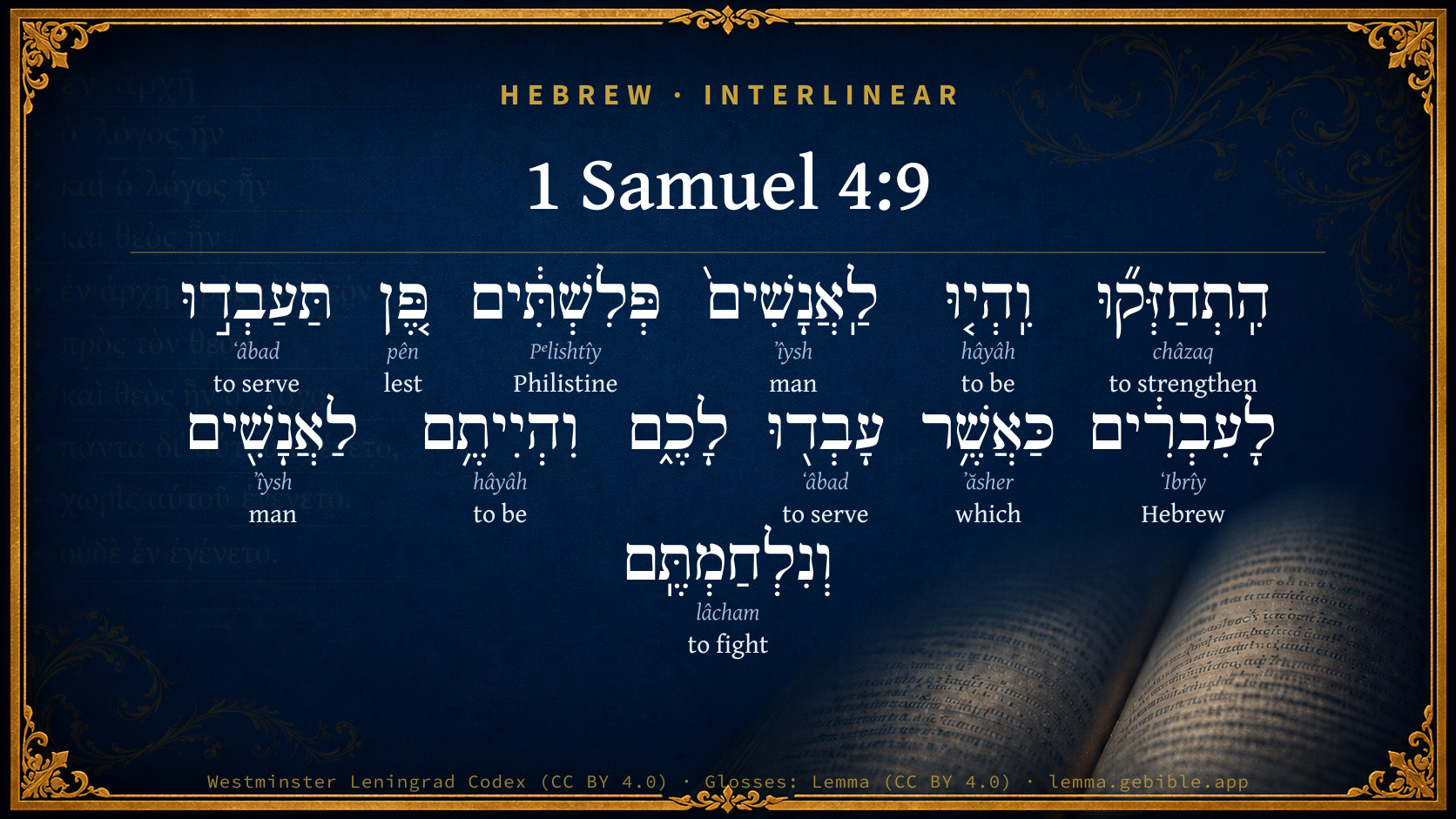
  1. הִֽתְחַזְּק֞וּ châzaq H2388 “strengthen” Verb, Hithpael, Imperative, 2nd Person, Masculine, Plural
  2. וִֽהְי֤וּ hâyâh H1961 “and · be” Conjunction + Verb, Qal, Imperative, 2nd Person, Masculine, Plural
  3. לַֽאֲנָשִׁים֙ ʼîysh H376 “to/for · men” Preposition + Noun, Common, Masculine, Plural, Absolute
  4. פְּלִשְׁתִּ֔ים Pᵉlishtîy H6430 “Philistines” Noun, Gentilic, Masculine, Plural, Absolute
  5. פֶּ֚ן pên H6435 “lest” Conjunction
  6. תַּעַבְד֣וּ ʻâbad H5647 “to serve” Verb, Qal, Imperfect, 2nd Person, Masculine, Plural
  7. כַּאֲשֶׁ֥ר ʼăsher H834 “like/as · which” Preposition + Particle, Relative
  8. עָבְד֖וּ ʻâbad H5647 “to serve” Verb, Qal, Perfect, 3rd Person, Common, Plural
  9. וִהְיִיתֶ֥ם hâyâh H1961 “and · to be” Conjunction + Verb, Qal, Sequential Perfect, 2nd Person, Masculine, Plural
  10. לַאֲנָשִׁ֖ים ʼîysh H376 “to/for · men” Preposition + Noun, Common, Masculine, Plural, Absolute
  11. וְנִלְחַמְתֶּֽם lâcham H3898 “and · to fight” Conjunction + Verb, Niphal, Sequential Perfect, 2nd Person, Masculine, Plural

About this verse

These counts appear in no published source. They are computed here, from the morphology-tagged text and Lemma’s own curated glosses. What Lemma adds →

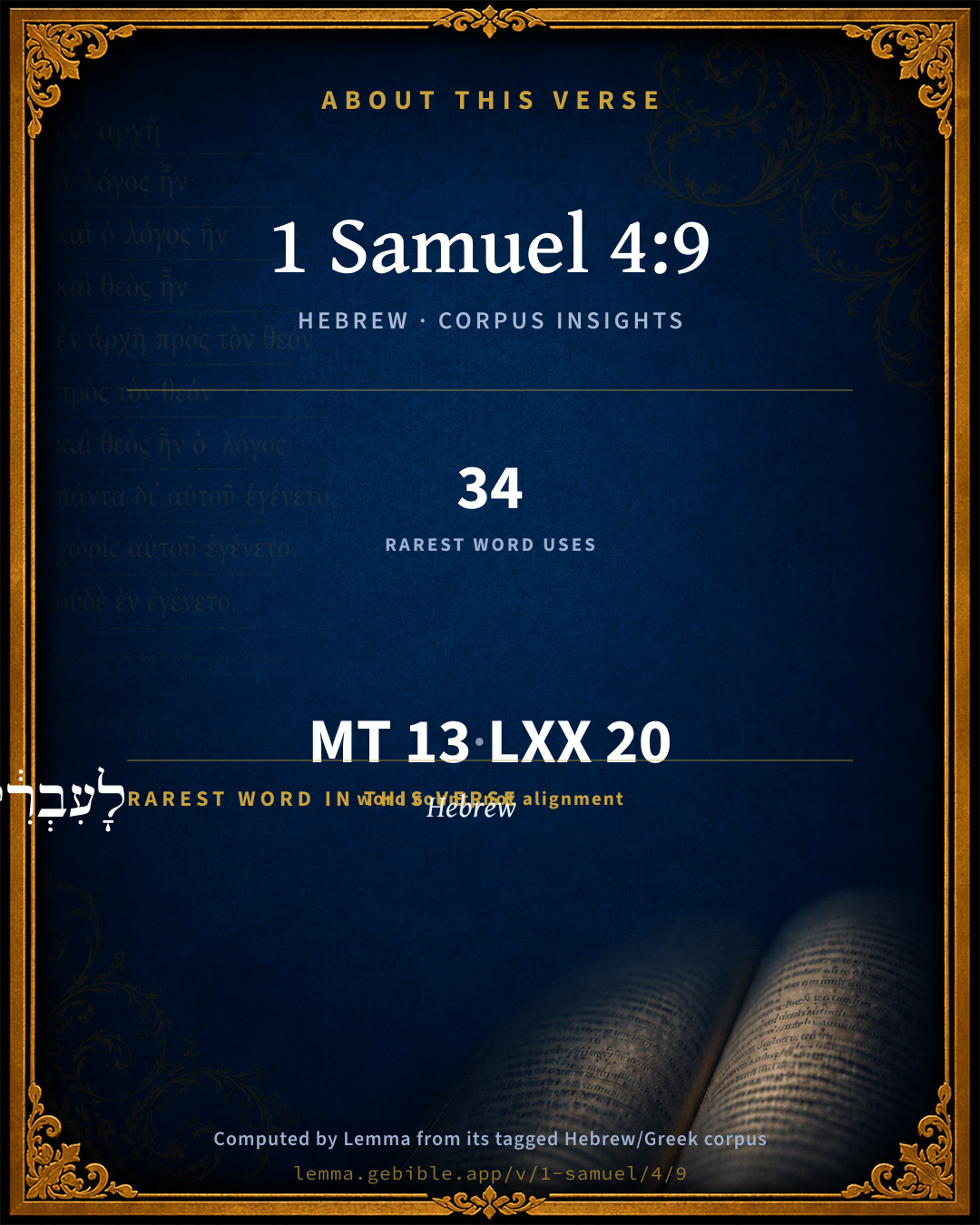
13
words
9
distinct lemmas
Historical
section

Shared distinctive vocabulary

לָעִבְרִ֔ים Hebrew H5680 occurs in 32 verses of the Hebrew Bible. Also found in:

Grammatical profile

  • 6 verbs
  • 4 nouns
  • 1 preposition
  • 1 conjunction
  • 1 particle

Verb forms

  • הִֽתְחַזְּק֞וּ Hithpael · Imperative
  • וִֽהְי֤וּ Qal · Imperative
  • תַּעַבְד֣וּ Qal · Imperfect
  • עָבְד֖וּ Qal · Perfect
  • וִהְיִיתֶ֥ם Qal · Sequential Perfect
  • וְנִלְחַמְתֶּֽם Niphal · Sequential Perfect

Repetition

Words recur within this verse — often emphatic in Hebrew:

  • וִֽהְי֤וּ to be H1961 ×2
  • לַֽאֲנָשִׁים֙ man H376 ×2
  • תַּעַבְד֣וּ to serve H5647 ×2

Hebrew & Septuagint length

In English translation the verse runs 30 words from the Hebrew and 30 from the Septuagint (LXX English) — the same length.

A rough comparison of the two English renderings, which tokenize alike — not a word-level alignment.

Word counts can differ between the Hebrew and the Greek without any difference in meaning — e.g. the Hebrew direct-object marker אֵת has no separate Greek word, and Greek often adds the article ὁ.

In the original languages it is 13 Hebrew tokens and 20 Greek tokens — but the two are counted differently (Hebrew bundles its prefixes and suffixes into one token; the Greek is in lemma form), so that isn’t a like-for-like length.

Cross-references

8

Topical passages linked to 1 Samuel 4:9 in the Treasury of Scripture Knowledge — connected by theme and wording, ordered by reader-vote popularity; previews shown in the World English Bible.

  • 1 Corinthians 16:13 Watch! Stand firm in the faith! Be courageous! Be strong!
  • Judges 13:1 The children of Israel again did that which was evil in the sight of Yahweh; and Yahweh delivered them into the hand of the Philistines forty years.
  • 2 Samuel 10:12 Be of good courage, and let us play the man for our people, and for the cities of our God: and Yahweh do that which seems him good.
  • Ephesians 6:10–11 Finally, be strong in the Lord, and in the strength of his might.
  • Judges 10:7 The anger of Yahweh was kindled against Israel, and he sold them into the hand of the Philistines, and into the hand of the children of Ammon.
  • Isaiah 33:1 Woe to you who destroy, and you weren't destroyed; and deal treacherously, and they didn't deal treacherously with you! When you have ceased to destroy, you shall be destroyed; and when you have made an end of dealing treacherously, they shall deal treacherously with you.
  • Deuteronomy 28:47–48 Because you didn't serve Yahweh your God with joyfulness, and with gladness of heart, by reason of the abundance of all things;
  • Isaiah 14:2 The peoples shall take them, and bring them to their place; and the house of Israel shall possess them in the land of Yahweh for servants and for handmaids: and they shall take them captive whose captives they were; and they shall rule over their oppressors.

Cross-references courtesy of OpenBible.info (CC BY 4.0).

Hebrew and Greek witnesses Masoretic Hebrew ↔ Greek Septuagint

The same verse in the two great witnesses to the Old Testament, shown verse-for-verse.

These are two independent witnesses, not word-aligned to each other, and the Septuagint is shown in lemma (dictionary) form.

Hebrew 1 Samuel 4:9 Masoretic · Westminster Leningrad Codex

הִֽתְחַזְּק֞וּ וִֽהְי֤וּ לַֽאֲנָשִׁים֙ פְּלִשְׁתִּ֔ים פֶּ֚ן תַּעַבְד֣וּ לָעִבְרִ֔ים כַּאֲשֶׁ֥ר עָבְד֖וּ לָכֶ֑ם וִהְיִיתֶ֥ם לַאֲנָשִׁ֖ים וְנִלְחַמְתֶּֽם

Be strong, and behave yourselves like men, O you Philistines, that you not be servants to the Hebrews, as they have been to you: quit yourselves like men, and fight.

World English Bible · Public Domain

Greek LXX 1 Samuel 4:9 Septuagint · lemma form

κραταιόω καί γίγνομαι εἰς ἀνήρ ἀλλόφυλος μήποτε δουλεύω ὁ εβραῖος καθώς δουλεύω ἐγώ καί εἰμί εἰς ἀνήρ καί πολεμέω αὐτός

Strengthen yourselves and behave yourselves like men, O you⌃ Philistines, that you⌃ may not serve the Hebrews as they have served us, but be you⌃ men and fight with them.

LXX2012 (modern English Septuagint) · Public Domain

Hebrew: Westminster Leningrad Codex (CC BY 4.0). Greek: Septuagint (public domain); English from LXX2012 (modern English Septuagint) (Public Domain). How the Septuagint differs from the Hebrew →

Targum (Aramaic paraphrase)

1

The Targum is the ancient Jewish Aramaic paraphrase of the Hebrew Scriptures — an interpretive translation, not the Hebrew text itself. Onkelos (literal) and Pseudo-Jonathan (expansive) render the Torah, and Jonathan the Prophets. Coverage is partial: where no permissively-licensed English translation exists for a verse, only the Aramaic is shown. This is verse-level text, not a word-by-word alignment to the Hebrew.

  1. Targum Jonathan Prophets (Joshua–Malachi)
    אִיתְקְפוּ וַהֲווֹ לְגַבְרִין פְּלִשְׁתָּאֵי דִלְמָא תִּשְׁתַּעְבְּדוּן לִיהוּדָאֵי כְּמָא דְאִשְׁתַּעְבְּדוּ לְכוֹן וּתְהוֹן לְגַבְרִין גִבָּרִין וְתַגִיחוּן קְרָבָא:

    (no public-domain English translation for this verse)

    Targum Jonathan — Aramaic: “Mikraot Gedolot” (public domain). English: “Sefaria Community Translation” (CC0 1.0 (public-domain dedication)); “London "Chaldee Paraphrase," 1871” (public domain). Text via Sefaria.

Commentary

Notes on 1 Samuel 4:9 from classic Christian and Jewish commentators (each source and its license shown beneath its notes). The classic Christian expositions comment on the surrounding passage and are grouped to its opening verse, so a note may address several verses; the Jewish commentaries on the Tanakh (Rashi and others) are per-verse, so they appear only where the commentator wrote on this verse.

Lemma curates 59 commentaries, every one of them public domain or Creative Commons licensed, each selected and text-cleaned for this edition rather than reprinted as found. About our sources →

Trapp's Complete Commentary

John Trapp

1Sa 4:9 Be strong, and quit yourselves like men, O ye Philistines, that ye be not servants unto the Hebrews, as they have been to you: quit yourselves like men, and fight.

Ver. 9. Be strong, and quit yourselves like men.] Though they were convinced that they should fight against God, yet they hearten up themselves, and resolve to fight howsoever: so doth every obstinate sinner. Ahaziah sent a third captain to fetch the prophet ai despito di Die, as if he would despitefully spit in the face of Heaven, and wrestle a fall with the Almighty.

That ye be not servants unto the Hebrews.] That ye lose not your sweet liberty. Philo Judaeus reporteth of a certain heathen people, who in their wars used only this expression, to put spirit into their soldiers, Estote viri, libertas agitur. Play the men, for your liberty lieth at stake.

John Trapp, A Commentary or Exposition upon All the Books of the Old and New Testament (1647–1656) — public domain. Text from a community e-Sword module.

Joseph Benson's Commentary

1Sa 4:9. Be strong, and quit yourselves like men — When they were recovered out of the fright which had at first seized them, they considered that they had made the Israelites subject to them notwithstanding the power of their God, and had also overthrown them in a late battle. Probably the words of this verse were spoken by some of their commanders, or they spoke thus to encourage one another.

Joseph Benson's Commentary on the Old and New Testaments (1811–1818) — public domain. Text from a community e-Sword module.

Adam Clarke's Commentary

Verse 9. Be strong, c.] This was the address to the whole army, and very forcible it was. "If ye do not fight, and acquit yourselves like men, ye will be servants to the Hebrews, as they have been to you and you may expect that they will avenge themselves of you for all the cruelty you have exercised towards them."

Adam Clarke's Commentary on the Bible (1810–1826) — public domain. Text from a community e-Sword/MySword module.

Ellicott's Commentary for English Readers

(9) Be strong, . . . O ye Philistines . . .—The ring of these striking words—part of the same Philistine tradition of their splendid success—probably embodied in some well-known hymn of victory, was evidently in St. Paul’s mind when he wrote his stirring words of exhortation to his loved Corinthian Church, “Quit ye like men; be strong.”

A Bible Commentary for English Readers, edited by Charles John Ellicott (1878–1897) — public domain. Text from a community e-Sword module.

The Cambridge Bible for Schools and Colleges

gen. ed. J. J. S. Perowne

9. quit yourselves] i.e. behave. Cp. 1Co_16:13. “To quit oneself” = “to acquit oneself,” to release oneself from obligation by meeting the claims upon or expectations entertained of oneself. It is derived from Lat. quietare, through Fr. quitter. Cp. Milton, Samson Agonistes, 1709,

“Samson hath quit himself

Like Samson.”

servants] Tributary vassals. See Jdg_13:1. The Philistines appear to have had some Israelites as actual slaves (ch. 1Sa_14:21).

The Cambridge Bible for Schools and Colleges (gen. ed. J. J. S. Perowne; Cambridge University Press, 1878–1918) — public domain. Text from a community e-Sword module.

John Gill's Exposition

Be strong, and quit yourselves like men, O ye Philistines,.... Since this was all they had to depend upon, their manly courage; if they did not exert that it was all over with them; and seeing their case was desperate, having gods as well as men to fight with, it became them to exert themselves to the uttermost; which did they, there was a possibility still of gaining victory, and so immortal honour to themselves; these words seem to be spoken by the generals and officers of the army of the Philistines to the common soldiers:

that ye be not servants to the Hebrews, as they have been to you; that is, before and in the times of Samson; but it appears from hence that at this time neither the Philistines ruled over the Israelites, nor the Israelites over them; but as there was danger of their becoming subject to Israel, they had better die gloriously in the field of battle than to be in the base state of servitude:

quit yourselves like men, and fight; this is repeated to animate them to battle, which they supposed was not far off by the shoutings of the Israelites, and which they must prepare for.

John Gill's Exposition of the Whole Bible (1746–1763) — public domain (CC PDM 1.0). Text via the HelloAO Bible API.

Haydock's Catholic Bible Commentary

Fight. To serve those whom they had lately oppressed, would be doubly afflicting. (Salien) --- If these people had seriously attended to the instructions, which they might have derived from the fall of others, they would surely never have exposed themselves to fight against the high God. But they looked upon him in no other light than their own contemptible idols. Homer often represents them as wounded, and conquered by mortal men.

George Leo Haydock (1774–1849), Haydock's Catholic Family Bible and Commentary, 1859 edition — public domain. Excludes Psalms (Douay-Rheims chapter numbering differs from Protestant) and Deuterocanonical books (Catholic canon only).

Matthew Poole's English Annotations

Quit yourselves like men; since you can expect no relief from your gods, who are not able to resist theirs, it concerns you to put forth all your strength and courage, and once for all to act like brave and valiant men.

Matthew Poole's English Annotations on the Holy Bible (1683–1685) — public domain. Text from a community e-Sword/MySword module.

The Pulpit Commentary

Be strong. But, as is often the case, despair served only to nerve them to bitter determination. The greatness of the danger for as heathen the Philistines fully believed that the ark would act as a charm and the fearful alternative of being servants, i.e. slaves to those who not so very long ago had been slaves to them, made them resolve to do their very utmost. The result was a complete victory.

The Pulpit Commentary (1880–1919), ed. H.D.M. Spence-Jones & Joseph S. Exell — public domain. Text from a community e-Sword module.

Keil & Delitzsch

C. F. Keil & F. Delitzsch

But instead of despairing, they encouraged one another, saying, "Show yourselves strong, and be men, O Philistines, that we may not be obliged to serve the Hebrews, as they have served you; be men, and fight!"

Keil & Delitzsch — Biblical Commentary on the Old Testament (1861–1891) — public domain (CC PDM 1.0). Text via the HelloAO Bible API. (Old Testament only.)

Lesson kit

Teaching starters — assembled from the data on this page, not authored interpretation. Every prompt links to the verse data it draws on. Edit before teaching.

1 Samuel, in the Historical, opens this verse with 13 words (9 distinct Hebrew lemmas). Its most distinctive word is ʻIbrîy (“Hebrew”). A historical commentator’s framing appears above. Read the whole chapter for the surrounding context.

Discussion questions

  1. How does “Hebrew” (ʻIbrîy) shape what this verse is saying?
  2. How does Genesis 14:13, which shares the word «Hebrew», read alongside this verse?
  3. What does the repetition of “to be” (2× in this one verse) do in this verse?
  4. The translations on this page render this verse differently — a whole-verse word diff, not a word-by-word alignment. What might account for the different wordings?
  5. «הִֽתְחַזְּק֞וּ» is a Hithpael Imperative verb. How does that grammatical form shape the action described?
  6. Compare how Trapp's Complete Commentary and Joseph Benson's Commentary read this verse. Where do they agree or differ?

Things to notice

Reading settings

Reading text

Shown beneath each verse's original-language words.

Old Testament
Old Testament edition

Read the OT as the Masoretic Hebrew (MT) or the Greek Septuagint (LXX).

English shown for the Greek Septuagint (in the Hebrew ↔ Greek comparison).

Comparing translations? Open the Compare panel on any verse page to stack up to four side by side.