
Ezra 6:22

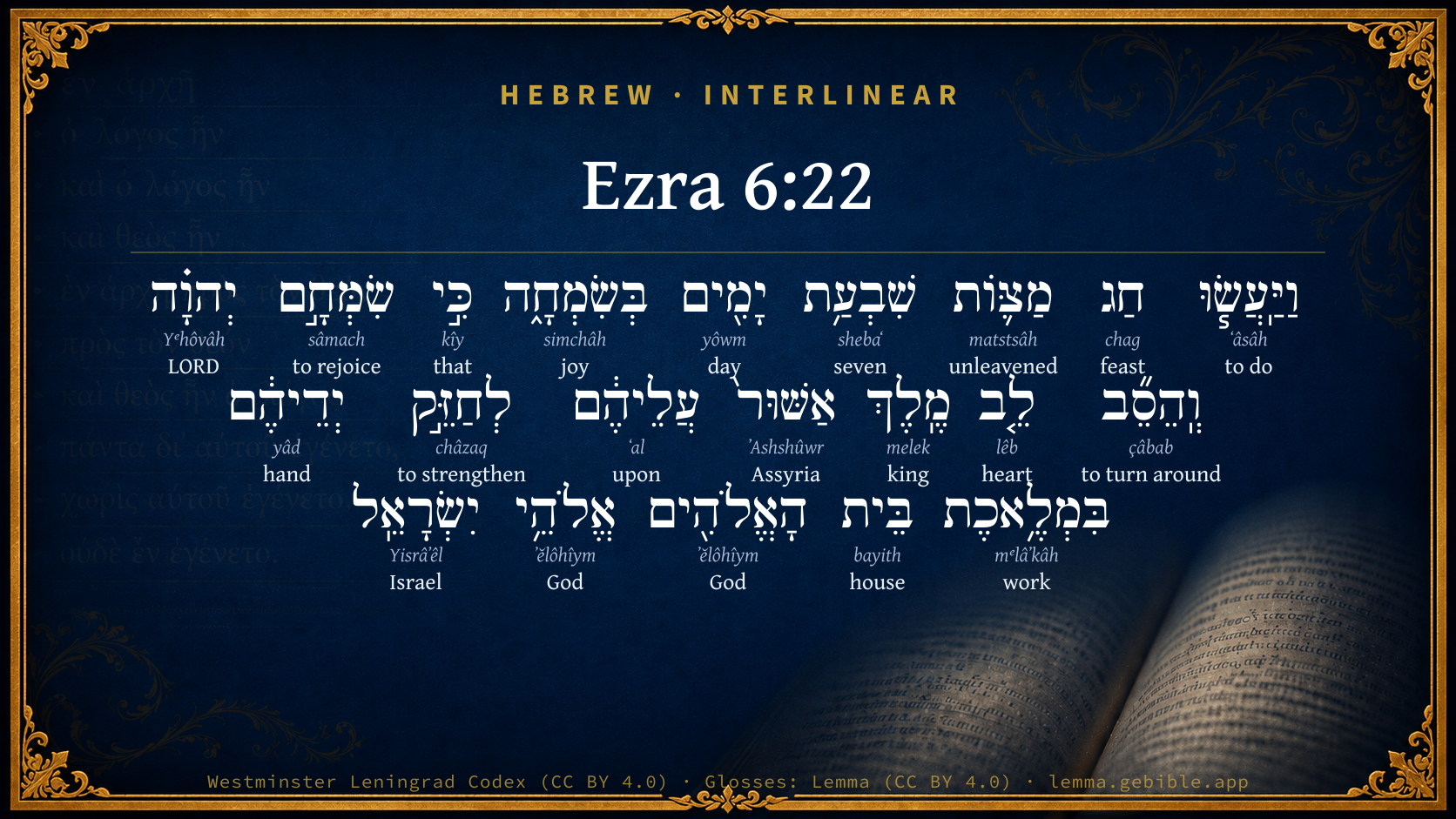
Hebrew (Westminster Leningrad Codex) Ezra 6:22 appears in the Hebrew Old Testament. The text above is from the Westminster Leningrad Codex. Each word links to its Strong’s number, a concise gloss, and parsing drawn from the Open Scriptures Hebrew Bible morphology. Click any word for its full Brown-Driver-Briggs (BDB) entry.
Download image
Cite this verse

Ezra 6:22 (World English Bible). Public Domain. Lemma interlinear Bible study tool, https://lemma.gebible.app/v/ezra/6/22.

Show BibTeX & RIS
BibTeX
RIS
English Translation
and kept the feast of unleavened bread seven days with joy: for Yahweh had made them joyful, and had turned the heart of the king of Assyria to them, to strengthen their hands in the work of the house of God, the God of Israel.
World English Bible · Public Domain
Download a study sheet

One document with this verse’s original text, its word-by-word gloss line, the meaning frame, cross-references with their text, attributed commentary, and full source and license credits — printable, and it pastes into notes with its structure intact.

This verse Autodidact and up

Study sheet (.html) Plain text (.txt)

A passage Seminary Student

Up to 50 verses in one chapter. A passage sheet keeps up to 6 commentary sources and 12 cross-references per verse, in the order this page ranks them, and says so on the sheet whenever that leaves anything out. Ask for a single verse and you get the Autodidact verse sheet above.

Everything on this page stays free to read, with no account — the sheet is a download of what is already on screen, not access to it.

Want to remove ads? Support Godless Engineer
Compare translations 3

The same verse in 3 English versions, stacked beneath the original-language interlinear above. Click any original word for its lexicon entry.

Each is an independent rendering of the whole verse — the interlinear is not word-aligned to these translations.

Highlighted words mark where these versions differ — a whole-verse word diff, not a word-by-word alignment.

  • World English Bible Public Domain
    and kept the feast of unleavened bread seven days with joy: for Yahweh had made them joyful, and had turned the heart of the king of Assyria to them, to strengthen their hands in the work of the house of God, the God of Israel.
  • King James Version Public Domain
    And kept the feast of unleavened bread seven days with joy: for the LORD had made them joyful, and turned the heart of the king of Assyria unto them, to strengthen their hands in the work of the house of God, the God of Israel.
  • unfoldingWord Literal Text CC BY-SA 4.0
    Then they performed the Festival of Unleavened Bread seven days with joy, because Yahweh had caused them to be joyful, and had caused the heart of the king of Assyria to turn toward them, to strengthen their hands in the work of the house of God, the God of Israel.

unfoldingWord Literal Text — © unfoldingWord, licensed CC BY-SA 4.0. Word-aligned USFM3 via Door43 (git.door43.org/unfoldingWord/en_ult).

Versions to compare (up to 4)

3 of 4 selected

Show all 18 translations

Every available English version of this verse, each an independent rendering of the whole verse.

  • World English Bible Public Domain
    and kept the feast of unleavened bread seven days with joy: for Yahweh had made them joyful, and had turned the heart of the king of Assyria to them, to strengthen their hands in the work of the house of God, the God of Israel.
  • Berean Standard Bible Public Domain
    For seven days they kept the Feast of Unleavened Bread with joy, because the LORD had made them joyful and turned the heart of the king of Assyria toward them to strengthen their hands in the work on the house of the God of Israel.
  • Majority Standard Bible Public Domain
    For seven days they kept the Feast of Unleavened Bread with joy, because the LORD had made them joyful and turned the heart of the king of Assyria toward them to strengthen their hands in the work on the house of the God of Israel.
  • King James Version Public Domain
    And kept the feast of unleavened bread seven days with joy: for the LORD had made them joyful, and turned the heart of the king of Assyria unto them, to strengthen their hands in the work of the house of God, the God of Israel.
  • American Standard Version (1901) Public Domain
    and kept the feast of unleavened bread seven days with joy: for Jehovah had made them joyful, and had turned the heart of the king of Assyria unto them, to strengthen their hands in the work of the house of God, the God of Israel.
  • Revised Version (1885) Public Domain
    and kept the feast of unleavened bread seven days with joy: for the LORD had made them joyful, and had turned the heart of the king of Assyria unto them, to strengthen their hands in the work of the house of God, the God of Israel.
  • Geneva Bible (1599) Public Domain
    And they kept ye feast of vnleauened bread seuen dayes with ioy: for the Lord had made them glad, and turned the heart of the King of Asshur vnto them, to incourage them in the worke of the house of God, euen the God of Israel.
  • Douay-Rheims (1899) Public Domain
    And they kept the feast of unleavened bread seven days with joy, for the Lord had made them joyful, and had turned the heart of the king of Assyria to them, that he should help their hands in the work of the house of the Lord the God of Israel.
  • Young's Literal Translation Public Domain
    and they make the feast of unleavened things seven days with joy, for Jehovah made them to rejoice, and turned round the heart of the king of Asshur unto them, to strengthen their hands in the work of the house of God, the God of Israel.
  • Literal Standard Version CC BY-SA 4.0
    and they make the Celebration of Unleavened Things seven days with joy, for YHWH made them to rejoice, and turned around the heart of the king of Asshur to them, to strengthen their hands in the work of the house of God, the God of Israel.
  • Unlocked Literal Bible CC BY-SA 4.0
    They joyfully celebrated the Festival of Unleavened Bread for seven days, for Yahweh had brought them joy and turned the heart of Assyria's king to strengthen their hands in the work of his house, the house of the God of Israel.
  • unfoldingWord Literal Text CC BY-SA 4.0
    Then they performed the Festival of Unleavened Bread seven days with joy, because Yahweh had caused them to be joyful, and had caused the heart of the king of Assyria to turn toward them, to strengthen their hands in the work of the house of God, the God of Israel.
  • Darby Bible Public Domain
    and they kept the feast of unleavened bread seven days with joy; for Jehovah had made them joyful, and turned the heart of the king of Assyria to them, to strengthen their hands in the work of the house of God, the God of Israel.
  • World Messianic Bible Public Domain
    and kept the feast of unleavened bread seven days with joy; because the LORD had made them joyful, and had turned the heart of the king of Assyria to them, to strengthen their hands in the work of God, the God of Israel’s house.
  • Webster's Bible Public Domain
    And kept the feast of unleavened bread seven days with joy: for the LORD had made them joyful, and turned the heart of the king of Assyria to them, to strengthen their hands in the work of the house of God, the God of Israel.
  • Free Bible Version CC BY-SA 4.0
    Then they observed the Festival of Unleavened Bread for seven days. Everyone throughout the land was so happy because the Lord had made the king of Assyria favorable to them, helping them to rebuild the Temple of God, the God of Israel.
  • Bible in Basic English Public Domain
    And kept the feast of unleavened bread for seven days with joy: for the Lord had made them full of joy, by turning the heart of the king of Assyria to them to give them help in the work of the house of God, the God of Israel.
  • JPS Tanakh (1917) Public Domain
    and kept the feast of unleavened bread seven days with joy; for the LORD had made them joyful, and had turned the heart of the king of Assyria unto them, to strengthen their hands in the work of the house of God, the God of Israel.

Literal Standard Version (2020), Covenant Press — licensed CC BY-SA 4.0. Text via the HelloAO Bible API (eBible.org). Unlocked Literal Bible (unfoldingWord) — licensed CC BY-SA 4.0. Text via the HelloAO Bible API (eBible.org). unfoldingWord Literal Text — © unfoldingWord, licensed CC BY-SA 4.0. Word-aligned USFM3 via Door43 (git.door43.org/unfoldingWord/en_ult). Free Bible Version, Dr. Jonathan Gallagher — licensed CC BY-SA 4.0. Text via the HelloAO Bible API (eBible.org).

Word by word

More ways to search: Search by grammar → Find every occurrence → Compare this word →

Practice this passage: Drill this verse → Learn its vocabulary →

מַצּ֛וֹת
matstsâh
H4682
“unleavened bread”
Noun, Common, Feminine, Plural, Absolute
Part of Speech
Noun
Type
Common
Gender
Feminine
Number
Plural
State
Absolute
Full BDB Definition

Origin: from H4711 in the sense of greedily devouring for sweetness

TWOT: None

unleavened (bread, cake), without leaven.
  1. וַיַּֽעֲשׂ֧וּ ʻâsâh H6213 “and · to do” Conjunction + Verb, Qal, Sequential Imperfect, 3rd Person, Masculine, Plural
  2. חַג chag H2282 “feast of” Noun, Common, Masculine, Singular, Construct
  3. שִׁבְעַ֥ת shebaʻ H7651 “seven” Adjective, Cardinal number, Masculine, Singular, Construct
  4. יָמִ֖ים yôwm H3117 “days” Noun, Common, Masculine, Plural, Absolute
  5. בְּשִׂמְחָ֑ה simchâh H8057 “in/at · joy” Preposition + Noun, Common, Feminine, Singular, Absolute
  6. כִּ֣י kîy H3588 “that” Conjunction
  7. שִׂמְּחָ֣ם sâmach H8055 “to rejoice · them” Verb, Piel, Perfect, 3rd Person, Masculine, Singular + Suffix, Personal, 3rd Person, Masculine, Plural
  8. יְהוָ֗ה Yᵉhôvâh H3068 “LORD” Noun, Proper
  9. וְֽהֵסֵ֞ב çâbab H5437 “and · to turn around” Conjunction + Verb, Hiphil, Perfect, 3rd Person, Masculine, Singular
  10. לֵ֤ב lêb H3820 “heart of” Noun, Common, Masculine, Singular, Construct
  11. מֶֽלֶךְ melek H4428 “king of” Noun, Common, Masculine, Singular, Construct
  12. אַשּׁוּר֙ ʼAshshûwr H804 “Assyria” Noun, Proper
  13. עֲלֵיהֶ֔ם ʻal H5921 “upon · them” Preposition + Suffix, Personal, 3rd Person, Masculine, Plural
  14. לְחַזֵּ֣ק châzaq H2388 “to strengthen” Preposition + Verb, Piel, Infinitive Construct
  15. יְדֵיהֶ֔ם yâd H3027 “hands · their” Noun, Common, Both, Dual, Construct + Suffix, Personal, 3rd Person, Masculine, Plural
  16. בִּמְלֶ֥אכֶת mᵉlâʼkâh H4399 “in/at · work of” Preposition + Noun, Common, Feminine, Singular, Construct
  17. בֵּית bayith H1004 “house of” Noun, Common, Masculine, Singular, Construct
  18. הָאֱלֹהִ֖ים ʼĕlôhîym H430 “the · God(s)” Particle, Definite Article + Noun, Common, Masculine, Plural, Absolute
  19. אֱלֹהֵ֥י ʼĕlôhîym H430 “God(s) of” Noun, Common, Masculine, Plural, Construct
  20. יִשְׂרָאֵֽל Yisrâʼêl H3478 “Israel” Noun, Proper

About this verse

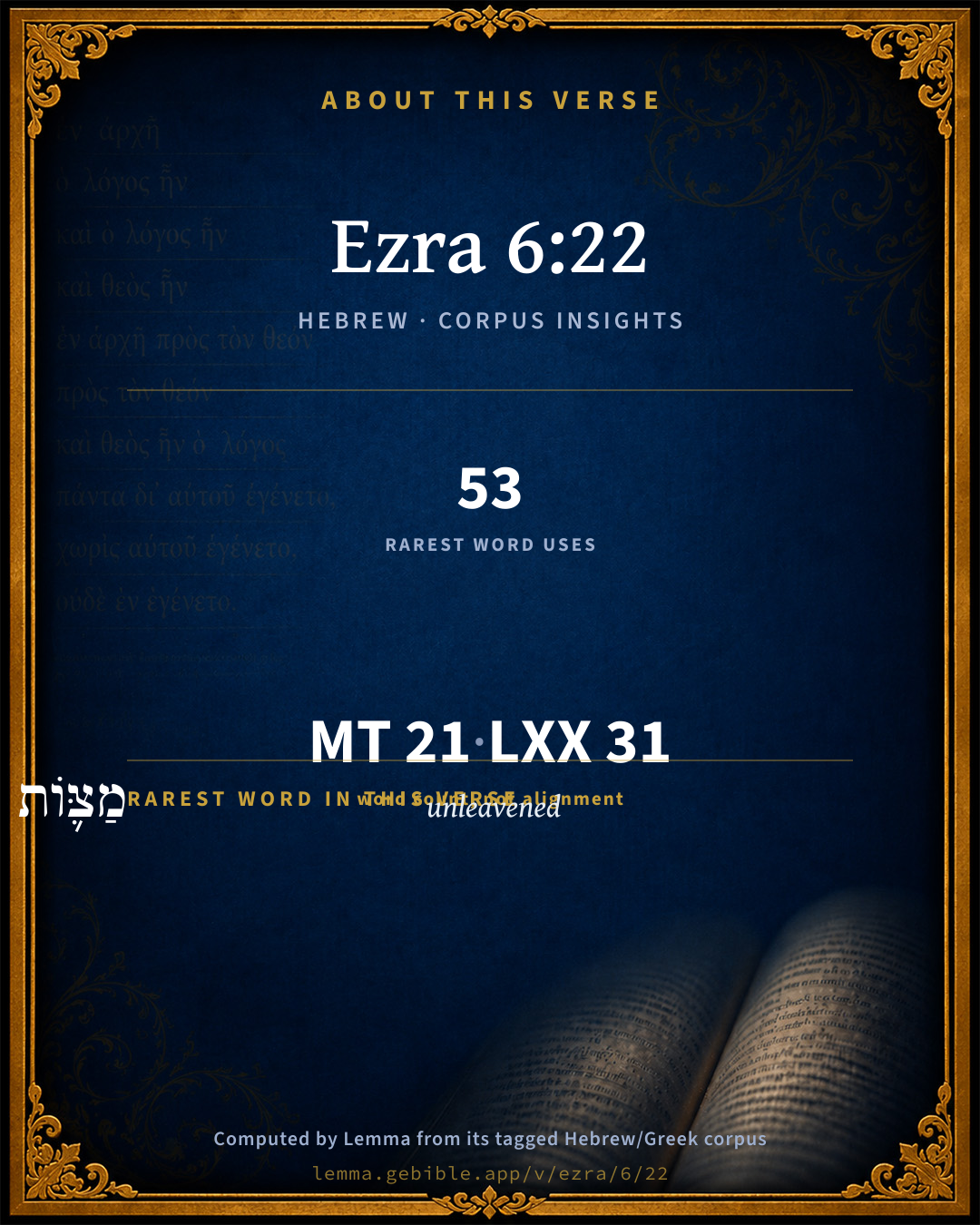
These counts appear in no published source. They are computed here, from the morphology-tagged text and Lemma’s own curated glosses. What Lemma adds →

21
words
20
distinct lemmas
Historical
section

Shared distinctive vocabulary

מַצּ֛וֹת unleavened H4682 occurs in 42 verses of the Hebrew Bible. Also found in:

Grammatical profile

  • 4 verbs
  • 14 nouns
  • 1 adjective
  • 1 preposition
  • 1 conjunction

Verb forms

  • וַיַּֽעֲשׂ֧וּ Qal · Sequential Imperfect
  • שִׂמְּחָ֣ם Piel · Perfect
  • וְֽהֵסֵ֞ב Hiphil · Perfect
  • לְחַזֵּ֣ק Piel · Infinitive Construct

Repetition

A word recurs within this verse — often emphatic in Hebrew:

  • הָאֱלֹהִ֖ים God H430 ×2

Hebrew & Septuagint length

In English translation the verse runs 45 words from the Hebrew and 45 from the Septuagint (LXX English) — the same length.

A rough comparison of the two English renderings, which tokenize alike — not a word-level alignment.

Word counts can differ between the Hebrew and the Greek without any difference in meaning — e.g. the Hebrew direct-object marker אֵת has no separate Greek word, and Greek often adds the article ὁ.

In the original languages it is 21 Hebrew tokens and 31 Greek tokens — but the two are counted differently (Hebrew bundles its prefixes and suffixes into one token; the Greek is in lemma form), so that isn’t a like-for-like length.

Cross-references

15

Topical passages linked to Ezra 6:22 in the Treasury of Scripture Knowledge — connected by theme and wording, ordered by reader-vote popularity; previews shown in the World English Bible.

  • 2 Chronicles 30:21 The children of Israel who were present at Jerusalem kept the feast of unleavened bread seven days with great gladness; and the Levites and the priests praised Yahweh day by day, [singing] with loud instruments to Yahweh.
  • Ezra 1:1 Now in the first year of Cyrus king of Persia, that the word of Yahweh by the mouth of Jeremiah might be accomplished, Yahweh stirred up the spirit of Cyrus king of Persia, so that he made a proclamation throughout all his kingdom, and [put it] also in writing, saying,
  • Proverbs 21:1 The king's heart is in Yahweh's hand like the watercourses. He turns it wherever he desires.
  • 2 Chronicles 35:17 The children of Israel who were present kept the Passover at that time, and the feast of unleavened bread seven days.
  • Ezra 7:27 Blessed be Yahweh, the God of our fathers, who has put such a thing as this in the king's heart, to beautify the house of Yahweh which is in Jerusalem;
  • Proverbs 16:7 When a man's ways please Yahweh, He makes even his enemies to be at peace with him.
  • Exodus 12:15–20 Seven days shall you eat unleavened bread; even the first day you shall put away yeast out of your houses, for whoever eats leavened bread from the first day until the seventh day, that soul shall be cut off from Israel.
  • Exodus 13:6–7 Seven days you shall eat unleavened bread, and in the seventh day shall be a feast to Yahweh.
  • John 19:11 Jesus answered, "You would have no power at all against me, unless it were given to you from above. Therefore he who delivered me to you has greater sin."
  • 2 Kings 23:29 In his days Pharaoh Necoh king of Egypt went up against the king of Assyria to the river Euphrates: and king Josiah went against him; and [Pharaoh Necoh] killed him at Megiddo, when he had seen him.
  • 2 Chronicles 33:11 Therefore Yahweh brought on them the captains of the host of the king of Assyria, who took Manasseh in chains, and bound him with fetters, and carried him to Babylon.
  • Ezra 6:6–12 Now therefore, Tattenai, governor beyond the River, Shetharbozenai, and your companions the Apharsachites, who are beyond the River, be you far from there:
  • Zechariah 10:10–11 I will bring them again also out of the land of Egypt, And gather them out of Assyria; And I will bring them into the land of Gilead and Lebanon; And there won't be room enough for them.
  • Matthew 26:17 Now on the first day of unleavened bread, the disciples came to Jesus, saying to him, "Where do you want us to prepare for you to eat the Passover?"
  • 1 Corinthians 5:7–8 Purge out the old yeast, that you may be a new lump, even as you are unleavened. For indeed Christ, our Passover, has been sacrificed in our place.

Cross-references courtesy of OpenBible.info (CC BY 4.0).

Hebrew and Greek witnesses Masoretic Hebrew ↔ Greek Septuagint

The same verse in the two great witnesses to the Old Testament, shown verse-for-verse.

These are two independent witnesses, not word-aligned to each other, and the Septuagint is shown in lemma (dictionary) form.

Hebrew Ezra 6:22 Masoretic · Westminster Leningrad Codex

וַיַּֽעֲשׂ֧וּ חַג מַצּ֛וֹת שִׁבְעַ֥ת יָמִ֖ים בְּשִׂמְחָ֑ה כִּ֣י שִׂמְּחָ֣ם יְהוָ֗ה וְֽהֵסֵ֞ב לֵ֤ב מֶֽלֶךְ אַשּׁוּר֙ עֲלֵיהֶ֔ם לְחַזֵּ֣ק יְדֵיהֶ֔ם בִּמְלֶ֥אכֶת בֵּית הָאֱלֹהִ֖ים אֱלֹהֵ֥י יִשְׂרָאֵֽל

and kept the feast of unleavened bread seven days with joy: for Yahweh had made them joyful, and had turned the heart of the king of Assyria to them, to strengthen their hands in the work of the house of God, the God of Israel.

World English Bible · Public Domain

Greek LXX Ezra 6:22 Septuagint · lemma form

καί ποιέω ὁ ἑορτή ὁ ἄζυμος ἑπτά ἡμέρα ἐν εὐφροσύνη ὅτι εὐφραίνω αὐτός κύριος καί ἐπιστρέφω καρδία βασιλεύς ασσουρ ἐπί αὐτός κραταιόω ὁ χείρ αὐτός ἐν ἔργον οἶκος ὁ θεός ἰσραήλ

and they kept the feast of unleavened bread seven days with gladness, because the Lord made them glad, and he turned the heart of the king of Assyria to them, to strengthen their hands in the works of the house of the God of Israel.

LXX2012 (modern English Septuagint) · Public Domain

In the Septuagint this is one book — Esdras B (2 Esdras): Ezra is chapters 1–10, Nehemiah 11–23.

Hebrew: Westminster Leningrad Codex (CC BY 4.0). Greek: Septuagint (public domain); English from LXX2012 (modern English Septuagint) (Public Domain). How the Septuagint differs from the Hebrew →

Commentary

Notes on Ezra 6:22 from classic Christian and Jewish commentators (each source and its license shown beneath its notes). The classic Christian expositions comment on the surrounding passage and are grouped to its opening verse, so a note may address several verses; the Jewish commentaries on the Tanakh (Rashi and others) are per-verse, so they appear only where the commentator wrote on this verse.

Lemma curates 59 commentaries, every one of them public domain or Creative Commons licensed, each selected and text-cleaned for this edition rather than reprinted as found. About our sources →

Trapp's Complete Commentary

John Trapp

Ezr 6:22 And kept the feast of unleavened bread seven days with joy: for the LORD had made them joyful, and turned the heart of the king of Assyria unto them, to strengthen their hands in the work of the house of God, the God of Israel.

Ver. 22. And kept the feast of unleavened bread] See 1Co 7:8 Exo 12:35, with the notes.

Seven days] This began on the fifteenth day, and lasted till the one and twentieth day, Num 28:16-17 Exo 34:25.

With joy] {See Trapp on "Ezr 6:16"}

For the Lord had made them joyful] Given them cause of joy, and a heart enlarged accordingly, a mind right set for the purpose. St James’s word, ευθυμειν, Jas 5:13, shows that all true mirth is from the rectitude of a man’s mind, which God only giveth.

And turned the heart of the king] It is he alone that gives favour, that frameth men’s opinions and affections, that maketh a good man’s enemies to be at peace with him.

To strengthen their hands] As Ezr 6:8. And this did more ennoble him than all his warlike achievements.

John Trapp, A Commentary or Exposition upon All the Books of the Old and New Testament (1647–1656) — public domain. Text from a community e-Sword module.

The Biblical Illustrator

Joseph S. Exell

Ezr_6:22

For the Lord had made them joyful.

God the joy-bringer

I. God is the joy-maker.

1. The object of much that God does is simply the blessedness of human hearts. The poorest creature that lives has a right to ask of God the satisfaction of its instincts, and every man has a claim on God to make him glad. God pays all cheques legitimately drawn on Him, and regards Himself as occupied in a manner entirely congruous with His magnificence and infinitude, when He stoops to put some kind of vibrating gladnesses into the wings of a gnat that dances for an hour in the sunshine, and into the heart of a man that lives his time for only a very little longer.

2. Gods method of making us glad is by putting Himself into us. The secret of all true human well-being is close communion with God.

3. By His providences He gives the secondary and lower gifts which men according to their circumstances need. He gives whatever is contributory to any kind of gladness; and if we are wise we shall trace all to Him. Our common mercies are His love-tokens and they all come to us just as the gifts of parents to their children do, with this on the fly-leaf, With a fathers love.

II. The obligation and wisdom of taking our god-given joys.

1. Be sure you take Him. When He is waiting to pour all His love into your heart, and all His sweetness into your spirit, to calm your anxieties, to deepen your blessedness; to strengthen everything that is good in you; to be to you a stay in the midst of crumbling prosperity and a light in the midst of the gathering darkness, be sure that you take the joy that waits your acceptance.

2. Recognise Him in all common mercies, because He is at the back of them all. Everything ought to be vocal to us of the loving-kindness of our Father in heaven. Link Him with everything that makes your heart glad. God does not desire to be put away high up on a pedestal above our lives, as if He regulated the great things and the trifles regulated themselves; but He seeks to come as air into the lungs, into every particle of the mass of life, and to fill it all with His purifying presence.

3. Recognise Him in common joys.

4. Be sure that you use the joys which He gives. There are two ways in which you can look at the world and at everything that befalls you. There is enough in everybodys life to make him sad if he selects these things to dwell upon. There is enough in everybodys life to make him continually glad if he wisely picks out these things to think about. It depends altogether on the angle at which you look at your life what you see about it. For instance, you know how children do when they get a bit of a willow wand into their possession. They cut off rings of bark and get the switch alternately white and black, white and black, and so on right to the tip. Whether will you look at the white rings or the black ones? They are both there, but if you rightly look at the black you will find out that there is white below it, and it only needs a very little stripping off of a film to make it into white too. No Christian man has a right to regard anything that Gods providence brings to him as such unmingled evil that it ought to make him sad. We are bound to rejoice in the Lord alway.

5. Be sure that you limit your delights by God-made joys. There is nothing sadder than the joys that come into a life and do not come from God. Let us see to it that we do not fill our cisterns with poisonous sewage, when. God is waiting to fill them with the pure river of the water of life. Does my joy help me to come near to God? Does it interfere with my communion with Him? Does it aid me in the consecration of myself? Does my conscience go with it when my conscience is most awake? The alternative presented to each of us is whether we will have surface joy and a centre of dark discontent, or surface sorrow and a centre of calm blessedness. The film of stagnant water on a pond of rottenness simulates the glories of the rainbow, in which pure sunshine falls upon the pure drops, but it is only painted corruption after all, and if a man put his lips to it, it will kill him. Such is the joy which is apart from God. (A. Maclaren, D. D.)

Cheerfulness

Cheerfulness is the root of constancy; for there is no more shifty and unreliable person than your curmudgeon, who is the slave of his own caprices; it is the best assurance of life, health, and wealth; it is the sign and evidence of steady and energetic mind. It will make a fruitful youth, a happy manhood, and a serene old age. It is the open sesame to many secrets which the discontented and peevish strive hard to discover but always miss; it is the magic medium of friendship, if not even of love; where there may be lack of special tastes and sympathies, cheerfulness will do much to supply their place. As water to the flower, so is cheerfulness to the mind. It keeps all green and sweet, and sends forth a gracious savour that is imperceptible, but wins all by its perfume. By cheerfulness a mans powers of work and production are doubled; he has, as it were, taken in a set of working partners most ready to aid him in every task and enterprise. Cheerfulness keeps all the faculties in good condition, so that they are ever ready to do their utmost without strain. (Dr. Japp, in the Argosy.)

.

Joy favourable to religion: sing and rejoice

One bright summers day we noticed a lark; at first we could not see it, but with the eye shaded by an uplifted hand it was soon detected. There it flew, a little speck, a dim spot in the Italian-blue sky, pouring down floods of music. On it went, higher and higher; as long as it sang and rejoiced, it arose. But when the song ceased its flight ceased too. Thus is it with our souls; they ascend Godwards while we sing and rejoice. Rejoice in the Lord; for you it is safe; take refuge in the citadel of heaven-sent bliss, and you are secure against many a Satanic attack. (T. R. Stevenson.)

.

The Biblical Illustrator, edited by Joseph S. Exell (c. 1880s–1900s) — public domain. Text from a community e-Sword module.

Joseph Benson's Commentary

Ezr 6:22. And kept the feast with joy: for the Lord had made them joyful — Had given them both cause to rejoice, and hearts to rejoice. “It was now near twenty years,” says Henry, “since the foundation of this temple was laid, and it is probable that most of the old men, who then wept at the remembrance of the first temple, were dead by this time, so that now there were no tears mingled with their joys.” Those that are upon good grounds joyful, have therefore reason to be thankful, because it is God that makes them to rejoice. He is the fountain from whence all the streams of our joy flow. And turned the heart of the king of Assyria — Of the king of Persia, called the king of Assyria, as now reigning over all the kingdoms which were formerly under the power of the Assyrians; and to signify the great power and goodness of God in turning the hearts of these great monarchs, whose predecessors in empire and dominion, in these parts of the world, had formerly been the chief persecutors and oppressors of the people of God. Darius, as we have seen, was now on the throne, of whom Dr. Prideaux gives this character: “He was a prince of great wisdom, clemency, and justice; and has the honour to be recorded in holy writ for a favourer of God’s people, a restorer of his temple at Jerusalem, and a promoter of his worship therein. For all this God was pleased to make him his instrument; and with respect to this, I doubt not, it was, that he blessed him with a numerous issue, a long reign, and great prosperity.”

Joseph Benson's Commentary on the Old and New Testaments (1811–1818) — public domain. Text from a community e-Sword module.

MacLaren's Expositions of Holy Scripture

Alexander MacLaren

Ezra

THE NEW TEMPLE AND ITS WORSHIP

GOD THE JOY-BRINGER

Ezr 6:22.

Twenty years of hard work and many disappointments and dangers had at last, for the Israelites returning from the captivity, been crowned by the completion of the Temple. It was a poor affair as compared with the magnificent house that had stood upon Zion; and so some of them ‘despised the day of small things.’ They were ringed about by enemies; they were feeble in themselves; there was a great deal to darken their prospects and to sadden their hearts; and yet, when memories of the ancient days came back, and once more they saw the sacrificial smoke rising from the long cold and ruined altar, they rejoiced in God, and they kept the passover amid the ruins, as my text tells us, for the ‘seven days’ of the statutory period ‘with joy,’ because, in spite of all, ‘the Lord had made them joyful.’

I think if we take this simple saying we get two or three thoughts, not altogether irrelevant to universal experience, about the true and the counterfeit gladnesses possible to us all.

I. Look at that great and wonderful thought-God the joy-maker.

We do not often realise how glad God is when we are glad, and how worthy an object of much that He does is simply the prosperity and the blessedness of human hearts. The poorest creature that lives has a right to ask from God the satisfaction of its instincts, and every man has a claim on God-because he is God’s creature-to make him glad. God honours all cheques legitimately drawn on Him, and answers all claims, and regards Himself as occupied in a manner entirely congruous with His magnificence and His infinitude, when He stoops to put some kind of vibrating gladness into the wings of a gnat that dances for an hour in the sunshine, and into the heart of a man that lives his time for only a very little longer.

God is the Joy-maker. There are far more magnificent and sublime thoughts about Him than that; but I do not know that there is any that ought to come nearer to our hearts, and to silence more of our grumblings and of our distrust, than the belief that the gladness of His children is an end contemplated by Him in all that He does. Whether we think it of small importance or no, He does not think it so, that all mankind should rejoice in Himself. And this is a marvellous revelation to break out of the very heart of that comparatively hard system of ancient Judaism. ‘The Lord hath made them joyful.’

Turning away from the immediate connection of these words, let me remind you of the great outlines of the divine provision for gladdening men’s hearts. I was going to say that God had only one way of making us glad; and perhaps that is in the deepest sense true. That way is by putting Himself into us. He gives us Himself to make us glad; for nothing else will do it-or, at least, though there may be many subordinate sources of joy, if there be in the innermost shrine of our spirits an empty place, where the Shekinah ought to shine, no other joys will suffice to settle and to rejoice the soul. The secret of all true human well-being is close communion with God; and when He looks at the poorest of us, desiring to make us blessed, He can but say, ‘I will give Myself to that poor man; to that ignorant creature; to that wayward and prodigal child; to that harlot in her corruption; to that worldling in his narrow godlessness; I will give Myself, if they will have Me.’ And thus, and only thus, does He make us truly, perfectly, and for ever glad.

Besides that, or rather as a sequel and consequence of that, there come such other God-given blessings as these to which my text refers. What were the outward reasons for the restored exiles’ gladness? ‘The Lord had made them joyful, and turned the heart of the king . . . unto them to strengthen their hands in the work of the house of God, the God of Israel.’

So, then, He pours into men’s lives by His providences the secondary and lower gifts which men, according to changing circumstances, need; and He also satisfies the permanent physical necessities of all orders of beings to whom He has given life. He gives Himself for the spirit; He gives whatever is contributory to any kind of gladness; and if we are wise we shall trace all to Him. He is the Joy-giver; and that man has not yet understood either the sanctity of life or the full sweetness of its sweetest things unless he sees, written over every one of them, the name of God, their giver. Your common mercies are His love tokens, and they all come to us, just as the gifts of parents to their children do, with this on the fly-leaf, ‘With a father’s love.’ Whatever comes to God’s child with that inscription, surely it ought to kindle a thrill of gladness. That ‘the king of Assyria’s heart is turned’; shall we thank the king of Assyria? Yes and No! For it was God who ‘turned’ it. Oh! to carry the quiet confidence of that thought into all our daily life, and see His name written upon everything that contributes to make us blessed. God is the true Source and Maker of every joy.

And by the side of that we must put this other thought-there are sources of joy with which He has nothing to do. There are people who are joyful-and there are some of them listening now-not because God made them joyful, but because ‘the world, the devil, and the flesh’ have given them ghastly caricatures of the true gladness. And these rival sources of blessedness, the existence of which my text suggests, are the enemies of all that is good and noble in us and in our joys. God made these men joyful, and so their gladness was wholesome.

II. Note the consequent obligation and wisdom of taking our God-given joys.

‘They kept the feast with joy, for the Lord had made them joyful.’ Then it is our obligation to accept and use what it is His blessedness to give. Be sure you take Him. When He is waiting to pour all His love into your heart, and all His sweetness into your sensitive spirit, to calm your anxieties, to deepen your blessedness, to strengthen everything that is good in you, to be to you a stay in the midst of crumbling prosperity, and a Light in the midst of gathering darkness, be sure that you take the joy that waits your acceptance. Do not let it be said that, when the Lord Christ has come down from heaven, and lived upon earth, and gone back to heaven, and sent His Spirit to dwell in you, you lock the door against the entrance of the joy-bringing Messenger, and are sad and restless and discontented because you have shut out the God who desires to abide in your hearts.

‘They kept the feast with joy, because the Lord had made them joyful.’ Oh! how many Christian men and women there are, who in the midst of the abundant and wonderful provision for continual cheerfulness and buoyancy of spirit given to them in the promises of the Gospel, in the gifts of Christ, in the indwelling of the Divine Spirit, do yet go through life creeping and sad, burdened and anxious, perplexed and at their wits’ end, just because they will not have the God who yearns to come to them, or at least will not have Him in anything like the fullness and the completeness in which He desires to bestow Himself. If God gives, surely we are bound to receive. It is an obligation upon Christian men and women, which they do not sufficiently realise, to be glad, and it is a commandment needing to be reiterated. ‘Rejoice in the Lord always; and again I say, rejoice.’ Would that Christian experience in this generation was more alive to the obligation and the blessedness of perpetual joy arising from perpetual communion with Him.

Further, another obligation is to recognise Him in all common mercies, because He is at the back of them all. Let them always proclaim Him to us. Oh! if we did not go through the world blinded to the real Power that underlies all its motions, we should feel that everything was vocal to us of the loving-kindness of our Father in heaven. Link Him, dear friend! with everything that makes your heart glad; with everything pleasant that comes to you. There is nothing good or sweet but it flows from Him. There is no common delight of flesh or sense, of sight or taste or smell, no little enjoyment that makes the moment pass more brightly, no drop of oil that eases the friction of the wheels of life, but it may be elevated into greatness and nobleness, and will then first be understood in its true significance, if it is connected with Him. God does not desire to be put away high up on a pedestal above our lives, as if He regulated the great things and the trifles regulated themselves; but He seeks to come, as air into the lungs, into every particle of the mass of life, and to fill it all with His own purifying presence.

Recognise Him in common joys. If, when we sit down to partake of them, we would say to ourselves, ‘The Lord has made us joyful,’ all our home delights, all our social pleasures, all our intellectual and all our sensuous ones-rest and food and drink and all other goods for the body-they would all be felt to be great, as they indeed are. Enjoyed in Him, the smallest is great; without Him, the greatest is small. ‘The Lord made them joyful’; and what is large enough for Him to give ought not to be too small for us to receive with recognition of His hand.

Another piece of wholesome counsel in this matter is-Be sure that you use the joys which God does give. Many good people seem to think that it is somehow devout and becoming to pitch most of their songs in a minor key, and to be habitually talking about trials and disappointments, and ‘a desert land,’ and ‘Brief life is here our portion,’ and so on, and so on. There are two ways in which you can look at the world and at everything that befalls you. There is enough in everybody’s life to make him sad if he sulkily selects these things to dwell upon. There is enough in everybody’s life to make him continually glad if he wisely picks out these to think about. It depends altogether on the angle at which you look at your life what you see in it. For instance, you know how children do when they get a bit of a willow wand into their possession. They cut off rings of bark, and get the switch alternately white and black, white and black, and so on right away to the tip. Whether will you look at the white rings or the black ones? They are both there. But if you rightly look at the black you will find out that there is white below it, and it only needs a very little stripping off of a film to make it into white too. Or, to put it into simpler words, no Christian man has the right to regard anything that God’s Providence brings to him as such unmingled evil that it ought to make him sad. We are bound to ‘rejoice in the Lord always.’

I know how hard it is, but sure am I that it is possible for a man, if he keeps near Jesus Christ, to reproduce Paul’s paradox of being ‘sorrowful yet always rejoicing,’ and even in the midst of darkness and losses and sorrows and blighted hopes and disappointed aims to rejoice in the Lord, and to ‘keep the feast with gladness, because the Lord has made him joyful.’ Nor do we discharge our duty, unless side by side with the sorrow which is legitimate, which is blessed, strengthening, purifying, calming, moderating, there is also ‘joy unspeakable and full of glory.’

Again, be sure that you limit your delights to God-made joys. Too many of us have what parts of our nature recognise as satisfaction, and are glad to have, apart from Him. There is nothing sadder than the joys that come into a life, and do not come from God. Oh! let us see to it that we do not fill our cisterns with poisonous sewage when God is waiting to fill them with the pure ‘river of the water of life.’ Do not let us draw our blessedness from the world and its evils. Does my joy help me to come near to God? Does it interfere with my communion with Him? Does it aid me in the consecration of myself? Does my conscience go with it when my conscience is most awake? Do I recognise Him as the Giver of the thing that is so blessed? If we can say Yes! to these questions, we can venture to believe that our blessedness comes from God, and leads to God, however homely, however sensuous and material may be its immediate occasion. But if not, then the less we have to do with such sham gladness the better. ‘Even in laughter the heart is sorrowful, and the end of that mirth is heaviness.’ The alternative presented for the choice of each of us is whether we will have surface joy and a centre of dark discontent, or surface sorrow and a centre of calm blessedness. The film of stagnant water on a pond full of rottenness simulates the glories of the rainbow, in which pure sunshine falls upon the pure drops, but it is only painted corruption after all, a sign of rotting; and if a man puts his lips to it it will kill him. Such is the joy which is apart from God. It is the ‘crackling of thorns under a pot’-the more fiercely they burn the sooner they are ashes. And, on the other hand, ‘these things have I spoken unto you that My joy might remain in you, and that your joy might be full.’

It is not ‘for seven days’ that we ‘keep the feast’ if God has ‘made us joyful,’ but for all the rest of the days of time, and for the endless years of the calm gladnesses of the heavens.

Alexander MacLaren, Expositions of Holy Scripture (1904–1910) — public domain. Text from a community e-Sword module.

Tyndale Open Study Notes

Tyndale Open Resources

6:22 Passover was the beginning of the seven-day Festival of Unleavened Bread (see Exod 12:15-20; Lev 23:6-8), a time of feasting in remembrance of the unleavened bread eaten when Israel left Egypt. • the Lord had caused: Although Darius I was the powerful king of a vast empire, God directed his heart to help rebuild the Temple of God.

Tyndale Open Study Notes — © Tyndale Open Resources, licensed CC BY-SA 4.0. Text via the HelloAO Bible API.

Geneva Bible (1599)

Geneva Bible translators

Hebrew, to strengthen their hands.

Meaning, Darius who was king of the Medes, Persians, and Assyrians.

Geneva Bible (1599) marginal notes — public domain. Text via Bolls.life.

Jamieson, Fausset & Brown

Robert Jamieson, A. R. Fausset & David Brown

kept the feast . . . with joy: for the Lord . . . turned the heart of the king of Assyria unto them--that is, king of the Persian empire, which now included the possessions, and had surpassed the glory, of Assyria. The favorable disposition which Darius had evinced towards the Jews secured them peace and prosperity and the privileges of their own religion during the rest of his reign. The religious joy that so remarkably characterized the celebration of this feast, was testified by expressions of lively gratitude to God, whose overruling power and converting grace had produced so marvellous a change in the hearts of the mighty potentates, and disposed them, pagans though they were, to aid the cause and provide for the worship of the true God.

Next: Ezra Chapter 7

Jamieson, Fausset & Brown — Commentary Critical and Explanatory on the Whole Bible (1871) — public domain (CC PDM 1.0). Text via the HelloAO Bible API.

Adam Clarke's Commentary

Verse 22. Turned the heart of the king of Assyria] I am of Calmet's mind, that king of Assyria is here put for king of Persia. Cyrus and his successors possessed all the rights and estates of the ancient kings of Assyria, and therefore the same monarch may be styled king of Assyria as well as king of Persia.

DARIUS had a very high character, as a wise, just, and merciful prince. To strengthen his title to the crown, he married two of the daughters of Cyrus, and, no doubt, to show his affection to this family, he the more cheerfully confirmed the edict which Cyrus had made in favour of the Jews.

Adam Clarke's Commentary on the Bible (1810–1826) — public domain. Text from a community e-Sword/MySword module.

Ellicott's Commentary for English Readers

(22) And kept the feast.—The Mazzoth, or week of unleavened bread, was the symbol of entire separation from evil, to the service of that God whom on the Passover they accepted as their God. The special joy of this feast was the feeling that the Lord had “turned the heart of the king of Assyria.” The king of Persia is so called as a remembrancer of their oppression by his forerunners.

A Bible Commentary for English Readers, edited by Charles John Ellicott (1878–1897) — public domain. Text from a community e-Sword module.

The Cambridge Bible for Schools and Colleges

gen. ed. J. J. S. Perowne

22. seven days] see Exo_12:15.

had made them joyful] the same phrase in the original as that rendered in 2Ch_20:27, “for the Lord had made them to rejoice” R.V. Neh_12:43, “For God had made them rejoice”.

and turned the heart] R.V. had turned the heart. Vulg. “convertit cor”, cf. same expression as in 1Ki_18:37. The verb is different from that used in the similar phrase in Mal_4:6 (cf. Luk_1:17).

of the king of Assyria] This is a strange expression to be used of a Persian king. For by the context it naturally refers to Darius.

(1) It has been said that Darius is so called because the Persian kings were the successors to the great Assyrian empire.

(2) It has been suggested that all Western Asia might be termed Assyria.

(3) It has been supposed that Darius is not personally referred to, but that the power of Western Asia is symbolized by the name of Assyria, Israel’s traditional foe. (But to the Jew, after the Captivity, the symbolical hostile power is Babylon.)

Of these views the first is the most probable. See note on Ezr_5:13 (Cyrus king of Babylon). Perhaps however the phrase is a copyist’s error.

strengthen their hands] Cf. Neh_2:18; Neh_6:9; Jdg_7:11; Isa_35:3.

in the work of the house &c.] Cf. Ezr_3:8-9.

Part II. The Return under Ezra

Ezr_7:1-10. A brief summary: Ezra’s genealogy (1–5), arrival at Jerusalem (6–10).

Ezr_7:11-26. Ezra’s commission from the king Artaxerxes.

Ezr_7:27-28. Ezra’s Thanksgiving.

Ezr_8:1-20. The list of those that went up with Ezra to Jerusalem.

Ezr_8:21-36. The events of the journey: 21–30 preparations for the journey, (a) 21–23 rendezvous and fast at Ahava, (b) 24–30 the care of the treasure: (c) 31–36 the arrival at Jerusalem, transfer of the treasure, declaration of the mission.

Ezr_9:1-4. The people’s sin.

Ezr_9:5-15. Ezra’s confession.

Ezr_10:1-5. The acknowledgment of guilt and the people’s covenant.

Ezr_10:6-15. The assembly and the reform.

Ezr_10:16-17. The inquiry.

Ezr_10:18-44. The list of offenders.

The Cambridge Bible for Schools and Colleges (gen. ed. J. J. S. Perowne; Cambridge University Press, 1878–1918) — public domain. Text from a community e-Sword module.

Albert Barnes' Notes on the Bible

The king of Assyria - i. e., Darius. Assyria had so long been the great monarchy of western Asia that the sacred writers continue the title to those who had inherited the old Assyrian power, as first to the Babylonians 2Ki 23:29, and secondly to the Persians. With similar inexactness we find Herodotus calling Cyrus “king of the Medes.”

Albert Barnes' Notes on the Bible (1834–1885) — public domain. Text from a community e-Sword/MySword module.

Haydock's Catholic Bible Commentary

Assyria. The successors of Cyrus now ruled over those countries, (Calmet) which had belonged to the most potent Assyrian and Chaldean monarchs; and therefore the titles are given to them indiscriminately. (Tirinus)

George Leo Haydock (1774–1849), Haydock's Catholic Family Bible and Commentary, 1859 edition — public domain. Excludes Psalms (Douay-Rheims chapter numbering differs from Protestant) and Deuterocanonical books (Catholic canon only).

Matthew Poole's English Annotations

The heart of the king of Assyria, i.e. of the king of Persia, which was now king of Assyria also, or emperor of that vast and famous Assyrian empire; which was first subdued by the king of Babylon, who therefore is somewhere called the Assyrian; and for the same reason the Persian monarch is here so called emphatically, to note the great power and goodness of God in turning the hearts of these great monarchs, whose predecessors had been the chief persecutors and oppressors of God’s people.

Matthew Poole's English Annotations on the Holy Bible (1683–1685) — public domain. Text from a community e-Sword/MySword module.

Whedon's Commentary on the Bible

Daniel D. Whedon

22. Turned the heart of the king of Assyria — The Persian monarch is here called king of Assyria, because he ruled over all the provinces that were comprised in the former Assyrian empire, and these provinces now constituted the greater part of the Persian empire. For the same or a similar reason, Cyrus is called in Ezr_5:13, and Artaxerxes in Neh_13:6, king of Babylon, whereas they also like Darius, were kings of Persia. The king of Assyria may here be understood of both Cyrus and Darius, for they both took measures to strengthen their hands in the work of the house of God. Both being adherents of the comparatively pure monotheism of the ancient Persians, they had a natural sympathy for the religious system of the Jews. Compare notes on Ezr_1:2.

Daniel D. Whedon (gen. ed.), Commentary on the Old and New Testaments (1874–1909) — public domain. Text from a community e-Sword module.

The Pulpit Commentary

Kept the feast of unleavened bread seven days. As required by the law. (Exo_12:15 Exo_13:7 Lev_23:6, etc.) On the spiritual meaning of the feast, see 1Co_5:8. The Lord had turned the heart of the king of Assyria. It has been generally supposed that Darius is personally meant here, and surprise has been expressed at his being called "king of Assyria. " That title is never elsewhere given in Scripture to a king of Persia. Perhaps the writer"s real intention in this place is to express in a general way the thankfulness of the Jews that God had turned, the hearts of their civil rulers, whether Assyrians, Babylonians, or Persians, from hostility to friendship, having replaced the bitter enmity of Sennacherib and Nebuchadnezzar by the hearty good-will of Cyrus and Darius. On this view, Assyria would represent merely the great power of Western Asia, and "the king" would not be Darius personally, but the lord of Western Asia in a more general way, who by God"s goodness had become the permanent friend of Israel instead of her oppressor and enemy.

The Pulpit Commentary (1880–1919), ed. H.D.M. Spence-Jones & Joseph S. Exell — public domain. Text from a community e-Sword module.

John Wesley's Explanatory Notes

Joyful - He had given them both cause to rejoice, and hearts to rejoice. God is the fountain whence all the streams of true joy flow. Of Assyria - Of the king of Persia, who was now king of Assyria also, here so called emphatically, to note the great power and goodness of God in turning the hearts of these great monarchs, whose predecessors had been the chief persecutors and oppressors of God's people.

John Wesley, Explanatory Notes Upon the Whole Bible (1754–1765) — public domain. Text via the GEBible commentary corpus.

Rashi

Rabbi Shlomo Yitzchaki (Rashi)

and turned the heart of the king of Assyria toward them And the Holy One, blessed be He, turned the heart of the king of Assyria toward the Israelites who were dwelling under his dominion in the land of Assyria, to strengthen them and to assist in the work of the building.

Rashi on the Tanakh — English translations: “The Judaica Press complete Tanach with Rashi, translated by A. J. Rosenberg” (CC BY 4.0); “Pentateuch with Rashi's commentary by M. Rosenbaum and A.M. Silbermann, 1929-1934” (public domain); “The Metsudah Tanach series, Lakewood, N.J” (CC BY 4.0); and “The Book of Joshua, Metsudah Publications, 1997” (CC BY 4.0). Text via Sefaria.

Lesson kit

Teaching starters — assembled from the data on this page, not authored interpretation. Every prompt links to the verse data it draws on. Edit before teaching.

Ezra, in the Historical, opens this verse with 21 words (20 distinct Hebrew lemmas). Its most distinctive word is matstsâh (“unleavened”). A historical commentator’s framing appears above. Read the whole chapter for the surrounding context.

Discussion questions

  1. How does “unleavened” (matstsâh) shape what this verse is saying?
  2. Genesis 19:3 shares the word «unleavened» with this verse. How do the two illuminate each other?
  3. “God” occurs 2× in this one verse. What is the effect of the repetition?
  4. These translations render this verse differently. What is at stake in choosing one wording over another?
  5. The verb «וַיַּֽעֲשׂ֧וּ» is Qal Sequential Imperfect. How does its form color the action?
  6. Reading how Trapp's Complete Commentary and The Biblical Illustrator read this verse, where do the two commentators agree and where do they part?

Things to notice

Reading settings

Reading text

Shown beneath each verse's original-language words.

Old Testament
Old Testament edition

Read the OT as the Masoretic Hebrew (MT) or the Greek Septuagint (LXX).

English shown for the Greek Septuagint (in the Hebrew ↔ Greek comparison).

Comparing translations? Open the Compare panel on any verse page to stack up to four side by side.