
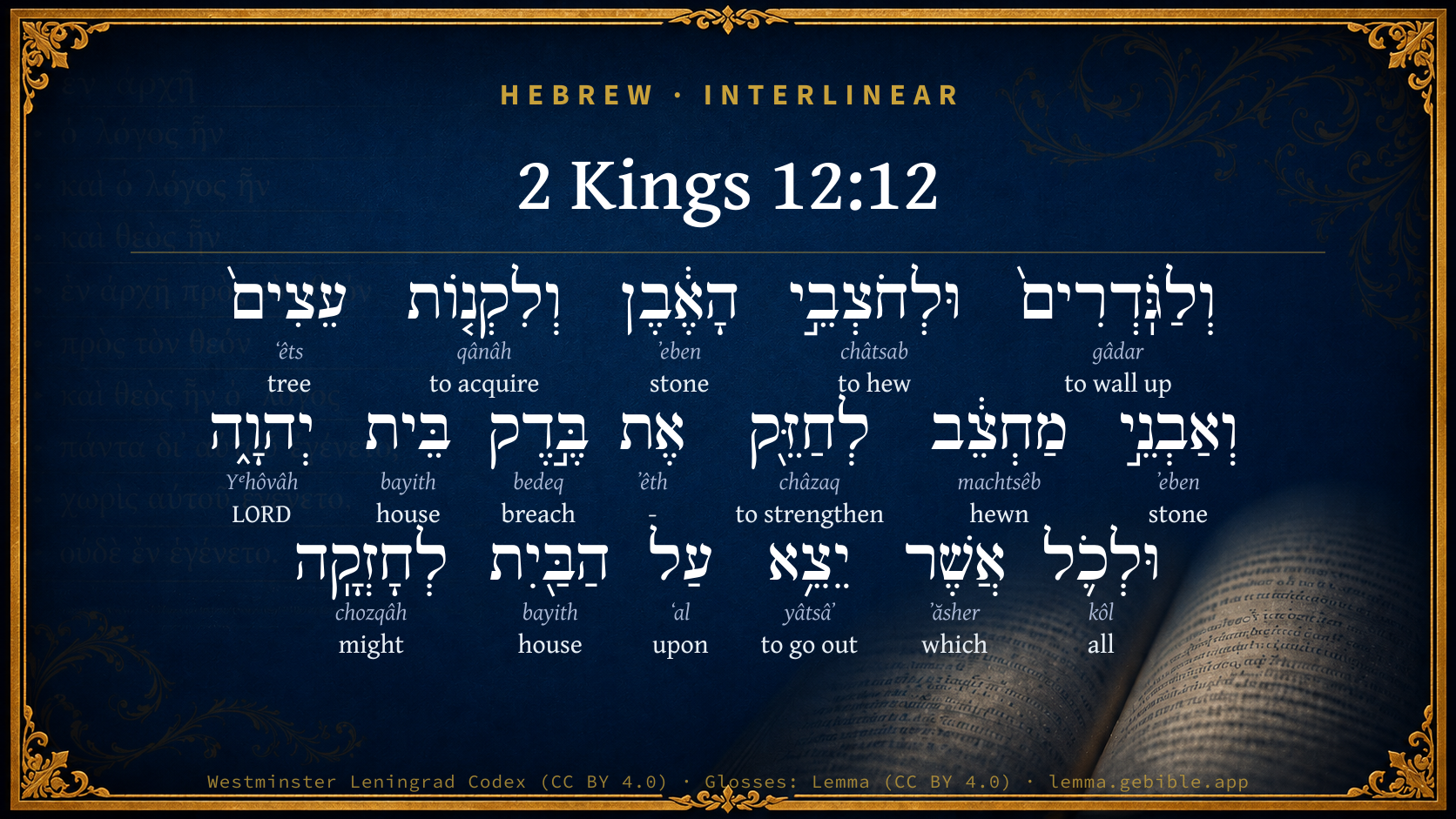
2 Kings 12:12

Hebrew (Westminster Leningrad Codex) 2 Kings 12:12 appears in the Hebrew Old Testament. The text above is from the Westminster Leningrad Codex. Each word links to its Strong’s number, a concise gloss, and parsing drawn from the Open Scriptures Hebrew Bible morphology. Click any word for its full Brown-Driver-Briggs (BDB) entry.
Download image
Cite this verse

2 Kings 12:12 (World English Bible). Public Domain. Lemma interlinear Bible study tool, https://lemma.gebible.app/v/2-kings/12/12.

Show BibTeX & RIS
BibTeX
RIS
English Translation
and to the masons and the stone cutters, and for buying timber and hewn stone to repair the breaches of the house of Yahweh, and for all that was laid out for the house to repair it.
World English Bible · Public Domain
Highlights
  • 2 first appearances in the Hebrew Bible
Full analysis ↓
Download a study sheet

One document with this verse’s original text, its word-by-word gloss line, the meaning frame, cross-references with their text, attributed commentary, and full source and license credits — printable, and it pastes into notes with its structure intact.

This verse Autodidact and up

Study sheet (.html) Plain text (.txt)

A passage Seminary Student

Up to 50 verses in one chapter. A passage sheet keeps up to 6 commentary sources and 12 cross-references per verse, in the order this page ranks them, and says so on the sheet whenever that leaves anything out. Ask for a single verse and you get the Autodidact verse sheet above.

Everything on this page stays free to read, with no account — the sheet is a download of what is already on screen, not access to it.

Want to remove ads? Support Godless Engineer
Compare translations 3

The same verse in 3 English versions, stacked beneath the original-language interlinear above. Click any original word for its lexicon entry.

Each is an independent rendering of the whole verse — the interlinear is not word-aligned to these translations.

Highlighted words mark where these versions differ — a whole-verse word diff, not a word-by-word alignment.

  • World English Bible Public Domain
    and to the masons and the stone cutters, and for buying timber and hewn stone to repair the breaches of the house of Yahweh, and for all that was laid out for the house to repair it.
  • King James Version Public Domain
    And to masons, and hewers of stone, and to buy timber and hewed stone to repair the breaches of the house of the LORD, and for all that was laid out for the house to repair it.
  • unfoldingWord Literal Text CC BY-SA 4.0
    and to the masons and to the hewers of stone and to buy wood and stones of hewing to strengthen the damage of the house of Yahweh and for everything that came out concerning the house to strengthen.

unfoldingWord Literal Text — © unfoldingWord, licensed CC BY-SA 4.0. Word-aligned USFM3 via Door43 (git.door43.org/unfoldingWord/en_ult).

Versions to compare (up to 4)

3 of 4 selected

Show all 18 translations

Every available English version of this verse, each an independent rendering of the whole verse.

  • World English Bible Public Domain
    and to the masons and the stone cutters, and for buying timber and hewn stone to repair the breaches of the house of Yahweh, and for all that was laid out for the house to repair it.
  • Berean Standard Bible Public Domain
    masons, and stonecutters. They also purchased timber and dressed stone to repair the damage to the house of the LORD, and they paid the other expenses of the temple repairs.
  • Majority Standard Bible Public Domain
    masons, and stonecutters. They also purchased timber and dressed stone to repair the damage to the house of the LORD, and they paid the other expenses of the temple repairs.
  • King James Version Public Domain
    And to masons, and hewers of stone, and to buy timber and hewed stone to repair the breaches of the house of the LORD, and for all that was laid out for the house to repair it.
  • American Standard Version (1901) Public Domain
    and to the masons and the hewers of stone, and for buying timber and hewn stone to repair the breaches of the house of Jehovah, and for all that was laid out for the house to repair it.
  • Revised Version (1885) Public Domain
    and to the masons and the hewers of stone, and for buying timber and hewn stone to repair the breaches of the house of the LORD, and for all that was laid out for the house to repair it.
  • Geneva Bible (1599) Public Domain
    And to the masons and hewers of stone, and to bye timber and hewed stone, to repayre that was decayed in the house of the Lord, and for all that which was layed out for the reparation of the Temple.
  • Douay-Rheims (1899) Public Domain
    And made the repairs: and to them that cut stones, and to buy timber, and stones, to be hewed, that the repairs of the house of the Lord might be completely finished, and wheresoever there was need of expenses to uphold the house
  • Young's Literal Translation Public Domain
    and to those `repairing' the wall, and to hewers of stone, and to buy wood and hewn stones to strengthen the breach of the house of Jehovah, and for all that goeth out on the house, to strengthen it.
  • Literal Standard Version CC BY-SA 4.0
    and to those [repairing] the wall, and to hewers of stone, and to buy wood and hewn stones to strengthen the breach of the house of YHWH, and for all that goes out on the house, to strengthen it.
  • Unlocked Literal Bible CC BY-SA 4.0
    and to the masons and the stonecutters, for buying timber and cutting stone to repair the temple of Yahweh, and for all that was needed to be paid to repair it.
  • unfoldingWord Literal Text CC BY-SA 4.0
    and to the masons and to the hewers of stone and to buy wood and stones of hewing to strengthen the damage of the house of Yahweh and for everything that came out concerning the house to strengthen.
  • Darby Bible Public Domain
    and to masons, and hewers of stone, and to buy timber and hewn stone to repair the breaches of the house of Jehovah, and for all that had to be laid out on the house for repairs.
  • World Messianic Bible Public Domain
    and to the masons and the stone cutters, and for buying timber and cut stone to repair the damage to the LORD’s house, and for all that was laid out for the house to repair it.
  • Webster's Bible Public Domain
    And to masons, and hewers of stone, and to buy timber and hewed stone to repair the breaches of the house of the LORD, and for all that was laid out for the house to repair it.
  • Free Bible Version CC BY-SA 4.0
    masons, and stonecutters. They also bought the timber and blocks of cut stone needed for the repair of the Lord's Temple, and paid all the other costs of restoring the Temple.
  • Bible in Basic English Public Domain
    And to the wall-builders and the stone-cutters, and to get wood and cut stone for building up the broken parts of the house of the Lord, and for everything needed to put the house in good order.
  • JPS Tanakh (1917) Public Domain
    (12-13) and to the masons and the hewers of stone, and for buying timber and hewn stone to repair the breaches of the house of the LORD, and for all that was laid out for the house to repair it.

Literal Standard Version (2020), Covenant Press — licensed CC BY-SA 4.0. Text via the HelloAO Bible API (eBible.org). Unlocked Literal Bible (unfoldingWord) — licensed CC BY-SA 4.0. Text via the HelloAO Bible API (eBible.org). unfoldingWord Literal Text — © unfoldingWord, licensed CC BY-SA 4.0. Word-aligned USFM3 via Door43 (git.door43.org/unfoldingWord/en_ult). Free Bible Version, Dr. Jonathan Gallagher — licensed CC BY-SA 4.0. Text via the HelloAO Bible API (eBible.org).

Word by word

More ways to search: Search by grammar → Find every occurrence → Compare this word →

Practice this passage: Drill this verse → Learn its vocabulary →

מַחְצֵ֔ב
machtsêb
H4274
“hewn”
Noun, Common, Masculine, Singular, Absolute
Part of Speech
Noun
Type
Common
Gender
Masculine
Number
Singular
State
Absolute
Full BDB Definition

Origin: from H2672

TWOT: 718a

hewing, hewn - of stones
  1. וְלַגֹּֽדְרִים֙ gâdar H1443 “and · to/for the · walling up” Conjunction + Preposition, Determined + Verb, Qal, Participle Active, Masculine, Plural, Absolute
  2. וּלְחֹצְבֵ֣י châtsab H2672 “and · to/for · hewing” Conjunction + Preposition + Verb, Qal, Participle Active, Masculine, Plural, Construct
  3. הָאֶ֔בֶן ʼeben H68 “the · stone” Particle, Definite Article + Noun, Common, Feminine, Singular, Absolute
  4. וְלִקְנ֤וֹת qânâh H7069 “and · to acquire” Conjunction + Preposition + Verb, Qal, Infinitive Construct
  5. עֵצִים֙ ʻêts H6086 “trees” Noun, Common, Masculine, Plural, Absolute
  6. וְאַבְנֵ֣י ʼeben H68 “and · stones of” Conjunction + Noun, Common, Feminine, Plural, Construct
  7. לְחַזֵּ֖ק châzaq H2388 “to strengthen” Preposition + Verb, Piel, Infinitive Construct
  8. אֶת ʼêth H853 “-” Particle, Direct Object
  9. בֶּ֣דֶק bedeq H919 “breach of” Noun, Common, Masculine, Singular, Construct
  10. בֵּית bayith H1004 “house of” Noun, Common, Masculine, Singular, Construct
  11. יְהוָ֑ה Yᵉhôvâh H3068 “LORD” Noun, Proper
  12. וּלְכֹ֛ל kôl H3605 “and · to/for · all” Conjunction + Preposition + Noun, Common, Masculine, Singular, Absolute
  13. אֲשֶׁר ʼăsher H834 “which” Particle, Relative
  14. יֵצֵ֥א yâtsâʼ H3318 “to go out” Verb, Qal, Imperfect, 3rd Person, Masculine, Singular
  15. עַל ʻal H5921 “upon” Preposition
  16. הַבַּ֖יִת bayith H1004 “the · house” Particle, Definite Article + Noun, Common, Masculine, Singular, Absolute
  17. לְחָזְקָֽה chozqâh H2394 “to/for · might” Preposition + Verb, Qal, Infinitive Construct

About this verse

These counts appear in no published source. They are computed here, from the morphology-tagged text and Lemma’s own curated glosses. What Lemma adds →

18
words
16
distinct lemmas
Historical
section

Notable vocabulary

The rarest word here is מַחְצֵ֔ב hewn H4274 — appearing just 3 times in the whole Hebrew Bible.

First appearance in Scripture

These words make their first canonical appearance in the Hebrew Bible here:

  • וְלַגֹּֽדְרִים֙ to wall up H1443
  • מַחְצֵ֔ב hewn H4274

Shared distinctive vocabulary

מַחְצֵ֔ב hewn H4274 occurs in 3 verses of the Hebrew Bible. Also found in:

Grammatical profile

  • 6 verbs
  • 9 nouns
  • 1 preposition
  • 2 particles

Verb forms

  • וְלַגֹּֽדְרִים֙ Qal · Participle Active
  • וּלְחֹצְבֵ֣י Qal · Participle Active
  • וְלִקְנ֤וֹת Qal · Infinitive Construct
  • לְחַזֵּ֖ק Piel · Infinitive Construct
  • יֵצֵ֥א Qal · Imperfect
  • לְחָזְקָֽה Qal · Infinitive Construct

Repetition

Words recur within this verse — often emphatic in Hebrew:

  • הָאֶ֔בֶן stone H68 ×2
  • בֵּית house H1004 ×2

Hebrew & Septuagint length

In English translation the verse runs 37 words from the Hebrew and 40 from the Septuagint (LXX English) — closely comparable.

A rough comparison of the two English renderings, which tokenize alike — not a word-level alignment.

Word counts can differ between the Hebrew and the Greek without any difference in meaning — e.g. the Hebrew direct-object marker אֵת has no separate Greek word, and Greek often adds the article ὁ.

In the original languages it is 18 Hebrew tokens and 29 Greek tokens — but the two are counted differently (Hebrew bundles its prefixes and suffixes into one token; the Greek is in lemma form), so that isn’t a like-for-like length.

Cross-references

5

Topical passages linked to 2 Kings 12:12 in the Treasury of Scripture Knowledge — connected by theme and wording, ordered by reader-vote popularity; previews shown in the World English Bible.

  • 2 Kings 22:5–6 and let them deliver it into the hand of the workmen who have the oversight of the house of Yahweh; and let them give it to the workmen who are in the house of Yahweh, to repair the breaches of the house,
  • 1 Kings 5:17–18 The king commanded, and they hewed out great stones, costly stones, to lay the foundation of the house with worked stone.
  • Ezra 3:7 They gave money also to the masons, and to the carpenters; and food, and drink, and oil, to them of Sidon, and to them of Tyre, to bring cedar trees from Lebanon to the sea, to Joppa, according to the grant that they had of Cyrus king of Persia.
  • Ezra 5:8 Be it known to the king, that we went into the province of Judah, to the house of the great God, which is built with great stones, and timber is laid in the walls; and this work goes on with diligence and prospers in their hands.
  • Luke 21:5 As some were talking about the temple and how it was decorated with beautiful stones and gifts, he said,

Cross-references courtesy of OpenBible.info (CC BY 4.0).

Hebrew and Greek witnesses Masoretic Hebrew ↔ Greek Septuagint

The same verse in the two great witnesses to the Old Testament, shown verse-for-verse.

These are two independent witnesses, not word-aligned to each other, and the Septuagint is shown in lemma (dictionary) form.

Hebrew 2 Kings 12:12 Masoretic · Westminster Leningrad Codex

וְלַגֹּֽדְרִים֙ וּלְחֹצְבֵ֣י הָאֶ֔בֶן וְלִקְנ֤וֹת עֵצִים֙ וְאַבְנֵ֣י מַחְצֵ֔ב לְחַזֵּ֖ק אֶת בֶּ֣דֶק בֵּית יְהוָ֑ה וּלְכֹ֛ל אֲשֶׁר יֵצֵ֥א עַל הַבַּ֖יִת לְחָזְקָֽה

and to the masons and the stone cutters, and for buying timber and hewn stone to repair the breaches of the house of Yahweh, and for all that was laid out for the house to repair it.

World English Bible · Public Domain

Greek LXX 2 Kings 12:12 Septuagint · lemma form

καί δίδωμι ὁ ἀργύριον ὁ ἑτοιμάζω ἐπί χείρ ποιέω ὁ ἔργον ὁ ἐπισκοπός οἶκος κύριος καί ἐκδίδωμι ὁ τέκτων ὁ ξύλον καί ὁ οἰκοδόμος ὁ ποιέω ἐν οἶκος κύριος

And to the masons, and to the hewers of stone, to purchase timber and hewn stone to repair the breaches of the house of the Lord, for all that was spent on the house of the Lord to repair it.

LXX2012 (modern English Septuagint) · Public Domain

Hebrew: Westminster Leningrad Codex (CC BY 4.0). Greek: Septuagint (public domain); English from LXX2012 (modern English Septuagint) (Public Domain). How the Septuagint differs from the Hebrew →

Targum (Aramaic paraphrase)

1

The Targum is the ancient Jewish Aramaic paraphrase of the Hebrew Scriptures — an interpretive translation, not the Hebrew text itself. Onkelos (literal) and Pseudo-Jonathan (expansive) render the Torah, and Jonathan the Prophets. Coverage is partial: where no permissively-licensed English translation exists for a verse, only the Aramaic is shown. This is verse-level text, not a word-by-word alignment to the Hebrew.

  1. Targum Jonathan Prophets (Joshua–Malachi)
    וְיַהֲבִין יַת כַּסְפָּא דְמִטַקֵס עַל יְדֵי עָבְדֵי עֲבִידָא דִי מְמַנָן עַל בֵּית מַקְדְשָׁא דַייָ וּמַפְקִין לְנַגְרֵי אֳעַיָא וּלְאַרְדִיכְלַיָא דְעַבְדִין בֵּית מַקְדְשָׁא דַיָי:

    (no public-domain English translation for this verse)

    Targum Jonathan — Aramaic: “Mikraot Gedolot” (public domain). English: “Sefaria Community Translation” (CC0 1.0 (public-domain dedication)); “London "Chaldee Paraphrase," 1871” (public domain). Text via Sefaria.

Commentary

Notes on 2 Kings 12:12 from classic Christian and Jewish commentators (each source and its license shown beneath its notes). The classic Christian expositions comment on the surrounding passage and are grouped to its opening verse, so a note may address several verses; the Jewish commentaries on the Tanakh (Rashi and others) are per-verse, so they appear only where the commentator wrote on this verse.

Lemma curates 59 commentaries, every one of them public domain or Creative Commons licensed, each selected and text-cleaned for this edition rather than reprinted as found. About our sources →

Trapp's Complete Commentary

John Trapp

2Ki 12:12 And to masons, and hewers of stone, and to buy timber and hewed stone to repair the breaches of the house of the LORD, and for all that was laid out for the house to repair [it].

Ver. 12. For the house to repair it.] See on 2Ki 12:5.

John Trapp, A Commentary or Exposition upon All the Books of the Old and New Testament (1647–1656) — public domain. Text from a community e-Sword module.

Ellicott's Commentary for English Readers

(12) Masons . . . hewers.—Heb., the masons . . . the hewers.

Hewed stone.—Or, quarry stone.

That was laid out.—The Hebrew tense implies that it was done repeatedly.

To repair it.—Rather, for repair. The word (chozqah) does not recur in this sense.

A Bible Commentary for English Readers, edited by Charles John Ellicott (1878–1897) — public domain. Text from a community e-Sword module.

The Cambridge Bible for Schools and Colleges

gen. ed. J. J. S. Perowne

12. and to buy timber and hewed stone] R.V. And for buying timber and hewn stone. The whole passage thus becomes, as the Hebrew makes it, dependent on the previous verb ‘they paid it out’, so that the overseers are represented as paying all wages and buying all materials.

The Cambridge Bible for Schools and Colleges (gen. ed. J. J. S. Perowne; Cambridge University Press, 1878–1918) — public domain. Text from a community e-Sword module.

John Gill's Exposition

But they gave that to the workmen, and repaired therewith the house of the Lord. They took care that the workmen should first be paid for the repairs of the temple.

But they gave that to the workmen, and repaired therewith the house of the Lord. They took care that the workmen should first be paid for the repairs of the temple.

2 Kings 12:15

kg2 12:15

kg2 12:15

kg2 12:15Moreover, they reckoned not with the men into whose hand they delivered the money to be bestowed on the workmen,.... That is, the king's secretary and the high priest, or his officer, never called to account the overseers of the workmen, to whom they committed the money to pay them with; never examined how they laid it out, and for what:

for they dealt faithfully; they saw they acted such an honest and upright part, and such an high opinion had they of them, that they never examined their accounts, or called for their bills.

John Gill's Exposition of the Whole Bible (1746–1763) — public domain (CC PDM 1.0). Text via the HelloAO Bible API.

Matthew Poole's English Annotations

And for all other things which were necessary for the reparation of the house.

Matthew Poole's English Annotations on the Holy Bible (1683–1685) — public domain. Text from a community e-Sword/MySword module.

The Pulpit Commentary

And to masons; rather, to the masons. The "masons" (goderim) are the actual artisans who worked under instructions from the "builders." And hewers of stone or, stone-cutters rather, those who sawed up the stones on the spot, than those who hewed them in the quarriesand to buy timber and hewed stone to repair the breaches of the house of the Lord. The writer of Chronicles mentions "workers in iron and brass" (bronze) also. (2Ch_24:12) Probably, when once the work was taken thoroughly in hand, it was found that repairs of all sorts and kinds were needed. The temple had stood for a hundred and thirty-six years, and up to this time it had, so far as we know, undergone no repairs at all. Certainly none are mentioned. And for all that was laid out for the house to repair it. This general clause shows how wide were the powers of the overseers. The suspicions and jealousies which modern writers have imagined contrast remarkably with the general confidence and trust which seem to have prevailed among all those concerned in the repairs.

The Pulpit Commentary (1880–1919), ed. H.D.M. Spence-Jones & Joseph S. Exell — public domain. Text from a community e-Sword module.

Rashi

Rabbi Shlomo Yitzchaki (Rashi)

They gave the counted money. They would give the counted money, i.e., after it was taken out of the chest and weighed and counted, they would give it into the hands of the treasurers who were in charge of the workers.

The counted. [מְתֻכָּן is] an expression of a number, as in, “and the number [=וְתוֹכֵן] of bricks you shall give.”

Who were [thus] appointed. Who were appointed.

They paid. [וַיּוֹצִיאֻהוּ is] an expression of spending, for the purpose of hiring carpenters.

And the builders. They are the architects, the stone smiths, whose colleagues worked under their orders, [i.e., בּוֹנִים were] the supervisors of the craftsmen.

Rashi on the Tanakh — English translations: “The Judaica Press complete Tanach with Rashi, translated by A. J. Rosenberg” (CC BY 4.0); “Pentateuch with Rashi's commentary by M. Rosenbaum and A.M. Silbermann, 1929-1934” (public domain); “The Metsudah Tanach series, Lakewood, N.J” (CC BY 4.0); and “The Book of Joshua, Metsudah Publications, 1997” (CC BY 4.0). Text via Sefaria.

Lesson kit

Teaching starters — assembled from the data on this page, not authored interpretation. Every prompt links to the verse data it draws on. Edit before teaching.

2 Kings, in the Historical, opens this verse with 18 words (16 distinct Hebrew lemmas). Its most distinctive word is machtsêb (“hewn”). A historical commentator’s framing appears above. Read the whole chapter for the surrounding context.

Discussion questions

  1. How does “hewn” (machtsêb) shape what this verse is saying?
  2. 2 words here appear for the first time in Scripture. What is being introduced at this debut?
  3. 2 Kings 22:6 shares the word «hewn» with this verse. How do the two illuminate each other?
  4. “stone” occurs 2× in this one verse. What is the effect of the repetition?
  5. The translations on this page render this verse differently — a whole-verse word diff, not a word-by-word alignment. What might account for the different wordings?
  6. The verb «וְלַגֹּֽדְרִים֙» is Qal Participle Active. How does its form color the action?
  7. Reading how Trapp's Complete Commentary and Ellicott's Commentary for English Readers read this verse, where do the two commentators agree and where do they part?

Things to notice

Reading settings

Reading text

Shown beneath each verse's original-language words.

Old Testament
Old Testament edition

Read the OT as the Masoretic Hebrew (MT) or the Greek Septuagint (LXX).

English shown for the Greek Septuagint (in the Hebrew ↔ Greek comparison).

Comparing translations? Open the Compare panel on any verse page to stack up to four side by side.