

2 Chronicles 34:8

Hebrew (Westminster Leningrad Codex) 2 Chronicles 34:8 appears in the Hebrew Old Testament. The text above is from the Westminster Leningrad Codex. Each word links to its Strong’s number, a concise gloss, and parsing drawn from the Open Scriptures Hebrew Bible morphology. Click any word for its full Brown-Driver-Briggs (BDB) entry.
Download image
Cite this verse

2 Chronicles 34:8 (World English Bible). Public Domain. Lemma interlinear Bible study tool, https://lemma.gebible.app/v/2-chronicles/34/8.

Show BibTeX & RIS
BibTeX
RIS
English Translation
Now in the eighteenth year of his reign, when he had purged the land and the house, he sent Shaphan the son of Azaliah, and Maaseiah the governor of the city, and Joah the son of Joahaz the recorder, to repair the house of Yahweh his God.
World English Bible · Public Domain
Download a study sheet

One document with this verse’s original text, its word-by-word gloss line, the meaning frame, cross-references with their text, attributed commentary, and full source and license credits — printable, and it pastes into notes with its structure intact.

This verse Autodidact and up

Study sheet (.html) Plain text (.txt)

A passage Seminary Student

Up to 50 verses in one chapter. A passage sheet keeps up to 6 commentary sources and 12 cross-references per verse, in the order this page ranks them, and says so on the sheet whenever that leaves anything out. Ask for a single verse and you get the Autodidact verse sheet above.

Everything on this page stays free to read, with no account — the sheet is a download of what is already on screen, not access to it.

Want to remove ads? Support Godless Engineer
Compare translations 3

The same verse in 3 English versions, stacked beneath the original-language interlinear above. Click any original word for its lexicon entry.

Each is an independent rendering of the whole verse — the interlinear is not word-aligned to these translations.

Highlighted words mark where these versions differ — a whole-verse word diff, not a word-by-word alignment.

  • World English Bible Public Domain
    Now in the eighteenth year of his reign, when he had purged the land and the house, he sent Shaphan the son of Azaliah, and Maaseiah the governor of the city, and Joah the son of Joahaz the recorder, to repair the house of Yahweh his God.
  • King James Version Public Domain
    Now in the eighteenth year of his reign, when he had purged the land, and the house, he sent Shaphan the son of Azaliah, and Maaseiah the governor of the city, and Joah the son of Joahaz the recorder, to repair the house of the LORD his God.
  • unfoldingWord Literal Text CC BY-SA 4.0
    And in the 18th year of his reigning, to cleanse the land and the house, he sent Shaphan the son of Azaliah, and Maaseiah, the chief of the city, and Joah the son of Joahaz the secretary, to make strong the house of Yahweh his God.

unfoldingWord Literal Text — © unfoldingWord, licensed CC BY-SA 4.0. Word-aligned USFM3 via Door43 (git.door43.org/unfoldingWord/en_ult).

Versions to compare (up to 4)

3 of 4 selected

Show all 18 translations

Every available English version of this verse, each an independent rendering of the whole verse.

  • World English Bible Public Domain
    Now in the eighteenth year of his reign, when he had purged the land and the house, he sent Shaphan the son of Azaliah, and Maaseiah the governor of the city, and Joah the son of Joahaz the recorder, to repair the house of Yahweh his God.
  • Berean Standard Bible Public Domain
    Now in the eighteenth year of his reign, in order to cleanse the land and the temple, Josiah sent Shaphan son of Azaliah, Maaseiah the governor of the city, and Joah son of Joahaz, the recorder, to repair the house of the LORD his God.
  • Majority Standard Bible Public Domain
    Now in the eighteenth year of his reign, in order to cleanse the land and the temple, Josiah sent Shaphan son of Azaliah, Maaseiah the governor of the city, and Joah son of Joahaz, the recorder, to repair the house of the LORD his God.
  • King James Version Public Domain
    Now in the eighteenth year of his reign, when he had purged the land, and the house, he sent Shaphan the son of Azaliah, and Maaseiah the governor of the city, and Joah the son of Joahaz the recorder, to repair the house of the LORD his God.
  • American Standard Version (1901) Public Domain
    Now in the eighteenth year of his reign, when he had purged the land and the house, he sent Shaphan the son of Azaliah, and Maaseiah the governor of the city, and Joah the son of Joahaz the recorder, to repair the house of Jehovah his God.
  • Revised Version (1885) Public Domain
    Now in the eighteenth year of his reign, when he had purged the land, and the house, he sent Shaphan the son of Azaliah, and Maaseiah the governor of the city, and Joah the son of Joahaz the recorder, to repair the house of the LORD his God.
  • Geneva Bible (1599) Public Domain
    Then in the eightenth yere of his reigne, when hee had purged the lande and the Temple, he sent Shaphan the sonne of Azaliah, and Maaseiah the gouernour of the citie, and Ioah the sonne of Ioahaz the recorder, to repaire the house of the Lord his God.
  • Douay-Rheims (1899) Public Domain
    Now in the eighteenth year of his reign, when he had cleansed the land, and the temple of the Lord, he sent Saphan the son of Eselias, and Maasias the governor of the city, Joha the son of Joachaz the recorder, to repair the house of the Lord his God.
  • Young's Literal Translation Public Domain
    And in the eighteenth year of his reign, to purify the land and the house he hath sent Shaphan son of Azaliah, and Maaseiah head of the city, and Joah son of Johaz the remembrancer, to strengthen the house of Jehovah his God.
  • Literal Standard Version CC BY-SA 4.0
    And in the eighteenth year of his reign, to purify the land and the house, he has sent Shaphan son of Azaliah, and Maaseiah head of the city, and Joah son of Johaz the remembrancer, to strengthen the house of his God YHWH.
  • Unlocked Literal Bible CC BY-SA 4.0
    Now in the eighteenth year of his reign, after Josiah had cleansed the land and the temple, he sent Shaphan son of Azaliah, Maaseiah, the governor of the city, and Joah son of Joahaz the secretary, to repair the house of Yahweh his God.
  • unfoldingWord Literal Text CC BY-SA 4.0
    And in the 18th year of his reigning, to cleanse the land and the house, he sent Shaphan the son of Azaliah, and Maaseiah, the chief of the city, and Joah the son of Joahaz the secretary, to make strong the house of Yahweh his God.
  • Darby Bible Public Domain
    And in the eighteenth year of his reign, when he purged the land and the house, he sent Shaphan the son of Azaliah, and Maaseiah the governor of the city, and Joah the son of Joahaz the chronicler, to repair the house of Jehovah his God.
  • World Messianic Bible Public Domain
    Now in the eighteenth year of his reign, when he had purged the land and the house, he sent Shaphan the son of Azaliah, Maaseiah the governor of the city, and Joah the son of Joahaz the recorder to repair the house of the LORD his God.
  • Webster's Bible Public Domain
    Now in the eighteenth year of his reign, when he had purged the land, and the house, he sent Shaphan the son of Azaliah, and Maaseiah the governor of the city, and Joah the son of Joahaz the recorder, to repair the house of the LORD his God.
  • Free Bible Version CC BY-SA 4.0
    In the eighteenth year of his reign, once he had finished cleansing the land and the Temple, Josiah sent Shaphan, son of Azaliah, Maaseiah the city governor, and Joah, son of Joahaz, the record-keeper, to repair the Temple of the Lord his God.
  • Bible in Basic English Public Domain
    Now in the eighteenth year of his rule, when the land and the house had been made clean, he sent Shaphan, the son of Azaliah, and Maaseiah, the ruler of the town, and Joah, the son of Joahaz, the recorder, to make good what was damaged in the house of the Lord his God.
  • JPS Tanakh (1917) Public Domain
    Now in the eighteenth year of his reign, when he had purged the land, and the house, he sent Shaphan the son of Azaliah, and Maaseiah the governor of the city, and Joah the son of Joahaz the recorder, to repair the house of the LORD his God.

Literal Standard Version (2020), Covenant Press — licensed CC BY-SA 4.0. Text via the HelloAO Bible API (eBible.org). Unlocked Literal Bible (unfoldingWord) — licensed CC BY-SA 4.0. Text via the HelloAO Bible API (eBible.org). unfoldingWord Literal Text — © unfoldingWord, licensed CC BY-SA 4.0. Word-aligned USFM3 via Door43 (git.door43.org/unfoldingWord/en_ult). Free Bible Version, Dr. Jonathan Gallagher — licensed CC BY-SA 4.0. Text via the HelloAO Bible API (eBible.org).

Word by word

More ways to search: Search by grammar → Find every occurrence → Compare this word →

Practice this passage: Drill this verse → Learn its vocabulary →

אֲצַלְיָ֜הוּ
ʼĂtsalyâhûw
H683
“Azaliah”
Noun, Proper
Part of Speech
Noun
Type
Proper
Full BDB Definition

Origin: from H680 and H3050 prolonged

TWOT: None

Azaliah = "Jehovah (Yahweh) has reserved (set apart)" - the father of Shaphan the scribe
  1. וּבִשְׁנַ֨ת shâneh H8141 “and · in/at · year of” Conjunction + Preposition + Noun, Common, Feminine, Singular, Construct
  2. שְׁמוֹנֶ֤ה shᵉmôneh H8083 “eight” Adjective, Cardinal number, Feminine, Singular, Absolute
  3. עֶשְׂרֵה֙ ʻâsâr H6240 “teen” Adjective, Cardinal number, Feminine, Singular, Absolute
  4. לְמָלְכ֔וֹ mâlak H4427 “to reign · him” Preposition + Verb, Qal, Infinitive Construct + Suffix, Personal, 3rd Person, Masculine, Singular
  5. לְטַהֵ֥ר ṭâhêr H2891 “to cleanse” Preposition + Verb, Piel, Infinitive Construct
  6. הָאָ֖רֶץ ʼerets H776 “the · land” Particle, Definite Article + Noun, Common, Both, Singular, Absolute
  7. וְהַבָּ֑יִת bayith H1004 “and · the · house” Conjunction + Particle, Definite Article + Noun, Common, Masculine, Singular, Absolute
  8. שָׁ֠לַח shâlach H7971 “to send” Verb, Qal, Perfect, 3rd Person, Masculine, Singular
  9. אֶת ʼêth H853 “-” Particle, Direct Object
  10. שָׁפָ֨ן shâphân H8227 “rock badger” Noun, Proper
  11. בֶּן bên H1121 “son of” Noun, Common, Masculine, Singular, Construct
  12. וְאֶת ʼêth H853 “and · -” Conjunction + Particle, Direct Object
  13. מַעֲשֵׂיָ֣הוּ Maʻăsêyâh H4641 “Maaseiah” Noun, Proper
  14. שַׂר sar H8269 “prince of” Noun, Common, Masculine, Singular, Construct
  15. הָעִ֗יר ʻîyr H5892 “the · city” Particle, Definite Article + Noun, Common, Feminine, Singular, Absolute
  16. וְ֠אֵת ʼêth H853 “and · -” Conjunction + Particle, Direct Object
  17. יוֹאָ֤ח Yôwʼâch H3098 “Joah” Noun, Proper
  18. בֶּן bên H1121 “son of” Noun, Common, Masculine, Singular, Construct
  19. יֽוֹאָחָז֙ Yôwʼâchâz H3099 “Joahaz” Noun, Proper
  20. הַמַּזְכִּ֔יר zâkar H2142 “the · remembering” Particle, Definite Article + Verb, Hiphil, Participle Active, Masculine, Singular, Absolute
  21. לְחַזֵּ֕ק châzaq H2388 “to strengthen” Preposition + Verb, Piel, Infinitive Construct
  22. אֶת ʼêth H853 “-” Particle, Direct Object
  23. בֵּ֖ית bayith H1004 “house of” Noun, Common, Masculine, Singular, Construct
  24. יְהוָ֥ה Yᵉhôvâh H3068 “LORD” Noun, Proper
  25. אֱלֹהָֽיו ʼĕlôhîym H430 “God(s) · his” Noun, Common, Masculine, Plural, Construct + Suffix, Personal, 3rd Person, Masculine, Singular

About this verse

These counts appear in no published source. They are computed here, from the morphology-tagged text and Lemma’s own curated glosses. What Lemma adds →

26
words
21
distinct lemmas
Historical
section

Notable vocabulary

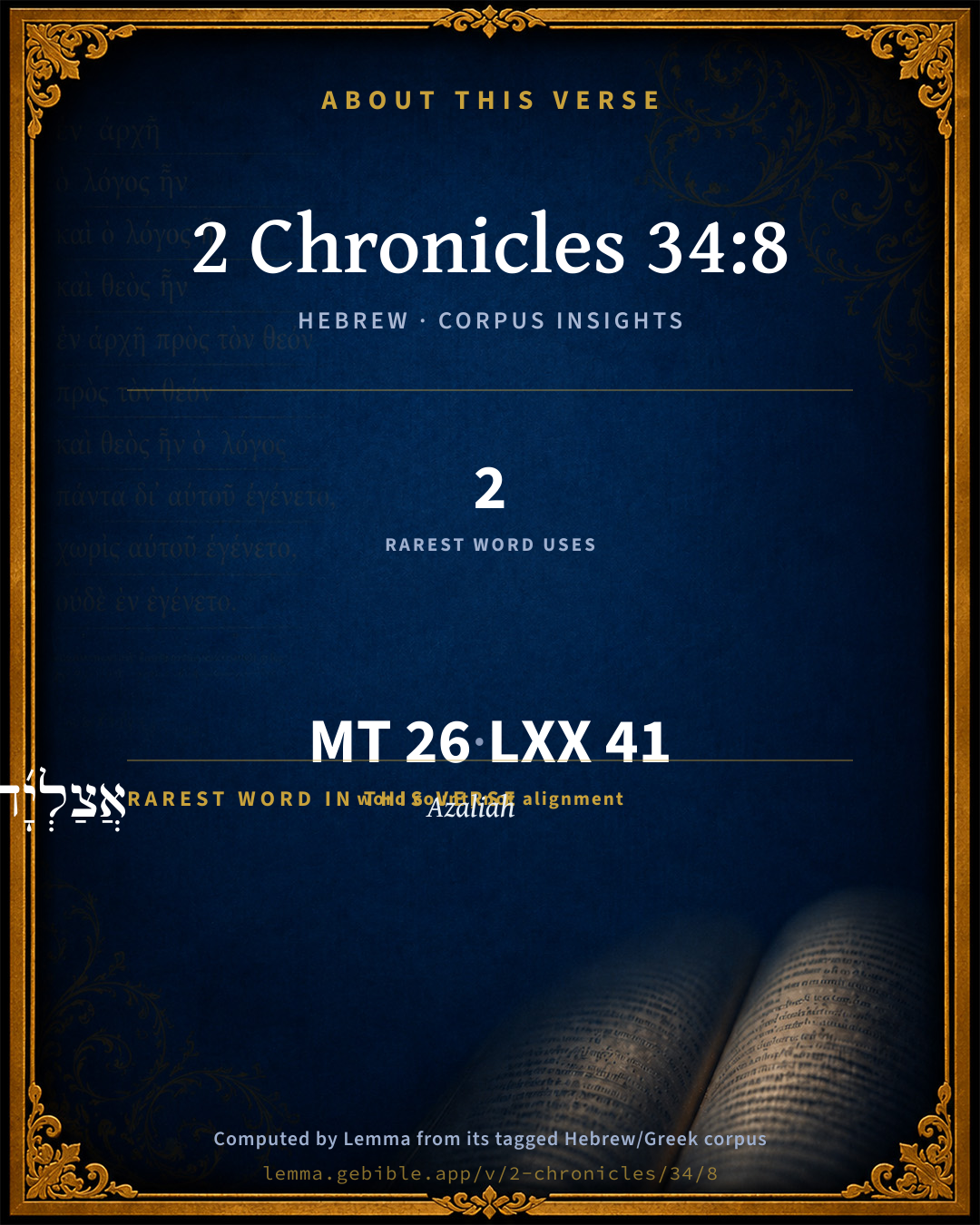
The rarest word here is אֲצַלְיָ֜הוּ Azaliah H683 — appearing just 2 times in the whole Hebrew Bible.

Shared distinctive vocabulary

אֲצַלְיָ֜הוּ Azaliah H683 occurs in 2 verses of the Hebrew Bible. Also found in:

Grammatical profile

  • 5 verbs
  • 15 nouns
  • 2 adjectives
  • 4 particles

Verb forms

  • לְמָלְכ֔וֹ Qal · Infinitive Construct
  • לְטַהֵ֥ר Piel · Infinitive Construct
  • שָׁ֠לַח Qal · Perfect
  • הַמַּזְכִּ֔יר Hiphil · Participle Active
  • לְחַזֵּ֕ק Piel · Infinitive Construct

Repetition

Words recur within this verse — often emphatic in Hebrew:

  • וְהַבָּ֑יִת house H1004 ×2
  • בֶּן son H1121 ×2

Hebrew & Septuagint length

In English translation the verse runs 47 words from the Hebrew and 45 from the Septuagint (LXX English) — closely comparable.

A rough comparison of the two English renderings, which tokenize alike — not a word-level alignment.

Word counts can differ between the Hebrew and the Greek without any difference in meaning — e.g. the Hebrew direct-object marker אֵת has no separate Greek word, and Greek often adds the article ὁ.

In the original languages it is 26 Hebrew tokens and 41 Greek tokens — but the two are counted differently (Hebrew bundles its prefixes and suffixes into one token; the Greek is in lemma form), so that isn’t a like-for-like length.

Cross-references

15

Topical passages linked to 2 Chronicles 34:8 in the Treasury of Scripture Knowledge — connected by theme and wording, ordered by reader-vote popularity; previews shown in the World English Bible.

  • 2 Samuel 8:16 Joab the son of Zeruiah was over the host; and Jehoshaphat the son of Ahilud was recorder;
  • 2 Samuel 20:24 and Adoram was over the men subject to forced labor; and Jehoshaphat the son of Ahilud was the recorder;
  • 2 Kings 22:3–20 It happened in the eighteenth year of king Josiah, that the king sent Shaphan, the son of Azaliah the son of Meshullam, the scribe, to the house of Yahweh, saying,
  • 1 Chronicles 18:15 Joab the son of Zeruiah was over the host; and Jehoshaphat the son of Ahilud was recorder;
  • 2 Chronicles 18:25 The king of Israel said, Take Micaiah, and carry him back to Amon the governor of the city, and to Joash the king's son;
  • Jeremiah 1:2–3 to whom the word of Yahweh came in the days of Josiah the son of Amon, king of Judah, in the thirteenth year of his reign.
  • Jeremiah 21:1 The word which came to Jeremiah from Yahweh, when king Zedekiah sent to him Pashhur the son of Malchijah, and Zephaniah the son of Maaseiah, the priest, saying,
  • Jeremiah 26:24 But the hand of Ahikam the son of Shaphan was with Jeremiah, that they should not give him into the hand of the people to put him to death.
  • Jeremiah 29:3 by the hand of Elasah the son of Shaphan, and Gemariah the son of Hilkiah, (whom Zedekiah king of Judah sent to Babylon to Nebuchadnezzar king of Babylon), saying,
  • Jeremiah 29:21 Thus says Yahweh of Hosts, the God of Israel, concerning Ahab the son of Kolaiah, and concerning Zedekiah the son of Maaseiah, who prophesy a lie to you in my name: Behold, I will deliver them into the hand of Nebuchadrezzar king of Babylon; and he shall kill them before your eyes;
  • Jeremiah 29:25 Thus speaks Yahweh of Hosts, the God of Israel, saying, Because you have sent letters in your own name to all the people who are at Jerusalem, and to Zephaniah the son of Maaseiah, the priest, and to all the priests, saying,
  • Jeremiah 36:10 Then read Baruch in the book the words of Jeremiah in the house of Yahweh, in the chamber of Gemariah the son of Shaphan, the scribe, in the upper court, at the entry of the new gate of Yahweh's house, in the ears of all the people.
  • Jeremiah 39:14 they sent, and took Jeremiah out of the court of the guard, and committed him to Gedaliah the son of Ahikam, the son of Shaphan, that he should carry him home: so he lived among the people.
  • Jeremiah 40:11 Likewise when all the Jews who were in Moab, and among the children of Ammon, and in Edom, and who were in all the countries, heard that the king of Babylon had left a remnant of Judah, and that he had set over them Gedaliah the son of Ahikam, the son of Shaphan;
  • Ezekiel 8:11 There stood before them seventy men of the elders of the house of Israel; and in the midst of them stood Jaazaniah the son of Shaphan, every man with his censer in his hand; and the odor of the cloud of incense went up.

Cross-references courtesy of OpenBible.info (CC BY 4.0).

Hebrew and Greek witnesses Masoretic Hebrew ↔ Greek Septuagint

The same verse in the two great witnesses to the Old Testament, shown verse-for-verse.

These are two independent witnesses, not word-aligned to each other, and the Septuagint is shown in lemma (dictionary) form.

Hebrew 2 Chronicles 34:8 Masoretic · Westminster Leningrad Codex

וּבִשְׁנַ֨ת שְׁמוֹנֶ֤ה עֶשְׂרֵה֙ לְמָלְכ֔וֹ לְטַהֵ֥ר הָאָ֖רֶץ וְהַבָּ֑יִת שָׁ֠לַח אֶת שָׁפָ֨ן בֶּן אֲצַלְיָ֜הוּ וְאֶת מַעֲשֵׂיָ֣הוּ שַׂר הָעִ֗יר וְ֠אֵת יוֹאָ֤ח בֶּן יֽוֹאָחָז֙ הַמַּזְכִּ֔יר לְחַזֵּ֕ק אֶת בֵּ֖ית יְהוָ֥ה אֱלֹהָֽיו

Now in the eighteenth year of his reign, when he had purged the land and the house, he sent Shaphan the son of Azaliah, and Maaseiah the governor of the city, and Joah the son of Joahaz the recorder, to repair the house of Yahweh his God.

World English Bible · Public Domain

Greek LXX 2 Chronicles 34:8 Septuagint · lemma form

καί ἐν ὁ ὀκτωκαιδέκατος ἔτος ὁ βασιλεία αὐτός ὁ καθαρίζω ὁ γῆ καί ὁ οἶκος ἀποστέλλω ὁ σαφαν υἱός εσελια καί ὁ μαασια ἄρχων ὁ πόλις καί ὁ ιουαχ υἱός ιωαχαζ ὁ ςὑπομνηματογράφο αὐτός κραταιόω ὁ οἶκος κύριος ὁ θεός αὐτός

And in the eighteenth year of his reign, after having cleansed the land, and the house, he sent Saphan the son of Ezelias, and Maasa prefect of the city, and Juach son of Joachaz his recorder, to repair the house of the Lord his God.

LXX2012 (modern English Septuagint) · Public Domain

On this verse, Ellicott's Commentary for English Readers discusses the Septuagint’s reading. Read the note in Commentary ↓

Hebrew: Westminster Leningrad Codex (CC BY 4.0). Greek: Septuagint (public domain); English from LXX2012 (modern English Septuagint) (Public Domain). How the Septuagint differs from the Hebrew →

Commentary

Notes on 2 Chronicles 34:8 from classic Christian and Jewish commentators (each source and its license shown beneath its notes). The classic Christian expositions comment on the surrounding passage and are grouped to its opening verse, so a note may address several verses; the Jewish commentaries on the Tanakh (Rashi and others) are per-verse, so they appear only where the commentator wrote on this verse.

Lemma curates 59 commentaries, every one of them public domain or Creative Commons licensed, each selected and text-cleaned for this edition rather than reprinted as found. About our sources →

Matthew Henry's Commentary

Here, 1. Orders are given by the king for the repair of the temple, Ch2 34:8. When he had purged the house of the corruptions of it he began to fit it up for the services that were to be performed in it. Thus we must do by the spiritual temple of the heart, get it cleansed from the pollutions of sin, and then renewed, so as to be transformed into the image of God. Josiah, in this order, calls God the Lord his God. Those that truly love God will love the habitation of his house. 2. Care is taken about it, effectual care. The Levites went about the country and gathered money towards it, which was returned to the three trustees mentioned, Ch2 34:8. They brought it to Hilkiah the high priest (Ch2 34:9), and he and they put it into the hands of workmen, both overseers and labourers, who undertook to do it by the great, as we say, or in the gross, Ch2 34:10, Ch2 34:11. It is observed that the workmen were industrious and honest: They did the work faithfully (Ch2 34:12); and workmen are not completely faithful if they are not both careful and diligent, for a confidence is reposed in them that they will be so. It is also intimated that the overseers were ingenious; for it is said that all those were employed to inspect this work who were skilful in instruments of music; not that their skill in music could be of any use in architecture, but it was an evidence that they were men of sense and ingenuity, and particularly that their genius lay towards the mathematics, which qualified them very much for this trust. Witty men are then wise men when they employ their wit in doing good, in helping their friends, and, as they have opportunity, in serving the public. Observe, in this work, how God dispenses his gifts variously; here were some that were bearers of burdens, cut out for bodily labour and fit to work. Here were others (made meliori luto - of finer materials) that had skill in music, and they were overseers of those that laboured, and scribes and officers. The former were the hands: these were the heads. They had need of one another, and the work needed both. Let not the overseers of the work despise the bearers of burdens, nor let those that work in the service grudge at those whose office it is to direct; but let each esteem and serve the other in love, and let God have the glory and the church the benefit of the different gifts and dispositions of both.

Matthew Henry's Commentary on the Whole Bible (1708–1710) — public domain (CC PDM 1.0). Text via the HelloAO Bible API.

Jamieson, Fausset & Brown

Robert Jamieson, A. R. Fausset & David Brown

HE REPAIRS THE TEMPLE. (Ch2 34:8-18)

in the eighteenth year of his reign . . . he sent Shaphan--(See on Kg2 22:3-9).

Jamieson, Fausset & Brown — Commentary Critical and Explanatory on the Whole Bible (1871) — public domain (CC PDM 1.0). Text via the HelloAO Bible API.

Trapp's Complete Commentary

John Trapp

2Ch 34:8 Now in the eighteenth year of his reign, when he had purged the land, and the house, he sent Shaphan the son of Azaliah, and Maaseiah the governor of the city, and Joah the son of Joahaz the recorder, to repair the house of the LORD his God.

Ver. 8. Now in the eighteenth year.] See on 2Ki 22:3.

To repair the house of the Lord.] This had been done before by Joash, {2Ki 12:5} but that was two hundred and thirty-four years since: so that now there was need of new reparations. Tempus edax rerum.

John Trapp, A Commentary or Exposition upon All the Books of the Old and New Testament (1647–1656) — public domain. Text from a community e-Sword module.

Joseph Benson's Commentary

2Ch 34:8-11. When he had purged the land and the house — The house of God, called the house, by way of eminence. And they returned to Jerusalem — That is, the Levites, who had gone abroad through all Josiah’s kingdom to gather money for this use, and now came with it to Jerusalem to lodge it in the treasuries of the Lord’s house. To floor the houses which the kings of Judah had destroyed — The chambers adjoining to the temple, or within the courts.

Joseph Benson's Commentary on the Old and New Testaments (1811–1818) — public domain. Text from a community e-Sword module.

Keil & Delitzsch

C. F. Keil & F. Delitzsch

The cleansing and repairing of the temple, and the finding of the book of the law. Cf. Kg2 22:3-10. - In the eighteenth year of his reign, when he was purging the land and the house (of God), he sent. לטהר does not indeed signify "after the purging" (De Wette, with the older expositors), but still less is it a statement of the object, "to purge" (Berth.); for that is decisively disposed of both by its position at the beginning of the sentence, where no statement of the object would stand, but still more by the fact that a statement of the object follows, וגו לחזּק. ל used of time denotes "about," and so with the inf., e.g., Jer 46:13 : at (his) coming = when he came. Shaphan was סופר, state secretary, according to Kg2 22:3. With him the king sent the governor of the city Maaseiah, and the chancellor Joah. These two are not mentioned in Kg2 22:3, but have not been arbitrarily added by the chronicler, or invented by him, as Then. groundlessly supposes. "To repair the house of Jahve." What these high royal officials had to do with it we learn from what follows.

Ch2 34:9-12

They, together with the high priest, gave the money which had been received for the repair of the temple to the overseers of the building, who then gave it to workmen to procure building materials and for wages, just as was done when the temple was repaired by Joash, Ch2 24:11-13. The Keri ויּשׁבוּ is a correction resulting from a misinterpretation of the Keth. וישׁבי, "and of the dwellers in Jerusalem." The enumeration, "from the hand of Manasseh, Ephraim," etc., is rhetorical. In ויּתּנוּ, Ch2 34:10, the verb of Ch2 34:9 is again taken up: they handed it to the overseers of the building, and they to the workmen. הם עשׂה is a rare form of the plur. עשׁי; see on Ch1 23:24. The overseers of the building (המפקדים - עשׁי) are the subject of the second ויּתּנוּ; and before the following עשׂי ל, which stands in 2 Kings, is to be supplied. בדוק is a denom. from בּדק, and signifies to repair what has been damaged. The statement of Ch2 34:10 is made more definite by Ch2 34:11 : they gave it, namely, to the workers in stone and wood, and to the builders to buy hewn stones and timber for couplings, and for the beams of the houses (לקרות, to provide with beams; הבּתים are the various buildings of the temple and its courts), which the kings of Judah had allowed to decay (השׁחית, not of designed destroying, but of ruining by neglect). - In Ch2 34:12 we have still the remark that the people did the work with fidelity, and the money could consequently be given to them without reckoning, cf. Kg2 22:7; and then the names of the building inspectors follow. Two Levites of the family of Merari, and two of the family of Kohath, were overseers; לנצּח, i.e., to lead in the building, to preside over it as upper overseers; and besides them, the Levites, all who were skilled in instruments of song (cf. Ch1 25:6.). As men who by their office and their art occupied a conspicuous place among the Levites, the oversight of the workmen in the temple was committed to them, not "that they might incite and cheer the workmen by music and song" (Berth.).

Ch2 34:13

Ch2 34:13 is probably to be taken, along with Ch2 34:12, in the signification, "All the Levites who were skilled in music were over the bearers of burdens, and were overseers of all the workmen in reference to every work." The ו before הס על appears certainly to go against this interpretation, and Berth. would consequently erase it to connect הסּבּלים על with the preceding verse, and begin a new sentence with וּמנצּחים: "and they led all the workmen." But if we separate וּמנצּחים from הסּבּלים על, this mention of the bearers of burdens (סבלים) comes awkwardly in between the subject and the predicate, or the statement as to the subject. We hold the text to be correct, and make the w before הס על correspond to the ו before מנצחים, in the signification, et - et. The Levites, all who were skilled in instruments of song, were both over the bearers of burdens, and overseeing the workmen, or leading the workmen. Besides, of the Levites were, i.e., still other Levites were, scribes and officers and porters, i.e., were busied about the temple in the discharge of these functions.

Ch2 34:14-18

In bringing out the money that had been brought into the house of the Lord, the high priest found the book of Moses' law. It is not clearly implied in the words, that he found it in the place where the money was laid up. The book of the law which was found is merely characterized as the book of the Mosaic law by the words בּיד־משׁה, not necessarily as Moses' autograph. The communication of this discovery by the high priest to the state secretary Shaphan, and by him to the king, is narrated in Ch2 34:15-18, just as in Kg2 22:8-10. The statement, Ch2 34:16, "And Shaphan brought the book to the king," instead of the words, "and Shaphan the ספר came (went) to the king," involves no difference as to the facts; it rather makes the matter clear. For since in Kg2 22:10, immediately after the statement that Hilkiah gave him the book, it is said that Shaphan read from it to the king, he must have brought it to the king. With this elucidation, both the omission of ויּקראהוּ (Kg2 22:8), and the insertion of עוד after ויּשׁב, Ch2 34:16, is connected. The main thing, that which it concerned the author of the Chronicle to notice, was the fact that the book of the law which had been discovered was immediately brought and read to the king; while the circumstance that Shaphan, when the book was given him, also opened it and read in it, is omitted, as it had no further results. But since Shaphan did not go to the king merely to bring him the book, but rather, in the first place, to report upon the performance of the commission entrusted to him in respect of the money, this report required to be brought prominently forward by the עוד: He brought the book to the king, and besides, made his report to the king. All that has been committed to thy servants (בּיד נתן), that they do; they have poured out the money, etc. The עבדים are not Shaphan and the others mentioned in Ch2 34:8, but in general those who were entrusted with the oversight of the repair of the temple, among whom, indeed, the chief royal officials were not included. After this report there follows in Ch2 34:18 an account of the book which Shaphan had brought, and which, as we were informed in Ch2 34:16, in anticipation of the event, he gave to the king.

Keil & Delitzsch — Biblical Commentary on the Old Testament (1861–1891) — public domain (CC PDM 1.0). Text via the HelloAO Bible API. (Old Testament only.)

Geneva Bible (1599)

Geneva Bible translators

2 Kings 33:5

Geneva Bible (1599) marginal notes — public domain. Text via Bolls.life.

Ellicott's Commentary for English Readers

(8-13) The cleansing and repair of the Temple. (Comp. 2Ki_22:3-7; and the similar account of the restoration by Joash in 2Ch_24:11-13).

When he had purged.—Omit had. (Lĕtahçr is apparently co-ordinate with lĕmolkû, “in the eighteenth year to his reigning, to purging the land “; as if the work of purification had been co-extensive with the reign. The LXX., however, has, “in order to purge the land,” which may be right.)

He sent Shaphan.—Who was secretary of state (2Ki_22:3, “the scribe”).

Maaseiah . . . Joah.—Kings mentions Shaphan only.

The governor of the city.—Sar ha’îr; praefectus urois. (Conp. 1Ch_11:6.)

A Bible Commentary for English Readers, edited by Charles John Ellicott (1878–1897) — public domain. Text from a community e-Sword module.

The Cambridge Bible for Schools and Colleges

gen. ed. J. J. S. Perowne

8–28 (= 2Ki_22:3-20). Repair of the Temple. Discovery of the Book of the Law

8. Shaphan] According to 2 Kin. he was Scribe. See 1Ch_18:16 (note).

the governor of the city] Render, a ruler of the city; cp. 2Ch_29:20.

the recorder] R.V. mg. the chronicler; cp. 1Ch_18:15 (note). Neither Maaseiah nor Joah is mentioned in 2 Kin.

The Cambridge Bible for Schools and Colleges (gen. ed. J. J. S. Perowne; Cambridge University Press, 1878–1918) — public domain. Text from a community e-Sword module.

John Gill's Exposition

And when they came to Hilkiah the high priest,.... To whom they were sent to advise with about the repair of the temple:

they delivered the money that was brought into the house of God; that is, the high priest, and the Levites the doorkeepers, gave it to the king's ministers; which money was either brought to the temple voluntarily, as the free gifts of the people, for the repairs; or rather what was collected by the Levites, sent throughout the land for that purpose, or it may be both:

which the Levites that kept the doors; of the temple; and received the money as the people brought it:

and also had gathered of the hand of Manasseh and Ephraim, and of all the remnant of Israel, and of all Judah, and Benjamin; they went throughout all the land of Israel and Judah, and collected money for the above purpose:

and they returned to Jerusalem; with it, which the high priest took the sum of, see Kg2 22:4 of whom the king's ministers now received it.

John Gill's Exposition of the Whole Bible (1746–1763) — public domain (CC PDM 1.0). Text via the HelloAO Bible API.

Haydock's Catholic Bible Commentary

Eselias, or Assia. This man is alone mentioned, 4 K. xxii. 3. C.

George Leo Haydock (1774–1849), Haydock's Catholic Family Bible and Commentary, 1859 edition — public domain. Excludes Psalms (Douay-Rheims chapter numbering differs from Protestant) and Deuterocanonical books (Catholic canon only).

Matthew Poole's English Annotations

The land and the house; the house of God, called the house by way of eminency.

Matthew Poole's English Annotations on the Holy Bible (1683–1685) — public domain. Text from a community e-Sword/MySword module.

The Pulpit Commentary

It is in some sense as though the work of purification, atoning, penitence, must precede that of practical repentance, of repairing, restoring, rebuilding. The original, however, does not warrant the laying of any stress on the when, found again in the Authorized Version. Shaphau. In the parallel (2Ki_22:3) Shaphan is designated "the scribe." His descendants, to the second generation, at all events, did him honor. (Jer_26:24 Jer_29:3 Jer_36:10, Jer_36:12, Jer_36:25; Eze_8:11; see also 2Ki_25:22) The names of Masseiah (Jer_35:4) and Joah (2Ki_18:18) are known, but not marking the present persons.

Vers. 8-13.

The repairing of the temple by Josiah.

I THE COMMISSIONERS.

1. Their names. Shaphan the son of Azaliah, the king"s secretary (ver. 15); Maaseiah the governor of the city; and Josh the son of Joahaz, the recorder or chronicler.

2. Their business. To repair the house of the Lord. This had been done two centuries before by Joash, (2Ch_24:12) and nearly one century before by Hezekiah. (2Ch_29:12-19) During the reigns of Manasseh and Amon it had fallen into such disorder that it a third time demanded renovation. In this respect the temple was a melancholy symbol of all human institutions not excepting such as are religious which constantly exhibit a tendency as they grow old to become degenerate, and, as a consequence stand in need of periodic reformation and rejuvenescence.

3. Their procedure. Along with Hilkiah the priest as Joash had acted in concert with Jehoiada, and the king"s scribe had co-operated with the high priest"s officer (2Ch_24:11, 2Ch_24:12) they received the money which the Levites that kept the temple doors had collected from the people of Manasseh and Ephraim, and of all the remnant of Israel, and from the inhabitants of all Judah and Benjamin, who, following the plan in vogue since the days of Joash and Jehoiada, cast in their free-will offerings into a box placed in the temple court for the purpose of receiving the voluntary contributions of the faithful towards the good end the king had in view, the repairing of the temple. Having received this money, the three commissioners, along with the high priest, paid it over to the superintendents who had the oversight of the house of the Lord.

II THE OVERSEERS.

1. Their names.

(1) Jahath and Obadiah, two Levites of the family of Merari;

(2) Zechariah and Meshullam, two Levites of the house of Kohath: and

(3) others unnamed, but specified as "Levites, all that could skill of instruments of music" (ver. 12).

2. Their duties.

(1) To exercise supervision over the workmen, over the bearers of burdens, and all that wrought in any manner of service (ver. 13), over the carpenters, builders, and other artisans engaged in the undertaking (ver. 11).

(2) To set forward the work (ver. 12), or "to preside over it" (margin).

(3) Perhaps also to do both, i.e. incite and cheer the workmen, and so prosper the work, by music and song (Bertheau). "Orpheus and Amphion, by their music, moved the workmen to diligence and activity, and lessened and alleviated their toil. May we not suppose, then, that skilful musicians among the Levites did exercise their art among the workmen who were employed in the repairs of the house of the Lord? "(Adam Clarke).

(4) To distribute the moneys received from the commissioners to the different tradesmen that these might procure the necessary materials for the building (vers. 10, 11).

III THE ARTISANS.

1. Carpenters, or workers in wood, whose business was to prepare timber for couplings and to make beams for the houses, i.e. for the temple and its courts, which the kings of Judah had permitted to fall into decay.

2. Masons, or workers in stone; not to hew, since the stones were already hewn when purchased, but to build in this perhaps designedly following the example given in the building of the temple. (1Ki_6:7)

IV THE ASSISTANTS.

1. Scribes, who kept a record of the progress of, as well as the necessary accounts connected with, the work.

2. Officers, who served in different capacities under superiors.

3. Porters, who watched at the several gates of the temple while the work was going on.

LESSONS.

1. The beauty of order,

2. The efficiency secured by division of labour.

3. The value of co-operation. W.

The Pulpit Commentary (1880–1919), ed. H.D.M. Spence-Jones & Joseph S. Exell — public domain. Text from a community e-Sword module.

John Wesley's Explanatory Notes

The house - The house of God, called the house by way of eminency.

John Wesley, Explanatory Notes Upon the Whole Bible (1754–1765) — public domain. Text via the GEBible commentary corpus.

unfoldingWord translationNotes

Door43 World Missions Community

the eighteenth year

"year 18" (See: Ordinal Numbers)

Josiah had cleansed the land and the temple

This speaks of Josiah causing Judah and Jerusalem to be acceptable to Yahweh as if he made them physically clean. AT: "Josiah had caused the land and the temple to become acceptable again to Yahweh" (See: Metaphor)

Shaphan son of Azaliah, Maaseiah ... Joah son of Joahaz ... Hilkiah

These are the names of men. (See: How to Translate Names)

entrusted to him

"gave to him the responsibility of using the money"

that had been brought into the house of God, that the Levites, the guards of the doors, had gathered

This can be stated in active form. AT: "that the Levites who guarded the doors had brought into the house of God all that they had gathered" (See: Active or Passive)

translationWords

Josiah

temple

high priest

house of God

Levi

remnant

kingdom of Judah

Benjamin

unfoldingWord translationNotes — © Distant Shores Media and the Door43 World Missions Community, licensed CC BY-SA 4.0. Source: git.door43.org/Door43/en_tn.

Rashi

Rabbi Shlomo Yitzchaki (Rashi)

the recorder Wherever a scribe is mentioned, a recorder is mentioned in close proximity, for every king had a scribe to write everything that occurred in the kingdom, whether favorable or unfavorable, and he had a recorder sitting beside the scribe, to mention every incident, and the scribe would write according to what he told him.

Rashi on the Tanakh — English translations: “The Judaica Press complete Tanach with Rashi, translated by A. J. Rosenberg” (CC BY 4.0); “Pentateuch with Rashi's commentary by M. Rosenbaum and A.M. Silbermann, 1929-1934” (public domain); “The Metsudah Tanach series, Lakewood, N.J” (CC BY 4.0); and “The Book of Joshua, Metsudah Publications, 1997” (CC BY 4.0). Text via Sefaria.

Lesson kit

Teaching starters — assembled from the data on this page, not authored interpretation. Every prompt links to the verse data it draws on. Edit before teaching.

2 Chronicles, in the Historical, opens this verse with 26 words (21 distinct Hebrew lemmas). Its most distinctive word is ʼĂtsalyâhûw (“Azaliah”). A historical commentator’s framing appears above. Read the whole chapter for the surrounding context.

Discussion questions

  1. What does “Azaliah” (ʼĂtsalyâhûw) contribute to the verse as a whole?
  2. How does 2 Kings 22:3, which shares the word «Azaliah», read alongside this verse?
  3. What does the repetition of “house” (2× in this one verse) do in this verse?
  4. These translations render this verse differently; the difference is in the English rendering, not the original. What questions does that raise?
  5. «לְמָלְכ֔וֹ» is a Qal Infinitive Construct verb. How does that grammatical form shape the action described?
  6. Compare how Matthew Henry's Commentary and Jamieson, Fausset & Brown read this verse. Where do they agree or differ?

Things to notice

Reading settings

Reading text

Shown beneath each verse's original-language words.

Old Testament
Old Testament edition

Read the OT as the Masoretic Hebrew (MT) or the Greek Septuagint (LXX).

English shown for the Greek Septuagint (in the Hebrew ↔ Greek comparison).

Comparing translations? Open the Compare panel on any verse page to stack up to four side by side.