Exodus 9:35

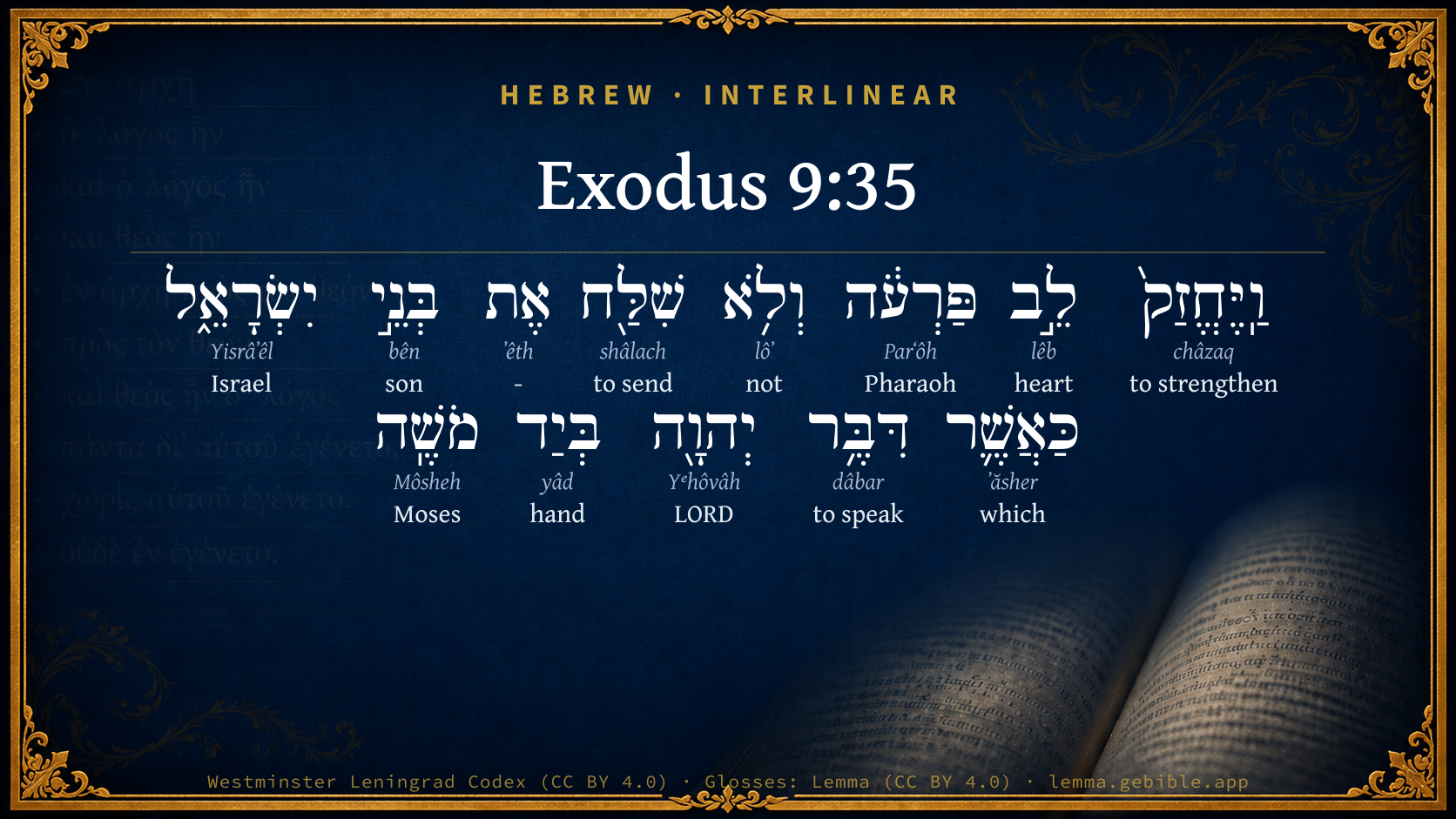
Hebrew (Westminster Leningrad Codex) Exodus 9:35 appears in the Hebrew Old Testament. The text above is from the Westminster Leningrad Codex. Each word links to its Strong’s number, a concise gloss, and parsing drawn from the Open Scriptures Hebrew Bible morphology. Click any word for its full Brown-Driver-Briggs (BDB) entry.
Download image
Cite this verse

Exodus 9:35 (World English Bible). Public Domain. Lemma interlinear Bible study tool, https://lemma.gebible.app/v/exodus/9/35.

Show BibTeX & RIS
BibTeX
RIS
English Translation
The heart of Pharaoh was hardened, and he didn't let the children of Israel go, just as Yahweh had spoken through Moses.
World English Bible · Public Domain
Download a study sheet

One document with this verse’s original text, its word-by-word gloss line, the meaning frame, cross-references with their text, attributed commentary, and full source and license credits — printable, and it pastes into notes with its structure intact.

This verse Autodidact and up

Study sheet (.html) Plain text (.txt)

A passage Seminary Student

Up to 50 verses in one chapter. A passage sheet keeps up to 6 commentary sources and 12 cross-references per verse, in the order this page ranks them, and says so on the sheet whenever that leaves anything out. Ask for a single verse and you get the Autodidact verse sheet above.

Everything on this page stays free to read, with no account — the sheet is a download of what is already on screen, not access to it.

Want to remove ads? Support Godless Engineer
Compare translations 3

The same verse in 3 English versions, stacked beneath the original-language interlinear above. Click any original word for its lexicon entry.

Each is an independent rendering of the whole verse — the interlinear is not word-aligned to these translations.

Highlighted words mark where these versions differ — a whole-verse word diff, not a word-by-word alignment.

  • World English Bible Public Domain
    The heart of Pharaoh was hardened, and he didn't let the children of Israel go, just as Yahweh had spoken through Moses.
  • King James Version Public Domain
    And the heart of Pharaoh was hardened, neither would he let the children of Israel go; as the LORD had spoken by Moses.
  • unfoldingWord Literal Text CC BY-SA 4.0
    And the heart of Pharaoh was strong, and he did not let the sons of Israel go, just as Yahweh had said by the hand of Moses.

unfoldingWord Literal Text — © unfoldingWord, licensed CC BY-SA 4.0. Word-aligned USFM3 via Door43 (git.door43.org/unfoldingWord/en_ult).

Versions to compare (up to 4)

3 of 4 selected

Show all 18 translations

Every available English version of this verse, each an independent rendering of the whole verse.

  • World English Bible Public Domain
    The heart of Pharaoh was hardened, and he didn't let the children of Israel go, just as Yahweh had spoken through Moses.
  • Berean Standard Bible Public Domain
    So Pharaoh’s heart was hardened, and he would not let the Israelites go, just as the LORD had said through Moses.
  • Majority Standard Bible Public Domain
    So Pharaoh’s heart was hardened, and he would not let the Israelites go, just as the LORD had said through Moses.
  • King James Version Public Domain
    And the heart of Pharaoh was hardened, neither would he let the children of Israel go; as the LORD had spoken by Moses.
  • American Standard Version (1901) Public Domain
    And the heart of Pharaoh was hardened, and he did not let the children of Israel go, as Jehovah had spoken by Moses.
  • Revised Version (1885) Public Domain
    And the heart of Pharaoh was hardened, and he did not let the children of Israel go; as the LORD had spoken by Moses.
  • Geneva Bible (1599) Public Domain
    So the heart of Pharaoh was hardened: neither would he let the children of Israel goe, as the Lord had said by Moses.
  • Douay-Rheims (1899) Public Domain
    And his heart was hardened, and the heart of his servants, and it was made exceeding hard: neither did he let the children of Israel go, as the Lord had commanded by the hand of Moses.
  • Young's Literal Translation Public Domain
    and the heart of Pharaoh is strong, and he hath not sent the sons of Israel away, as Jehovah hath spoken by the hand of Moses.
  • Literal Standard Version CC BY-SA 4.0
    and the heart of Pharaoh is strong, and he has not sent the sons of Israel away, as YHWH has spoken by the hand of Moses.
  • Unlocked Literal Bible CC BY-SA 4.0
    Pharaoh's heart was hardened, so he did not let the people of Israel go. This was the way that Yahweh had said to Moses that Pharaoh would act.
  • unfoldingWord Literal Text CC BY-SA 4.0
    And the heart of Pharaoh was strong, and he did not let the sons of Israel go, just as Yahweh had said by the hand of Moses.
  • Darby Bible Public Domain
    And the heart of Pharaoh was stubborn, neither would he let the children of Israel go, as Jehovah had spoken by Moses.
  • World Messianic Bible Public Domain
    The heart of Pharaoh was hardened, and he didn’t let the children of Israel go, just as the LORD had spoken through Moses.
  • Webster's Bible Public Domain
    And the heart of Pharaoh was hardened, neither would he let the children of Israel go; as the LORD had spoken by Moses.
  • Free Bible Version CC BY-SA 4.0
    Because of his stubborn attitude, Pharaoh would not let the Israelites leave, just as the Lord had predicted through Moses.
  • Bible in Basic English Public Domain
    And the heart of Pharaoh was hard, and he did not let the people go, as the Lord had said by the mouth of Moses.
  • JPS Tanakh (1917) Public Domain
    And the heart of Pharaoh was hardened, and he did not let the children of Israel go; as the LORD had spoken by Moses.

Literal Standard Version (2020), Covenant Press — licensed CC BY-SA 4.0. Text via the HelloAO Bible API (eBible.org). Unlocked Literal Bible (unfoldingWord) — licensed CC BY-SA 4.0. Text via the HelloAO Bible API (eBible.org). unfoldingWord Literal Text — © unfoldingWord, licensed CC BY-SA 4.0. Word-aligned USFM3 via Door43 (git.door43.org/unfoldingWord/en_ult). Free Bible Version, Dr. Jonathan Gallagher — licensed CC BY-SA 4.0. Text via the HelloAO Bible API (eBible.org).

Word by word

More ways to search: Search by grammar → Find every occurrence → Compare this word →

Practice this passage: Drill this verse → Learn its vocabulary →

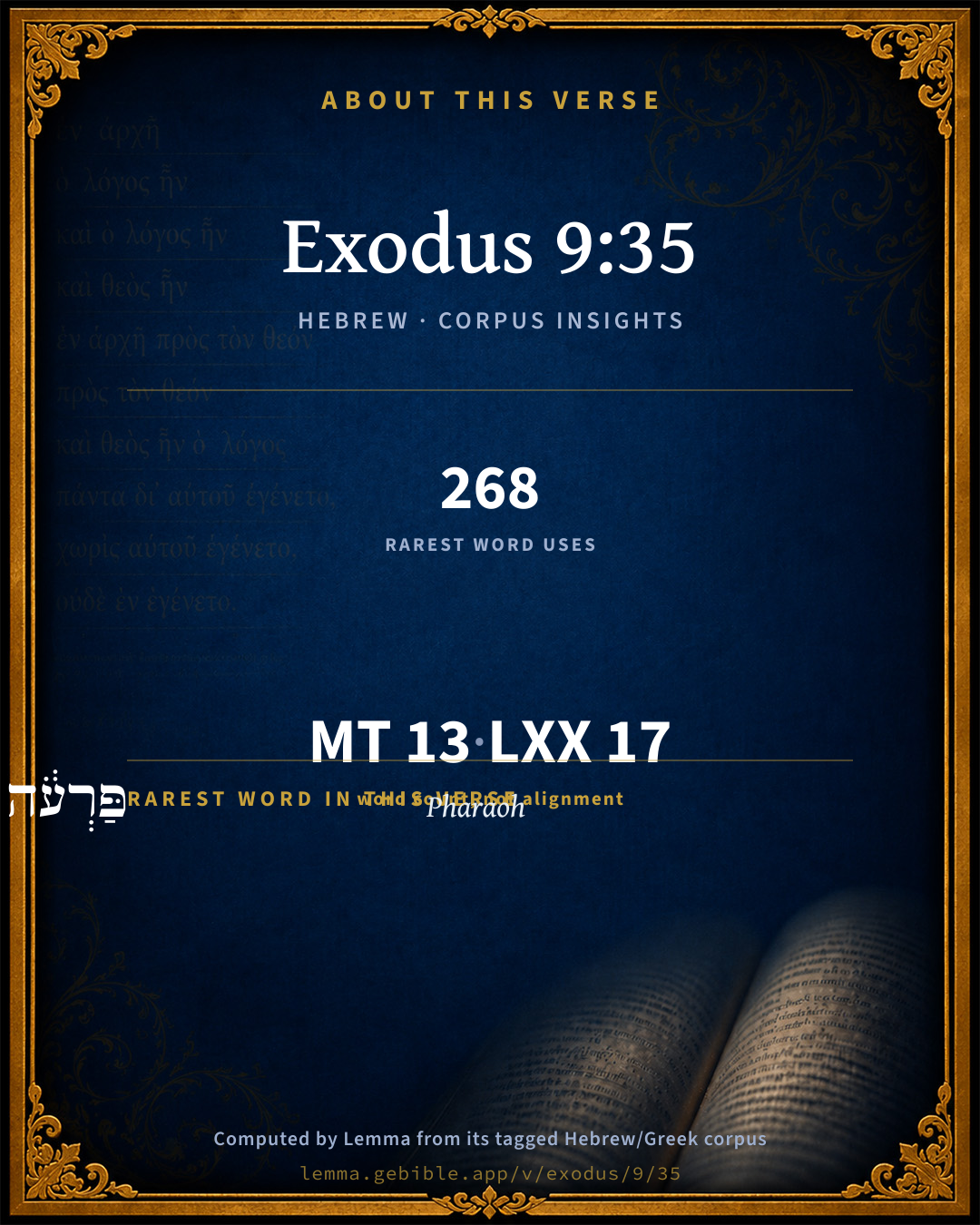
פַּרְעֹ֔ה
Parʻôh
H6547
“Pharaoh”
Noun, Proper
Part of Speech
Noun
Type
Proper
Full BDB Definition

Origin: of Egyptian derivation

TWOT: 1825

Pharaoh = "great house" - the common title of the king of Egypt
  1. וַֽיֶּחֱזַק֙ châzaq H2388 “and · to strengthen” Conjunction + Verb, Qal, Sequential Imperfect, 3rd Person, Masculine, Singular
  2. לֵ֣ב lêb H3820 “heart of” Noun, Common, Masculine, Singular, Construct
  3. וְלֹ֥א lôʼ H3808 “and · not” Conjunction + Particle, Negative
  4. שִׁלַּ֖ח shâlach H7971 “to send” Verb, Piel, Perfect, 3rd Person, Masculine, Singular
  5. אֶת ʼêth H853 “-” Particle, Direct Object
  6. בְּנֵ֣י bên H1121 “sons of” Noun, Common, Masculine, Plural, Construct
  7. יִשְׂרָאֵ֑ל Yisrâʼêl H3478 “Israel” Noun, Proper
  8. כַּאֲשֶׁ֛ר ʼăsher H834 “like/as · which” Preposition + Particle, Relative
  9. דִּבֶּ֥ר dâbar H1696 “to speak” Verb, Piel, Perfect, 3rd Person, Masculine, Singular
  10. יְהוָ֖ה Yᵉhôvâh H3068 “LORD” Noun, Proper
  11. בְּיַד yâd H3027 “in/at · hand of” Preposition + Noun, Common, Both, Singular, Construct
  12. מֹשֶֽׁה Môsheh H4872 “Moses” Noun, Proper

About this verse

These counts appear in no published source. They are computed here, from the morphology-tagged text and Lemma’s own curated glosses. What Lemma adds →

13
words
13
distinct lemmas
Pentateuch
section

Grammatical profile

  • 3 verbs
  • 7 nouns
  • 3 particles

Verb forms

  • וַֽיֶּחֱזַק֙ Qal · Sequential Imperfect
  • שִׁלַּ֖ח Piel · Perfect
  • דִּבֶּ֥ר Piel · Perfect

Hebrew & Septuagint length

In English translation the verse runs 22 words from the Hebrew and 23 from the Septuagint (LXX English) — closely comparable.

A rough comparison of the two English renderings, which tokenize alike — not a word-level alignment.

Word counts can differ between the Hebrew and the Greek without any difference in meaning — e.g. the Hebrew direct-object marker אֵת has no separate Greek word, and Greek often adds the article ὁ.

In the original languages it is 13 Hebrew tokens and 17 Greek tokens — but the two are counted differently (Hebrew bundles its prefixes and suffixes into one token; the Greek is in lemma form), so that isn’t a like-for-like length.

Cross-references

1

Topical passages linked to Exodus 9:35 in the Treasury of Scripture Knowledge — connected by theme and wording, ordered by reader-vote popularity; previews shown in the World English Bible.

  • Exodus 4:21 Yahweh said to Moses, "When you go back into Egypt, see that you do before Pharaoh all the wonders which I have put in your hand, but I will harden his heart and he will not let the people go.

Cross-references courtesy of OpenBible.info (CC BY 4.0).

Hebrew and Greek witnesses Masoretic Hebrew ↔ Greek Septuagint

The same verse in the two great witnesses to the Old Testament, shown verse-for-verse.

These are two independent witnesses, not word-aligned to each other, and the Septuagint is shown in lemma (dictionary) form.

Hebrew Exodus 9:35 Masoretic · Westminster Leningrad Codex

וַֽיֶּחֱזַק֙ לֵ֣ב פַּרְעֹ֔ה וְלֹ֥א שִׁלַּ֖ח אֶת בְּנֵ֣י יִשְׂרָאֵ֑ל כַּאֲשֶׁ֛ר דִּבֶּ֥ר יְהוָ֖ה בְּיַד מֹשֶֽׁה

The heart of Pharaoh was hardened, and he didn't let the children of Israel go, just as Yahweh had spoken through Moses.

World English Bible · Public Domain

Greek LXX Exodus 9:35 Septuagint · lemma form

καί σκληρύνω ὁ καρδία φαραώ καί οὐ ἐκ ἀποστέλλω ὁ υἱός ἰσραήλ καθάπερ λαλέω κύριος ὁ μωυσῆς

And the heart of Pharao was hardened, and he did not send forth the children of Israel, as the Lord said to Moses.

LXX2012 (modern English Septuagint) · Public Domain

Hebrew: Westminster Leningrad Codex (CC BY 4.0). Greek: Septuagint (public domain); English from LXX2012 (modern English Septuagint) (Public Domain). How the Septuagint differs from the Hebrew →

Targum (Aramaic paraphrase)

2

The Targum is the ancient Jewish Aramaic paraphrase of the Hebrew Scriptures — an interpretive translation, not the Hebrew text itself. Onkelos (literal) and Pseudo-Jonathan (expansive) render the Torah, and Jonathan the Prophets. Coverage is partial: where no permissively-licensed English translation exists for a verse, only the Aramaic is shown. This is verse-level text, not a word-by-word alignment to the Hebrew.

  1. Targum Onkelos Torah (Genesis–Deuteronomy)
    וְאִתַּקַף לִבָּא דְפַרְעֹה וְלָא שַׁלַח יָת בְּנֵי יִשְׂרָאֵל כְּמָא דִי מַלֵיל יְיָ בִּידָא דְמשֶׁה:

    (no public-domain English translation for this verse)

    Targum Onkelos — Aramaic: “Onkelos Genesis” (public domain); “Onkelos Exodus” (public domain); “Onkelos Leviticus” (public domain); “Onkelos Numbers” (public domain); “Onkelos Deuteronomy” (public domain). English: “Sefaria Community Translation” (CC0 1.0 (public-domain dedication)); “J.W. Etheridge. The Targums of Onkelos and Jonathan Ben Uzziel on the Pentateuch. London: Longmans, Green, 1862” (public domain). Text via Sefaria.

  2. Targum Pseudo-Jonathan Torah (Genesis–Deuteronomy)
    וְאִיתְקַף יִצְרָא דְלִבָּא דְפַרְעה וְלָא פְטַר יַת בְּנֵי יִשְׁרָאֵל הֵיכְמָא דְמַלֵיל יְיָ בִּידָא דְמשֶׁה

    And Pharoh's heart was made obstinate, and he would not release the children of Israel, as the Lord had said through Mosheh.

    Targum Pseudo-Jonathan — Aramaic: “Targum Jonathan on Genesis” (public domain); “Targum Jonathan on Exodus” (public domain); “Targum Jonathan on Leviticus” (public domain); “Targum Jonathan on Numbers” (public domain); “Targum Jonathan on Deuteronomy” (public domain). English: “The Targum of Jonathan ben Uzziel, trans. J. W. Etheridge, London, 1862” (public domain). Text via Sefaria.

Commentary

Notes on Exodus 9:35 from classic Christian and Jewish commentators (each source and its license shown beneath its notes). The classic Christian expositions comment on the surrounding passage and are grouped to its opening verse, so a note may address several verses; the Jewish commentaries on the Tanakh (Rashi and others) are per-verse, so they appear only where the commentator wrote on this verse.

Lemma curates 59 commentaries, every one of them public domain or Creative Commons licensed, each selected and text-cleaned for this edition rather than reprinted as found. About our sources →

Trapp's Complete Commentary

John Trapp

Exo 9:35 And the heart of Pharaoh was hardened, neither would he let the children of Israel go; as the LORD had spoken by Moses.

Ver. 35. And the heart of Pharaoh was hardened.] Judicially; and penally, after that he had first hardened his own heart. {Exo 9:34}

John Trapp, A Commentary or Exposition upon All the Books of the Old and New Testament (1647–1656) — public domain. Text from a community e-Sword module.

Albert Barnes' Notes on the Bible

Hardened - Different words in the Hebrew. In Exo 9:34 the word means “made heavy,” i. e. obtuse, incapable of forming a right judgment; in Exo 9:35 it is stronger, and implies a stubborn resolution.

Albert Barnes' Notes on the Bible (1834–1885) — public domain. Text from a community e-Sword/MySword module.

Geneva Bible (1599)

Geneva Bible translators

Hebrew, by the hand of Moses.

Geneva Bible (1599) marginal notes — public domain. Text via Bolls.life.

Adam Clarke's Commentary

Verse 35. And the heart of Pharaoh was hardened] In consequence of his sinning yet more, and hardening his own heart against both the judgments and mercies of God, we need not be surprised that, after God had given him the means of softening and repentance, and he had in every instance resisted and abused them, he should at last have been left to the hardness and darkness of his own obstinate heart, so as to fill up the measure of his iniquity, and rush headlong to his own destruction.

IN the fifth, sixth, and seventh plagues described in this chapter, we have additional proofs of the justice and mercy of God, as well as of the stupidity, rebellion, and wickedness of Pharaoh and his courtiers. As these continued to contradict and resist, it was just that God should continue to inflict those punishments which their iniquities deserved. Yet in the midst of judgment he remembers mercy; and therefore Moses and Aaron are sent to inform the Egyptians that such plagues would come if they continued obstinate. Here is mercy; the cattle only are destroyed, and the people saved! Is it not evident from all these messages, and the repeated expostulations of Moses and Aaron in the name and on the authority of God, that Pharaoh was bound by no fatal necessity to continue his obstinacy; that he might have humbled himself before God, and thus prevented the disasters that fell on the land, and saved himself and his people from destruction? But he would sin, and therefore he must be punished.

In the sixth plague Pharaoh had advantages which he had not before. The magicians, by their successful imitations of the miracles wrought by Moses, made it doubtful to the Egyptians whether Moses himself was not a magician acting without any Divine authority; but the plague of the boils, which they could not imitate, by which they were themselves afflicted, and which they confessed to be the finger of God, decided the business. Pharaoh had no longer any excuse, and must know that he had now to contend, not with Moses and Aaron, mortals like himself, but with the living God. How strange, then, that he should continue to resist! Many affect to be astonished at this, and think it must be attributed only to a sovereign controlling influence of God, which rendered it impossible for him to repent or take warning. But the whole conduct of God shows the improbability of this opinion: and is not the conduct of Pharaoh and his courtiers copied and reacted by thousands who are never suspected to be under any such necessitating decree? Every sinner under heaven, who has the Bible in his hand, is acting the same part. God says to the swearer and the profane, Thou shalt not take the name of the Lord thy God in vain; and yet common swearing and profaneness are most scandalously common among multitudes who bear the Christian name, and who presume on the mercy of God to get at last to the kingdom of heaven! He says also, Remember the Sabbath day to keep it holy; thou shalt not kill; thou shalt not commit adultery; thou shalt not steal; thou shalt not bear false witness; thou shalt not covet; and sanctions all these commandments with the most awful penalties: and yet, with all these things before them, and the professed belief that they came from God, Sabbath-breakers, men-slayers, adulterers, fornicators, thieves, dishonest men, false witnesses, liars, slanderers, backbiters, covetous men, lovers of the world more than lovers of God, are found by hundreds and thousands! What were the crimes of the poor half-blind Egyptian king when compared with these! He sinned against a comparatively unknown God; these sin against the God of their fathers - against the God and Father of Him whom they call their Lord and Saviour, Jesus Christ! They sin with the Bible in their hand, and a conviction of its Divine authority in their hearts. They sin against light and knowledge; against the checks of their consciences, the reproofs of their friends, the admonitions of the messengers of God; against Moses and Aaron in the law; against the testimony of all the prophets; against the evangelists, the apostles, the Maker of heaven and earth, the Judge of all men, and the Saviour of the world! What were Pharaoh's crimes to the crimes of these? On comparison, his atom of moral turpitude is lost in their world of iniquity. And yet who supposes these to be under any necessitating decree to sin on, and go to perdition? Nor are they; nor was Pharaoh. In all things God has proved both his justice and mercy to be clear in this point. Pharaoh, through a principle of covetousness, refused to dismiss the Israelites, whose services he found profitable to the state: these are absorbed in the love of the world, the love of pleasure, and the love of gain; nor will they let one lust go, even in the presence of the thunders of Sinai, or in sight of the agony, bloody sweat, crucifixion, and death of Jesus Christ! Alas! how many are in the habit of considering Pharaoh the worst of human beings, inevitably cut off from the possibility of being saved because of his iniquities, who outdo him so far in the viciousness of their lives, that Pharaoh, hardening his heart against ten plagues, appears a saint when compared with those who are hardening their hearts against ten millions of mercies. Reader, art thou of this number? Proceed no farther! God's judgments linger not. Desperate as thy state is, thou mayest return; and thou, even thou, find mercy through the blood of the Lamb.

See the observations at the conclusion of the next chapter. See Clarke on Ex 10:29.

Adam Clarke's Commentary on the Bible (1810–1826) — public domain. Text from a community e-Sword/MySword module.

Haydock's Catholic Bible Commentary

Hard. Hebrew, "and he hardened his heart." (Worthington)

George Leo Haydock (1774–1849), Haydock's Catholic Family Bible and Commentary, 1859 edition — public domain. Excludes Psalms (Douay-Rheims chapter numbering differs from Protestant) and Deuterocanonical books (Catholic canon only).

The Pulpit Commentary

As the Lord had spoken by Moses. Compare Exo_3:19 Exo_4:21; and Exo_7:3, Exo_7:4.

The Pulpit Commentary (1880–1919), ed. H.D.M. Spence-Jones & Joseph S. Exell — public domain. Text from a community e-Sword module.

Lesson kit

Teaching starters — assembled from the data on this page, not authored interpretation. Every prompt links to the verse data it draws on. Edit before teaching.

Exodus, in the Pentateuch, opens this verse with 13 words (13 distinct Hebrew lemmas). Its most distinctive word is Parʻôh (“Pharaoh”). A historical commentator’s framing appears above. Read the whole chapter for the surrounding context.

Discussion questions

  1. What does “Pharaoh” (Parʻôh) contribute to the verse as a whole?
  2. How does Exodus 4:21, which shares this passage’s theme, read alongside this verse?
  3. These translations render this verse differently. What is at stake in choosing one wording over another?
  4. «וַֽיֶּחֱזַק֙» is a Qal Sequential Imperfect verb. How does that grammatical form shape the action described?
  5. Compare how Trapp's Complete Commentary and Albert Barnes' Notes on the Bible read this verse. Where do they agree or differ?

Things to notice

Reading settings

Reading text

Shown beneath each verse's original-language words.

Old Testament
Old Testament edition

Read the OT as the Masoretic Hebrew (MT) or the Greek Septuagint (LXX).

English shown for the Greek Septuagint (in the Hebrew ↔ Greek comparison).

Comparing translations? Open the Compare panel on any verse page to stack up to four side by side.