Judges 19:4

Hebrew (Westminster Leningrad Codex) Judges 19:4 appears in the Hebrew Old Testament. The text above is from the Westminster Leningrad Codex. Each word links to its Strong’s number, a concise gloss, and parsing drawn from the Open Scriptures Hebrew Bible morphology. Click any word for its full Brown-Driver-Briggs (BDB) entry.
Download image
Cite this verse

Judges 19:4 (World English Bible). Public Domain. Lemma interlinear Bible study tool, https://lemma.gebible.app/v/judges/19/4.

Show BibTeX & RIS
BibTeX
RIS
English Translation
His father-in-law, the young lady's father, retained him; and he abode with him three days: so they ate and drink, and lodged there.
World English Bible · Public Domain
Download a study sheet

One document with this verse’s original text, its word-by-word gloss line, the meaning frame, cross-references with their text, attributed commentary, and full source and license credits — printable, and it pastes into notes with its structure intact.

This verse Autodidact and up

Study sheet (.html) Plain text (.txt)

A passage Seminary Student

Up to 50 verses in one chapter. A passage sheet keeps up to 6 commentary sources and 12 cross-references per verse, in the order this page ranks them, and says so on the sheet whenever that leaves anything out. Ask for a single verse and you get the Autodidact verse sheet above.

Everything on this page stays free to read, with no account — the sheet is a download of what is already on screen, not access to it.

Want to remove ads? Support Godless Engineer
Compare translations 3

The same verse in 3 English versions, stacked beneath the original-language interlinear above. Click any original word for its lexicon entry.

Each is an independent rendering of the whole verse — the interlinear is not word-aligned to these translations.

Highlighted words mark where these versions differ — a whole-verse word diff, not a word-by-word alignment.

  • World English Bible Public Domain
    His father-in-law, the young lady's father, retained him; and he abode with him three days: so they ate and drink, and lodged there.
  • King James Version Public Domain
    And his father in law, the damsel's father, retained him; and he abode with him three days: so they did eat and drink, and lodged there.
  • unfoldingWord Literal Text CC BY-SA 4.0
    And his father-in-law, the father of the young woman, prevailed upon him, and he stayed with him three days. And they ate and they drank and they lodged there.

unfoldingWord Literal Text — © unfoldingWord, licensed CC BY-SA 4.0. Word-aligned USFM3 via Door43 (git.door43.org/unfoldingWord/en_ult).

Versions to compare (up to 4)

3 of 4 selected

Show all 18 translations

Every available English version of this verse, each an independent rendering of the whole verse.

  • World English Bible Public Domain
    His father-in-law, the young lady's father, retained him; and he abode with him three days: so they ate and drink, and lodged there.
  • Berean Standard Bible Public Domain
    His father-in-law, the girl’s father, persuaded him to stay, so he remained with him three days, eating, drinking, and lodging there.
  • Majority Standard Bible Public Domain
    His father-in-law, the girl’s father, persuaded him to stay, so he remained with him three days, eating, drinking, and lodging there.
  • King James Version Public Domain
    And his father in law, the damsel's father, retained him; and he abode with him three days: so they did eat and drink, and lodged there.
  • American Standard Version (1901) Public Domain
    And his father-in-law, the damsel's father, retained him; and he abode with him three days: so they did eat and drink, and lodged there.
  • Revised Version (1885) Public Domain
    And his father in law, the damsel’s father, retained him; and he abode with him three days: so they did eat and drink, and lodged there.
  • Geneva Bible (1599) Public Domain
    And his father in lawe, the yong womans father reteined him: and he abode with him three dayes: so they did eate and drinke, and lodged there.
  • Douay-Rheims (1899) Public Domain
    And embraced the man. And the son in law tarried in the house of his father in law three days, eating with him and drinking familiarly.
  • Young's Literal Translation Public Domain
    And keep hold on him doth his father-in-law, father of the young woman, and he abideth with him three days, and they eat and drink, and lodge there.
  • Literal Standard Version CC BY-SA 4.0
    And his father-in-law keeps hold on him, father of the young woman, and he abides with him three days, and they eat and drink, and lodge there.
  • Unlocked Literal Bible CC BY-SA 4.0
    His father-in-law, the girl's father, persuaded him to stay for three days. They ate and drank, and they spent the night there.
  • unfoldingWord Literal Text CC BY-SA 4.0
    And his father-in-law, the father of the young woman, prevailed upon him, and he stayed with him three days. And they ate and they drank and they lodged there.
  • Darby Bible Public Domain
    And his father-in-law, the girl's father, made him stay, and he remained with him three days; so they ate and drank, and lodged there.
  • World Messianic Bible Public Domain
    His father-in-law, the young lady’s father, kept him there; and he stayed with him three days. So they ate and drank, and stayed there.
  • Webster's Bible Public Domain
    And his father-in-law, the damsel's father, retained him; and he abode with him three days: so they ate and drank, and lodged there.
  • Free Bible Version CC BY-SA 4.0
    Her father pressed him to stay with them, so he remained for three days, eating, drinking, and sleeping there.
  • Bible in Basic English Public Domain
    And his father-in-law, the girl's father, kept him there for three days; and they had food and drink and took their rest there.
  • JPS Tanakh (1917) Public Domain
    And his father-in-law, the damsel's father, retained him; and he abode with him three days; so they did eat and drink, and lodged there.

Literal Standard Version (2020), Covenant Press — licensed CC BY-SA 4.0. Text via the HelloAO Bible API (eBible.org). Unlocked Literal Bible (unfoldingWord) — licensed CC BY-SA 4.0. Text via the HelloAO Bible API (eBible.org). unfoldingWord Literal Text — © unfoldingWord, licensed CC BY-SA 4.0. Word-aligned USFM3 via Door43 (git.door43.org/unfoldingWord/en_ult). Free Bible Version, Dr. Jonathan Gallagher — licensed CC BY-SA 4.0. Text via the HelloAO Bible API (eBible.org).

Word by word

More ways to search: Search by grammar → Find every occurrence → Compare this word →

Practice this passage: Drill this verse → Learn its vocabulary →

חֹֽתְנוֹ֙
châthan
H2859
“marrying · him”
Verb, Qal, Participle Active, Masculine, Singular, Construct + Suffix, Personal, 3rd Person, Masculine, Singular
Part of Speech
Verb
Stem
Qal
Form
Participle Active
Gender
Masculine
Number
Singular
State
Construct
Full BDB Definition

Origin: a primitive root

TWOT: 781b

to become a son-in-law, make oneself a daughter's husband - (Qal) wife's father, wife's mother, father-in-law, mother-in-law (participle) - (Hithpael) to make oneself a daughter's husband
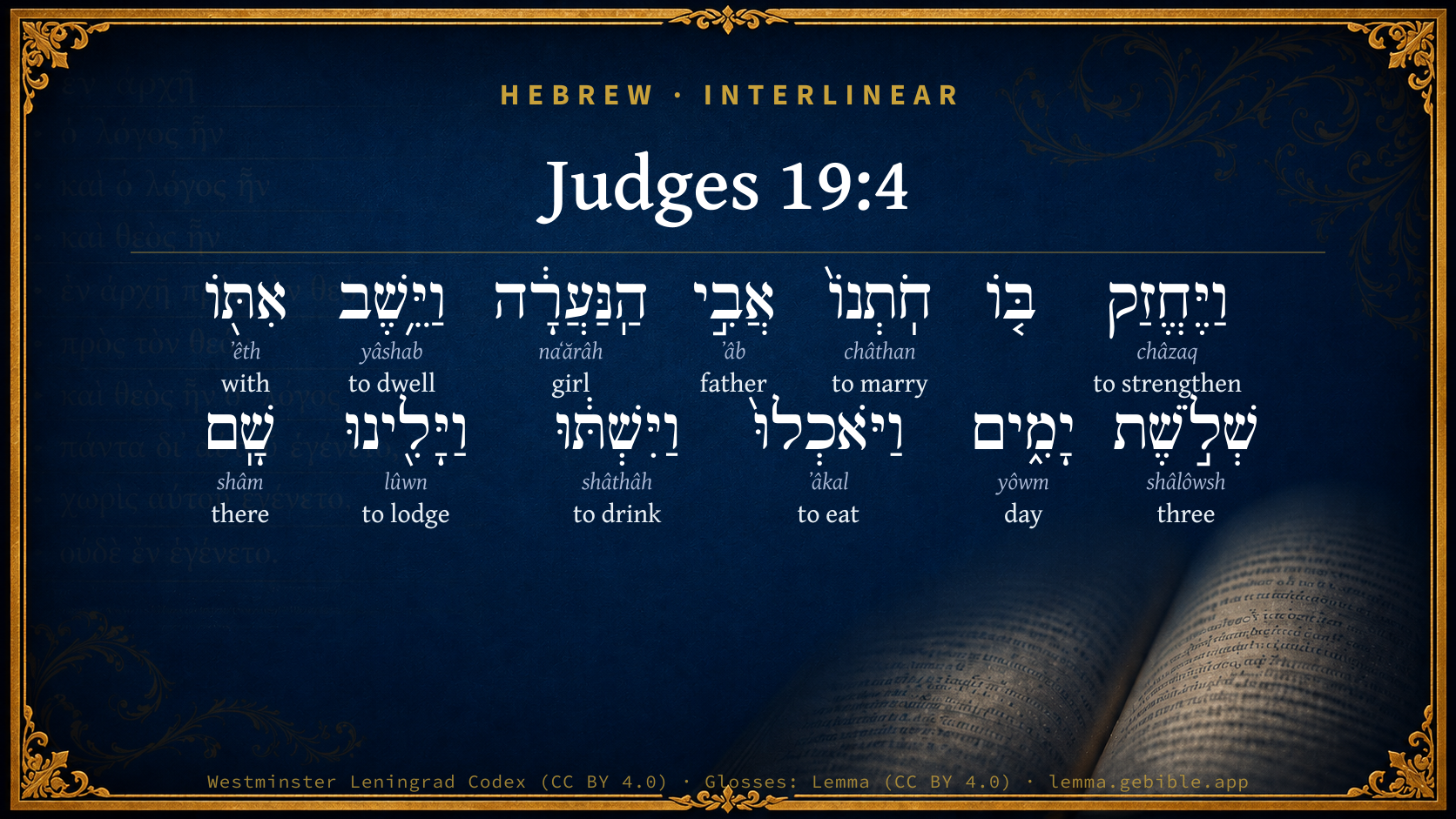
  1. וַיֶּחֱזַק châzaq H2388 “and · to strengthen” Conjunction + Verb, Qal, Sequential Imperfect, 3rd Person, Masculine, Singular
  2. אֲבִ֣י ʼâb H1 “father of” Noun, Common, Masculine, Singular, Construct
  3. הַֽנַּעֲרָ֔ה naʻărâh H5291 “the · girl” Particle, Definite Article + Noun, Common, Feminine, Singular, Absolute
  4. וַיֵּ֥שֶׁב yâshab H3427 “and · to dwell” Conjunction + Verb, Qal, Sequential Imperfect, 3rd Person, Masculine, Singular
  5. אִתּ֖וֹ ʼêth H854 “with · him” Preposition + Suffix, Personal, 3rd Person, Masculine, Singular
  6. שְׁלֹ֣שֶׁת shâlôwsh H7969 “three” Adjective, Cardinal number, Masculine, Singular, Construct
  7. יָמִ֑ים yôwm H3117 “days” Noun, Common, Masculine, Plural, Absolute
  8. וַיֹּאכְלוּ֙ ʼâkal H398 “and · to eat” Conjunction + Verb, Qal, Sequential Imperfect, 3rd Person, Masculine, Plural
  9. וַיִּשְׁתּ֔וּ shâthâh H8354 “and · to drink” Conjunction + Verb, Qal, Sequential Imperfect, 3rd Person, Masculine, Plural
  10. וַיָּלִ֖ינוּ lûwn H3885 “and · to lodge” Conjunction + Verb, Qal, Sequential Imperfect, 3rd Person, Masculine, Plural
  11. שָֽׁם shâm H8033 “there” Adverb

About this verse

These counts appear in no published source. They are computed here, from the morphology-tagged text and Lemma’s own curated glosses. What Lemma adds →

13
words
12
distinct lemmas
Historical
section

Shared distinctive vocabulary

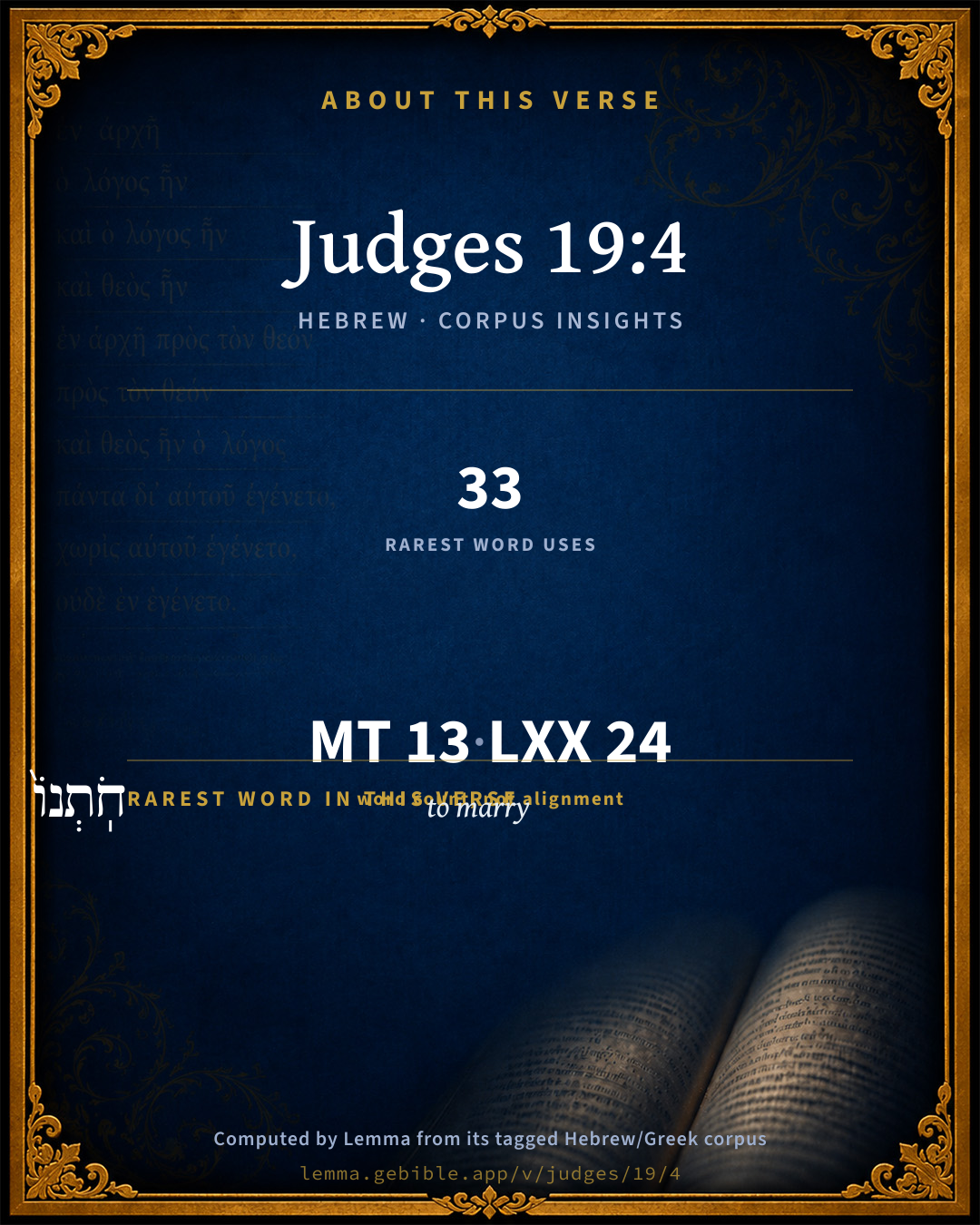
חֹֽתְנוֹ֙ to marry H2859 occurs in 32 verses of the Hebrew Bible. Also found in:

Grammatical profile

  • 6 verbs
  • 3 nouns
  • 1 adjective
  • 2 prepositions
  • 1 adverb

Verb forms

  • וַיֶּחֱזַק Qal · Sequential Imperfect
  • חֹֽתְנוֹ֙ Qal · Participle Active
  • וַיֵּ֥שֶׁב Qal · Sequential Imperfect
  • וַיֹּאכְלוּ֙ Qal · Sequential Imperfect
  • וַיִּשְׁתּ֔וּ Qal · Sequential Imperfect
  • וַיָּלִ֖ינוּ Qal · Sequential Imperfect

Hebrew & Septuagint length

In English translation the verse runs 23 words from the Hebrew and 26 from the Septuagint (LXX English) — closely comparable.

A rough comparison of the two English renderings, which tokenize alike — not a word-level alignment.

Word counts can differ between the Hebrew and the Greek without any difference in meaning — e.g. the Hebrew direct-object marker אֵת has no separate Greek word, and Greek often adds the article ὁ.

In the original languages it is 13 Hebrew tokens and 24 Greek tokens — but the two are counted differently (Hebrew bundles its prefixes and suffixes into one token; the Greek is in lemma form), so that isn’t a like-for-like length.

Hebrew and Greek witnesses Masoretic Hebrew ↔ Greek Septuagint

The same verse in the two great witnesses to the Old Testament, shown verse-for-verse.

These are two independent witnesses, not word-aligned to each other, and the Septuagint is shown in lemma (dictionary) form.

Hebrew Judges 19:4 Masoretic · Westminster Leningrad Codex

וַיֶּחֱזַק בּ֤וֹ חֹֽתְנוֹ֙ אֲבִ֣י הַֽנַּעֲרָ֔ה וַיֵּ֥שֶׁב אִתּ֖וֹ שְׁלֹ֣שֶׁת יָמִ֑ים וַיֹּאכְלוּ֙ וַיִּשְׁתּ֔וּ וַיָּלִ֖ינוּ שָֽׁם

His father-in-law, the young lady's father, retained him; and he abode with him three days: so they ate and drink, and lodged there.

World English Bible · Public Domain

Greek LXX Judges 19:4 Septuagint · lemma form

καί καταἔχω αὐτός ὁ γαμβρός αὐτός ὁ πατήρ ὁ νεᾶνις καί καταἵζω μετά αὐτός ἐπί τρεῖς ἡμέρα καί ἐσθίω καί πίνω καί αὐλίζω ἐκεῖ

And his father-in-law, the father of the damsel, constrained him, and he stayed with him for three days; and they ate and drank, and lodged there.

LXX2012 (modern English Septuagint) · Public Domain

On this verse, The Cambridge Bible for Schools and Colleges discusses the Septuagint’s reading. Read the note in Commentary ↓

Hebrew: Westminster Leningrad Codex (CC BY 4.0). Greek: Septuagint (public domain); English from LXX2012 (modern English Septuagint) (Public Domain). How the Septuagint differs from the Hebrew →

Targum (Aramaic paraphrase)

1

The Targum is the ancient Jewish Aramaic paraphrase of the Hebrew Scriptures — an interpretive translation, not the Hebrew text itself. Onkelos (literal) and Pseudo-Jonathan (expansive) render the Torah, and Jonathan the Prophets. Coverage is partial: where no permissively-licensed English translation exists for a verse, only the Aramaic is shown. This is verse-level text, not a word-by-word alignment to the Hebrew.

  1. Targum Jonathan Prophets (Joshua–Malachi)
    וְאַתְקֵיף בֵּיהּ חֲמוּהִי אֲבוּהָא דְעוּלֶמְתָּא וִיתֵיב עִמֵיהּ תְּלָתָא יוֹמִין וַאֲכָלוּ וּשְׁתִיאוּ וּבָתוּ תַמָן:

    (no public-domain English translation for this verse)

    Targum Jonathan — Aramaic: “Mikraot Gedolot” (public domain). English: “Sefaria Community Translation” (CC0 1.0 (public-domain dedication)); “London "Chaldee Paraphrase," 1871” (public domain). Text via Sefaria.

Commentary

Notes on Judges 19:4 from classic Christian and Jewish commentators (each source and its license shown beneath its notes). The classic Christian expositions comment on the surrounding passage and are grouped to its opening verse, so a note may address several verses; the Jewish commentaries on the Tanakh (Rashi and others) are per-verse, so they appear only where the commentator wrote on this verse.

Lemma curates 59 commentaries, every one of them public domain or Creative Commons licensed, each selected and text-cleaned for this edition rather than reprinted as found. About our sources →

Trapp's Complete Commentary

John Trapp

Jdg 19:4 And his father in law, the damsel’s father, retained him; and he abode with him three days: so they did eat and drink, and lodged there.

Ver. 4. Retained him.] Or, as others render it, Embraced him.

So they did eat and drink.] In token of hearty reconciliation. {Gen 26:30 Exo 32:6}

John Trapp, A Commentary or Exposition upon All the Books of the Old and New Testament (1647–1656) — public domain. Text from a community e-Sword module.

Ellicott's Commentary for English Readers

(4) Retained him.—One motive of the father-in-law would doubtless be to practise the full rights of hospitality, which are in the East so specially sacred; but he probably desired further to win back the Levite’s heart to his erring daughter.

A Bible Commentary for English Readers, edited by Charles John Ellicott (1878–1897) — public domain. Text from a community e-Sword module.

The Cambridge Bible for Schools and Colleges

gen. ed. J. J. S. Perowne

4. retained him] or laid hold on him to prevent him from going away, cf. Jdg_7:8. The pressing and rather boisterous hospitality of the girl’s father has a tragic significance in view of what follows, hence it is emphasized from the beginning. There is no need to add and brought him in with some mss. of LXX, for the Levite has already entered the house, Jdg_19:3.

The Cambridge Bible for Schools and Colleges (gen. ed. J. J. S. Perowne; Cambridge University Press, 1878–1918) — public domain. Text from a community e-Sword module.

John Gill's Exposition

And his father in law, the damsel's father, retained him,.... Prevailed upon him to stay some time with him:

and he abode with him three days; it seems as if he agreed to stay with him so long, and that time he stayed contentedly:

so they did eat and drink, and lodged there; the Levite and his servant were very handsomely entertained, and had everything provided for them convenient for meat, drink, and lodging.

John Gill's Exposition of the Whole Bible (1746–1763) — public domain (CC PDM 1.0). Text via the HelloAO Bible API.

The Pulpit Commentary

Retained him. See the same phrase 2Ki_4:8, where it is rendered she constrained him. The full phrase is in Gen_21:18, hold him in thy hand.

Vers. 4-10. Troublesome hospitality.

There is no more vivid picture of this extravagance. The Levite is delayed beyond all his reckoning, and perhaps through this is exposed to the evils subsequently narrated. There is a latent purpose betrayed by the anxiety of his host, which robs the offer of its simplicity and true hospitality. Like all who simulate a virtue for other than the mere love of it, he oversteps the bounds of modesty and decorum, and becomes an inconvenience instead of a help.

I TRUE HOSPITALITY SHOULD BE FOR THE SAKE OF THE GUEST, AND NOT THE HOST.

II EXCESS OF HOSPITALITY MAY ENTAIL INCONVENIENCE AND WRONG UPON OUR GUEST.

III WHERE HOSPITALITY IS OFFERED FOR SOME EXTRINSIC PURPOSE, IT LOSES ITS TRUE CHARACTER.

IV CHRIST THE GRAND EXAMPLE OF THE HOST. His moderation; careful calculation as to needs of his guests; fulness of human sympathy; impartation of spiritual grace to the humbler viands. M.

The Pulpit Commentary (1880–1919), ed. H.D.M. Spence-Jones & Joseph S. Exell — public domain. Text from a community e-Sword module.

Lesson kit

Teaching starters — assembled from the data on this page, not authored interpretation. Every prompt links to the verse data it draws on. Edit before teaching.

Judges, in the Historical, opens this verse with 13 words (12 distinct Hebrew lemmas). Its most distinctive word is châthan (“to marry”). A historical commentator’s framing appears above. Read the whole chapter for the surrounding context.

Discussion questions

  1. What does “to marry” (châthan) contribute to the verse as a whole?
  2. Genesis 34:9 shares the word «to marry» with this verse. How do the two illuminate each other?
  3. The translations on this page render this verse differently — a whole-verse word diff, not a word-by-word alignment. What might account for the different wordings?
  4. The verb «וַיֶּחֱזַק» is Qal Sequential Imperfect. How does its form color the action?
  5. Reading how Trapp's Complete Commentary and Ellicott's Commentary for English Readers read this verse, where do the two commentators agree and where do they part?

Things to notice

Reading settings

Reading text

Shown beneath each verse's original-language words.

Old Testament
Old Testament edition

Read the OT as the Masoretic Hebrew (MT) or the Greek Septuagint (LXX).

English shown for the Greek Septuagint (in the Hebrew ↔ Greek comparison).

Comparing translations? Open the Compare panel on any verse page to stack up to four side by side.