
Daniel 10:19

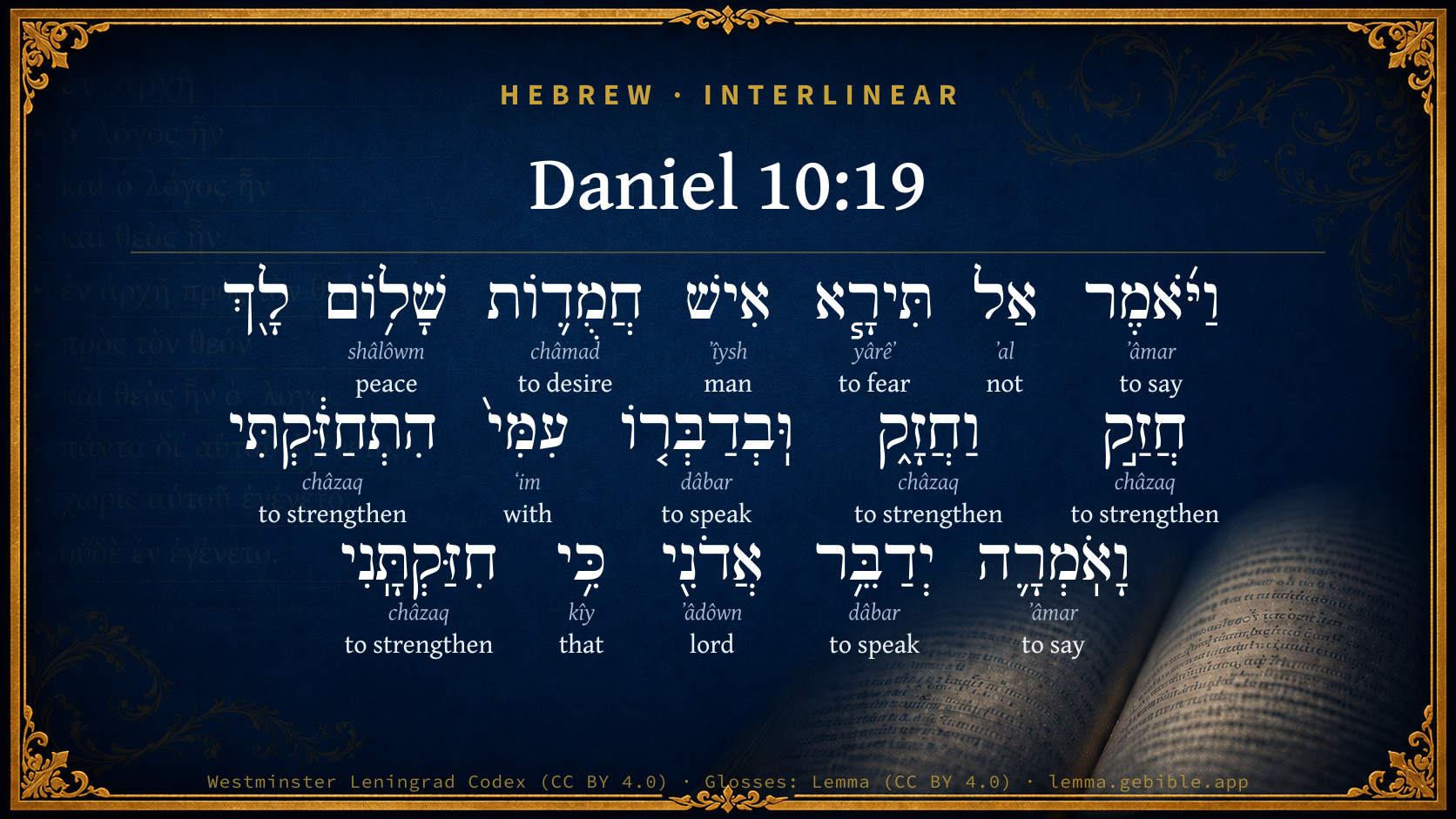
Hebrew (Westminster Leningrad Codex) Daniel 10:19 appears in the Hebrew Old Testament. The text above is from the Westminster Leningrad Codex. Each word links to its Strong’s number, a concise gloss, and parsing drawn from the Open Scriptures Hebrew Bible morphology. Click any word for its full Brown-Driver-Briggs (BDB) entry.
Download image
Cite this verse

Daniel 10:19 (World English Bible). Public Domain. Lemma interlinear Bible study tool, https://lemma.gebible.app/v/daniel/10/19.

Show BibTeX & RIS
BibTeX
RIS
English Translation
He said, "Greatly beloved man, don't be afraid: peace be to you, be strong, yes, be strong." When he spoke to me, I was strengthened, and said, "Let my lord speak; for you have strengthened me."
World English Bible · Public Domain
Download a study sheet

One document with this verse’s original text, its word-by-word gloss line, the meaning frame, cross-references with their text, attributed commentary, and full source and license credits — printable, and it pastes into notes with its structure intact.

This verse Autodidact and up

Study sheet (.html) Plain text (.txt)

A passage Seminary Student

Up to 50 verses in one chapter. A passage sheet keeps up to 6 commentary sources and 12 cross-references per verse, in the order this page ranks them, and says so on the sheet whenever that leaves anything out. Ask for a single verse and you get the Autodidact verse sheet above.

Everything on this page stays free to read, with no account — the sheet is a download of what is already on screen, not access to it.

Want to remove ads? Support Godless Engineer
Compare translations 3

The same verse in 3 English versions, stacked beneath the original-language interlinear above. Click any original word for its lexicon entry.

Each is an independent rendering of the whole verse — the interlinear is not word-aligned to these translations.

Highlighted words mark where these versions differ — a whole-verse word diff, not a word-by-word alignment.

  • World English Bible Public Domain
    He said, "Greatly beloved man, don't be afraid: peace be to you, be strong, yes, be strong." When he spoke to me, I was strengthened, and said, "Let my lord speak; for you have strengthened me."
  • King James Version Public Domain
    And said, O man greatly beloved, fear not: peace be unto thee, be strong, yea, be strong. And when he had spoken unto me, I was strengthened, and said, Let my lord speak; for thou hast strengthened me.
  • unfoldingWord Literal Text CC BY-SA 4.0
    He said, “Do not be afraid, O man greatly treasured. May peace be to you! Be strong and be strong!” While he was speaking to me, I was strengthened and said, “Let my lord speak, for you have strengthened me.”

unfoldingWord Literal Text — © unfoldingWord, licensed CC BY-SA 4.0. Word-aligned USFM3 via Door43 (git.door43.org/unfoldingWord/en_ult).

Versions to compare (up to 4)

3 of 4 selected

Show all 18 translations

Every available English version of this verse, each an independent rendering of the whole verse.

  • World English Bible Public Domain
    He said, "Greatly beloved man, don't be afraid: peace be to you, be strong, yes, be strong." When he spoke to me, I was strengthened, and said, "Let my lord speak; for you have strengthened me."
  • Berean Standard Bible Public Domain
    “Do not be afraid, you who are highly precious,” he said. “Peace be with you! Be strong now; be very strong!” As he spoke with me, I was strengthened and said, “Speak, my lord, for you have strengthened me.”
  • Majority Standard Bible Public Domain
    “Do not be afraid, you who are highly precious,” he said. “Peace be with you! Be strong now; be very strong!” As he spoke with me, I was strengthened and said, “Speak, my lord, for you have strengthened me.”
  • King James Version Public Domain
    And said, O man greatly beloved, fear not: peace be unto thee, be strong, yea, be strong. And when he had spoken unto me, I was strengthened, and said, Let my lord speak; for thou hast strengthened me.
  • American Standard Version (1901) Public Domain
    And he said, O man greatly beloved, fear not: peace be unto thee, be strong, yea, be strong. And when he spake unto me, I was strengthened, and said, Let my lord speak; for thou hast strengthened me.
  • Revised Version (1885) Public Domain
    And he said, O man greatly beloved, fear not: peace be unto thee, be strong, yea, be strong. And when he spake unto me, I was strengthened, and said, Let my lord speak; for thou hast strengthened me.
  • Geneva Bible (1599) Public Domain
    And said, O man, greatly beloued, feare not: peace be vnto thee: be strong and of good courage. And when he had spoken vnto me, I was strengthened, and saide, Let my Lord speake: for thou hast strengthened me.
  • Douay-Rheims (1899) Public Domain
    And he said: Fear not, O man of desires, peace be to thee: take courage and be strong. And when he spoke to me, I grew strong: and I said: Speak, O my lord, for thou hast strengthened me.
  • Young's Literal Translation Public Domain
    and he saith: Do not fear, O man greatly desired, peace to thee, be strong, yea, be strong; and when he speaketh with me, I have strengthened myself, and I say, Let my lord speak, for thou hast strengthened me.
  • Literal Standard Version CC BY-SA 4.0
    and he says: Do not fear, O man greatly desired, peace to you, be strong, indeed, be strong; and when he speaks with me, I have strengthened myself, and I say, Let my lord speak, for you have strengthened me.
  • Unlocked Literal Bible CC BY-SA 4.0
    He said, “Do not be afraid, man greatly treasured. May peace be to you! Be strong now, be strong!” While he was speaking to me, I was strengthened. I said, “Let my master speak, for you have strengthened me.”
  • unfoldingWord Literal Text CC BY-SA 4.0
    He said, “Do not be afraid, O man greatly treasured. May peace be to you! Be strong and be strong!” While he was speaking to me, I was strengthened and said, “Let my lord speak, for you have strengthened me.”
  • Darby Bible Public Domain
    and he said, Fear not, man greatly beloved; peace be unto thee, be strong, yea, be strong. And as he was speaking with me I was strengthened, and I said, Let my lord speak; for thou hast strengthened me.
  • World Messianic Bible Public Domain
    He said, “Greatly beloved man, don’t be afraid. Peace be to you. Be strong. Yes, be strong.” When he spoke to me, I was strengthened, and said, “Let my lord speak, for you have strengthened me.”
  • Webster's Bible Public Domain
    \\10:20\\Then said he, Knowest thou for what cause I come to thee? and now will I return to fight with the prince of Persia: and when I am gone forth, lo, the prince of Grecia shall come.
  • Free Bible Version CC BY-SA 4.0
    “Don't be afraid; God loves you very much. May you have peace! Be strong! Have courage!” As he spoke to me, I became stronger and I said, “My lord, speak to me, for you have strengthened me.”
  • Bible in Basic English Public Domain
    Then he said, It is clear to you why I have come to you. And now I will give you an account of what is recorded in the true writings:
  • JPS Tanakh (1917) Public Domain
    And he said: 'O man greatly beloved, fear not! peace be unto thee, be strong, yea, be strong.' And when he had spoken unto me, I was strengthened, and said: 'Let my lord speak; for thou hast strengthened me.'

Literal Standard Version (2020), Covenant Press — licensed CC BY-SA 4.0. Text via the HelloAO Bible API (eBible.org). Unlocked Literal Bible (unfoldingWord) — licensed CC BY-SA 4.0. Text via the HelloAO Bible API (eBible.org). unfoldingWord Literal Text — © unfoldingWord, licensed CC BY-SA 4.0. Word-aligned USFM3 via Door43 (git.door43.org/unfoldingWord/en_ult). Free Bible Version, Dr. Jonathan Gallagher — licensed CC BY-SA 4.0. Text via the HelloAO Bible API (eBible.org).

Word by word

More ways to search: Search by grammar → Find every occurrence → Compare this word →

Practice this passage: Drill this verse → Learn its vocabulary →

חֲמֻד֛וֹת
châmad
H2530
“desirable things”
Noun, Common, Feminine, Plural, Absolute
Part of Speech
Noun
Type
Common
Gender
Feminine
Number
Plural
State
Absolute
Full BDB Definition

Origin: a primitive root

TWOT: 673

to desire, covet, take pleasure in, delight in (verb) - (Qal) to desire - (Niphal) to be desirable - (Piel) to delight greatly, desire greatly - desirableness, preciousness (noun feminine)
  1. וַיֹּ֜אמֶר ʼâmar H559 “and · to say” Conjunction + Verb, Qal, Sequential Imperfect, 3rd Person, Masculine, Singular
  2. אַל ʼal H408 “not” Particle, Negative
  3. תִּירָ֧א yârêʼ H3372 “to fear” Verb, Qal, Jussive, 2nd Person, Masculine, Singular
  4. אִישׁ ʼîysh H376 “man of” Noun, Common, Masculine, Singular, Construct
  5. שָׁל֥וֹם shâlôwm H7965 “peace” Noun, Common, Masculine, Singular, Absolute
  6. חֲזַ֣ק châzaq H2388 “strengthen” Verb, Qal, Imperative, 2nd Person, Masculine, Singular
  7. וַחֲזָ֑ק châzaq H2388 “and · strengthen” Conjunction + Verb, Qal, Imperative, 2nd Person, Masculine, Singular
  8. וּֽבְדַבְּר֤וֹ dâbar H1696 “and · in/at · to speak · him” Conjunction + Preposition + Verb, Piel, Infinitive Construct + Suffix, Personal, 3rd Person, Masculine, Singular
  9. עִמִּי֙ ʻim H5973 “with · me” Preposition + Suffix, Personal, 1st Person, Common, Singular
  10. הִתְחַזַּ֔קְתִּי châzaq H2388 “to strengthen” Verb, Hithpael, Perfect, 1st Person, Common, Singular
  11. וָאֹֽמְרָ֛ה ʼâmar H559 “and · to say” Conjunction + Verb, Qal, Sequential Imperfect, 1st Person, Common, Singular + Suffix, h
  12. יְדַבֵּ֥ר dâbar H1696 “to speak” Verb, Piel, Jussive, 3rd Person, Masculine, Singular
  13. אֲדֹנִ֖י ʼâdôwn H113 “lord · my” Noun, Common, Masculine, Singular, Construct + Suffix, Personal, 1st Person, Common, Singular
  14. כִּ֥י kîy H3588 “that” Conjunction
  15. חִזַּקְתָּֽנִי châzaq H2388 “to strengthen · me” Verb, Piel, Perfect, 2nd Person, Masculine, Singular + Suffix, Personal, 1st Person, Common, Singular

About this verse

These counts appear in no published source. They are computed here, from the morphology-tagged text and Lemma’s own curated glosses. What Lemma adds →

17
words
11
distinct lemmas
Prophets
section

Shared distinctive vocabulary

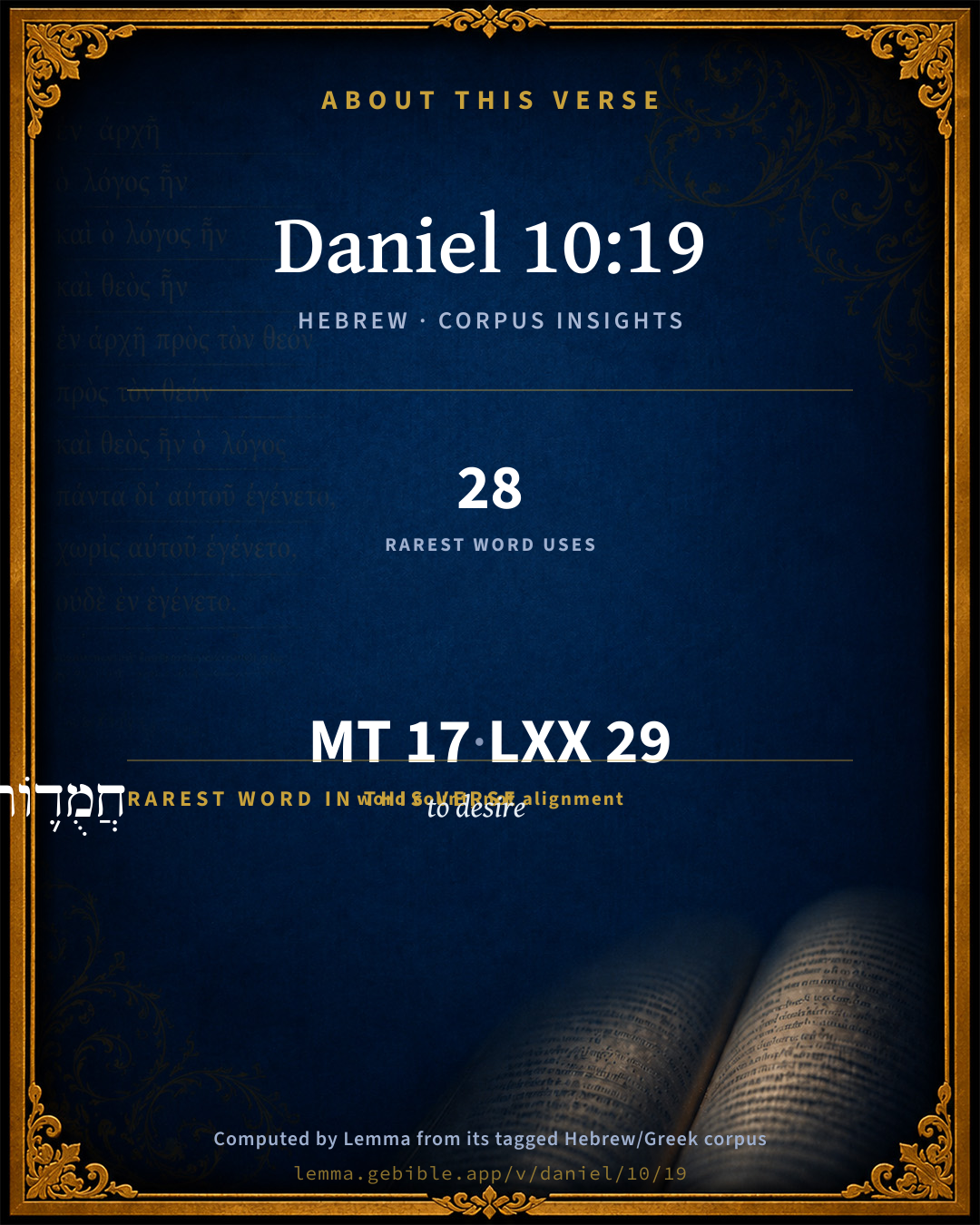
חֲמֻד֛וֹת to desire H2530 occurs in 27 verses of the Hebrew Bible. Also found in:

Grammatical profile

  • 9 verbs
  • 4 nouns
  • 2 prepositions
  • 1 conjunction
  • 1 particle

Verb forms

  • וַיֹּ֜אמֶר Qal · Sequential Imperfect
  • תִּירָ֧א Qal · Jussive
  • חֲזַ֣ק Qal · Imperative
  • וַחֲזָ֑ק Qal · Imperative
  • וּֽבְדַבְּר֤וֹ Piel · Infinitive Construct
  • הִתְחַזַּ֔קְתִּי Hithpael · Perfect
  • וָאֹֽמְרָ֛ה Qal · Sequential Imperfect
  • יְדַבֵּ֥ר Piel · Jussive
  • חִזַּקְתָּֽנִי Piel · Perfect

Repetition

Words recur within this verse — often emphatic in Hebrew:

  • חֲזַ֣ק to strengthen H2388 ×4
  • וַיֹּ֜אמֶר to say H559 ×2
  • וּֽבְדַבְּר֤וֹ to speak H1696 ×2

Hebrew & Septuagint length

In English translation the verse runs 36 words from the Hebrew and 42 from the Septuagint (LXX English) — closely comparable.

A rough comparison of the two English renderings, which tokenize alike — not a word-level alignment.

Word counts can differ between the Hebrew and the Greek without any difference in meaning — e.g. the Hebrew direct-object marker אֵת has no separate Greek word, and Greek often adds the article ὁ.

In the original languages it is 17 Hebrew tokens and 29 Greek tokens — but the two are counted differently (Hebrew bundles its prefixes and suffixes into one token; the Greek is in lemma form), so that isn’t a like-for-like length.

Cross-references

29

Topical passages linked to Daniel 10:19 in the Treasury of Scripture Knowledge — connected by theme and wording, ordered by reader-vote popularity; previews shown in the World English Bible.

  • Isaiah 35:4 Tell those who are of a fearful heart, Be strong, don't be afraid: behold, your God will come [with] vengeance, [with] the recompense of God; he will come and save you.
  • Joshua 1:9 Haven't I commanded you? Be strong and of good courage; don't be afraid, neither be dismayed: for Yahweh your God is with you wherever you go.
  • Judges 6:23 Yahweh said to him, Peace be to you; don't be afraid: you shall not die.
  • Daniel 9:23 At the beginning of your petitions the commandment went forth, and I am come to tell you; for you are greatly beloved: therefore consider the matter, and understand the vision.
  • Daniel 10:11–12 He said to me, Daniel, you man greatly beloved, understand the words that I speak to you, and stand upright; for to you am I now sent. When he had spoken this word to me, I stood trembling.
  • Isaiah 43:1–2 But now thus says Yahweh who created you, Jacob, and he who formed you, Israel: Don't be afraid, for I have redeemed you; I have called you by your name, you are mine.
  • 2 Corinthians 12:9 He has said to me, "My grace is sufficient for you, for my power is made perfect in weakness." Most gladly therefore I will rather glory in my weaknesses, that the power of Christ may rest on me.
  • John 14:27 Peace I leave with you. My peace I give to you; not as the world gives, give I to you. Don't let your heart be troubled, neither let it be fearful.
  • John 19:26 Therefore when Jesus saw his mother, and the disciple whom he loved standing there, he said to his mother, "Woman, behold your son!"
  • 2 Timothy 2:1 You therefore, my child, be strengthened in the grace that is in Christ Jesus.
  • Revelation 1:17 When I saw him, I fell at his feet like a dead man. He laid his right hand on me, saying, "Don't be afraid. I am the first and the last,
  • Luke 24:36–38 As they said these things, Jesus himself stood among them, and said to them, "Peace be to you."
  • John 11:3 The sisters therefore sent to him, saying, "Lord, behold, he for whom you have great affection is sick."
  • John 11:5 Now Jesus loved Martha, and her sister, and Lazarus.
  • John 11:36 The Jews therefore said, "See how much affection he had for him!"
  • John 15:9–14 Even as the Father has loved me, I also have loved you. Remain in my love.
  • John 21:20 Then Peter, turning around, saw a disciple following. This was the disciple whom Jesus sincerely loved, the one who had also leaned on Jesus' breast at the supper and asked, "Lord, who is going to betray You?"
  • Joshua 1:6–7 Be strong and of good courage; for you shall cause this people to inherit the land which I swore to their fathers to give them.
  • Haggai 2:4 Yet now be strong, Zerubbabel,' says Yahweh. 'Be strong, Joshua, son of Jehozadak, the high priest. Be strong, all you people of the land,' says Yahweh, 'and work, for I am with you,' says Yahweh of Hosts.
  • 1 Corinthians 16:13 Watch! Stand firm in the faith! Be courageous! Be strong!
  • 1 Samuel 3:9–10 Therefore Eli said to Samuel, Go, lie down: and it shall be, if he call you, that you shall say, Speak, Yahweh; for your servant hears. So Samuel went and lay down in his place.
  • Psalms 138:3 In the day that I called, you answered me. You encouraged me with strength in my soul.
  • Isaiah 41:10 Don't you be afraid, for I am with you; don't be dismayed, for I am your God; I will strengthen you; yes, I will help you; yes, I will uphold you with the right hand of my righteousness.
  • Isaiah 41:14 Don't be afraid, you worm Jacob, and you men of Israel; I will help you, says Yahweh, and your Redeemer is the Holy One of Israel.
  • Daniel 10:18 Then there touched me again one like the appearance of a man, and he strengthened me.
  • Zechariah 8:9 Thus says Yahweh of Hosts: "Let your hands be strong, you who hear in these days these words from the mouth of the prophets who were in the day that the foundation of the house of Yahweh of Hosts was laid, even the temple, that it might be built.
  • Zechariah 8:13 It shall come to pass that, as you were a curse among the nations, house of Judah and house of Israel, so will I save you, and you shall be a blessing. Don't be afraid. Let your hands be strong."
  • John 16:33 I have told you these things, that in me you may have peace. In the world you have oppression; but cheer up! I have overcome the world."
  • Ephesians 6:10 Finally, be strong in the Lord, and in the strength of his might.

Cross-references courtesy of OpenBible.info (CC BY 4.0).

Hebrew and Greek witnesses Masoretic Hebrew ↔ Greek Septuagint

The same verse in the two great witnesses to the Old Testament, shown verse-for-verse.

These are two independent witnesses, not word-aligned to each other, and the Septuagint is shown in lemma (dictionary) form.

Hebrew Daniel 10:19 Masoretic · Westminster Leningrad Codex

וַיֹּ֜אמֶר אַל תִּירָ֧א אִישׁ חֲמֻד֛וֹת שָׁל֥וֹם לָ֖ךְ חֲזַ֣ק וַחֲזָ֑ק וּֽבְדַבְּר֤וֹ עִמִּי֙ הִתְחַזַּ֔קְתִּי וָאֹֽמְרָ֛ה יְדַבֵּ֥ר אֲדֹנִ֖י כִּ֥י חִזַּקְתָּֽנִי

He said, "Greatly beloved man, don't be afraid: peace be to you, be strong, yes, be strong." When he spoke to me, I was strengthened, and said, "Let my lord speak; for you have strengthened me."

World English Bible · Public Domain

Greek LXX Daniel 10:19 Septuagint · lemma form

καί εἶπον ἐγώ ἄνθρωπος ἐλεεινός εἰμί μή φοβέω ὑγιαίνω ἀνδρίζομαι καί ἰσχύω καί ἐν ὁ λαλέω αὐτός μετά ἐγώ ἰσχύω καί εἶπον λαλέω ὁ κύριος ἐγώ ὅτι ἐνἰσχύω ἐγώ

and said to me, Fear not, man greatly beloved: peace be to you, quit yourself like a man, and be strong. And when he had spoken with me, I received strength, and said, Let my lord speak; for you have strengthened me.

LXX2012 (modern English Septuagint) · Public Domain

On this verse, The Pulpit Commentary discusses the Septuagint’s reading. Read the note in Commentary ↓

Hebrew: Westminster Leningrad Codex (CC BY 4.0). Greek: Septuagint (public domain); English from LXX2012 (modern English Septuagint) (Public Domain). How the Septuagint differs from the Hebrew →

Commentary

Notes on Daniel 10:19 from classic Christian and Jewish commentators (each source and its license shown beneath its notes). The classic Christian expositions comment on the surrounding passage and are grouped to its opening verse, so a note may address several verses; the Jewish commentaries on the Tanakh (Rashi and others) are per-verse, so they appear only where the commentator wrote on this verse.

Lemma curates 59 commentaries, every one of them public domain or Creative Commons licensed, each selected and text-cleaned for this edition rather than reprinted as found. About our sources →

Trapp's Complete Commentary

John Trapp

Dan 10:19 And said, O man greatly beloved, fear not: peace [be] unto thee, be strong, yea, be strong. And when he had spoken unto me, I was strengthened, and said, Let my lord speak; for thou hast strengthened me.

Ver. 19. Be strong, yea, be strong.] Holy angels are ready to strengthen such as are ready to faint in holy duties.

John Trapp, A Commentary or Exposition upon All the Books of the Old and New Testament (1647–1656) — public domain. Text from a community e-Sword module.

The Biblical Illustrator

Joseph S. Exell

Dan_10:19

O Man greatly beloved.

Daniel

Daniel is the servant of God seen in the haunts of the wicked world. No place is essentially unfit for the child of God. It is not of necessity in seclusion from the world that the saintly character is formed; holiness may exist, and the most perfect man be brought out in haunts which are peculiarly the dwellings of Satan. But there are certain safeguards and tendencies which are necessary to such a position. All the circumstances connected with Daniels position, character, and writings, tend to give him an important and prominent position in the history of the Church of God. He is a highly interesting type of the position which the servant of God may lawfully occupy in the midst of scenes of dazzling temptation. We must simply go out of the world, if we are to avoid its temptations and allurements. Daniels safeguards concerned his food. He prepared himself by thoroughly mastering the learning of the people amongst whom he sojourned. He preserved most rigidly his habits of attention to the hours of devotion ordered by the Jewish church. He entered the world with a resolute determination to speak the truth before God conscientiously. With these four weapons every one who enters or lives in the world must war against it and protect himself. (E. Munro.)

A man greatly beloved

I. THE NAME GIVEN TO DANIEL. Greatly beloved. Compare Joh_21:20. We too are each of us the objects of Gods love. (Eph_2:4-5).

II. THE PEACE WISHED UNTO DANIEL. It is that which St. Paul speaks about. (Rom_5:1; Rom_4:25) If you dont feel that you have the peace, trust God, and he will give you consciousness of it.

III. THE THREEFOLD CHARGE. Fear not. Why should you fear? Your Sins are washed away. Christs righteousness is yours. Be strong. In thy testimony before men. In faith, giving glory to God. Believe, Faith is to be exercised in temporal matters. (J. Duncan Craig, D.D.)

The Man Greatly Beloved

The weakest babes in grace are as truly loved as those who have come to the fulness of the stature of men in Christ Jesus. There are delicious spots where the suns light seems to rest most constantly, yet the sun of Gods love shines on all the field which he hath chosen. The goodly land owned the superior excellency of its Carmel and Sharon; yet from Dan to Beersheba, every acre was blessed of the Lord. Every heir of heaven is purchased with the same blood, written in the same roll of life, called by the same Spirit, preserved by the same divine power, and is ripened under the same spiritual influences for the eternal glory: surely then every believer is beloved, and greatly beloved too. Great love has been shown in the salvation of each one of us, and in our preservation to this day.

I. The text glitters with A CHOICE TITLE. Daniel is said to be a man greatly beloved, or as some read it, a man of desires--a desirable man towards God, whom God desired to commune with, in whose society the Lord delighted. He was a man greatly beloved. Now the great love of God to Daniel is very conspicuously seen in his character. I shall not describe his character as the reason why God loved him, far from it, but I shall mention his character as being the effect of Gods great love to him. God loved him greatly, and therefore he made him this and that. The first token of the Lords great love to Daniel which we shall consider was this, God gave him early piety. No one can ever over-estimate the great privilege of being brought to God in childhood or youth. If it were only to be saved from the injury which a course of sin brings upon the mind, if it.were only to escape from the regrets for the past which will arise even when the conscience is in after days purged from sin, if it were only to have saved those precious hours of the early morning of life and to have used them in the Masters cause, if it were only for those three reasons, and they are but part of a great cluster, they are something for which eternally to bless the Special love of God. O man, greatly beloved, when thou wast a child the Lord delighted in thee. But, secondly, the great love of God to Daniel appeared in his early and thorough nonconformity to the world. Everything was done that could be done to make the young Hebrew forget the God of his fathers. His very name was changed as well as those of the three right worthy companions of his captivity. Everywhere around them they saw idolatry, lust, and crime. There was nothing when they went abroad or when they stayed at home but what would suggest to them the abominations of the heathen. It is always safest if you are at war with a deadly enemy to have a very high wall between you and him. There will be no fault in its being too high if he aims at destroying you. Any division which we establish between us and sin, will never be too broad or too deep. Gentle manners are a fit robe for firm principles. We read, therefore, that Daniel requested of the prince of the eunuchs, that he might not defile himself. If you are not at the outset thorough for God, I fear you never will be. Christians ought to grow in grace, but I am sorry to say that with many of them they go from weakness to weakness, and all I fear because there is not a sound beginning. Every builder will tell you the necessity of having the foundation laid well. Daniel was a man greatly beloved, because even early he was distinguished for his nonconformity to the world. In after life we find another sweet result of Gods love, in his courageous trust in God. He was a man greatly beloved to be such a lion as he was in the midst of all his foes. Coupled with this as another evidence of Gods love to him, was his wonderful endurance of prosperity. A further instance of Gods great love to him comes out in his firmness under trial. Let me add, that here we ought not to forget that Gods grace and love shone conspicuously in making Daniel a man of such continuous devotion. Every day witnessed his constant regularity in prayer. I think that I have shown you that the outward signs of Gods love to Daniel were such as many of us have enjoyed in a measure and may enjoy still more, for there are some here who were saved in youth, some who early began to be decided for God, some who have been brave for Christ, and have not denied the faith, who have sustained prosperity, and have endured trial too, and who have by grace been taught to plead with God. Perhaps they will not recognize themselves, but we may be able to recognize them, and call them men greatly beloved. In one word, there was one crowning token of Gods love to Daniel, and that is the perfect consistency of his life all through. It is a special mark of a man greatly beloved, when he is consistent from the beginning to the end through the grace of God.

II. I must hasten in the second place, to notice that Daniel became the subject of a COMMON INFIRMITY. He was full of fear on one occasion, and therefore, an angel said to him, Fear not. I am glad of this, because it teaches us that even the best of men may be subject to very great fears. He was nothing in himself, and owed all his greatness to the grace of God. Those fears on the part of Daniel were not the result of personal trial just then, they came to him indeed, when he had been highly honoured by revelations from God; but his fears sprang from a sight of his Lord, and from a sense of his own unworthiness. You may be a man greatly beloved, and, therefore you may have a clearer sight of the Lord Jesus than other men have; and for that very reason you may feel a greater shame and confusion of face whenever you think of yourself. Recollect how Daniel says concerning himself, There remained no strength in me, my comeliness was turned in me into corruption, and I retained no strength. O if the Lord ever favours you with much love, and with nearness of access to himself, you must expect the other side of it--that is to say, you must feel your own nothingness, baseness, unworthiness--feel as if you were unfit to do anything for Gods people, unit even to bear Christs name, and yet all the while you may be a man greatly beloved, and may be eminently blessed. Perhaps, too, Daniels great fears had been awakened by the disclosures that had been made to him of the history of the nations, and especially of his own people. He had a peculiar anxiety for his own people. Did you ever get into that state, and begin to look upon the world, and upon the country, and upon the church, and then fall into a fit of trembling? I do assure you it is wonderfully easy to put on the garb of Jeremy, the weeping prophet. Yes, Daniel had seen the history of the world for a long period to come, therefore he was full of fear. And are you full of fear too? Well, it is a part of the lot of men whom God greatly loves that they should bear the troubles of the times. I think too that Daniels sorrow was occasioned partly by the repetition of those words to him: The vision is true, but the time appointed is long. It seemed to come over and over to Daniel. The time is long. I do not know any trouble that presses more heavily on my heart than that. It seems to be a dreadful long while since God has wrought a miracle--such a while since the church has had any great thing done in the midst of her. And if any here have been favoured to be beloved of God, I am sure this will weigh upon them, How long, Lord, how long? Why tarriest thou?

III. The CONSOLATIONS which the angel brought to Daniel, and which, in proportion as we are greatly beloved and the subject of like fears, he brings to us. He said to him first, Peace be unto thee. So he says to every one of the beloved here,--Peace be unto thee. Why art thou fretting, worrying, tossed up and down in thy mind? Peace be unto thee. Let peace be thine first, because thou art greatly beloved. Whatever is happening or not happening, thou art greatly beloved. So, be still, be calm, thou art beloved of heaven. And next, fear not, peace be unto thee, God is still ruling--he ruled the world before thou wast born, and accomplished all his will; he will rule it when thou art dead, and fulfil his own decrees. Why dost thou worry thyself? What use can thy fretting serve ? And whereas thou art disturbed about the length of time,--with what dost thou measure? With thine own age of seventy years, or with days and weeks--dost thou measure so ? Hast thou ever seen the measuring line of the Eternal, and dost thou know, that if this world were to last through millions of millions of years, yet it would be but a speck between the two eternities that should precede and follow? Gods life is not made up of tickings of the clock! He can wait, he can wait. Then he adds be strong, as if these fears of Daniel made him weak, and as if it was important that he should be strong. Now, if there is any importance in us at all, and there is not much, certainly anything that we can do in our present place will require of us all our strength. And since our fears decidedly weaken us for all practical purposes they should be shaken off. Hence the angel says twice, Be strong, yea, be strong; and, beloved, we ought to be strong in faith, for God deserves it. Fall before the Lord in earnest prayer, and ask him to take away thy fretfulness,and make thee, as thou art greatly beloved, to be strong. (C. H. Spurgeon)

The Exemplary Conduct of Daniel

I. DANIELS PECULIAR SITUATION.

1. Exposed to great temptations.

2. Deprived of religious privileges.

3. Exposed to great sufferings for conscience sake.

II. DANIELS EXALTED PIETY. Piety will ensure divine, if it does not receive human, approbation. How was Daniels piety seen?

1. In his conscientious regard to the exercise of devotion. The man who is much with God in secret is likely to be an eminent witness for God in public. Principles produced and strengthened at a throne of grace give stability and firmness of character, that no external opposition can destroy.

2. In his unbending firmness. Decision of character is a great Christian excellence.

3. An unblemished reputation. What lamentable blots disfigure--we might almost say--disgrace the portraits of many, whose moral features are delineated by the faithful pencil of Divine revelation. But no prominent defects in Daniels character require the aid of the veil of charity. See Dan_6:4.

III. HIS DISTINGUISHED HONOUR. His piety was no barrier to his preferment.

1. He was the special object of the divine care. As to his body, and as to his soul.

2. Daniel was an eminent witness for God.

3. He was remarkably useful; and

4. He was favoured with extraordinary revelations from the great Head of the Church. (J. R. Cooper.)

The Biblical Illustrator, edited by Joseph S. Exell (c. 1880s–1900s) — public domain. Text from a community e-Sword module.

Tyndale Open Study Notes

Tyndale Open Resources

10:19 God’s word gives strength to his servants (cp. Pss 29:11; 68:35).

Tyndale Open Study Notes — © Tyndale Open Resources, licensed CC BY-SA 4.0. Text via the HelloAO Bible API.

Geneva Bible (1599)

Geneva Bible translators

Which declareth that when God smiteth down his children, he doth not immediately lift them up at once (for now the Angel had touched him twice) but by little and little.

He declareth hereby that God would be merciful to the people of Israel.

Geneva Bible (1599) marginal notes — public domain. Text via Bolls.life.

Jamieson, Fausset & Brown

Robert Jamieson, A. R. Fausset & David Brown

peace be unto thee--God is favorable to thee and to thy people Israel. See Jdg 13:21-22, as to the fear of some evil resulting from a vision of angels.

Jamieson, Fausset & Brown — Commentary Critical and Explanatory on the Whole Bible (1871) — public domain (CC PDM 1.0). Text via the HelloAO Bible API.

Adam Clarke's Commentary

Verse 19. O man, greatly beloved] איש חמדות ish chamudoth, man of delights; the most amiable of men.

Let my lord speak] I am now so strengthened and encouraged, that I shall be able to bear any revelation that thou mayest make.

Adam Clarke's Commentary on the Bible (1810–1826) — public domain. Text from a community e-Sword/MySword module.

John Calvin's Commentaries

He first explains how he recovered his spirits at the angel’s exhortation; for he refers to this encouragement as a command to be of good courage. Fear not, therefore, O man of desires The angel here addresses Daniel soothingly, to calm his fears, for he needed some enticement when oppressed with fear at both the words and aspect of the angel. This is the reason why he calls him a man to be desired He adds, peace to thee, a customary salutation with the Hebrews, who mean by the phrase the same as the Latin expression, May it be well with thee. Peace, as the Jews used it, means a state of prosperity, happiness, and quiet, and everything of this kind. Peace, therefore, to thee, meaning, May you prosper. By this word the angel declares his arrival in the Prophet’s favor to bear witness to God’s merciful feelings towards the Israelites, and to the reception of his own prayers. We ought diligently to notice this, because, as I have already remarked, whenever God puts forth any sign of his majesty, we necessarily become frightened. No other remedy is equal to the favor of God fully manifested towards us, and his testimony to his drawing near us as a father. The angel expresses this feeling by the phrase which he uses, shewing with what justice Daniel fell down lifeless through reverence for God’s presence, and the necessity for his being calm and collected when he knew himself sent forth to bear witness to God’s favor. Peace, therefore, to thee. He next adds, be strong, be strong By this repetition, the angel teaches how strong an effort was required to arouse the Prophet; if he had been but slightly terrified, one word would have been enough to recover him. But as he was carried beyond himself, and all his senses had failed him, the angel inculcates twice the same exhortation to be strong. Be strong, then, be strong; that is, recover your spirits; and if this cannot be done in a moment, persevere in recovering that alacrity which may render you a fitting disciple; for, while you thus remain astonished, I should address you in vain. There are two reasons why we must notice the Prophet’s informing us again how dejected he was. First, it proves how free from ambiguity this revelation really was, and how clearly it was stamped with marks of genuineness. Secondly, we must learn how formidable God’s presence is to us, unless we are persuaded of the exercise of his paternal love towards us. Lastly, we must observe how, when once we are struck down, we cannot immediately and completely recover our spirits, but we must be satisfied if God gradually and successively inspires us with renewed strength.

Daniel afterwards says, he was strengthened, and said, Let my lord speak, for thou hast made me strong By these words he indicates his peace of mind after the angel had roused him by touching him twice, and by giving him courage by means of his exhortation. It is very useful to us to take due notice of this mental tranquillity, because the Prophet ought first to become a diligent scholar to enable him afterwards to discharge for us the office of a faithful teacher. With the greatest propriety, he repeats his assertion about the recovery of his strength, which enabled him to address the angel with facility. It now follows: —

John Calvin's Commentaries (1540-1563) — public domain. Text from the Calvin Translation Society English edition (1840s-50s) via the Christian Classics Ethereal Library (ccel.org). Calvin's coverage is partial (roughly two-thirds of the Bible); uncommented books and verses are honest gaps, never fabricated. The 19th-century editor's footnotes and remarks are omitted so the notes are faithfully Calvin's own voice.

Ellicott's Commentary for English Readers

(19) Be strong.—Comp. 2Sa_10:12.

A Bible Commentary for English Readers, edited by Charles John Ellicott (1878–1897) — public domain. Text from a community e-Sword module.

The Cambridge Bible for Schools and Colleges

gen. ed. J. J. S. Perowne

19. And he said] The dazzling being described in Dan_10:5-6, who has been speaking in Dan_10:11 a, 12–14, and whom Daniel had addressed in Dan_10:16 b, 17. Not the angel mentioned in Dan_10:16 a, 18.

Fear not (Dan_10:12), O man greatly desired] Dan_10:11.

be strong … was strengthened] as in Dan_10:18. Cf. 2Sa_10:12, A.V., R.V. ‘be of good courage, and let us play the man’; Heb., exactly as here, ‘be strong, and let us strengthen ourselves (or be strengthened)’; Ezr_7:28.

20–11:1. Before, however, the speaker proceeds to disclose the future to Daniel (Dan_11:2 ff.), in accordance with the promise of Dan_10:14, he acquaints him with certain facts relating to the celestial world, calculated to inspire him with confidence: in himself, and Michael, the people of Israel have two champions able to defend them effectually against the assaults of heathen powers.

The Cambridge Bible for Schools and Colleges (gen. ed. J. J. S. Perowne; Cambridge University Press, 1878–1918) — public domain. Text from a community e-Sword module.

John Gill's Exposition

And said, O man, greatly beloved,..... Or, "man of desires", as before, Dan 10:11, which shows it to be the same here speaking as there, and probably Gabriel:

fear not; for a man has nothing to fear, from men or devils, that is beloved of the Lord; and especially from good angels, how glorious and majestic soever they are:

peace be unto thee; all prosperity of body and soul; inward peace of mind, a freedom from all hurry of thought, and commotion of the passions, and eternal peace and joy in the world to come:

be strong, yea, be strong; take heart, pull up the spirits, be of good courage, play the man; be strong in the Lord, and in his grace, and fear nothing: the word is repeated for the greater encouragement:

and when he had spoken unto me, I was strengthened: divine power going along with his word; the prophet found his bodily strength renewed, his spirits revived, his heart cheerful, and his soul comforted, and all fear and dread removed from him; which was owing to the energy of divine grace; for otherwise not only men, but angels too, would speak in vain:

and said, let my lord speak, for thou hast strengthened me; and so was able to bear the sight of him, support in his presence, and hear his words, and take in what he said, which before he was unfit for; so an angel may be an instrument of strengthening a saint, yea, a prophet, and even our Lord Jesus Christ himself as man, Luk 22:43.

John Gill's Exposition of the Whole Bible (1746–1763) — public domain (CC PDM 1.0). Text via the HelloAO Bible API.

Albert Barnes' Notes on the Bible

And said, O man greatly beloved - See the notes at Dan 9:23.

Fear not - Neither at my presence, nor at what I have to say. There was nothing in the visitation of an angel that could be a ground of dread to a good man; there was nothing in what he had to communicate that could be a reasonable cause of alarm.

Be strong, yea, be strong - These are words of encouragement such as we address to those who are timid and fearful. We exhort them not to yield; to make a vigorous effort to meet danger, difficulty, or trial.

Let my lord speak - That is, I am now prepared to receive what you have to communicate.

For thou hast strengthened me - By your encouraging words, and by the kindness of your manner.

Albert Barnes' Notes on the Bible (1834–1885) — public domain. Text from a community e-Sword/MySword module.

Matthew Poole's English Annotations

The Lord is gracious and compassionate towards his saints under their infirmities, Psa 103:13,14. And this tender carriage towards him was a token for good to him and his people, that the Lord would be propitious to them.

Matthew Poole's English Annotations on the Holy Bible (1683–1685) — public domain. Text from a community e-Sword/MySword module.

The Pulpit Commentary

And said, O man greatly beloved, fear not; peace be unto thee, be strong, yea, be strong. And when he had spoken unto me, I was strengthened, and said, Let my lord speak; for thou hast strengthened me. The LXX has its ordinary translation of the phrase rendered, "man greatly beloved (anqrwpov ejleeinov ei)." They give three words for the repetition of the command, "be strong:" uJgiaine, be in good health;" ajndrizou, "play the man;" iscue, "be strong." In the last clause the third person is retained, "Let my lord speak, for he strengthened me a change made for symmetry. Theodotion is much closer to the Massoretic text, only he, too, varies the words in the command, and has ajndrizou kai iscue. The Peshitta, like Theodotion, varies the word in the command, In the last clause the verb is put in the passive, "and I was strengthened," For the command the Vulgate has, confortare et esto robustus; but the last clause is in strict agreement with the Massoretic. It is to be noted that the repetition of the imperative, united by ray, is unexampled; the various renderings in the versions point to this being felt a difficulty, but do not suggest any variations of reading. Not only is the strengthening touch given, but consoling words are added, "Be strong, yea, be strong." Daniel was called upon to put forth energy, to summon his forces mental and spiritual. He had received the strengthening touch, but his own volition must go along with the aid divinely afforded. It is the combination which we find in our Lord"s life; without faith even the miraculous power of our Lord could not be put forth. As we have noted, there is some uncertainty as to the reading, but no change would alter the sense of the passage, "And when he had spoken unto me, I was strengthened." The words spoken called forth the power that was latent, and had been imparted to Daniel. And said, Let my lord speak, for thou hast strengthened me. Even to hold converse with angelic beings, entailed expenditure of vital energy. The overpowering sense of the spiritual has to be resisted, at least so far, in order that mental action may go on. Had strength not been imparted, the revelations bestowed would not have produced any permanent impression on the mind.

The Pulpit Commentary (1880–1919), ed. H.D.M. Spence-Jones & Joseph S. Exell — public domain. Text from a community e-Sword module.

Lesson kit

Teaching starters — assembled from the data on this page, not authored interpretation. Every prompt links to the verse data it draws on. Edit before teaching.

Daniel, in the Prophets, opens this verse with 17 words (11 distinct Hebrew lemmas). Its most distinctive word is châmad (“to desire”). A historical commentator’s framing appears above. Read the whole chapter for the surrounding context.

Discussion questions

  1. What does “to desire” (châmad) contribute to the verse as a whole?
  2. Genesis 2:9 shares the word «to desire» with this verse. How do the two illuminate each other?
  3. “to strengthen” occurs 4× in this one verse. What is the effect of the repetition?
  4. These translations render this verse differently. What is at stake in choosing one wording over another?
  5. The verb «וַיֹּ֜אמֶר» is Qal Sequential Imperfect. How does its form color the action?
  6. Reading how Trapp's Complete Commentary and The Biblical Illustrator read this verse, where do the two commentators agree and where do they part?

Things to notice

Reading settings

Reading text

Shown beneath each verse's original-language words.

Old Testament
Old Testament edition

Read the OT as the Masoretic Hebrew (MT) or the Greek Septuagint (LXX).

English shown for the Greek Septuagint (in the Hebrew ↔ Greek comparison).

Comparing translations? Open the Compare panel on any verse page to stack up to four side by side.