
Judges 20:22

Hebrew (Westminster Leningrad Codex) Judges 20:22 appears in the Hebrew Old Testament. The text above is from the Westminster Leningrad Codex. Each word links to its Strong’s number, a concise gloss, and parsing drawn from the Open Scriptures Hebrew Bible morphology. Click any word for its full Brown-Driver-Briggs (BDB) entry.
Download image
Cite this verse

Judges 20:22 (World English Bible). Public Domain. Lemma interlinear Bible study tool, https://lemma.gebible.app/v/judges/20/22.

Show BibTeX & RIS
BibTeX
RIS
English Translation
The people, the men of Israel, encouraged themselves, and set the battle again in array in the place where they set themselves in array the first day.
World English Bible · Public Domain
Download a study sheet

One document with this verse’s original text, its word-by-word gloss line, the meaning frame, cross-references with their text, attributed commentary, and full source and license credits — printable, and it pastes into notes with its structure intact.

This verse Autodidact and up

Study sheet (.html) Plain text (.txt)

A passage Seminary Student

Up to 50 verses in one chapter. A passage sheet keeps up to 6 commentary sources and 12 cross-references per verse, in the order this page ranks them, and says so on the sheet whenever that leaves anything out. Ask for a single verse and you get the Autodidact verse sheet above.

Everything on this page stays free to read, with no account — the sheet is a download of what is already on screen, not access to it.

Want to remove ads? Support Godless Engineer
Compare translations 3

The same verse in 3 English versions, stacked beneath the original-language interlinear above. Click any original word for its lexicon entry.

Each is an independent rendering of the whole verse — the interlinear is not word-aligned to these translations.

Highlighted words mark where these versions differ — a whole-verse word diff, not a word-by-word alignment.

  • World English Bible Public Domain
    The people, the men of Israel, encouraged themselves, and set the battle again in array in the place where they set themselves in array the first day.
  • King James Version Public Domain
    And the people the men of Israel encouraged themselves, and set their battle again in array in the place where they put themselves in array the first day.
  • unfoldingWord Literal Text CC BY-SA 4.0
    But the people, the men of Israel, strengthened themselves, and they resumed to array for battle at the place where they had arrayed there on the first day.

unfoldingWord Literal Text — © unfoldingWord, licensed CC BY-SA 4.0. Word-aligned USFM3 via Door43 (git.door43.org/unfoldingWord/en_ult).

Versions to compare (up to 4)

3 of 4 selected

Show all 18 translations

Every available English version of this verse, each an independent rendering of the whole verse.

  • World English Bible Public Domain
    The people, the men of Israel, encouraged themselves, and set the battle again in array in the place where they set themselves in array the first day.
  • Berean Standard Bible Public Domain
    But the Israelite army took courage and again took their battle positions in the same place where they had arrayed themselves on the first day.
  • Majority Standard Bible Public Domain
    But the Israelite army took courage and again took their battle positions in the same place where they had arrayed themselves on the first day.
  • King James Version Public Domain
    And the people the men of Israel encouraged themselves, and set their battle again in array in the place where they put themselves in array the first day.
  • American Standard Version (1901) Public Domain
    And the people, the men of Israel, encouraged themselves, and set the battle again in array in the place where they set themselves in array the first day.
  • Revised Version (1885) Public Domain
    And the people, the men of Israel, encouraged themselves, and set the battle again in array in the place where they set themselves in array the first day.
  • Geneva Bible (1599) Public Domain
    And the people, the men of Israel plucked vp their hearts, and set their battel againe in aray in the place where they put them in aray the first day.
  • Douay-Rheims (1899) Public Domain
    Again Israel trusting in their strength and their number, set their army in array in the same place, where they had fought before:
  • Young's Literal Translation Public Domain
    And the people, the men of Israel, strengthen themselves, and add to set the battle in array in the place where they arranged themselves on the first day.
  • Literal Standard Version CC BY-SA 4.0
    And the people, the men of Israel, strengthen themselves, and add to set in array [for] battle in the place where they arranged themselves on the first day.
  • Unlocked Literal Bible CC BY-SA 4.0
    But the people of Israel strengthened themselves and they formed the battle line in the same place where they had taken positions on the first day.
  • unfoldingWord Literal Text CC BY-SA 4.0
    But the people, the men of Israel, strengthened themselves, and they resumed to array for battle at the place where they had arrayed there on the first day.
  • Darby Bible Public Domain
    But the people, the men of Israel, took courage, and again formed the battle line in the same place where they had formed it on the first day.
  • World Messianic Bible Public Domain
    The people, the men of Israel, encouraged themselves, and set the battle again in array in the place where they set themselves in array the first day.
  • Webster's Bible Public Domain
    And the people the men of Israel encouraged themselves, and set their battle again in array in the place where they put themselves in array the first day.
  • Free Bible Version CC BY-SA 4.0
    But the Israelites encouraged one another to be confident, and they took up the same positions they had on the first day.
  • Bible in Basic English Public Domain
    But the people, the men of Israel, taking heart again, put their forces in order and took up the same position as on the first day.
  • JPS Tanakh (1917) Public Domain
    And the people, the men of Israel, encouraged themselves, and set the battle again in array in the place where they set themselves in array the first day.

Literal Standard Version (2020), Covenant Press — licensed CC BY-SA 4.0. Text via the HelloAO Bible API (eBible.org). Unlocked Literal Bible (unfoldingWord) — licensed CC BY-SA 4.0. Text via the HelloAO Bible API (eBible.org). unfoldingWord Literal Text — © unfoldingWord, licensed CC BY-SA 4.0. Word-aligned USFM3 via Door43 (git.door43.org/unfoldingWord/en_ult). Free Bible Version, Dr. Jonathan Gallagher — licensed CC BY-SA 4.0. Text via the HelloAO Bible API (eBible.org).

Word by word

More ways to search: Search by grammar → Find every occurrence → Compare this word →

Practice this passage: Drill this verse → Learn its vocabulary →

לַעֲרֹ֣ךְ
ʻârak
H6186
“to arrange”
Preposition + Verb, Qal, Infinitive Construct
Part of Speech
Preposition + Verb
Stem
Qal
Form
Infinitive Construct
Full BDB Definition

Origin: a primitive root

TWOT: 1694

to arrange, set or put or lay in order, set in array, prepare, order, ordain, handle, furnish, esteem, equal, direct, compare - (Qal) - to arrange or set or lay in order, arrange, state in order, set forth (a legal case), set in place - to compare, be comparable - (Hiphil) to value, tax
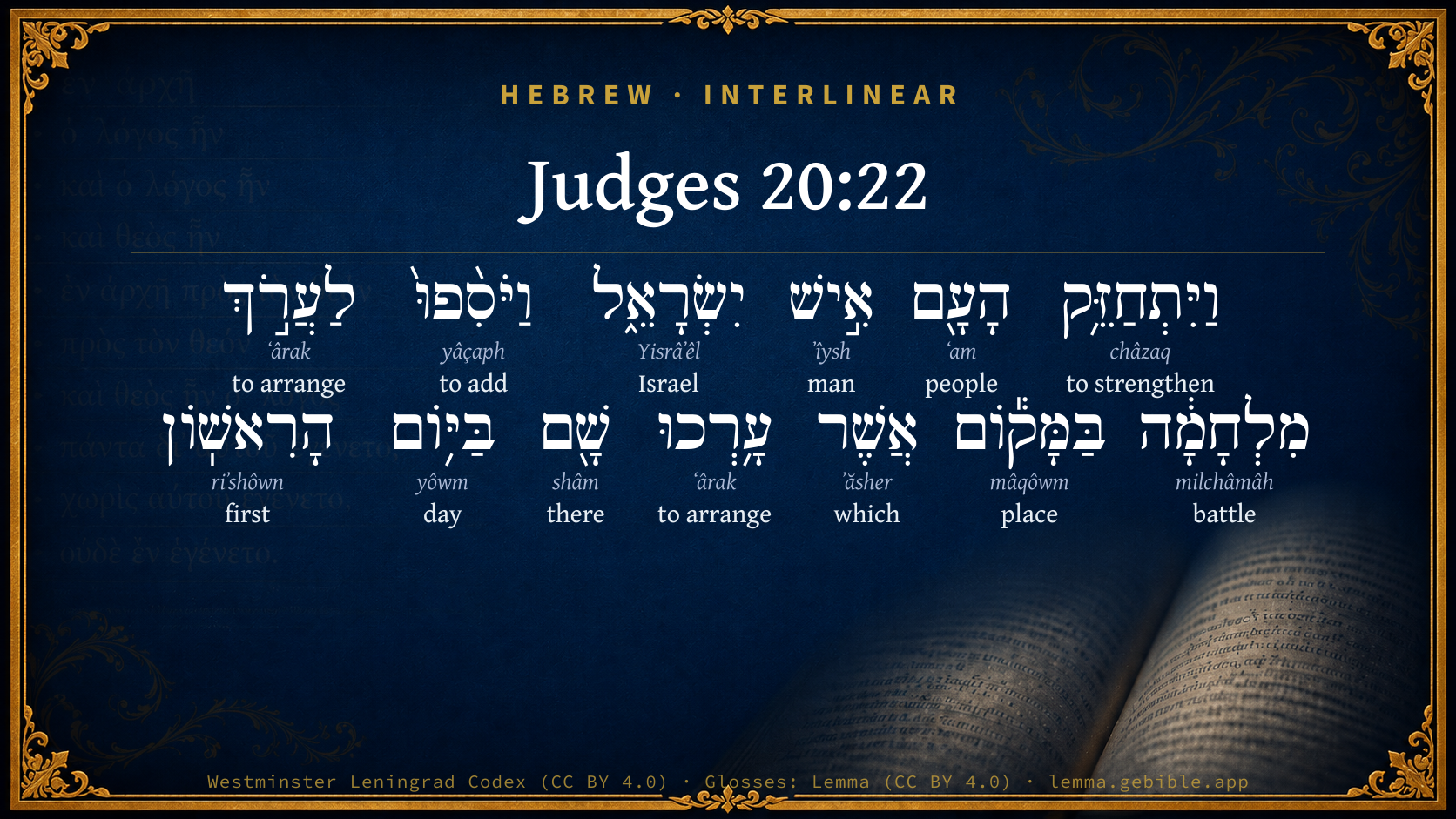
  1. וַיִּתְחַזֵּ֥ק châzaq H2388 “and · to strengthen” Conjunction + Verb, Hithpael, Sequential Imperfect, 3rd Person, Masculine, Singular
  2. הָעָ֖ם ʻam H5971 “the · people” Particle, Definite Article + Noun, Common, Masculine, Singular, Absolute
  3. אִ֣ישׁ ʼîysh H376 “man of” Noun, Common, Masculine, Singular, Construct
  4. יִשְׂרָאֵ֑ל Yisrâʼêl H3478 “Israel” Noun, Proper
  5. וַיֹּסִ֨פוּ֙ yâçaph H3254 “and · to add” Conjunction + Verb, Hiphil, Sequential Imperfect, 3rd Person, Masculine, Plural
  6. מִלְחָמָ֔ה milchâmâh H4421 “battle” Noun, Common, Feminine, Singular, Absolute
  7. בַּמָּק֕וֹם mâqôwm H4725 “in/at the · place” Preposition, Determined + Noun, Common, Masculine, Singular, Absolute
  8. אֲשֶׁר ʼăsher H834 “which” Particle, Relative
  9. עָ֥רְכוּ ʻârak H6186 “to arrange” Verb, Qal, Perfect, 3rd Person, Common, Plural
  10. שָׁ֖ם shâm H8033 “there” Adverb
  11. בַּיּ֥וֹם yôwm H3117 “in/at the · day” Preposition, Determined + Noun, Common, Masculine, Singular, Absolute
  12. הָרִאשֽׁוֹן riʼshôwn H7223 “the · first” Particle, Definite Article + Adjective, Ordinal number, Masculine, Singular, Absolute

About this verse

These counts appear in no published source. They are computed here, from the morphology-tagged text and Lemma’s own curated glosses. What Lemma adds →

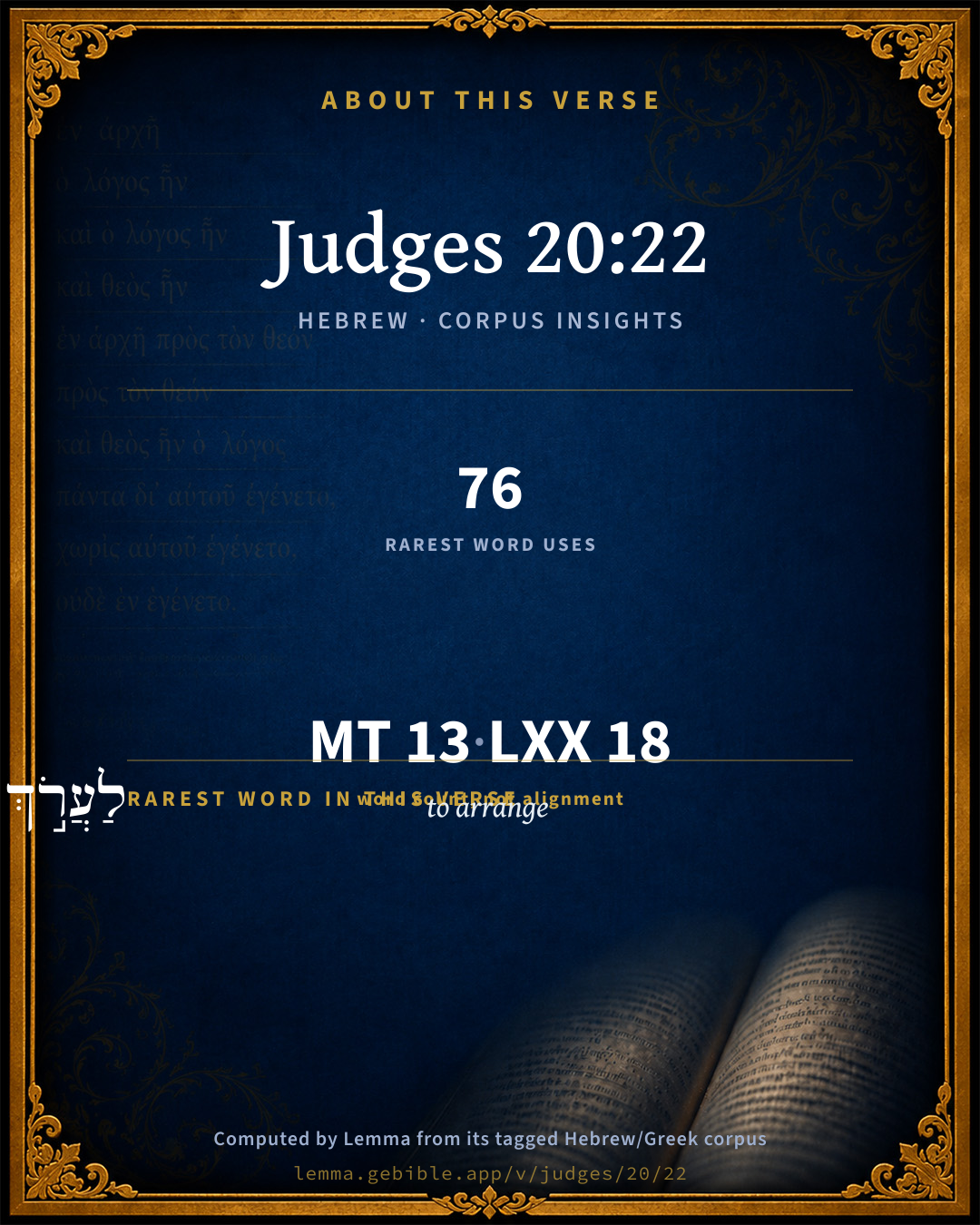
13
words
12
distinct lemmas
Historical
section

Grammatical profile

  • 4 verbs
  • 6 nouns
  • 1 adjective
  • 1 adverb
  • 1 particle

Verb forms

  • וַיִּתְחַזֵּ֥ק Hithpael · Sequential Imperfect
  • וַיֹּסִ֨פוּ֙ Hiphil · Sequential Imperfect
  • לַעֲרֹ֣ךְ Qal · Infinitive Construct
  • עָ֥רְכוּ Qal · Perfect

Repetition

A word recurs within this verse — often emphatic in Hebrew:

  • לַעֲרֹ֣ךְ to arrange H6186 ×2

Hebrew & Septuagint length

In English translation the verse runs 27 words from the Hebrew and 23 from the Septuagint (LXX English) — closely comparable.

A rough comparison of the two English renderings, which tokenize alike — not a word-level alignment.

Word counts can differ between the Hebrew and the Greek without any difference in meaning — e.g. the Hebrew direct-object marker אֵת has no separate Greek word, and Greek often adds the article ὁ.

In the original languages it is 13 Hebrew tokens and 18 Greek tokens — but the two are counted differently (Hebrew bundles its prefixes and suffixes into one token; the Greek is in lemma form), so that isn’t a like-for-like length.

Cross-references

5

Topical passages linked to Judges 20:22 in the Treasury of Scripture Knowledge — connected by theme and wording, ordered by reader-vote popularity; previews shown in the World English Bible.

  • Judges 20:15 The children of Benjamin were numbered on that day out of the cities twenty-six thousand men who drew the sword, besides the inhabitants of Gibeah, who were numbered seven hundred chosen men.
  • Judges 20:17 The men of Israel, besides Benjamin, were numbered four hundred thousand men who drew sword: all these were men of war.
  • 1 Samuel 30:6 David was greatly distressed; for the people spoke of stoning him, because the soul of all the people was grieved, every man for his sons and for his daughters: but David strengthened himself in Yahweh his God.
  • 2 Samuel 11:25 Then David said to the messenger, Thus shall you tell Joab, Don't let this thing displease you, for the sword devours one as well as another; make your battle more strong against the city, and overthrow it: and encourage you him.
  • Psalms 64:5 They encourage themselves in evil plans. They talk about laying snares secretly. They say, "Who will see them?"

Cross-references courtesy of OpenBible.info (CC BY 4.0).

Hebrew and Greek witnesses Masoretic Hebrew ↔ Greek Septuagint

The same verse in the two great witnesses to the Old Testament, shown verse-for-verse.

These are two independent witnesses, not word-aligned to each other, and the Septuagint is shown in lemma (dictionary) form.

Hebrew Judges 20:22 Masoretic · Westminster Leningrad Codex

וַיִּתְחַזֵּ֥ק הָעָ֖ם אִ֣ישׁ יִשְׂרָאֵ֑ל וַיֹּסִ֨פוּ֙ לַעֲרֹ֣ךְ מִלְחָמָ֔ה בַּמָּק֕וֹם אֲשֶׁר עָ֥רְכוּ שָׁ֖ם בַּיּ֥וֹם הָרִאשֽׁוֹן

The people, the men of Israel, encouraged themselves, and set the battle again in array in the place where they set themselves in array the first day.

World English Bible · Public Domain

Greek LXX Judges 20:22 Septuagint · lemma form

καί ἐνἰσχύω ἀνήρ ἰσραήλ καί προςτίθημι συνἅπτω παράταξις ἐν ὁ τόπος ὅπου συνἅπτω ἐν ὁ ἡμέρα ὁ πρῶτος

And the men of Israel strengthened themselves, and again engaged in battle in the place where they had engaged on the first day.

LXX2012 (modern English Septuagint) · Public Domain

Hebrew: Westminster Leningrad Codex (CC BY 4.0). Greek: Septuagint (public domain); English from LXX2012 (modern English Septuagint) (Public Domain). How the Septuagint differs from the Hebrew →

Targum (Aramaic paraphrase)

1

The Targum is the ancient Jewish Aramaic paraphrase of the Hebrew Scriptures — an interpretive translation, not the Hebrew text itself. Onkelos (literal) and Pseudo-Jonathan (expansive) render the Torah, and Jonathan the Prophets. Coverage is partial: where no permissively-licensed English translation exists for a verse, only the Aramaic is shown. This is verse-level text, not a word-by-word alignment to the Hebrew.

  1. Targum Jonathan Prophets (Joshua–Malachi)
    וְאִתְקֵף עַמָא אֱנַשׁ יִשְׂרָאֵל וְאוֹסִיפוּ לְסַדָרָא קְרָבָא בְּאַתְרָא דְסַדַרוּ תַּמָן בְּיוֹמָא קַדְמָאָה:

    (no public-domain English translation for this verse)

    Targum Jonathan — Aramaic: “Mikraot Gedolot” (public domain). English: “Sefaria Community Translation” (CC0 1.0 (public-domain dedication)); “London "Chaldee Paraphrase," 1871” (public domain). Text via Sefaria.

Commentary

Notes on Judges 20:22 from classic Christian and Jewish commentators (each source and its license shown beneath its notes). The classic Christian expositions comment on the surrounding passage and are grouped to its opening verse, so a note may address several verses; the Jewish commentaries on the Tanakh (Rashi and others) are per-verse, so they appear only where the commentator wrote on this verse.

Lemma curates 59 commentaries, every one of them public domain or Creative Commons licensed, each selected and text-cleaned for this edition rather than reprinted as found. About our sources →

Trapp's Complete Commentary

John Trapp

Jdg 20:22 And the people the men of Israel encouraged themselves, and set their battle again in array in the place where they put themselves in array the first day.

Ver. 22. Encouraged themselves.] Not in the Lord their God, as David in a distress did, {1Sa 30:6} but in the goodness of their cause, and in the multitude of their men. Thus also did the Tigurines in their fight against the Popish cantons, and were defeated and discomfited by them. In that fight fell that famous man of God, Huldericus Zuinglius. And Oecolampadius in an epistle to the divines of Ulm writeth thus thereupon, Non inter minima bona recenseri merentur humiliatio mentium nostrarum, et fiducia non in brachium carnis sed in Deum ipsum: quae duo electi inde discunt. Two good things we have learned by this late defeat: first to humble ourselves under the mighty hand of God; and secondly, not to put confidence any more in the arm of flesh, but in God alone.

John Trapp, A Commentary or Exposition upon All the Books of the Old and New Testament (1647–1656) — public domain. Text from a community e-Sword module.

Joseph Benson's Commentary

Jdg 20:22-23. The men of Israel encouraged — Hebrew, strengthened themselves, supporting themselves with the consciousness of the justice of their cause, and putting themselves in better order for defending themselves, and annoying their enemies. The children of Israel wept — Not so much for their sins, as for their defeat and loss. My brother — They impute their ill success, not to their own sins, but to their taking up arms against their brethren. But still they persist in their former neglect of seeking God’s assistance in the way which he had appointed, as they themselves acknowledged presently, by doing those very things which now they neglected.

Joseph Benson's Commentary on the Old and New Testaments (1811–1818) — public domain. Text from a community e-Sword module.

Ellicott's Commentary for English Readers

(22) Encouraged themselves.—Trusting, as the Vulgate adds, in their courage and numbers.

A Bible Commentary for English Readers, edited by Charles John Ellicott (1878–1897) — public domain. Text from a community e-Sword module.

The Cambridge Bible for Schools and Colleges

gen. ed. J. J. S. Perowne

22. To make sense this and Jdg_20:23 should change places. After the men of Israel the Vulgate adds trusting to their prowess and numbers, i.e. it was the presumption of the Israelites which caused their defeat.

The Cambridge Bible for Schools and Colleges (gen. ed. J. J. S. Perowne; Cambridge University Press, 1878–1918) — public domain. Text from a community e-Sword module.

John Gill's Exposition

And the people, the men of Israel, encouraged themselves,.... That though they had lost a great number of men, yet still their forces were large and greatly superior to those of Benjamin, and above all their cause was good:

and set their battle again in array formed a line of battle again facing their enemy, inviting to another battle, and bidding defiance:

and in the place where they put themselves in array the first day; by which it seems they kept the field of battle; though they lost so many men, they did not flee before the children of Benjamin, but stood their ground; nor were they so superstitious as to fancy the place unlucky; nor was it a bad situation they were in, to which their want of success was owing, for then they would have changed it.

John Gill's Exposition of the Whole Bible (1746–1763) — public domain (CC PDM 1.0). Text via the HelloAO Bible API.

Haydock's Catholic Bible Commentary

Trusting in their strength. The Lord suffered them to be overthrown, and many of them to be slain, though their cause was just; partly in punishment of the idolatry which they exercised or tolerated in the tribe of Dan, and elsewhere: and partly because they trusted in their own strength: and therefore, though he bid them fight, he would not give them the victory, till they were thoroughly humbled, and had learned to trust in him alone. (Challoner) --- God’s thoughts are often different from ours; and he frequently delays to crown with success the most holy enterprises, that man may learn to be more humble, and to trust wholly in his mercy. (Calmet)

George Leo Haydock (1774–1849), Haydock's Catholic Family Bible and Commentary, 1859 edition — public domain. Excludes Psalms (Douay-Rheims chapter numbering differs from Protestant) and Deuterocanonical books (Catholic canon only).

Matthew Poole's English Annotations

Encouraged themselves, Heb. strengthened themselves; partly by supporting themselves with the conscience of the justice of their cause, and the hopes of success; and partly by putting themselves in better order for defending themselves, and annoying their enemies.

In the place where they put themselves in array the first day; hereby showing their freedom from that heathenish superstition, whereby they might have been apt to have rejected that as an unlucky place. Compare 1Ki 20:23,28.

Matthew Poole's English Annotations on the Holy Bible (1683–1685) — public domain. Text from a community e-Sword/MySword module.

Whedon's Commentary on the Bible

Daniel D. Whedon

22. Encouraged themselves — “They did not seek for courage from God, but they cheered one another with vainglorious vauntings of their own strength, and with confident assurances of victory, and therefore God punished them.” — Wordsworth.

Daniel D. Whedon (gen. ed.), Commentary on the Old and New Testaments (1874–1909) — public domain. Text from a community e-Sword module.

John Wesley's Explanatory Notes

Encouraged - Hebrew. strengthened themselves, supporting themselves with the consciousness of the justice of their cause, and putting themselves in better order for defending themselves, and annoying their enemies.

John Wesley, Explanatory Notes Upon the Whole Bible (1754–1765) — public domain. Text via the GEBible commentary corpus.

Keil & Delitzsch

C. F. Keil & F. Delitzsch

Notwithstanding this terrible overthrow, the people strengthened themselves, and prepared again for battle, "at the same place" where they had made ready on the first day, "seeking out of pure vainglory to wipe out the stains and the disgrace which their previous defeat had brought upon them" (Berleb. Bible).

Keil & Delitzsch — Biblical Commentary on the Old Testament (1861–1891) — public domain (CC PDM 1.0). Text via the HelloAO Bible API. (Old Testament only.)

unfoldingWord translationNotes

Door43 World Missions Community

strengthened themselves

Here "strengthened" is an idiom that means they encouraged each other. (See: Idiom)

they formed the battle line

This probably means that the Israelites prepared their battle lines for the next day's fighting. AT: "they got ready to fight the next day"

they sought direction from Yahweh

The method they used is not stated. The priest may have cast lots to determine God's will.

translationWords

Yahweh

brother

unfoldingWord translationNotes — © Distant Shores Media and the Door43 World Missions Community, licensed CC BY-SA 4.0. Source: git.door43.org/Door43/en_tn.

Lesson kit

Teaching starters — assembled from the data on this page, not authored interpretation. Every prompt links to the verse data it draws on. Edit before teaching.

Judges, in the Historical, opens this verse with 13 words (12 distinct Hebrew lemmas). Its most distinctive word is ʻârak (“to arrange”). A historical commentator’s framing appears above. Read the whole chapter for the surrounding context.

Discussion questions

  1. What does “to arrange” (ʻârak) contribute to the verse as a whole?
  2. Judges 20:15 shares this passage’s theme. How do the two illuminate each other?
  3. “to arrange” occurs 2× in this one verse. What is the effect of the repetition?
  4. These translations render this verse differently; the difference is in the English rendering, not the original. What questions does that raise?
  5. The verb «וַיִּתְחַזֵּ֥ק» is Hithpael Sequential Imperfect. How does its form color the action?
  6. Reading how Trapp's Complete Commentary and Joseph Benson's Commentary read this verse, where do the two commentators agree and where do they part?

Things to notice

Reading settings

Reading text

Shown beneath each verse's original-language words.

Old Testament
Old Testament edition

Read the OT as the Masoretic Hebrew (MT) or the Greek Septuagint (LXX).

English shown for the Greek Septuagint (in the Hebrew ↔ Greek comparison).

Comparing translations? Open the Compare panel on any verse page to stack up to four side by side.