
1 Chronicles 11:10

Hebrew (Westminster Leningrad Codex) 1 Chronicles 11:10 appears in the Hebrew Old Testament. The text above is from the Westminster Leningrad Codex. Each word links to its Strong’s number, a concise gloss, and parsing drawn from the Open Scriptures Hebrew Bible morphology. Click any word for its full Brown-Driver-Briggs (BDB) entry.
Download image
Cite this verse

1 Chronicles 11:10 (World English Bible). Public Domain. Lemma interlinear Bible study tool, https://lemma.gebible.app/v/1-chronicles/11/10.

Show BibTeX & RIS
BibTeX
RIS
English Translation
Now these are the chief of the mighty men whom David had, who shown themselves strong with him in his kingdom, together with all Israel, to make him king, according to the word of Yahweh concerning Israel.
World English Bible · Public Domain
Download a study sheet

One document with this verse’s original text, its word-by-word gloss line, the meaning frame, cross-references with their text, attributed commentary, and full source and license credits — printable, and it pastes into notes with its structure intact.

This verse Autodidact and up

Study sheet (.html) Plain text (.txt)

A passage Seminary Student

Up to 50 verses in one chapter. A passage sheet keeps up to 6 commentary sources and 12 cross-references per verse, in the order this page ranks them, and says so on the sheet whenever that leaves anything out. Ask for a single verse and you get the Autodidact verse sheet above.

Everything on this page stays free to read, with no account — the sheet is a download of what is already on screen, not access to it.

Want to remove ads? Support Godless Engineer
Compare translations 3

The same verse in 3 English versions, stacked beneath the original-language interlinear above. Click any original word for its lexicon entry.

Each is an independent rendering of the whole verse — the interlinear is not word-aligned to these translations.

Highlighted words mark where these versions differ — a whole-verse word diff, not a word-by-word alignment.

  • World English Bible Public Domain
    Now these are the chief of the mighty men whom David had, who shown themselves strong with him in his kingdom, together with all Israel, to make him king, according to the word of Yahweh concerning Israel.
  • King James Version Public Domain
    These also are the chief of the mighty men whom David had, who strengthened themselves with him in his kingdom, and with all Israel, to make him king, according to the word of the LORD concerning Israel.
  • unfoldingWord Literal Text CC BY-SA 4.0
    Now these the heads of the warriors who to David, the ones strengthening themselves with him in his kingdom with all of Israel to make him king according to the word of Yahweh concerning Israel.

unfoldingWord Literal Text — © unfoldingWord, licensed CC BY-SA 4.0. Word-aligned USFM3 via Door43 (git.door43.org/unfoldingWord/en_ult).

Versions to compare (up to 4)

3 of 4 selected

Show all 18 translations

Every available English version of this verse, each an independent rendering of the whole verse.

  • World English Bible Public Domain
    Now these are the chief of the mighty men whom David had, who shown themselves strong with him in his kingdom, together with all Israel, to make him king, according to the word of Yahweh concerning Israel.
  • Berean Standard Bible Public Domain
    Now these were the chiefs of David’s mighty men, who, together with all Israel, bolstered and strengthened his kingdom, according to the word of the LORD concerning Israel.
  • Majority Standard Bible Public Domain
    Now these were the chiefs of David’s mighty men, who, together with all Israel, bolstered and strengthened his kingdom, according to the word of the LORD concerning Israel.
  • King James Version Public Domain
    These also are the chief of the mighty men whom David had, who strengthened themselves with him in his kingdom, and with all Israel, to make him king, according to the word of the LORD concerning Israel.
  • American Standard Version (1901) Public Domain
    Now these are the chief of the mighty men whom David had, who showed themselves strong with him in his kingdom, together with all Israel, to make him king, according to the word of Jehovah concerning Israel.
  • Revised Version (1885) Public Domain
    Now these are the chief of the mighty men whom David had, who shewed themselves strong with him in his kingdom, together with all Israel, to make him king, according to the word of the LORD concerning Israel.
  • Geneva Bible (1599) Public Domain
    These also are the chiefe of the valiant men that were with Dauid, and ioyned their force with him in his kingdome with al Israel, to make him King ouer Israel, according to the worde of the Lord.
  • Douay-Rheims (1899) Public Domain
    These are the chief of the valiant men of David, who helped him to be made king over all Israel, according to the word of the Lord, which he spoke to Israel.
  • Young's Literal Translation Public Domain
    And these `are' heads of the mighty ones whom David hath, who are strengthening themselves with him in his kingdom, with all Israel, to cause him to reign, according to the word of Jehovah, over Israel.
  • Literal Standard Version CC BY-SA 4.0
    And these [are] heads of the mighty ones whom David has, who are strengthening themselves with him in his kingdom, with all Israel, to cause him to reign, according to the word of YHWH, over Israel.
  • Unlocked Literal Bible CC BY-SA 4.0
    These were the leaders David had, who showed themselves strong with him in his kingdom, together with all Israel, to make him king, obeying the word of Yahweh concerning Israel.
  • unfoldingWord Literal Text CC BY-SA 4.0
    Now these the heads of the warriors who to David, the ones strengthening themselves with him in his kingdom with all of Israel to make him king according to the word of Yahweh concerning Israel.
  • Darby Bible Public Domain
    And these are the chief of the mighty men whom David had, who shewed themselves valiant with him in his kingdom, with all Israel, to make him king, according to the word of Jehovah concerning Israel.
  • World Messianic Bible Public Domain
    Now these are the chief of the mighty men whom David had, who showed themselves strong with him in his kingdom, together with all Israel, to make him king, according to the LORD’s word concerning Israel.
  • Webster's Bible Public Domain
    These also are the chief of the mighty men whom David had, who strengthened themselves with him in his kingdom, and with all Israel, to make him king according to the word of the LORD concerning Israel.
  • Free Bible Version CC BY-SA 4.0
    These were the leaders of David's powerful warriors who, along with all the Israelites, gave him strong support in becoming king, just as the Lord had promised would happen to Israel.
  • Bible in Basic English Public Domain
    Now these are the chief of David's men of war who were his strong supporters in the kingdom, and, with all Israel, made him king, as the Lord had said about Israel.
  • JPS Tanakh (1917) Public Domain
    Now these are the chief of the mighty men whom David had, who held strongly with him in his kingdom, together with all Israel, to make him king, according to the word of the LORD concerning Israel.

Literal Standard Version (2020), Covenant Press — licensed CC BY-SA 4.0. Text via the HelloAO Bible API (eBible.org). Unlocked Literal Bible (unfoldingWord) — licensed CC BY-SA 4.0. Text via the HelloAO Bible API (eBible.org). unfoldingWord Literal Text — © unfoldingWord, licensed CC BY-SA 4.0. Word-aligned USFM3 via Door43 (git.door43.org/unfoldingWord/en_ult). Free Bible Version, Dr. Jonathan Gallagher — licensed CC BY-SA 4.0. Text via the HelloAO Bible API (eBible.org).

Word by word

More ways to search: Search by grammar → Find every occurrence → Compare this word →

Practice this passage: Drill this verse → Learn its vocabulary →

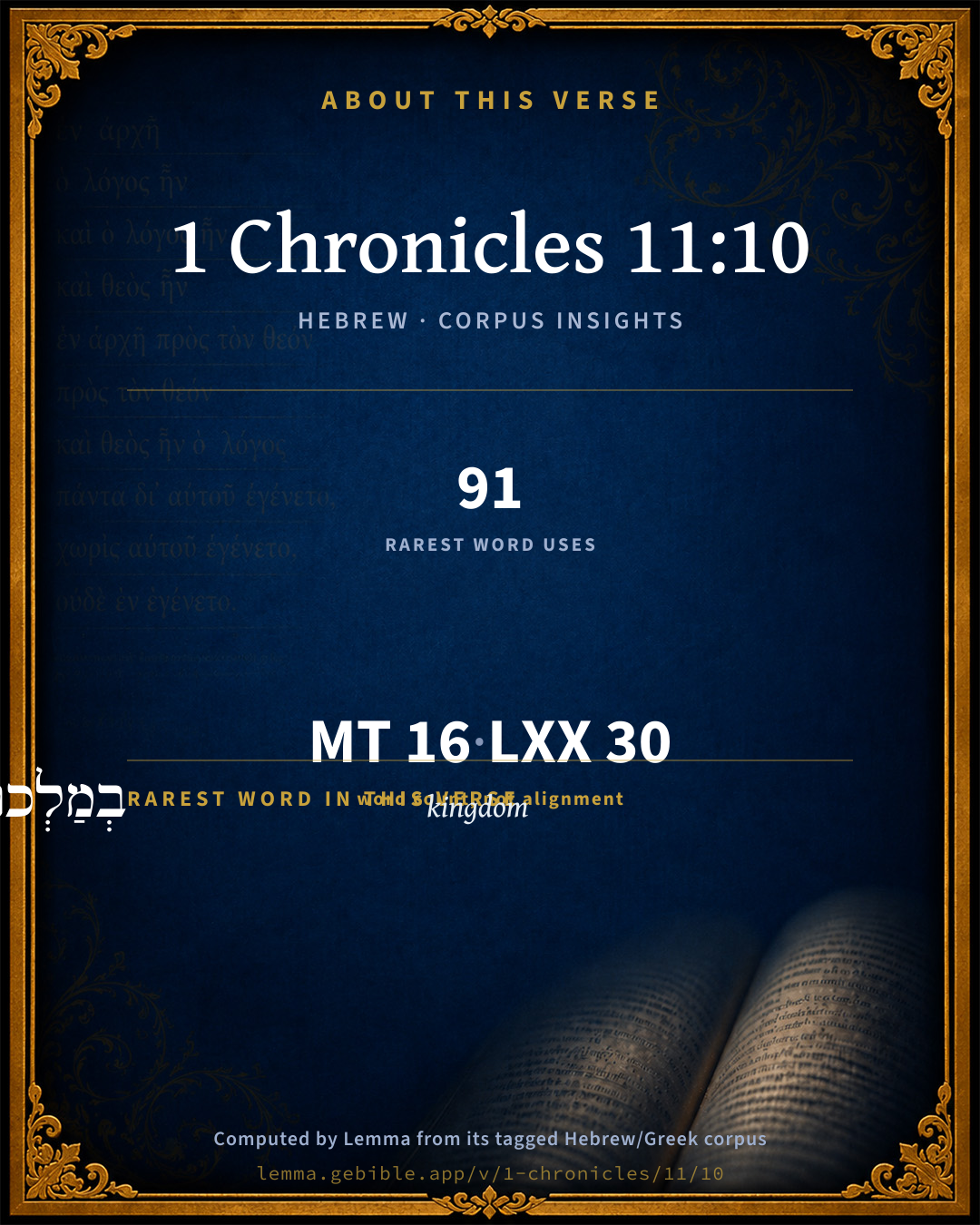
בְמַלְכוּת֛וֹ
malkûwth
H4438
“in/at · kingdom · his”
Preposition + Noun, Common, Feminine, Singular, Construct + Suffix, Personal, 3rd Person, Masculine, Singular
Part of Speech
Preposition + Noun
Type
Common
Gender
Feminine
Number
Singular
State
Construct
Full BDB Definition

Origin: from H4427

TWOT: 1199e

royalty, royal power, reign, kingdom, sovereign power - royal power, dominion - reign - kingdom, realm
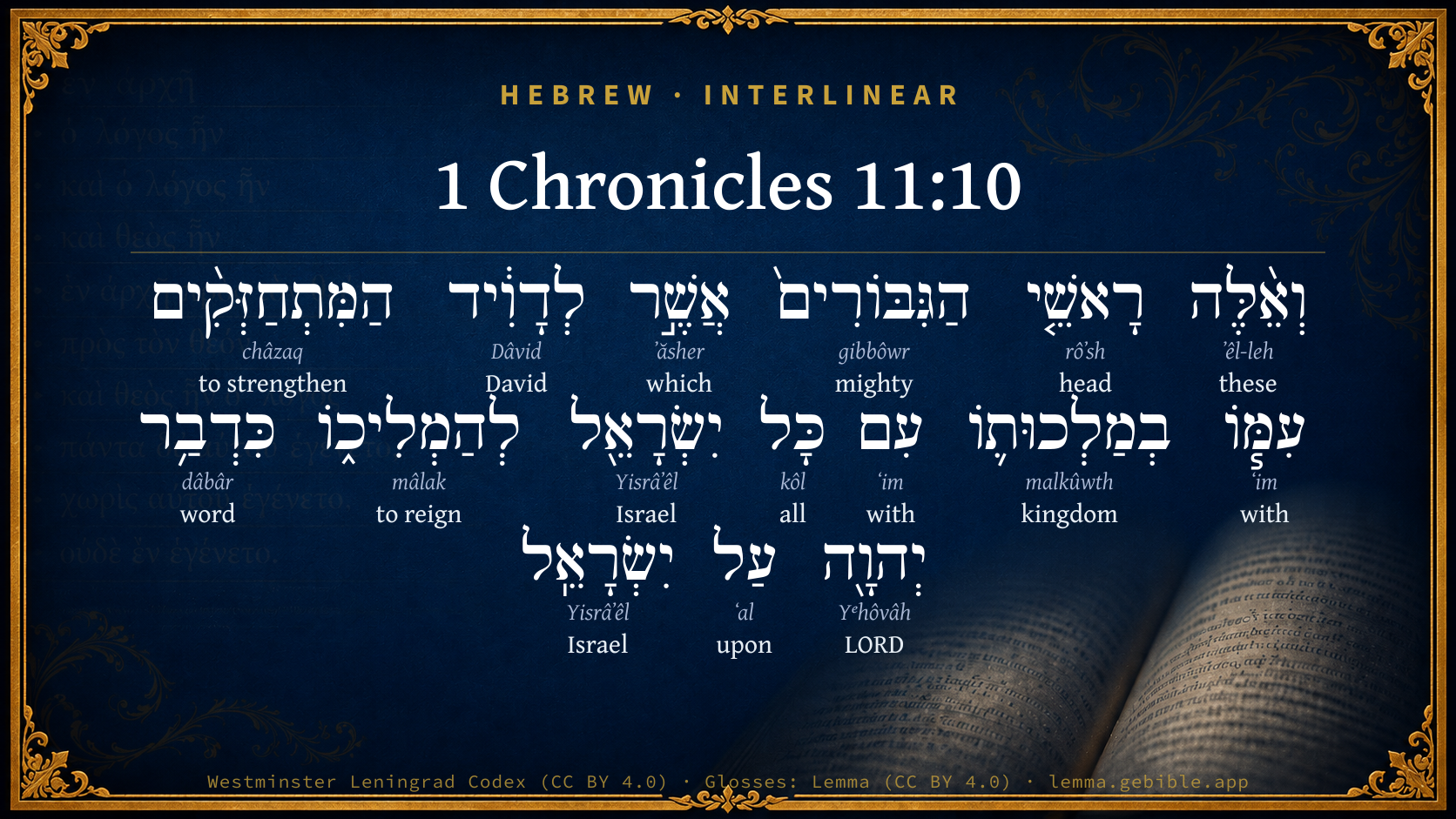
  1. וְאֵ֨לֶּה ʼêl-leh H428 “and · these” Conjunction + Pronoun, Demonstrative, Common, Plural
  2. רָאשֵׁ֤י rôʼsh H7218 “heads of” Noun, Common, Masculine, Plural, Construct
  3. הַגִּבּוֹרִים֙ gibbôwr H1368 “the · mighty” Particle, Definite Article + Adjective, Adjective, Masculine, Plural, Absolute
  4. אֲשֶׁ֣ר ʼăsher H834 “which” Particle, Relative
  5. לְדָוִ֔יד Dâvid H1732 “to/for · David” Preposition + Noun, Proper
  6. הַמִּתְחַזְּקִ֨ים châzaq H2388 “the · strengthening” Particle, Definite Article + Verb, Hithpael, Participle Active, Masculine, Plural, Absolute
  7. עִמּ֧וֹ ʻim H5973 “with · him” Preposition + Suffix, Personal, 3rd Person, Masculine, Singular
  8. עִם ʻim H5973 “with” Preposition
  9. כָּל kôl H3605 “all of” Noun, Common, Masculine, Singular, Construct
  10. יִשְׂרָאֵ֖ל Yisrâʼêl H3478 “Israel” Noun, Proper
  11. לְהַמְלִיכ֑וֹ mâlak H4427 “to reign · him” Preposition + Verb, Hiphil, Infinitive Construct + Suffix, Personal, 3rd Person, Masculine, Singular
  12. כִּדְבַ֥ר dâbâr H1697 “like/as · word of” Preposition + Noun, Common, Masculine, Singular, Construct
  13. יְהוָ֖ה Yᵉhôvâh H3068 “LORD” Noun, Proper
  14. עַל ʻal H5921 “upon” Preposition
  15. יִשְׂרָאֵֽל Yisrâʼêl H3478 “Israel” Noun, Proper

About this verse

These counts appear in no published source. They are computed here, from the morphology-tagged text and Lemma’s own curated glosses. What Lemma adds →

16
words
14
distinct lemmas
Historical
section

Grammatical profile

  • 2 verbs
  • 8 nouns
  • 1 adjective
  • 1 pronoun
  • 3 prepositions
  • 1 particle

Verb forms

  • הַמִּתְחַזְּקִ֨ים Hithpael · Participle Active
  • לְהַמְלִיכ֑וֹ Hiphil · Infinitive Construct

Repetition

Words recur within this verse — often emphatic in Hebrew:

  • יִשְׂרָאֵ֖ל Israel H3478 ×2
  • עִמּ֧וֹ with H5973 ×2

Hebrew & Septuagint length

In English translation the verse runs 37 words from the Hebrew and 36 from the Septuagint (LXX English) — closely comparable.

A rough comparison of the two English renderings, which tokenize alike — not a word-level alignment.

Word counts can differ between the Hebrew and the Greek without any difference in meaning — e.g. the Hebrew direct-object marker אֵת has no separate Greek word, and Greek often adds the article ὁ.

In the original languages it is 16 Hebrew tokens and 30 Greek tokens — but the two are counted differently (Hebrew bundles its prefixes and suffixes into one token; the Greek is in lemma form), so that isn’t a like-for-like length.

Cross-references

7

Topical passages linked to 1 Chronicles 11:10 in the Treasury of Scripture Knowledge — connected by theme and wording, ordered by reader-vote popularity; previews shown in the World English Bible.

  • 2 Samuel 23:8–39 These are the names of the mighty men whom David had: Josheb Basshebeth a Tahchemonite, chief of the captains; the same was Adino the Eznite, against eight hundred slain at one time.
  • 1 Chronicles 11:3 So all the elders of Israel came to the king to Hebron; and David made a covenant with them in Hebron before Yahweh; and they anointed David king over Israel, according to the word of Yahweh by Samuel.
  • 1 Samuel 16:1 Yahweh said to Samuel, How long will you mourn for Saul, seeing I have rejected him from being king over Israel? fill your horn with oil, and go: I will send you to Jesse the Bethlehemite; for I have provided me a king among his sons.
  • 1 Samuel 16:12–14 He sent, and brought him in. Now he was ruddy, and withal of a beautiful face, and goodly to look on. Yahweh said, Arise, anoint him; for this is he.
  • 2 Samuel 3:17–18 Abner had communication with the elders of Israel, saying, In times past you sought for David to be king over you:
  • 2 Samuel 3:21 Abner said to David, I will arise and go, and will gather all Israel to my lord the king, that they may make a covenant with you, and that you may reign over all that your soul desires. David sent Abner away; and he went in peace.
  • 1 Chronicles 12:38 All these being men of war, who could order the battle array, came with a perfect heart to Hebron, to make David king over all Israel: and all the rest also of Israel were of one heart to make David king.

Cross-references courtesy of OpenBible.info (CC BY 4.0).

Hebrew and Greek witnesses Masoretic Hebrew ↔ Greek Septuagint

The same verse in the two great witnesses to the Old Testament, shown verse-for-verse.

These are two independent witnesses, not word-aligned to each other, and the Septuagint is shown in lemma (dictionary) form.

Hebrew 1 Chronicles 11:10 Masoretic · Westminster Leningrad Codex

וְאֵ֨לֶּה רָאשֵׁ֤י הַגִּבּוֹרִים֙ אֲשֶׁ֣ר לְדָוִ֔יד הַמִּתְחַזְּקִ֨ים עִמּ֧וֹ בְמַלְכוּת֛וֹ עִם כָּל יִשְׂרָאֵ֖ל לְהַמְלִיכ֑וֹ כִּדְבַ֥ר יְהוָ֖ה עַל יִשְׂרָאֵֽל

Now these are the chief of the mighty men whom David had, who shown themselves strong with him in his kingdom, together with all Israel, to make him king, according to the word of Yahweh concerning Israel.

World English Bible · Public Domain

Greek LXX 1 Chronicles 11:10 Septuagint · lemma form

καί οὗτος ὁ ἄρχων ὁ δυνατός ὅς εἰμί ὁ δαυίδ ὁ καταἰσχύω μετά αὐτός ἐν ὁ βασιλεία αὐτός μετά πᾶς ἰσραήλ ὁ βασιλεύω αὐτός κατά ὁ λόγος κύριος ἐπί ἰσραήλ

And these are the chiefs of the mighty men, whom David had, who strengthened themselves with him in his kingdom, with all Israel, to make him king, according to the word of the Lord concerning Israel.

LXX2012 (modern English Septuagint) · Public Domain

Hebrew: Westminster Leningrad Codex (CC BY 4.0). Greek: Septuagint (public domain); English from LXX2012 (modern English Septuagint) (Public Domain). How the Septuagint differs from the Hebrew →

Commentary

Notes on 1 Chronicles 11:10 from classic Christian and Jewish commentators (each source and its license shown beneath its notes). The classic Christian expositions comment on the surrounding passage and are grouped to its opening verse, so a note may address several verses; the Jewish commentaries on the Tanakh (Rashi and others) are per-verse, so they appear only where the commentator wrote on this verse.

Lemma curates 59 commentaries, every one of them public domain or Creative Commons licensed, each selected and text-cleaned for this edition rather than reprinted as found. About our sources →

Matthew Henry's Commentary

We have here an account of David's worthies, the great men of his time that served him and were preferred by him. The first edition of this catalogue we had, Sa2 23:8, etc. This is much the same, only that those named here from Ch1 11:41 to the end are added. Observe,

I. The connexion of this catalogue with that which is said concerning David, Ch1 11:9. 1. David waxed greater and greater, and these were his mighty men. Much of the strength and honour of great men is borrowed from their servants and depends upon them, which cannot but somewhat diminish pomp and power in the opinion of those that are wise. David is great because he has great men about him; take these away, and he is where he was. 2. The Lord of hosts was with him, and these were the mighty men which he had. God was with him and wrought for him, but by men and means and the use of second causes. By this it appeared that God was with him, that he inclined the hearts of those to come over to him that were able to serve his interest. As, if God be for us none can be against us, so, if God be for us, all shall be for us that we have occasion for. Yet David ascribed his success and increase, not to the hosts he had, but to the Lord of hosts, not to the mighty men that were with him, but to the mighty God whose presence with us is all in all.

II. The title of this catalogue (Ch1 11:10): These are the men who strengthened themselves with him. In strengthening him they strengthened themselves and their own interest; for his advancement was theirs. What we do in our places for the support of the kingdom of the Son of David we shall be gainers by. In strengthening it we strengthen ourselves. It may be read, They held strongly with him and with all Israel. Note, When God has work to do he will not want fit instruments to do it with. If it be work that requires mighty men, mighty men shall either be found or made to effect it, according to the word of the Lord.

III. That which made all these men honourable was the good service that they did to their king and country; they helped to make David king (Ch1 11:10) - a good work. They slew the Philistines, and other public enemies, and were instrumental to save Israel. Note, The way to be great is to do good. Nor did they gain this honour without labour and the hazard of their lives. The honours of Christ's kingdom are prepared for those that fight the good fight of faith, that labour and suffer, and are willing to venture all, even life itself, for Christ and a good conscience. It is by a patient continuance in well-doing that we must seek for glory, and honour, and immortality; and those that are faithful to the Son of David shall find their names registered and enrolled much more to their honour than these are in the records of fame.

IV. Among all the great exploits of David's mighty men, here is nothing great mentioned concerning David himself but his pouring out water before the Lord which he had longed for, Ch1 11:18, Ch1 11:19. Four very honourable dispositions of David appeared in that action, which, for aught I know, made it as great as any of the achievements of those worthies. 1. Repentance for his own weakness. It is really an honour to a man, when he is made sensible that he has said or done any thing unadvisedly, to unsay it and undo it again by repentance, as it is a shame to a man when he has said or done amiss to stand to it. 2. Denial of his own appetite. He longed for the water of the well of Bethlehem; but, when he had it, he would not drink it, because he would not so far humour himself and gratify a foolish fancy. He that has such a rule as this over his own spirit is better than the mighty. It is an honour to a man to have the command of himself; but he that will command himself must sometimes cross himself. 3. Devotion towards God. That water which he thought too good, too precious, for his own drinking, he poured out to the Lord for a drink offering. If we have any thing better than another, let God be honoured with it, who is the best, and should have the best. 4. Tenderness of his servants. It put him into the greatest confusion imaginable to think that three brave men should hazard their lives to fetch water for him. In his account it turns the water into blood. It is the honour of great men not to be prodigal of the blood of those they employ, but, in all the commands they give them, to put their own souls into their souls' stead.

V. In the wonderful achievements of these heroes the power of God must be acknowledged. How could one slay 300 and another the same number (Ch1 11:11, Ch1 11:20), another two lion-like men (Ch1 11:22), and another an Egyptian giant (Ch1 11:23), if they had not had the extraordinary presence of God with them, according to that promise, Jos 23:10, One man of you shall chase a thousand, for the Lord your God fighteth for you?

VI. One of these worthies is said to be an Ammonite (Ch1 11:39), another a Moabite (Ch1 11:46), and yet the law was that an Ammonite and a Moabite should not enter into the congregation of the Lord, Deu 23:3. These, it is likely, had approved themselves so hearty for the interest of Israel that in their case it was thought fit to dispense with that law, and the rather because it was an indication that the Son of David would have worthies among the Gentiles: with him there is neither Greek nor Jew.

Matthew Henry's Commentary on the Whole Bible (1708–1710) — public domain (CC PDM 1.0). Text via the HelloAO Bible API.

Jamieson, Fausset & Brown

Robert Jamieson, A. R. Fausset & David Brown

A CATALOGUE OF HIS WORTHIES. (1Ch. 11:10-47)

These . . . are the chief of the mighty men--(See on Sa2 23:8). They are here described as those who held strongly with him (Margin) to make him king, &c. In these words the sacred historian assigns a reason for introducing the list of their names, immediately after his account of the election of David as king, and the conquest of Jerusalem; namely, that they assisted in making David king. In the original form of the list, and the connection in which it occurs in Samuel, there is no reference to the choice of a king; and even in this passage it is only in the clause introduced into the superscription that such a reference occurs [KEIL].

Jamieson, Fausset & Brown — Commentary Critical and Explanatory on the Whole Bible (1871) — public domain (CC PDM 1.0). Text via the HelloAO Bible API.

Trapp's Complete Commentary

John Trapp

1Ch 11:10 These also [are] the chief of the mighty men whom David had, who strengthened themselves with him in his kingdom, [and] with all Israel, to make him king, according to the word of the LORD concerning Israel.

Ver. 10. These also are the chief of the mighties.] The same catalogue of David’s worthies we have in 2Sa 23:1-39, but here with a more ample inscription. Christ hath his heroes also, who in their several generations have done "worthily in Ephrata," and been "famous in Bethlehem." And if their names be not all registered on earth, yet they are "written in heaven," and shall one day be renowned in that great amphitheatre. {Heb 12:22-23}

Who strengthened themselves with him.] Where God intendeth to raise or preserve kingdoms and states, he giveth and gifteth men for the purpose; as he did for Alexander the Great, for the Romans, and for our Queen Elizabeth.

John Trapp, A Commentary or Exposition upon All the Books of the Old and New Testament (1647–1656) — public domain. Text from a community e-Sword module.

Joseph Benson's Commentary

1Ch 11:10. The chief of the mighty men — Who helped with all their might to settle him in his kingdom. With all Israel — In conjunction with all those loyal Israelites who joined with David. Yet David ascribed his success, not to the hosts he had, but to the Lord of hosts: not to the mighty men that were with him, but to the mighty God, whose presence with us is all in all.

Joseph Benson's Commentary on the Old and New Testaments (1811–1818) — public domain. Text from a community e-Sword module.

Tyndale Open Study Notes

Tyndale Open Resources

11:10-47 This account of David’s mighty warriors demonstrates that David had the support of Israel’s best and bravest men, as well as the support of all Israel (cp. 2 Sam 23:8-39).

11:10 just as the Lord had promised: David’s kingship was God’s choice, not David’s or the people’s (cp. 11:3; 1 Sam 16:11-14).

Tyndale Open Study Notes — © Tyndale Open Resources, licensed CC BY-SA 4.0. Text via the HelloAO Bible API.

Ellicott's Commentary for English Readers

(10) These also are the chief of the mighty men.—Rather, And these were the heads of the warriors (i.e., the chief warriors, other warriors of lower rank being enumerated in 1 Chronicles 12) who showed themselves strong in his support (with him, Dan_10:21; Psa_12:4), in the matter of his kingdom, in common with all Israel, in order to make him king (and maintain him as such: comp. their exploits, noticed below). This description of the heroes is not given in Samuel, the connection there being different.

According to the word of the Lord concerning Israel.—Comp. Note on 1Ch_11:3. David was made king (1) for his own sake. It was work for which he was best fitted, and a reward of his faithfulness. (2) For Israel’s sake: “So he led them with a faithful and true heart” (Psa_78:70-72).

(10-44) X list of the warriors who helped David to win and maintain his kingdom. This catalogue answers to that of 2Sa_23:8-39, which, however, breaks off with Uriah the Hittite; whereas our text communicates sixteen additional names. This fact proves that the chronicler had either a fuller source, or a different recension of Samuel. The numerous variant spellings are in general mistakes of transcription.

A Bible Commentary for English Readers, edited by Charles John Ellicott (1878–1897) — public domain. Text from a community e-Sword module.

The Cambridge Bible for Schools and Colleges

gen. ed. J. J. S. Perowne

10. These also] R.V. Now these. This verse is the Chronicler’s own heading which he prefixes to the list of heroes taken from Sam., while retaining (in 1Ch_11:11) the original heading given in Sam.

who strengthened themselves with him] Render with R.V. mg., who held strongly with him. Cp. 1Ch_12:23.

and with all Israel] R.V. together with all Israel.

10–41a (= 2Sa_23:8-39). David’s Mighty Men and their Deeds

(The names of twelve of these heroes reappear in chap. 27 as the commanders of David’s twelve “courses.”)

This section seems to consist of elements drawn from different sources and brought together (probably by the author of Samuel) in order to give as complete a list as possible of the heroes who at different times in David’s career did good service to Israel.

1Ch_11:11-14 (= 2Sa_23:8-12) deal with two (in Sam. three) heroes otherwise unknown.

1Ch_11:15-19 (= 2Sa_23:13-17) are independent of the foregoing and narrate an exploit of three unnamed heroes.

1Ch_11:20-25 (= 2Sa_23:18-23) seem in turn to be independent of 15–19, and 1Ch_11:21; 1Ch_11:25 in particular seem to be quoted from some lost poem. These verses contain the eulogy of Abishai and Benaiah.

1Ch_11:26-41 a (= 2Sa_23:24-39) contain thirty names of heroes whose exploits are not recorded. It is to be noted that Chron., 1Ch_11:41 b–47, adds some sixteen names at the end which are not given in Samuel.

Joab is not included in the formal list because he has been already mentioned (1Ch_11:6).

Lists of names are favourite features in Oriental Histories. Thus ibn Hishâm in his life of Mohammed gives a list of the 83 Moslems who took refuge in Abyssinia from the persecution of the Koreish, of the 75 inhabitants of Medina who swore allegiance to the Prophet before the Hegira, and even of the 314 Moslems who were present at the battle of Bedr.

The Cambridge Bible for Schools and Colleges (gen. ed. J. J. S. Perowne; Cambridge University Press, 1878–1918) — public domain. Text from a community e-Sword module.

Albert Barnes' Notes on the Bible

Strengthened themselves - Or “exerted themselves” - “strenuously assisted with all Israel in making David king.” This list of David’s principal heroes belongs, therefore, to his reign at Hebron. In Samuel the list is not given until nearly the end of David’s reign 2 Sam. 23:8-39.

Albert Barnes' Notes on the Bible (1834–1885) — public domain. Text from a community e-Sword/MySword module.

Haydock's Catholic Bible Commentary

These. Besides the help which David received immediately from God, he derived great assistance from Joab, the captain-general, from the six more renowned valiant men, and from the body of Thirty, as well as from fifteen others of less note, who are mentioned here. (Haydock)

George Leo Haydock (1774–1849), Haydock's Catholic Family Bible and Commentary, 1859 edition — public domain. Excludes Psalms (Douay-Rheims chapter numbering differs from Protestant) and Deuterocanonical books (Catholic canon only).

Matthew Poole's English Annotations

Who strengthened themselves with him in his kingdom; who helped him with all their might to settle him in his kingdom.

With all Israel; in conjunction with all those loyal Israelites who joined with David; of whom see the next chapter.

Matthew Poole's English Annotations on the Holy Bible (1683–1685) — public domain. Text from a community e-Sword/MySword module.

The Pulpit Commentary

Vers. 10-25. This list of chiefs of David"s "mighty men" finds a more appropriate position where it is placed here, than where it is found, after the close of the very dying speech of David, in 2Sa_23:8-23. It plainly belongs to the time of the establishment of David"s sway over the whole people. The different position of the list here is itself an indication of some force, that the writers of the work of Samuel and of Chronicles availed them- selves independently of the common source, and that the latter did not take through the former.

Vers. 10-14, 20-47.

The moral of the mighty men.

We may learn from this record of gallant exploits and of the names of David"s mighty men

I THAT NO MAN, HOWEVER GREAT AND WISE, CAN DISPENSE WITH THE CO-OPERATION OF OTHERS. David"s elevation to the throne was largely due to his own character and to his own deeds. That was noble and winning; these were great and worthy. But he could not and would not have become king over all Israel, had not these mighty men "strengthened themselves with him to make him king" (ver. 10). And though the power and glory of his long reign were, to a great extent, the product of the king"s own wisdom, valour, and loyalty to Jehovah, yet the deeds of his mighty men had much to do with the triumphs he won and the power he wielded. No Christian leader can accomplish great things without an active following on the part of brave and true men, who "strengthen themselves with him." Around the illustrious men whose names are household words and who wrought great things for Christ and for the world, there were gathered others, less in moral and spiritual stature than they, whose names were unwritten or have faded from view, but whose cooperation ensured success. All who would accomplish much must know how to surround themselves with others who will second their work and sustain their hands.

II THAT MEN MAY SERVE A GOOD CAUSE ANIMATED BY VARIOUS MOTIVES. It is impossible to suppose that all those who "strengthened themselves with David according to the word of the Lord" (ver. 10) took their part, then and afterwards, solely on the ground that they were thus carrying out the Divine will. Doubtless they had their personal ambitions. The court at Jerusalem was not without its rivalries and jealousies. The mighty men were no doubt stirred to more daring deeds because they hoped to "have a name among the three" (vers. 20, 24), if not the" first three" (ver. 21); or among "the thirty" (ver. 25), if not the three; or to be counted among "the valiant men of the armies" (ver. 26). In our Christian warfare we should be actuated by the very highest considerations by the love of Christ and the love of man. we may also be affected, maylet our zeal burn more steadily and brightly, by considerations less lofty than these by the desire to gain the approval of our leaders, by the hope of a large reward, etc.

III THAT MEN MAY DEDICATE THEIR PHYSICAL PROWESS TO THE SERVICE OF GOD AND OF THEIR KIND. The worthies whose deeds are here recorded were rendering a not unimportant service to their race. The reign of David had a certain serious bearing on the whole plan of Providence. It was, perhaps, an essential link in the whole redemptive chain. In this light the exploits of these heroes, who helped to place David in regal power and to sustain him on the throne of Israel, formed a contribution to the work of God and the redemption of man. The tendency of our nature is to overestimate such brilliant feats as those of this chapter (vers. 11-14, 20, 22, 23). But it is possible, by a reaction of thought, to under-estimate them, and even to deny them a place in the account of honourable service. Physical prowess has served and yet may serve the cause of truth, righteousness, wisdom.

IV "THAT USUALLY IN OTHER WAYS THAN THESE GOD ASKS AND ACCEPTS OUR SERVICE. Now, in these Christian times, it is

(1) by moral rather than by physical courage;

(2) in obscurity rather than in distinction;

(3) with the sword of the Spirit rather than with the sword of steel, that we are to win victories and render service to our Lord. C.

Ver. 2Sa_23:8-24. David formed a military staff out of this "great host" that had gathered around him. The "mighty men," or "champions," of this staff were divided into three classes. The highest was Jashobeam, the son of Hachmoni; the second, Eleazar the son of Dodo, the Ahohite; the third, Shammah the son of Agee, the Hararite. These were of the first class or highest rank. In the second class were first Abishai the brother of Joab, the son of Zeruiah; the second, Benaiah the son of Jehoiada; the third, Asahel the brother of Joab. These were of the second rank. The third class were the thirty men enumerated in these chapters, of whom Asahel was the chief. There are thirty-one mentioned in the list, including Asahel, which, including the six of the two superior ranks, make thirty-seven. The first name in the chief rank, Jashobeam, was an office, or "seat". (2Sa_23:8) Adino the Eznite is said to have filled this office under Joab. The one who filled this seat was president of war. The three chief men who composed the ranks of each of the first two classes were chosen for their valour, and the remarkable manner in which they had distinguished themselves at, the time when David was Saul"s general against the Philistines. The two chapters give in detail the account of the exploits performed by Jashobeam, Eleazar, Shammah, Abishai, Benaiah, and Asahel. These were the men who had so distinguished themselves under David when acting as Saul"s general. Adino the Eznite is represented as sitting in Jashobeam"s seat probably acting for him as the president of the council of war. Jashobeam is said to have slain eight hundred men with "his own spear." The Philistines gathered together against David in a field of barley, or lentiles. There Eleazar met them, and fought "till his hand was weary," and it "clave unto the sword." The same battle was continued by Shammah after the exhaustion of Eleazar, and he, by his valour, preserved the field. To these two the Lord gave a great victory, and "the People returned after them only to spoil." These were the exploits of the three chief men of David"s first rank. In his second rank, Abishai the brother of Joab slew with his own spear three hundred men. Benaiah the son of Jehoiada slew at one time two Moabitish giants; at another time, when snow covered the ground, he slew a lion in a pit; and at another an Egyptian giant with his own spear. Asahel, the third of the second rank, and brother also of Joab, is merely described as one of the valiant men. This "great host" had gathered to David in the cave of Adullam, situate within a few miles of Bethlehem. Drawn thither by personal attachment to himself, they preferred rejection and danger and every hardship of life. Let us learn a few spiritual lessons from this narrative. All those who are drawn around the true David, the Lord Jesus, are not only Christians but warriors. They are to be heroes in the Lord"s service to "fight the good fight of faith." And as with these "mighty men," according to their individual prowess will they be rewarded in the day of the true David"s glory, Many of the noble acts of valour which distinguished these "mighty men" were done in secret, and on their own special ground, never heard of till now, and on this account were they chosen as David"s "mighty men" now. Those who are fit to fight the Lord"s battles in public are those who have conquered in secret, on their own home ground, and where no eye has seen but God"s. The man who knows not, like David himself, what it is to have killed the "lion and the bear" in secret is not fit to stand in the public arena to contend with Goliath of Oath. Here we have the election of David to the throne by God, even while Saul was reigning. Just so is it now. The prince of this world reigns, but Jesus is God"s chosen One. "Why do the heathen rage, and the people imagine a vain thing? The kings of the earth set themselves, and the rulers take \ together, against the Lord, and against his Anointed Yet have I set my King upon my holy hill of Zion." The anointing of David by God is brought before us in 1Sa_16:12, 1Sa_16:13. The election and anointing of David by the people is recorded in the chapter we are now considering. In these two passages we have the election of Jesus and his anointing by God shadowed forth in those of David, even while as yet the world"s king was reigning. In the mean time David, thus chosen and anointed of God, is rejected and cast out by the people of God and by the Gentiles. This is shadowed forth in the rejection by Saul and by Achish, King of Gath. (1Sa_21:10-15) Thus Jesus, the Chosen and Anointed of God, has been rejected by Jews and Gentiles. "Away with him! Crucify him!" was the united cry of both. The rejected king David takes refuge in the cave of Adullam, and there "a great host as the host of God" gather round him, drawn to him by devoted love, and preferring to be identified with him in his rejection than to be in honour under Saul. How fully we see Christ in all this! As the rejected One, Jesus is now hiding from the view of the world, like David in the cave of Adullam. He has ascended on high, as the Chosen and Anointed of God. He is King, "set upon his holy hill of Zion." And now "a great host, as the host of God," is being gathered out of this world, "a multitude which no man can number," drawn around this rejected One drawn by his love, and preferring rejection with him to "enjoying the pleasures of sin for a season." The prince of this world is ruling still; but though in the world, his people are not of the world. Saul is not their king, but David; not Satan, but Jesus. "He is precious" to them the "chief of ten thousand, the altogether lovely." And just as there was great joy in this outgathered host of David, (1Ch_12:40) so there is joy among the people of God. Jesus is their joy. He is coming to reign. They know it. And the joy which David"s outgathered ones had in him was indeed only a faint shadow of that joy which is theirs, for they have "his joy fulfilled in themselves." And what was the character of those who were drawn to David as the rejected one in the cave of Adullam? "And every one that was in distress, and every one that was in debt, and every one that was bitter of soul, gathered themselves unto him; and he became a captain over them." Could any passage more accurately describe those who flocked round the standard of the Lord Jesus when on earth? "Publicans and harlots, sinners," those out of whom had been east seven devils, the broken in heart, the outcast, the blind and deaf and dumb, the naked and hungry and wretched, such were those who were drawn to the true David when on earth drawn by his love, and, with his love constraining them, content to "count all things as dung that they might win Christ, and be found in him." And such are they still who are drawn to the world"s rejected One. They are in "distress they have nothing, and are full of want. Wearied with the mockery of a world that has ever cheated them, they have cast themselves, weary and heavy laden, on Jesus. Again and again they have uttered the cry, "Lord, to whom shall we go? thou hast the words of eternal life." They are "in debt debtors to a broken Law , with the sword of Divine wrath hanging over their heads on account of guilt and sin. They are "bitter of soul;" for sin has wounded them, the world has wounded them, Satan has pierced them through and through. They had "no hope, and were without God in the world." They were "hateful and hating one another." They were "dead in trespasses and sins." Drawn to Jesus by his love, he is now their All in all." He has risen from the dead and has ascended on high. He has "become a Captain over them the "Captain of their salvation, made perfect through sufferings." The host thus gathering round the true David is indeed "the host of God." It is increasing and shall increase till it becomes "a multitude that no man can number," which shall come with Jesus when he shall return in glory, and shall reign with him, "King of kings and Lord of lords." There is one very precious word in this narrative, "And David went on going and growing: for the Lord of hosts was with him" (see margin, 2Sa_5:10, and ver. 9 of this chapter). What a word for each of us and growing"! Yes; they are inseparable! In your "walk" with God you must "grow." Oh, how many are in the way to heaven, but standing still! Reader, are you growing? Are you "walking" with God? then you must grow; but not otherwise. Less each day in your own eyes, but more in his. Growth in grace is a going down a reversal to ourselves. Christ"s glory so rises till the soul is lost in it. "Going andgrowing"! And what was the secret of it? Not David"s natural prowess; not the numbers who were daily flocking to his standard. No; none of these: "for the Lord of hosts was with him." Yes; God"s presence abiding in Jesus is the secret of all going" and the secret of all "growing." None without it. W.

The Pulpit Commentary (1880–1919), ed. H.D.M. Spence-Jones & Joseph S. Exell — public domain. Text from a community e-Sword module.

John Wesley's Explanatory Notes

Mighty men - Yet David ascribed his success, not to the hosts he had, but to the Lord of hosts: not to the mighty men that were with him, but to the mighty God, whole presence with us is all in all.

John Wesley, Explanatory Notes Upon the Whole Bible (1754–1765) — public domain. Text via the GEBible commentary corpus.

Kretzmann's Popular Commentary

Paul E. Kretzmann

David’s Mighty Men and their Deeds

v. 10. These also are the chief of the mighty men whom David had, the great heroes or champions of his army, who strengthened themselves with him in his kingdom, standing bravely by him during his entire reign, and with all Israel, to make him king, according to the word of the Lord concerning Israel.

v. 11. And this is the number of the mighty men whom David had, for they apparently formed a band with a definite number of members; Jashobeam, an Hachmonite, the chief of the captains, head of thirty heroes; he lifted up his spear against three hundred slain by him at one time, the total number overthrown by him probably being eight hundred, 2Sa 23:8, the five hundred being wounded or scattered.

v. 12. And after him was Eleazar, the son of Dodo, the Ahohite, who was one of the three mighties. Cf 2Sa 23:11.

v. 13. He was with David at Pas-dammim (or Ephesdammim), and there the Philistines were gathered together to battle, where was a parcel of ground full of barley, a part of the field, at least, being sowed to lentils; and the people fled from before the Philistines.

v. 14. And they, Shemmah being mentioned especially as standing up with Eleazar, and even taking his place when he was exhausted, set themselves in the midst of that parcel, and delivered it, and slew the Philistines; and the Lord saved them by a great deliverance. Cf 2Sa 23:9-11.

v. 15. Now, three of the thirty captains went down to the rock to David, into the cave of Adullam, near the Philistine frontier, and the host of the Philistines encamped in the Valley of Rephaim, some distance west of Jerusalem.

v. 16. And David was then in the hold, in his mountain stronghold in the wilderness, and the Philistines’ garrison was then at Bethlehem, an advanced outpost.

v. 17. And David longed, in remembrance of the cooling water of his home town, and said, Oh that one would give me drink of the water of the well of Bethlehem that is at the gate!

v. 18. And the three, also members of this famous band, brake through the host of the Philistines, and drew water out of the well of Bethlehem that was by the gate, and took it, and brought it to David, an act showing their devotion to their beloved leader. But David would not drink of it, but poured it out to the Lord, as a sort of drink offering,

v. 19. and said, My God forbid it me that I should do this thing; shall I drink the blood of these men that have put their lives in jeopardy? For with the jeopardy of their lives they brought it. He considered that they risked their lives, their hearts’ life-blood, in performing this act of kindness. Therefore he would not drink it. These things did these three mightiest, members of the band of David’s most valiant heroes.

v. 20. And Abishai, the brother of Joab, he was chief of the three, 2Sa 23:18-23, he also was a member of this illustrious band; for lifting up his spear against three hundred, he slew them and had a name among the three, distinguished for his valor.

v. 21. of the three he was more honorable than the two, he was doubly, most conspicuously, honored, for he was their captain; howbeit he attained not to the first three. There seems to have been no difference in bravery, but only in the number of feats accomplished.

v. 22. Benaiah, the son of Jehoiada, the son of a valiant man of Kabzeel, who had done many acts, conspicuous for courageous feats; he slew two lionlike men of Moab; also he went down and slew a lion in a pit in a snowy day. Cf 2Sa 23:20.

v. 23. And he slew an Egyptian, a man of great stature, five cubits high (about eight feet); and in the Egyptian’s hand was a spear like a weaver’s beam, on the order of that carried by Goliath; and he went down to him with a staff, his walking-stick being his only weapon, and plucked the spear out of the Egyptian’s hand, and slew him with his own spear.

v. 24. These things did Benaiah, the son of Jehoiada, and had the name among the three mighties, apparently in the second division of the band of valiant heroes.

v. 25. Behold, he was honorable among the thirty, but attained not to the first three; and David set him over his guard, which, in turn, seems to have been made up of the bravest of David’s six hundred followers, who were commanded by his champions.

v. 26. Also the valiant men of the armies, the heroes in all the wars which David waged, were: Asahel, the brother of Joab, Elhanan, the son of Dodo, of Bethlehem,

v. 27. Shammoth (or Shammah) the Harorite, Helez the Pelonite,

v. 28. Ira, the son of Ikkesh, the Tekoite, Abiezer the Antothite,

v. 29. Sibbecai the Hushathite, Ilai (or Zalmon), the Ahohite,

v. 30. Maharai the Netophathite, Heled (or Heleb), the son of Baanah, the Netophathite,

v. 31. Ithai, the son of Ribai, of Gibeah, that pertained to the children of Benjamin, being Saul’s own city, Benaiah the Pirathonite,

v. 32. Hurai (or Hiddai) of the brooks of Gaash, in the mountains of Ephraim, Abiel (or Abialbon) the Arbathite,

v. 33. Azmaveth the Baharumite, Eliahba the Shaalbonite,

v. 34. the sons of Hashem (or Jashen) the Gizonite, Jonathan, the son of Shage, the Hararite,

v. 35. Ahiam, the son of Sacar (or Sharar), the Hararite, Eliphal (or Eliphelet), the son of Ur (or Ahasbai),

v. 36. Hepher the Mecherathite, Ahijah the Pelonite,

v. 37. Hezro (or Hezrai) the Carmelite, Naarai (or Paarai), the son of Ezbai,

v. 38. Joel, the brother of Nathan, Mibhar, the son of Haggeri (or the Haggerite),

v. 39. Zelek the Ammonite, Naharai the Berothite, the armor-bearer of Joab, the son of Zeruiah,

v. 40. Ira the Ithrite, Gareb the Ithrite,

v. 41. Uriah the Hittite, Zabad, the son of Ahlai,

v. 42. Adina, the son of Shiza, the Reubenite, a captain of the Reubenites, and thirty with him,

v. 43. Hanan, the son of Maachah, and Joshaphat the Mithnite,

v. 44. Uzzia the Ashterathite, Shama and Jehiel, the sons of Hothan the Aroerite,

v. 45. Jediael, the son of Shimri (or the Shimrite), and Joha, his brother, the Tizite,

v. 46. Eliel the Mahavite, and Jeribai and Joshaviah, the sons of Elnaam, and Ithmah the Moabite,

v. 47. Eliel, and Obed, and Jasiel the Mesobaite. It was a fine thing that the names of these great heroes were preserved, as a constant example to the children of Israel. But a much finer thing it is for the Christians to have their names recorded in the book of life.

Paul E. Kretzmann, Popular Commentary of the Bible (1921–1924) — public domain. Text from a community e-Sword module.

unfoldingWord translationNotes

Door43 World Missions Community

These were the leaders David had

"These were the leaders of David's warriors"

who showed themselves strong with him in his kingdom ... to make him king

This phrase means that both the leaders of David's army, and the full army, helped David to establish himself as king over Israel. AT: "who strongly supported David's kingdom ... to make him king" (See: Assumed Knowledge and Implicit Information)

Jashobeam

This is the name of a man. (See: How to Translate Names)

a Hachmonite

This refers to a person from the Hachmon clan. (See: How to Translate Names)

on one occasion

"in one battle"

translationWords

kingdom

obey

spear

unfoldingWord translationNotes — © Distant Shores Media and the Door43 World Missions Community, licensed CC BY-SA 4.0. Source: git.door43.org/Door43/en_tn.

Lesson kit

Teaching starters — assembled from the data on this page, not authored interpretation. Every prompt links to the verse data it draws on. Edit before teaching.

1 Chronicles, in the Historical, opens this verse with 16 words (14 distinct Hebrew lemmas). Its most distinctive word is malkûwth (“kingdom”). A historical commentator’s framing appears above. Read the whole chapter for the surrounding context.

Discussion questions

  1. The word malkûwth carries the sense “kingdom.” How does it shape the verse?
  2. 2 Samuel 23:8–39 shares this passage’s theme. How do the two illuminate each other?
  3. “Israel” occurs 2× in this one verse. What is the effect of the repetition?
  4. These translations render this verse differently; the difference is in the English rendering, not the original. What questions does that raise?
  5. The verb «הַמִּתְחַזְּקִ֨ים» is Hithpael Participle Active. How does its form color the action?
  6. Reading how Matthew Henry's Commentary and Jamieson, Fausset & Brown read this verse, where do the two commentators agree and where do they part?

Things to notice

Reading settings

Reading text

Shown beneath each verse's original-language words.

Old Testament
Old Testament edition

Read the OT as the Masoretic Hebrew (MT) or the Greek Septuagint (LXX).

English shown for the Greek Septuagint (in the Hebrew ↔ Greek comparison).

Comparing translations? Open the Compare panel on any verse page to stack up to four side by side.