Nehemiah 3:10

Hebrew (Westminster Leningrad Codex) Nehemiah 3:10 appears in the Hebrew Old Testament. The text above is from the Westminster Leningrad Codex. Each word links to its Strong’s number, a concise gloss, and parsing drawn from the Open Scriptures Hebrew Bible morphology. Click any word for its full Brown-Driver-Briggs (BDB) entry.
Download image
Cite this verse

Nehemiah 3:10 (World English Bible). Public Domain. Lemma interlinear Bible study tool, https://lemma.gebible.app/v/nehemiah/3/10.

Show BibTeX & RIS
BibTeX
RIS
English Translation
Next to them repaired Jedaiah the son of Harumaph, over against his house. Next to him repaired Hattush the son of Hashabneiah.
World English Bible · Public Domain
Highlights
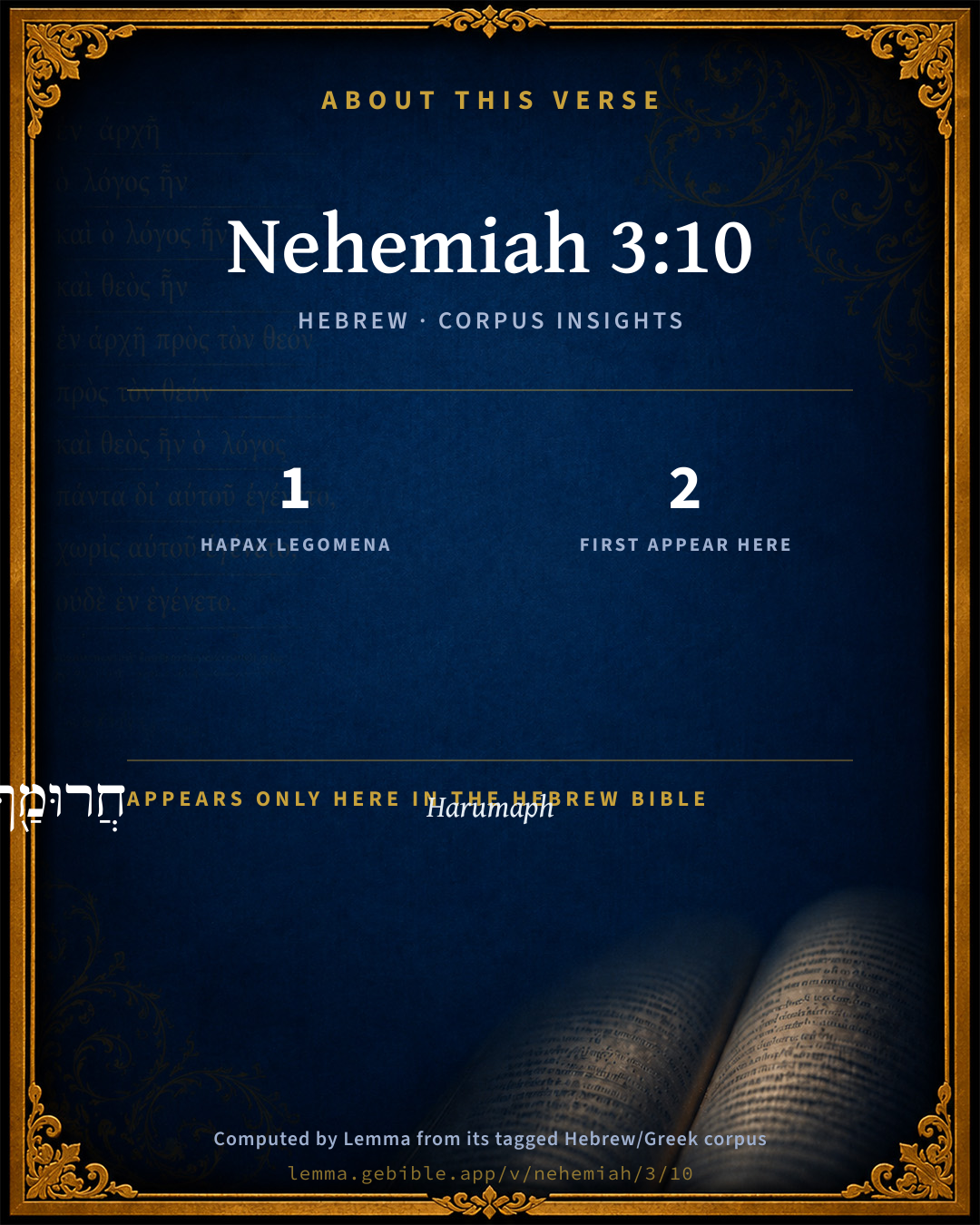
  • 1 hapax legomenon — only here in the Hebrew Bible
  • 2 first appearances in the Hebrew Bible
Full analysis ↓
Download a study sheet

One document with this verse’s original text, its word-by-word gloss line, the meaning frame, cross-references with their text, attributed commentary, and full source and license credits — printable, and it pastes into notes with its structure intact.

This verse Autodidact and up

Study sheet (.html) Plain text (.txt)

A passage Seminary Student

Up to 50 verses in one chapter. A passage sheet keeps up to 6 commentary sources and 12 cross-references per verse, in the order this page ranks them, and says so on the sheet whenever that leaves anything out. Ask for a single verse and you get the Autodidact verse sheet above.

Everything on this page stays free to read, with no account — the sheet is a download of what is already on screen, not access to it.

Want to remove ads? Support Godless Engineer
Compare translations 3

The same verse in 3 English versions, stacked beneath the original-language interlinear above. Click any original word for its lexicon entry.

Each is an independent rendering of the whole verse — the interlinear is not word-aligned to these translations.

Highlighted words mark where these versions differ — a whole-verse word diff, not a word-by-word alignment.

  • World English Bible Public Domain
    Next to them repaired Jedaiah the son of Harumaph, over against his house. Next to him repaired Hattush the son of Hashabneiah.
  • King James Version Public Domain
    And next unto them repaired Jedaiah the son of Harumaph, even over against his house. And next unto him repaired Hattush the son of Hashabniah.
  • unfoldingWord Literal Text CC BY-SA 4.0
    And Jedaiah the son of Harumaph strengthened at their hand, even in front of his house. And Hattush the son of Hashabneiah strengthened at his hand.

unfoldingWord Literal Text — © unfoldingWord, licensed CC BY-SA 4.0. Word-aligned USFM3 via Door43 (git.door43.org/unfoldingWord/en_ult).

Versions to compare (up to 4)

3 of 4 selected

Show all 18 translations

Every available English version of this verse, each an independent rendering of the whole verse.

  • World English Bible Public Domain
    Next to them repaired Jedaiah the son of Harumaph, over against his house. Next to him repaired Hattush the son of Hashabneiah.
  • Berean Standard Bible Public Domain
    next to him, Jedaiah son of Harumaph made repairs across from his house; and next to him, Hattush son of Hashabneiah made repairs.
  • Majority Standard Bible Public Domain
    next to him, Jedaiah son of Harumaph made repairs across from his house; and next to him, Hattush son of Hashabneiah made repairs.
  • King James Version Public Domain
    And next unto them repaired Jedaiah the son of Harumaph, even over against his house. And next unto him repaired Hattush the son of Hashabniah.
  • American Standard Version (1901) Public Domain
    And next unto them repaired Jedaiah the son of Harumaph, over against his house. And next unto him repaired Hattush the son of Hashabneiah.
  • Revised Version (1885) Public Domain
    And next unto them repaired Jedaiah the son of Harumaph, even over against his house. And next unto him repaired Hattush the son of Hashabneiah.
  • Geneva Bible (1599) Public Domain
    And next vnto him fortified Iedaiah the sonne of Harumaph, euen ouer against his house: and next vnto him fortified Hattush, the sonne of Hashabniah.
  • Douay-Rheims (1899) Public Domain
    And next to him Jedaia the son of Haromaph over against his own house: and next to him built Hattus the son of Hasebonia.
  • Young's Literal Translation Public Domain
    And by their hand hath Jedaiah son of Harumaph strengthened, and over-against his own house; and by his hand hath Hattush son of Hashabniah strengthened.
  • Literal Standard Version CC BY-SA 4.0
    And by their hand Jedaiah son of Harumaph has strengthened, and opposite his own house; and by his hand Hattush son of Hashabniah has strengthened.
  • Unlocked Literal Bible CC BY-SA 4.0
    Next to them Jedaiah son of Harumaph repaired next to his house. Next to him Hattush son of Hashabneiah repaired.
  • unfoldingWord Literal Text CC BY-SA 4.0
    And Jedaiah the son of Harumaph strengthened at their hand, even in front of his house. And Hattush the son of Hashabneiah strengthened at his hand.
  • Darby Bible Public Domain
    And next to them repaired Jedaiah the son of Harumaph, even over against his house. And next to him repaired Hattush the son of Hashabniah.
  • World Messianic Bible Public Domain
    Next to them, Jedaiah the son of Harumaph made repairs across from his house. Next to him, Hattush the son of Hashabneiah made repairs.
  • Webster's Bible Public Domain
    And next to them repaired Jedaiah the son of Harumaph, even over against his house. And next to him repaired Hattush the son of Hashabniah.
  • Free Bible Version CC BY-SA 4.0
    Next was Jedaiah, son of Harumaph, who made repairs opposite his house. Next was Hattush, son of Hashabneiah.
  • Bible in Basic English Public Domain
    By his side was Jedaiah, the son of Harumaph, opposite his house. And by him was Hattush, the son of Hashabneiah.
  • JPS Tanakh (1917) Public Domain
    And next unto them repaired Jedaiah the son of Harumaph, even over against his house. And next unto him repaired Hattush the son of Hashabneiah.

Literal Standard Version (2020), Covenant Press — licensed CC BY-SA 4.0. Text via the HelloAO Bible API (eBible.org). Unlocked Literal Bible (unfoldingWord) — licensed CC BY-SA 4.0. Text via the HelloAO Bible API (eBible.org). unfoldingWord Literal Text — © unfoldingWord, licensed CC BY-SA 4.0. Word-aligned USFM3 via Door43 (git.door43.org/unfoldingWord/en_ult). Free Bible Version, Dr. Jonathan Gallagher — licensed CC BY-SA 4.0. Text via the HelloAO Bible API (eBible.org).

Word by word

More ways to search: Search by grammar → Find every occurrence → Compare this word →

Practice this passage: Drill this verse → Learn its vocabulary →

חֲרוּמַ֖ף
chărûwmaph
H2739
“Harumaph”
Noun, Proper
Part of Speech
Noun
Type
Proper
Full BDB Definition

Origin: from pass. participle of H2763 and H639

TWOT: None

Harumaph = "split nose" - father of Jedaiah, one of the builders of the wall in Nehemiah's time
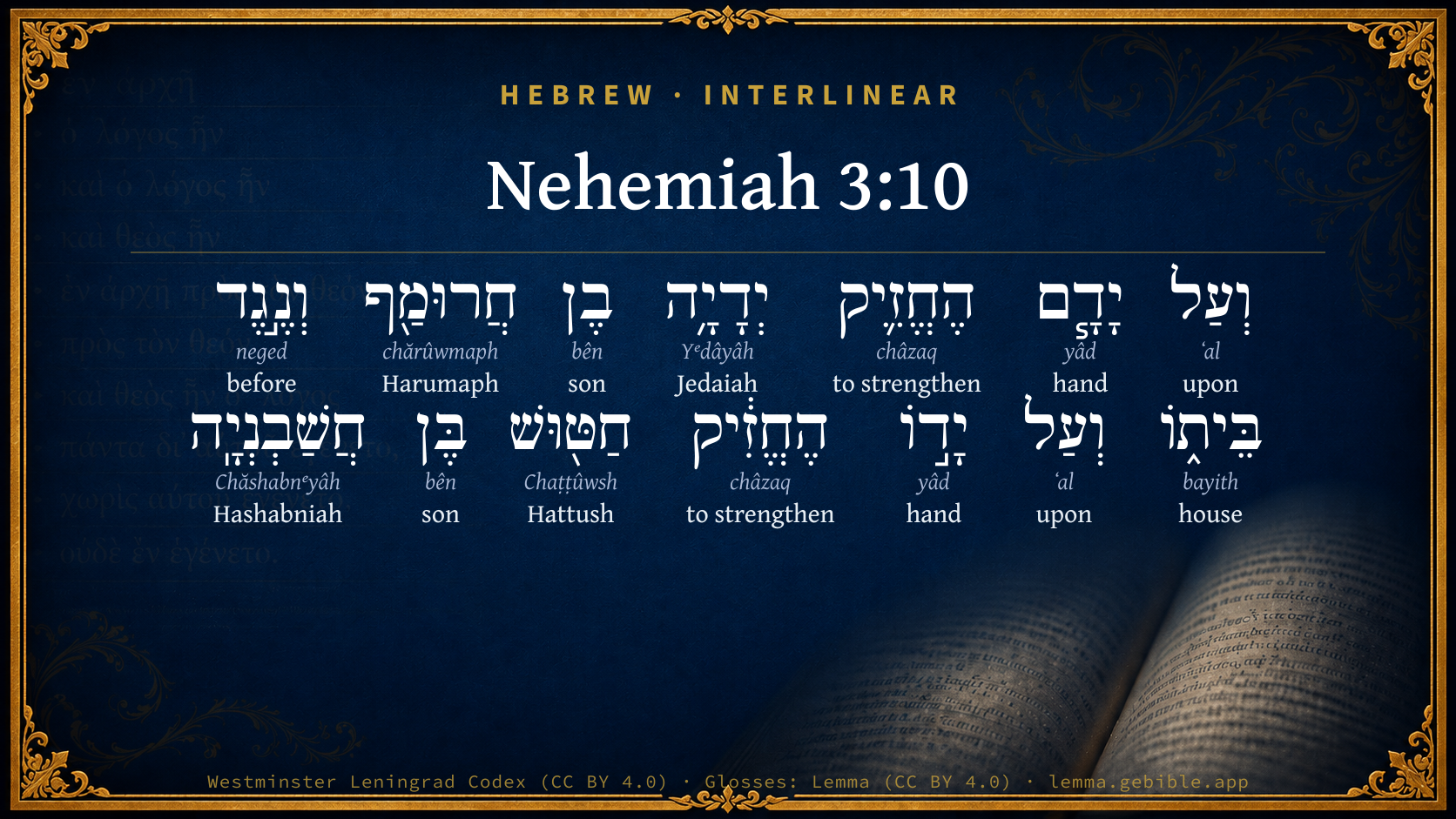
  1. וְעַל ʻal H5921 “and · upon” Conjunction + Preposition
  2. יָדָ֧ם yâd H3027 “hand · their” Noun, Common, Both, Singular, Construct + Suffix, Personal, 3rd Person, Masculine, Plural
  3. הֶחֱזִ֛יק châzaq H2388 “to strengthen” Verb, Hiphil, Perfect, 3rd Person, Masculine, Singular
  4. יְדָיָ֥ה Yᵉdâyâh H3042 “Jedaiah” Noun, Proper
  5. בֶן bên H1121 “son of” Noun, Common, Masculine, Singular, Construct
  6. וְנֶ֣גֶד neged H5048 “and · before” Conjunction + Preposition
  7. בֵּית֑וֹ bayith H1004 “house · his” Noun, Common, Masculine, Singular, Construct + Suffix, Personal, 3rd Person, Masculine, Singular
  8. וְעַל ʻal H5921 “and · upon” Conjunction + Preposition
  9. יָד֣וֹ yâd H3027 “hand · his” Noun, Common, Both, Singular, Construct + Suffix, Personal, 3rd Person, Masculine, Singular
  10. הֶחֱזִ֔יק châzaq H2388 “to strengthen” Verb, Hiphil, Perfect, 3rd Person, Masculine, Singular
  11. חַטּ֖וּשׁ Chaṭṭûwsh H2407 “Hattush” Noun, Proper
  12. בֶּן bên H1121 “son of” Noun, Common, Masculine, Singular, Construct
  13. חֲשַׁבְנְיָֽה Chăshabnᵉyâh H2813 “Hashabniah” Noun, Proper

About this verse

These counts appear in no published source. They are computed here, from the morphology-tagged text and Lemma’s own curated glosses. What Lemma adds →

14
words
10
distinct lemmas
Historical
section

Notable vocabulary

1 hapax legomenon — a word that appears only here in the entire Hebrew Bible:

  • חֲרוּמַ֖ף Harumaph H2739

First appearance in Scripture

These words make their first canonical appearance in the Hebrew Bible here:

  • חֲרוּמַ֖ף Harumaph H2739
  • חֲשַׁבְנְיָֽה Hashabniah H2813

Shared distinctive vocabulary

יְדָיָ֥ה Jedaiah H3042 occurs in 2 verses of the Hebrew Bible. Also found in:

Grammatical profile

  • 2 verbs
  • 9 nouns
  • 3 prepositions

Verb forms

  • הֶחֱזִ֛יק Hiphil · Perfect
  • הֶחֱזִ֔יק Hiphil · Perfect

Repetition

Words recur within this verse — often emphatic in Hebrew:

  • וְעַל upon H5921 ×2
  • יָדָ֧ם hand H3027 ×2
  • הֶחֱזִ֛יק to strengthen H2388 ×2
  • בֶן son H1121 ×2

Cross-references

3

Topical passages linked to Nehemiah 3:10 in the Treasury of Scripture Knowledge — connected by theme and wording, ordered by reader-vote popularity; previews shown in the World English Bible.

  • Nehemiah 3:23 After them repaired Benjamin and Hasshub over against their house. After them repaired Azariah the son of Maaseiah the son of Ananiah beside his own house.
  • Nehemiah 3:28–30 Above the horse gate repaired the priests, everyone over against his own house.
  • Nehemiah 10:4 Hattush, Shebaniah, Malluch,

Cross-references courtesy of OpenBible.info (CC BY 4.0).

Hebrew and Greek witnesses Masoretic Hebrew ↔ Greek Septuagint

The same verse in the two great witnesses to the Old Testament, shown verse-for-verse.

These are two independent witnesses, not word-aligned to each other, and the Septuagint is shown in lemma (dictionary) form.

Hebrew Nehemiah 3:10 Masoretic · Westminster Leningrad Codex

וְעַל יָדָ֧ם הֶחֱזִ֛יק יְדָיָ֥ה בֶן חֲרוּמַ֖ף וְנֶ֣גֶד בֵּית֑וֹ וְעַל יָד֣וֹ הֶחֱזִ֔יק חַטּ֖וּשׁ בֶּן חֲשַׁבְנְיָֽה

Next to them repaired Jedaiah the son of Harumaph, over against his house. Next to him repaired Hattush the son of Hashabneiah.

World English Bible · Public Domain

Greek LXX Structure differs

The Septuagint has no separate book of Nehemiah. Its Greek text is the second half of Esdras B (2 Esdras), chapters 11–23; Ezra is the first half (1–10).

A verse-for-verse comparison isn’t shown here because the chapters and verses don’t line up. Switch to the LXX edition with the MT / LXX toggle above to read the Greek directly.

Hebrew: Westminster Leningrad Codex (CC BY 4.0). Greek: Septuagint (public domain); English from a public-domain English Septuagint. How the Septuagint differs from the Hebrew →

Commentary

Notes on Nehemiah 3:10 from classic Christian and Jewish commentators (each source and its license shown beneath its notes). The classic Christian expositions comment on the surrounding passage and are grouped to its opening verse, so a note may address several verses; the Jewish commentaries on the Tanakh (Rashi and others) are per-verse, so they appear only where the commentator wrote on this verse.

Lemma curates 59 commentaries, every one of them public domain or Creative Commons licensed, each selected and text-cleaned for this edition rather than reprinted as found. About our sources →

Trapp's Complete Commentary

John Trapp

Neh 3:10 And next unto them repaired Jedaiah the son of Harumaph, even over against his house. And next unto him repaired Hattush the son of Hashabniah.

Ver. 10. Even over against his house] Thither he was assigned, probably, because there he would build the stronger, for his own security.

John Trapp, A Commentary or Exposition upon All the Books of the Old and New Testament (1647–1656) — public domain. Text from a community e-Sword module.

The Biblical Illustrator

Joseph S. Exell

Neh_3:10

Even over against his house.

Repairing the house

We are all temples, buildings of the living God, and some of us are sadly out of repair; some among us have fallen into absolute ruin. Our bodies, instead of being the sanctuary of the Holy Spirit, are inhabited by evil lusts, cruel tempers, foul passions. Others, although not in such a sad case, are yet grievously out of repair. There is much in their lives which needs altering, mending. Our own carelessness and neglect have allowed our lives to fall into decay, and the rubbish to accumulate. A restored congregation is ever more important than the restored fabric of the church. Let Nehemiah teach us how these repairs can best be carried out.

1. In the first place, before he undertook the work at all, Nehemiah prayed unto the God of heaven--Lord, undertake for me. Unless the Lord build the house, their labour is but lost that build it. We must ask God to restore in us all that the fraud and malice of the devil have decayed in us.

2. The next thing which Nehemiah did, after praying to God, was to set to work, and to set others to work, at repairs. Work and prayer must go together; pray most earnestly, work with a will.

3. Nehemiah made each worker wear a sword by his side, because of the enemies around them who would try to hinder them. That teaches us that whatever our work may be, we must have our religion with us. We must have the sword of the Spirit beside us. Our enemies--the world, the flesh, and the devil--are sure to attack us, and woe unto us if we are unarmed! There was a drummer-boy in the great American war who lost his Bible, a book which he valued above all things. So he set to work to repair his loss as far as possible. He remembered many texts which he had learnt at Sunday-school, and these he wrote on the parchment of his drum. Thus, on the march, in the field of battle, or wherever he did his work, Gods Word was before his eyes. Like Nehemiahs builders, he had the sword by his side. Before the work of repairs actually began, Nehemiah made a careful examination of the state of the ruins, that he might know exactly what was wanted. Let us survey the ruins, the breaches in the walls, the rubbish that has accumulated, the weak points in the building.

And where shall we begin?

1. For the most part, he set each of his workers to repair over against his own house. In trying to repair the mistakes and faults and failures of our lives, let us begin over against our own house. Let us survey the ruins there, not those of our neighbour. Mending our own ways is the surest and best plan to fit us to help others to repair theirs. Let us look boldly into the neglected corners of our life, and see what repairs are needed.

2. Let us examine the ruins again; is there no need of repairs in our business life? Is our way of doing our work, whatever it is, quite satisfactory, quite true, and honest, and straightforward?

3. Then is there no need of repairs in the home circle, remembering that we must begin over against our own house? The children are often unruly, selfish, troublesome. The servants are frequently a source of discomfort. One husband sees much need of repairs in his wife. The wife says the same of the husband. Well, let us begin over against our own house. Are we doing our best to set a good example in the family?

4. Is there no need of repairs in our praying? I think many of us feel that our prayers are sometimes neglected, often hurried, formal, cold, unreal. Then there is Bible-reading. Some of us neglect this altogether, others read without interest or under-standing. Is there not something to be mended here? (H. J. Wilmot Buxton, M. A.)

Building over against ones own house

This suggests--

I. The care of ones own soul. Is it saved? Is it prospering?

II. A deep interest in the spiritual welfare of those who live under the same roof.

III. Labour for the salvation of all who in the providence of God are brought into close or frequent relations with us. (W. P. Lockhart.)

Work at each door

The principle on which a great part of the work was done is indicated in several places in this chapter. Charles Reade says: This may seem a small thing to busy readers, but it was a master stroke of genius. Not only was it a grand division of labour, but it animated the work with a noble emulation and a personal pride. Nehemiah made use of a method which is generally regarded as an outgrowth of our modern civilisation, and anticipated the managers of our great industries in the use of the principle of division of labour, which in our day is carried to so great a length. Every man over against his own house is the principle that should be applied in all work for the moral and spiritual elevation of the community in which we live.

I. There is work to be done at our very doors. There is still plenty of work to be done in our own hearts. The best wall we can build for the protection of our own homes is the structure of a Christlike life. It is as real a defence to our homes to have them surrounded by pure-hearted men and women as was to Jerusalem the wall that Nehemiah raised. The reason that so many missionaries send their children is not always for the sake of the superior education to be had in our schools, but oftener, perhaps, because it would not be safe to allow their children to grow up in the midst of the moral miasma of a heathen land. In the ruined characters and worse than wasted lives of many of the men and women among whom we live, we see the broken wall, and the work of repair consists in the efforts we make to Christianise them. Here there is, work at every ones door.

II. Each man is responsible for the bit of work that lies nearest to his own house. A minister is placed over a congregation, not to do the peoples work for them, but to induce each of them to do the work that God has laid at the door for each to do. I know a successful minister who attributes much of his success to the fact that he will not do anything himself that he can get one of his people to do. (A. Soutar, M. A.)

The Biblical Illustrator, edited by Joseph S. Exell (c. 1880s–1900s) — public domain. Text from a community e-Sword module.

The Cambridge Bible for Schools and Colleges

gen. ed. J. J. S. Perowne

10. And next unto them] i.e. next unto those who were represented by Rephaiah.

Hattush …] Possibly a priest belonging to the family of this name mentioned in Neh_10:4, or a Levite the son of the Hashabneiah mentioned in Neh_9:5.

Hashabniah] R.V. Hashabneiah.

The Cambridge Bible for Schools and Colleges (gen. ed. J. J. S. Perowne; Cambridge University Press, 1878–1918) — public domain. Text from a community e-Sword module.

John Gill's Exposition

Malchijah the son of Harim, and Hashub the son of Pahathmoab,.... The fathers of these were heads of families that came out of captivity with Zerubbabel, Ezr 2:6

repaired the other piece: or second piece, below and next to that which Hattush repaired, the last builder mentioned:

and the tower of the furnaces; near to which were furnaces for the baking of bread, or of bricks.

John Gill's Exposition of the Whole Bible (1746–1763) — public domain (CC PDM 1.0). Text via the HelloAO Bible API.

Haydock's Catholic Bible Commentary

House. Thus he would be induced to do the work more perfectly. (Menochius)

George Leo Haydock (1774–1849), Haydock's Catholic Family Bible and Commentary, 1859 edition — public domain. Excludes Psalms (Douay-Rheims chapter numbering differs from Protestant) and Deuterocanonical books (Catholic canon only).

Matthew Poole's English Annotations

Over against his house; that part of the wall which was next to him, which his own interest obliged him to do with care.

Matthew Poole's English Annotations on the Holy Bible (1683–1685) — public domain. Text from a community e-Sword/MySword module.

Whedon's Commentary on the Bible

Daniel D. Whedon

10. Over against his house — Or opposite to his house. His house probably stood near to this part of the wall.

Daniel D. Whedon (gen. ed.), Commentary on the Old and New Testaments (1874–1909) — public domain. Text from a community e-Sword module.

Rashi

Rabbi Shlomo Yitzchaki (Rashi)

and opposite his house his lot fell to build, for his house was near that place of the wall of the city.

Rashi on the Tanakh — English translations: “The Judaica Press complete Tanach with Rashi, translated by A. J. Rosenberg” (CC BY 4.0); “Pentateuch with Rashi's commentary by M. Rosenbaum and A.M. Silbermann, 1929-1934” (public domain); “The Metsudah Tanach series, Lakewood, N.J” (CC BY 4.0); and “The Book of Joshua, Metsudah Publications, 1997” (CC BY 4.0). Text via Sefaria.

Lesson kit

Teaching starters — assembled from the data on this page, not authored interpretation. Every prompt links to the verse data it draws on. Edit before teaching.

Nehemiah, in the Historical, opens this verse with 14 words (10 distinct Hebrew lemmas). Its most distinctive word is chărûwmaph (“Harumaph”). A historical commentator’s framing appears above. Read the whole chapter for the surrounding context.

Discussion questions

  1. How does “Harumaph” (chărûwmaph) shape what this verse is saying?
  2. 1 word here appears nowhere else in the Hebrew Bible. Why might the author reach for such rare wording?
  3. 2 words make their first appearance in Scripture here. What does this debut establish?
  4. How does 1 Chronicles 4:37, which shares the word «Jedaiah», read alongside this verse?
  5. What does the repetition of “upon” (2× in this one verse) do in this verse?
  6. The translations on this page render this verse differently — a whole-verse word diff, not a word-by-word alignment. What might account for the different wordings?
  7. «הֶחֱזִ֛יק» is a Hiphil Perfect verb. How does that grammatical form shape the action described?
  8. Compare how Trapp's Complete Commentary and The Biblical Illustrator read this verse. Where do they agree or differ?

Things to notice

  • 1 word in this verse appears nowhere else in the Hebrew Bible.
  • 2 words make their first canonical appearance in Scripture here.
  • These translations choose different wording for 11 words in this verse.
  • “upon” occurs 2× in this single verse.
  • 10 distinct Hebrew lemmas span 14 words in this verse.

Reading settings

Reading text

Shown beneath each verse's original-language words.

Old Testament
Old Testament edition

Read the OT as the Masoretic Hebrew (MT) or the Greek Septuagint (LXX).

English shown for the Greek Septuagint (in the Hebrew ↔ Greek comparison).

Comparing translations? Open the Compare panel on any verse page to stack up to four side by side.