Exodus 7:22

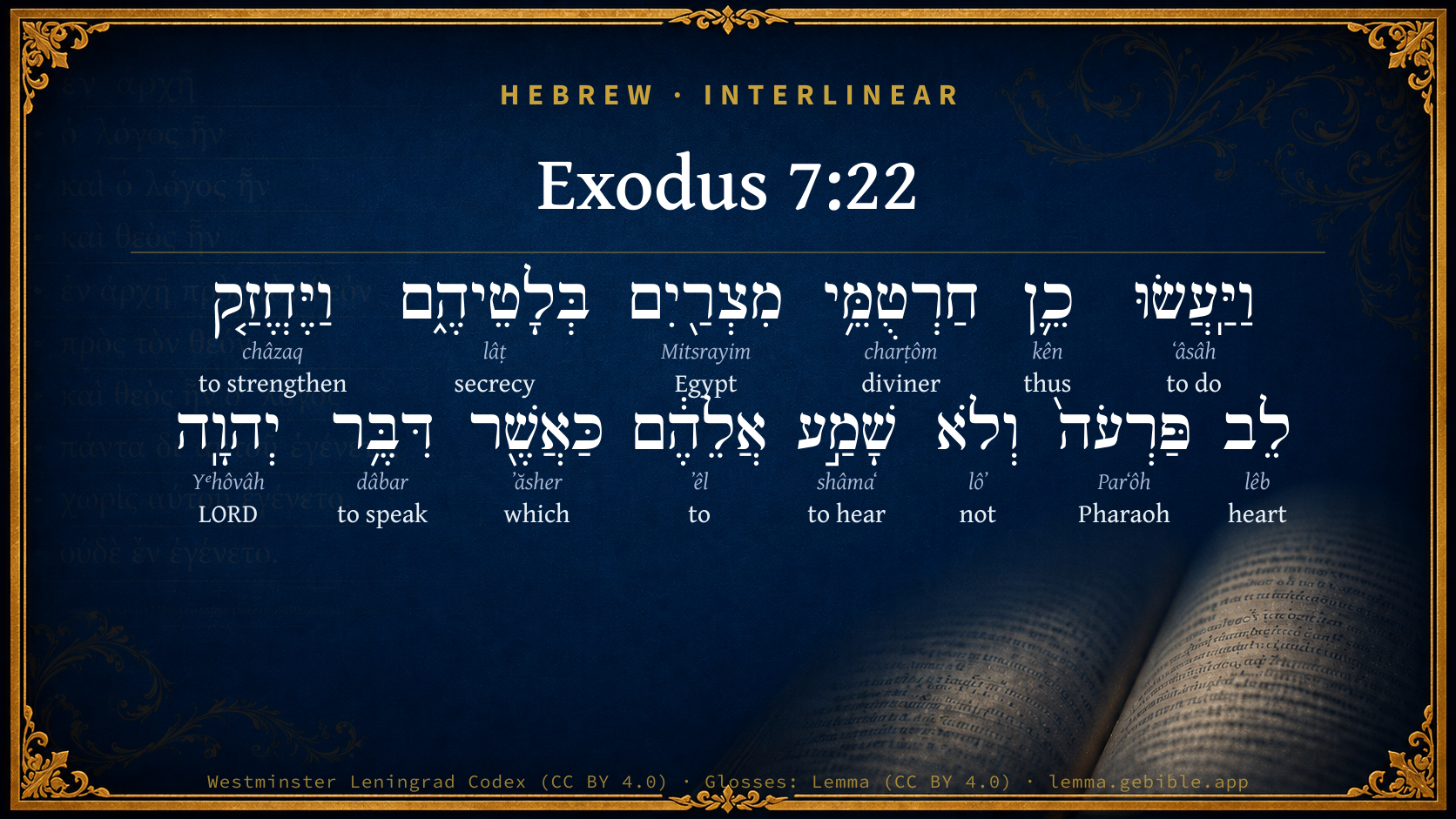
Hebrew (Westminster Leningrad Codex) Exodus 7:22 appears in the Hebrew Old Testament. The text above is from the Westminster Leningrad Codex. Each word links to its Strong’s number, a concise gloss, and parsing drawn from the Open Scriptures Hebrew Bible morphology. Click any word for its full Brown-Driver-Briggs (BDB) entry.
Download image
Cite this verse

Exodus 7:22 (World English Bible). Public Domain. Lemma interlinear Bible study tool, https://lemma.gebible.app/v/exodus/7/22.

Show BibTeX & RIS
BibTeX
RIS
English Translation
The magicians of Egypt did in like manner with their enchantments; and Pharaoh's heart was hardened, and he didn't listen to them; as Yahweh had spoken.
World English Bible · Public Domain
Highlights
  • 1 first appearance in the Hebrew Bible
Full analysis ↓
Download a study sheet

One document with this verse’s original text, its word-by-word gloss line, the meaning frame, cross-references with their text, attributed commentary, and full source and license credits — printable, and it pastes into notes with its structure intact.

This verse Autodidact and up

Study sheet (.html) Plain text (.txt)

A passage Seminary Student

Up to 50 verses in one chapter. A passage sheet keeps up to 6 commentary sources and 12 cross-references per verse, in the order this page ranks them, and says so on the sheet whenever that leaves anything out. Ask for a single verse and you get the Autodidact verse sheet above.

Everything on this page stays free to read, with no account — the sheet is a download of what is already on screen, not access to it.

Want to remove ads? Support Godless Engineer
Compare translations 3

The same verse in 3 English versions, stacked beneath the original-language interlinear above. Click any original word for its lexicon entry.

Each is an independent rendering of the whole verse — the interlinear is not word-aligned to these translations.

Highlighted words mark where these versions differ — a whole-verse word diff, not a word-by-word alignment.

  • World English Bible Public Domain
    The magicians of Egypt did in like manner with their enchantments; and Pharaoh's heart was hardened, and he didn't listen to them; as Yahweh had spoken.
  • King James Version Public Domain
    And the magicians of Egypt did so with their enchantments: and Pharaoh's heart was hardened, neither did he hearken unto them; as the LORD had said.
  • unfoldingWord Literal Text CC BY-SA 4.0
    And the magicians of Egypt did the same with their magic. And the heart of Pharaoh was strong, and he did not listen to them, just as Yahweh had spoken.

unfoldingWord Literal Text — © unfoldingWord, licensed CC BY-SA 4.0. Word-aligned USFM3 via Door43 (git.door43.org/unfoldingWord/en_ult).

Versions to compare (up to 4)

3 of 4 selected

Show all 18 translations

Every available English version of this verse, each an independent rendering of the whole verse.

  • World English Bible Public Domain
    The magicians of Egypt did in like manner with their enchantments; and Pharaoh's heart was hardened, and he didn't listen to them; as Yahweh had spoken.
  • Berean Standard Bible Public Domain
    But the magicians of Egypt did the same things by their magic arts. So Pharaoh’s heart was hardened, and he would not listen to Moses and Aaron, just as the LORD had said.
  • Majority Standard Bible Public Domain
    But the magicians of Egypt did the same things by their magic arts. So Pharaoh’s heart was hardened, and he would not listen to Moses and Aaron, just as the LORD had said.
  • King James Version Public Domain
    And the magicians of Egypt did so with their enchantments: and Pharaoh's heart was hardened, neither did he hearken unto them; as the LORD had said.
  • American Standard Version (1901) Public Domain
    And the magicians of Egypt did in like manner with their enchantments: and Pharaoh's heart was hardened, and he hearkened not unto them; as Jehovah had spoken.
  • Revised Version (1885) Public Domain
    And the magicians of Egypt did in like manner with their enchantments: and Pharaoh’s heart was hardened, and he hearkened not unto them; as the LORD had spoken.
  • Geneva Bible (1599) Public Domain
    And the enchanters of Egypt did likewise with their sorceries: and the heart of Phraoh was hardened: so that he did not hearken vnto them, as the Lord had sayde.
  • Douay-Rheims (1899) Public Domain
    And the magicians of the Egyptians with their enchantments did in like manner: and Pharao's heart was hardened, neither did he hear them, as the Lord had commanded.
  • Young's Literal Translation Public Domain
    And the scribes of Egypt do so with their flashings, and the heart of Pharaoh is strong, and he hath not hearkened unto them, as Jehovah hath spoken,
  • Literal Standard Version CC BY-SA 4.0
    And the enchanters of Egypt do so with their secrets, and the heart of Pharaoh is strong, and he has not listened to them, as YHWH has spoken,
  • Unlocked Literal Bible CC BY-SA 4.0
    But the magicians of Egypt did the same thing with their magic. So Pharaoh's heart was hardened, and he refused to listen to Moses and Aaron, just as Yahweh had said would happen.
  • unfoldingWord Literal Text CC BY-SA 4.0
    And the magicians of Egypt did the same with their magic. And the heart of Pharaoh was strong, and he did not listen to them, just as Yahweh had spoken.
  • Darby Bible Public Domain
    And the scribes of Egypt did so with their sorceries; and Pharaoh's heart was stubborn, neither did he hearken to them, as Jehovah had said.
  • World Messianic Bible Public Domain
    The magicians of Egypt did the same thing with their enchantments. So Pharaoh’s heart was hardened, and he didn’t listen to them, as the LORD had spoken.
  • Webster's Bible Public Domain
    And the magicians of Egypt did so with their enchantments: and Pharaoh's heart was hardened, neither did he hearken to them; as the LORD had said.
  • Free Bible Version CC BY-SA 4.0
    But the Egyptian magicians did the same thing using their magic arts. Pharaoh maintained his stubborn attitude and he wouldn't listen to Moses and Aaron, just as the Lord had predicted.
  • Bible in Basic English Public Domain
    And the wonder-workers of Egypt did the same with their secret arts: but Pharaoh's heart was made hard, and he would not give ear to them, as the Lord had said.
  • JPS Tanakh (1917) Public Domain
    And the magicians of Egypt did in like manner with their secret arts; and Pharaoh's heart was hardened, and he hearkened not unto them; as the LORD had spoken.

Literal Standard Version (2020), Covenant Press — licensed CC BY-SA 4.0. Text via the HelloAO Bible API (eBible.org). Unlocked Literal Bible (unfoldingWord) — licensed CC BY-SA 4.0. Text via the HelloAO Bible API (eBible.org). unfoldingWord Literal Text — © unfoldingWord, licensed CC BY-SA 4.0. Word-aligned USFM3 via Door43 (git.door43.org/unfoldingWord/en_ult). Free Bible Version, Dr. Jonathan Gallagher — licensed CC BY-SA 4.0. Text via the HelloAO Bible API (eBible.org).

Word by word

More ways to search: Search by grammar → Find every occurrence → Compare this word →

Practice this passage: Drill this verse → Learn its vocabulary →

בְּלָטֵיהֶ֑ם
lâṭ
H3909
“in/at · enchantments · their”
Preposition + Noun, Common, Masculine, Plural, Construct + Suffix, Personal, 3rd Person, Masculine, Plural
Part of Speech
Preposition + Noun
Type
Common
Gender
Masculine
Number
Plural
State
Construct
Full BDB Definition

Origin: a form of H3814 or else participle from H3874

TWOT: 1092a

secrecy, mystery, enchantment - secrecy, secretly - mystery, enchantment
  1. וַיַּֽעֲשׂוּ ʻâsâh H6213 “and · to do” Conjunction + Verb, Qal, Sequential Imperfect, 3rd Person, Masculine, Plural
  2. כֵ֛ן kên H3651 “thus” Adverb
  3. חַרְטֻמֵּ֥י charṭôm H2748 “diviners of” Noun, Common, Masculine, Plural, Construct
  4. מִצְרַ֖יִם Mitsrayim H4714 “Egypt” Noun, Proper
  5. וַיֶּחֱזַ֤ק châzaq H2388 “and · to strengthen” Conjunction + Verb, Qal, Sequential Imperfect, 3rd Person, Masculine, Singular
  6. לֵב lêb H3820 “heart of” Noun, Common, Masculine, Singular, Construct
  7. פַּרְעֹה֙ Parʻôh H6547 “Pharaoh” Noun, Proper
  8. וְלֹא lôʼ H3808 “and · not” Conjunction + Particle, Negative
  9. שָׁמַ֣ע shâmaʻ H8085 “to hear” Verb, Qal, Perfect, 3rd Person, Masculine, Singular
  10. אֲלֵהֶ֔ם ʼêl H413 “to · them” Preposition + Suffix, Personal, 3rd Person, Masculine, Plural
  11. כַּאֲשֶׁ֖ר ʼăsher H834 “like/as · which” Preposition + Particle, Relative
  12. דִּבֶּ֥ר dâbar H1696 “to speak” Verb, Piel, Perfect, 3rd Person, Masculine, Singular
  13. יְהוָֽה Yᵉhôvâh H3068 “LORD” Noun, Proper

About this verse

These counts appear in no published source. They are computed here, from the morphology-tagged text and Lemma’s own curated glosses. What Lemma adds →

14
words
14
distinct lemmas
Pentateuch
section

Notable vocabulary

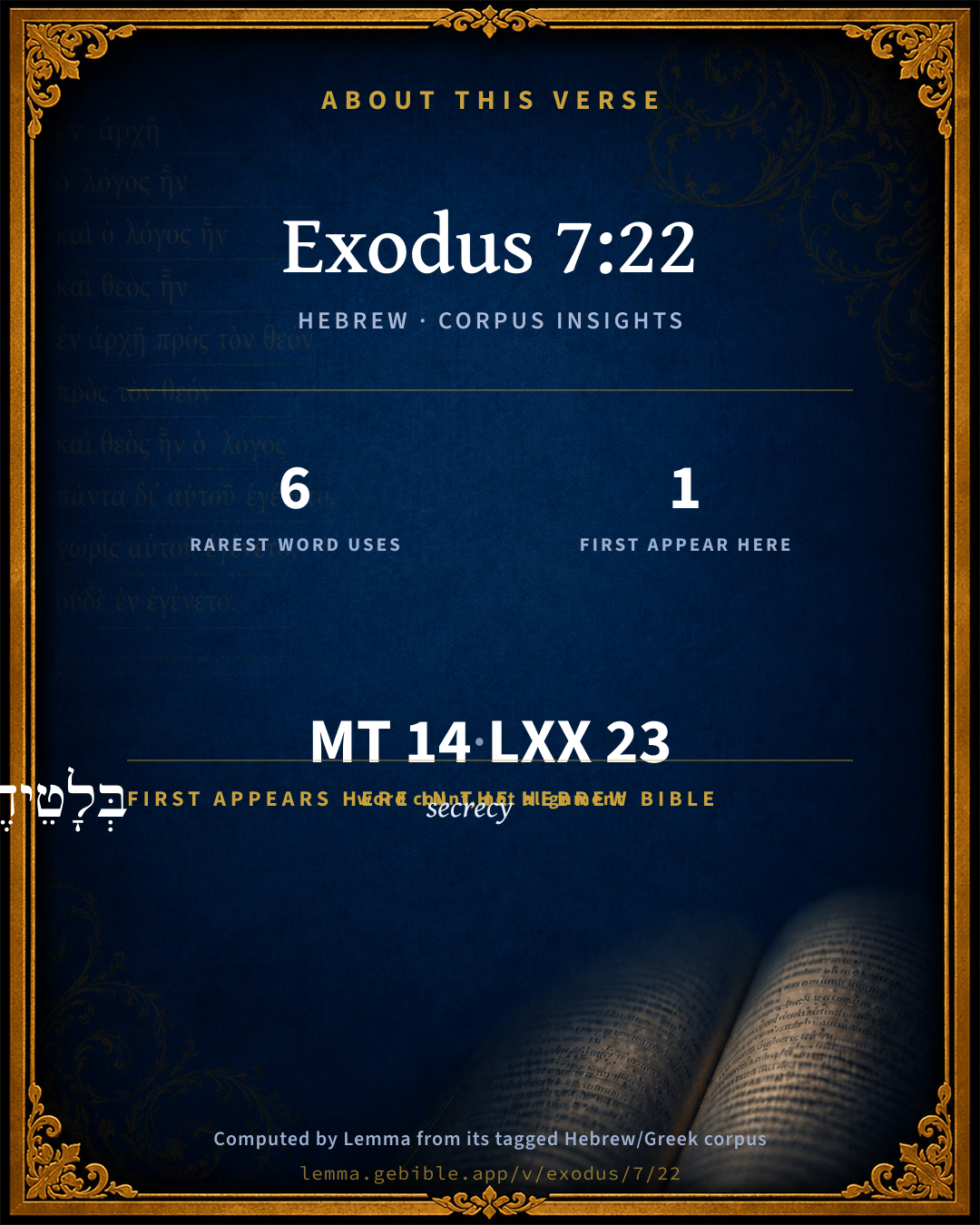
The rarest word here is בְּלָטֵיהֶ֑ם secrecy H3909 — appearing just 6 times in the whole Hebrew Bible.

First appearance in Scripture

This word makes its first canonical appearance in the Hebrew Bible here:

  • בְּלָטֵיהֶ֑ם secrecy H3909

Shared distinctive vocabulary

בְּלָטֵיהֶ֑ם secrecy H3909 occurs in 6 verses of the Hebrew Bible. Also found in:

Grammatical profile

  • 4 verbs
  • 6 nouns
  • 1 preposition
  • 1 adverb
  • 2 particles

Verb forms

  • וַיַּֽעֲשׂוּ Qal · Sequential Imperfect
  • וַיֶּחֱזַ֤ק Qal · Sequential Imperfect
  • שָׁמַ֣ע Qal · Perfect
  • דִּבֶּ֥ר Piel · Perfect

Hebrew & Septuagint length

In English translation the verse runs 26 words from the Hebrew and 31 from the Septuagint (LXX English) — closely comparable.

A rough comparison of the two English renderings, which tokenize alike — not a word-level alignment.

Word counts can differ between the Hebrew and the Greek without any difference in meaning — e.g. the Hebrew direct-object marker אֵת has no separate Greek word, and Greek often adds the article ὁ.

In the original languages it is 14 Hebrew tokens and 23 Greek tokens — but the two are counted differently (Hebrew bundles its prefixes and suffixes into one token; the Greek is in lemma form), so that isn’t a like-for-like length.

Cross-references

4

Topical passages linked to Exodus 7:22 in the Treasury of Scripture Knowledge — connected by theme and wording, ordered by reader-vote popularity; previews shown in the World English Bible.

  • Exodus 7:11 Then Pharaoh also called for the wise men and the sorcerers. They also, the magicians of Egypt, did in like manner with their enchantments.
  • Exodus 8:7–8 The magicians did in like manner with their enchantments, and brought up frogs on the land of Egypt.
  • Jeremiah 27:18 But if they be prophets, and if the word of Yahweh be with them, let them now make intercession to Yahweh of Hosts, that the vessels which are left in the house of Yahweh, and in the house of the king of Judah, and at Jerusalem, don't go to Babylon.
  • 2 Timothy 3:8 Even as Jannes and Jambres opposed Moses, so do these also oppose the truth; men corrupted in mind, reprobate concerning the faith.

Cross-references courtesy of OpenBible.info (CC BY 4.0).

Hebrew and Greek witnesses Masoretic Hebrew ↔ Greek Septuagint

The same verse in the two great witnesses to the Old Testament, shown verse-for-verse.

These are two independent witnesses, not word-aligned to each other, and the Septuagint is shown in lemma (dictionary) form.

Hebrew Exodus 7:22 Masoretic · Westminster Leningrad Codex

וַיַּֽעֲשׂוּ כֵ֛ן חַרְטֻמֵּ֥י מִצְרַ֖יִם בְּלָטֵיהֶ֑ם וַיֶּחֱזַ֤ק לֵב פַּרְעֹה֙ וְלֹא שָׁמַ֣ע אֲלֵהֶ֔ם כַּאֲשֶׁ֖ר דִּבֶּ֥ר יְהוָֽה

The magicians of Egypt did in like manner with their enchantments; and Pharaoh's heart was hardened, and he didn't listen to them; as Yahweh had spoken.

World English Bible · Public Domain

Greek LXX Exodus 7:22 Septuagint · lemma form

ποιέω δέ ὡσαύτως καί ὁ ἐπαοιδός ὁ αἰγύπτιος ὁ φαρμακία αὐτός καί σκληρύνω ὁ καρδία φαραώ καί οὐ εἰςἀκούω αὐτός καθάπερ εἶπον κύριος

And the charmers also of the Egyptians did so with their sorceries; and the heart of Pharao was hardened, and he did not listen to them, even as the Lord said.

LXX2012 (modern English Septuagint) · Public Domain

Hebrew: Westminster Leningrad Codex (CC BY 4.0). Greek: Septuagint (public domain); English from LXX2012 (modern English Septuagint) (Public Domain). How the Septuagint differs from the Hebrew →

Targum (Aramaic paraphrase)

2

The Targum is the ancient Jewish Aramaic paraphrase of the Hebrew Scriptures — an interpretive translation, not the Hebrew text itself. Onkelos (literal) and Pseudo-Jonathan (expansive) render the Torah, and Jonathan the Prophets. Coverage is partial: where no permissively-licensed English translation exists for a verse, only the Aramaic is shown. This is verse-level text, not a word-by-word alignment to the Hebrew.

  1. Targum Onkelos Torah (Genesis–Deuteronomy)
    וַעֲבָדוּ כֵן חָרָשֵׁי מִצְרַיִם בְּלַחֲשֵׁיהוֹן וְאִתַּקַף לִבָּא דְפַרְעֹה וְלָא קַבֵּיל מִנְהוֹן כְּמָא דְמַלִיל יְיָ:

    (no public-domain English translation for this verse)

    Targum Onkelos — Aramaic: “Onkelos Genesis” (public domain); “Onkelos Exodus” (public domain); “Onkelos Leviticus” (public domain); “Onkelos Numbers” (public domain); “Onkelos Deuteronomy” (public domain). English: “Sefaria Community Translation” (CC0 1.0 (public-domain dedication)); “J.W. Etheridge. The Targums of Onkelos and Jonathan Ben Uzziel on the Pentateuch. London: Longmans, Green, 1862” (public domain). Text via Sefaria.

  2. Targum Pseudo-Jonathan Torah (Genesis–Deuteronomy)
    וַעֲבָדוּ הֵיכְדֵין אִצְטַגְנִינֵי מִצְרַיִם בְּלַחֲשֵׁיהוֹן וְהָפִיכוּ מִן מַיָא דְגוֹשֶׁן לְאַדְמָא וְאִיתְקֵיף יִצְרָא דְלִבָּא דְפַרְעה וְלָא קַבֵּיל מִנְהוֹן הֵיכְמָא דְמַלֵיל יְיָ

    But so (also) did the astrologers of Mizraim by their burnings, and turned the waters of Goshen into blood. And the design of Pharoh's heart was strengthened, and he would not hearken. to them, as the Lord had said.

    Targum Pseudo-Jonathan — Aramaic: “Targum Jonathan on Genesis” (public domain); “Targum Jonathan on Exodus” (public domain); “Targum Jonathan on Leviticus” (public domain); “Targum Jonathan on Numbers” (public domain); “Targum Jonathan on Deuteronomy” (public domain). English: “The Targum of Jonathan ben Uzziel, trans. J. W. Etheridge, London, 1862” (public domain). Text via Sefaria.

Commentary

Notes on Exodus 7:22 from classic Christian and Jewish commentators (each source and its license shown beneath its notes). The classic Christian expositions comment on the surrounding passage and are grouped to its opening verse, so a note may address several verses; the Jewish commentaries on the Tanakh (Rashi and others) are per-verse, so they appear only where the commentator wrote on this verse.

Lemma curates 59 commentaries, every one of them public domain or Creative Commons licensed, each selected and text-cleaned for this edition rather than reprinted as found. About our sources →

Trapp's Complete Commentary

John Trapp

Exo 7:22 And the magicians of Egypt did so with their enchantments: and Pharaoh’s heart was hardened, neither did he hearken unto them; as the LORD had said.

Ver. 22. Did so with their enchantments.] With their secret sleights and magic, they seemed to do so. See Exo 7:12, for Pharaoh’s hardening.

John Trapp, A Commentary or Exposition upon All the Books of the Old and New Testament (1647–1656) — public domain. Text from a community e-Sword module.

Joseph Benson's Commentary

Exo 7:22. The magicians did so — By God’s permission; with their enchantments — It seems they performed real miracles, for the text says expressly they did the same as Moses, and probably to their own surprise, as well as that of others, not knowing that any such effect would follow upon their using enchantments. Certainly they were ignorant of the extent of their own power, or rather, what Satan would or could do by them, and by what means these things came to pass, otherwise they would not have disgraced themselves, by making an attempt to bring forth lice, which they could not perform. What they did do served Pharaoh for an excuse not to set his heart to this also. And a poor excuse it was. Could they have turned the river of blood into water again, and by a word have purified those waters which the almighty power of God had rendered corrupt, they would have proved their power and done Pharaoh a signal favour. But the superiority of the miracles of Moses, even in these instances in which they vied with him, was incontestible: and they were compelled to acknowledge that what he did was by the finger of God. “God, by permitting them to succeed thus far in their opposition, rendered their folly more conspicuous: for by suffering them to change the waters into blood, and putting it out of their power to restore them to their former purity; and by permitting them to produce frogs, which they were not able to remove, he only put it in their power to increase those plagues upon themselves and their countrymen at the same time that they demonstrated their own inability.”— Bishop Kidder.

Joseph Benson's Commentary on the Old and New Testaments (1811–1818) — public domain. Text from a community e-Sword module.

Tyndale Open Study Notes

Tyndale Open Resources

7:22 The Egyptian priests did not do anything as extensive as Moses and Aaron had done, but Pharaoh did not want to believe, so it took only the smallest thing to justify his unbelief.

Tyndale Open Study Notes — © Tyndale Open Resources, licensed CC BY-SA 4.0. Text via the HelloAO Bible API.

Geneva Bible (1599)

Geneva Bible translators

Hebrew, was made strong.

In outward appearance, and after that the seven days were ended.

Geneva Bible (1599) marginal notes — public domain. Text via Bolls.life.

Jamieson, Fausset & Brown

Robert Jamieson, A. R. Fausset & David Brown

And the magicians . . . did so with their enchantments, &c.--Little or no pure water could be procured, and therefore their imitation must have been on a small scale --the only drinkable water available being dug among the sands. It must have been on a sample or specimen of water dyed red with some coloring matter. But it was sufficient to serve as a pretext or command for the king to turn unmoved and go to his house.

Next: Exodus Chapter 8

Jamieson, Fausset & Brown — Commentary Critical and Explanatory on the Whole Bible (1871) — public domain (CC PDM 1.0). Text via the HelloAO Bible API.

Adam Clarke's Commentary

Verse 22. And the magicians - did so] But if all the water in Egypt was turned into blood by Moses, where did the magicians get the water which they changed into blood? This question is answered in Ex 7:24. The Egyptians digged round about the river for water to drink, and it seems that the water obtained by this means was not bloody like that in the river: on this water therefore the magicians might operate. Again, though a general commission was given to Moses, not only to turn the waters of the river (Nile) into blood, but also those of their streams, rivers, ponds, and pools; yet it seems pretty clear from Ex 7:20 that he did not proceed thus far, at least in the first instance; for it is there stated that only the waters of the river were turned into blood. Afterwards the plague doubtless became general. At the commencement therefore of this plague, the magicians might obtain other water to imitate the miracle; and it would not be difficult for them, by juggling tricks or the assistance of a familiar spirit, (for we must not abandon the possibility of this use,) to give it a bloody appearance, a fetid smell, and a bad taste. On either of these grounds there is no contradiction in the Mosaic account, though some have been very studious to find one.

The plague of the bloody waters may be considered as a display of retributive justice against the Egyptians, for the murderous decree which enacted that all the male children of the Israelites should be drowned in that river, the waters of which, so necessary to their support and life, were now rendered not only insalubrious but deadly, by being turned into blood. As it is well known that the Nile was a chief object of Egyptian idolatry, (See Clarke on Ex 7:15,) and that annually they sacrificed a girl, or as others say, both a boy and a girl, to this river, in gratitude for the benefits received from it, (Universal Hist., vol. i., p. 178, fol. edit.,) God might have designed this plague as a punishment for such cruelty: and the contempt poured upon this object of their adoration, by turning its waters into blood, and rendering them fetid and corrupt, must have had a direct tendency to correct their idolatrous notions, and lead them to acknowledge the power and authority of the true God.

Adam Clarke's Commentary on the Bible (1810–1826) — public domain. Text from a community e-Sword/MySword module.

Ellicott's Commentary for English Readers

(22) The magicians . . . did so with their enchantments.—The act of the magicians must have been a very poor imitation of the action of Moses and Aaron. The two brothers had turned into blood all the waters of the river, the canals, the pools or lakes, and the reservoirs. The magicians could not act on this large scale. They could only operate, or seem to operate, on some small quantity of water, obtained probably in the way noticed in Exo_7:24. On this they succeeded, so far as to satisfy Pharaoh, who was probably easy to satisfy, and perhaps so far as to satisfy the courtiers. They turned the liquid of a red colour, or by sleight-of-hand substituted blood for it. The result was subjected to no test, and was perhaps not even done in the presence of any hostile witness. But it enabled the king to harden himself, and refuse the request of the brothers.

A Bible Commentary for English Readers, edited by Charles John Ellicott (1878–1897) — public domain. Text from a community e-Sword module.

The Cambridge Bible for Schools and Colleges

gen. ed. J. J. S. Perowne

22. The magicians, however, did the same with their ‘secret arts’; and the Pharaoh remained unmoved. The expressions, as vv. 11b, 13 (P).

The Cambridge Bible for Schools and Colleges (gen. ed. J. J. S. Perowne; Cambridge University Press, 1878–1918) — public domain. Text from a community e-Sword module.

John Gill's Exposition

And the magicians of Egypt did so with their enchantments,.... Who were either in company with Pharaoh and his nobles, or were immediately sent for to try their art, and confront Moses and Aaron with it; and who very probably got a little water in a vessel, and by some juggling trick imposing upon, and deceiving the sight of Pharaoh and his servants, made it look like blood; and the devil might help them to a sufficient quantity of blood, and discolour the water with it, and make it appear as if it was blood, and which was a poor business; had they turned the bloody river into water again, they would have equalled the miracle of Moses and Aaron, and done some service to their country; but to deceive the sight of people, or to spoil a small quantity of water that was good, by mixing it with blood, was but a mean and unworthy action. Should it be asked from whence they had this water, when all was turned into blood? it may be answered, either from Goshen, as the Targum of Jonathan, the waters of the Hebrews not being affected with this plague: though Aben Ezra thinks they were; or from the sea, as Theodoret; but both these places were too far distant to fetch water from, in the time that Pharaoh stayed here before his return home: rather therefore this water was had from some habitation of the Israelites in the city near at hand, where Pharaoh lived, or was dug for immediately by the magicians, as in Exo 7:24 or it may be that all the waters were not immediately turned into blood, but successively and gradually, first the river, and then its streams, &c. so that there might be near at hand a pool of water, not yet turned into blood, and a vessel of water might be fetched from it, on which they exercised their juggling art:

and Pharaoh's heart was hardened: by seeing his magicians do what was similar to what Moses and Aaron had done; and therefore concluded that it was not by the hand of God, but owing to a magic art they were masters of, as his magicians were:

neither did he hearken unto them; to Moses and Aaron, and what they said to him, to let the people go:

as the Lord had said; had before told he would not hearken to them, Exo 7:4.

John Gill's Exposition of the Whole Bible (1746–1763) — public domain (CC PDM 1.0). Text via the HelloAO Bible API.

Haydock's Catholic Bible Commentary

Like. They got a small quantity of water, either from the sea, from Gessen, (Wisdom xi. 5,) or by digging wells, ver. 24. (Calmet) --- This plague lasted a full week, ver. 25. The water which they found in the mean time in the wells was mixed with blood. (Philo; St. Augustine, in Psalm lxxvii.) Wisdom xi. 7, thou gavest human blood to the unjust.

George Leo Haydock (1774–1849), Haydock's Catholic Family Bible and Commentary, 1859 edition — public domain. Excludes Psalms (Douay-Rheims chapter numbering differs from Protestant) and Deuterocanonical books (Catholic canon only).

Matthew Poole's English Annotations

It was not difficult for the devil to convey blood speedily and unperceivably, and that in a great quantity, which might suffice to infect with a bloody colour those small parcels of water which were left for them to show their art in.

Quest. Whence could they have water, when all their waters were turned into blood?

Answ. It might be had, either,

1. By rain, which at that time God was pleased to send down either for this purpose, or to mitigate the extremity of the plague, or for other reasons known to him, though not to us. For that rain sometimes falls in Egypt, though not much nor often, is affirmed by ancient writers and late travellers. Or,

2. From Goshen, which was not far from the court, or from some houses of the Israelites, who dwelt amongst the Egyptians, as appears from many places of this history, and who were free from these plagues. See Exo 8:22; 9:26; 10:23; 12:13 &c. Or,

3. From the pits which they digged, Exo 7:24. Or,

4. From some branch of Nilus, or some vessels in their houses, whose waters were not yet changed; for this change might be wrought not suddenly, (which is not affirmed in this relation,) but by degrees, which God might so order for this very end, that the magicians might have matter for the trial of their experiment.

Matthew Poole's English Annotations on the Holy Bible (1683–1685) — public domain. Text from a community e-Sword/MySword module.

Whedon's Commentary on the Bible

Daniel D. Whedon

22. And the magicians of Egypt did so with their enchantments: and Pharaoh’s heart was hardened — The two things are connected as cause and effect. He tried to believe that their pretended miracle was as real as Jehovah’s judgment “sign.” They could as easily obtain water for their trick as could the Egyptians for drinking. If they had the power to which they pretended, their part, of course, was to turn back the water as it was before, and so relieve the distress of the Egyptians.

Daniel D. Whedon (gen. ed.), Commentary on the Old and New Testaments (1874–1909) — public domain. Text from a community e-Sword module.

The Pulpit Commentary

Vers. 22, 23. On the occurrence of the second sign and first plague, the magicians were again consulted; and, by means which it is impossible to do more the. conjecture, they produced a seeming transformation into blood of a certain quantity of water. The inquiry, whence they procured the water, is answered by ver. 24. That they actually turned water into blood is scarcely asserted in the vague "did so" of ver. 22. Perhaps they had recourse to sleight of hand, and made a substitution, like modem conjurors; perhaps they merely turned the water of a red colour. All that was necessary was to convince Pharaoh that they were able to do what Moses and Aaron had done there was no one to watch, and test, and examine their pretended miracle, which consequently passed muster, though it may have been no more than a trick. Pharaoh, however, suffered himself to be convinced, and "turned and went into his house" without paying any attention to the marvel wrought (ver. 23).

The magicians of Egypt did so. They could not do what Moses and Aaron had done stretch out, that is, a rod over the Nile, and turn it and all its branches, and ponds, and pools, into blood, for this was already done. They could only show their skill upon some small quantity of water in a cup or other vessel. No doubt they produced some apparent change, which was accepted by Pharaoh as an equivalent to what had been effected by the Israelite chiefs, but which must have fallen far short of it. Pharaoh would not be a severe critic.

Vers. 22, 23. The power of Satan is with all deceivableness.

Satan himself, and wicked men, his instruments, are especially strong in the power of deception. Satan deceived Eve. (1Ti_2:14) The lying spirit deceived Ahab. (1Ki_22:22) Rebekah and Jacob together deceived Isaac. Gehazi deceived Naaman. Bad men are clever and plausible, and keensighted, and painstaking, and careful they lay their plans skilfully, and carry them out boldly, and are usually successful. The magicians had not only their own credit at stake, but also that of the priests, who were in league with them. They would not be very scrupulous what means they used, so that they could persuade the Pharaoh that whatever Moses and Aaron could do, they could do: and they succeeded. The "father of lies" no doubt suggested to them some clever method of seeming to perform the same sort of miracle as the Israelitish leaders had performed they adopted it, and cheated the eyes of the beholders. When men wished to nip the religion of Christ in the bud, they called its Founder "that deceiver". (Mat_27:63) Deceit is a device of Satan. In nothing are the powers of light and darkness more contrasted than in the simpleness, the straightforward sincerity that characterises the former, and the crookedness, the tortuousness, the insincerity that goes with the latter. He who is "the Way" and "the Life," is also "the Truth." All who would have fellowship with him must "walk in truth."

The Pulpit Commentary (1880–1919), ed. H.D.M. Spence-Jones & Joseph S. Exell — public domain. Text from a community e-Sword module.

John Wesley's Explanatory Notes

And the magicians did so - By God's permission with their enchantments; and this served Pharaoh for an excuse not to set his heart to this also, (ver. 23,) and a poor excuse it was. Could they have turned the river of blood into water again, it had been something; then they had proved their power, and Pharaoh had been obliged to them as his benefactors.

John Wesley, Explanatory Notes Upon the Whole Bible (1754–1765) — public domain. Text via the GEBible commentary corpus.

Rashi

Rabbi Shlomo Yitzchaki (Rashi)

בלטיהם SECRET ARTS — magic formulas which they utter secretly and in a whisper. Our Rabbis stated that בלטיהם refers to the work of demons, בלהטיהם to witchcraft (Sanhedrin 67b; Exodus Rabbah 9:11).

ויחזק לב פרעה AND PHARAOH’S HEART WAS HARDENED so that he said: You are doing this by witchcraft: “You are bringing straw to Afarayim”— a city that is full of straw; thus you bring sorcery to Egypt, a land that is full of sorcery (Menachot 85a; Exodus Rabbah 9:6-7).

Rashi on the Tanakh — English translations: “The Judaica Press complete Tanach with Rashi, translated by A. J. Rosenberg” (CC BY 4.0); “Pentateuch with Rashi's commentary by M. Rosenbaum and A.M. Silbermann, 1929-1934” (public domain); “The Metsudah Tanach series, Lakewood, N.J” (CC BY 4.0); and “The Book of Joshua, Metsudah Publications, 1997” (CC BY 4.0). Text via Sefaria.

Lesson kit

Teaching starters — assembled from the data on this page, not authored interpretation. Every prompt links to the verse data it draws on. Edit before teaching.

Exodus, in the Pentateuch, opens this verse with 14 words (14 distinct Hebrew lemmas). Its most distinctive word is lâṭ (“secrecy”). A historical commentator’s framing appears above. Read the whole chapter for the surrounding context.

Discussion questions

  1. How does “secrecy” (lâṭ) shape what this verse is saying?
  2. This is the first place “secrecy” appears in Scripture (first appears here). What does its debut here establish?
  3. How does Exodus 8:7, which shares the word «secrecy», read alongside this verse?
  4. These translations render this verse differently. What is at stake in choosing one wording over another?
  5. «וַיַּֽעֲשׂוּ» is a Qal Sequential Imperfect verb. How does that grammatical form shape the action described?
  6. Compare how Trapp's Complete Commentary and Joseph Benson's Commentary read this verse. Where do they agree or differ?

Things to notice

Reading settings

Reading text

Shown beneath each verse's original-language words.

Old Testament
Old Testament edition

Read the OT as the Masoretic Hebrew (MT) or the Greek Septuagint (LXX).

English shown for the Greek Septuagint (in the Hebrew ↔ Greek comparison).

Comparing translations? Open the Compare panel on any verse page to stack up to four side by side.