
Exodus 14:8

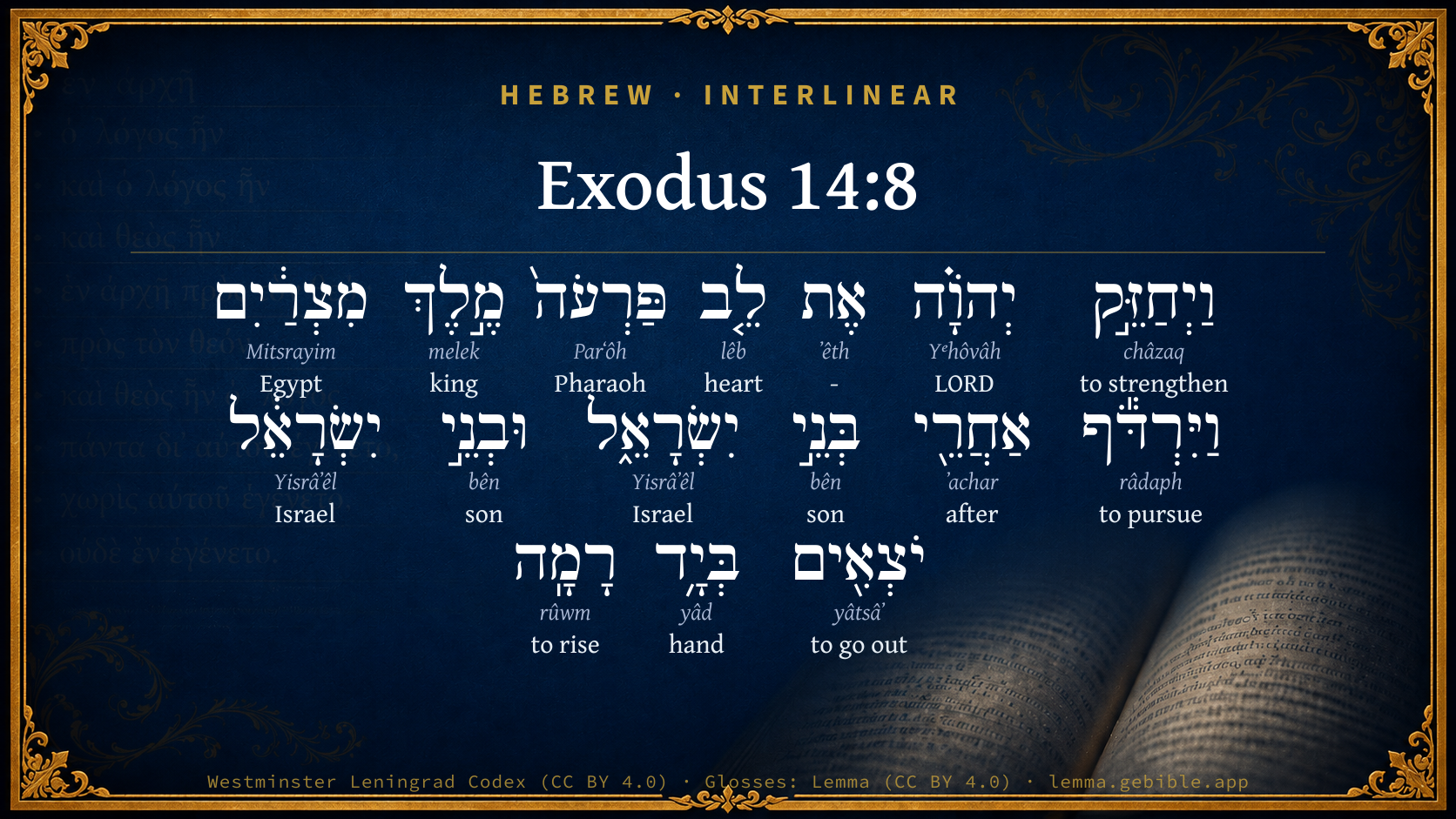
Hebrew (Westminster Leningrad Codex) Exodus 14:8 appears in the Hebrew Old Testament. The text above is from the Westminster Leningrad Codex. Each word links to its Strong’s number, a concise gloss, and parsing drawn from the Open Scriptures Hebrew Bible morphology. Click any word for its full Brown-Driver-Briggs (BDB) entry.
Download image
Cite this verse

Exodus 14:8 (World English Bible). Public Domain. Lemma interlinear Bible study tool, https://lemma.gebible.app/v/exodus/14/8.

Show BibTeX & RIS
BibTeX
RIS
English Translation
Yahweh hardened the heart of Pharaoh king of Egypt, and he pursued after the children of Israel; for the children of Israel went out with a high hand.
World English Bible · Public Domain
Download a study sheet

One document with this verse’s original text, its word-by-word gloss line, the meaning frame, cross-references with their text, attributed commentary, and full source and license credits — printable, and it pastes into notes with its structure intact.

This verse Autodidact and up

Study sheet (.html) Plain text (.txt)

A passage Seminary Student

Up to 50 verses in one chapter. A passage sheet keeps up to 6 commentary sources and 12 cross-references per verse, in the order this page ranks them, and says so on the sheet whenever that leaves anything out. Ask for a single verse and you get the Autodidact verse sheet above.

Everything on this page stays free to read, with no account — the sheet is a download of what is already on screen, not access to it.

Want to remove ads? Support Godless Engineer
Compare translations 3

The same verse in 3 English versions, stacked beneath the original-language interlinear above. Click any original word for its lexicon entry.

Each is an independent rendering of the whole verse — the interlinear is not word-aligned to these translations.

Highlighted words mark where these versions differ — a whole-verse word diff, not a word-by-word alignment.

  • World English Bible Public Domain
    Yahweh hardened the heart of Pharaoh king of Egypt, and he pursued after the children of Israel; for the children of Israel went out with a high hand.
  • King James Version Public Domain
    And the LORD hardened the heart of Pharaoh king of Egypt, and he pursued after the children of Israel: and the children of Israel went out with an high hand.
  • unfoldingWord Literal Text CC BY-SA 4.0
    And Yahweh strengthened the heart of Pharaoh, king of Egypt, and he pursued after the sons of Israel, and the sons of Israel were going out with a high hand.

unfoldingWord Literal Text — © unfoldingWord, licensed CC BY-SA 4.0. Word-aligned USFM3 via Door43 (git.door43.org/unfoldingWord/en_ult).

Versions to compare (up to 4)

3 of 4 selected

Show all 18 translations

Every available English version of this verse, each an independent rendering of the whole verse.

  • World English Bible Public Domain
    Yahweh hardened the heart of Pharaoh king of Egypt, and he pursued after the children of Israel; for the children of Israel went out with a high hand.
  • Berean Standard Bible Public Domain
    And the LORD hardened the heart of Pharaoh king of Egypt so that he pursued the Israelites, who were marching out defiantly.
  • Majority Standard Bible Public Domain
    And the LORD hardened the heart of Pharaoh king of Egypt so that he pursued the Israelites, who were marching out defiantly.
  • King James Version Public Domain
    And the LORD hardened the heart of Pharaoh king of Egypt, and he pursued after the children of Israel: and the children of Israel went out with an high hand.
  • American Standard Version (1901) Public Domain
    And Jehovah hardened the heart of Pharaoh king of Egypt, and he pursued after the children of Israel: for the children of Israel went out with a high hand.
  • Revised Version (1885) Public Domain
    And the LORD hardened the heart of Pharaoh king of Egypt, and he pursued after the children of Israel, for the children of Israel went out with an high hand.
  • Geneva Bible (1599) Public Domain
    (For the Lord had hardened the heart of Pharaoh king of Egypt, and he followed after the children of Israel: but the children of Israel went out with an hie hand)
  • Douay-Rheims (1899) Public Domain
    And the Lord hardened the heart of Pharao king of Egypt, and he pursued the children of Israel: but they were gone forth in a mighty hand.
  • Young's Literal Translation Public Domain
    and Jehovah strengtheneth the heart of Pharaoh king of Egypt, and he pursueth after the sons of Israel, and the sons of Israel are going out with a high hand,
  • Literal Standard Version CC BY-SA 4.0
    and YHWH strengthens the heart of Pharaoh king of Egypt, and he pursues after the sons of Israel, and the sons of Israel are going out with a high hand,
  • Unlocked Literal Bible CC BY-SA 4.0
    Yahweh hardened the heart of Pharaoh, king of Egypt, and the king pursued the Israelites. Now the Israelites had gone away in triumph.
  • unfoldingWord Literal Text CC BY-SA 4.0
    And Yahweh strengthened the heart of Pharaoh, king of Egypt, and he pursued after the sons of Israel, and the sons of Israel were going out with a high hand.
  • Darby Bible Public Domain
    And Jehovah hardened the heart of Pharaoh king of Egypt, and he pursued after the children of Israel; and the children of Israel had gone out with a high hand.
  • World Messianic Bible Public Domain
    The LORD hardened the heart of Pharaoh king of Egypt, and he pursued the children of Israel; for the children of Israel went out with a high hand.
  • Webster's Bible Public Domain
    And the LORD hardened the heart of Pharaoh king of Egypt, and he pursued the children of Israel: and the children of Israel went out with a high hand.
  • Free Bible Version CC BY-SA 4.0
    The Lord gave Pharaoh, king of Egypt, a stubborn attitude so he chased after the Israelites, who were leaving with their fists raised in triumph.
  • Bible in Basic English Public Domain
    And the Lord made the heart of Pharaoh hard, and he went after the children of Israel: for the children of Israel had gone out without fear.
  • JPS Tanakh (1917) Public Domain
    And the LORD hardened the heart of Pharaoh king of Egypt, and he pursued after the children of Israel; for the children of Israel went out with a high hand.

Literal Standard Version (2020), Covenant Press — licensed CC BY-SA 4.0. Text via the HelloAO Bible API (eBible.org). Unlocked Literal Bible (unfoldingWord) — licensed CC BY-SA 4.0. Text via the HelloAO Bible API (eBible.org). unfoldingWord Literal Text — © unfoldingWord, licensed CC BY-SA 4.0. Word-aligned USFM3 via Door43 (git.door43.org/unfoldingWord/en_ult). Free Bible Version, Dr. Jonathan Gallagher — licensed CC BY-SA 4.0. Text via the HelloAO Bible API (eBible.org).

Word by word

More ways to search: Search by grammar → Find every occurrence → Compare this word →

Practice this passage: Drill this verse → Learn its vocabulary →

וַיִּרְדֹּ֕ף
râdaph
H7291
“and · to pursue”
Conjunction + Verb, Qal, Sequential Imperfect, 3rd Person, Masculine, Singular
Part of Speech
Conjunction + Verb
Stem
Qal
Form
Sequential Imperfect
Person
3rd Person
Gender
Masculine
Number
Singular
Full BDB Definition

Origin: a primitive root

TWOT: 2124

to be behind, follow after, pursue, persecute, run after - (Qal) - to pursue, put to flight, chase, dog, attend closely upon - to persecute, harass (figuratively) - to follow after, aim to secure (figuratively) - to run after (a bribe) (figuratively) - (Niphal) - to be pursued - one pursued (participle) - (Piel) to pursue ardently, aim eagerly to secure, pursue - (Pual) to be pursued, be chased away - (Hiphil) to pursue, chase
  1. וַיְחַזֵּ֣ק châzaq H2388 “and · to strengthen” Conjunction + Verb, Piel, Sequential Imperfect, 3rd Person, Masculine, Singular
  2. יְהֹוָ֗ה Yᵉhôvâh H3068 “LORD” Noun, Proper
  3. אֶת ʼêth H853 “-” Particle, Direct Object
  4. לֵ֤ב lêb H3820 “heart of” Noun, Common, Masculine, Singular, Construct
  5. פַּרְעֹה֙ Parʻôh H6547 “Pharaoh” Noun, Proper
  6. מֶ֣לֶךְ melek H4428 “king of” Noun, Common, Masculine, Singular, Construct
  7. מִצְרַ֔יִם Mitsrayim H4714 “Egypt” Noun, Proper
  8. אַחֲרֵ֖י ʼachar H310 “after” Preposition
  9. בְּנֵ֣י bên H1121 “sons of” Noun, Common, Masculine, Plural, Construct
  10. יִשְׂרָאֵ֑ל Yisrâʼêl H3478 “Israel” Noun, Proper
  11. וּבְנֵ֣י bên H1121 “and · sons of” Conjunction + Noun, Common, Masculine, Plural, Construct
  12. יִשְׂרָאֵ֔ל Yisrâʼêl H3478 “Israel” Noun, Proper
  13. יֹצְאִ֖ים yâtsâʼ H3318 “going out” Verb, Qal, Participle Active, Masculine, Plural, Absolute
  14. בְּיָ֥ד yâd H3027 “in/at · hand” Preposition + Noun, Common, Both, Singular, Absolute
  15. רָמָֽה rûwm H7311 “rising” Verb, Qal, Participle Active, Feminine, Singular, Absolute

About this verse

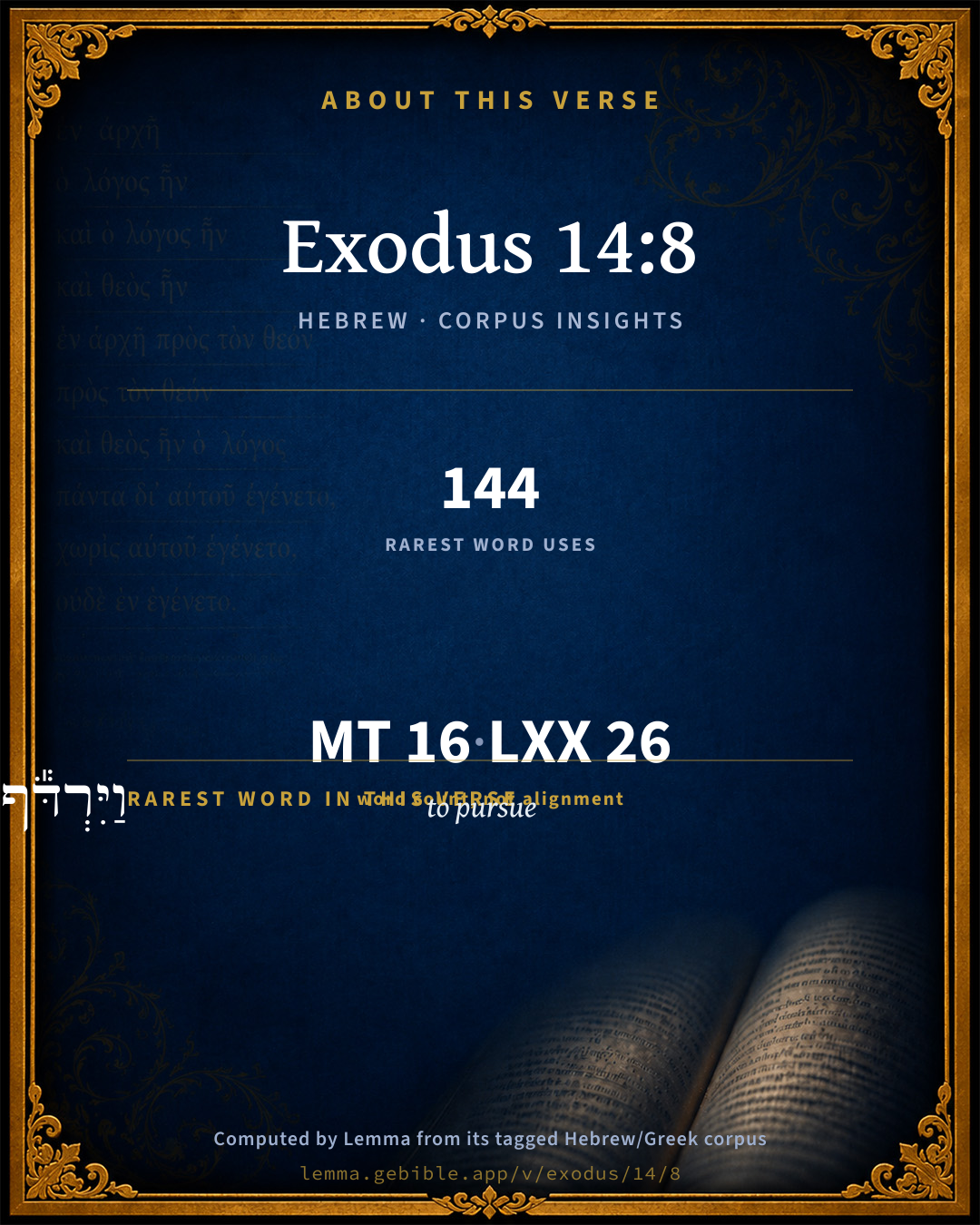
These counts appear in no published source. They are computed here, from the morphology-tagged text and Lemma’s own curated glosses. What Lemma adds →

16
words
14
distinct lemmas
Pentateuch
section

Grammatical profile

  • 4 verbs
  • 10 nouns
  • 1 preposition
  • 1 particle

Verb forms

  • וַיְחַזֵּ֣ק Piel · Sequential Imperfect
  • וַיִּרְדֹּ֕ף Qal · Sequential Imperfect
  • יֹצְאִ֖ים Qal · Participle Active
  • רָמָֽה Qal · Participle Active

Repetition

Words recur within this verse — often emphatic in Hebrew:

  • בְּנֵ֣י son H1121 ×2
  • יִשְׂרָאֵ֑ל Israel H3478 ×2

Hebrew & Septuagint length

In English translation the verse runs 28 words from the Hebrew and 34 from the Septuagint (LXX English) — closely comparable.

A rough comparison of the two English renderings, which tokenize alike — not a word-level alignment.

Word counts can differ between the Hebrew and the Greek without any difference in meaning — e.g. the Hebrew direct-object marker אֵת has no separate Greek word, and Greek often adds the article ὁ.

In the original languages it is 16 Hebrew tokens and 26 Greek tokens — but the two are counted differently (Hebrew bundles its prefixes and suffixes into one token; the Greek is in lemma form), so that isn’t a like-for-like length.

Cross-references

10

Topical passages linked to Exodus 14:8 in the Treasury of Scripture Knowledge — connected by theme and wording, ordered by reader-vote popularity; previews shown in the World English Bible.

  • Numbers 33:3 They traveled from Rameses in the first month, on the fifteenth day of the first month; on the next day after the Passover the children of Israel went out with a high hand in the sight of all the Egyptians,
  • Acts 13:17 The God of this people chose our fathers, and exalted the people when they stayed as aliens in the land of Egypt, and with an uplifted arm, he led them out of it.
  • Exodus 6:1 Yahweh said to Moses, "Now you shall see what I will do to Pharaoh, for by a strong hand he shall let them go, and by a strong hand he shall drive them out of his land."
  • Exodus 13:16 It shall be for a sign on your hand, and for symbols between your eyes: for by strength of hand Yahweh brought us forth out of Egypt."
  • Exodus 14:4 I will harden Pharaoh's heart, and he will follow after them; and I will get honor over Pharaoh, and over all his host; and the Egyptians shall know that I am Yahweh." They did so.
  • Deuteronomy 26:8 and Yahweh brought us forth out of Egypt with a mighty hand, and with an outstretched arm, and with great terror, and with signs, and with wonders;
  • Exodus 13:9 It shall be for a sign to you on your hand, and for a memorial between your eyes, that the law of Yahweh may be in your mouth; for with a strong hand Yahweh has brought you out of Egypt.
  • Exodus 13:18 but God led the people around by the way of the wilderness by the Red Sea; and the children of Israel went up armed out of the land of Egypt.
  • Deuteronomy 32:27 Were it not that I feared the provocation of the enemy, Lest their adversaries should judge wrongly, Lest they should say, Our hand is exalted, Yahweh has not done all this.
  • Psalms 86:13 For your loving kindness is great toward me. You have delivered my soul from the lowest Sheol.

Cross-references courtesy of OpenBible.info (CC BY 4.0).

Hebrew and Greek witnesses Masoretic Hebrew ↔ Greek Septuagint

The same verse in the two great witnesses to the Old Testament, shown verse-for-verse.

These are two independent witnesses, not word-aligned to each other, and the Septuagint is shown in lemma (dictionary) form.

Hebrew Exodus 14:8 Masoretic · Westminster Leningrad Codex

וַיְחַזֵּ֣ק יְהֹוָ֗ה אֶת לֵ֤ב פַּרְעֹה֙ מֶ֣לֶךְ מִצְרַ֔יִם וַיִּרְדֹּ֕ף אַחֲרֵ֖י בְּנֵ֣י יִשְׂרָאֵ֑ל וּבְנֵ֣י יִשְׂרָאֵ֔ל יֹצְאִ֖ים בְּיָ֥ד רָמָֽה

Yahweh hardened the heart of Pharaoh king of Egypt, and he pursued after the children of Israel; for the children of Israel went out with a high hand.

World English Bible · Public Domain

Greek LXX Exodus 14:8 Septuagint · lemma form

καί σκληρύνω κύριος ὁ καρδία φαραώ βασιλεύς αἴγυπτος καί ὁ θεράπων αὐτός καί καταδιώκω ὀπίσω ὁ υἱός ἰσραήλ ὁ δέ υἱός ἰσραήλ ἐκπορεύομαι ἐν χείρ ὑψηλός

And the Lord hardened the heart of Pharao king of Egypt, and of his servants, and he pursued after the children of Israel; and the children of Israel went forth with a high hand.

LXX2012 (modern English Septuagint) · Public Domain

Hebrew: Westminster Leningrad Codex (CC BY 4.0). Greek: Septuagint (public domain); English from LXX2012 (modern English Septuagint) (Public Domain). How the Septuagint differs from the Hebrew →

Targum (Aramaic paraphrase)

2

The Targum is the ancient Jewish Aramaic paraphrase of the Hebrew Scriptures — an interpretive translation, not the Hebrew text itself. Onkelos (literal) and Pseudo-Jonathan (expansive) render the Torah, and Jonathan the Prophets. Coverage is partial: where no permissively-licensed English translation exists for a verse, only the Aramaic is shown. This is verse-level text, not a word-by-word alignment to the Hebrew.

  1. Targum Onkelos Torah (Genesis–Deuteronomy)
    וְתַקִיף יְיָ יָת לִבָּא דְפַרְעֹה מַלְכָּא דְמִצְרַיִם וּרְדַף בָּתַר בְּנֵי יִשְׂרָאֵל וּבְנֵי יִשְׂרָאֵל נְפָקוּ בְּרֵישׁ גְלִי:

    (no public-domain English translation for this verse)

    Targum Onkelos — Aramaic: “Onkelos Genesis” (public domain); “Onkelos Exodus” (public domain); “Onkelos Leviticus” (public domain); “Onkelos Numbers” (public domain); “Onkelos Deuteronomy” (public domain). English: “Sefaria Community Translation” (CC0 1.0 (public-domain dedication)); “J.W. Etheridge. The Targums of Onkelos and Jonathan Ben Uzziel on the Pentateuch. London: Longmans, Green, 1862” (public domain). Text via Sefaria.

  2. Targum Pseudo-Jonathan Torah (Genesis–Deuteronomy)
    וּתְקֵיף יְיָ יָת יִצְרָא דְלִבָּא דְפַרְעה מַלְכָּא דְמִצְרַיִם וּרְדַף בָּתַר בְּנֵי יִשְרָאֵל וּבְנֵי יִשְרָאֵל נַפְקִין בִּידָא מְרַמְמָא מִתְגַּבְּרִין עַל מִצְרָאֵי

    And the Lord hardened the design of the heart of Pharoh king of Mizraim, and he pursued after the sons of Israel. But the sons of Israel, going out with a high hand, were stronger than the Mizraee.

    Targum Pseudo-Jonathan — Aramaic: “Targum Jonathan on Genesis” (public domain); “Targum Jonathan on Exodus” (public domain); “Targum Jonathan on Leviticus” (public domain); “Targum Jonathan on Numbers” (public domain); “Targum Jonathan on Deuteronomy” (public domain). English: “The Targum of Jonathan ben Uzziel, trans. J. W. Etheridge, London, 1862” (public domain). Text via Sefaria.

Commentary

Notes on Exodus 14:8 from classic Christian and Jewish commentators (each source and its license shown beneath its notes). The classic Christian expositions comment on the surrounding passage and are grouped to its opening verse, so a note may address several verses; the Jewish commentaries on the Tanakh (Rashi and others) are per-verse, so they appear only where the commentator wrote on this verse.

Lemma curates 59 commentaries, every one of them public domain or Creative Commons licensed, each selected and text-cleaned for this edition rather than reprinted as found. About our sources →

Trapp's Complete Commentary

John Trapp

Exo 14:8 And the LORD hardened the heart of Pharaoh king of Egypt, and he pursued after the children of Israel: and the children of Israel went out with an high hand.

Ver. 8. With a high hand.] Bravely; boldly; in battle array, not as runaways; in all comely equipage.

John Trapp, A Commentary or Exposition upon All the Books of the Old and New Testament (1647–1656) — public domain. Text from a community e-Sword module.

Joseph Benson's Commentary

Exo 14:8. With a high hand — Boldly and resolutely. It seems the latter part of the verse had better be rendered, even the children of Israel, going away with a high hand, or, in other words, in spite of him.

Joseph Benson's Commentary on the Old and New Testaments (1811–1818) — public domain. Text from a community e-Sword module.

Geneva Bible (1599)

Geneva Bible translators

With great joy and boldness.

Geneva Bible (1599) marginal notes — public domain. Text via Bolls.life.

Ellicott's Commentary for English Readers

(8) The children of Israel went out.—Rather, were going out.

With an high hand—i.e., confidently, boldly, perhaps somewhat proudly, as having brought the Egyptians to entreat them to take their departure (Exo_12:33).

A Bible Commentary for English Readers, edited by Charles John Ellicott (1878–1897) — public domain. Text from a community e-Sword module.

The Cambridge Bible for Schools and Colleges

gen. ed. J. J. S. Perowne

8. and the children of Israel were going: out, &c.] cf. the participle in v. 10.

with an high hand] i.e. proudly and defiantly; cf. Num_33:3 (P): in Num_15:30 used of sins committed wilfully, in deliberate defiance of God’s will. The ‘high hand’ is properly the hand uplifted to deliver a blow: cf. Job_38:15 (‘the high arm is broken’), Mic_5:9; Deu_32:27 (the same Heb.). The representation of P differs from the of J (so Di.): in J the Israelites ‘flee’ (v. 5) after obtaining the Pharaoh’s leave for a temporary absence (Exo_12:31 f.): in P they from the first leave Egypt defiantly, regardless of the Pharaoh’s wishes. Cf. on Exo_6:11.

The Cambridge Bible for Schools and Colleges (gen. ed. J. J. S. Perowne; Cambridge University Press, 1878–1918) — public domain. Text from a community e-Sword module.

John Gill's Exposition

And the Lord hardened the heart of Pharaoh king of Egypt,.... As he said he would, Exo 14:4,

and he pursued after the children of Israel; took their rout in pursuit of them:

and the children of Israel went out with an high hand: not once dreaming they should be pursued by Pharaoh as an enemy, when they went out with his full consent, and with such pressing solicitations to be gone, and with so much favour shown them by the Egyptians; wherefore they set out, and went on with great boldness, courage, and intrepidity; "with an uncovered head", as the Targum of Onkelos, without any fear, and with great alacrity and cheerfulness; they carried both their heads and their hands high, were fearless and thoughtless of any danger when this mighty preparation was making against them.

John Gill's Exposition of the Whole Bible (1746–1763) — public domain (CC PDM 1.0). Text via the HelloAO Bible API.

Haydock's Catholic Bible Commentary

Hand. Without any dread, Numbers xv. 30. (Calmet) --- All the army of Egypt could do nothing against them. Yet presently, at their approach, the Hebrews were suffered to fall into dismay, that they might learn not to confide in their multitudes, and might pray with greater earnestness for protection, ver. 10.

George Leo Haydock (1774–1849), Haydock's Catholic Family Bible and Commentary, 1859 edition — public domain. Excludes Psalms (Douay-Rheims chapter numbering differs from Protestant) and Deuterocanonical books (Catholic canon only).

Matthew Poole's English Annotations

Either,

1. Of God, with a Divine hand or power, by comparing Exo 13:16. Or,

2. Their own, not with hands hanging down, a posture betraying weakness and fainting, fear and shame, Heb 12:12, but with hands lifted up; with courage and confidence, not like fugitives, but like valiant and victorious soldiers, openly, boldly, resolvedly; as men are said to sin with a high hand, Num 15:30, that sin in such a manner.

Matthew Poole's English Annotations on the Holy Bible (1683–1685) — public domain. Text from a community e-Sword/MySword module.

Whedon's Commentary on the Bible

Daniel D. Whedon

8. With a high hand — Openly and defiantly; but how their courage failed when they saw Pharaoh’s chariots!

Daniel D. Whedon (gen. ed.), Commentary on the Old and New Testaments (1874–1909) — public domain. Text from a community e-Sword module.

The Pulpit Commentary

The Children of Israel went out with a high hand i.e. , boldly and confidently, not as fugitives, but as men in the exercise of their just fights perhaps with a certain amount of ostentation.

Jehovah hardening Pharaoh"s heart.

I NOTICE THE EMPHASIS WITH WHICH THIS FACT IS STATED. The hardening of Pharaoh"s heart is mentioned, not in one place only, but in many. If it were mentioned in one place only, it might be in some doubtful way, such as would excuse us for passing it over without much examination. But being mentioned so many times, we dare not leave it on one side as something, to lie in necessary obscurity, meanwhile consoling ourselves that the obscurity is unimportant. The statement meets us in the very midst of the way of Jehovah"s judgments on Pharaoh, and we must meet it in return with a resolution to understand it as far as believers in Jehovah may be able to do. Notice, then, exactly, how often the statement is repeated. Jehovah says to Moses, or ever he leaves Midian, I will harden Pharaoh"s heart that he shall not let the people go". (Exo_4:21) Again, just as Jehovah"s dealings with Pharaoh were beginning, he says: I will harden Pharaoh"s heart, and multiply my signs and my wonders in the land of Egypt". (Exo_7:3) After the rod was changed to a serpent his heart was still hardened. (Exo_7:13) Nor was there yet any change after the waters were turned to blood. (Exo_7:22) He yielded a little when the frogs came, but as soon as they vanished and there was respite, he hardened his heart once more. (Exo_8:15) When the magicians confessed the finger of God in the gnats, his heart remained the same. (Exo_8:19) The flies were taken away, and he hardened his heart at this time also, neither would he let the people go". (Exo_8:32) In Exo_9:12 we have an express statement that the Lord hardened the heart of Pharaoh. After the visitation of the hail there seems to have been a complete surrender; but as soon as it ceases the hardening returns; (Exo_9:35) and so the references continue down to the end. (Exo_10:1, Exo_10:20, 27 11:10 14:4, 8, 17) Making these references, we are led to notice also the variety of expressions used. Sometimes it is simply said that Pharaohs heart was hardened, sometimes that Pharaoh hardened it, sometimes that God hardened it; and once or twice the expression rises to the emphasis of the first person, and Jehovah himself says I will harden Pharaoh"s heart.

II NOTICE THE CONSEQUENT OBLIGATION TO MAKE DEVOUT AND REVERENT INQUIRY INTO THIS MATTER. There is no way to escape from the feeling that Jehovah did actually harden Pharaoh"s heart. We must treat the hardening of his heart as a great fact just as Moses did the burning bush; not doubting at all that it did happen, but rather asking how and why it happened. We must turn aside and see this great sign, why Jehovah exercised such a fearful power over Pharaoh that the end of it was the destruction of his host in the waters of the Red Sea. It is a commonplace of speech to say that the expression here is one of the most difficult in all the Scriptures. It is also a commonplace of action to shake the head with what is meant for pious submission to an impenetrable mystery. But what if this be only an indolent and most censurable avoidance of earnest thought on the ways of God towards men? No one will pretend that the mystery of this expression is penetrable to all its depths; but so far as it is penetrable we are bound to explore. How are we really to know that a thing is unfathomable, until we make an attempt to fathom it? A devout Israelite, although excluded from the Holy of Holies, did not make that a reason for neglecting the temple altogether. Our duty then is to inquire what this hardening of the heart may be, in what sense it is reconcilable with the goodness and righteousness of God. One reason why this statement is put so prominently forward in one of the most prominent narratives of Scripture, and therefore one of the most prominent in all history, may be this, that we should be kept from wrong conclusions on man"s agency as a responsible being; conclusions dishonouring to God and perilous to ourselves. Is it not a great deal gained if only this narrative sets people thinking, so as to deliver them from the snares of fatalism?

III Whatever View we take of this statement must evidently be IN THE LIGHT OF ALL WE ARE PERMITTED TO KNOW CONCERNING THE CHARACTER OF JEHOVAH. In considering all difficult statements as to the Divine dealings, we must start with certain postulates as to the Divine character. Before we can say that God does a thing we must know that the thing done is not out Of harmony with the rest of his ascertained doings. There may be plenty of evidence as to the thing done, when there is very little evidence as to the doer. That the streams of Egypt were actually turned to blood was a thing that could be certified by the senses of every one who inspected those streams. But that God wrought this strange work could only be made sure by asking, first, what evidence there was of God"s presence, and next, what consistency there was with his acknowledged dealings. It is only too plain that Pharaoh"s heart was hardened, that he became ever more settled in his resolution to keep hold of Israel as long as he could. But when we are told that God hardened Pharaoh"s heart, then we must at once bring to mind all that we have heard of God in the Scriptures. We must take back into our inspection of those distant times all we know of his character whom Jesus revealed; for the loving Father of our Saviour is the same with the great Jehovah. The same holy personality is at work in the God who so loved the world that he gave his only begotten Son, that whosoever believeth in him should not perish but have eternal life, as in the God who hardened Pharaoh"s heart. We must not tolerate any conception of the hardening which contradicts the Divine character. Any view of this expression which does not harmonise with the revelation of God in the New Testament is therefore condemned. There is certainly no word in the Old Testament that more needs to be looked at in the light of the New than this. We must then dismiss from our minds any sort of notion that in hardening Pharaoh"s heart, God dulled his moral sensibilities and made him proud, indifferent to pity and justice and the fulfilment of promises. God cannot put even the germs of these feelings into any human heart; much less can he increase them to such portentous magnitude as they attained in Pharaoh. We must start with the conviction and keep to it, that what God does is right, and that it is right not because he does it, but that he does it because it is right. It is not open for us first to fix our own interpretation of what may be meant by hardening the heart, and then call it an outrage on moral sense to say that God should do this. What if we have blundered in our interpretation?

IV A right view of this statement must evidently also be taken IN THE LIGHT OF ALL THAT WE KNOW BY AN APPEAL TO HUMAN CONSCIOUSNESS. As no word God has ever spoken can contradict the facts of external nature, so neither can it contradict the facts of mans consciousness within. That which is true, independently of the teaching of Scripture, does not become less true, nor does it become false when Scripture begins to speak. Man is a free agent; he acts as one; he resents being treated otherwise by his fellow men. He is degraded and impoverished just in proportion as he sinks to a mere machine. His own decision is required every day, and he finds that wise decisions lead to profit, and foolish ones to loss. The law treats him as a free agent. Nay, more; what can be clearer than that God treated Pharaoh as a free agent? The plain statement that God hardened his heart is not more frequent than the equally plain statement that God demanded from him the liberation of Israel. If the one word is to be taken as simple verity, so is the other. If when God hardened Pharaohs heart, he really did something in his nature; then also when he asked Pharaoh to liberate Israel, he asked something which he was at liberty to grant or refuse. Moses does not mock us with a mere trick of rhetoric in saying that God hardened Pharaoh"s heart; neither did God mock Pharaoh with a useless appeal when he said, Let my People go. " Pharaoh knew well in his heart that it only needed his resolution and the whole of Israel could march forth at very short notice. He himself would have been amazed to hear that God had hardened his heart. True as it was, he would have denied it most strenuously and indignantly; and he would have denied it with justice, if it had been taken to mean the destruction of his own free agency.

V We may now Perhaps consider the ground sufficiently cleared for a positive conjecture as to what is meant by God hardening Pharaohs heart. It means, we take it, THAT HE WORKED A MIRACULOUS CHANGE IN ONE OF PHARAOH"S NATURAL FACULTIES. There are certain things in every human being we do not hold that being responsible for, e.g. , sex, features, temperament, acuteness and activity in senses and intellect. Some persons have good vision, others poor, others are altogether blind. In a similar way, some are naturally of a tenacious, determined will. Whatever they have set their mind upon, they hold to, with bull-dog grip. Others again are easily swayed about. Now clearly just as there are natural differences in sight, or hearing, or intellect, so there must be natural differences in this will-faculty. A man may have it very strong; he may be one who if he sets high and worthy aims before him, will be called resolute, inflexible, tenacious, indomitable, loyal to conscience; whereas if his aims be low, selfish and entirely without ground in reason, he will be called obstinate, stubborn, self-willed in the fullest sense of that word; and is it not plain that God may take this power of volition, this will-energy, and do with it, as we know that Jesus in many of his miracles did with defective or absent faculties? To the blind, Jesus gave vision, and he who could thus call a non-existent faculty into existence, evidently could increase a faculty actually existing to any degree such as man might be able to possess. And was it not something of this kind that God did in hardening Pharaoh"s heart? The term has come to have a dreadful meaning to us in connexion with Pharaoh, simply because of Pharaohs career. But the very miracle which God wrought in Pharaohs heart would have had good results, if only Pharaoh had been a different sort of man. Suppose the instance of a blind man who gets sight from Jesus. He goes into life again with a recovered faculty: and that life, with respect to its opportunities, is vastly larger than it was before. How will he use these opportunities? He may use them selfishly, and Christ"s own blessing will thus become a curse; or he may use them as Christ would have him use them, to become his efficient and grateful servant. There is a moral certainty that some who had faith enough in Jesus to have impaired natural faculties put right were yet destitute of that faith which went on to spiritual salvation and spiritual service. It was one thing to believe in Christ for a temporal gain, quite another to believe in him for a spiritual one; and the one faith while meant to lead on to the other, would not always have that effect. It is but a fond imagination to suppose that it would. So Pharaoh, if he had been a humane, compassionate and righteous man, a king with a true king"s feelings for his own people, would, through the very process of hardening his heart, have become a more efficient ruler. This is the way God helps men who are struggling with temptation, struggling towards truth and light, towards conquest over appetite, violent temper, evil habits. God does for them and in them exactly what he did in Pharaoh. What he did in Pharaoh happened to hasten him in the way where he was already disposed to go. If Pharaoh had been a blind man as well as a bad one, no one would have had any perplexity as to God s dealings in restoring his sight and giving it the greatest perfection sight can attain. If Pharaoh had used that restored vision for bad, cruel purposes, he would have been blamed, and not Jehovah, and exactly the same remark applies if we change the name of the faculty. God strengthens the faculty of will, but Pharaoh is responsible for a right use of the strengthened faculty as much as he was for the use of the weaker faculty before. God dealt with a part of his nature where he had no power to resist any more than a blind man would have power to resist, if God were to restore vision to him. It was not against the hardening that Pharaoh struggled, but against the delivering. The hardening worked in a way he was not conscious of, but the delivering was by an appeal to him, and that appeal he was by no means disposed to entertain. It was not an awakened conscience that compelled him to his successive yieldings; these were but as the partial taming of a wild beast. Paul said, When I would do good, evil is present with me; " but Pharaoh was steadily disposed to do evil. His cry would rather have been, When I think to get my own way, one of those terrible plagues comes in to relax my resolutions and confuse my plans.

VI A certain amount of weight must also be allowed for PHARAOH"S TYPICAL POSITION AND CHARACTER. We must distinguish between what he was typically and what he was personally. Far be it from us to diminish his guilt or attempt to whitewash his memory. Doubtless he was a bad man, and a very bad man; but for typical purposes it was needful to represent him as not having one redeeming feature. His name is not linked even with one virtue amid a thousand crimes. He had to be set before the whole world and all ages as the enemy of God"s people. He is the type of a permanent adversary far greater than himself. And just as the people of God, typically considered, appeared very much better than they actually were, so Pharaoh, typically considered, is described so as to appear worse. (e.g. in Num_23:21, it is said, He hath not beheld iniquity in Jacob, neither hath he seen perverseness in Israel. ") We do no, Show all God"s dealings with Pharaoh. They are hidden beneath the waters of the Red Sea, and it is no duty of ours to pass judgment on the defeated and baffled opponent. God calls us to the more practical business of going on with the livings struggling people. Y.

The Pulpit Commentary (1880–1919), ed. H.D.M. Spence-Jones & Joseph S. Exell — public domain. Text from a community e-Sword module.

John Wesley's Explanatory Notes

With an high hand - Boldly, resolutely.

John Wesley, Explanatory Notes Upon the Whole Bible (1754–1765) — public domain. Text via the GEBible commentary corpus.

Rashi

Rabbi Shlomo Yitzchaki (Rashi)

ויחזק ה׳ את לב פרעה AND THE LORD ALLOWED THE HEART OF PHARAOH TO BE HARDENED — the meaning is, that he was in doubt whether to pursue or not, and He hardened his heart to pursue (Mekhilta).

ביד רמה WITH A HIGH HAND — with high and open daring (cf. Mekhilta).

Rashi on the Tanakh — English translations: “The Judaica Press complete Tanach with Rashi, translated by A. J. Rosenberg” (CC BY 4.0); “Pentateuch with Rashi's commentary by M. Rosenbaum and A.M. Silbermann, 1929-1934” (public domain); “The Metsudah Tanach series, Lakewood, N.J” (CC BY 4.0); and “The Book of Joshua, Metsudah Publications, 1997” (CC BY 4.0). Text via Sefaria.

Sforno

Rabbi Ovadia Sforno

High handedly (yad ramah). This is akin to the phrase, “Our arms have prevailed” (Yadeinu ramah; Devarim 32:27) and it indicates that B’nei Yisrael intended on engaging the much smaller Egyptian force in battle. This shows how little they understood of warfare, for in fact they had more to fear from these few elite troops than all the masses of Egyptians that came later.

Sforno on the Tanakh — English translation: “Yalkut, Sifsei Chachomim Chumash, Metsudah Publications, 2009” (CC BY 4.0). Text via Sefaria.

Lesson kit

Teaching starters — assembled from the data on this page, not authored interpretation. Every prompt links to the verse data it draws on. Edit before teaching.

Exodus, in the Pentateuch, opens this verse with 16 words (14 distinct Hebrew lemmas). Its most distinctive word is râdaph (“to pursue”). A historical commentator’s framing appears above. Read the whole chapter for the surrounding context.

Discussion questions

  1. What does “to pursue” (râdaph) contribute to the verse as a whole?
  2. How does Numbers 33:3, which shares this passage’s theme, read alongside this verse?
  3. What does the repetition of “son” (2× in this one verse) do in this verse?
  4. These translations render this verse differently. What is at stake in choosing one wording over another?
  5. «וַיְחַזֵּ֣ק» is a Piel Sequential Imperfect verb. How does that grammatical form shape the action described?
  6. Compare how Trapp's Complete Commentary and Joseph Benson's Commentary read this verse. Where do they agree or differ?

Things to notice

Reading settings

Reading text

Shown beneath each verse's original-language words.

Old Testament
Old Testament edition

Read the OT as the Masoretic Hebrew (MT) or the Greek Septuagint (LXX).

English shown for the Greek Septuagint (in the Hebrew ↔ Greek comparison).

Comparing translations? Open the Compare panel on any verse page to stack up to four side by side.