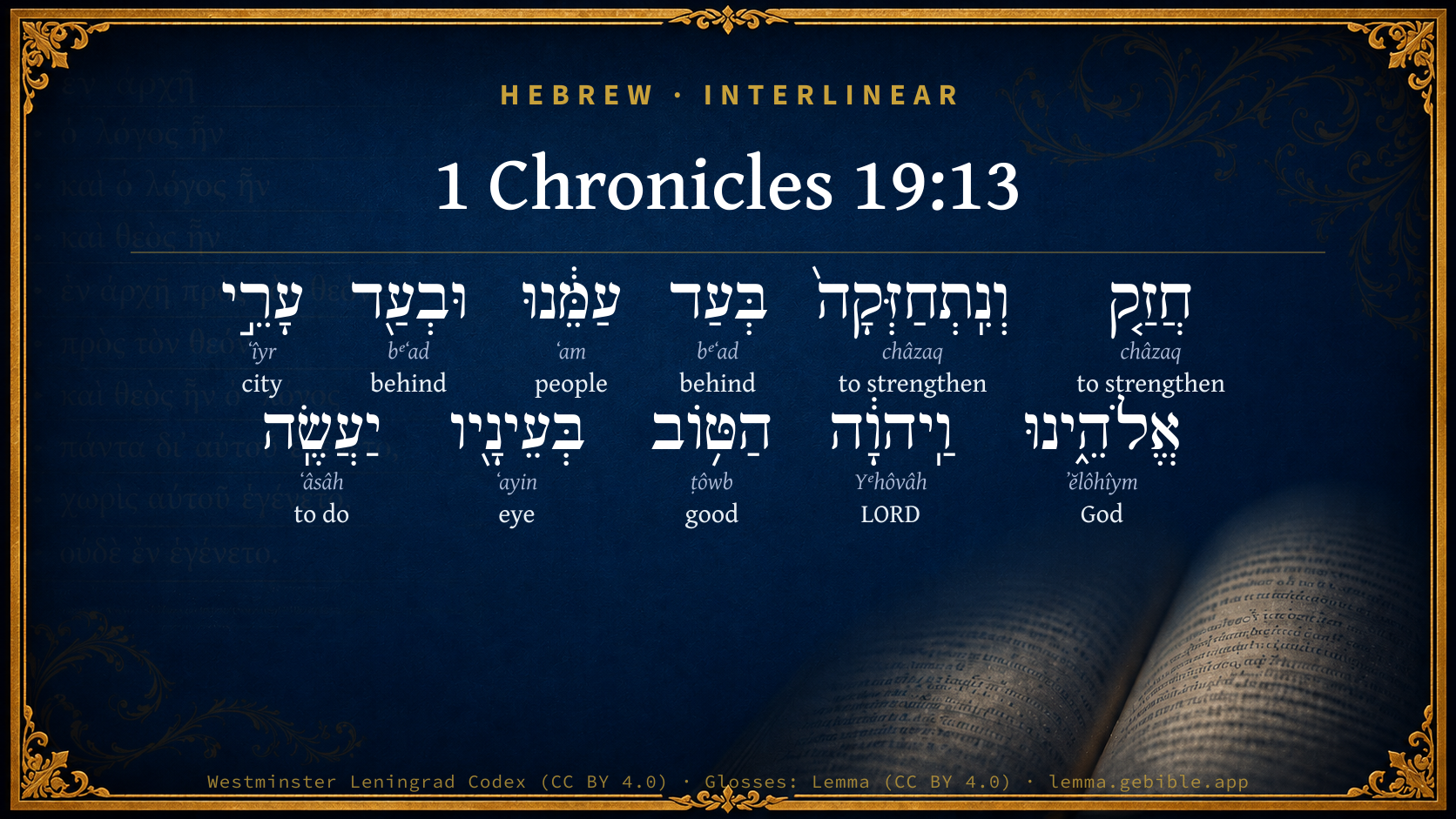
1 Chronicles 19:13

Hebrew (Westminster Leningrad Codex) 1 Chronicles 19:13 appears in the Hebrew Old Testament. The text above is from the Westminster Leningrad Codex. Each word links to its Strong’s number, a concise gloss, and parsing drawn from the Open Scriptures Hebrew Bible morphology. Click any word for its full Brown-Driver-Briggs (BDB) entry.
Download image
Cite this verse

1 Chronicles 19:13 (World English Bible). Public Domain. Lemma interlinear Bible study tool, https://lemma.gebible.app/v/1-chronicles/19/13.

Show BibTeX & RIS
BibTeX
RIS
English Translation
Be of good courage, and let us play the man for our people, and for the cities of our God: and Yahweh do that which seems him good.
World English Bible · Public Domain
Download a study sheet

One document with this verse’s original text, its word-by-word gloss line, the meaning frame, cross-references with their text, attributed commentary, and full source and license credits — printable, and it pastes into notes with its structure intact.

This verse Autodidact and up

Study sheet (.html) Plain text (.txt)

A passage Seminary Student

Up to 50 verses in one chapter. A passage sheet keeps up to 6 commentary sources and 12 cross-references per verse, in the order this page ranks them, and says so on the sheet whenever that leaves anything out. Ask for a single verse and you get the Autodidact verse sheet above.

Everything on this page stays free to read, with no account — the sheet is a download of what is already on screen, not access to it.

Want to remove ads? Support Godless Engineer
Compare translations 3

The same verse in 3 English versions, stacked beneath the original-language interlinear above. Click any original word for its lexicon entry.

Each is an independent rendering of the whole verse — the interlinear is not word-aligned to these translations.

Highlighted words mark where these versions differ — a whole-verse word diff, not a word-by-word alignment.

  • World English Bible Public Domain
    Be of good courage, and let us play the man for our people, and for the cities of our God: and Yahweh do that which seems him good.
  • King James Version Public Domain
    Be of good courage, and let us behave ourselves valiantly for our people, and for the cities of our God: and let the LORD do that which is good in his sight.
  • unfoldingWord Literal Text CC BY-SA 4.0
    Be strong, and let us strengthen ourselves for the sake of our people and for the sake of the cities of our God. And may Yahweh do the good in his eyes.”

unfoldingWord Literal Text — © unfoldingWord, licensed CC BY-SA 4.0. Word-aligned USFM3 via Door43 (git.door43.org/unfoldingWord/en_ult).

Versions to compare (up to 4)

3 of 4 selected

Show all 18 translations

Every available English version of this verse, each an independent rendering of the whole verse.

  • World English Bible Public Domain
    Be of good courage, and let us play the man for our people, and for the cities of our God: and Yahweh do that which seems him good.
  • Berean Standard Bible Public Domain
    Be strong and let us fight bravely for our people and for the cities of our God. May the LORD do what is good in His sight.”
  • Majority Standard Bible Public Domain
    Be strong and let us fight bravely for our people and for the cities of our God. May the LORD do what is good in His sight.”
  • King James Version Public Domain
    Be of good courage, and let us behave ourselves valiantly for our people, and for the cities of our God: and let the LORD do that which is good in his sight.
  • American Standard Version (1901) Public Domain
    Be of good courage, and let us play the man for our people, and for the cities of our God: and Jehovah do that which seemeth him good.
  • Revised Version (1885) Public Domain
    Be of good courage, and let us play the men for our people, and for the cities of our God: and the LORD do that which seemeth him good.
  • Geneva Bible (1599) Public Domain
    Be strong, and let vs shewe our selues valiant for our people, and for the cities of our God, and let the Lord doe that which is good in his owne sight.
  • Douay-Rheims (1899) Public Domain
    Be of good courage and let us behave ourselves manfully for our people, and for the cities of our God: and the Lord will do that which is good in his sight.
  • Young's Literal Translation Public Domain
    be strong, and we strengthen ourselves, for our people, and for the cities of our God, and Jehovah doth that which is good in His eyes.'
  • Literal Standard Version CC BY-SA 4.0
    be strong, and we strengthen ourselves, for our people, and for the cities of our God, and YHWH does that which is good in His eyes.”
  • Unlocked Literal Bible CC BY-SA 4.0
    Be strong, and let us show ourselves to be strong for our people and for the cities of our God, for Yahweh will do what is good in his eyes.”
  • unfoldingWord Literal Text CC BY-SA 4.0
    Be strong, and let us strengthen ourselves for the sake of our people and for the sake of the cities of our God. And may Yahweh do the good in his eyes.”
  • Darby Bible Public Domain
    Be strong, and let us shew ourselves valiant for our people, and for the cities of our God; and Jehovah will do what is good in his sight.
  • World Messianic Bible Public Domain
    Be courageous, and let’s be strong for our people and for the cities of our God. May the LORD do that which seems good to him.”
  • Webster's Bible Public Domain
    Be of good courage, and let us behave ourselves valiantly for our people, and for the cities of our God: and let the LORD do that which is good in his sight.
  • Free Bible Version CC BY-SA 4.0
    Be brave, and fight your best for our people and the towns of our God. May the Lord do what he sees as good!”
  • Bible in Basic English Public Domain
    Take heart, and let us be strong for our people and for the towns of our God; and may the Lord do what seems good to him.
  • JPS Tanakh (1917) Public Domain
    Be of good courage, and let us prove strong for our people, and for the cities of our God; and the LORD do that which seemeth Him good.'

Literal Standard Version (2020), Covenant Press — licensed CC BY-SA 4.0. Text via the HelloAO Bible API (eBible.org). Unlocked Literal Bible (unfoldingWord) — licensed CC BY-SA 4.0. Text via the HelloAO Bible API (eBible.org). unfoldingWord Literal Text — © unfoldingWord, licensed CC BY-SA 4.0. Word-aligned USFM3 via Door43 (git.door43.org/unfoldingWord/en_ult). Free Bible Version, Dr. Jonathan Gallagher — licensed CC BY-SA 4.0. Text via the HelloAO Bible API (eBible.org).

Word by word

More ways to search: Search by grammar → Find every occurrence → Compare this word →

Practice this passage: Drill this verse → Learn its vocabulary →

בְּעַד
bᵉʻad
H1157
“behind”
Preposition
Part of Speech
Preposition
Full BDB Definition

Origin: from H5704 with prepositional prefix

TWOT: 258a

behind, through, round about, on behalf of, away from, about - through (of action) - behind (with verbs of shutting) - about (with verbs of fencing) - on behalf of (metaphorically especially with Hithpael)
  1. חֲזַ֤ק châzaq H2388 “strengthen” Verb, Qal, Imperative, 2nd Person, Masculine, Singular
  2. וְנִֽתְחַזְּקָה֙ châzaq H2388 “and · to strengthen” Conjunction + Verb, Hithpael, Cohortative, 1st Person, Common, Plural
  3. עַמֵּ֔נוּ ʻam H5971 “people · our” Noun, Common, Masculine, Singular, Construct + Suffix, Personal, 1st Person, Common, Plural
  4. וּבְעַ֖ד bᵉʻad H1157 “and · behind” Conjunction + Preposition
  5. עָרֵ֣י ʻîyr H5892 “cities of” Noun, Common, Feminine, Plural, Construct
  6. אֱלֹהֵ֑ינוּ ʼĕlôhîym H430 “God(s) · our” Noun, Common, Masculine, Plural, Construct + Suffix, Personal, 1st Person, Common, Plural
  7. וַֽיהוָ֔ה Yᵉhôvâh H3068 “and · LORD” Conjunction + Noun, Proper
  8. הַטּ֥וֹב ṭôwb H2896 “the · good” Particle, Definite Article + Adjective, Adjective, Masculine, Singular, Absolute
  9. בְּעֵינָ֖יו ʻayin H5869 “in/at · eyes · his” Preposition + Noun, Common, Both, Dual, Construct + Suffix, Personal, 3rd Person, Masculine, Singular
  10. יַעֲשֶֽׂה ʻâsâh H6213 “to do” Verb, Qal, Imperfect, 3rd Person, Masculine, Singular

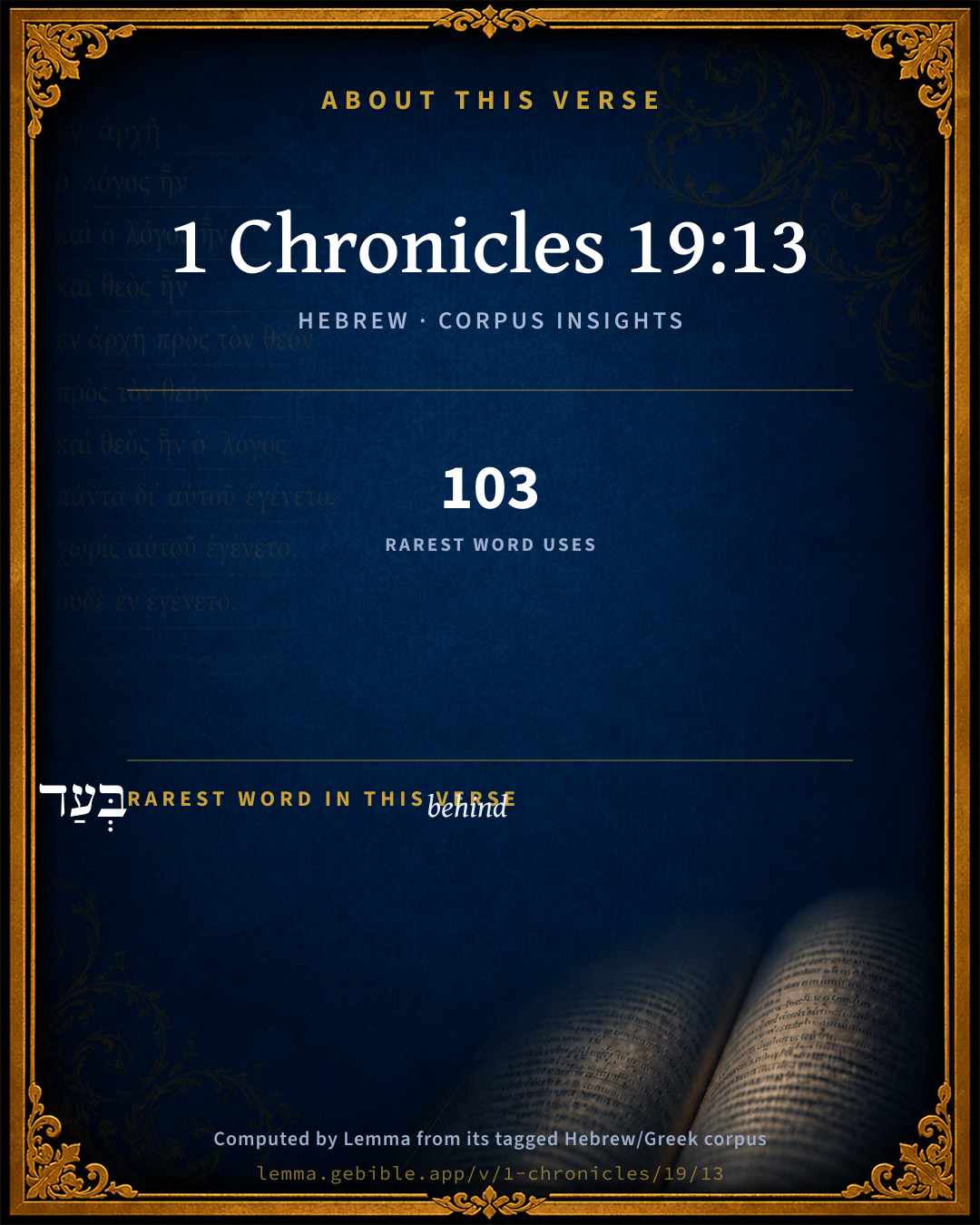
About this verse

These counts appear in no published source. They are computed here, from the morphology-tagged text and Lemma’s own curated glosses. What Lemma adds →

11
words
9
distinct lemmas
Historical
section

Grammatical profile

  • 3 verbs
  • 5 nouns
  • 1 adjective
  • 2 prepositions

Verb forms

  • חֲזַ֤ק Qal · Imperative
  • וְנִֽתְחַזְּקָה֙ Hithpael · Cohortative
  • יַעֲשֶֽׂה Qal · Imperfect

Repetition

Words recur within this verse — often emphatic in Hebrew:

  • חֲזַ֤ק to strengthen H2388 ×2
  • בְּעַד behind H1157 ×2

Hebrew & Septuagint length

In English translation the verse runs 28 words from the Hebrew and 30 from the Septuagint (LXX English) — closely comparable.

A rough comparison of the two English renderings, which tokenize alike — not a word-level alignment.

Word counts can differ between the Hebrew and the Greek without any difference in meaning — e.g. the Hebrew direct-object marker אֵת has no separate Greek word, and Greek often adds the article ὁ.

Cross-references

16

Topical passages linked to 1 Chronicles 19:13 in the Treasury of Scripture Knowledge — connected by theme and wording, ordered by reader-vote popularity; previews shown in the World English Bible.

  • Psalms 27:14 Wait for Yahweh. Be strong, and let your heart take courage. Yes, wait for Yahweh.
  • Joshua 10:25 Joshua said to them, Don't be afraid, nor be dismayed; be strong and of good courage: for thus shall Yahweh do to all your enemies against whom you fight.
  • 2 Samuel 10:12 Be of good courage, and let us play the man for our people, and for the cities of our God: and Yahweh do that which seems him good.
  • Nehemiah 4:14 I looked, and rose up, and said to the nobles, and to the rulers, and to the rest of the people, Don't be you afraid of them: remember the Lord, who is great and awesome, and fight for your brothers, your sons, and your daughters, your wives, and your houses.
  • 1 Corinthians 16:13 Watch! Stand firm in the faith! Be courageous! Be strong!
  • 1 Samuel 4:9 Be strong, and behave yourselves like men, O you Philistines, that you not be servants to the Hebrews, as they have been to you: quit yourselves like men, and fight.
  • Deuteronomy 31:6–7 Be strong and of good courage, don't be afraid, nor be scared of them: for Yahweh your God, he it is who does go with you; he will not fail you, nor forsake you.
  • Joshua 1:7 Only be strong and very courageous, to observe to do according to all the law, which Moses my servant commanded you: don't turn from it to the right hand or to the left, that you may have good success wherever you go.
  • Judges 10:15 The children of Israel said to Yahweh, We have sinned: do you to us whatever seems good to you; only deliver us, we pray you, this day.
  • 1 Samuel 17:32 David said to Saul, Let no man's heart fail because of him; your servant will go and fight with this Philistine.
  • Ezra 10:4 Arise; for the matter belongs to you, and we are with you: be of good courage, and do it.
  • 1 Samuel 3:18 Samuel told him every whit, and hid nothing from him. He said, It is Yahweh: let him do what seems him good.
  • 1 Samuel 14:6–12 Jonathan said to the young man who bore his armor, Come, and let us go over to the garrison of these uncircumcised: it may be that Yahweh will work for us; for there is no restraint to Yahweh to save by many or by few.
  • 2 Samuel 15:26 but if he say thus, I have no delight in you; behold, here am I, let him do to me as seems good to him.
  • 2 Samuel 16:10–11 The king said, What have I to do with you, you sons of Zeruiah? Because he curses, and because Yahweh has said to him, Curse David; who then shall say, Why have you done so?
  • Job 1:22 In all this, Job did not sin, nor charge God with wrongdoing.

Cross-references courtesy of OpenBible.info (CC BY 4.0).

Hebrew and Greek witnesses Masoretic Hebrew ↔ Greek Septuagint

The same verse in the two great witnesses to the Old Testament, shown verse-for-verse.

These are two independent witnesses, not word-aligned to each other, and the Septuagint is shown in lemma (dictionary) form.

Hebrew 1 Chronicles 19:13 Masoretic · Westminster Leningrad Codex

חֲזַ֤ק וְנִֽתְחַזְּקָה֙ בְּעַד עַמֵּ֔נוּ וּבְעַ֖ד עָרֵ֣י אֱלֹהֵ֑ינוּ וַֽיהוָ֔ה הַטּ֥וֹב בְּעֵינָ֖יו יַעֲשֶֽׂה

Be of good courage, and let us play the man for our people, and for the cities of our God: and Yahweh do that which seems him good.

World English Bible · Public Domain

Greek LXX 1 Chronicles 19:13 Septuagint · lemma form

ἀνδρίζομαι καί ἐνἰσχύω περί ὁ λαός ἐγώ καί περί ὁ πόλις ὁ θεός ἐγώ καί κύριος ὁ ἀγαθός ἐν ὀφθαλμός αὐτός ποιέω

Be of good courage, and let us be strong, for our people, and for the cities of our God: and the Lord shall do what is good in his eyes.

LXX2012 (modern English Septuagint) · Public Domain

Hebrew: Westminster Leningrad Codex (CC BY 4.0). Greek: Septuagint (public domain); English from LXX2012 (modern English Septuagint) (Public Domain). How the Septuagint differs from the Hebrew →

Commentary

Notes on 1 Chronicles 19:13 from classic Christian and Jewish commentators (each source and its license shown beneath its notes). The classic Christian expositions comment on the surrounding passage and are grouped to its opening verse, so a note may address several verses; the Jewish commentaries on the Tanakh (Rashi and others) are per-verse, so they appear only where the commentator wrote on this verse.

Lemma curates 59 commentaries, every one of them public domain or Creative Commons licensed, each selected and text-cleaned for this edition rather than reprinted as found. About our sources →

Tyndale Open Study Notes

Tyndale Open Resources

19:13 Joab knew that the battle was not being waged to gain more territory but to defend the people and the cities of Israel from invasion (cp. 19:8). • Joab placed his trust in God, knowing that the outcome depended on the Lord’s providence.

Tyndale Open Study Notes — © Tyndale Open Resources, licensed CC BY-SA 4.0. Text via the HelloAO Bible API.

Geneva Bible (1599)

Geneva Bible translators

He declareth that where the cause is evil, the courage cannot be valiant, and that in good causes men ought to be courageous, and commit the success to God.

Geneva Bible (1599) marginal notes — public domain. Text via Bolls.life.

Adam Clarke's Commentary

Verse 13. Be of good courage] 2Sa 10:12.

Adam Clarke's Commentary on the Bible (1810–1826) — public domain. Text from a community e-Sword/MySword module.

Ellicott's Commentary for English Readers

(13) Be of good courage.—The same verb was rendered “be strong” in 1Ch_19:12.

Let us behave ourselves valiantly.—The same verb again, in reflexive form. Thus the whole runs literally: Be strong, and let us shew ourselves strong!

And let the Lord do . . .—Literally, And Jehovah—the good in his own eyes may he do! The order in the Hebrew of Samuel is that of the Authorised Version here. The chronicler lays stress on the auspicious word “good.” There is also emphasis on “Jehovah,” as leaving the issue in His hands who is Lord of hosts and God of battles; and on the verb, expressive of a pious wish that right may not miscarry. Evidently the spirit which inspired the prayer, “Thy will be done,” was not unknown to the warriors of the old theocracy.

A Bible Commentary for English Readers, edited by Charles John Ellicott (1878–1897) — public domain. Text from a community e-Sword module.

The Cambridge Bible for Schools and Colleges

gen. ed. J. J. S. Perowne

13. let us behave ourselves valiantly] R.V. let us play the men, as in 2Sa_10:12.

the cities of our God] The cities which our God has given us and in which He is worshipped. If these were captured by the enemy, false gods would be worshipped in them. Religious feeling often supplies the place of patriotism in the East.

The Cambridge Bible for Schools and Colleges (gen. ed. J. J. S. Perowne; Cambridge University Press, 1878–1918) — public domain. Text from a community e-Sword module.

The Pulpit Commentary

True valour.

The annals of the human race are, alas! filled with the records of war, and the happily unwritten annals of innumerable tribes would have consisted of little else. Israel is no exception. Joab, as one of David"s mighty men, shared his chief"s warlike prowess without sharing all the higher excellences of his character. Yet on this occasion Joab gave utterance to language the nobility and beauty of which cannot but be acknowledged. The words are an expression and a description of true valour.

I THE HEART OF THE VALIANT. "Be of good courage." Action needs motive. The heart within is the explanation of the outer life. In modern warfare, science, skill, command of material, are far more important than in ancient times, when the individual qualities of the hero were almost everything in the conduct and results of war. But, if a country is to be defended or delivered, the people and their leaders must have a brave, a dauntless heart.

II THE CONDUCT OF THE VALIANT. A brave heart must find its expression in brave deeds. "Let us behave ourselves valiantly!" "Who would be free, themselves must strike the blow." It is so in all departments of life. It is not the dreamer or the sage, but the man of resolution and of energy, who conquers in the strife.

III THE MOTIVE OF THE VALIANT. "For our people, and for the cities of our God." Remark the power of unselfishness to raise the moral quality of actions. It was not with aggressive, ambitious purposes that the Israelites drew the sword

But chief were those who not for empire sought, But with their toils their people"s safety bought.

Many wars doubtless have been undertaken in a misguided, mistaken spirit of patriotism. Still, it is a good element so far in any enterprise, that the motive animating it is our country"s good.

IV THE CONFIDENCE OF THE VALIANT. "Let the Lord do that which is good in his sight." Here was faith in Providence; a reference of all to the wisdom of the Most High; a resolve to leave the issues in the hands of the God of hosts. Fatalism has sometimes been regarded as favourable to valour; but far more stimulating to courage is confidence in an all-wise Ruler and Disposer of events. The soldier will go bravely to battle, the labourer to work, the martyr to suffering, when the heart is inspired with the assurance of the Divine presence and favour and support. "They that trust in the Lord shall never be ashamed or confounded, world without end. T.

Skill and trust ensuring victory.

In one or two forms this subject has already been dealt with; so, under this heading, we propose to give here only a brief outline, as the filling up of it must of necessity involve some repetition of thought. A new outline may suggest some freshness of form. The principle expressed in the familiar words, "Work out your own salvation with fear and trembling, for it is God that worketh in you," finds illustration in every age, and in every sphere of our life. Give the illustrative incident connected with this verse. Joab skilfully planned, as a good general; but he called for a full trust in God, and committal of the matter to him, as became the good man.

I MAN MUST PLAN AND WORK AS IF EVERYTHING DEPENDED ON HIS SKILL. This is the life-loyalty.

II MAN MUST PRAY AND WAIT AS IF EVERYTHING DEPENDED ON HIS TRUST. This is the heart-loyalty.

III GOD GIVES A BLESSING WHICH CROWNS BOTH THE WORKING AND THE WAITING. This is the Divine recognition of the whole man: the acceptance of the offering of a man"s whole self, including both the active and the passive sides of his nature.

APPLY. Our fellow-man can see only our working, and so our success may seem to be the natural fruitage of our own work. But we know, and God sees, that our successes are the Divine benedictions that rest upon the life-toil and the heart-trust, when these are fully and lovingly blended together. R.T.

The Pulpit Commentary (1880–1919), ed. H.D.M. Spence-Jones & Joseph S. Exell — public domain. Text from a community e-Sword module.

Lesson kit

Teaching starters — assembled from the data on this page, not authored interpretation. Every prompt links to the verse data it draws on. Edit before teaching.

1 Chronicles, in the Historical, opens this verse with 11 words (9 distinct Hebrew lemmas). Its most distinctive word is bᵉʻad (“behind”). A historical commentator’s framing appears above. Read the whole chapter for the surrounding context.

Discussion questions

  1. How does “behind” (bᵉʻad) shape what this verse is saying?
  2. How does Psalms 27:14, which shares this passage’s theme, read alongside this verse?
  3. What does the repetition of “to strengthen” (2× in this one verse) do in this verse?
  4. These translations render this verse differently; the difference is in the English rendering, not the original. What questions does that raise?
  5. «חֲזַ֤ק» is a Qal Imperative verb. How does that grammatical form shape the action described?
  6. Compare how Tyndale Open Study Notes and Geneva Bible (1599) read this verse. Where do they agree or differ?

Things to notice

  • These translations choose different wording for 17 words in this verse.
  • “to strengthen” occurs 2× in this single verse.
  • 9 distinct Hebrew lemmas span 11 words in this verse.

Reading settings

Reading text

Shown beneath each verse's original-language words.

Old Testament
Old Testament edition

Read the OT as the Masoretic Hebrew (MT) or the Greek Septuagint (LXX).

English shown for the Greek Septuagint (in the Hebrew ↔ Greek comparison).

Comparing translations? Open the Compare panel on any verse page to stack up to four side by side.