
1 Samuel 30:6

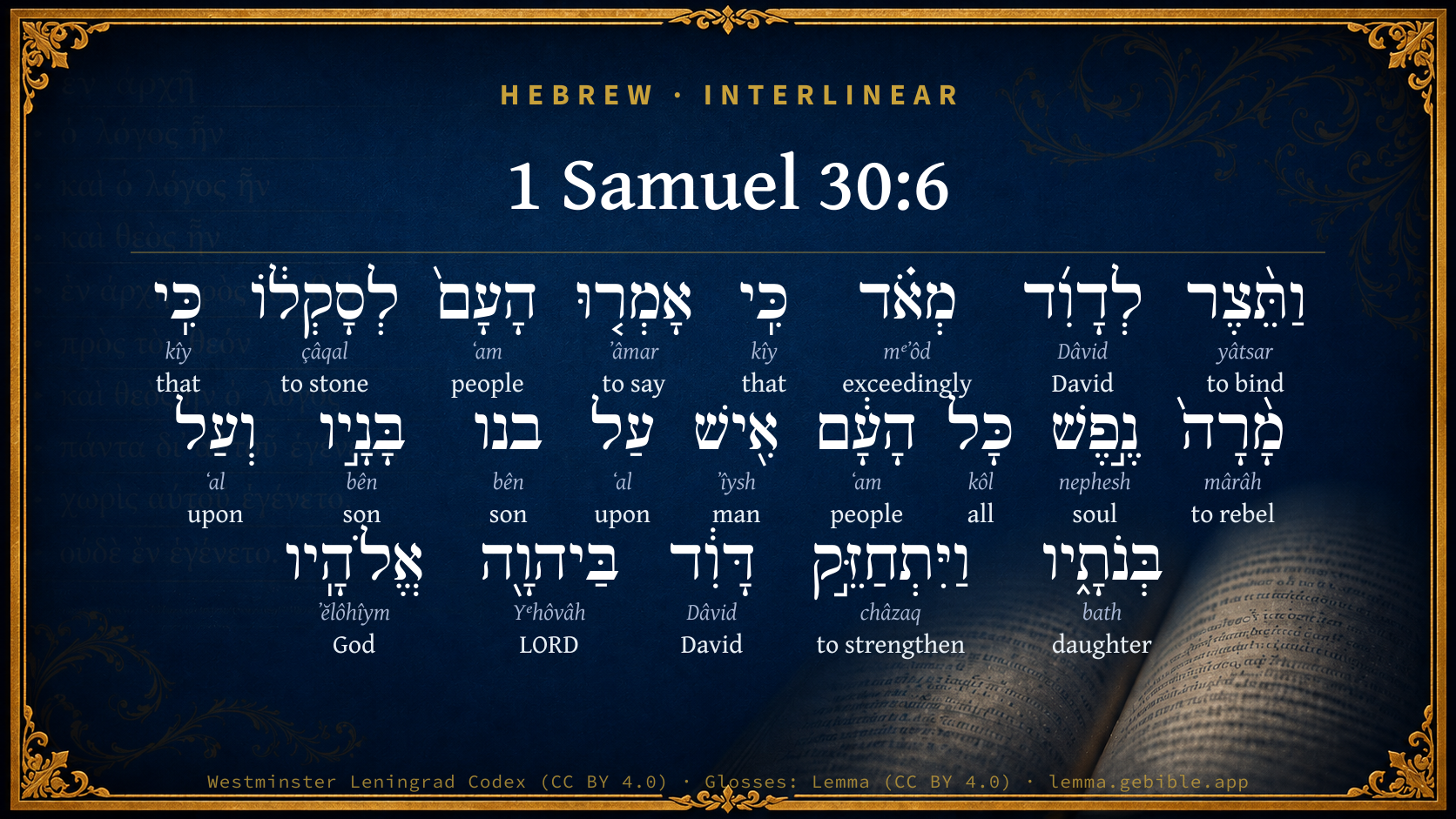
Hebrew (Westminster Leningrad Codex) 1 Samuel 30:6 appears in the Hebrew Old Testament. The text above is from the Westminster Leningrad Codex. Each word links to its Strong’s number, a concise gloss, and parsing drawn from the Open Scriptures Hebrew Bible morphology. Click any word for its full Brown-Driver-Briggs (BDB) entry.
Download image
Cite this verse

1 Samuel 30:6 (World English Bible). Public Domain. Lemma interlinear Bible study tool, https://lemma.gebible.app/v/1-samuel/30/6.

Show BibTeX & RIS
BibTeX
RIS
English Translation
David was greatly distressed; for the people spoke of stoning him, because the soul of all the people was grieved, every man for his sons and for his daughters: but David strengthened himself in Yahweh his God.
World English Bible · Public Domain
Download a study sheet

One document with this verse’s original text, its word-by-word gloss line, the meaning frame, cross-references with their text, attributed commentary, and full source and license credits — printable, and it pastes into notes with its structure intact.

This verse Autodidact and up

Study sheet (.html) Plain text (.txt)

A passage Seminary Student

Up to 50 verses in one chapter. A passage sheet keeps up to 6 commentary sources and 12 cross-references per verse, in the order this page ranks them, and says so on the sheet whenever that leaves anything out. Ask for a single verse and you get the Autodidact verse sheet above.

Everything on this page stays free to read, with no account — the sheet is a download of what is already on screen, not access to it.

Want to remove ads? Support Godless Engineer
Compare translations 3

The same verse in 3 English versions, stacked beneath the original-language interlinear above. Click any original word for its lexicon entry.

Each is an independent rendering of the whole verse — the interlinear is not word-aligned to these translations.

Highlighted words mark where these versions differ — a whole-verse word diff, not a word-by-word alignment.

  • World English Bible Public Domain
    David was greatly distressed; for the people spoke of stoning him, because the soul of all the people was grieved, every man for his sons and for his daughters: but David strengthened himself in Yahweh his God.
  • King James Version Public Domain
    And David was greatly distressed; for the people spake of stoning him, because the soul of all the people was grieved, every man for his sons and for his daughters: but David encouraged himself in the LORD his God.
  • unfoldingWord Literal Text CC BY-SA 4.0
    And it was very narrow to David, for the people said to stone him, for the soul of all of the people bitter, a man for his sons and for his daughters. But David strengthened himself in Yahweh his God.

unfoldingWord Literal Text — © unfoldingWord, licensed CC BY-SA 4.0. Word-aligned USFM3 via Door43 (git.door43.org/unfoldingWord/en_ult).

Versions to compare (up to 4)

3 of 4 selected

Show all 18 translations

Every available English version of this verse, each an independent rendering of the whole verse.

  • World English Bible Public Domain
    David was greatly distressed; for the people spoke of stoning him, because the soul of all the people was grieved, every man for his sons and for his daughters: but David strengthened himself in Yahweh his God.
  • Berean Standard Bible Public Domain
    And David was greatly distressed because the people spoke of stoning him, because the soul of every man grieved for his sons and daughters. But David found strength in the LORD his God.
  • Majority Standard Bible Public Domain
    And David was greatly distressed because the people spoke of stoning him, because the soul of every man grieved for his sons and daughters. But David found strength in the LORD his God.
  • King James Version Public Domain
    And David was greatly distressed; for the people spake of stoning him, because the soul of all the people was grieved, every man for his sons and for his daughters: but David encouraged himself in the LORD his God.
  • American Standard Version (1901) Public Domain
    And David was greatly distressed; for the people spake of stoning him, because the soul of all the people was grieved, every man for his sons and for his daughters: but David strengthened himself in Jehovah his God.
  • Revised Version (1885) Public Domain
    And David was greatly distressed; for the people spake of stoning him, because the soul of all the people was grieved, every man for his sons and for his daughters: but David strengthened himself in the LORD his God.
  • Geneva Bible (1599) Public Domain
    And Dauid was in great sorowe: for the people entended to stone him, because the heartes of all the people were vexed euery man for his sonnes and for his daughters: but Dauid comforted him selfe in the Lord his God.
  • Douay-Rheims (1899) Public Domain
    And David was greatly afflicted: for the people had a mind to stone him, for the soul of every man was bitterly grieved for his sons, and daughters: but David took courage in the Lord his God.
  • Young's Literal Translation Public Domain
    and David hath great distress, for the people have said to stone him, for the soul of all the people hath been bitter, each for his sons and for his daughters; and David doth strengthen himself in Jehovah his God.
  • Literal Standard Version CC BY-SA 4.0
    and David has great distress, for the people have said to stone him, for the soul of all the people has been bitter, each for his sons and for his daughters; and David strengthens himself in his God YHWH.
  • Unlocked Literal Bible CC BY-SA 4.0
    David was greatly distressed, for the people were talking about stoning him, for all the people were bitter in spirit, each man for his sons and daughters; but David strengthened himself in Yahweh, his God.
  • unfoldingWord Literal Text CC BY-SA 4.0
    And it was very narrow to David, for the people said to stone him, for the soul of all of the people bitter, a man for his sons and for his daughters. But David strengthened himself in Yahweh his God.
  • Darby Bible Public Domain
    And David was greatly distressed; for the people spoke of stoning him; for the soul of all the people was embittered, every man because of his sons and because of his daughters; but David strengthened himself in Jehovah his God.
  • World Messianic Bible Public Domain
    David was greatly distressed, for the people spoke of stoning him, because the souls of all the people were grieved, every man for his sons and for his daughters; but David strengthened himself in the LORD his God.
  • Webster's Bible Public Domain
    And David was greatly distressed: for the people spoke of stoning him, because the soul of all the people was grieved, every man for his sons, and for his daughters: but David encouraged himself in the LORD his God.
  • Free Bible Version CC BY-SA 4.0
    David was in a great deal of trouble, because the men were so upset over losing their children that they began to talk of stoning him. But trusting in the Lord his God,
  • Bible in Basic English Public Domain
    And David was greatly troubled; for the people were talking of stoning him, because their hearts were bitter, every man sorrowing for his sons and his daughters: but David made himself strong in the Lord his God.
  • JPS Tanakh (1917) Public Domain
    And David was greatly distressed; for the people spoke of stoning him, because the soul of all the people was grieved, every man for his sons and for his daughters; but David strengthened himself in the LORD his God.

Literal Standard Version (2020), Covenant Press — licensed CC BY-SA 4.0. Text via the HelloAO Bible API (eBible.org). Unlocked Literal Bible (unfoldingWord) — licensed CC BY-SA 4.0. Text via the HelloAO Bible API (eBible.org). unfoldingWord Literal Text — © unfoldingWord, licensed CC BY-SA 4.0. Word-aligned USFM3 via Door43 (git.door43.org/unfoldingWord/en_ult). Free Bible Version, Dr. Jonathan Gallagher — licensed CC BY-SA 4.0. Text via the HelloAO Bible API (eBible.org).

Word by word

More ways to search: Search by grammar → Find every occurrence → Compare this word →

Practice this passage: Drill this verse → Learn its vocabulary →

וַתֵּ֨צֶר
yâtsar
H3334
“and · to bind”
Conjunction + Verb, Qal, Sequential Imperfect, 3rd Person, Feminine, Singular
Part of Speech
Conjunction + Verb
Stem
Qal
Form
Sequential Imperfect
Person
3rd Person
Gender
Feminine
Number
Singular
Full BDB Definition

Origin: a primitive root

TWOT: 1973

to bind, be distressed, be in distress, be cramped, be narrow, be scant, be in straits, make narrow, cause distress, beseige - (Qal) to suffer distress
  1. לְדָוִ֜ד Dâvid H1732 “to/for · David” Preposition + Noun, Proper
  2. מְאֹ֗ד mᵉʼôd H3966 “exceedingly” Adverb
  3. כִּֽי kîy H3588 “that” Conjunction
  4. אָמְר֤וּ ʼâmar H559 “to say” Verb, Qal, Perfect, 3rd Person, Common, Plural
  5. הָעָם֙ ʻam H5971 “the · people” Particle, Definite Article + Noun, Common, Masculine, Singular, Absolute
  6. לְסָקְל֔וֹ çâqal H5619 “to stone · him” Preposition + Verb, Qal, Infinitive Construct + Suffix, Personal, 3rd Person, Masculine, Singular
  7. כִּֽי kîy H3588 “that” Conjunction
  8. מָ֨רָה֙ mârâh H4784 “to rebel” Verb, Qal, Perfect, 3rd Person, Feminine, Singular
  9. נֶ֣פֶשׁ nephesh H5315 “soul of” Noun, Common, Both, Singular, Construct
  10. כָּל kôl H3605 “all of” Noun, Common, Masculine, Singular, Construct
  11. הָעָ֔ם ʻam H5971 “the · people” Particle, Definite Article + Noun, Common, Masculine, Singular, Absolute
  12. אִ֖ישׁ ʼîysh H376 “man” Noun, Common, Masculine, Singular, Absolute
  13. עַל ʻal H5921 “upon” Preposition
  14. בנו bên H1121 “son · his” Noun, Common, Masculine, Singular, Construct + Suffix, Personal, 3rd Person, Masculine, Singular
  15. בָּנָ֣יו bên H1121 “sons · his” Noun, Common, Masculine, Plural, Construct + Suffix, Personal, 3rd Person, Masculine, Singular
  16. וְעַל ʻal H5921 “and · upon” Conjunction + Preposition
  17. בְּנֹתָ֑יו bath H1323 “daughters · his” Noun, Common, Feminine, Plural, Construct + Suffix, Personal, 3rd Person, Masculine, Singular
  18. וַיִּתְחַזֵּ֣ק châzaq H2388 “and · to strengthen” Conjunction + Verb, Hithpael, Sequential Imperfect, 3rd Person, Masculine, Singular
  19. דָּוִ֔ד Dâvid H1732 “David” Noun, Proper
  20. בַּיהוָ֖ה Yᵉhôvâh H3068 “in/at · LORD” Preposition + Noun, Proper
  21. אֱלֹהָֽיו ʼĕlôhîym H430 “God(s) · his” Noun, Common, Masculine, Plural, Construct + Suffix, Personal, 3rd Person, Masculine, Singular

About this verse

These counts appear in no published source. They are computed here, from the morphology-tagged text and Lemma’s own curated glosses. What Lemma adds →

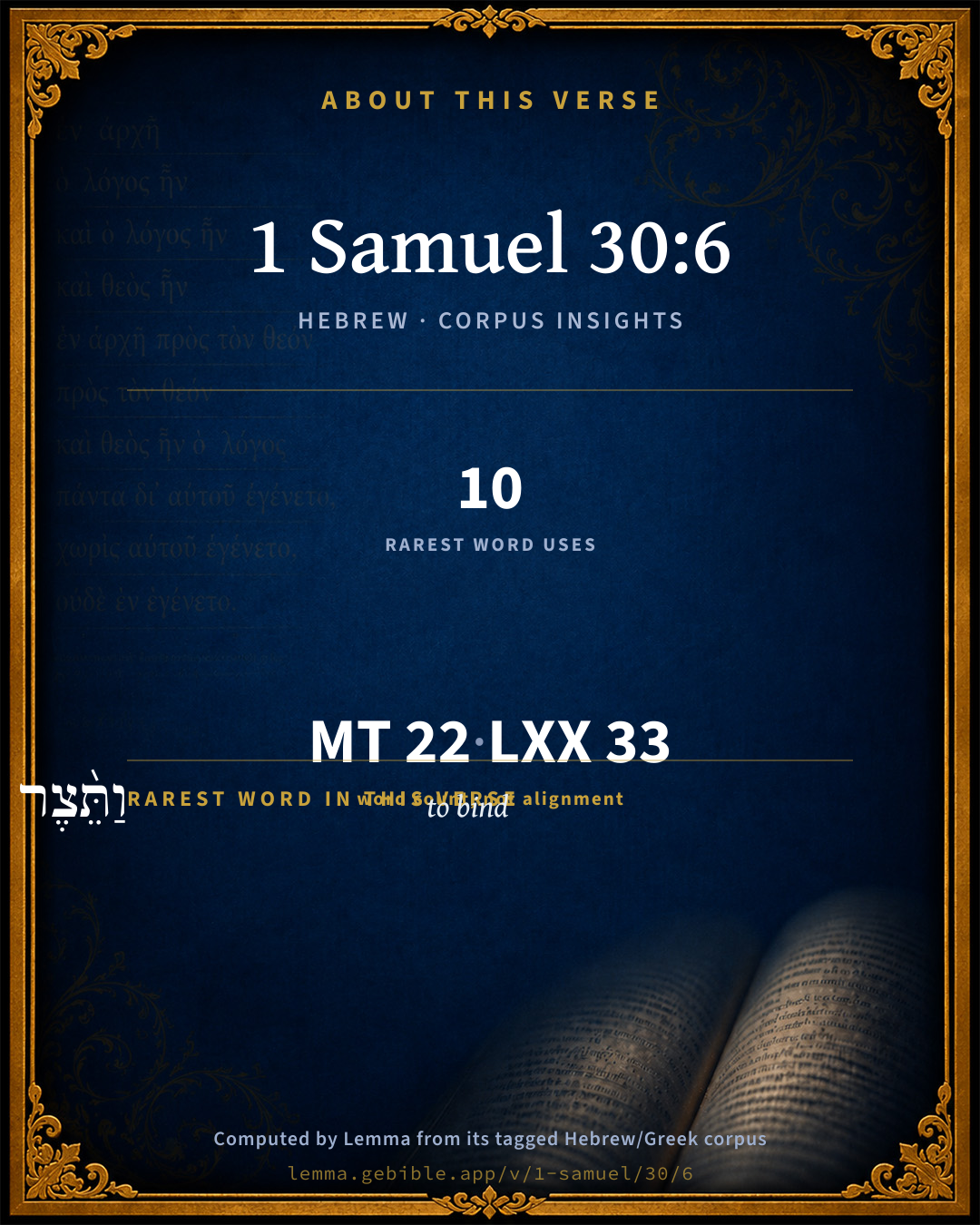
22
words
17
distinct lemmas
Historical
section

Notable vocabulary

The rarest word here is וַתֵּ֨צֶר to bind H3334 — appearing just 10 times in the whole Hebrew Bible.

Shared distinctive vocabulary

וַתֵּ֨צֶר to bind H3334 occurs in 10 verses of the Hebrew Bible. Also found in:

Grammatical profile

  • 5 verbs
  • 12 nouns
  • 2 prepositions
  • 2 conjunctions
  • 1 adverb

Verb forms

  • וַתֵּ֨צֶר Qal · Sequential Imperfect
  • אָמְר֤וּ Qal · Perfect
  • לְסָקְל֔וֹ Qal · Infinitive Construct
  • מָ֨רָה֙ Qal · Perfect
  • וַיִּתְחַזֵּ֣ק Hithpael · Sequential Imperfect

Repetition

Words recur within this verse — often emphatic in Hebrew:

  • לְדָוִ֜ד David H1732 ×2
  • הָעָם֙ people H5971 ×2
  • עַל upon H5921 ×2
  • בנו son H1121 ×2
  • כִּֽי that H3588 ×2

Hebrew & Septuagint length

In English translation the verse runs 37 words from the Hebrew and 37 from the Septuagint (LXX English) — the same length.

A rough comparison of the two English renderings, which tokenize alike — not a word-level alignment.

Word counts can differ between the Hebrew and the Greek without any difference in meaning — e.g. the Hebrew direct-object marker אֵת has no separate Greek word, and Greek often adds the article ὁ.

In the original languages it is 22 Hebrew tokens and 33 Greek tokens — but the two are counted differently (Hebrew bundles its prefixes and suffixes into one token; the Greek is in lemma form), so that isn’t a like-for-like length.

Cross-references

42

Topical passages linked to 1 Samuel 30:6 in the Treasury of Scripture Knowledge — connected by theme and wording, ordered by reader-vote popularity; previews shown in the World English Bible.

  • Psalms 56:3–4 When I am afraid, I will put my trust in you.
  • Psalms 56:11 I have put my trust in God. I will not be afraid. What can man do to me?
  • Psalms 62:5 My soul, wait in silence for God alone, For my expectation is from him.
  • Psalms 27:1–3 Yahweh is my light and my salvation. Whom shall I fear? Yahweh is the strength of my life. Of whom shall I be afraid?
  • Psalms 18:6 In my distress I called on Yahweh, And cried to my God. He heard my voice out of his temple, My cry before him came into his ears.
  • Psalms 25:17 The troubles of my heart are enlarged. Oh bring me out of my distresses.
  • Psalms 40:1–2 I waited patiently for Yahweh. He turned to me, and heard my cry.
  • Exodus 17:4 Moses cried to Yahweh, saying, "What shall I do with these people? They are almost ready to stone me."
  • Romans 8:31 What then shall we say about these things? If God is for us, who can be against us?
  • 2 Corinthians 1:8–10 For we don't desire to have you uninformed, brothers, concerning our affliction which happened to us in Asia, that we were weighed down exceedingly, beyond our power, so much that we despaired even of life.
  • Hebrews 13:6 So that with good courage we say, "The Lord is my helper. I will not fear. What can man do to me?"
  • Psalms 27:14 Wait for Yahweh. Be strong, and let your heart take courage. Yes, wait for Yahweh.
  • Psalms 42:11 Why are you in despair, my soul? Why are you disturbed within me? Hope in God! For I shall still praise him, The saving help of my countenance, and my God.
  • Psalms 62:8–9 Trust in him at all times, you people. Pour out your heart before him. God is a refuge for us. Selah.
  • Psalms 116:3–4 The cords of death surrounded me, The pains of Sheol got a hold of me. I found trouble and sorrow.
  • Psalms 116:10 I believed, therefore I said, "I was greatly afflicted."
  • Romans 4:18 Who in hope believed against hope, to the end that he might become a father of many nations, according to that which had been spoken, "So will your seed be."
  • Psalms 34:1–8 I will bless Yahweh at all times. His praise will always be in my mouth.
  • 2 Corinthians 4:8 We are pressed on every side, yet not crushed; perplexed, yet not to despair;
  • Numbers 14:10 But all the congregation bade stone them with stones. The glory of Yahweh appeared in the tent of meeting to all the children of Israel.
  • Psalms 118:8–13 It is better to take refuge in Yahweh, Than to put confidence in man.
  • John 8:59 Therefore they took up stones to throw at him, but Jesus was hidden, and went out of the temple, having gone through the midst of them, and so passed by.
  • 1 Samuel 1:10 She was in bitterness of soul, and prayed to Yahweh, and wept sore.
  • Proverbs 18:10 The name of Yahweh is a strong tower: The righteous run to him, and are safe.
  • 2 Corinthians 7:5 For even when we had come into Macedonia, our flesh had no relief, but we were afflicted on every side. Fightings were outside. Fear was inside.
  • Job 13:15 Behold, he will kill me; I have no hope. Nevertheless, I will maintain my ways before him.
  • Isaiah 37:14–20 Hezekiah received the letter from the hand of the messengers, and read it; and Hezekiah went up to the house of Yahweh, and spread it before Yahweh.
  • Genesis 32:7 Then Jacob was greatly afraid and was distressed: and he divided the people who were with him, and the flocks, and the herds, and the camels, into two companies;
  • Isaiah 25:4 For you have been a stronghold to the poor, a stronghold to the needy in his distress, a refuge from the storm, a shade from the heat, when the blast of the awesome ones is as a storm against the wall.
  • Matthew 21:9 The multitudes who went before him, and who followed kept shouting, "Hosanna to the son of David! Blessed is he who comes in the name of the Lord! Hosanna in the highest!"
  • Matthew 27:22 Pilate said to them, "What then shall I do to Jesus, who is called Christ?" They all said to him, "Let him be crucified!"
  • Romans 4:20 Yet, looking to the promise of God, he didn't waver through unbelief, but grew strong through faith, giving glory to God,
  • 2 Corinthians 1:6 But if we are afflicted, it is for your comfort and salvation. If we are comforted, it is for your comfort, which produces in you the patient enduring of the same sufferings which we also suffer.
  • Judges 18:25 The children of Dan said to him, "Don't let your voice be heard among us, lest angry fellows fall on you, and you lose your life, with the lives of your household."
  • 2 Samuel 17:8 Hushai said moreover, You know your father and his men, that they are mighty men, and they are fierce in their minds, as a bear robbed of her cubs in the field; and your father is a man of war, and will not lodge with the people.
  • Psalms 26:1–2 Judge me, Yahweh, for I have walked in my integrity. I have trusted also in Yahweh without wavering.
  • Psalms 42:7 Deep calls to deep at the noise of your waterfalls. All your waves and your billows have swept over me.
  • Psalms 62:1 My soul rests in God alone. My salvation is from him.
  • Jeremiah 16:19 Yahweh, my strength, and my stronghold, and my refuge in the day of affliction, to you shall the nations come from the ends of the earth, and shall say, Our fathers have inherited nothing but lies, [even] vanity and things in which there is no profit.
  • Habakkuk 3:17–18 For though the fig tree doesn't flourish, Nor fruit be in the vines; The labor of the olive fails, The fields yield no food; The flocks are cut off from the fold, And there is no herd in the stalls:
  • Psalms 42:5 Why are you in despair, my soul? Why are you disturbed within me? Hope in God! For I shall still praise him for the saving help of his presence.
  • 2 Kings 4:27 When she came to the man of God to the hill, she caught hold of his feet. Gehazi came near to thrust her away; but the man of God said, Let her alone: for her soul is vexed within her; and Yahweh has hid it from me, and has not told me.

Cross-references courtesy of OpenBible.info (CC BY 4.0).

Hebrew and Greek witnesses Masoretic Hebrew ↔ Greek Septuagint

The same verse in the two great witnesses to the Old Testament, shown verse-for-verse.

These are two independent witnesses, not word-aligned to each other, and the Septuagint is shown in lemma (dictionary) form.

Hebrew 1 Samuel 30:6 Masoretic · Westminster Leningrad Codex

וַתֵּ֨צֶר לְדָוִ֜ד מְאֹ֗ד כִּֽי אָמְר֤וּ הָעָם֙ לְסָקְל֔וֹ כִּֽי מָ֨רָה֙ נֶ֣פֶשׁ כָּל הָעָ֔ם אִ֖ישׁ עַל בנו בָּנָ֣יו וְעַל בְּנֹתָ֑יו וַיִּתְחַזֵּ֣ק דָּוִ֔ד בַּיהוָ֖ה אֱלֹהָֽיו

David was greatly distressed; for the people spoke of stoning him, because the soul of all the people was grieved, every man for his sons and for his daughters: but David strengthened himself in Yahweh his God.

World English Bible · Public Domain

Greek LXX 1 Samuel 30:6 Septuagint · lemma form

καί θλίβω δαυίδ σφόδρα ὅτι εἶπον ὁ λαός λιθοβολέω αὐτός ὅτι κατώδυνος ψυχή πᾶς ὁ λαός ἕκαστος ἐπί ὁ υἱός αὐτός καί ἐπί ὁ θυγάτηρ αὐτός καί κραταιόω δαυίδ ἐν κύριος θεός αὐτός

And David was greatly distressed, because the people spoke of stoning him, because the soul of all the people was grieved, each for his sons and his daughters: but David strengthened himself in the Lord his God.

LXX2012 (modern English Septuagint) · Public Domain

Hebrew: Westminster Leningrad Codex (CC BY 4.0). Greek: Septuagint (public domain); English from LXX2012 (modern English Septuagint) (Public Domain). How the Septuagint differs from the Hebrew →

Targum (Aramaic paraphrase)

1

The Targum is the ancient Jewish Aramaic paraphrase of the Hebrew Scriptures — an interpretive translation, not the Hebrew text itself. Onkelos (literal) and Pseudo-Jonathan (expansive) render the Torah, and Jonathan the Prophets. Coverage is partial: where no permissively-licensed English translation exists for a verse, only the Aramaic is shown. This is verse-level text, not a word-by-word alignment to the Hebrew.

  1. Targum Jonathan Prophets (Joshua–Malachi)
    וְעָקַת לְדָוִד לַחֲדָא אֲרֵי אֲמַרוּ עַמָא לְמִרְגְמֵיהּ אֲרֵי מָרַת נַפְשָׁא דְכָל עַמָא גְבַר עַל בְּנוֹהִי וְעַל בְּנָתֵיהּ וְאַתְקֵיף דָוִד בְּמֵימְרָא דַייָ אֱלָהֵיהּ:

    (no public-domain English translation for this verse)

    Targum Jonathan — Aramaic: “Mikraot Gedolot” (public domain). English: “Sefaria Community Translation” (CC0 1.0 (public-domain dedication)); “London "Chaldee Paraphrase," 1871” (public domain). Text via Sefaria.

Commentary

Notes on 1 Samuel 30:6 from classic Christian and Jewish commentators (each source and its license shown beneath its notes). The classic Christian expositions comment on the surrounding passage and are grouped to its opening verse, so a note may address several verses; the Jewish commentaries on the Tanakh (Rashi and others) are per-verse, so they appear only where the commentator wrote on this verse.

Lemma curates 59 commentaries, every one of them public domain or Creative Commons licensed, each selected and text-cleaned for this edition rather than reprinted as found. About our sources →

Jamieson, Fausset & Brown

Robert Jamieson, A. R. Fausset & David Brown

BUT DAVID, ENCOURAGED BY GOD, PURSUES THEM. (Sa1 30:6-15)

David was greatly distressed--He had reason, not only on his own personal account (Sa1 30:5), but on account of the vehement outcry and insurrectionary threats against him for having left the place so defenseless that the families of his men fell an unresisting prey to the enemy. Under the pressure of so unexpected and widespread a calamity, of which he was upbraided as the indirect occasion, the spirit of any other leader guided by ordinary motives would have sunk;

but David encouraged himself in the LORD his God--His faith supplied him with inward resources of comfort and energy, and through the seasonable inquiries he made by Urim, he inspired confidence by ordering an immediate pursuit of the plunderers.

Jamieson, Fausset & Brown — Commentary Critical and Explanatory on the Whole Bible (1871) — public domain (CC PDM 1.0). Text via the HelloAO Bible API.

Trapp's Complete Commentary

John Trapp

1Sa 30:6 And David was greatly distressed; for the people spake of stoning him, because the soul of all the people was grieved, every man for his sons and for his daughters: but David encouraged himself in the LORD his God.

Ver. 6. And David was greatly distressed.] So that he knew not which way to look, but heavenward. See 1Sa 30:3.

For the people spake of stoning him.] As the chief cause of their calamity, by carrying them all after Achish to no purpose; whereby their city was exposed to the spoil of the enemy.

Because the soul of all the people was grieved.] Imbittered and enraged; their great losses had put them into an anger, and David into danger.

But David encouraged himself in the Lord his God.] He ran to his cordial. Virtus lecythos habet in malis, he turned into his counting house, and there saw himself well stored, and well underlaid, as we say. He had that which supported him in the fail of outward comforts - viz., the power, promises, and fatherly providence of God; who is here called his God, as being in covenant with him, never to fail him nor forsake him. No marvel that God remembereth David in all his troubles, since David did in all his troubles thus remember his God. If Saul could have done thus, he would never have been his own death’s man. See Hab 3:17-18. {See Trapp on "Hab 3:17"} {See Trapp on "Hab 3:18"}

John Trapp, A Commentary or Exposition upon All the Books of the Old and New Testament (1647–1656) — public domain. Text from a community e-Sword module.

The Biblical Illustrator

Joseph S. Exell

1Sa_30:6

David encouraged himself in the Lord his God.

David encouraging himself in God

I. Davids distress.

1. David was greatly distressed, for he had been acting without consulting his God. Perhaps some of you are in distress in the same way: you have chosen your own path, and now you are caught in the tangled bushes which tear your flesh. You have carved for yourselves, and you have cut your own fingers; you have obtained your hearts desire, and while the meat is yet in your mouth a curse has come with it. You say you did it for the best; ay, but it has turned out to be for the worst.

2. Worse than this, if worse can be, David had also followed policy instead of truth. The Oriental mind was, and probably still is, given to lying. Easterns do not think it wrong to tell an untruth; many do it habitually. Just as an upright merchant in this country would not be suspected of a falsehood, so you would not in the olden time have suspected the average Oriental of ever speaking the truth if he could help it, because he felt that everybody else would deceive him, and so he must practise great cunning. The golden rule in Davids day was, Do others, for others will certainly do you.

3. Yet was his distress the more severe on another account, for David had sided with the enemies of the Lords people.

4. Picture the position of David, in the centre of his band. He has been driven away by the Philistine lords with words of contempt; his men have been sneered at--What do these Hebrews here? Is not this David? What do these Hebrews here? is the sarcastic question of the world. How comes a professing Christian to be acting as we do?

5. At the back of this came bereavement. His wives were gone.

II. Davids encouragement: And David encouraged himself. That is well, Davids He did not at first attempt to encourage anybody else; but he encouraged himself. Some of the best talks in the world are those which a man has with himself. He who speaks to everybody except himself is a great fool. I think I hear David say, Why art thou cast down, O my soul, and why art thou disquieted within me? hope thou in God; for I will yet praise him. David encouraged himself. But he encouraged himself in the Lord his God, namely, in Jehovah. That is the surest way of encouraging yourself. David might have drawn, if he had pleased, a measure of encouragement from those valiant men who joined him just about this particular time; for it happened, according to 1Ch_12:19-20, that many united with his band at that hour. If you are in trouble, and your trouble is mixed with sin, if you have afflicted yourselves by your backslidings and perversities, nevertheless I pray you look nowhere else for help but to the God whom you have offended. When He lilts his arm, as it were, to execute vengeance, lay hold upon it and He will spare you. Does he not, Himself say, Let him lay hold on My strength? I remember old Master Quarles has a strange picture of one trying to strike another with a flail, and how does the other escape? Why, he runs in and keeps close, and so he is not struck. It is the very thing to do. Close in with God. Cling to Him by faith: hold fast by Him in hope. Say, Though He slay me, yet will I terror in Him. Resolve, I will not let Thee go. Let us try to conceive of the way in which David would encourage Himself in the Lord his God.

1. Standing amidst those ruins he would say, Yet the Lord does love me, and I love Him.

2. Then he went further, and argued, Hath not the Lord chosen me? Has He not ordained me to be king in Israel? Do you need an interpretation of this parable? Can you not see its application to yourselves?

3. Then he would go over all the past deliverances which he had experienced.

III. David enquiring of God.

1. Observe, that David takes it for granted that his God is going to help him. He only wants to know how it is to he done. Shall I pursue? shall I overtake?

2. It is to be remarked, however, that David does not expect that God is going to help him without his doing his best. He enquires, Shall I pursue? shall I overtake?

3. David also distrusted his own strength, though quite ready to use what he had; for he said, Shall I overtake? Can my men march fast enough to overtake these robbers?

IV. Davids answer of peace. The Lord heard his supplication. He says, In my distress I cried unto the Lord and He heard me. Trust in the Lord your God. Believe also in his Son Jesus. Get rid of sham faith, and really believe. Get rid of a professional faith, and trust in the Lord at all times, about everything. (C. H. Spurgeon.)

David encouraging himself in God

I. He encouraged himself in the Lord his God--that is what he is said to have done.

1. In the Lord, observe. The first step towards real comfort in real sorrow is to feel it must come from God, and the next is to raise up our minds to God; to get them above the things which are distressing us.

2. The Lord, observe again--Jehovah, as the capital letters in our Bibles indicate; the self-existent, everlasting, unchangeable, unlimited, all-sufficient God.

3. But a material point to be noticed here is Davids connection with this high Being. It was the Lord his God, in whom he encouraged himself. It implies clearly an acquaintance with God, some previous intercourse with him, and a connection formed between him and the soul.

(1) What he did is opposed to two things--first, to despondency in trouble, to a giving of ourselves up in it to inaction and despair.

(2) And this conduct of David is opposed also to a torpid waiting in affliction for comfort. He did not stand still, observe, for God to encourage him, he set about encouraging himself in God.

II. Now let us look at the difficult circumstances under which David did what is here ascribed to him. The text itself draws our attention to these. But David encouraged himself in the Lord his God; he did so notwithstanding the circumstances in which he was placed.

1. Notwithstanding his great sorrow and distress. We sometimes think that soldiers have not hearts, but we cannot read this chapter and think so. The men on their return to their desolated homes were overwhelmed with grief. The loss of their wives and children completely unmanned them.

2. David encouraged himself in the Lord notwithstanding his sinfulness. We are not told so, but there must have been a voice there which said, All this is my own doing. It is all the fruit of my own folly and sin. Had I but trusted my God and remained in Judah, or even had I stayed here in Ziklag, this would not have come to pass. He did not simply make an effort to encourage himself, he actually encouraged himself, found encouragement for himself, in the Lord his God. It must have been in some such moment as this that he first felt, if not said, I know, O Lord, that Thy judgments are right, and that Their in faithfulness has afflicted me. (C. Bradley, M. A.)

The secret of courage

Now the first thing I notice is

I. The grand assurance which this man gripped fast. It is not by accident, nor if it a mere piece of tautology, that we read the Lord his God. For, if you will remember, the very keynote of the psalms which are ascribed to David is just that expression, My God, My God. So far as the very fragmentary records of Jewish literature go, it would appear as if David was the very first of all the ancient singers to grapple that thought that he stood in a personal, individual relation to God, and God to him. And so it was his God that he laid hold of at that dark hour. Now I am not putting too much into a little word when I insist upon it that the very essence and nerve of what strengthened the king, at that supreme moment of desolation, was the, conviction that welled up in his heart that, in spite of it all, he had a grip of God a hand as his very own, and God had hold of him, I would not go to the length of saying that the living realisation, in heart and mind, of this personal possession of God is the difference between a traditional sad vague profession of religion and a vital possession of religion, but if it is not the difference, it goes a long way towards explaining the difference. The man who contents himself with the generality of a Gospel for the world, and who can say no more than that Jesus Christ died for all, has yet to learn the most intimate sweetness, and the most quickening and transforming power, of that Gospel, and he only learns it when he says, Who loved me, and gave himself for me.

II. The sufficiency of this one conviction and assurance. Here is one of the many eloquent buts of the Bible. On the one hand is piled up a black heap of calamities, loss, treachery, and peril; and opposed to them is only that one clause: But David encouraged himself in the Lord his God. God is enough: whatever else may go. The Lord his God was the sufficient portion for this man when he stood a homeless pauper. So for poverty, loss, the blasting of earthly hopes, the crushing of earthly affections, the extremity of danger, and the utmost threatening of death, here is the sufficient remedy--that one mighty assurance: The Lord is my God. For if He is the strength of my heart he will be my portion foreverse He is not poor who has God for his, nor does he wander with a hungry heart who can rest his heart on Gods; nor need he fear death who possesses God, and in Him eternal life. You never know the good of the breakwater until the storm is rolling the waves against its outer side. Put a little candle in a room, and you will not see the lightning when it flashes outside, however stormy the sky, and seamed with the fiery darts. If we have God in our hearts, we have enough for courage and for strength.

III. The effort by which this assurance is attained and sustained. The words of the original convey even more forcibly than those of our translation the thought of Davids own action in securing him the hold of God as his. He strengthened himself in the Lord his God. The Hebrew conveys the notion of effort, persistent and continuous; and it tells us this, that when things are as black as they were round David at that hour--it is not a matter of course, even for a good man, that there shall well up in his heart this tranquillising and victorious conviction; but he has to set himself to reach and to keep it. God will give it, but he will not give it unless the man strains after it. He strengthened himself in the Lord, and if he had not set doggedly about resisting the pressure of circumstances, and flinging himself as it were, by am effort, into the arms of God, circumstances would have been too many for him, and despair would have shrouded his soul. In the darkest moment it is possible for a man to surround himself with Gods light, but even in the brightest it is not possible to do so unless he makes a serious effete. That effort may consist mainly in two things. One is that we shall honestly try to occupy our minds, as well as our hearts, with the truth which certifies to us that God is, in very deed, ours. If we never think, or think languidly and rarely, about what God has revealed to us by the Word and life and death and intercession of Jesus Christ, concerning Himself, His heart of love towards us, and His relations to us, then we shall not have, either in the time of disaster or of joy, the blessed sense that He is indeed ours if a man will not think about Christian truth he will not have the blessedness of Christian possession of God. There is no mystery about the road to the sweetness and holiness and power that may belong to a Christian. The only way to get them is to be occupied, far more than most of us are, with the plain truths of Gods revelation in Jesus Christ. If you can never think about them they cannot affect you, and they will not make you sure that God is yours. There is another thing which we have to make an effort to do, if we would have the blessedness of this conviction filling and flooding oar hearts. For the possession is reciprocal; we say, My God, and He says, My people. Unless we yield ourselves to Him and say, I am Thine, we shall never be able to say, Thou art mine. We must recognise His possession of us; we must yield ourselves; we must obey; we must elect Him as our chief good, we must feel that we are not our own, but bought with a price. And then when we look up into the heavens thus submissive, thus obedient, thus owning His authority, and His rights, as well as claiming His love and His tenderness, and cry; My Father, He will bend down and whisper into our hearts: Thou art My beloved son. Then we shall be strong, and of a good courage, however weak and timid, and we shall be rich, though, like David, we have lost all things. (A. Maclaren, D. D.)

Features of Davids faith

I. The reality of Davids faith. It proved its reality by its power to enhearten him. It inspired him with courage; it rallied the scattered, prostrated powers of his soul; it opened a pathway of hope for him; it braced him for the necessities of the occasion.

II. This leads us to remark upon the sufficiency of Davids faith. You may have a strong impression that in certain you shall be helped, delivered, but the impression may be all a delusion, the baseless fabric of a vision, a hallucination of the mind. Davids faith was real subjectively, because it was sufficiently well-grounded objectively. He encouraged himself in the Lord his God. Faith separated from an adequate object is powerless; inspired by such an object--there is but One--it is mighty, puts heart into the weak, puts enthusiasm into the hopeless, laying hem upon God it is omnipotent.

III. Another feature of Davids faith is its activity, its energy. David bestirred himself to appropriate the strength which the Object of his faith, and his faith in that Object, were calculated to inspire. He encouraged himself in the Lord his God. What a blessed art this of self-encouragement in God. There is an attitude of faith which is passive. The language of its triumph then is the meek, Thy will be done. But faith is active, lively. This is its characteristic feature.

IV. Let us not forget the practical character of Davids faith (from 5:7). It was no time to lie upon the earth; there was something to be done, and done at once. Davids faith gave shape and force to his action. He calls for the ephod, enquires of the Lord, obtains a favourable response, pursues the Amalekites, rescues the captives, inflicts a crushing blow upon the captors. Application:--Nil desperandum! We may encourage ourselves and one another in the Lord our God. He is ours if we will but accept Him. In Jesus Christ He is our Lord and our God. And if we are thus to encourage ourselves, we should maintain a spirit of calm equanimity. (Joseph Morris.)

The Biblical Illustrator, edited by Joseph S. Exell (c. 1880s–1900s) — public domain. Text from a community e-Sword module.

Joseph Benson's Commentary

1Sa 30:6. The people spake of stoning him — As the cause of this calamity, by coming to Ziklag at first, by provoking the Amalekites so grievously as he had done, and by his forwardness in marching away with Achish, and leaving the town, their wives and children unguarded. But David encouraged himself in the Lord his God — Who had never failed him in his greatest distresses; and in whom he still had confidence. He encouraged himself — By believing that this all-wise and all-powerful Lord was his God by covenant and special promise, and fatherly affection, as he had showed himself to be in the whole course of his providence toward him. It is the duty of all good men, whatever happens, to encourage themselves in the Lord their God, assuring themselves that he both can and will bring light out of darkness.

Joseph Benson's Commentary on the Old and New Testaments (1811–1818) — public domain. Text from a community e-Sword module.

MacLaren's Expositions of Holy Scripture

Alexander MacLaren

1 Samuel

THE SECRET OF COURAGE

1Sa 30:6.

David was at perhaps the very lowest ebb of his fortunes. He had long been a wandering outlaw, and had finally been driven, by Saul’s persistent hostility, to take refuge in the Philistines’ country. He had gathered around himself a band of desperate men, and was living very much like a freebooter. He had found refuge in a little city of the Philistines, far down in the South, from which he and his men had marched as a contingent in the Philistine army, which was preparing an attack upon Saul. But, naturally, the Philistine soldiers doubted their ally, and he was obliged to take himself and his troops back again to their temporary home.

When he came there it was a heap of smoking ruins. Everything was gone; property, cattle, wives, children-and all was desolation. His turbulent followers rose against him, a mutiny broke out-a dangerous thing amongst such a crew-and they were ready to stone him. And at that moment what did he do? Nothing. Was he cast down? No. Was he agitated? No. ‘But David encouraged himself in the Lord his God.’

Now the first thing I notice is

I. The grand assurance which this man gripped fast at such a time.

It is not by accident, nor is it a mere piece of tautology, that we read ‘the Lord his God.’ For, if you will remember, the very keynote of the psalms which are ascribed to David is just that expression, ‘My God,’ ‘My God.’ So far as the very fragmentary records of Jewish literature go, it would appear as if David was the very first of all the ancient singers to grapple that thought that he stood in a personal, individual relation to God, and God to him. And so it was his God that he laid hold of at that dark hour.

Now I am not putting too much into a little word when I insist upon it that the very essence and nerve of what strengthened David, at that supreme moment of desolation, was the conviction that welled up in his heart that, in spite of it all, he had a grip of God’s hand as his very own, and God had hold of him. Just think of the difference between the attitude of mind and heart expressed in the names that were more familiar to the Israelitish people, and this name for Jehovah. ‘The God of Israel’-that is wide, general; and a man might use it and yet fail to feel that it implied that each individual of the community stood by himself in a personal relation to God. But David penetrated through the broad, general thought, and got into the heart of the matter. It was not enough for him, in his time of need, to stay himself upon a vague universal goodness, but he had to clasp to his burdened heart the individualising thought, ‘the God of Israel is my God.’

Think, too, of the contrast of the thoughts and emotions suggested by ‘My God,’ and by ‘the God of Abraham, and of Isaac, and of Jacob.’ Great as that name is, it carries the mind away back into the past, and speaks of a historical relation in former days, which may or may not continue in all its tenderness and sweetness and power into the prosaic present. But when a man feels, not only ‘the God of Jacob is our Refuge,’ but, ‘the God of Jacob is my God,’ then the whole thing flashes up into new power. ‘My sun’-will one man claim property in that great luminary that pours its light down on the whole world? Yes.

‘The sun whose beams most glorious are,

Disdaineth no beholder,’

as the old song has it. Each man’s eye receives the straight impact of its universal beams. It is my sun, though it be the light that lightens all men that come into the world. ‘My atmosphere’-will one man claim the free, unappropriated winds of heaven as his? Yes, for they will pour into his lungs; and yet his brother will be none the poorer.

I would not go the length of saying that the living realisation, in heart and mind, of this personal possession of God is the difference between a traditional and vague profession of religion and a vital possession of religion, but if it is not the difference, it goes a long way towards explaining the difference. The man who contents himself with the generality of a Gospel for the world, and who can say no more than that Jesus Christ died for all, has yet to learn the most intimate sweetness, and the most quickening and transforming power, of that Gospel, and he only learns it when he says, ‘Who loved me, and gave Himself for me.’

So do not let us be content with saying, ‘the God of Israel,’ and its many thousands, or ‘the God of Abraham, and of Isaac, and of Jacob,’ who filled the past with His lustre, but let us bring the general good into our own houses, as men might draw the waters of Niagara into their homes through pipes, and let us cry: ‘My Lord and my God!’ ‘David encouraged himself in the Lord his God.’

II. Now note, secondly, the sufficiency of this one conviction and assurance.

Here is one of the many eloquent ‘buts’ of the Bible. On the one hand is piled up a black heap of calamities, loss, treachery and peril; and opposed to them is only that one clause: ‘But David encouraged himself in the Lord his God.’ There was only one possession in all the world, except his body and the clothes that he stood in, that he could call his own at that moment. Everything else was gone; his property was carried off by raiders, his home was smouldering embers. But the Amalekites had not stolen God from him. Though he could no longer say, ‘My house, my city, my possessions,’ he could say, ‘My God.’ Whatever else we lose, as long as we have Him we are rich; and whatever else we possess, we are poor as long as we have not Him. God is enough; whatever else may go. The Lord his God was the sufficient portion for this man when he stood a homeless pauper. He had lost everything that his heart clung to; wives, children; Abigail and Abinoam were captives in the arms of some Amalekites; his house was left to him desolate; his heart was bleeding. ‘But David encouraged himself in the Lord his God’ and the bleeding heart was stanched, and the yearning for some one to love and be loved by was satisfied, when he turned himself from the desolation of earth to the riches in the heavens. He was standing on the edge of possible death, for his followers were ready to stone him. He had come through many perils in the past, but he had never been nearer a fatal end than he was at that moment. But the thought of the undying Friend lifted him buoyantly above the dread of death, and he could look with an unwinking eye right into the fleshless eye-sockets of the skeleton, and say, ‘I fear no evil, for Thou art with me.’

So for poverty, loss, the blasting of earthly hopes, the crushing of earthly affections, the extremity of danger, and the utmost threatening of death, here is the sufficient remedy-that one mighty assurance: ‘The Lord is my God.’ For if He is ‘the strength of my heart,’ He will be my portion for ever.’ He is not poor who has God for his, nor does he wander with a hungry heart who can rest his heart on God’s; nor need he fear death who possesses God, and in Him eternal life.

So, brethren, in all our changing circumstances, there is more than enough for us in that sweet, simple, strong thought. The end of sorrow {that is to say, the purpose thereof} is to breed in us the conviction that God is ours, to drive us to Him by lack of all beside; and the end of sorrow {that is to say, the termination thereof} is the kindling in our hearts of the light of that blessed assurance, for with Him we shall fear no evil. You never know the good of the breakwater until the storm is rolling the waves against its outer side. Light a little candle in a room, and you will not see the lightning when it flashes outside, however stormy the sky, and seamed with the fiery darts. If we have God in our hearts, we have enough for courage and for strength.

I need not remind you, I suppose, how this darkest moment of David’s fortunes was the moment at which the darkness broke. Three days after this emeute of his turbulent followers, there came a fugitive into the camp with news that Saul was dead and David was king. So it was not in vain that he had ‘strengthened himself in the Lord his God.’ Our ‘light affliction which is but for a moment’ leads on to a manifestation of the true power of God our Friend, and to the breaking of the day.

III. And now the last thing to be noted is the effort by which this assurance is attained and sustained.

The words of the original convey even more forcibly than those of our translation the thought of David’s own action in securing him the hold of God as his. He ‘strengthened himself in the Lord his God.’ The Hebrew conveys the notion of effort, persistent and continuous; and it tells us this, that when things are as black as they were round David at that hour-it is not a matter of course, even for a good man, that there shall well up in his heart this tranquillising and victorious conviction; but he has to set himself to reach and to keep it. God will give it, but He will not give it unless the man strains after it. David ‘strengthened himself in the Lord,’ and if he had not doggedly set about resisting the pressure of circumstances, and flinging himself as it were, by an effort, into the arms of God, circumstances would have been too strong for him, and despair would have shrouded his soul. In the darkest moment it is possible for a man to surround himself with God’s light, but even in the brightest it is not possible to do so unless he makes a serious effort.

That effort must consist mainly in two things. One is that we shall honestly try to occupy our minds, as well as our hearts, with the truth which certifies to us that God is, in very deed, ours. If we never think, or think languidly and rarely, about what God has revealed to us, by the word and life and death and intercession of Jesus Christ, concerning Himself, His heart of love towards us, and His relations to us, then we shall not have, either in the time of disaster or of joy, the blessed sense that He is indeed ours. If a man will not think about Christian truth he will not have the blessedness of Christian possession of God. There is no mystery about the road to the sweetness and holiness and power that may belong to a Christian. The only way to win them is to be occupied, far more than most of us are, with the plain truths of God’s revelation in Jesus Christ. If you never think about them they cannot affect you, and they will not make you sure that God is yours.

But we cannot occupy ourselves with these truths unless we have a distinct and resolute purpose running through our lives, of averting our eyes from the things that might make us lose sight of them and of Him. David had his choice. He could either, as a great many of us do, stand there and look, and look, and look, and see nothing but his disasters, or he could look past them; and see beyond them God. Peter had his choice whether he would look at the water, or whether he would look at Jesus Christ. He chose to look at the water; ‘and when he saw the wind boisterous he began to sink’-of course, and when he looked at Christ and cried: ‘Lord, save me!’ he was held up-equally of course. Make the effort not to let the sorrowful things, or the difficult things, or the fearful things, or the joyous things, in your life, absorb you, but turn away, and, as the writer of the Epistle to the Hebrews says, in another connection, ‘look off unto Jesus, the Author and Finisher of faith.’ David had to put constraint upon himself, to admit any other thoughts into his mind than those that were pressed into it by the facts before his eyes; but he put on the constraint, and so he was encouraged because he encouraged himself.

There is another thing which we have to make an effort to do, if we would have the blessedness of this conviction filling and flooding our hearts. For the possession is reciprocal; we say, ‘My God,’ and He says, ‘My people.’ Unless we yield ourselves to Him and say, ‘I am Thine,’ we shall never be able to say, ‘Thou art mine.’ We must recognise His possession of us; we must yield ourselves; we must obey; we must elect Him as our chief good, we must feel that we are not our own, but bought with a price. And then when we look up into the heavens thus submissive, thus obedient, thus owning His authority and His rights, as well as claiming His love and His tenderness, and cry: ‘My Father,’ He will bend down and whisper into our hearts: ‘Thou art My beloved son.’ Then we shall be ‘strong, and of a good courage,’ however weak and timid, and we shall be rich, though, like David, we have lost all things.

Alexander MacLaren, Expositions of Holy Scripture (1904–1910) — public domain. Text from a community e-Sword module.

Tyndale Open Study Notes

Tyndale Open Resources

30:6 in great danger: Saul had used the same expression about himself: When “in deep trouble” (28:15), Saul turned to necromancy, with disastrous results. David, by contrast, found strength and success in the Lord his God.

Tyndale Open Study Notes — © Tyndale Open Resources, licensed CC BY-SA 4.0. Text via the HelloAO Bible API.

Geneva Bible (1599)

Geneva Bible translators

Thus we see that in troubles and adversity we do not consider God’s providence, but like raging beasts forget both our own duty, and contemn God’s appointment over us.

Geneva Bible (1599) marginal notes — public domain. Text via Bolls.life.

Adam Clarke's Commentary

Verse 6. The people spake of stoning him] David had done much to civilize those men; but we find by this of what an unruly and ferocious spirit they were; and yet they strongly felt the ties of natural affection, they "grieved every man for his sons and for his daughters."

David encouraged himself in the Lord] He found he could place very little confidence in his men; and, as he was conscious that this evil had not happened either through his neglect or folly, he saw he might the more confidently expect succour from his Maker.

Adam Clarke's Commentary on the Bible (1810–1826) — public domain. Text from a community e-Sword/MySword module.

Ellicott's Commentary for English Readers

(6) For the people spake of stoning him.—Probably the discontent and anger of the people had been previously aroused by David’s close connection with Achish, which had entailed upon these valiant Israelites the bitter degradation of having had to march against their own countrymen under the banner of the Philistine King of Gath; and now, finding that David had neglected to provide against the Amalekite raid, their pent-up fury thus displayed itself. Then David, we shall see, threw himself, with all his old perfect trustfulness, upon the mercy of his God.

But David encouraged himself in the Lord his God.—He encouraged himself in prayer, thus casting himself and his fortunes on the God who, years before, had chosen him to be “His anointed.” It was this trust, as we have before seen in his own case, in the case, too, of Jonathan, as it had been in old days with all the heroes of Israel—this perfect, childlike, implicit trust in the “Glorious Arm”—which had been the source of the marvellous success of the chosen people. When they forgot the invisible King, who for His own great purposes had chosen them, their fortunes at once declined; they fell to the level, and often below the level, of the surrounding nations. We have many conspicuous examples of this; for instance, in the lives of Samson and Saul, how, when with weeping and with mourning, they returned to their allegiance, and again leaned on the “Arm,” success and victory returned to them. This is what happened now to David at Ziklag, while about the same time Saul, alone and distrustful, fought and fell on the bloody day of Gilboa. David, with the help of his God, on whose mercy he had thrown himself, obtained his brilliant success over Amalek, and restored his prestige not only among his own immediate followers, but through all the cities and villages of Southern Canaan.

A Bible Commentary for English Readers, edited by Charles John Ellicott (1878–1897) — public domain. Text from a community e-Sword module.

The Cambridge Bible for Schools and Colleges

gen. ed. J. J. S. Perowne

6. spake of stoning him] Cp. Exo_17:4; Num_14:10. They laid the blame on him, because he had left no force to guard Ziklag.

was grieved] Was exasperated, lit. “was bitter.” Cp. 1Sa_22:2.

encouraged himself] Strengthened himself. Cp. 1Sa_23:16; Eph_6:10; and many of the Psalms, e.g. Psa_18:2, Psa_27:14, Psa_31:1 ff., Psa_31:24, &c.

The Cambridge Bible for Schools and Colleges (gen. ed. J. J. S. Perowne; Cambridge University Press, 1878–1918) — public domain. Text from a community e-Sword module.

John Gill's Exposition

And David was greatly distressed,.... Partly for the loss of his two wives, and partly because of the mutiny and murmuring of his men:

for the people spake of stoning him; as the Israelites did of Moses and Aaron, Num 14:10; the reason of this was, because, as they judged, it was owing to David that they went along with Achish, and left the city defenceless, and because he had provoked the Amalekites by his inroad upon them, who took this opportunity of avenging themselves. Abarbinel is of opinion that it was his excess of sorrow for his two wives, and his remissness and backwardness to take vengeance on their enemies, that provoked them, and put them on talking after this manner:

because the soul of all the people was grieved, every man for his sons and for his daughters; as well as David; and they were very desirous of recovering them if possible, and of taking vengeance on those who had carried them captive:

but David encouraged himself in the Lord his God; took all patiently, and exercised faith on his God; he encouraged himself in the power and providence of God; in the promises of God, and his faithfulness in keeping them; in a view of his covenant relation to God; in remembrance of the grace, mercy, and goodness of God, and his former experiences of it; hoping and believing that God would appear for him in some way or another, and work salvation for him. The Targum is,"he strengthened himself in the Word of the Lord his God;''in Christ the Word of God, and in the power of his might, and in the grace that is in him, Eph 6:10.

John Gill's Exposition of the Whole Bible (1746–1763) — public domain (CC PDM 1.0). Text via the HelloAO Bible API.

Haydock's Catholic Bible Commentary

Stone him, as the author of all their losses, because he had not left a sufficient garrison at Siceleg, and had irritated the Amalecites. Inconstant people! they thought that he we indebted to them for all that he possessed! (Calmet) --- David, without being too much dejected, sought out for an immediate remedy, and led them on to battle. Their ancestors had once threatened to stone Moses, Exodus xvii., &c. (Tirinus)

George Leo Haydock (1774–1849), Haydock's Catholic Family Bible and Commentary, 1859 edition — public domain. Excludes Psalms (Douay-Rheims chapter numbering differs from Protestant) and Deuterocanonical books (Catholic canon only).

Matthew Poole's English Annotations

The people spake of stoning him, as the author of their miseries, by coming to Ziklag at first, by provoking the Amalekites to this cruelty, by his forwardness in marching away with Achish, and leaving their wives and children unguarded.

In the Lord his God, i.e. in this, that the all-wise and all-powerful Lord was his God by covenant relation, and special promise, and true and fatherly affection, as he had showed himself to be in the whole course of his providence towards him.

Matthew Poole's English Annotations on the Holy Bible (1683–1685) — public domain. Text from a community e-Sword/MySword module.

Whedon's Commentary on the Bible

Daniel D. Whedon

6. The people spake of stoning him — They may have thought at first that David’s readiness to go to the war with Achish was unwise, and now as they felt their loss, they blamed him as the cause of all, and in the emotion of the hour were ready to mutiny. This was not strange when we consider the antecedents of many of these men. See 1Sa_22:2.

David encouraged himself in the Lord — Betook himself to prayer, and through the ephod of the priest, as narrated in the following verses, received counsel and promise from Jehovah. Happy he, who in the hour of trouble knows how to encourage himself in Jehovah, for such a man shall surely triumph over all foes.

Daniel D. Whedon (gen. ed.), Commentary on the Old and New Testaments (1874–1909) — public domain. Text from a community e-Sword module.

The Pulpit Commentary

The soul of all the people was grieved. Hebrew, "was bitter." Their great sorrow is pathetically described in ver. 4. But, as is often the case with those in distress, from grief they turned to anger, and sought relief for their feelings by venting their rage upon the innocent. Possibly David had not taken precautions against a danger which he had not apprehended; but, left almost friendless in the angry crowd who were calling out to stone him, he encouraged himself in Jehovah, his God. Literally, "strengthened himself in Jehovah, and summoned the priest to ask counsel and guidance of God by the ephod.

HOMILIES BY D. FRASER Ver. 6.

Faith reviving in distress.

I CORRECTION. David, being a true but faulty child of God, was corrected by the rod. Quickly fell stroke after stroke. First he had to bear the galling scorn and suspicion of the Philistine lords. This was all he had gained by cajoling their king. Next he had to see Ziklag plundered and burnt. This was all he had gained by attacking the Amalekites and concealing the deed. Next, and in some respects most trying of all, he saw the loyalty of his own followers swept away in their passionate grief. "The people spake of stoning him." This was all he had gained by all his unworthy devices to save his own life. All refuge failed him. So God in loving kindness scourges his children now when they have faltered in faith, and, mistrusting his defence, have betaken themselves to some Ziklag, some position unworthy of them. Their new confidences reject them, and they have to sit like David in dust and ashes.

II ITS HAPPY ISSUE. Faith revived. When all refuge failed him, David returned to his Divine stronghold. "He encouraged himself in Jehovah his God." Mark the contrast with Saul. When that unhappy king was stricken he departed from God more and more, hardened his heart in pride, found no place of repentance, and at last betook himself to unhallowed and forbidden arts. So we find Saul passing from gloom into thicker and blacker shadow, while David emerges into the sunshine. Such is the happy experience of many of the children of God. Faith revives in distress, and darkness turns to light. This, too, as the New Testament teaches us, always by the gracious operation of the Holy Spirit, reviving childlike trust rekindling holy courage. The way in which David"s recovered faith wrought in him is full of instruction for us.

1. Revived faith rests on the Divine word of promise. David had let the promise of the kingdom made to him through Samuel slip from his mind when he began to despair of his life; and it is remarkable that he gave way to this fear at a time when there was a lull in the persecution directed against him. But when real danger was upon him, when he had lost all, and his own followers turned against him, his faith again caught hold of the Divine promise. He could not die then and there, for the purpose of the Lord must stand, the word of the Lord must be fulfilled. Now those who believe in Christ have the promise of eternal life in him. In hours of relaxed diligence they perhaps let it slip; but under real pressure faith revives and grasps the promise again. They shall not perish. They may be humbled and distressed, and they will acknowledge that they have brought this on themselves; but they are persuaded that he is faithful who promised, and so will not cast them off. He has said, "I will never leave thee nor forsake thee;" so that we may boldly say, "The Lord is my helper.

2. Revived faith takes to prayer and to diligent effort. The first thing which David did was to inquire of God. Faith restored always acts thus. Rising against discouragement, it is sure that God can turn darkness into light, loss into gain, death into life, and simply asks for direction. "What shall I do? Shall I sit still, or shall I move? Shall I pursue?" There are trials and dangers in which the only wise course is to be quite patient and passive; the "strength is to sit still." When Daniel was cast to the lions his faith was shown in not struggling with the wild beasts, but sitting among them calm and still till rescue came at break of day. So may a Christian fall into a den of troubles out of which no effort of his own can bring him up; and his faith is shown in prayer and waiting on God, who is able to send his angel to minister to the weak and protect the helpless. Those whose faith has not failed at all may do more than pray may sing praises, as Paul and Silas did in the dark dungeon. Other cases there are, and more frequent, in which prayer should be promptly followed by active exertion. David did not ask the Lord to work a miracle, or send angels, to restore to him what the Amalekites had taken. It was possible for him and his men to pursue, overtake, and defeat the spoilers. So he asked the Lord whether he should pursue; and receiving the Divine command to do so, he addressed himself at once to the pursuit, and obtained a splendid success. Such is the energetic action of revived faith. Difficulties go down before its resolutions, and lost things come back to him who boldly pursues. Tears of defeat are turned into songs of victory. The troubles that afflict the people of God are to a large extent chastisements for unbelief or unfaithfulness. At the time they are not joyous, but grievous; nevertheless, afterward they yield the peaceable fruit of righteousness to those who are exercised thereby. Such are sufferings in sympathy with David. But to some extent those troubles are in sympathy with and for the sake of the Son of David, the Lord Jesus Christ. In such a case we have the comfort that

Christ leads us through no darker rooms Than he went through before.

He is touched with a feeling of our infirmities. He has wept and he has loved. So if we are despoiled, he is our present help, and through him we may do valiantly and recover all. If messengers of Satan buffet us, his grace is sufficient for us, for his "strength is made perfect in weakness. F.

The Pulpit Commentary (1880–1919), ed. H.D.M. Spence-Jones & Joseph S. Exell — public domain. Text from a community e-Sword module.

John Wesley's Explanatory Notes

Stoning him - As the author of their miseries, by coming to Ziklag at first, by provoking the Amalekites to this cruelty, and by his forwardness in marching away with Achish, and leaving their wives and children unguarded. Encouraged himself - That is, in this that the all-wise, and all-powerful Lord, was his God by covenant and special promise, and fatherly affection, as he had shewed himself to be in the whole course of his providence towards him. It is the duty of all good men, whatever happens, to encourage themselves in the Lord their God, assuring themselves, that he both can and will bring light out of darkness.

John Wesley, Explanatory Notes Upon the Whole Bible (1754–1765) — public domain. Text via the GEBible commentary corpus.

Lesson kit

Teaching starters — assembled from the data on this page, not authored interpretation. Every prompt links to the verse data it draws on. Edit before teaching.

1 Samuel, in the Historical, opens this verse with 22 words (17 distinct Hebrew lemmas). Its most distinctive word is yâtsar (“to bind”). A historical commentator’s framing appears above. Read the whole chapter for the surrounding context.

Discussion questions

  1. What does “to bind” (yâtsar) contribute to the verse as a whole?
  2. How does Genesis 32:7, which shares the word «to bind», read alongside this verse?
  3. What does the repetition of “David” (2× in this one verse) do in this verse?
  4. These translations render this verse differently. What is at stake in choosing one wording over another?
  5. «וַתֵּ֨צֶר» is a Qal Sequential Imperfect verb. How does that grammatical form shape the action described?
  6. Compare how Jamieson, Fausset & Brown and Trapp's Complete Commentary read this verse. Where do they agree or differ?

Things to notice

Reading settings

Reading text

Shown beneath each verse's original-language words.

Old Testament
Old Testament edition

Read the OT as the Masoretic Hebrew (MT) or the Greek Septuagint (LXX).

English shown for the Greek Septuagint (in the Hebrew ↔ Greek comparison).

Comparing translations? Open the Compare panel on any verse page to stack up to four side by side.