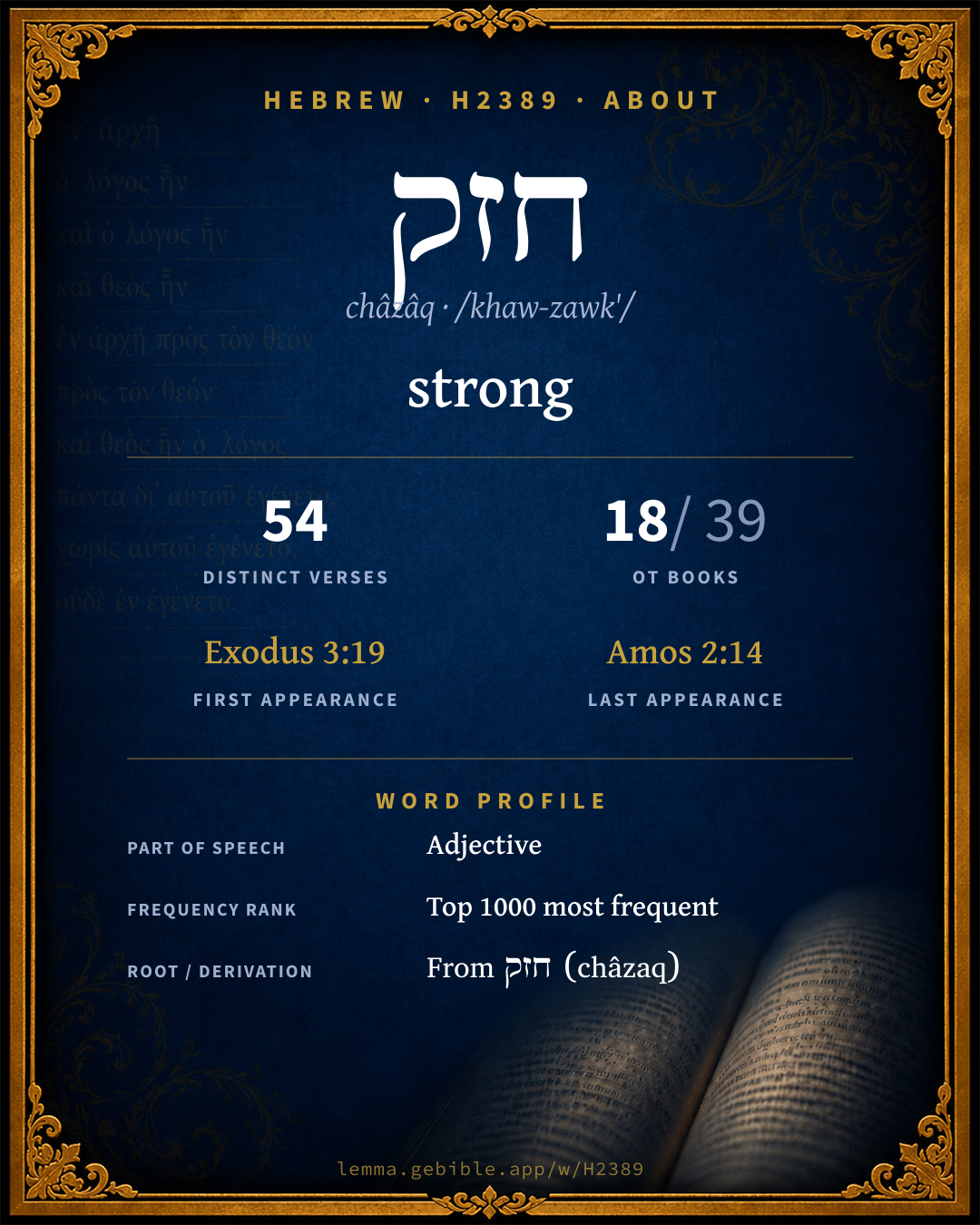
חָזָק
strong
also: stout, mighty fuller range ↓
Full lexicon entry — Brown-Driver-Briggs (BDB)
From Brown-Driver-Briggs (BDB)
Where this word appears
See every Absolute-state word in the Hebrew Bible →
Grammar key — what these labels mean
Part of speech
- Adjective
- A word that describes or qualifies a noun.
State
- Absolute
- The independent form of a noun, not bound to a following word.
- Construct
- A noun bound to a following noun in a possessive / “of” relationship (the construct chain).
Gender
- Feminine
- Grammatically feminine.
- Masculine
- Grammatically masculine.
Number
- Singular
- One.
- Plural
- More than one (in Hebrew, generally three or more).
Grammatical forms
- Adjective, Adjective, Feminine, Singular, Absolute 32 times (57%)
- Adjective, Adjective, Masculine, Singular, Absolute 19 times (34%)
- Adjective, Adjective, Masculine, Plural, Absolute 3 times (5%)
- Adjective, Adjective, Masculine, Plural, Construct 2 times (4%)
Parsed forms decoded from the imported morphology (morphhb / Westminster Leningrad Codex — WLC text public domain, morphhb tagging CC BY 4.0), counted across 56 parsed occurrences — not distinct verses.
Every verse where H2389 appears — 54 distinct verses across 18 books. Click any verse to open its interlinear word-by-word view. Verse text shown in the World English Bible for context — . Each verse’s Hebrew form is shown with its reference; the English is not keyword-highlighted, since the data carries no word-level English alignment. Use “Compare translations” on any verse to read it across multiple English versions. This concordance covers the Hebrew Bible; Septuagint (Greek Old Testament) occurrences are not indexed here.
Exodus 6 verses
- Exodus 3:19 חֲזָקָֽה adj Adjective fs I know that the king of Egypt won't give you permission to go, no, not by a mighty hand.
- Exodus 6:1 חֲזָקָה֙ חֲזָקָ֔ה adj Adjective fs adj Adjective fs Yahweh said to Moses, "Now you shall see what I will do to Pharaoh, for by a strong hand he shall let them go, and by a strong hand he shall drive them out of his land."
- Exodus 10:19 חָזָ֣ק adj Adjective ms Yahweh turned an exceeding strong west wind, which took up the locusts, and drove them into the Red Sea. There remained not one locust in all the borders of Egypt.
- Exodus 13:9 חֲזָקָ֔ה adj Adjective fs It shall be for a sign to you on your hand, and for a memorial between your eyes, that the law of Yahweh may be in your mouth; for with a strong hand Yahweh has brought you out of Egypt.
- Exodus 19:16 חָזָ֣ק adj Adjective ms It happened on the third day, when it was morning, that there were thunders and lightnings, and a thick cloud on the mountain, and the sound of an exceedingly loud trumpet; and all the people who were in the camp trembled.
- Exodus 32:11 חֲזָקָֽה adj Adjective fs Moses begged Yahweh his God, and said, "Yahweh, why does your wrath burn hot against your people, that you have brought forth out of the land of Egypt with great power and with a mighty hand?
Numbers 3 verses
- Numbers 13:18 הֶ/חָזָ֥ק ptcl inter + Adjective Adjective ms and see the land, what it is; and the people who dwell therein, whether they are strong or weak, whether they are few or many;
- Numbers 13:31 חָזָ֥ק adj Adjective ms But the men who went up with him said, We aren't able to go up against the people; for they are stronger than we.
- Numbers 20:20 חֲזָקָֽה adj Adjective fs He said, You shall not pass through. Edom came out against him with much people, and with a strong hand.
Deuteronomy 10 verses
- Deuteronomy 3:24 הַ/חֲזָקָ֑ה ptcl def.art + Adjective Adjective fs Lord Yahweh, you have begun to show your servant your greatness, and your strong hand: for what god is there in heaven or in earth, that can do according to your works, and according to your mighty acts?
- Deuteronomy 4:34 חֲזָקָה֙ adj Adjective fs Or has God tried to go and take him a nation from the midst of [another] nation, by trials, by signs, and by wonders, and by war, and by a mighty hand, and by an outstretched arm, and by great terrors, according to all that Yahweh your God did for you in Egypt before your eyes?
- Deuteronomy 5:15 חֲזָקָ֖ה adj Adjective fs You shall remember that you were a servant in the land of Egypt, and Yahweh your God brought you out of there by a mighty hand and by an outstretched arm: therefore Yahweh your God commanded you to keep the Sabbath day.
- Deuteronomy 6:21 חֲזָקָֽה adj Adjective fs then you shall tell your son, We were Pharaoh's bondservants in Egypt: and Yahweh brought us out of Egypt with a mighty hand;
- Deuteronomy 7:8 חֲזָקָ֑ה adj Adjective fs but because Yahweh loves you, and because he would keep the oath which he swore to your fathers, has Yahweh brought you out with a mighty hand, and redeemed you out of the house of bondage, from the hand of Pharaoh king of Egypt.
- Deuteronomy 7:19 הַ/חֲזָקָה֙ ptcl def.art + Adjective Adjective fs the great trials which your eyes saw, and the signs, and the wonders, and the mighty hand, and the outstretched arm, by which Yahweh your God brought you out: so shall Yahweh your God do to all the peoples of whom you are afraid.
- Deuteronomy 9:26 חֲזָקָֽה adj Adjective fs I prayed to Yahweh, and said, Lord Yahweh, don't destroy your people and your inheritance, that you have redeemed through your greatness, that you have brought forth out of Egypt with a mighty hand.
- Deuteronomy 11:2 הַ/חֲזָקָ֔ה ptcl def.art + Adjective Adjective fs Know you this day: for I don't speak with your children who have not known, and who have not seen the chastisement of Yahweh your God, his greatness, his mighty hand, and his outstretched arm,
- Deuteronomy 26:8 חֲזָקָה֙ adj Adjective fs and Yahweh brought us forth out of Egypt with a mighty hand, and with an outstretched arm, and with great terror, and with signs, and with wonders;
- Deuteronomy 34:12 הַ/חֲזָקָ֔ה ptcl def.art + Adjective Adjective fs and in all the mighty hand, and in all the great terror, which Moses worked in the sight of all Israel.
Joshua 3 verses
- Joshua 4:24 חֲזָקָ֖ה adj Adjective fs that all the peoples of the earth may know the hand of Yahweh, that it is mighty; that you may fear Yahweh your God forever.
- Joshua 14:11 חָזָ֗ק adj Adjective ms As yet I am as strong this day as I as in the day that Moses sent me: as my strength was then, even so is my strength now, for war, and to go out and to come in.
- Joshua 17:18 חָזָ֖ק adj Adjective ms but the hill-country shall be yours; for though it is a forest, you shall cut it down, and the goings out of it shall be yours; for you shall drive out the Canaanites, though they have chariots of iron, and though they are strong.
Judges 1 verse
1 Samuel 1 verse
2 Samuel 1 verse
1 Kings 4 verses
- 1 Kings 8:42 הַֽ/חֲזָקָ֔ה ptcl def.art + Adjective Adjective fs (for they shall hear of your great name, and of your mighty hand, and of your outstretched arm); when he shall come and pray toward this house;
- 1 Kings 17:17 חָזָ֣ק adj Adjective ms It happened after these things, that the son of the woman, the mistress of the house, fell sick; and his sickness was so sore, that there was no breath left in him.
- 1 Kings 18:2 חָזָ֥ק adj Adjective ms Elijah went to show himself to Ahab. The famine was sore in Samaria.
- 1 Kings 19:11 וְ/חָזָ֞ק conj + Adjective Adjective ms He said, Go forth, and stand on the mountain before Yahweh. Behold, Yahweh passed by, and a great and strong wind tore the mountains, and broke in pieces the rocks before Yahweh; but Yahweh was not in the wind: and after the wind an earthquake; but Yahweh was not in the earthquake:
2 Chronicles 1 verse
Nehemiah 1 verse
Job 2 verses
Psalms 2 verses
- Psalms 35:10 מֵ/חָזָ֣ק prep + Adjective Adjective ms All my bones shall say, "Yahweh, who is like you, Who delivers the poor from him who is too strong for him, Yes, the poor and the needy from him who robs him?"
- Psalms 136:12 חֲ֭זָקָה adj Adjective fs With a strong hand, and with an outstretched arm; For his loving kindness endures forever:
Proverbs 1 verse
Isaiah 3 verses
- Isaiah 27:1 וְ/הַֽ/חֲזָקָ֗ה conj + ptcl def.art + Adjective Adjective fs In that day Yahweh with his hard and great and strong sword will punish leviathan the swift serpent, and leviathan the crooked serpent; and he will kill the monster that is in the sea.
- Isaiah 28:2 חָזָ֤ק adj Adjective ms Behold, the Lord has a mighty and strong one; as a tempest of hail, a destroying storm, as a tempest of mighty waters overflowing, will he cast down to the earth with the hand.
- Isaiah 40:10 בְּ/חָזָ֣ק prep + Adjective Adjective ms Behold, the Lord Yahweh will come as a mighty one, and his arm will rule for him: Behold, his reward is with him, and his recompense before him.
Jeremiah 4 verses
- Jeremiah 21:5 חֲזָקָ֑ה adj Adjective fs I myself will fight against you with an outstretched hand and with a strong arm, even in anger, and in wrath, and in great indignation.
- Jeremiah 31:11 חָזָ֥ק adj Adjective ms For Yahweh has ransomed Jacob, and redeemed him from the hand of him who was stronger than he.
- Jeremiah 32:21 חֲזָקָה֙ adj Adjective fs and brought forth your people Israel out of the land of Egypt with signs, and with wonders, and with a strong hand, and with an outstretched arm, and with great terror;
- Jeremiah 50:34 חָזָ֗ק adj Adjective ms Their Redeemer is strong; Yahweh of Hosts is his name: he will thoroughly plead their cause, that he may give rest to the earth, and disquiet the inhabitants of Babylon.
Ezekiel 9 verses
- Ezekiel 2:4 וְ/חִזְקֵי conj + Adjective Adjective mp cs The children are impudent and stiff-hearted: I do sent you to them; and you shall tell them, Thus says the Lord Yahweh.
- Ezekiel 3:7 חִזְקֵי adj Adjective mp cs But the house of Israel will not listen to you; for they will not listen to me: for all the house of Israel are of hard forehead and of a stiff heart.
- Ezekiel 3:8 חֲזָקִ֖ים חָזָ֖ק adj Adjective mp adj Adjective ms Behold, I have made your face hard against their faces, and your forehead hard against their foreheads.
- Ezekiel 3:9 חָזָ֥ק adj Adjective ms As an adamant harder than flint have I made your forehead: don't be afraid of them, neither be dismayed at their looks, though they are a rebellious house.
- Ezekiel 20:33 חֲזָקָ֜ה adj Adjective fs As I live, says the Lord Yahweh, surely with a mighty hand, and with an outstretched arm, and with wrath poured out, will I be king over you:
- Ezekiel 20:34 חֲזָקָה֙ adj Adjective fs and I will bring you out from the peoples, and will gather you out of the countries in which you are scattered, with a mighty hand, and with an outstretched arm, and with wrath poured out;
- Ezekiel 26:17 חֲזָקָ֤ה adj Adjective fs They shall take up a lamentation over you, and tell you, How are you destroyed, who were inhabited by seafaring men, the renowned city, who was strong in the sea, she and her inhabitants, who caused their terror to be on all who lived there!
- Ezekiel 30:22 הַ/חֲזָקָ֖ה ptcl def.art + Adjective Adjective fs Therefore thus says the Lord Yahweh: Behold, I am against Pharaoh king of Egypt, and will break his arms, the strong [arm], and that which was broken; and I will cause the sword to fall out of his hand.
- Ezekiel 34:16 הַ/חֲזָקָ֛ה ptcl def.art + Adjective Adjective fs I will seek that which was lost, and will bring back that which was driven away, and will bind up that which was broken, and will strengthen that which was sick: but the fat and the strong I will destroy; I will feed them in justice.
Daniel 1 verse
Amos 1 verse
About this entry
At a glance — auto-summarized from this page’s data, not written by a person. Every figure links to its source below. This summary describes the numbers; it doesn’t interpret them.
At its core, חזק (châzâq) means “strong.” It first appears in Exodus 3:19. It turns up in 54 verses across 18 books, a moderately common footprint. Beyond its headline sense, its full sense range takes in “stout” and “mighty”. It clusters with חזק, חזק and חזק under a shared root. Dig into 54-verse concordance and the renderings breakdown below.
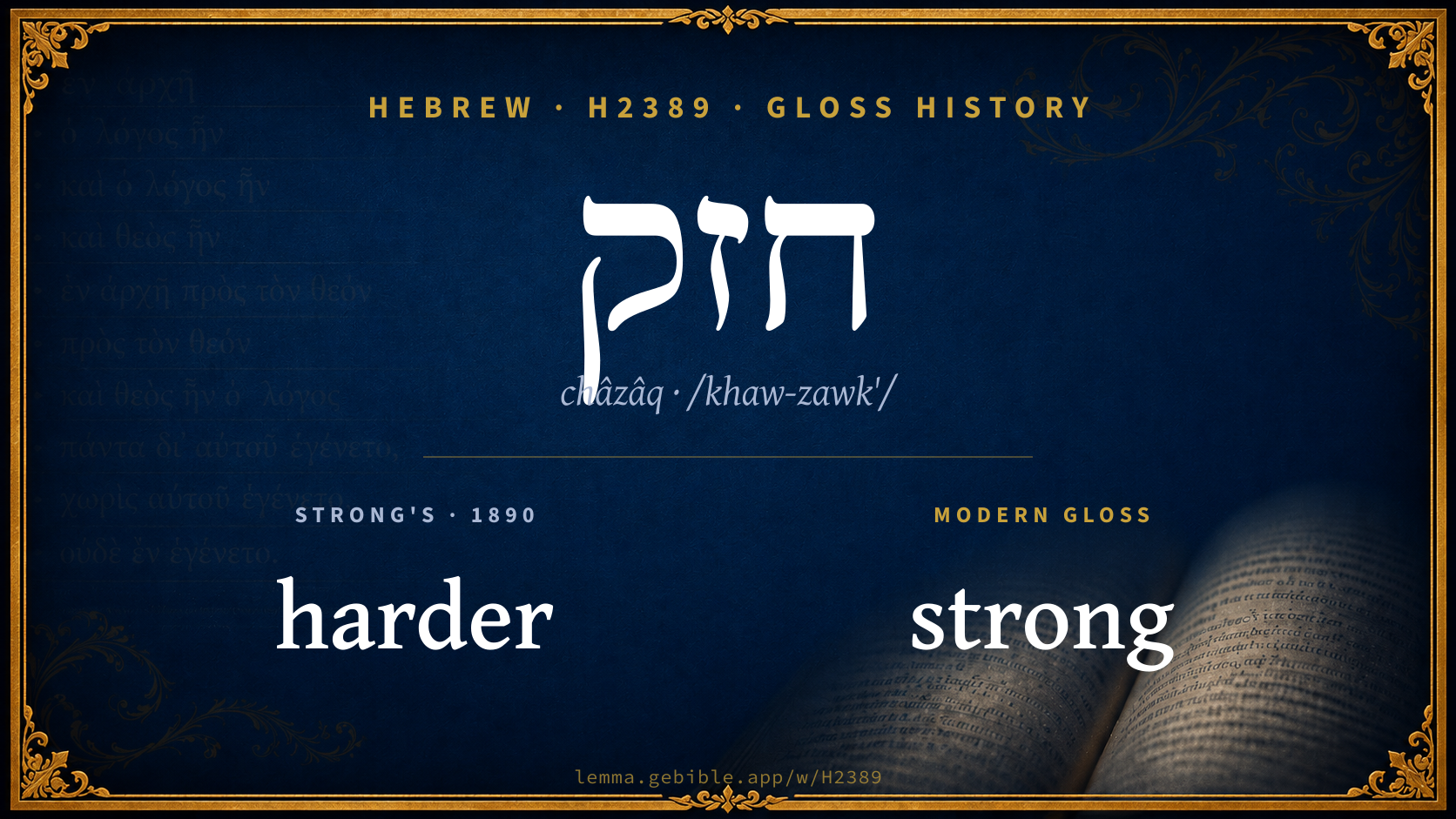
Gloss history
Strong's 1890 vs modern scholarship
About this word
Strong's H2389 catalogs a Hebrew word from the Hebrew Old Testament.
These counts are not copied from any lexicon or concordance. They are computed here, from the morphology-tagged Hebrew Old Testament. What Lemma adds →
- 54
- distinct verses
- The word appears in 54 distinct verses.
- 18 / 39
- OT books
- The word appears in 18 of 39 Old Testament books.
- #678
- by frequency
- Top 1000 most frequent Hebrew words (rank 678 of 8,640 Hebrew words by occurrence).
View all 54 occurrences in the concordance →
Most concentrated in
- Deuteronomy 10 verses 19%
- Ezekiel 9 verses 17%
- Exodus 6 verses 11%
By section of the Old Testament
By traditional corpus
Conventional, traditional groupings — biblical authorship is debated, so this is a traditional corpus grouping, not an authorship claim. Each share is this word’s portion of its verses in that division of the Hebrew canon. Each figure is a share of the word’s 54 distinct verses.
- Prophets (Nevi'im) 27 verses · 50%
- Torah (Pentateuch) 19 verses · 35%
- Writings (Ketuvim) 8 verses · 15%
How translations render this word
Counts come from each version’s own published word-to-Strong’s tagging or interlinear alignment — an approximate guide to how each version renders this word, not a word-level alignment the data otherwise carries. Because each total is that version’s own tagged count, the per-version totals vary from one another and need not match the appearance or distinct-verse counts above. These counts may also differ from a printed concordance because Lemma counts each distinctly tagged rendering and does not collapse phrase taggings into a single head-word total. This is a fixed set of word-tagged versions (KJV, ASV, BSB, ULT) and does not change with the reading translation you choose elsewhere. Each version’s license is shown beside its name below (and on Sources).
- King James Version: Strong 18×, Mighty 13×, Is mighty 2×
- American Standard Version: Strong 15×, Mighty 13×, Is strong 3×
- Berean Standard Bible: Mighty 19×, Strong 11×, Hard 2×
- unfoldingWord Literal Text: Strong 23×, Mighty 14×, Hard 4×
King James Version Public Domain
Renders H2389 across 56 tagged occurrences — most commonly:
Plus 21 renderings that appear only once — usually multi-word phrases or single function words the recovered tagging swept in, not distinct renderings.
American Standard Version Public Domain
Renders H2389 across 56 tagged occurrences — most commonly:
Plus 21 renderings that appear only once — usually multi-word phrases or single function words the recovered tagging swept in, not distinct renderings.
Berean Standard Bible Public Domain
Renders H2389 across 55 tagged occurrences — most commonly:
Plus 19 renderings that appear only once — usually multi-word phrases or single function words the recovered tagging swept in, not distinct renderings. Not rendered by a distinct English word in 1 further occurrence.
unfoldingWord Literal Text CC BY-SA 4.0
Renders H2389 across 54 tagged occurrences — most commonly:
Plus 9 renderings that appear only once — usually multi-word phrases or single function words the recovered tagging swept in, not distinct renderings.
7 senses and sub-senses in the full BDB
What do BDB’s symbols mean?
BDB uses these scholarly abbreviations:
| Symbol | Meaning |
|---|---|
| 𝔊 | the Septuagint (the ancient Greek translation, LXX) |
| 𝔙 | the Vulgate (the Latin translation) |
| 𝔖 | the Syriac version (the Peshitta) |
| 𝔗 | the Targum (the Aramaic translation) |
| ψ | the Psalms |
| √ | root (the underlying root or stem) |
| ‖ | parallel passage (a synonymous or contrasted parallel) |
| † | the dagger: every passage where the word occurs is cited |
The 7 senses and sub-senses the full Brown-Driver-Briggs lexicon distinguishes for this word, in lexicon order (not ranked by frequency), with BDB’s own verbatim wording and sub-sense lettering. Shown in Hebrew script with BDB’s own scholarly abbreviations. The condensed entry is in the Lexicon Entry tab. See also the Forms in the corpus table below.
- 1. strong:
- a. of men, rarely pred. Nu 13:18 (opp. רָפֶה), v 31 (compar. c. מִן), Jos 14:11; 17:18 (all JE), Ju 18:26 (compar. c. מִן); also of גֹּאֲלָם Je 50:34 Pr 23:11; of hand of י׳ Jos 4:24 (D), so Ez 3:14 𝔊 Co (v. supr. and חָזַק Qal 3); cf. of Tyre הָֽיְתָה חֲזָקָה בַּיָּם Ez 26:17 (del. B Co). e.g. Numbers 13:18
- b. usually attrib.; of arm of Pharaoh Ez 30:22 (opp. נִשְׁבָּ֑רֶת); especially of hand of י׳ in delivering Isr. from Egypt, Ex 3:19 (gloss? v. Di), 6:1(×2); 13:9 (all J), Dt 6:21; 7:8; 9:26 Dn 9:15; in wonders done by agency of Moses Dt 34:12; also בְּכֹחַ גָּדוֹל וּבְיָד חֲזָקָה Ex 32:11 (JE), cf. Ne 1:10, but oftener ביד חזקה וּבִזְרוֹעַ נְטוּיָה Dt 4:34; 5:15; 7:19; 11:2; 26:8 Je 32:21 ψ 136:12; of control of enemies and deliverance from exile Ez 20:33, 34; more gen. Dt 3:24 (‖ גָּדְלְךָ), 1 K 8:42 = 2 Ch 6:32; of י׳’s opposition to Zedekiah Je 21:5; once of Edom, opp. Isr. בעם כבד וביד חזקה Nu 20:20 (JE). e.g. Ezekiel 30:22
- c. of sword of י׳ Is 27:1 (‖ הַקָּשָׁה וְהַגְּדוֹלָה), of wind Ex 10:19 (J), 1 K 19:11; sound of trumpet (= loud) Ex 19:16 (E). e.g. Isaiah 27:1
- d. severe, sharp, hot, of war 1 S 14:52 (pred.), battle 2 S 11:15, sickness 1 K 17:17 (pred.), famine 18:2. e.g. 1 Samuel 14:52
- e. firm, hard, of face, פנים Ez 3:8, forehead, מֵצַח v 8; adamant, sim. of forehead v 9 (compar., c. מִן); of sky Jb 37:18 (pred.) In pl. cstr. ח׳ לֵב Ez 2:4 hard of heart (‖ קְשֵׁי פָנִים) but om. B Co, ח׳־מֵצַח 3:7 hard (= impudent) of forehead (‖ קְשֵׁי־לֵב). e.g. Ezekiel 3:8
- 2. as subst., a strong one, of י׳ (בְּחָזָק, as, in the character of, a strong one) Is 40:10; of י׳’s agent Is 28:2 (‖ אַמִּץ); v. also וְחָזָק לֹא יְאַמֵּץ כֹּחוֹ Am 2:14; c. מִן comp. = one too strong for Je 31:11 ψ 35:10. In Ez 34:16 MT uses הח׳ in bad sense (‖ הַשְּׁמֵנָה), 𝔊 Co, with diff. text, in good sense. (v. VB). e.g. Isaiah 40:10
Senses from the full Brown-Driver-Briggs lexicon (Brown, Driver, Briggs; Oxford 1906 — public domain), digitized via Sefaria, supplemented by the OpenScriptures HebrewLexicon (CC BY 4.0). Full attribution on Sources.
Word origin
adj. strong, stout, mighty;—ח׳ Ex 10:19 + 18 times; f. חֲזָקָה Ex 3:19 + 31 times + Ez 3:14 (Co for MT vb. 3 fs.); pl. חֲזָקִים Ju 18:25 + 2 times; cstr. חִזְקֵי Ez 2:4 (del. Co v. infr.) 3:7;—
— Brown-Driver-Briggs (Oxford 1906, public domain), digitized via Sefaria, supplemented by the OpenScriptures HebrewLexicon (CC BY 4.0). See Sources.
Derived from חזק (châzaq) (H2388) — to strengthen.
Jastrow Dictionary
A second Hebrew/Aramaic lexicon for comparison, covering Aramaic and post-biblical (Talmudic, Targumic, Midrashic) usage that the biblical-Hebrew BDB does not. Matched by lemma rather than by Strong’s number, so a lemma may carry more than one Jastrow headword (shown separately below), and the entries cover usage well beyond the Bible.
חָזַק
- [to squeeze together,] (neut. verb) to be thick, solid; to be strong. Y. Ber. I, 2ᶜ bot. (ref. to Gen. I, 6) יֶחֱזַק הרקיע וכ׳ let the expanse become solidified, let it coagulate, congeal; Gen. R. s. 4; (Yalk. ib. 5 יתחזק, Hithpa.). e.g. Genesis 1:6
- to join, repair, tighten, strengthen. Snh. 94ᵃ (expl. חזקיה) שחי׳ את ישראל וכ׳ (Ms. M. שהחזיק, Hif.) he joined Israel to their Father &c. Ib. שחִזְּקוֹ יה the Lord strengthened him. Pes. 45ᵃ שעשוי לחַזֵּק Ms. M. where the dough in the cracks is put in for repairing the trough. Sabb. 146ᵇ (העשוי) לחַ׳ when the hole was filled up for making the vessel sound, opp. לשמר to prevent evaporation; a. fr.—Part. pass. מְחוּזָּק, pl. מְחוּזָּקִים. Sifré Num. 1 אין מְחַזְּקִים אלא המח׳ (ed. תמוחז׳) only the strong-minded it is worth while to strengthen (encourage).
- 1. same, v. supra.— same, v. supra.—ה׳ טובה ל־ to attach merit to, to account as merit, to be grateful. Ab. II, 8 אל תַּחֲזִיק ט׳ לעצמך do not claim credit for it (be not proud). Yoma 86ᵇ אלא שמַחֲזִיק לו ט׳ but He even gives him credit (for his sins when he repents). Men. 53ᵃ הַחֲזֵק לי וכ׳ give me credit for making Thee known &c. Keth. 68ᵃ, a. e. בואו ונַחֲזִיק וכ׳ let us be thankful to the fraudulent poor &c.; a. fr.
- 2. (with יד) to strengthen, to encourage, abet. Gitt. V, 9 לפי שאין מַחֲזִיקִין וכ׳ because we must not encourage (by favors) those who do wrong. Ib. ומחזיקין ידי עכו"ם וכ׳ we may encourage (greet with תחזקנה ידיכם, Zech. VIII, 9) gentiles at agricultural work in the Sabbatical year; a. fr. e.g. Zechariah 8:9
- 3. to hold, contain. Ib. 57ᵃ אין עורו מחזיק וכ׳ its skin (once flayed) can not again cover its entire body (it shrinks). Ib. (in Chald. dict.) אפי׳ שתין … לא מ׳ it would not have room even for sixty myriads of reeds. Par. VII, 8 בשביל שתַּחֲזִיק וכ׳ in order that it (the reservoir) might hold more water. Ukts. III, 12 לא מצא … מחזיק וכ׳ the Lord found no vessel so fit to contain all blessings as peace; Deut. R. s. 5 end; a. fr.
- 4. (with ב) to take a hold of, seize, take possession. Ḥull. 4ᵃ, a. e. כל מצוה שהֶחֱזִיקוּ וכ׳ whatever Jewish law the Samaritans have adopted &c., v. דִּקְדֵּק. B. Mets. I, 4 וה׳ בה and took a hold of it. B. Bath. III, 3 במַחֲזִיק when one is in possession (basing his claim on possession). Ib. המַ׳ בנכסי הגר he who takes possession of the estate of a convert (who has no heirs in law). Ib. 2 ויַחֲזִיק שנה that he may be in possession for one year, v. אִסְפַּמְיָא; a. fr.; v. חֲזָקָה.—Y. Ḥag. I, 76ᶜ, a. e. שלא הֶחֱזִיקוּ בשכר וכ׳ they did not cling to the duty of maintaining teachers &c.
- 5. (v. חֲזָקָה) to presume, to be under a certain impression, to be convinced. Y. Kidd. IV, 66ᵇ היו מַחֲזִיקִין בו שהוא בנו וכ׳ if people were under the impression that a certain person was their neighbor’s son, but in his dying hour he declared &c. Ib. היו מ׳ אותו שהוא וכ׳ if people took him to be a relation of his; a. e.—Ḥag. 19ᵃ, v. infra.
- (denom. of חֲזָקָה) to be presumed, be held for, be known for. Gitt. 14ᵃ בשה׳ כפרן when the man is known to be a liar. Shebu. 34ᵇ, a. fr. ה׳ כפרן (in such a case) he is considered a confirmed liar.—Y. Kidd. l. c. bot. הוּחְזְקוּ if they were generally assumed (to be husband and wife); a. fr.—Ḥag. 19ᵃ הטובל לחולין וה׳ לחולין if one takes an immersion for the purpose of being enabled to partake of ordinary food and is considered (by himself) to have immersed for that purpose. Ib. טבל ולא ה׳ if he did immerse but did not have a certain purpose in view. Ib. עודיהו … ה׳ לדבר קל מחזיק עצמו וכ׳ as long as he has one foot yet in the water, when he had had in view a minor purpose for his bath, he may still change it for a higher purpose. Ib. אם לא ה׳ מחזיק if he had had no particular object in view, he may on coming out define the object for which he has bathed.—Part. מוּחֲזָק
- 1. held in possession, adhered to. Bekh. VIII, 9 ולא בראוי כבמ׳ nor does he take a double share of what is coming due to the estate as he does of what is held in possession; B. Bath. 55ᵃ; a. fr.—Sabb. 130ᵃ עדיין היא מוּחֲזֶקֶת בידם it is still strongly adhered to, opp. מרופה, v. רָפָה.
- 2. being known, approved. Sifra K’dosh. Par. 3, ch. V במ׳ לך when he is known to thee (to be a proselyte); a. e.
- 3. being sure, convinced, knowing from experience. Keth. 25ᵇ מוּחֲזַקְנִי בזה וכ׳ (= מ׳ אני) I know this man to be a priest; a. e.—Sifré Num. 1, v. supra.
- 1. to become solid, strong. Yalk. Gen. 5 יִתְחַזֵּק, v. preced.
- 2. to feel encouraged, take courage. Ber. 32ᵃ נ׳ בתפלה became emboldened to pray.
חֲזַק
- 1. same.—Part. pass. חֲזִיק tied up, bandaged. Y. Ber. II, 4ᶜ top דהוה ח׳ רישיה when his head was tied up (with a turban); Pesik. R. s. 22 (not רישין, v. notes in ed. Fr.). Y. Pes. X, 37ᶜ וח׳ רישיה וכ׳ and his head was tied up (or he felt like having a bandage around his head) &c.; Y. Shek. III, 47ᶜ top והוה חזוק (read חזיק); וחזק (corr. acc.).
- 2. to take possession. B. Bath. 52ᵇ, sq. חֲזַק וקני take possession and acquire; a. fr.
- to fasten.—Lev. R. s. 21 [read] חַזֵּק כפתוי tighten his muzzle, v. כֵּיפְתָא.—Part. pass. מְחַזַּק. Targ. Y. Gen. L, 1.
- as preced. Hif.;
- 1. (with טיבו &c.) to give credit to. Y. Ber. II, 5ᵃ bot. אנא מַחֲזִיק טיבו לראשי וכ׳ I give credit to my head, which bends of itself &c. Bab. Ber. 19ᵃ לאַחֲזוּקֵי ליה וכ׳ that due credit for the preservation of Israel be given to Moses.
- 2. to presume. Shebu. 46ᵇ לאַחֲזוּקֵי אינש בגנבי לא מַחְזְקִינָן we must not put a person in the category of thieves (on the charge of one individual); a. e.
- 3. to adhere to, adopt. Ḥull. 4ᵃ כיון דאַחֲזִיקוּ בהו א׳ בהו since they (the Samaritans) have adopted it, they observe it (also for Israelites). Ib. אַחֲזוּק ולא א׳ וכ׳ as to their observance or non-observance of adopted unwritten customs for Israelites there are differences of opinion; a. fr.
- 4. to take possession, to claim possession. B. Bath. 29ᵇ כי היכי דלא תַחְזְקוּ אהדדי ed. (differ. in Ms. M., v. Rabb. D. S. a. l.) that you might not claim possession against one another. Ib. 36ᵃ האי מאן דא׳ וכ׳ if one claims a field on the ground of possession, if it lies outside &c., v. גּוּדָּא I. Ib. לא מַחְזְקֵי בן ולא מַחְזְקִינָן בהו they have no claim of possession against us (for one might have been afraid to disturb them), and they have no claim against us (for, being wealthy, they might not have cared to drive one out); a. fr.
- 5. to be strong, encouraged. Gitt. 62ᵃ אַחֲזוּקוּ ‘be strong’ (a greeting to field laborers, v. preced.).
- 1. to adhere to. Targ. Prov. IV, 13; a. e.
- 2. to be known, be under the presumption. Targ. Y. Lev. XIX, 33 (v. preced.).—Ḥull. 10ᵇ היכא דלא א׳ where no presumption (of leprosy) has as yet been formed. Snh. 89ᵇ דמִיתְחֲזַק וכ׳ Ms. M. (ed. מוחזק) where one is approved (as a righteous prophet), it is different.
A Dictionary of the Targumim, the Talmud Babli and Yerushalmi, and the Midrashic Literature (Marcus Jastrow; London, Luzac, 1903) — Public Domain. Digitized via Sefaria. Digitized via Sefaria. Full attribution on Sources.
Forms in the corpus
The 34 distinct written forms H2389 takes in the Hebrew Bible, most frequent first — each parse links to that state’s occurrences in the concordance. Hebrew forms include their vowel points and cantillation, so a single lemma takes many written forms.
Same root — word family
Other BDB entries built from the same root as H2389, grouped by Strong’s listed origin. These share a root / origin per the lexicon — not necessarily a shared meaning. Each links to that word’s own entry.
Derives from
Shares the same root
Proper names from this root
People and places named from this root — a name, not an additional meaning of the word.
Compare all same-root words → Showing 4 of 8 — not the complete family. 3 of the same-root words are proper names (people or places). They share a root, not necessarily a meaning.
Septuagint verse parallels
This word appears in 51 verses that also exist in the Greek Old Testament (Septuagint), out of the 54 Hebrew verses it occurs in. You can read those verses in Greek by switching the Old Testament edition to the Septuagint.
Read these verses in the Septuagint
- Exodus 3:19
- Numbers 13:18
- Deuteronomy 3:24
- Joshua 4:24
- Judges 18:26
- 1 Samuel 14:52
- 2 Samuel 11:15
- 1 Kings 8:42
- 2 Chronicles 6:32
- Job 5:15
- Psalms 35:10
- Proverbs 23:11
This is a verse-level parallel only — the same verses exist in both the Hebrew and Greek Old Testaments. No word-level Hebrew↔Greek correspondence is claimed: the data carries no such alignment, so no Greek word is shown as this Hebrew word’s translation. Coverage is not total — the Septuagint omits the deuterocanon and renumbers the Psalms, so some Hebrew verses have no direct Greek parallel.