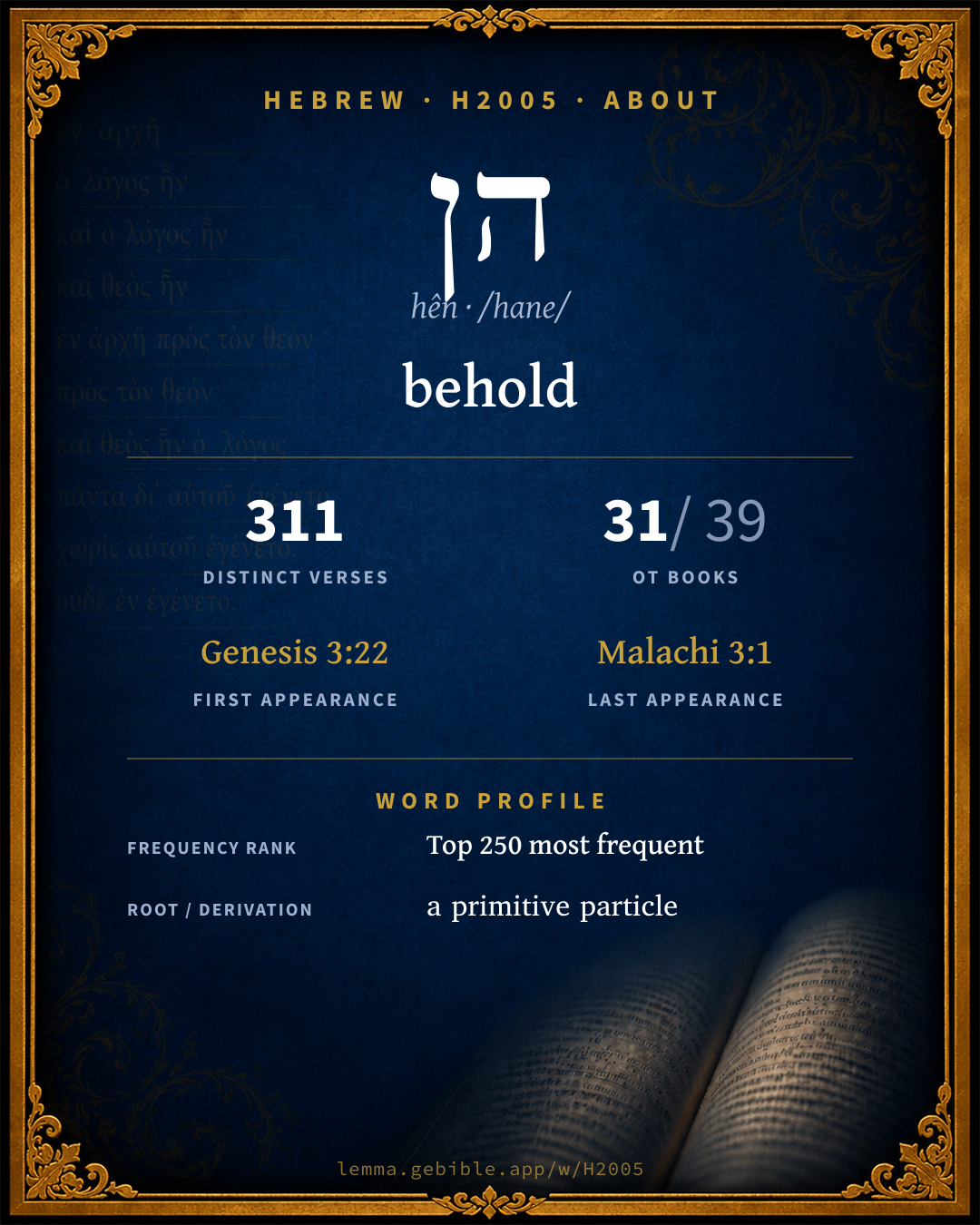
הֵן
behold
also: lo, though fuller range ↓
Full lexicon entry — Brown-Driver-Briggs (BDB)
From Brown-Driver-Briggs (BDB)
Where this word appears
Grammar key — what these labels mean
Part of speech
- Particle
- A short function word — article, negation, interrogative, the sign of the direct object, and the like.
Grammatical forms
- Particle, Demonstrative 287 times (90%)
- Particle, Interjection 31 times (10%)
Parsed forms decoded from the imported morphology (morphhb / Westminster Leningrad Codex — WLC text public domain, morphhb tagging CC BY 4.0), counted across 318 parsed occurrences — not distinct verses.
Page 1 of 2 — showing verses 1–200 of 311 distinct verses where H2005 appears, across 31 books. Click any verse to open its interlinear word-by-word view. Verse text shown in the World English Bible for context — . Each verse’s Hebrew form is shown with its reference; the English is not keyword-highlighted, since the data carries no word-level English alignment. Use “Compare translations” on any verse to read it across multiple English versions. This concordance covers the Hebrew Bible; Septuagint (Greek Old Testament) occurrences are not indexed here.
Genesis 19 verses
- Genesis 3:22 הֵ֤ן ptcl dem Yahweh God said, "Behold, the man has become like one of us, knowing good and evil. Now, lest he put forth his hand, and also take of the tree of life, and eat, and live forever..."
- Genesis 4:14 הֵן֩ ptcl dem Behold, you have driven me out this day from the surface of the ground. I will be hidden from your face, and I will be a fugitive and a wanderer in the earth. It will happen that whoever finds me will kill me."
- Genesis 6:13 וְ/הִנְ/נִ֥י conj + ptcl intj + sfx pers 1cs God said to Noah, "The end of all flesh has come before me, for the earth is filled with violence through them. Behold, I will destroy them with the earth.
- Genesis 9:9 הִנְנִ֥/י ptcl intj + sfx pers 1cs "As for me, behold, I establish my covenant with you, and with your offspring after you,
- Genesis 11:6 הֵ֣ן ptcl dem Yahweh said, "Behold, they are one people, and they have all one language; and this is what they begin to do. Now nothing will be withheld from them, which they intend to do.
- Genesis 15:3 הֵ֣ן ptcl dem Abram said, "Behold, to me you have given no seed: and, behold, one born in my house is my heir."
- Genesis 19:34 הֵן ptcl dem It came to pass on the next day, that the firstborn said to the younger, "Behold, I lay last night with my father. Let us make him drink wine again, tonight. You go in, and lie with him, that we may preserve our father's seed."
- Genesis 27:11 הֵ֣ן ptcl dem Jacob said to Rebekah his mother, "Behold, Esau my brother is a hairy man, and I am a smooth man.
- Genesis 27:37 הֵ֣ן ptcl dem Isaac answered Esau, "Behold, I have made him your lord, and all his brothers have I given to him for servants. With grain and new wine have I sustained him. What then will I do for you, my son?"
- Genesis 29:7 הֵ֥ן ptcl dem He said, "Behold, it is still the middle of the day, not time to gather the cattle together. Water the sheep, and go and feed them."
- Genesis 30:34 הֵ֑ן ptcl dem Laban said, "Behold, I desire it to be according to your word."
- Genesis 39:8 הֵ֣ן ptcl dem But he refused, and said to his master's wife, "Behold, my master doesn't know what is with me in the house, and he has put all that he has into my hand.
- Genesis 40:6 וְ/הִנָּ֖/ם conj + ptcl dem + sfx pers 3mp Joseph came in to them in the morning, and saw them, and saw that they were sad.
- Genesis 41:17 הִנְ/נִ֥י ptcl dem + sfx pers 1cs Pharaoh spoke to Joseph, "In my dream, behold, I stood on the brink of the river:
- Genesis 44:8 הֵ֣ן ptcl dem Behold, the money, which we found in our sacks' mouths, we brought again to you out of the land of Canaan. How then should we steal silver or gold out of your lord's house?
- Genesis 44:16 הִנֶּ/נּ֤וּ ptcl dem + sfx pers 1cp Judah said, "What will we tell my lord? What will we speak? Or how will we clear ourselves? God has found out the iniquity of your servants. Behold, we are my lord's bondservants, both we, and he also in whose hand the cup is found."
- Genesis 47:1 וְ/הִנָּ֖/ם conj + ptcl dem + sfx pers 3mp Then Joseph went in and told Pharaoh, and said, "My father and my brothers, with their flocks, their herds, and all that they own, have come out of the land of Canaan; and, behold, they are in the land of Goshen."
- Genesis 47:23 הֵן֩ ptcl dem Then Joseph said to the people, "Behold, I have bought you and your land today for Pharaoh. Behold, here is seed for you, and you shall sow the land.
- Genesis 48:4 הִנְ/נִ֤י ptcl dem + sfx pers 1cs and said to me, 'Behold, I will make you fruitful, and multiply you, and I will make of you a company of peoples, and will give this land to your seed after you for an everlasting possession.'
Exodus 12 verses
- Exodus 4:1 וְ/הֵן֙ conj + ptcl intj Moses answered, "But, behold, they will not believe me, nor listen to my voice; for they will say, 'Yahweh has not appeared to you.'"
- Exodus 5:5 הֵן ptcl dem Pharaoh said, "Behold, the people of the land are now many, and you make them rest from their burdens."
- Exodus 6:12 הֵ֤ן ptcl dem Moses spoke before Yahweh, saying, "Behold, the children of Israel haven't listened to me. How then shall Pharaoh listen to me, who am of uncircumcised lips?"
- Exodus 6:30 הֵ֤ן ptcl dem Moses said before Yahweh, "Behold, I am of uncircumcised lips, and how shall Pharaoh listen to me?"
- Exodus 8:21 הִנְ/נִי֩ ptcl dem + sfx pers 1cs Else, if you will not let my people go, behold, I will send swarms of flies on you, and on your servants, and on your people, and into your houses: and the houses of the Egyptians shall be full of swarms of flies, and also the ground whereon they are.
- Exodus 8:26 הֵ֣ן ptcl dem Moses said, "It isn't appropriate to do so; for we shall sacrifice the abomination of the Egyptians to Yahweh our God. Behold, shall we sacrifice the abomination of the Egyptians before their eyes, and won't they stone us?
- Exodus 9:18 הִנְ/נִ֤י ptcl dem + sfx pers 1cs Behold, tomorrow about this time I will cause it to rain a very grievous hail, such as has not been in Egypt since the day it was founded even until now.
- Exodus 10:4 הִנְ/נִ֨י ptcl dem + sfx pers 1cs Or else, if you refuse to let my people go, behold, tomorrow I will bring locusts into your country,
- Exodus 14:17 הִנְ/נִ֤י ptcl dem + sfx pers 1cs I, behold, I will harden the hearts of the Egyptians, and they shall go in after them: and I will get myself honor over Pharaoh, and over all his host, over his chariots, and over his horsemen.
- Exodus 16:4 הִנְ/נִ֨י ptcl dem + sfx pers 1cs Then said Yahweh to Moses, "Behold, I will rain bread from the sky for you, and the people shall go out and gather a day's portion every day, that I may test them, whether they will walk in my law, or not.
- Exodus 17:6 הִנְ/נִ֣י ptcl dem + sfx pers 1cs Behold, I will stand before you there on the rock in Horeb. You shall strike the rock, and water will come out of it, that the people may drink." Moses did so in the sight of the elders of Israel.
- Exodus 34:11 הִנְ/נִ֧י ptcl dem + sfx pers 1cs Observe that which I command you this day. Behold, I drive out before you the Amorite, the Canaanite, the Hittite, the Perizzite, the Hivite, and the Jebusite.
Leviticus 3 verses
- Leviticus 10:18 הֵ֚ן ptcl dem Behold, its blood was not brought into the inner part of the sanctuary: you certainly should have eaten it in the sanctuary, as I commanded."
- Leviticus 10:19 הֵ֣ן ptcl dem Aaron spoke to Moses, "Behold, this day they have offered their sin offering and their burnt offering before Yahweh; and such things as these have happend to me: and if I had eaten the sin offering today, would it have been pleasing in the sight of Yahweh?"
- Leviticus 25:20 הֵ֚ן ptcl dem If you said, "What shall we eat the seventh year? Behold, we shall not sow, nor gather in our increase;"
Numbers 7 verses
- Numbers 14:40 הִנֶּ֗/נּוּ ptcl dem + sfx pers 1cp They rose up early in the morning, and got them up to the top of the mountain, saying, Behold, we are here, and will go up to the place which Yahweh has promised: for we have sinned.
- Numbers 17:12 הֵ֥ן ptcl dem The children of Israel spoke to Moses, saying, Behold, we perish, we are undone, we are all undone.
- Numbers 23:9 הֶן ptcl intj For from the top of the rocks I see him, From the hills I see him: behold, it is a people that dwells alone, And shall not be reckoned among the nations.
- Numbers 23:24 הֶן ptcl intj Behold, the people rises up as a lioness, As a lion does he lift himself up: He shall not lie down until he eat of the prey, Drink the blood of the slain.
- Numbers 24:14 הִנְנִ֥/י ptcl intj + sfx pers 1cs Now, behold, I go to my people: come, [and] I will advertise you what this people shall do to your people in the latter days.
- Numbers 25:12 הִנְנִ֨/י ptcl intj + sfx pers 1cs Therefore say, Behold, I give to him my covenant of peace:
- Numbers 31:16 הֵ֣ן ptcl dem Behold, these caused the children of Israel, through the counsel of Balaam, to commit trespass against Yahweh in the matter of Peor, and so the plague was among the congregation of Yahweh.
Deuteronomy 4 verses
- Deuteronomy 5:24 הֵ֣ן ptcl dem and you said, Behold, Yahweh our God has shown us his glory and his greatness, and we have heard his voice out of the midst of the fire: we have seen this day that God does speak with man, and he lives.
- Deuteronomy 10:14 הֵ֚ן ptcl dem Behold, to Yahweh your God belongs heaven and the heaven of heavens, the earth, with all that is therein.
- Deuteronomy 31:14 הֵ֣ן ptcl dem Yahweh said to Moses, Behold, your days approach that you must die: call Joshua, and present yourselves in the tent of meeting, that I may give him a charge. Moses and Joshua went, and presented themselves in the tent of meeting.
- Deuteronomy 31:27 הֵ֣ן ptcl dem For I know your rebellion, and your stiff neck: behold, while I am yet alive with you this day, you have been rebellious against Yahweh; and how much more after my death?
Joshua 1 verse
1 Samuel 10 verses
- 1 Samuel 3:4 הִנֵּֽ/נִי ptcl dem + sfx pers 1cs that Yahweh called Samuel; and he said, Here am I.
- 1 Samuel 3:5 הִנְ/נִי֙ ptcl dem + sfx pers 1cs He ran to Eli, and said, Here am I; for you called me. He said, I didn't call; lie down again. He went and lay down.
- 1 Samuel 3:6 הִנְ/נִ֔י ptcl dem + sfx pers 1cs Yahweh called yet again, Samuel. Samuel arose and went to Eli, and said, Here am I; for you called me. He answered, I didn't call, my son; lie down again.
- 1 Samuel 3:8 הִנְ/נִ֔י ptcl dem + sfx pers 1cs Yahweh called Samuel again the third time. He arose and went to Eli, and said, Here am I; for you called me. Eli perceived that Yahweh had called the child.
- 1 Samuel 3:16 הִנֵּֽ/נִי ptcl dem + sfx pers 1cs Then Eli called Samuel, and said, Samuel, my son. He said, Here am I.
- 1 Samuel 12:3 הִנְ/נִ֣י ptcl dem + sfx pers 1cs Here I am: witness against me before Yahweh, and before his anointed: whose ox have I taken? or whose donkey have I taken? or whom have I defrauded? whom have I oppressed? or of whose hand have I taken a ransom to blind my eyes therewith? and I will restore it you.
- 1 Samuel 14:7 הִנְ/נִ֥י ptcl dem + sfx pers 1cs His armor bearer said to him, Do all that is in your heart: turn you, behold, I am with you according to your heart.
- 1 Samuel 14:43 הִנְ/נִ֥י ptcl dem + sfx pers 1cs Then Saul said to Jonathan, Tell me what you have done. Jonathan told him, and said, I did certainly taste a little honey with the end of the rod that was in my hand; and, behold, I must die.
- 1 Samuel 22:12 הִנְ/נִ֥י ptcl dem + sfx pers 1cs Saul said, Hear now, you son of Ahitub. He answered, Here I am, my lord.
- 1 Samuel 25:19 הִנְ/נִ֖י ptcl dem + sfx pers 1cs She said to her young men, Go on before me; behold, I come after you. But she didn't tell her husband, Nabal.
2 Samuel 5 verses
- 2 Samuel 1:7 הִנֵּֽ/נִי ptcl dem + sfx pers 1cs When he looked behind him, he saw me, and called to me. I answered, Here am I.
- 2 Samuel 5:1 הִנְ/נ֛וּ ptcl intj + sfx pers 1cp Then came all the tribes of Israel to David to Hebron, and spoke, saying, Behold, we are your bone and your flesh.
- 2 Samuel 12:11 הִנְ/נִי֩ ptcl dem + sfx pers 1cs This is what Yahweh says: 'Behold, I will raise up evil against you out of your own house; and I will take your wives before your eyes, and give them to your neighbor, and he will lie with your wives in the sight of this sun.
- 2 Samuel 15:26 הִנְ/נִ֕י ptcl dem + sfx pers 1cs but if he say thus, I have no delight in you; behold, here am I, let him do to me as seems good to him.
- 2 Samuel 16:8 וְ/הִנְּ/ךָ֙ conj + ptcl intj + sfx pers 2ms Yahweh has returned on you all the blood of the house of Saul, in whose place you have reigned; and Yahweh has delivered the kingdom into the hand of Absalom your son; and, behold, you are [taken] in your own mischief, because you are a man of blood.
1 Kings 10 verses
- 1 Kings 5:5 וְ/הִנְ/נִ֣י conj + ptcl intj + sfx pers 1cs Behold, I purpose to build a house for the name of Yahweh my God, as Yahweh spoke to David my father, saying, Your son, whom I will set on your throne in your room, he shall build the house for my name.
- 1 Kings 11:22 וְ/הִנְּ/ךָ֥ conj + ptcl intj + sfx pers 2ms Then Pharaoh said to him, But what have you lacked with me, that behold, you seek to go to your own country? He answered, Nothing: however only let me depart.
- 1 Kings 11:31 הִנְ/נִ֨י ptcl dem + sfx pers 1cs He said to Jeroboam, Take ten pieces; for thus says Yahweh, the God of Israel, Behold, I will tear the kingdom out of the hand of Solomon, and will give ten tribes to you
- 1 Kings 14:10 הִנְ/נִ֨י ptcl dem + sfx pers 1cs therefore, behold, I will bring evil on the house of Jeroboam, and will cut off from Jeroboam every man-child, him who is shut up and him who is left at large in Israel, and will utterly sweep away the house of Jeroboam, as a man sweeps away dung, until it be all gone.
- 1 Kings 16:3 הִנְ/נִ֥י ptcl dem + sfx pers 1cs behold, I will utterly sweep away Baasha and his house; and I will make your house like the house of Jeroboam the son of Nebat.
- 1 Kings 17:12 וְ/הִנְ/נִ֨י conj + ptcl intj + sfx pers 1cs She said, As Yahweh your God lives, I don't have a cake, but a handful of meal in the jar, and a little oil in the jar: and, behold, I am gathering two sticks, that I may go in and bake it for me and my son, that we may eat it, and die.
- 1 Kings 20:13 הִנְ/נִ֨י ptcl dem + sfx pers 1cs Behold, a prophet came near to Ahab king of Israel, and said, Thus says Yahweh, Have you seen all this great multitude? behold, I will deliver it into your hand this day; and you shall know that I am Yahweh.
- 1 Kings 20:36 הִנְּ/ךָ֤ ptcl dem + sfx pers 2ms Then said he to him, Because you have not obeyed the voice of Yahweh, behold, as soon as you are departed from me, a lion shall kill you. As soon as he was departed from him, a lion found him, and killed him.
- 1 Kings 21:21 הִנְ/נִ֨י ptcl dem + sfx pers 1cs Behold, I will bring evil on you, and will utterly sweep you away and will cut off from Ahab every man-child, and him who is shut up and him who is left at large in Israel:
- 1 Kings 22:25 הִנְּ/ךָ֥ ptcl dem + sfx pers 2ms Micaiah said, Behold, you shall see on that day, when you shall go into an inner chamber to hide yourself.
2 Kings 8 verses
- 2 Kings 7:2 הִנְּ/כָ֤ה ptcl dem + sfx pers 2ms Then the captain on whose hand the king leaned answered the man of God, and said, Behold, if Yahweh should make windows in heaven, might this thing be? He said, Behold, you shall see it with your eyes, but shall not eat of it.
- 2 Kings 7:13 הִנָּ֕/ם ptcl dem + sfx pers 3mp One of his servants answered, Please let some take five of the horses that remain, which are left in the city (behold, they are as all the multitude of Israel who are left in it; behold, they are as all the multitude of Israel who are consumed); and let us send and see.
- 2 Kings 7:19 הִנְּ/ךָ֤ ptcl dem + sfx pers 2ms and that captain answered the man of God, and said, Now, behold, if Yahweh should make windows in heaven, might such a thing be? and he said, Behold, you shall see it with your eyes, but shall not eat of it:
- 2 Kings 19:7 הִנְ/נִ֨י ptcl dem + sfx pers 1cs Behold, I will put a spirit in him, and he shall hear news, and shall return to his own land; and I will cause him to fall by the sword in his own land.
- 2 Kings 20:5 הִנְ/נִי֙ ptcl dem + sfx pers 1cs Turn back, and tell Hezekiah the prince of my people, Thus says Yahweh, the God of David your father, I have heard your prayer, I have seen your tears: behold, I will heal you; on the third day you shall go up to the house of Yahweh.
- 2 Kings 21:12 הִנְ/נִי֙ ptcl dem + sfx pers 1cs therefore thus says Yahweh, the God of Israel, Behold, I bring such evil on Jerusalem and Judah, that whoever hears of it, both his ears shall tingle.
- 2 Kings 22:16 הִנְ/נִ֨י ptcl dem + sfx pers 1cs Thus says Yahweh, Behold, I will bring evil on this place, and on the inhabitants of it, even all the words of the book which the king of Judah has read.
- 2 Kings 22:20 הִנְ/נִ֨י ptcl dem + sfx pers 1cs Therefore, behold, I will gather you to your fathers, and you shall be gathered to your grave in peace, neither shall your eyes see all the evil which I will bring on this place. They brought the king word again.
1 Chronicles 1 verse
2 Chronicles 19 verses
- 2 Chronicles 7:13 הֵ֣ן וְ/הֵן ptcl dem conj + ptcl intj If I shut up the sky so that there is no rain, or if I command the locust to devour the land, or if I send pestilence among my people;
- 2 Chronicles 16:11 הִנָּ֤/ם ptcl dem + sfx pers 3mp Behold, the acts of Asa, first and last, behold, they are written in the book of the kings of Judah and Israel.
- 2 Chronicles 18:24 הִנְּ/ךָ֥ ptcl dem + sfx pers 2ms Micaiah said, Behold, you shall see on that day, when you shall go into an inner chamber to hide yourself.
- 2 Chronicles 20:16 הִנָּ֥/ם ptcl dem + sfx pers 3mp Tomorrow go you down against them: behold, they come up by the ascent of Ziz; and you shall find them at the end of the valley, before the wilderness of Jeruel.
- 2 Chronicles 20:24 וְ/הִנָּ֧/ם conj + ptcl dem + sfx pers 3mp When Judah came to the watch-tower of the wilderness, they looked at the multitude; and, behold, they were dead bodies fallen to the earth, and there were none who escaped.
- 2 Chronicles 20:34 הִנָּ֣/ם ptcl dem + sfx pers 3mp Now the rest of the acts of Jehoshaphat, first and last, behold, they are written in the history of Jehu the son of Hanani, which is inserted in the book of the kings of Israel.
- 2 Chronicles 24:27 הִנָּ֣/ם ptcl dem + sfx pers 3mp Now concerning his sons, and the greatness of the burdens [laid] on him, and the rebuilding of the house of God, behold, they are written in the commentary of the book of the kings. Amaziah his son reigned in his place.
- 2 Chronicles 25:26 הִנָּ֣/ם ptcl dem + sfx pers 3mp Now the rest of the acts of Amaziah, first and last, behold, aren't they written in the book of the kings of Judah and Israel?
- 2 Chronicles 27:7 הִנָּ֣/ם ptcl dem + sfx pers 3mp Now the rest of the acts of Jotham, and all his wars, and his ways, behold, they are written in the book of the kings of Israel and Judah.
- 2 Chronicles 28:26 הִנָּ֣/ם ptcl dem + sfx pers 3mp Now the rest of his acts, and all his ways, first and last, behold, they are written in the book of the kings of Judah and Israel.
- 2 Chronicles 29:19 וְ/הִנָּ֕/ם conj + ptcl dem + sfx pers 3mp Moreover all the vessels, which king Ahaz in his reign did cast away when he trespassed, have we prepared and sanctified; and, behold, they are before the altar of Yahweh.
- 2 Chronicles 32:32 הִנָּ֣/ם ptcl dem + sfx pers 3mp Now the rest of the acts of Hezekiah, and his good deeds, behold, they are written in the vision of Isaiah the prophet the son of Amoz, in the book of the kings of Judah and Israel.
- 2 Chronicles 33:18 הִנָּ֕/ם ptcl dem + sfx pers 3mp Now the rest of the acts of Manasseh, and his prayer to his God, and the words of the seers who spoke to him in the name of Yahweh, the God of Israel, behold, they are written among the acts of the kings of Israel.
- 2 Chronicles 33:19 הִנָּ֣/ם ptcl dem + sfx pers 3mp His prayer also, and how [God] was entreated of him, and all his sin and his trespass, and the places in which he built high places, and set up the Asherim and the engraved images, before he humbled himself: behold, they are written in the history of Hozai.
- 2 Chronicles 34:24 הִנְ/נִ֨י ptcl dem + sfx pers 1cs Thus says Yahweh, Behold, I will bring evil on this place, and on the inhabitants of it, even all the curses that are written in the book which they have read before the king of Judah.
- 2 Chronicles 34:28 הִנְ/נִ֨י ptcl dem + sfx pers 1cs Behold, I will gather you to your fathers, and you shall be gathered to your grave in peace, neither shall your eyes see all the evil that I will bring on this place, and on the inhabitants of it. They brought back word to the king.
- 2 Chronicles 35:25 וְ/הִנָּ֥/ם conj + ptcl dem + sfx pers 3mp Jeremiah lamented for Josiah: and all the singing men and singing women spoke of Josiah in their lamentations to this day; and they made them an ordinance in Israel: and, behold, they are written in the lamentations.
- 2 Chronicles 35:27 הִנָּ֣/ם ptcl dem + sfx pers 3mp and his acts, first and last, behold, they are written in the book of the kings of Israel and Judah.
- 2 Chronicles 36:8 הִנָּ֣/ם ptcl dem + sfx pers 3mp Now the rest of the acts of Jehoiakim, and his abominations which he did, and that which was found in him, behold, they are written in the book of the kings of Israel and Judah: and Jehoiachin his son reigned in his place.
Ezra 1 verse
Job 34 verses
- Job 2:6 הִנּ֣/וֹ ptcl intj + sfx pers 3ms Yahweh said to Satan, "Behold, he is in your hand. Only spare his life."
- Job 4:18 הֵ֣ן ptcl dem Behold, he puts no trust in his servants. He charges his angels with error.
- Job 8:19 הֶן ptcl intj Behold, this is the joy of his way: Out of the earth shall others spring.
- Job 8:20 הֶן ptcl intj "Behold, God will not cast away a blameless man, Neither will he uphold the evil-doers.
- Job 9:11 הֵ֤ן ptcl dem Behold, he goes by me, and I don't see him. He passes on also, but I don't perceive him.
- Job 9:12 הֵ֣ן ptcl dem Behold, he snatches away; who can hinder him? Who will ask him, 'What are you doing?'
- Job 12:14 הֵ֣ן ptcl dem Behold, he breaks down, and it can't be built again; He imprisons a man, and there can be no release.
- Job 12:15 הֵ֤ן ptcl dem Behold, he withholds the waters, and they dry up; Again, he sends them out, and they overturn the earth.
- Job 13:1 הֶן ptcl intj "Behold, my eye has seen all this, My ear has heard and understood it.
- Job 13:15 הֵ֣ן ptcl dem Behold, he will kill me; I have no hope. Nevertheless, I will maintain my ways before him.
- Job 15:15 הֵ֣ן ptcl dem Behold, he puts no trust in his holy ones; Yes, the heavens are not clean in his sight:
- Job 19:7 הֵ֤ן ptcl dem "Behold, I cry out of wrong, but I am not heard: I cry for help, but there is no justice.
- Job 21:16 הֵ֤ן ptcl dem Behold, their prosperity is not in their hand: The counsel of the wicked is far from me.
- Job 21:27 הֵ֣ן ptcl dem "Behold, I know your thoughts, The devices with which you would wrong me.
- Job 23:8 הֵ֤ן ptcl dem "If I go east, he is not there; If west, I can't find him;
- Job 24:5 הֵ֤ן ptcl dem Behold, as wild donkeys in the desert, They go forth to their work, seeking diligently for food; The wilderness yields them bread for their children.
- Job 25:5 הֵ֣ן ptcl dem Behold, even the moon has no brightness, And the stars are not pure in his sight;
- Job 26:14 הֶן ptcl intj Behold, these are but the outskirts of his ways. How small a whisper do we hear of him! But the thunder of his power who can understand?"
- Job 27:12 הֵן ptcl dem Behold, all of you have seen it yourselves; Why then have you become altogether vain?
- Job 28:28 הֵ֤ן ptcl dem To man he said, 'Behold, the fear of the Lord, that is wisdom. To depart from evil is understanding.'"
- Job 31:35 הֶן ptcl intj Oh that I had one to hear me! (Behold, here is my signature, let the Almighty answer me); Let the accuser write my indictment!
- Job 32:11 הֵ֤ן ptcl dem "Behold, I waited for your words, And I listened for your reasoning, While you searched out what to say.
- Job 33:6 הֵן ptcl dem Behold, I am toward God even as you are: I am also formed out of the clay.
- Job 33:10 הֵ֣ן ptcl dem Behold, he finds occasions against me, He counts me for his enemy:
- Job 33:12 הֶן ptcl intj "Behold, I will answer you. In this you are not just; For God is greater than man.
- Job 33:29 הֶן ptcl intj "Behold, God works all these things, Twice, yes three times, with a man,
- Job 36:5 הֶן ptcl intj "Behold, God is mighty, and doesn't despise anyone. He is mighty in strength of understanding.
- Job 36:22 הֶן ptcl intj Behold, God is exalted in his power. Who is a teacher like him?
- Job 36:26 הֶן ptcl intj Behold, God is great, and we don't know him. The number of his years is unsearchable.
- Job 36:30 הֵן ptcl dem Behold, he spreads his light around him. He covers the bottom of the sea.
- Job 38:35 הִנֵּֽ/נוּ ptcl dem + sfx pers 1cp Can you send forth lightnings, that they may go? Do they report to you, 'Here we are?'
- Job 40:4 הֵ֣ן ptcl dem "Behold, I am of small account. What shall I answer you? I lay my hand on my mouth.
- Job 40:23 הֵ֤ן ptcl dem Behold, if a river overflows, he doesn't tremble. He is confident, though the Jordan swells even to his mouth.
- Job 41:9 הֵן ptcl dem Behold, the hope of him is in vain. Will not one be cast down even at the sight of him?
Psalms 6 verses
- Psalms 51:5 הֵן ptcl dem Behold, I was brought forth in iniquity. In sin my mother conceived me.
- Psalms 51:6 הֵן ptcl dem Behold, you desire truth in the inward parts. You teach me wisdom in the inmost place.
- Psalms 68:33 הֵ֥ן ptcl dem To him who rides on the heaven of heavens, which are of old; Behold, he utters his voice, a mighty voice.
- Psalms 78:20 הֵ֤ן ptcl dem Behold, he struck the rock, so that waters gushed out, Streams overflowed. Can he give bread also? Will he provide flesh for his people?"
- Psalms 139:4 הֵ֥ן ptcl dem For there is not a word on my tongue, But, behold, Yahweh, you know it altogether.
- Psalms 139:8 הִנֶּֽ/ךָּ ptcl dem + sfx pers 2ms If I ascend up into heaven, you are there. If I make my bed in Sheol, behold, you are there!
Proverbs 2 verses
- Proverbs 11:31 הֵ֣ן ptcl dem Behold, the righteous shall be repaid in the earth; How much more the wicked and the sinner!
- Proverbs 24:12 הֵן֮ ptcl dem If you say, "Behold, we didn't know this;" Doesn't he who weighs the hearts consider it? He who keeps your soul, doesn't he know it? Shall he not render to every man according to his work?
Song of Solomon 3 verses
- Song of Solomon 1:15 הִנָּ֤/ךְ הִנָּ֥/ךְ ptcl dem + sfx pers 2fs ptcl dem + sfx pers 2fs Behold, you are beautiful, my love. Behold, you are beautiful. Your eyes are doves. Beloved
- Song of Solomon 1:16 הִנְּ/ךָ֨ ptcl dem + sfx pers 2ms Behold, you are beautiful, my beloved, yes, pleasant; And our couch is verdant. Lover
- Song of Solomon 4:1 הִנָּ֨/ךְ הִנָּ֣/ךְ ptcl dem + sfx pers 2fs ptcl dem + sfx pers 2fs Behold, you are beautiful, my love. Behold, you are beautiful. Your eyes are doves behind your veil. Your hair is as a flock of goats, That descend from Mount Gilead.
Isaiah 40 verses
- Isaiah 6:8 הִנְ/נִ֥י ptcl dem + sfx pers 1cs I heard the Lord's voice, saying, "Whom shall I send, and who will go for us?" Then I said, "Here I am. Send me!"
- Isaiah 13:17 הִנְ/נִ֛י ptcl dem + sfx pers 1cs Behold, I will stir up the Medes against them, who shall not regard silver, and as for gold, they shall not delight in it.
- Isaiah 23:13 הֵ֣ן ptcl dem Behold, the land of the Chaldeans: this people was not; the Assyrian founded it for those who dwell in the wilderness; they set up their towers; they overthrew the palaces of it; they made it a ruin.
- Isaiah 28:16 הִנְ/נִ֛י ptcl dem + sfx pers 1cs therefore thus says the Lord Yahweh, Behold, I lay in Zion for a foundation a stone, a tried stone, a precious corner -[stone] of sure foundation: he who believes shall not be in haste.
- Isaiah 29:14 הִנְ/נִ֥י ptcl dem + sfx pers 1cs therefore, behold, I will proceed to do a marvelous work among this people, even a marvelous work and a wonder; and the wisdom of their wise men shall perish, and the understanding of their prudent men shall be hid.
- Isaiah 32:1 הֵ֥ן ptcl dem Behold, a king shall reign in righteousness, and princes shall rule in justice.
- Isaiah 33:7 הֵ֚ן ptcl dem Behold, their valiant ones cry outside; the ambassadors of peace weep bitterly.
- Isaiah 37:7 הִנְ/נִ֨י ptcl dem + sfx pers 1cs Behold, I will put a spirit in him, and he shall hear news, and shall return to his own land; and I will cause him to fall by the sword in his own land.
- Isaiah 38:5 הִנְ/נִי֙ ptcl dem + sfx pers 1cs Go, and tell Hezekiah, Thus says Yahweh, the God of David your father, I have heard your prayer, I have seen your tears: behold, I will add to your days fifteen years.
- Isaiah 38:8 הִנְ/נִ֣י ptcl dem + sfx pers 1cs behold, I will cause the shadow on the steps, which is gone down on the dial of Ahaz with the sun, to return backward ten steps. So the sun returned ten steps on the dial whereon it was gone down.
- Isaiah 40:15 הֵ֤ן הֵ֥ן ptcl dem ptcl dem Behold, the nations are as a drop of a bucket, and are accounted as the small dust of the balance: Behold, he takes up the isles as a very little thing.
- Isaiah 41:11 הֵ֤ן ptcl dem Behold, all those who are incensed against you shall be disappointed and confounded: those who strive with you shall be as nothing, and shall perish.
- Isaiah 41:24 הֵן ptcl dem Behold, you are of nothing, and your work is of nothing; an abomination is he who chooses you.
- Isaiah 41:27 הִנָּ֑/ם ptcl dem + sfx pers 3mp [I am the] first [who says] to Zion, Behold, behold them; and I will give to Jerusalem one who brings good news.
- Isaiah 41:29 הֵ֣ן ptcl dem Behold, all of them, their works are vanity [and] nothing; their molten images are wind and confusion.
- Isaiah 42:1 הֵ֤ן ptcl dem Behold, my servant, whom I uphold; my chosen, in whom my soul delights: I have put my Spirit on him; he will bring forth justice to the Gentiles.
- Isaiah 43:19 הִנְ/נִ֨י ptcl dem + sfx pers 1cs Behold, I will do a new thing; now shall it spring forth; shall you not know it? I will even make a way in the wilderness, and rivers in the desert.
- Isaiah 44:11 הֵ֤ן ptcl dem Behold, all his fellows shall be disappointed; and the workmen, they are of men: let them all be gathered together, let them stand up; they shall fear, they shall be put to shame together.
- Isaiah 49:16 הֵ֥ן ptcl dem Behold, I have engraved you on the palms of my hands; your walls are continually before me.
- Isaiah 49:21 הֵ֤ן ptcl dem Then shall you say in your heart, Who has conceived these for me, seeing I have been bereaved of my children, and am solitary, an exile, and wandering back and forth? and who has brought up these? Behold, I was left alone; these, where were they?
- Isaiah 50:1 הֵ֤ן ptcl dem Thus says Yahweh, Where is the bill of your mother's divorce, with which I have put her away? or which of my creditors is it to whom I have sold you? Behold, for your iniquities were you sold, and for your transgressions was your mother put away.
- Isaiah 50:2 הֵ֣ן ptcl dem Why, when I came, was there no man? when I called, was there none to answer? Is my hand shortened at all, that it can't redeem? or have I no power to deliver? Behold, at my rebuke I dry up the sea, I make the rivers a wilderness: their fish stink, because there is no water, and die for thirst.
- Isaiah 50:9 הֵ֣ן הֵ֤ן ptcl dem ptcl dem Behold, the Lord Yahweh will help me; who is he who shall condemn me? Behold, all they shall wax old as a garment, the moth shall eat them up.
- Isaiah 50:11 הֵ֧ן ptcl dem Behold, all you who kindle a fire, who gird yourselves about with firebrands; walk you in the flame of your fire, and among the brands that you have kindled. This shall you have of my hand; you shall lie down in sorrow.
- Isaiah 52:6 הִנֵּֽ/נִי ptcl dem + sfx pers 1cs Therefore my people shall know my name: therefore [they shall know] in that day that I am he who does speak; behold, it is I.
- Isaiah 54:15 הֵ֣ן ptcl dem Behold, they may gather together, but not by me: whoever shall gather together against you shall fall because of you.
- Isaiah 54:16 הן הִנֵּ֤ה ptcl intj ptcl dem Behold, I have created the smith who blows the fire of coals, and brings forth a weapon for his work; and I have created the waster to destroy.
- Isaiah 55:4 הֵ֛ן ptcl dem Behold, I have given him for a witness to the peoples, a leader and commander to the peoples.
- Isaiah 55:5 הֵ֣ן ptcl dem Behold, you shall call a nation that you don't know; and a nation that didn't know you shall run to you, because of Yahweh your God, and for the Holy One of Israel; for he has glorified you.
- Isaiah 56:3 הֵ֥ן ptcl dem Neither let the foreigner, who has joined himself to Yahweh, speak, saying, Yahweh will surely separate me from his people; neither let the eunuch say, Behold, I am a dry tree.
- Isaiah 58:3 הֵ֣ן ptcl dem Why have we fasted, [say they], and you don't see? [why] have we afflicted our soul, and you take no knowledge? Behold, in the day of your fast you find [your own] pleasure, and exact all your labors.
- Isaiah 58:4 הֵ֣ן ptcl dem Behold, you fast for strife and contention, and to strike with the fist of wickedness: you don't fast this day so as to make your voice to be heard on high.
- Isaiah 58:9 הִנֵּ֑/נִי ptcl dem + sfx pers 1cs Then shall you call, and Yahweh will answer; you shall cry, and he will say, Here I am. If you take away from the midst of you the yoke, the putting forth of the finger, and speaking wickedly;
- Isaiah 59:1 הֵ֛ן ptcl dem Behold, Yahweh's hand is not shortened, that it can't save; neither his ear heavy, that it can't hear:
- Isaiah 64:5 הֵן ptcl dem You meet him who rejoices and works righteousness, those who remember you in your ways: behold, you were angry, and we sinned: in them [have we been] of long time; and shall we be saved?
- Isaiah 64:9 הֵ֥ן ptcl dem Don't be angry very sore, Yahweh, neither remember iniquity forever: see, look, we beg you, we are all your people.
- Isaiah 65:1 הִנֵּ֣/נִי הִנֵּ֔/נִי ptcl dem + sfx pers 1cs ptcl dem + sfx pers 1cs I am inquired of by those who didn't ask; I am found by those who didn't seek me: I said, See me, see me, to a nation that was not called by my name.
- Isaiah 65:17 הִנְ/נִ֥י ptcl dem + sfx pers 1cs For, behold, I create new heavens and a new earth; and the former things shall not be remembered, nor come into mind.
- Isaiah 65:18 הִנְ/נִ֨י ptcl dem + sfx pers 1cs But be you glad and rejoice forever in that which I create; for, behold, I create Jerusalem a rejoicing, and her people a joy.
- Isaiah 66:12 הִנְ/נִ֣י ptcl dem + sfx pers 1cs For thus says Yahweh, Behold, I will extend peace to her like a river, and the glory of the nations like an overflowing stream: and you shall suck [of it]; you shall be borne on the side, and shall be dandled on the knees.
Jeremiah 69 verses
- Jeremiah 1:15 הִנְ/נִ֣י ptcl dem + sfx pers 1cs For, behold, I will call all the families of the kingdoms of the north, says Yahweh; and they shall come, and they shall set everyone his throne at the entrance of the gates of Jerusalem, and against all the walls of it round about, and against all the cities of Judah.
- Jeremiah 2:10 הֵ֥ן ptcl dem For pass over to the isles of Kittim, and see; and send to Kedar, and consider diligently; and see if there has been such a thing.
- Jeremiah 2:35 הִנְ/נִי֙ ptcl dem + sfx pers 1cs Yet you said, I am innocent; surely his anger is turned away from me. Behold, I will enter into judgment with you, because you say, I have not sinned.
- Jeremiah 3:1 הֵ֣ן ptcl dem They say, If a man put away his wife, and she go from him, and become another man's, will he return to her again? Won't that land be greatly polluted? But you have played the prostitute with many lovers; yet return again to me, says Yahweh.
- Jeremiah 3:22 הִנְ/נוּ֙ ptcl intj + sfx pers 1cp Return, you backsliding children, I will heal your backsliding. Behold, we are come to you; for you are Yahweh our God.
- Jeremiah 5:14 הִנְ/נִ֣י ptcl dem + sfx pers 1cs Therefore thus says Yahweh, the God of hosts, Because you speak this word, behold, I will make my words in your mouth fire, and this people wood, and it shall devour them.
- Jeremiah 5:15 הִנְ/נִ֣י ptcl dem + sfx pers 1cs Behold, I will bring a nation on you from far, house of Israel, says Yahweh: it is a mighty nation, it is an ancient nation, a nation whose language you don't know, neither understand what they say.
- Jeremiah 6:21 הִנְ/נִ֥י ptcl dem + sfx pers 1cs Therefore thus says Yahweh, Behold, I will lay stumbling-blocks before this people; and the fathers and the sons together shall stumble against them; the neighbor and his friend shall perish.
- Jeremiah 8:17 הִנְ/נִ֨י ptcl dem + sfx pers 1cs For, behold, I will send serpents, adders, among you, which will not be charmed; and they shall bite you, says Yahweh.
- Jeremiah 9:7 הִנְ/נִ֥י ptcl dem + sfx pers 1cs Therefore thus says Yahweh of Hosts, Behold, I will melt them, and try them; for how [else] should I do, because of the daughter of my people?
- Jeremiah 9:15 הִנְ/נִ֧י ptcl dem + sfx pers 1cs therefore thus says Yahweh of Hosts, the God of Israel, Behold, I will feed them, even this people, with wormwood, and give them water of gall to drink.
- Jeremiah 10:18 הִנְ/נִ֥י ptcl dem + sfx pers 1cs For thus says Yahweh, Behold, I will sling out the inhabitants of the land at this time, and will distress them, that they may feel [it].
- Jeremiah 11:11 הִנְ/נִ֨י ptcl dem + sfx pers 1cs Therefore thus says Yahweh, Behold, I will bring evil on them, which they shall not be able to escape; and they shall cry to me, but I will not listen to them.
- Jeremiah 11:22 הִנְ/נִ֥י ptcl dem + sfx pers 1cs therefore thus says Yahweh of hosts, Behold, I will punish them: the young men shall die by the sword; their sons and their daughters shall die by famine;
- Jeremiah 12:14 הִנְ/נִ֤י ptcl dem + sfx pers 1cs Thus says Yahweh against all my evil neighbors, who touch the inheritance which I have caused my people Israel to inherit: behold, I will pluck them up from off their land, and will pluck up the house of Judah from among them.
About this entry
At a glance — auto-summarized from this page’s data, not written by a person. Every figure links to its source below. This summary describes the numbers; it doesn’t interpret them.
“behold” is the headline sense of the Hebrew word הן (hên). First canonically at Genesis 3:22, it enters the text early. It turns up in 311 verses across 31 books, a common footprint. Not a single-sense word: its full sense range also takes in “lo” and “though”. From the same root come הן, הנה and להן. See the sense tree, 311-verse concordance, and the renderings breakdown below.
Gloss history
Strong's 1890 vs modern scholarship
About this word
Strong's H2005 catalogs a Hebrew word from the Hebrew Old Testament.
These counts are not copied from any lexicon or concordance. They are computed here, from the morphology-tagged Hebrew Old Testament. What Lemma adds →
- 311
- distinct verses
- The word appears in 311 distinct verses.
- 31 / 39
- OT books
- The word appears in 31 of 39 Old Testament books.
- #157
- by frequency
- Top 250 most frequent Hebrew words (rank 157 of 8,640 Hebrew words by occurrence).
View all 311 occurrences in the concordance →
By section of the Old Testament
By traditional corpus
Conventional, traditional groupings — biblical authorship is debated, so this is a traditional corpus grouping, not an authorship claim. Each share is this word’s portion of its verses in that division of the Hebrew canon. Each figure is a share of the word’s 311 distinct verses.
- Prophets (Nevi'im) 199 verses · 64%
- Writings (Ketuvim) 67 verses · 22%
- Torah (Pentateuch) 45 verses · 14%
How translations render this word
Counts come from each version’s own published word-to-Strong’s tagging or interlinear alignment — an approximate guide to how each version renders this word, not a word-level alignment the data otherwise carries. Because each total is that version’s own tagged count, the per-version totals vary from one another and need not match the appearance or distinct-verse counts above. These counts may also differ from a printed concordance because Lemma counts each distinctly tagged rendering and does not collapse phrase taggings into a single head-word total. This is a fixed set of word-tagged versions (KJV, ASV, BSB, ULT) and does not change with the reading translation you choose elsewhere. Each version’s license is shown beside its name below (and on Sources).
BDB lists this Strong’s number as 2 distinct words (homographs). Each count above pools all of them and is not split by sense — see the Senses section below. A low-frequency rendering may belong to a different one of those words, not the primary meaning.
- King James Version†: Behold 3×
- American Standard Version†: Behold 4×
- Berean Standard Bible†: Behold 107×, If 17×, I am 15×
- unfoldingWord Literal Text†: Behold 123×, Behold they 11×, If 6×
King James Version Public Domain
Renders H2005 across 7† tagged occurrences — most commonly:
Plus 4 renderings that appear only once — usually multi-word phrases or single function words the recovered tagging swept in, not distinct renderings.
American Standard Version Public Domain
Renders H2005 across 7† tagged occurrences — most commonly:
Plus 3 renderings that appear only once — usually multi-word phrases or single function words the recovered tagging swept in, not distinct renderings.
Berean Standard Bible Public Domain
Renders H2005 across 247† tagged occurrences — most commonly:
Plus other, less common renderings. Plus 37 renderings that appear only once — usually multi-word phrases or single function words the recovered tagging swept in, not distinct renderings. Not rendered by a distinct English word in 62 further occurrences.
unfoldingWord Literal Text CC BY-SA 4.0
Renders H2005 across 159† tagged occurrences — most commonly:
Plus 7 renderings that appear only once — usually multi-word phrases or single function words the recovered tagging swept in, not distinct renderings.
Senses in the full BDB
What do BDB’s symbols mean?
BDB uses these scholarly abbreviations:
| Symbol | Meaning |
|---|---|
| 𝔊 | the Septuagint (the ancient Greek translation, LXX) |
| 𝔙 | the Vulgate (the Latin translation) |
| 𝔖 | the Syriac version (the Peshitta) |
| 𝔗 | the Targum (the Aramaic translation) |
| ψ | the Psalms |
| √ | root (the underlying root or stem) |
| ‖ | parallel passage (a synonymous or contrasted parallel) |
| † | the dagger: every passage where the word occurs is cited |
The 3 senses and sub-senses the full Brown-Driver-Briggs lexicon distinguishes for this word, in lexicon order (not ranked by frequency), with BDB’s own verbatim wording and sub-sense lettering. Shown in Hebrew script with BDB’s own scholarly abbreviations. The condensed entry is in the Lexicon Entry tab. See also the Forms in the corpus table below.
הן I on. 3 pl.fem., often in NH, in Bibl. Heb. only with prefixes, בָּהֵן, etc.
הן II
- a. Gn 3:22 הֵן הָאָדָם הָיָה behold, the man is become as one of us, & now lest, etc., 4:14 behold, thou hast driven me forth etc., 11:6; 15:3; 19:34; 27:11; 29:7; 30:34 (nearly = yea), Ex 5:5; 6:12, 30 Lv 10:18, 19 Nu 17:27 Dt 5:21 (in prose only in Pent. (23 times) and Ez 18:4 in this usage); in poetry, used more freely, but chiefly in Is 2 & Jb,—Nu 23:9, 24 (Balaam) Is 23:13; 32:1; 33:7 ψ 51:7, 8; 68:34; 78:20; 139:4 Pr 11:31 (stating the premiss to a conclusion introduced by אַף כִּי, q.v.), 24:12: elsewhere (except in senses b, c) only in Is 2 (23 times) & Jb (31 times), as Is 40:15(×2); 41:11, 24, 29; 50:1, 2, 9(×2), 11 Jb 4:18; 15:15; 25:5 (in these three passages before אַף or אַף כִּי), 9:11, 12 etc. (v. supr.). e.g. Genesis 3:22
- b. as a hypoth. part., propounding a possibility, if (so NH Biblical Aramaic, Mand. Palm. (ZMG 1888, 404); on the contr. Syriac ܐܶܢ, Pal. 𝔗 אִין, also Palm. (ib. p. 415), Arabic إِنْ, with א), a special application or development of the use a: Ex 4:1 והן לא יאמינו לי and behold (= and suppose) they will not believe me?, Lv 10:8; 25:20 and if (וְכִי) ye say, What shall we eat the 7th year? הֵן לֹא נִזְרַע behold, we shall not sow etc. (i.e. supposing we do not sow), Is 54:15 Jb 9:12; 13:15; 40:23 2 Ch 7:13(×2) (v 13b וְאִם); stating ground on which a qu. is based, Ex 8:22 (וְלֹא = הֲלֹא), Je 3:1 Hg 2:12 (v. הֵן Aramaic b). e.g. Exodus 4:1
- c. if, whether, in an indirect question, Je 2:10 רְאוּ הֵן הָֽיְתָה כָּזֹאת (but Gr הֲנִהְיְתָה); cf. אִם 2 b, and הֵן Aramaic c. e.g. Jeremiah 2:10
Senses from the full Brown-Driver-Briggs lexicon (Brown, Driver, Briggs; Oxford 1906 — public domain), digitized via Sefaria, supplemented by the OpenScriptures HebrewLexicon (CC BY 4.0). Full attribution on Sources.
Word origin
I. pron. 3 pl.fem., often in NH, in Bibl. Heb. only with prefixes, בָּהֵן, etc.: see under הֵמָּה 8 d.
II. (הֶן־ †Nu 23:9, 24 Jb 8:19, 20; 13:1; 26:14; 33:6, 12, 29; 36:5, 22, 26; הֵן־ Jb 13:15; 36:30 41:1 +) demonstr. adv. or interj. lo! behold (on etym. v. הִנֵּה), less widely used than הִנֵּה, and in prose mostly confined to calling attention to some fact upon which action is to be taken, or a conclusion based;
— Brown-Driver-Briggs (Oxford 1906, public domain), digitized via Sefaria, supplemented by the OpenScriptures HebrewLexicon (CC BY 4.0). See Sources.
Origin: a primitive particle
Jastrow Dictionary
A second Hebrew/Aramaic lexicon for comparison, covering Aramaic and post-biblical (Talmudic, Targumic, Midrashic) usage that the biblical-Hebrew BDB does not. Matched by lemma rather than by Strong’s number, so a lemma may carry more than one Jastrow headword (shown separately below), and the entries cover usage well beyond the Bible.
הוּא ²
- , ch. same. Targ. Ex. I, 16; a. v. fr.—היא הדא, v. דָּא.—Y. Shebi. VII, 37ᶜ top בהוא אתר (R. S. to Shebi. VII, 3 בההוא אתרא) in the same place.—כל דהו whatsoever, v. preced. Arakh. 2ᵃ נפשות כל דהו human beings of any nature, v. כָּל.—Y. Kil. VI, 31ᵇ top כהיא דאמר וכ׳ (in Babli כי הא) as (that which) R. … said.—Pl. הֵן (perhaps only in Hebr. phrases); הִינוּן, הִינִין. Targ. Y. Ex. I, 10; Ib. 19 (O. אינ׳); a. fr.—With prefix ה: הַהוּא, הַהִיא. Targ. Y. Ex. XXI, 20; a. fr.—In Talmud frequ. used to introduce a case. Pes. 3ᵇ ה׳ ארמאה ד־ it occurred that a gentile &c. Keth. 78ᵇ ה׳ איתתא ד־ the case came up of a woman that &c.; a. v. fr.—ה׳ גברא, ה׳ איתתא frequ. euphemistically for myself, thyself (to avoid ominous speech or curse). Y. Maas. Sh. IV, 55ᵇ bot. אביו דה׳ ג׳ thy father. Ib.ᶜ top חמית ה׳ א׳ I saw; בעלה דה׳ א׳ thy husband; a. v. fr.—With prefix ד־: דהוא, דהיא, contr. דּוּ, דִּי, v. דְּ־ a. דּוּ.—With prefixed prep. בְּהוֹן, בּוֹן, לְהוֹן, לוֹן.
הֵן
- they, pl. of הוּא, הִיא.
הֵן ²
- (b. h. הֵן)
- 1. here is, behold. הִינָּם, הִינָּן behold, they are. Ned. V, 6 (48ᵃ) והי׳ לפניך אלא וכ׳ Bab. ed. (Mish. ואינן; Y. ed. והן בפניך עד) and behold they are before thee (thine), but only in order that my father &c.
- 2. (introducing a question or exclamation) how?, indeed! Y. Shek. I, 45ᵈ bot. הן נקרא ולא וכ׳ can we, indeed, read this and not feel ashamed? (Bab. ed. הניקרא, marginal correct. Ms. M. הן נק׳).
- 3. if. Dan. II, 5, sq.; a. fr.—הן—הן whether—or. Ezra VII, 26.—B. Bath. VII, 2 הן חסר הן יתר whether it be less (than a Beth Kor) or more. Ib. 3; a. e. e.g. Daniel 2:5
- 4. yes (cmp. אִין I). B. Mets. 49ᵃ, v. הִין II Mekh. Yithro s. 4 answer על לאו לאו ועל הן הן no to a prohibition and yes to a positive command. Ib. s. 5 ה׳ וה׳ yes, indeed; a fr.—Ned. 11ᵃ, a. fr. מכלל לאו אתה שומע הן from the negative we derive the affirmative by implication; Y. ib. I, end, 37ᵃ, a. e. ממשמע לאו וכ׳. Men. X, 3 (65ᵃ).
הָן
- 1. ה׳ ד־ he who. Targ. Prov. XIX, 1, a. fr. in Ms., ed. Lag. הֲווֹ q. v.—Pesik. Aḥaré, p. 169ᵇ, v. דְּחוּכָא; a. e.
- 2. this one, that one. Y. Meg. I, 72ᵃ היך … להן וכ׳ (Y. Succ. III, 54ᵃ top לדין), v. הֵיךְ. Y. Kil. IX, 32ᶜ top [read:] מה הן שאל להן וכ׳; Y. Keth. XII, 35ᵇ top מה הין דשאיל להון (corr. acc.) from all that this one asked that one &c.; a. fr.
- 3. what? Y. B. Mets. II, 8ᶜ לְהָן, v. אֲהָן.
- 4. where (relat.), where? Esth. R. to I, 12 [read:] הן דליסטאה מקפח וכ׳ where the robber waylays, there he is executed. Y. Snh. I, 19ᵃ top; Y. Ned. VI, 40ᵃ bot. הן דמטא מטא where he came to, he came to (and his order was obeyed). Y. Kil. IX, 32ᶜ bot. [read:] להן דאשתלחית מינסבינן to the place whither I was sent to take them; Y. Keth. XII, 35ᵇ להון דשלחית (read דאשתלחית). Gen. R. s. 78, v. בְּרָא. Y. Ber. II, 5ᶜ bot. להן ייזיל whither shall he go? Ib. II, 5ᵃ top מן הן הוא where is he from?; a. fr.—Pl. הַנְהוּ, הַנֵּי, הַנָּךְ those, these. Targ. Esth. I, 10; a. e.—Tam. 32ᵇ. B. Mets. 117ᵃ, v. הַהוּא.—Gitt. 6ᵃ הנך … דהני והני בדהנך וכ׳ those (the inhabitants of Ctesiphon) know the signatures of these (of Ardshir), but the latter do not know &c. Bets. 10ᵇ; a. v. fr.—*Fem. pl. הַנָּן. Y. Bets. V, 63ᵇ top רבנין … מפרשין לה׳ the Rabbis of Cæsarea report these (controversies) more explicitly (stating the opinion of each by name; Y. Pes. VIII, 36ᵃ top מפרשין להון).—הני מילי (abbrev. הנ"מ) these words (have been said), i.e. this is the case only &c. Ber. 21ᵃ bot. (הוה אמינא) הנ"מ יחיד ויחיד I might have thought this refers only to &c.—Ib. 15ᵃ והנ"מ לק"ש but this applies only to &c.; a. v. fr.—מנא הני מילי, v. מְנָא II.—Emphatic. הַנָּא, הַנָּה. Gen. R. s. 87 הנה טבא וכ׳ is this (slave) good? Is the omen favorable?; Yalk. ib. 145 הא טב וכ׳ (corr. acc.).
A Dictionary of the Targumim, the Talmud Babli and Yerushalmi, and the Midrashic Literature (Marcus Jastrow; London, Luzac, 1903) — Public Domain. Digitized via Sefaria. Digitized via Sefaria. Full attribution on Sources.
Forms in the corpus
The 71 distinct written forms H2005 takes in the Hebrew Bible, most frequent first — each parse links to that state’s occurrences in the concordance. Hebrew forms include their vowel points and cantillation, so a single lemma takes many written forms.
| Form | Parsing | Example | Uses |
|---|---|---|---|
| הִנְ/נִ֨י | Particle, Demonstrative | Amos 7:8 | 45 |
| הֵ֣ן | Particle, Demonstrative | Deuteronomy 5:24 | 33 |
| הִנְ/נִ֣י | Particle, Demonstrative | Daniel 8:19 | 25 |
| הִנְ/נִ֥י | Particle, Demonstrative | Ezekiel 5:8 | 25 |
| הֵ֤ן | Particle, Demonstrative | Exodus 6:12 | 21 |
| הִנְ/נִ֤י | Particle, Demonstrative | Exodus 9:18 | 20 |
| הֶן | Particle, Interjection | Job 8:19 | 12 |
| הִנְ/נִי֙ | Particle, Demonstrative | Ezekiel 23:28 | 10 |
| הִנְ/נִי֩ | Particle, Demonstrative | Amos 6:14 | 10 |
| הֵ֥ן | Particle, Demonstrative | Genesis 29:7 | 10 |
| הֵן | Particle, Demonstrative | Exodus 5:5 | 10 |
| הִנָּ֣/ם | Particle, Demonstrative | 2 Chronicles 20:34 | 9 |
| הִנְ/נִ֧י | Particle, Demonstrative | Exodus 34:11 | 7 |
| הִנְ/נִי | Particle, Demonstrative | Ezekiel 34:11 | 6 |
| הִנֵּֽ/נִי | Particle, Demonstrative | 1 Samuel 3:4 | 4 |
| הֵ֚ן | Particle, Demonstrative | Deuteronomy 10:14 | 4 |
| הִנְ/נִ֔י | Particle, Demonstrative | 1 Samuel 3:6 | 3 |
| הִנְ/נִ֛י | Particle, Demonstrative | Ezekiel 29:8 | 3 |
| הִנְנִ֥/י | Particle, Interjection | Genesis 9:9 | 2 |
| הִנְּ/ךָ֤ | Particle, Demonstrative | 1 Kings 20:36 | 2 |
| הִנְּ/ךָ֥ | Particle, Demonstrative | 1 Kings 22:25 | 2 |
| הִנָּ֕/ם | Particle, Demonstrative | 2 Chronicles 33:18 | 2 |
| הֵ֛ן | Particle, Demonstrative | Isaiah 55:4 | 2 |
| הֵן֩ | Particle, Demonstrative | Genesis 4:14 | 2 |
| וְ/הִנְּ/ךָ֥ | Particle, Interjection | 1 Kings 11:22 | 2 |
| וְ/הִנָּ֖/ם | Particle, Demonstrative | Genesis 40:6 | 2 |
| הִ֠נְ/נִי | Particle, Demonstrative | Jeremiah 23:32 | 1 |
| הִנְ/נ֛וּ | Particle, Interjection | 2 Samuel 5:1 | 1 |
| הִנְ/נ֣וּ | Particle, Interjection | Joshua 9:25 | 1 |
| הִנְ/נ֤וּ | Particle, Interjection | Ezra 9:15 | 1 |
| הִנְ/נִ֕י | Particle, Demonstrative | 2 Samuel 15:26 | 1 |
| הִנְ/נִ֖י | Particle, Demonstrative | 1 Samuel 25:19 | 1 |
| הִנְ/נוּ֙ | Particle, Interjection | Jeremiah 3:22 | 1 |
| הִנְנִ֨/י | Particle, Interjection | Numbers 25:12 | 1 |
| הִנּ֣/וֹ | Particle, Interjection | Job 2:6 | 1 |
| הִנּ֤/וֹ | Particle, Interjection | 1 Chronicles 11:25 | 1 |
| הִנְּ/ךָ֨ | Particle, Demonstrative | Song of Solomon 1:16 | 1 |
| הִנְּ/כָ֤ה | Particle, Demonstrative | 2 Kings 7:2 | 1 |
| הִנֵּ֑/נִי | Particle, Demonstrative | Isaiah 58:9 | 1 |
| הִנֵּ֔/נִי | Particle, Demonstrative | Isaiah 65:1 | 1 |
| הִנֵּ֣/נִי | Particle, Demonstrative | Isaiah 65:1 | 1 |
| הִנֵּ֤ה | Particle, Demonstrative | Isaiah 54:16 | 1 |
| הִנֵּֽ/נוּ | Particle, Demonstrative | Job 38:35 | 1 |
| הִנֶּ/נּ֤וּ | Particle, Demonstrative | Genesis 44:16 | 1 |
| הִנֶּ֗/נּוּ | Particle, Demonstrative | Numbers 14:40 | 1 |
| הִנֶּֽ/ךָּ | Particle, Demonstrative | Psalms 139:8 | 1 |
| הִנָּ/ם֙ | Particle, Demonstrative | Ezekiel 14:22 | 1 |
| הִנָּ֑/ם | Particle, Demonstrative | Isaiah 41:27 | 1 |
| הִנָּ֣/ךְ | Particle, Demonstrative | Song of Solomon 4:1 | 1 |
| הִנָּ֤/ךְ | Particle, Demonstrative | Song of Solomon 1:15 | 1 |
| הִנָּ֤/ם | Particle, Demonstrative | 2 Chronicles 16:11 | 1 |
| הִנָּ֥/ךְ | Particle, Demonstrative | Song of Solomon 1:15 | 1 |
| הִנָּ֥/ם | Particle, Demonstrative | 2 Chronicles 20:16 | 1 |
| הִנָּ֨/ךְ | Particle, Demonstrative | Song of Solomon 4:1 | 1 |
| הֵ֑ן | Particle, Demonstrative | Genesis 30:34 | 1 |
| הֵ֧ן | Particle, Demonstrative | Isaiah 50:11 | 1 |
| הֵן֮ | Particle, Demonstrative | Proverbs 24:12 | 1 |
| הן | Particle, Interjection | Isaiah 54:16 | 1 |
| וְ/הִנְ/נִ֣י | Particle, Interjection | 1 Kings 5:5 | 1 |
| וְ/הִנְ/נִ֥י | Particle, Interjection | Genesis 6:13 | 1 |
The 60 most common forms are shown; 11 rarer forms follow in the full concordance.
Same root — word family
Other BDB entries built from the same root as H2005, grouped by Strong’s listed origin. These share a root / origin per the lexicon — not necessarily a shared meaning. Each links to that word’s own entry.
Derived from this word
Compare all same-root words → They share a root, not necessarily a meaning.
Septuagint verse parallels
This word appears in 291 verses that also exist in the Greek Old Testament (Septuagint), out of the 311 Hebrew verses it occurs in. You can read those verses in Greek by switching the Old Testament edition to the Septuagint.
Read these verses in the Septuagint
- Genesis 3:22
- Exodus 4:1
- Leviticus 10:18
- Numbers 14:40
- Deuteronomy 5:24
- Joshua 9:25
- 1 Samuel 3:4
- 2 Samuel 1:7
- 1 Kings 11:22
- 2 Kings 7:2
- 1 Chronicles 11:25
- 2 Chronicles 7:13
This is a verse-level parallel only — the same verses exist in both the Hebrew and Greek Old Testaments. No word-level Hebrew↔Greek correspondence is claimed: the data carries no such alignment, so no Greek word is shown as this Hebrew word’s translation. Coverage is not total — the Septuagint omits the deuterocanon and renumbers the Psalms, so some Hebrew verses have no direct Greek parallel.