Isaiah 54:16

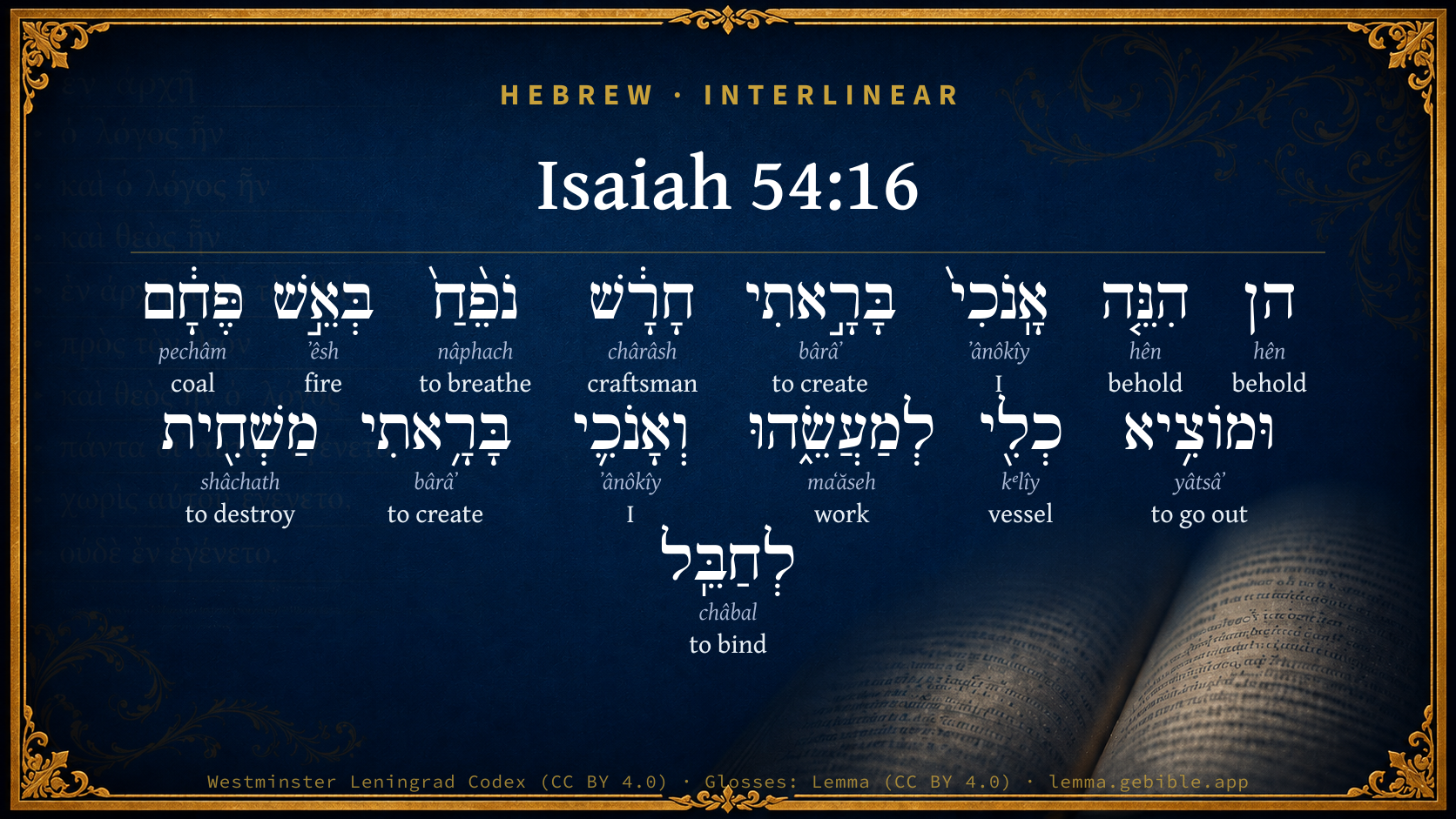
Hebrew (Westminster Leningrad Codex) Isaiah 54:16 appears in the Hebrew Old Testament. The text above is from the Westminster Leningrad Codex. Each word links to its Strong’s number, a concise gloss, and parsing drawn from the Open Scriptures Hebrew Bible morphology. Click any word for its full Brown-Driver-Briggs (BDB) entry.
Download image
Cite this verse

Isaiah 54:16 (World English Bible). Public Domain. Lemma interlinear Bible study tool, https://lemma.gebible.app/v/isaiah/54/16.

Show BibTeX & RIS
BibTeX
RIS
English Translation
Behold, I have created the smith who blows the fire of coals, and brings forth a weapon for his work; and I have created the waster to destroy.
World English Bible · Public Domain
Download a study sheet

One document with this verse’s original text, its word-by-word gloss line, the meaning frame, cross-references with their text, attributed commentary, and full source and license credits — printable, and it pastes into notes with its structure intact.

This verse Autodidact and up

Study sheet (.html) Plain text (.txt)

A passage Seminary Student

Up to 50 verses in one chapter. A passage sheet keeps up to 6 commentary sources and 12 cross-references per verse, in the order this page ranks them, and says so on the sheet whenever that leaves anything out. Ask for a single verse and you get the Autodidact verse sheet above.

Everything on this page stays free to read, with no account — the sheet is a download of what is already on screen, not access to it.

Want to remove ads? Support Godless Engineer
Compare translations 3

The same verse in 3 English versions, stacked beneath the original-language interlinear above. Click any original word for its lexicon entry.

Each is an independent rendering of the whole verse — the interlinear is not word-aligned to these translations.

Highlighted words mark where these versions differ — a whole-verse word diff, not a word-by-word alignment.

  • World English Bible Public Domain
    Behold, I have created the smith who blows the fire of coals, and brings forth a weapon for his work; and I have created the waster to destroy.
  • King James Version Public Domain
    Behold, I have created the smith that bloweth the coals in the fire, and that bringeth forth an instrument for his work; and I have created the waster to destroy.
  • unfoldingWord Literal Text CC BY-SA 4.0
    “Behold, I, I have created the craftsman blowing on a fire of a coal and bringing out a weapon for its work, and I, I have created the destroyer to destroy.

unfoldingWord Literal Text — © unfoldingWord, licensed CC BY-SA 4.0. Word-aligned USFM3 via Door43 (git.door43.org/unfoldingWord/en_ult).

Versions to compare (up to 4)

3 of 4 selected

Show all 18 translations

Every available English version of this verse, each an independent rendering of the whole verse.

  • World English Bible Public Domain
    Behold, I have created the smith who blows the fire of coals, and brings forth a weapon for his work; and I have created the waster to destroy.
  • Berean Standard Bible Public Domain
    Behold, I have created the craftsman who fans the coals into flame and forges a weapon fit for its task; and I have created the destroyer to wreak havoc.
  • Majority Standard Bible Public Domain
    Behold, I have created the craftsman who fans the coals into flame and forges a weapon fit for its task; and I have created the destroyer to wreak havoc.
  • King James Version Public Domain
    Behold, I have created the smith that bloweth the coals in the fire, and that bringeth forth an instrument for his work; and I have created the waster to destroy.
  • American Standard Version (1901) Public Domain
    Behold, I have created the smith that bloweth the fire of coals, and bringeth forth a weapon for his work; and I have created the waster to destroy.
  • Revised Version (1885) Public Domain
    Behold, I have created the smith that bloweth the fire of coals, and bringeth forth a weapon for his work; and I have created the waster to destroy.
  • Geneva Bible (1599) Public Domain
    Beholde, I haue created the smith that bloweth the coales in the fire, and him that bringeth forth an instrument for his worke, and I haue created the destroyer to destroy.
  • Douay-Rheims (1899) Public Domain
    Behold, I have created the smith that bloweth the coals in the fire, and bringeth forth an instrument for his work, and I have created the killer to destroy.
  • Young's Literal Translation Public Domain
    Lo, I -- I have prepared an artizan, Blowing on a fire of coals, And bringing out an instrument for his work, And I have prepared a destroyer to destroy.
  • Literal Standard Version CC BY-SA 4.0
    Behold, I have created an artisan, || Blowing on a fire of coals, || And bringing out an instrument for his work, || And I have created a destroyer to destroy.
  • Unlocked Literal Bible CC BY-SA 4.0
    See, I have created the craftsman, who blows the burning coals and forges weapons as his work, and I have created the destroyer to destroy.
  • unfoldingWord Literal Text CC BY-SA 4.0
    “Behold, I, I have created the craftsman blowing on a fire of a coal and bringing out a weapon for its work, and I, I have created the destroyer to destroy.
  • Darby Bible Public Domain
    Behold, it is I who have created the smith that bloweth in the fire of coal, and that bringeth forth an instrument for his work; and I have created the destroyer to ravage.
  • World Messianic Bible Public Domain
    “Behold, I have created the blacksmith who fans the coals into flame, and forges a weapon for his work; and I have created the destroyer to destroy.
  • Webster's Bible Public Domain
    Behold, I have created the smith that bloweth the coals in the fire, and that bringeth forth an instrument for his work; and I have created the waster to destroy.
  • Free Bible Version CC BY-SA 4.0
    Look—I have created a blacksmith who blows the coals into a hot flame and forges a suitable weapon; and I have created the destroyer who brings destruction.
  • Bible in Basic English Public Domain
    See, I have made the iron-worker, blowing on the burning coals, and making the instrument of war by his work; and I have made the waster for destruction.
  • JPS Tanakh (1917) Public Domain
    Behold, I have created the smith that bloweth the fire of coals, and bringeth forth a weapon for his work; and I have created the waster to destroy.

Literal Standard Version (2020), Covenant Press — licensed CC BY-SA 4.0. Text via the HelloAO Bible API (eBible.org). Unlocked Literal Bible (unfoldingWord) — licensed CC BY-SA 4.0. Text via the HelloAO Bible API (eBible.org). unfoldingWord Literal Text — © unfoldingWord, licensed CC BY-SA 4.0. Word-aligned USFM3 via Door43 (git.door43.org/unfoldingWord/en_ult). Free Bible Version, Dr. Jonathan Gallagher — licensed CC BY-SA 4.0. Text via the HelloAO Bible API (eBible.org).

Word by word

More ways to search: Search by grammar → Find every occurrence → Compare this word →

Practice this passage: Drill this verse → Learn its vocabulary →

פֶּחָ֔ם
pechâm
H6352
“coal”
Noun, Common, Masculine, Singular, Absolute
Part of Speech
Noun
Type
Common
Gender
Masculine
Number
Singular
State
Absolute
Full BDB Definition

Origin: perhaps from an unused root probably meaning to be black

TWOT: 1760a

coal, charcoal, ember
  1. הן hên H2005 “behold” Particle, Interjection
  2. הִנֵּ֤ה hên H2005 “behold” Particle, Demonstrative
  3. אָֽנֹכִי֙ ʼânôkîy H595 “I” Pronoun, Personal, 1st Person, Common, Singular
  4. בָּרָ֣אתִי bârâʼ H1254 “to create” Verb, Qal, Perfect, 1st Person, Common, Singular
  5. חָרָ֔שׁ chârâsh H2796 “craftsman” Noun, Common, Masculine, Singular, Absolute
  6. נֹפֵ֨חַ֙ nâphach H5301 “breathing” Verb, Qal, Participle Active, Masculine, Singular, Absolute
  7. בְּאֵ֣שׁ ʼêsh H784 “in/at · fire of” Preposition + Noun, Common, Both, Singular, Construct
  8. וּמוֹצִ֥יא yâtsâʼ H3318 “and · going out” Conjunction + Verb, Hiphil, Participle Active, Masculine, Singular, Absolute
  9. כְלִ֖י kᵉlîy H3627 “vessel” Noun, Common, Masculine, Singular, Absolute
  10. לְמַעֲשֵׂ֑הוּ maʻăseh H4639 “to/for · work · his” Preposition + Noun, Common, Masculine, Singular, Construct + Suffix, Personal, 3rd Person, Masculine, Singular
  11. וְאָנֹכִ֛י ʼânôkîy H595 “and · I” Conjunction + Pronoun, Personal, 1st Person, Common, Singular
  12. בָּרָ֥אתִי bârâʼ H1254 “to create” Verb, Qal, Perfect, 1st Person, Common, Singular
  13. מַשְׁחִ֖ית shâchath H7843 “destroying” Verb, Hiphil, Participle Active, Masculine, Singular, Absolute
  14. לְחַבֵּֽל châbal H2254 “to bind” Preposition + Verb, Piel, Infinitive Construct

About this verse

These counts appear in no published source. They are computed here, from the morphology-tagged text and Lemma’s own curated glosses. What Lemma adds →

15
words
12
distinct lemmas
Prophets
section

Notable vocabulary

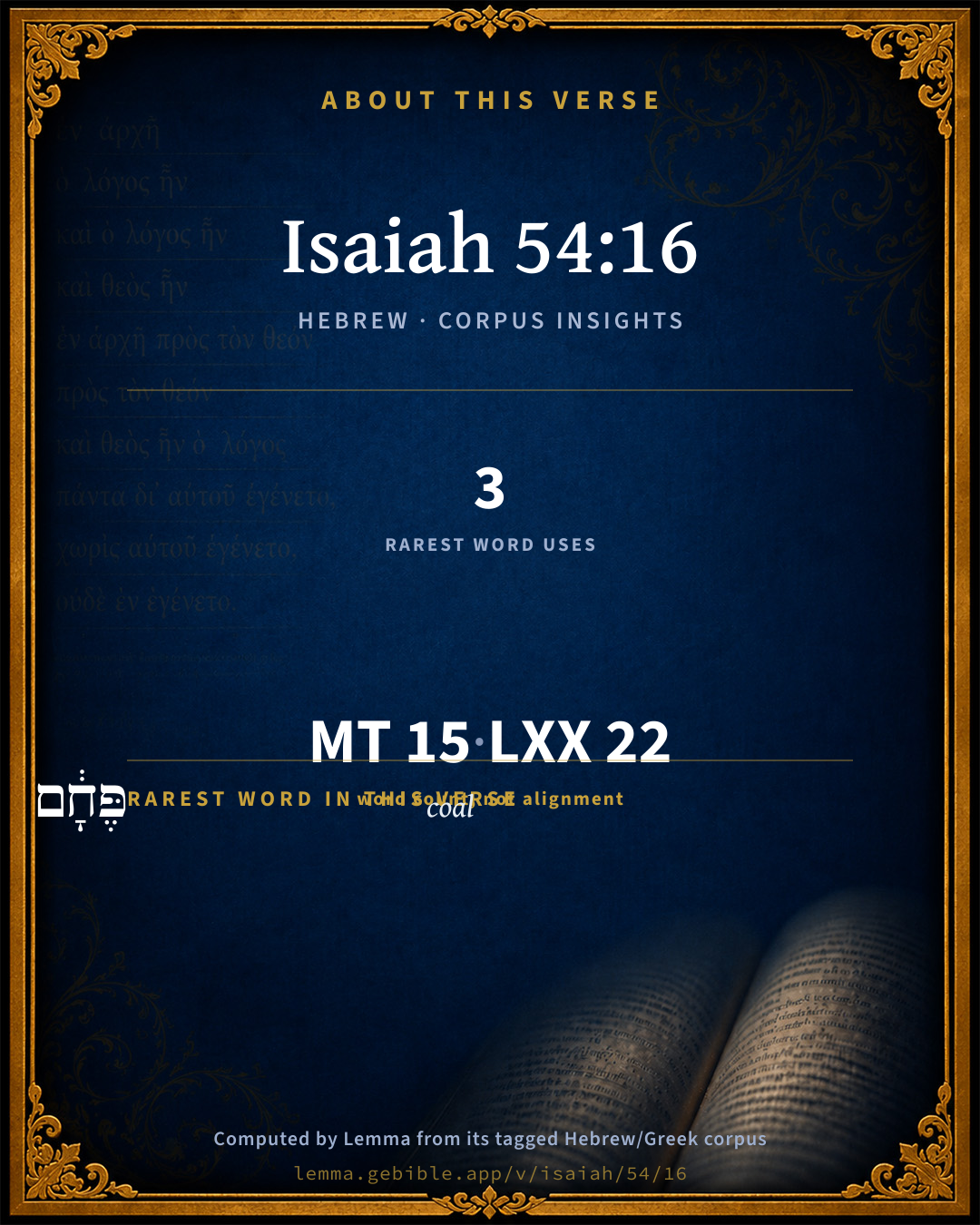
The rarest word here is פֶּחָ֔ם coal H6352 — appearing just 3 times in the whole Hebrew Bible.

Shared distinctive vocabulary

פֶּחָ֔ם coal H6352 occurs in 3 verses of the Hebrew Bible. Also found in:

Grammatical profile

  • 6 verbs
  • 5 nouns
  • 2 pronouns
  • 2 particles

Verb forms

  • בָּרָ֣אתִי Qal · Perfect
  • נֹפֵ֨חַ֙ Qal · Participle Active
  • וּמוֹצִ֥יא Hiphil · Participle Active
  • בָּרָ֥אתִי Qal · Perfect
  • מַשְׁחִ֖ית Hiphil · Participle Active
  • לְחַבֵּֽל Piel · Infinitive Construct

Repetition

Words recur within this verse — often emphatic in Hebrew:

  • הן behold H2005 ×2
  • בָּרָ֣אתִי to create H1254 ×2
  • אָֽנֹכִי֙ I H595 ×2

Hebrew & Septuagint length

In English translation the verse runs 28 words from the Hebrew and 32 from the Septuagint (LXX English) — closely comparable.

A rough comparison of the two English renderings, which tokenize alike — not a word-level alignment.

Word counts can differ between the Hebrew and the Greek without any difference in meaning — e.g. the Hebrew direct-object marker אֵת has no separate Greek word, and Greek often adds the article ὁ.

In the original languages it is 15 Hebrew tokens and 22 Greek tokens — but the two are counted differently (Hebrew bundles its prefixes and suffixes into one token; the Greek is in lemma form), so that isn’t a like-for-like length.

Cross-references

8

Topical passages linked to Isaiah 54:16 in the Treasury of Scripture Knowledge — connected by theme and wording, ordered by reader-vote popularity; previews shown in the World English Bible.

  • Exodus 9:16 but indeed for this cause I have made you stand: to show you my power, and that my name may be declared throughout all the earth;
  • Proverbs 16:4 Yahweh has made everything for its own end-- Yes, even the wicked for the day of evil.
  • Isaiah 46:11 calling a ravenous bird from the east, the man of my counsel from a far country; yes, I have spoken, I will also bring it to pass; I have purposed, I will also do it.
  • Isaiah 10:5–6 Ho Assyrian, the rod of my anger, the staff in whose hand is my indignation!
  • Isaiah 10:15 Shall the axe boast itself against him who hews therewith? Shall the saw magnify itself against him who wields it? as if a rod should wield those who lift it up, [or] as if a staff should lift up [him who is] not wood.
  • Isaiah 37:26 Have you not heard how I have done it long ago, and formed it of ancient times? now have I brought it to pass, that it should be your to lay waste fortified cities into ruinous heaps.
  • Daniel 4:34–35 At the end of the days I, Nebuchadnezzar, lifted up my eyes to heaven, and my understanding returned to me, and I blessed the Most High, and I praised and honored him who lives forever; for his dominion is an everlasting dominion, and his kingdom from generation to generation.
  • John 19:11 Jesus answered, "You would have no power at all against me, unless it were given to you from above. Therefore he who delivered me to you has greater sin."

Cross-references courtesy of OpenBible.info (CC BY 4.0).

Hebrew and Greek witnesses Masoretic Hebrew ↔ Greek Septuagint

The same verse in the two great witnesses to the Old Testament, shown verse-for-verse.

These are two independent witnesses, not word-aligned to each other, and the Septuagint is shown in lemma (dictionary) form.

Hebrew Isaiah 54:16 Masoretic · Westminster Leningrad Codex

הן הִנֵּ֤ה אָֽנֹכִי֙ בָּרָ֣אתִי חָרָ֔שׁ נֹפֵ֨חַ֙ בְּאֵ֣שׁ פֶּחָ֔ם וּמוֹצִ֥יא כְלִ֖י לְמַעֲשֵׂ֑הוּ וְאָנֹכִ֛י בָּרָ֥אתִי מַשְׁחִ֖ית לְחַבֵּֽל

Behold, I have created the smith who blows the fire of coals, and brings forth a weapon for his work; and I have created the waster to destroy.

World English Bible · Public Domain

Greek LXX Isaiah 54:16 Septuagint · lemma form

ἰδού ἐγώ κτίζω σύ οὐ ὡς χαλκεύς φυσάω ἄνθραξ καί ἐκφέρω σκεῦος εἰς ἔργον ἐγώ δέ κτίζω σύ οὐ εἰς ἀπώλεια φθείρω

Behold, I have created you, not as the coppersmith blowing coals, and bringing out a vessel fit for work; but I have created you, not for ruin, that I should destroy you.

LXX2012 (modern English Septuagint) · Public Domain

On this verse, Haydock's Catholic Bible Commentary discusses the Septuagint’s reading. Read the note in Commentary ↓

Hebrew: Westminster Leningrad Codex (CC BY 4.0). Greek: Septuagint (public domain); English from LXX2012 (modern English Septuagint) (Public Domain). How the Septuagint differs from the Hebrew →

Targum (Aramaic paraphrase)

1

The Targum is the ancient Jewish Aramaic paraphrase of the Hebrew Scriptures — an interpretive translation, not the Hebrew text itself. Onkelos (literal) and Pseudo-Jonathan (expansive) render the Torah, and Jonathan the Prophets. Coverage is partial: where no permissively-licensed English translation exists for a verse, only the Aramaic is shown. This is verse-level text, not a word-by-word alignment to the Hebrew.

  1. Targum Jonathan Prophets (Joshua–Malachi)
    הָא אֲנָא בָּרֵית נַפָּחָא נָפַח נוּר בִּשְׁחוֹרִין וּמַפִּיק מָנָא לְצוֹרְכֵהּ וַאֲנָא בָּרֵית מְחַבְּלָא לְחַבָּלָא:

    Behold, I have created the smith that bloweth the coals in the fire, and that bringeth forth an instrument for his use; and I have created the destroyer to destroy.

    Targum Jonathan — Aramaic: “Mikraot Gedolot” (public domain). English: “Sefaria Community Translation” (CC0 1.0 (public-domain dedication)); “London "Chaldee Paraphrase," 1871” (public domain). Text via Sefaria.

Commentary

Notes on Isaiah 54:16 from classic Christian and Jewish commentators (each source and its license shown beneath its notes). The classic Christian expositions comment on the surrounding passage and are grouped to its opening verse, so a note may address several verses; the Jewish commentaries on the Tanakh (Rashi and others) are per-verse, so they appear only where the commentator wrote on this verse.

Lemma curates 59 commentaries, every one of them public domain or Creative Commons licensed, each selected and text-cleaned for this edition rather than reprinted as found. About our sources →

Trapp's Complete Commentary

John Trapp

Isa 54:16 Behold, I have created the smith that bloweth the coals in the fire, and that bringeth forth an instrument for his work; and I have created the waster to destroy.

Ver. 16. Behold, I have created the smith that bloweth the coals,] i.e., The devil, say some; rather his imps and instruments, those kindle coals and tools of his.

And I have created the waster to destroy.] Those brats of Abaddon. I have determined their evil doings, overruling the same, and directing them to a good end.

John Trapp, A Commentary or Exposition upon All the Books of the Old and New Testament (1647–1656) — public domain. Text from a community e-Sword module.

The Biblical Illustrator

Joseph S. Exell

Isa_54:16-17

Behold, I have created the smith

Hope for the Church in the sovereignty of God

The general meaning evidently is, that God can certainly redeem His pledge, because all instruments and agents are alike at His disposal and under His control.

(J. A. Alexander.)

The Churchs fears silenced

The idea is that the Church has been saying, Where is that awful man the smith? The Lord says in reply, You see that smith? The Church answers, Yes, too well. The Lord retorts, I made him, I hold him within the bend of My fingers, and one quiver, and there is no more smith to be seen. But the Church says, He is blowing his bellows. The Lord says, I made those bellows. The Church says, See what a fire he is kindling! The Lord says, He got the coals from My mines, and I could shut down that mining shaft so that he could never get another cinder. As for all these little tyrants and enemies and mockers and jibers and sceptics and infidels and others, have no fear of them; if any of them have any sincerity the reward shall not be withheld, and that sincerity may turn by-and-by to intelligence and to faith, but in so far as they mock and sneer and contemn have no fear of them; they are creatures, not creators; the smith is only a mechanic of a low degree or high; he is not Divine, he is most human. But, saith the Church, yet there is a weapon formed against me. The Lord says, So there may be, but it has no edge, and it has no handle; and if any man were foolish enough to take it up to strike with, it would curl up in his hand. But, Lord, there are tongues that rise against me in judgment, fluent tongues, yea eloquent tongues, and it is not in my power to answer their wordy arguments or to follow the tortuous train of their reasoning. And the Lord replies, Let them talk; they will soon exhaust their vocabulary. Never interrupt a man who has a bad cause. He trusts to interruption. He thinks the interruption may create for him an opportunity of abandoning the main line of his impeachment. The way to answer a foolish and unjust accuser is to listen to him in silence. (J. Parker, D. D.)

The Biblical Illustrator, edited by Joseph S. Exell (c. 1880s–1900s) — public domain. Text from a community e-Sword module.

Geneva Bible (1599)

Geneva Bible translators

Signifying hereby, that man can do nothing, but so far as God giveth power: for seeing that all are his creatures, he must needs govern and guide them.

Geneva Bible (1599) marginal notes — public domain. Text via Bolls.life.

Jamieson, Fausset & Brown

Robert Jamieson, A. R. Fausset & David Brown

The workman that forms "weapons against thee" (Isa 54:17) is wholly in My power, therefore thou needest not fear, having Me on thy side.

for his work--rather, "by his labor [HORSLEY]. "According to the exigencies of his work" [MAURER].

waster to destroy-- (Isa 10:5-7; Isa 37:26-27; Isa 45:1-6). Desolating conquerors who use the "instruments" framed by "the smith." The repetition of the "I" implies, however, something in the latter half of the verse contrasted with the former understand it, therefore, thus: "I have in My power both him who frames arms and him who destroys them (arms)" [ROSENMULLER].

Jamieson, Fausset & Brown — Commentary Critical and Explanatory on the Whole Bible (1871) — public domain (CC PDM 1.0). Text via the HelloAO Bible API.

Ellicott's Commentary for English Readers

(16) Behold, I have created the smith . . .—The words assert the same thought. The “axe,” the “hammer,” the “sword,” of the great ravagers of the earth are formed by the great Work-Master, and He would fashion no such weapon against the new Jerusalem.

A Bible Commentary for English Readers, edited by Charles John Ellicott (1878–1897) — public domain. Text from a community e-Sword module.

The Cambridge Bible for Schools and Colleges

gen. ed. J. J. S. Perowne

16, 17. No weapon formed against Zion shall prosper, because both the makers of weapons and those who use them are alike created by Jehovah, and all their activity is under His control.

the smith that bloweth the fire of coals (R.V.)] Cf. ch. Isa_44:12.

an instrument for his work] rather for its work, or perhaps “according to its work,” adapted to the particular work for which it is intended,—a scythe for reaping, a sword for slaughter, and so on. The smith will turn out anything, amongst other things deadly weapons, but all by the permission of Jehovah who has made him.

the waster to destroy] Not “to destroy the weapon that the smith has made”; the “waster” is the one for whose use the weapon is made; he also is the creature of Jehovah.

The Cambridge Bible for Schools and Colleges (gen. ed. J. J. S. Perowne; Cambridge University Press, 1878–1918) — public domain. Text from a community e-Sword module.

John Gill's Exposition

Behold, I have created the smith that bloweth the coals in the fire,.... Into which he puts his iron to soften it, that he may beat it, and form it into what shape he pleases; which descriptive clause is added to show that it is a blacksmith that is intended, and to distinguish him from the carpenter and mason, of whom this word is also used, who deal, the one in wood, and the other in stone, and neither of which requires fire: now the Lord observes, to the comfort of his people, surrounded by enemies with instruments of war in their hands, that he made the smith that made these, not only as a man, but as an artificer gave him all the skill he has in making military weapons; and therefore could take away his skill, or hinder him from making any, or destroy and defeat, and render useless those that are made; and therefore they had nothing to fear from warlike preparations. Some understand this of the devil, that great incendiary of mankind; and others of a council of war, that forms the design, blows up the coals of contention, and brings forth the plan of operation in war, it follows, as a further description of the smith,

and that bringeth forth an instrument for his work: who takes the iron out of the fire which he blows, as an instrument to work upon, and which he forms into a military weapon, as an arrow, a sword, a spear, or shield; or, "for their work" (e); for the use of the enemies of Christ and his church:

and I have created the waster to destroy; military men, soldiers that use the above weapons of destruction for that purpose; these are God's creatures, and he can destroy or disappoint them, so that their hands cannot perform their enterprise. Some understand this also of the devil, who is by way of eminence the waster of mankind; others of tyrannical princes; I should choose to interpret it of the Romish antichrist, that waster and destroyer of the souls of men, and of the antichristian states that destroy the earth, and shall be destroyed themselves; or of the Turk, the locust, whose king is called Apollyon and Abaddon, which signifies a waster and a destroyer, Rev 11:18. These are said to be "created" by the Lord, not only because they are his creatures, the work of his hands, but because they are raised up by his providence, according to his secret purpose, as Pharaoh was, to show his power in them; and are permitted by him to continue for awhile to fulfil his will, being entirely dependent upon him, and subject to his influence, direction, and overruling providence; and therefore his people had no reason to be afraid of them.

(e) "ad opus ipsorum", Gataker.

John Gill's Exposition of the Whole Bible (1746–1763) — public domain (CC PDM 1.0). Text via the HelloAO Bible API.

Albert Barnes' Notes on the Bible

Behold, I have created the smith - The sense of this verse is, ‘Everything that can effect your welfare is under my control. The smith who manufactures the instruments of war or of torture is under me. His life, his strength, his skill, are all in my hands, and he can do nothing which I shall not deem it best to permit him to do. So with the enemy of the church himself - the waster who destroys. I bare made him, and he is wholly under my control and at my disposal.’ The smith who bloweth the coals, denotes the man who is engaged in forging instruments for war, or for any other purpose. Here it refers to him who should be engaged in forging instruments of battle to attack the church; and why should it not refer also to him who should be engaged in making instruments of torture - such as are used in times of persecution?

That bringeth forth an instrument for his work - Lowth, ‘According to his work.’ Noyes, ‘By his labor.’ The idea is, that he produces an instrument as the result of his work.

I have created the waster to destroy - I have formed every man who is engaged in spreading desolation by wars, and I have every such man under my control (see the notes at Isa 10:5-7; Isa 37:26-27; Isa 46:1-6). The sense here is, that as God had all such conquerors under his control, they could accomplish no more than he permitted them to do.

Albert Barnes' Notes on the Bible (1834–1885) — public domain. Text from a community e-Sword/MySword module.

Haydock's Catholic Bible Commentary

Destroy. I can give peace or war. (Calmet) --- Septuagint, "but I have created thee not for utter destruction." (Haydock)

George Leo Haydock (1774–1849), Haydock's Catholic Family Bible and Commentary, 1859 edition — public domain. Excludes Psalms (Douay-Rheims chapter numbering differs from Protestant) and Deuterocanonical books (Catholic canon only).

Matthew Poole's English Annotations

Both the smith that maketh all warlike instruments, and the soldier that useth them, are my creatures, and totally at my command, and therefore they cannot hurt you without my leave. To destroy; to destroy only whom and when I please.

Matthew Poole's English Annotations on the Holy Bible (1683–1685) — public domain. Text from a community e-Sword/MySword module.

Whedon's Commentary on the Bible

Daniel D. Whedon

16, 17. I have created the smith — Every instrument which is employed against God’s people, as well as its maker, is in God’s hands to overrule and to foreclose.

I have created the waster to destroy — This means, that Zion’s welfare is wholly in God’s care, and every destroyer in war in the interest only of himself is equally and absolutely at God’s ultimate disposal. “The smith,” or armorer, who forges the weapon, and the warrior who wields it, are both as easily controlled as created. Man’s free act, when projected, is in divine, not in self-same human hands, to be used.

Daniel D. Whedon (gen. ed.), Commentary on the Old and New Testaments (1874–1909) — public domain. Text from a community e-Sword module.

The Pulpit Commentary

Behold, I have created, etc. The Church is encouraged to fear no danger by being reminded that all power to do hurt is from God. Whether it be the smith that forges a weapon, or the waster that destroys and lays waste whole countries, or any other worker of woe to man, all are equally brought into being, and sustained in life, by God. None can do a hurt that God does not allow. The smith that bloweth the coals. In ancient times the smith worked his metal into shape by the help of a blowpipe, which he blew himself (see Rosellini, "Monumenti Civili," pl. 51, fig 4, and pl. 52, fig. 4). For his work; or, for its work: i.e. destruction. The waster; i.e. the conquering king, such as Tiglath-Pileser, Sargon, Sennacherib, Nebuchadnezzar, Cyrus.

The Divine control of evil forces.

"I have created the waster to destroy." This is an assurance which we, with our theological notions of the sphere of Satan, find it very difficult to realize. We cannot associate God directly with the forces that work evil Even if we get so far as to say that God permits evil, and overrules it for good, we cannot see that he actually sends the evil and arranges the evil, which is as truly his angel, his messenger, as any form of good is. Perhaps the conception was less difficult to a Jew than to us, because he had better notions of the Divine unity than we can gain. The "waster" here is a comprehensive term for the great conquering kings of Assyria and Babylonia, at whose hands Israel had so grievously suffered. Isaiah declares that God raised them up; God sent them forth; God gave them their work. He assures the new Jerusalem that it is quite safe, for God does not intend to send against them any such "wasters;" and they may dismiss for ever from their thoughts that any other being exists who can send "wasters" forth. Matthew Arnold says, "Destroyers and destruction are God"s work; they reach those only whom he means to reach, and he does not mean them to reach Israel.

I GOD SENDS TO US ALL THE EVIL THAT COMES TO US. We must never rest with second causes, nor talk of circumstances as if they were under no wise control. We must see God in calamity, and enmity, and temptation, and everything to which we can attach the name evil. Evil indeed is, oftentimes, no more than good which we cannot understand. The supreme control of God over all that man calls evil is figured for us in Satan, as the angel of calamity, appearing, to give account of his work, among the sons of God. (see Job_1:2)

II GOD WARDS OFF ALL THE EVIL THAT MIGHT COME TO US. For there is a sense in which, as free-willed creatures, we are bringing evil upon ourselves; and others, as free-willed creatures, in some limited sense, may contemplate doing evil to us. Therefore have we, in ver. 17, the further assurance, No weapon that is formed against thee shall prosper; and every tongue that shall rise against thee for the judgment shalt thou show to be guilty." It is with God, and God alone, to send into our lives, or to withhold from us, both the evil and the good. R.T.

The Pulpit Commentary (1880–1919), ed. H.D.M. Spence-Jones & Joseph S. Exell — public domain. Text from a community e-Sword module.

John Wesley's Explanatory Notes

The smith - Both the smith that makes warlike instruments, and the soldier that uses them, are my creatures, and totally at my command, and therefore they cannot hurt you without my leave. The waster - To destroy only whom and when I please.

John Wesley, Explanatory Notes Upon the Whole Bible (1754–1765) — public domain. Text via the GEBible commentary corpus.

Keil & Delitzsch

C. F. Keil & F. Delitzsch

Jerusalem will be thus invincible, because Jehovah, the Almighty One, is its protector. "Behold, I have created the smith who bloweth the coal-fire, and brings to the light a weapon according to his trade; and I have created the destroyer to destroy. Every weapon formed against thee has no success, and every tongue that cometh before the judgment with thee thou wilt condemn. This the inheritance of the servants of Jehovah; and their righteousness from me, saith Jehovah." If Jehovah has created the armourer, who forges a weapon למעסהוּ (i.e., according to his trade, or according to the thing he has to finish, whether an arrow, or a sword, or a spear; not "for his own use," as Kimchi supposes), to be used in the hostile army against Jerusalem, He has also created a destroyer (לחבּל) to destroy. The very same creative might, to which the origin of the weapon is to be traced as its primary cause, has opposed to it beforehand a defender of Jerusalem. And as every hostile weapon fails, Jerusalem, in the consciousness of its divine right, will convict every accusing tongue as guilty and deserving of utter condemnation (הרשׁיע as in Isa 50:9, cf., Sa1 14:47, where it denotes the punishment of the guilty). The epiphonem in Isa 54:17, with the retrospective זאת and the words "saith the Lord," which confirm the certainty of the fulfilment, forms an unmistakeable close to the prophecy. This is the position in which Jehovah has placed His servants as heirs of the future salvation; and this the righteousness which they have received as His gift, and which makes them strong within and victorious without. The individual idea of the church, which we find elsewhere personified as "the servant of Jehovah," equivalent to "the people in whose heart is my law" (Isa 51:7), or "my people that have sought me" (Isa 65:10), is here expanded into "the servants of Jehovah" (as in Isa 65:8-9; compare Isa 59:21 with Isa 51:16). But totally different colours are employed in Isa 52:13 to Isa 53:1-12 to depict the exaltation of the one "Servant of Jehovah," from those used here to paint the glory of the church of the "servants of Jehovah," a proof that the ideas do not cover one another. That which is the reward of suffering in the case of the former, is the experience of divine mercy in that of the latter: it becomes a partaker of the salvation purchased by the other. The one "Servant of Jehovah" is the heart of the church, in which the crisis which bursts forth into life is passing; the righteousness of the "servants of Jehovah" is the fruit of the sufferings of this one "Servant of Jehovah," who is Himself צדיק and מצידק. He is the Mediator of all the salvation of the church. He is not only its "head," but its "fulness" (πλήρωμα) also.

Keil & Delitzsch — Biblical Commentary on the Old Testament (1861–1891) — public domain (CC PDM 1.0). Text via the HelloAO Bible API. (Old Testament only.)

J. A. Alexander on Isaiah

Joseph Addison Alexander

“Lo, I have created the smith, blowing into the fire of coal, and bringing out a weapon for his work; and I have created the waster to destroy.” The general meaning evidently is, that God can certainly redeem His pledge, because all instruments and agents are alike at His disposal and under His control. He is not only the maker of the weapons of war, but the maker of their maker, as well as of the warrior who wields them. The pronoun in both clauses is emphatic. ‘It is I (and not another) who created them.’ A similar glimpse into the ancient forge or smithy has already been afforded in the scornful attack upon the worshippers of idols, Isa 41:7. ‘Bringing out’ does not mean bringing out of his workshop or his hands, but bringing into shape or into being, precisely as we say bringing forth, producing, although commonly in reference to animal or vegetable life. Perhaps however, it would be still better to explain it as meaning out of the fire, in which case there would be a fine antithesis between blowing into it and bringing the wrought iron out of it. ‘It is I that create the smith who makes the instruments, and it is also I that create the destroyer who employs them.’

Joseph Addison Alexander, The Prophecies of Isaiah (1846–1847; New York: Scribner, 1870–1878) — public domain. Text from a community e-Sword module.

Rashi

Rabbi Shlomo Yitzchaki (Rashi)

Behold I am He Who created a smith who devises a weapon, and I am He Who has created a destroyer that destroys it. That is, to say: I am He Who incited the enemy against you; I am He Who has prepared retribution for him.

and produces a weapon for his work For necessity. He completes it according to all that is necessary.

Rashi on the Tanakh — English translations: “The Judaica Press complete Tanach with Rashi, translated by A. J. Rosenberg” (CC BY 4.0); “Pentateuch with Rashi's commentary by M. Rosenbaum and A.M. Silbermann, 1929-1934” (public domain); “The Metsudah Tanach series, Lakewood, N.J” (CC BY 4.0); and “The Book of Joshua, Metsudah Publications, 1997” (CC BY 4.0). Text via Sefaria.

Ibn Ezra

Rabbi Abraham ibn Ezra

Behold, I have created the smith, etc. It is a figurative expression.

ומוציא כלי למעשהו And that bringeth forth a vessel for its work. That bringeth forth a vessel out of the fire, to finish it. And I have also created the waster to destroy the instrument of the smith.

Ibn Ezra on the Tanakh — English translations: “Sefaria Community Translation” (CC0 1.0 (public-domain dedication)); “Yalkut, Sifsei Chachomim Chumash, Metsudah Publications, 2009” (CC BY 4.0); and “Commentary of Ibn Ezra on Isaiah - trans. by M. Friedlander, 1873” (public domain). Text via Sefaria.

Lesson kit

Teaching starters — assembled from the data on this page, not authored interpretation. Every prompt links to the verse data it draws on. Edit before teaching.

Isaiah, in the Prophets, opens this verse with 15 words (12 distinct Hebrew lemmas). Its most distinctive word is pechâm (“coal”). A historical commentator’s framing appears above. Read the whole chapter for the surrounding context.

Discussion questions

  1. How does “coal” (pechâm) shape what this verse is saying?
  2. How does Proverbs 26:21, which shares the word «coal», read alongside this verse?
  3. What does the repetition of “behold” (2× in this one verse) do in this verse?
  4. These translations render this verse differently. What is at stake in choosing one wording over another?
  5. «בָּרָ֣אתִי» is a Qal Perfect verb. How does that grammatical form shape the action described?
  6. Compare how Trapp's Complete Commentary and The Biblical Illustrator read this verse. Where do they agree or differ?

Things to notice

Reading settings

Reading text

Shown beneath each verse's original-language words.

Old Testament
Old Testament edition

Read the OT as the Masoretic Hebrew (MT) or the Greek Septuagint (LXX).

English shown for the Greek Septuagint (in the Hebrew ↔ Greek comparison).

Comparing translations? Open the Compare panel on any verse page to stack up to four side by side.