1 Chronicles 11:25

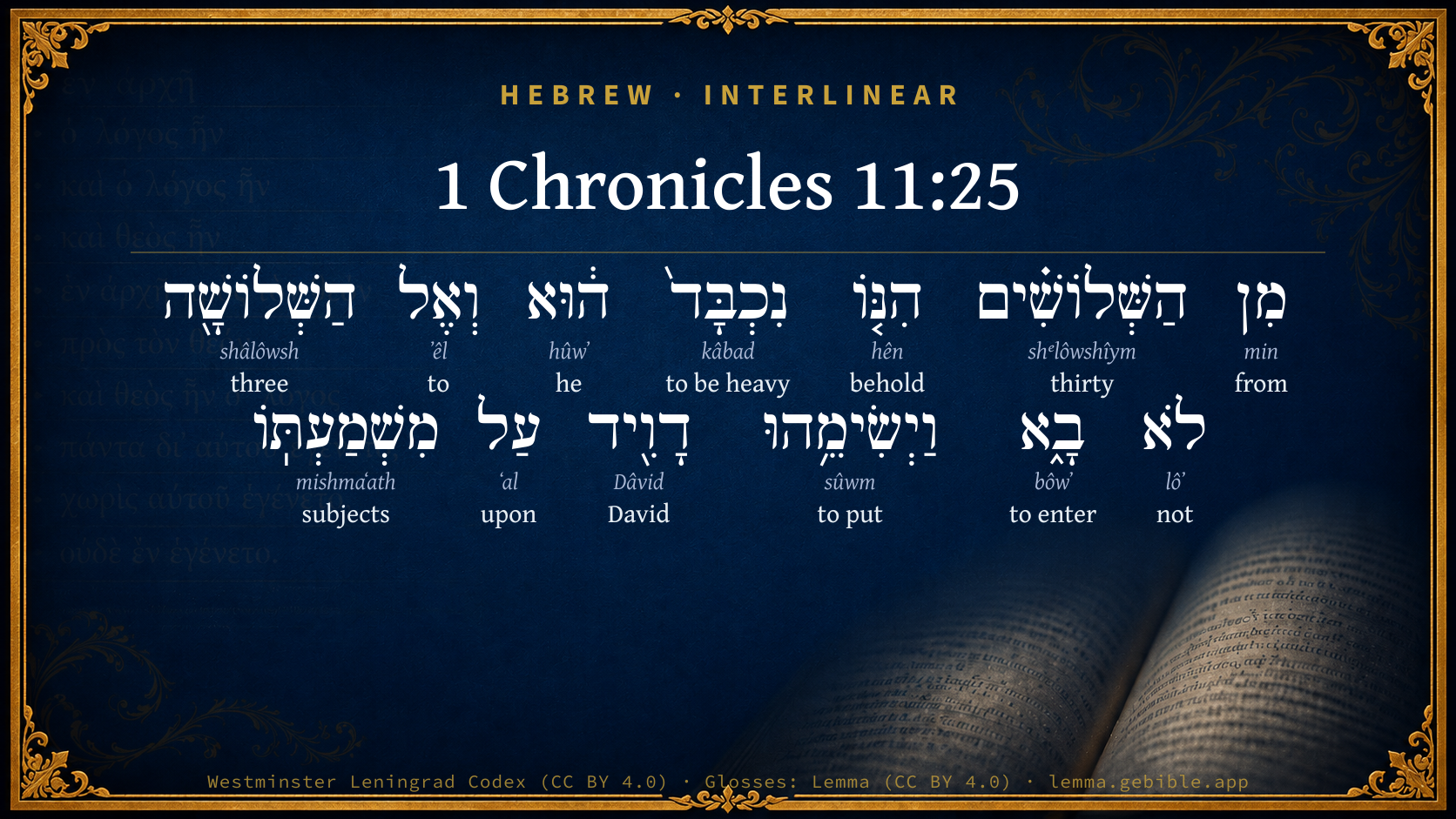
Hebrew (Westminster Leningrad Codex) 1 Chronicles 11:25 appears in the Hebrew Old Testament. The text above is from the Westminster Leningrad Codex. Each word links to its Strong’s number, a concise gloss, and parsing drawn from the Open Scriptures Hebrew Bible morphology. Click any word for its full Brown-Driver-Briggs (BDB) entry.
Download image
Cite this verse

1 Chronicles 11:25 (World English Bible). Public Domain. Lemma interlinear Bible study tool, https://lemma.gebible.app/v/1-chronicles/11/25.

Show BibTeX & RIS
BibTeX
RIS
English Translation
Behold, he was more honorable than the thirty, but he didn't attain to the [first] three: and David set him over his guard.
World English Bible · Public Domain
Download a study sheet

One document with this verse’s original text, its word-by-word gloss line, the meaning frame, cross-references with their text, attributed commentary, and full source and license credits — printable, and it pastes into notes with its structure intact.

This verse Autodidact and up

Study sheet (.html) Plain text (.txt)

A passage Seminary Student

Up to 50 verses in one chapter. A passage sheet keeps up to 6 commentary sources and 12 cross-references per verse, in the order this page ranks them, and says so on the sheet whenever that leaves anything out. Ask for a single verse and you get the Autodidact verse sheet above.

Everything on this page stays free to read, with no account — the sheet is a download of what is already on screen, not access to it.

Want to remove ads? Support Godless Engineer
Compare translations 3

The same verse in 3 English versions, stacked beneath the original-language interlinear above. Click any original word for its lexicon entry.

Each is an independent rendering of the whole verse — the interlinear is not word-aligned to these translations.

Highlighted words mark where these versions differ — a whole-verse word diff, not a word-by-word alignment.

  • World English Bible Public Domain
    Behold, he was more honorable than the thirty, but he didn't attain to the [first] three: and David set him over his guard.
  • King James Version Public Domain
    Behold, he was honorable among the thirty, but attained not to the first three: and David set him over his guard.
  • unfoldingWord Literal Text CC BY-SA 4.0
    More than the Thirty, behold him, being honored, him, but to the Three, he did not come. And David put him over his bodyguard.

unfoldingWord Literal Text — © unfoldingWord, licensed CC BY-SA 4.0. Word-aligned USFM3 via Door43 (git.door43.org/unfoldingWord/en_ult).

Versions to compare (up to 4)

3 of 4 selected

Show all 18 translations

Every available English version of this verse, each an independent rendering of the whole verse.

  • World English Bible Public Domain
    Behold, he was more honorable than the thirty, but he didn't attain to the [first] three: and David set him over his guard.
  • Berean Standard Bible Public Domain
    He was most honored among the Thirty, but he did not become one of the Three. And David appointed him over his guard.
  • Majority Standard Bible Public Domain
    He was most honored among the Thirty, but he did not become one of the Three. And David appointed him over his guard.
  • King James Version Public Domain
    Behold, he was honorable among the thirty, but attained not to the first three: and David set him over his guard.
  • American Standard Version (1901) Public Domain
    Behold, he was more honorable than the thirty, but he attained not to the `first' three: and David set him over his guard.
  • Revised Version (1885) Public Domain
    Behold, he was more honourable than the thirty, but he attained not to the first three: and David set him over his guard.
  • Geneva Bible (1599) Public Domain
    Behold, he was honourable among thirtie, but he attained not vnto the first three. And Dauid made him of his counsell.
  • Douay-Rheims (1899) Public Domain
    And the first among the thirty, but yet to the three he attained not: and David made him of his council.
  • Young's Literal Translation Public Domain
    Of the thirty, lo, he `is' honoured, and unto the `first' three he hath not come, and David setteth him over his guard.
  • Literal Standard Version CC BY-SA 4.0
    Of the thirty, behold, he [is] honored, but he has not come to the [first] three, and David sets him over his guard.
  • Unlocked Literal Bible CC BY-SA 4.0
    He was more highly regarded than the thirty soldiers in general, but he was not regarded quite as highly as the three mighty men. Yet David put him in charge of his bodyguard.
  • unfoldingWord Literal Text CC BY-SA 4.0
    More than the Thirty, behold him, being honored, him, but to the Three, he did not come. And David put him over his bodyguard.
  • Darby Bible Public Domain
    Behold, he was honoured above the thirty, but he did not attain to the [first] three. And David set him in his council.
  • World Messianic Bible Public Domain
    Behold, he was more honorable than the thirty, but he didn’t attain to the three; and David set him over his guard.
  • Webster's Bible Public Domain
    Behold, he was honorable among the thirty, but attained not to the first three: and David set him over his guard.
  • Free Bible Version CC BY-SA 4.0
    He was the most highly regarded of the Thirty, though he was not one of the Three. David put him in charge of his personal bodyguard.
  • Bible in Basic English Public Domain
    He was honoured over the thirty, but he was not equal to the first three: and David put him over his servants.
  • JPS Tanakh (1917) Public Domain
    Behold, he was more honourable than the thirty, but he attained not to the first three; and David set him over his guard.

Literal Standard Version (2020), Covenant Press — licensed CC BY-SA 4.0. Text via the HelloAO Bible API (eBible.org). Unlocked Literal Bible (unfoldingWord) — licensed CC BY-SA 4.0. Text via the HelloAO Bible API (eBible.org). unfoldingWord Literal Text — © unfoldingWord, licensed CC BY-SA 4.0. Word-aligned USFM3 via Door43 (git.door43.org/unfoldingWord/en_ult). Free Bible Version, Dr. Jonathan Gallagher — licensed CC BY-SA 4.0. Text via the HelloAO Bible API (eBible.org).

Word by word

More ways to search: Search by grammar → Find every occurrence → Compare this word →

Practice this passage: Drill this verse → Learn its vocabulary →

מִשְׁמַעְתּֽוֹ
mishmaʻath
H4928
“subjects · his”
Noun, Common, Feminine, Singular, Construct + Suffix, Personal, 3rd Person, Masculine, Singular
Part of Speech
Noun
Type
Common
Gender
Feminine
Number
Singular
State
Construct
Full BDB Definition

Origin: from H4926

TWOT: 2412g

subjects, body of subjects, bodyguard, listeners, obedient ones - bodyguard - subjects
  1. מִן min H4480 “from” Preposition
  2. הַשְּׁלוֹשִׁ֗ים shᵉlôwshîym H7970 “the · thirty” Particle, Definite Article + Adjective, Cardinal number, Both, Plural, Absolute
  3. הִנּ֤וֹ hên H2005 “behold · him” Particle, Interjection + Suffix, Personal, 3rd Person, Masculine, Singular
  4. נִכְבָּד֙ kâbad H3513 “being heavy” Verb, Niphal, Participle Active, Masculine, Singular, Absolute
  5. ה֔וּא hûwʼ H1931 “he” Pronoun, Personal, 3rd Person, Masculine, Singular
  6. וְאֶל ʼêl H413 “and · to” Conjunction + Preposition
  7. הַשְּׁלוֹשָׁ֖ה shâlôwsh H7969 “the · three” Particle, Definite Article + Adjective, Cardinal number, Masculine, Singular, Absolute
  8. לֹא lôʼ H3808 “not” Particle, Negative
  9. בָ֑א bôwʼ H935 “to enter” Verb, Qal, Perfect, 3rd Person, Masculine, Singular
  10. וַיְשִׂימֵ֥הוּ sûwm H7760 “and · to put · him” Conjunction + Verb, Qal, Sequential Imperfect, 3rd Person, Masculine, Singular + Suffix, Personal, 3rd Person, Masculine, Singular
  11. דָוִ֖יד Dâvid H1732 “David” Noun, Proper
  12. עַל ʻal H5921 “upon” Preposition

About this verse

These counts appear in no published source. They are computed here, from the morphology-tagged text and Lemma’s own curated glosses. What Lemma adds →

13
words
13
distinct lemmas
Historical
section

Notable vocabulary

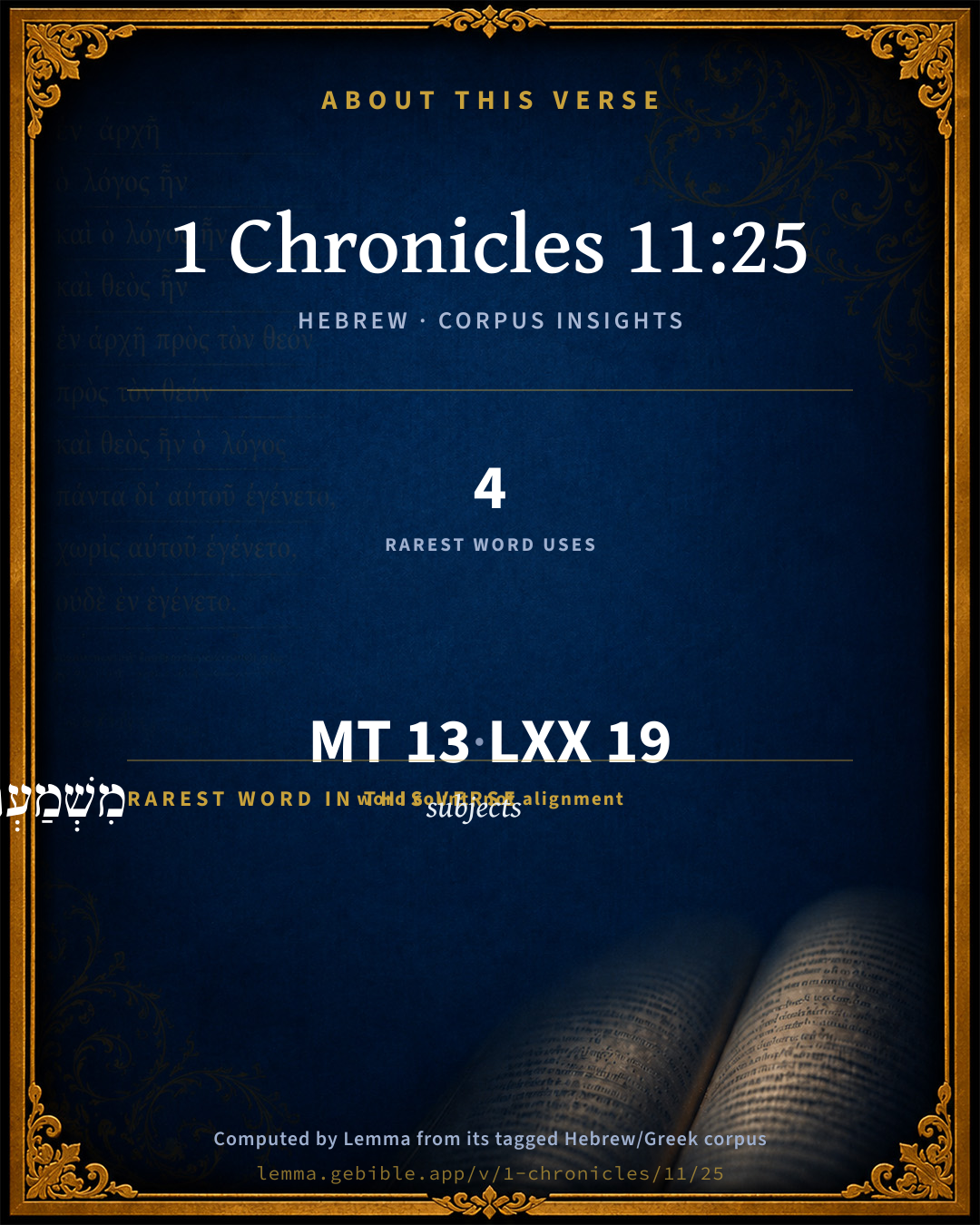
The rarest word here is מִשְׁמַעְתּֽוֹ subjects H4928 — appearing just 4 times in the whole Hebrew Bible.

Shared distinctive vocabulary

מִשְׁמַעְתּֽוֹ subjects H4928 occurs in 4 verses of the Hebrew Bible. Also found in:

Grammatical profile

  • 3 verbs
  • 2 nouns
  • 2 adjectives
  • 1 pronoun
  • 3 prepositions
  • 2 particles

Verb forms

  • נִכְבָּד֙ Niphal · Participle Active
  • בָ֑א Qal · Perfect
  • וַיְשִׂימֵ֥הוּ Qal · Sequential Imperfect

Hebrew & Septuagint length

In English translation the verse runs 23 words from the Hebrew and 21 from the Septuagint (LXX English) — closely comparable.

A rough comparison of the two English renderings, which tokenize alike — not a word-level alignment.

Word counts can differ between the Hebrew and the Greek without any difference in meaning — e.g. the Hebrew direct-object marker אֵת has no separate Greek word, and Greek often adds the article ὁ.

In the original languages it is 13 Hebrew tokens and 19 Greek tokens — but the two are counted differently (Hebrew bundles its prefixes and suffixes into one token; the Greek is in lemma form), so that isn’t a like-for-like length.

Cross-references

1

Topical passages linked to 1 Chronicles 11:25 in the Treasury of Scripture Knowledge — connected by theme and wording, ordered by reader-vote popularity; previews shown in the World English Bible.

  • 2 Samuel 20:23 Now Joab was over all the host of Israel; and Benaiah the son of Jehoiada was over the Cherethites and over the Pelethites;

Cross-references courtesy of OpenBible.info (CC BY 4.0).

Hebrew and Greek witnesses Masoretic Hebrew ↔ Greek Septuagint

The same verse in the two great witnesses to the Old Testament, shown verse-for-verse.

These are two independent witnesses, not word-aligned to each other, and the Septuagint is shown in lemma (dictionary) form.

Hebrew 1 Chronicles 11:25 Masoretic · Westminster Leningrad Codex

מִן הַשְּׁלוֹשִׁ֗ים הִנּ֤וֹ נִכְבָּד֙ ה֔וּא וְאֶל הַשְּׁלוֹשָׁ֖ה לֹא בָ֑א וַיְשִׂימֵ֥הוּ דָוִ֖יד עַל מִשְׁמַעְתּֽוֹ

Behold, he was more honorable than the thirty, but he didn't attain to the [first] three: and David set him over his guard.

World English Bible · Public Domain

Greek LXX 1 Chronicles 11:25 Septuagint · lemma form

ὑπέρ ὁ τριάκοντα ἔνδοξος οὗτος καί πρός ὁ τρεῖς οὐ ἄρχω καί καταἵστημι αὐτός δαυίδ ἐπί ὁ πατριά αὐτός

He was distinguished beyond the thirty, yet he reached not to the first three: and David set him over his family.

LXX2012 (modern English Septuagint) · Public Domain

On this verse, Haydock's Catholic Bible Commentary discusses the Septuagint’s reading. Read the note in Commentary ↓

Hebrew: Westminster Leningrad Codex (CC BY 4.0). Greek: Septuagint (public domain); English from LXX2012 (modern English Septuagint) (Public Domain). How the Septuagint differs from the Hebrew →

Commentary

Notes on 1 Chronicles 11:25 from classic Christian and Jewish commentators (each source and its license shown beneath its notes). The classic Christian expositions comment on the surrounding passage and are grouped to its opening verse, so a note may address several verses; the Jewish commentaries on the Tanakh (Rashi and others) are per-verse, so they appear only where the commentator wrote on this verse.

Lemma curates 59 commentaries, every one of them public domain or Creative Commons licensed, each selected and text-cleaned for this edition rather than reprinted as found. About our sources →

Trapp's Complete Commentary

John Trapp

1Ch 11:25 Behold, he was honourable among the thirty, but attained not to the [first] three: and David set him over his guard.

Ver. 25. Behold, he was honourable among the thirty.] Yea, and above them too.

And David set him over his guard.] Heb., Over his hearing; that is, over those praetorian soldiers that were ever within his hearing and at his hand, viz., the Cherethites and the Pelethites, who stuck to him in all his troubles, and were now his bodyguard. 1Ch 11:26

John Trapp, A Commentary or Exposition upon All the Books of the Old and New Testament (1647–1656) — public domain. Text from a community e-Sword module.

Geneva Bible (1599)

Geneva Bible translators

Meaning, those three which brought the water to David.

Geneva Bible (1599) marginal notes — public domain. Text via Bolls.life.

Jamieson, Fausset & Brown

Robert Jamieson, A. R. Fausset & David Brown

David set him over his guard--the Cherethites and Pelethites that composed the small bodyguard in immediate attendance on the king.

Jamieson, Fausset & Brown — Commentary Critical and Explanatory on the Whole Bible (1871) — public domain (CC PDM 1.0). Text via the HelloAO Bible API.

Adam Clarke's Commentary

Verse 25. David set him over his guard] "Made him chief ruler over his disciples." - T.

FOR other particulars, see the notes on the parallel places, where the subject is farther considered.

Adam Clarke's Commentary on the Bible (1810–1826) — public domain. Text from a community e-Sword/MySword module.

Ellicott's Commentary for English Readers

(25) Behold, he was honourable among the thirty.—Rather, above the thirty behold he was honoured.

But attained not to the first three.—For he was a member of the second triad of heroes. The third member is omitted here, as in the case of the first triad.

Over his guard.—Literally, over his obedience; an abstract for concrete, as in Isa_11:14 (= vassals). The Cherethites and Pelethites, a small corps probably of foreigners, who constituted David’s body-guard, and were under his direct orders, appear to be meant here. (See 2Sa_8:18; 2Sa_20:23.) The word has this precise sense only in this place and its parallel.

A Bible Commentary for English Readers, edited by Charles John Ellicott (1878–1897) — public domain. Text from a community e-Sword module.

The Cambridge Bible for Schools and Colleges

gen. ed. J. J. S. Perowne

25. he was honourable among the thirty] R.V. (cp. 1Ch_11:21), he was more honourable than the thirty. The verse probably comes from some poem written in praise of Benaiah. Cp. 1Ch_27:6.

but attained not to the first three] Cp. note on 1Ch_11:21.

guard] The same Heb. word, mishma‘ath, is translated “council” in 1Sa_22:14. The literal meaning of the word is “obedience”; it seems both here and in Sam. (l.c.) to designate those who executed the king’s commands, i.e. his ministers. (Minister = “servant”.)

The Cambridge Bible for Schools and Colleges (gen. ed. J. J. S. Perowne; Cambridge University Press, 1878–1918) — public domain. Text from a community e-Sword module.

Haydock's Catholic Bible Commentary

Among, or rather "above," as he was the second captain of this series, and not one of the body of Thirty. (Kennicott) --- Council. Literally, "placed him at his ear," (Haydock) fecit eum auricularium a secreto; (2 Kings) though the word is the same. (Calmet) --- It seems, however, to have been read differently. (Haydock) --- Septuagint, "he placed him over his family, (Calmet, Greek: patrian) or native place." (Haydock) --- Syriac, "guard of his spear, and chief of his heroes." Arabic, "over all his riches." Some would translate, "captain of his guards." (Grotius) --- Banaias was a man of consummate prudence, as well as a great warrior. (Calmet) --- David "gives Banaias the command of his life-guard." (Josephus, [Antiquities?] vii. 12.) --- Hebrew, "Behold! he was more honourable than the Thirty; but he attained not unto the first three, and David set him over his guard," the Cerethites, &c., chap. xviii. 17. (Kennicott) --- This author adopts the correction of Grotius, as the Protestants do; though he acknowledges there is not impropriety in the present reading, "over his hearing or obedience." He also adds "first," by way of explanation, as [in] ver. 21. (Haydock)

George Leo Haydock (1774–1849), Haydock's Catholic Family Bible and Commentary, 1859 edition — public domain. Excludes Psalms (Douay-Rheims chapter numbering differs from Protestant) and Deuterocanonical books (Catholic canon only).

Matthew Poole's English Annotations

Heb. his hearing, or obedience, i.e. those that were always ready to hear and obey or execute his commands, to wit, the guards of his body.

Matthew Poole's English Annotations on the Holy Bible (1683–1685) — public domain. Text from a community e-Sword/MySword module.

The Pulpit Commentary

Over his guard. If the reference is not as above (see ver. 22), the margin of the parallel 2Sa_23:23) may be followed, which would translate "guard" as council. This Gesenius adopts, and translates "privy council." There seems, however, no necessity for this, with the references before us above given (2Sa_8:18, etc., to which may be added ch. 27:6, which shows Benaiah to be captain of the third division).

The Pulpit Commentary (1880–1919), ed. H.D.M. Spence-Jones & Joseph S. Exell — public domain. Text from a community e-Sword module.

Rashi

Rabbi Shlomo Yitzchaki (Rashi)

Of the thirty, he was the most honored, but to the three he did not come To the heroic feats of the three he did not reach; i.e., to those three mentioned above (verse 20). Therefore, לא is written above with an “aleph.”

over his guard עַל מִשְׁמַעְתּוֹ, an expression of appointment, and likewise, (Isa. 11:14): “... and the children of Ammon will be their appointees מִשְׁמַעְתָּם.”

Rashi on the Tanakh — English translations: “The Judaica Press complete Tanach with Rashi, translated by A. J. Rosenberg” (CC BY 4.0); “Pentateuch with Rashi's commentary by M. Rosenbaum and A.M. Silbermann, 1929-1934” (public domain); “The Metsudah Tanach series, Lakewood, N.J” (CC BY 4.0); and “The Book of Joshua, Metsudah Publications, 1997” (CC BY 4.0). Text via Sefaria.

Lesson kit

Teaching starters — assembled from the data on this page, not authored interpretation. Every prompt links to the verse data it draws on. Edit before teaching.

1 Chronicles, in the Historical, opens this verse with 13 words (13 distinct Hebrew lemmas). Its most distinctive word is mishmaʻath (“subjects”). A historical commentator’s framing appears above. Read the whole chapter for the surrounding context.

Discussion questions

  1. The word mishmaʻath carries the sense “subjects.” How does it shape the verse?
  2. 1 Samuel 22:14 shares the word «subjects» with this verse. How do the two illuminate each other?
  3. These translations render this verse differently; the difference is in the English rendering, not the original. What questions does that raise?
  4. The verb «נִכְבָּד֙» is Niphal Participle Active. How does its form color the action?
  5. Reading how Trapp's Complete Commentary and Geneva Bible (1599) read this verse, where do the two commentators agree and where do they part?

Things to notice

Reading settings

Reading text

Shown beneath each verse's original-language words.

Old Testament
Old Testament edition

Read the OT as the Masoretic Hebrew (MT) or the Greek Septuagint (LXX).

English shown for the Greek Septuagint (in the Hebrew ↔ Greek comparison).

Comparing translations? Open the Compare panel on any verse page to stack up to four side by side.