Isaiah 43:19

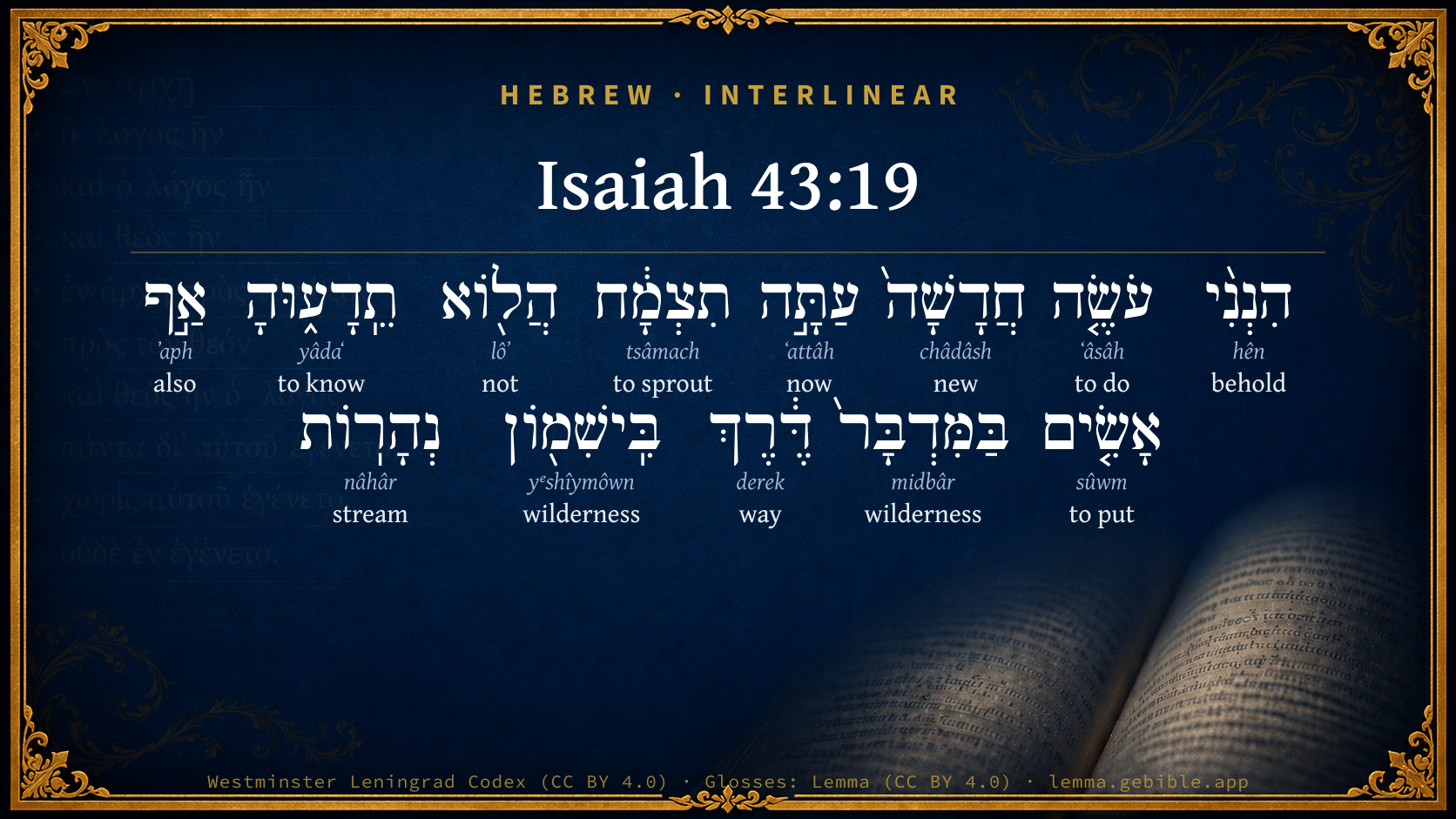
Hebrew (Westminster Leningrad Codex) Isaiah 43:19 appears in the Hebrew Old Testament. The text above is from the Westminster Leningrad Codex. Each word links to its Strong’s number, a concise gloss, and parsing drawn from the Open Scriptures Hebrew Bible morphology. Click any word for its full Brown-Driver-Briggs (BDB) entry.
Download image
Cite this verse

Isaiah 43:19 (World English Bible). Public Domain. Lemma interlinear Bible study tool, https://lemma.gebible.app/v/isaiah/43/19.

Show BibTeX & RIS
BibTeX
RIS
English Translation
Behold, I will do a new thing; now shall it spring forth; shall you not know it? I will even make a way in the wilderness, and rivers in the desert.
World English Bible · Public Domain
Download a study sheet

One document with this verse’s original text, its word-by-word gloss line, the meaning frame, cross-references with their text, attributed commentary, and full source and license credits — printable, and it pastes into notes with its structure intact.

This verse Autodidact and up

Study sheet (.html) Plain text (.txt)

A passage Seminary Student

Up to 50 verses in one chapter. A passage sheet keeps up to 6 commentary sources and 12 cross-references per verse, in the order this page ranks them, and says so on the sheet whenever that leaves anything out. Ask for a single verse and you get the Autodidact verse sheet above.

Everything on this page stays free to read, with no account — the sheet is a download of what is already on screen, not access to it.

Want to remove ads? Support Godless Engineer
Compare translations 3

The same verse in 3 English versions, stacked beneath the original-language interlinear above. Click any original word for its lexicon entry.

Each is an independent rendering of the whole verse — the interlinear is not word-aligned to these translations.

Highlighted words mark where these versions differ — a whole-verse word diff, not a word-by-word alignment.

  • World English Bible Public Domain
    Behold, I will do a new thing; now shall it spring forth; shall you not know it? I will even make a way in the wilderness, and rivers in the desert.
  • King James Version Public Domain
    Behold, I will do a new thing; now it shall spring forth; shall ye not know it? I will even make a way in the wilderness, and rivers in the desert.
  • unfoldingWord Literal Text CC BY-SA 4.0
    Behold me, doing the new. Now it sprouts; do you not know it? Indeed, I will make a way in the wilderness, rivers in the wasteland.

unfoldingWord Literal Text — © unfoldingWord, licensed CC BY-SA 4.0. Word-aligned USFM3 via Door43 (git.door43.org/unfoldingWord/en_ult).

Versions to compare (up to 4)

3 of 4 selected

Show all 18 translations

Every available English version of this verse, each an independent rendering of the whole verse.

  • World English Bible Public Domain
    Behold, I will do a new thing; now shall it spring forth; shall you not know it? I will even make a way in the wilderness, and rivers in the desert.
  • Berean Standard Bible Public Domain
    Behold, I am about to do something new; even now it is coming. Do you not see it? Indeed, I will make a way in the wilderness and streams in the desert.
  • Majority Standard Bible Public Domain
    Behold, I am about to do something new; even now it is coming. Do you not see it? Indeed, I will make a way in the wilderness and streams in the desert.
  • King James Version Public Domain
    Behold, I will do a new thing; now it shall spring forth; shall ye not know it? I will even make a way in the wilderness, and rivers in the desert.
  • American Standard Version (1901) Public Domain
    Behold, I will do a new thing; now shall it spring forth; shall ye not know it? I will even make a way in the wilderness, and rivers in the desert.
  • Revised Version (1885) Public Domain
    Behold, I will do a new thing; now shall it spring forth; shall ye not know it? I will even make a way in the wilderness, and rivers in the desert.
  • Geneva Bible (1599) Public Domain
    Behold, I do a new thing: now shall it come foorth: shall you not knowe it? I wil euen make a way in the desert, and floods in the wildernesse.
  • Douay-Rheims (1899) Public Domain
    Behold I do new things, and now they shall spring forth, verily you shall know them: I will make a way in the wilderness, and rivers in the desert.
  • Young's Literal Translation Public Domain
    Lo, I am doing a new thing, now it springeth up, Do ye not know it? Yea, I put in a wilderness a way, In a desolate place -- floods.
  • Literal Standard Version CC BY-SA 4.0
    Behold, I am doing a new thing, now it springs up, || Do you not know it? Indeed, I put a way in a wilderness, || In a desolate place—floods.
  • Unlocked Literal Bible CC BY-SA 4.0
    Look, I am about to do a new thing; now it begins to happen; do you not perceive it? I will make a road in the desert and streams of water in the wilderness.
  • unfoldingWord Literal Text CC BY-SA 4.0
    Behold me, doing the new. Now it sprouts; do you not know it? Indeed, I will make a way in the wilderness, rivers in the wasteland.
  • Darby Bible Public Domain
    behold, I do a new thing; now it shall spring forth: shall ye not know it? I will even make a way in the wilderness, rivers in the waste.
  • World Messianic Bible Public Domain
    Behold, I will do a new thing. It springs out now. Don’t you know it? I will even make a way in the wilderness, and rivers in the desert.
  • Webster's Bible Public Domain
    Behold, I will do a new thing; now it shall spring forth; shall ye not know it? I will even make a way in the wilderness, and rivers in the desert.
  • Free Bible Version CC BY-SA 4.0
    Just look at something new I'm going to do now! In fact it's started already. Can't you see it? Yes, I'm making a way through the wilderness, rivers in the desert!
  • Bible in Basic English Public Domain
    See, I am doing a new thing; now it is starting; will you not take note of it? I will even make a way in the waste land, and rivers in the dry country.
  • JPS Tanakh (1917) Public Domain
    Behold, I will do a new thing; now shall it spring forth; shall ye not know it? I will even make a way in the wilderness, and rivers in the desert.

Literal Standard Version (2020), Covenant Press — licensed CC BY-SA 4.0. Text via the HelloAO Bible API (eBible.org). Unlocked Literal Bible (unfoldingWord) — licensed CC BY-SA 4.0. Text via the HelloAO Bible API (eBible.org). unfoldingWord Literal Text — © unfoldingWord, licensed CC BY-SA 4.0. Word-aligned USFM3 via Door43 (git.door43.org/unfoldingWord/en_ult). Free Bible Version, Dr. Jonathan Gallagher — licensed CC BY-SA 4.0. Text via the HelloAO Bible API (eBible.org).

Word by word

More ways to search: Search by grammar → Find every occurrence → Compare this word →

Practice this passage: Drill this verse → Learn its vocabulary →

בִּֽישִׁמ֖וֹן
yᵉshîymôwn
H3452
“in/at · wilderness”
Preposition + Noun, Common, Masculine, Singular, Absolute
Part of Speech
Preposition + Noun
Type
Common
Gender
Masculine
Number
Singular
State
Absolute
Full BDB Definition

Origin: from H3456

TWOT: 927b

waste, wilderness, desert, desolate place
  1. הִנְנִ֨י hên H2005 “behold · me” Particle, Demonstrative + Suffix, Personal, 1st Person, Common, Singular
  2. עֹשֶׂ֤ה ʻâsâh H6213 “doing” Verb, Qal, Participle Active, Masculine, Singular, Absolute
  3. חֲדָשָׁה֙ châdâsh H2319 “new” Adjective, Adjective, Feminine, Singular, Absolute
  4. עַתָּ֣ה ʻattâh H6258 “now” Adverb
  5. תִצְמָ֔ח tsâmach H6779 “to sprout” Verb, Qal, Imperfect, 3rd Person, Feminine, Singular
  6. הֲל֖וֹא lôʼ H3808 “not” Particle, Interrogative + Particle, Negative
  7. תֵֽדָע֑וּהָ yâdaʻ H3045 “to know · her” Verb, Qal, Imperfect, 2nd Person, Masculine, Plural + Suffix, Personal, 3rd Person, Feminine, Singular
  8. אַ֣ף ʼaph H637 “also” Particle, Accusative
  9. אָשִׂ֤ים sûwm H7760 “to put” Verb, Qal, Imperfect, 1st Person, Common, Singular
  10. בַּמִּדְבָּר֙ midbâr H4057 “in/at the · wilderness” Preposition, Determined + Noun, Common, Masculine, Singular, Absolute
  11. דֶּ֔רֶךְ derek H1870 “way” Noun, Common, Both, Singular, Absolute
  12. נְהָרֽוֹת nâhâr H5104 “streams” Noun, Common, Masculine, Plural, Absolute

About this verse

These counts appear in no published source. They are computed here, from the morphology-tagged text and Lemma’s own curated glosses. What Lemma adds →

13
words
13
distinct lemmas
Prophets
section

Notable vocabulary

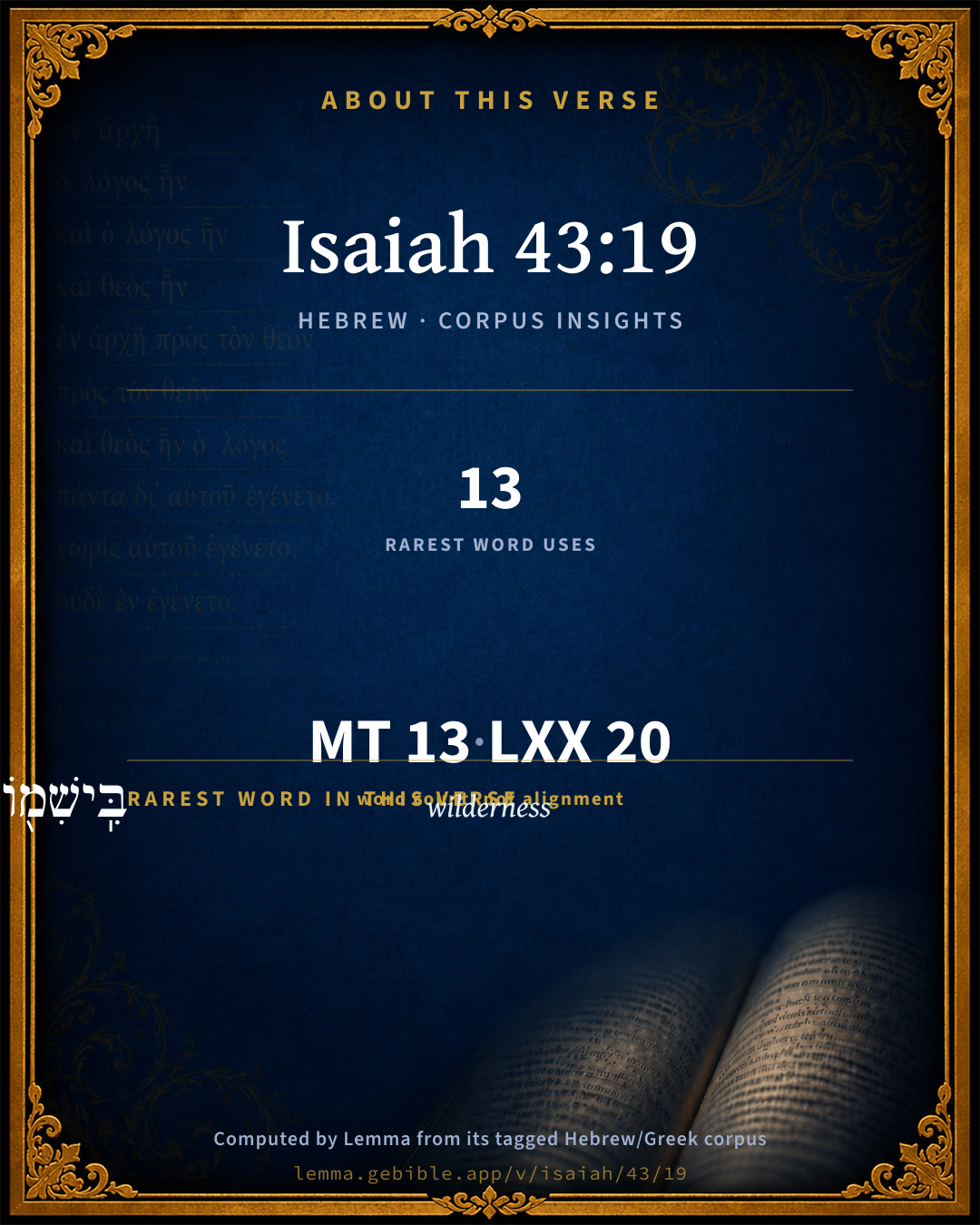
The rarest word here is בִּֽישִׁמ֖וֹן wilderness H3452 — appearing just 13 times in the whole Hebrew Bible.

Shared distinctive vocabulary

בִּֽישִׁמ֖וֹן wilderness H3452 occurs in 13 verses of the Hebrew Bible. Also found in:

Grammatical profile

  • 4 verbs
  • 4 nouns
  • 1 adjective
  • 1 adverb
  • 3 particles

Verb forms

  • עֹשֶׂ֤ה Qal · Participle Active
  • תִצְמָ֔ח Qal · Imperfect
  • תֵֽדָע֑וּהָ Qal · Imperfect
  • אָשִׂ֤ים Qal · Imperfect

Hebrew & Septuagint length

In English translation the verse runs 31 words from the Hebrew and 31 from the Septuagint (LXX English) — the same length.

A rough comparison of the two English renderings, which tokenize alike — not a word-level alignment.

Word counts can differ between the Hebrew and the Greek without any difference in meaning — e.g. the Hebrew direct-object marker אֵת has no separate Greek word, and Greek often adds the article ὁ.

In the original languages it is 13 Hebrew tokens and 20 Greek tokens — but the two are counted differently (Hebrew bundles its prefixes and suffixes into one token; the Greek is in lemma form), so that isn’t a like-for-like length.

Cross-references

15

Topical passages linked to Isaiah 43:19 in the Treasury of Scripture Knowledge — connected by theme and wording, ordered by reader-vote popularity; previews shown in the World English Bible.

  • Isaiah 48:6 You have heard it; see all this; and you, will you not declare it? I have shown you new things from this time, even hidden things, which you have not known.
  • Isaiah 42:9 Behold, the former things have happened, and new things do I declare. Before they spring forth I tell you of them.
  • 2 Corinthians 5:17 Therefore if anyone is in Christ, he is a new creation. The old things have passed away. Behold, all things have become new.
  • Revelation 21:5 He who sits on the throne said, "Behold, I am making all things new." He said, "Write, for these words of God are faithful and true."
  • Isaiah 41:18 I will open rivers on the bare heights, and springs in the midst of the valleys; I will make the wilderness a pool of water, and the dry land springs of water.
  • Luke 3:4–5 As it is written in the book of the words of Isaiah the prophet, "The voice of one crying in the wilderness, 'Make ready the way of the Lord. Make his paths straight.
  • Isaiah 35:6–10 Then shall the lame man leap as a hart, and the tongue of the mute shall sing; for in the wilderness shall waters break out, and streams in the desert.
  • Jeremiah 31:22 How long will you go here and there, you backsliding daughter? for Yahweh has created a new thing in the earth: a woman shall encompass a man.
  • Psalms 78:16–20 He brought streams also out of the rock, And caused waters to run down like rivers.
  • Isaiah 40:3–4 The voice of one who cries, Prepare you in the wilderness the way of Yahweh; make level in the desert a highway for our God.
  • Exodus 17:6 Behold, I will stand before you there on the rock in Horeb. You shall strike the rock, and water will come out of it, that the people may drink." Moses did so in the sight of the elders of Israel.
  • Deuteronomy 8:15 who led you through the great and terrible wilderness, [in which were] fiery serpents and scorpions, and thirsty ground where was no water; who brought you forth water out of the rock of flint;
  • Isaiah 48:21–22 They didn't thirst when he led them through the deserts; he caused the waters to flow out of the rock for them; he split the rock also, and the waters gushed out.
  • Psalms 105:41 He opened the rock, and waters gushed out. They ran as a river in the dry places.
  • Numbers 20:11 Moses lifted up his hand, and struck the rock with his rod twice: and water came forth abundantly, and the congregation drank, and their cattle.

Cross-references courtesy of OpenBible.info (CC BY 4.0).

Hebrew and Greek witnesses Masoretic Hebrew ↔ Greek Septuagint

The same verse in the two great witnesses to the Old Testament, shown verse-for-verse.

These are two independent witnesses, not word-aligned to each other, and the Septuagint is shown in lemma (dictionary) form.

Hebrew Isaiah 43:19 Masoretic · Westminster Leningrad Codex

הִנְנִ֨י עֹשֶׂ֤ה חֲדָשָׁה֙ עַתָּ֣ה תִצְמָ֔ח הֲל֖וֹא תֵֽדָע֑וּהָ אַ֣ף אָשִׂ֤ים בַּמִּדְבָּר֙ דֶּ֔רֶךְ בִּֽישִׁמ֖וֹן נְהָרֽוֹת

Behold, I will do a new thing; now shall it spring forth; shall you not know it? I will even make a way in the wilderness, and rivers in the desert.

World English Bible · Public Domain

Greek LXX Isaiah 43:19 Septuagint · lemma form

ἰδού ποιέω καινός ὅς νῦν ἀνατέλλω καί γιγνώσκω αὐτός καί ποιέω ἐν ὁ ἔρημος ὁδός καί ἐν ὁ ἄνυδρος ποταμός

Behold, I will do new things, which shall presently spring forth, and you⌃ shall know them: and I will make a way in the wilderness, and rivers in the dry land.

LXX2012 (modern English Septuagint) · Public Domain

Hebrew: Westminster Leningrad Codex (CC BY 4.0). Greek: Septuagint (public domain); English from LXX2012 (modern English Septuagint) (Public Domain). How the Septuagint differs from the Hebrew →

Targum (Aramaic paraphrase)

1

The Targum is the ancient Jewish Aramaic paraphrase of the Hebrew Scriptures — an interpretive translation, not the Hebrew text itself. Onkelos (literal) and Pseudo-Jonathan (expansive) render the Torah, and Jonathan the Prophets. Coverage is partial: where no permissively-licensed English translation exists for a verse, only the Aramaic is shown. This is verse-level text, not a word-by-word alignment to the Hebrew.

  1. Targum Jonathan Prophets (Joshua–Malachi)
    הָא אֲנָא עָבִיד חַדְתָּא וּכְעַן תִּתְגְלֵי הֲלָא תֵידְעוּנָהּ אַף אַשַׁוֵי בְמַדְבְּרָא אוֹרַח בְּצַדְיוּתָא נַהַרְוָן:

    Behold, I make a new thing, and now it shall be revealed: and will ye not know it? I will even make a way in the wilderness, and rivers in the desert.

    Targum Jonathan — Aramaic: “Mikraot Gedolot” (public domain). English: “Sefaria Community Translation” (CC0 1.0 (public-domain dedication)); “London "Chaldee Paraphrase," 1871” (public domain). Text via Sefaria.

Commentary

Notes on Isaiah 43:19 from classic Christian and Jewish commentators (each source and its license shown beneath its notes). The classic Christian expositions comment on the surrounding passage and are grouped to its opening verse, so a note may address several verses; the Jewish commentaries on the Tanakh (Rashi and others) are per-verse, so they appear only where the commentator wrote on this verse.

Lemma curates 59 commentaries, every one of them public domain or Creative Commons licensed, each selected and text-cleaned for this edition rather than reprinted as found. About our sources →

John Gill's Exposition

The beast of the field shall honour me, the dragons, and the owls,.... Which is not to be understood literally of these creatures, who as they had honoured the Lord, when Israel passed through the wilderness, so would again in their way praise the Lord, when they came through the deserts from Babylon, for giving them water to drink in such dry and thirsty places, to which there may be an allusion; but spiritually of the Gentiles, compared to those creatures for the savageness, fierceness, and stupidity of them, and who were reckoned by the Jews no other than as the beasts of the field; who should honour and glorify God for the Gospel brought unto them, and for his grace and mercy bestowed on them:

because I give waters in the wilderness, and rivers in the desert; as before; See Gill on Isa 43:19; because of the plenty of divine grace, and the means of it:

to give drink to my people, my chosen; to refresh and comfort the hearts of his people, whom he had chosen out from among the Gentiles, and now would call them by his grace, and set them a thirsting after Christ, and salvation by him.

John Gill's Exposition of the Whole Bible (1746–1763) — public domain (CC PDM 1.0). Text via the HelloAO Bible API.

Trapp's Complete Commentary

John Trapp

Isa 43:19 Behold, I will do a new thing; now it shall spring forth; shall ye not know it? I will even make a way in the wilderness, [and] rivers in the desert.

Ver. 19. Shall ye not know it?] Or, Do ye not perceive it? He speaketh of it as present and under view.

And rivers in a desert.] As once when I set the flint abroach. {Exo 17:6 Num 20:8; Num 20:11 Psa 105:41} By this way in the wilderness, and rivers in the desert, understand the doctrine of the gospel, and the comforts of the Spirit. {Joh 7:38-39}

John Trapp, A Commentary or Exposition upon All the Books of the Old and New Testament (1647–1656) — public domain. Text from a community e-Sword module.

The Biblical Illustrator

Joseph S. Exell

Isa_43:19

Behold, I will do a new thing

The future better than the past

How dear to the heart of the Israelites was the remembrance of the nations deliverance from Egypt and their journey to the Land of Promise! To those great events the religious teachers of the people continually turned for illustrations and proofs of Gods greatness and power and goodness and love.

From this well used and familiar store of imagery the figurative expressions of the text are derived. Dropping the figures put of sight for a moment, we may say this is a gracious promise of suitable help and supply, even under circumstances most difficult and precarious. It is intended as an encouragement to repentance and to renewed consecration to God. It is the old message that God will give to all who look to Him everything that is requisite for spiritual progress and success. In presence of every untried enterprise; on the threshold of every unknown experience; in the hearing of every Divine call, this promise floats as a banner before the soldiers eye, and rings as the sound of a trumpet rings upon the soldiers heart. (T. Stephenson.)

A new thing

1. This messenger of God proclaims, and he may be regarded as in this respect representing all Gods messengers of grace to the world, Look not on the former things--listen not now, in these moments of penitence and prayer, to those threatening voices which tell of an inexorable law of repetition, of the relentless working out of a foregone conclusion and appointed destiny--old things may pass away, all things may become new. Behold, I will do a new thing!

2. This new thing, in the instance before us, is compared with the opening of a path in the wilderness, and the supply of rivers of waters in the desert. The pathless wilderness of the future is before us--no foot has trodden it,--it is beset by unknown difficulties and unseen perils; but even their God will make a way, a road upon which His people shall travel in security and with unerring certainty to their appointed destination. And although the heat of the sun may beat fiercely down upon that path, drying up every particle of moisture and consuming all pleasant vegetation, so that it may seem most unlikely that life can be sustained in the journey across such an arid waste, God can and will provide all that is needed; and rivers of water, an abundant and continuous supply, shall be found there. Preparation and guidance! These are the ideas involved in the promise to make a path. Difficulty, peril, privation! These are the thoughts which associate themselves with the desert and the wilderness. (T. Stephenson.)

The new thing

This doing a new thing is the very achievement which many voices of high authority are assuring us, just now, is impossible with God. The power that carries on the universe, they tell us, never does a new thing. What seems to us the new is only the old revealing itself in an unexpected way. Continuity is the law that governs all things. It is the language of those whose symbol of deity is an interrogation mark, or the sign for an unknown quantity, or a fetter, as they may happen to prefer. It is a phase of thought by no means modern, although sometimes imagined to be such. It never found more telling expression anywhere than at the lips of one who flourished a thousand years before Christ, more or less, and who put it thus: The thing that hath been, it is that which shall be; and that which is done is that which shall be done, and there is no new thing under the sun. Is there anything whereof it may be said, See, this is new? I suggest that we take up the ancient challenge. I will mention some of the ways in which Christ may be said to have broken in upon the monotony and uniformity of human life and thought with something new. He brought us--

I. A NEW LIKENESS OF GOD.

II. THE TRUTH ABOUT THE FORGIVENESS OF SINS.

III. A NEW HOPE. (W. R. Huntington, D. D.)

The Biblical Illustrator, edited by Joseph S. Exell (c. 1880s–1900s) — public domain. Text from a community e-Sword module.

Whedon's Commentary on the Bible

Daniel D. Whedon

19-21. A new thing — As the former event was common in invasions, sieges, etc., to the unfortunate conquered, the marvel now to be spoken of is the certainly approaching spiritual restoration, not on Jews only, but also on Gentiles.

A way in the wilderness… rivers in the desert — Certainly the same figures, almost the same language, as in chap. xxv, manifestly used of the great renovation under Messiah, and it seems quite to establish again the same authorship of both compositions. See notes on chap. 35. Of this great renovation, to come over all men, the literal restoration from Babylon, is the type.

This people… formed for myself — Probably the exiles from Babylon prefigure here the whole spiritual Israel of the coming Messianic ages. It was a great thing that the exiles were so far spiritually restored as never afterward to relapse into their old idolatry; and that which this prefigured was “the new thing” of Isa_43:19. A glorious fruitage awaits the budding of Messianic germs which the changed wilderness is showing. One thinks of Luk_19:40 : “If these should hold their peace, the stones would cry out.” When Messiah shall reign as king and judge, all things will “show forth Jehovah’s praise.”

Daniel D. Whedon (gen. ed.), Commentary on the Old and New Testaments (1874–1909) — public domain. Text from a community e-Sword module.

The Preacher's Complete Homiletical Commentary

Joseph S. Exell (gen. ed.)

THE FUTURE BETTER THAN THE PAST

Isa_43:19. Behold, I will do a new thing, &c.

God’s messages to Israel are steeped in imagery supplied by their past experiences. From this familiar store the figurative expressions of the text are derived; it holds out a challenge to faith, a rebuke to unbelief.

I. The emphasis of the promise lies in God’s promise to do a NEW thing—i.e., something unprecedented. Israel was cautioned not to make the past the measure of the future (cf. Isa_43:18-19). They were often exhorted to seek help and consolation in remembering their past; but this is a caution against a way of looking at the past which works injury—against a brooding on it that spoils the future. Self-consciousness comes with increasing years; we are apt to exclaim, “The thing which hath been is that which shall be;” “The child is father of the man,” points to the conclusion of a wide induction. Philosophy tells us that this unreadiness to believe that the future can be better than the past is but a proof of growing wisdom; and we are often inclined to say, “our theories of the Christian life have always been far in advance of our attainments; but shortcomings have brought down our expectations.” It is one of the severest penalties of unfaithfulness, that hope for the future is slain.

Often men are not troubled much about the loss of hope, but even these know what it is to have a dark void where there should be a light shining more and more.

One of the hardest tasks of the Hebrew prophets was that of renewing in the people the impulses of hope; and so this representative messenger of God proclaims, “Remember not the former things,” old things may pass away, all things may become new.

II. This new thing is compared with the opening of a path in the wilderness, and the supply of rivers in the desert. Before each one there is a pathless wilderness, beset by difficulties and perils; but even there God will make a way for His people, and sustain their life. Preparation and guidance, difficulty, peril, privation! These are thoughts which associate themselves with the desert and the wilderness. For every Christian, God is preparing a way through unknown experiences. Of each man it may be said—

“He was the first that ever burst

Into that silent sea.”

But God prepares the way; He preserves the traveller; He connects the present, the future, and the past Each day shall be, in some respects, different from all past days; and when the heart turns faint at new demands made upon it, He breathes new life into it with the promise, “Behold, I will do a new thing!” The voice of apprehension cries, “How shall freshness and vigour be maintained within me?” God says, “I will supply rivers in the desert;” not simply sufficiency, but abundance. To-morrow may be a barren prospect; but God is with us; we are near to the Fountain of Life. We often speak of our lack of spiritual life and vigour as though it were a perplexing problem. Is it so, when we do not, will not, drink? There is a “law of the life” of the spirit as well as of the body. Our hearts are like seeds wrapped round so that moisture and air are excluded; such seeds may be planted, but they will not grow. Nor will our hearts wrapped round by prayerlessness, selfishness, indolence, and forgetfulness. Take away these wrappings, lay them aside for ever!

Note further, that this Divine promise pledges God to supply that which is a natural source of verdure, gladness, beauty. This is only one of many instances, in which we are taught that God’s will is not only to preserve, but also to adorn our life (Isa_35:1). The young should surely listen to this voice. For them all life is emphatically new; their experiences shall not, indeed, be unparalleled in the history of men, but to them they shall be a new thing from God. Christ declares Himself to be the Giver of “living water;” life, and light, and beauty go before Him; He speaks the word which cannot fail: “Behold, I make all things new!”—Thomas Stephenson: Christian World Pulpit, vol. v. pp. 209–210.

The Preacher's Complete Homiletical Commentary (gen. ed. Joseph S. Exell; Funk & Wagnalls, c. 1892) — public domain (pre-1929). A full-Bible homiletical/sermon-outline anthology covering 65 of 66 books (2 John is absent from the source module). Text from a community e-Sword module.

Geneva Bible (1599)

Geneva Bible translators

Meaning, that their deliverance out of Babylon should be more famous than that from Egypt was, Jer. 23:7; Hag. 2:10; 2 Cor. 5:17; Rev. 21:5, 7.

Geneva Bible (1599) marginal notes — public domain. Text via Bolls.life.

Jamieson, Fausset & Brown

Robert Jamieson, A. R. Fausset & David Brown

new--unprecedented in its wonderful character (Isa 42:9).

spring forth--as a germinating herb: a beautiful image of the silent but certain gradual growth of events in God's providence (Mar 4:26-28).

way in . . . wilderness--just as Israel in the wilderness, between the Red Sea and Canaan, was guided, and supplied with water by Jehovah; but the "new" deliverance shall be attended with manifestations of God's power and love, eclipsing the old (compare Isa 41:17-19). "I will open a way, not merely in the Red Sea, but in the wilderness of the whole world; and not merely one river shall gush out of the rock, but many, which shall refresh, not the bodies as formerly, but the souls of the thirsty, so that the prophecy shall be fulfilled: 'With joy shall ye draw water out of the wells of salvation'" [JEROME]. "A way" often stands for the true religion (Act 9:2; Act 18:26). "Rivers" express the influences of the Holy Spirit (Joh 7:37-39). Israel's literal restoration hereafter is included, as appears by comparing Isa 11:15-16.

Jamieson, Fausset & Brown — Commentary Critical and Explanatory on the Whole Bible (1871) — public domain (CC PDM 1.0). Text via the HelloAO Bible API.

Adam Clarke's Commentary

Verse 19. Behold, I will do a new thing] At Isa 43:16, the prophet had referred to the deliverance from Egypt and the passage through the Red Sea; here he promises that the same power shall be employed in their redemption and return from the Babylonish captivity. This was to be a new prodigy.

Adam Clarke's Commentary on the Bible (1810–1826) — public domain. Text from a community e-Sword/MySword module.

The Cambridge Bible for Schools and Colleges

gen. ed. J. J. S. Perowne

19. The making of the way through the desert and water for the pilgrims to drink (See on ch. Isa_40:3 f., Isa_41:18 ff.) is considered to be a miracle transcending the passage of the Red Sea, and all the miracles which attended the first exodus. This is the new thing on which the prophet’s mind fastens as the symbol of Israel’s deliverance.

now it shall &c.] Rather: even now it is springing forth; do ye not recognise it? In ch. Isa_42:9, the new things are spoken of as announced before they “spring forth,” while as yet there is no sign of their appearing; here to the lively imagination of the prophet they are already seen “germinating,” and he calls on the people to see them as the inevitable issue of the conquests of Cyrus. But while the above seems the most effective rendering of the question, that of the E.V. is quite possible:—“shall ye not experience it.”

the desert] Heb. Jìshîmôn, an utterly barren and arid region (Deu_32:10; Psa_68:7; Psa_78:40; Psa_107:4 &c.) as distinguished from midbâr (“wilderness” or “steppe”), where flocks can find a scanty sustenance. It occurs as a proper name in Num_21:20 (1Sa_26:1).

The Cambridge Bible for Schools and Colleges (gen. ed. J. J. S. Perowne; Cambridge University Press, 1878–1918) — public domain. Text from a community e-Sword module.

Albert Barnes' Notes on the Bible

I will do a new thing - Something that has not hitherto occurred, some unheard of and wonderful event, that shall far surpass all that he had formerly done (see the note at Isa 42:9).

Now it shall spring forth - (See the note at Isa 42:9). It shall spring up as the grass does from the earth; or it shall bud forth like the opening leaves and flowers - a beautiful figure, denoting the manner in which the events of Divine Providence come to pass.

I will even make a way in the wilderness - In this part of the verse, the prophet describes the anxious care which God would show in protecting his people, and providing for them in conducting them to their native land. See the expressions fully explained in the notes at Isa 41:17-19.

Albert Barnes' Notes on the Bible (1834–1885) — public domain. Text from a community e-Sword/MySword module.

Haydock's Catholic Bible Commentary

New. I shall work the like miracles as were seen in the wilderness.

George Leo Haydock (1774–1849), Haydock's Catholic Family Bible and Commentary, 1859 edition — public domain. Excludes Psalms (Douay-Rheims chapter numbering differs from Protestant) and Deuterocanonical books (Catholic canon only).

Matthew Poole's English Annotations

A new thing; such a work as was never yet done in the world, even the redemption of the world by the Messiah.

Now; shortly, although it was not to be done till after some hundreds of years. For so the Scripture oft speaketh of things at a great distance of time as if they were now at hand, as Hag 2:6; Jam 5:9; Rev 22:20, and elsewhere; which it doth to correct our impatience, and to make us willing to wait till God’s time come; and to assure us that the mercy shall come as soon as ever it is fit for us, and we for it; and to make us sensible of the inconsiderableness of time, and all temporal things, in comparison of God, and of the eternal things; upon which account it is said that a thousand years are in God’s sight but as one day, Psa 90:4.

Shall ye not know it? certainly you Jews shall know it by experience, and shall find that I do not deceive you with vain hopes.

I will even make a way in the wilderness, and rivers in the desert; I will give you direction and provision in the wilderness, where there is commonly no path, and where all necessaries are wanting; which as it literally speaks of God’s conducting them in the way from Babylon to Jerusalem, which lay through a great desert; so it is mystically meant of those spiritual blessings which God in and through Christ will confer upon all his people, not the Jews only, but also the Gentiles, who in prophetical language are oft compared to the wilderness, as Isa 35:1, and elsewhere.

Matthew Poole's English Annotations on the Holy Bible (1683–1685) — public domain. Text from a community e-Sword/MySword module.

The Pulpit Commentary

Behold, I will do a new thing. (comp. Isa_42:9, with the comment) It is, of course, quite possible that the novelty is not merely in the circumstances of the deliverance, but extends to all its results, among which is the Messianic kingdom verily, a "new thing". (see Jer_31:22) Now it shall spring forth; rather, already it is springing up. (Isa_42:9) Things, however, are more advanced (to the prophet"s eye) than when that passage was written. Events are shaping themselves the deliverance approaches. Shall ye not know it? rather, will ye not give heed to it? Will not the exiled people, whom Isaiah addresses, turn their thoughts this way, and let the idea of deliverance take possession of their minds, instead of brooding on past and present sufferings? (see Isa_40:30 Isa_41:17 Isa_42:22) God is about to make a way in the wilderness, and rivers in the desert. As he led his people out of their Egyptian bondage, first through the Red Sea, and then through a "howling wilderness", (Deu_32:10) so now he will "make a way" for them through a still more desolate tract. We are nowhere historically told by what route the Israelites ultimately returned. If they went by Tadmor and Damascus, they must have traversed a most arid and difficult desert. Even if they did not quit the Euphrates till they reached the latitude of Aleppo, still they must have had some wide tracts of wilderness to cross.

The Pulpit Commentary (1880–1919), ed. H.D.M. Spence-Jones & Joseph S. Exell — public domain. Text from a community e-Sword module.

John Wesley's Explanatory Notes

A new thing - Such a work as was never yet done in the world. Now - The scripture often speaks of things at a great distance of time, as if they were now at hand; to make us sensible of the inconsiderableness of time, and all temporal things, in comparison of God, and eternal things; upon which account it is said, that a thousand years are in God's sight but as one day.

John Wesley, Explanatory Notes Upon the Whole Bible (1754–1765) — public domain. Text via the GEBible commentary corpus.

J. A. Alexander on Isaiah

Joseph Addison Alexander

“Behold I (am) doing (something) new, it is now (or yet) to sprout (or germinate); do you not know it? Yes, I will place in the wilderness a way, in the desert streams.” The now does not necessarily denote a proximate futurity, but only that the thing is yet to happen, or in other words, that it is something new, as distinguished from all former instances. As if He had said, it is still future. The figure of germination implies that as yet there was no appearance of the final issue. (See the same expression in Isa 42:9) Do you not know it, (i.e., know what it is)? Or, will you not know it, (i.e., are you not willing to be convinced? Or, shall you not know it, (i.e., is not the event to be attested by your own experience? Not content with having made a way through the sea, He would make one through the desert. Now as this is really a less extraordinary act of power than the other, it would seem to favor the opinion, that v. 16 and the one before us do not relate indefinitely to the exhibition of Jehovah’s omnipotence, but specifically to the exodus from Egypt and the restoration of the Jews from exile. Even on this hypothesis, however, the terms of this verse must be understood not as a description of the literal return, but as a figurative representation of deliverance and relief, whereas v. 16 describes a literal deliverance. On the whole, therefore, it is best to take both verses as strong metaphorical descriptions of deliverance from suffering and danger by a direct divine interposition. Even supposing an allusion to the literal journey through the desert, what is said of rivers must be figurative, which makes it probable that the whole sentence is of the same description. Thus understood, the Prophet’s language means that God could change the face of nature and control the angry elements in favor of His people; that he had so done in time past, and would again do so in time to come.

Joseph Addison Alexander, The Prophecies of Isaiah (1846–1847; New York: Scribner, 1870–1878) — public domain. Text from a community e-Sword module.

Ibn Ezra

Rabbi Abraham ibn Ezra

A new thing. The taking of Babylon, or the fact that the Israelites alone will escape; the latter seems the more probable explanation. I will even make, etc. I shall, besides, produce water in the wilderness for the benefit of those who will return from Babylon to Zion.

Ibn Ezra on the Tanakh — English translations: “Sefaria Community Translation” (CC0 1.0 (public-domain dedication)); “Yalkut, Sifsei Chachomim Chumash, Metsudah Publications, 2009” (CC BY 4.0); and “Commentary of Ibn Ezra on Isaiah - trans. by M. Friedlander, 1873” (public domain). Text via Sefaria.

Lesson kit

Teaching starters — assembled from the data on this page, not authored interpretation. Every prompt links to the verse data it draws on. Edit before teaching.

Isaiah, in the Prophets, opens this verse with 13 words (13 distinct Hebrew lemmas). Its most distinctive word is yᵉshîymôwn (“wilderness”). A historical commentator’s framing appears above. Read the whole chapter for the surrounding context.

Discussion questions

  1. What does “wilderness” (yᵉshîymôwn) contribute to the verse as a whole?
  2. Numbers 21:20 shares the word «wilderness» with this verse. How do the two illuminate each other?
  3. These translations render this verse differently; the difference is in the English rendering, not the original. What questions does that raise?
  4. The verb «עֹשֶׂ֤ה» is Qal Participle Active. How does its form color the action?
  5. Reading how John Gill's Exposition and Trapp's Complete Commentary read this verse, where do the two commentators agree and where do they part?

Things to notice

Reading settings

Reading text

Shown beneath each verse's original-language words.

Old Testament
Old Testament edition

Read the OT as the Masoretic Hebrew (MT) or the Greek Septuagint (LXX).

English shown for the Greek Septuagint (in the Hebrew ↔ Greek comparison).

Comparing translations? Open the Compare panel on any verse page to stack up to four side by side.