Jeremiah 3:22

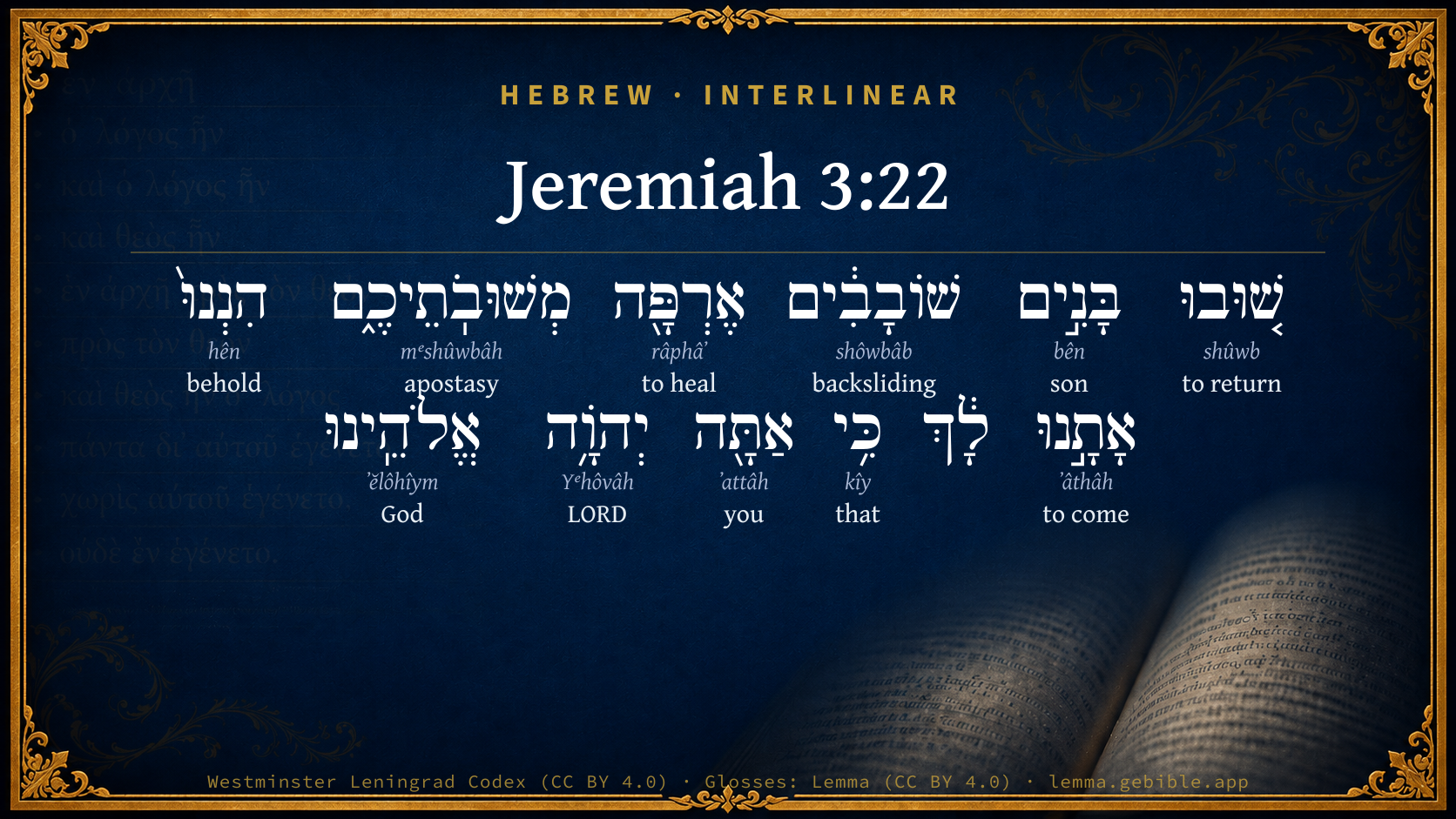
Hebrew (Westminster Leningrad Codex) Jeremiah 3:22 appears in the Hebrew Old Testament. The text above is from the Westminster Leningrad Codex. Each word links to its Strong’s number, a concise gloss, and parsing drawn from the Open Scriptures Hebrew Bible morphology. Click any word for its full Brown-Driver-Briggs (BDB) entry.
Download image
Cite this verse

Jeremiah 3:22 (World English Bible). Public Domain. Lemma interlinear Bible study tool, https://lemma.gebible.app/v/jeremiah/3/22.

Show BibTeX & RIS
BibTeX
RIS
English Translation
Return, you backsliding children, I will heal your backsliding. Behold, we are come to you; for you are Yahweh our God.
World English Bible · Public Domain
Download a study sheet

One document with this verse’s original text, its word-by-word gloss line, the meaning frame, cross-references with their text, attributed commentary, and full source and license credits — printable, and it pastes into notes with its structure intact.

This verse Autodidact and up

Study sheet (.html) Plain text (.txt)

A passage Seminary Student

Up to 50 verses in one chapter. A passage sheet keeps up to 6 commentary sources and 12 cross-references per verse, in the order this page ranks them, and says so on the sheet whenever that leaves anything out. Ask for a single verse and you get the Autodidact verse sheet above.

Everything on this page stays free to read, with no account — the sheet is a download of what is already on screen, not access to it.

Want to remove ads? Support Godless Engineer
Compare translations 3

The same verse in 3 English versions, stacked beneath the original-language interlinear above. Click any original word for its lexicon entry.

Each is an independent rendering of the whole verse — the interlinear is not word-aligned to these translations.

Highlighted words mark where these versions differ — a whole-verse word diff, not a word-by-word alignment.

  • World English Bible Public Domain
    Return, you backsliding children, I will heal your backsliding. Behold, we are come to you; for you are Yahweh our God.
  • King James Version Public Domain
    Return, ye backsliding children, and I will heal your backslidings. Behold, we come unto thee; for thou art the LORD our God.
  • unfoldingWord Literal Text CC BY-SA 4.0
    “Turn back, apostatizing sons! I will heal your apostasies!” “Behold! We come to you, for you Yahweh our God! ts\*

unfoldingWord Literal Text — © unfoldingWord, licensed CC BY-SA 4.0. Word-aligned USFM3 via Door43 (git.door43.org/unfoldingWord/en_ult).

Versions to compare (up to 4)

3 of 4 selected

Show all 18 translations

Every available English version of this verse, each an independent rendering of the whole verse.

  • World English Bible Public Domain
    Return, you backsliding children, I will heal your backsliding. Behold, we are come to you; for you are Yahweh our God.
  • Berean Standard Bible Public Domain
    “Return, O faithless children, and I will heal your faithlessness.” “Here we are. We come to You, for You are the LORD our God.
  • Majority Standard Bible Public Domain
    “Return, O faithless children, and I will heal your faithlessness.” “Here we are. We come to You, for You are the LORD our God.
  • King James Version Public Domain
    Return, ye backsliding children, and I will heal your backslidings. Behold, we come unto thee; for thou art the LORD our God.
  • American Standard Version (1901) Public Domain
    Return, ye backsliding children, I will heal your backslidings. Behold, we are come unto thee; for thou art Jehovah our God.
  • Revised Version (1885) Public Domain
    Return, ye backsliding children, I will heal your backslidings, Behold, we are come unto thee; for thou art the LORD our God.
  • Geneva Bible (1599) Public Domain
    O yee disobedient children, returne and I wil heale your rebellions. Behold, we come vnto thee, for thou art the Lord our God.
  • Douay-Rheims (1899) Public Domain
    Return, you rebellious children, and I will heal your rebellions. Behold we come to thee: for thou art the Lord our God.
  • Young's Literal Translation Public Domain
    Turn back, O backsliding sons, I cause your backslidings to cease. -- Behold us, we have come to Thee, For Thou `art' Jehovah our God.
  • Literal Standard Version CC BY-SA 4.0
    “Return, O backsliding sons, || I cause your backslidings to cease.” “Behold us, we have come to You, || For You [are] our God YHWH.
  • Unlocked Literal Bible CC BY-SA 4.0
    “Return, faithless people! I will heal you of treachery!” “Behold! We will come to you, for you are Yahweh our God!
  • unfoldingWord Literal Text CC BY-SA 4.0
    “Turn back, apostatizing sons! I will heal your apostasies!” “Behold! We come to you, for you Yahweh our God! ts\*
  • Darby Bible Public Domain
    -- Return, backsliding children; I will heal your backslidings.... Behold, we come unto thee; for thou art Jehovah our God.
  • World Messianic Bible Public Domain
    Return, you backsliding children, and I will heal your backsliding. “Behold, we have come to you; for you are the LORD our God.
  • Webster's Bible Public Domain
    Return, ye backsliding children, and I will heal your backslidings. Behold, we come to thee; for thou art the LORD our God.
  • Free Bible Version CC BY-SA 4.0
    Come back, unfaithful children, and I will heal your unfaithfulness. “We're here! Yes, we're coming back to you, because you are the Lord our God.”
  • Bible in Basic English Public Domain
    Come back, you children who have been turned away, and I will take away your desire for wandering. See, we have come to you, for you are the Lord our God.
  • JPS Tanakh (1917) Public Domain
    Return, ye backsliding children, I will heal your backslidings. — 'Here we are, we are come unto Thee; for Thou art the LORD our God.

Literal Standard Version (2020), Covenant Press — licensed CC BY-SA 4.0. Text via the HelloAO Bible API (eBible.org). Unlocked Literal Bible (unfoldingWord) — licensed CC BY-SA 4.0. Text via the HelloAO Bible API (eBible.org). unfoldingWord Literal Text — © unfoldingWord, licensed CC BY-SA 4.0. Word-aligned USFM3 via Door43 (git.door43.org/unfoldingWord/en_ult). Free Bible Version, Dr. Jonathan Gallagher — licensed CC BY-SA 4.0. Text via the HelloAO Bible API (eBible.org).

Word by word

More ways to search: Search by grammar → Find every occurrence → Compare this word →

Practice this passage: Drill this verse → Learn its vocabulary →

שׁוֹבָבִ֔ים
shôwbâb
H7726
“backsliding”
Adjective, Adjective, Masculine, Plural, Absolute
Part of Speech
Adjective
Type
Adjective
Gender
Masculine
Number
Plural
State
Absolute
Full BDB Definition

Origin: from H7725

TWOT: 2340c

backsliding, backturning, apostate, recusant
  1. שׁ֚וּבוּ shûwb H7725 “return” Verb, Qal, Imperative, 2nd Person, Masculine, Plural
  2. בָּנִ֣ים bên H1121 “sons” Noun, Common, Masculine, Plural, Absolute
  3. אֶרְפָּ֖ה râphâʼ H7495 “to heal” Verb, Qal, Imperfect, 1st Person, Common, Singular
  4. מְשׁוּבֹֽתֵיכֶ֑ם mᵉshûwbâh H4878 “apostasies · your” Noun, Common, Feminine, Plural, Construct + Suffix, Personal, 2nd Person, Masculine, Plural
  5. הִנְנוּ֙ hên H2005 “behold · us” Particle, Interjection + Suffix, Personal, 1st Person, Common, Plural
  6. אָתָ֣נוּ ʼâthâh H857 “to come” Verb, Qal, Perfect, 1st Person, Common, Plural
  7. כִּ֥י kîy H3588 “that” Conjunction
  8. אַתָּ֖ה ʼattâh H859 “you” Pronoun, Personal, 2nd Person, Masculine, Singular
  9. יְהֹוָ֥ה Yᵉhôvâh H3068 “LORD” Noun, Proper
  10. אֱלֹהֵֽינוּ ʼĕlôhîym H430 “God(s) · our” Noun, Common, Masculine, Plural, Construct + Suffix, Personal, 1st Person, Common, Plural

About this verse

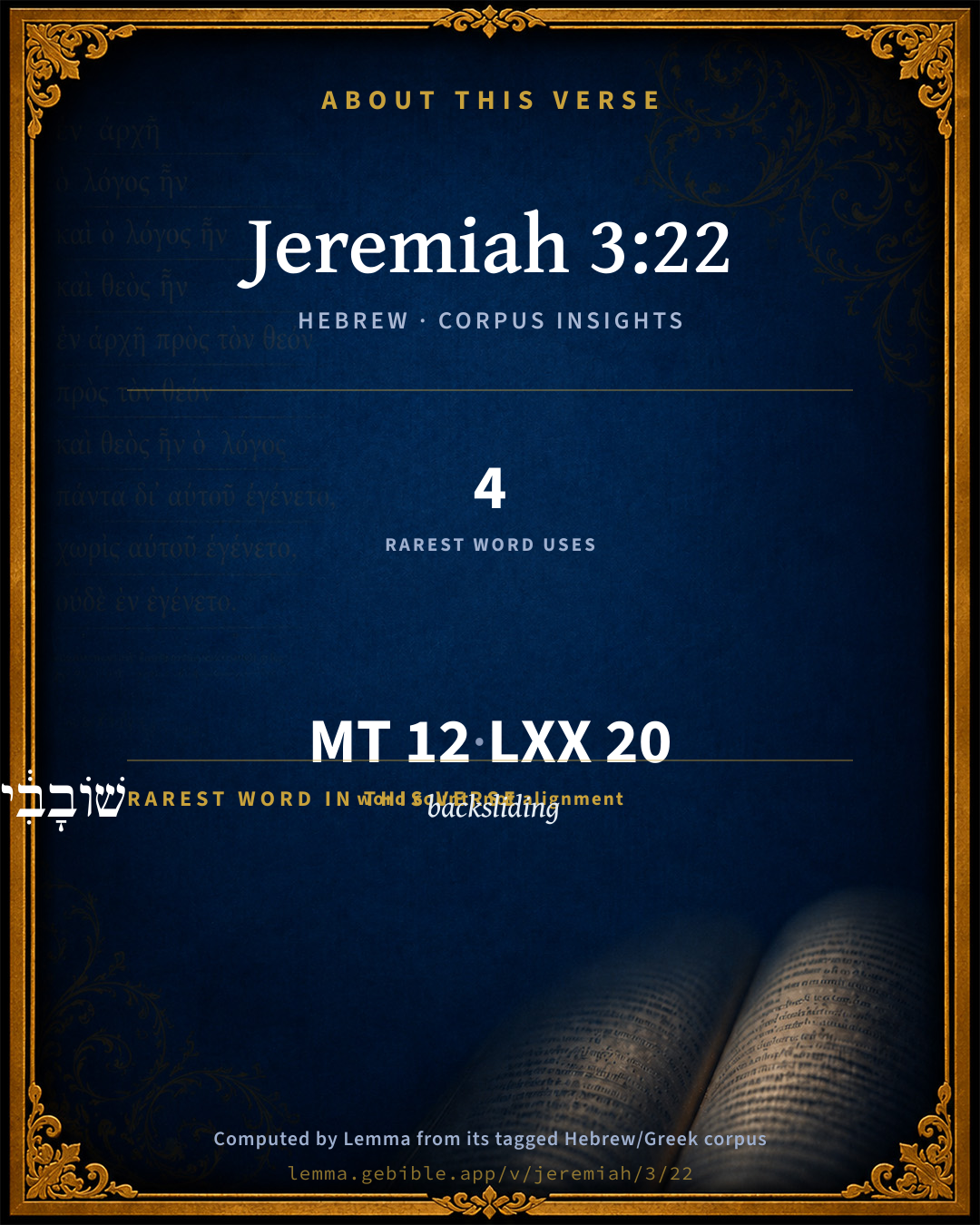
These counts appear in no published source. They are computed here, from the morphology-tagged text and Lemma’s own curated glosses. What Lemma adds →

12
words
11
distinct lemmas
Prophets
section

Notable vocabulary

The rarest word here is שׁוֹבָבִ֔ים backsliding H7726 — appearing just 4 times in the whole Hebrew Bible.

Shared distinctive vocabulary

שׁוֹבָבִ֔ים backsliding H7726 occurs in 4 verses of the Hebrew Bible. Also found in:

Grammatical profile

  • 3 verbs
  • 4 nouns
  • 1 adjective
  • 1 pronoun
  • 1 preposition
  • 1 conjunction
  • 1 particle

Verb forms

  • שׁ֚וּבוּ Qal · Imperative
  • אֶרְפָּ֖ה Qal · Imperfect
  • אָתָ֣נוּ Qal · Perfect

Hebrew & Septuagint length

In the original languages it is 12 Hebrew tokens and 20 Greek tokens — but the two are counted differently (Hebrew bundles its prefixes and suffixes into one token; the Greek is in lemma form), so that isn’t a like-for-like length.

Cross-references

12

Topical passages linked to Jeremiah 3:22 in the Treasury of Scripture Knowledge — connected by theme and wording, ordered by reader-vote popularity; previews shown in the World English Bible.

  • Hosea 14:1 Israel, return to Yahweh your God; For you have fallen because of your sin.
  • Hosea 14:4 "I will heal their waywardness. I will love them freely; For my anger is turned away from him.
  • Zechariah 13:9 I will bring the third part into the fire, And will refine them as silver is refined, And will test them like gold is tested. They will call on my name, and I will hear them. I will say, 'It is my people;' And they will say, 'Yahweh is my God.'"
  • Jeremiah 30:17 For I will restore health to you, and I will heal you of your wounds, says Yahweh; because they have called you an outcast, [saying], It is Zion, whom no man seeks after.
  • Hosea 6:1–2 "Come, and let us return to Yahweh; For he has torn us to pieces, And he will heal us; He has injured us, And he will bind up our wounds.
  • Hosea 3:5 Afterward the children of Israel shall return, and seek Yahweh their God, and David their king, and shall come with trembling to Yahweh and to his blessings in the last days.
  • Hosea 13:4 "Yet I am Yahweh your God from the land of Egypt; And you will know no god but me, And besides me there is no savior.
  • Song of Solomon 1:4 Take me away with you. Let us hurry. The king has brought me into his chambers. Friends We will be glad and rejoice in you. We will praise your love more than wine! Beloved They are right to love you.
  • Jeremiah 31:18 I have surely heard Ephraim bemoaning himself [thus], You have chastised me, and I was chastised, as a calf unaccustomed [to the yoke]: turn you me, and I shall be turned; for you are Yahweh my God.
  • Jeremiah 33:6 Behold, I will bring it health and cure, and I will cure them; and I will reveal to them abundance of peace and truth.
  • Hosea 14:8 Ephraim, what have I to do any more with idols? I answer, and will take care of him. I am like a green fir tree; From me your fruit is found."
  • Isaiah 27:8 In measure, when you send them away, you do contend with them; he has removed [them] with his rough blast in the day of the east wind.

Cross-references courtesy of OpenBible.info (CC BY 4.0).

Hebrew and Greek witnesses Masoretic Hebrew ↔ Greek Septuagint

The same verse in the two great witnesses to the Old Testament, shown verse-for-verse.

These are two independent witnesses, not word-aligned to each other, and the Septuagint is shown in lemma (dictionary) form.

Hebrew Jeremiah 3:22 Masoretic · Westminster Leningrad Codex

שׁ֚וּבוּ בָּנִ֣ים שׁוֹבָבִ֔ים אֶרְפָּ֖ה מְשׁוּבֹֽתֵיכֶ֑ם הִנְנוּ֙ אָתָ֣נוּ לָ֔ךְ כִּ֥י אַתָּ֖ה יְהֹוָ֥ה אֱלֹהֵֽינוּ

Return, you backsliding children, I will heal your backsliding. Behold, we are come to you; for you are Yahweh our God.

World English Bible · Public Domain

Greek LXX Structure differs

In the Septuagint, Jeremiah is about an eighth shorter than the Hebrew and arranges its material differently — the Oracles Against the Nations (Hebrew chapters 46–51) appear in the middle of the Greek book, after 25:13. Because the chapter and verse boundaries do not line up, a verse-for-verse comparison with the Hebrew is not shown.

A verse-for-verse comparison isn’t shown here because the chapters and verses don’t line up. Switch to the LXX edition with the MT / LXX toggle above to read the Greek directly.

Hebrew: Westminster Leningrad Codex (CC BY 4.0). Greek: Septuagint (public domain); English from a public-domain English Septuagint. How the Septuagint differs from the Hebrew →

Targum (Aramaic paraphrase)

1

The Targum is the ancient Jewish Aramaic paraphrase of the Hebrew Scriptures — an interpretive translation, not the Hebrew text itself. Onkelos (literal) and Pseudo-Jonathan (expansive) render the Torah, and Jonathan the Prophets. Coverage is partial: where no permissively-licensed English translation exists for a verse, only the Aramaic is shown. This is verse-level text, not a word-by-word alignment to the Hebrew.

  1. Targum Jonathan Prophets (Joshua–Malachi)
    תּוּבוּ בְּנַיָא דְמִתְחַסְנִין לְמֵיתָב אֶשְׁבּוֹק לְכוֹן כַּד תְתוּבוּן הָא בְּכָל עִדָן אַתּוּן אָמְרִין תִּבְנָא לְפוּלְחָנָךְ פְרוֹקְנָא אֲרֵי אַתְּ יְיָ אֱלָהָנָא:

    (no public-domain English translation for this verse)

    Targum Jonathan — Aramaic: “Mikraot Gedolot” (public domain). English: “Sefaria Community Translation” (CC0 1.0 (public-domain dedication)); “London "Chaldee Paraphrase," 1871” (public domain). Text via Sefaria.

Commentary

Notes on Jeremiah 3:22 from classic Christian and Jewish commentators (each source and its license shown beneath its notes). The classic Christian expositions comment on the surrounding passage and are grouped to its opening verse, so a note may address several verses; the Jewish commentaries on the Tanakh (Rashi and others) are per-verse, so they appear only where the commentator wrote on this verse.

Lemma curates 59 commentaries, every one of them public domain or Creative Commons licensed, each selected and text-cleaned for this edition rather than reprinted as found. About our sources →

Trapp's Complete Commentary

John Trapp

Jer 3:22 Return, ye backsliding children, [and] I will heal your backslidings. Behold, we come unto thee; for thou [art] the LORD our God.

Ver. 22. Return, ye backsliding children.] Give the whole turn, and not the half turn only. So Act 2:38, Peter said to them that were already pricked at heart, "Repent ye," even to a transmentation; and Jer 3:19, "Repent ye, and be converted, that your sins may be blotted out." Repent not only for sin, but from sin too; be thorough in your repentance; let it be such as shall never be repented of. {2Co 7:10} It is not a slight sorrow that will serve apostates’ turn; it must be deep and downright.

And I will heal your backslidings.] Pardon your sins, and heal your natures. "I will love you freely," and cause your broken bones to rejoice. {Hos 14:4 Isa 19:22} Oh sweetest promise! What wonder, then, that their hard hearts were forthwith melted by it into such a gracious compliance as followeth.

Behold, we come to thee.] See Zec 13:9. {See Trapp on "Zec 13:9"}

John Trapp, A Commentary or Exposition upon All the Books of the Old and New Testament (1647–1656) — public domain. Text from a community e-Sword module.

Joseph Benson's Commentary

Jer 3:22. Here begins a dialogue between God and his people, wherein he offers gracious terms of pardon to them, and they make sincere professions of obedience to him. Return, ye backsliding — Or revolted, children — Return to me, and to my worship and service; return to your duty. God is introduced as saying this upon hearing the weeping and supplications of the Israelites, acknowledging their sin, and humbling themselves for it. And I will heal your backslidings — Your revolts, or apostacies: I will take away the guilt of them, and save you from a refractory and revolting disposition. God heals our backslidings by his pardoning mercy, his composing peace, and his renewing grace. Behold, we come unto thee — We readily and cheerfully obey thy command, and comply with thy invitation. It is an echo to God’s call; an immediate, speedy answer, without delay; not we will come hereafter, but we do come now; we need not take time to consider of it. For thou art the Lord our God — Words expressing the strongest inducements to return to God imaginable, because God had an undoubted right to them and their services, was willing to accept them, and able to save them, Isa 55:7; chap. Jer 14:22. Not only this latter part of the verse, but what follows, to the end of the chapter, is spoken of in the name of the Israelites, accepting the divine invitation, acknowledging the vanity of their misplaced trust, and professing the deepest contrition and shame for their misconduct. It is a description, not of what was really done by the Israelites in general, but of what was necessary to be done in order to their regaining God’s favour; and of what he foresaw would actually be done by such of them as should believe on the Messiah, when he came, and receive the privileges and blessings of the new covenant.

Joseph Benson's Commentary on the Old and New Testaments (1811–1818) — public domain. Text from a community e-Sword module.

Tyndale Open Study Notes

Tyndale Open Resources

3:22-24 The Lord heard the touching prayer of devotion; the people affirmed their acceptance of the Lord as their God (31:7; Pss 38:18; 121:1-2). • The people even confessed that they had worshiped idols and engaged in religious orgies. They admitted that all this was a delusion (Jer 11:13; 14:20; Hos 9:10) and acknowledged that salvation is found only in the Lord. Their ancestors had squandered their wealth by killing their animals and children in honor of Baal.

3:22 The Lord did not forget his children. Out of the depths of his being, he called them to come back so that he could heal them. He desired to set aside his anger and pour forth his love (30:17; 33:6; Hos 6:1; 14:4).

Tyndale Open Study Notes — © Tyndale Open Resources, licensed CC BY-SA 4.0. Text via the HelloAO Bible API.

Geneva Bible (1599)

Geneva Bible translators

This is spoken in the person of Israel to the shame of Judah, which stayed so long to turn unto God.

Geneva Bible (1599) marginal notes — public domain. Text via Bolls.life.

Jamieson, Fausset & Brown

Robert Jamieson, A. R. Fausset & David Brown

Jehovah's renewed invitation (Jer 3:12, Jer 3:14) and their immediate response.

heal--forgive (Ch2 30:18, Ch2 30:20; Hos 14:4).

unto thee--rather, "in obedience to thee"; literally, "for thee" [ROSENMULLER].

Jamieson, Fausset & Brown — Commentary Critical and Explanatory on the Whole Bible (1871) — public domain (CC PDM 1.0). Text via the HelloAO Bible API.

Adam Clarke's Commentary

Verse 22. Return, ye backsliding children] This they gladly receive, and with one voice make their confession to him: "Behold, we come unto thee, for thou art Jehovah our God;" and thence to the end of the chapter, show the reasons why they return unto God.

1. Because he is the true God.

2. Because the idols did not profit them: they could give no help in time of trouble.

3. Because it is the prerogative of God alone to give salvation.

4. Because they had no kind of prosperity since they had abandoned the worship of their Maker. And this was not only their case, but it was the case of their forefathers, who all suffered in consequence of their idolatry and disobedience.

5. These reasons are concluded with a hearty confession of sin, at the thought of which they are confounded; for the remembrance of their sin was grievous to them, and the burden was intolerable. This confession ended, God appears in the next chapter with gracious promises, and proper directions how they are to return, and how to conduct themselves in future.

Adam Clarke's Commentary on the Bible (1810–1826) — public domain. Text from a community e-Sword/MySword module.

John Calvin's Commentaries

God here exhorts the Israelites to repent, that by their example he might move the Jews. The benefit of what is here taught might indeed have reached to the miserable captives and exiles; but as Jeremiah was especially the teacher of his own nation, he labored chiefly no doubt for their advantage, as we have before stated. God then here declares, that he would be reconcilable to the Israelites, how grievously soever they had sinned, he afterwards introduces them as answering, Behold, we return, or we shall come to thee: for the Prophet speaks here of the future conversion of the ten tribes.

It is then a dialogue between God and the Israelites. God himself freely invites them to repent: Return, he says, ye rebellious children; and then he promises to be a physician to heal their diseases: I will heal thy transgressions; that is, I will blot out thy sins, and absolve thee from guilt. God then undertakes to do these things; first, to stimulate the Israelites to repentance, and then to give them the hope of pardon: and he says that a remedy was provided for them, except they hardened themselves. Now, the Israelites, on the other hand, make this answer, Behold, we shall come to thee Here Jeremiah condemns the obstinacy of his own nation, by saying, that the Israelites, when thus kindly invited by God, would not be perverse, but would, on the contrary, be tractable and obedient. This indeed was not fulfilled, when a liberty to return was given to the people, except in the case of a few, who had a right feeling, and preferred the glory of God to their temporal advantages. But the number was small; nor was it a matter of surprise; for God had not previously said, without reason, that if one came from a city, and two from a tribe, he would be received, though others continued fixed in their perverseness. However this may have been, God here intimates that the Israelites would not be so refractory as not to obey his admonition when the hope of pardon and salvation would be presented to them: and this is mentioned, that the perverseness of the Jews might appear more detestable.

But some think that the Israelites are here upbraided, because they hypocritically pretended that they always sought God. Hence they elicit this meaning, “Ye indeed say, Behold, we return to thee, thou art our God;” as though he condemned their hypocrisy, because they falsely alleged that they always sought him. But this view seems to me foreign to the intention of the Prophet. Hence I doubt not but that Jeremiah sets before the Jews, as in a picture, what ought to have constrained them not to persist so obstinately in their sinful courses: “Behold,” he says, “God is prepared to receive into favor your brethren, who are undone and past all hope; and when they shall hear God’s voice kindly and graciously inviting them to himself, they will doubtless return: why then do not ye obey?”

John Calvin's Commentaries (1540-1563) — public domain. Text from the Calvin Translation Society English edition (1840s-50s) via the Christian Classics Ethereal Library (ccel.org). Calvin's coverage is partial (roughly two-thirds of the Bible); uncommented books and verses are honest gaps, never fabricated. The 19th-century editor's footnotes and remarks are omitted so the notes are faithfully Calvin's own voice.

Ellicott's Commentary for English Readers

(22) Return, ye backsliding children . . .—We lose, as before, the force of the Hebrew repetition of the same root, Turn, ye children that have turned, I will heal your turnings. As so often in Hebrew poetry, we have the answer to the invitation given in dramatic form, and hear the cry—we might almost call it the litany—of the suppliants, “Behold, we come unto thee.” They at last own Jehovah as their one true God.

A Bible Commentary for English Readers, edited by Charles John Ellicott (1878–1897) — public domain. Text from a community e-Sword module.

The Cambridge Bible for Schools and Colleges

gen. ed. J. J. S. Perowne

22. God’s reply to the lamentation and expressions of repentance. The Hebrew is striking in its play on the word turn, Turn, ye turned children; I will heal your turnings. Cp. Jer_3:6; Hos_14:4.

The Cambridge Bible for Schools and Colleges (gen. ed. J. J. S. Perowne; Cambridge University Press, 1878–1918) — public domain. Text from a community e-Sword module.

John Gill's Exposition

Return, ye backsliding children,.... This is the call of the Jews to repentance in the latter day; See Gill on Jer 3:14.

and I will heal your backslidings; that is, I will forgive your sins. Sins are the diseases of the soul, and the wounds made in it; and pardoning them is healing them. So the Targum,

"I will forgive you when ye return;''

see Psa 103:3, this is done by the application of the blood of Christ, the only physician, and whose blood is the balm that heals every wound; and this springs from the love of God, and his free favour to his people, even the riches of his grace and abounding mercy through Christ; and is the great motive and inducement, and what gives the greatest encouragement to return unto the Lord, Hos 14:1.

Behold, we come unto thee; the Targum represents this as what the Jews pretended always to say, and did say, in a hypocritical manner, with which they are upbraided,

"lo, at all times ye say, we return to thy worship, save us;''

and Jarchi is of opinion that these are words the prophet put into their mouths, and taught them to say, and to confess in this manner: but they are rather their own words, arising from a true sense of sin, under the influence of divine grace, and encouraged with the hope and assurance of pardon; declaring that as they were called upon to return, so they did return, and now were come to God by repentance, with confession and acknowledgment of sin, and by prayer and supplication for pardon and by the exercise of faith upon him for it; and also were come into his house to wait upon him, and worship him in his ordinances:

for thou art the Lord our God; not merely as the God of nature and providence, or in a natural way, but in a way of special grace, of which they now will have an application by the Spirit of God.

John Gill's Exposition of the Whole Bible (1746–1763) — public domain (CC PDM 1.0). Text via the HelloAO Bible API.

Albert Barnes' Notes on the Bible

Yahweh’s answer to their prayer in Jer 3:21 is immediately followed by their acceptance of the offer of divine mercy.

For - Rather, because ... This profession of faith gives the reason why they return to Yahweh. The whole description is most graphically conceived. The people weeping upon the hills: God’s gracious voice bidding them return: the glad cry of the penitents exclaiming that they come: the profession of faith won from them by the divine love; these form altogether a most touching picture of a national repentance.

Albert Barnes' Notes on the Bible (1834–1885) — public domain. Text from a community e-Sword/MySword module.

Matthew Poole's English Annotations

Return, viz. repent for sin and from sin. Here God calls upon them, and invites them to consider whither they are going, and to hearken unto the voice of his ministers, Hos 14:1; Act 3:19. See Jer 3:12. God doth as it were bid them hearken to his messengers, and then he will heal their backsliding.

I will heal your backslidings, i.e. idolatries, whereby you turned from me, and rebelled against me; I will take you into that state, as if you had never turned from me; I will make all whole again among you, and reconcile you to myself, Isa 57:18; Jer 32:40. See Zec 10:6; 13:9. I will not only remove your judgments, but your sins also shall be forgiven.

Behold, we come unto thee. This is either God’s framing their answer for them, prescribing the manner and form of their repentance, by a figure called mimesis, Hos 14:2,3; or it is their reply to God by way of promise, which they performed under Josiah, 2Ki 22; 2Ki 23, which with their confession reacheth to the end of the chapter.

For thou art the Lord our God; words expressing the strongest inducements to it imaginable, because God hath right to them, is willing to accept them, and able to save them, Isa 55:7; Jer 14:22.

Matthew Poole's English Annotations on the Holy Bible (1683–1685) — public domain. Text from a community e-Sword/MySword module.

Whedon's Commentary on the Bible

Daniel D. Whedon

22. Answering to this penitence is God’s gracious willingness to receive and pardon. The prophet echoes the divine invitation and promise.

Return, ye backsliding children… I will heal your backslidings — Literally, Turn, ye turned children, I will heal your turnings. To this promise they answer, Behold, we come unto thee, for thou art the Lord our God.

Daniel D. Whedon (gen. ed.), Commentary on the Old and New Testaments (1874–1909) — public domain. Text from a community e-Sword module.

The Pulpit Commentary

Return, ye backsliding children, etc.; more literally, Turn, ye turned-away sons; I will heal your turnings. (as Hos_14:4) It seems strange at first sight that this verso does not stand before ver. 21. But the truth is that ver. 21 describes not so much the "conversion" of the Jews as their willingness to "convert" (an archaism of King James"s Bible, which we may well regret), or "turn" to God. Christ must touch, or at least make his presence felt, in order that the sick man may be healed; a special call of God must be heard, in order that the sinner may truly repent. Behold, we come unto thee. Efficacious, and not "irresistible" grace, is the doctrine of the Old Testament.

Invitation and response.

I THE INVITATION.

1. The object of the invitation. God calls on his people to return to him. Not simple reformation of morals, but the restoration of personal relations with God as the Father of his people is desired.

2. The condition of the invited. They are apostate children; i.e.

a. they are far from God, though

b. they were once near to him, and

c. they are still his children.

As sinners, men have all lost a first estate of innocence, but have not lost, and can never lose, their filial relationship to God. Hence

(1) the greatness of their guilt and

(2) the hope of their restoration.

3. The accompanying promise. God invites and does not drive; he here exchanges threats for promises. God will heal, not simply receive his children. God alone can heal their apostasies. Man repents of sin, but God cures it. It is our part to turn from the evil, God"s to destroy that evil. Sin is washed out, not by the tears of penitence, but by the blood of Christ. The healing is of the apostasies themselves, not simply of their painful effects. Christ saves from sin. This is what God most requires in us, and what we most need for our own blessedness. (Joh_1:29)

II THE RESPONSE.

1. An expression of willing obedience. "Behold, we come unto thee." This response must be voluntary. God waits for man"s return, does not force it; since what he desires is not the abject submission of vanquished enemies, but the loving reconciliation of children. This response must also be active. "We come." The penitent does not simply "accept" the grace of God in a passive faith. He must "arise and go". (Luk_15:18) This implies exertion of will, active obedience.

2. An indication of the grounds of that obedience. "For thou art the Lord our God." God invites by a promise of blessing to his people; they respond by turning from the thought of their own profit to that of the character and claim of God. The great motive to return is found in what God is rather than in what he does, because the return is to him and not merely to his blessings. Men will return to God when they see what there is in him to attract them to his feet. Hence the importance of knowing God. (Job_22:21) Christ invites us by revealing the Father. (Joh_14:6, Joh_14:7)

(1) We should think of the revealed character of God as a ground for returning to him. Israel returns by remembering the ancient Name "Jehovah," with its glorious significance and its sacred memories.

(2) We should think of God"s peculiar relations with us. Israel thinks of "Jehovah our God." This relationship points to God"s claim upon us, rising out of his recognized authority as "ours," and the special covenant bonds of those who have once yielded themselves to him, and also to the peculiar grace God bestows on his people, which both increases the obligation and facilitates the effort to return.

"Backsliding Israel.

"Backsliding" was the characteristic vice of the Jewish people throughout the whole course of their history. Their career was one of perpetual sinning and repenting, until the great apostasy, the final "falling away." And in this we see what is too often a truthful reflection of the individual life of men. The Jews were emphatically a representative people. Not merely does their recorded history represent the method of God"s ways, but it illustrates the folly and treachery, the moral weakness and waywardness of our human nature. Dwell on the individual application of this passage. Consider

I THE EVIL INDICATED. "Backsliding" is suggestive of a turning away from God, a departure from the path of truth and righteousness, a fall from some higher state of spiritual consciousness or moral life. This evil may assume different forms. It may consist:

1. In the loss of the simplicity and integrity of religious faith. In an age of mental restlessness like the present, men too easily lose their hold of truth, which is the very hope and life of their souls. We may look with perfect composure upon the conflict between truth and error as regards its general and ultimate issues, but dare not forget how disastrous its bearings upon the individual life may be. There are revolutions in the history of religious thought, as in the history of nations, which it is as vain to think of arresting as it would be to attempt to turn back the ocean tide; but it is a mournful thing when, under such conditions, the mind that once had a firm grasp of the vital elements of Christian truth has slipped from its moorings and drifted out into the wild sea of doubt and uncertainty. To a really earnest spirit the recovery of a lost faith is generally a painful process. How many have traveled back, as with wounded, bleeding feet, to positions of clearer vision and firmer standing which they once occupied, but in an evil hour had forsaken! As sometimes after a bright morning, which has been followed by a day of cloud and storm, there is again at sunset a glorious outbursting gleam of the radiance that had been obscured; so is it with their souls. They return to rest calmly in the truth that they had for a while lost sight of, and "at eventide," as in the morning, "it is light.

2. In the decline of religious feeling, the decay of those affections in which religious life consists. This is that secret spiritual "backsliding" that directly affects the soul"s personal relation to God, and the consciousness of which sometimes extorts the bitter cry, "Oh that I were as in months past!" etc. (Job_29:2-4) It may arise from no change in religious belief. While a departure from the simplicity of the faith is generally connected with a lowering of the tone of religious feeling, the converse of this is not always true. But the faith has lost its life-giving force. The light it sheds has no warm, kindling glow. It is the light of the moon rather than the sun clear and cold, having no power to quicken the frame of nature, to develop its beauty and fruitfulness, to awaken its music, and fill it with exulting joy. The carnalizing influences of the world, the wear and tear of daily life, inevitably lead to this internal spiritual decay, unless there is a perpetual renewal of the life "whose springs are hidden and Divine.

3. In practical departure from the standard of religious duty. The backsliding of the heart cannot long be concealed. It betrays itself in many ways in a forsaking of the paths of Christian service, in some manifest lack of moral integrity, in a relapse into some form of vicious habit, perhaps in a complete loosening of the bonds of religious restraint, and utter abandonment to the pursuits of an ungodly life. It is of such a case that our Lord says, "If the salt have lost his savor," etc.; (Mat_5:13) and again, "No man, having put his hand to the plough," etc.; (Luk_9:62) and St. Peter afterwards affirms, "It had been better for them not to have known the way of righteousness," etc. (2Pe_2:21)

II GOD"S METHOD OF HEALING. "I will heal your backslidings." This is the gracious persuasion by which he seeks to reclaim his children from their guilty wanderings. How may we expect him to fulfill the promise?

1. By awakening in us a vivid sense and penitent acknowledgment of the wrong. We can scarcely be delivered from it till we have seen all the sin and shame of it its real meaning, the source from whence it springs, the end to which it leads. Until all this is deeply felt and freely confessed before God, the first step in the process of recovery has not been taken. (see Psa_51:3, 4 32:5 2Co_7:10, 2Co_7:11)

2. By moving us to trust simply in his forgiving and renewing mercy. Our only refuge is in the Divine mercy, and there is no other way of mercy than that which the gospel reveals. The guilt of our backslidings can alone be cancelled by the blood of Christ, and the secret cause of them removed by the grace of his Spirit. (1Jn_2:1, 2 3:5-9) "There is no prescription for the sickness of the heart but that which is written in the Redeemer"s blood," for in this alone have we both the pledge and the channel of the saving love of God.

3. By creating in us the energy of a nobler life: "Return," etc. It is a question, after all, of moral resolution and serf-determining spiritual power. "Full seldom does a man repent, or use Both grace and will to pick the vicious quitch Of blood and custom wholly out of him, And make all clean, and plant himself afresh.

But God gives this gracious energy to those who seek it, and such "repentance unto life" is the true "healing. W.

The Pulpit Commentary (1880–1919), ed. H.D.M. Spence-Jones & Joseph S. Exell — public domain. Text from a community e-Sword module.

Rashi

Rabbi Shlomo Yitzchaki (Rashi)

Here we are, we have come to You The prophet teaches them to confess and to say as follows, “Here we are, we have come to You... Truly, in vain... But the shameful thing has consumed, etc., Let us lie in our shame.” All this is the language of the prayer that the prophet teaches them to say.

We have come אתנו.

Rashi on the Tanakh — English translations: “The Judaica Press complete Tanach with Rashi, translated by A. J. Rosenberg” (CC BY 4.0); “Pentateuch with Rashi's commentary by M. Rosenbaum and A.M. Silbermann, 1929-1934” (public domain); “The Metsudah Tanach series, Lakewood, N.J” (CC BY 4.0); and “The Book of Joshua, Metsudah Publications, 1997” (CC BY 4.0). Text via Sefaria.

Lesson kit

Teaching starters — assembled from the data on this page, not authored interpretation. Every prompt links to the verse data it draws on. Edit before teaching.

Jeremiah, in the Prophets, opens this verse with 12 words (11 distinct Hebrew lemmas). Its most distinctive word is shôwbâb (“backsliding”). A historical commentator’s framing appears above. Read the whole chapter for the surrounding context.

Discussion questions

  1. The word shôwbâb carries the sense “backsliding.” How does it shape the verse?
  2. Isaiah 57:17 shares the word «backsliding» with this verse. How do the two illuminate each other?
  3. These translations render this verse differently. What is at stake in choosing one wording over another?
  4. The verb «שׁ֚וּבוּ» is Qal Imperative. How does its form color the action?
  5. Reading how Trapp's Complete Commentary and Joseph Benson's Commentary read this verse, where do the two commentators agree and where do they part?

Things to notice

Reading settings

Reading text

Shown beneath each verse's original-language words.

Old Testament
Old Testament edition

Read the OT as the Masoretic Hebrew (MT) or the Greek Septuagint (LXX).

English shown for the Greek Septuagint (in the Hebrew ↔ Greek comparison).

Comparing translations? Open the Compare panel on any verse page to stack up to four side by side.