Jeremiah 9:7

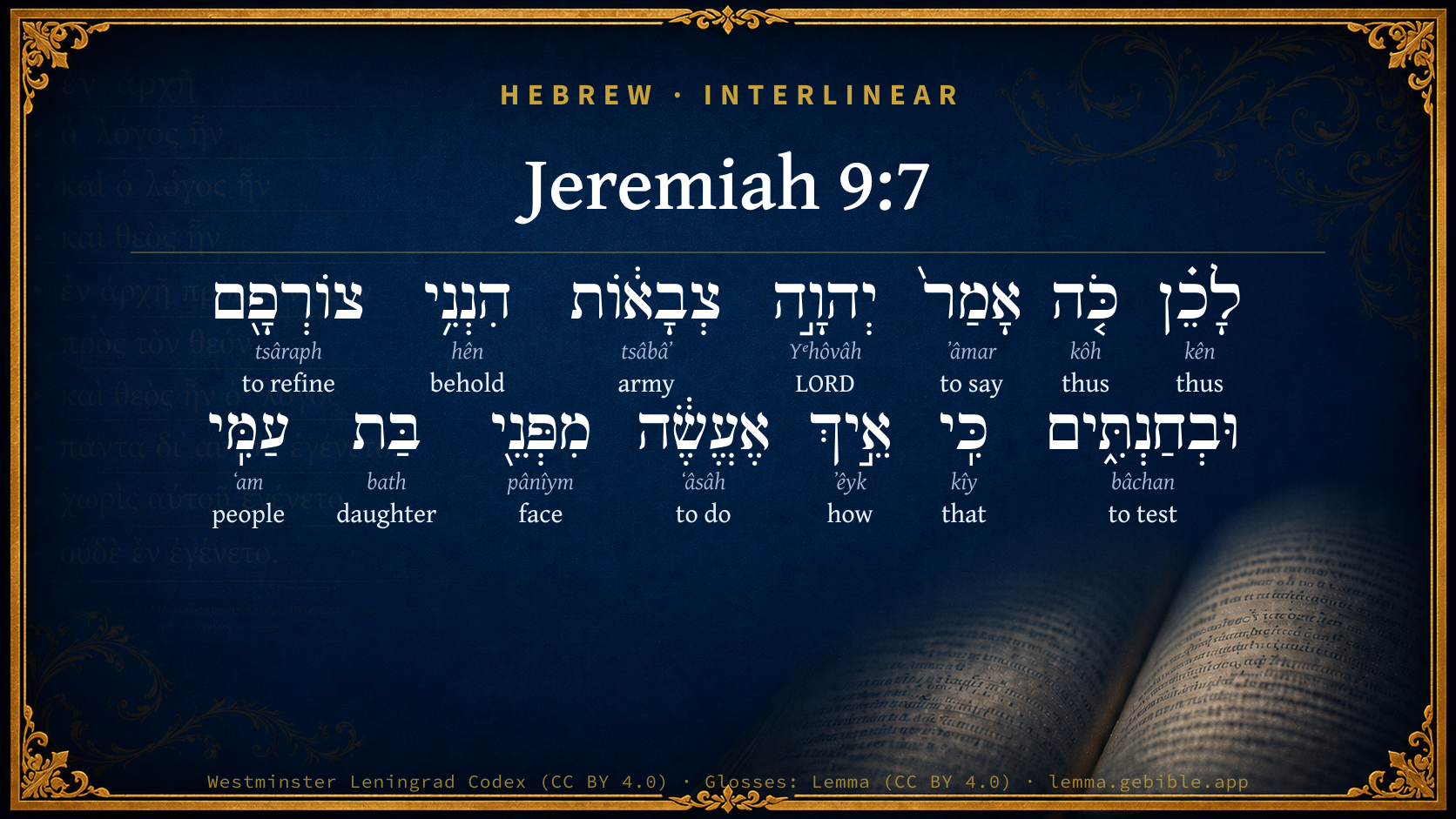
Hebrew (Westminster Leningrad Codex) Jeremiah 9:7 appears in the Hebrew Old Testament. The text above is from the Westminster Leningrad Codex. Each word links to its Strong’s number, a concise gloss, and parsing drawn from the Open Scriptures Hebrew Bible morphology. Click any word for its full Brown-Driver-Briggs (BDB) entry.
Download image
Cite this verse

Jeremiah 9:7 (World English Bible). Public Domain. Lemma interlinear Bible study tool, https://lemma.gebible.app/v/jeremiah/9/7.

Show BibTeX & RIS
BibTeX
RIS
English Translation
Therefore thus says Yahweh of Hosts, Behold, I will melt them, and try them; for how [else] should I do, because of the daughter of my people?
World English Bible · Public Domain
Download a study sheet

One document with this verse’s original text, its word-by-word gloss line, the meaning frame, cross-references with their text, attributed commentary, and full source and license credits — printable, and it pastes into notes with its structure intact.

This verse Autodidact and up

Study sheet (.html) Plain text (.txt)

A passage Seminary Student

Up to 50 verses in one chapter. A passage sheet keeps up to 6 commentary sources and 12 cross-references per verse, in the order this page ranks them, and says so on the sheet whenever that leaves anything out. Ask for a single verse and you get the Autodidact verse sheet above.

Everything on this page stays free to read, with no account — the sheet is a download of what is already on screen, not access to it.

Want to remove ads? Support Godless Engineer
Compare translations 3

The same verse in 3 English versions, stacked beneath the original-language interlinear above. Click any original word for its lexicon entry.

Each is an independent rendering of the whole verse — the interlinear is not word-aligned to these translations.

Highlighted words mark where these versions differ — a whole-verse word diff, not a word-by-word alignment.

  • World English Bible Public Domain
    Therefore thus says Yahweh of Hosts, Behold, I will melt them, and try them; for how [else] should I do, because of the daughter of my people?
  • King James Version Public Domain
    Therefore thus saith the LORD of hosts, Behold, I will melt them, and try them; for how shall I do for the daughter of my people?
  • unfoldingWord Literal Text CC BY-SA 4.0
    Therefore, thus says Yahweh of hosts, “Behold, I am refining them and will test them, for how shall I act from before the face of the daughter of my people?

unfoldingWord Literal Text — © unfoldingWord, licensed CC BY-SA 4.0. Word-aligned USFM3 via Door43 (git.door43.org/unfoldingWord/en_ult).

Versions to compare (up to 4)

3 of 4 selected

Show all 18 translations

Every available English version of this verse, each an independent rendering of the whole verse.

  • World English Bible Public Domain
    Therefore thus says Yahweh of Hosts, Behold, I will melt them, and try them; for how [else] should I do, because of the daughter of my people?
  • Berean Standard Bible Public Domain
    Therefore this is what the LORD of Hosts says: “Behold, I will refine them and test them, for what else can I do because of the daughter of My people?
  • Majority Standard Bible Public Domain
    Therefore this is what the LORD of Hosts says: “Behold, I will refine them and test them, for what else can I do because of the daughter of My people?
  • King James Version Public Domain
    Therefore thus saith the LORD of hosts, Behold, I will melt them, and try them; for how shall I do for the daughter of my people?
  • American Standard Version (1901) Public Domain
    Therefore thus saith Jehovah of hosts, Behold, I will melt them, and try them; for how `else' should I do, because of the daughter of my people?
  • Revised Version (1885) Public Domain
    Therefore thus saith the LORD of hosts, Behold, I will melt them, and try them; for how else should I do, because of the daughter of my people?
  • Geneva Bible (1599) Public Domain
    Therefore thus sayth the Lord of hostes, Behold, I wil melt them, and trie them: for what should I els do for the daughter of my people?
  • Douay-Rheims (1899) Public Domain
    Therefore thus saith the Lord of hosts: Behold I will melt, and try them: for what else shall I do before the daughter of my people?
  • Young's Literal Translation Public Domain
    Therefore, thus said Jehovah of Hosts: Lo, I am refining them, and have tried them, For how do I do because of the daughter of My people?
  • Literal Standard Version CC BY-SA 4.0
    Therefore, thus said YHWH of Hosts: “Behold, I am refining them, and have tried them, || For how do I deal with the daughter of My people?
  • Unlocked Literal Bible CC BY-SA 4.0
    Yahweh of hosts says this, “See, I am about to refine them and test them, for what else can I do, because of what my people have done?
  • unfoldingWord Literal Text CC BY-SA 4.0
    Therefore, thus says Yahweh of hosts, “Behold, I am refining them and will test them, for how shall I act from before the face of the daughter of my people?
  • Darby Bible Public Domain
    Therefore thus saith Jehovah of hosts: Behold, I will melt them, and try them; for how else could I do for the daughter of my people?
  • World Messianic Bible Public Domain
    Therefore the LORD of Hosts says, “Behold, I will melt them and test them; for how should I deal with the daughter of my people?
  • Webster's Bible Public Domain
    Therefore thus saith the LORD of hosts, Behold, I will melt them, and try them; for how shall I do for the daughter of my people?
  • Free Bible Version CC BY-SA 4.0
    So this is what the Lord Almighty says: Look, I'm going to test them and purify them like metal in a furnace. What else can I do because of what my people have done?
  • Bible in Basic English Public Domain
    So the Lord of armies has said, See, I will make them soft in the fire and put them to the test; this I will do because of their evil-doing.
  • JPS Tanakh (1917) Public Domain
    (9-6) Therefore thus saith the LORD of hosts: Behold, I will smelt them, and try them; for how else should I do, because of the daughter of My people?

Literal Standard Version (2020), Covenant Press — licensed CC BY-SA 4.0. Text via the HelloAO Bible API (eBible.org). Unlocked Literal Bible (unfoldingWord) — licensed CC BY-SA 4.0. Text via the HelloAO Bible API (eBible.org). unfoldingWord Literal Text — © unfoldingWord, licensed CC BY-SA 4.0. Word-aligned USFM3 via Door43 (git.door43.org/unfoldingWord/en_ult). Free Bible Version, Dr. Jonathan Gallagher — licensed CC BY-SA 4.0. Text via the HelloAO Bible API (eBible.org).

Word by word

More ways to search: Search by grammar → Find every occurrence → Compare this word →

Practice this passage: Drill this verse → Learn its vocabulary →

וּבְחַנְתִּ֑ים
bâchan
H974
“and · to test · them”
Conjunction + Verb, Qal, Sequential Perfect, 1st Person, Common, Singular + Suffix, Personal, 3rd Person, Masculine, Plural
Part of Speech
Conjunction + Verb
Stem
Qal
Form
Sequential Perfect
Person
1st Person
Gender
Common
Number
Singular
Full BDB Definition

Origin: a primitive root

TWOT: 230

to examine, try, prove - (Qal) - to examine, scrutinise - to test, prove, try (of gold, persons, the heart, man of God) - (Niphal) to be tried, proved - (Pual) to make a trial
  1. לָכֵ֗ן kên H3651 “to/for · thus” Preposition + Adverb
  2. כֹּ֤ה kôh H3541 “thus” Adverb
  3. אָמַר֙ ʼâmar H559 “to say” Verb, Qal, Perfect, 3rd Person, Masculine, Singular
  4. יְהוָ֣ה Yᵉhôvâh H3068 “LORD” Noun, Proper
  5. צְבָא֔וֹת tsâbâʼ H6635 “armies” Noun, Common, Both, Plural, Absolute
  6. הִנְנִ֥י hên H2005 “behold · me” Particle, Demonstrative + Suffix, Personal, 1st Person, Common, Singular
  7. צוֹרְפָ֖ם tsâraph H6884 “refining · them” Verb, Qal, Participle Active, Masculine, Singular, Construct + Suffix, Personal, 3rd Person, Masculine, Plural
  8. כִּֽי kîy H3588 “that” Conjunction
  9. אֵ֣יךְ ʼêyk H349 “how” Particle, Interrogative
  10. אֶעֱשֶׂ֔ה ʻâsâh H6213 “to do” Verb, Qal, Imperfect, 1st Person, Common, Singular
  11. מִפְּנֵ֖י pânîym H6440 “from · face(s) of” Preposition + Noun, Common, Both, Plural, Construct
  12. בַּת bath H1323 “daughter of” Noun, Common, Feminine, Singular, Construct
  13. עַמִּֽי ʻam H5971 “people · my” Noun, Common, Masculine, Singular, Construct + Suffix, Personal, 1st Person, Common, Singular

About this verse

These counts appear in no published source. They are computed here, from the morphology-tagged text and Lemma’s own curated glosses. What Lemma adds →

14
words
14
distinct lemmas
Prophets
section

Shared distinctive vocabulary

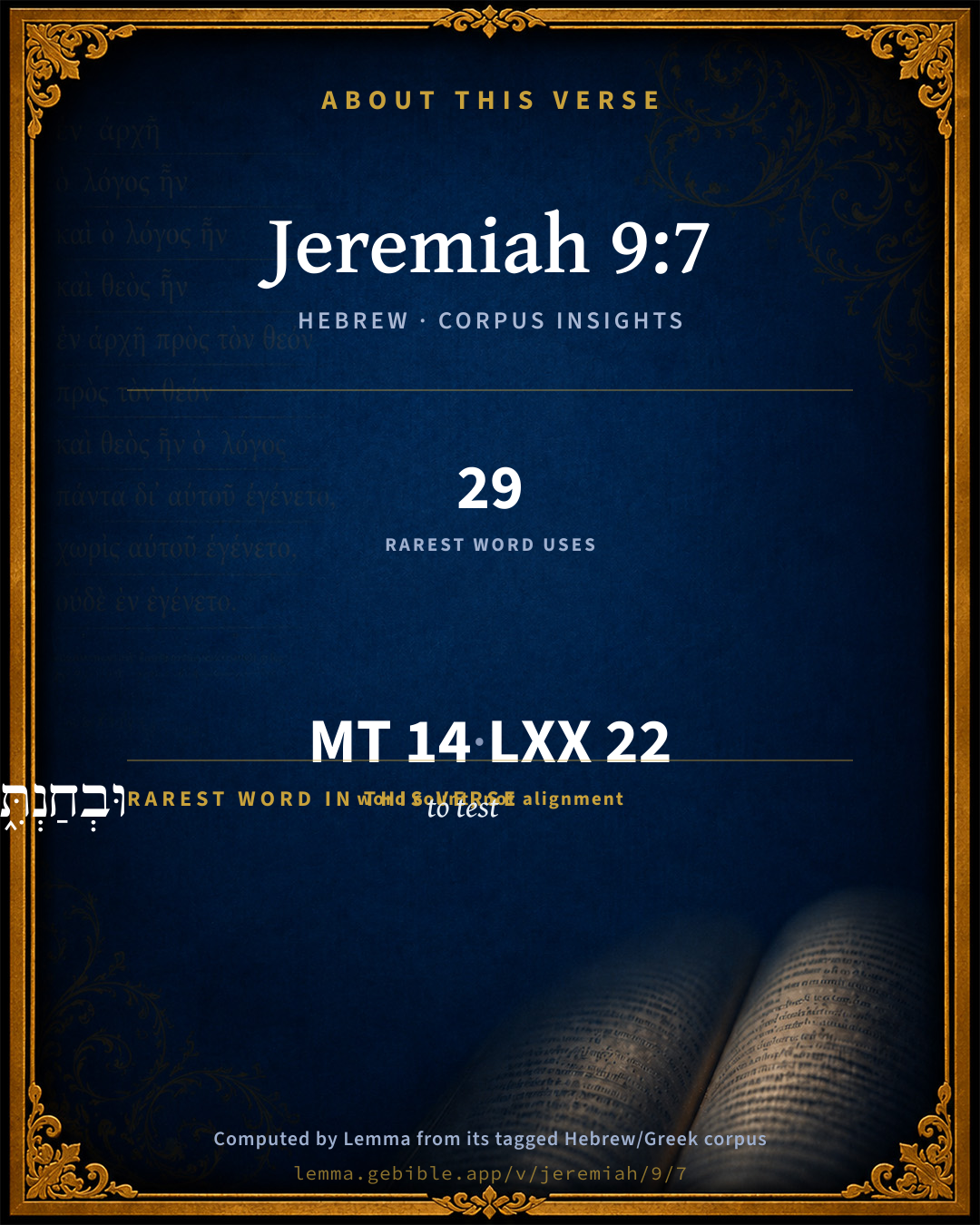
וּבְחַנְתִּ֑ים to test H974 occurs in 28 verses of the Hebrew Bible. Also found in:

Grammatical profile

  • 4 verbs
  • 5 nouns
  • 1 conjunction
  • 2 adverbs
  • 2 particles

Verb forms

  • אָמַר֙ Qal · Perfect
  • צוֹרְפָ֖ם Qal · Participle Active
  • וּבְחַנְתִּ֑ים Qal · Sequential Perfect
  • אֶעֱשֶׂ֔ה Qal · Imperfect

Hebrew & Septuagint length

In the original languages it is 14 Hebrew tokens and 22 Greek tokens — but the two are counted differently (Hebrew bundles its prefixes and suffixes into one token; the Greek is in lemma form), so that isn’t a like-for-like length.

Cross-references

15

Topical passages linked to Jeremiah 9:7 in the Treasury of Scripture Knowledge — connected by theme and wording, ordered by reader-vote popularity; previews shown in the World English Bible.

  • Isaiah 1:25 And I will turn my hand on you, Thoroughly purge away your dross, And will take away all your tin.
  • Isaiah 48:10 Behold, I have refined you, but not as silver; I have chosen you in the furnace of affliction.
  • Jeremiah 6:27 I have made you a tester of metals [and] a fortress among my people; that you may know and try their way.
  • Malachi 3:3 and he will sit as a refiner and purifier of silver, and he will purify the sons of Levi, and refine them as gold and silver; and they shall offer to Yahweh offerings in righteousness.
  • Zechariah 13:9 I will bring the third part into the fire, And will refine them as silver is refined, And will test them like gold is tested. They will call on my name, and I will hear them. I will say, 'It is my people;' And they will say, 'Yahweh is my God.'"
  • Hosea 11:8–9 "How can I give you up, Ephraim? How can I hand you over, Israel? How can I make you like Admah? How can I make you like Zeboiim? My heart is turned within me, My compassion is aroused.
  • 1 Peter 1:7 that the proof of your faith, which is more precious than gold that perishes even though it is tested by fire, may be found to result in praise, glory, and honor at the revelation of Jesus Christ--
  • 1 Peter 4:12 Beloved, don't be astonished at the fiery trial which has come upon you, to test you, as though a strange thing happened to you.
  • Jeremiah 6:29–30 The bellows blow fiercely; the lead is consumed of the fire: in vain do they go on refining; for the wicked are not plucked away.
  • Ezekiel 22:18–22 Son of man, the house of Israel is become dross to me: all of them are brass and tin and iron and lead, in the midst of the furnace; they are the dross of silver.
  • 2 Chronicles 36:15 Yahweh, the God of their fathers, sent to them by his messengers, rising up early and sending, because he had compassion on his people, and on his dwelling-place:
  • Jeremiah 31:20 Is Ephraim my dear son? is he a darling child? for as often as I speak against him, I do earnestly remember him still: therefore my heart yearns for him; I will surely have mercy on him, says Yahweh.
  • Ezekiel 26:11–12 With the hoofs of his horses shall he tread down all your streets; he shall kill your people with the sword; and the pillars of your strength shall go down to the ground.
  • Hosea 6:4–5 "Ephraim, what shall I do to you? Judah, what shall I do to you? For your love is like a morning cloud, And like the dew that disappears early.
  • Zechariah 1:14–16 So the angel who talked with me said to me, "Proclaim, saying, 'Thus says Yahweh of Hosts: "I am jealous for Jerusalem and for Zion with a great jealousy.

Cross-references courtesy of OpenBible.info (CC BY 4.0).

Hebrew and Greek witnesses Masoretic Hebrew ↔ Greek Septuagint

The same verse in the two great witnesses to the Old Testament, shown verse-for-verse.

These are two independent witnesses, not word-aligned to each other, and the Septuagint is shown in lemma (dictionary) form.

Hebrew Jeremiah 9:7 Masoretic · Westminster Leningrad Codex

לָכֵ֗ן כֹּ֤ה אָמַר֙ יְהוָ֣ה צְבָא֔וֹת הִנְנִ֥י צוֹרְפָ֖ם וּבְחַנְתִּ֑ים כִּֽי אֵ֣יךְ אֶעֱשֶׂ֔ה מִפְּנֵ֖י בַּת עַמִּֽי

Therefore thus says Yahweh of Hosts, Behold, I will melt them, and try them; for how [else] should I do, because of the daughter of my people?

World English Bible · Public Domain

Greek LXX Structure differs

In the Septuagint, Jeremiah is about an eighth shorter than the Hebrew and arranges its material differently — the Oracles Against the Nations (Hebrew chapters 46–51) appear in the middle of the Greek book, after 25:13. Because the chapter and verse boundaries do not line up, a verse-for-verse comparison with the Hebrew is not shown.

A verse-for-verse comparison isn’t shown here because the chapters and verses don’t line up. Switch to the LXX edition with the MT / LXX toggle above to read the Greek directly.

On this verse, The Cambridge Bible for Schools and Colleges discusses the Septuagint’s reading. Read the note in Commentary ↓

Hebrew: Westminster Leningrad Codex (CC BY 4.0). Greek: Septuagint (public domain); English from a public-domain English Septuagint. How the Septuagint differs from the Hebrew →

Targum (Aramaic paraphrase)

1

The Targum is the ancient Jewish Aramaic paraphrase of the Hebrew Scriptures — an interpretive translation, not the Hebrew text itself. Onkelos (literal) and Pseudo-Jonathan (expansive) render the Torah, and Jonathan the Prophets. Coverage is partial: where no permissively-licensed English translation exists for a verse, only the Aramaic is shown. This is verse-level text, not a word-by-word alignment to the Hebrew.

  1. Targum Jonathan Prophets (Joshua–Malachi)
    כְגִיר דִי מְחָרֵף לִישַׁנְהוֹן נִכְלִין מְחַשֵׁב בְּפוּמְהוֹן שְׁלָמָא גְבַר עִם חַבְרֵיהּ מְמַלְלִין וּבִמְעוֹהִי מְשַׁוֵי כְמַנְתֵּיהּ:

    (no public-domain English translation for this verse)

    Targum Jonathan — Aramaic: “Mikraot Gedolot” (public domain). English: “Sefaria Community Translation” (CC0 1.0 (public-domain dedication)); “London "Chaldee Paraphrase," 1871” (public domain). Text via Sefaria.

Commentary

Notes on Jeremiah 9:7 from classic Christian and Jewish commentators (each source and its license shown beneath its notes). The classic Christian expositions comment on the surrounding passage and are grouped to its opening verse, so a note may address several verses; the Jewish commentaries on the Tanakh (Rashi and others) are per-verse, so they appear only where the commentator wrote on this verse.

Lemma curates 59 commentaries, every one of them public domain or Creative Commons licensed, each selected and text-cleaned for this edition rather than reprinted as found. About our sources →

Trapp's Complete Commentary

John Trapp

Jer 9:7 Therefore thus saith the LORD of hosts, Behold, I will melt them, and try them; for how shall I do for the daughter of my people?

Ver. 7. Behold, I will melt them and try them.] I will cast them into the fiery crucible of sharp affliction. A metaphor from metallaries. See Jer 6:29.

For how should I do for the daughter of my people?] i.e., How should I do otherwise? What can I do less to them though they are my people, since they are so shamelessly, so lawlessly wicked? An unruly patient maketh a cruel physician; a desperate disease must have a desperate remedy.

John Trapp, A Commentary or Exposition upon All the Books of the Old and New Testament (1647–1656) — public domain. Text from a community e-Sword module.

The Biblical Illustrator

Joseph S. Exell

Jer_9:7

Therefore thus saith the Lord of hosts, Behold, I will melt them, and try them.

Gods people melted and tried

Observe, here, that God represents Himself as greatly concerned to know what to do with His people. But notice, next, the Lord is so resolved to save His people, that He will use the sternest possible means rather than lose any of those whom He loves. Observe, once more, that Gods concern about His people, and His resolve to use strange ways with them, spring out of His relationship to them; for He says, How shall I do for the daughter of My people? My people. They were His, though they were so far away from Him through their evil ways. When God has chosen a man from before the foundation of the world, and when He has given that man over to Christ to be a part of the reward of His souls travail, He will adopt strange means to accomplish His sacred purpose, and He will carry out that purpose, let it cost Him what it may.

I. First, these principles may be applied to the matter of conversion.

1. There is a very simple way of being saved; it should be, I hope it is, the common way. It is the simple way of following the call of grace. Without any violence, your heart is opened, as with the picklock of grace. God puts the latch key into the door, and steps into your heart without a word.

2. This is the way of salvation, but there are some who will not come this way. There is the Wicket Gate. They have but to knock, and it will be opened; but they prefer to go round about through the Slough of Despond, or to get under the care of Mr. Worldly Wiseman, who leads them round by the house of Mr. Legality, who dwells in the village of Morality, and there they go with their burdens on their backs, which they need not carry even for a single hour, for they would roll off directly if they would but look to Jesus, and believe in Him. But they will not do this. There are some of whom God has to say, How shall I do for the daughter of My people? Why is this? Well, some of them have a crooked sort of mind, they never can believe anything straight; they must go round about. But some others are obstinate in sin. They are not happy in it; but they will not give it up. Some others are unwilling to confess sin at all. They think themselves wrong; but they try to make excuses. Then there are some people who are not saved, but who are outwardly very religious. They have never omitted going to Church; they have been brought up carefully, and they have said their prayers regularly, and they have had family prayer, too. The robe of their self-righteousness clings to them, and prevents their coming to rest in Jesus. There are some others who will not come to Christ because they are so full of levity and fickleness. They are all froth, all fun. They live like butterflies; they suck in the juices from the flowers, and only flit from one to the other. They are easily impressed one way and another; but there is no heart in them. And withal, there is another class of persons that are insincere. There is no depth of earth about them. They do not really feel what they think they feel; and when they say that they believe, they do not really believe in their heart.

3. Now, having brought before you these characters, or held up the looking glass of Gods Word so that they might see themselves in it, I want you to notice how God does deal with such people very often. According to my text, they will have to feel the furnace. I have noticed, during a considerable period of time, some of the self-righteous and the outwardly-religious put into the fire and melted, by being permitted to fall into some gross and open sin. I pray God that none of you self-righteous people may be left to go into an open sin; but it may be that the Lord may leave you to yourselves, to let you see what you really are, for you probably have no idea what you are. Some, again, have been melted down by temporal calamities. Oh yes, there are some who cannot be saved as long as they have a silver spoon in their mouths; but when they are brought to poverty, it is the nearest way round to the Fathers house, round by the far country where they would fain fill their bellies with the husks that the swine eat. At other times, without any overt sin, without any temporal trouble, God has ways of taking men apart from their fellows, and whipping them behind the door. They have told me that their sin haunts them day and night; they cannot hope for mercy; they cannot think that God will ever blot out their transgressions. They are ground down, and brought low. This is all meant to work for their good; they would not come to God any other way. It is by such an experience that God is fulfilling His Word, I will melt them, and try them.

4. In all this God has one great object. It is just this, first, to hide pride from men. God will not save us, and have us proud. Grace must have the glory of it from first to last. Beside that, God means to take us out of our sin, and to do that He makes it to be a bitter and an evil thing to us. Blessed is the blow that almost crushes you if it breaks off the connection between you and sin.

II. I want to say something to Christians; for, in the matter of Christian life, God seems to say, What shall I do for the daughter of My people? I will melt them, and try them.

1. Some Christians go from joy to joy. Their path, like that of the light, shineth more and more unto the perfect day. Why should not you and I be like that?

2. There are other Christians who appear to make much progress in Divine things, but it is not true progress. Whereas they say that they are rich, and increased in goods, and have need of nothing, they are all the while naked, and blind, and poor, and miserable. The worst thing about their condition is that some of them do not want to know their real state. They half suspect that it is not what they say it is; but they do not like to be told so; in fact, they get very cross when anyone even hints at the truth. Now, there are such people in all our congregations, of whom God might well say, How shall I do for the daughter of My people?

3. This is what He will do with a great many who are now inflated with a false kind of grace: I will melt them, and try them, says the Lord of hosts. He will put them to a test. Here is a man who has a quantity of plate, and he does not know the value of it, so he takes it to a goldsmith, and asks him what it is worth. Well, says he, I cannot exactly tell you; but if you give me a little time, I will melt it all down, and then I will let you know its value. Thus does the Lord deal with many of His people. They have become very good, and very great, as they fancy, and He says, I will melt them. He that is pure gold will lose nothing in the melting; but he that is somebody in his own opinion, will have to come down a peg or two before long.

4. Now, the result of melting is truth and humility. The result of melting is that we arrive at a true valuation of things. The result of melting is that we are poured out into a new and better fashion. And, oh, we may almost wish for the melting-pot if we may but get rid of the dross, if we may but be pure, if we may but be fashioned more completely like unto our Lord! (C. H. Spurgeon.)

The Biblical Illustrator, edited by Joseph S. Exell (c. 1880s–1900s) — public domain. Text from a community e-Sword module.

Joseph Benson's Commentary

Jer 9:7-8. Behold, I will melt them and try them — I will cast them into the furnace of affliction, that I may purify them from their dross. See note on Jer 6:29-30, and on Isa 1:25. For how shall I do, &c. — I have tried all other means, and they have proved ineffectual. Their tongue is as an arrow, &c. — It was compared to a bow bent, Jer 9:3, plotting and preparing mischief; here it is an arrow shot out, putting in execution what they had projected. Dr. Waterland renders the words, as a sharp, or killing arrow; it speaketh deceit — They speak what they do not mean, that they may more easily deceive the credulous: they speak fair when they mean to destroy, as the next words explain it.

Joseph Benson's Commentary on the Old and New Testaments (1811–1818) — public domain. Text from a community e-Sword module.

Tyndale Open Study Notes

Tyndale Open Resources

9:7-9 The Lord announced that he would place the people in the crucible of affliction (6:27-30; Isa 1:25). The three rhetorical questions challenged Jeremiah or anyone else to suggest a possible alternative to the Lord’s actions or to explain why they were not justified.

Tyndale Open Study Notes — © Tyndale Open Resources, licensed CC BY-SA 4.0. Text via the HelloAO Bible API.

Geneva Bible (1599)

Geneva Bible translators

With the fire of affliction.

Geneva Bible (1599) marginal notes — public domain. Text via Bolls.life.

Jamieson, Fausset & Brown

Robert Jamieson, A. R. Fausset & David Brown

melt . . . try them--by sending calamities on them.

for how shall I do--"What else can I do for the sake of the daughter of My people?" [MAURER], (Isa 1:25; Mal 3:3).

Jamieson, Fausset & Brown — Commentary Critical and Explanatory on the Whole Bible (1871) — public domain (CC PDM 1.0). Text via the HelloAO Bible API.

Adam Clarke's Commentary

Verse 7. Behold, I will melt them] I will put them in the furnace of affliction, and see if this will be a means of purging away their dross. See Clarke on Jer 6:27.

Adam Clarke's Commentary on the Bible (1810–1826) — public domain. Text from a community e-Sword/MySword module.

John Calvin's Commentaries

Jeremiah, speaking in God’s name, concludes that the chastisement, of which he had spoken, was necessary; And what I have already said appears more clearly from this verse, — that he brings to light their sins, that they might know that they could not escape God’s hand, who is a just avenger of wickedness; for they had extremely provoked him by their petulance and obstinacy.

I will try or melt them, he says, and I will prove them As they put on a false color, he says that there was a trial needful, as when any one shews copper or any other metal for gold, he is disproved by trial. Any impostor might otherwise sell dross for silver: the spurious metal, that is passed as gold or silver, must be proved; it must be cast into the fire and melted. As then the Jews thought that they had honest pretences to cover their baseness, God gives this answer, that he had yet a way to discover their deceitfulness, and as it were tells them, “The goldsmith, when any one brings dross for silver, or copper for gold, has a furnace, and he tries it; so will I try and melt you; for you think that you can dazzle ray eyes by false pretences: this will avail you nothing.” In short, God intimates that he had means ready at hand to discover their deceitfulness, and that thus their hypocrisy would be of no advantage to them, as his judgments would be like a furnace. As then stubble or wood, cast into the furnace, is immediately burnt, so hypocrites cannot endure God’s judgment. They indeed at first exhibit some brightness, until God tries them; but their deceits must eventually be discovered; and they themselves will be consumed when they come to be really proved. This is the meaning.

And the reason is added, For how should I do with the daughter of my people? This may be applied to Jeremiah himself; but it would be a strained meaning. He then continues, I have no doubt, to speak in God’s name; How then should I do, or act, with the daughter of my people? God speaks here as one deliberating; and thus he more fully proves the Jews guilty; for since he admits them as judges or counsellors, they could give no other reply. We hence see that this question is very emphatic; for the Prophet intimates, that except the Jews were beyond measure stupid, they could no longer flatter themselves in their sins, so as to demand to be otherwise treated by God, as they had in so many ways and with s.uch perversity procured vengeance for themselves.

But we hence learn that it is right that judgment should begin at the house of God, as it is elsewhere said. (1 Peter 4:17.) God indeed will not pass by anytliing without punishing it: hence the heathens must at last stand before his tribunal. But as he is nearer to his Church, their impiety, who profess themselves to be as it were his domestics, is less tolerable, as though he had said, “I have chosen you to be my peculiar people, and have taken you under my care and protection; when ye become intractable, what remains for me to do, but to try you, as ye act so unfaithfully towards me.” It follows —

John Calvin's Commentaries (1540-1563) — public domain. Text from the Calvin Translation Society English edition (1840s-50s) via the Christian Classics Ethereal Library (ccel.org). Calvin's coverage is partial (roughly two-thirds of the Bible); uncommented books and verses are honest gaps, never fabricated. The 19th-century editor's footnotes and remarks are omitted so the notes are faithfully Calvin's own voice.

Ellicott's Commentary for English Readers

(7) I will melt them, and try them.—The prophet, speaking in the name of Jehovah, falls back upon the imagery of Jer_6:28-30; Isa_48:10. The evil has come to such a pass that nothing is left but the melting of the fiery furnace of affliction. How else could He act for the daughter of His people? The phrase throws us back upon Jer_8:21-22. The balm of Gilead had proved ineffectual. The disease required a severer remedy.

A Bible Commentary for English Readers, edited by Charles John Ellicott (1878–1897) — public domain. Text from a community e-Sword module.

The Cambridge Bible for Schools and Colleges

gen. ed. J. J. S. Perowne

7. melt] the same Hebrew word as “refining” in Jer_6:29, where see note, and cp. Zec_13:9.

how else should] or, how (terribly) will.

because of the daughter] LXX probably rightly has because of the evil of the daughter, etc. Cp. Jer_7:12, Jer_32:32.

The Cambridge Bible for Schools and Colleges (gen. ed. J. J. S. Perowne; Cambridge University Press, 1878–1918) — public domain. Text from a community e-Sword module.

John Gill's Exposition

Therefore thus saith the Lord of hosts,.... Because of this deceit and hypocrisy, and lying:

behold, I will melt them, and try them: as the refiner does his gold and silver, by putting them into the fire of afflictions, and thereby remove their dross and corruption from them. So the Targum,

"behold, I will bring distress upon them, and melt them, and try them.''

For how shall I do for the daughter of my people? the sense is, what could be done otherwise or better? what was more fit or proper to be done, than to melt and try them, and purge away their sin, "from the face of the daughter of my people", as the words may be rendered? The Septuagint version is, "what shall I do from the face of the wickedness of my people?" and so the Targum,

"what shall I do from before the sins of the congregation of my people?''

that is, by way of resentment of them, and in order to remove them.

John Gill's Exposition of the Whole Bible (1746–1763) — public domain (CC PDM 1.0). Text via the HelloAO Bible API.

Haydock's Catholic Bible Commentary

Try them in the crucible of war, chap. vi. 27. (Calmet)

George Leo Haydock (1774–1849), Haydock's Catholic Family Bible and Commentary, 1859 edition — public domain. Excludes Psalms (Douay-Rheims chapter numbering differs from Protestant) and Deuterocanonical books (Catholic canon only).

Matthew Poole's English Annotations

I will melt them, and try them; the same metaphor used Jer 6:29; try them by melting them, i.e. either I will try what lesser afflictions will do before I do utterly destroy them; or rather, I will bring judgment upon them, the fire and fury of the Chaldean war, that shall clear away their dross from among them, and purge away those deceits in which they trust, that fire remnant may be purified, Dan 11:35; as when the dross is separated from metals, the rest remains pure: see on Isa 1:25. How shall I do? q. d. There is no remedy, I have tried all other means, and they have been ineffectual, any people will take no wanting; they are grown to such a height of impiety, that I can do no less, though they are any people, Hos 6:4. Or God doth expostulate with them, How can you expect that I should treat you otherwise, that have so provoked me, and whose impieties have redounded so much to any dishonour?

Matthew Poole's English Annotations on the Holy Bible (1683–1685) — public domain. Text from a community e-Sword/MySword module.

Whedon's Commentary on the Bible

Daniel D. Whedon

7. I will melt them… try them — Even their punishment is not simply retributive, but rather, corrective. God punishes for their sake and not for his own. He puts them into the crucible, not to torture, but to purify. How shall I do, etc. — That is, how else can I do? Is there any other course for me to take? Other and milder measures have failed, this alone remains.

Daniel D. Whedon (gen. ed.), Commentary on the Old and New Testaments (1874–1909) — public domain. Text from a community e-Sword module.

The Pulpit Commentary

I will melt them. It is the same word as that used in Mal_3:3 of the "refiner and purifier of silver." Purification, not destruction, is the object of the judgment which is threatened! Strange that mercy should find place, after the offence of the criminal has been found so grievous l But, lest we should expect too favorable an issue, the prophet adds, in the name of Jehovah, For how shall I do? or rather, How should I act? How otherwise should I act? The continuation is a little doubtful. The Hebrew has," by reason of the daughter of my people;" but this can hardly be right. We naturally expect something to justify the preceding statement. The reading of the Septuagint answers to our anticipations by rendering apo proswpou ponhriav yugatro , and this is confirmed by the parallel passage Jer_7:12. (comp. Jer_11:17 Jer_32:32)

The doings and doom of deceit.

The verses from Ver. 2 to the text set forth its doings, and the text and remainder of the chapter foretell its doom. Note

I DECEIT. It is a terrible indictment that the prophet brings. He affirms that deceit is:

1. Universal. Ver. 2, "They be all," etc. Ver. 6, "Thine habitation is in the midst of deceit;" i.e. it is everywhere, all around you. That:

2. It has broken up the most sacred relationships: "They be all adulterers" (Ver. 2).

3. It has turned their solemn assemblies into a conclave of liars (Ver. 2).

4. It is practiced deliberately. Ver. 3: as a man deliberately bends and takes aim with his bow.

5. It has mounted the judge"s seat (Ver. 3; cf. true translation of phrase, "They are not valiant for the truth").

6. It has smoothed the way for all evil. "They proceed from evil to evil" (Ver. 3). It has destroyed all confidence

a. between neighbors,

b. between brethren (Ver. 4).

7. It is diligently studied. Ver. 5, "They have taught," etc. "They take the utmost pains to go crookedly.

8. It is cruel and deadly in its aims (Ver. 8). In view of a condition of things so horrible, how unanswerable is the demand of Ver. 9, "Shall I not visit them for these things?" etc.! It will be found in all the judgments of God upon nations that those judgments have never come until there was no other way of dealing with such nations, if the moral life of the world was to be maintained.

II ITS DOINGS.

1. It had made dwelling amongst them intolerable to the righteous. (Cf. Ver. 2) Jeremiah longs to get away from them. The most desolate solitude would be preferable to living amid such a people as this. It is an ominous sign for a community when the godly, however compassionate, however long-suffering, can no longer endure to dwell in their midst.

2. It had made the thought of God intolerable to themselves. Vers. 3, 6, "They know not me, saith the Lord." Just as a man may meet one whom he desires to have nothing to do with, but when he meets him will pass him as if he did not know him; so deceit had made these people, as it makes all such, desirous of having nothing to do with God. Therefore they will not recognize or acknowledge him in any way.

3. And at last it had made them intolerable to God. Ver. 7: God asks, "What else can I do for the daughter of my people?" (cf. Exposition). There was nothing now but for the judgment of God to go forth against them. Therefore note

III ITS DOOM. Ver. 7, "Therefore thus saith" etc. And down to Ver. 22 these awful judgments of God are set forth. Inquire, therefore, what there is about deceit which renders it so hateful in the sight of God.

1. There can be no doubt that it is so. "Lying tips are an abomination unto the Lord". (cf. Ps 15 Ac 5) "All liars shall have their part in the lake that burneth," etc.

2. And some of the reasons are:

(1) Deceit cometh from Satan, who was "a liar from the beginning," and "the father of lies." It was by his lies that our first parents were deceived and sin was brought into the world.

(2) It is the source of infinite misery and distress. It is" the deceits of the world, the flesh, and the devil" which still work well-nigh all our sorrow and our shame.

(3) It tends to the destruction of human society. All our well-being and comfort depend upon good faith being maintained between man and man. "But now, where fraud and falsehood, like a plague or cancer, comes over to invade society, the band which held together the parts compounding it presently breaks, and men are thereby put to a loss where to league and to fasten their dependencies, and so are forced to scatter and shift every one for himself. Upon which account every notoriously false person ought to be looked upon and detested as a public enemy, and to be pursued as a wolf or a mad dog, and a disturber of the common peace and welfare of mankind; there being no particular person whatsoever but has his private interest concerned and endangered in the mischief that such a wretch does to the public" (South). A sin, therefore, so destructive of the well-being of his children cannot but be abominable in the eyes of the Father of us all.

1. It shuts God out of the heart altogether. God has made us for himself, but deceit bars fast the door of man"s heart against him. God can only be worshipped in spirit and in truth; but deceit renders this primary condition of such worship unattainable.

2. But God in his anger remembers mercy. Ver 7, "Behold, I will melt them, and try them," that is to say, he will, as the smelter casts the metal into the fire not to destroy but to refine it, to purge away its dross, and then, that being done, tests and tries it to see that the process has been effectual; so God will send his judgments upon his people, not to destroy, but to purify them, and he will afterwards test them again, give them another opportunity of serving him. He might have destroyed, but this he will not do. He "will melt them, and try them." But less than this he cannot do. "What else," etc.? he asks. It is a dread process; Judah and Jerusalem found it so, and all who compel God to cast them into such a crucible find it to be a dread process. Our blessed Savior wept over Jerusalem, although he told them that when next they saw him they should say, "Blessed is he that cometh in the Name of the Lord." It was the thought of that furnace for fire through which they must be passed ere they would come to this better mind that drew forth those tears. Let none, therefore, deem the judgment of God a subject for trifling with, because, as here, God says its purpose is to "melt and try," rather than to destroy.

CONCLUSION. Let this consideration of the doings and doom of deceit lead us to listen to the Lord"s appeal, "Oh, do not this thing that I hate! C.

The Pulpit Commentary (1880–1919), ed. H.D.M. Spence-Jones & Joseph S. Exell — public domain. Text from a community e-Sword module.

John Wesley's Explanatory Notes

Try them - By melting them, I will bring upon them, the fire of the Chaldean war, that shall purge away those deceits in which they trust, that the remnant may be purified. For how - I have tried all other means.

John Wesley, Explanatory Notes Upon the Whole Bible (1754–1765) — public domain. Text via the GEBible commentary corpus.

unfoldingWord translationNotes

Door43 World Missions Community

General Information:

Yahweh continues to speak about the people of Judah.

See

Yahweh uses this word here to draw Jeremiah's attention to what he says next. AT: "Listen" (See: Idiom)

to refine them

Yahweh speaks of testing the people and dealing with their evil ways, as if they were metal that he were melting in a crucible to remove its impurities. (See: Metaphor)

for what else can I do, because of what my people have done?

Yahweh uses this rhetorical question to state that this is how he needs to deal with his people because of what they have done. This question can be written as a statement. AT: "for this is how I must deal with my people because of what they have done." (See: Rhetorical Question)

Their tongues are sharpened arrows

This speaks of people's tongues as if they were sharpened arrows because of how the people hurt others by what they say. Here their speech is represented by their "tongues." AT: "Their words are like sharpened arrows that hurt other people" (See: Metaphorand Metonymy)

With their mouths they proclaim peace with their neighbors

Here people's speech is represented by their "mouths." AT: "They speak, saying that they want peace with their neighbors" (See: Metonymy)

but with their hearts they lie in wait for them

Here a people's desires are represented by their "hearts." This speaks of them wanting to hurt their neighbors as if they were an animal crouching and waiting to attack its prey. AT: "but what they really want is to destroy their neighbors" (See: Metaphorand Metonymy)

Should I not punish them because of these things ... should I not avenge myself on a nation that is like this?

Yahweh uses this question to emphasize that the things that they are doing are so bad that he will not have mercy and stop himself from punishing them. See how you translated similar words in Jeremiah 5:9. AT: "Because they do these things, I will punish them ... I will certainly get revenge for myself against them." (See: Rhetorical Question)

this is Yahweh's declaration

Yahweh speaks of himself by name to express the certainty of what he is declaring. See how you translated this in Jeremiah 1:8. AT: "this is what Yahweh has declared" or "this is what I, Yahweh, have declared" (See: First, Second, or Third Person)

translationWords

Yahweh of hosts

test

bow and arrow

faithful

preach

peace

neighbor

heart

punish

avenge

nation

unfoldingWord translationNotes — © Distant Shores Media and the Door43 World Missions Community, licensed CC BY-SA 4.0. Source: git.door43.org/Door43/en_tn.

Rashi

Rabbi Shlomo Yitzchaki (Rashi)

Their tongue is a deadly arrow Heb. שחוט, drawn. Comp. (I Kings 10:16) “malleable gold” (שחוט). Also, (Hos. 5:2) “And the extent of their turning away (ושחטה),” (tirer in French), pulling. Another explanation is that it is actually an expression of slaughter (tranchant in French, cutting). In this manner Menahem classified it (Machbereth Menahem p. 172), and in this manner Jonathan rendered it: כּגיר די מחרף, like a sharpened arrow.

but in his heart lit. in his midst. Jonathan renders: in his innards.

Rashi on the Tanakh — English translations: “The Judaica Press complete Tanach with Rashi, translated by A. J. Rosenberg” (CC BY 4.0); “Pentateuch with Rashi's commentary by M. Rosenbaum and A.M. Silbermann, 1929-1934” (public domain); “The Metsudah Tanach series, Lakewood, N.J” (CC BY 4.0); and “The Book of Joshua, Metsudah Publications, 1997” (CC BY 4.0). Text via Sefaria.

Lesson kit

Teaching starters — assembled from the data on this page, not authored interpretation. Every prompt links to the verse data it draws on. Edit before teaching.

Jeremiah, in the Prophets, opens this verse with 14 words (14 distinct Hebrew lemmas). Its most distinctive word is bâchan (“to test”). A historical commentator’s framing appears above. Read the whole chapter for the surrounding context.

Discussion questions

  1. What does “to test” (bâchan) contribute to the verse as a whole?
  2. How does Genesis 42:15, which shares the word «to test», read alongside this verse?
  3. These translations render this verse differently. What is at stake in choosing one wording over another?
  4. «אָמַר֙» is a Qal Perfect verb. How does that grammatical form shape the action described?
  5. Compare how Trapp's Complete Commentary and The Biblical Illustrator read this verse. Where do they agree or differ?

Things to notice

Reading settings

Reading text

Shown beneath each verse's original-language words.

Old Testament
Old Testament edition

Read the OT as the Masoretic Hebrew (MT) or the Greek Septuagint (LXX).

English shown for the Greek Septuagint (in the Hebrew ↔ Greek comparison).

Comparing translations? Open the Compare panel on any verse page to stack up to four side by side.