
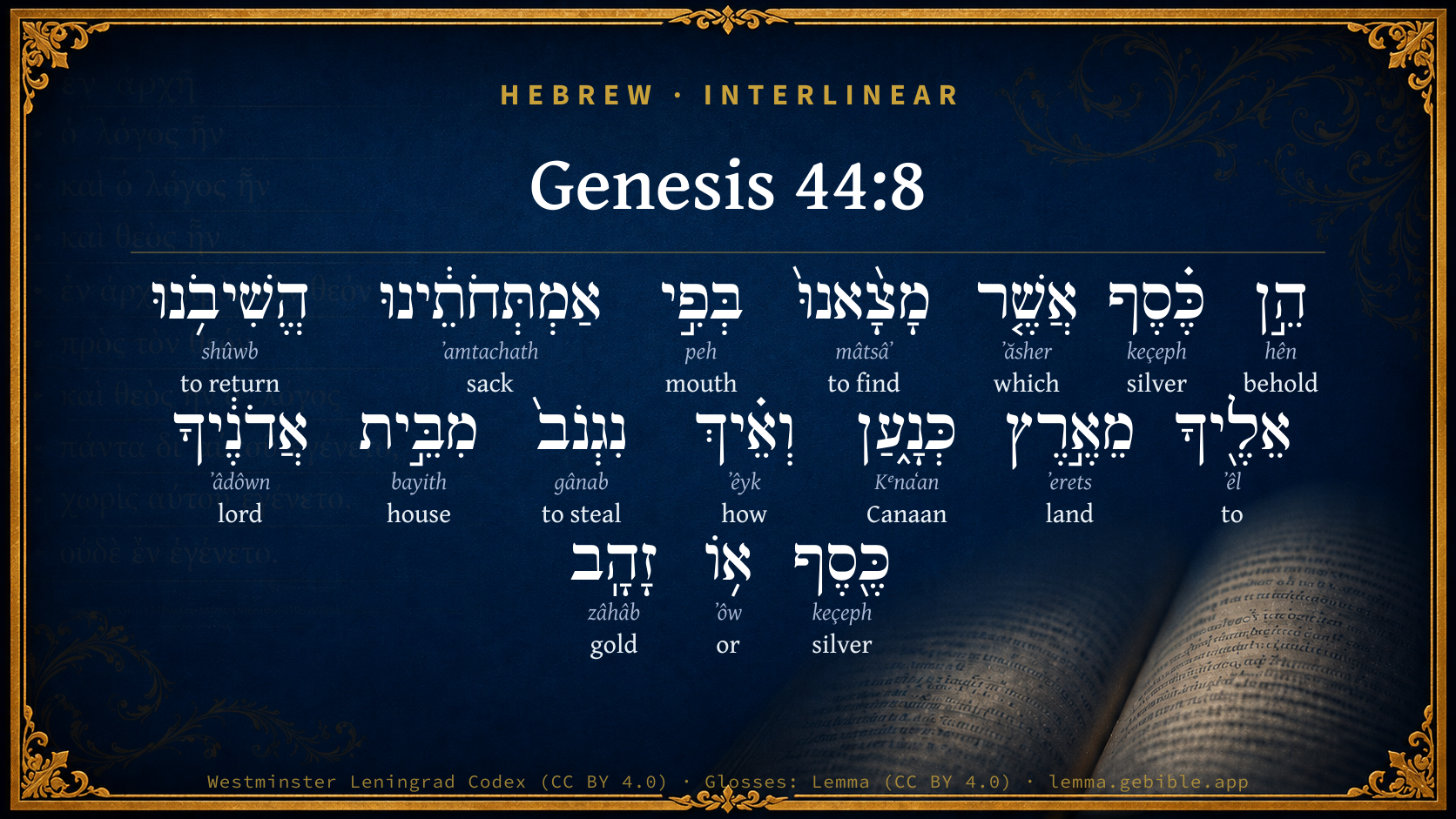
Genesis 44:8

Hebrew (Westminster Leningrad Codex) Genesis 44:8 appears in the Hebrew Old Testament. The text above is from the Westminster Leningrad Codex. Each word links to its Strong’s number, a concise gloss, and parsing drawn from the Open Scriptures Hebrew Bible morphology. Click any word for its full Brown-Driver-Briggs (BDB) entry.
Download image
Cite this verse

Genesis 44:8 (World English Bible). Public Domain. Lemma interlinear Bible study tool, https://lemma.gebible.app/v/genesis/44/8.

Show BibTeX & RIS
BibTeX
RIS
English Translation
Behold, the money, which we found in our sacks' mouths, we brought again to you out of the land of Canaan. How then should we steal silver or gold out of your lord's house?
World English Bible · Public Domain
Download a study sheet

One document with this verse’s original text, its word-by-word gloss line, the meaning frame, cross-references with their text, attributed commentary, and full source and license credits — printable, and it pastes into notes with its structure intact.

This verse Autodidact and up

Study sheet (.html) Plain text (.txt)

A passage Seminary Student

Up to 50 verses in one chapter. A passage sheet keeps up to 6 commentary sources and 12 cross-references per verse, in the order this page ranks them, and says so on the sheet whenever that leaves anything out. Ask for a single verse and you get the Autodidact verse sheet above.

Everything on this page stays free to read, with no account — the sheet is a download of what is already on screen, not access to it.

Want to remove ads? Support Godless Engineer
Compare translations 3

The same verse in 3 English versions, stacked beneath the original-language interlinear above. Click any original word for its lexicon entry.

Each is an independent rendering of the whole verse — the interlinear is not word-aligned to these translations.

Highlighted words mark where these versions differ — a whole-verse word diff, not a word-by-word alignment.

  • World English Bible Public Domain
    Behold, the money, which we found in our sacks' mouths, we brought again to you out of the land of Canaan. How then should we steal silver or gold out of your lord's house?
  • King James Version Public Domain
    Behold, the money, which we found in our sacks' mouths, we brought again unto thee out of the land of Canaan: how then should we steal out of thy lord's house silver or gold?
  • unfoldingWord Literal Text CC BY-SA 4.0
    Behold, the silver that we found in the mouth of our sacks we brought back to you from the land of Canaan. So how would we steal silver or gold from the house of your lord?

unfoldingWord Literal Text — © unfoldingWord, licensed CC BY-SA 4.0. Word-aligned USFM3 via Door43 (git.door43.org/unfoldingWord/en_ult).

Versions to compare (up to 4)

3 of 4 selected

Show all 18 translations

Every available English version of this verse, each an independent rendering of the whole verse.

  • World English Bible Public Domain
    Behold, the money, which we found in our sacks' mouths, we brought again to you out of the land of Canaan. How then should we steal silver or gold out of your lord's house?
  • Berean Standard Bible Public Domain
    We even brought back to you from the land of Canaan the silver we found in the mouths of our sacks. Why would we steal silver or gold from your master’s house?
  • Majority Standard Bible Public Domain
    We even brought back to you from the land of Canaan the silver we found in the mouths of our sacks. Why would we steal silver or gold from your master’s house?
  • King James Version Public Domain
    Behold, the money, which we found in our sacks' mouths, we brought again unto thee out of the land of Canaan: how then should we steal out of thy lord's house silver or gold?
  • American Standard Version (1901) Public Domain
    Behold, the money, which we found in our sacks' mouths, we brought again unto thee out of the land of Canaan: how then should we steal out of thy lord's house silver or gold?
  • Revised Version (1885) Public Domain
    Behold, the money, which we found in our sacks’ mouths, we brought again unto thee out of the land of Canaan: how then should we steal out of thy lord’s house silver or gold?
  • Geneva Bible (1599) Public Domain
    Behold, the money which we found in our sackes mouthes, wee brought againe to thee out of the land of Canaan: how then should we steale out of thy lordes house siluer or golde?
  • Douay-Rheims (1899) Public Domain
    The money, that we found in the top of our sacks, we brought back to thee from the land of Chanaan: how then should it be that we should steal out of thy lord's house, gold or silver?\
  • Young's Literal Translation Public Domain
    lo, the money which we found in the mouth of our bags we brought back unto thee from the land of Canaan, and how do we steal from the house of thy lord silver or gold?
  • Literal Standard Version CC BY-SA 4.0
    behold, the money which we found in the mouth of our bags we brought back to you from the land of Canaan, and how do we steal from the house of your lord silver or gold?
  • Unlocked Literal Bible CC BY-SA 4.0
    Look, the money that we found in our sacks' openings, we brought again to you out of the land of Canaan. How then could we steal out of your master's house silver or gold?
  • unfoldingWord Literal Text CC BY-SA 4.0
    Behold, the silver that we found in the mouth of our sacks we brought back to you from the land of Canaan. So how would we steal silver or gold from the house of your lord?
  • Darby Bible Public Domain
    Behold, the money that we found in our sacks' mouths we have brought again to thee from the land of Canaan; and how should we steal out of thy lord's house silver or gold?
  • World Messianic Bible Public Domain
    Behold, the money, which we found in our sacks’ mouths, we brought again to you out of the land of Canaan. How then should we steal silver or gold out of your lord’s house?
  • Webster's Bible Public Domain
    Behold, the money which we found in our sacks' mouths, we brought again to thee from the land of Canaan: how then should we steal from thy lord's house silver or gold?
  • Free Bible Version CC BY-SA 4.0
    Remember that we brought back the money we found at the top of our sacks when we returned from Canaan. Why would we steal silver or gold from your master's house?
  • Bible in Basic English Public Domain
    See, the money which was in the mouth of our bags we gave back to you when we came again from Canaan: how then might we take silver or gold from your lord's house?
  • JPS Tanakh (1917) Public Domain
    Behold, the money, which we found in our sacks' mouths, we brought back unto thee out of the land of Canaan; how then should we steal out of thy lord's house silver or gold?

Literal Standard Version (2020), Covenant Press — licensed CC BY-SA 4.0. Text via the HelloAO Bible API (eBible.org). Unlocked Literal Bible (unfoldingWord) — licensed CC BY-SA 4.0. Text via the HelloAO Bible API (eBible.org). unfoldingWord Literal Text — © unfoldingWord, licensed CC BY-SA 4.0. Word-aligned USFM3 via Door43 (git.door43.org/unfoldingWord/en_ult). Free Bible Version, Dr. Jonathan Gallagher — licensed CC BY-SA 4.0. Text via the HelloAO Bible API (eBible.org).

Word by word

More ways to search: Search by grammar → Find every occurrence → Compare this word →

Practice this passage: Drill this verse → Learn its vocabulary →

אַמְתְּחֹתֵ֔ינוּ
ʼamtachath
H572
“sacks · our”
Noun, Common, Feminine, Plural, Construct + Suffix, Personal, 1st Person, Common, Plural
Part of Speech
Noun
Type
Common
Gender
Feminine
Number
Plural
State
Construct
Full BDB Definition

Origin: from H4969

TWOT: 1265a

sack, flexible container (for grain) - (TWOT) spread out
  1. הֵ֣ן hên H2005 “behold” Particle, Demonstrative
  2. כֶּ֗סֶף keçeph H3701 “silver” Noun, Common, Masculine, Singular, Absolute
  3. אֲשֶׁ֤ר ʼăsher H834 “which” Particle, Relative
  4. מָצָ֨אנוּ֙ mâtsâʼ H4672 “to find” Verb, Qal, Perfect, 1st Person, Common, Plural
  5. בְּפִ֣י peh H6310 “in/at · mouth of” Preposition + Noun, Common, Masculine, Singular, Construct
  6. הֱשִׁיבֹ֥נוּ shûwb H7725 “to return” Verb, Hiphil, Perfect, 1st Person, Common, Plural
  7. אֵלֶ֖יךָ ʼêl H413 “to · you” Preposition + Suffix, Personal, 2nd Person, Masculine, Singular
  8. מֵאֶ֣רֶץ ʼerets H776 “from · land of” Preposition + Noun, Common, Both, Singular, Construct
  9. כְּנָ֑עַן Kᵉnaʻan H3667 “Canaan” Noun, Proper
  10. וְאֵ֗יךְ ʼêyk H349 “and · how” Conjunction + Particle, Interrogative
  11. נִגְנֹב֙ gânab H1589 “to steal” Verb, Qal, Imperfect, 1st Person, Common, Plural
  12. מִבֵּ֣ית bayith H1004 “from · house of” Preposition + Noun, Common, Masculine, Singular, Construct
  13. אֲדֹנֶ֔יךָ ʼâdôwn H113 “lords · your” Noun, Common, Masculine, Plural, Construct + Suffix, Personal, 2nd Person, Masculine, Singular
  14. כֶּ֖סֶף keçeph H3701 “silver” Noun, Common, Masculine, Singular, Absolute
  15. א֥וֹ ʼôw H176 “or” Conjunction
  16. זָהָֽב zâhâb H2091 “gold” Noun, Common, Masculine, Singular, Absolute

About this verse

These counts appear in no published source. They are computed here, from the morphology-tagged text and Lemma’s own curated glosses. What Lemma adds →

17
words
16
distinct lemmas
Pentateuch
section

Notable vocabulary

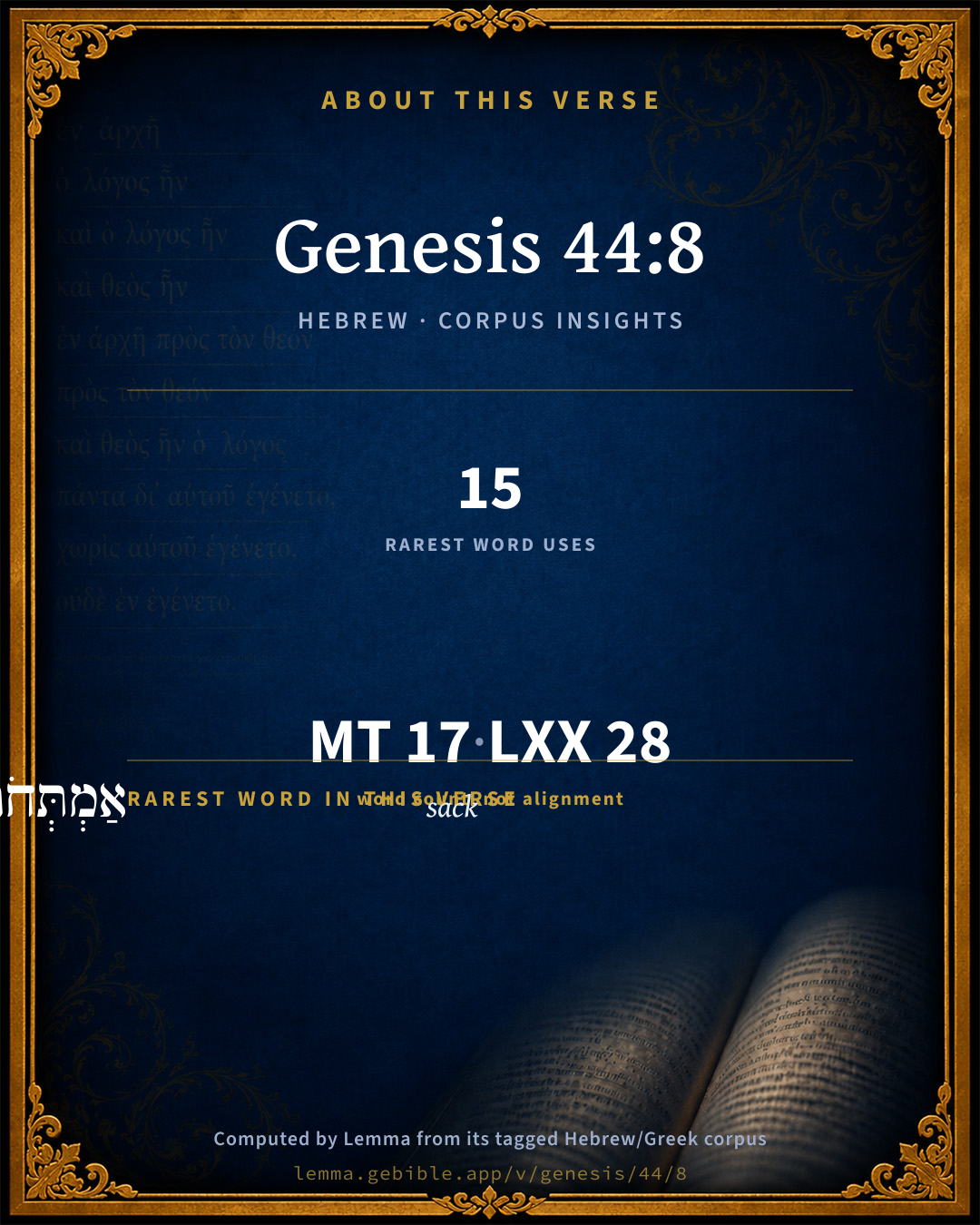
The rarest word here is אַמְתְּחֹתֵ֔ינוּ sack H572 — appearing just 15 times in the whole Hebrew Bible.

Shared distinctive vocabulary

אַמְתְּחֹתֵ֔ינוּ sack H572 occurs in 12 verses of the Hebrew Bible. Also found in:

Grammatical profile

  • 3 verbs
  • 9 nouns
  • 1 preposition
  • 1 conjunction
  • 3 particles

Verb forms

  • מָצָ֨אנוּ֙ Qal · Perfect
  • הֱשִׁיבֹ֥נוּ Hiphil · Perfect
  • נִגְנֹב֙ Qal · Imperfect

Repetition

A word recurs within this verse — often emphatic in Hebrew:

  • כֶּ֗סֶף silver H3701 ×2

Hebrew & Septuagint length

In English translation the verse runs 34 words from the Hebrew and 34 from the Septuagint (LXX English) — the same length.

A rough comparison of the two English renderings, which tokenize alike — not a word-level alignment.

Word counts can differ between the Hebrew and the Greek without any difference in meaning — e.g. the Hebrew direct-object marker אֵת has no separate Greek word, and Greek often adds the article ὁ.

In the original languages it is 17 Hebrew tokens and 28 Greek tokens — but the two are counted differently (Hebrew bundles its prefixes and suffixes into one token; the Greek is in lemma form), so that isn’t a like-for-like length.

Cross-references

11

Topical passages linked to Genesis 44:8 in the Treasury of Scripture Knowledge — connected by theme and wording, ordered by reader-vote popularity; previews shown in the World English Bible.

  • Genesis 42:21 They said one to another, "We are most assuredly guilty concerning our brother, in that we saw the distress of his soul, when he begged us, and we wouldn't listen. Therefore this distress has come on us."
  • Genesis 42:27 As one of them opened his sack to give his donkey food in the lodging-place, he saw his money. Behold, it was in the mouth of his sack.
  • Genesis 42:35 It happened as they emptied their sacks, that behold, every man's bundle of money was in his sack. When they and their father saw their bundles of money, they were afraid.
  • Genesis 43:12 and take double money in your hand, with the money that was returned in the mouth of your sacks carry again in your hand. Perhaps it was an oversight.
  • Genesis 43:21–22 and it happened, when we came to the lodging-place, that we opened our sacks, and, behold, every man's money was in the mouth of his sack, our money in full weight. We have brought it again in our hand.
  • Genesis 44:7 They said to him, "Why does my lord speak such words as these? Far be it from your servants that they should do such a thing!
  • Exodus 20:15 "You shall not steal.
  • Deuteronomy 5:19 "Neither shall you steal.
  • Matthew 19:18 He said to him, "Which ones?" Jesus said, "'You shall not murder.' 'You shall not commit adultery.' 'You shall not steal.' 'You shall not offer false testimony.'
  • Romans 13:9 For the commandments, "You shall not commit adultery," "You shall not murder," "You shall not steal," "You shall not give false testimony," "You shall not covet," and whatever other commandments there are, are all summed up in this saying, namely, "You shall love your neighbor as yourself."
  • James 2:10–11 For whoever shall keep the whole law, and yet stumble in one point, he has become guilty of all.

Cross-references courtesy of OpenBible.info (CC BY 4.0).

Hebrew and Greek witnesses Masoretic Hebrew ↔ Greek Septuagint

The same verse in the two great witnesses to the Old Testament, shown verse-for-verse.

These are two independent witnesses, not word-aligned to each other, and the Septuagint is shown in lemma (dictionary) form.

Hebrew Genesis 44:8 Masoretic · Westminster Leningrad Codex

הֵ֣ן כֶּ֗סֶף אֲשֶׁ֤ר מָצָ֨אנוּ֙ בְּפִ֣י אַמְתְּחֹתֵ֔ינוּ הֱשִׁיבֹ֥נוּ אֵלֶ֖יךָ מֵאֶ֣רֶץ כְּנָ֑עַן וְאֵ֗יךְ נִגְנֹב֙ מִבֵּ֣ית אֲדֹנֶ֔יךָ כֶּ֖סֶף א֥וֹ זָהָֽב

Behold, the money, which we found in our sacks' mouths, we brought again to you out of the land of Canaan. How then should we steal silver or gold out of your lord's house?

World English Bible · Public Domain

Greek LXX Genesis 44:8 Septuagint · lemma form

εἰ ὁ μέν ἀργύριον ὅς εὑρίσκω ἐν ὁ μάρσιππος ἐγώ ἀποστρέφω πρός σύ ἐκ γῆ χανααν πῶς ἄν κλέπτω ἐκ ὁ οἶκος ὁ κύριος σύ ἀργύριον ἤ χρυσίον

If we brought back to you out of the land of Chanaan the money which we found in our sacks, how should we steal silver or gold out of the house of your lord?

LXX2012 (modern English Septuagint) · Public Domain

Hebrew: Westminster Leningrad Codex (CC BY 4.0). Greek: Septuagint (public domain); English from LXX2012 (modern English Septuagint) (Public Domain). How the Septuagint differs from the Hebrew →

Targum (Aramaic paraphrase)

2

The Targum is the ancient Jewish Aramaic paraphrase of the Hebrew Scriptures — an interpretive translation, not the Hebrew text itself. Onkelos (literal) and Pseudo-Jonathan (expansive) render the Torah, and Jonathan the Prophets. Coverage is partial: where no permissively-licensed English translation exists for a verse, only the Aramaic is shown. This is verse-level text, not a word-by-word alignment to the Hebrew.

  1. Targum Onkelos Torah (Genesis–Deuteronomy)
    הָא כַסְפָּא דִּי אַשְׁכַּחְנָא בְּפוּם טּוֹעֲנָנָא אֲתֵיבְנוֹהִי לָךְ מֵאַרְעָא דִּכְנָעַן וְאֶכְדֵּין נִגְנוּב מִבֵּית רִבּוֹנָךְ כַּסְפָּא אוֹ דַּהֲבָא (מָנִין דִּכְסַף אוֹ מָנִין דִּדְהָב)

    (no public-domain English translation for this verse)

    Targum Onkelos — Aramaic: “Onkelos Genesis” (public domain); “Onkelos Exodus” (public domain); “Onkelos Leviticus” (public domain); “Onkelos Numbers” (public domain); “Onkelos Deuteronomy” (public domain). English: “Sefaria Community Translation” (CC0 1.0 (public-domain dedication)); “J.W. Etheridge. The Targums of Onkelos and Jonathan Ben Uzziel on the Pentateuch. London: Longmans, Green, 1862” (public domain). Text via Sefaria.

  2. Targum Pseudo-Jonathan Torah (Genesis–Deuteronomy)
    הָא כַסְפָּא דְאַשְׁכַּחְנָא בְּפוּם טוֹנָנָא אָתִיבְנֵיהּ לָךְ מֵאַרְעָא דִכְנָעַן וְהֵיכְדֵין נִיגְנוֹב מִבֵּית רִבּוֹנָךְ מָנִין דִכְסַף אוֹ מָנִין דִדְהָב

    Behold, the money which we found in the mouth of our bags we brought to thee again from the land of Kenaan; how then should we steal from thy lord's house vessels of silver, or vessels of gold?

    Targum Pseudo-Jonathan — Aramaic: “Targum Jonathan on Genesis” (public domain); “Targum Jonathan on Exodus” (public domain); “Targum Jonathan on Leviticus” (public domain); “Targum Jonathan on Numbers” (public domain); “Targum Jonathan on Deuteronomy” (public domain). English: “The Targum of Jonathan ben Uzziel, trans. J. W. Etheridge, London, 1862” (public domain). Text via Sefaria.

Commentary

Notes on Genesis 44:8 from classic Christian and Jewish commentators (each source and its license shown beneath its notes). The classic Christian expositions comment on the surrounding passage and are grouped to its opening verse, so a note may address several verses; the Jewish commentaries on the Tanakh (Rashi and others) are per-verse, so they appear only where the commentator wrote on this verse.

Lemma curates 59 commentaries, every one of them public domain or Creative Commons licensed, each selected and text-cleaned for this edition rather than reprinted as found. About our sources →

Trapp's Complete Commentary

John Trapp

Gen 44:8 Behold, the money, which we found in our sacks’ mouths, we brought again unto thee out of the land of Canaan: how then should we steal out of thy lord’s house silver or gold?

Ver. 8. Behold, the money.] Those that from a right principle can find in their hearts to make restitution, may be safely trusted as to wronging others, either by covin or ravin. (agreement or robbery)

John Trapp, A Commentary or Exposition upon All the Books of the Old and New Testament (1647–1656) — public domain. Text from a community e-Sword module.

Joseph Benson's Commentary

Gen 44:8-9. How then should we steal, &c. — It is not probable that we, who restored that which it was in our power to keep, and to conceal without any danger, should steal that which was likely to be discovered with so much shame and hazard to ourselves. With whomsoever it is found, let him die — They suspected no fraud, and were so conscious of their innocence, that they consented to suffer the severest punishment, if found guilty. Their offer, however, was rash and inconsiderate.

Joseph Benson's Commentary on the Old and New Testaments (1811–1818) — public domain. Text from a community e-Sword module.

John Gill's Exposition

Behold, the money which we found in our sacks mouths;.... Upon their return from Egypt, the first time they went thither for corn:

we brought again unto thee out of the land of Canaan; which was a full proof of their honesty: they might have kept it until it was called for and demanded of them, but of themselves they brought it with them, as being money not their own; and they did not wait to be examined about it when they came to Egypt again, but of their own accord related the story of it, and offered the money to this same man the steward they were now speaking to, which he could not deny: yea, they brought it to him out of the land of Canaan, a foreign country at a considerable distance, and out of the jurisdiction of Egypt, and where they were not liable to be called to an account for it:

how then should we steal out of thy lord's house silver or gold? that is, vessels of silver or vessels of gold, as the Targums of Onkelos and Jonathan; it could not be reasonably thought they would, for if they would not retain the governor's money when in their own land and out of his reach, much less would they steal anything out his house, which they might conclude would soon be missed, and they easily apprehended and committed to prison, and suffer for it.

John Gill's Exposition of the Whole Bible (1746–1763) — public domain (CC PDM 1.0). Text via the HelloAO Bible API.

Matthew Poole's English Annotations

It is not probable that we who restored that which was in our power to keep, and to conceal without any danger, should steal that which was likely to be discovered with so much shame and hazard to ourselves.

Matthew Poole's English Annotations on the Holy Bible (1683–1685) — public domain. Text from a community e-Sword/MySword module.

unfoldingWord translationNotes

Door43 World Missions Community

Look, the money

"Listen to what we are about to say and you will see that we are speaking the truth: the money"

the money that we found in our sacks' openings

"you know the money that we found in our sacks"

we brought again to you out of the land of Canaan

"we brought back to you from Canaan"

How then could we steal out of your master's house silver or gold?

The brothers use a question to emphasize that they would not steal from the lord of Egypt. AT: "So we would never take anything from your master's house!" (See: Rhetorical Question)

silver or gold

These words are used together to mean that they would not steal anything of any value.

With whomever of your servants it is found

The brothers refer to themselves as "your servants." This is a formal way of speaking to someone with greater authority. It can be stated in the first person. Also, "is is found" can be stated in active form. AT: "If you find that one of us has stolen the cup" (See: First, Second, or Third Person and Active or Passive)

we also will be my master's slaves

The phrase "my master" refers to the steward. This can be stated in the second person. AT: "you may take us as your slaves" (See: First, Second, or Third Person)

Now also let it be according to your words

"Very well. I will do what you said." Here "now" does not mean "at this moment," but is used to draw attention to the important point that follows.

He with whom the cup is found will be my slave

This can be stated in active form. AT: "If I find the cup in one of your sacks, that person will be my slave" (See: Active or Passive)

translationWords

Canaan

silver

gold

servant

manager

word

innocent

unfoldingWord translationNotes — © Distant Shores Media and the Door43 World Missions Community, licensed CC BY-SA 4.0. Source: git.door43.org/Door43/en_tn.

Rashi

Rabbi Shlomo Yitzchaki (Rashi)

הן כסף אשר מצאנו BEHOLD THE MONEY WHICH WE FOUND — This is one of the ten inferences from minor to major mentioned in the Bible. They are all enumerated in Genesis Rabbah (Genesis Rabbah 92:7).

Rashi on the Tanakh — English translations: “The Judaica Press complete Tanach with Rashi, translated by A. J. Rosenberg” (CC BY 4.0); “Pentateuch with Rashi's commentary by M. Rosenbaum and A.M. Silbermann, 1929-1934” (public domain); “The Metsudah Tanach series, Lakewood, N.J” (CC BY 4.0); and “The Book of Joshua, Metsudah Publications, 1997” (CC BY 4.0). Text via Sefaria.

Lesson kit

Teaching starters — assembled from the data on this page, not authored interpretation. Every prompt links to the verse data it draws on. Edit before teaching.

Genesis, in the Pentateuch, opens this verse with 17 words (16 distinct Hebrew lemmas). Its most distinctive word is ʼamtachath (“sack”). A historical commentator’s framing appears above. Read the whole chapter for the surrounding context.

Discussion questions

  1. How does “sack” (ʼamtachath) shape what this verse is saying?
  2. Genesis 42:27 shares the word «sack» with this verse. How do the two illuminate each other?
  3. “silver” occurs 2× in this one verse. What is the effect of the repetition?
  4. The translations on this page render this verse differently — a whole-verse word diff, not a word-by-word alignment. What might account for the different wordings?
  5. The verb «מָצָ֨אנוּ֙» is Qal Perfect. How does its form color the action?
  6. Reading how Trapp's Complete Commentary and Joseph Benson's Commentary read this verse, where do the two commentators agree and where do they part?

Things to notice

Reading settings

Reading text

Shown beneath each verse's original-language words.

Old Testament
Old Testament edition

Read the OT as the Masoretic Hebrew (MT) or the Greek Septuagint (LXX).

English shown for the Greek Septuagint (in the Hebrew ↔ Greek comparison).

Comparing translations? Open the Compare panel on any verse page to stack up to four side by side.