
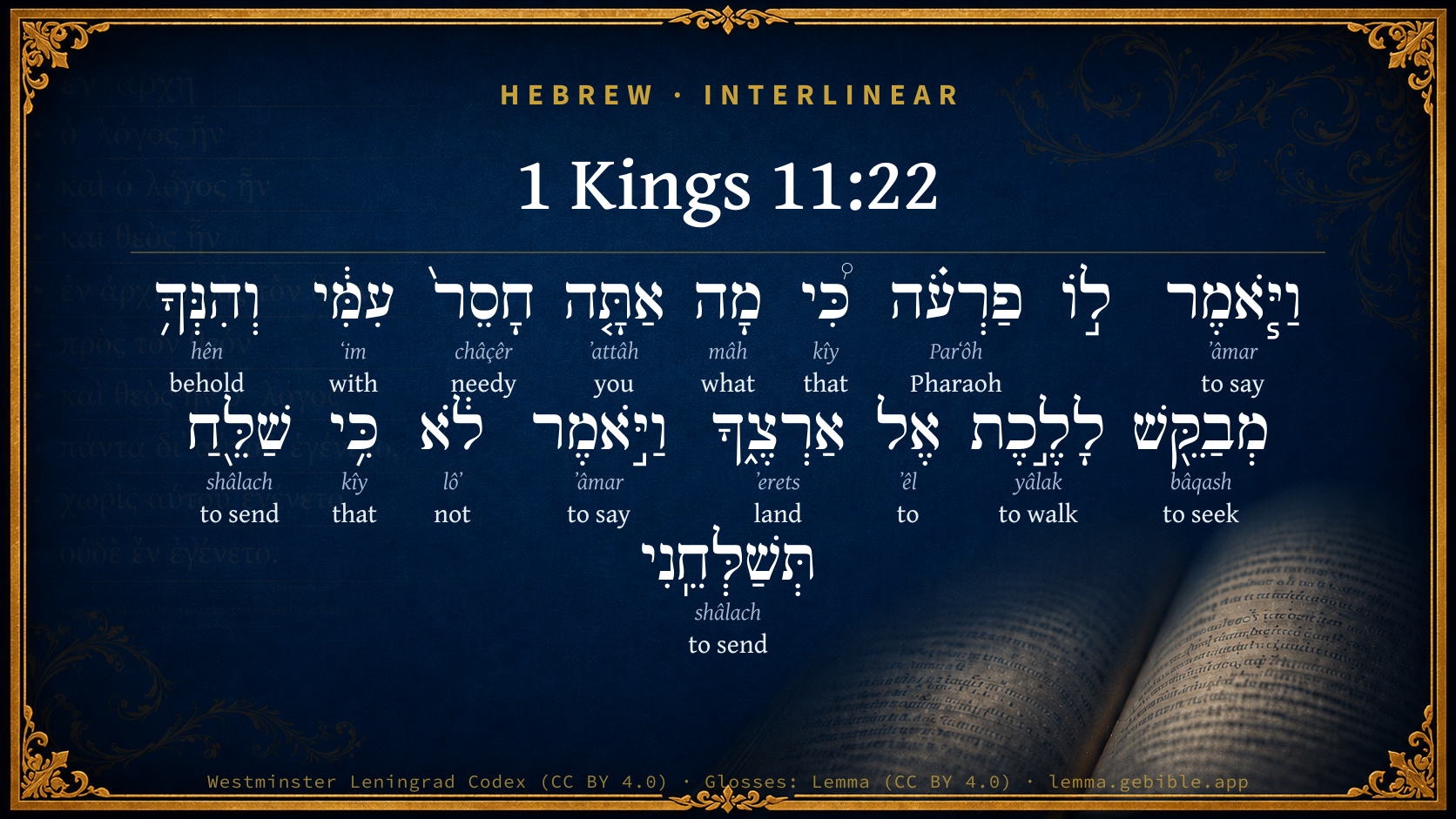
1 Kings 11:22

Hebrew (Westminster Leningrad Codex) 1 Kings 11:22 appears in the Hebrew Old Testament. The text above is from the Westminster Leningrad Codex. Each word links to its Strong’s number, a concise gloss, and parsing drawn from the Open Scriptures Hebrew Bible morphology. Click any word for its full Brown-Driver-Briggs (BDB) entry.
Download image
Cite this verse

1 Kings 11:22 (World English Bible). Public Domain. Lemma interlinear Bible study tool, https://lemma.gebible.app/v/1-kings/11/22.

Show BibTeX & RIS
BibTeX
RIS
English Translation
Then Pharaoh said to him, But what have you lacked with me, that behold, you seek to go to your own country? He answered, Nothing: however only let me depart.
World English Bible · Public Domain
Download a study sheet

One document with this verse’s original text, its word-by-word gloss line, the meaning frame, cross-references with their text, attributed commentary, and full source and license credits — printable, and it pastes into notes with its structure intact.

This verse Autodidact and up

Study sheet (.html) Plain text (.txt)

A passage Seminary Student

Up to 50 verses in one chapter. A passage sheet keeps up to 6 commentary sources and 12 cross-references per verse, in the order this page ranks them, and says so on the sheet whenever that leaves anything out. Ask for a single verse and you get the Autodidact verse sheet above.

Everything on this page stays free to read, with no account — the sheet is a download of what is already on screen, not access to it.

Want to remove ads? Support Godless Engineer
Compare translations 3

The same verse in 3 English versions, stacked beneath the original-language interlinear above. Click any original word for its lexicon entry.

Each is an independent rendering of the whole verse — the interlinear is not word-aligned to these translations.

Highlighted words mark where these versions differ — a whole-verse word diff, not a word-by-word alignment.

  • World English Bible Public Domain
    Then Pharaoh said to him, But what have you lacked with me, that behold, you seek to go to your own country? He answered, Nothing: however only let me depart.
  • King James Version Public Domain
    Then Pharaoh said unto him, But what hast thou lacked with me, that, behold, thou seekest to go to thine own country? And he answered, Nothing: howbeit let me go in any wise.
  • unfoldingWord Literal Text CC BY-SA 4.0
    And Pharaoh said to him, “But what you lacking with me, that behold you, seeking to go to your land?” And he said, “Nothing, but sending, may you send me away.”

unfoldingWord Literal Text — © unfoldingWord, licensed CC BY-SA 4.0. Word-aligned USFM3 via Door43 (git.door43.org/unfoldingWord/en_ult).

Versions to compare (up to 4)

3 of 4 selected

Show all 18 translations

Every available English version of this verse, each an independent rendering of the whole verse.

  • World English Bible Public Domain
    Then Pharaoh said to him, But what have you lacked with me, that behold, you seek to go to your own country? He answered, Nothing: however only let me depart.
  • Berean Standard Bible Public Domain
    But Pharaoh asked him, “What have you lacked here with me that you suddenly want to go back to your own country?” “Nothing,” Hadad replied, “but please let me go.”
  • Majority Standard Bible Public Domain
    But Pharaoh asked him, “What have you lacked here with me that you suddenly want to go back to your own country?” “Nothing,” Hadad replied, “but please let me go.”
  • King James Version Public Domain
    Then Pharaoh said unto him, But what hast thou lacked with me, that, behold, thou seekest to go to thine own country? And he answered, Nothing: howbeit let me go in any wise.
  • American Standard Version (1901) Public Domain
    Then Pharaoh said unto him, But what hast thou lacked with me, that, behold, thou seekest to go to thine own country? And he answered, Nothing: howbeit only let me depart.
  • Revised Version (1885) Public Domain
    Then Pharaoh said unto him, But what hast thou lacked with me, that, behold, thou seekest to go to thine own country? And he answered, Nothing: howbeit let me depart in any wise.
  • Geneva Bible (1599) Public Domain
    But Pharaoh saide vnto him, What hast thou lacked with me, that thou wouldest thus go to thine owne countrey? And he answered, Nothing, but in any wise let me goe.
  • Douay-Rheims (1899) Public Domain
    And Pharao said to him: Why, what is wanting to thee with me, that thou seekest to go to thy own country? But he answered: Nothing: yet I beseech thee to let me go.
  • Young's Literal Translation Public Domain
    And Pharaoh saith to him, `But, what art thou lacking with me, that lo, thou art seeking to go unto thine own land?' and he saith, `Nay, but thou dost certainly send me away.'
  • Literal Standard Version CC BY-SA 4.0
    And Pharaoh says to him, “But what are you lacking with me, that behold, you are seeking to go to your own land?” And he says, “Nothing, but you certainly send me away.”
  • Unlocked Literal Bible CC BY-SA 4.0
    Then Pharaoh said to him, “But what have you lacked with me, that you now seek to go to your own country?” Hadad answered, “Nothing. Please let me go.”
  • unfoldingWord Literal Text CC BY-SA 4.0
    And Pharaoh said to him, “But what you lacking with me, that behold you, seeking to go to your land?” And he said, “Nothing, but sending, may you send me away.”
  • Darby Bible Public Domain
    And Pharaoh said to him, What then dost thou lack with me, that behold, thou desirest to go to thine own country? And he said, Nothing; but in any case let me depart.
  • World Messianic Bible Public Domain
    Then Pharaoh said to him, “But what have you lacked with me, that behold, you seek to go to your own country?” He answered, “Nothing, however only let me depart.”
  • Webster's Bible Public Domain
    Then Pharaoh said to him, But what hast thou lacked with me, that, behold, thou seekest to go to thy own country? And he answered, Nothing: yet, in any wise let me go.
  • Free Bible Version CC BY-SA 4.0
    Pharaoh asked him, “Is there anything that you have lacked here with me that now you want to go back to your own country?” “No, there's nothing,” Hadad replied, “but please just let me go home.”
  • Bible in Basic English Public Domain
    But Pharaoh said to him, What have you been short of while you have been with me, that you are desiring to go back to your country? And he said, Nothing; but even so, send me back.
  • JPS Tanakh (1917) Public Domain
    Then Pharaoh said unto him: 'But what hast thou lacked with me, that, behold, thou seekest to go to thine own country?' And he answered: 'Nothing; howbeit let me depart in any wise.'

Literal Standard Version (2020), Covenant Press — licensed CC BY-SA 4.0. Text via the HelloAO Bible API (eBible.org). Unlocked Literal Bible (unfoldingWord) — licensed CC BY-SA 4.0. Text via the HelloAO Bible API (eBible.org). unfoldingWord Literal Text — © unfoldingWord, licensed CC BY-SA 4.0. Word-aligned USFM3 via Door43 (git.door43.org/unfoldingWord/en_ult). Free Bible Version, Dr. Jonathan Gallagher — licensed CC BY-SA 4.0. Text via the HelloAO Bible API (eBible.org).

Word by word

More ways to search: Search by grammar → Find every occurrence → Compare this word →

Practice this passage: Drill this verse → Learn its vocabulary →

חָסֵר֙
châçêr
H2638
“needy”
Adjective, Adjective, Masculine, Singular, Absolute
Part of Speech
Adjective
Type
Adjective
Gender
Masculine
Number
Singular
State
Absolute
Full BDB Definition

Origin: from H2637

TWOT: 705c

in need of, lacking, needy, in want of
  1. וַיֹּ֧אמֶר ʼâmar H559 “and · to say” Conjunction + Verb, Qal, Sequential Imperfect, 3rd Person, Masculine, Singular
  2. פַרְעֹ֗ה Parʻôh H6547 “Pharaoh” Noun, Proper
  3. כִּ֠י kîy H3588 “that” Conjunction
  4. מָה mâh H4100 “what” Particle, Interrogative
  5. אַתָּ֤ה ʼattâh H859 “you” Pronoun, Personal, 2nd Person, Masculine, Singular
  6. עִמִּ֔י ʻim H5973 “with · me” Preposition + Suffix, Personal, 1st Person, Common, Singular
  7. וְהִנְּךָ֥ hên H2005 “and · behold · you” Conjunction + Particle, Interjection + Suffix, Personal, 2nd Person, Masculine, Singular
  8. מְבַקֵּ֖שׁ bâqash H1245 “seeking” Verb, Piel, Participle Active, Masculine, Singular, Absolute
  9. לָלֶ֣כֶת yâlak H3212 “to walk” Preposition + Verb, Qal, Infinitive Construct
  10. אֶל ʼêl H413 “to” Preposition
  11. אַרְצֶ֑ךָ ʼerets H776 “land · your” Noun, Common, Both, Singular, Construct + Suffix, Personal, 2nd Person, Masculine, Singular
  12. וַיֹּ֣אמֶר ʼâmar H559 “and · to say” Conjunction + Verb, Qal, Sequential Imperfect, 3rd Person, Masculine, Singular
  13. לֹ֔א lôʼ H3808 “not” Particle, Negative
  14. כִּ֥י kîy H3588 “that” Conjunction
  15. שַׁלֵּ֖חַ shâlach H7971 “to send” Verb, Piel, Infinitive Absolute
  16. תְּשַׁלְּחֵֽנִי shâlach H7971 “to send · me” Verb, Piel, Imperfect, 2nd Person, Masculine, Singular + Suffix, Personal, 1st Person, Common, Singular

About this verse

These counts appear in no published source. They are computed here, from the morphology-tagged text and Lemma’s own curated glosses. What Lemma adds →

18
words
14
distinct lemmas
Historical
section

Notable vocabulary

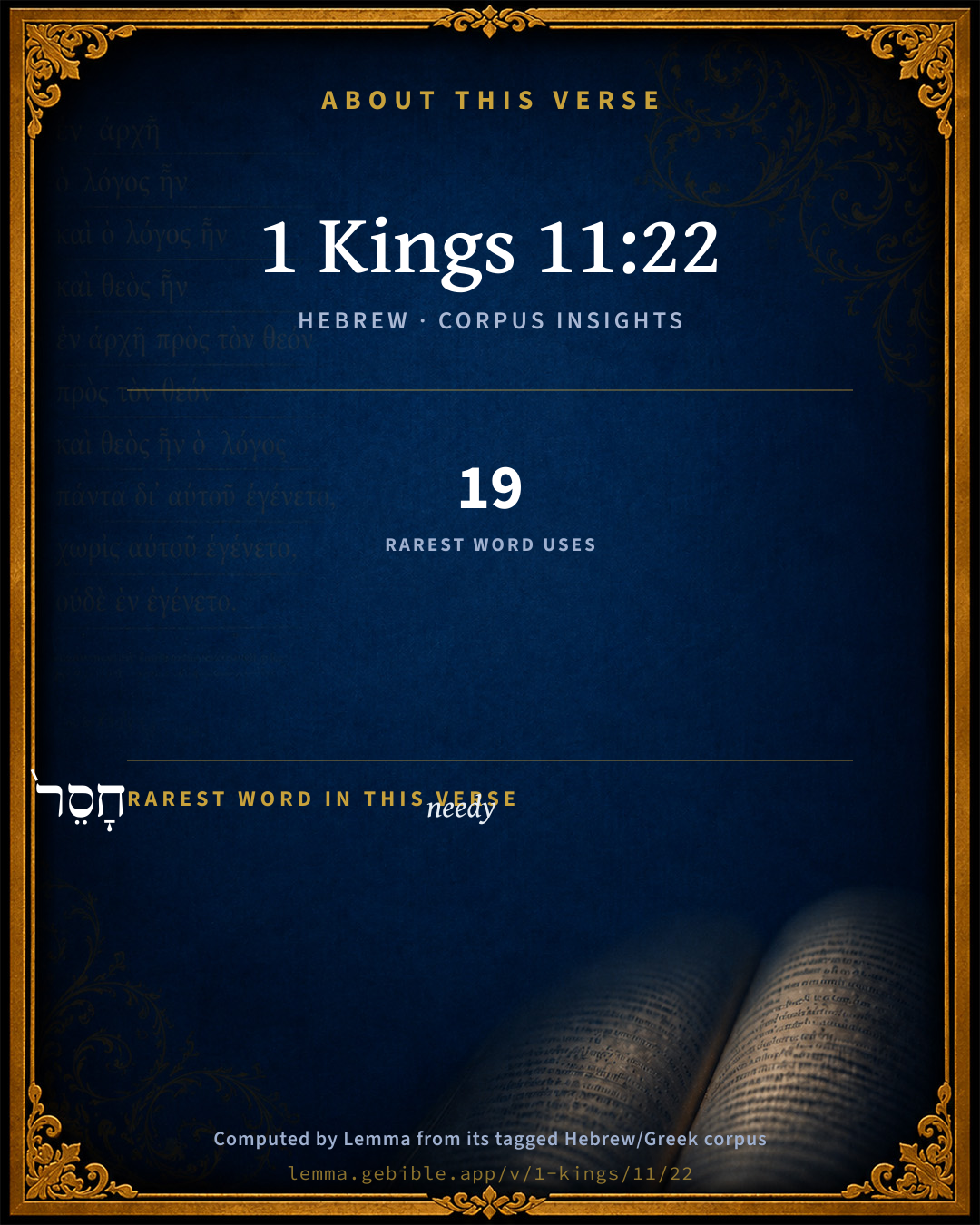
The rarest word here is חָסֵר֙ needy H2638 — appearing just 19 times in the whole Hebrew Bible.

Shared distinctive vocabulary

חָסֵר֙ needy H2638 occurs in 19 verses of the Hebrew Bible. Also found in:

Grammatical profile

  • 6 verbs
  • 2 nouns
  • 1 adjective
  • 1 pronoun
  • 3 prepositions
  • 2 conjunctions
  • 3 particles

Verb forms

  • וַיֹּ֧אמֶר Qal · Sequential Imperfect
  • מְבַקֵּ֖שׁ Piel · Participle Active
  • לָלֶ֣כֶת Qal · Infinitive Construct
  • וַיֹּ֣אמֶר Qal · Sequential Imperfect
  • שַׁלֵּ֖חַ Piel · Infinitive Absolute
  • תְּשַׁלְּחֵֽנִי Piel · Imperfect

Repetition

Words recur within this verse — often emphatic in Hebrew:

  • וַיֹּ֧אמֶר to say H559 ×2
  • שַׁלֵּ֖חַ to send H7971 ×2
  • כִּ֠י that H3588 ×2

Hebrew & Septuagint length

In English translation the verse runs 30 words from the Hebrew and 30 from the Septuagint (LXX English) — the same length.

A rough comparison of the two English renderings, which tokenize alike — not a word-level alignment.

Word counts can differ between the Hebrew and the Greek without any difference in meaning — e.g. the Hebrew direct-object marker אֵת has no separate Greek word, and Greek often adds the article ὁ.

Cross-references

5

Topical passages linked to 1 Kings 11:22 in the Treasury of Scripture Knowledge — connected by theme and wording, ordered by reader-vote popularity; previews shown in the World English Bible.

  • Luke 22:35 He said to them, "When I sent you out without purse, and wallet, and shoes, did you lack anything?" They said, "Nothing."
  • 2 Samuel 18:22–23 Then said Ahimaaz the son of Zadok yet again to Joab, But come what may, Please let me also run after the Cushite. Joab said, Why will you run, my son, seeing that you will have no reward for the news?
  • Psalms 37:8 Cease from anger, and forsake wrath. Don't fret, it leads only to evildoing.
  • Jeremiah 2:31 Generation, see the word of Yahweh. Have I been a wilderness to Israel? or a land of thick darkness? why say my people, We are broken loose; we will come no more to you?
  • Mark 14:31 But he spoke all the more, "If I must die with you, I will not deny you." They all said the same thing.

Cross-references courtesy of OpenBible.info (CC BY 4.0).

Hebrew and Greek witnesses Masoretic Hebrew ↔ Greek Septuagint

The same verse in the two great witnesses to the Old Testament, shown verse-for-verse.

These are two independent witnesses, not word-aligned to each other, and the Septuagint is shown in lemma (dictionary) form.

Hebrew 1 Kings 11:22 Masoretic · Westminster Leningrad Codex

וַיֹּ֧אמֶר ל֣וֹ פַרְעֹ֗ה כִּ֠י מָה אַתָּ֤ה חָסֵר֙ עִמִּ֔י וְהִנְּךָ֥ מְבַקֵּ֖שׁ לָלֶ֣כֶת אֶל אַרְצֶ֑ךָ וַיֹּ֣אמֶר לֹ֔א כִּ֥י שַׁלֵּ֖חַ תְּשַׁלְּחֵֽנִי

Then Pharaoh said to him, But what have you lacked with me, that behold, you seek to go to your own country? He answered, Nothing: however only let me depart.

World English Bible · Public Domain

Greek LXX 1 Kings 11:22 Septuagint · lemma form

καί εἶπον φαραώ ὁ αδερ τίς σύ ἐλαττονέω μετά ἐγώ καί ἰδού σύ ζητέω ἀποἔρχομαι εἰς ὁ γῆ σύ καί εἶπον αὐτός αδερ ὅτι ἐκ ἀποστέλλω ἐκ ἀποστέλλω ἐγώ καί ἀναστρέφω αδερ εἰς ὁ γῆ αὐτός

And Pharao said to Ader, What lack you with me? that behold! you seek to depart to your country? and Ader said to him, By all means let me go.

LXX2012 (modern English Septuagint) · Public Domain

On this verse, The Cambridge Bible for Schools and Colleges discusses the Septuagint’s reading. Read the note in Commentary ↓

Hebrew: Westminster Leningrad Codex (CC BY 4.0). Greek: Septuagint (public domain); English from LXX2012 (modern English Septuagint) (Public Domain). How the Septuagint differs from the Hebrew →

Targum (Aramaic paraphrase)

1

The Targum is the ancient Jewish Aramaic paraphrase of the Hebrew Scriptures — an interpretive translation, not the Hebrew text itself. Onkelos (literal) and Pseudo-Jonathan (expansive) render the Torah, and Jonathan the Prophets. Coverage is partial: where no permissively-licensed English translation exists for a verse, only the Aramaic is shown. This is verse-level text, not a word-by-word alignment to the Hebrew.

  1. Targum Jonathan Prophets (Joshua–Malachi)
    וַאֲמַר לֵיהּ פַּרְעֹה אֲרֵי מָא אַתְּ חָסֵר עִמִי דְאַתְּ בָּעֵי לְמֵיזַל לְאַרְעָךְ וַאֲמַר לָא אֲרֵי שַׁלָחָא תְּשַׁלְחִינַנִי:

    (no public-domain English translation for this verse)

    Targum Jonathan — Aramaic: “Mikraot Gedolot” (public domain). English: “Sefaria Community Translation” (CC0 1.0 (public-domain dedication)); “London "Chaldee Paraphrase," 1871” (public domain). Text via Sefaria.

Commentary

Notes on 1 Kings 11:22 from classic Christian and Jewish commentators (each source and its license shown beneath its notes). The classic Christian expositions comment on the surrounding passage and are grouped to its opening verse, so a note may address several verses; the Jewish commentaries on the Tanakh (Rashi and others) are per-verse, so they appear only where the commentator wrote on this verse.

Lemma curates 59 commentaries, every one of them public domain or Creative Commons licensed, each selected and text-cleaned for this edition rather than reprinted as found. About our sources →

Trapp's Complete Commentary

John Trapp

1Ki 11:22 Then Pharaoh said unto him, But what hast thou lacked with me, that, behold, thou seekest to go to thine own country? And he answered, Nothing: howbeit let me go in any wise.

Ver. 22. Howbeit let me go in any wise.] Heb., No, but in sending send me away. Fugiamus et nos ad clarissimarn patriam: hasten we also to heaven, though the world would detain us longer here by her blandishments and largesses, Rivers run to the sea, whence they came; the dove returneth to the ark; &c. Nature hath ingrafted in every creature to love the place where it took birth and beginning.

John Trapp, A Commentary or Exposition upon All the Books of the Old and New Testament (1647–1656) — public domain. Text from a community e-Sword module.

Adam Clarke's Commentary

Verse 22. Let me go in any wise.] It does not appear that he avowed his real intention to Pharaoh; for at this time there must have been peace between Israel and Egypt, Solomon having married the daughter of Pharaoh.

Adam Clarke's Commentary on the Bible (1810–1826) — public domain. Text from a community e-Sword/MySword module.

The Cambridge Bible for Schools and Colleges

gen. ed. J. J. S. Perowne

22. And he answered, Nothing] The Hebrew has for the last word only the simple negative ‘Not.’ (See A.V. marg.) The verb ‘I have lacked’ is to be supplied.

let me go in any wise] The verb is not the same as that translated ‘go’ in the former part of the verse. The R.V. marks the difference by rendering depart here, as the word corresponds to that so translated in 21.

Here the LXX. (Vat.) has in addition ‘And Hadad (Ἄδερ) returned to his own land. This is the evil which Hadad: and he was indignant against Israel, and reigned in the land of Edom.’ Then 1Ki_11:23-25 are omitted, having been partly represented by the additions to 1Ki_11:14 noticed above.

The Cambridge Bible for Schools and Colleges (gen. ed. J. J. S. Perowne; Cambridge University Press, 1878–1918) — public domain. Text from a community e-Sword module.

John Gill's Exposition

And God stirred him up another adversary,.... One from the north, as the other was from the south:

Rezon, the son of Eliadah, which fled from his lord Hadadezer king of Zobah: when David fought with him; and this man seeing the battle go against his master, and that he was like to be worsted, deserted him and fled, see Sa2 8:3.

John Gill's Exposition of the Whole Bible (1746–1763) — public domain (CC PDM 1.0). Text via the HelloAO Bible API.

Whedon's Commentary on the Bible

Daniel D. Whedon

22. Let me go in any wise — Or, Send me by all means away. He was ambitious to recover the lost fortunes of his father’s house, and the luxurious ease of Egyptian court-life could not detain him. The sacred history does not give us the sequel of Hadad’s career; but Josephus, following the intimation of 1Ki_11:25, and the Septuagint, or perhaps some older tradition, says that Pharaoh persuaded Hadad for a long time not to leave him; but when Solomon’s popularity began to decline, he permitted him to go, and Hadad at once went to Edom and tried to incite his countrymen to revolt from the Hebrew government. Failing in this, he joined himself to Rezon, whose hostility to Solomon is recorded 1Ki_11:23-25.

Daniel D. Whedon (gen. ed.), Commentary on the Old and New Testaments (1874–1909) — public domain. Text from a community e-Sword module.

The Pulpit Commentary

Then Pharaoh said unto him, But what hast thou lacked with me, that, behold, thou seekest to go to thine own country? The natural inquiry of Eastern courtesy. And he answered, Nothing: howbeit let me go in any wise. Heb. thou shalt surely send me away. Rawlinson says, "There is a remarkable abruptness in this termination." But we must remember how unfinished, to our eyes, Scripture narratives constantly seem. There is no need, consequently, to suspect any accidental omission from the Hebrew text. The LXX, it is true, adds, "and Ader departed," etc., but this may be inferred from vers. 14, 25. And Hadad"s persistent desire to depart, for which he assigns no reason, is suggestive of the thoughts which were stirring in his soul. "The keen remembrance of his native land, his lost kingdom, and the slaughter of all his house, gathered strength within him; and all the ease and princely honour which he enjoyed in Egypt availed not against the claims of ambition, vengeance, and patriotism" (Kitto).

The Pulpit Commentary (1880–1919), ed. H.D.M. Spence-Jones & Joseph S. Exell — public domain. Text from a community e-Sword module.

Lesson kit

Teaching starters — assembled from the data on this page, not authored interpretation. Every prompt links to the verse data it draws on. Edit before teaching.

1 Kings, in the Historical, opens this verse with 18 words (14 distinct Hebrew lemmas). Its most distinctive word is châçêr (“needy”). A historical commentator’s framing appears above. Read the whole chapter for the surrounding context.

Discussion questions

  1. The word châçêr carries the sense “needy.” How does it shape the verse?
  2. How does 1 Samuel 21:15, which shares the word «needy», read alongside this verse?
  3. What does the repetition of “to say” (2× in this one verse) do in this verse?
  4. The translations on this page render this verse differently — a whole-verse word diff, not a word-by-word alignment. What might account for the different wordings?
  5. «וַיֹּ֧אמֶר» is a Qal Sequential Imperfect verb. How does that grammatical form shape the action described?
  6. Compare how Trapp's Complete Commentary and Adam Clarke's Commentary read this verse. Where do they agree or differ?

Things to notice

Reading settings

Reading text

Shown beneath each verse's original-language words.

Old Testament
Old Testament edition

Read the OT as the Masoretic Hebrew (MT) or the Greek Septuagint (LXX).

English shown for the Greek Septuagint (in the Hebrew ↔ Greek comparison).

Comparing translations? Open the Compare panel on any verse page to stack up to four side by side.