
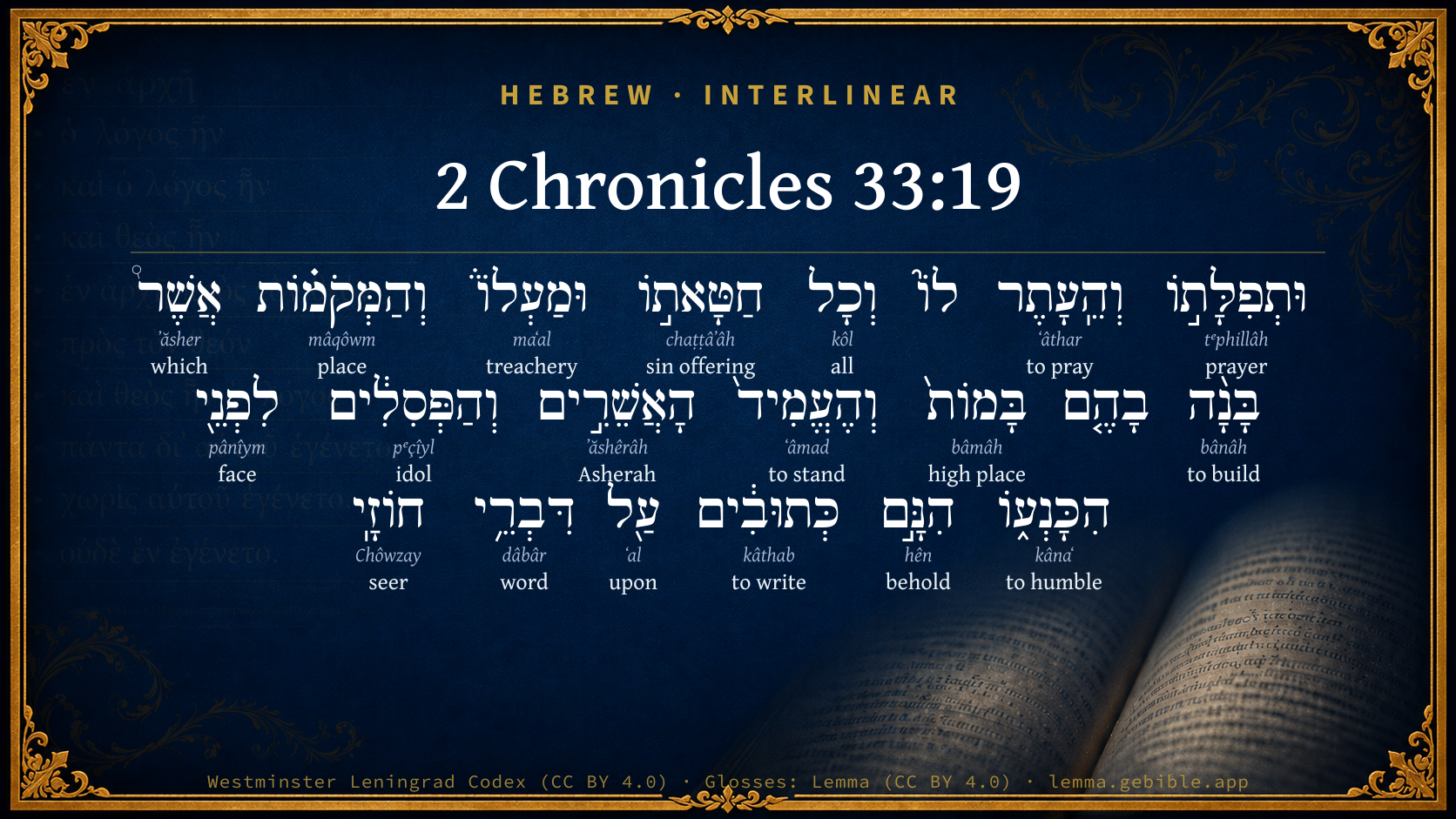
2 Chronicles 33:19

Hebrew (Westminster Leningrad Codex) 2 Chronicles 33:19 appears in the Hebrew Old Testament. The text above is from the Westminster Leningrad Codex. Each word links to its Strong’s number, a concise gloss, and parsing drawn from the Open Scriptures Hebrew Bible morphology. Click any word for its full Brown-Driver-Briggs (BDB) entry.
Download image
Cite this verse

2 Chronicles 33:19 (World English Bible). Public Domain. Lemma interlinear Bible study tool, https://lemma.gebible.app/v/2-chronicles/33/19.

Show BibTeX & RIS
BibTeX
RIS
English Translation
His prayer also, and how [God] was entreated of him, and all his sin and his trespass, and the places in which he built high places, and set up the Asherim and the engraved images, before he humbled himself: behold, they are written in the history of Hozai.
World English Bible · Public Domain
Highlights
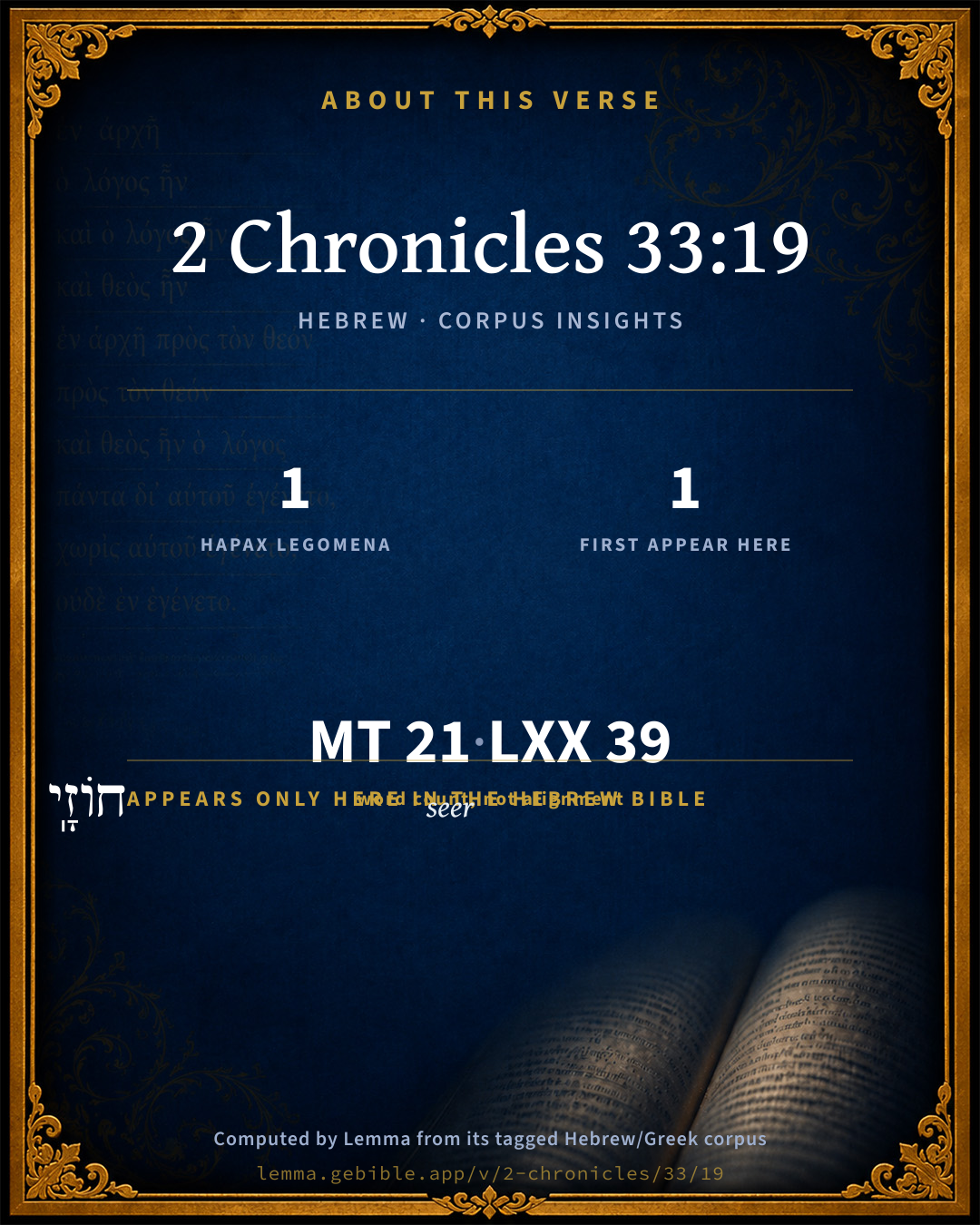
  • 1 hapax legomenon — only here in the Hebrew Bible
  • 1 first appearance in the Hebrew Bible
Full analysis ↓
Download a study sheet

One document with this verse’s original text, its word-by-word gloss line, the meaning frame, cross-references with their text, attributed commentary, and full source and license credits — printable, and it pastes into notes with its structure intact.

This verse Autodidact and up

Study sheet (.html) Plain text (.txt)

A passage Seminary Student

Up to 50 verses in one chapter. A passage sheet keeps up to 6 commentary sources and 12 cross-references per verse, in the order this page ranks them, and says so on the sheet whenever that leaves anything out. Ask for a single verse and you get the Autodidact verse sheet above.

Everything on this page stays free to read, with no account — the sheet is a download of what is already on screen, not access to it.

Want to remove ads? Support Godless Engineer
Compare translations 3

The same verse in 3 English versions, stacked beneath the original-language interlinear above. Click any original word for its lexicon entry.

Each is an independent rendering of the whole verse — the interlinear is not word-aligned to these translations.

Highlighted words mark where these versions differ — a whole-verse word diff, not a word-by-word alignment.

  • World English Bible Public Domain
    His prayer also, and how [God] was entreated of him, and all his sin and his trespass, and the places in which he built high places, and set up the Asherim and the engraved images, before he humbled himself: behold, they are written in the history of Hozai.
  • King James Version Public Domain
    His prayer also, and how God was intreated of him, and all his sins, and his trespass, and the places wherein he built high places, and set up groves and graven images, before he was humbled: behold, they are written among the sayings of the seers.
  • unfoldingWord Literal Text CC BY-SA 4.0
    And his prayer and how he was entreated by him, and all his sin, and his unfaithfulness, and the places where he built in them high places, and he raised Asherim and idols before he humbled himself—behold, they are written in the Words of Hozai.

unfoldingWord Literal Text — © unfoldingWord, licensed CC BY-SA 4.0. Word-aligned USFM3 via Door43 (git.door43.org/unfoldingWord/en_ult).

Versions to compare (up to 4)

3 of 4 selected

Show all 18 translations

Every available English version of this verse, each an independent rendering of the whole verse.

  • World English Bible Public Domain
    His prayer also, and how [God] was entreated of him, and all his sin and his trespass, and the places in which he built high places, and set up the Asherim and the engraved images, before he humbled himself: behold, they are written in the history of Hozai.
  • Berean Standard Bible Public Domain
    His prayer and how God received his plea, as well as all his sin and unfaithfulness, and the sites where he built high places and set up Asherah poles and idols before he humbled himself, they are indeed written in the Records of the Seers.
  • Majority Standard Bible Public Domain
    His prayer and how God received his plea, as well as all his sin and unfaithfulness, and the sites where he built high places and set up Asherah poles and idols before he humbled himself, they are indeed written in the Records of the Seers.
  • King James Version Public Domain
    His prayer also, and how God was intreated of him, and all his sins, and his trespass, and the places wherein he built high places, and set up groves and graven images, before he was humbled: behold, they are written among the sayings of the seers.
  • American Standard Version (1901) Public Domain
    His prayer also, and how `God' was entreated of him, and all his sin and his trespass, and the places wherein he built high places, and set up the Asherim and the graven images, before he humbled himself: behold, they are written in the history of Hozai.
  • Revised Version (1885) Public Domain
    His prayer also, and how God was entreated of him, and all his sin and his trespass, and the places wherein he built high places, and set up the Asherim and the graven images, before he humbled himself: behold, they are written in the history of Hozai.
  • Geneva Bible (1599) Public Domain
    And his prayer and how God was intreated of him, and all his sinne, and his trespasse, and the places wherein he built hie places, and set groues and images (before he was humbled) behold, they are written in the booke of the Seers.
  • Douay-Rheims (1899) Public Domain
    His prayer also, and his being heard, and all his sins, and contempt, and places wherein he built high places, and set up groves, and statues before he did penance, are written in the words of Hozai.
  • Young's Literal Translation Public Domain
    and his prayer, and his entreaty, and all his sin, and his trespass, and the places in which he had built high places, and established the shrines and the graven images before his being humbled, lo, they are written beside the matters of Hozai.
  • Literal Standard Version CC BY-SA 4.0
    and his prayer, and his plea, and all his sin, and his trespass, and the places in which he had built high places, and established the Asherim and the carved images before his being humbled, behold, they are written beside the matters of Hozai.
  • Unlocked Literal Bible CC BY-SA 4.0
    In that account there is history of his prayer, and how God was moved by it. There is also an account of all his sin and his trespasses, and the places where he had built high places and set up the Asherah poles and the carved figures, before he humbled himself—they are written about in the Chronicles of the Seers.
  • unfoldingWord Literal Text CC BY-SA 4.0
    And his prayer and how he was entreated by him, and all his sin, and his unfaithfulness, and the places where he built in them high places, and he raised Asherim and idols before he humbled himself—behold, they are written in the Words of Hozai.
  • Darby Bible Public Domain
    And his prayer, and [how God] was intreated of him, and all his sin and his unfaithfulness, and the places in which he built high places, and set up Asherahs and graven images, before he was humbled, behold, they are written among the words of Hozai.
  • World Messianic Bible Public Domain
    His prayer also, and how God listened to his request, and all his sin and his trespass, and the places in which he built high places and set up the Asherah poles and the engraved images before he humbled himself: behold, they are written in the history of Hozai.
  • Webster's Bible Public Domain
    His prayer also, and how God was entreated by him, and all his sin, and his trespass, and the places in which he built high places, and set up groves and graven images, before he was humbled: behold, they are written among the sayings of the seers.
  • Free Bible Version CC BY-SA 4.0
    His prayer and how God answered him, as well as all his sins and unfaithfulness, and where he built high places and set up Asherah poles and idols before he admitted he was wrong, are recorded in the Records of the Seers.
  • Bible in Basic English Public Domain
    And the prayer which he made to God, and how God gave him an answer, and all his sin and his wrongdoing, and the places where he made high places and put up pillars of wood and images, before he put away his pride, are recorded in the history of the seers.
  • JPS Tanakh (1917) Public Domain
    His prayer also, and how God was entreated of him, and all his sin and his transgression, and the places wherein he built high places, and set up the Asherim and the graven images, before he humbled himself; behold, they are written in the history of the seers.

Literal Standard Version (2020), Covenant Press — licensed CC BY-SA 4.0. Text via the HelloAO Bible API (eBible.org). Unlocked Literal Bible (unfoldingWord) — licensed CC BY-SA 4.0. Text via the HelloAO Bible API (eBible.org). unfoldingWord Literal Text — © unfoldingWord, licensed CC BY-SA 4.0. Word-aligned USFM3 via Door43 (git.door43.org/unfoldingWord/en_ult). Free Bible Version, Dr. Jonathan Gallagher — licensed CC BY-SA 4.0. Text via the HelloAO Bible API (eBible.org).

Word by word

More ways to search: Search by grammar → Find every occurrence → Compare this word →

Practice this passage: Drill this verse → Learn its vocabulary →

חוֹזָֽי
Chôwzay
H2335
“seer”
Noun, Proper
Part of Speech
Noun
Type
Proper
Full BDB Definition

Origin: from H2374

TWOT: None

seer - seer - vision
  1. וּתְפִלָּת֣וֹ tᵉphillâh H8605 “and · prayer · his” Conjunction + Noun, Common, Feminine, Singular, Construct + Suffix, Personal, 3rd Person, Masculine, Singular
  2. וְהֵֽעָתֶר ʻâthar H6279 “and · to pray” Conjunction + Verb, Niphal, Infinitive Construct
  3. וְכָל kôl H3605 “and · all of” Conjunction + Noun, Common, Masculine, Singular, Construct
  4. חַטָּאת֣וֹ chaṭṭâʼâh H2403 “sin offering · his” Noun, Common, Feminine, Singular, Construct + Suffix, Personal, 3rd Person, Masculine, Singular
  5. וּמַעְלוֹ֒ maʻal H4604 “and · treachery · his” Conjunction + Noun, Common, Masculine, Singular, Construct + Suffix, Personal, 3rd Person, Masculine, Singular
  6. וְהַמְּקֹמ֗וֹת mâqôwm H4725 “and · the · places” Conjunction + Particle, Definite Article + Noun, Common, Masculine, Plural, Absolute
  7. אֲשֶׁר֩ ʼăsher H834 “which” Particle, Relative
  8. בָּנָ֨ה bânâh H1129 “to build” Verb, Qal, Perfect, 3rd Person, Masculine, Singular
  9. בָּמוֹת֙ bâmâh H1116 “high places” Noun, Common, Feminine, Plural, Absolute
  10. וְהֶעֱמִיד֙ ʻâmad H5975 “and · to stand” Conjunction + Verb, Hiphil, Perfect, 3rd Person, Masculine, Singular
  11. הָאֲשֵׁרִ֣ים ʼăshêrâh H842 “the · Asherah” Particle, Definite Article + Noun, Proper
  12. וְהַפְּסִלִ֔ים pᵉçîyl H6456 “and · the · idols” Conjunction + Particle, Definite Article + Noun, Common, Masculine, Plural, Absolute
  13. לִפְנֵ֖י pânîym H6440 “to/for · face(s) of” Preposition + Noun, Common, Both, Plural, Construct
  14. הִכָּנְע֑וֹ kânaʻ H3665 “to humble · him” Verb, Niphal, Infinitive Construct + Suffix, Personal, 3rd Person, Masculine, Singular
  15. הִנָּ֣ם hên H2005 “behold · them” Particle, Demonstrative + Suffix, Personal, 3rd Person, Masculine, Plural
  16. כְּתוּבִ֔ים kâthab H3789 “written” Verb, Qal, Participle Passive, Masculine, Plural, Absolute
  17. עַ֖ל ʻal H5921 “upon” Preposition
  18. דִּבְרֵ֥י dâbâr H1697 “words of” Noun, Common, Masculine, Plural, Construct

About this verse

These counts appear in no published source. They are computed here, from the morphology-tagged text and Lemma’s own curated glosses. What Lemma adds →

21
words
19
distinct lemmas
Historical
section

Notable vocabulary

1 hapax legomenon — a word that appears only here in the entire Hebrew Bible:

  • חוֹזָֽי seer H2335

First appearance in Scripture

This word makes its first canonical appearance in the Hebrew Bible here:

  • חוֹזָֽי seer H2335

Shared distinctive vocabulary

וְהֵֽעָתֶר to pray H6279 occurs in 19 verses of the Hebrew Bible. Also found in:

Grammatical profile

  • 5 verbs
  • 11 nouns
  • 3 prepositions
  • 2 particles

Verb forms

  • וְהֵֽעָתֶר Niphal · Infinitive Construct
  • בָּנָ֨ה Qal · Perfect
  • וְהֶעֱמִיד֙ Hiphil · Perfect
  • הִכָּנְע֑וֹ Niphal · Infinitive Construct
  • כְּתוּבִ֔ים Qal · Participle Passive

Hebrew & Septuagint length

In English translation the verse runs 48 words from the Hebrew and 51 from the Septuagint (LXX English) — closely comparable.

A rough comparison of the two English renderings, which tokenize alike — not a word-level alignment.

Word counts can differ between the Hebrew and the Greek without any difference in meaning — e.g. the Hebrew direct-object marker אֵת has no separate Greek word, and Greek often adds the article ὁ.

In the original languages it is 21 Hebrew tokens and 39 Greek tokens — but the two are counted differently (Hebrew bundles its prefixes and suffixes into one token; the Greek is in lemma form), so that isn’t a like-for-like length.

Cross-references

12

Topical passages linked to 2 Chronicles 33:19 in the Treasury of Scripture Knowledge — connected by theme and wording, ordered by reader-vote popularity; previews shown in the World English Bible.

  • Acts 9:11 The Lord said to him, "Arise, and go to the street which is called Straight, and inquire in the house of Judas for one named Saul, a man of Tarsus. For behold, he is praying,
  • 1 John 1:9 If we confess our sins, he is faithful and righteous to forgive us the sins, and to cleanse us from all unrighteousness.
  • Jeremiah 44:10 They are not humbled even to this day, neither have they feared, nor walked in my law, nor in my statutes, that I set before you and before your fathers.
  • Daniel 5:22 You his son, Belshazzar, have not humbled your heart, though you knew all this,
  • Romans 5:16 The gift is not as through one who sinned: for the judgment came by one to condemnation, but the free gift came of many trespasses to justification.
  • 2 Chronicles 36:12 and he did that which was evil in the sight of Yahweh his God; he didn't humble himself before Jeremiah the prophet [speaking] from the mouth of Yahweh.
  • Psalms 119:67 Before I was afflicted, I went astray; But now I observe your word.
  • Proverbs 15:8 The sacrifice made by the wicked is an abomination to Yahweh, But the prayer of the upright is his delight.
  • 2 Chronicles 30:11 Nevertheless certain men of Asher and Manasseh and of Zebulun humbled themselves, and came to Jerusalem.
  • 2 Chronicles 33:1–13 Manasseh was twelve years old when he began to reign; and he reigned fifty-five years in Jerusalem.
  • Psalms 119:71 It is good for me that I have been afflicted, That I may learn your statutes.
  • Psalms 119:75 Yahweh, I know that your judgments are righteous, That in faithfulness you have afflicted me.

Cross-references courtesy of OpenBible.info (CC BY 4.0).

Hebrew and Greek witnesses Masoretic Hebrew ↔ Greek Septuagint

The same verse in the two great witnesses to the Old Testament, shown verse-for-verse.

These are two independent witnesses, not word-aligned to each other, and the Septuagint is shown in lemma (dictionary) form.

Hebrew 2 Chronicles 33:19 Masoretic · Westminster Leningrad Codex

וּתְפִלָּת֣וֹ וְהֵֽעָתֶר לוֹ֮ וְכָל חַטָּאת֣וֹ וּמַעְלוֹ֒ וְהַמְּקֹמ֗וֹת אֲשֶׁר֩ בָּנָ֨ה בָהֶ֤ם בָּמוֹת֙ וְהֶעֱמִיד֙ הָאֲשֵׁרִ֣ים וְהַפְּסִלִ֔ים לִפְנֵ֖י הִכָּנְע֑וֹ הִנָּ֣ם כְּתוּבִ֔ים עַ֖ל דִּבְרֵ֥י חוֹזָֽי

His prayer also, and how [God] was entreated of him, and all his sin and his trespass, and the places in which he built high places, and set up the Asherim and the engraved images, before he humbled himself: behold, they are written in the history of Hozai.

World English Bible · Public Domain

Greek LXX 2 Chronicles 33:19 Septuagint · lemma form

προσευχή αὐτός καί ὡς ἐπιἀκούω αὐτός καί πᾶς ὁ ἁμαρτία αὐτός καί ὁ ἀπόστασις αὐτός καί ὁ τόπος ἐπί ὅς οἰκοδομέω ὁ ὑψηλός καί ἵστημι ἐκεῖ ἄλσος καί γλυπτός πρό ὁ ἐπιστρέφω ἰδού γράφω ἐπί ὁ λόγος ὁ ὁράω

behold, they are in the account of his prayer; and God listened to him. And all his sins, and his backslidings, and the spots on which he built the high places, and set there groves and graven images, before he repented, behold, they are written in the books of the seers.

LXX2012 (modern English Septuagint) · Public Domain

On this verse, Ellicott's Commentary for English Readers discusses the Septuagint’s reading. Read the note in Commentary ↓

Hebrew: Westminster Leningrad Codex (CC BY 4.0). Greek: Septuagint (public domain); English from LXX2012 (modern English Septuagint) (Public Domain). How the Septuagint differs from the Hebrew →

Commentary

Notes on 2 Chronicles 33:19 from classic Christian and Jewish commentators (each source and its license shown beneath its notes). The classic Christian expositions comment on the surrounding passage and are grouped to its opening verse, so a note may address several verses; the Jewish commentaries on the Tanakh (Rashi and others) are per-verse, so they appear only where the commentator wrote on this verse.

Lemma curates 59 commentaries, every one of them public domain or Creative Commons licensed, each selected and text-cleaned for this edition rather than reprinted as found. About our sources →

Trapp's Complete Commentary

John Trapp

2Ch 33:19 His prayer also, and [how God] was intreated of him, and all his sin, and his trespass, and the places wherein he built high places, and set up groves and graven images, before he was humbled: behold, they [are] written among the sayings of the seers.

Ver. 19. His prayer also] Which was sure some excellent and eximious prayer, and is therefore so much mentioned. Affliction exciteth devotion: and then, if ever, men "pray in the Holy Ghost."

And all his sin, and his trespass.] His transgression against God, and his trespass against men. So St Paul, I was - as to the first table - "a blasphemer," saith he, and - as to the second - "a persecutor": and - as to both - "injurious," one that wronged both God and man. {1Ti 1:13}

Among the sayings of the seers.] Or, Of Hosai, who might be some prophet, whose book is not now extant. Some Rabbis hold that Hosai is Isaiah. Others of them say, that Isaiah was slain by Manasseh, before his captivity. Seder Olam maketh mention of Ozai as a prophet under the reign of Amon.

John Trapp, A Commentary or Exposition upon All the Books of the Old and New Testament (1647–1656) — public domain. Text from a community e-Sword module.

Joseph Benson's Commentary

2Ch 33:19. His prayer also — Which is twice mentioned as remarkable. We have a prayer which, it is pretended, he made in prison. The church does not receive it as canonical; but it has a place among the apocryphal pieces, and, in our collection, stands before the books of Maccabees. The Greek church has received it into its book of prayers, and it is there sometimes used as a devout form, and which contains nothing in it deserving censure. And how God was entreated of him — Which was written for the generations to come, that the people that should be created might praise the Lord, for his readiness to receive returning prodigals. They are written among the sayings of the seers — To those seers that spake to him, (2Ch 33:18,) to reprove him for his sin, he sent his confession, when he repented, to be inserted in their memoirs, as a token of his gratitude to them for their kindness in reproving him. Thus it becomes penitents to take shame to themselves, and to give thanks to their reprovers, and warning to others.

Joseph Benson's Commentary on the Old and New Testaments (1811–1818) — public domain. Text from a community e-Sword module.

Tyndale Open Study Notes

Tyndale Open Resources

33:19 The Record of the Seers: This record no longer exists.

Tyndale Open Study Notes — © Tyndale Open Resources, licensed CC BY-SA 4.0. Text via the HelloAO Bible API.

Geneva Bible (1599)

Geneva Bible translators

Or, Hozai.

Geneva Bible (1599) marginal notes — public domain. Text via Bolls.life.

Adam Clarke's Commentary

Verse 19. His prayer also] What is called the Prayer of Manasseh, king of Judah, when he was holden captive in Babylon, being found among our apocryphal books, I have inserted it at the end of the chapter, without either asserting or thinking that it is the identical prayer which this penitent king used when a captive in Babylon. But, as I have observed in another place, there are many good sentiments in it; and some sinners may find it a proper echo of the distresses of their hearts; I therefore insert it.

Written among the sayings of the seers.] "They are written in the words of Chozai." - Targum. So says the Vulgate. The Syriac has Hunan the prophet; and the Arabic has Saphan the prophet.

Adam Clarke's Commentary on the Bible (1810–1826) — public domain. Text from a community e-Sword/MySword module.

Ellicott's Commentary for English Readers

(19) His prayer also . . . of him.—And his prayer, and the hearing him. Literally, and the being propitious to him (the same verb as in 2Ch_33:13 and Gen_25:21).

All his sins, and his trespass.—All his sin and his unfaithfulness. 2Ki_21:17 has, “And his sin that he sinned.” The chronicler, as usual, heightens the expression.

Groves.—The Ashçrim. (See Note on 2Ch_33:3.)

Among the sayings of the seers.—In the history of Hozai. This work was, therefore, the source from which the chronicler derived his additional information about the reign of Manasseh. (See Introduction.) The LXX. has “the seers;” but the Vulg., “in sermonibus Hozai,” and the Syriac, “in the story of Hanan the prophet.” It is pretty clear that Hozai is simply a mutilated form of ha-hôzîm, “the seers,” a term which occurred in 2Ch_33:17.

A Bible Commentary for English Readers, edited by Charles John Ellicott (1878–1897) — public domain. Text from a community e-Sword module.

The Cambridge Bible for Schools and Colleges

gen. ed. J. J. S. Perowne

19. groves and graven images, before he was humbled] R.V. the Asherim and the graven images, before he humbled himself.

among the sayings of the seers] Render, in the history of his seers; cp. R.V. mg. and LXX., slightly emending the Hebrew text. To take the Heb. word (ḥôzai) as a proper name (so R.V.) is unsuitable, since the same word occurs as a common noun (“seers”) in the preceding verse.

The Cambridge Bible for Schools and Colleges (gen. ed. J. J. S. Perowne; Cambridge University Press, 1878–1918) — public domain. Text from a community e-Sword module.

John Gill's Exposition

So Manasseh slept with his fathers, and they buried him in his own house,.... That is, in the garden of his house; see Gill on Kg2 21:18; there; to which may be added, that the Jews (s) in later times buried in a garden; though it was the custom of the ancients, both Greeks (t) and Romans (u), to bury the dead in their own houses; hence sprung the worship of the Lares and Penates, the household gods: from hence to the end of the chapter is the same with Kg2 21:18.

(s) Cippi Heb. p. 43. (t) Plato in Minoe. (u) Servius in Virgil. Aeneid. 5. "praeterea si nova", & in l. 6. "sedibus hunc refer", &c.

Next: 2 Chronicles Chapter 34

John Gill's Exposition of the Whole Bible (1746–1763) — public domain (CC PDM 1.0). Text via the HelloAO Bible API.

Albert Barnes' Notes on the Bible

The seers - Most moderns adopt the translation given in the margin of the Authorized Version, making Hosai (or rather, Chozai) a proper name. The point is a doubtful one.

Albert Barnes' Notes on the Bible (1834–1885) — public domain. Text from a community e-Sword/MySword module.

Haydock's Catholic Bible Commentary

Contempt. Heb. "prevarication." Sept. "apostacy." M. --- Chozai means "seers." Sept. Protestants) H. --- But it more probably signifies some particular prophet, (C.) Isaias, (S. Jerom, Trad.) "Hanan," (Syriac) or "Saphan." Arabic version) C. --- This work, less than the book of the kings of Israel, is now lost. M.

George Leo Haydock (1774–1849), Haydock's Catholic Family Bible and Commentary, 1859 edition — public domain. Excludes Psalms (Douay-Rheims chapter numbering differs from Protestant) and Deuterocanonical books (Catholic canon only).

Matthew Poole's English Annotations

Or rather, of Hosai, a writer so called; for when the sacred penmen make a reference, they constantly refer us to some particular book or certain author, as to the chronicles of the kings of Israel, or Judah; to the prophecy of Ahijah, or Oded, &c.

Matthew Poole's English Annotations on the Holy Bible (1683–1685) — public domain. Text from a community e-Sword/MySword module.

Whedon's Commentary on the Bible

Daniel D. Whedon

19. His prayer also — The same prayer referred to in the previous verse. The writer simply adds in this verse that the prayer and other things concerning Manasseh were also written among the sayings of the seers — Our translators took this to be a general reference to several well-known prophetical works which contained accounts of Manasseh’s reign, for the Hebrew word is the same as that rendered seers in the preceding verse. But the form of the word is different, and to sustain the common version we must assume a textual error, and read החזיםinstead of חוזי. For this there is no external authority, and we have no other instance of such a general reference to written authorities. Whenever the chronicler refers to a written document he always mentions its author. Hence most modern critics take חוזיas a proper name, Chozai, (or Hosai, as in the margin,) and understand that the acts of Manasseh were written by one named Hozai, of whom, however, we have no other mention.

2Ch_33:21-25 describe the reign of Amon, but add nothing of importance to the account in 2Ki_21:19-26, where see notes.

Daniel D. Whedon (gen. ed.), Commentary on the Old and New Testaments (1874–1909) — public domain. Text from a community e-Sword module.

John Wesley's Explanatory Notes

Hosai - A writer so called.

John Wesley, Explanatory Notes Upon the Whole Bible (1754–1765) — public domain. Text via the GEBible commentary corpus.

Rashi

Rabbi Shlomo Yitzchaki (Rashi)

and his prayer how he prayed.

and its acceptance and his return to his kingdom.

Rashi on the Tanakh — English translations: “The Judaica Press complete Tanach with Rashi, translated by A. J. Rosenberg” (CC BY 4.0); “Pentateuch with Rashi's commentary by M. Rosenbaum and A.M. Silbermann, 1929-1934” (public domain); “The Metsudah Tanach series, Lakewood, N.J” (CC BY 4.0); and “The Book of Joshua, Metsudah Publications, 1997” (CC BY 4.0). Text via Sefaria.

Lesson kit

Teaching starters — assembled from the data on this page, not authored interpretation. Every prompt links to the verse data it draws on. Edit before teaching.

2 Chronicles, in the Historical, opens this verse with 21 words (19 distinct Hebrew lemmas). Its most distinctive word is Chôwzay (“seer”). A historical commentator’s framing appears above. Read the whole chapter for the surrounding context.

Discussion questions

  1. How does “seer” (Chôwzay) shape what this verse is saying?
  2. This verse holds 1 word here found nowhere else in the Hebrew Bible. What might the rare word draw attention to?
  3. The word “seer” first appears here in Scripture. What is being introduced at this debut?
  4. Genesis 25:21 shares the word «to pray» with this verse. How do the two illuminate each other?
  5. The translations on this page render this verse differently — a whole-verse word diff, not a word-by-word alignment. What might account for the different wordings?
  6. The verb «וְהֵֽעָתֶר» is Niphal Infinitive Construct. How does its form color the action?
  7. Reading how Trapp's Complete Commentary and Joseph Benson's Commentary read this verse, where do the two commentators agree and where do they part?

Things to notice

Reading settings

Reading text

Shown beneath each verse's original-language words.

Old Testament
Old Testament edition

Read the OT as the Masoretic Hebrew (MT) or the Greek Septuagint (LXX).

English shown for the Greek Septuagint (in the Hebrew ↔ Greek comparison).

Comparing translations? Open the Compare panel on any verse page to stack up to four side by side.