
Song of Solomon 1:15

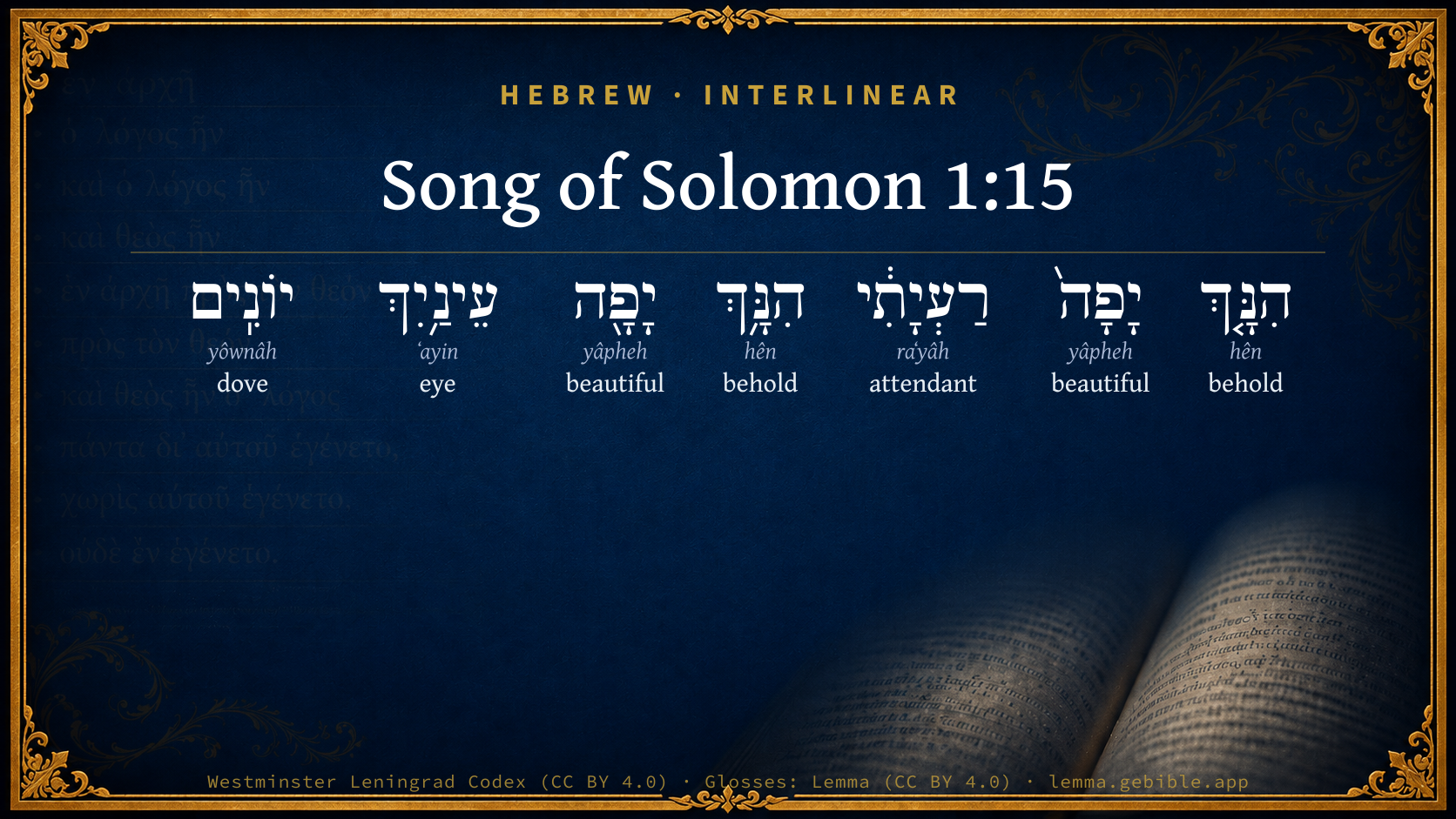
Hebrew (Westminster Leningrad Codex) Song of Solomon 1:15 appears in the Hebrew Old Testament. The text above is from the Westminster Leningrad Codex. Each word links to its Strong’s number, a concise gloss, and parsing drawn from the Open Scriptures Hebrew Bible morphology. Click any word for its full Brown-Driver-Briggs (BDB) entry.
Download image
Cite this verse

Song of Solomon 1:15 (World English Bible). Public Domain. Lemma interlinear Bible study tool, https://lemma.gebible.app/v/song-of-solomon/1/15.

Show BibTeX & RIS
BibTeX
RIS
English Translation
Behold, you are beautiful, my love. Behold, you are beautiful. Your eyes are doves. Beloved
World English Bible · Public Domain
Download a study sheet

One document with this verse’s original text, its word-by-word gloss line, the meaning frame, cross-references with their text, attributed commentary, and full source and license credits — printable, and it pastes into notes with its structure intact.

This verse Autodidact and up

Study sheet (.html) Plain text (.txt)

A passage Seminary Student

Up to 50 verses in one chapter. A passage sheet keeps up to 6 commentary sources and 12 cross-references per verse, in the order this page ranks them, and says so on the sheet whenever that leaves anything out. Ask for a single verse and you get the Autodidact verse sheet above.

Everything on this page stays free to read, with no account — the sheet is a download of what is already on screen, not access to it.

Want to remove ads? Support Godless Engineer
Compare translations 3

The same verse in 3 English versions, stacked beneath the original-language interlinear above. Click any original word for its lexicon entry.

Each is an independent rendering of the whole verse — the interlinear is not word-aligned to these translations.

Highlighted words mark where these versions differ — a whole-verse word diff, not a word-by-word alignment.

  • World English Bible Public Domain
    Behold, you are beautiful, my love. Behold, you are beautiful. Your eyes are doves. Beloved
  • King James Version Public Domain
    Behold, thou art fair, my love; behold, thou art fair; thou hast doves' eyes.
  • unfoldingWord Literal Text CC BY-SA 4.0
    Behold you, beautiful, my darling! Behold you, beautiful! Your eyes doves.

unfoldingWord Literal Text — © unfoldingWord, licensed CC BY-SA 4.0. Word-aligned USFM3 via Door43 (git.door43.org/unfoldingWord/en_ult).

Versions to compare (up to 4)

3 of 4 selected

Show all 18 translations

Every available English version of this verse, each an independent rendering of the whole verse.

  • World English Bible Public Domain
    Behold, you are beautiful, my love. Behold, you are beautiful. Your eyes are doves. Beloved
  • Berean Standard Bible Public Domain
    How beautiful you are, my darling! Oh, how very beautiful! Your eyes are like doves.
  • Majority Standard Bible Public Domain
    How beautiful you are, my darling! Oh, how very beautiful! Your eyes are like doves.
  • King James Version Public Domain
    Behold, thou art fair, my love; behold, thou art fair; thou hast doves' eyes.
  • American Standard Version (1901) Public Domain
    Behold, thou art fair, my love; Behold thou art fair; Thine eyes are `as' doves.
  • Revised Version (1885) Public Domain
    Behold, thou art fair, my love; behold, thou art fair; thine eyes are as doves.
  • Geneva Bible (1599) Public Domain
    My welbeloued, beholde, thou art faire and pleasant: also our bed is greene:
  • Douay-Rheims (1899) Public Domain
    Behold thou art fair, my beloved, and comely. Our bed is flourishing.
  • Young's Literal Translation Public Domain
    Lo, thou `art' fair, my friend, Lo, thou `art' fair, thine eyes `are' doves!
  • Literal Standard Version CC BY-SA 4.0
    Behold, you [are] beautiful, my friend, || Behold, you [are] beautiful, your eyes [are] doves!
  • Unlocked Literal Bible CC BY-SA 4.0
    Listen, you are beautiful, my love; listen, you are beautiful; your eyes are doves. The woman speaking to the man
  • unfoldingWord Literal Text CC BY-SA 4.0
    Behold you, beautiful, my darling! Behold you, beautiful! Your eyes doves.
  • Darby Bible Public Domain
    Behold, thou art fair, my love; Behold, thou art fair: thine eyes are doves.
  • World Messianic Bible Public Domain
    Behold, you are beautiful, my love. Behold, you are beautiful. Your eyes are like doves.
  • Webster's Bible Public Domain
    Behold, thou art fair, my love; behold, thou art fair; thou hast doves' eyes.
  • Free Bible Version CC BY-SA 4.0
    Look at how very beautiful you are, my darling, how beautiful! Your eyes are as gentle as doves.
  • Bible in Basic English Public Domain
    See, you are fair, my love, you are fair; you have the eyes of a dove.
  • JPS Tanakh (1917) Public Domain
    Behold, thou art fair, my love; behold, thou art fair; thine eyes are as doves.

Literal Standard Version (2020), Covenant Press — licensed CC BY-SA 4.0. Text via the HelloAO Bible API (eBible.org). Unlocked Literal Bible (unfoldingWord) — licensed CC BY-SA 4.0. Text via the HelloAO Bible API (eBible.org). unfoldingWord Literal Text — © unfoldingWord, licensed CC BY-SA 4.0. Word-aligned USFM3 via Door43 (git.door43.org/unfoldingWord/en_ult). Free Bible Version, Dr. Jonathan Gallagher — licensed CC BY-SA 4.0. Text via the HelloAO Bible API (eBible.org).

Word by word

More ways to search: Search by grammar → Find every occurrence → Compare this word →

Practice this passage: Drill this verse → Learn its vocabulary →

About this verse

These counts appear in no published source. They are computed here, from the morphology-tagged text and Lemma’s own curated glosses. What Lemma adds →

7
words
5
distinct lemmas
Wisdom
section

Notable vocabulary

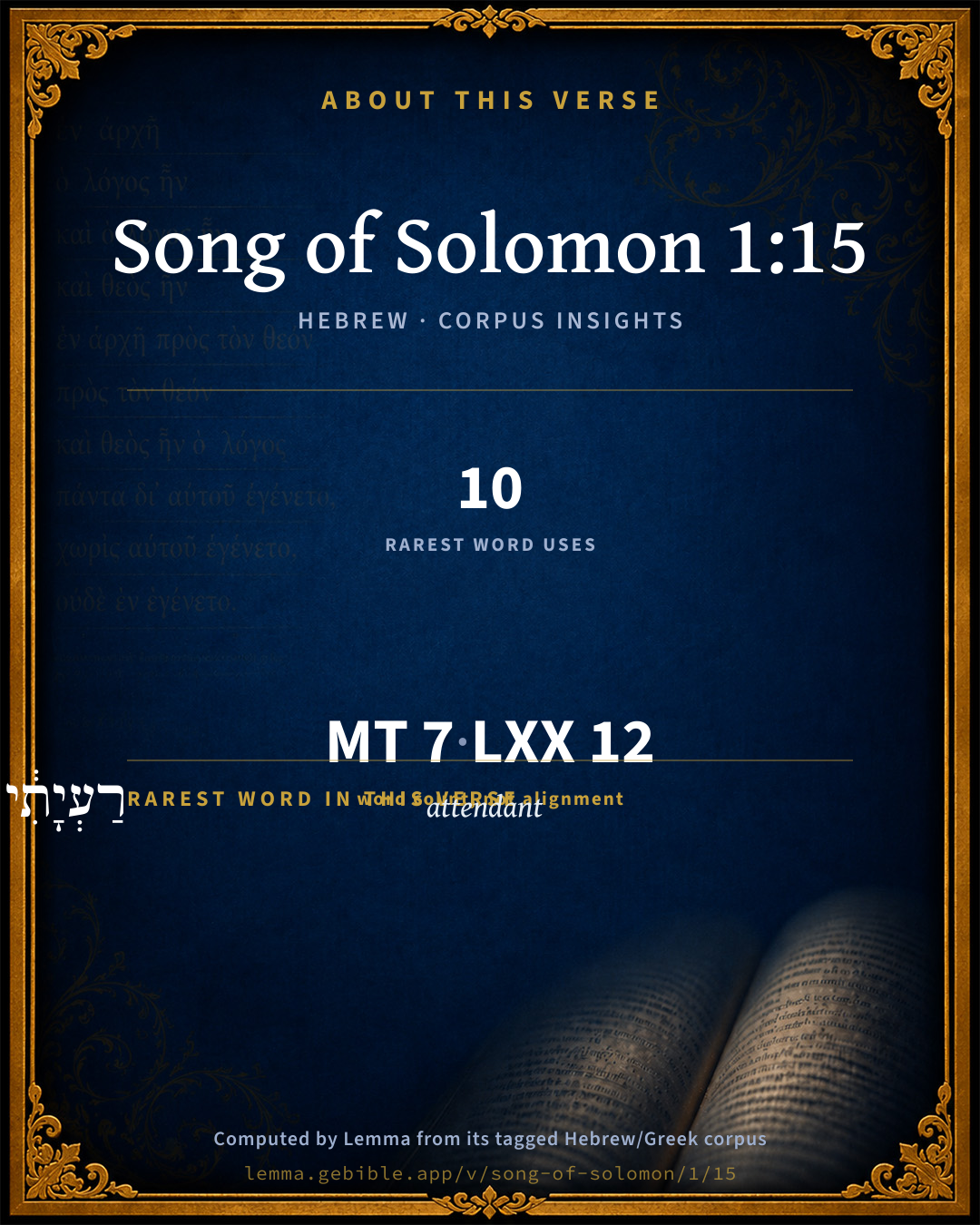
The rarest word here is רַעְיָתִ֔י attendant H7474 — appearing just 10 times in the whole Hebrew Bible.

Shared distinctive vocabulary

רַעְיָתִ֔י attendant H7474 occurs in 10 verses of the Hebrew Bible. Also found in:

Grammatical profile

  • 3 nouns
  • 2 adjectives
  • 2 particles

Repetition

Words recur within this verse — often emphatic in Hebrew:

  • הִנָּ֤ךְ behold H2005 ×2
  • יָפָה֙ beautiful H3303 ×2

Hebrew & Septuagint length

In English translation the verse runs 15 words from the Hebrew and 14 from the Septuagint (LXX English) — closely comparable.

A rough comparison of the two English renderings, which tokenize alike — not a word-level alignment.

Word counts can differ between the Hebrew and the Greek without any difference in meaning — e.g. the Hebrew direct-object marker אֵת has no separate Greek word, and Greek often adds the article ὁ.

In the original languages it is 7 Hebrew tokens and 12 Greek tokens — but the two are counted differently (Hebrew bundles its prefixes and suffixes into one token; the Greek is in lemma form), so that isn’t a like-for-like length.

Cross-references

13

Topical passages linked to Song of Solomon 1:15 in the Treasury of Scripture Knowledge — connected by theme and wording, ordered by reader-vote popularity; previews shown in the World English Bible.

  • Song of Solomon 4:1 Behold, you are beautiful, my love. Behold, you are beautiful. Your eyes are doves behind your veil. Your hair is as a flock of goats, That descend from Mount Gilead.
  • Song of Solomon 5:12 His eyes are like doves beside the water brooks, Washed with milk, mounted like jewels.
  • Song of Solomon 4:7 You are all beautiful, my love. There is no spot in you.
  • 2 Corinthians 11:2–3 For I am jealous over you with a godly jealousy. For I married you to one husband, that I might present you as a pure virgin to Christ.
  • Ephesians 1:17–18 that the God of our Lord Jesus Christ, the Father of glory, may give to you a spirit of wisdom and revelation in the knowledge of him;
  • Song of Solomon 1:8 If you don't know, most beautiful among women, Follow the tracks of the sheep. Graze your young goats beside the shepherds' tents.
  • Song of Solomon 2:10 My beloved spoke, and said to me, Rise up, my love, my beautiful one, and come away.
  • Song of Solomon 2:13 The fig tree ripens her green figs. The vines are in blossom; They give forth their fragrance. Arise, my love, my beautiful one, And come away. Lover
  • Song of Solomon 4:10 How beautiful is your love, my sister, my bride! How much better is your love than wine! The fragrance of your perfumes than all manner of spices!
  • Song of Solomon 5:2 I was asleep, but my heart was awake. It is the voice of my beloved who knocks: Open to me, my sister, my love, my dove, my undefiled; For my head is filled with dew, My hair with the dampness of the night.
  • Song of Solomon 6:4 You are beautiful, my love, as Tirzah, Lovely as Jerusalem, Awesome as an army with banners.
  • Song of Solomon 7:6 How beautiful and how pleasant are you, Love, for delights!
  • Malachi 2:14 Yet you say, 'Why?' Because Yahweh has been witness between you and the wife of your youth, against whom you have dealt treacherously, though she is your companion, and the wife of your covenant.

Cross-references courtesy of OpenBible.info (CC BY 4.0).

Hebrew and Greek witnesses Masoretic Hebrew ↔ Greek Septuagint

The same verse in the two great witnesses to the Old Testament, shown verse-for-verse.

These are two independent witnesses, not word-aligned to each other, and the Septuagint is shown in lemma (dictionary) form.

Hebrew Song of Solomon 1:15 Masoretic · Westminster Leningrad Codex

הִנָּ֤ךְ יָפָה֙ רַעְיָתִ֔י הִנָּ֥ךְ יָפָ֖ה עֵינַ֥יִךְ יוֹנִֽים

Behold, you are beautiful, my love. Behold, you are beautiful. Your eyes are doves. Beloved

World English Bible · Public Domain

Greek LXX Song of Solomon 1:15 Septuagint · lemma form

ἰδού εἰμί καλός ὁ πλησίον ἐγώ ἰδού εἰμί καλός ὀφθαλμός σύ περιστερά

Behold, you are fair, my companion; behold, you are fair; your eyes are doves.

LXX2012 (modern English Septuagint) · Public Domain

On this verse, The Cambridge Bible for Schools and Colleges discusses the Septuagint’s reading. Read the note in Commentary ↓

Hebrew: Westminster Leningrad Codex (CC BY 4.0). Greek: Septuagint (public domain); English from LXX2012 (modern English Septuagint) (Public Domain). How the Septuagint differs from the Hebrew →

Commentary

Notes on Song of Solomon 1:15 from classic Christian and Jewish commentators (each source and its license shown beneath its notes). The classic Christian expositions comment on the surrounding passage and are grouped to its opening verse, so a note may address several verses; the Jewish commentaries on the Tanakh (Rashi and others) are per-verse, so they appear only where the commentator wrote on this verse.

Lemma curates 59 commentaries, every one of them public domain or Creative Commons licensed, each selected and text-cleaned for this edition rather than reprinted as found. About our sources →

The Cambridge Bible for Schools and Colleges

gen. ed. J. J. S. Perowne

15. thou hast doves’ eyes] Rather, as R.V., thine eyes are (as) doves, i.e. are dove-like. As a rule in such comparisons the particle of comparison ke = as stands before the predicate (see Ges. Gramm. 141 d, note). But this form is more emphatic. The absence of the particle does not consequently compel us to translate as Oettli following the LXX does, thy eyes are doves, i.e. are glancing and shimmering in various colours, so as to resemble doves. That seems an improbable simile; more probably it is the innocence which is associated with doves’ eyes which is the point of comparison.

15–17. In these verses the king continues his praises of the Shulammite, while she continues to think only of her absent lover. In Son_1:15 the pronouns and the corresponding adjectives are feminine, while in Son_1:16 they are masculine. Consequently in Son_1:15 Solomon is represented as addressing the Shulammite, while in Son_1:16 the Shulammite speaks, addressing however not Solomon but her absent lover.

The Cambridge Bible for Schools and Colleges (gen. ed. J. J. S. Perowne; Cambridge University Press, 1878–1918) — public domain. Text from a community e-Sword module.

Trapp's Complete Commentary

John Trapp

Son 1:15 Behold, thou [art] fair, my love; behold, thou [art] fair; thou [hast] doves’ eyes.

Ver. 15. Behold thou art fair, my love.] Or, My fellow friend. {as Son 1:9} And as she is his love, so he is her beloved, {Son 1:16} and as he commends her, so she him no less. This should be all the strife between married couples, who should outstrip the other in mutual melting heartedness, and all loving respects either to other, in all passages, carriages, and behaviours whatsoever between them; accustoming themselves, as here, to speak kindly and cheerfully one to the other. This is that which will infinitely sweeten and beautify the married estate; it will make marriage a merry age, which else will prove a mar-age. And here let "husbands learn to love their wives, as Christ loved the Church," {Eph 5:25} celebrating her beauty in a song, repeating her just praises, to show his heartiness therein, and inviting others with an Ecce, Behold, to the due contemplation thereof. "Behold, thou art all fair, my love! behold, thou art fair!" Non est ficta aut frigida haec laudatio, This is no feigned or frigid commendation, but such as proceeds from entire affection, and breathes, abundance of goodwill. Full well might the prophet tell the Church, "Surely, as the bridegroom rejoiceth over the bride, so shall thy God rejoice over thee." {Isa 62:5} And again, "The Lord thy God will rejoice over thee with joy; he will rest in his love (and seek no further), he will joy over thee with singing." {Zep 3:17} The Church had acknowledged {Son 1:5} that she was "black," or at least blackish, and yet, by way of apology too, she had pleaded that she was "comely," and so not to be slighted. But Christ affirms her "fair," yea, "twice fair," yea, the "fairest among women" - sic suum cuique pluchrum, so doth he even "err in her love," as the wise man phraseth it {Pro 5:9} - as himself is said to be the "fairest among men," {Psa 45:2} where the Hebrew word likewise is of double form - Thou art fair, thou art fair above the sons of Adam, to note out double, that is, excellent beauty, such as draweth love and liking. {a} Now it is a maxim in the civil law, Uxor fulget radiis mariti, The wife shineth with her husband’s beams, so doth the Church with Christ’s graces, wherewith she is decked, as Rebecca did wish Isaac’s jewels. Read Eze 16:2-5, &c., and you will see that all the Church’s beauty is borrowed. The maids that were brought to Ahasuerus, besides their own native beauty, they were first purified and perfumed before he chose one {Est 2:3} But here it is otherwise altogether, for when the Church was "in her blood, in her blood, in her blood" - three several times it is so said, that we might the better observe it, and be affected with it - Christ "sanctified and cleansed her with the washing of water by the word, that he might present her to himself a glorious church, holy and without blemish." {Eph 5:26-27} But a bloody spouse she was to him, who "loved her, and washed her with his blood." {Rev 1:5}

Thou hast doves’ eyes.] Sweet, amiable, single, and chaste. In the eyes beauty sits, and shines more than in any part of the body besides, γλαυκωπις βοωπις, &c., apud Homerum. The Turks tell their desperate devotees of beautiful women, with full eyes, in their fools’ paradise; and thereby hearten them on to bold attempts. {b} The Hebrews say that in oculis, loculis, poculis, the heart of a man shows itself. The Church is here said not to have eagles’, vultures’, foxes’, apes’ eyes, but doves’ eyes. Now,

“ Felle columba caret, rostro non caedit, et ungues

Possidet innocuos, puraque grana legit. ”

The dove hath her name in the Hebrew, {c} from a root that signifieth to oppress and make a prey of any, as poor people, strangers, fatherless, &c., {Jer 50:16} because, belike, this creature is subject to the prey and spoil of hawks; when pursued, they save themselves by flight, not fight; - the prophet Jonah was so called, as some think, quod columbae instar aufugeret, because he fled as a dove, when God sent him to Nineveh, but not with the wings of a dove - sometimes sitting in their dove cotes they see their nests destroyed, their young ones taken away and killed before their eyes, never offering to rescue or revenge, which all other fowls seem in some sort to do. This is very appliable to the persecuted Church, as may be seen in the Lamentations and Martyrologies. In Greek, the dove hath her name from her exceeding love to her mate and young ones. {d} Kυουσι γαρ αλληλους, saith Aristotle, they kiss one another; the Church likewise kisseth Christ, and is interchangeably kissed of Christ, {Psa 2:12 Son 1:2} being drawn together by a mutual dear affection, as the apostle’s word {e} imports. {Heb 11:13} As if at any time the dove and her mate fall out and fight; shortly after,

“ Qum mode pugnarunt, iungunt sua rostra columbae,

Quarum blanditias, verbaque murmur habet. ”

Differences may arise between Christ and his spouse (she may thank herself, for he grieves her not willingly {Lam 3:35} - Ille dolet quoties cogitur esse ferox), and some household words she may have from him; but soon after he takes her "into the wilderness, and speaks to her heart," {Hos 2:14} yea, he takes her unto his wine cellar, {Son 2:4} then when one would think he should carry her into a dungeon rather. He kisses her, as doves do one another, with the "kisses of his mouth"; then when one would think he should, upon such high provocations, kick her, nay, kill her, then he shows her matchless mercy, such as no man would show his wife. {Jer 3:1; Jer 3:22} "For he is God, and not man," yea, such a "sin pardoning" God as never was heard of. {Mic 7:18} If there be but a dove’s eye in the heads of any of his, a columbine simplicity, if simple to do evil, bunglers at it, and have nothing to say in defence of it when it is done, {Rom 16:19} the amends is made; and love with her long mantle "covers a multitude of sins." {Pro 10:12}

{a} οττι καλον φιλον. - Theog.

{b} Blunt’s Voyages.

{c} יונה [Jonah] of ינה

{d} περιστερα παρα το περισσως εραν.

{e} ασπασαμενοι ab a simul et σπαω, traho.

John Trapp, A Commentary or Exposition upon All the Books of the Old and New Testament (1647–1656) — public domain. Text from a community e-Sword module.

Joseph Benson's Commentary

Son 1:15. Behold, thou art fair — This is the speech of Christ. The words are doubled to manifest his fervent affection for her. Thou hast doves’ eyes — Which are mild and harmless, chaste and faithful. And by the eyes he seems to design both her outward behaviour and the inward disposition of her mind.

Joseph Benson's Commentary on the Old and New Testaments (1811–1818) — public domain. Text from a community e-Sword module.

The Preacher's Complete Homiletical Commentary

Joseph S. Exell (gen. ed.)

Bride and Bridegroom’s Mutual Commendations.

I. THE KING’S COMMENDATION OF SHULAMITE

(Son_1:15-17)

Behold, thou art fair, my love;

Behold, thou art fair;

Thou hast dove’s eyes (Son_1:15).

The language earnest and emphatic. ‘Behold:’ expressive of admiration. Repeated with the declaration—‘thou art fair,’—as indicative of strong emotion and deep conviction, as well as of the desire to assure the bride of its truth, and the difficulty of doing so. The assurance all the more necessary from Shulamite’s own sense of her blackness, and the depreciation of her by the ladies of the Court on that account. Observe—

(1) Believers’ eyes more readily fixed on their own corruption than on Christ’s grace in them.

(2) Love delights in expressing high esteem for and admiration of its object.

(3) Believers never fairer in Christ’s eyes than when blackest in their own, and meekly enduring the contempt of others.

(4) Believers not only beautiful in the eyes of others (Son_1:8), but very specially in the eyes of Christ Himself. Christ looks not at the blemishes, but the beauties of His people. The beauties His, the blemishes their own. ‘He seeth no iniquity in Jacob.’ Christ the best judge of beauty. To be beautiful in His eyes is to be beautiful indeed, and blessed as well as beautiful. Beautiful in His eyes, it matters little what we are in the eyes of others. ‘Let them curse, but bless thou.’ Christ looks not only at what believers are now, but at what they shall be hereafter. Views past, present, and future at one glance. Christ takes delight in His people’s beauty (Psa_45:10-11). Rejoices over them as the Bridegroom over the Bride (Isa_62:5). The double assertion: ‘Thou art fair,’ probably intended to express the greatness as well as the reality of Shulamite’s beauty. A two-fold beauty in believers: beauty of the inward spirit and of the outward life; beauty in doing and in suffering; beauty in imputed righteousness and imparted grace. The repeated assertion of Shulamite’s beauty, accompanied with the King’s assurance of His love to her, and her relation to Him: ‘My love.’ Sweet and comforting, as well as strengthening and sanctifying to believers, to be assured of Christ’s love, and of their relation to Him as His bride.

A special feature in Shulamite’s beauty noted: ‘Thou hast doves’ eyes,’ or ‘Thine eyes are doves.’ The eyes of Syrian doves distinguished for their softness, tenderness, and lustrous beauty. The eye especially the seat of beauty. The eyes of Syrian females particularly beautiful. The eye the expression of the soul. More especially the expression of inward affection. Hence the power of the eye in captivating the heart (chap. Son_4:9; Son_6:5). Observe—

(1) Christ notices not only the beauty of believers in general, but their single graces in particular; more especially He notices their love which has Himself for its object.

(2) The eyes of believers those of doves, or doves themselves. The dove distinguished for (i) gentleness and meekness; (ii.) affection and fidelity to its mate; (iii.) purity and cleanliness; (iv.) timidity and retiring disposition. Its character indicated in its eyes. The eyes of believers not those of the tiger, or the fox, or the hawk; but of the dove. The contrast of the believer’s eyes indicated in Mat_20:15; 2Pe_2:14; Psa_131:1. Believers learn of Jesus to be meek and lowly in heart. The ‘gentleness of Christ’ to be a distinguishing feature in their character. ‘Gentleness’ is love holding intercourse with those around us. Implies tenderness of feeling; readiness of sympathy; considerateness of others. ‘Gentleness’ is ‘love in its depth and in its delicacy.’ Believers chosen in Christ to be holy and without blame before God in love (Eph_1:4). Not to be drawn away from Christ by any suffering or persecution. Pass the time of their sojourning here in fear. Work out their salvation with fear and trembling (1Pe_1:17; Php_2:12).

2. SHULAMITE TO THE KING

(Son_1:16)

Behold thou art fair, my beloved; Yea, pleasant.

The Bride returns her Beloved’s commendation. Every good word from Christ to be turned to His own praise. What the believer is made, he is made ‘to the praise of the glory of His grace.’ The title also reciprocated: ‘My Beloved’. The believer made conscious both of His love to Christ and his relation to Him. Bride’s commendation also commences with a note of exclamation: ‘Behold.’ Implies the reality and greatness of the King’s beauty. His beauty a thing to be contemplated and dwelt upon. The ascription of beauty to the Bride returned as belonging rather to Himself. The believer’s beauty only a reflection of Christ’s. Shulamite commends her beloved as—

I. FAIR. Observe—

1. Jesus supremely beautiful in the eyes of believers. Their eyes anointed with Divine eye-salve to see His beauty. Able to testify with John we beheld His glory. Their blessedness, to behold even now, by the eye of faith, ‘the King in His beauty.’ Christ formerly to them as to others, a root out of a dry ground, without form or comeliness: now the chief among ten thousand, and altogether lovely.

2 Jesus in Himself transcendently beautiful. Observe, in reference to the

Beauty of Christ—

1. Its greatness. His beauty such as no angel’s hand could pourtray, or tongue describe. The exclamation of the prophet: ‘How great is His beauty!’ (Zec_9:17.) Of the Psalmist: ‘Thou art fairer than the children of men; grace is poured into thy lips’ (Psalms 45).

(2) His beauty a glory such as becomes the Son of God: ‘We beheld His glory; the glory as of the only begotten of the Father’ (Joh_1:14). All beauty summed up and centered in Jesus. Whatever is beautiful in the creature, found in Him in an infinitely greater degree. All creature beauty only a ray or emanation from His own. Christ the fountain and ocean of beauty; all beauty in the creature, whether angel, man, or nature, only a stream from that fountain, or a drop from that ocean His an essential beauty; theirs a derived one. All beautiful things in nature only made to reflect something of His beauty, and to lead up to it.

2. Its character. His beauty mainly a moral and spiritual one: ‘Full of grace and truth.’ His countenance, doubtless, indicative of that spiritual beauty. Not the less beautiful because, for our sakes, marred more than any man’s, and soiled with blood and tears His beauty in His soul, but manifesting itself in His words, looks, and actions. Seen both in what He is in Himself, and in what He is to others, especially to poor sinners of mankind. His soul free from all sin, and full of all grace. All its powers and faculties in complete order and perfect harmony. His beauty seen not only in the separate graces of His character, but in their combination, proportion, and symmetry. Displayed in His love and lovingness—His self-forgetting, and self-denying benevolence, sympathy, and compassion; in His gentleness and tenderness, His meekness and humility; in His kindness and condescension to the poor, the ignorant, and the despised; in His wisdom and intelligence, combined with forbearance and child-like simplicity; in His patience in suffering and submission to His Father’s will; in his fearlessness in regard to Himself with the tenderest care and consideration for others; in His manliness combined with meekness; in His firmness of principle with flexibility of manners; in His purity combined with pity; in His hatred of sin with love to the sinner; in His ardent affection for His friends with the most generous forgiveness of his enemies; in His supreme love to God combined with untiring self-sacrificing love to man.

II. PLEASANT. Shulamite adds—‘Yea, pleasant’ or comely. ‘Yea,’ indicating the difficulty she finds in expressing her appreciation of the King’s excellence, and the delight she found in Him. Not only ‘fair,’ but ‘pleasant’ besides. The most beautiful not always the most pleasant. Christ not only beautiful but pleasant. Observe in regard to the

Pleasantness of Christ:

In Him the greatest moral excellence combined with the greatest pleasantness. Pleasantness a special quality, and superadded to excellence. Indicates what a person is in relation to others. That which renders a man amiable, agreeable, and enjoyable to those around him. The quality in an individual that affords pleasure and delight in his presence and society. Has special reference to one’s spirit and temper, manners and deportment,—a person’s looks, and the tone of hit voice, as well as his words and actions. Implies a combination of graces as well as virtues; of charms, as well as excellencies; of agreeable as well as solid qualities, fitting their possessor for imparting pleasure as well as profit to those in contact with him. Such pleasantness in Jesus. Jesus fair in Himself; pleasant to others. Such that not only angels but men—not only the godly but sinners—may find pleasure in Him. The evidence of His pleasantness seen in His disciples who so fondly adhered to Him and so closely followed Him; in John the fisherman, who was wont to pillow his head on His bosom; in the multitudes that everywhere thronged about Him; in the publicans and sinners that drew near to hear Him; in the children that followed Him with their parents, and sang His praise in the temple-courts; in the infants that He took up in His arms, putting His hands on their head and blessing them. David’s testimony in regard to Jonathan that of every believer in regard to Jesus: ‘Very pleasant hast thou been unto me.’ Jesus ‘very pleasant’ to believers now while conversed with through a veil. What when they see Him face to face?

3. SHULAMITE REJOICES IN THE KING’S FELLOWSHIP AND THE PLACE OF ITS ENJOYMENT

Son_1:16-17

Also our bed is green;

The beams of our house are cedar,

And our rafters of fir.

The scene now the grounds of the palace. Shulamite has found the King at the shepherd’s tents. Intensely happy in each other’s society and love, they sit down and repose on a green and flowery bank—the resting-place at noon (Son_1:7). The cedars spread their shady branches over them like the beams of a palace, while the fragant fir trees form a gallery for their walk. Shulamite notices these things, and in her delighted enjoyment of the King’s fellowship, and her fine appreciation of the objects of nature, expresses her gratification in these agreeable surroundings. Brought up in the country, she is everywhere exhibited in the Song as an enthusiastic admirer of natural beauty. In this way as well as others, a meet companion for him who ‘spake of trees, from the cedar tree that is in Lebanon, even unto the hyssop that springeth out of the wall’ (1Ki_4:33). Enjoyment of a dear one’s fellowship gives of itself a charm to the place which is the scene of it. The place where a believer has enjoyed sweet and hallowed communion with his Saviour, especially in the season of his first love, rendered beautiful in his eyes, and endeared to his heart. All the more so when this has been in the midst of natural scenery. With the joy of a soul’s deliverance from bondage and possession of a newly found Saviour, all surrounding nature seems to be in harmony. By a law of our mental constitution, the joy transfuses itself over all surrounding objects. The mountains and hills break forth into singing, and all the trees of the field clap their hands (Isa_55:12). Christ’s graciously manifested person sheds a beauty and sweetness over every thing around us. Himself fair and pleasant, the very place becomes such where He is found and enjoyed. Where He treads, lilies and roses bloom. Hence the sweetness of Divine ordinances. Christ’s fellowship usually most enjoyed in connection with the ordinances of His own institution. Gospel ordinances the shepherds’ tents where the Chief Shepherd is found, and where He makes His flock to rest at noon. The promise,—‘I will commune with them from off the mercy seat.’ Hence, the very place of these ordinances, beautiful and delightful to a loving believer. ‘How amiable are Thy tabernacles;’ ‘Strength and beauty are in His sanctuary.’ ‘A day in Thy courts is better than a thousand.’ Hence his longing desire after them. ‘My soul longeth, yea even fainteth, for the courts of the Lord.;’ ‘One thing have I desired of the Lord, and that will I seek after; that I may dwell in the house of the Lord all the days of my life, to behold the beauty of the Lord and inquire in His temple’ (Psalms 84; Psalms 96; Psalms 63; Psalms 27). This sweetness and charm connected with the sanctuary something very different from mere outward attraction; though it may be desirable that even that should not be altogether wanting. Nothing lost when that which meets the bodily eye is somewhat in harmony with the spiritual beauty of the sanctuary, which only the eye of the living soul can perceive and the renewed heart delight in.

Shulamite commends both the beauty of the grassy couch on which they reposed, and the agreeableness of the shade afforded by the trees which spread their branches over their heads like the beams of sylvan chambers. ‘Our bed (or couch) is green (or flourishing); the beams of our house (Heb. “houses”) are of cedar (or cedars are the beams of our chambers); and our rafters (or galleries) are of fir’ (or fir trees are our rafters or galleries). Suggesting, in regard to

Divine Ordinances,

1. Community of interest and participation on the part of Christ and His people. ‘Our bed;’ ‘our house;’ as pertaining both to the bride and bridegroom. So Divine ordinances the joint property of Christ and His people. The temple at Jerusalem spoken of as both God’s house and that of the people: ‘Our beautiful house;’ ‘Your house is left unto you desolate.’ The sacrifices participated in both by God and the offerer. Called ‘the bread of their God,’ ‘the food of the offering made by fire unto the Lord’ (Lev_3:11; Lev_21:6; Lev_21:8, &c.). Christian ordinances intended both for the enjoyment of Christ and His people. ‘If any man hear my voice and open the door, I will come in unto him, and will sup with him and he with me’ (Rev_3:21).

2. Repose as well at comfort to the soul. Christ found in the ordinances of his house as ‘the rest and the refreshing’ wherewith ‘the weary’ are to be made to rest, and ‘as the shadow of a great rock in a weary land’ (Isa_28:12; Isa_32:2). ‘One thing have I desired of the Lord, that I may dwell in the house of the Lord all the days of my life: For in the time of trouble he shall hide me in his pavilion: in the secret of his tabernacle shall he hide me.’ ‘There is a river, the streams whereof shall make glad the city of God, the holy place of the tabernacles of the most high, (Psa_46:4; Psa_27:4-5).

3. Freshness and life. ‘Our bed is green’ or flourishing. The ordinances of the Christian Church, wherever two or three are gathered together in the Master’s name, as fresh and lively, as full of blessing and as precious to believers note as when after Pentecost the disciples ‘continued steadfast in the Apostles’ fellowship and doctrine, and in breaking of bread, and in prayers’ (Act_2:42). These ordinances as sweet and refreshing to the believer at the close of his earthly pilgrimage as at the beginning of it. The promised presence of Christ and the operation of His Spirit, that which keeps the couch green and flourishing. ‘There is a river, &c.’

4. Strength and permanence. ‘The beams of our house are cedars.’ Strength as well as beauty in God’s sanctuary (Psa_96:6). Christ’s promised presence gives permanence, as well as life and freshness, to ordinances. The Lord’s Supper, the central ordinance of Christian worship, to continue till He come again. These ordinances have continued throughout eighteen centuries in almost all parts of the known world, and are, to a great extent, the same even in form at this day as when originally instituted and observed by the earliest converts. One precious fruit of the Reformation, the restoration of these ordinances to their primitive simplicity, after having been overlaid and disfigured both in the Eastern and Western Churches with rites and ceremonies of mere human invention. What is Divine in ordinances permanent as the cedars; what is merely human, perishable, and to be put away.

5. Fragrance and beauty. ‘Our rafters (or galleries) of fir’ (or, are firs or cypresses). The fir or cypress distinguished for its beauty as well as its fragrance. ‘Instead of the thorn shall come up the fir tree.’ Promised in connection with the sanctuary in Gospel times. ‘The glory of Lebanon shall come unto thee, the fir tree and the pine tree and the box together, to beautify the place of my sanctuary’ (Isa_60:13; Isa_55:13). Beauty, as well as strength, in God a sanctuary (Psa_96:6). The fragrance and beauty of Divine ordinances not in the fumes of incense, or in external decoration, whether of place or persons; but in the truths of the Gospel exhibited, the presence of Christ enjoyed, and the power of the Spirit experienced in them.

The Preacher's Complete Homiletical Commentary (gen. ed. Joseph S. Exell; Funk & Wagnalls, c. 1892) — public domain (pre-1929). A full-Bible homiletical/sermon-outline anthology covering 65 of 66 books (2 John is absent from the source module). Text from a community e-Sword module.

Tyndale Open Study Notes

Tyndale Open Resources

1:15–2:7 The couple exchange adoring descriptions of each other that honor her incomparable beauty and praise his stalwart protection and provision for her.

1:15 The comparison of the woman’s eyes with doves (see also 4:1; 5:12) is not clear. The metaphor may be commenting on their color or on a softness of expression.

Tyndale Open Study Notes — © Tyndale Open Resources, licensed CC BY-SA 4.0. Text via the HelloAO Bible API.

Geneva Bible (1599)

Geneva Bible translators

That is, the heart of the faithful, wherein Christ dwelleth by his Spirit.

Geneva Bible (1599) marginal notes — public domain. Text via Bolls.life.

Adam Clarke's Commentary

Verse 15. Thou hast doves' eyes] The large and beautiful dove of Syria is supposed to be here referred to, the eyes of which are remarkably fine.

Adam Clarke's Commentary on the Bible (1810–1826) — public domain. Text from a community e-Sword/MySword module.

Ellicott's Commentary for English Readers

(15) Behold, thou art fair.—The song is now transferred to a male speaker—the advocates for the dramatic theory cannot agree whether Solomon or the shepherd; and no wonder, since the poem gives no indication.

My love.—Marg., companion, LXX. πλησίον, in Heb. rayati, is used for the female, dôdi being her usual term for her lover. Beyond this the terms of endearment used cannot safely be pressed for any theory.

Thou hast doves’ eyes.—Literally, thine eyes are doves’. The same image is repeated (Son_4:1), and adopted in return by the heroine (Son_5:12). The point of the comparison is either quickness of glance or generally tenderness and grace. The dove, a favourite with all poets as an emblem of love, is especially dear to this bard. Out of about fifty mentions of the bird in Scripture, seven occur in the short compass of this book. For general account of the dove in Palestine, see Psa_55:6, and for particular allusions Notes below to Son_2:11-12; Son_2:14. (Comp. Shakespeare’s Coriolanus, v. 3:—

“Or those doves’ eyes

That can make gods forsworn.”

Tennyson’s Maud:—

“Do I hear her sing as of old,

My bird with the shining head,

My own dove, with her tender eye?”)

A Bible Commentary for English Readers, edited by Charles John Ellicott (1878–1897) — public domain. Text from a community e-Sword module.

Haydock's Catholic Bible Commentary

Behold. The spouse makes a return of praise, and thanksgiving for her repose, to Christ. (Worthington) --- The corporal beauty of Solomon or of our Saviour is not fully ascertained; but their inward perfections are often proclaimed. --- Flourishing. Hebrew, "green." Septuagint, "shaded." (Esther i. 5.) --- This bed was the womb of the blessed Virgin [Mary], the cross, or any faithful soul. St. Bernard says it is a monastery, retired and adorned with all virtues. (Calmet)

George Leo Haydock (1774–1849), Haydock's Catholic Family Bible and Commentary, 1859 edition — public domain. Excludes Psalms (Douay-Rheims chapter numbering differs from Protestant) and Deuterocanonical books (Catholic canon only).

Matthew Poole's English Annotations

Behold, thou art fair: this is the speech of Christ. The words are doubled, partly to note the certainty of the thing, notwithstanding her mean and modest opinion of herself; and partly to manifest his high esteem and fervent affection for her, and to assure her that, notwithstanding all her infirmities, he was very well pleased with her.

Thou hast doves’ eyes; which are,

1. Comely and pleasant.

2. Modest and humble, not lofty, as the looks of some other creatures are.

3. Mild and harmless, not fierce and fiery, not looking and watching for prey, as the eyes of ravenous birds are.

4. Chaste and faithful, looking only to their mates; so that if any of them cast a lustful eye upon another, her companions are enraged against her, and quickly tear her in pieces; as some natural historians write. And such are the church’s eyes said to be. And by the eyes he seems to design partly her looks and outward behaviour or conversation, and partly and chiefly the inward disposition of her mind, which is commonly discovered, and in Scripture is oft signified, by the eye; in which sense we read of an evil eye, Pro 23:6 Mat 6:23, of a bountiful eye, Pro 22:9, of a single eye, Luk 11:34, of a proud or lofty look, all which signify such tempers of men’s minds.

Matthew Poole's English Annotations on the Holy Bible (1683–1685) — public domain. Text from a community e-Sword/MySword module.

Whedon's Commentary on the Bible

Daniel D. Whedon

15. Behold — The Beloved now appears, not in person, but in rehearsal of tender words now remembered by the Enamoured. So naturally does this reminiscence agree with the uttered longings for him, that the laws of the drama are honoured, and no violent transition is felt.

Thou art fair — The repetition gives a sense of emphasis. Thou art very fair.

Thou hast doves’ eyes — Hebrew, Thine eyes are doves, not “doves’ eyes.” The dove is the emblem of gentleness, purity, and fidelity.

Daniel D. Whedon (gen. ed.), Commentary on the Old and New Testaments (1874–1909) — public domain. Text from a community e-Sword module.

The Pulpit Commentary

Behold, thou art fair, my love; behold, thou art fair; thine eyes are as doves; literally, thine eyes are doves. The king receives the worship of his bride and delights in her. She is very sweet and fair to him. The dove is a natural symbol of love; hence it was attached by the classical nations to the garden of love, together with the myrtle, rose, and apple, all of which we find introduced in this Hebrew poem. Hence the Arabic name for a dove, Jemima, as we see in the Book of Job, was the name of a woman (cf. Columbina). The language of the king is that of ecstasy; hence the interjection and repetition. The enraptured monarch gazes into the eyes of his beloved bride, and sees there only purity, constancy, and affection. In Son_7:4 the eyes are compared to fish ponds, no doubt for their clear, liquid depth and serenity. Some have thought that the allusion is to the very lovely eyes of the doves; but there is no need of the limitation.

The Pulpit Commentary (1880–1919), ed. H.D.M. Spence-Jones & Joseph S. Exell — public domain. Text from a community e-Sword module.

John Wesley's Explanatory Notes

Behold - This is the speech of Christ. The words are doubled to manifest his fervent affection for her. Doves eyes - Which are mild and harmless, chaste and faithful. And by the eyes he seems to design both her outward behaviour, and the inward disposition of her mind.

John Wesley, Explanatory Notes Upon the Whole Bible (1754–1765) — public domain. Text via the GEBible commentary corpus.

unfoldingWord translationNotes

Door43 World Missions Community

Listen, you

"Pay attention, because what I am about to say is both true and important: you"

my love

"you whom I love." See how you translated this in Song of Songs 1:9

your eyes are doves

Possible meaning are 1) the Israelites considered doves to be gentle and soft birds, and the man considers the woman's eyes beautiful because the way the woman looks at him makes him think she is gentle. AT: "you are very gentle" or 2) the man is speaking of the woman's white eyeballs or the shape of her eyes as being like the shape of a dove. (See: Metonymy)

translationWords

dove

unfoldingWord translationNotes — © Distant Shores Media and the Door43 World Missions Community, licensed CC BY-SA 4.0. Source: git.door43.org/Door43/en_tn.

Rashi

Rabbi Shlomo Yitzchaki (Rashi)

Behold, you are comely, my beloved I was ashamed of my sin, but He encouraged me with appeasing words, saying, (Num. 14:20): “I have forgiven according to your words,” and you are most fair, for your eyes are like doves; i.e., a bride whose eyes are ugly—her entire body requires examination but [a bride] whose eyes are beautiful, her body requires no examination. (Song Rabbah 4). The allegorical meaning is: I forgave you for your iniquity, and behold you are fair with [your statement of] “Let us do,” and you are fair with [your statement of] “Let us hear”; fair with the deeds of your forefathers and fair with your own deeds, because...

your eyes are like doves There are righteous among you who clung to Me like a dove, which, as soon as it recognizes its mate, does not abandon it to mate with another. Similarly, (Exod. 32:26): “and all the sons of Levi gathered to him,” and they did not err with the Calf, and moreover, behold you are fair with the work of the Tabernacle, as it is said (ibid. 39:43): “and behold, they made it, etc. and Moses blessed them”; behold he praised them for that.

Rashi on the Tanakh — English translations: “The Judaica Press complete Tanach with Rashi, translated by A. J. Rosenberg” (CC BY 4.0); “Pentateuch with Rashi's commentary by M. Rosenbaum and A.M. Silbermann, 1929-1934” (public domain); “The Metsudah Tanach series, Lakewood, N.J” (CC BY 4.0); and “The Book of Joshua, Metsudah Publications, 1997” (CC BY 4.0). Text via Sefaria.

Lesson kit

Teaching starters — assembled from the data on this page, not authored interpretation. Every prompt links to the verse data it draws on. Edit before teaching.

Song of Solomon, in the Wisdom, opens this verse with 7 words (5 distinct Hebrew lemmas). Its most distinctive word is raʻyâh (“attendant”). A historical commentator’s framing appears above. Read the whole chapter for the surrounding context.

Discussion questions

  1. How does “attendant” (raʻyâh) shape what this verse is saying?
  2. Judges 11:37 shares the word «attendant» with this verse. How do the two illuminate each other?
  3. “behold” occurs 2× in this one verse. What is the effect of the repetition?
  4. These translations render this verse differently; the difference is in the English rendering, not the original. What questions does that raise?
  5. Reading how The Cambridge Bible for Schools and Colleges and Trapp's Complete Commentary read this verse, where do the two commentators agree and where do they part?

Things to notice

Reading settings

Reading text

Shown beneath each verse's original-language words.

Old Testament
Old Testament edition

Read the OT as the Masoretic Hebrew (MT) or the Greek Septuagint (LXX).

English shown for the Greek Septuagint (in the Hebrew ↔ Greek comparison).

Comparing translations? Open the Compare panel on any verse page to stack up to four side by side.