
2 Chronicles 35:25

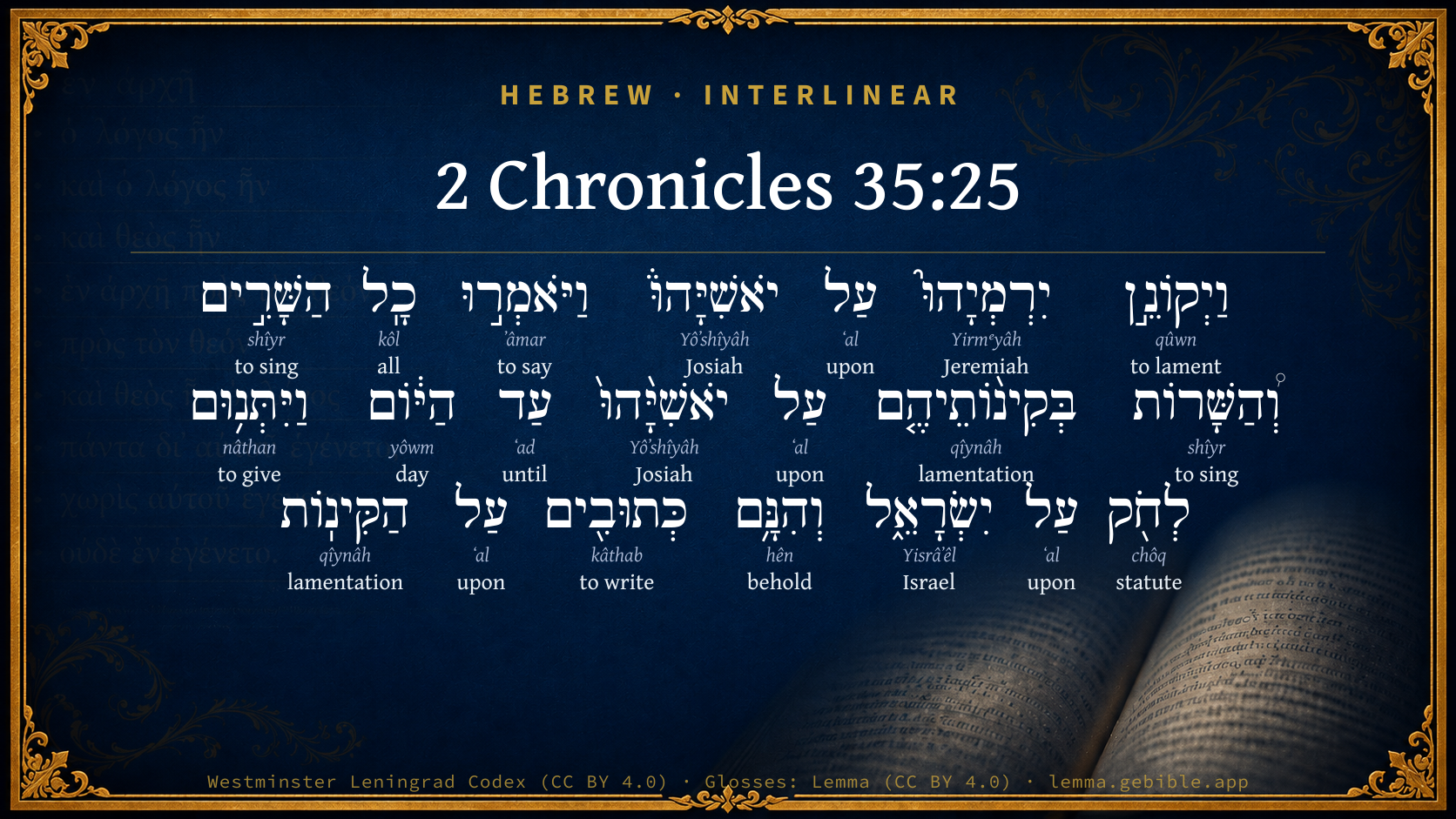
Hebrew (Westminster Leningrad Codex) 2 Chronicles 35:25 appears in the Hebrew Old Testament. The text above is from the Westminster Leningrad Codex. Each word links to its Strong’s number, a concise gloss, and parsing drawn from the Open Scriptures Hebrew Bible morphology. Click any word for its full Brown-Driver-Briggs (BDB) entry.
Download image
Cite this verse

2 Chronicles 35:25 (World English Bible). Public Domain. Lemma interlinear Bible study tool, https://lemma.gebible.app/v/2-chronicles/35/25.

Show BibTeX & RIS
BibTeX
RIS
English Translation
Jeremiah lamented for Josiah: and all the singing men and singing women spoke of Josiah in their lamentations to this day; and they made them an ordinance in Israel: and, behold, they are written in the lamentations.
World English Bible · Public Domain
Download a study sheet

One document with this verse’s original text, its word-by-word gloss line, the meaning frame, cross-references with their text, attributed commentary, and full source and license credits — printable, and it pastes into notes with its structure intact.

This verse Autodidact and up

Study sheet (.html) Plain text (.txt)

A passage Seminary Student

Up to 50 verses in one chapter. A passage sheet keeps up to 6 commentary sources and 12 cross-references per verse, in the order this page ranks them, and says so on the sheet whenever that leaves anything out. Ask for a single verse and you get the Autodidact verse sheet above.

Everything on this page stays free to read, with no account — the sheet is a download of what is already on screen, not access to it.

Want to remove ads? Support Godless Engineer
Compare translations 3

The same verse in 3 English versions, stacked beneath the original-language interlinear above. Click any original word for its lexicon entry.

Each is an independent rendering of the whole verse — the interlinear is not word-aligned to these translations.

Highlighted words mark where these versions differ — a whole-verse word diff, not a word-by-word alignment.

  • World English Bible Public Domain
    Jeremiah lamented for Josiah: and all the singing men and singing women spoke of Josiah in their lamentations to this day; and they made them an ordinance in Israel: and, behold, they are written in the lamentations.
  • King James Version Public Domain
    And Jeremiah lamented for Josiah: and all the singing men and the singing women spake of Josiah in their lamentations to this day, and made them an ordinance in Israel: and, behold, they are written in the lamentations.
  • unfoldingWord Literal Text CC BY-SA 4.0
    And Jeremiah sang a dirge for Josiah, and all the male singers and the female singers said in their dirges about Josiah until today. And they placed for a statute over Israel; and behold, they are written in the Laments.

unfoldingWord Literal Text — © unfoldingWord, licensed CC BY-SA 4.0. Word-aligned USFM3 via Door43 (git.door43.org/unfoldingWord/en_ult).

Versions to compare (up to 4)

3 of 4 selected

Show all 18 translations

Every available English version of this verse, each an independent rendering of the whole verse.

  • World English Bible Public Domain
    Jeremiah lamented for Josiah: and all the singing men and singing women spoke of Josiah in their lamentations to this day; and they made them an ordinance in Israel: and, behold, they are written in the lamentations.
  • Berean Standard Bible Public Domain
    Then Jeremiah lamented over Josiah, and to this day all the choirs of men and women sing laments over Josiah. They established them as a statute for Israel, and indeed they are written in the Book of Laments.
  • Majority Standard Bible Public Domain
    Then Jeremiah lamented over Josiah, and to this day all the male and female singers recite laments over Josiah. They established them as a statute for Israel, and indeed they are written in the Book of Laments.
  • King James Version Public Domain
    And Jeremiah lamented for Josiah: and all the singing men and the singing women spake of Josiah in their lamentations to this day, and made them an ordinance in Israel: and, behold, they are written in the lamentations.
  • American Standard Version (1901) Public Domain
    And Jeremiah lamented for Josiah: and all the singing men and singing women spake of Josiah in their lamentations unto this day; and they made them an ordinance in Israel: and, behold, they are written in the lamentations.
  • Revised Version (1885) Public Domain
    And Jeremiah lamented for Josiah: and all the singing men and singing women spake of Josiah in their lamentations, unto this day; and they made them an ordinance in Israel: and, behold, they are written in the lamentations.
  • Geneva Bible (1599) Public Domain
    And Ieremiah lamented Iosiah, and al singing men and singing women mourned for Iosiah in their lamentations to this day, and made the same for an ordinance vnto Israel: and beholde, they be written in the lamentations.
  • Douay-Rheims (1899) Public Domain
    Particularly Jeremias: whose lamentations for Josias all the singing men and singing women repeat unto this day, and it became like a law in Israel: Behold it is found written in the Lamentations.
  • Young's Literal Translation Public Domain
    and Jeremiah lamenteth for Josiah, and all the singers and the songstresses speak in their lamentations of Josiah unto this day, and set them for a statute on Israel, and lo, they are written beside the lamentations.
  • Literal Standard Version CC BY-SA 4.0
    and Jeremiah laments for Josiah, and all the male and female singers speak in their lamentations of Josiah to this day, and set them for a statute on Israel, and behold, they are written beside the Lamentations.
  • Unlocked Literal Bible CC BY-SA 4.0
    Jeremiah lamented for Josiah; all the male and female singers lament about Josiah to this day. These songs became customary in Israel; behold, they are written in the songs of lament.
  • unfoldingWord Literal Text CC BY-SA 4.0
    And Jeremiah sang a dirge for Josiah, and all the male singers and the female singers said in their dirges about Josiah until today. And they placed for a statute over Israel; and behold, they are written in the Laments.
  • Darby Bible Public Domain
    And Jeremiah lamented for Josiah; and all the singing men and singing women spoke of Josiah in their lamentations to this day; and they made them an ordinance for Israel. And behold, they are written in the lamentations.
  • World Messianic Bible Public Domain
    Jeremiah lamented for Josiah, and all the singing men and singing women spoke of Josiah in their lamentations to this day; and they made them an ordinance in Israel. Behold, they are written in the lamentations.
  • Webster's Bible Public Domain
    And Jeremiah lamented for Josiah: and all the singing men and the singing women have spoken of Josiah in their lamentations to this day, and made them an ordinance in Israel: and behold, they are written in the lamentations.
  • Free Bible Version CC BY-SA 4.0
    Then Jeremiah wrote a lament over Josiah, and to this day male and female choirs sing sad songs about Josiah. They have become a part of what is regularly sung in Israel, and they are recorded in the Book of Laments.
  • Bible in Basic English Public Domain
    And Jeremiah made a song of grief for Josiah; and to this day Josiah is named by all the makers of melody, men and women, in their songs of grief; they made it a rule in Israel; and the songs are recorded among the songs of grief.
  • JPS Tanakh (1917) Public Domain
    And Jeremiah lamented for Josiah; and all the singing men and singing women spoke of Josiah in their lamentations, unto this day; and they made them an ordinance in Israel; and, behold, they are written in the lamentations.

Literal Standard Version (2020), Covenant Press — licensed CC BY-SA 4.0. Text via the HelloAO Bible API (eBible.org). Unlocked Literal Bible (unfoldingWord) — licensed CC BY-SA 4.0. Text via the HelloAO Bible API (eBible.org). unfoldingWord Literal Text — © unfoldingWord, licensed CC BY-SA 4.0. Word-aligned USFM3 via Door43 (git.door43.org/unfoldingWord/en_ult). Free Bible Version, Dr. Jonathan Gallagher — licensed CC BY-SA 4.0. Text via the HelloAO Bible API (eBible.org).

Word by word

More ways to search: Search by grammar → Find every occurrence → Compare this word →

Practice this passage: Drill this verse → Learn its vocabulary →

וַיְקוֹנֵ֣ן
qûwn
H6969
“and · to lament”
Conjunction + Verb, Polel, Sequential Imperfect, 3rd Person, Masculine, Singular
Part of Speech
Conjunction + Verb
Stem
Polel
Form
Sequential Imperfect
Person
3rd Person
Gender
Masculine
Number
Singular
Full BDB Definition

Origin: a primitive root

TWOT: 2018

to chant a dirge, chant, wail, lament - (Polel) to lament
  1. יִרְמְיָהוּ֮ Yirmᵉyâh H3414 “Jeremiah” Noun, Proper
  2. עַל ʻal H5921 “upon” Preposition
  3. יֹאשִׁיָּהוּ֒ Yôʼshîyâh H2977 “Josiah” Noun, Proper
  4. וַיֹּאמְר֣וּ ʼâmar H559 “and · to say” Conjunction + Verb, Qal, Sequential Imperfect, 3rd Person, Masculine, Plural
  5. כָֽל kôl H3605 “all of” Noun, Common, Masculine, Singular, Construct
  6. הַשָּׁרִ֣ים shîyr H7891 “the · singing” Particle, Definite Article + Verb, Qal, Participle Active, Masculine, Plural, Absolute
  7. וְ֠הַשָּׁרוֹת shîyr H7891 “and · the · singing” Conjunction + Particle, Definite Article + Verb, Qal, Participle Active, Feminine, Plural, Absolute
  8. בְּקִינ֨וֹתֵיהֶ֤ם qîynâh H7015 “in/at · lamentations · their” Preposition + Noun, Common, Feminine, Plural, Construct + Suffix, Personal, 3rd Person, Masculine, Plural
  9. עַל ʻal H5921 “upon” Preposition
  10. יֹאשִׁיָּ֨הוּ֙ Yôʼshîyâh H2977 “Josiah” Noun, Proper
  11. עַד ʻad H5704 “until” Preposition
  12. הַיּ֔וֹם yôwm H3117 “the · day” Particle, Definite Article + Noun, Common, Masculine, Singular, Absolute
  13. וַיִּתְּנ֥וּם nâthan H5414 “and · to give · them” Conjunction + Verb, Qal, Sequential Imperfect, 3rd Person, Masculine, Plural + Suffix, Personal, 3rd Person, Masculine, Plural
  14. לְחֹ֖ק chôq H2706 “to/for · statute” Preposition + Noun, Common, Masculine, Singular, Absolute
  15. עַל ʻal H5921 “upon” Preposition
  16. יִשְׂרָאֵ֑ל Yisrâʼêl H3478 “Israel” Noun, Proper
  17. וְהִנָּ֥ם hên H2005 “and · behold · them” Conjunction + Particle, Demonstrative + Suffix, Personal, 3rd Person, Masculine, Plural
  18. כְּתוּבִ֖ים kâthab H3789 “written” Verb, Qal, Participle Passive, Masculine, Plural, Absolute
  19. עַל ʻal H5921 “upon” Preposition
  20. הַקִּינֽוֹת qîynâh H7015 “the · lamentations” Particle, Definite Article + Noun, Common, Feminine, Plural, Absolute

About this verse

These counts appear in no published source. They are computed here, from the morphology-tagged text and Lemma’s own curated glosses. What Lemma adds →

21
words
15
distinct lemmas
Historical
section

Notable vocabulary

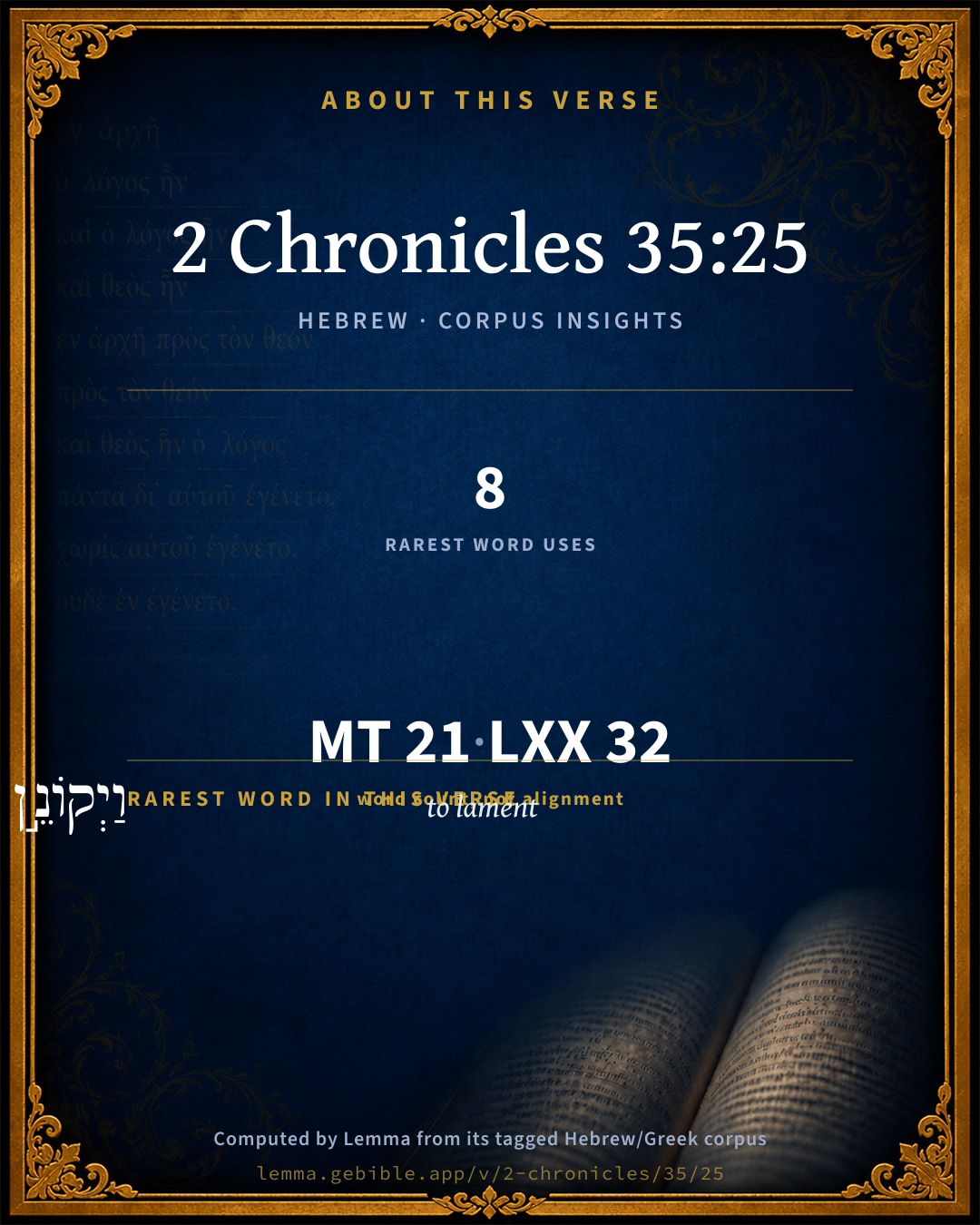
The rarest word here is וַיְקוֹנֵ֣ן to lament H6969 — appearing just 8 times in the whole Hebrew Bible.

Shared distinctive vocabulary

וַיְקוֹנֵ֣ן to lament H6969 occurs in 6 verses of the Hebrew Bible. Also found in:

Grammatical profile

  • 6 verbs
  • 9 nouns
  • 5 prepositions
  • 1 particle

Verb forms

  • וַיְקוֹנֵ֣ן Polel · Sequential Imperfect
  • וַיֹּאמְר֣וּ Qal · Sequential Imperfect
  • הַשָּׁרִ֣ים Qal · Participle Active
  • וְ֠הַשָּׁרוֹת Qal · Participle Active
  • וַיִּתְּנ֥וּם Qal · Sequential Imperfect
  • כְּתוּבִ֖ים Qal · Participle Passive

Repetition

Words recur within this verse — often emphatic in Hebrew:

  • עַל upon H5921 ×4
  • יֹאשִׁיָּהוּ֒ Josiah H2977 ×2
  • הַשָּׁרִ֣ים to sing H7891 ×2
  • בְּקִינ֨וֹתֵיהֶ֤ם lamentation H7015 ×2

Hebrew & Septuagint length

In English translation the verse runs 37 words from the Hebrew and 37 from the Septuagint (LXX English) — the same length.

A rough comparison of the two English renderings, which tokenize alike — not a word-level alignment.

Word counts can differ between the Hebrew and the Greek without any difference in meaning — e.g. the Hebrew direct-object marker אֵת has no separate Greek word, and Greek often adds the article ὁ.

In the original languages it is 21 Hebrew tokens and 32 Greek tokens — but the two are counted differently (Hebrew bundles its prefixes and suffixes into one token; the Greek is in lemma form), so that isn’t a like-for-like length.

Cross-references

7

Topical passages linked to 2 Chronicles 35:25 in the Treasury of Scripture Knowledge — connected by theme and wording, ordered by reader-vote popularity; previews shown in the World English Bible.

  • Jeremiah 22:10 Don't you weep for the dead, neither bemoan him; but weep sore for him who goes away; for he shall return no more, nor see his native country.
  • Lamentations 4:20 The breath of our nostrils, the anointed of Yahweh, was taken in their pits; Of whom we said, Under his shadow we shall live among the nations.
  • Job 3:8 Let them curse it who curse the day, Who are ready to rouse up leviathan.
  • Jeremiah 9:17–21 Thus says Yahweh of Hosts, Consider you, and call for the mourning women, that they may come; and send for the skillful women, that they may come:
  • Matthew 9:23 When Jesus came into the ruler's house, and saw the flute players, and the crowd in noisy disorder,
  • Jeremiah 22:20 Go up to Lebanon, and cry; and lift up your voice in Bashan, and cry from Abarim; for all your lovers are destroyed.
  • Ecclesiastes 12:5 Yes, they shall be afraid of heights, And terrors will be in the way; And the almond tree shall blossom, And the grasshopper shall be a burden, And desire shall fail; Because man goes to his everlasting home, And the mourners go about the streets:

Cross-references courtesy of OpenBible.info (CC BY 4.0).

Hebrew and Greek witnesses Masoretic Hebrew ↔ Greek Septuagint

The same verse in the two great witnesses to the Old Testament, shown verse-for-verse.

These are two independent witnesses, not word-aligned to each other, and the Septuagint is shown in lemma (dictionary) form.

Hebrew 2 Chronicles 35:25 Masoretic · Westminster Leningrad Codex

וַיְקוֹנֵ֣ן יִרְמְיָהוּ֮ עַל יֹאשִׁיָּהוּ֒ וַיֹּאמְר֣וּ כָֽל הַשָּׁרִ֣ים וְ֠הַשָּׁרוֹת בְּקִינ֨וֹתֵיהֶ֤ם עַל יֹאשִׁיָּ֨הוּ֙ עַד הַיּ֔וֹם וַיִּתְּנ֥וּם לְחֹ֖ק עַל יִשְׂרָאֵ֑ל וְהִנָּ֥ם כְּתוּבִ֖ים עַל הַקִּינֽוֹת

Jeremiah lamented for Josiah: and all the singing men and singing women spoke of Josiah in their lamentations to this day; and they made them an ordinance in Israel: and, behold, they are written in the lamentations.

World English Bible · Public Domain

Greek LXX 2 Chronicles 35:25 Septuagint · lemma form

καί θρηνέω ἰερεμίας ἐπί ιωσίας καί εἶπον πᾶς ὁ ἄρχων καί ὁ ἄρχω θρῆνος ἐπί ιωσίας ἕως ὁ σήμερον καί δίδωμι αὐτός εἰς πρόσταγμα ἐπί ἰσραήλ καί ἰδού γράφω ἐπί ὁ θρῆνος

And Jeremias mourned over Josias, and all the chief men and chief women uttered a lamentation over Josias until this day: and they made it an ordinance for Israel, and, behold, it is written in the lamentations.

LXX2012 (modern English Septuagint) · Public Domain

On this verse, Ellicott's Commentary for English Readers discusses the Septuagint’s reading. Read the note in Commentary ↓

Hebrew: Westminster Leningrad Codex (CC BY 4.0). Greek: Septuagint (public domain); English from LXX2012 (modern English Septuagint) (Public Domain). How the Septuagint differs from the Hebrew →

Commentary

Notes on 2 Chronicles 35:25 from classic Christian and Jewish commentators (each source and its license shown beneath its notes). The classic Christian expositions comment on the surrounding passage and are grouped to its opening verse, so a note may address several verses; the Jewish commentaries on the Tanakh (Rashi and others) are per-verse, so they appear only where the commentator wrote on this verse.

Lemma curates 59 commentaries, every one of them public domain or Creative Commons licensed, each selected and text-cleaned for this edition rather than reprinted as found. About our sources →

Trapp's Complete Commentary

John Trapp

2Ch 35:25 And Jeremiah lamented for Josiah: and all the singing men and the singing women spake of Josiah in their lamentations to this day, and made them an ordinance in Israel: and, behold, they [are] written in the lamentations.

Ver. 25. And Jeremiah lamented for Josiah.] Whose worth he had fully known; and to whom himself was better known than Daniel was afterwards to Belshazzar; who knew not till he was told by his mother that there was any such man in his kingdom. Whereas had he been a Tricongiustospot, he would sooner have taken knowledge of him.

And behold they are written in the lamentations.] Whether he meant the Lamentations of Jeremiah Lam 4:1-22, or some other mournful ditty extant in those time, and known by the name of the Lamentations, {a} is uncertain. The Roman senate bitterly bewailed the death of Titus, heaping more praise upon him dead than ever they had done whilst he was alive. {b} Cardanus’s epitaph upon our King Edward VI is well known -

“ Flete nefas magnum, sed toto flebitis orbe

Mortales: rester corruit omnis honos.

Nam regum decus et iuvenum flos, spesque bonorum,

Deliciae saecli et gloria gentis erat.

Dignus Apollineis lachrymis, doctaeque Minervae

Flosculus (heu misero) concidit ante diem.

Te tumulo dabimus Musae supremaque flentes

Munera, Melpomene tristia fata canet. ”

{a} θρηνωδιας

{b} Sueton.

John Trapp, A Commentary or Exposition upon All the Books of the Old and New Testament (1647–1656) — public domain. Text from a community e-Sword module.

Joseph Benson's Commentary

2Ch 35:25. Jeremiah lamented for Josiah — Sorrowed much on account of the immature death of this good king, foreseeing that the utter ruin of his country would follow upon it. And as it was usual with the Jews to make lamentations, elegies, or mournful pieces upon the death of great men, princes, and others that had distinguished themselves among them, and deserved well of their country, it is probable Jeremiah wrote such a piece on the occasion of Josiah’s death. If he did so, the loss of it is very much to be deplored, because, as Dr. Dodd observes, it was, no doubt, “a masterpiece of its kind as there never was an author more deeply affected with his subject, or more capable of carrying it through all the tender sentiments of sorrow and compassion, than Jeremiah.” All the singing-men and singing-women spake of Josiah in their lamentations — Among the Jews men and women were usually employed to mourn at funerals, and to sing the praises of the dead. And so real and great was the mourning for Josiah, that for ages afterward they always remembered it in their lamentations for the dead, saying of the person deceased, Then art worthy to be lamented for, as good Josiah was, or words to the same purpose. Or, as Poole thinks, the meaning may be, that in all their succeeding lamentations for their public calamities, they remembered Josiah’s death as their first and fatal blow, which opened the flood-gates to all their following miseries. And made them an ordinance in Israel — Ordained that the mournful pieces, penned on this sad occasion, should be learned and sung by all sorts of people. And, behold, they are written in the Lamentations — Not in the book termed The Lamentations of Jeremiah, which was written on another occasion; but in some collection of mournful poems, now lost.

Joseph Benson's Commentary on the Old and New Testaments (1811–1818) — public domain. Text from a community e-Sword module.

Tyndale Open Study Notes

Tyndale Open Resources

35:25 Jeremiah held Josiah in high esteem (see Jer 22:15-16; cp. Jer 22:10). The Book of Laments was lost; it is not related to the Book of Lamentations.

Tyndale Open Study Notes — © Tyndale Open Resources, licensed CC BY-SA 4.0. Text via the HelloAO Bible API.

Geneva Bible (1599)

Geneva Bible translators

Which some think Jeremiah made, wherein he lamenteth the state of the Church after this king’s death.

Geneva Bible (1599) marginal notes — public domain. Text via Bolls.life.

Jamieson, Fausset & Brown

Robert Jamieson, A. R. Fausset & David Brown

Jeremiah lamented for Josiah, &c.--The elegy of the prophet has not reached us; but it seems to have been long preserved among his countrymen and chanted on certain public occasions by the professional singers, who probably got the dirges they sang from a collection of funeral odes composed on the death of good and great men of the nation. The spot in the valley of Megiddo where the battle was fought was near the town of Hadad-rimmon; hence the lamentation for the death of Josiah was called "the lamentation of Hadad-rimmon in the valley of Megiddo," which was so great and so long continued, that the lamentation of Hadad passed afterwards into a proverbial phrase to express any great and extraordinary sorrow (Zac 12:11).

Next: 2 Chronicles Chapter 36

Jamieson, Fausset & Brown — Commentary Critical and Explanatory on the Whole Bible (1871) — public domain (CC PDM 1.0). Text via the HelloAO Bible API.

Adam Clarke's Commentary

Verse 25. Behold, they are written in the lamentations.] The Hebrews had poetical compositions for all great and important events, military songs, songs of triumph, epithalamia or marriage odes, funeral elegies, c. Several of these are preserved in different parts of the historical books of Scripture, and these were generally made by prophets or inspired men. That composed on the tragical end of this good king by Jeremiah is now lost. The Targum says, "Jeremiah bewailed Josiah with a great lamentation and all the chiefs and matrons sing these lamentations concerning Josiah to the present day, and it was a statute in Israel annually to bewail Josiah. Behold, these are written in the book of Lamentations, which Baruch wrote down from the mouth of Jeremiah."

Adam Clarke's Commentary on the Bible (1810–1826) — public domain. Text from a community e-Sword/MySword module.

Ellicott's Commentary for English Readers

(25) And Jeremiah lamented—i.e., wrote a dirge. The special mourning of the land over Josiah is not mentioned in Kings.

The singing men . . . women.—The LXX. has “the ruling men . . . women,” reading sârîm . . . sârôth, instead of shârîm . . . shârôth.

Spake of Josiah in their lamentations.—In the dirges which they used to sing on certain anniversaries of disaster.

And made them an ordinance.—And they made them (i.e. the laments for Josiah) a standing custom to Israel.

They are written in the lamentations.—The dirges alluding to Josiah’s untimely end, and among them Jeremiah’s, were preserved in a Book of Dirges (qînôth), which may have been extant in the chronicler’s day. (Comp. the allusions in Jer_22:10; Jer_22:18; Zec_12:11.)

This collection, however, was quite different from the canonical book of Lamentations, the subject of which is the ruin of Judah and Jerusalem by the Chaldeans.

A Bible Commentary for English Readers, edited by Charles John Ellicott (1878–1897) — public domain. Text from a community e-Sword module.

The Cambridge Bible for Schools and Colleges

gen. ed. J. J. S. Perowne

25 (= 1Es_1:32; not in 2 Kin.). The Lamentations for Josiah

25. lamented] i.e. “composed (or uttered) an elegy.” The Heb. word (ḳônçn) suggests formal composition, and the actual words of lamentation are often given; 2Sa_1:17 ff; 2Sa_3:33-34; Eze_27:32; Eze_32:2; Eze_32:16.

and they made them an ordinance] Cp. 2Sa_1:18, R.V.

in the lamentations] In some lost work, not in our canonical book of the Lamentations, for there we “look in vain for a single word distinctive of a funeral dirge over a devout and zealous reformer like Josiah” (E. H. Plumptre in Smith’s Bib. Dict. s.v.).

The Cambridge Bible for Schools and Colleges (gen. ed. J. J. S. Perowne; Cambridge University Press, 1878–1918) — public domain. Text from a community e-Sword module.

John Gill's Exposition

His piety towards God, and liberality to the people; of these two verses; see Gill on Kg2 23:28.

Next: 2 Chronicles Chapter 36

John Gill's Exposition of the Whole Bible (1746–1763) — public domain (CC PDM 1.0). Text via the HelloAO Bible API.

Albert Barnes' Notes on the Bible

Some find Jeremiah’s lament in the entire Book of Lamentations; others in a part of it Lam. 4. But most critics are of opinion that the lament is lost. Days of calamity were commemorated by lamentations on their anniversaries, and this among the number. The “Book of Dirges” was a collection of such poems which once existed but is now lost.

And made them an ordinance - Rather, “and they made them an ordinance,” they i. e. who had authority to do so, not the minstrels.

Albert Barnes' Notes on the Bible (1834–1885) — public domain. Text from a community e-Sword/MySword module.

Haydock's Catholic Bible Commentary

Lamentations. Some think that we have them in the Bible. Josephus, &c. --- Others believe that they are lost. Salien, the year of the world 3425. --- Law, on the anniversary; (M.) or when any calamity occurs, the lamentations of Jeremias are used. T. --- There were collections of such poems, as well as of canticles, for victory and marriages. C.

George Leo Haydock (1774–1849), Haydock's Catholic Family Bible and Commentary, 1859 edition — public domain. Excludes Psalms (Douay-Rheims chapter numbering differs from Protestant) and Deuterocanonical books (Catholic canon only).

Matthew Poole's English Annotations

In their lamentations to this day; in all their succeeding lamentations for their public calamities, and for the ruin of their city, and temple, and state, and church they remembered Josiah’s death as their first and most fatal blow, and as that which opened the flood-gates to all their following miseries, and it was ordained that they should do so, as the next words intimate.

In the lamentations; either in that canonical book of Jeremiah’s Lamentations, or in some other volume of mournful ditties, made by divers persons upon occasion of their following calamities, which is since lost.

Matthew Poole's English Annotations on the Holy Bible (1683–1685) — public domain. Text from a community e-Sword/MySword module.

Whedon's Commentary on the Bible

Daniel D. Whedon

25. The lamentations — See Introduction.

Daniel D. Whedon (gen. ed.), Commentary on the Old and New Testaments (1874–1909) — public domain. Text from a community e-Sword module.

The Pulpit Commentary

If Jeremiah"s lamenting on this occasion was one committed to writing, it has not survived. To this day; i.e. probably anniversary after anniversary to the time of the writer to whom this statement belongs, the authority from which our compiler draws his materials. Written in the lamentations. We have here another glimpse of a work which has not been handed down to us.

The Pulpit Commentary (1880–1919), ed. H.D.M. Spence-Jones & Joseph S. Exell — public domain. Text from a community e-Sword module.

John Wesley's Explanatory Notes

To this day - In all their succeeding Lamentations for their publick calamities, they remembered Josiah's death as their first and fatal blow, which opened the flood-gates to all their following miseries.

John Wesley, Explanatory Notes Upon the Whole Bible (1754–1765) — public domain. Text via the GEBible commentary corpus.

unfoldingWord translationNotes

Door43 World Missions Community

to this day

This means the day on which the writer wrote. See how you translated this in 2 Chronicles 5:9.

behold, they

Possible meanings: 1) "this is where they are: they" or 2) "they still exist: they."

the songs of lament

This was an ancient scroll of funeral songs.

translationWords

Jeremiah

lament

unfoldingWord translationNotes — © Distant Shores Media and the Door43 World Missions Community, licensed CC BY-SA 4.0. Source: git.door43.org/Door43/en_tn.

Rashi

Rabbi Shlomo Yitzchaki (Rashi)

And all the male...singers - הַשָּׁרִים, an expression of song, choristers, for both song and lamentation are recited with the same voice. Concerning him, Amos prophesied (8:9): “and I will cause the sun to set at midday, and I will darken the land on a sunny day.” This is the day of Josiah, who died at the age of thirty-nine, in the middle of his days, for it is written (Ps. 90:10): “The days of our years because of them are seventy years,” and it is written (Amos 8:10): “And I will turn your festivals into mourning, and all your songs into lamentation, etc. and I will make it like the mourning for an only son, and its end like a bitter day.” This is what [the Chronicler] says: “And all the male and female singers said in their lamentations,” “and all of Judah and Jerusalem were mourning” for him.

and they made them a statute When any grief or weeping befalls them, for which they lament and weep, they mention this grief with it. An example is the Ninth of Av, in which we recite lamentations for those slain in the persecutions that occurred in our times. They will similarly bewail the day of Josiah’s death. An example is (Jud. 11:39f.): “and it became a statute in Israel, etc. to lament the daughter of Jephthah the Gileadite, four days in a year.”

and behold, they are written in the lamentations in the Book of Lamentations.

Rashi on the Tanakh — English translations: “The Judaica Press complete Tanach with Rashi, translated by A. J. Rosenberg” (CC BY 4.0); “Pentateuch with Rashi's commentary by M. Rosenbaum and A.M. Silbermann, 1929-1934” (public domain); “The Metsudah Tanach series, Lakewood, N.J” (CC BY 4.0); and “The Book of Joshua, Metsudah Publications, 1997” (CC BY 4.0). Text via Sefaria.

Lesson kit

Teaching starters — assembled from the data on this page, not authored interpretation. Every prompt links to the verse data it draws on. Edit before teaching.

2 Chronicles, in the Historical, opens this verse with 21 words (15 distinct Hebrew lemmas). Its most distinctive word is qûwn (“to lament”). A historical commentator’s framing appears above. Read the whole chapter for the surrounding context.

Discussion questions

  1. The word qûwn carries the sense “to lament.” How does it shape the verse?
  2. How does 2 Samuel 1:17, which shares the word «to lament», read alongside this verse?
  3. What does the repetition of “upon” (4× in this one verse) do in this verse?
  4. The translations on this page render this verse differently — a whole-verse word diff, not a word-by-word alignment. What might account for the different wordings?
  5. «וַיְקוֹנֵ֣ן» is a Polel Sequential Imperfect verb. How does that grammatical form shape the action described?
  6. Compare how Trapp's Complete Commentary and Joseph Benson's Commentary read this verse. Where do they agree or differ?

Things to notice

Reading settings

Reading text

Shown beneath each verse's original-language words.

Old Testament
Old Testament edition

Read the OT as the Masoretic Hebrew (MT) or the Greek Septuagint (LXX).

English shown for the Greek Septuagint (in the Hebrew ↔ Greek comparison).

Comparing translations? Open the Compare panel on any verse page to stack up to four side by side.