
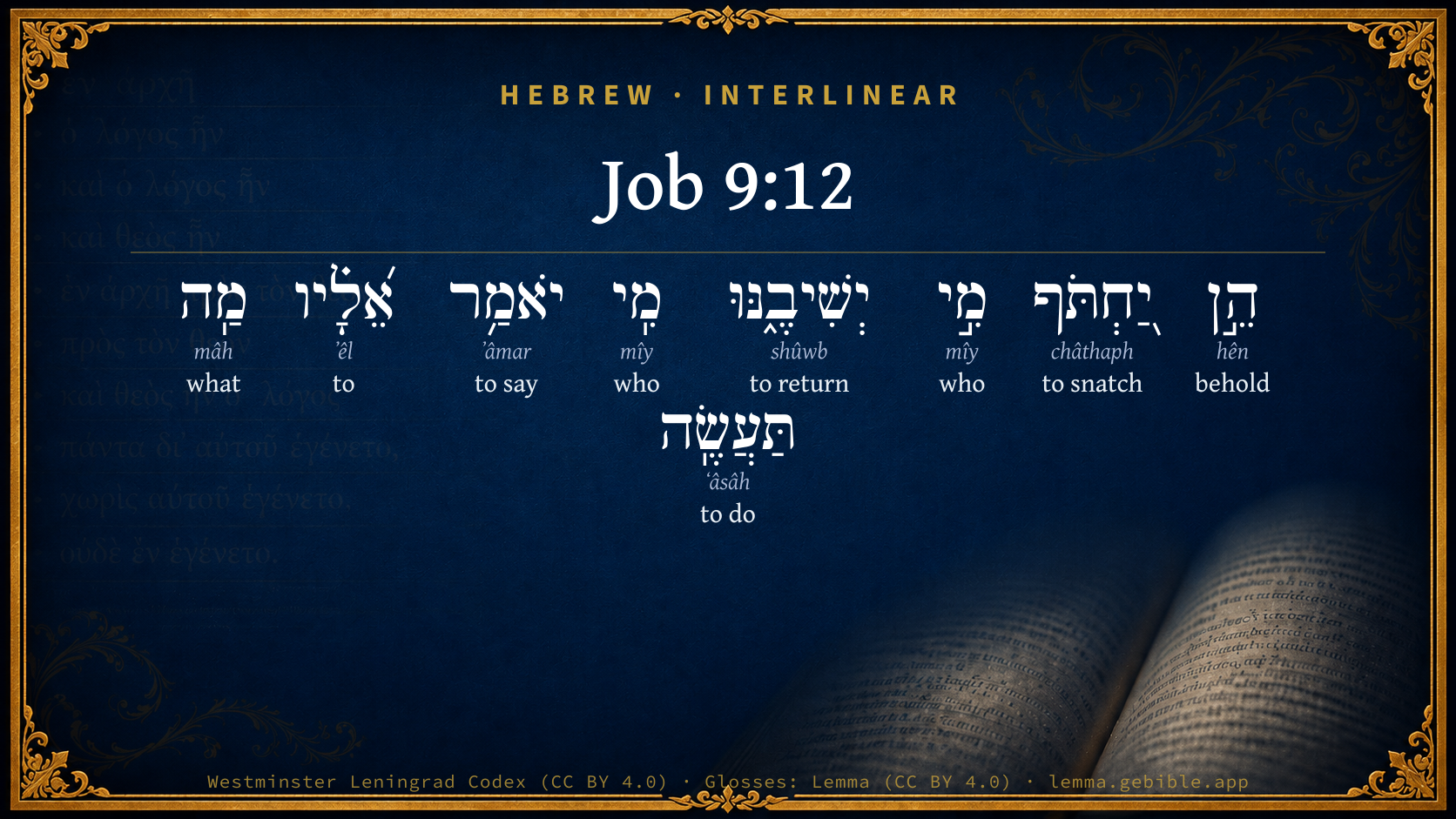
Job 9:12

Hebrew (Westminster Leningrad Codex) Job 9:12 appears in the Hebrew Old Testament. The text above is from the Westminster Leningrad Codex. Each word links to its Strong’s number, a concise gloss, and parsing drawn from the Open Scriptures Hebrew Bible morphology. Click any word for its full Brown-Driver-Briggs (BDB) entry.
Download image
Cite this verse

Job 9:12 (World English Bible). Public Domain. Lemma interlinear Bible study tool, https://lemma.gebible.app/v/job/9/12.

Show BibTeX & RIS
BibTeX
RIS
English Translation
Behold, he snatches away; who can hinder him? Who will ask him, 'What are you doing?'
World English Bible · Public Domain
Highlights
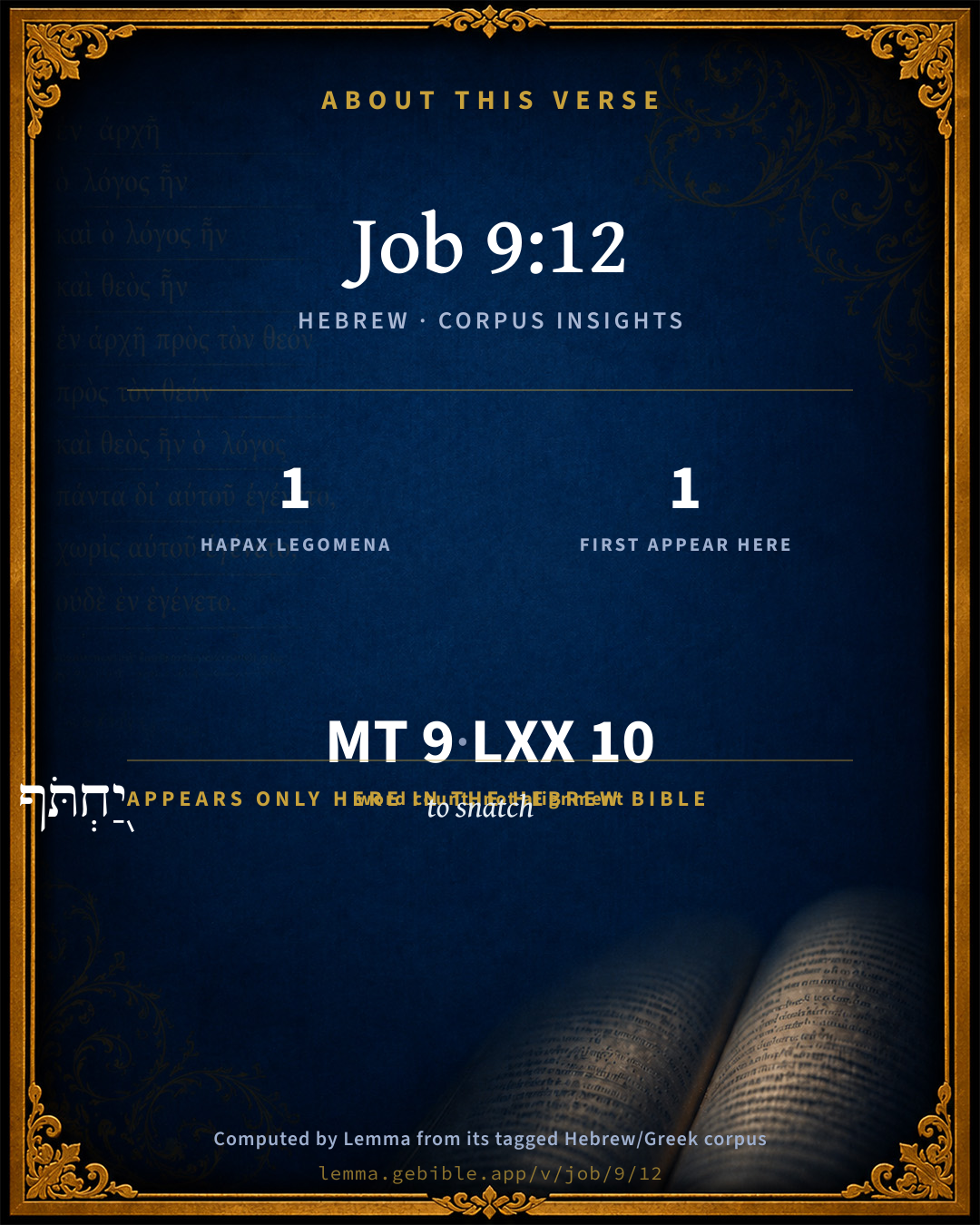
  • 1 hapax legomenon — only here in the Hebrew Bible
  • 1 first appearance in the Hebrew Bible
Full analysis ↓
Download a study sheet

One document with this verse’s original text, its word-by-word gloss line, the meaning frame, cross-references with their text, attributed commentary, and full source and license credits — printable, and it pastes into notes with its structure intact.

This verse Autodidact and up

Study sheet (.html) Plain text (.txt)

A passage Seminary Student

Up to 50 verses in one chapter. A passage sheet keeps up to 6 commentary sources and 12 cross-references per verse, in the order this page ranks them, and says so on the sheet whenever that leaves anything out. Ask for a single verse and you get the Autodidact verse sheet above.

Everything on this page stays free to read, with no account — the sheet is a download of what is already on screen, not access to it.

Want to remove ads? Support Godless Engineer
Compare translations 3

The same verse in 3 English versions, stacked beneath the original-language interlinear above. Click any original word for its lexicon entry.

Each is an independent rendering of the whole verse — the interlinear is not word-aligned to these translations.

Highlighted words mark where these versions differ — a whole-verse word diff, not a word-by-word alignment.

  • World English Bible Public Domain
    Behold, he snatches away; who can hinder him? Who will ask him, 'What are you doing?'
  • King James Version Public Domain
    Behold, he taketh away, who can hinder him? who will say unto him, What doest thou?
  • unfoldingWord Literal Text CC BY-SA 4.0
    If he takes away, who will turn him back? Who will say to him, ‘What are you doing?’

unfoldingWord Literal Text — © unfoldingWord, licensed CC BY-SA 4.0. Word-aligned USFM3 via Door43 (git.door43.org/unfoldingWord/en_ult).

Versions to compare (up to 4)

3 of 4 selected

Show all 18 translations

Every available English version of this verse, each an independent rendering of the whole verse.

  • World English Bible Public Domain
    Behold, he snatches away; who can hinder him? Who will ask him, 'What are you doing?'
  • Berean Standard Bible Public Domain
    If He takes away, who can stop Him? Who dares to ask Him, ‘What are You doing?’
  • Majority Standard Bible Public Domain
    If He takes away, who can stop Him? Who dares to ask Him, ‘What are You doing?’
  • King James Version Public Domain
    Behold, he taketh away, who can hinder him? who will say unto him, What doest thou?
  • American Standard Version (1901) Public Domain
    Behold, he seizeth `the prey', who can hinder him? Who will say unto him, What doest thou?
  • Revised Version (1885) Public Domain
    Behold, he seizeth the prey, who can hinder him? who will say unto him, What doest thou?
  • Geneva Bible (1599) Public Domain
    Behold, when he taketh a pray, who can make him to restore it? who shall say vnto him, What doest thou?
  • Douay-Rheims (1899) Public Domain
    If he examine on a sudden, who shall answer him? or who can say: Why dost thou so?
  • Young's Literal Translation Public Domain
    Lo, He snatches away, who bringeth it back? Who saith unto Him, `What dost Thou?'
  • Literal Standard Version CC BY-SA 4.0
    Behold, He snatches away, who brings it back? Who says to Him, What [are] You doing?
  • Unlocked Literal Bible CC BY-SA 4.0
    If he takes something away, who can stop him? Who can say to him, 'What are you doing?'
  • unfoldingWord Literal Text CC BY-SA 4.0
    If he takes away, who will turn him back? Who will say to him, ‘What are you doing?’
  • Darby Bible Public Domain
    Behold, he taketh away: who will hinder him? Who will say unto him, What doest thou?
  • World Messianic Bible Public Domain
    Behold, he snatches away. Who can hinder him? Who will ask him, ‘What are you doing?’
  • Webster's Bible Public Domain
    Behold, he taketh away, who can hinder him? who will say to him, What doest thou?
  • Free Bible Version CC BY-SA 4.0
    If he takes away, who can prevent him? Who is going to ask him, ‘What are you doing?’
  • Bible in Basic English Public Domain
    If he puts out his hand to take, by whom may it be turned back? who may say to him, What are you doing?
  • JPS Tanakh (1917) Public Domain
    Behold, He snatcheth away, who can hinder Him? Who will say unto Him: 'What doest Thou?'

Literal Standard Version (2020), Covenant Press — licensed CC BY-SA 4.0. Text via the HelloAO Bible API (eBible.org). Unlocked Literal Bible (unfoldingWord) — licensed CC BY-SA 4.0. Text via the HelloAO Bible API (eBible.org). unfoldingWord Literal Text — © unfoldingWord, licensed CC BY-SA 4.0. Word-aligned USFM3 via Door43 (git.door43.org/unfoldingWord/en_ult). Free Bible Version, Dr. Jonathan Gallagher — licensed CC BY-SA 4.0. Text via the HelloAO Bible API (eBible.org).

Word by word

More ways to search: Search by grammar → Find every occurrence → Compare this word →

Practice this passage: Drill this verse → Learn its vocabulary →

About this verse

These counts appear in no published source. They are computed here, from the morphology-tagged text and Lemma’s own curated glosses. What Lemma adds →

9
words
8
distinct lemmas
Wisdom
section

Notable vocabulary

1 hapax legomenon — a word that appears only here in the entire Hebrew Bible:

  • יַ֭חְתֹּף to snatch H2862

First appearance in Scripture

This word makes its first canonical appearance in the Hebrew Bible here:

  • יַ֭חְתֹּף to snatch H2862

Grammatical profile

  • 4 verbs
  • 1 preposition
  • 4 particles

Verb forms

  • יַ֭חְתֹּף Qal · Imperfect
  • יְשִׁיבֶ֑נּוּ Hiphil · Imperfect
  • יֹאמַ֥ר Qal · Imperfect
  • תַּעֲשֶֽׂה Qal · Imperfect

Repetition

A word recurs within this verse — often emphatic in Hebrew:

Hebrew & Septuagint length

In English translation the verse runs 16 words from the Hebrew and 20 from the Septuagint (LXX English) — closely comparable.

A rough comparison of the two English renderings, which tokenize alike — not a word-level alignment.

Word counts can differ between the Hebrew and the Greek without any difference in meaning — e.g. the Hebrew direct-object marker אֵת has no separate Greek word, and Greek often adds the article ὁ.

In the original languages it is 9 Hebrew tokens and 10 Greek tokens — but the two are counted differently (Hebrew bundles its prefixes and suffixes into one token; the Greek is in lemma form), so that isn’t a like-for-like length.

Cross-references

12

Topical passages linked to Job 9:12 in the Treasury of Scripture Knowledge — connected by theme and wording, ordered by reader-vote popularity; previews shown in the World English Bible.

  • Job 11:10 If he passes by, or confines, Or convenes a court, then who can oppose him?
  • Isaiah 45:9 Woe to him who strives with his Maker--a potsherd among the potsherds of the earth! Shall the clay ask him who fashions it, "What are you making?" or your work, "He has no hands?"
  • Job 23:13 But he stands alone, and who can oppose him? What his soul desires, even that he does.
  • Job 34:29 When he gives quietness, who then can condemn? When he hides his face, who then can see him? Alike whether to a nation, or to a man:
  • Daniel 4:35 All the inhabitants of the earth are reputed as nothing; and he does according to his will in the army of heaven, and among the inhabitants of the earth; and none can stay his hand, or tell him, What do you?
  • Romans 11:34 "For who has known the mind of the Lord? Or who has been his counselor?"
  • Job 33:13 Why do you strive against him, Because he doesn't give account of any of his matters?
  • Jeremiah 18:6 House of Israel, can't I do with you as this potter? says Yahweh. Behold, as the clay in the potter's hand, so are you in my hand, house of Israel.
  • Matthew 20:15 Isn't it lawful for me to do what I want to with what I own? Or is your eye evil, because I am good?'
  • Matthew 11:26 Yes, Father, for so it was well-pleasing in your sight.
  • Ephesians 1:11 in whom also we were assigned an inheritance, having been foreordained according to the purpose of him who works all things after the counsel of his will;
  • Romans 9:18–20 So then, he has mercy on whom he desires, and he hardens whom he desires.

Cross-references courtesy of OpenBible.info (CC BY 4.0).

Hebrew and Greek witnesses Masoretic Hebrew ↔ Greek Septuagint

The same verse in the two great witnesses to the Old Testament, shown verse-for-verse.

These are two independent witnesses, not word-aligned to each other, and the Septuagint is shown in lemma (dictionary) form.

Hebrew Job 9:12 Masoretic · Westminster Leningrad Codex

הֵ֣ן יַ֭חְתֹּף מִ֣י יְשִׁיבֶ֑נּוּ מִֽי יֹאמַ֥ר אֵ֝לָ֗יו מַֽה תַּעֲשֶֽׂה

Behold, he snatches away; who can hinder him? Who will ask him, 'What are you doing?'

World English Bible · Public Domain

Greek LXX Job 9:12 Septuagint · lemma form

ἐάν ἀποἀλλάσσω τίς ἀποστρέφω ἤ τίς εἶπον αὐτός τίς ποιέω

If he would take away, who shall turn him back? or who shall say to him, What have you done?

LXX2012 (modern English Septuagint) · Public Domain

Hebrew: Westminster Leningrad Codex (CC BY 4.0). Greek: Septuagint (public domain); English from LXX2012 (modern English Septuagint) (Public Domain). How the Septuagint differs from the Hebrew →

Commentary

Notes on Job 9:12 from classic Christian and Jewish commentators (each source and its license shown beneath its notes). The classic Christian expositions comment on the surrounding passage and are grouped to its opening verse, so a note may address several verses; the Jewish commentaries on the Tanakh (Rashi and others) are per-verse, so they appear only where the commentator wrote on this verse.

Lemma curates 59 commentaries, every one of them public domain or Creative Commons licensed, each selected and text-cleaned for this edition rather than reprinted as found. About our sources →

Trapp's Complete Commentary

John Trapp

Job 9:12 Behold, he taketh away, who can hinder him? who will say unto him, What doest thou?

Ver. 12. Behold, he taketh away] Raptim aufert; He snatcheth away, or taketh by force, as a lion doth his prey, or a thief doth another man’s goods. Confer Pro 23:28. Which if he do, who can repel or turn him back? Here Job plainly alludeth to the taking away of his children, servants, and cattle, the likelihood also of losing his life (according to the Chaldee paraphrast) by his present miseries; which, if it should befall him from God, it would not be safe for him to cavil, or once question God’s proceeding, to urge him to restitution, or charge him with oppression; since he is chief Lord of all, and may do with his own what he pleaseth. He is uncontrollable, as Nebuchadnezzar at length acknowledged, Dan 4:35, and his will is the true and only rule of justice itself, nec solum recta, sed et regula. Wherefore let all the earth keep silence before him, Hab 2:20, and let none presume once to ask him what he hath done, either to question his right to do it, or to question his righteousness in the doing of it.

John Trapp, A Commentary or Exposition upon All the Books of the Old and New Testament (1647–1656) — public domain. Text from a community e-Sword module.

The Biblical Illustrator

Joseph S. Exell

Job_9:12

Behold, He taketh away.

The conduct to which adverse dispensations should lead

Job was a sufferer. Of his property he was deprived; of his children he was bereaved; in his own person he was sorely afflicted. It would not have been strange had Job given way to murmuring and repining. Unsupported and uncomforted from above, what else can be expected from man when in deep distress, but the expression of uneasiness and fretful discontent? Some, indeed, attempt to bear up under adversity by hard-hearted callousness, and others by a prideful aversion to complain. Job felt what he endured, and he acknowledged what he endured, but his feeling and acknowledgment indicated calm submission.

I. The doctrine taught--the agency of God. His agency in providence. Not to be classed with chance or accident. It would be a mistake to represent God as exercising no providential superintendence, no control, no management, no rule. Some hold that Gods agency is general, not particular, not concerned with details. But great and little are not to God what they are to us. What it was no degradation to God to create, it can be no degradation to God to superintend. A particular agency on His part is the only intelligible notion of Gods agency in providence. The manner in which Gods agency, in the various dispensations of providence, is regarded respectively by the believer and by the unbeliever, constitutes one of the most marked distinctions between the characters of these two classes of person.

II. The lessons which this doctrine teaches.

1. Privation and loss are the doing of Him who neither does nor can do us any wrong. God is never arbitrary, never capricious, never unjust. He is essentially righteous. In no sense can He do that which is unrighteous. He cannot do it from ignorance, or from design.

2. Privation and loss are the doing of Him, all whose doings in reference to us are in accordance with what He Himself is--wise and gracious. Not only is He wise, but all-wise; actually, absolutely, yea, necessarily all-wise. His understanding is infinite. He is gracious. His nature is love. What a proof of this did He afford in devising a plan by which sinners might be rescued from the penal consequences of sin.

3. Privation and loss are the doing of Him who is able, and as willing as He is able, to educe, in our experience, good from evil. Out of the strait in which we are involved there may be no seeming way of escape. But is it irremediable by Him whose arm is full of might, who is equal to our support and deliverance, whatever be our condition? This subject calls for thankfulness; it should produce resignation; it should lead us to prepare for changes. (A. Jack, D. D.)

Who will say unto Him, What doest Thou?--

The Divine dispensations not to be questioned

In the cup of life there are many bitter ingredients. From the day we are born, till the day we die, there is an invariable mixture of joy and sorrow. The world is full of uncertainties. Its best satisfactions are neither substantial nor permanent Religion is not satisfied with directing our attention to second causes. It leads us above them to the First Cause of all things. It conducts us to God; and presents Him to us under the mild aspect of a Father, always mindful of our happiness; and who has given us so many proofs of this in nature, providence, and grace, as to merit our entire confidence and unreserved submission. There is much in the present state of things to perplex the understanding, as well as to wound the heart. I find in the revelation which religion has made to me another and better world, where my perplexities will be resolved, and my troubles cease. In dines of sorrow, philosophy has no effectual help for us. Various and contradictory maxims may be urged upon us, and to all we must reply, with the ancient sufferer, Miserable comforters are ye all. But it is not in vain to direct our thoughts to God; to make an oblation of our wills to Him. There is too much disposition in mankind to disregard the providence of God; to overlook His agency in the occurrences of life. What would become of us if our life were an unmingled portion of good; if our day were never darkened with the clouds of adversity? Afflictions are intended as the instruments of good to us. Afflictions, rightly improved, are real blessings. (C. Lowell.)

Submission to Divine sovereignty

Job was afflicted not more for his own benefit than for the benefit of others. His discourses with his friends gave him a good opportunity of justifying the sovereignty of God, in the dispensations of His providence. The friends insisted that God treated every man according to his real character, in His providential conduct towards him; but Job maintained that God acted as a sovereign, without any design of distinguishing His friends from His enemies, by outward mercies and afflictions. In the preceding verses, he gives a striking description of Divine sovereignty.

I. It is the natural tendency of afflictions to make the friends of God realise and submit to His sovereignty. Afflictions always display the sovereignty of God. Whenever God afflicts His children, He gives a practical and sensible evidence that He has a right to dispose of them contrary to their views, their desires, and most tender feelings. Of all afflictions, those which are called bereavements, give the clearest display of Divine sovereignty.

II. Such a realising sense of the sovereignty of God in afflictions, has a natural tendency to excite true submission in every pious heart.

1. While they realise the nature of His sovereignty, they cannot help seeing the true ground or reason of submission.

2. God designs thus to bring His children to submission.

3. It has so often produced this desirable effect in their hearts. Apply the subject.

(1) If all afflictions are designed and adapted to bring men to a cordial submission to Divine sovereignty, then all true submission must be in its own nature absolute and unreserved.

(2) We may assume that we shall have to submit to the Divine sovereignty in the world to come.

(3) The doctrine of unconditional submission to God ought to be plainly taught and inculcated.

(4) If afflictions are designed and suited to make men realise Divine sovereignty, then they always try their hearts, whether they are friendly or unfriendly to God.

(5) The afflictions that bring men to submission must do them good. (N. Emmons, D. D.)

Divine providence

These words speak of three solemn and weighty truths.

I. The Lords sovereign agency. We see this in families, we see it in provinces, we see it in whole nations. We perceive prosperity or adversity--peace or discord--joy or misery--coming both to individuals and to communities without their knowledge, and often without their concurrence. The human race are subject to other influences besides their own. From the Bible we learn that the smallest, as well as the weightiest affairs, are under Christs supervision and control. Nothing arises in this our world by chance or by accident. The same sovereign agency is seen in the issues of life. The keys of the invisible world are committed to Christs sole custody. All second causes work out the sovereign will of the Great First Cause. It is He who fixes the precise moment for the removal of men by death from their busy occupations.

II. His irresistible might. This is the groundwork of the patriarchs argument in the passage before us. Who can hinder Him? Shall the man of wisdom? Shall a parents love avert the threatening blow? Shall the tears of a wife? Shall the regrets of an admiring nation?

III. His unsearchable wisdom. The Almighty doeth all things well. From all eternity the Lord has had certain purposes to be accomplished. In some matters the wisdom of the Lords dealing is so palpable that we are compelled to acquiesce. At other seasons we are all in the dark. Then it is our privilege to exercise faith in the fatherly care and unfailing love of our Almighty Redeemer. (C. Clayton, M. A.)

The Biblical Illustrator, edited by Joseph S. Exell (c. 1880s–1900s) — public domain. Text from a community e-Sword module.

Joseph Benson's Commentary

Job 9:12. Behold, he taketh away — If he determine to take away from any man his children, or servants, or estate, who is able to restrain him from doing it? Or, who dare presume to reprove him for it? And, therefore, far be it from me to quarrel with God, whereof you untruly accuse me.

Joseph Benson's Commentary on the Old and New Testaments (1811–1818) — public domain. Text from a community e-Sword module.

Geneva Bible (1599)

Geneva Bible translators

He showeth that when God doth execute his power, he doeth it justly, forasmuch as none can control him.

Geneva Bible (1599) marginal notes — public domain. Text via Bolls.life.

Jamieson, Fausset & Brown

Robert Jamieson, A. R. Fausset & David Brown

If "He taketh away," as in my case all that was dear to me, still a mortal cannot call Him to account. He only takes His own. He is an absolute King (Ecc 8:4; Dan 4:35).

Jamieson, Fausset & Brown — Commentary Critical and Explanatory on the Whole Bible (1871) — public domain (CC PDM 1.0). Text via the HelloAO Bible API.

Adam Clarke's Commentary

Verse 12. He taketh away] He never gives, but he is ever lending: and while the gift is useful or is improved, he permits it to remain; but when it becomes useless or is misused, he recalls it.

Who can hinder him?] Literally, Who can cause him to restore it?

What doest thou?] He is supreme, and will give account of none of his matters. He is infinitely wise, and cannot mistake. He is infinitely kind, and can do nothing cruel. He is infinitely good, and can do nothing wrong. No one, therefore, should question either his motives or his operations.

Adam Clarke's Commentary on the Bible (1810–1826) — public domain. Text from a community e-Sword/MySword module.

Ellicott's Commentary for English Readers

(12) What doest thou?—Putting the case even that God were, so to say, in the wrong, and the assailant, yet even then He would maintain His cause from sheer might, and crush His adversary.

A Bible Commentary for English Readers, edited by Charles John Ellicott (1878–1897) — public domain. Text from a community e-Sword module.

The Cambridge Bible for Schools and Colleges

gen. ed. J. J. S. Perowne

12. It is irresistible and irresponsible.

taketh away] Carries off, as a beast of prey its booty.

who can hinder him] Or, turn him back.

The Cambridge Bible for Schools and Colleges (gen. ed. J. J. S. Perowne; Cambridge University Press, 1878–1918) — public domain. Text from a community e-Sword module.

John Gill's Exposition

If God will not withdraw his anger,.... Or "God will not withdraw his anger" (m); he is angry, or at least seems to be angry with his own people, in their apprehension, when he afflicts them and hides his face from them, or does not immediately appear to their relief and assistance; but this does not always last, he does not retain or keep anger for ever; but shows great mercies to them, and with everlasting kindness has mercy on them, by discovering his love to them, applying his pardoning grace and mercy, and comforting them with the consolations of his spirit; but then he is angry with the wicked every day, for their continual transgressions; and he never withdraws his anger from them, neither here nor hereafter, but punishes them with everlasting destruction, and casts them into everlasting fire, to which his wrath and anger are compared: the consequence of which is:

the proud helpers do stoop under him; or "the helpers of pride" (n), or helpers of proud men; proud, wicked, and ungodly men, who combine together and help one another against God, his people, cause and interest; men of power, rule and government, as Aben Ezra explains it; civil magistrates, men in authority, who, instead of being terrors to evil doers, encourage them, and help them forward in their wickedness; but though both those that help, and those that are helped, may continue for a while, and be supported, yet they shall sooner or later fall under the mighty hand of God, his power and wrath, and be crushed by it. Some regard may be had either to the giants, the men of the old world, who filled the earth with violence, and were swept away with the flood, Gen 6:13; or rather to the builders of Babel, who helped one another to build a tower to make them a name, and secure themselves, and in opposition to God; but he being angry with them, made them desist, and they bowed under him, Gen 11:4. Some render it, "the helpers of Rahab"; that is, of Egypt (o), Rahab being a name of Egypt, Psa 87:4. The devils are meant, whose sin was pride, and by which they fell, and which they have endeavoured to promote and cherish among men; but these proud spirits are cast out of heaven and into hell, where they are reserved in chains of darkness to the great judgment, Jde 1:6; and are obliged, whether they will or not, to stoop to the Lord, and even to the son of God in human nature, which their proud stomachs cannot well bear; but are forced to it, the anger of God lying upon them, and his wrath, which will never be withdrawn from them.

(m) "Deus non revocabit furorem suum", Pagninus, Beza. (n) "adjutores superbiae", Montanus, Vatablus, Drusius, Junius & Tremellius, Schmidt, Michaelis. (o) So Jarchi.

John Gill's Exposition of the Whole Bible (1746–1763) — public domain (CC PDM 1.0). Text via the HelloAO Bible API.

Albert Barnes' Notes on the Bible

Behold, he taketh away - Property, friends, or life.

Who can hinder him? - Margin, turn him away. Or, rather, “who shall cause him to restore?” that is, who can bring back what he takes away? He is so mighty, that what he removes, it is impossible for us to recover.

Who will say unto him, What doest thou? - A similar expression occurs in Dan 4:35. The meaning is plain. God has a right to remove any thing which we possess. Our friends, property, health, and lives, are his gift, and he has a right to them all. When he takes them away, he is but taking that which is his own, and which has been lent to us for a little time, and which he has a right to remove when it seems good to him. This truth Job fully admits, and in the calm contemplation of all his losses and his sorrows, he acknowledges that God had a right to do as he had done; see note, Job 1:21.

Albert Barnes' Notes on the Bible (1834–1885) — public domain. Text from a community e-Sword/MySword module.

Matthew Poole's English Annotations

If he determine to take away from any man his children, or servants, or estate, as he hath done from me, who is able to restrain him from doing it? or who dare presume to reprove him for it? And therefore far be it from me to quarrel with God, whereof you untruly accuse me.

Matthew Poole's English Annotations on the Holy Bible (1683–1685) — public domain. Text from a community e-Sword/MySword module.

Whedon's Commentary on the Bible

Daniel D. Whedon

12. He taketh away — There is nothing that declares man’s impotency more than his powerlessness to save his loved ones from death. Job regards the work of death as the work of God.

Daniel D. Whedon (gen. ed.), Commentary on the Old and New Testaments (1874–1909) — public domain. Text from a community e-Sword module.

The Pulpit Commentary

Behold, he taketh away; rather, he seizeth the prey (see the Revised Version). The expression is much stronger than that used in Job_1:21. Job seems to be smarting under the recollection of all that he has lost, and takes an aggrieved tone. Who can hinder him?. (comp. Isa_45:9 Jer_18:6 Rev_19:20) Who will say unto him, What doest thou? To have to do with such an irresistible Being, alone in his might, would indeed be terrible if, while absolutely powerful, unchecked and uncontrolled from without, he were not also absolutely good, and therefore controlled and checked by a law from within. This, however, Job, in his present mood, does not seem clearly to see.

The Pulpit Commentary (1880–1919), ed. H.D.M. Spence-Jones & Joseph S. Exell — public domain. Text from a community e-Sword module.

John Wesley's Explanatory Notes

Taketh - If he determines to take away from any man his children or servants, or estate, who is able to restrain him from doing it? Or who dare presume to reprove him for it? And therefore far be it from me to quarrel with God, whereof you untruly accuse me.

John Wesley, Explanatory Notes Upon the Whole Bible (1754–1765) — public domain. Text via the GEBible commentary corpus.

Rashi

Rabbi Shlomo Yitzchaki (Rashi)

Behold, He strikes suddenly Heb. יחתף, He strikes suddenly, like (Prov. 23:28), “She, too, will suddenly (כחתף) lurk,” an expression of suddenness.

Rashi on the Tanakh — English translations: “The Judaica Press complete Tanach with Rashi, translated by A. J. Rosenberg” (CC BY 4.0); “Pentateuch with Rashi's commentary by M. Rosenbaum and A.M. Silbermann, 1929-1934” (public domain); “The Metsudah Tanach series, Lakewood, N.J” (CC BY 4.0); and “The Book of Joshua, Metsudah Publications, 1997” (CC BY 4.0). Text via Sefaria.

Lesson kit

Teaching starters — assembled from the data on this page, not authored interpretation. Every prompt links to the verse data it draws on. Edit before teaching.

Job, in the Wisdom, opens this verse with 9 words (8 distinct Hebrew lemmas). Its most distinctive word is châthaph (“to snatch”). A historical commentator’s framing appears above. Read the whole chapter for the surrounding context.

Discussion questions

  1. How does “to snatch” (châthaph) shape what this verse is saying?
  2. 1 word here appears nowhere else in the Hebrew Bible. Why might the author reach for such rare wording?
  3. This is the first place “to snatch” appears in Scripture (first appears here). What does its debut here establish?
  4. How does Job 11:10, which shares this passage’s theme, read alongside this verse?
  5. What does the repetition of “who” (2× in this one verse) do in this verse?
  6. These translations render this verse differently. What is at stake in choosing one wording over another?
  7. «יַ֭חְתֹּף» is a Qal Imperfect verb. How does that grammatical form shape the action described?
  8. Compare how Trapp's Complete Commentary and The Biblical Illustrator read this verse. Where do they agree or differ?

Things to notice

  • 1 word in this verse appears nowhere else in the Hebrew Bible.
  • 1 word makes its first canonical appearance in Scripture here.
  • This verse counts 9 Hebrew ↔ 10 Greek words.
  • These translations choose different wording for 13 words in this verse.
  • “who” occurs 2× in this single verse.

Reading settings

Reading text

Shown beneath each verse's original-language words.

Old Testament
Old Testament edition

Read the OT as the Masoretic Hebrew (MT) or the Greek Septuagint (LXX).

English shown for the Greek Septuagint (in the Hebrew ↔ Greek comparison).

Comparing translations? Open the Compare panel on any verse page to stack up to four side by side.