Ezekiel 34:11

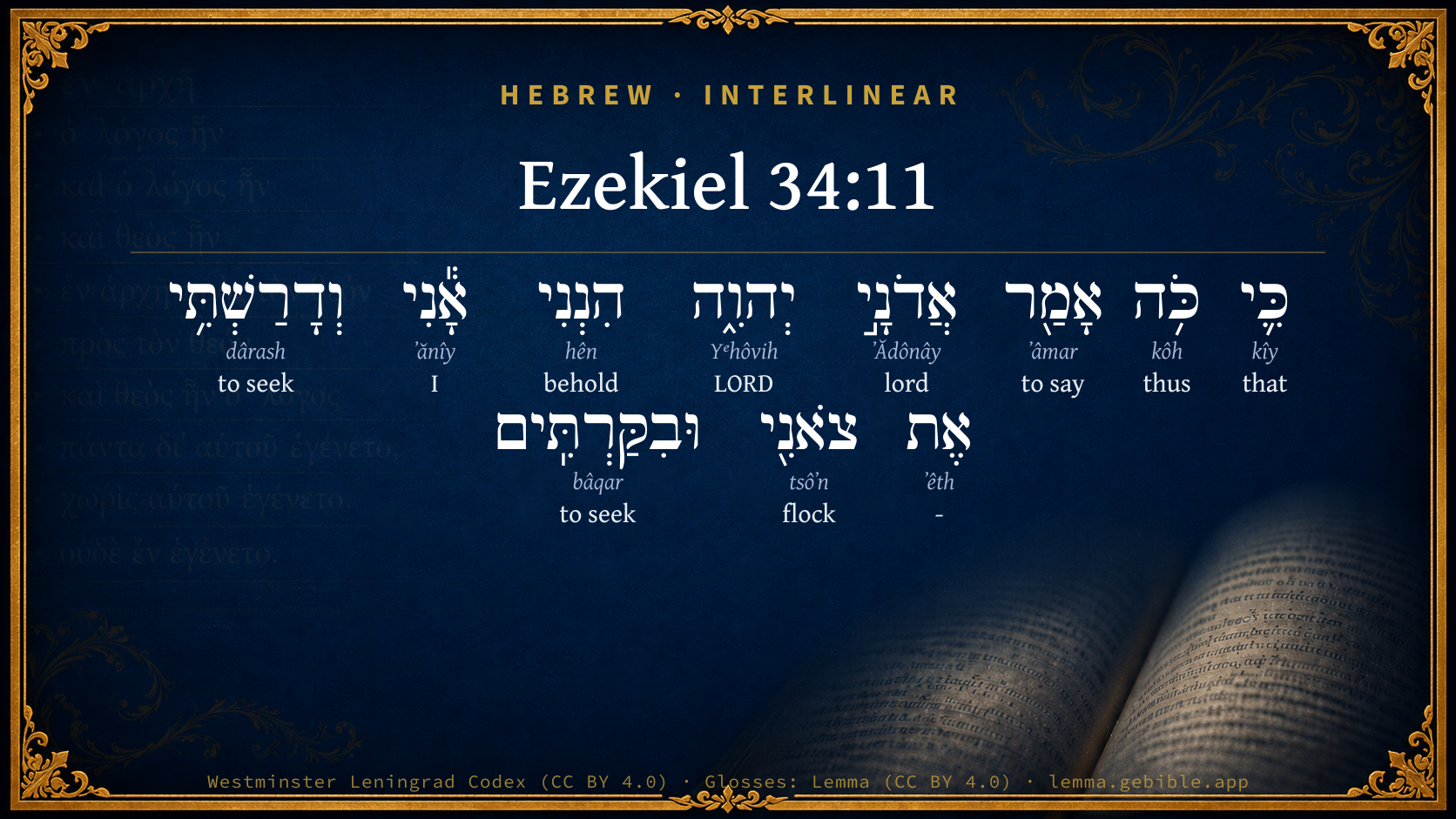
Hebrew (Westminster Leningrad Codex) Ezekiel 34:11 appears in the Hebrew Old Testament. The text above is from the Westminster Leningrad Codex. Each word links to its Strong’s number, a concise gloss, and parsing drawn from the Open Scriptures Hebrew Bible morphology. Click any word for its full Brown-Driver-Briggs (BDB) entry.
Download image
Cite this verse

Ezekiel 34:11 (World English Bible). Public Domain. Lemma interlinear Bible study tool, https://lemma.gebible.app/v/ezekiel/34/11.

Show BibTeX & RIS
BibTeX
RIS
English Translation
For thus says the Lord Yahweh: Behold, I myself, even I, will search for my sheep, and will seek them out.
World English Bible · Public Domain
Download a study sheet

One document with this verse’s original text, its word-by-word gloss line, the meaning frame, cross-references with their text, attributed commentary, and full source and license credits — printable, and it pastes into notes with its structure intact.

This verse Autodidact and up

Study sheet (.html) Plain text (.txt)

A passage Seminary Student

Up to 50 verses in one chapter. A passage sheet keeps up to 6 commentary sources and 12 cross-references per verse, in the order this page ranks them, and says so on the sheet whenever that leaves anything out. Ask for a single verse and you get the Autodidact verse sheet above.

Everything on this page stays free to read, with no account — the sheet is a download of what is already on screen, not access to it.

Want to remove ads? Support Godless Engineer
Compare translations 3

The same verse in 3 English versions, stacked beneath the original-language interlinear above. Click any original word for its lexicon entry.

Each is an independent rendering of the whole verse — the interlinear is not word-aligned to these translations.

Highlighted words mark where these versions differ — a whole-verse word diff, not a word-by-word alignment.

  • World English Bible Public Domain
    For thus says the Lord Yahweh: Behold, I myself, even I, will search for my sheep, and will seek them out.
  • King James Version Public Domain
    For thus saith the Lord GOD; Behold, I, even I, will both search my sheep, and seek them out.
  • unfoldingWord Literal Text CC BY-SA 4.0
    For the Lord Yahweh says this: Behold! I myself will seek out my flock and I will look after them,

unfoldingWord Literal Text — © unfoldingWord, licensed CC BY-SA 4.0. Word-aligned USFM3 via Door43 (git.door43.org/unfoldingWord/en_ult).

Versions to compare (up to 4)

3 of 4 selected

Show all 18 translations

Every available English version of this verse, each an independent rendering of the whole verse.

  • World English Bible Public Domain
    For thus says the Lord Yahweh: Behold, I myself, even I, will search for my sheep, and will seek them out.
  • Berean Standard Bible Public Domain
    For this is what the Lord GOD says: ‘Behold, I Myself will search for My flock and seek them out.
  • Majority Standard Bible Public Domain
    For this is what the Lord GOD says: ‘Behold, I Myself will search for My flock and seek them out.
  • King James Version Public Domain
    For thus saith the Lord GOD; Behold, I, even I, will both search my sheep, and seek them out.
  • American Standard Version (1901) Public Domain
    For thus saith the Lord Jehovah: Behold, I myself, even I, will search for my sheep, and will seek them out.
  • Revised Version (1885) Public Domain
    For thus saith the Lord GOD: Behold, I myself, even I, will search for my sheep, and will seek them out.
  • Geneva Bible (1599) Public Domain
    For thus sayeth the Lord God, Beholde, I will search my sheepe, and seeke them out.
  • Douay-Rheims (1899) Public Domain
    For thus saith the Lord God: Behold I myself will seek my sheep, and will visit them.
  • Young's Literal Translation Public Domain
    For thus said the Lord Jehovah: Lo, I -- even I, have required My flock, And I have sought it out.
  • Literal Standard Version CC BY-SA 4.0
    For thus said Lord YHWH: Behold, I—even I, have required My flock, || And I have sought it out.
  • Unlocked Literal Bible CC BY-SA 4.0
    For the Lord Yahweh says this: Behold! I myself will seek out my flock and I will look after them,
  • unfoldingWord Literal Text CC BY-SA 4.0
    For the Lord Yahweh says this: Behold! I myself will seek out my flock and I will look after them,
  • Darby Bible Public Domain
    For thus saith the Lord Jehovah: Behold I, [even] I, will both search for my sheep, and tend them.
  • World Messianic Bible Public Domain
    “‘For the Lord GOD says: “Behold, I myself, even I, will search for my sheep, and will seek them out.
  • Webster's Bible Public Domain
    For thus saith the Lord GOD; Behold, I even I, will both search for my sheep, and seek them out.
  • Free Bible Version CC BY-SA 4.0
    For this is what the Lord God says: Watch as I myself will go looking for my sheep, searching to find them.
  • Bible in Basic English Public Domain
    For this is what the Lord has said: Truly, I, even I, will go searching and looking for my sheep.
  • JPS Tanakh (1917) Public Domain
    For thus saith the Lord GOD: Behold, here am I, and I will search for My sheep, and seek them out.

Literal Standard Version (2020), Covenant Press — licensed CC BY-SA 4.0. Text via the HelloAO Bible API (eBible.org). Unlocked Literal Bible (unfoldingWord) — licensed CC BY-SA 4.0. Text via the HelloAO Bible API (eBible.org). unfoldingWord Literal Text — © unfoldingWord, licensed CC BY-SA 4.0. Word-aligned USFM3 via Door43 (git.door43.org/unfoldingWord/en_ult). Free Bible Version, Dr. Jonathan Gallagher — licensed CC BY-SA 4.0. Text via the HelloAO Bible API (eBible.org).

Word by word

More ways to search: Search by grammar → Find every occurrence → Compare this word →

Practice this passage: Drill this verse → Learn its vocabulary →

וּבִקַּרְתִּֽים
bâqar
H1239
“and · to seek · them”
Conjunction + Verb, Piel, Sequential Perfect, 1st Person, Common, Singular + Suffix, Personal, 3rd Person, Masculine, Plural
Part of Speech
Conjunction + Verb
Stem
Piel
Form
Sequential Perfect
Person
1st Person
Gender
Common
Number
Singular
Full BDB Definition

Origin: a primitive root

TWOT: 274

to seek, enquire, consider - (Piel) - to seek, look for - to consider, reflect
  1. כִּ֛י kîy H3588 “that” Conjunction
  2. כֹּ֥ה kôh H3541 “thus” Adverb
  3. אָמַ֖ר ʼâmar H559 “to say” Verb, Qal, Perfect, 3rd Person, Masculine, Singular
  4. אֲדֹנָ֣י ʼĂdônây H136 “Lord · my” Noun, Common, Masculine, Plural, Construct + Suffix, Personal, 1st Person, Common, Singular
  5. יְהוִ֑ה Yᵉhôvih H3069 “LORD” Noun, Proper
  6. הִנְנִי hên H2005 “behold · me” Particle, Demonstrative + Suffix, Personal, 1st Person, Common, Singular
  7. אָ֕נִי ʼănîy H589 “I” Pronoun, Personal, 1st Person, Common, Singular
  8. וְדָרַשְׁתִּ֥י dârash H1875 “and · to seek” Conjunction + Verb, Qal, Sequential Perfect, 1st Person, Common, Singular
  9. אֶת ʼêth H853 “-” Particle, Direct Object
  10. צֹאנִ֖י tsôʼn H6629 “flock · my” Noun, Common, Both, Singular, Construct + Suffix, Personal, 1st Person, Common, Singular

About this verse

These counts appear in no published source. They are computed here, from the morphology-tagged text and Lemma’s own curated glosses. What Lemma adds →

11
words
11
distinct lemmas
Prophets
section

Notable vocabulary

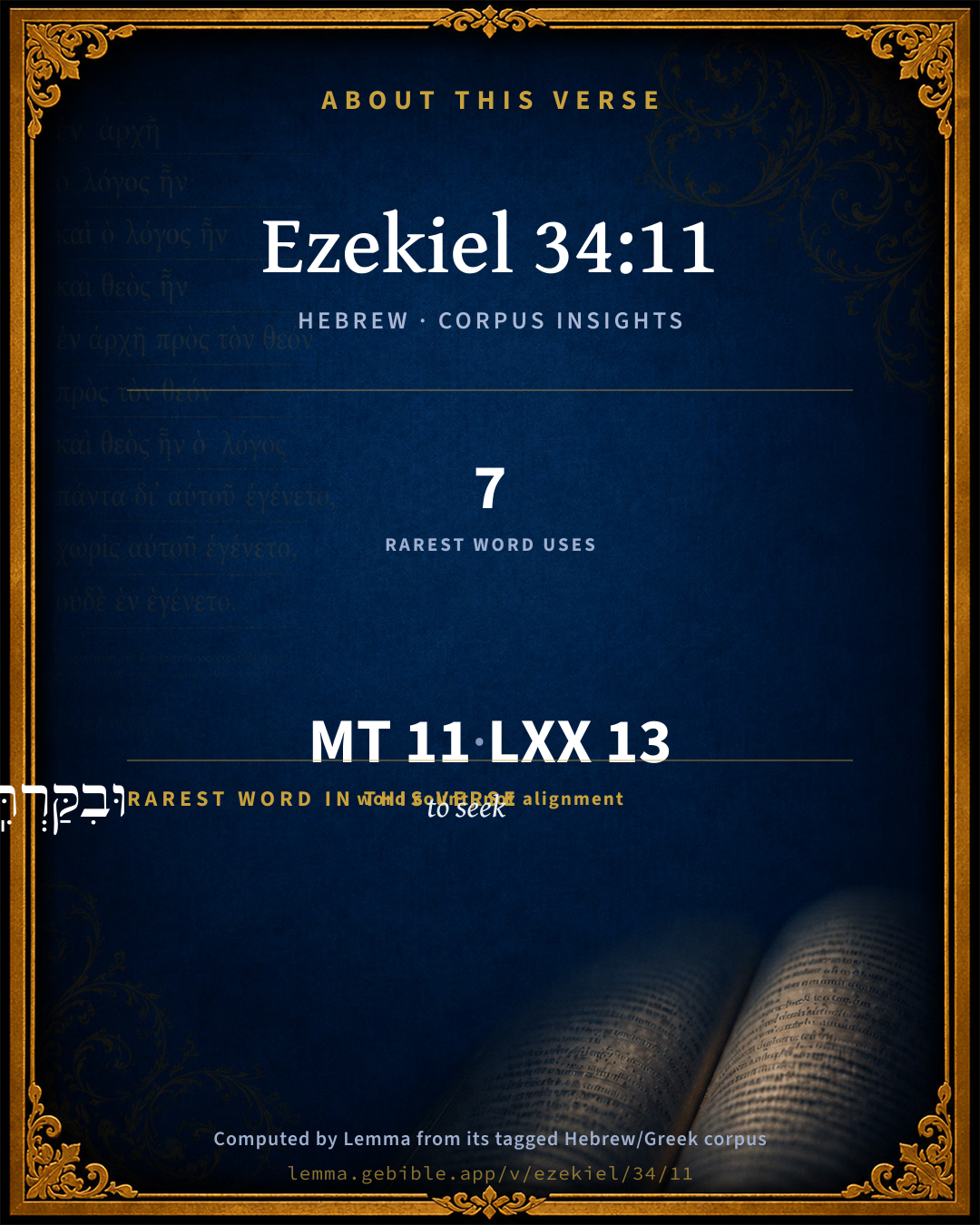
The rarest word here is וּבִקַּרְתִּֽים to seek H1239 — appearing just 7 times in the whole Hebrew Bible.

Shared distinctive vocabulary

וּבִקַּרְתִּֽים to seek H1239 occurs in 7 verses of the Hebrew Bible. Also found in:

Grammatical profile

  • 3 verbs
  • 3 nouns
  • 1 pronoun
  • 1 conjunction
  • 1 adverb
  • 2 particles

Verb forms

  • אָמַ֖ר Qal · Perfect
  • וְדָרַשְׁתִּ֥י Qal · Sequential Perfect
  • וּבִקַּרְתִּֽים Piel · Sequential Perfect

Hebrew & Septuagint length

In English translation the verse runs 21 words from the Hebrew and 17 from the Septuagint (LXX English) — closely comparable.

A rough comparison of the two English renderings, which tokenize alike — not a word-level alignment.

Word counts can differ between the Hebrew and the Greek without any difference in meaning — e.g. the Hebrew direct-object marker אֵת has no separate Greek word, and Greek often adds the article ὁ.

In the original languages it is 11 Hebrew tokens and 13 Greek tokens — but the two are counted differently (Hebrew bundles its prefixes and suffixes into one token; the Greek is in lemma form), so that isn’t a like-for-like length.

Cross-references

19

Topical passages linked to Ezekiel 34:11 in the Treasury of Scripture Knowledge — connected by theme and wording, ordered by reader-vote popularity; previews shown in the World English Bible.

  • John 10:16 I have other sheep, which are not of this fold. I must bring them also, and they will hear my voice. They will become one flock with one shepherd.
  • Luke 19:10 For the Son of Man came to seek and to save that which was lost."
  • Isaiah 40:10–11 Behold, the Lord Yahweh will come as a mighty one, and his arm will rule for him: Behold, his reward is with him, and his recompense before him.
  • Jeremiah 23:3 I will gather the remnant of my flock out of all the countries where I have driven them, and will bring them again to their folds; and they shall be fruitful and multiply.
  • Jeremiah 31:8 Behold, I will bring them from the north country, and gather them from the uttermost parts of the earth, [and] with them the blind and the lame, the woman with child and her who travails with child together: a great company shall they return here.
  • Psalms 80:1 Hear us, Shepherd of Israel, You who lead Joseph like a flock, You who sit above the cherubim, shine forth.
  • Isaiah 45:12 I have made the earth, and created man on it: I, even my hands, have stretched out the heavens; and all their host have I commanded.
  • Isaiah 56:8 The Lord Yahweh, who gathers the outcasts of Israel, says, Yet will I gather [others] to him, besides his own who are gathered.
  • Psalms 23:1–3 Yahweh is my shepherd: I shall lack nothing.
  • Isaiah 51:12 I, even I, am he who comforts you: who are you, that you are afraid of man who shall die, and of the son of man who shall be made as grass;
  • Matthew 13:11–12 He answered them, "To you it is given to know the mysteries of the Kingdom of Heaven, but it is not given to them.
  • Deuteronomy 32:39 See now that I, even I, am he, There is no god with me: I kill, and I make alive; I wound, and I heal; There is none who can deliver out of my hand.
  • Psalms 119:176 I have gone astray like a lost sheep. Seek your servant, for I don't forget your commandments.
  • Isaiah 48:15 I, even I, have spoken; yes, I have called him; I have brought him, and he shall make his way prosperous.
  • Ezekiel 5:8 therefore thus says the Lord Yahweh: Behold, I, even I, am against you; and I will execute judgments in the midst of you in the sight of the nations.
  • Hosea 5:14 For I will be to Ephraim like a lion, And like a young lion to the house of Judah. I myself will tear in pieces and go away. I will carry off, and there will be no one to deliver.
  • Genesis 6:17 I, even, I do bring the flood of waters on this earth, to destroy all flesh having the breath of life from under the sky. Everything that is in the earth will die.
  • Leviticus 26:28 then I will walk contrary to you in wrath; and I also will chastise you seven times for your sins.
  • Ezekiel 6:3 and say, You mountains of Israel, hear the word of the Lord Yahweh: Thus says the Lord Yahweh to the mountains and to the hills, to the watercourses and to the valleys: Behold, I, even I, will bring a sword on you, and I will destroy your high places.

Cross-references courtesy of OpenBible.info (CC BY 4.0).

Hebrew and Greek witnesses Masoretic Hebrew ↔ Greek Septuagint

The same verse in the two great witnesses to the Old Testament, shown verse-for-verse.

These are two independent witnesses, not word-aligned to each other, and the Septuagint is shown in lemma (dictionary) form.

Hebrew Ezekiel 34:11 Masoretic · Westminster Leningrad Codex

כִּ֛י כֹּ֥ה אָמַ֖ר אֲדֹנָ֣י יְהוִ֑ה הִנְנִי אָ֕נִי וְדָרַשְׁתִּ֥י אֶת צֹאנִ֖י וּבִקַּרְתִּֽים

For thus says the Lord Yahweh: Behold, I myself, even I, will search for my sheep, and will seek them out.

World English Bible · Public Domain

Greek LXX Ezekiel 34:11 Septuagint · lemma form

διότι ὅδε λέγω κύριος ἰδού ἐγώ ἐκζητέω ὁ πρόβατον ἐγώ καί ἐπισκέπτομαι αὐτός

For thus says the Lord God, Behold, I will seek out my sheep, and will visit them.

LXX2012 (modern English Septuagint) · Public Domain

On this verse, Keil & Delitzsch discusses the Septuagint’s reading. Read the note in Commentary ↓

Hebrew: Westminster Leningrad Codex (CC BY 4.0). Greek: Septuagint (public domain); English from LXX2012 (modern English Septuagint) (Public Domain). How the Septuagint differs from the Hebrew →

Targum (Aramaic paraphrase)

1

The Targum is the ancient Jewish Aramaic paraphrase of the Hebrew Scriptures — an interpretive translation, not the Hebrew text itself. Onkelos (literal) and Pseudo-Jonathan (expansive) render the Torah, and Jonathan the Prophets. Coverage is partial: where no permissively-licensed English translation exists for a verse, only the Aramaic is shown. This is verse-level text, not a word-by-word alignment to the Hebrew.

  1. Targum Jonathan Prophets (Joshua–Malachi)
    אֲרֵי כִּדְנַן אֲמַר יְיָ אֱלֹהִים הָא אֲנָא מִתְגְלִי וְאֶתְבַּע יַת עַמִי וַאֲבַקְרִינוּן:

    (no public-domain English translation for this verse)

    Targum Jonathan — Aramaic: “Mikraot Gedolot” (public domain). English: “Sefaria Community Translation” (CC0 1.0 (public-domain dedication)); “London "Chaldee Paraphrase," 1871” (public domain). Text via Sefaria.

Commentary

Notes on Ezekiel 34:11 from classic Christian and Jewish commentators (each source and its license shown beneath its notes). The classic Christian expositions comment on the surrounding passage and are grouped to its opening verse, so a note may address several verses; the Jewish commentaries on the Tanakh (Rashi and others) are per-verse, so they appear only where the commentator wrote on this verse.

Lemma curates 59 commentaries, every one of them public domain or Creative Commons licensed, each selected and text-cleaned for this edition rather than reprinted as found. About our sources →

Trapp's Complete Commentary

John Trapp

Eze 34:11 For thus saith the Lord GOD; Behold, I, [even] I, will both search my sheep, and seek them out.

Ver. 11. Behold, I, even I, {a} will both search.] Ego, ego reposcam et anquiram. Rather than the work shall be undone, I will do all myself, and then it is sure to be well done. Aristotle telleth of a certain Persian, who, being asked, What did most of all feed the horse? answered, The master’s eye; and of a certain African, of whom, when it was demanded, What was the best manure or soil for a field? answered, The owner’s footsteps - that is, his presence and perambulation. Praesul ut praesit et prosit suis, ab iis non absit, Shepherds should reside with their flocks; the Arch-shepherd will not fail to do so.

{a} Ego, ego, nominativus absolute positus - OEconom., lib. i.

John Trapp, A Commentary or Exposition upon All the Books of the Old and New Testament (1647–1656) — public domain. Text from a community e-Sword module.

The Biblical Illustrator

Joseph S. Exell

Eze_34:11-19

I, even I, will both search My sheep, and seek them out.

The flock sought and found

Is the Great Shepherd to leave the stray sheep to wander and perish? or is He to pity and reclaim them? In the Crimean War there were two ways, very different from each other, in which heroic deed manifested itself. One was, by our soldiers indomitable courage in the field,--when brave men stood manfully to their guns, and poured the iron hail against fearful odds. That was the stern glory of carnage and destruction. The other unfolds a picture in strange and startling contrast with this. At midnight, in stiffed hospital wards, amid the light of dim lamps and moans of sufferers, a gentle form of pity flitted from couch to couch, with words and looks and deeds of mercy;--pale lips kissing the shadow on their pillows as it passed. On which of the two does the mind love most to dwell? On that field of stern desperate valour; or on these hushed corridors, away from the roar of battle, with the one hero-heart moving like a ministering angel amid the congregated crowd of wounded and dying? Gods way regarding man (with reverence we say it) was the latter. We may look to this truth, first, in its simplest aspect. The soul, as we have already noted, is ever and anon manifesting some undefined longing after its lost portion in God. But it has in itself a hopeless moral inability to return. It cannot retrace its lost way. Alas! often there is rather the plunging deeper and deeper amid the pathless wilds of ruin, till, in addition to inability, there is added disinclination to be restored to the long lost fold. The sheep, rather than return to the Shepherd, will go roaming in search of other pastures--increasing its mournful distance from the fold, and bringing it only into more perilous vicinity to the lions dens and the mountains of the leopards. How, then, can the sinner be reclaimed? It is manifest that by no self-originated effort can he return. If saved, it must be by another. Himself he cannot,--himself he will not save. Omnipotence alone can bring it back. It is easy enough to take the tiara of priceless diamonds, or the necklace of gold, and plunge it down in mid ocean; but it is not so easy to descend through that untraversed barrier, that liquid rampart which rolls defiant between, and get them up again. The soul, the true casket of lost treasures, by reason of its own sad principle of moral gravitation, sinks easily downward. But it is He alone who taketh up the waters in the hollow of His hand that cart rescue it from the depths of ruin and despair. Here, then, is the Gospels glorious history of the restoration of the wanderers. Marvellous condescension--unspeakable grace! He speaks in one of the verses which precede this chapter as if it were something wondrous,--something well-nigh incredible: Behold I, even I. The spot is still pointed out with pride, amid the rocky wilds of Dauphine, where nil eagle bore in its talons the infant which had been left smiling in fearless innocence in its cradle by the cottage door. One stalwart form after another tried to climb that giddy height for the rescue, but had to abandon it in despair. At last a fleet and nimble foot spurns all difficulties. Up she climbs, from crag to crag, until, reaching the dizzy eminence, she buries the yet living child in her bosom, saying, as a mothers tongue in such an hour alone could say, This my child was dead, and is alive again--was lost, and is found! But that was a mothers speechless affection for her offspring. As she brought her loved and lost back to her cottage home, and replaced it in the empty cradle, we would think it strange to hear her saying, Behold I, even I, have done this. Who could have done it but she? But what does the Infinite Jehovah see in us?--What claim have these sheep on this Shepherd of the universe--these sinners on their God?--None! The natural heart is a den of pollution, a haunt of evil, the nurturing home of rebellion. Not only, however, are we called to note and admire Gods grace and condescension; but to admire the sovereignty of that grace as shown in the selection of its objects. Mankind were not the only fallen family in the universe. Other sheep, not of the earthly fold, had also strayed from the Shepherd. Might we not have expected that, in resolving on the ransom and recovery of any lost ones, he would have made choice rather of a different race of wanderers? Fallen angels (the aborigines of heaven) were greater than man. Well may we pause and ponder this wondrous manifestation of sovereign grace in the salvation of sinners of the dust! Truly, indeed, this salvation of man is a story of grace. Turn the moral kaleidoscope as we may, the gleaming words still stand radiant before our eyes, By the grace of God we are what we are. Once more. Gods grace and compassion are further manifested in His untiring love and patience in the pursuit of the lost, till restoration and safety be ensured. In other words, we have to admire, not only His free grace and His sovereign grace, but what the old writers call His irresistible grace. Thus saith the Lord God, Behold I, even I, will both search My sheep and seek them out. He will not only search for them, but He will search till He discover them. He goeth after that which was lost until He find it. The Saviours love is bounded by no distance, is cooled by no difficulties, is repulsed by no obstacles. One of the noblest records of true heroism in Englands annals is of comparatively recent date; when a gallant vessel, manned with gallant hearts, vent forth amid the frowning icebergs of the Northern Seas, to search for a band of missing explorers. They sailed thither, buoyed with the faint, feeble hope that the object of their search might still be found, battling bravely with eternal winter. Alas! they went after the lost until they found them; but they found them with the stiffened snow and ice as their winding sheet! They brought not back the living, but only some sad mementoes and memorials of the dead. Not so is the journey, not so the pursuit, of the Great Shepherd of the sheep. His omniscient eye follows every wanderer. Those whom He has marked for His own He will, without fail, bring home. Not one can elude His pursuit, nor evade His loving scrutiny. (J. R. Macduff, D. D.)

The Divine Shepherd

I. The simile of Christ to a shepherd.

1. His character: a shepherd (Joh_10:14).

2. His employment: seeketh out (Eze_34:11).

3. The objects of His care: His flock (Isa_40:11).

4. Their condition: scattered (Joh_11:52).

5. Then the time of gathering: the day (Zec_13:1).

6. His situation: among them (Psa_132:13-14).

II. The important declaration. I will seek out.

1. By the word written (2Ti_3:15).

2. The word preached (1Co_1:23-24).

3. But always by the Spirit (Zec_4:6).

III. Why they are called His sheep.

IV. The deliverance of the sheep.

1. This implies determination: I will (Eze_13:21).

2. It denotes contest: deliver (Isa_49:25).

3. It signifies power: I will deliver them (Isa_40:29). All places.

(1) From all parts of the world.

(2) From all sinful practices.

(3) From all opposing powers (Rev_7:9).

4. It also denotes great wisdom in searching and distinguishing them; simply because--

(1) They are separated one from another.

(2) They mingle with the wicked. (T. B. Baker.)

In the cloudy and dark day.

The Shepherd seeking the flock in the cloudy and dark day

I. The lost. We may regard the figure as descriptive of those who (by imperceptible degrees) have erred and strayed from the Shepherds fold and presence. Once their landscape was bathed in sunshine;--the mountain tops of Gods faithfulness were clear;--the summits of the heavenly hills sparkled gloriously;--theirs were the green pastures and still waters,--the Shepherds voice to cheer them, and the Shepherds steps to guide them. But all is gloomy now;--the storm clouds have gathered in their once serene sky. It may arise from their own sluggish unconcern;--a drowsy, sleepy, callous frame,--the result of a gradual, but ever-deepening insensibility to Divine things;--a trifling with their spiritual interests;--languor in prayer--conformity with the world--tampering with sins of omission--venturing on forbidden or debatable ground.

II. Those who are driven away. Some overt act has been the cause of their scattering. Look at David as an illustration. His own iniquities separated between him and his God. He never after was the joyous believer he once was. He was indeed restored, pardoned, loved;--but the memory of that sad day followed him to the grave, and mantled Iris whole moral landscape with clouds, even to the very entrance of the dark valley. And how many among the true flock of the Shepherd have to tell a similar mournful tale! Some one guilty deed has laid the foundation of weeks and months--ay, years, of spiritual alienation and distance from the fold.

III. The broken. How numerous are these! Some are broken by calamity;--penury scattering them in its cloudy and dark day. Some are broken by bitter disappointment; an aching heart wound too sacred to be revealed has left them bleeding and desolate, refusing to be comforted. Some are broken by bereavement.

IV. The sick. We might take this in a figurative sense; as descriptive of those who are sick at heart,--sad and disconsolate with the trials and sins and sorrows of death, and with the corruptions of their own natures. But why not regard it literally, an applied to those laid on beds of sickness? Many among us who inadequately appreciate the talent of health are apt also to forget and overlook this large section in Gods world;--the poor afflicted ones, the maimed members of the flock.

V. To one and all of these scattered ones the Great Shepherd comes. He has a special word of comfort for each separate case.

1. Lost! He seeks you. Though you have forgotten Him, He has not forgotten you.

2. Ye who have been driven away, He will bring you again. Ye who, like the Psalmist of Israel, have unwarily left the pastures of peace and security, and entangled yourselves in the midnight forest of danger and sin; the grace of Him who first brought you to the fold is able to bring you back again, and restore to you the joys of His salvation.

3. Broken ones! Ye who are crushed and mutilated by the thousand ills of suffering and sorrow: rejoice! That Shepherd came to bind up breaking hearts; His name is The Healer of the broken hearted.

4. Sick! Ye pining sufferers in earths great hospital! Ye bleating sheep, lying languid and helpless in the fold--He, the Great Shepherd, comes to strengthen you. A sick bed--where the noisy world is shut out--where its cares and anxieties and aspirations and ambitions are no longer present to hamper and harass--what a blessed season for converse with the Infinite.

VI. The gracious adaptation of Christs dealings to the different wants and trials and necessities of His people.

1. He seeks the lost; and on finding them a look of love suffices to bring the conscience-stricken wanderers back.

2. He brings again the driven away. Those cowering in terror at their own wilful blindness and apostasy, their deep ingratitude and heinous guilt, need help, encouragement, guidance;--they need being carried in the Shepherds arms.

3. He binds up the broken; He stanches the bleeding wound with the application of tender restoratives--the balm words of His own exceeding great and precious promises. He, the Brother born for adversity, teaches the wounded spirit, and He alone can, how to bear in this dark and cloudy day; He turns the shadow of death into the morning.

4. He strengthens the sick--those who for years on years have been laid on couches of languishing--secluded from the gladsome light of day, on whose ears the tones of the Sabbath bell fall only to tell of forfeited privileges. They can best bear attestation how a mysterious, sustaining strength, not their own, is imparted to them, which makes them wonders to themselves.

Let us close with two practical reflections.

1. The all-sufficiency of the Shepherds power and love. There is no case He cannot meet. Lost ones, driven ones, broken ones, sick ones. It seems to exhaust the circle of human wants and necessities. He seems to anticipate every supposable case, so that none dare say that Shepherd-love does not include me.

2. This precious passage, so full of tenderness and love to the erring, the backsliding, the suffering, ends with a brief but most solemn utterance of judgment on the impenitent, the self-righteous, and unbelieving. He that has rest for disquieted saints, says Matthew Henry, has terror to speak to presumptuous sinners. (J. R. Macduff, D. D.)

Shadows of religious life

Night and morning are familiar types of human life in its alternation of shadow and sunshine, its chequered history of grief and joy. Weeping may endure for a night, but joy cometh in the morning. It is the law of nature and of humanity. Is it not also the law of the higher spiritual life? No doubt there are moments of rare enjoyment in the experience of a godly man; moments of special communion with the Unseen. But there are seasons, too, of a widely different complexion, when the firmament above him darkens into a hemisphere without a star, and the heart within him grows sick of the weary struggle, and he is sorely tempted, like Elijah, to fold his head in his mantle, and lie down in despair to die.

1. These shadows of religious life sometimes originate in physical disease. Very wonderful is the sympathy between body and soul. Many a life might be comparatively blithesome, but that chronic dyspepsia fills it with morbid fears and feelings. Trifling with the delicate mechanism of the human frame has brought upon many excellent people a settled melancholy, an impression that they have committed some unpardonable sin, and are absolute outcasts from Gods covenant of mercy. Let the organ be out of tune, and Handel himself could not bring good music out of it; and when the nervous organism is unstrung, it is not surprising if the secret harmonies of the soul be turned into jars and discord. Temperance, chastity, and godliness,--the mens sana in corpore sano,--are a wellspring of perennial cheerfulness; but without them, the fountains of real pleasure are poisoned, life loses its zest and buoyancy, and becomes little better than a funeral march to death and judgment.

2. These shadows of religious life sometimes originate in personal wrong-doing. Misconduct is the ruin of tranquillity, and may cast a pall and blight over lifes fairest prospects. He who can do a deliberate wrong without a pang of regret is more demon than man. Peters backsliding cost him bitter tears. Davids double crime made his children a scourge and his conscience an accusing hell. Sauls transgression caused an evil spirit to enter into him, so that he sat in his palace, javelin in hand, silent, moody, and downcast. And the sin of Gods people, in like manner, may still rob them of solid peace, and make them acquainted, otherwise than by book, with Bunyans Slough of Despond, Doubting Castle, and Giant Despair.

3. These shadows of religious life sometimes originate in providential trials. Saint or sinner, if you are pricked you bleed; with this difference, that in the one case you possess a balm for the wound, in the other not. Insensibility would render Divine discipline a nullity. It is right to feel appropriately towards all things as they really are; nay more, such inflexion of feeling is a necessary condition of human amendment; Christianity is a nobler science of life than stoicism, for it teaches how sable and gold may both be woven into a robe of immortal radiance--how adversity, even more than prosperity, may come laden with the richest blessings.

4. These shadows of religious life sometimes originate in spiritual conflicts. No fortress on earth is so often beleaguered as the citadel of the human heart. No din of contending hosts is there--no anxious nations look on in breathless suspense--no change of temporal dynasty or statecraft or dominion is imminent; but the doom of an immortal soul is involved, and heaven and hell hang upon the final issue. The stake is tremendous, and all trifling is simply insane. The ground has to be won inch by inch, and, maybe, lost and won again. Shield of faith, helmet of salvation, breastplate of righteousness, girdle of truth, sword of the Spirit, greaves of love and peace, all bear marks of the severity of the strife. Protracted to the end of life, the battle is as arduous as it is honourable, and its wavering fortunes not unfrequently make one pensive, careworn, and disheartened. Thank God! though he fall, he shall rise again--he shall not be utterly cast down. An invincible Captain leads us on.

5. These shadows of religious life sometimes originate in doctrinal perplexities. It has been said that the Bible has shallows in which a lamb may wade, and deeps in which an elephant may swim. Unhappily, some who are not elephants venture to leave the terra firma of revealed truth, and to plunge into the bottomless sea of metaphysical divinity; and, as they cannot swim, they sink in deep waters, or flounder about like a log in a tempest, and the waves and billows go over them. Without putting a veto on legitimate inquiry, it is well to remember that secret things belong unto the Lord--that His eternal wisdom and kindness will manage them without human meddling--that no prying curiosity of ours can ever modify them in the least degree; and that for us the only possible solution of them is the testimony of individual character and life.

6. These shadows of religious life sometimes originate in the enigmas of Divine government. God in history, subordinating everything to His supreme will, and accomplishing through secondary agencies or otherwise His own sovereign purposes, is the basis of a good mans creed, and the sole pledge of humanitys regeneration. But, to mans thinking, how often do the ways of God seem a mystery, an anomaly, or even a contradiction! Everywhere the old Titanic forces of good and evil wrestle with each other in mortal combat, and the wonder is how the strife will end. And, standing face to face with facts like these, after some six thousand years of credible history, and some nineteen centuries of Christian teaching, many a heart cries out in fearfulness and pain: How long, O Lord, how long? Why tarry the wheels of Thy chariot? Oh, when shall the wickedness of the wicked come to a perpetual end? Pilgrims of the night! amid all this darkness, turmoil, and misery, rest in the Lord, and wait patiently for Him. (L. B. Brown.)

The Biblical Illustrator, edited by Joseph S. Exell (c. 1880s–1900s) — public domain. Text from a community e-Sword module.

Joseph Benson's Commentary

Eze 34:11-16. Behold, I, even I, will search my sheep — I myself will recall them from their wanderings into the right way; and will seek them out — Hebrew, בקדתים, I will seek them early, or, seek them in the morning. As a shepherd seeketh out his flock — With the greatest care and diligence; as he gathers them together, counts them, brings them to the fold, observes what they have suffered, and, if lame or torn, binds up and heals them, and provides pasture for them; so will I seek out my sheep, &c. — Though magistrates and ministers fail in doing their part for the good of the church, yet God will not fail in doing his; he will take his flock into his own hands, rather than it should be deprived of any kindness he had designed for it. The under shepherds may prove careless, but the chief Shepherd neither slumbers nor sleeps. They may be false, but he abides faithful. And deliver them out of all places where they have been scattered — Will bring them home from their several dispersions, whither they have been driven; in the cloudy and dark day — Hebrew, ביום ענן וערפל, in the day of clouds and darkness; in the dark and dismal time of the destruction of their country. And will bring them out from the people — This prophecy primarily respected their restoration from captivity in Babylon, and was in part at least fulfilled when so many thousands of them returned to their own land under the conduct of Zerubbabel, Ezra, and others. It seems, however, to look still further, even to the general restoration of the whole Jewish nation from their present wide dispersion over the whole world, which restoration most of the prophets foretel shall be effected in the latter days. But there is no need to confine this promise wholly to the Jews; when those, in any age or nation, that have gone astray from God into the paths of sin are brought back by repentance; when those that erred come to the acknowledgment of the truth; when God’s outcasts are gathered and restored, and religious assemblies that were dispersed are again collected and united upon the ceasing of persecution; and when the churches have rest and liberty, then this prediction has a true accomplishment. I will feed them in a good pasture — I will supply all their wants, and make ample provision for the support both of their natural and spiritual life. Upon the high mountains of Israel shall their fold be —

There shall they have fixed habitations upon their return, and there shall they rest in safety. There shall they lie in a good fold, &c. — These expressions denote both plenty and security. But I will destroy the fat and the strong — Those who oppress and tyrannise over the weak. I will feed them with judgment — I will judge, chastise, and punish them.

Joseph Benson's Commentary on the Old and New Testaments (1811–1818) — public domain. Text from a community e-Sword module.

Keil & Delitzsch

C. F. Keil & F. Delitzsch

Jehovah Himself will seek His flock, gather it together from the dispersion, lead it to good pasture, and sift it by the destruction of the bad sheep. - Eze 34:11. For thus saith the Lord Jehovah, Behold, I myself, I will inquire after my flock, and take charge thereof. Eze 34:12. As a shepherd taketh charge of his flock in the day when he is in the midst of his scattered sheep, so will I take charge of my flock, and deliver them out of all the places whither they have been scattered in the day of cloud and cloudy night. Eze 34:13. And I will bring them out from the nations, and gather them together out of the lands, and bring them into their land, and feed them upon the mountains of Israel, in the valleys, and in all the dwelling-places of the land. Eze 34:14. I will feed them in a good pasture, and on the high mountains of Israel will their pasture-ground be: there shall they lie down in a good pasture-ground, and have fat pasture on the mountains of Israel. Eze 34:15. I will feed my flock, and I will cause them to lie down, is the saying of the Lord Jehovah. Eze 34:16. That which is lost will I seek, and that which is driven away will I bring back; that which is wounded will I bind up, and that which is sick will I strengthen: but that which is fat and strong will I destroy, and feed them according to justice. Eze 34:17. And you, my sheep, thus saith the Lord Jehovah, Behold, I will judge between sheep and sheep, and the rams and the he-goats. Eze 34:18. Is it too little for you, that ye eat up the good pasture, and what remains of your pasture ye tread down with your feet? and the clear water ye drink, and render muddy what remains with your feet? Eze 34:19. And are my sheep to have for food that which is trodden down by your feet, and to drink that which is made muddy by your feet? Eze 34:20. Therefore thus saith the Lord Jehovah to them, Behold, I, I will judge between fat sheep and lean. Eze 34:21. Because ye press with side and shoulder, and thrust all the weak with your horns, till ye have driven them out; Eze 34:22. I will help my sheep, so that they shall no more become a prey; and will judge between sheep and sheep. - All that the Lord will do for His flock is summed up in Eze 34:11, in the words דּרשׁתּי את־צאני וּבקּרתּים, which stand in obvious antithesis to 'ואין דּורשׁ וגו in Eze 34:6 - an antithesis sharply accentuated by the emphatic הנני אני, which stands at the head in an absolute form. The fuller explanation is given in the verses which follow, from Eze 34:12 onwards. Observe here that biqeer is substituted for בּקּשׁ. בּקּר, to seek and examine minutely, involves the idea of taking affectionate charge. What the Lord does for His people is compared in Eze 34:12 to the care which a shepherd who deserves the name manifests towards sheep when they are scattered (נפרשׁות without the article is connected with צאנו in the form of apposition); and in Eze 34:12 it is still more particularly explained. In the first place, He will gather them from all the places to which they have been scattered. הצּיל implies that in their dispersion they have fallen into a state of oppression and bondage among the nations (cf. Exo 6:6). בּיום belongs to the relative clause: whither they have been scattered. The circumstance that these words are taken from Joe 2:2 does not compel us to take them in connection with the principal clause, as Hitzig and Kliefoth propose, and to understand them as relating to the time when God will hold His judgment of the heathen world. The notion that the words in Joel signify "God's day of judgment upon all the heathen" (Kliefoth), is quite erroneous; and even Hitzig does not derive this meaning from Joe 2:2, but from the combination of our verse with Eze 30:3 and Eze 29:21. The deliverance of the sheep out of the places to which they have been scattered, consists in the gathering together of Israel out of the nations, and their restoration to their own land, and their feeding upon the mountains and all the dwelling-places of the land (מושׁב, a place suitable for settlement), and that in good and fat pasture (Eze 34:14); and lastly, in the fact that Jehovah bestows the necessary care upon the sheep, strengthens and heals the weak and sick (Eze 34:15 and Eze 34:16) - that is to say, does just what the bad shepherds have omitted (Eze 34:4) - and destroys the fat and strong. In this last clause another side is shown of the pastoral fidelity of Jehovah. אשׁמיד has been changed by the lxx, Syr., and Vulg. into ,אשׁמורφυλάχω; and Luther has followed them in his rendering, "I will watch over them." But this is evidently a mistake, as it fails to harmonize with ארענּה במשׁפּט. The fat and strong sheep are characterized in Eze 34:18 and Eze 34:19 as those which spoil the food and water of the others. The allusion, therefore, is to the rich and strong ones of the nation, who oppress the humble and poor, and treat them with severity. The destruction of these oppressors shows that the loving care of the Lord is associated with righteousness - that He feeds the flock בּמשׁפּט.

This thought is carried out still further in Eze 34:17-21, the sheep themselves being directly addressed, and the Lord assuring them that He will judge between sheep and sheep, and put an end to the oppressive conduct of the fat sheep and the strong. בּין שׂה לשׂה: between the one sheep and the other. לשׂה is extended in the apposition, "the rams and he-goats," which must not be rendered, "with regard to the rams and he-goats," as it has been by Kliefoth. The thought is not that Jehovah will divide the rams and he-goats from the sheep, as some have explained it, from an inappropriate comparison with Mat 25:32; but the division is to be effected in such a manner that sheep will be separated from sheep, the fat sheep being placed on one side with the rams and he-goats, and kept apart from the lean (רזה, Eze 34:20) and the sickly sheep (נהלות, Mat 25:21). It is to the last-named sheep, rams, and he-goats that Mat 25:18 and Mat 25:19 are addressed. With regard to the charge brought against them, that they eat up the pasture and tread down the remainder with their feet, etc., Bochart has already correctly observed, that "if the words are not quite applicable to actual sheep, they are perfectly appropriate to the mystical sheep intended here, i.e., to the Israelites, among whom many of the rich, after enjoying an abundant harvest and vintage, grudged the poor their gleaning in either one or the other." משׁקע, a substantive formation, like מרמס, literally, precipitation of the water, i.e., the water purified by precipitation; for שׁקע, to sink, is the opposite of רפשׂ, to stir up or render muddy by treading with the feet (compare Eze 32:14 and Eze 32:2). בּריה, Eze 34:20 = בּראה or בּריּה. Eze 34:22 brings to a close the description of the manner in which God will deliver His flock, and feed it with righteousness. והושׁעתּי points back to והצּלתּי in Eze 34:12, and ושׁפטתּי to ארענּה במשׁפּט in Eze 34:16. - To this there is appended in Eze 34:23. a new train of thought, describing how God will still further display to His people His pastoral fidelity.

Keil & Delitzsch — Biblical Commentary on the Old Testament (1861–1891) — public domain (CC PDM 1.0). Text via the HelloAO Bible API. (Old Testament only.)

Fairbairn on Ezekiel, Jonah & the Pastoral Epistles

Patrick Fairbairn

Eze 34:11. For thus saith the Lord Jehovah, Behold, I come (I, the proprietor of the sheep, now appear on the field in their behalf), and seek after my flock, and search them out.

Eze 34:12. Like a shepherd’s searching of his flock, in the day that he is in the midst of his flock that has been scattered, so will I search out my sheep, and deliver them from all the places whither they have been scattered in the day of clouds and thick darkness.

Eze 34:13. And I lead them forth from the peoples, and gather them from the countries, and bring them to their own land, and feed them upon the mountains of Israel, beside the streams and all the habitable portions of the land.

Eze 34:14. With good pasture I will feed them, and upon the mountains of the height of Israel (On two former occasions (Eze 17:23; Eze 20:40) the prophet had used the expression, “the mountain of the height of Israel,” or its high mountain; but here we have the plural, “the mountains of the height.” The reason of the difference is evident: there the prophet spoke of the centre of the kingdom, where the king was to have his seat, and the people were to meet for the worship of Jehovah—Mount Zion; but here he speaks of the kingdom at large—the entire region occupied by the flock. The mountains oil which they roam are still, however, the mountains of the height of Israel, because everything in Israel has a moral elevation—a height, not as perceived by the eye of flesh, but well known and discerned by the eye of faith; for to it the high places of the earth are always those where God’s kingdom is.) shall their lair be; there shall they lie down in a good lair, and in a fat pasture shall they feed upon the mountains of Israel.

Eze 34:15. I will feed my flock, and I will make them to lie down, saith the Lord Jehovah.

Eze 34:16. That which is lost I will search out, and that which is driven away I will bring back, and will bind up that which is broken, and will strengthen that which is weak; but the fat and the strong I will destroy, I will tend them with judgment.

Eze 34:17. And for you, my flock, thus saith the Lord Jehovah, Behold, I judge between sheep and sheep, rams and he-goats. (The parties meant here by the rams and the he-goats are evidently the same as in Eze 34:16, and are called “the fat and the strong,” as contradistinguished from the lean, the weak, and the sick. The Lord would judge between sheep and sheep, the rams and he-goats; that is, between the sheep generally, and this particular class of them, the more robust and headstrong part; for the לָשֶׂה is in apposition with the two expressions that follow,—the rams and he-goats; these form the evil-doers that are to be distinguished from the שֶׂח, the flock generally. Many have erred in supposing that by this fat and robust class are represented the rulers of the people, identifying them with the shepherds in the earlier portion; against the connection, for these have already been judged and disposed of (Eze 34:10-11), and also against the natural import of the figure, which treats here of one part of the flock as compared with another. The misconduct of the rulers had been, imitated by the stronger and more ungodly portion of the people, who had dealt unkindly with their poorer brethren, and acted as if it would even be an enhancement of their own comforts to oppress and trample on the rights of others. The description given is of a haughty, insolent, and selfish disposition,—the very reverse of that required in the kingdom of God; and hence one that must be judged and punished by him.)

Eze 34:18. Is it too little for you that ye eat up the good pasture, but that ye tread down the residue of your pastures with your feet? and that ye drink of the deeper waters (i.e., the clearer and cooler), but that ye trouble the residue of them with your feet?

Eze 34:19. And my flock! they feed on what has been trodden by your feet; and drink of what has been troubled by your feet.

Eze 34:20. Therefore, thus saith the Lord Jehovah to you, Behold, I come and judge between the fat sheep and the lean sheep.

Eze 34:21. Because with side and with shoulder ye have pushed, and with your horns have thrust at all the weak, till ye have scattered them abroad;

Eze 34:22. And I deliver my flock, and they shall no more be for a prey, and I judge between sheep and sheep.

Eze 34:23. And I will raise up over them one shepherd, (The emphasis is here on the singleness of the shepherd, רֹעֶה אֶחָד, a shepherd, one: qualified to exercise an undivided superintendence over the covenant-people, as opposed to the old division, fraught with such unhappy results, into the two kingdoms of Judah and Israel. It implies, of course, the possession of singular qualities in the one who should be appointed to hold such a place; he must be in the fullest sense a shepherd after God’s own heart, capable of healing far worse divisions, and rectifying far worse disorders, than those which prevailed when David came to the throne. In this oneness, therefore, of the promised shepherd, an intimation of his pre-eminent excellence lies concealed; as is also presently expressed, in his being called “my servant David”—my servant, not pursuing a self-chosen and arbitrary course, as so many of the kings had done, but acting as the faithful administrator of the will of God. In an immense number of passages this appellation is given to David, to indicate his peculiar fitness for the office of ruling in the name of God.) and he will feed them, my servant David, he will feed them, and he will be their shepherd.

Eze 34:24. And I Jehovah will be their God, and my servant David a prince among them; I Jehovah have spoken.

Eze 34:25. And I establish for them a covenant of peace, and cause the evil beasts to cease out of the land, and they dwell in the wilderness securely, and sleep in the woods.

Eze 34:26. And I will make them and the environs of my hill a blessing; and I will cause the rain to come clown in its season; there shall be showers of blessing. (What is meant by my hill in the first clause of this verse is undoubtedly Zion, for this was God’s hill by way of eminence. But the idea of Hengstenberg, that this hill here designates Israel as the people of God, and that the environs are the heathen who join themselves to Israel, is quite unnatural. The discourse here is simply of Israel, and of the blessings to be conferred on them. They are represented as dwellers on God’s hill of Zion, where, as in the seat and centre of all good, they are richly blessed; but not they alone, the blessing streams forth, and all the environs of the hill partake in the beneficence of Heaven. All the suburbs, the pasture grounds (for the allusion is plainly to that), are refreshed from the Lord’s presence, as well as the people themselves. And so the idea indicated is presently expressed more fully by the promise of rain in plentiful abundance, to produce a rich pasturage. In this promise, as well as in the promise of peace and security, allusion is made to Lev 26:2-6, where these blessings are specially connected with the covenant of God.)

Eze 34:27. And the tree of the field shall yield its fruit, and the land shall give forth its increase, and they shall be on their land in security, and they shall know that I am Jehovah, when I break their yoke, and deliver them from the hand of those who made slaves of them.

Eze 34:28. And they shall no more be for a prey to the heathen, and the wild beasts of the earth shall not devour them; and they shall dwell securely, and there is nothing that shall make them afraid.

Eze 34:29. And I raise up to them a plantation for a name, and no more shall they be taken away by hunger in the land, and no more shall they bear the reproach of the heathen. (By “the plantation for a name,” or renown, that the Lord promises in the earlier part of this verse to raise up, is not to be understood Israel itself, but something for Israel’s benefit, something that would give them a name of honour among the nations, and take away for ever the reproach of poverty and want. It simply means that the Lord would secure for them a flourishing and prosperous condition, under the image of “a place well planted with fruitful trees, rising aloft and growing through the goodness of God, so that the Israelites should be replenished with the means of nourishment, and be no more impoverished with want” (Gussetius Lex.). An allusion appears to be made, as Hengstenberg and Hävernick suggest, to Gen 2:8-11, where the garden of Eden is described with its trees of all kinds good for food and pleasant to the sight: the land of Israel would become such a glorious plantation—a second Eden.)

Eze 34:30. And they shall know that I Jehovah, their God, am with them, and they are my people, the house of Israel, saith the Lord Jehovah.

Eze 34:31. And ye my flock, my pasture-flock, men are ye, I am your God saith the Lord Jehovah. (Dathe, Ewald, and others, would understand the declaration in this closing verse as a mere explanation of the parable—that the flock are the men of Israel, and the shepherd is God. But there is evidently an emphasis on the men: men are ye; remember your place, you are but men; but remember at the same time that I am your God; so that without me nothing, but with me all. Hitzig prefers the miserable tautology of the LXX.: “ye are my sheep and the sheep of my flock, and I am,” etc., and calls it an excellent sense!!)

A succession of blessings is promised to the covenant-people in this glowing delineation. First, the evils were to be rectified that bad sprung from the former misrule and corruption—the scattered flock gathered again from its dispersions, and restored to the good pasturage of the mountains of Israel. Then the internal disorders that had been allowed to exist and grow, like festering sores, among the flock themselves,—the selfishness and fraud and violence which had so greatly marred the mutual flow and interchange of good, and aggravated every evil,—these were now to be rooted out; for the persons indulging in such unrighteous dispositions were to be judged by God, and hence forth denied a place in his kingdom. Then again, in lieu of the false shepherds who had formerly wasted and devoured the flock, there was to be raised up one, the pre-eminently good shepherd, the Lord’s servant David, who by his wise and faithful administration should prevent such disorders and misrule from again arising, and should establish throughout the whole land, even to its wildernesses and forests, perfect security and peace. Finally, in fit correspondence with this happy state of internal order and settled righteousness, all was to be smiling and prosperous outwardly—refreshing showers of rain to fertilize the ground, fruitful fields, cultivated by a free and joyous people, crops everywhere yielding their produce, and trees their fruit in due season—all exhibiting the delightful spectacle of a flock pastured by God himself, or a people enjoying the noble distinction of having him for their God, and sharing in the richest manifestations of his goodness.

In principle, it will be observed, this promise of future good is precisely similar to what has already so frequently appeared in the threatenings of judgment. It takes the form of a renewal of the old, with such modifications and changes as might adapt it to the altered circumstances of the time to come. When judgment was the prophet’s theme, the Spirit led him to predict the return of the years of former troubles and desolations, not only of the more general calamities often experienced, of famine and sword and pestilence, but even of the more peculiar afflictions of the Egypt-state of bondage and oppression, and the dreary sojourn in the wilderness. So germane to the prophet’s cast of mind is this mode of representation, that even when he passes out of the territory of Israel, and speaks of what was to befall the nations of the earth—there, too, when the delineation is of a lengthened and minute description (as in the cases of Tyre and Egypt), it is as a recurrence of the past that he delights to present the evil to our view: the history of Tyre’s head and representative is a kind of rehearsal of the best and the worst in the general history of man; and Egypt is spoken of as passing through Israel’s peculiar experiences of evil—her bondage, her dispersion, and even her forty years’ sojourn in the wilderness; Not that in any of these cases of threatened judgment there was to be the exact reproduction of the old, but only a renewal of its general character and design—a repetition of it in its essential moral features. And in each case peculiar traits, we found, were introduced into the delineation, as if on purpose to indicate that not the literal recurrence of the past was intended, but only what chiefly characterised it as a dispensation of God. Now the correspondence in form between those threatenings of evil and this promise of good, warrants us in applying to it the same principle of interpretation; and indeed the earlier here, as in all similar cases, must be taken as the key to the latter. The uniformity that we expect to characterise the productions of the same hand demand that it be so taken. Nor can we fail to perceive here also the introduction of such an ideal trait as was sufficient to show that the past only in character, not in the precise forms and outward conditions of being was to be expected. For while we are told of a recovered possession of the mountains of Israel, and a secure habitation there as in the best periods of the past, and a fruitful inheritance and a united people dwelling under the peculiar favour and blessing of Jehovah, we are at the same time told of David being the shepherd under whose invigorating influence and paternal oversight the Lord’s flock were to rise to such a height of peace and prosperity. But David has long ago slept with his fathers, having “served his own generation according to the will of God;” and not the literal David restored to life again, but a distinguished scion of David’s house, as our prophet had himself already announced (Eze 17:22, Eze 21:27), was to be the future head and leader of the Lord’s people. Shall we therefore consider the name of the father here put for the name of the son? Shall we merely substitute the Messiah for David, and hold that with this exception the whole description must be understood according to the letter? This is what is commonly done, but it is manifestly quite arbitrary; and we can see no reason in the nature of things why the literal and the non-literal should be thus made to alternate and be confounded with each other.

The proper view rather is, not that this individual trait merely, but that the description throughout is of an ideal kind: the prophet foretells simply the nature of the coming future under the form of the old landmarks and well-known relations. The best of the past shall revive again; more than revive, it shall appear free from the defects that formerly intermingled with it, clothed with a perfection and a completeness hitherto unknown. J$ut while the substance should thus coincide in the new and the old, it is not obscurely intimated that the shell would materially differ; for certainly the literal David should not be the prince in whom the promise was to stand, but one unspeakably greater than he. And if the other things in the description should receive a corresponding elevation, ought it to have been a matter of surprise to any? would the terms of the prediction have been thereby contravened? would there not rather have been given to them a wider range of meaning and a nobler realization? Unquestionably, up to the time that the new David came to accomplish the predicted good, believers were bound to look for a fulfilment in the nearest possible accordance with the letter of the description. They would thus get the highest idea of the expected good they were then capable of entertaining. But when the personal manifestation of the promised shepherd gave a new turn and aspect to affairs—when he proved to be as much superior to David as the builder of the house is to the house itself—when he was found to be the glorious and mighty Lord to whom, as David in the Spirit foresaw, the heritage, not of Canaan, but of all lands and all nations belonged—when the flock of the Lord’s pasture thus saw how sublime a turn was given to what may be called the key-note of the prediction,—then it behoved them to conclude that all the rest must receive a corresponding enlargement: the region, the people, the inheritance of blessing, must severally be what the old but represented and typified; therefore no longer confined to the ancient land marks and conditions, but found wherever Christ himself is, and reaching as far and as high as the blessings of his great redemption extend. And what Canaan would have been with its David restored again, and all its covenant blessings enjoyed in richest profusion, such, in the new and higher sphere of the Messiah’s kingdom, shall the whole domain be over which he is Lord, when this promise of good things to come attains to its full and final accomplishment. Nothing shall be left in it that can hurt or offend; it shall be the inheritance of the saints in light.

Such, it seems manifest, is the only consistent mode of handling a prophecy like the one before us—the only style of interpretation that brings it into harmonious agreement with other predictions that resemble it in form, and binds together its several parts by a common principle of union. But if still it should seem strange to any that the Spirit of God should have led his servant to give forth a prediction of corning good so deeply encased in the literalities of the old land and people of the covenant, while not these precisely, but things far higher and greater, were to constitute the proper fulfilment, let them seriously consider and resolve the question whether it could have been otherwise. It is easy for persons now—since the realities of the Messiah’s dispensation have come—to say, that if these had been chiefly meant in the promise, they would have been more plainly described, the promise would not have run so exclusively in the form of blessings announced to the land and people of Israel. But the question to be fairly met and determined is, Could the promise of the Messiah, and of the affairs connected with his work and kingdom, have been unfolded to the Church beforehand, with any degree of detail, excepting under the form and shadow of Old Testament relations? We unhesitatingly answer, No; not unless the Spirit of God had violently controlled the minds of the prophets, and superseded the free exercise of their faculties; Which, again, would have interfered with the essential principles of his working in inspiration, as well as in the commoner operations of grace.

In conceiving of the higher, and anticipating the future things of God’s kingdom, the mind must always serve itself of the objects and relations of the present; these are the ladders by which it must rise, the leading-strings by which it must feel its way to what is above and beyond. Man is the highest form of intelligent and animated being with which we are conversant on earth; and it is solely by means of his powers and organs—indefinitely expanded, indeed, in the idea, but still by means of these as the forms and elements of thought that we are enabled to think of the higher creatures of God’s universe, and even of God himself. We can ascribe no perfection to God; we cannot, even in imagination, conceive of any belonging to him but what in an infinitely smaller degree we ourselves possess. And so also in regard to the concerns of God’s kingdom, the future must always take shape in our minds from the present or the past, the unknown from the known. We are scarcely sensible how much this is the case, so long as we confine ourselves to a few vague and general ideas; but whenever we attempt to go into detail, our impotence presently betrays itself. Let the purest and loftiest mind under the present dispensation begin to particularize in its thoughts and words respecting the coming dispensation of glory, and what can it do but tell of the removal of existing evils, or the accumulation and enhancement of present blessings? It imagines to itself a state in which there are no longer to be found sin and corruption, sorrow and sighing, bodily diseases, mental infirmities, the numberless evils and disorders of life, or the wide-wasting desolation of death, now so universally experienced; but instead of these, undecaying health and beauty, purity unalloyed, the splendours of an eternal day, rivers of pleasure, feasts of joy, pavements of gold, sceptres, crowns, thrones of glory;—what can we say more? and when we have said them, what are they but the best and greatest things that the world, as it now is, presents to our view? And yet we know, that as flesh and blood cannot inherit that world of incorruption, so there shall be no place there for such carnal elements of grandeur and delight. But we have no other means to help out our apprehensions of what is to be hereafter, no other forms and conditions of being under which to shape and fashion our ideas respecting it; and inspired teachers, as well as others, have no alternative but to resort to them. The things that cannot be exhibited thus are things for the present unutterable (2Co 12:4).

But the position which we now occupy in regard to the more glorious future is precisely that which God’s servants of old occupied in regard to our present. And nearly all the difficulty that is experienced, as also nearly all the misapprehensions that have arisen, in reading the descriptions they have penned of what was to take place in Messianic times, springs from the necessity of realizing their exact position (which requires some effort of mind), and surveying the prospects they delineated from their, and not from our, point of observation. To get a correct understanding of what they wrote, it must be borne in mind that all was conceived and uttered by them under the bond of the old shadows and relations, the impress of whose imperfect image and superscription necessarily appears in what they wrote. It might, no doubt, have been possible for them, without any marked reference to these older forms of things, to have given forth a few vague, and general statements respecting the future dispensation of the Gospel such as, that a great Saviour was to appear, or a glorious work was to be achieved for the good of the Church, or a general diffusion was to take place of peace and blessing throughout the world. But such announcements could not of themselves have served the great ends of prophecy; they could not have met the emergencies that arose in the Church’s history, nor provided for a weak and dim-eyed faith what it required for support and nourishment. Particular and even lengthened descriptions were indispensable. But these could only be presented under the existing forms of things, by telling, as is done here, how the present evils should be abolished, or the past good restored; by filling up the picture with pleasing views of Canaan, Jerusalem, Zion, hills of holiness, sacrifices of righteousness, a seed of blessing, a king and a commonwealth every way worthy of the goodness and majesty of Heaven; by employing, in short, and at the same time expanding and improving upon the old forms and relations, so as to make out of them the picture of a glorious future—a picture perfectly true when viewed in respect to its substance, but necessarily imperfect when considered as to its external conditions. One of two things was inevitable: either there must have been no detailed predictions extending into Gospel times, or those given must have been cast into the mould and pattern of what existed in the times going before. And for any one to insist now on having a fulfilment, which shall preserve entire the very forms of the prophetical representations, is just to repeat on the field of prophecy the error of those in apostolic times who, in respect to the things of salvation themselves, sought to retain the shadow along with the substance—who clung with childish fondness to the weak and beggarly elements of typical ordinances, after the Divine reality had come and burst the narrow shell, because it then required a larger room and a nobler elevation.

Does any enlightened Christian doubt that the prophecy of the sacrificial types has been really fulfilled in Christ, though he formally offered himself on no external altar, and sprinkled no actual mercy-seat with his blood? Does he not readily understand, that however necessary it might be to present the coming redemption under such aspects before, yet, when the redemption itself came, it was too grand to be wrapt up in these little swaddling-bands? And why should we judge otherwise of a prophecy like the one before us—a prophecy in detail, and as such, necessarily written out in the language of Old Testament times? In that language it made promise of a glorious future under Heaven’s anointed King. It told the heart of faith, even in the darkest season, not to despair; for the evils then prevailing should be abolished. The kingdom of God should rise from its depression, and the territory of the kingdom yet become, to its utmost bounds, a region of righteousness and peace and blessing. We see the word beginning to take effect, even before Messiah came, in the partial re-establishment of the Divine kingdom within the ancient bounds, and, as far as was needed, for the higher purposes of the kingdom. We see it advancing afterwards toward its riper fulfilment, when the great object of the prediction came and did the part of the Good Shepherd, by avenging for ever the cause of his elect, and laying the sure foundation of his everlasting inheritance. And we see it still travelling on to its full and destined realization, in every victim that is won from the power of Satan and every conquest that is made by the truth of God over the darkness and corruption of the world.

Thus understood, the prophecy is consistent with itself, and in accordance with others of a like kind in the earlier portions of the Book; while in the form it assumes it bears the natural impress of the time to which it belonged. But if any, determined to hear of nothing but the letter, will still hold by the watchword of literality, will maintain that as it is a literal Israel that is the subject of promise, a literal Canaan, a literal dispersion, and a literal return from it, such too must be all that is to come,—then, we say, let them carry it out, and the shepherd by whom the good is to be accomplished must be the literal David, for David alone is expressly named in the promise; and so the Messiah altogether vanishes from the word of which he is the very heart and centre, and there must be no advance in the Divine dispensations, nothing but the formal reproduction of the past. Such is the result of a slavish adherence to the letter; it ends in shutting up the new wine of the Messiah’s kingdom in the old bottles of a transitory and provisional economy. It was necessary that the spirit of prophecy should serve itself of such old things, so long as the old lasted; but it is otherwise now, since the greater and better things have come—things so great and good, that “eye hath not seen them, nor ear heard, nor had they entered into the mind of man.” And we do no more than make due allowance for the change that the introduction of these has brought into the Divine kingdom, when we say, that as the new David in the prophecy before us was to be one to whom the heritage, not of Canaan, but of the whole earth belonged, so the flock which he presides over and blesses must be the saints of God, gathered from every region by his grace, and feeding in security on his good pasturage; and that the full realization of the word of promise shall be found only when these saints with him shall possess the kingdom, and the ends of the earth shall be blessed in Christ.

Patrick Fairbairn — An Exposition of Ezekiel (1851), Jonah (1849), and The Pastoral Epistles (1874) — public domain. Text from a community e-Sword module.

Jamieson, Fausset & Brown

Robert Jamieson, A. R. Fausset & David Brown

I . . . will . . . search--doing that which the so-called shepherds had failed to do, I being the rightful owner of the flock.

Jamieson, Fausset & Brown — Commentary Critical and Explanatory on the Whole Bible (1871) — public domain (CC PDM 1.0). Text via the HelloAO Bible API.

Ellicott's Commentary for English Readers

(11) Behold, I, even I.—The rich promises of the following verses are all essentially contained in this, that Jehovah Himself will be the Shepherd of His flock. It is the same assurance as that given by the Saviour in John 10, and here, as there, must necessarily be understood spiritually. In the following verses many promises are given of an earthly and temporary character, and these were fulfilled partly in the. restoration from exile, partly in the glorious deliverance of the Church from its foes under the Maccabees. But these deliverances themselves were but types of the more glorious Messianic deliverance of the future, and necessary means whereby it was secured. The promise of that deliverance could only be brought at all within the comprehension of the people by setting it forth in earthly language, just as even now it is impossible for us to understand the glories of the Church triumphant, except by the aid of the sensible images in which Scripture has portrayed them. Far less was it possible to this people, so much behind us in spiritual education and enlightenment.

A Bible Commentary for English Readers, edited by Charles John Ellicott (1878–1897) — public domain. Text from a community e-Sword module.

The Cambridge Bible for Schools and Colleges

gen. ed. J. J. S. Perowne

11. search my sheep] i.e. search for, or, search out.

11–16. Jehovah himself will undertake the care of his flock

The Cambridge Bible for Schools and Colleges (gen. ed. J. J. S. Perowne; Cambridge University Press, 1878–1918) — public domain. Text from a community e-Sword module.

John Gill's Exposition

As a shepherd seeketh out his flock in the day that he is among his sheep that are scattered,.... That is, when they have been scattered, and are got together again; then he goes among them, to see if there are any missing, and in wheat condition they are, and what they want:

so will I seek out my sheep, and deliver them out of all places where they have been scattered in the cloudy and dark day; such as, in a literal sense, the time of the captivity was, when the Jews were dispersed in the various provinces of Babylon, and other countries; and which was a time of darkness and affliction to them. The time of Adam's fall was a dark and cloudy day; when all sinned in him, and were made sinners by his disobedience; when the sentence of condemnation and death passed upon all, and they became liable to utter ruin and destruction; when darkness and ignorance seized all human nature; when all mankind were separated from God, and set at a distance from him; in consequence of which the children of God, his sheep, were scattered abroad. A time of unregeneracy is a cloudy and dark day with God's elect; they are in darkness, and walk in darkness, and are darkness itself, till made light in the Lord: and so is a time of desertion; when the Lord's people are laid in darkness, and the deeps, and both sit and walk therein, and see no light; when they can neither see the Lord, nor hear from him, nor have any communion with him; when the sun of righteousness is withdrawn or eclipsed; and they cannot see their interest clear in spiritual and eternal things: as is also a time of persecution with the churches of Christ; when both ministers and people are scattered abroad, and their eyes cannot behold their teachers; and moon and stars are not seen for many days, Gospel ministers and Gospel ordinances: and the same is a time of blasphemy and error; and when it is neither day nor night, as is the present season; but there is no day so cloudy and dark but the shepherd can see his sheep, and will look them out, though they cannot see him.

John Gill's Exposition of the Whole Bible (1746–1763) — public domain (CC PDM 1.0). Text via the HelloAO Bible API.

Albert Barnes' Notes on the Bible

Yahweh is the shepherd of His people. He will do all which the shepherds should have done and did not. These promises - partially fulfilled in the return from Babylon, and in the subsequent prosperity under the Maccabees - point to the ingathering of all nations in the Church of Christ the Good Shepherd. Compare Mat 18:11 : John 10:1-18; Rom 9:25-33.

Albert Barnes' Notes on the Bible (1834–1885) — public domain. Text from a community e-Sword/MySword module.

Matthew Poole's English Annotations

I, even I: the construction is emphatical in the Hebrew and well expressed here; I, the Owner, the Lover, the Maker, the great Shepherd, even I, who committed them to your care, never submitted them to your rapine and cruelty, am as angry with you for devouring them as I am zealous for their welfare.

Search; will demand the them of you. I know how many I delivered to your keeping and I expect an account of so many again; I will see in what state and condition they are too. Seek them out: see Eze 34:5,6; under your hand many are, but under my hand not one shall be lost.

Matthew Poole's English Annotations on the Holy Bible (1683–1685) — public domain. Text from a community e-Sword/MySword module.

Whedon's Commentary on the Bible

Daniel D. Whedon

11-16. Jehovah himself is the Good Shepherd (compare Psalms 23; Mat_9:36; Joh_10:1-16) who will feed his flock and make them lie down in good pastures, and will care tenderly for the sick and those whose bones have been broken, and “will keep the fat and the strong” (Eze_34:16, LXX.), and bring them all back to the home land in peace — excepting such as have fattened upon their brothers’ calamity; these he will feed “in judgment.”

Daniel D. Whedon (gen. ed.), Commentary on the Old and New Testaments (1874–1909) — public domain. Text from a community e-Sword module.

The Pulpit Commentary

Behold, I, even I, etc. The words, as the last reference shows, and as we find in vers. 23-31, do not exclude, rather they imply, human instrumentality, just us our Lord"s do in Mat_18:12 and Luk_15:4-7; but they reveal the truth that Jehovah is the true Shepherd of his people. Not the sweet psalmist of Israel only, but the lowest outcast, might use the language of Psalm 23., and say, "The Lord is my Shepherd." He will gather the sheep that have been scattered in the "cloudy and dark day," the day of the Lord"s judgment. (Eze_30:3) For the prophet the words pointed to that vision of a restored Israel, which was dominant in the expectations both of Isaiah (or the Deutero-Isaiah) in Ezekiel 40-48., and in Jeremiah, (Jer_33:12-18) which floated before the minds of the apostles, (Act_1:6) and to which even St. Paul looked forward as the solution of the great problems of the world"s history (Romans 9-11.).

Vers. 11-13. Seeking lost sheep.

I THE SHEEP ARE LOST. Israel was scattered among the nations like sheep that have wandered from the fold and are lost in the wilderness. Souls have been scattered from their shelter and have wandered into distant places. Note some of the characteristics of the lost sheep.

1. They were originally in the fold. This refers to Jews rather than to heathen, to backsliding Christians, to children of Christian homes; but also in a general way to all, because all men begin life in innocent childhood not far from the besom of God.

2. They have gone into distant places. Israel was driven abroad locally; souls depart from their homes spiritually,

(1) in thought, when the old beliefs are abandoned for the wilderness of doubt;

(2) in life, when the old ways are left, and God and duty are neglected. Heaven then recedes into the background.

1. They were scattered. No bond of union remains. The flock, which was a unit, becomes broken, and there are now only separate sheep. Error and sin disintegrate society.

2. They were lost in darkness. The disaster happened "in the cloudy and dark day." The time of doubt, trouble, or temptation is one of danger. Then souls may be cast adrift for want of wise and tender shepherding.

3. They suffered through the neglect of the shepherds. The great sin is that of the faithless leaders.

II THEY ARE SOUGHT. The shepherds lost them; God seeks them. God himself desires that the lost should be restored. For he values them as the farmer values his flock. It is not a matter of indifference to God that souls should perish. He does not leave the sheep to come home, prepared to welcome them on their return; he seeks them. He does not only hold himself ready to welcome the returning penitent. He goes forth to seek him. The housewife sweeps the house to find her lost piece of silver. (Luk_15:8) The father goes to meet the prodigal son. (Luk_15:20)

1. God seeks by his providence. The movements of life should bring us back to God.

2. He seeks by his prophets. Ezekiel was seeking the lost sheep. The Bible is sent forth as God"s means of seeking the lost. So is all true preaching of the gospel.

3. He seeks by his Son. Christ came first to seek "the lost sheep of the house of Israel", (Mat_15:24) and then all lost sheep. Christianity is a search for the lost.

III THEY ARE FOUND. "I will bring them out from the peoples," etc. When God finds a soul, he restores it. He may find it in the wilderness; if so, he will not leave it there. The shepherd may find his sheep buried in the snow; it may be hard to dig them out; he may even have to carry them home on his shoulders. If he is strong enough he will do this. God not only finds; he restores.

1. He brings the sheep home. Israel is restored to her own land. Souls are restored to their home in God.

2. He feeds them. They must be hungry in the wilderness, far from the green pastures. So "he feeds them upon the mountains of IsraeL" The father kills the fatted calf for his restored son. Christ gives his body as bread of life for his people.

3. He refreshes them. The sheep are led "by the rivers." They thirsted in the wilderness; now they can drink and live. God gives new life and peace to his restored children. Christ gives "living water". (Joh_4:10) When God finds a lost soul, that soul is safe restored, fed, refreshed by his grace.

Vers. 11-16. The Divine Shepherd of the flock.

What a marvelous contrast is here presented between the hireling and unfaithful shepherds who have presumptuously undertaken the care of God"s people, and the Lord God, who in his condescension assumes the pastoral office, and fulfils it with Divine qualifications and completeness! According to the beautiful and touching representation of this passage

I THE LORD SEEKS HIS SHEEP WHEN LOST. They have gone astray, through willfulness on their part and through negligence on the part of the pretended shepherds. Bat the Divine Shepherd seeks and saves that which was lost, and, distant though they be, and in dangerous places, finds them out and lays his gracious hand upon them.

II THE LORD DELIVERS HIS SHEEP FROM THE POWER OF THEIR ENEMIES. They have their enemies, and they have fallen into their enemies" hands. From such peril One only can save; and the Lord rescues them and, in the exercise of his pity and his power, sets them free from bondage and oppression.

III THE LORD RESTORES THEM TO THE FOLD OF SAFETY AND OF PEACE. Even as Jehovah brought back the exiles from the East into the land of their fathers, so does the good Shepherd and Bishop of souls ever restore the penitent and believing to the welcome of his gracious heart, and to the fellowship of his rejoicing Church, to go no more out.

IV THE LORD FEEDS THEM IN THE PASTURES OF HIS GRACE. The language of this passage is upon this point very full, rich, and reassuring. The good Shepherd declares, "I will feed them upon the mountains of Israel, by the water-courses; I will feed them upon good pasture, and on fat pasture shall they feed upon the mountains of Israel." We may understand by this all the provision which the wisdom and loving-kindness of God have made for the wants and the welfare of his redeemed the truth of his Word, the blessings of his sacraments, the fellowship ofhis saints.

V THE LORD HEALS THEM FROM ALL THEIR WEAKNESSES AND SUFFERINGS. "I will bind up that which was broken, and strengthen that which was sick." He healeth all our diseases. His hand applies the remedy, administers the medicine, restores the broken health of the soul. No necessity is uncared for; no ill fails to meet his sympathy; no weakly, tender lamb of his flock shall perish through neglect. "He shall gather the lambs in his arm, and carry them in his bosom, and shall gently lead those that give suck.

APPLICATION. These representations of Divine pity and tenderness are amply fulfilled in the gospel of our Lord and Savior Jesus Christ. In his own discourses he set forth his mission under the similitude of the faithful, devoted shepherd. He laid down his life for the sheep. The apostles felt the justice and the beauty of the similitude. And upon the early Christians generally it made a profound impression; in their works of art they delighted to picture Jesus as the good shepherd. T.

Vers. 11, 12. God"s interest in men.

We learn of the interest God takes in us that he is

I UNAFFECTED BY OUR SOCIAL DISTINCTIONS. The great ones of the land regarded those who were at the bottom of society as beneath their consideration. What mattered it if they lived in privation and in ignorance, so long as the royal palace, so long as the costly castle, was well furnished? But this distinction between the worth of men on the ground of social rank or of circumstance finds no place at all in the mind and heart of God. He cares for men as they are; possessed as they are with a nature that is capable of great things great sufferings, sorrows, degradation, iniquities, on the one hand, and great joys, hopes, nobilities, achievements, on the other hand. Not where we stand or what we hold, but what we are and what we may become, is the Divine consideration.

II DRAWN TOWARDS THE NEGLECTED. It is the guilty neglect of the flock by the selfish shepherds that drives the sheep to the notice of the Divine Shepherd, and that draws out his pitiful pastoral affection (vers. 811). And we may infer that the neglected, because they are such, are the objects of the Divine sympathy. The neglected child in the home, member of the Church, pupil in the school, student or toiler in the world of art and industry, citizen in social circle or the broader sphere of the nation, is the object of the pitiful regard of One who never overlooks, who understands how that heart feels which is wounded by the disregard of men, who "lifteth up the meek," who "hath respect unto the lowly.

III CONCERNED FOR THE LOST AND SCATTERED. Those who are far away from Zion and from all its sacred and hallowing influences are still "my sheep" (ver. 11); and the strain of the twelfth verse is one of tender sympathy and earnest solicitude for those who "in the day of clouds and thick darkness" have been "scattered on the wild." We have wandered away from the home of the Father; some of us into a very "far country;" it may be that of almost entire forgetfulness; or of an utter shameless indifference; or of a deliberate disobedience of his known will; or of an absolute denial of his existence; or of a wanton endeavor to corrupt and destroy the character of his children. And yet, however far we have gone astray, in all the emptiness and spiritual poverty of our distance from home, in all our misery and aching of heart, in all our hopelessness, our Divine Father follows us and pities us; his heart is filled with a parental solicitude for us.

For though deceived and led astray, We"ve traveled far and wandered long, Our God hath seen us all the way, And all the turns that led us wrong.

IV ACTIVELY ENGAGED IN THEIR REDEMPTION. "I will seek out my sheep, and deliver them.

1. The restoration of the exiled Jews may be one part of the fulfillment of this promise.

2. The coming of the Son of man "to seek and to save that which was lost" was a later and better fulfillment. And we find a further, a perpetual Divine redemption of this ancient word of promise in:

3. The putting forth by the Church of Christ of all its redeeming energies. Whenever and however any one that, filled with the spirit of his Savior, seeks to raise the fallen, to bring back to truth and piety those that have gone away in the darkness, to heal the stricken and suffering spirit and to enrobe it with "the garment of praise," there God is himself "searching out his sheep," and "delivering them from the places whither they have wandered." How excellent is the portion of those who are his agents in this gracious work! C.

The Pulpit Commentary (1880–1919), ed. H.D.M. Spence-Jones & Joseph S. Exell — public domain. Text from a community e-Sword module.

Kretzmann's Popular Commentary

Paul E. Kretzmann

Jehovah as Israel’s true Shepherd

v. 11. For thus saith the Lord God, Behold, I, even I, will both search My sheep and seek them out, giving them the solicitous attention which their condition demanded and which their earthly rulers failed to give them.

v. 12. As a shepherd seeketh out his flock, inspecting them with careful solicitude, in the day that he is among his sheep that are scattered, earnestly concerned about ways and means to bring them together again after a severe storm or after a raid by wild beasts, so will I seek out My sheep, going after them with His divine care, and will deliver them out of all places where they have been scattered in the cloudy and dark day, at the time when Judah was led away into captivity.

v. 13. And I will bring them out from the people, from the nations into whose lands they had been deported, and gather them from the countries, and will bring them to their own land, and feed them upon the mountains of Israel by the rivers, in full abundance, and in all the inhabited places of the country, the land of Israel here representing the Spiritual country of the Church of God.

v. 14. I will feed them in a good pasture, Psa 23:2, and upon the high mountains of Israel shall their fold be, where the rich meadows of the uplands offered food in luscious abundance; there shall they lie in a good fold, in safe dwelling-places, and in a fat pasture shall they feed upon the mountains of Israel, where the Lord Himself provided the richest of food.

v. 15. I will feed My flock, taking charge of this important function himself, and I will cause them to lie down, saith the Lord God, so that they will be secure under His protection.

v. 16. I will, by way of contrast to the selfish behavior of the false shepherds, seek that which was lost, and bring again that which was driven away, and will bind up that which was broken, crippled by some misfortune or accident, and will strengthen that which was sick, thereby faithfully discharging the several duties neglected by the rulers of Israel; but I will destroy the fat and the strong, the wealthy and mighty oppressors of the poor; I will feed them with judgment, with justice and equity instead of the arbitrary manner and cruel selfishness of the false shepherds.

v. 17. And as for you, O My flock, thus saith the Lord God, in announcing His policy over against the entire nation, Behold, I judge between cattle and cattle, literally, "between sheep and sheep," or the small cattle, lamb and kids, between the rams and the he-goats, so that the fat sheep with the rams and he-goats would occupy a place for themselves, where the Lord could readily judge them.

v. 18. Seemeth it a small thing unto you to have eaten up the good pasture, as the rich and powerful did in oppressing the poor, but ye must tread down with your feet the residue of your pastures? thereby preventing the poorer members of the nation from obtaining what the rich and mighty, for some cause or other, could not use at just that moment, and to have drunk of the deep waters, getting their fill, but ye must foul the residue with your feet? spoiling it so that others would have no benefit from its use.

v. 19. And as for My flock, consisting of the poor, weak, and helpless, they eat that which ye have trodden with your feet, being compelled to be satisfied with the food discarded and spoiled by the mighty; and they drink that which ye have fouled with your feet, for want of anything cleaner.

v. 20. Therefore, thus saith the Lord God unto them, Behold, I, even I, will judge between the fat cattle and between the lean cattle, between the powerful with their presumption and pride and the weak and oppressed, who were practically at the mercy of the former.

v. 21. Because ye have thrust with side and with shoulder, like cattle fighting their way to the trough or feeding-rack, and pushed all the diseased with your horns till ye have scattered them abroad,

v. 22. therefore will I save My flock, delivering the poor and helpless from the power of the oppressors, and they shall no more be a prey, at the mercy of unscrupulous rulers, and I will judge between cattle and cattle, so that justice would be done. The Virgin Mary was right in saying that God hath put down the mighty from their seats and exalted them of low degree. Luk 1:52.

Paul E. Kretzmann, Popular Commentary of the Bible (1921–1924) — public domain. Text from a community e-Sword module.

unfoldingWord translationNotes

Door43 World Missions Community

General Information:

Yahweh continues giving Ezekiel his message to the leaders of Israel.

General Information:

Yahweh continues speaking of the people of Israel as if they were a flock of sheep. Here he speaks of himself as if he were their shepherd and will take care of them. (See: Metaphor)

For the Lord Yahweh says this

This can be stated in first person. AT: "For this is what I, the Lord Yahweh, say" (See: First, Second, or Third Person)

Behold!

The word "Behold" here alerts the shepherds to pay attention to the surprising information that follows.

will seek out

"will look for"

within the midst of his scattered flock

"with his scattered flock"

they were scattered

It is is implied that the animals in the flock scattered because they did not have a shepherd to care for them or protect them. This can be stated in active form. AT: "they scattered because they did not have a shepherd to care for them" (See: Assumed Knowledge and Implicit Information and Active or Passive)

on the day of clouds and darkness

"on the cloudy and dark day." Disasters are spoken of as if they were a day of darkness. AT: "when terrible disasters happened to them" (See: Metaphor)

bring them

"bring my sheep and my goats" or "bring my flock"

from among the peoples

"from the places where they lived with other peoples"

I will put them in pastures ... every settlement in the land

Yahweh bringing his people back from exile to their land so that he can care for them and keep them safe is spoken of as if he were their shepherd who puts his flock in a place where there is plenty of land, food, and water. (See: Metaphor)

pastures

land that has grass and small plants that sheep and goats can eat

settlement

This is a place where people live. Usually they live in houses in a settlement.

translationWords

flocks

shepherd

darkness

people group

Israel

unfoldingWord translationNotes — © Distant Shores Media and the Door43 World Missions Community, licensed CC BY-SA 4.0. Source: git.door43.org/Door43/en_tn.

Rashi

Rabbi Shlomo Yitzchaki (Rashi)

and I shall seek them out [Heb. וּבִקַרְתִּים,] in the sense of visiting (בִּיקוּר) the sick.

Rashi on the Tanakh — English translations: “The Judaica Press complete Tanach with Rashi, translated by A. J. Rosenberg” (CC BY 4.0); “Pentateuch with Rashi's commentary by M. Rosenbaum and A.M. Silbermann, 1929-1934” (public domain); “The Metsudah Tanach series, Lakewood, N.J” (CC BY 4.0); and “The Book of Joshua, Metsudah Publications, 1997” (CC BY 4.0). Text via Sefaria.

Lesson kit

Teaching starters — assembled from the data on this page, not authored interpretation. Every prompt links to the verse data it draws on. Edit before teaching.

Ezekiel, in the Prophets, opens this verse with 11 words (11 distinct Hebrew lemmas). Its most distinctive word is bâqar (“to seek”). A historical commentator’s framing appears above. Read the whole chapter for the surrounding context.

Discussion questions

  1. What does “to seek” (bâqar) contribute to the verse as a whole?
  2. Leviticus 13:36 shares the word «to seek» with this verse. How do the two illuminate each other?
  3. These translations render this verse differently. What is at stake in choosing one wording over another?
  4. The verb «אָמַ֖ר» is Qal Perfect. How does its form color the action?
  5. Reading how Trapp's Complete Commentary and The Biblical Illustrator read this verse, where do the two commentators agree and where do they part?

Things to notice

Reading settings

Reading text

Shown beneath each verse's original-language words.

Old Testament
Old Testament edition

Read the OT as the Masoretic Hebrew (MT) or the Greek Septuagint (LXX).

English shown for the Greek Septuagint (in the Hebrew ↔ Greek comparison).

Comparing translations? Open the Compare panel on any verse page to stack up to four side by side.