Isaiah 64:9

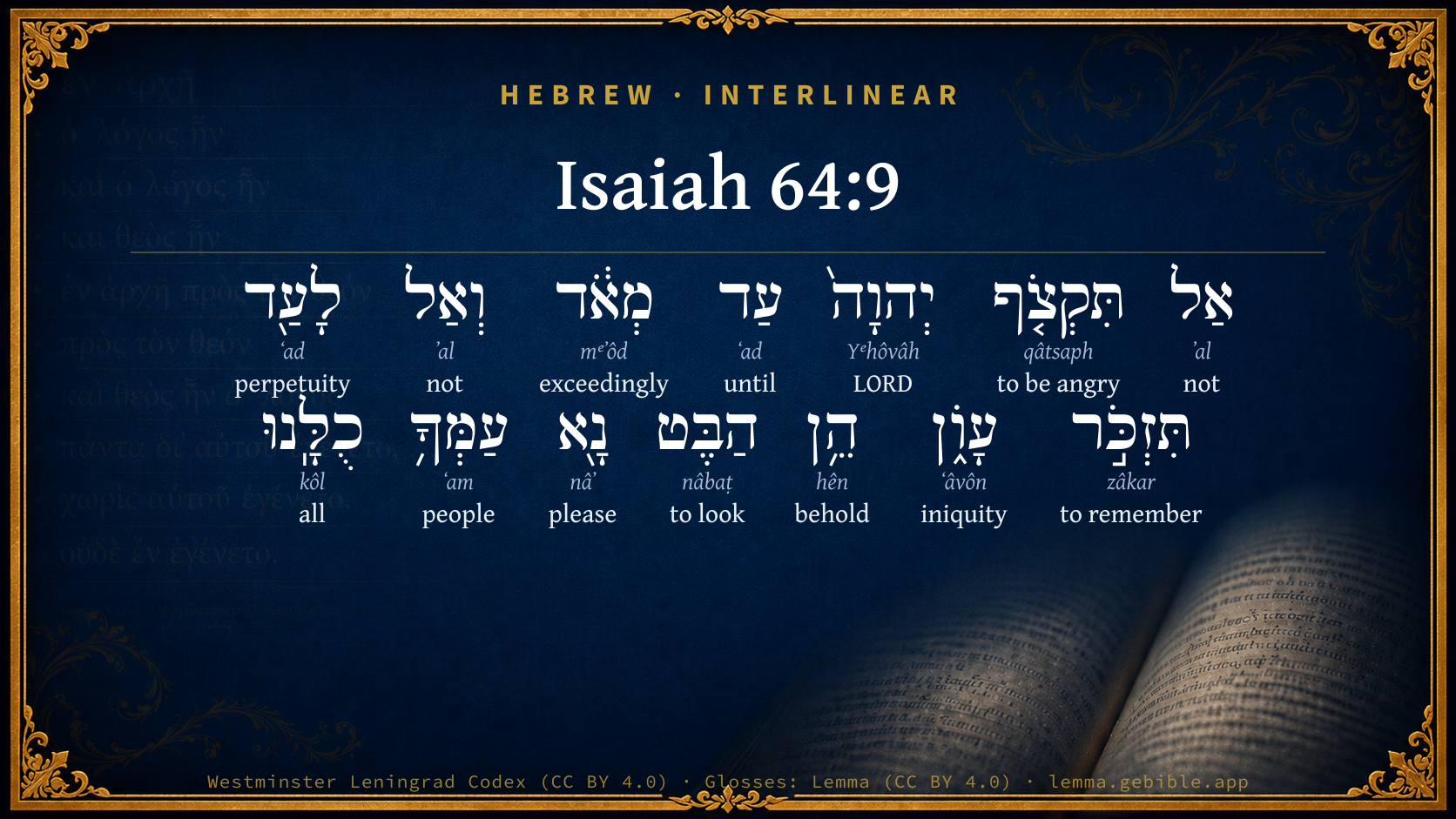
Hebrew (Westminster Leningrad Codex) Isaiah 64:9 appears in the Hebrew Old Testament. The text above is from the Westminster Leningrad Codex. Each word links to its Strong’s number, a concise gloss, and parsing drawn from the Open Scriptures Hebrew Bible morphology. Click any word for its full Brown-Driver-Briggs (BDB) entry.
Download image
Cite this verse

Isaiah 64:9 (World English Bible). Public Domain. Lemma interlinear Bible study tool, https://lemma.gebible.app/v/isaiah/64/9.

Show BibTeX & RIS
BibTeX
RIS
English Translation
Don't be angry very sore, Yahweh, neither remember iniquity forever: see, look, we beg you, we are all your people.
World English Bible · Public Domain
Download a study sheet

One document with this verse’s original text, its word-by-word gloss line, the meaning frame, cross-references with their text, attributed commentary, and full source and license credits — printable, and it pastes into notes with its structure intact.

This verse Autodidact and up

Study sheet (.html) Plain text (.txt)

A passage Seminary Student

Up to 50 verses in one chapter. A passage sheet keeps up to 6 commentary sources and 12 cross-references per verse, in the order this page ranks them, and says so on the sheet whenever that leaves anything out. Ask for a single verse and you get the Autodidact verse sheet above.

Everything on this page stays free to read, with no account — the sheet is a download of what is already on screen, not access to it.

Want to remove ads? Support Godless Engineer
Compare translations 3

The same verse in 3 English versions, stacked beneath the original-language interlinear above. Click any original word for its lexicon entry.

Each is an independent rendering of the whole verse — the interlinear is not word-aligned to these translations.

Highlighted words mark where these versions differ — a whole-verse word diff, not a word-by-word alignment.

  • World English Bible Public Domain
    Don't be angry very sore, Yahweh, neither remember iniquity forever: see, look, we beg you, we are all your people.
  • King James Version Public Domain
    Be not wroth very sore, O LORD, neither remember iniquity for ever: behold, see, we beseech thee, we are all thy people.
  • unfoldingWord Literal Text CC BY-SA 4.0
    May you not be angry, Yahweh, to abundance, and may you not remember iniquity forever. Behold, please consider your people, all of us.

unfoldingWord Literal Text — © unfoldingWord, licensed CC BY-SA 4.0. Word-aligned USFM3 via Door43 (git.door43.org/unfoldingWord/en_ult).

Versions to compare (up to 4)

3 of 4 selected

Show all 18 translations

Every available English version of this verse, each an independent rendering of the whole verse.

  • World English Bible Public Domain
    Don't be angry very sore, Yahweh, neither remember iniquity forever: see, look, we beg you, we are all your people.
  • Berean Standard Bible Public Domain
    Do not be angry, O LORD, beyond measure; do not remember our iniquity forever. Oh, look upon us, we pray; we are all Your people!
  • Majority Standard Bible Public Domain
    Do not be angry, O LORD, beyond measure; do not remember our iniquity forever. Oh, look upon us, we pray; we are all Your people!
  • King James Version Public Domain
    Be not wroth very sore, O LORD, neither remember iniquity for ever: behold, see, we beseech thee, we are all thy people.
  • American Standard Version (1901) Public Domain
    Be not wroth very sore, O Jehovah, neither remember iniquity for ever: behold, look, we beseech thee, we are all thy people.
  • Revised Version (1885) Public Domain
    Be not wroth very sore, O LORD, neither remember iniquity for ever: behold, look, we beseech thee, we are all thy people.
  • Geneva Bible (1599) Public Domain
    Be not angry, O Lord, aboue measure, neither remember iniquitie for euer: lo, we beseech thee beholde, we are all thy people.
  • Douay-Rheims (1899) Public Domain
    Be not very angry, O Lord, and remember no longer our iniquity: behold, see we are all thy people.
  • Young's Literal Translation Public Domain
    Be not wroth, O Jehovah, very sore, Nor for ever remember iniquity, Lo, look attentively, we beseech Thee, Thy people `are' we all.
  • Literal Standard Version CC BY-SA 4.0
    Do not be angry, O YHWH, very severely, || Nor remember iniquity forever, || Behold, look attentively, we implore You, || We [are] all Your people.
  • Unlocked Literal Bible CC BY-SA 4.0
    Be not too angry, Yahweh, nor always call to mind against us our sins. Please look at us all, your people.
  • unfoldingWord Literal Text CC BY-SA 4.0
    May you not be angry, Yahweh, to abundance, and may you not remember iniquity forever. Behold, please consider your people, all of us.
  • Darby Bible Public Domain
    Be not wroth very sore, O Jehovah, neither remember iniquity for ever. Behold, see, we beseech thee, we are all thy people.
  • World Messianic Bible Public Domain
    Don’t be furious, LORD. Don’t remember iniquity forever. Look and see, we beg you, we are all your people.
  • Webster's Bible Public Domain
    \\64:10\\Thy holy cities are a wilderness, Zion is a wilderness, Jerusalem a desolation.
  • Free Bible Version CC BY-SA 4.0
    Please limit your anger, Lord, and don't remember our sins forever. Look at us, and see that we are all your people.
  • Bible in Basic English Public Domain
    Your holy towns have become a waste, Zion has become a waste, Jerusalem is a mass of broken walls.
  • JPS Tanakh (1917) Public Domain
    (64-8) Be not wroth very sore, O LORD, neither remember iniquity for ever; behold, look, we beseech Thee, we are all Thy people.

Literal Standard Version (2020), Covenant Press — licensed CC BY-SA 4.0. Text via the HelloAO Bible API (eBible.org). Unlocked Literal Bible (unfoldingWord) — licensed CC BY-SA 4.0. Text via the HelloAO Bible API (eBible.org). unfoldingWord Literal Text — © unfoldingWord, licensed CC BY-SA 4.0. Word-aligned USFM3 via Door43 (git.door43.org/unfoldingWord/en_ult). Free Bible Version, Dr. Jonathan Gallagher — licensed CC BY-SA 4.0. Text via the HelloAO Bible API (eBible.org).

Word by word

More ways to search: Search by grammar → Find every occurrence → Compare this word →

Practice this passage: Drill this verse → Learn its vocabulary →

תִּקְצֹ֤ף
qâtsaph
H7107
“to be angry”
Verb, Qal, Jussive, 2nd Person, Masculine, Singular
Part of Speech
Verb
Stem
Qal
Form
Jussive
Person
2nd Person
Gender
Masculine
Number
Singular
Full BDB Definition

Origin: a primitive root

TWOT: 2058

to be displeased, be angry, fret oneself, be wroth - (Qal) to be wroth, to be full of wrath, to be furious - (Hiphil) to provoke to wrath or anger - (Hithpael) to put oneself in a rage, anger oneself
  1. אַל ʼal H408 “not” Particle, Negative
  2. יְהוָה֙ Yᵉhôvâh H3068 “LORD” Noun, Proper
  3. עַד ʻad H5704 “until” Preposition
  4. מְאֹ֔ד mᵉʼôd H3966 “exceedingly” Adverb
  5. וְאַל ʼal H408 “and · not” Conjunction + Particle, Negative
  6. לָעַ֖ד ʻad H5703 “to/for · perpetuity” Preposition + Noun, Common, Masculine, Singular, Absolute
  7. תִּזְכֹּ֣ר zâkar H2142 “to remember” Verb, Qal, Imperfect, 2nd Person, Masculine, Singular
  8. עָוֺ֑ן ʻâvôn H5771 “iniquity” Noun, Common, Both, Singular, Absolute
  9. הֵ֥ן hên H2005 “behold” Particle, Demonstrative
  10. הַבֶּט nâbaṭ H5027 “look” Verb, Hiphil, Imperative, 2nd Person, Masculine, Singular
  11. נָ֖א nâʼ H4994 “please” Particle, Exhortation
  12. עַמְּךָ֥ ʻam H5971 “people · your” Noun, Common, Masculine, Singular, Construct + Suffix, Personal, 2nd Person, Masculine, Singular
  13. כֻלָּֽנוּ kôl H3605 “all · our” Noun, Common, Masculine, Singular, Construct + Suffix, Personal, 1st Person, Common, Plural

About this verse

These counts appear in no published source. They are computed here, from the morphology-tagged text and Lemma’s own curated glosses. What Lemma adds →

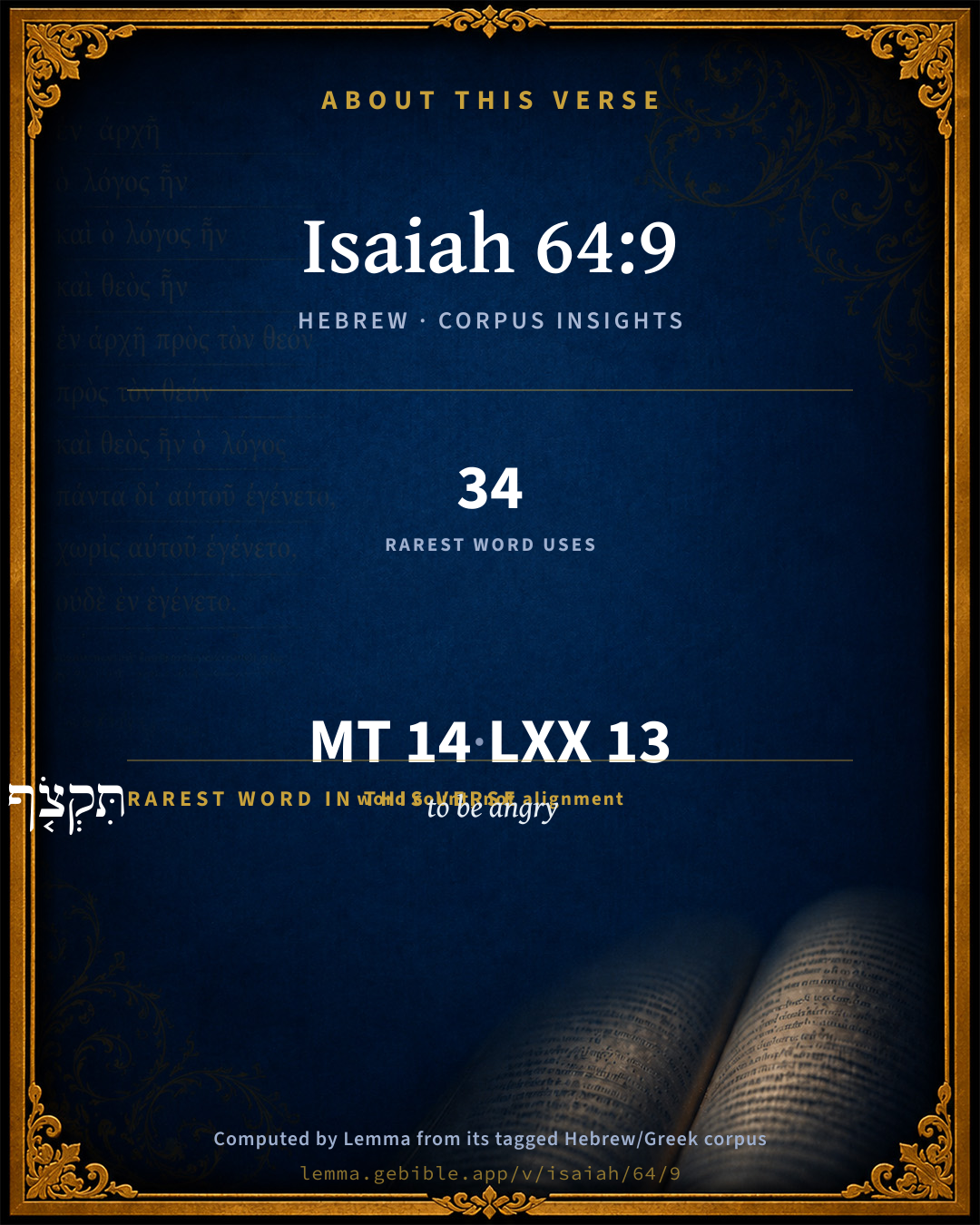
14
words
13
distinct lemmas
Prophets
section

Shared distinctive vocabulary

תִּקְצֹ֤ף to be angry H7107 occurs in 32 verses of the Hebrew Bible. Also found in:

Grammatical profile

  • 3 verbs
  • 5 nouns
  • 1 preposition
  • 1 adverb
  • 4 particles

Verb forms

  • תִּקְצֹ֤ף Qal · Jussive
  • תִּזְכֹּ֣ר Qal · Imperfect
  • הַבֶּט Hiphil · Imperative

Repetition

A word recurs within this verse — often emphatic in Hebrew:

  • אַל not H408 ×2

Hebrew & Septuagint length

In English translation the verse runs 20 words from the Hebrew and 24 from the Septuagint (LXX English) — closely comparable.

A rough comparison of the two English renderings, which tokenize alike — not a word-level alignment.

Word counts can differ between the Hebrew and the Greek without any difference in meaning — e.g. the Hebrew direct-object marker אֵת has no separate Greek word, and Greek often adds the article ὁ.

In the original languages it is 14 Hebrew tokens and 13 Greek tokens — but the two are counted differently (Hebrew bundles its prefixes and suffixes into one token; the Greek is in lemma form), so that isn’t a like-for-like length.

Cross-references

18

Topical passages linked to Isaiah 64:9 in the Treasury of Scripture Knowledge — connected by theme and wording, ordered by reader-vote popularity; previews shown in the World English Bible.

  • Psalms 74:1–2 God, why have you rejected us forever? Why does your anger smolder against the sheep of your pasture?
  • Psalms 79:13 So we, your people and sheep of your pasture, Will give you thanks forever. We will praise you forever, to all generations.
  • Micah 7:18–20 Who is a God like you, who pardons iniquity, And passes over the disobedience of the remnant of his heritage? He doesn't retain his anger forever, Because he delights in loving kindness.
  • Psalms 6:1 Yahweh, don't rebuke me in your anger, Neither discipline me in your wrath.
  • Psalms 38:1 Yahweh, don't rebuke me in your wrath, Neither chasten me in your hot displeasure.
  • Psalms 79:5–9 How long, Yahweh? Will you be angry forever? Will your jealousy burn like fire?
  • Psalms 119:94 I am yours. Save me, for I have sought your precepts.
  • Isaiah 43:25 I, even I, am he who blots out your transgressions for my own sake; and I will not remember your sins.
  • Isaiah 57:17 For the iniquity of his covetousness was I angry, and struck him; I hid [my face] and was angry; and he went on backsliding in the way of his heart.
  • Isaiah 60:10 Foreigners shall build up your walls, and their kings shall minister to you: for in my wrath I struck you, but in my favor have I had mercy on you.
  • Isaiah 63:19 We are become as they over whom you never bear rule, as those who were not called by your name.
  • Jeremiah 3:12 Go, and proclaim these words toward the north, and say, Return, you backsliding Israel, says Yahweh; I will not look in anger on you; for I am merciful, says Yahweh, I will not keep [anger] forever.
  • Jeremiah 10:24 Yahweh, correct me, but in measure: not in your anger, lest you bring me to nothing.
  • Lamentations 5:20 Why do you forget us forever, [And] forsake us so long time?
  • Habakkuk 3:2 Yahweh, I have heard of your fame. I stand in awe of your deeds, Yahweh. Renew your work in the midst of the years. In the midst of the years make it known. In wrath, you remember mercy.
  • Malachi 1:4 Whereas Edom says, "We are beaten down, but we will return and build the waste places;" thus says Yahweh of Hosts, "They shall build, but I will throw down; and men will call them 'The Wicked Land,' even the people against whom Yahweh shows wrath forever."
  • 2 Peter 2:17 These are wells without water, clouds driven by a storm; for whom the blackness of darkness has been reserved forever.
  • Revelation 20:10 The devil who deceived them was thrown into the lake of fire and sulfur, where the beast and the false prophet are also. They will be tormented day and night forever and ever.

Cross-references courtesy of OpenBible.info (CC BY 4.0).

Hebrew and Greek witnesses Masoretic Hebrew ↔ Greek Septuagint

The same verse in the two great witnesses to the Old Testament, shown verse-for-verse.

These are two independent witnesses, not word-aligned to each other, and the Septuagint is shown in lemma (dictionary) form.

Hebrew Isaiah 64:9 Masoretic · Westminster Leningrad Codex

אַל תִּקְצֹ֤ף יְהוָה֙ עַד מְאֹ֔ד וְאַל לָעַ֖ד תִּזְכֹּ֣ר עָוֺ֑ן הֵ֥ן הַבֶּט נָ֖א עַמְּךָ֥ כֻלָּֽנוּ

Don't be angry very sore, Yahweh, neither remember iniquity forever: see, look, we beg you, we are all your people.

World English Bible · Public Domain

Greek LXX Isaiah 64:9 Septuagint · lemma form

πόλις ὁ ἅγιος σύ γίγνομαι ἔρημος σιων ὡς ἔρημος γίγνομαι ἰερουσαλήμ εἰς κατάρα

Be not very angry with us, and remember not our sins for ever; but now look on us, for we are all your people.

LXX2012 (modern English Septuagint) · Public Domain

Hebrew: Westminster Leningrad Codex (CC BY 4.0). Greek: Septuagint (public domain); English from LXX2012 (modern English Septuagint) (Public Domain). How the Septuagint differs from the Hebrew →

Targum (Aramaic paraphrase)

1

The Targum is the ancient Jewish Aramaic paraphrase of the Hebrew Scriptures — an interpretive translation, not the Hebrew text itself. Onkelos (literal) and Pseudo-Jonathan (expansive) render the Torah, and Jonathan the Prophets. Coverage is partial: where no permissively-licensed English translation exists for a verse, only the Aramaic is shown. This is verse-level text, not a word-by-word alignment to the Hebrew.

  1. Targum Jonathan Prophets (Joshua–Malachi)
    קִרְוֵי קוּדְשָׁךְ הֲוָאָה מַדְבְּרָא צִיוֹן מַדְבְּרָא הֲוָת וִירוּשְׁלֵם צַדְיָא:

    Thy holy cities have become a wilderness, Zion is a wilderness, Jerusalem has become a desolation.

    Targum Jonathan — Aramaic: “Mikraot Gedolot” (public domain). English: “Sefaria Community Translation” (CC0 1.0 (public-domain dedication)); “London "Chaldee Paraphrase," 1871” (public domain). Text via Sefaria.

Commentary

Notes on Isaiah 64:9 from classic Christian and Jewish commentators (each source and its license shown beneath its notes). The classic Christian expositions comment on the surrounding passage and are grouped to its opening verse, so a note may address several verses; the Jewish commentaries on the Tanakh (Rashi and others) are per-verse, so they appear only where the commentator wrote on this verse.

Lemma curates 59 commentaries, every one of them public domain or Creative Commons licensed, each selected and text-cleaned for this edition rather than reprinted as found. About our sources →

Trapp's Complete Commentary

John Trapp

Isa 64:9 Be not wroth very sore, O LORD, neither remember iniquity for ever: behold, see, we beseech thee, we [are] all thy people.

Ver. 9. Be not wroth very sore, O Lord.]]Neither overly much nor overly long, but "spare us, as a man spareth his own son that serveth him." This is commended for the best line in all Terence -

“ Pro peccato magno paululum supplicii satis est Patri. ”

John Trapp, A Commentary or Exposition upon All the Books of the Old and New Testament (1647–1656) — public domain. Text from a community e-Sword module.

The Biblical Illustrator

Joseph S. Exell

Isa_64:9

Be not wroth very sore, O Lord

Gods wrath deprecated

I.

THE EVIL DEPRECATED. Gods anger.

1. Merited.

2. Acknowledged.

II. THE TERMS IN WHICH IT IS DEPRECATED.

1. Imply the justice of Gods procedure.

2. Beseech a limitation of its severity.

III. THE PLEA BY WHICH IT IS DEPRECATED.

1. Humble.

2. Confident.

3. Founded on Gods covenant relation to His people. (Homiletic Commentary.)

The Biblical Illustrator, edited by Joseph S. Exell (c. 1880s–1900s) — public domain. Text from a community e-Sword module.

Geneva Bible (1599)

Geneva Bible translators

For so the flesh judgeth when God doth not immediately send succor.

Geneva Bible (1599) marginal notes — public domain. Text via Bolls.life.

Jamieson, Fausset & Brown

Robert Jamieson, A. R. Fausset & David Brown

(Psa 74:1-2).

we are . . . thy people-- (Jer 14:9, Jer 14:21).

Jamieson, Fausset & Brown — Commentary Critical and Explanatory on the Whole Bible (1871) — public domain (CC PDM 1.0). Text via the HelloAO Bible API.

Adam Clarke's Commentary

Verse 9. Neither remember iniquity] For לעד תזכר laad tizcor, one of my MSS. has לעד תקצף laad tiktsoph, "be not angry," as in the preceding clause. This has been partially obliterated, and תזכר tizcor, written in the margin by a later hand: but this MS. abounds with words of this kind, all altered by later hands.

Adam Clarke's Commentary on the Bible (1810–1826) — public domain. Text from a community e-Sword/MySword module.

The Cambridge Bible for Schools and Colleges

gen. ed. J. J. S. Perowne

9. neither remember iniquity for ever] Psa_79:8. The nation feels that it is bearing the inexhaustible penalty of past sins. Such a thought was specially natural after the Restoration, when it appeared as if even the immeasurable calamity of the Exile had not wiped out the arrears of hereditary guilt (cf. Zec_1:12).

The Cambridge Bible for Schools and Colleges (gen. ed. J. J. S. Perowne; Cambridge University Press, 1878–1918) — public domain. Text from a community e-Sword module.

John Gill's Exposition

Be not wroth very sore, O Lord,.... They knew not how to deprecate the displeasure of God entirely; having sinned so greatly against him, they were sensible they deserved his wrath; but entreat it might not be hot and very vehement, and carried to the highest pitch, which would be intolerable:

neither remember iniquity for ever; to afflict and punish for it, but forgive it, for not to remember sin is to forgive it; and not inflict the deserved punishment of it, but take off and remove the effects of divine displeasure, which as yet continued, and had a long time, as this petition suggests; and therefore suits better with the present long captivity of the Jews than their seventy years' captivity in Babylon.

Behold, see, we beseech thee, we are all thy people; look upon all our troubles and distresses, and upon us under them, with an eye of pity and compassion; and consider that we are thy people, not only by creation, but by covenant and profession; even everyone of us; or we are all the people thou hast, the Jews looking upon themselves to be the special and peculiar people of God, and the Gentiles as having no claim to such a relation; this is the pure spirit of Judaism. The Targum is,

"lo, it is manifest before thee that we are all of us thy people.''

John Gill's Exposition of the Whole Bible (1746–1763) — public domain (CC PDM 1.0). Text via the HelloAO Bible API.

Matthew Poole's English Annotations

Be not wroth very sore, O Lord, neither remember iniquity for ever, viz. Thou hast been angry with us a long time, be not so for ever; but deal with us as may best consist with a father’s bowels. It hath reference both to quantity and time, that it might not be very great, nor of long durance. See on Psa 79:8.

We are all thy people, thy peculiar people, Isa 28:9. Though we are very bad in ourselves, and very badly handled by our enemies, thou sufferest in our sufferings, for thou hast not people in covenant but us, and wilt thou not leave thyself a people in the world?

Matthew Poole's English Annotations on the Holy Bible (1683–1685) — public domain. Text from a community e-Sword/MySword module.

Whedon's Commentary on the Bible

Daniel D. Whedon

9. Be not wroth very sore — That is, mitigate thy wrath, deserved by us as a nation.

We are all thy people — The idea national merges into the idea spiritual. All adhering to, and now praying to, him, are the spiritual Israel; and the prayer is, “Because we adhere and pray to thee, spare us!”

Daniel D. Whedon (gen. ed.), Commentary on the Old and New Testaments (1874–1909) — public domain. Text from a community e-Sword module.

The Pulpit Commentary

Be not wroth very sore. At the time of the Captivity God was wroth very sore. (Lam_5:22) His auger was hot against the sheep of his pasture. (Psa_74:1) But they had suffered, they had been afflicted many years. Might he not now relent, and remit somewhat from his fierce anger? Neither remember iniquity. (comp. Psa_79:8) God had already made a promise by the mouth of Isaiah, "I, even I, am he that blotteth out thy trangressions, and will not remember thy sins". (Isa_43:25) The captives lay hold, as it were, on this promise, and entreat that their "iniquity" may be not only forgiven, but forgotten. (Jer_31:34) We are all thy people. A fresh argument. "We are thy children," individually (ver. 8); "we are thy work, thy creatures" (ver. 8), again individually; but also, "we are all of us (kullanu), collectively, thy people the people whom thou hast chosen to thyself, and over whom thou hast watched for so many centuries. Surely this consideration, if no other, will induce thee to forego thy wrath and forgive our iniquity.

The Pulpit Commentary (1880–1919), ed. H.D.M. Spence-Jones & Joseph S. Exell — public domain. Text from a community e-Sword module.

John Wesley's Explanatory Notes

Thy people - Thou hast no people in covenant but us, and wilt thou not leave thyself a people in the world?

John Wesley, Explanatory Notes Upon the Whole Bible (1754–1765) — public domain. Text via the GEBible commentary corpus.

Keil & Delitzsch

C. F. Keil & F. Delitzsch

The re-erection of the ruins of the promised land requires the zeal of every one, and this state of ruin must not continue. It calls out the love and faithfulness of Jehovah. "The cities of Thy holiness have become a pasture-ground; Zion has become a pasture-ground, Jerusalem a desert. The house of our holiness and of our adorning, where our fathers praised Thee, is given up to the fire, and everything that was our delight given up to devastation. Wilt Thou restrain Thyself in spite of this, O Jehovah, be silent, and leave us to suffer the utmost?" Jerusalem by itself could not possibly be called "cities" (‛ârē), say with reference to the upper and lower cities (Vitringa). It is merely mentioned by name as the most prominent of the many cities which were all "holy cities," inasmuch as the whole of Canaan was the land of Jehovah (Isa 14:25), and His holy territory (Psa 78:54). The word midbâr (pasture-land, heath, different from tsiyyâh, the pastureless desert, Isa 35:1) is repeated, for the purpose of showing that the same fate had fallen upon Zion-Jerusalem as upon the rest of the cities of the land. The climax of the terrible calamity was the fact, that the temple had also fallen a prey to the burning of the fire (compare for the fact, Jer 52:13). The people call it "house of our holiness and of our glory." Jehovah's qōdesh and tiph'ereth have, as it were, transplanted heaven to earth in the temple (compare Isa 63:15 with Isa 60:7); and this earthly dwelling-place of God is Israel's possession, and therefore Israel's qōdesh and tiph'ereth. The relative clause describes what sublime historical reminiscences are attached to the temple: אשׁר is equivalent to שׁם אשׁר, as in Gen 39:20; Num 20:13 (compare Psa 84:4), Deu 8:15, etc. הללּך has chateph-pathach, into which, as a rule, the vocal sheva under the first of two similar letters is changed. Machămaddēnū (our delights) may possibly include favourite places, ornamental buildings, and pleasure grounds; but the parallel leads us rather to think primarily of things associated with the worship of God, in which the people found a holy delight. כל, contrary to the usual custom, is here followed by the singular of the predicate, as in Pro 16:2; Eze 31:15 (cf., Gen 9:29). Will Jehovah still put restraint upon Himself, and cause His merciful love to keep silence, על־זאת, with such a state of things as this, or notwithstanding this state of things (Job 10:7)? On התאפּק, see Isa 63:15; Isa 42:14. The suffering would indeed increase עד־מאד (to the utmost), if it caused the destruction of Israel, or should not be followed at last by Israel's restoration. Jehovah's compassion cannot any longer thus forcibly restrain itself; it must break forth, like Joseph's tears in the recognition scene (Gen 45:1).

Keil & Delitzsch — Biblical Commentary on the Old Testament (1861–1891) — public domain (CC PDM 1.0). Text via the HelloAO Bible API. (Old Testament only.)

J. A. Alexander on Isaiah

Joseph Addison Alexander

“Be not angry, oh Jehovah, to extremity, and do not to eternity remember guilt; lo, look, we pray Thee, Thy people (are) we all.” This is the application of the argument presented in the foregoing verse, the actual prayer founded on the fact there stated. The common version (very sore) fails to reproduce the form of the original expression, as consisting of a preposition and a noun.

Joseph Addison Alexander, The Prophecies of Isaiah (1846–1847; New York: Scribner, 1870–1878) — public domain. Text from a community e-Sword module.

Ibn Ezra

Rabbi Abraham ibn Ezra

The holy cities, etc. Supply הבט, see from the preceding verse. Look at the towns which Thou hast sanctified with Thy name, and which are now desolate.

Ibn Ezra on the Tanakh — English translations: “Sefaria Community Translation” (CC0 1.0 (public-domain dedication)); “Yalkut, Sifsei Chachomim Chumash, Metsudah Publications, 2009” (CC BY 4.0); and “Commentary of Ibn Ezra on Isaiah - trans. by M. Friedlander, 1873” (public domain). Text via Sefaria.

Lesson kit

Teaching starters — assembled from the data on this page, not authored interpretation. Every prompt links to the verse data it draws on. Edit before teaching.

Isaiah, in the Prophets, opens this verse with 14 words (13 distinct Hebrew lemmas). Its most distinctive word is qâtsaph (“to be angry”). A historical commentator’s framing appears above. Read the whole chapter for the surrounding context.

Discussion questions

  1. The word qâtsaph carries the sense “to be angry.” How does it shape the verse?
  2. Genesis 40:2 shares the word «to be angry» with this verse. How do the two illuminate each other?
  3. “not” occurs 2× in this one verse. What is the effect of the repetition?
  4. The translations on this page render this verse differently — a whole-verse word diff, not a word-by-word alignment. What might account for the different wordings?
  5. The verb «תִּקְצֹ֤ף» is Qal Jussive. How does its form color the action?
  6. Reading how Trapp's Complete Commentary and The Biblical Illustrator read this verse, where do the two commentators agree and where do they part?

Things to notice

Reading settings

Reading text

Shown beneath each verse's original-language words.

Old Testament
Old Testament edition

Read the OT as the Masoretic Hebrew (MT) or the Greek Septuagint (LXX).

English shown for the Greek Septuagint (in the Hebrew ↔ Greek comparison).

Comparing translations? Open the Compare panel on any verse page to stack up to four side by side.