Isaiah 52:6

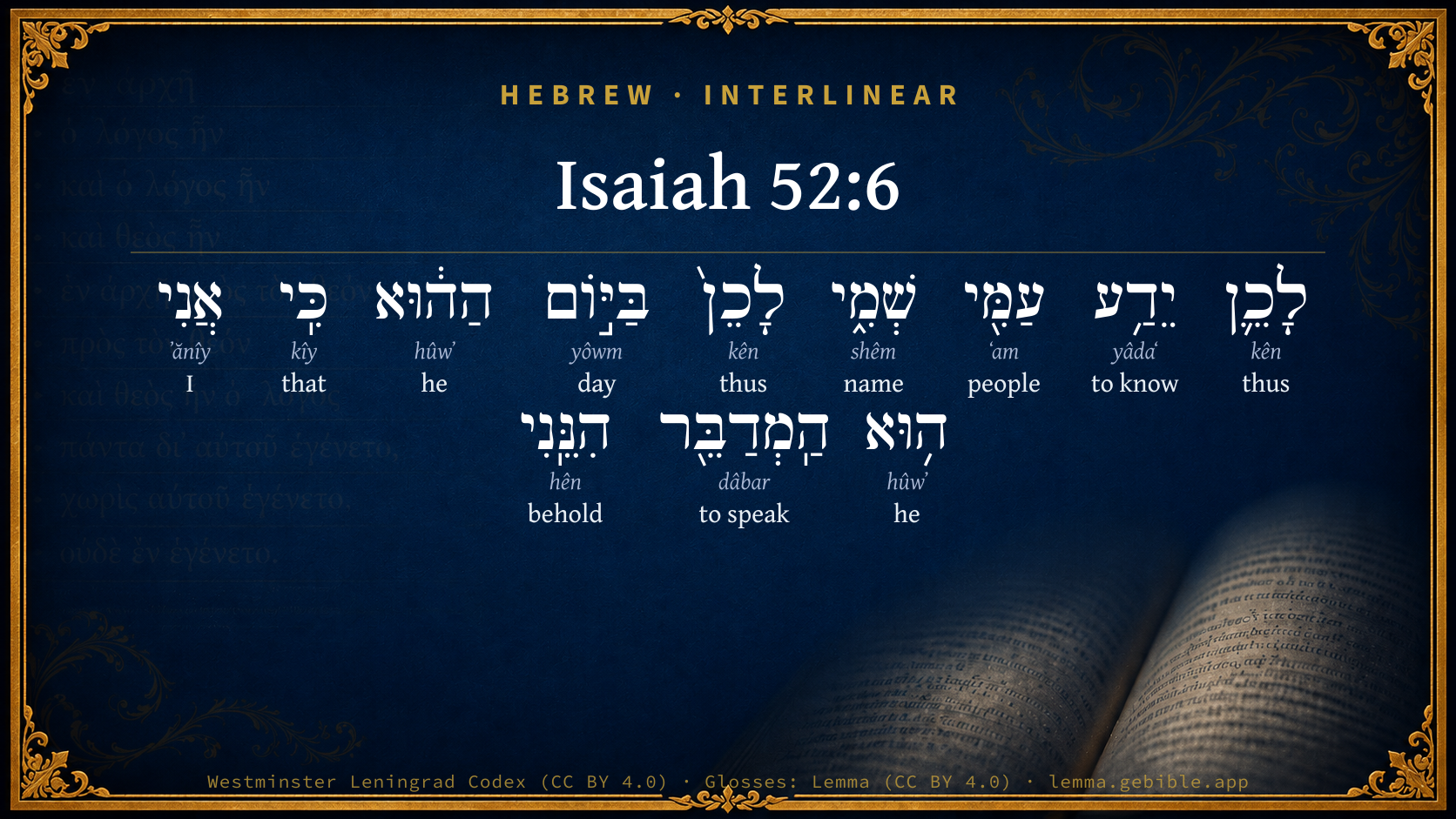
Hebrew (Westminster Leningrad Codex) Isaiah 52:6 appears in the Hebrew Old Testament. The text above is from the Westminster Leningrad Codex. Each word links to its Strong’s number, a concise gloss, and parsing drawn from the Open Scriptures Hebrew Bible morphology. Click any word for its full Brown-Driver-Briggs (BDB) entry.
Download image
Cite this verse

Isaiah 52:6 (World English Bible). Public Domain. Lemma interlinear Bible study tool, https://lemma.gebible.app/v/isaiah/52/6.

Show BibTeX & RIS
BibTeX
RIS
English Translation
Therefore my people shall know my name: therefore [they shall know] in that day that I am he who does speak; behold, it is I.
World English Bible · Public Domain
Download a study sheet

One document with this verse’s original text, its word-by-word gloss line, the meaning frame, cross-references with their text, attributed commentary, and full source and license credits — printable, and it pastes into notes with its structure intact.

This verse Autodidact and up

Study sheet (.html) Plain text (.txt)

A passage Seminary Student

Up to 50 verses in one chapter. A passage sheet keeps up to 6 commentary sources and 12 cross-references per verse, in the order this page ranks them, and says so on the sheet whenever that leaves anything out. Ask for a single verse and you get the Autodidact verse sheet above.

Everything on this page stays free to read, with no account — the sheet is a download of what is already on screen, not access to it.

Want to remove ads? Support Godless Engineer
Compare translations 3

The same verse in 3 English versions, stacked beneath the original-language interlinear above. Click any original word for its lexicon entry.

Each is an independent rendering of the whole verse — the interlinear is not word-aligned to these translations.

Highlighted words mark where these versions differ — a whole-verse word diff, not a word-by-word alignment.

  • World English Bible Public Domain
    Therefore my people shall know my name: therefore [they shall know] in that day that I am he who does speak; behold, it is I.
  • King James Version Public Domain
    Therefore my people shall know my name: therefore they shall know in that day that I am he that doth speak: behold, it is I.
  • unfoldingWord Literal Text CC BY-SA 4.0
    Therefore, my people will know my name; therefore, on that day, that I he, the one speaking, behold me.” q1

unfoldingWord Literal Text — © unfoldingWord, licensed CC BY-SA 4.0. Word-aligned USFM3 via Door43 (git.door43.org/unfoldingWord/en_ult).

Versions to compare (up to 4)

3 of 4 selected

Show all 18 translations

Every available English version of this verse, each an independent rendering of the whole verse.

  • World English Bible Public Domain
    Therefore my people shall know my name: therefore [they shall know] in that day that I am he who does speak; behold, it is I.
  • Berean Standard Bible Public Domain
    Therefore My people will know My name; therefore they will know on that day that I am He who speaks. Here I am!”
  • Majority Standard Bible Public Domain
    Therefore My people will know My name; therefore they will know on that day that I am He who speaks. Here I am!”
  • King James Version Public Domain
    Therefore my people shall know my name: therefore they shall know in that day that I am he that doth speak: behold, it is I.
  • American Standard Version (1901) Public Domain
    Therefore my people shall know my name: therefore `they shall know' in that day that I am he that doth speak; behold, it is I.
  • Revised Version (1885) Public Domain
    Therefore my people shall know my name: therefore they shall know in that day that I am he that doth speak; behold, it is I.
  • Geneva Bible (1599) Public Domain
    Therefore my people shall know my Name: therefore they shall know in that day, that I am he that doe speake: beholde, it is I.
  • Douay-Rheims (1899) Public Domain
    Therefore my people shall know my name in that day: for I myself that spoke, behold I am here.
  • Young's Literal Translation Public Domain
    Therefore doth My people know My name, Therefore, in that day, Surely I `am' He who is speaking, behold Me.'
  • Literal Standard Version CC BY-SA 4.0
    Therefore My people know My Name, || Therefore, in that day, || Surely I [am] He who is speaking, behold Me.”
  • Unlocked Literal Bible CC BY-SA 4.0
    Therefore my people will know my name; they will know in that day that I am the one who says, “Yes, it is I!”
  • unfoldingWord Literal Text CC BY-SA 4.0
    Therefore, my people will know my name; therefore, on that day, that I he, the one speaking, behold me.” q1
  • Darby Bible Public Domain
    Therefore my people shall know my name; therefore [they shall know] in that day that I [am] HE, that saith, Here am I.
  • World Messianic Bible Public Domain
    Therefore my people shall know my name. Therefore they shall know in that day that I am he who speaks. Behold, it is I.”
  • Webster's Bible Public Domain
    Therefore my people shall know my name: therefore they shall know in that day that I am he that doth speak: behold, it is I.
  • Free Bible Version CC BY-SA 4.0
    So I'm going to make sure my people know me; at that time they will know that I am the one who means what he says. Yes, it's me!
  • Bible in Basic English Public Domain
    For this cause I will make my name clear to my people; in that day they will be certain that it is my word which comes to them; see, here am I.
  • JPS Tanakh (1917) Public Domain
    Therefore My people shall know My name; therefore they shall know in that day that I, even He that spoke, behold, here I am.

Literal Standard Version (2020), Covenant Press — licensed CC BY-SA 4.0. Text via the HelloAO Bible API (eBible.org). Unlocked Literal Bible (unfoldingWord) — licensed CC BY-SA 4.0. Text via the HelloAO Bible API (eBible.org). unfoldingWord Literal Text — © unfoldingWord, licensed CC BY-SA 4.0. Word-aligned USFM3 via Door43 (git.door43.org/unfoldingWord/en_ult). Free Bible Version, Dr. Jonathan Gallagher — licensed CC BY-SA 4.0. Text via the HelloAO Bible API (eBible.org).

Word by word

More ways to search: Search by grammar → Find every occurrence → Compare this word →

Practice this passage: Drill this verse → Learn its vocabulary →

הִנֵּֽנִי
hên
H2005
“behold · me”
Particle, Demonstrative + Suffix, Personal, 1st Person, Common, Singular
Part of Speech
Particle
Type
Demonstrative
Full BDB Definition

Origin: a primitive particle

TWOT: 510

behold, lo, though (interjection) - if (hypothetical particle)
  1. לָכֵ֛ן kên H3651 “to/for · thus” Preposition + Adverb
  2. יֵדַ֥ע yâdaʻ H3045 “to know” Verb, Qal, Imperfect, 3rd Person, Masculine, Singular
  3. עַמִּ֖י ʻam H5971 “people · my” Noun, Common, Masculine, Singular, Construct + Suffix, Personal, 1st Person, Common, Singular
  4. שְׁמִ֑י shêm H8034 “name · my” Noun, Common, Masculine, Singular, Construct + Suffix, Personal, 1st Person, Common, Singular
  5. לָכֵן֙ kên H3651 “to/for · thus” Preposition + Adverb
  6. בַּיּ֣וֹם yôwm H3117 “in/at the · day” Preposition, Determined + Noun, Common, Masculine, Singular, Absolute
  7. הַה֔וּא hûwʼ H1931 “the · he” Particle, Definite Article + Pronoun, Personal, 3rd Person, Masculine, Singular
  8. כִּֽי kîy H3588 “that” Conjunction
  9. אֲנִי ʼănîy H589 “I” Pronoun, Personal, 1st Person, Common, Singular
  10. ה֥וּא hûwʼ H1931 “he” Pronoun, Personal, 3rd Person, Masculine, Singular
  11. הַֽמְדַבֵּ֖ר dâbar H1696 “the · speaking” Particle, Definite Article + Verb, Piel, Participle Active, Masculine, Singular, Absolute

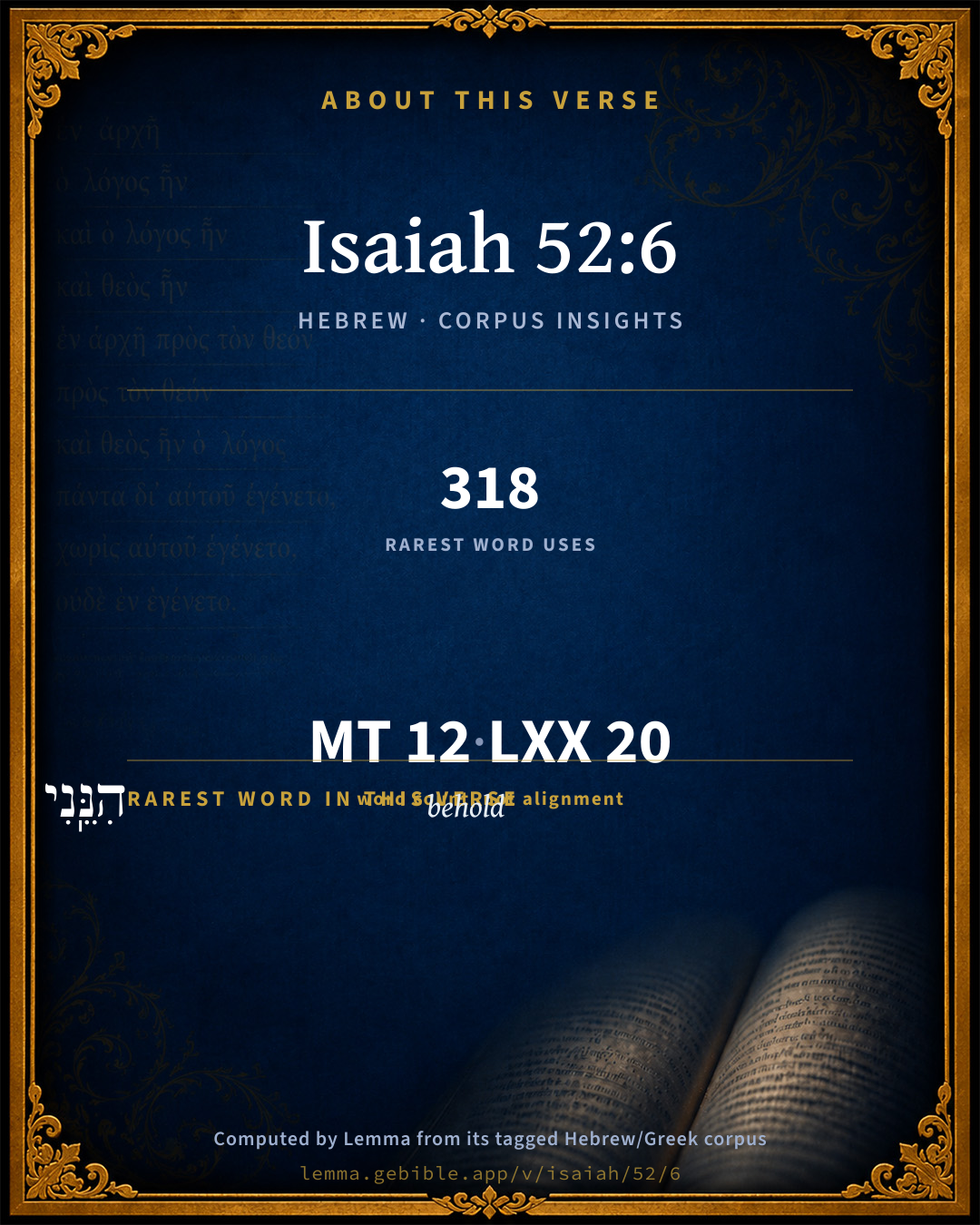
About this verse

These counts appear in no published source. They are computed here, from the morphology-tagged text and Lemma’s own curated glosses. What Lemma adds →

12
words
10
distinct lemmas
Prophets
section

Grammatical profile

  • 2 verbs
  • 3 nouns
  • 3 pronouns
  • 1 conjunction
  • 2 adverbs
  • 1 particle

Verb forms

  • יֵדַ֥ע Qal · Imperfect
  • הַֽמְדַבֵּ֖ר Piel · Participle Active

Repetition

Words recur within this verse — often emphatic in Hebrew:

  • לָכֵ֛ן thus H3651 ×2
  • הַה֔וּא he H1931 ×2

Hebrew & Septuagint length

In English translation the verse runs 25 words from the Hebrew and 19 from the Septuagint (LXX English) — closely comparable.

A rough comparison of the two English renderings, which tokenize alike — not a word-level alignment.

Word counts can differ between the Hebrew and the Greek without any difference in meaning — e.g. the Hebrew direct-object marker אֵת has no separate Greek word, and Greek often adds the article ὁ.

In the original languages it is 12 Hebrew tokens and 20 Greek tokens — but the two are counted differently (Hebrew bundles its prefixes and suffixes into one token; the Greek is in lemma form), so that isn’t a like-for-like length.

Cross-references

12

Topical passages linked to Isaiah 52:6 in the Treasury of Scripture Knowledge — connected by theme and wording, ordered by reader-vote popularity; previews shown in the World English Bible.

  • Ezekiel 37:13–14 You shall know that I am Yahweh, when I have opened your graves, and caused you to come up out of your graves, my people.
  • Ezekiel 20:44 You shall know that I am Yahweh, when I have dealt with you for my name's sake, not according to your evil ways, nor according to your corrupt doings, you house of Israel, says the Lord Yahweh.
  • Zechariah 10:9–12 I will sow them among the peoples; And they will remember me in far countries; And they will live with their children, and will return.
  • Hebrews 8:10–11 "For this is the covenant that I will make with the house of Israel. After those days," says the Lord; "I will put my laws into their mind, I will also write them on their heart. I will be to them a God, And they will be to me a people.
  • Exodus 33:19 He said, "I will make all my goodness pass before you, and will proclaim the name of Yahweh before you. I will be gracious to whom I will be gracious, and will show mercy on whom I will show mercy."
  • Ezekiel 39:27–29 when I have brought them back from the peoples, and gathered them out of their enemies' lands, and am sanctified in them in the sight of many nations.
  • Numbers 23:19 God is not a man, that he should lie, Neither the son of man, that he should repent: Has he said, and will he not do it? Or has he spoken, and will he not make it good?
  • Psalms 48:10 As is your name, God, So is your praise to the ends of the earth. Your right hand is full of righteousness.
  • Exodus 34:5–7 Yahweh descended in the cloud, and stood with him there, and proclaimed the name of Yahweh.
  • Hebrews 6:14–18 saying, "Most surely I will bless you, and I will surely multiply you."
  • Isaiah 42:9 Behold, the former things have happened, and new things do I declare. Before they spring forth I tell you of them.
  • Isaiah 49:23 Kings shall be your nursing fathers, and their queens your nursing mothers: they shall bow down to you with their faces to the earth, and lick the dust of your feet; and you shall know that I am Yahweh; and those who wait for me shall not be disappointed.

Cross-references courtesy of OpenBible.info (CC BY 4.0).

Hebrew and Greek witnesses Masoretic Hebrew ↔ Greek Septuagint

The same verse in the two great witnesses to the Old Testament, shown verse-for-verse.

These are two independent witnesses, not word-aligned to each other, and the Septuagint is shown in lemma (dictionary) form.

Hebrew Isaiah 52:6 Masoretic · Westminster Leningrad Codex

לָכֵ֛ן יֵדַ֥ע עַמִּ֖י שְׁמִ֑י לָכֵן֙ בַּיּ֣וֹם הַה֔וּא כִּֽי אֲנִי ה֥וּא הַֽמְדַבֵּ֖ר הִנֵּֽנִי

Therefore my people shall know my name: therefore [they shall know] in that day that I am he who does speak; behold, it is I.

World English Bible · Public Domain

Greek LXX Isaiah 52:6 Septuagint · lemma form

διά οὗτος γιγνώσκω ὁ λαός ἐγώ ὁ ὄνομα ἐγώ ἐν ὁ ἡμέρα ἐκεῖνος ὅτι ἐγώ εἰμί αὐτός ὁ λαλέω παραεἰμί

Therefore shall my people know my name in that day, for I am he that speaks: I am present,

LXX2012 (modern English Septuagint) · Public Domain

On this verse, Adam Clarke's Commentary discusses the Septuagint’s reading. Read the note in Commentary ↓

Hebrew: Westminster Leningrad Codex (CC BY 4.0). Greek: Septuagint (public domain); English from LXX2012 (modern English Septuagint) (Public Domain). How the Septuagint differs from the Hebrew →

Targum (Aramaic paraphrase)

1

The Targum is the ancient Jewish Aramaic paraphrase of the Hebrew Scriptures — an interpretive translation, not the Hebrew text itself. Onkelos (literal) and Pseudo-Jonathan (expansive) render the Torah, and Jonathan the Prophets. Coverage is partial: where no permissively-licensed English translation exists for a verse, only the Aramaic is shown. This is verse-level text, not a word-by-word alignment to the Hebrew.

  1. Targum Jonathan Prophets (Joshua–Malachi)
    בְּכֵן יִתְרַבָּא בְעַמְמַיָא שְׁמִי בְּכֵן בְּעִידָנָא הַהִיא תֵּידְעוּן אֲרֵי אֲנָא הוּא דְמַלְלֵית וּמֵימְרִי קַיָם:

    Therefore my name shall be magnified among the nations: therefore at that time ye shall know, that I am He that hath spoken: and my WORD shall abide.

    Targum Jonathan — Aramaic: “Mikraot Gedolot” (public domain). English: “Sefaria Community Translation” (CC0 1.0 (public-domain dedication)); “London "Chaldee Paraphrase," 1871” (public domain). Text via Sefaria.

Commentary

Notes on Isaiah 52:6 from classic Christian and Jewish commentators (each source and its license shown beneath its notes). The classic Christian expositions comment on the surrounding passage and are grouped to its opening verse, so a note may address several verses; the Jewish commentaries on the Tanakh (Rashi and others) are per-verse, so they appear only where the commentator wrote on this verse.

Lemma curates 59 commentaries, every one of them public domain or Creative Commons licensed, each selected and text-cleaned for this edition rather than reprinted as found. About our sources →

Trapp's Complete Commentary

John Trapp

Isa 52:6 Therefore my people shall know my name: therefore [they shall know] in that day that I [am] he that doth speak: behold, [it is] I.

Ver. 6. Therefore my people shall know my name,] sc., That I am Jehovah; {as Exo 6:3} the God of Amen, {Isa 65:16} who "will not suffer my faithfulness to fail, nor alter the thing that is gone out of my mouth." {Psa 89:33-34} And it shall therefore be so because my name - that nomen maiestativum - hath been blasphemed and vilified. God’s people fare the better for their enemies’ insolencies.

That I am he that doth speak: behold, it is I.] Or, That it is I that do speak, saying, Lo, here I am. This some understand to be the second person in the Trinity, the eternal Son of the eternal Father, called "the Word," {Joh 1:1} and there are those who give us this rule - Where the Old Testament bringeth in God appearing and speaking, we are to understand it always to be the second person. See Joh 12:37-42.

John Trapp, A Commentary or Exposition upon All the Books of the Old and New Testament (1647–1656) — public domain. Text from a community e-Sword module.

Tyndale Open Study Notes

Tyndale Open Resources

52:6 Just as God did to Moses before the Exodus (Exod 3:15), he will reveal himself in the coming rescue from exile.

Tyndale Open Study Notes — © Tyndale Open Resources, licensed CC BY-SA 4.0. Text via the HelloAO Bible API.

Jamieson, Fausset & Brown

Robert Jamieson, A. R. Fausset & David Brown

shall know in that day--when Christ shall reveal Himself to Israel sensibly; the only means whereby their obstinate unbelief shall be overcome (Psa 102:16; Zac 12:10; Zac 14:5).

Jamieson, Fausset & Brown — Commentary Critical and Explanatory on the Whole Bible (1871) — public domain (CC PDM 1.0). Text via the HelloAO Bible API.

Adam Clarke's Commentary

Verse 6. Therefore my people shall know] The word לכן lachen, occurring the second time in this verse, seems to be repeated by mistake. It has no force nor emphasis as a repetition; it only embarrasses the construction and the sense. It was not in the copies from which the Septuagint, Syriac, and Vulgate were translated; it was not in the copy of the Septuagint from which the Arabic was translated; but in the Aldine and Complutensian editions διατουτο is repeated; probably so corrected, in order to make it conformable with the Hebrew text.

I am he that doth speak - "I am he, JEHOVAH, that promised"] For הוא hu, the Bodleian MS. and another have יהוה, Jehovah; "For I am JEHOVAH that promised;" and another ancient MS. adds יהוה Jehovah after הוא hu. The addition of JEHOVAH seems to be right in consequence of what was said in the preceding line, "My people shall know my name."

Adam Clarke's Commentary on the Bible (1810–1826) — public domain. Text from a community e-Sword/MySword module.

The Cambridge Bible for Schools and Colleges

gen. ed. J. J. S. Perowne

6. The contempt thus brought on His name is the crowning motive of Jehovah’s interposition,—another point of affinity with Ezekiel (see Eze_36:21).

my people shall know my name] i.e. shall know by experience what My name imports; comp. “shall know that I am Jehovah,” in Ezekiel (Eze_20:42; Eze_20:44 and often). The second therefore, followed by no new verb, is both superfluous and difficult and should probably be omitted, with LXX.

that I am he that doth speak: behold, it is I] The last words “behold me” are hardly to be taken as obj. of the verb “speak”; they simply repeat the sense of the preceding clause: “They shall know that it is I who speak; here am I” (cf. Eze_5:13).

The Cambridge Bible for Schools and Colleges (gen. ed. J. J. S. Perowne; Cambridge University Press, 1878–1918) — public domain. Text from a community e-Sword module.

John Gill's Exposition

Therefore my people shall know my name,.... His nature and perfections; his faithfulness in fulfilling his promises to them; his power in delivering them out of their bondage; and his justice in punishing their enemies.

Therefore they shall know on that day that I am he that doth speak: behold, it is I; they shall then see, when the people of God are delivered from the antichristian slavery and bondage, and when Babylon is fallen, that all the promises God has spoken are yea and amen; that Jesus Christ is the true and faithful witness; and that these are his true and faithful sayings, which he has spoken.

John Gill's Exposition of the Whole Bible (1746–1763) — public domain (CC PDM 1.0). Text via the HelloAO Bible API.

Albert Barnes' Notes on the Bible

Therefore my people shall know my name - The idea in this verse is, that his people should have such exhibitions of his power as to furnish to them demonstration that he was God.

Albert Barnes' Notes on the Bible (1834–1885) — public domain. Text from a community e-Sword/MySword module.

Haydock's Catholic Bible Commentary

Here. Jesus Christ appears, the Redeemer foretold so long before.

George Leo Haydock (1774–1849), Haydock's Catholic Family Bible and Commentary, 1859 edition — public domain. Excludes Psalms (Douay-Rheims chapter numbering differs from Protestant) and Deuterocanonical books (Catholic canon only).

Matthew Poole's English Annotations

My people shall know my name; they shall have sensible experience of my infinite power and goodness in fighting for them and against you; whereby they shall be able to put your blasphemous tongues to silence.

They shall know; which word is understood from the foregoing clause, as is very frequent in Scripture.

In that day; when I shall redeem my people: which work was begun by the return of the Jews from Babylon, and afterwards carried on, and at last perfected, by the coming of the Messiah.

That I am he that doth speak: behold, it is I: that all these promises are not the words of a weak, or fickle, or deceitful man, but of him who is the omnipotent, and unchangeable, and covenant-keeping God. Or thus, That I who have formerly spoken to you by my servants the prophets, (for it was the Spirit of Christ which was and spake in them, 1Pe 1:11) do now speak to you in my own person, being clothed with flesh; which agrees well, as with the analogy of faith, and with divers other scriptures, so particularly with the next verse, and with divers following passages, which so evidently speak of the person and kingdom of Christ, that they cannot without great force be understood of any other.

Matthew Poole's English Annotations on the Holy Bible (1683–1685) — public domain. Text from a community e-Sword/MySword module.

The Pulpit Commentary

Therefore. Because of the "howling" and the "blasphemy." My people shall know my Name; i.e. "my people shall know by practical experience that I am all that my name of El or Elohim Strong," "the Powerful implies." They shall know in that day. The "day" when God would come to their help and deliver them from their oppressors when they would call upon him, and he would manifest himself, (Isa_58:9) responding to their appeal as distinctly as though he said, "Here I am.

Knowing God"s Name.

By that is meant finding out for ourselves all that is involved in his Name; proving for ourselves what he can and will do, even for us. The prophet has recalled to mind the deliverance from Egypt, and is full of the revelation which was then made, to Moses, of God"s Name. Elsewhere it has been shown that God"s Name is twofold.

1. An incommunicable name a bare assertion of existence, "Jehovah, I am.

2. A relational name, that sets us upon observing what God has done and does. "The God of Abraham, of Isaac, and of Jacob." Now we gain illustration from another incident in the Mosaic history. Moses, in one of the sternest experiences of his life, asked for the infinite comforting of being shown the Lord"s glory; and this was the Divine response, "I will make all my goodness pass before thee, and I will proclaim the Name of the Lord before thee." Evidently the adequate impression of God"s goodness is "knowing God"s Name." And the special point of goodness dwelt on in our text is the goodness that restores us from the consequences of our own follies and sins.

I THE KNOWLEDGE OF GOD"S NAME THAT COMES BY REVELATION. This is mainly a head knowledge, and does not, of necessity, influence the spirit or the conduct.

II THE KNOWLEDGE OF GOD"S NAME THAT COMES THROUGH THE EXPERIENCES OF OTHERS.

1. As recorded in the Word.

2. As met with in life.

This is helpful, but it is secondary knowledge. And the response we make to it is goodness upon other people"s persuasion, and is only likely to last so long as the persuasion lasts. Like the parasite, we are,good just as long as we have somebody else"s life to drink of.

III THE KNOWLEDGE OF GOD"S NAME THAT COMES THROUGH OUR OWN EXPERIENCES. We never really know God until we know him for ourselves, by our own soul-sight and soul-touch. This is well expressed by the saint of old, "I have heard of thee by the hearing of the ear: but now mine eye seeth thee. Wherefore I abhor myself, and repent in dust and ashes." In the text God assures his people that his restoring mercies shall be a personal revelation of himself to them; and, knowing him, they shall know the full joy of full trust. R.T.

The Pulpit Commentary (1880–1919), ed. H.D.M. Spence-Jones & Joseph S. Exell — public domain. Text from a community e-Sword module.

John Wesley's Explanatory Notes

Shall know - They shall experience my power and goodness in fighting for them. In that day - When I shall redeem my people: which work was begun by the return of the Jews from Babylon, and perfected by the coming of the Messiah. Behold - That all these promises are the words of the omnipotent, unchangeable God.

John Wesley, Explanatory Notes Upon the Whole Bible (1754–1765) — public domain. Text via the GEBible commentary corpus.

J. A. Alexander on Isaiah

Joseph Addison Alexander

“Therefore (because my name is thus blasphemed) my people shall know my name; therefore in that day (shall they know) that I am He that said, Behold me!” The exact sense of the last words according to this construction is, ‘I am He that spake (or promised) a Behold me?’ To know the name of God, is to know His nature so far as it has been revealed; and in this case more specifically, it is to know that the name blasphemed among the wicked was deserving of the highest honor. The second ‘therefore’ is to be regarded pregnant and emphatic.

Joseph Addison Alexander, The Prophecies of Isaiah (1846–1847; New York: Scribner, 1870–1878) — public domain. Text from a community e-Sword module.

Rashi

Rabbi Shlomo Yitzchaki (Rashi)

My people shall know When I redeem them, they will recognize that My name is master, monarch, and ruler, as is its apparent meaning.

therefore, on that day The day of their redemption, they will understand that I am He Who speaks, and behold, I have fulfilled the prophecy.

Rashi on the Tanakh — English translations: “The Judaica Press complete Tanach with Rashi, translated by A. J. Rosenberg” (CC BY 4.0); “Pentateuch with Rashi's commentary by M. Rosenbaum and A.M. Silbermann, 1929-1934” (public domain); “The Metsudah Tanach series, Lakewood, N.J” (CC BY 4.0); and “The Book of Joshua, Metsudah Publications, 1997” (CC BY 4.0). Text via Sefaria.

Ibn Ezra

Rabbi Abraham ibn Ezra

Therefore my people shall know my name when I shall proclaim, Behold, it is I.

Ibn Ezra on the Tanakh — English translations: “Sefaria Community Translation” (CC0 1.0 (public-domain dedication)); “Yalkut, Sifsei Chachomim Chumash, Metsudah Publications, 2009” (CC BY 4.0); and “Commentary of Ibn Ezra on Isaiah - trans. by M. Friedlander, 1873” (public domain). Text via Sefaria.

Lesson kit

Teaching starters — assembled from the data on this page, not authored interpretation. Every prompt links to the verse data it draws on. Edit before teaching.

Isaiah, in the Prophets, opens this verse with 12 words (10 distinct Hebrew lemmas). Its most distinctive word is hên (“behold”). A historical commentator’s framing appears above. Read the whole chapter for the surrounding context.

Discussion questions

  1. The word hên carries the sense “behold.” How does it shape the verse?
  2. Ezekiel 37:13–14 shares this passage’s theme. How do the two illuminate each other?
  3. “thus” occurs 2× in this one verse. What is the effect of the repetition?
  4. The translations on this page render this verse differently — a whole-verse word diff, not a word-by-word alignment. What might account for the different wordings?
  5. The verb «יֵדַ֥ע» is Qal Imperfect. How does its form color the action?
  6. Reading how Trapp's Complete Commentary and Tyndale Open Study Notes read this verse, where do the two commentators agree and where do they part?

Things to notice

Reading settings

Reading text

Shown beneath each verse's original-language words.

Old Testament
Old Testament edition

Read the OT as the Masoretic Hebrew (MT) or the Greek Septuagint (LXX).

English shown for the Greek Septuagint (in the Hebrew ↔ Greek comparison).

Comparing translations? Open the Compare panel on any verse page to stack up to four side by side.