
Deuteronomy 10:14

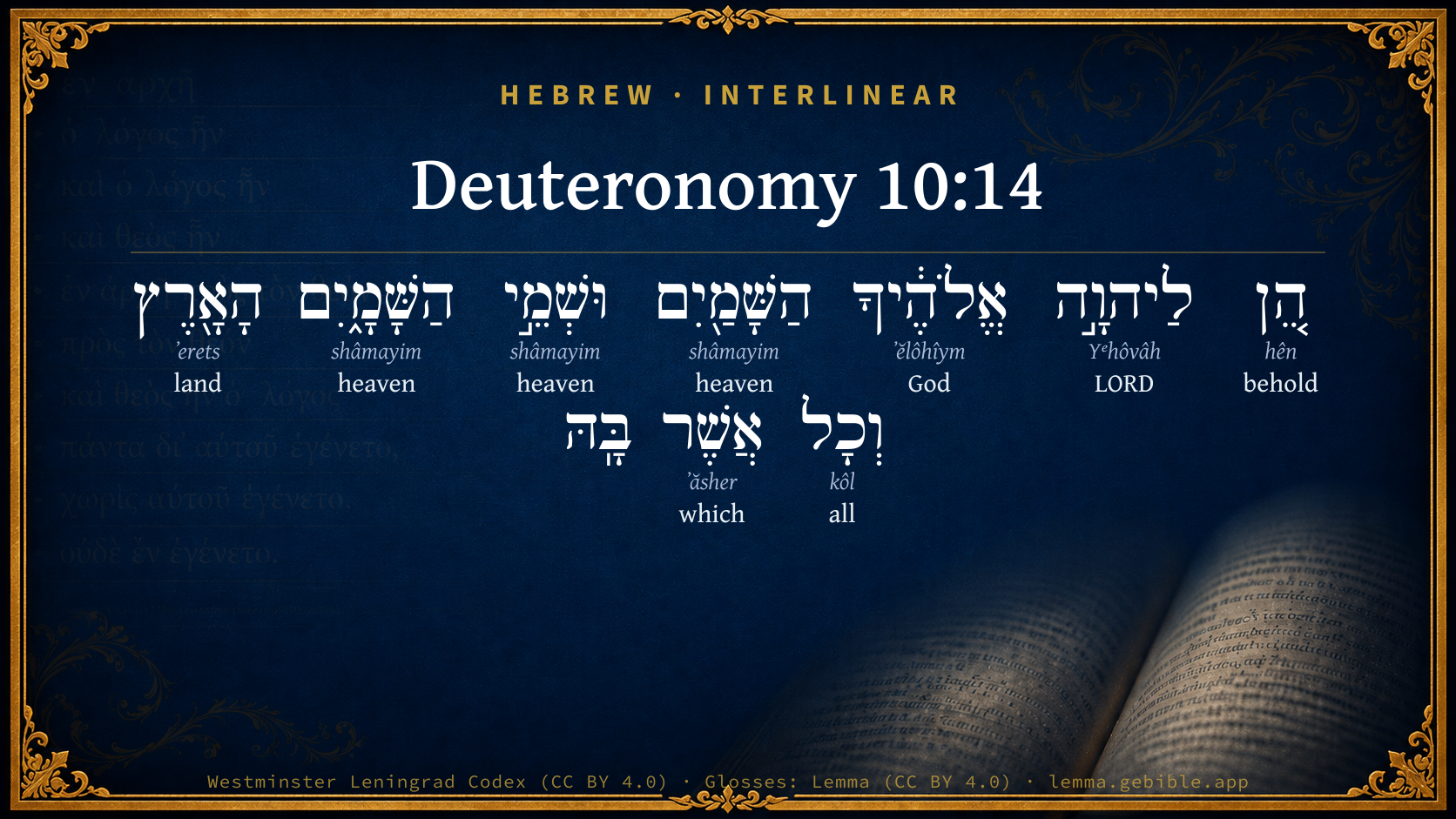
Hebrew (Westminster Leningrad Codex) Deuteronomy 10:14 appears in the Hebrew Old Testament. The text above is from the Westminster Leningrad Codex. Each word links to its Strong’s number, a concise gloss, and parsing drawn from the Open Scriptures Hebrew Bible morphology. Click any word for its full Brown-Driver-Briggs (BDB) entry.
Download image
Cite this verse

Deuteronomy 10:14 (World English Bible). Public Domain. Lemma interlinear Bible study tool, https://lemma.gebible.app/v/deuteronomy/10/14.

Show BibTeX & RIS
BibTeX
RIS
English Translation
Behold, to Yahweh your God belongs heaven and the heaven of heavens, the earth, with all that is therein.
World English Bible · Public Domain
Download a study sheet

One document with this verse’s original text, its word-by-word gloss line, the meaning frame, cross-references with their text, attributed commentary, and full source and license credits — printable, and it pastes into notes with its structure intact.

This verse Autodidact and up

Study sheet (.html) Plain text (.txt)

A passage Seminary Student

Up to 50 verses in one chapter. A passage sheet keeps up to 6 commentary sources and 12 cross-references per verse, in the order this page ranks them, and says so on the sheet whenever that leaves anything out. Ask for a single verse and you get the Autodidact verse sheet above.

Everything on this page stays free to read, with no account — the sheet is a download of what is already on screen, not access to it.

Want to remove ads? Support Godless Engineer
Compare translations 3

The same verse in 3 English versions, stacked beneath the original-language interlinear above. Click any original word for its lexicon entry.

Each is an independent rendering of the whole verse — the interlinear is not word-aligned to these translations.

Highlighted words mark where these versions differ — a whole-verse word diff, not a word-by-word alignment.

  • World English Bible Public Domain
    Behold, to Yahweh your God belongs heaven and the heaven of heavens, the earth, with all that is therein.
  • King James Version Public Domain
    Behold, the heaven and the heaven of heavens is the LORD's thy God, the earth also, with all that therein is.
  • unfoldingWord Literal Text CC BY-SA 4.0
    Behold, to Yahweh your God belong the heavens and the heaven of heavens, the earth, and all that in it.

unfoldingWord Literal Text — © unfoldingWord, licensed CC BY-SA 4.0. Word-aligned USFM3 via Door43 (git.door43.org/unfoldingWord/en_ult).

Versions to compare (up to 4)

3 of 4 selected

Show all 18 translations

Every available English version of this verse, each an independent rendering of the whole verse.

  • World English Bible Public Domain
    Behold, to Yahweh your God belongs heaven and the heaven of heavens, the earth, with all that is therein.
  • Berean Standard Bible Public Domain
    Behold, to the LORD your God belong the heavens, even the highest heavens, and the earth and everything in it.
  • Majority Standard Bible Public Domain
    Behold, to the LORD your God belong the heavens, even the highest heavens, and the earth and everything in it.
  • King James Version Public Domain
    Behold, the heaven and the heaven of heavens is the LORD's thy God, the earth also, with all that therein is.
  • American Standard Version (1901) Public Domain
    Behold, unto Jehovah thy God belongeth heaven and the heaven of heavens, the earth, with all that is therein.
  • Revised Version (1885) Public Domain
    Behold, unto the LORD thy God belongeth the heaven, and the heaven of heavens, the earth, with all that therein is.
  • Geneva Bible (1599) Public Domain
    Beholde, heauen, and the heauen of heauens is the Lords thy God, and the earth, with all that therein is.
  • Douay-Rheims (1899) Public Domain
    Behold heaven is the Lord's thy God, and the heaven of heaven, the earth and all things that are therein.
  • Young's Literal Translation Public Domain
    `Lo, to Jehovah thy God `are' the heavens and the heavens of the heavens, the earth and all that `is' in it;
  • Literal Standard Version CC BY-SA 4.0
    Behold, the heavens, even the heavens of the heavens, [belong] to your God YHWH, [as does] the earth and all that [is] in it.
  • Unlocked Literal Bible CC BY-SA 4.0
    Behold, to Yahweh your God belongs heaven and the heaven of heavens, the earth, with all that is in them.
  • unfoldingWord Literal Text CC BY-SA 4.0
    Behold, to Yahweh your God belong the heavens and the heaven of heavens, the earth, and all that in it.
  • Darby Bible Public Domain
    Behold, the heaven and the heaven of heavens belong to Jehovah thy God; the earth and all that is therein.
  • World Messianic Bible Public Domain
    Behold, to the LORD your God belongs heaven, the heaven of heavens, and the earth, with all that is therein.
  • Webster's Bible Public Domain
    Behold, the heaven and the heaven of heavens belongeth to the LORD thy God, the earth also, with all that it contains.
  • Free Bible Version CC BY-SA 4.0
    Look! Everything belongs to the Lord your God: the heavens, the highest heavens, and the earth and all that is there.
  • Bible in Basic English Public Domain
    The Lord your God is ruler of heaven, of the heaven of heavens, and of the earth with everything in it.
  • JPS Tanakh (1917) Public Domain
    Behold, unto the LORD thy God belongeth the heaven, and the heaven of heavens, the earth, with all that therein is.

Literal Standard Version (2020), Covenant Press — licensed CC BY-SA 4.0. Text via the HelloAO Bible API (eBible.org). Unlocked Literal Bible (unfoldingWord) — licensed CC BY-SA 4.0. Text via the HelloAO Bible API (eBible.org). unfoldingWord Literal Text — © unfoldingWord, licensed CC BY-SA 4.0. Word-aligned USFM3 via Door43 (git.door43.org/unfoldingWord/en_ult). Free Bible Version, Dr. Jonathan Gallagher — licensed CC BY-SA 4.0. Text via the HelloAO Bible API (eBible.org).

Word by word

More ways to search: Search by grammar → Find every occurrence → Compare this word →

Practice this passage: Drill this verse → Learn its vocabulary →

About this verse

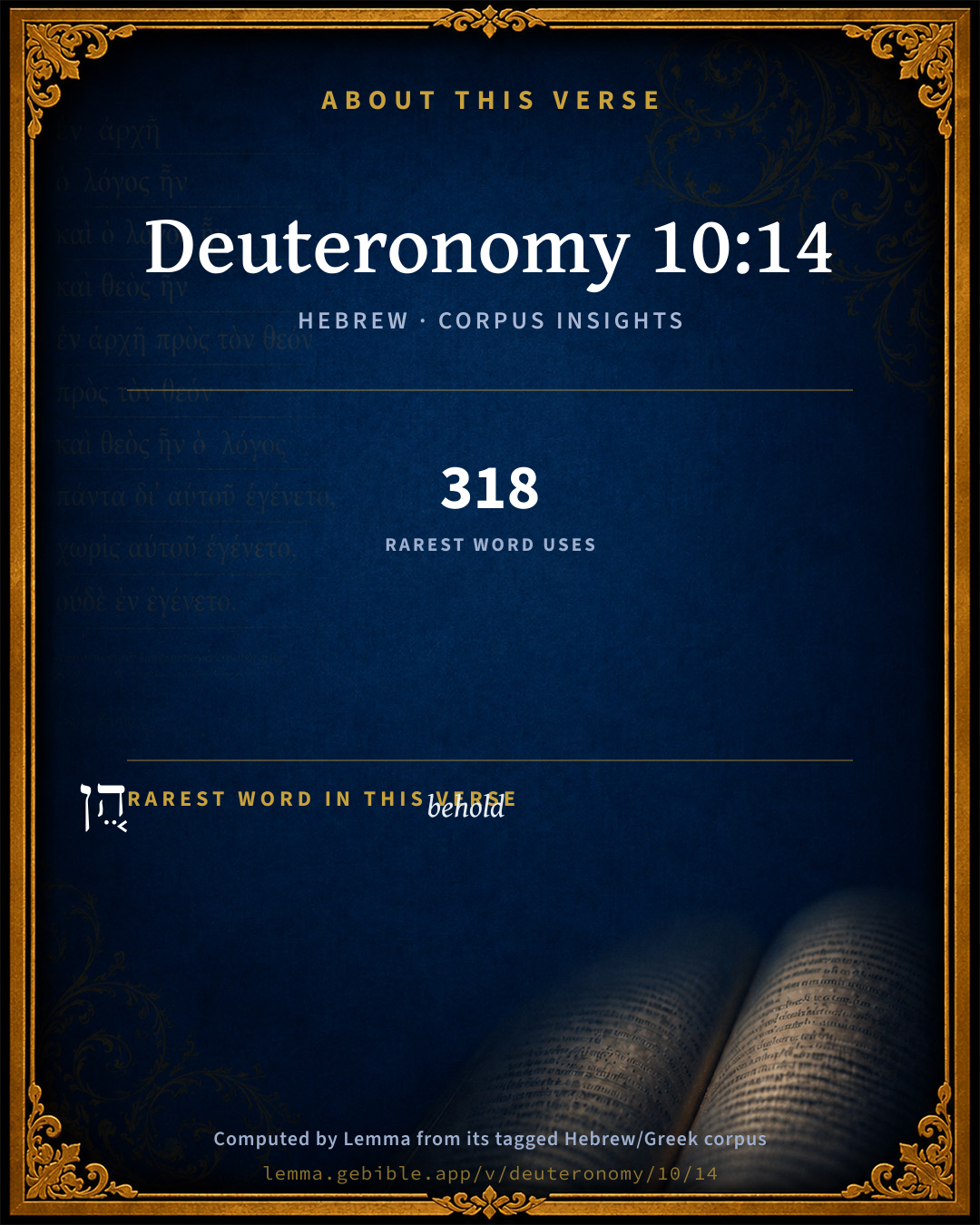
These counts appear in no published source. They are computed here, from the morphology-tagged text and Lemma’s own curated glosses. What Lemma adds →

10
words
7
distinct lemmas
Pentateuch
section

Grammatical profile

  • 7 nouns
  • 1 preposition
  • 2 particles

Repetition

A word recurs within this verse — often emphatic in Hebrew:

  • הַשָּׁמַ֖יִם heaven H8064 ×3

Hebrew & Septuagint length

In English translation the verse runs 19 words from the Hebrew and 23 from the Septuagint (LXX English) — closely comparable.

A rough comparison of the two English renderings, which tokenize alike — not a word-level alignment.

Word counts can differ between the Hebrew and the Greek without any difference in meaning — e.g. the Hebrew direct-object marker אֵת has no separate Greek word, and Greek often adds the article ὁ.

Cross-references

14

Topical passages linked to Deuteronomy 10:14 in the Treasury of Scripture Knowledge — connected by theme and wording, ordered by reader-vote popularity; previews shown in the World English Bible.

  • Exodus 19:5 Now therefore, if you will indeed obey my voice, and keep my covenant, then you shall be my own possession from among all peoples; for all the earth is mine;
  • Psalms 24:1 The earth is Yahweh's, with its fullness; The world, and those who dwell therein.
  • Nehemiah 9:6 You are Yahweh, even you alone; you have made heaven, the heaven of heavens, with all their host, the earth and all things that are thereon, the seas and all that is in them, and you preserve them all; and the host of heaven worships you.
  • Psalms 115:16 The heavens are the heavens of Yahweh; But the earth has he given to the children of men.
  • 1 Kings 8:27 But will God in very deed dwell on the earth? behold, heaven and the heaven of heavens can't contain you; how much less this house that I have built!
  • Psalms 148:4 Praise him, you heavens of heavens, You waters that are above the heavens.
  • Exodus 9:29 Moses said to him, "As soon as I have gone out of the city, I will spread abroad my hands to Yahweh. The thunders shall cease, neither shall there be any more hail; that you may know that the earth is Yahweh's.
  • 2 Chronicles 6:18 But will God in very deed dwell with men on the earth? behold, heaven and the heaven of heavens can't contain you; how much less this house which I have built!
  • Psalms 50:12 If I were hungry, I would not tell you, For the world is mine, and all that is in it.
  • Jeremiah 27:5–6 I have made the earth, the men and the animals that are on the surface of the earth, by my great power and by my outstretched arm; and I give it to whom it seems right to me.
  • Genesis 14:19 He blessed him, and said, "Blessed be Abram of God Most High, possessor of heaven and earth:
  • Isaiah 66:1 Thus says Yahweh, heaven is my throne, and the earth is my footstool: what manner of house will you build to me? and what place shall be my rest?
  • 1 Corinthians 10:26 for "the earth is the Lord's, and its fullness."
  • 1 Corinthians 10:28 But if anyone says to you, "This was offered to idols," don't eat it for the sake of the one who told you, and for the sake of conscience. For "the earth is the Lord's, and all its fullness."

Cross-references courtesy of OpenBible.info (CC BY 4.0).

Hebrew and Greek witnesses Masoretic Hebrew ↔ Greek Septuagint

The same verse in the two great witnesses to the Old Testament, shown verse-for-verse.

These are two independent witnesses, not word-aligned to each other, and the Septuagint is shown in lemma (dictionary) form.

Hebrew Deuteronomy 10:14 Masoretic · Westminster Leningrad Codex

הֵ֚ן לַיהוָ֣ה אֱלֹהֶ֔יךָ הַשָּׁמַ֖יִם וּשְׁמֵ֣י הַשָּׁמָ֑יִם הָאָ֖רֶץ וְכָל אֲשֶׁר בָּֽהּ

Behold, to Yahweh your God belongs heaven and the heaven of heavens, the earth, with all that is therein.

World English Bible · Public Domain

Greek LXX Deuteronomy 10:14 Septuagint · lemma form

ἰδού κύριος ὁ θεός σύ ὁ οὐρανός καί ὁ οὐρανός ὁ οὐρανός ὁ γῆ καί πᾶς ὅσος εἰμί ἐν αὐτός

Behold, the heaven and the heaven of heavens belong to the Lord your God, the earth and all things that are in it.

LXX2012 (modern English Septuagint) · Public Domain

Hebrew: Westminster Leningrad Codex (CC BY 4.0). Greek: Septuagint (public domain); English from LXX2012 (modern English Septuagint) (Public Domain). How the Septuagint differs from the Hebrew →

Targum (Aramaic paraphrase)

2

The Targum is the ancient Jewish Aramaic paraphrase of the Hebrew Scriptures — an interpretive translation, not the Hebrew text itself. Onkelos (literal) and Pseudo-Jonathan (expansive) render the Torah, and Jonathan the Prophets. Coverage is partial: where no permissively-licensed English translation exists for a verse, only the Aramaic is shown. This is verse-level text, not a word-by-word alignment to the Hebrew.

  1. Targum Onkelos Torah (Genesis–Deuteronomy)
    הָא דַיְיָ אֱלָהָךְ שְׁמַיָא וּשְׁמֵי שְׁמַיָא אַרְעָא וְכָל דִי בַהּ

    (no public-domain English translation for this verse)

    Targum Onkelos — Aramaic: “Onkelos Genesis” (public domain); “Onkelos Exodus” (public domain); “Onkelos Leviticus” (public domain); “Onkelos Numbers” (public domain); “Onkelos Deuteronomy” (public domain). English: “Sefaria Community Translation” (CC0 1.0 (public-domain dedication)); “J.W. Etheridge. The Targums of Onkelos and Jonathan Ben Uzziel on the Pentateuch. London: Longmans, Green, 1862” (public domain). Text via Sefaria.

  2. Targum Pseudo-Jonathan Torah (Genesis–Deuteronomy)
    הָא דַיְיָ אֱלָהָכוֹן שְׁמַיָא וּשְׁמֵי שְׁמַיָא וְכִתֵּי מַלְאָכַיָא דִבְהוֹן לִמְשַׁמְשִׁין קֳדָמוֹי אַרְעָא וְכָל דְּאִית בָּהּ

    Behold, the heavens, and the heavens of the heavens, are be Lord’s your God, and the hosts of angels are in them to minister before Him, and the earth, and whatsoever is therein.

    Targum Pseudo-Jonathan — Aramaic: “Targum Jonathan on Genesis” (public domain); “Targum Jonathan on Exodus” (public domain); “Targum Jonathan on Leviticus” (public domain); “Targum Jonathan on Numbers” (public domain); “Targum Jonathan on Deuteronomy” (public domain). English: “The Targum of Jonathan ben Uzziel, trans. J. W. Etheridge, London, 1862” (public domain). Text via Sefaria.

Commentary

Notes on Deuteronomy 10:14 from classic Christian and Jewish commentators (each source and its license shown beneath its notes). The classic Christian expositions comment on the surrounding passage and are grouped to its opening verse, so a note may address several verses; the Jewish commentaries on the Tanakh (Rashi and others) are per-verse, so they appear only where the commentator wrote on this verse.

Lemma curates 59 commentaries, every one of them public domain or Creative Commons licensed, each selected and text-cleaned for this edition rather than reprinted as found. About our sources →

Trapp's Complete Commentary

John Trapp

Deu 10:14 Behold, the heaven and the heaven of heavens [is] the LORD’S thy God, the earth [also], with all that therein [is].

Ver. 14. Behold the heaven and the heaven of heavens.] Not the air and sky only, the visible heaven, but the third heaven, whereof no natural knowledge can be had, nor any help by human arts, geometry, optics, &c. For it is neither aspectable nor movable.

The earth also.] So that there was no necessity of pitching upon thee for his peculiar, since he had choice enough before him.

John Trapp, A Commentary or Exposition upon All the Books of the Old and New Testament (1647–1656) — public domain. Text from a community e-Sword module.

The Biblical Illustrator

Joseph S. Exell

Deu_10:14-16

He chose . . . you above all people.

Election and holiness

I. In setting forth election, I must have you observe, first of all, its extraordinary singularity. God has chosen to Himself a people whom no man can number, out of the children of Adam. Now this is a wonder of wonders, when we come to consider that the heaven, even the heaven of heavens, is the Lords. If God must have a chosen race, why did He not select one from the majestic order of angels, or from the flaming cherubim and seraphim who stand around His throne? Why was not Gabriel fixed upon? What could there be in man, a creature lower than the angels, that God should select him rather than the angelic spirits? I have given you, then, some reason at starting, why we should regard Gods Election as being singular. But I have to offer others. Observe, the text not only says, Behold, the heaven, even the heaven of the heavens is the Lords, but it adds, the earth also, with all that therein is. Yet one other thought to make Gods Election marvellous indeed. God had unlimited power of creation. Now, if He willed to take a people who should be His favourites, who should be united to the person of His Son, why did He not make a new race? When Adam sinned, it would have been easy enough to strike the world out of existence. But no! Instead of making a new people, a pure people who could not sin, He takes a fallen people, and lifts these up, and that, too, by costly means; by the death of His own Son, by the work of His own Spirit; that these might be the jewels in His crown to reflect His glory forever. Oh, singular choice! My soul is lost in Thy depths, and I can only pause and cry, Oh, the goodness, oh, the mercy, oh, the sovereignty of Gods grace. Having thus spoken about its singularity, I turn to another subject.

2. Observe the unconstrained freeness of electing love. In our text this is hinted at by the word only. Why did God love their fathers? Why, only because He did so. There is no other reason. I come to the hardest part of my task. Election in its justice. Now, I shall defend this great fact, that God has chosen men to Himself, and I shall regard it from rather a different point of view from that which is usually taken. You tell me, if God has chosen some men to eternal life, that He has been unjust. I ask you to prove it. The burden of the proof lies with you. For I would have you remember that none merited this at all. God injures no man in blessing some. I defend it again on another ground. To which of you has God ever refused His mercy and love, when you have sought His face? Doth not His Word bid you come to Jesus? and doth it not solemnly say, Whosoever will, let him come? You say it is unjust that some should be lost while others are saved. Who makes those to be lost that are lost? Did God cause you to sin? Has the Spirit of God ever persuaded you to do a wrong thing? Has the Word of God ever bolstered you up in your own self-righteousness? No; God has never exercised any influence upon you to make you go the wrong way. The whole tendency of His Word, the whole tendency of the preaching of the Gospel, is to persuade you to turn from sin unto righteousness, from your wicked ways to Jehovah.

II. We now turn to election in its practical influences. You will see that the precept is annexed to the doctrine; God has loved you above all people that are upon the face of the earth; therefore, circumcise the foreskin of your hearts and be no more stiff-necked. It is whispered that Election is a licentious doctrine. It is my business to prove to you that it is the very reverse. Well, but, cries one, I know a man that believes in Election and yet lives in sin. Yes, and I suppose that disproves it. So that if I can go through London and find any ragged, drunken fellow, who believes a doctrine and lives in sin, the fact of his believing it disproves it. Singular logic, that! But I come back to my proof. It is laid down as a matter of theory that this doctrine is licentious. The fitness of things proves that it is not so. Election teaches that God has chosen some to be kings and priests to God. When a man believes that he is chosen to be a king, would it be legitimate inference to draw from it--I am chosen to be a king; therefore I will be a beggar; I am chosen to sit upon a throne, therefore I will wear rags? Why, you would say, There would be no argument, no sense in it. But there is quite as much sense in that as in your supposition, that God has chosen His people to be holy, and yet that a knowledge of this fact will make them unholy. No! the man, knowing that a peculiar dignity has been put upon him by God, feels working in his bosom a desire to live up to his dignity. Again, not only the fitness of things, but the thing itself proves that it is not so. Election is a separation. God has set apart him that is godly for Himself, has separated a people out of the mass of mankind. Does that separation allow us to draw the inference thus:--God has separated me, therefore I will live as other men live? No! if I believe that God has distinguished me by His discriminating love, and separated me, then I hear the cry, Come out from among them, and be ye separate, and touch not the unclean thing, and I will be a Father unto you. It were strange if the decree of separation should engender an unholy union. It cannot be. (C. H. Spurgeon.)

All things subserve the welfare of Gods elect children

I see a mother that, as the twilight falls and the baby sleeps, and because it sleeps out of her arms, goes about gathering from the floor its playthings, and carries them to the closet, and carries away the vestments that have been cast down, and stirring the fire, sweeping up the hearth, winding the clock, and gathering up dispersed books, she hums to herself low melodies as she moves about the room, until the whole place is once again neat, and clean, and in order. Why is it that the room is so precious to her? Is it because there is such beautiful paper on the walls? because there is so goodly a carpet on the floor? because the furniture in the room is so pleasing to the eye? All these are nothing in her estimation except as servants of that little creature of hers--the baby in the cradle. She says, All these things serve my heart while I rock my child. The whole round globe is but a cradle, and our God rocks it, and regards all things, even the world itself, as so many instruments for the promotion of our welfare. When He makes the tempest, the pestilence, or the storm, when He causes ages in their revolutions to change the world, it is all to serve His own heart through His children--men. When we are walking through this world, we are not walking through long files of laws that have no design; we are walking through a world that has natural laws, which we must both know and observe: yet these must have their master, and Christ is He. And all of these are made to be our servants because we are Gods children. (H. W. Beecher.)

Gods elective call

These words were intended to make it plain to the Israelites how greatly they had been honoured of God in being given such preeminence among the nations. So we must ever keep in view who calls us through the Gospel and has come near to us in it. It is God, whose are not only the earth but the heaven of heavens. From these words of Moses we may gather--

I. How great and mighty is the God who calls us to Himself--how wise and solicitous for mens good, and how He has proved this in all the regions of the creation which belongs to Him.

II. He who holds all things in His hand and cares for all, can have a special and peculiar care for each individual: and thus we may have fullest confidence in Him.

III. It should make us astonished and confused beyond measure to think that the great God should have called us weak and puny creatures to so great grace and favour; that He should even have sent His Son for our redemption, and that He would have us become temples of the Holy Ghost. Many indeed find it inconceivable that God should have destined our globe--one of the smallest of the worlds--for such high honour. This appears to them so absurd, that on this account they would throw over Christianity. They forget that the greatness of God lies in this, that He attends to and cares for the small as well as the great. To the infinite Jehovah the distinction between small and great is not as it appears to us. Moses understood this.

IV. In these words there appears the hint of a comprehensive Divine plan which God designed with regard to the creation through that which He accomplished toward this lower portion of it. So had He already proclaimed to that people chosen before all others. As truly as I live, saith the Lord, all the earth shall be filled with the glory of the Lord (Num_14:21). He thus proclaimed that through the choice of Israel He had in view the salvation of all the peoples; a truth already revealed in the blessing of Abraham, in whose seed all nations are to be blessed. Even so we may say that, in the choice of our globe for this special design, He contemplates the renewal and glorification of the universe. In Christ, in the fulness of time, He will gather together all things, both which are in heaven and which are on earth (Eph_1:10; Col_1:20). How this is to be accomplished we must leave to the care of Him whose are the heaven and the heaven of heavens.

V. The responsibility of those so highly favoured will be the greater if they should turn away to unbelief and disobedience. If these things be so, Moses words give us sufficient inducement to hold fast with decision and faithfulness what is offered us in the Gospel and in the revelation of Gods will. Let us not fail in our part, as we may be assured He will not fail who has come down so far in Christ unto us. (J. C. Blumhardt.)

Circumcise therefore the foreskin of your heart, and be no more stiff-necked.

Circumcision as compared with baptism

I. Spiritual circumcision--its meaning.

1. Declared in the Old and New Testaments, as, in the text, also in Jer_4:4, and elsewhere.

2. Spoken of as a seal of the righteousness of faith (Rom_4:11).

3. Spoken of as representing the renunciation of, and cutting off of, the superfluity of the flesh (Col_2:11).

4. Therefore true circumcision is of everlasting and universal obligation.

II. Literal circumcision. Temporary and preparatory.

1. For males only.

2. Superseded by baptism.

III. Circumcision and baptism.

1. Two points in which they differ.

(1) Baptism, in its literal sense, taken as an outward rite, is of universal and continual obligation--continual, that is, as long as this dispensation lasts.

(2) Taken in its literal sense, circumcision was the initiatory rite of the old covenant, as baptism is of the new.

2. Three points of resemblance.

(1) In a spiritual sense, both have the same signification. Both point to the renewal of heart which is required of all.

(2) Neither circumcision nor baptism are of value as mere rites, unaccompanied by the spiritual grace which they typify (Gal_5:6; 1Pe_3:21). (Archbp. Whateley.)

The cure of wilfulness

It is a thing much to be observed, that many of the outward and visible signs, which God has ordained His people to use in worshipping Him, have somewhat in them to remind us in some way of suffering, affliction, pain, self-denial, death. Thus the Holy Communion is the remembrance of our Saviours death, His violent and bitter death. But of all Church ceremonies, there is none which so distinctly sets before us our call to suffer, as that which has from the beginning always gone along with baptism; the signing the newly baptised with the sign of the Cross. The Cross is the very height and depth of all suffering. Now such as the baptismal Cross is in the Christian life, such was circumcision among Gods ancient people. It was His mark, made for life, in the very flesh of those who belonged to Him, setting them apart, in a manner, for suffering and self-denial. It was a foretaste of the Cross; add, as such, our Saviour Himself received it. Thus, whether we look to our Lords own example, or to the sacramental ways which He has ordained, both of old and new, to bring His people near Him, either way we are taught to count them happy which endure; to consider affliction and trouble as Gods seal, set upon those who particularly belong to Him, and to fear nothing so much as receiving our consolation in this world. But if this be so, then just in such measure as we are going on prosperously and at ease, have we need to mortify ourselves, and keep our passions in order; that by our own doing, if so please God, we may provide for ourselves something like that due chastening, which our afflicted brethren really have to endure. This, our self-denial, we must practise in little matters: it should accompany us in our everyday walk, as every Jew bore about with him the mark of circumcision, visibly impressed on his flesh. We must not keep our patience and self-command to be exercised only on great and solemn occasions; we must be continually sacrificing our own wills, as opportunity serves, to the will of others. There is no end, in short, of the many little crosses which, if quietly borne in a Christian way, will, by Gods grace, do the work of affliction, and help to tame our proud wills by little and little. I say, tame our proud wills, because Holy Scripture sets forth this as one of the particular objects for which circumcision was appointed, that Gods people might learn by it, not only to get over what are commonly called the lusts of the flesh, but the angry and envious, and proud feeling also; as the text seems specially to hint: Circumcise, therefore, the foreskin of your heart, and be no more stiff-necked. As if stubbornness and obstinacy, and, in one word, wilfulness (for that is the meaning of a stiff neck), were to be cured by the same kind of discipline as sensual passions, lust, and greediness. In short, it is not hard to understand how the body, which greatly affects the mind, may be tamed and brought into subjection, by a quiet and discreet method of fasting, accompanied, of course, with alms and prayer. And a little consideration will show that the same discipline must do great good to the passions of the soul too. If we abstain from indulging our bodily appetites, for the sake of pleasing God and obtaining His grace, is there not so far a better chance of our remembering Him, when we are tempted to indulge discontented, unkind, proud thoughts, wilful tempers of any sort? I do not of course mean that this benefit follows upon the mere outward exercise of fasting, but only if a person sets about it religiously, in the fear Of God, in desire to draw near to Christ, and in humble obedience to His will, made known in His Gospel and by His Church. Otherwise mere fasting, as well as mere prayer, or mere reading, or mere going to church, may be turned into a snare of the devil. But it is not therefore to be omitted, any more than those other holy exercises; but practised, as I said, in the fear of God, the want of which fear alone it is, which can ever make any person easy in depending on one or other holy duty, so as to leave out the rest. (Plain Sermons by Contributors to Tracts for the Times.)

The Biblical Illustrator, edited by Joseph S. Exell (c. 1880s–1900s) — public domain. Text from a community e-Sword module.

Joseph Benson's Commentary

Deu 10:14. The heaven — The aerial and starry heaven. The heaven of heavens — The highest, or third heaven, thus named for its eminence. All that therein is — All creatures and all men, which being all his, he might have chosen what nation he pleased to be his people.

Joseph Benson's Commentary on the Old and New Testaments (1811–1818) — public domain. Text from a community e-Sword module.

Adam Clarke's Commentary

Verse 14. Behold, the heaven and the heaven of heavens] All these words in the original are in the plural number: הן השמים ושמי השמים hen hashshamayim, ushemey hashshamayim; behold the heavens and the heavens of heavens. But what do they mean? To say that the first means the atmosphere, the second the planetary system, and the third the region of the blessed, is saying but very little in the way of explanation. The words were probably intended to point out the immensity of God's creation, in which we may readily conceive one system of heavenly bodies, and others beyond them, and others still in endless progression through the whole vortex of space, every star in the vast abyss of nature being a sun, with its peculiar and numerous attendant worlds! Thus there may be systems of systems in endless gradation up to the throne of God!

Adam Clarke's Commentary on the Bible (1810–1826) — public domain. Text from a community e-Sword/MySword module.

The Cambridge Bible for Schools and Colleges

gen. ed. J. J. S. Perowne

14. This and the next v. state motives for the fear and love just enjoined: for fear, because He is the greatest God, to whom all things belong; for love because, though He is such, He yet loved Israel’s fathers and chose their posterity, even those whom Moses is addressing.

the heaven, etc.] A characteristic deuteronomic accumulation.

heaven of heavens] i.e. the highest heavens (the same idiom as in Deu_10:17). Whether this idiomatic superlative (first here and then echoed in later passages, 1Ki_8:27; 2Ch_2:6; Neh_9:6; Psa_68:33; Psa_148:4) or the plural positive heavens was the germ of the later idea of the plurality of heavens (in the Jewish apocalyptic books and the N.T., e.g. 2Co_12:2; Eph_4:10 R.V.) is uncertain; but the development of the idea was due to the influences of Babylonian and Persian cosmologies and eschatologies. See S. D. F. Salmond, art. ‘Heaven’ in Hastings’ D.B., and Charles, Secrets of Enoch, 30–47.

The Cambridge Bible for Schools and Colleges (gen. ed. J. J. S. Perowne; Cambridge University Press, 1878–1918) — public domain. Text from a community e-Sword module.

John Gill's Exposition

Behold, the heaven, and the heaven of heavens, are the Lord's thy God,.... Made and possessed by him; the airy and starry heaven, the third heaven, which is the heaven of heavens, the seat of the divine Majesty, the habitation of angels and glorified saints:

the earth also, with all that therein is; that is his property, and at his disposal, being made by him, and all that is upon it, or contained in it, even whatsoever is on or in the whole terraqueous globe; see Psa 115:15.

John Gill's Exposition of the Whole Bible (1746–1763) — public domain (CC PDM 1.0). Text via the HelloAO Bible API.

Haydock's Catholic Bible Commentary

Of heaven. The Scripture mentions the third heaven, (2 Corinthians xii. 2,) where the majesty of God most gloriously appears. The second is the region of the stars, and the first the atmosphere, where the birds and the clouds move about. (Calmet)

George Leo Haydock (1774–1849), Haydock's Catholic Family Bible and Commentary, 1859 edition — public domain. Excludes Psalms (Douay-Rheims chapter numbering differs from Protestant) and Deuterocanonical books (Catholic canon only).

Matthew Poole's English Annotations

The heaven; the airy and starry heaven.

The heaven of heavens; the highest or third heaven, 1Ki 8:27; 2Co 12:2, called the heaven of heavens for its eminency, as the song of songs, king of kings, holy of holies, &c.

The earth also, with all creatures and all men, which being all his, he might have chosen what nation he pleased to be his people.

Matthew Poole's English Annotations on the Holy Bible (1683–1685) — public domain. Text from a community e-Sword/MySword module.

Whedon's Commentary on the Bible

Daniel D. Whedon

14. The heaven of heavens — This expression, in connexion with the earth also, with all that therein is, comprehends the universe. All belong to Jehovah thy God. He is the one who has chosen Israel for his own peculiar people.

Daniel D. Whedon (gen. ed.), Commentary on the Old and New Testaments (1874–1909) — public domain. Text from a community e-Sword module.

The Pulpit Commentary

Vers. 14, 15. To love and serve the Lord, Israel was specially bound, because of God"s love to them and choice of them to be his people. He, the Lord and Proprietor of the universe, was free to choose any of the nations he pleased, and needed not the service of any, but of his free grace he chose Israel, in whose fathers he had delight, to love them (cf. Exo_19:5) The heaven and the heaven of heavens; the highest heavens, all that may be called heaven, with all that it contains. Delight "set his eve; (Deu_7:7) literally, cleaved to, was attached to. "Affection, love, choice, the three moments prompting from the innermost impulses to the historical act" (Lange).

Vers. 14-22. The supreme persuasive.

The revelation of God"s character in its double aspect of exalted might and of condescending grace.

I GOD EXALTED, YET STOOPING. (Vers. 14-16.) The wonder of revelation:

1. That One so exalted should stoop at all. The wonder is not abated by reflecting that infinite perfection must include infinite mercy with every other attribute. It fills us with amazement to think of the Possessor of heaven and earth stooping to hold friendly converse with his creature, man. The Bible dwells on the thought with astonishment (1Ki_8:27; Psa_8:3, 4 147:3-6; Isa_57:15) Modern science indirectlytestifies to the wonder in objecting that, with our enlarged conceptions of the universe, it is impossible to believe that God should feel the special interest in man which the Bible says he does.

2. That One so exalted should stoop so far. God"s depth of condescension seen peculiarly in the gospel.

(1) In sending the Son.

(2) In surrendering him to death.

(3) This for enemies.

(4) In dwelling by the Spirit in imperfectly sanctified hearts (Joh_3:16; Rom_5:6-10 Rom_8:32; 2Co_6:16; Gal_5:17)

The persuasiveness of the revelation lies in its blending of majesty with grace.

II GOD MIGHTY AND EQUITABLE, YET TENDERLY SYMPATHETIC. (Vers. 17-20.) Another aspect of the Divine greatness, blending with lowliness, which attracts the heart. The combination of great strength with great gentleness; of judicial sternness with humane consideration of those in distress, are sufficiently rare to be always striking. We marvel when, in the hero of a hundred battles, we discover a heart of woman"s tenderness; when in the judge whose strictness on the bench every one remarks, we light on a spring of deep and genuine compassionateness. It is this combination we see in God. A God of gods, a Lord of lords; great, mighty, terrible, sternly just; yet, what might seem incompatible with this, tenderly and touchingly compassionate. His might and equity, so terrible to evil-doers, he throws as a shield around the fatherless, the widow, and the stranger. He executes their judgment. They are his peculiar care. Them, above all others, will he not allow to be wronged. (Psa_68:5)

III GOD OMNIPOTENT, YET HIS OMNIPOTENCE EXERTED IN DEFENDING AND BLESSING HIS CHURCH. (Vers. 21, 22.) Power in itself awakens fear; power known to be engaged in our protection and for our good inspires the highest confidence. Moses recalls to the Israelites, as a reason for fearing and loving God, his acts of power on then behalf, especially his power as exerted in their extraordinary increase. God"s power may be viewed as displayed:

1. In the Church"s redemption. (Col_1:13)

2. In the Church"s increase. (Act_5:38, Act_5:39)

3. In the Church"s protection from her foes (Mat_16:18; Act_4:24, Act_4:31)

The individual Christian will have reason to rejoice in the same power as exerted in his conversion, (Eph_1:19) in his upholding, (Jud_1:24) in his protection, (Rom_8:35-39) in his ultimate salvation. J.O. (1Pe_1:5)

The Pulpit Commentary (1880–1919), ed. H.D.M. Spence-Jones & Joseph S. Exell — public domain. Text from a community e-Sword module.

John Wesley's Explanatory Notes

The heaven - The airy and starry heaven. The heaven of heavens - The highest or third heaven, called the heaven of heavens for its eminency. All that therein is - With all creatures and all men, which being all his, he might have chosen what nation he pleased to be his people.

John Wesley, Explanatory Notes Upon the Whole Bible (1754–1765) — public domain. Text via the GEBible commentary corpus.

Keil & Delitzsch

C. F. Keil & F. Delitzsch

This obligation the Lord had laid upon Israel by the love with which He, to whom all the heavens and the earth, with everything upon it, belong, had chosen the patriarchs and their seed out of all nations. By "the heavens of the heavens," the idea of heaven is perfectly exhausted. This God, who might have chosen any other nation as well as Israel, or in fact all nations together, had directed His special love to Israel alone.

Keil & Delitzsch — Biblical Commentary on the Old Testament (1861–1891) — public domain (CC PDM 1.0). Text via the HelloAO Bible API. (Old Testament only.)

unfoldingWord translationNotes

Door43 World Missions Community

General Information:

Moses continues to speak to the Israelites as if they are one person. (See: Forms of You)

Behold, to

"Pay attention, because what I am about to say is both true and important: to"

heaven ... earth

These words show two extremes, and are combined to mean that all things everywhere belong to Yahweh. (See: Merism)

the heaven of heavens

This refers to the highest places in the heavens. Everything in the heavens belong to God.

chose you

Here the word "you" refers to all the Israelites and is plural. (See: Forms of You)

translationWords

Yahweh

God

heaven

earth

ancestor

love

chosen one

descend

people group

unfoldingWord translationNotes — © Distant Shores Media and the Door43 World Missions Community, licensed CC BY-SA 4.0. Source: git.door43.org/Door43/en_tn.

Rashi

Rabbi Shlomo Yitzchaki (Rashi)

הן לה׳ אלהיך BEHOLD, UNTO THE LORD THY GOD BELONGS the whole Universe (“the heavens … and the earth and all that therein is”), and yet רק באבתיך חשק ה׳ ONLY IN THY FATHERS DID THE LORD TAKE PLEASURE.

Rashi on the Tanakh — English translations: “The Judaica Press complete Tanach with Rashi, translated by A. J. Rosenberg” (CC BY 4.0); “Pentateuch with Rashi's commentary by M. Rosenbaum and A.M. Silbermann, 1929-1934” (public domain); “The Metsudah Tanach series, Lakewood, N.J” (CC BY 4.0); and “The Book of Joshua, Metsudah Publications, 1997” (CC BY 4.0). Text via Sefaria.

Lesson kit

Teaching starters — assembled from the data on this page, not authored interpretation. Every prompt links to the verse data it draws on. Edit before teaching.

Deuteronomy, in the Pentateuch, opens this verse with 10 words (7 distinct Hebrew lemmas). Its most distinctive word is hên (“behold”). A historical commentator’s framing appears above. Read the whole chapter for the surrounding context.

Discussion questions

  1. The word hên carries the sense “behold.” How does it shape the verse?
  2. How does Exodus 19:5, which shares this passage’s theme, read alongside this verse?
  3. What does the repetition of “heaven” (3× in this one verse) do in this verse?
  4. These translations render this verse differently. What is at stake in choosing one wording over another?
  5. Compare how Trapp's Complete Commentary and The Biblical Illustrator read this verse. Where do they agree or differ?

Things to notice

  • These translations choose different wording for 6 words in this verse.
  • “heaven” occurs 3× in this single verse.
  • 7 distinct Hebrew lemmas span 10 words in this verse.

Reading settings

Reading text

Shown beneath each verse's original-language words.

Old Testament
Old Testament edition

Read the OT as the Masoretic Hebrew (MT) or the Greek Septuagint (LXX).

English shown for the Greek Septuagint (in the Hebrew ↔ Greek comparison).

Comparing translations? Open the Compare panel on any verse page to stack up to four side by side.