
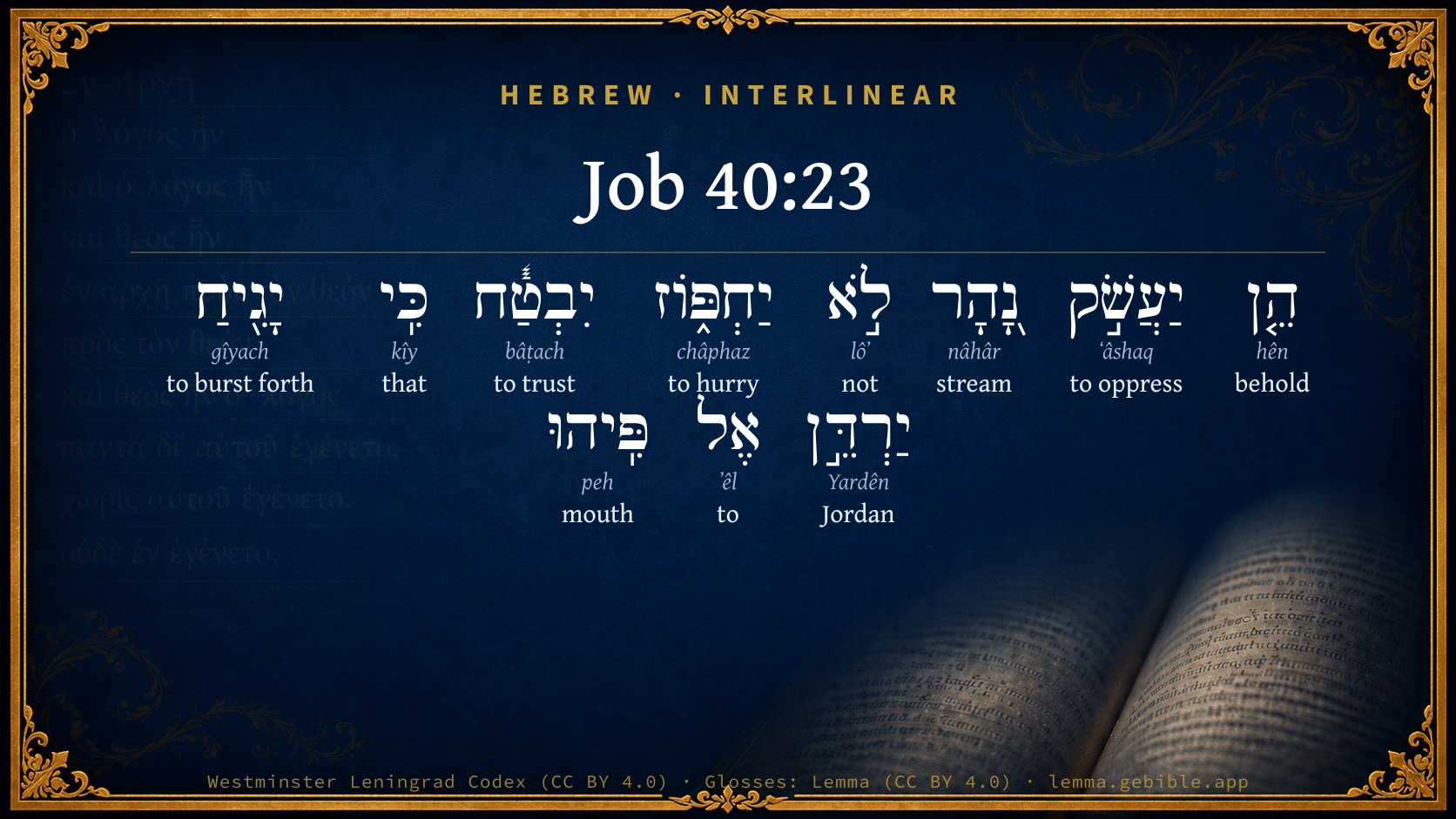
Job 40:23

Hebrew (Westminster Leningrad Codex) Job 40:23 appears in the Hebrew Old Testament. The text above is from the Westminster Leningrad Codex. Each word links to its Strong’s number, a concise gloss, and parsing drawn from the Open Scriptures Hebrew Bible morphology. Click any word for its full Brown-Driver-Briggs (BDB) entry.
Download image
Cite this verse

Job 40:23 (World English Bible). Public Domain. Lemma interlinear Bible study tool, https://lemma.gebible.app/v/job/40/23.

Show BibTeX & RIS
BibTeX
RIS
English Translation
Behold, if a river overflows, he doesn't tremble. He is confident, though the Jordan swells even to his mouth.
World English Bible · Public Domain
Download a study sheet

One document with this verse’s original text, its word-by-word gloss line, the meaning frame, cross-references with their text, attributed commentary, and full source and license credits — printable, and it pastes into notes with its structure intact.

This verse Autodidact and up

Study sheet (.html) Plain text (.txt)

A passage Seminary Student

Up to 50 verses in one chapter. A passage sheet keeps up to 6 commentary sources and 12 cross-references per verse, in the order this page ranks them, and says so on the sheet whenever that leaves anything out. Ask for a single verse and you get the Autodidact verse sheet above.

Everything on this page stays free to read, with no account — the sheet is a download of what is already on screen, not access to it.

Want to remove ads? Support Godless Engineer
Compare translations 3

The same verse in 3 English versions, stacked beneath the original-language interlinear above. Click any original word for its lexicon entry.

Each is an independent rendering of the whole verse — the interlinear is not word-aligned to these translations.

Highlighted words mark where these versions differ — a whole-verse word diff, not a word-by-word alignment.

  • World English Bible Public Domain
    Behold, if a river overflows, he doesn't tremble. He is confident, though the Jordan swells even to his mouth.
  • King James Version Public Domain
    Behold, he drinketh up a river, and hasteth not: he trusteth that he can draw up Jordan into his mouth.
  • unfoldingWord Literal Text CC BY-SA 4.0
    Behold, a river will overflow, it does not tremble; it is confident, if the Jordan should surge to its mouth.

unfoldingWord Literal Text — © unfoldingWord, licensed CC BY-SA 4.0. Word-aligned USFM3 via Door43 (git.door43.org/unfoldingWord/en_ult).

Versions to compare (up to 4)

3 of 4 selected

Show all 18 translations

Every available English version of this verse, each an independent rendering of the whole verse.

  • World English Bible Public Domain
    Behold, if a river overflows, he doesn't tremble. He is confident, though the Jordan swells even to his mouth.
  • Berean Standard Bible Public Domain
    Though the river rages, Behemoth is unafraid; he remains secure, though the Jordan surges to his mouth.
  • Majority Standard Bible Public Domain
    Though the river rages, Behemoth is unafraid; he remains secure, though the Jordan surges to his mouth.
  • King James Version Public Domain
    Behold, he drinketh up a river, and hasteth not: he trusteth that he can draw up Jordan into his mouth.
  • American Standard Version (1901) Public Domain
    Behold, if a river overflow, he trembleth not; He is confident, though a Jordan swell even to his mouth.
  • Revised Version (1885) Public Domain
    Behold, if a river overflow, he trembleth not: he is confident, though Jordan swell even to his mouth.
  • Geneva Bible (1599) Public Domain
    Will hee make a couenant with thee? and wilt thou take him as a seruant for euer?
  • Douay-Rheims (1899) Public Domain
    Will he make a covenant with thee, and wilt thou take him to be a servant for ever?
  • Young's Literal Translation Public Domain
    Lo, a flood oppresseth -- he doth not haste, He is confident though Jordan Doth come forth unto his mouth.
  • Literal Standard Version CC BY-SA 4.0
    Behold, a flood oppresses—he does not hurry, || He is confident though Jordan || Comes forth to his mouth.
  • Unlocked Literal Bible CC BY-SA 4.0
    See, if a river floods its banks, he does not tremble; he is confident, though the Jordan should surge up to his mouth.
  • unfoldingWord Literal Text CC BY-SA 4.0
    Behold, a river will overflow, it does not tremble; it is confident, if the Jordan should surge to its mouth.
  • Darby Bible Public Domain
    Lo, the river overfloweth -- he startleth not: he is confident though a Jordan break forth against his mouth.
  • World Messianic Bible Public Domain
    Behold, if a river overflows, he doesn’t tremble. He is confident, though the Jordan swells even to his mouth.
  • Webster's Bible Public Domain
    \\41:4\\Will he make a covenant with thee? wilt thou take him for a servant for ever?
  • Free Bible Version CC BY-SA 4.0
    Even if the river is in flood, it is not concerned; it remains calm when the Jordan river surges against it.
  • Bible in Basic English Public Domain
    Will he make an agreement with you, so that you may take him as a servant for ever?
  • JPS Tanakh (1917) Public Domain
    Behold, if a river overflow, he trembleth not; he is confident, though the Jordan rush forth to his mouth.

Literal Standard Version (2020), Covenant Press — licensed CC BY-SA 4.0. Text via the HelloAO Bible API (eBible.org). Unlocked Literal Bible (unfoldingWord) — licensed CC BY-SA 4.0. Text via the HelloAO Bible API (eBible.org). unfoldingWord Literal Text — © unfoldingWord, licensed CC BY-SA 4.0. Word-aligned USFM3 via Door43 (git.door43.org/unfoldingWord/en_ult). Free Bible Version, Dr. Jonathan Gallagher — licensed CC BY-SA 4.0. Text via the HelloAO Bible API (eBible.org).

Word by word

More ways to search: Search by grammar → Find every occurrence → Compare this word →

Practice this passage: Drill this verse → Learn its vocabulary →

About this verse

These counts appear in no published source. They are computed here, from the morphology-tagged text and Lemma’s own curated glosses. What Lemma adds →

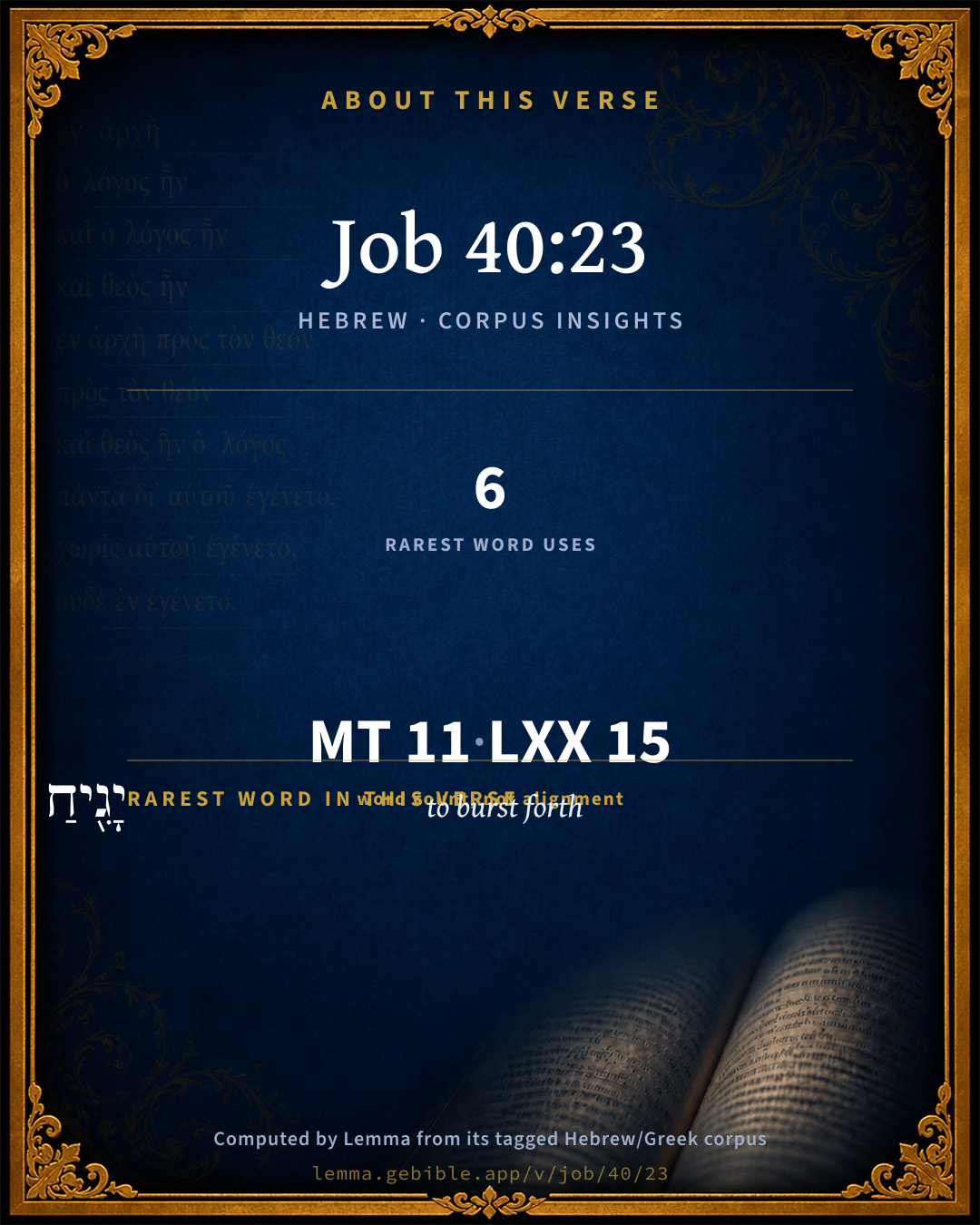
11
words
11
distinct lemmas
Wisdom
section

Notable vocabulary

The rarest word here is יָגִ֖יחַ to burst forth H1518 — appearing just 6 times in the whole Hebrew Bible.

Shared distinctive vocabulary

יָגִ֖יחַ to burst forth H1518 occurs in 6 verses of the Hebrew Bible. Also found in:

Grammatical profile

  • 4 verbs
  • 3 nouns
  • 1 preposition
  • 1 conjunction
  • 2 particles

Verb forms

  • יַעֲשֹׁ֣ק Qal · Imperfect
  • יַחְפּ֑וֹז Qal · Imperfect
  • יִבְטַ֓ח Qal · Imperfect
  • יָגִ֖יחַ Qal · Imperfect

Hebrew & Septuagint length

In English translation the verse runs 19 words from the Hebrew and 17 from the Septuagint (LXX English) — closely comparable.

A rough comparison of the two English renderings, which tokenize alike — not a word-level alignment.

Word counts can differ between the Hebrew and the Greek without any difference in meaning — e.g. the Hebrew direct-object marker אֵת has no separate Greek word, and Greek often adds the article ὁ.

In the original languages it is 11 Hebrew tokens and 15 Greek tokens — but the two are counted differently (Hebrew bundles its prefixes and suffixes into one token; the Greek is in lemma form), so that isn’t a like-for-like length.

Cross-references

5

Topical passages linked to Job 40:23 in the Treasury of Scripture Knowledge — connected by theme and wording, ordered by reader-vote popularity; previews shown in the World English Bible.

  • Genesis 13:10 Lot lifted up his eyes, and saw all the plain of the Jordan, that it was well watered every where, before Yahweh destroyed Sodom and Gomorrah, like the garden of Yahweh, like the land of Egypt, as you go to Zoar.
  • Joshua 3:15 and when those who bore the ark were come to the Jordan, and the feet of the priests who bore the ark were dipped in the brink of the water (for the Jordan overflows all its banks all the time of harvest),
  • Psalms 55:8 "I would hurry to a shelter from the stormy wind and tempest."
  • Isaiah 28:16 therefore thus says the Lord Yahweh, Behold, I lay in Zion for a foundation a stone, a tried stone, a precious corner -[stone] of sure foundation: he who believes shall not be in haste.
  • Isaiah 37:25 I have dug and drunk water, and with the sole of my feet will I dry up all the rivers of Egypt.

Cross-references courtesy of OpenBible.info (CC BY 4.0).

Hebrew and Greek witnesses Masoretic Hebrew ↔ Greek Septuagint

The same verse in the two great witnesses to the Old Testament, shown verse-for-verse.

These are two independent witnesses, not word-aligned to each other, and the Septuagint is shown in lemma (dictionary) form.

Hebrew Job 40:23 Masoretic · Westminster Leningrad Codex

הֵ֤ן יַעֲשֹׁ֣ק נָ֭הָר לֹ֣א יַחְפּ֑וֹז יִבְטַ֓ח כִּֽי יָגִ֖יחַ יַרְדֵּ֣ן אֶל פִּֽיהוּ

Behold, if a river overflows, he doesn't tremble. He is confident, though the Jordan swells even to his mouth.

World English Bible · Public Domain

Greek LXX Job 40:23 Septuagint · lemma form

ἐάν γίγνομαι πλήμμυρα οὐ μή αἰσθάνομαι πείθω ὅτι προςκρούω ὁ ιορδάνης εἰς ὁ στόμα αὐτός

And will he make a covenant with you? and will you take him for a perpetual servant?

LXX2012 (modern English Septuagint) · Public Domain

On this verse, Albert Barnes' Notes on the Bible discusses the Septuagint’s reading. Read the note in Commentary ↓

Hebrew: Westminster Leningrad Codex (CC BY 4.0). Greek: Septuagint (public domain); English from LXX2012 (modern English Septuagint) (Public Domain). How the Septuagint differs from the Hebrew →

Commentary

Notes on Job 40:23 from classic Christian and Jewish commentators (each source and its license shown beneath its notes). The classic Christian expositions comment on the surrounding passage and are grouped to its opening verse, so a note may address several verses; the Jewish commentaries on the Tanakh (Rashi and others) are per-verse, so they appear only where the commentator wrote on this verse.

Lemma curates 59 commentaries, every one of them public domain or Creative Commons licensed, each selected and text-cleaned for this edition rather than reprinted as found. About our sources →

Trapp's Complete Commentary

John Trapp

Job 40:23 Behold, he drinketh up a river, [and] hasteth not: he trusteth that he can draw up Jordan into his mouth.

Ver. 23. Behold, he drinketh up a river, and hasteth not] viz. Through fear, tanquam canis ad Nilum, as the dogs that drink at Nile fear the crocodile; or as they of this land anciently drank in fear of their lives the while, and were, therefore, wont to have some friend to undertake for their safety: whence that expression of him who is drunk to, I’ll pledge for you. The elephant, as he drinks huge draughts (beyond that of the camel, who drinketh, saith Pliny, lib. 8, cap. 18, Et in praeteritum, et in futurum, for both the time past and the time to come), so he drinks without disturbance, for who dare deal with him? Other cattle, through the frightfulness of their disposition, break their draughts to stare about them. Not so the elephant, who drinks as if he would exhaust and drain dry the river, and steps into it with such a big body as if he would stop the course of it; therefore some read the words thus, He hindereth the river, that it hasteth not. Some by he hasteth not understand that custom of the elephant, not to drink till he have first, by going into and stirring the water, made it puddly, for he loveth not clear waters, as Aelian writeth. Neither yet doth he at any time enter higher into a river than he can breathe through his large snout, for swim he cannot by reason of the weightiness of his body, saith Aristotle (Hist. Anim. l. 9, cap. 46).

He trusteth that he can draw up Jordan into his mouth] In the vast imagination of his fancy he conceits that he can devour and drink up the whole Jordan at once. Jordan is the greatest river of Canaan, running along the land, and falling into the Dead Sea, which yet grows no bigger by swallowing it. Hereunto some think that this text alludeth. But better by Jordan here (which ariseth from the root of Libanus, and, as some say, from a double fountain, the one on the right side, called Dan, and the other on the left, called Jor) we may understand, by a synecdoche, {a} any river; and so these words are nothing else but a hyperbolic repetition of the former.

{a} A figure by which a more comprehensive term is used for a less comprehensive or vice versa; as whole for part or part for whole, genus for species or species for genus, etc.

John Trapp, A Commentary or Exposition upon All the Books of the Old and New Testament (1647–1656) — public domain. Text from a community e-Sword module.

The Biblical Illustrator

Joseph S. Exell

Job_40:23

Behold, he drinketh up a river.

Christian confidence

We have often wondered what was meant by the singular action of behemoth in Job_40:23, Behold, he drinketh up a river, and hasteth not: he trusteth that he can draw up Jordan into his mouth. What does that mean? It means nothing. The revisers set forth the meaning very clearly, Behold, if a river overflow he trembleth not; he is confident though Jordan swell up to his mouth. That is just what men should be who put their trust in God. Behold, if a river overflow, he trembleth not; he says, It is all in the hand of God: the river is overflowing my meadows and carrying away my hay harvest, I do not fear or fret, it is not my harvest, it is Gods. He is confident though Jordan swell up to his mouth; he does not begin to fear when he sees Jordan, but when Jordan doubles itself, swells, expands, rises, floods over, and comes up to his very neck, and then to his chin, and then to his very mouth, he says, I shall still be saved. Over the brimming river he breathes his assurance of triumph through the power of God. (J. Parker, D. D.)

.

The Biblical Illustrator, edited by Joseph S. Exell (c. 1880s–1900s) — public domain. Text from a community e-Sword module.

Joseph Benson's Commentary

Job 40:23. Behold, he drinketh up a river — A great quantity of water, hyperbolically called a river. He swalloweth the waters to such a degree, says Aben Ezra, as to diminish their fulness. This may be fitly applied to the elephant, says Poole, ‘which, because of its great bulk and vehement thirst, drinks a great quantity of water at one draught, as naturalists and historians have observed.” And hasteth not — He does not drink with fear and caution, and sparingly, as the dogs do, who drink at the Nile, for fear of the crocodile; but such is his courage and self-confidence, that he fears no enemy either by water or by land, but drinks securely and freely. He trusteth he can draw up Jordan into his mouth — He drinks as if he designed, or hoped, to drink up the whole river. Bochart and others say that Jordan is put here, by a figure, for any river; but Houbigant is of opinion that Jordan itself is meant, which was not far from the land of Uz, and at which not only many elephants, no doubt, used to drink, but in which it is probable there were river-horses, as well as in the Nile. For, it is supposed, they might come into Jordan from the Dead sea, and into that by subterraneous passages from the Red, or the Mediterranean sea. It may be proper to observe here, that many other learned men who interpret this paragraph of the hippopotamus propose a different translation of this verse: thus, Behold, let the river press him, he will not tremble; he trusteth that he can spout forth Jordan with his mouth. And they paraphrase it thus, No sudden rising of the river, which makes it flow with uncommon violence and fury, gives him any alarm or fear. He is not borne away with the rapidity of the stream from his place, but enjoys himself the same as if the river ran with its usual flow: and, were such a river as Jordan to break forth suddenly from the earth, he would not be terrified; for he trusteth he can throw back its waters from his mouth.

Joseph Benson's Commentary on the Old and New Testaments (1811–1818) — public domain. Text from a community e-Sword module.

Geneva Bible (1599)

Geneva Bible translators

To do thy business, and be at thy commandment?

Geneva Bible (1599) marginal notes — public domain. Text via Bolls.life.

Jamieson, Fausset & Brown

Robert Jamieson, A. R. Fausset & David Brown

Rather, "(Though) a river be violent (overflow), he trembleth not"; (for though living on land, he can live in the water, too); he is secure, though a Jordan swell up to his mouth. "Jordan" is used for any great river (consonant with the "behemoth"), being a poetical generalization (see on Job 40:15). The author cannot have been a Hebrew as UMBREIT asserts, or he would not adduce the Jordan, where there were no river horses. He alludes to it as a name for any river, but not as one known to him, except by hearsay.

Jamieson, Fausset & Brown — Commentary Critical and Explanatory on the Whole Bible (1871) — public domain (CC PDM 1.0). Text via the HelloAO Bible API.

Adam Clarke's Commentary

Verse 23. Behold, he drinketh up a river] A similar mode of expression, and of precisely the same meaning, as that in Job 39:24: "He swalloweth the ground with fierceness." No river can stop his course: he wades through all; stems every tide and torrent; and hurries not as though he were in danger.

He trusteth that he can draw up Jordan] Even when the river overflows its banks, it is no stoppage to him: though the whole impetuosity of its stream rush against his mouth, he is not afraid. Mr. Good has seized the true idea in his translation of this verse: -

"If the stream rage, he revileth not:

He is unmoved, though Jordan rush against his mouth."

From this mention of Jordan it is probable that the behemoth was once an inhabitant of the mountains, marshes, and woods, of the land of Palestine.

Adam Clarke's Commentary on the Bible (1810–1826) — public domain. Text from a community e-Sword/MySword module.

Ellicott's Commentary for English Readers

(23) Behold, he drinketh up a river.—This verse is better rendered, Behold, if a river overflow (or, is violent), he trembleth not (or, hasteneth not); he is confident, though Jordan swell up to his mouth.

A Bible Commentary for English Readers, edited by Charles John Ellicott (1878–1897) — public domain. Text from a community e-Sword module.

The Cambridge Bible for Schools and Colleges

gen. ed. J. J. S. Perowne

23. The verse means,

Behold the stream swelleth, he trembleth not;

He is careless, though Jordan break forth upon his mouth.

The word “swelleth” means lit. oppresses, that is, rushes violently against him. The term “Jordan,” or “a Jordan,” is used by way of example, meaning a violent outbreak of water. The term “break forth” is that used of the sea, ch. Job_38:8.

The Cambridge Bible for Schools and Colleges (gen. ed. J. J. S. Perowne; Cambridge University Press, 1878–1918) — public domain. Text from a community e-Sword module.

John Gill's Exposition

He taketh it with his eyes,.... Or "can men take him before his eyes?" so Mr. Broughton; and others translate it to the same purpose; no, he is not to be taken openly, but privately, by some insidious crafty methods; whether it be understood of the elephant or river horse; elephants, according to Strabo (q) and Pliny (r) were taken in pits dug for them, into which they were decoyed; in like manner, according to some (s), the river horse is taken; a pit being dug and covered with reeds and sand, it falls into it unawares;

his nose pierceth through snares; he discerns them oftentimes and escapes them, so that he is not easily taken in them. It is reported of the sea morss (t), before mentioned; see Gill on Job 40:20, that they ascend mountains in great herds, where, before they give themselves to sleep, to which they are naturally inclined, they appoint one of their number as it were a watchman; who, if he chances to sleep or to be slain by the hunter, the rest may be easily taken; but if the watchman gives warning by roaring as the manner is, the whole herd immediately awake and fall down from the mountains with great swiftness into the sea, as before described; or, as Mr. Broughton, "cannot men take him, to pierce his nose with many snares?" they cannot; the elephant has no nose to be pierced, unless his trunk can be called so, and no hook nor snare can be put into the nose of the river horse. Diodorus Siculus (u) says, it cannot be taken but by many vessels joining together and surrounding it, and striking it with iron hooks, to one of which ropes are fastened, and so the creature is let go till it expires. The usual way of taking it now is, by baiting the hook with the roots of water lilies, at which it will catch, and swallow the hook with it; and by giving it line enough it will roll and tumble about, until, through loss of blood, it faints and dies. The way invented by Asdrubal for killing elephants was by striking a carpenter's chopping axe into his ear (w); the Jews (x) say a fly is a terror to an elephant, it enters into his nose and torments him grievously.

(q) Geograph. l. 15. p. 484. (r) Nat. Hist. l. 8. c. 8. See Ovington's Voyage to Surat, p. 192, 193. (s) Apud Bochart. ut supra, col. 768. (t) Eden's Travels, p. 318. Supplement to the North East Voyages, p. 94. (u) Bibliothec, l. 1. p. 32. (w) Orosii Hist. l. 4. c. 18. p. 62. Liv. Hist. l. 27. c. 49. (x) T. Bab. Sabbat, fol. 77. 2. & Gloss. in ib.

Next: Job Chapter 41

John Gill's Exposition of the Whole Bible (1746–1763) — public domain (CC PDM 1.0). Text via the HelloAO Bible API.

Albert Barnes' Notes on the Bible

Behold he drinketh up a river - Margin, “oppresseth.” The margin expresses the proper meaning of the Hebrew word, עשׁק ‛âshaq. It usually means to oppress, to treat with violence and injustice; and to defraud, or extort. But a very different sense is given to this verse by Bochart, Gesenius, Noyes, Schultens, Umbreit, Prof. Lee, and Rosenmuller. According to the interpretation given by them the meaning is, “The stream overfloweth, and he feareth not; he is secure, even though Jordan rush forth even to his mouth.” The reference then would be, not to the fact that he was greedy in his mode of drinking, but to the fact that this huge and fierce animal, that found its food often on the land, and that reposed under the shade of the lotus and the papyrus, could live in the water as well as on the land, and was unmoved even though the impetuous torrent of a swollen river should overwhelm him.

The “names” by which this translation is recommended are a sufficient guarantee that it is not a departure from the proper meaning of the original. It is also the most natural and obvious interpretation. It is impossible to make good sense of the phrase “he oppresseth a river;” nor does the word used properly admit of the translation “he drinketh up.” The word “river” in this place, therefore (נהר nâhâr), is to be regarded as in the nominative case to יעשׁק ya‛âshaq, and the meaning is, that when a swollen and impetuous river rushes along and bears all before it, and, as it were, “oppresses” everything in its course, he is not alarmed; he makes no effort to flee; he lies perfectly calm and secure. What was “remarkable” in this appears to have been, that an animal that was so much on land, and that was not properly a fish, should be thus calm and composed when an impetuous torrent rolled over him. The Septuagint appears to have been aware that this was the true interpretation, for they render this part of the verse, Ἐάν γέηται πλνμμύρα, κ.τ.λ. Ean genētai plēmmura, etc. - “Should there come a flood, he would not regard it.” Our common translation seems to have been adopted from the Vulgate - ”Ecceabsorbebit fluvium.”

He trusteth that he can draw up Jordan into his mouth - Or, rather, “He is confident, i. e. unmoved, though Jordan should rush forth to his mouth.” The idea is, that though the whole river Jordan should seem to pour down upon him as “if” it were about to rush into his mouth, it would not disturb him. Even such an impetuous torrent would not alarm him. Being amphibious, he would not dread what would fill a land animal with alarm. There is no evidence that the hippopotamus was ever found in the river Jordan, nor is it necessary to suppose this in order to understand this passage. The mention of the Jordan shows indeed that this river was known to the writer of this book, and that it was probably written by someone who resided in the vicinity. In speaking of this huge foreign animal, it was not unnatural to mention a river that was familiarly known, and to say that he would not be alarmed should such a river rush suddenly and impetuously upon him. Even though the hippopotamus is an inhabitant of the Nile, and was never seen in the Jordan, it was much more natural to mention this river in this connection than the Nile. It was better known, and the illustration would be better understood, and to an inhabitant of that country would be much more striking. I see no reason, therefore, for the supposition of Bechart and Rosenmuller, that the Jordan here is put for any large river. The illustration is just such as one would have used who was well acquainted with the Jordan - that the river horse would not be alarmed even though such a river should pour impetuously upon him.

Albert Barnes' Notes on the Bible (1834–1885) — public domain. Text from a community e-Sword/MySword module.

Matthew Poole's English Annotations

He drinketh up; or, he snatcheth, or draweth, or drinketh up as it were with force and violence, as the word signifies.

A river, i.e. a great quantity of water, hyperbolically called a river, as it is also Psa 78:16; 105:41. This may be fitly applied to the elephant, which because of its great bulk and vehement thirst drinks a great deal of water at one draught, as naturalists and historians have observed.

Hasteth not; he drinks not with fear and caution, and sparingly, as the dogs do at Nilus, for fear of the crocodile; but such is his courage and self-confidence, that he fears no enemy, either by water or by land, but drinketh securely and liberally.

He trusteth that he can draw up Jordan into his mouth; he drinks as if he designed, or hoped, or desired to drink up the whole river. He mentions Jordan, either as a river well known in and nigh unto Job’s land; or because possibly there were many elephants which used to drink at it; or as a river in some parts of it but small, which therefore might give more colour to the hyperbole, and to the elephant’s fancy or expectation, than a vaster river, such as Euphrates, would have done. Bochart expounds this also of the hippopotamus, which though he cannot swim, and may be drowned, as naturalists report, yet will continue securely under water at the bottom of Nilus for some days together; and he renders the verse thus, Behold, if a river oppress or cover him, he fears not; he is confident or secure, though Jordan (which is here put for any river) should break forth or overflow above his mouth, i.e. should overwhelm him. But the judgment of this I leave to the reader.

Matthew Poole's English Annotations on the Holy Bible (1683–1685) — public domain. Text from a community e-Sword/MySword module.

Whedon's Commentary on the Bible

Daniel D. Whedon

23. Behold, he drinketh… Jordan into his mouth — Behold the river swelleth, he trembleth not: he trusteth, though a Jordan rush to his mouth. By making the river the object rather than the subject of the verb עשׁק, oppress, (margin,) “do violence,” “swell,” the A.V. obscures the true sense. The word ‘ha-shak, “swell,” is now by almost universal consent admitted to be used of the river metaphorically, and to indicate the violence that comes from a flood. With this agrees the Septuagint, “should there come a flood he would not regard it.” In like manner the Syriac and Arabic.

Trusteth — Is confident; partly from the fact that the water is his habitat.

That — כ, though; thus Noldius. Being amphibious, he is at home in the water as well as on the land, and is not driven away by any flood. His comparative serenity at the sight of a flood arises rather from his natural sluggishness than from his innate courageousness. With this agree Dr. Livingstone’s observations: “The rapids in that part of the river [the Leeambye] are relieved by several reaches of still, deep water, fifteen or twenty miles long. In these, very large herds of hippopotami are seen, and the deep furrows they make in ascending the banks to graze during the nights, are everywhere apparent. They are guided back to the water by the scent, but a long continued pouring rain makes it impossible for them to perceive, by that means, in which direction the river lies, and they are found bewildered on the land. The hunters take advantage of their helplessness on these occasions to kill them. It is impossible to judge of the numbers in a herd, for they are almost always hidden beneath the waters; but as they require to come up every few minutes to breathe, when there is a constant succession of heads thrown up, then the herd is supposed to be large. They love a still reach of the stream, as in the more rapid parts of the channel they are floated down so rapidly that much exertion is necessary to regain the distance lost, by frequently swimming up again. Such constant exertion disturbs them in their nap. They prefer to remain by day in a drowsy, yawning state, and, though their eyes are open, they take but little notice of things at a distance. The males utter a long succession of snorting grunts which may be heard a mile off.… In the rivers of Londa, where they are in much danger of being shot, even the hippopotamus gains wit by experience.”… (Trav. in South Africa, 261, 262.) “They spend most of their time in the water, lolling about in a listless, dreamy manner. When they come out of the river by night they crop off the soft, succulent grass very neatly. When they blow, they puff up the water about three feet high.” — Ibid., 284. With greater particularity Sir Samuel Baker remarks: “Although the animal is amphibious, he requires a large and constant supply of air; the lungs are of enormous size, and he invariably inflates them before diving. From five to eight minutes is the time that he usually remains under water. He then comes to the surface and expends the air by blowing; he again refills the lungs almost instantaneously, and, if frightened, he sinks immediately. In places where they have become exceedingly shy from being hunted or fired at, they seldom expose the head above the surface, but merely protrude the nose, to breathe through the nostrils. It is then impossible to shoot them.” — Nile Tributaries, p. 341. Jordan — Here used generically for any turbulent river, whose sudden overflow is an occasion of fear to the wild beasts along its banks. Dr. Tristram says of a sudden rise of the Jordan: “By measurement, we found that the river had been lately fourteen feet higher than its present margin, and yet it was still many feet above its ordinary level.… Everywhere are traces of wild boar, hyena, and jackal, washed probably out of their usual lairs, and taking refuge in the higher grounds.” — Land of Israel, page 223. The original family relationship of the Hebrew Yarden (Jordan) to the Egyptian Jor or Aur, words used for the Nile, may have possibly led to its appearance in the text. See on Job_28:10.

Daniel D. Whedon (gen. ed.), Commentary on the Old and New Testaments (1874–1909) — public domain. Text from a community e-Sword module.

The Pulpit Commentary

Behold, he drinketh up a river, and hasteth not; rather, behold "let a river overflow" he trembleth not (eara gehtai, ou mh aisyhyh LXX). As an amphibious animal, the overflowing of a river has no terrors for the hippopotamus. But it would have some terrors for an elephant. He trusteth that he can draw up Jordan into his mouth. It is better to translate, he is steadfast (or, confident) though Jordan swell even to his mouth. "Jordan" probably stands for any large and strong-flowing river. The conjecture that dry is a corruption of ry, which often stands for "the Nile," is ingenious, but unnecessary.

The Pulpit Commentary (1880–1919), ed. H.D.M. Spence-Jones & Joseph S. Exell — public domain. Text from a community e-Sword module.

John Wesley's Explanatory Notes

River - A great quantity of water, hyperbolically called a river. Hasteth not - He drinks not with fear and caution; but such is his courage, that he fears no enemy either by water or by land. He drinks as if he designed, to drink up the whole river. He mentions Jordan, as a river well known, in and nigh unto Job's land.

John Wesley, Explanatory Notes Upon the Whole Bible (1754–1765) — public domain. Text via the GEBible commentary corpus.

Rashi

Rabbi Shlomo Yitzchaki (Rashi)

Behold, he plunders the river, and [he] does not harden The Euphrates, which is a large river whose waters increase, he oppresses and plunders from the creatures by his drinking.

and [he] does not harden [His belly does not harden from his drinking, like (verse 17), “His tail hardens.”

he trusts that he will draw the Jordan He is confident [of his ability] to draw the whole Jordan into his mouth were he to drink there: like (Ps. 22: 10), “Who drew me (גחי) from the womb.”

Rashi on the Tanakh — English translations: “The Judaica Press complete Tanach with Rashi, translated by A. J. Rosenberg” (CC BY 4.0); “Pentateuch with Rashi's commentary by M. Rosenbaum and A.M. Silbermann, 1929-1934” (public domain); “The Metsudah Tanach series, Lakewood, N.J” (CC BY 4.0); and “The Book of Joshua, Metsudah Publications, 1997” (CC BY 4.0). Text via Sefaria.

Lesson kit

Teaching starters — assembled from the data on this page, not authored interpretation. Every prompt links to the verse data it draws on. Edit before teaching.

Job, in the Wisdom, opens this verse with 11 words (11 distinct Hebrew lemmas). Its most distinctive word is gîyach (“to burst forth”). A historical commentator’s framing appears above. Read the whole chapter for the surrounding context.

Discussion questions

  1. The word gîyach carries the sense “to burst forth.” How does it shape the verse?
  2. Judges 20:33 shares the word «to burst forth» with this verse. How do the two illuminate each other?
  3. These translations render this verse differently; the difference is in the English rendering, not the original. What questions does that raise?
  4. The verb «יַעֲשֹׁ֣ק» is Qal Imperfect. How does its form color the action?
  5. Reading how Trapp's Complete Commentary and The Biblical Illustrator read this verse, where do the two commentators agree and where do they part?

Things to notice

Reading settings

Reading text

Shown beneath each verse's original-language words.

Old Testament
Old Testament edition

Read the OT as the Masoretic Hebrew (MT) or the Greek Septuagint (LXX).

English shown for the Greek Septuagint (in the Hebrew ↔ Greek comparison).

Comparing translations? Open the Compare panel on any verse page to stack up to four side by side.