
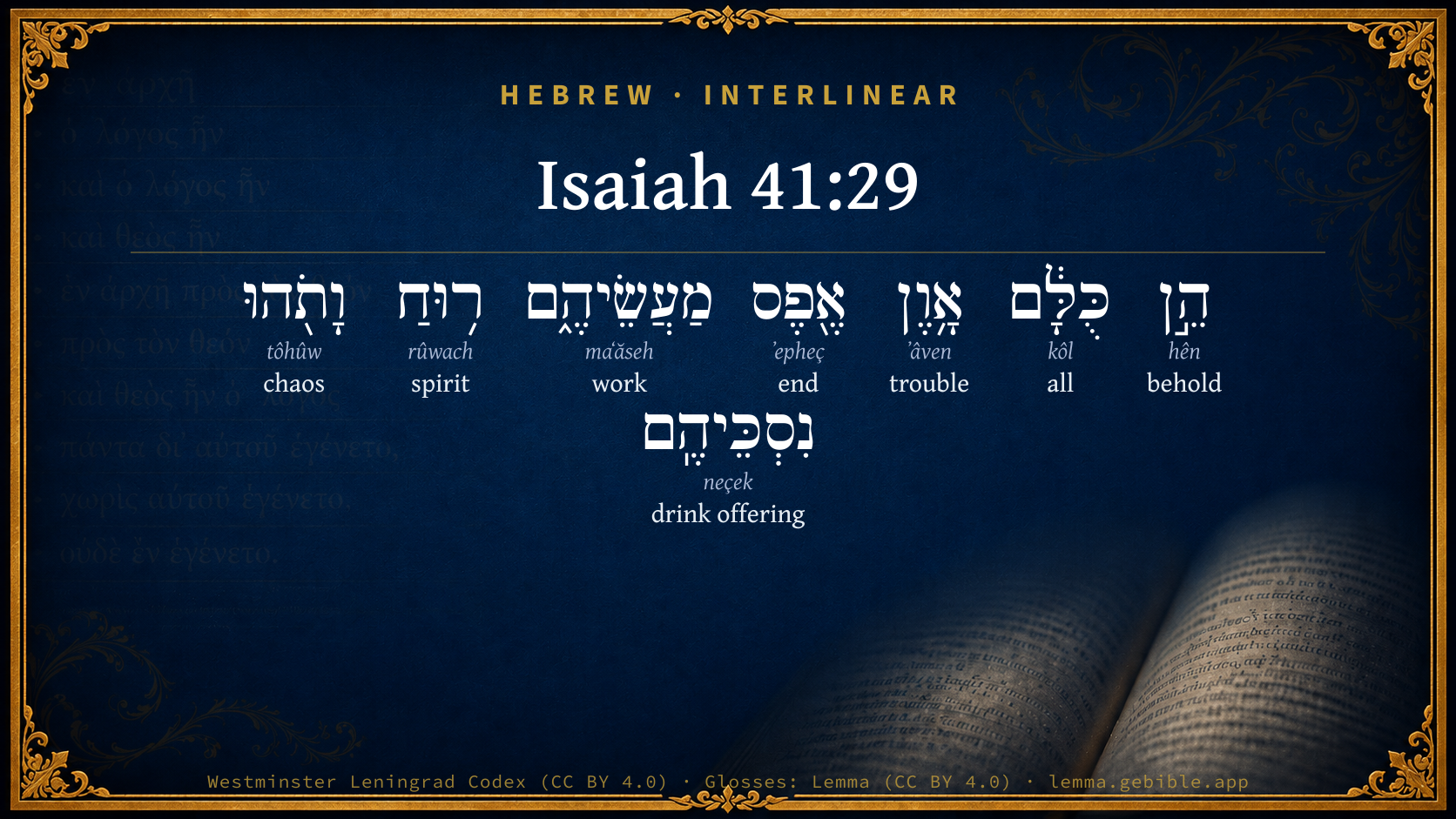
Isaiah 41:29

Hebrew (Westminster Leningrad Codex) Isaiah 41:29 appears in the Hebrew Old Testament. The text above is from the Westminster Leningrad Codex. Each word links to its Strong’s number, a concise gloss, and parsing drawn from the Open Scriptures Hebrew Bible morphology. Click any word for its full Brown-Driver-Briggs (BDB) entry.
Download image
Cite this verse

Isaiah 41:29 (World English Bible). Public Domain. Lemma interlinear Bible study tool, https://lemma.gebible.app/v/isaiah/41/29.

Show BibTeX & RIS
BibTeX
RIS
English Translation
Behold, all of them, their works are vanity [and] nothing; their molten images are wind and confusion.
World English Bible · Public Domain
Download a study sheet

One document with this verse’s original text, its word-by-word gloss line, the meaning frame, cross-references with their text, attributed commentary, and full source and license credits — printable, and it pastes into notes with its structure intact.

This verse Autodidact and up

Study sheet (.html) Plain text (.txt)

A passage Seminary Student

Up to 50 verses in one chapter. A passage sheet keeps up to 6 commentary sources and 12 cross-references per verse, in the order this page ranks them, and says so on the sheet whenever that leaves anything out. Ask for a single verse and you get the Autodidact verse sheet above.

Everything on this page stays free to read, with no account — the sheet is a download of what is already on screen, not access to it.

Want to remove ads? Support Godless Engineer
Compare translations 3

The same verse in 3 English versions, stacked beneath the original-language interlinear above. Click any original word for its lexicon entry.

Each is an independent rendering of the whole verse — the interlinear is not word-aligned to these translations.

Highlighted words mark where these versions differ — a whole-verse word diff, not a word-by-word alignment.

  • World English Bible Public Domain
    Behold, all of them, their works are vanity [and] nothing; their molten images are wind and confusion.
  • King James Version Public Domain
    Behold, they are all vanity; their works are nothing: their molten images are wind and confusion.
  • unfoldingWord Literal Text CC BY-SA 4.0
    Behold, all of them iniquity; their deeds nothing; their images wind and emptiness.

unfoldingWord Literal Text — © unfoldingWord, licensed CC BY-SA 4.0. Word-aligned USFM3 via Door43 (git.door43.org/unfoldingWord/en_ult).

Versions to compare (up to 4)

3 of 4 selected

Show all 18 translations

Every available English version of this verse, each an independent rendering of the whole verse.

  • World English Bible Public Domain
    Behold, all of them, their works are vanity [and] nothing; their molten images are wind and confusion.
  • Berean Standard Bible Public Domain
    See, they are all a delusion; their works amount to nothing; their images are as empty as the wind.
  • Majority Standard Bible Public Domain
    See, they are all a delusion; their works amount to nothing; their images are as empty as the wind.
  • King James Version Public Domain
    Behold, they are all vanity; their works are nothing: their molten images are wind and confusion.
  • American Standard Version (1901) Public Domain
    Behold, all of them, their works are vanity `and' nought; their molten images are wind and confusion.
  • Revised Version (1885) Public Domain
    Behold, all of them, their works are vanity and nought: their molten images are wind and confusion.
  • Geneva Bible (1599) Public Domain
    Beholde, they are all vanitie: their worke is of nothing, their images are wind and confusion.
  • Douay-Rheims (1899) Public Domain
    Behold they are all in the wrong, and their works are vain: their idols are wind and vanity.
  • Young's Literal Translation Public Domain
    `Lo, all of them `are' vanity, Nought `are' their works, Wind and emptiness their molten images!'
  • Literal Standard Version CC BY-SA 4.0
    “Behold, all of them [are] vanity, || Their works [are] nothing, || Their molten images [are] wind and emptiness!”
  • Unlocked Literal Bible CC BY-SA 4.0
    Look, all of them are nothing, and their deeds are nothing; their cast metal figures are wind and emptiness.
  • unfoldingWord Literal Text CC BY-SA 4.0
    Behold, all of them iniquity; their deeds nothing; their images wind and emptiness.
  • Darby Bible Public Domain
    Behold, they are all vanity, their works are nought, their molten images are wind and emptiness.
  • World Messianic Bible Public Domain
    Behold, all of their deeds are vanity and nothing. Their molten images are wind and confusion.
  • Webster's Bible Public Domain
    Behold, they are all vanity, their works are nothing: their molten images are wind and confusion.
  • Free Bible Version CC BY-SA 4.0
    Look at them! They're all evil, deceptive things. They can't do anything! They're just idols full of hot air! ”
  • Bible in Basic English Public Domain
    Truly they are all nothing, their works are nothing and of no value: their metal images are of no more use than wind.
  • JPS Tanakh (1917) Public Domain
    Behold, all of them, their works are vanity and nought; their molten images are wind and confusion.

Literal Standard Version (2020), Covenant Press — licensed CC BY-SA 4.0. Text via the HelloAO Bible API (eBible.org). Unlocked Literal Bible (unfoldingWord) — licensed CC BY-SA 4.0. Text via the HelloAO Bible API (eBible.org). unfoldingWord Literal Text — © unfoldingWord, licensed CC BY-SA 4.0. Word-aligned USFM3 via Door43 (git.door43.org/unfoldingWord/en_ult). Free Bible Version, Dr. Jonathan Gallagher — licensed CC BY-SA 4.0. Text via the HelloAO Bible API (eBible.org).

Word by word

More ways to search: Search by grammar → Find every occurrence → Compare this word →

Practice this passage: Drill this verse → Learn its vocabulary →

וָתֹ֖הוּ
tôhûw
H8414
“and · chaos”
Conjunction + Noun, Common, Masculine, Singular, Absolute
Part of Speech
Conjunction + Noun
Type
Common
Gender
Masculine
Number
Singular
State
Absolute
Full BDB Definition

Origin: from an unused root meaning to lie waste

TWOT: 2494a

formlessness, confusion, unreality, emptiness - formlessness (of primeval earth) - nothingness, empty space - that which is empty or unreal (of idols) (figuratively) - wasteland, wilderness (of solitary places) - place of chaos - vanity
  1. הֵ֣ן hên H2005 “behold” Particle, Demonstrative
  2. כֻּלָּ֔ם kôl H3605 “all · their” Noun, Common, Masculine, Singular, Construct + Suffix, Personal, 3rd Person, Masculine, Plural
  3. אָ֥וֶן ʼâven H205 “trouble” Noun, Common, Masculine, Singular, Absolute
  4. אֶ֖פֶס ʼepheç H657 “end” Noun, Common, Masculine, Singular, Absolute
  5. מַעֲשֵׂיהֶ֑ם maʻăseh H4639 “works · their” Noun, Common, Masculine, Plural, Construct + Suffix, Personal, 3rd Person, Masculine, Plural
  6. ר֥וּחַ rûwach H7307 “spirit” Noun, Common, Both, Singular, Absolute
  7. נִסְכֵּיהֶֽם neçek H5262 “drink offerings · their” Noun, Common, Masculine, Plural, Construct + Suffix, Personal, 3rd Person, Masculine, Plural

About this verse

These counts appear in no published source. They are computed here, from the morphology-tagged text and Lemma’s own curated glosses. What Lemma adds →

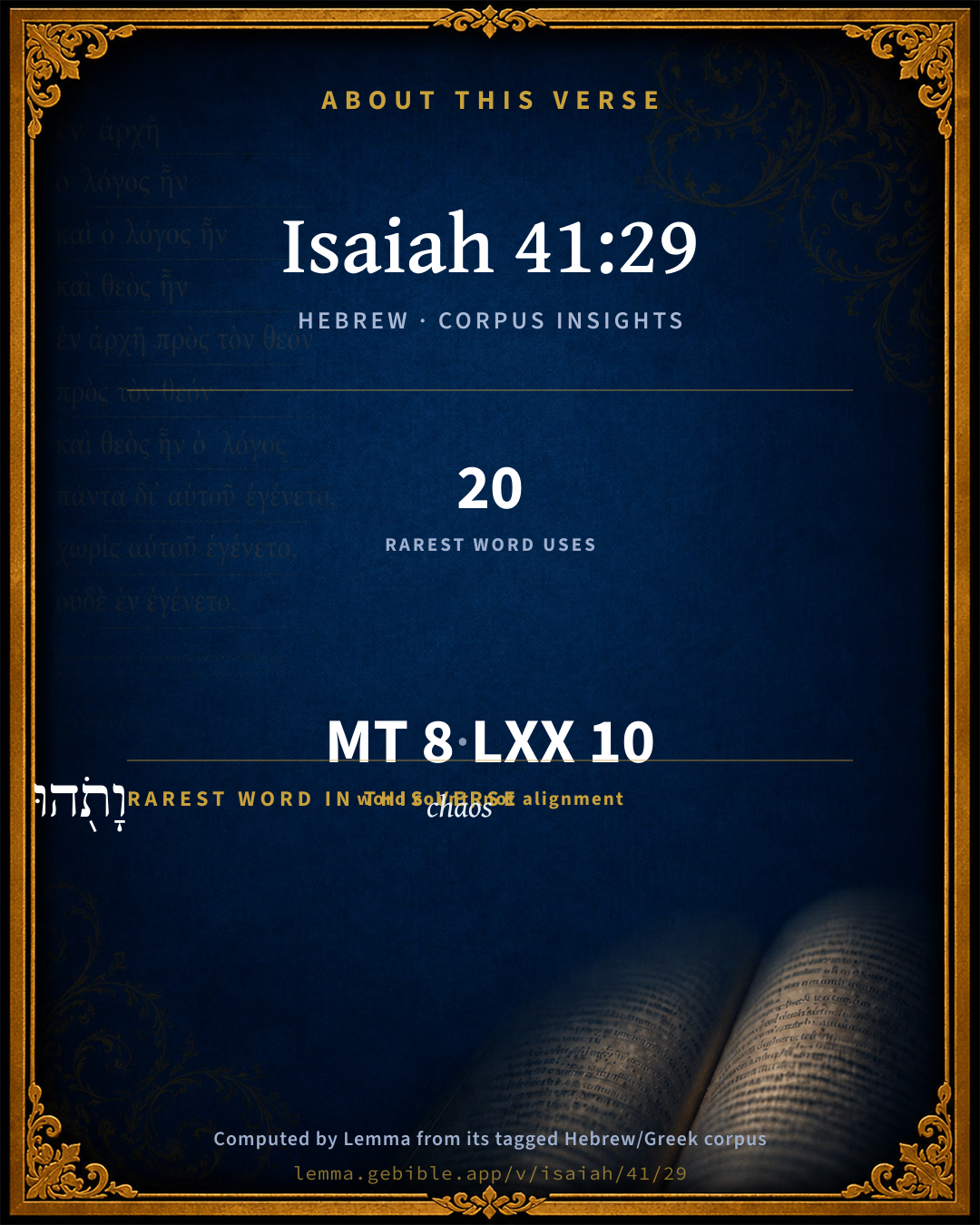
8
words
8
distinct lemmas
Prophets
section

Notable vocabulary

The rarest word here is וָתֹ֖הוּ chaos H8414 — appearing just 20 times in the whole Hebrew Bible.

Shared distinctive vocabulary

וָתֹ֖הוּ chaos H8414 occurs in 19 verses of the Hebrew Bible. Also found in:

Grammatical profile

  • 7 nouns
  • 1 particle

Hebrew & Septuagint length

In English translation the verse runs 17 words from the Hebrew and 17 from the Septuagint (LXX English) — the same length.

A rough comparison of the two English renderings, which tokenize alike — not a word-level alignment.

Word counts can differ between the Hebrew and the Greek without any difference in meaning — e.g. the Hebrew direct-object marker אֵת has no separate Greek word, and Greek often adds the article ὁ.

In the original languages it is 8 Hebrew tokens and 10 Greek tokens — but the two are counted differently (Hebrew bundles its prefixes and suffixes into one token; the Greek is in lemma form), so that isn’t a like-for-like length.

Cross-references

7

Topical passages linked to Isaiah 41:29 in the Treasury of Scripture Knowledge — connected by theme and wording, ordered by reader-vote popularity; previews shown in the World English Bible.

  • Jeremiah 5:13 and the prophets shall become wind, and the word is not in them: thus shall it be done to them.
  • Isaiah 41:24 Behold, you are of nothing, and your work is of nothing; an abomination is he who chooses you.
  • Psalms 115:4–8 Their idols are silver and gold, The work of men's hands.
  • Psalms 135:15–18 The idols of the nations are silver and gold, The work of men's hands.
  • Isaiah 44:9–20 Those who fashion an engraved image are all of them vanity; and the things that they delight in shall not profit; and their own witnesses don't see, nor know: that they may be disappointed.
  • Jeremiah 10:2–16 Thus says Yahweh, "Don't learn the way of the nations, and don't be dismayed at the signs of the sky; for the nations are dismayed at them.
  • Habakkuk 2:18 "What value does the engraved image have, that its maker has engraved it; the molten image, even the teacher of lies, that he who fashions its form trusts in it, to make mute idols?

Cross-references courtesy of OpenBible.info (CC BY 4.0).

Hebrew and Greek witnesses Masoretic Hebrew ↔ Greek Septuagint

The same verse in the two great witnesses to the Old Testament, shown verse-for-verse.

These are two independent witnesses, not word-aligned to each other, and the Septuagint is shown in lemma (dictionary) form.

Hebrew Isaiah 41:29 Masoretic · Westminster Leningrad Codex

הֵ֣ן כֻּלָּ֔ם אָ֥וֶן אֶ֖פֶס מַעֲשֵׂיהֶ֑ם ר֥וּחַ וָתֹ֖הוּ נִסְכֵּיהֶֽם

Behold, all of them, their works are vanity [and] nothing; their molten images are wind and confusion.

World English Bible · Public Domain

Greek LXX Isaiah 41:29 Septuagint · lemma form

εἰμί γάρ ὁ ποιέω σύ καί μάτην ὁ πλανάω σύ

For these are your makers, as you⌃ think, and they that cause you to err in vain.

LXX2012 (modern English Septuagint) · Public Domain

Hebrew: Westminster Leningrad Codex (CC BY 4.0). Greek: Septuagint (public domain); English from LXX2012 (modern English Septuagint) (Public Domain). How the Septuagint differs from the Hebrew →

Targum (Aramaic paraphrase)

1

The Targum is the ancient Jewish Aramaic paraphrase of the Hebrew Scriptures — an interpretive translation, not the Hebrew text itself. Onkelos (literal) and Pseudo-Jonathan (expansive) render the Torah, and Jonathan the Prophets. Coverage is partial: where no permissively-licensed English translation exists for a verse, only the Aramaic is shown. This is verse-level text, not a word-by-word alignment to the Hebrew.

  1. Targum Jonathan Prophets (Joshua–Malachi)
    הָא כוּלְהוֹן לְמָא וְלָא מִדָעַם עוֹבָדֵיהוֹן בִּזָא וּתְבִרָא עֶשְׁתּוֹנֵיהוֹן:

    Behold, all of them are nothing, and their work less than nothing: their thoughts are plunder and destruction.

    Targum Jonathan — Aramaic: “Mikraot Gedolot” (public domain). English: “Sefaria Community Translation” (CC0 1.0 (public-domain dedication)); “London "Chaldee Paraphrase," 1871” (public domain). Text via Sefaria.

Commentary

Notes on Isaiah 41:29 from classic Christian and Jewish commentators (each source and its license shown beneath its notes). The classic Christian expositions comment on the surrounding passage and are grouped to its opening verse, so a note may address several verses; the Jewish commentaries on the Tanakh (Rashi and others) are per-verse, so they appear only where the commentator wrote on this verse.

Lemma curates 59 commentaries, every one of them public domain or Creative Commons licensed, each selected and text-cleaned for this edition rather than reprinted as found. About our sources →

Trapp's Complete Commentary

John Trapp

Isa 41:29 Behold, they [are] all vanity; their works [are] nothing: their molten images [are] wind and confusion.

Ver. 29. Behold they are all vanity.] Jer 10:3; Jer 10:15.

Their works are nothing.] See Isa 41:24.

Are wind and confusion.] Or, Emptiness; Heb., Tohu. Nothing in themselves, and yet of sufficient efficacy to inflict vengeance on their worshippers.

John Trapp, A Commentary or Exposition upon All the Books of the Old and New Testament (1647–1656) — public domain. Text from a community e-Sword module.

Jamieson, Fausset & Brown

Robert Jamieson, A. R. Fausset & David Brown

confusion--"emptiness" [BARNES].

God's description of His character (Isa 42:1-4). God addresses Him directly (Isa 42:5-7). Address to the people to attend to the subject (Isa 42:8-9). Call to all, and especially the exile Jews to rejoice in the coming deliverance (Isa. 42:10-25).

Next: Isaiah Chapter 42

Jamieson, Fausset & Brown — Commentary Critical and Explanatory on the Whole Bible (1871) — public domain (CC PDM 1.0). Text via the HelloAO Bible API.

Ellicott's Commentary for English Readers

(29) They are all . . . their works . . .—The first pronoun refers to the idols themselves, the second to the idolaters who make them. In “confusion” we have the familiar tohu.

A Bible Commentary for English Readers, edited by Charles John Ellicott (1878–1897) — public domain. Text from a community e-Sword module.

The Cambridge Bible for Schools and Colleges

gen. ed. J. J. S. Perowne

29. The last word of the argument.

all of them (R.V.)] idols and worshippers together.

their works] are the images of the gods, “the work of men’s hands” (parallel to “molten images” below).

confusion] “nothingness”—chaos (see ch. Isa_40:17).

The Cambridge Bible for Schools and Colleges (gen. ed. J. J. S. Perowne; Cambridge University Press, 1878–1918) — public domain. Text from a community e-Sword module.

John Gill's Exposition

Behold, they are all vanity,.... Both the idols and the worshippers of them; in vain they claim the title of deity, to which they have no right; and in vain do men worship them, since they receive no benefit by them:

their works are nothing; they can do nothing, neither good nor evil; nothing is to be hoped or feared from them, and the worship given them is of no avail; nothing is got by it; it is all useless and insignificant, yea, pernicious and harmful:

their molten images are wind and confusion: though they are made of cast metal, yet setting aside the costly matter of which they are made, they are of no more solidity, efficacy, and use, than the wind; and are like the chaos of the first earth, mere "tohu" and "bohu", one of which words is here used, without form and void, having no form of deity on them; and therefore men are directed to turn themselves from them, and behold a most glorious Person, worthy of worship and praise, described in the beginning of the next chapter, "behold my servant", &c.

Next: Isaiah Chapter 42

John Gill's Exposition of the Whole Bible (1746–1763) — public domain (CC PDM 1.0). Text via the HelloAO Bible API.

Albert Barnes' Notes on the Bible

Behold, they are all vanity - They are unable to predict future events; they are unable to defend their friends, or to injure their enemies. This is the conclusion of the trial or debate (notes, Isa 41:1), and that conclusion is, that they were utterly destitute of strength, and that they were entirely unworthy of confidence and regard.

Their molten images - (See the note at Isa 40:19).

Are wind - Have no solidity or power. The doctrine of the whole chapter is, that confidence should be reposed in God, and in him alone. He is the friend of his people, and he is able to protect them. He will deliver them from the hand of all their enemies; and he will be always their God, protector, and guide. The idols of the pagan have no power; and it is folly, as well as sin, to trust in them, or to suppose that they can aid their friend.

It may be added, also, that it is equally vain to trust in any being for salvation but God. He only is able to protect and defend us; and it is a source of unspeakable consolation now, as it was in times past, that he is the friend of his people; and that, in times of deepest darkness and distress, he can raise up deliverers, as he did Cyrus, and will in his own way and time rescue his people from all their calamities.

Albert Barnes' Notes on the Bible (1834–1885) — public domain. Text from a community e-Sword/MySword module.

Matthew Poole's English Annotations

They are all vanity: this is the conclusion of the whole dispute, and the just sentence which God passeth upon idols after a fair trial; they are vain things, and are falsely called gods. Their works are nothing: see Isa 41:24.

Their molten images; which he mentions, because their materials were most precious, and more cost and art was commonly bestowed upon them; for after they had been molten, they used to be carved, or polished, and adorned: but under these he synecdochichally comprehends all images whatsoever.

Are wind; empty and unsatisfying things, which also, like the wind, do quickly pass away, and come to nothing. And confusion; confused, and deformed, and useless things, like that rude heap in the beginning of God’s creation, of which this very word is used, Gen 1:2.

Matthew Poole's English Annotations on the Holy Bible (1683–1685) — public domain. Text from a community e-Sword/MySword module.

John Wesley's Explanatory Notes

Behold - This is the conclusion of the dispute, but under these he comprehends all images whatsoever. Wind - Empty and unsatisfying things. Confusion - Confused and useless things, like that rude heap in the beginning of God's creation, of which this very word is used, Gen. i, 2.

John Wesley, Explanatory Notes Upon the Whole Bible (1754–1765) — public domain. Text via the GEBible commentary corpus.

Keil & Delitzsch

C. F. Keil & F. Delitzsch

This closing declaration of Jehovah terminates with similar words of wrath and contempt to those with which the judicial process ended in Isa 41:24. "See them all, vanity; nothingness are their productions, wind and desolation their molten images." מעשׂיהם are not the works of the idols, but, as the parallel shows, the productions (plural, as in Eze 6:6; Jer 1:16) of the idolaters - in other words, the idols themselves - a parallel expression to נסכּיהם (from נסך, as in Isa 48:5 = massēkhâh, Isa 42:17). אפס און is an emotional asyndeton (Ges. 155, 1, a). The address is thus rounded off by returning to the idolaters, with whom it first started. The first part, vv. 1-24, contains the judicial pleadings; the second part, Isa 41:25., recapitulates the evidence and the verdict.

Keil & Delitzsch — Biblical Commentary on the Old Testament (1861–1891) — public domain (CC PDM 1.0). Text via the HelloAO Bible API. (Old Testament only.)

J. A. Alexander on Isaiah

Joseph Addison Alexander

“Lo, they (are) all nought, nothing their works, wind and emptiness their molten images.” This is, at once, the termination of the sentence begun in the last clause of the verse preceding, and the summary conclusion of the whole preceding controversy as to the divinity of any gods except Jehovah. To the usual expressions of nonentity the Prophet adds two other strong descriptive terms, ‘wind’ and ‘emptiness’.

Joseph Addison Alexander, The Prophecies of Isaiah (1846–1847; New York: Scribner, 1870–1878) — public domain. Text from a community e-Sword module.

Rashi

Rabbi Shlomo Yitzchaki (Rashi)

Behold them all,...naught You should know that, as for the prophets of those who deny the Torah ([mss.:] pagan prophets;) ([other mss.:] prophets of Baal), all their deeds are naught and of no substance.

their molten images Heb. נִסְכֵּיהֶם. Comp. (supra 40:19) “The graven image the craftsman melted (נָסַךְ).” Jonathan renders this section differently: [27] The first one to Zion etc. The words of consolation that the prophets prophesied concerning Zion, from before, behold they have come. And according to the Targum, the entire section speaks of the King Messiah and of the last redemption, but I see that the prophecy that Isaiah prophesied concerning Cyrus is all in the same language as this section. Comp. (infra 45:13) “I aroused him with righteousness”; (Infra 46:11) “Calling from the east a bird of prey”; (infra 45:11) “The signs ask Me;” (infra 46:10) “Who tells from the beginning the end.” All of this resembles the topic of this section.

Rashi on the Tanakh — English translations: “The Judaica Press complete Tanach with Rashi, translated by A. J. Rosenberg” (CC BY 4.0); “Pentateuch with Rashi's commentary by M. Rosenbaum and A.M. Silbermann, 1929-1934” (public domain); “The Metsudah Tanach series, Lakewood, N.J” (CC BY 4.0); and “The Book of Joshua, Metsudah Publications, 1997” (CC BY 4.0). Text via Sefaria.

Ibn Ezra

Rabbi Abraham ibn Ezra

They. The idols.

אין ═ און nothing as some explain; the letters אֹ הֹ וֹ יֹ interchange. It can, however, also be taken literally. The meaning of the verse is, they are vanity, much more so their works.

נסכיהם According to some their images; comp. עגל מסכה molten calf (Ex. 32:4). I explain it their libations, that is, the libations which the idolaters offer to their idols.

Ibn Ezra on the Tanakh — English translations: “Sefaria Community Translation” (CC0 1.0 (public-domain dedication)); “Yalkut, Sifsei Chachomim Chumash, Metsudah Publications, 2009” (CC BY 4.0); and “Commentary of Ibn Ezra on Isaiah - trans. by M. Friedlander, 1873” (public domain). Text via Sefaria.

Lesson kit

Teaching starters — assembled from the data on this page, not authored interpretation. Every prompt links to the verse data it draws on. Edit before teaching.

Isaiah, in the Prophets, opens this verse with 8 words (8 distinct Hebrew lemmas). Its most distinctive word is tôhûw (“chaos”). A historical commentator’s framing appears above. Read the whole chapter for the surrounding context.

Discussion questions

  1. How does “chaos” (tôhûw) shape what this verse is saying?
  2. How does Genesis 1:2, which shares the word «chaos», read alongside this verse?
  3. These translations render this verse differently; the difference is in the English rendering, not the original. What questions does that raise?
  4. Compare how Trapp's Complete Commentary and Jamieson, Fausset & Brown read this verse. Where do they agree or differ?

Things to notice

Reading settings

Reading text

Shown beneath each verse's original-language words.

Old Testament
Old Testament edition

Read the OT as the Masoretic Hebrew (MT) or the Greek Septuagint (LXX).

English shown for the Greek Septuagint (in the Hebrew ↔ Greek comparison).

Comparing translations? Open the Compare panel on any verse page to stack up to four side by side.