
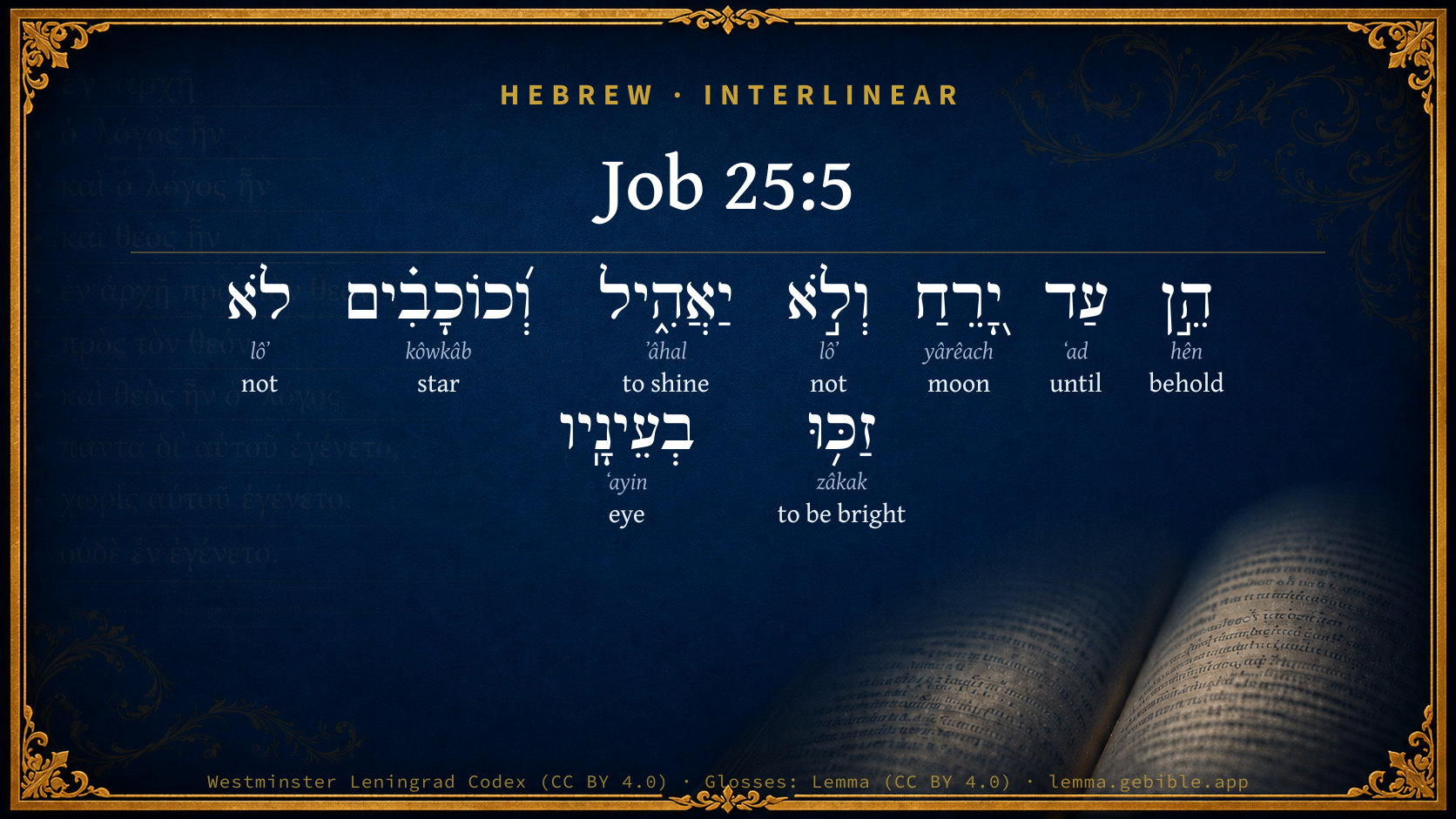
Job 25:5

Hebrew (Westminster Leningrad Codex) Job 25:5 appears in the Hebrew Old Testament. The text above is from the Westminster Leningrad Codex. Each word links to its Strong’s number, a concise gloss, and parsing drawn from the Open Scriptures Hebrew Bible morphology. Click any word for its full Brown-Driver-Briggs (BDB) entry.
Download image
Cite this verse

Job 25:5 (World English Bible). Public Domain. Lemma interlinear Bible study tool, https://lemma.gebible.app/v/job/25/5.

Show BibTeX & RIS
BibTeX
RIS
English Translation
Behold, even the moon has no brightness, And the stars are not pure in his sight;
World English Bible · Public Domain
Highlights
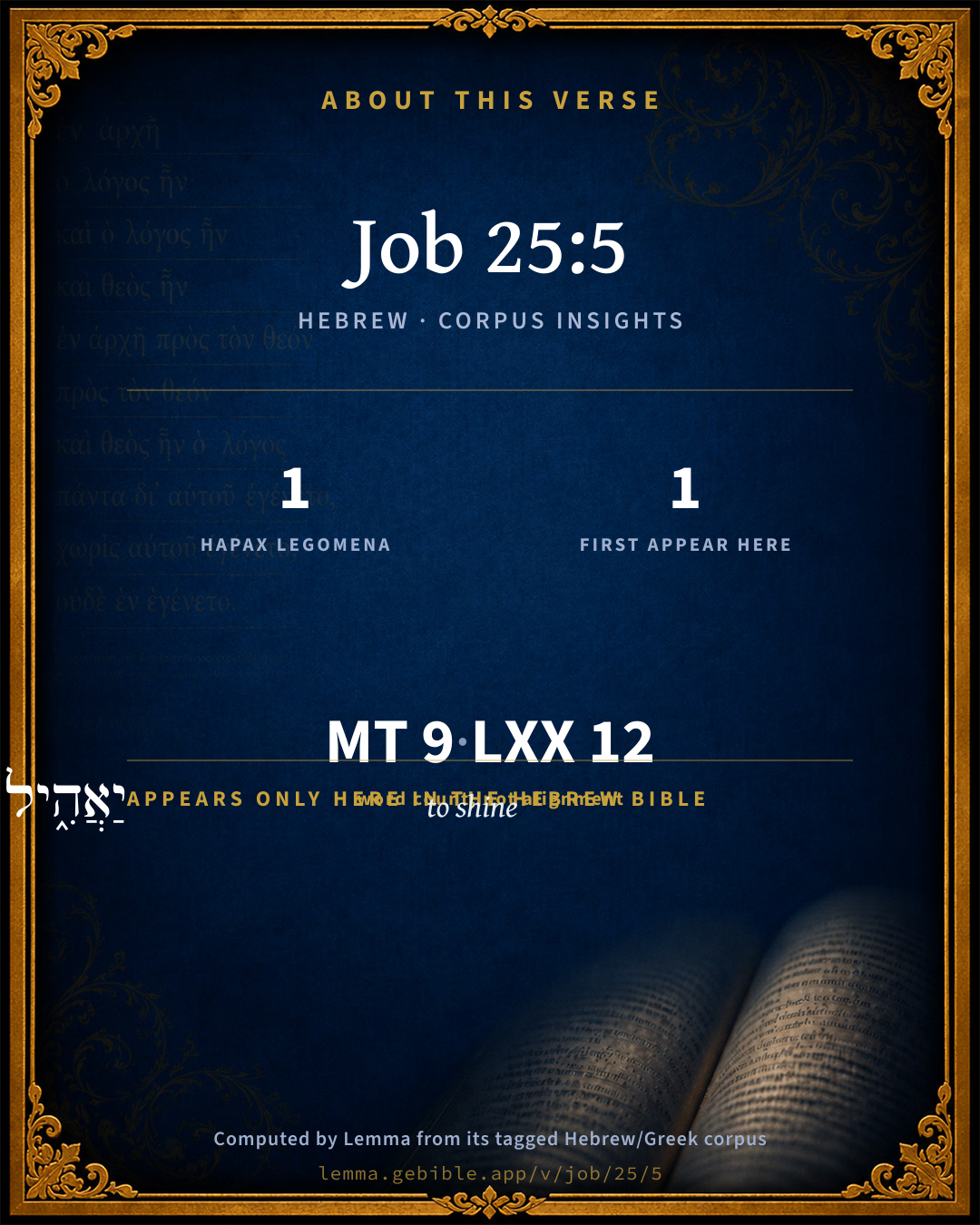
  • 1 hapax legomenon — only here in the Hebrew Bible
  • 1 first appearance in the Hebrew Bible
Full analysis ↓
Download a study sheet

One document with this verse’s original text, its word-by-word gloss line, the meaning frame, cross-references with their text, attributed commentary, and full source and license credits — printable, and it pastes into notes with its structure intact.

This verse Autodidact and up

Study sheet (.html) Plain text (.txt)

A passage Seminary Student

Up to 50 verses in one chapter. A passage sheet keeps up to 6 commentary sources and 12 cross-references per verse, in the order this page ranks them, and says so on the sheet whenever that leaves anything out. Ask for a single verse and you get the Autodidact verse sheet above.

Everything on this page stays free to read, with no account — the sheet is a download of what is already on screen, not access to it.

Want to remove ads? Support Godless Engineer
Compare translations 3

The same verse in 3 English versions, stacked beneath the original-language interlinear above. Click any original word for its lexicon entry.

Each is an independent rendering of the whole verse — the interlinear is not word-aligned to these translations.

Highlighted words mark where these versions differ — a whole-verse word diff, not a word-by-word alignment.

  • World English Bible Public Domain
    Behold, even the moon has no brightness, And the stars are not pure in his sight;
  • King James Version Public Domain
    Behold even to the moon, and it shineth not; yea, the stars are not pure in his sight.
  • unfoldingWord Literal Text CC BY-SA 4.0
    Behold, even the moon does not shine and the stars are not pure in his eyes.

unfoldingWord Literal Text — © unfoldingWord, licensed CC BY-SA 4.0. Word-aligned USFM3 via Door43 (git.door43.org/unfoldingWord/en_ult).

Versions to compare (up to 4)

3 of 4 selected

Show all 18 translations

Every available English version of this verse, each an independent rendering of the whole verse.

  • World English Bible Public Domain
    Behold, even the moon has no brightness, And the stars are not pure in his sight;
  • Berean Standard Bible Public Domain
    If even the moon does not shine, and the stars are not pure in His sight,
  • Majority Standard Bible Public Domain
    If even the moon does not shine, and the stars are not pure in His sight,
  • King James Version Public Domain
    Behold even to the moon, and it shineth not; yea, the stars are not pure in his sight.
  • American Standard Version (1901) Public Domain
    Behold, even the moon hath no brightness, And the stars are not pure in his sight:
  • Revised Version (1885) Public Domain
    Behold, even the moon hath no brightness, and the stars are not pure in his sight:
  • Geneva Bible (1599) Public Domain
    Behold, he wil giue no light to the moone, and the starres are vncleane in his sight.
  • Douay-Rheims (1899) Public Domain
    Behold even the moon doth not shine, and the stars are not pure in his sight.
  • Young's Literal Translation Public Domain
    Lo -- unto the moon, and it shineth not, And stars have not been pure in His eyes.
  • Literal Standard Version CC BY-SA 4.0
    Behold—to the moon, and it does not shine, || And stars have not been pure in His eyes.
  • Unlocked Literal Bible CC BY-SA 4.0
    See, even the moon has no brightness to him; the stars are not pure in his sight.
  • unfoldingWord Literal Text CC BY-SA 4.0
    Behold, even the moon does not shine and the stars are not pure in his eyes.
  • Darby Bible Public Domain
    Lo, even the moon is not bright; and the stars are not pure in his sight:
  • World Messianic Bible Public Domain
    Behold, even the moon has no brightness, and the stars are not pure in his sight;
  • Webster's Bible Public Domain
    Behold even to the moon, and it shineth not; and the stars are not pure in his sight.
  • Free Bible Version CC BY-SA 4.0
    If in God's eyes even the moon does not shine brightly, and the stars are not pure,
  • Bible in Basic English Public Domain
    See, even the moon is not bright, and the stars are not clean in his eyes:
  • JPS Tanakh (1917) Public Domain
    Behold, even the moon hath no brightness, and the stars are not pure in His sight;

Literal Standard Version (2020), Covenant Press — licensed CC BY-SA 4.0. Text via the HelloAO Bible API (eBible.org). Unlocked Literal Bible (unfoldingWord) — licensed CC BY-SA 4.0. Text via the HelloAO Bible API (eBible.org). unfoldingWord Literal Text — © unfoldingWord, licensed CC BY-SA 4.0. Word-aligned USFM3 via Door43 (git.door43.org/unfoldingWord/en_ult). Free Bible Version, Dr. Jonathan Gallagher — licensed CC BY-SA 4.0. Text via the HelloAO Bible API (eBible.org).

Word by word

More ways to search: Search by grammar → Find every occurrence → Compare this word →

Practice this passage: Drill this verse → Learn its vocabulary →

About this verse

These counts appear in no published source. They are computed here, from the morphology-tagged text and Lemma’s own curated glosses. What Lemma adds →

9
words
8
distinct lemmas
Wisdom
section

Notable vocabulary

1 hapax legomenon — a word that appears only here in the entire Hebrew Bible:

  • יַאֲהִ֑יל to shine H166

First appearance in Scripture

This word makes its first canonical appearance in the Hebrew Bible here:

  • יַאֲהִ֑יל to shine H166

Shared distinctive vocabulary

זַכּ֥וּ to be bright H2141 occurs in 4 verses of the Hebrew Bible. Also found in:

Grammatical profile

  • 2 verbs
  • 3 nouns
  • 1 preposition
  • 3 particles

Verb forms

  • יַאֲהִ֑יל Hiphil · Imperfect
  • זַכּ֥וּ Qal · Perfect

Repetition

A word recurs within this verse — often emphatic in Hebrew:

  • וְלֹ֣א not H3808 ×2

Hebrew & Septuagint length

In English translation the verse runs 16 words from the Hebrew and 20 from the Septuagint (LXX English) — closely comparable.

A rough comparison of the two English renderings, which tokenize alike — not a word-level alignment.

Word counts can differ between the Hebrew and the Greek without any difference in meaning — e.g. the Hebrew direct-object marker אֵת has no separate Greek word, and Greek often adds the article ὁ.

In the original languages it is 9 Hebrew tokens and 12 Greek tokens — but the two are counted differently (Hebrew bundles its prefixes and suffixes into one token; the Greek is in lemma form), so that isn’t a like-for-like length.

Cross-references

5

Topical passages linked to Job 25:5 in the Treasury of Scripture Knowledge — connected by theme and wording, ordered by reader-vote popularity; previews shown in the World English Bible.

  • Isaiah 60:19–20 The sun shall be no more your light by day; neither for brightness shall the moon give light to you: but Yahweh will be to you an everlasting light, and your God your glory.
  • Job 15:15 Behold, he puts no trust in his holy ones; Yes, the heavens are not clean in his sight:
  • Job 31:26 If I have seen the sun when it shined, Or the moon moving in splendor,
  • Isaiah 24:23 Then the moon shall be confounded, and the sun ashamed; for Yahweh of Hosts will reign on Mount Zion, and in Jerusalem; and before his elders shall be glory.
  • 2 Corinthians 3:10 For most assuredly that which has been made glorious has not been made glorious in this respect, by reason of the glory that surpasses.

Cross-references courtesy of OpenBible.info (CC BY 4.0).

Hebrew and Greek witnesses Masoretic Hebrew ↔ Greek Septuagint

The same verse in the two great witnesses to the Old Testament, shown verse-for-verse.

These are two independent witnesses, not word-aligned to each other, and the Septuagint is shown in lemma (dictionary) form.

Hebrew Job 25:5 Masoretic · Westminster Leningrad Codex

הֵ֣ן עַד יָ֭רֵחַ וְלֹ֣א יַאֲהִ֑יל וְ֝כוֹכָבִ֗ים לֹא זַכּ֥וּ בְעֵינָֽיו

Behold, even the moon has no brightness, And the stars are not pure in his sight;

World English Bible · Public Domain

Greek LXX Job 25:5 Septuagint · lemma form

εἰ σελήνη συντάσσω καί οὐ ἐπιφαύσκω ἄστρον δέ οὐ καθαρός ἐναντίον αὐτός

If he gives an order to the moon, then it shines not; and the stars are not pure before him.

LXX2012 (modern English Septuagint) · Public Domain

Hebrew: Westminster Leningrad Codex (CC BY 4.0). Greek: Septuagint (public domain); English from LXX2012 (modern English Septuagint) (Public Domain). How the Septuagint differs from the Hebrew →

Commentary

Notes on Job 25:5 from classic Christian and Jewish commentators (each source and its license shown beneath its notes). The classic Christian expositions comment on the surrounding passage and are grouped to its opening verse, so a note may address several verses; the Jewish commentaries on the Tanakh (Rashi and others) are per-verse, so they appear only where the commentator wrote on this verse.

Lemma curates 59 commentaries, every one of them public domain or Creative Commons licensed, each selected and text-cleaned for this edition rather than reprinted as found. About our sources →

Trapp's Complete Commentary

John Trapp

Job 25:5 Behold even to the moon, and it shineth not; yea, the stars are not pure in his sight.

Ver. 5. Behold even to the moon, and it shineth not] i.e. Either descend in thy thoughts, from the highest orbs as low as the moon; or else ascend from gold, gems, jewels, and other orient resplendent creatures, as high as the moon and stars, and comparing them with the surpassing majesty of God, thou shalt find no more beauty or brightness in them than is in a lump of earth or clod of clay; those heavenly lights will appear to be as so many snuffs. Or if thou canst discover no spots and blemishes in them, yet God can, without the help of any such perspective glasses as Galileo got him to explore the mountains on the moon. Some think it was by moonlight that this speech was uttered, and therefore the moon is mentioned. But as the moon is confounded, so the sun also is ashamed when the Lord of hosts will display the beams of his glory, Isa 24:23; Isa 60:19. There is a learned interpreter (Mr Abbot) who thus paraphraseth the test: Consider, that by reason of the fall of man, the very creatures that in themselves are sinless, yea, the very moon and stars (that are so far from earth, and so near to heaven), have contracted defilement, and are blemished; so that with God, for man’s sake, and by man’s sin, even they are not accounted free from pollution in his sight: thus he. The visible heavens are defiled by our sins, and must therefore be purged by the fire of the last day; as of old the vessel that held the sin offering was to be broken if earthen, or to pass the fire if of better metal.

Yea, the stars are not pure in his sight] Whatever they are in ours. A thing that I see in the night may shine, and that shining proceed from nothing but rottenness. There is a comparative imperfection and impurity in the stars and angels, Job 4:18.

John Trapp, A Commentary or Exposition upon All the Books of the Old and New Testament (1647–1656) — public domain. Text from a community e-Sword module.

Joseph Benson's Commentary

Job 25:5. Behold, even to the moon, and it shineth not — The moon, though bright and glorious, if compared with the divine majesty, is without any lustre or glory. By his naming the moon, and thence proceeding to the stars, he shows that he includes the sun also, and all other creatures, and signifies that the brightest and most glorious objects in nature shine not when compared with God’s ineffable and essential brightness. Indeed, the highest order of beings make but small advances to the essential perfection which is in him; so that, when a comparison is made, their highest purity will be little less than impurity, when brought before the standard of divine perfection.

Joseph Benson's Commentary on the Old and New Testaments (1811–1818) — public domain. Text from a community e-Sword module.

Geneva Bible (1599)

Geneva Bible translators

If God show his power, the Moon and Stars cannot have that light which is given them, much less can man have any excellency, but of God.

Geneva Bible (1599) marginal notes — public domain. Text via Bolls.life.

Jamieson, Fausset & Brown

Robert Jamieson, A. R. Fausset & David Brown

"Look up even unto the moon" (Job 15:15). "Stars" here answer to "saints" (angels) there; "the moon" here to "the heavens" there. Even the "stars," the most dazzling object to man's eye, and the angels, of which the stars are emblems (Job 4:18; Rev 9:1), are imperfect in His sight. Theirs is the light and purity but of creatures; His of the Creator.

Jamieson, Fausset & Brown — Commentary Critical and Explanatory on the Whole Bible (1871) — public domain (CC PDM 1.0). Text via the HelloAO Bible API.

Adam Clarke's Commentary

Verse 5. Behold even to the moon, and it shineth not] It is continually changing its appearance. It never appears twice in its whole revolution with the same face: it is ever waxing or waning; and its face is variegated with opaque spots. Its changeableness can never be compared with the unchangeable nature of God.

Yea, the stars are not pure in his sight.] Whatever their excellence may be as stars, it is nothing in comparison with him from whom they have derived their being and splendour. See the notes on Job 4:18; Job 15:14-16. The Targum reads: "Behold, the moon is as yet spotted in her eastern part; the sun shines not; and the stars are not pure in his sight."

Some think that by stars are meant those angels who kept not their first estate: this may be so, but I cannot see it in the text. It may, however, mean the heavenly host, as it is supposed to do, Job 28:7; but I still must hesitate on the propriety of such applications.

It is probable this speech of Bildad was delivered in the night-season, when clouds interrupted the bright shining of the moon. The third verse seems to refer immediately to the stars, which to the naked eye are innumerable. The sun is not mentioned, because of his absence.

This speech of Bildad is both confused and inconclusive. His reasoning is absurd, and he draws false conclusions from his premises. In the third verse, he says, "Is there any number of his armies? and upon whom does not his light arise?" But how absurd is the conclusion which he draws from his questions: - "How then can a man be justified with God, or he be clean who is born of a woman?"

This has no relation to the premises; still to us the question is not difficult, and has already been answered in the notes: "A man can be justified with God," through the blood of Christ; and "he can be clean who is born of a woman." through the sanctification of the Spirit.

Adam Clarke's Commentary on the Bible (1810–1826) — public domain. Text from a community e-Sword/MySword module.

Ellicott's Commentary for English Readers

(5) Even to the moon and stars, pure and chaste as their light is, they are not clean before Him (comp. Job_4:18), for the stars rise and set, and once in every month the moon hides her face.

A Bible Commentary for English Readers, edited by Charles John Ellicott (1878–1897) — public domain. Text from a community e-Sword module.

The Cambridge Bible for Schools and Colleges

gen. ed. J. J. S. Perowne

5. The thought of Job_25:4 amplified. Even the moon, the brightest star, does not shine, is dark, when He looks upon it, and the stars are not pure, how much less man, which is a worm? The contrast drawn by Eliphaz between man and the angels is drawn here between man and the heavenly bodies; comp. ch. Job_15:15. The Hebrew has two words for “worm” here, the one the worm of decay and corruption (ch. Job_7:5, Job_17:14, Job_21:26, Job_24:20; Exo_16:24; Isa_14:11), the other in the second clause, used to express the utmost abasement and abjectness, “Fear not thou worm Jacob,” Isa_41:14, “But I am a worm and no man,” Psa_22:6, though occasionally occurring also in the sense of the other word. We have only one word in English, for though Shakespeare speaks of “Grubs and eyeless skulls,” such a term can hardly be used now in language of any elevation.

The Cambridge Bible for Schools and Colleges (gen. ed. J. J. S. Perowne; Cambridge University Press, 1878–1918) — public domain. Text from a community e-Sword module.

John Gill's Exposition

Behold, even to the moon,.... If all things that are glorious and illustrious in the lower world, and which are between that and the region of the moon, are beheld; or all from the seat of the Divine Majesty, down to that glorious luminary, are viewed, they lose all their lustre and brightness, when compared with the Divine Being;

and it, even that itself

shineth not; it is darkened, confounded, and ashamed; it hides its beautiful face, and draws in its borrowed and useful light, at the approach of him, who is light itself, and in whom is no darkness at all: or it tabernacles not (n); has no tabernacle to abide in, as is said of the sun, Psa 19:4; or does not expand and spread its light, as a tent (o) or tabernacle is spread; it does not diffuse, but contracts it. No mention is made of the sun, not because that shines in its own light, which the moon does not; but perhaps because the controversy between Job and his friends was held in the night, when the moon and the stars were only seen, and therefore only mentioned; otherwise, what is here observed equally holds good of the sun as of the moon; see Isa 24:23;

yea, the stars are not pure in his sight; as there are spots in the sun and in the moon, seen by the eye of man, aided and assisted, so such may be seen by God in the stars also, and in these, both in a natural and in a mystical sense; as by them may be meant the angels of heaven, even those are not pure in the sight of God, and in comparison of him, the most perfectly pure and holy Being; see Job 4:18.

(n) "et non ponet tabernaculum", Montanus, Bolducius; so Schmidt, Schultens. (o) "Non expandet lumen suum in modum tentorii", Complutenses apud Bolduc.

John Gill's Exposition of the Whole Bible (1746–1763) — public domain (CC PDM 1.0). Text via the HelloAO Bible API.

Albert Barnes' Notes on the Bible

Behold even to the moon, and it shineth not - Or, behold even the moon shineth not. That is, in comparison with God it is dark and obscure. The idea is, that the most beautiful and glorious objects become dim and fade away when compared with him. So Jerome renders it, Ecce luna etiam non splendet. The word here rendered “shineth” (יאהיל ya'âhalı̂yl) frequently means to pitch or remove a tent, and is a form of the word אהל 'ôhel uniformly rendered tent or tabernacle. Some have supposed that the meaning here is, that even the moon and the stars of heaven - the bright canopy above - were not fit to furnish a tent or dwelling for God. But the parallelism seems to demand the usual interpretation, as meaning that the moon and stars faded away before God. The word אהל 'ôhel derives this meaning, according to Gesenius, from its relation to the word הלל hâlal, to be clear or brilliant, from the mutual relation of the פא and עע verbs. The Arabic has the same meaning.

Yea, the stars are not pure in his sight - That is, they are not bright in comparison with him. The design is to show the glory of the Most High and that nothing could be compared with him; see the notes at Job 4:18.

Albert Barnes' Notes on the Bible (1834–1885) — public domain. Text from a community e-Sword/MySword module.

Haydock's Catholic Bible Commentary

Sight, compared with him. The most beautiful things in nature are nothing; and of course, the most just are all imperfection, when left to themselves. (Calmet)

George Leo Haydock (1774–1849), Haydock's Catholic Family Bible and Commentary, 1859 edition — public domain. Excludes Psalms (Douay-Rheims chapter numbering differs from Protestant) and Deuterocanonical books (Catholic canon only).

Matthew Poole's English Annotations

The moon, though a bright and glorious creature, Job 31:26; Son 6:10, if compared with the splendour of the Divine majesty, is but as a dark and earthy lump, without any lustre or glory. He names the

moon and the

stars rather than the sun, because they many times are eclipsed or disappear even to our eyes, which is a plain evidence of their utter obscurity in respect of God’s light; whereas the sun, though that also he obscure, if compared with God, yet it casts a constant and most clear light. Or by naming the moon, and thence proceeding to the stars, the sun is included between them.

The stars are not pure in his sight; he can discern many spots and blemishes in them which we cannot see; and in like manner he can discover those corruptions or sins in us which are unknown to our own conscience, which should make thee, O Job, tremble to appear before his tribunal.

Matthew Poole's English Annotations on the Holy Bible (1683–1685) — public domain. Text from a community e-Sword/MySword module.

Whedon's Commentary on the Bible

Daniel D. Whedon

b. In the sinfulness and corruption of an entire race, Job may certainly find occasion for humiliation and repentance, Job_25:4-6.

5. It shineth not — The moon pales its light in the presence of God. As no mention is made of the sun, some have supposed it was then night.

Not pure — He means not the taint that comes from sin, as in this world, but metaphorically the dazzling sheen of the starry hosts; (a high symbol of purity among men;) even this is tainted when compared with the purity of the infinitely pure God.

Daniel D. Whedon (gen. ed.), Commentary on the Old and New Testaments (1874–1909) — public domain. Text from a community e-Sword module.

The Pulpit Commentary

Behold even to the moon, and it shineth not. Observe, i.e. , all that is purely bright in creation, "even to the moon," the most purely bright object of all, and consider that in God"s sight, compared to his radiance, it has no brightness shineth not." Or turn your attention from the moon to the stars, rivals of the moon in purity and brilliance, and reflect that the stars are not pure in his sight. A sort of dusky veil overspreads them.

Vers. 5, 6. The awe of God"s holiness.

I THE INCOMPARABLE HOLINESS OF GOD. This is a thought that cannot be described in human language. When conscience is aroused, some thrill of the awe of it may open our minds to its sublime meaning. We start from the conception of the absolute sinlessness of God. Not a spot of evil can be found on all he is or does. But holiness is more than negative freedom from sin. It is a real excellence, and on its positive side it expands into infinity. We do not know how far goodness may go. It is like light. No one can conceive how intense this may be; after a short time it becomes too brilliant for our eyes, and we are only blinded when we look at it; but it is conceivable that its intensity may be increased a thousandfold beyond the highest degree that we are capable of perceiving. There may be a brilliancy of light compared with which the glare of a tropical noon is as dull and gloomy as an English November. So there may be a holiness which in its positive character rises above all we can conceive or imagine of goodness into infinite regions of perfection. We can see no limit to the strength and depth of love. Human love may be strong as death. Yet compared to God"s love it is but as a feeble, flickering flame lost in the full sunlight. No one can conceive how full and rich God"s love is. All the attributes of the Divine holiness expand into infinity. Their greatness is immeasurable and inconceivable.

II ITS OVERAWING INFLUENCE. It is as though the moon cannot shine before such a Divine light. Even that silver shield seems to be tarnished when set by the side of the brightness of God"s holiness. The stars, which are far above the filth and corruption of earth, and move in heavenly spheres, do not seem to be pure in the light of God. This impression is natural, though of Course it is thrown into the form of poetic imagery. It leads to the humiliation of all human pride. If what is brightest looks dark in comparison with the splendour of God"s holiness, what must man be in his sight? Now, it is possible to abuse these conceptions, as Bildad was doing. God does not make men out to be worse than they are. He does not blame his creatures for not being equal to himself. He does not judge them by his own perfection, but only by their capacities. There is also a foolish way of depreciating humanity. There may be much pride in the heart of a man who calls himself "a worm." Such language is only natural and right when it is wrung out of the soul by a deep consciousness of sin, and by an overwhelming perception of God"s holiness. On the other hand, when this is the case, there is no ground for despair. The last stronghold of pride being abandoned, there is room for the mercy of God to come in. God"s holiness is just the perfection of his love. The error has been in the separation of the two attributes. In the present day a shallow conception of holiness is tempting men to think lightly of sin, for it is the awe of God"s holiness that impresses on us the feeling of our own guilt. Out of the humiliation thus produced springs our only hope the hope of free pardon and gracious renewal. Then the holiness of God becomes our inspiration; we are called to be perfect, as our Father in heaven is perfect. W.F.A.

The Pulpit Commentary (1880–1919), ed. H.D.M. Spence-Jones & Joseph S. Exell — public domain. Text from a community e-Sword module.

John Wesley's Explanatory Notes

Moon - The moon, tho' bright and glorious, if compared with the Divine Majesty, is without any lustre or glory. By naming the moon, and thence proceeding to the stars, the sun is also included.

John Wesley, Explanatory Notes Upon the Whole Bible (1754–1765) — public domain. Text via the GEBible commentary corpus.

Rashi

Rabbi Shlomo Yitzchaki (Rashi)

He removes the moon Heb. עד, like (28:8), “neither did a lion pass (עדה) over it.” The meaning is that even the moon will be removed from its [source of] light in the future and it will not shine, as it is written (Isa. 24:23): “And the moon shall be ashamed etc.” And the stars will not be pure in His eyes in the future. How much less can man, who is a worm, be just with God!

and will not shine Heb. יאהיל, like (Isa. 13:10), “shall not allow their light to illuminate (יהלו),” and this “alef” serves the same function as (I Sam. 2:33), “and to sadden (ולאדיב) your heart,” in which the “alef” is superfluous. Another explanation: יַאֲהִיל, you will not have shadow. When it does not shine, no shadows are cast. I prefer the former, but I heard both.

Rashi on the Tanakh — English translations: “The Judaica Press complete Tanach with Rashi, translated by A. J. Rosenberg” (CC BY 4.0); “Pentateuch with Rashi's commentary by M. Rosenbaum and A.M. Silbermann, 1929-1934” (public domain); “The Metsudah Tanach series, Lakewood, N.J” (CC BY 4.0); and “The Book of Joshua, Metsudah Publications, 1997” (CC BY 4.0). Text via Sefaria.

Lesson kit

Teaching starters — assembled from the data on this page, not authored interpretation. Every prompt links to the verse data it draws on. Edit before teaching.

Job, in the Wisdom, opens this verse with 9 words (8 distinct Hebrew lemmas). Its most distinctive word is ʼâhal (“to shine”). A historical commentator’s framing appears above. Read the whole chapter for the surrounding context.

Discussion questions

  1. The word ʼâhal carries the sense “to shine.” How does it shape the verse?
  2. 1 word here appears nowhere else in the Hebrew Bible. Why might the author reach for such rare wording?
  3. This is the first place “to shine” appears in Scripture (first appears here). What does its debut here establish?
  4. How does Job 9:30, which shares the word «to be bright», read alongside this verse?
  5. What does the repetition of “not” (2× in this one verse) do in this verse?
  6. These translations render this verse differently; the difference is in the English rendering, not the original. What questions does that raise?
  7. «יַאֲהִ֑יל» is a Hiphil Imperfect verb. How does that grammatical form shape the action described?
  8. Compare how Trapp's Complete Commentary and Joseph Benson's Commentary read this verse. Where do they agree or differ?

Things to notice

  • 1 word in this verse appears nowhere else in the Hebrew Bible.
  • 1 word makes its first canonical appearance in Scripture here.
  • This verse counts 9 Hebrew ↔ 12 Greek words.
  • These translations choose different wording for 8 words in this verse.
  • “not” occurs 2× in this single verse.

Reading settings

Reading text

Shown beneath each verse's original-language words.

Old Testament
Old Testament edition

Read the OT as the Masoretic Hebrew (MT) or the Greek Septuagint (LXX).

English shown for the Greek Septuagint (in the Hebrew ↔ Greek comparison).

Comparing translations? Open the Compare panel on any verse page to stack up to four side by side.