
Job 2:6

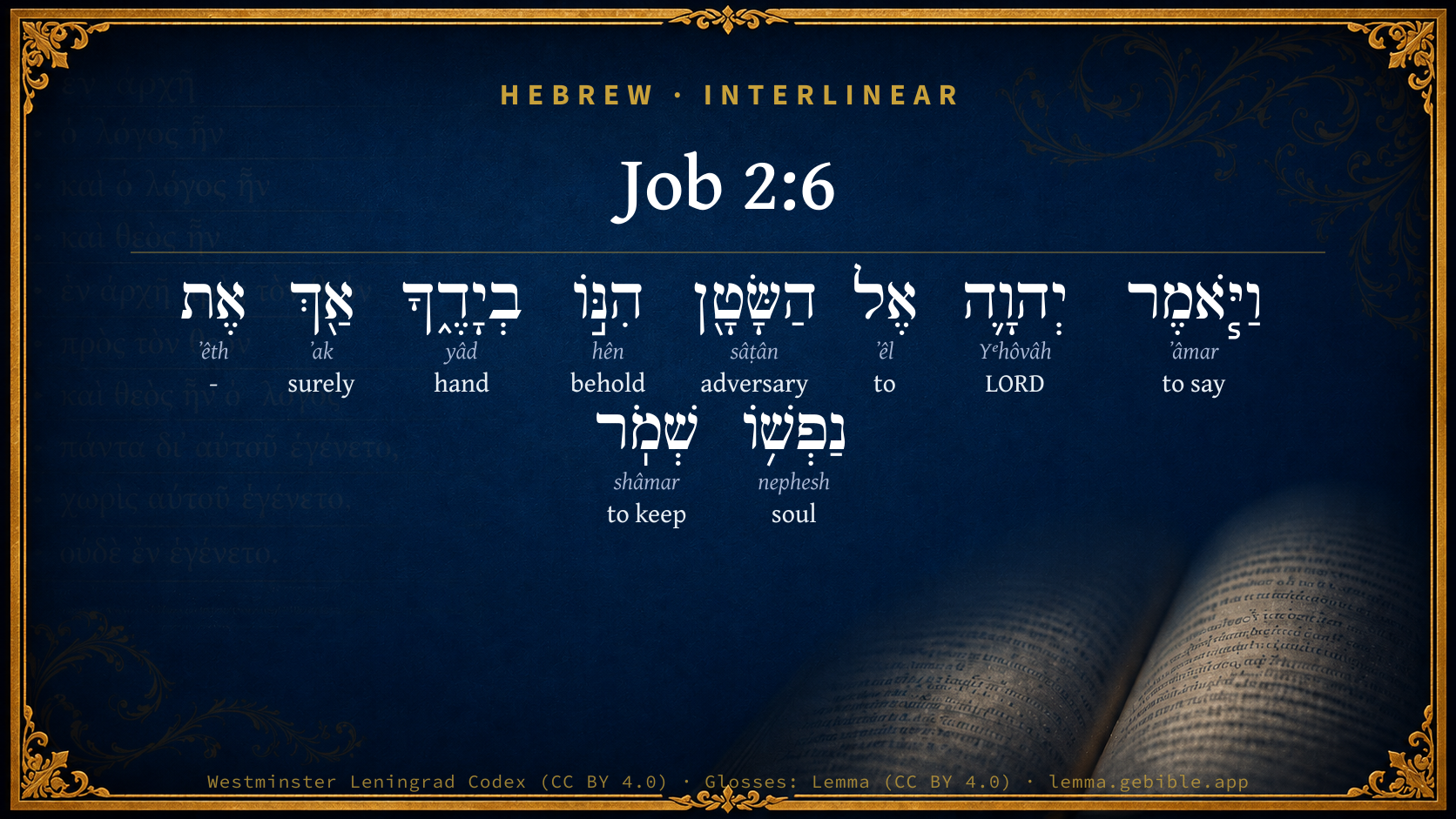
Hebrew (Westminster Leningrad Codex) Job 2:6 appears in the Hebrew Old Testament. The text above is from the Westminster Leningrad Codex. Each word links to its Strong’s number, a concise gloss, and parsing drawn from the Open Scriptures Hebrew Bible morphology. Click any word for its full Brown-Driver-Briggs (BDB) entry.
Download image
Cite this verse

Job 2:6 (World English Bible). Public Domain. Lemma interlinear Bible study tool, https://lemma.gebible.app/v/job/2/6.

Show BibTeX & RIS
BibTeX
RIS
English Translation
Yahweh said to Satan, "Behold, he is in your hand. Only spare his life."
World English Bible · Public Domain
Download a study sheet

One document with this verse’s original text, its word-by-word gloss line, the meaning frame, cross-references with their text, attributed commentary, and full source and license credits — printable, and it pastes into notes with its structure intact.

This verse Autodidact and up

Study sheet (.html) Plain text (.txt)

A passage Seminary Student

Up to 50 verses in one chapter. A passage sheet keeps up to 6 commentary sources and 12 cross-references per verse, in the order this page ranks them, and says so on the sheet whenever that leaves anything out. Ask for a single verse and you get the Autodidact verse sheet above.

Everything on this page stays free to read, with no account — the sheet is a download of what is already on screen, not access to it.

Want to remove ads? Support Godless Engineer
Compare translations 3

The same verse in 3 English versions, stacked beneath the original-language interlinear above. Click any original word for its lexicon entry.

Each is an independent rendering of the whole verse — the interlinear is not word-aligned to these translations.

Highlighted words mark where these versions differ — a whole-verse word diff, not a word-by-word alignment.

  • World English Bible Public Domain
    Yahweh said to Satan, "Behold, he is in your hand. Only spare his life."
  • King James Version Public Domain
    And the LORD said unto Satan, Behold, he is in thine hand; but save his life.
  • unfoldingWord Literal Text CC BY-SA 4.0
    And Yahweh said to the adversary, “Behold him in your hand; only spare his life.”

unfoldingWord Literal Text — © unfoldingWord, licensed CC BY-SA 4.0. Word-aligned USFM3 via Door43 (git.door43.org/unfoldingWord/en_ult).

Versions to compare (up to 4)

3 of 4 selected

Show all 18 translations

Every available English version of this verse, each an independent rendering of the whole verse.

  • World English Bible Public Domain
    Yahweh said to Satan, "Behold, he is in your hand. Only spare his life."
  • Berean Standard Bible Public Domain
    “Very well,” said the LORD to Satan. “He is in your hands, but you must spare his life.”
  • Majority Standard Bible Public Domain
    “Very well,” said the LORD to Satan. “He is in your hands, but you must spare his life.”
  • King James Version Public Domain
    And the LORD said unto Satan, Behold, he is in thine hand; but save his life.
  • American Standard Version (1901) Public Domain
    And Jehovah said unto Satan, Behold, he is in thy hand; only spare his life.
  • Revised Version (1885) Public Domain
    And the LORD said unto Satan, Behold, he is in thine hand; only spare his life.
  • Geneva Bible (1599) Public Domain
    Then the Lord said vnto Satan, Lo, he is in thine hand, but saue his life.
  • Douay-Rheims (1899) Public Domain
    And the Lord said to Satan: Behold be is in thy hand, but yet save his life.
  • Young's Literal Translation Public Domain
    And Jehovah saith unto the Adversary, `Lo, he `is' in thy hand; only his life take care of.'
  • Literal Standard Version CC BY-SA 4.0
    And YHWH says to Satan, “Behold, he [is] in your hand; only take care of his life.”
  • Unlocked Literal Bible CC BY-SA 4.0
    Yahweh said to Satan, “See, he is in your hand; it is only his life that you must spare.”
  • unfoldingWord Literal Text CC BY-SA 4.0
    And Yahweh said to the adversary, “Behold him in your hand; only spare his life.”
  • Darby Bible Public Domain
    And Jehovah said to Satan, Behold, he is in thy hand; only spare his life.
  • World Messianic Bible Public Domain
    The LORD said to Satan, “Behold, he is in your hand. Only spare his life.”
  • Webster's Bible Public Domain
    And the LORD said to Satan, Behold, he is in thy hand; but save his life.
  • Free Bible Version CC BY-SA 4.0
    So the Lord said to Satan, “Very well, you have the power to do whatever you want to him, but don't kill him.”
  • Bible in Basic English Public Domain
    And the Lord said to the Satan, See, he is in your hands, only do not take his life.
  • JPS Tanakh (1917) Public Domain
    And the LORD said unto Satan: 'Behold, he is in thy hand; only spare his life.'

Literal Standard Version (2020), Covenant Press — licensed CC BY-SA 4.0. Text via the HelloAO Bible API (eBible.org). Unlocked Literal Bible (unfoldingWord) — licensed CC BY-SA 4.0. Text via the HelloAO Bible API (eBible.org). unfoldingWord Literal Text — © unfoldingWord, licensed CC BY-SA 4.0. Word-aligned USFM3 via Door43 (git.door43.org/unfoldingWord/en_ult). Free Bible Version, Dr. Jonathan Gallagher — licensed CC BY-SA 4.0. Text via the HelloAO Bible API (eBible.org).

Word by word

More ways to search: Search by grammar → Find every occurrence → Compare this word →

Practice this passage: Drill this verse → Learn its vocabulary →

הַשָּׂטָ֖ן
sâṭân
H7854
“the · adversary”
Particle, Definite Article + Noun, Common, Masculine, Singular, Absolute
Part of Speech
Particle + Noun
Type
Common
Gender
Masculine
Number
Singular
State
Absolute
Full BDB Definition

Origin: from H7853

TWOT: 2252a

adversary, one who withstands - adversary (in general - personal or national) - superhuman adversary - Satan (as noun proper)
  1. וַיֹּ֧אמֶר ʼâmar H559 “and · to say” Conjunction + Verb, Qal, Sequential Imperfect, 3rd Person, Masculine, Singular
  2. יְהוָ֛ה Yᵉhôvâh H3068 “LORD” Noun, Proper
  3. אֶל ʼêl H413 “to” Preposition
  4. הִנּ֣וֹ hên H2005 “behold · him” Particle, Interjection + Suffix, Personal, 3rd Person, Masculine, Singular
  5. בְיָדֶ֑ךָ yâd H3027 “in/at · hand · your” Preposition + Noun, Common, Both, Singular, Construct + Suffix, Personal, 2nd Person, Masculine, Singular
  6. אַ֖ךְ ʼak H389 “surely” Particle, Accusative
  7. אֶת ʼêth H853 “-” Particle, Direct Object
  8. נַפְשׁ֥וֹ nephesh H5315 “soul · his” Noun, Common, Both, Singular, Construct + Suffix, Personal, 3rd Person, Masculine, Singular
  9. שְׁמֹֽר shâmar H8104 “keep” Verb, Qal, Imperative, 2nd Person, Masculine, Singular

About this verse

These counts appear in no published source. They are computed here, from the morphology-tagged text and Lemma’s own curated glosses. What Lemma adds →

10
words
10
distinct lemmas
Wisdom
section

Shared distinctive vocabulary

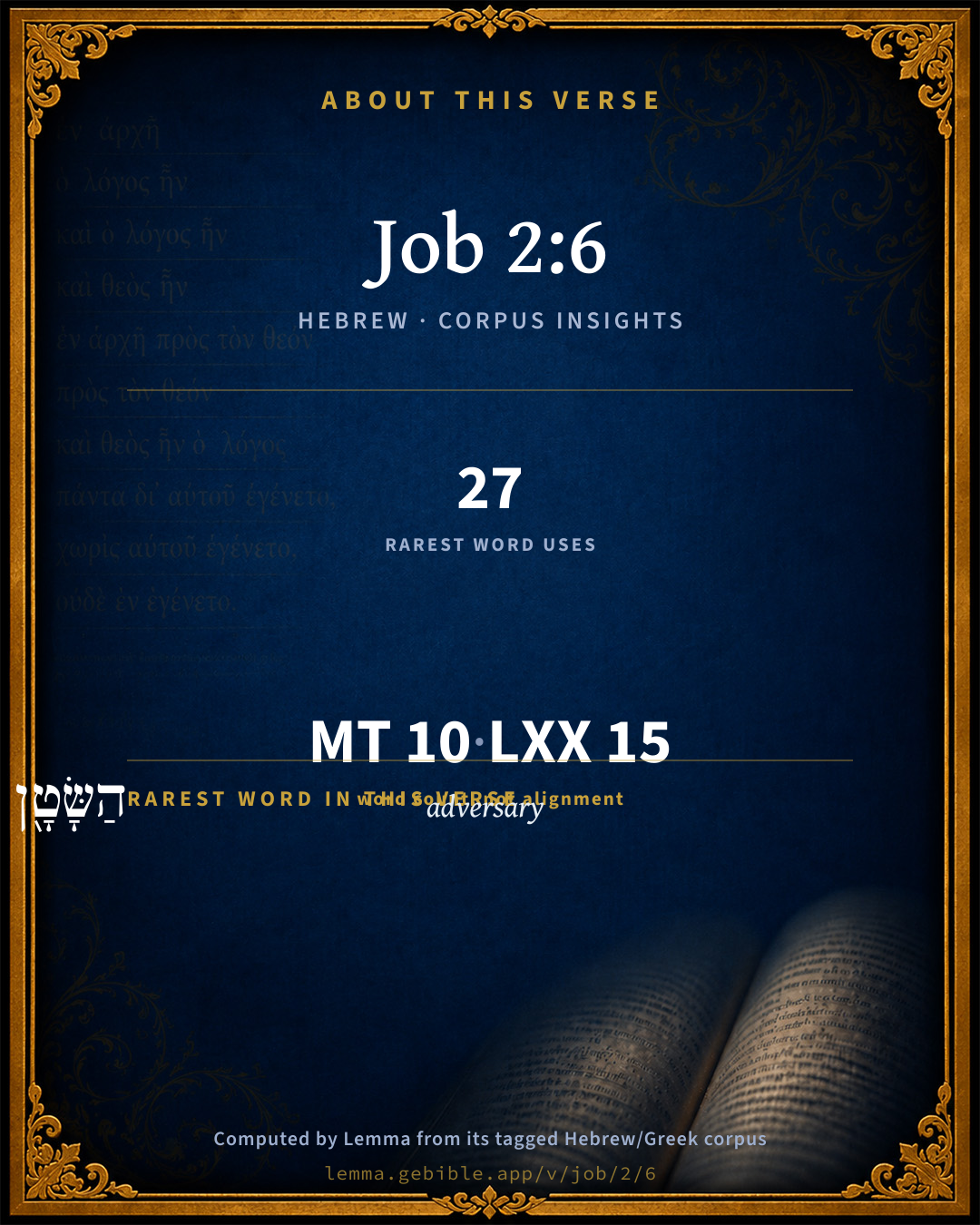
הַשָּׂטָ֖ן adversary H7854 occurs in 23 verses of the Hebrew Bible. Also found in:

Grammatical profile

  • 2 verbs
  • 4 nouns
  • 1 preposition
  • 3 particles

Verb forms

  • וַיֹּ֧אמֶר Qal · Sequential Imperfect
  • שְׁמֹֽר Qal · Imperative

Hebrew & Septuagint length

In English translation the verse runs 14 words from the Hebrew and 18 from the Septuagint (LXX English) — closely comparable.

A rough comparison of the two English renderings, which tokenize alike — not a word-level alignment.

Word counts can differ between the Hebrew and the Greek without any difference in meaning — e.g. the Hebrew direct-object marker אֵת has no separate Greek word, and Greek often adds the article ὁ.

In the original languages it is 10 Hebrew tokens and 15 Greek tokens — but the two are counted differently (Hebrew bundles its prefixes and suffixes into one token; the Greek is in lemma form), so that isn’t a like-for-like length.

Cross-references

9

Topical passages linked to Job 2:6 in the Treasury of Scripture Knowledge — connected by theme and wording, ordered by reader-vote popularity; previews shown in the World English Bible.

  • 1 Corinthians 10:13 No temptation has taken you except what is common to man. God is faithful, who will not allow you to be tempted above what you are able, but will with the temptation also make the way of escape, that you may be able to endure it.
  • Luke 22:31–32 The Lord said, "Simon, Simon, behold, Satan asked to have you, that he might sift you as wheat,
  • Job 1:12 Yahweh said to Satan, "Behold, all that he has is in your power. Only on himself don't put forth your hand." So Satan went forth from the presence of Yahweh.
  • Revelation 2:10 Don't be afraid of the things which you are about to suffer. Behold, the devil is about to throw some of you into prison, that you may be tested; and you will have oppression for ten days. Be faithful to death, and I will give you the crown of life.
  • Job 38:10–11 Marked out for it my bound, Set bars and doors,
  • Luke 8:29–33 For Jesus was commanding the unclean spirit to come out of the man. For the unclean spirit had often seized the man. He was kept under guard, and bound with chains and fetters. Breaking the bands apart, he was driven by the demon into the desert.
  • Psalms 65:7 Who stills the roaring of the seas, The roaring of their waves, And the turmoil of the nations.
  • Revelation 20:1–2 I saw an angel coming down out of heaven, having the key of the abyss and a great chain in his hand.
  • Revelation 20:7 And after the thousand years, Satan will be released from his prison,

Cross-references courtesy of OpenBible.info (CC BY 4.0).

Hebrew and Greek witnesses Masoretic Hebrew ↔ Greek Septuagint

The same verse in the two great witnesses to the Old Testament, shown verse-for-verse.

These are two independent witnesses, not word-aligned to each other, and the Septuagint is shown in lemma (dictionary) form.

Hebrew Job 2:6 Masoretic · Westminster Leningrad Codex

וַיֹּ֧אמֶר יְהוָ֛ה אֶל הַשָּׂטָ֖ן הִנּ֣וֹ בְיָדֶ֑ךָ אַ֖ךְ אֶת נַפְשׁ֥וֹ שְׁמֹֽר

Yahweh said to Satan, "Behold, he is in your hand. Only spare his life."

World English Bible · Public Domain

Greek LXX Job 2:6 Septuagint · lemma form

εἶπον δέ ὁ κύριος ὁ διάβολος ἰδού παραδίδωμι σύ αὐτός μόνον ὁ ψυχή αὐτός διαφυλάσσω

And the Lord said to the devil, Behold, I deliver him up to you; only save his life.

LXX2012 (modern English Septuagint) · Public Domain

Hebrew: Westminster Leningrad Codex (CC BY 4.0). Greek: Septuagint (public domain); English from LXX2012 (modern English Septuagint) (Public Domain). How the Septuagint differs from the Hebrew →

Commentary

Notes on Job 2:6 from classic Christian and Jewish commentators (each source and its license shown beneath its notes). The classic Christian expositions comment on the surrounding passage and are grouped to its opening verse, so a note may address several verses; the Jewish commentaries on the Tanakh (Rashi and others) are per-verse, so they appear only where the commentator wrote on this verse.

Lemma curates 59 commentaries, every one of them public domain or Creative Commons licensed, each selected and text-cleaned for this edition rather than reprinted as found. About our sources →

Trapp's Complete Commentary

John Trapp

Job 2:6 And the LORD said unto Satan, Behold, he [is] in thine hand; but save his life.

Ver. 6. And the Lord said unto Satan] Who hath his request: it is not always a mercy to have what we wish. Deus saepe dat iratus, quod negat propitius. God often gives wrath because he denies his favour. Be sure we bring lawful petitions, and true hearts, Heb 10:22, and then we shall have good things, and for our greatest good.

Behold, he is in thine hand] Here God puts his child into his slave’s hand to correct, but not to destroy. And surely, if we give reverence to the fathers of our flesh, who correct us for their own pleasure, shall we not much more be in subjection unto the Father of spirits chastening us for our profit, and live? The Turks, though cruelly lashed, are yet compelled to return to him that commanded it, to kiss his hand, and give him thanks, to pay the officer that whipped them. This last we need not do, but the former we ought, taking God’s part against ourselves, and resting contented; though as Paul delivered up some to Satan, that they might learn not to blaspheme, so God delivered us up to him and his agents (such as Satanically hate us, and are devilishly bent against us, Psa 32:10 causing us to suffer more than any ever did out of hell), that we may learn not to be proud, secure, sensual, and may preach forth the virtues of him who hath brought us out of darkness into his marvellous light, 1Pe 2:9. Let us not say if God would take the rod into his own hand, I could better bear it; but the tender mercies of that wicked one and his imps are mere cruelties. For, 1. This is as if the child should say, If I might choose my rod, I would not care to be whipped; or the condemned nobleman, If I might choose mine executioner, I would not care to lose mine head. 2. It is but one hand and many instruments that God smiteth us with. Our enemies are but the men of God’s hand, Psa 17:14, that can do no more than is given them from above, Joh 19:11. God’s masons to hew us here in the mount, that we may be as the polished corners of the temple, Psa 144:12. God’s scullions, to scour up the vessels of his household, that they may shine upon the celestial shelf, as that martyr said. 3. God ever reserveth to himself the royalty of setting them their task, limiting them their time, and letting out their tedder; hitherto ye shall go, and no further. 4. If they exceed their commission (as they are apt), God’s jealousy will smoke against them, Zec 1:14.

But save his life] Heb. his soul; put oft for the life, the cause for the effect. Satan shook his chain at Job’s soul, and would have destroyed it, but that he might not do; scratch him he might with his paws, but not fasten his fangs in him. Job could say (for a season at least), as that dying saint did, my body is weak, my soul is well. His afflictions, as afterwards St Paul’s, reached but to his flesh, Col 1:24. And see that thou save his life too, saith God (see how he chaineth up the devil who would fain have been sucking Job’s blood, and swallowing him down his wide gullet, 1Pe 5:8); save it, that is, spare it; see that the spirit fail not before me, and the soul that I have made, Isa 57:16. I have yet some further use of him, though a lamentable lazar. You know how through infirmity of the flesh, that is, notwithstanding the infirmity and weakness of my body, I preached the gospel, saith Paul, and my temptation which was in my flesh you despised not, Gal 4:13-14. Daniel, though sick, yet did the king s business; and Job, though scabbed all over, was yet of great use, and reserved to great honour; therefore saves his life, saith God; and the devil, say the Rabbis, was as much vexed and wounded with this restraint as Job was with all his wounds and ulcers. It is surely a vexation to malice not to do its utmost.

John Trapp, A Commentary or Exposition upon All the Books of the Old and New Testament (1647–1656) — public domain. Text from a community e-Sword module.

The Biblical Illustrator

Joseph S. Exell

Job_2:6-10

Behold, he is in thine hand.

Satan malevolently dealing with Jobs personality

I. Satans low estimate of human nature. His language here clearly implies that even a good mans love of goodness is not supreme and invincible. He states--

1. That goodness is not so dear to him as life. Skin for skin, yea, all that a man hath will he give for his life. Self-preservation is a strong instinct in human nature, and therefore a Divine principle; but it is not true that it is ever the strongest feeling in the human heart. A man who has come under the dominion of love for the true, the beautiful, and the good, holds his life as subordinate to the high principles of genuine religion and godly morality. This is a fact which the history of martyrdom places beyond debate. Thousands of men in Christendom today can say with Paul, I count not my life dear unto me, etc. He states--

2. That great personal suffering will turn even a good man against God. Such is the connection of the body with the soul that great bodily suffering has undoubtedly a tendency to generate a faithless, murmuring, and rebellious spirit.

II. Satans great power over human nature. We infer--

1. That his great power moves within fixed limits.

2. That his great power is used to torture the body and corrupt the soul. The ancients ascribed many physical diseases direct to the devil. Physical evils do spring from moral, and the devil is the instigator of the morally bad. See how he corrupts Jobs wife. Then said his wife unto him, Dost thou still retain thine integrity? curse God and die. If you substitute the word bless for curse, you still have the impious spirit of the wife: then in heartless irony she counsels her husband to blaspheme his God. Perhaps she meant, Thou hast been blessing God under thine affliction thus far, go on with thy cant, and die, for death would be desirable both to thyself and me. Satan acted thus not only on Jobs body, but on the soul of Jobs wife, and both in order to tempt the patriarch to sin against his Maker.

III. Satans grand purpose with human nature. What was his master purpose? To turn Job against God. And is not this his grand purpose with all men? There is one thought about his purpose, however, suggested by the text, encouraging to us, it is frustratable. Up to the present point he failed with Job. Three things are worthy of attention here concerning Job in frustrating the purpose of Satan.

1. He reproves his wife. Thou speakest as one of the foolish women speaketh.

2. He vindicates God. What? shall we receive good at the hands of God, and shall we not receive evil?

3. He is commended by inspiration. Here is the Divine testimony to Jobs state of mind amid the torturing of the devil. In all this did not Job sin with his lips. (Homilist.)

Man in the hands of Satan

Job has held and still holds a unique place as the representative sufferer of the human race. This hero of meekness, all but overwhelmed with blank hopelessness, paralysed in the inmost nerve of his life, isolated from all that makes living bright and precious, and left, to all human seeming, absolutely helpless in the hands of a slandering and malignant fate, has so burnt his story into the imagination of mankind that it will never disappear so long as hearts are crushed by the wheels of care, and souls are bruised by the blows of temptation. The Old Testament has no more vital element. But is Job a real man, in the hands of a real devil, and sustained and made victorious by a real God, or have we nothing more substantial than fibrous figures woven into a beautiful tapestry by the deft fingers of a nimble fancy? It is plain that the author moves almost wholly in the poetical realm. So the conviction settles in our minds that the thought and fact of this book are cast into a mould as real as that of Agamemnon: a drama intended not for the eye of sense, but for the eye of the mind. Admitting the poetical form of the book, we must ask whether all our highest poetry does not rest on the immutable basis of fact. Illustrate from In Memoriam, George Eliots Spanish Gipsy, Adam Bede, etc. The history of Job is actual, and not a whit less so, because the form of the story is ideal and dramatic. The important question is, Are the truths which Jobs story embodies and illumines, eternal and universal; and do the ideas set forth concerning God and man, evil and good, go to the root of things, and expound the essential nature of our human life? The one thing urgent for us to know, is not, was there a Job, but is there a light from God in the history of Job that guides the reason and conscience? Does Job teach us how to live the best life, and cling with inviolable tenacity to God, not in Uz, but in London? Is God greater than evil? Can He subdue it, and will He? A glance at the prologue of the poem is enough to convince us that the book is expressly written to solve these deep and perplexing problems of the mind. Poem though it be in form, its exhaustless fascination is its philosophy. Like Miltons great classic, it is a defence of the ways of God to men; a bold facing of plausible but false interpretations of life and destiny; a thorough and tremorless exposure of their inherent absurdity and unreason, and an unfaltering vindication of the character of God from all the aspersions of lazily-thinking Zophars, parrot-like Bildads, and fatalistic Elihus. See the special motive of Jobs fierce trial. He is not suffering for his sins. It is not a case of the ancestral eating of sour grapes. Nor is Job put into the furnace of affliction that he may come forth as gold. His affliction is not the apprenticeship of a strong nature to the educational influences of sorrow and temptation. What then is the special motive for this singular and significant experience? Listen to the colloquy in heaven between Satan and God concerning Job! Satan, the slanderer, says, Doth Job fear God for nought? Job knows well enough what he is about, and is simply making the best investment of his powers the market of human life offers. The case is crucial. The test is faultless. The experiment is carried to the maximum of severity. No element of evil is omitted. There then is the stake! How fare the combatants? That is the question at issue. See the swift changes through which Job is put. Satan is permitted to do his worst, and he does it with terrible suddenness and completeness. But all experiments fail utterly. The idea remains triumphant, that God is lovable in Himself and for Himself. Disinterested love of the Eternal is its own reward. He is lovable, notwithstanding fearful evils in our lot, and in our world. (J. Clifford, D. D.)

But save his life.

The worth of a good man

I. Because it is good in itself. Everything of inherent worth is worthy of preservation, even apart from the idea of utility. The jewel, though it be seldom worn as an ornament, must be carefully kept. So faith in the unseen, a reverent trust in God and fervent piety, had given a jewel-like beauty and value to the character of Job. Hence it must be spared.

II. Because it is useful to society. There are many things useful to society. Genius, and the honest pursuit of commercial enterprise, aid the common good of men. But nothing is more beneficial to society than true moral character. Men like Job are the strength, hope, and inspiration of the race. Remove them, and social life becomes dark, cold, and barren. Society has need to pray for the longevity of good men.

III. Because it shall be a pattern to after generations. The Bible is a pattern book of moral life. It is not only a book of cold precepts, but of sympathetic lives. Men need patterns in every sphere of work--in the mechanical and architectural, as well as in the moral. Many a man has become an artist through looking at a beautiful picture. While gazing upon it, the fires of genius have kindled within him. So the lives of men like Job have awakened the desire for piety within many a heart.

IV. Because the devil would only have liked to put an end to it. Could he have killed Job, he would have put out the best light of the times; have plucked the richest blossom of the season. But God would not allow this. He had to expend more discipline on Job yet. God has more love for His people than to let the devil do whet he likes with them. The power of Satan is limited, but fearful enough as it is. Are you afflicted? God watches you. Fear not!

V. Are our lives worth saving? (J. S. Exell, M. A.)

The Biblical Illustrator, edited by Joseph S. Exell (c. 1880s–1900s) — public domain. Text from a community e-Sword module.

Joseph Benson's Commentary

Job 2:6. The Lord said, Behold, he is in thy hand — I give thee permission to try him even in this way: do thy worst at him; afflict him to the uttermost of thy power. But save his life — Do not attempt to take that away which I will not suffer thee to do. God had mercy in store for Job, after this trial, and therefore he must survive it; and how much soever he may be afflicted, his life must be given him for a prey. If God did not chain up the roaring lion, how soon would he devour us! As far as he permits the wrath of Satan and wicked men to proceed against his people, he will make it turn to his own praise and theirs, and the remainder thereof he will restrain. Job, in being thus maligned and afflicted by Satan, was a type of Christ; whose heel that infernal serpent was permitted to bruise, to touch even his bone and his flesh, yea, and his life also; because, by dying, he was to do what Job could not do, to destroy him that had the power of death.

Joseph Benson's Commentary on the Old and New Testaments (1811–1818) — public domain. Text from a community e-Sword module.

Tyndale Open Study Notes

Tyndale Open Resources

2:6 spare (literally guard/watch over): God ironically made Satan responsible for guarding Job’s life (cp. 10:13-14; 13:27; 33:11).

Tyndale Open Study Notes — © Tyndale Open Resources, licensed CC BY-SA 4.0. Text via the HelloAO Bible API.

Geneva Bible (1599)

Geneva Bible translators

Thus Satan can go no further in punishing, than God hath limited him.

Geneva Bible (1599) marginal notes — public domain. Text via Bolls.life.

Jamieson, Fausset & Brown

Robert Jamieson, A. R. Fausset & David Brown

but save--rather, "only spare his life." Satan shows his ingenuity in inflicting pain, and also his knowledge of what man's body can bear without vital injury.

Jamieson, Fausset & Brown — Commentary Critical and Explanatory on the Whole Bible (1871) — public domain (CC PDM 1.0). Text via the HelloAO Bible API.

Adam Clarke's Commentary

Verse 6. But save his life.] His body thou shalt have permission to afflict, but against his life thou shalt have no power; therefore take care of his life. The original, נפשו שמר naphsho shemor, may be translated, keep his soul; but the word also signifies life; yet in the hands of the destroyer the life of this holy man is placed! How astonishing is the economy of salvation! It is so managed, by the unlimited power and skill of God, that the grand adversary of souls becomes himself, by the order of God, the preserver of that which the evil of his nature incessantly prompts him to destroy!

Adam Clarke's Commentary on the Bible (1810–1826) — public domain. Text from a community e-Sword/MySword module.

Ellicott's Commentary for English Readers

(6) But save his life.—God’s faithfulness cannot fail even if, as Satan hints, Job’s should do so (2Ti_2:13). There was one who cared for Job’s life more than he cared for it himself.

A Bible Commentary for English Readers, edited by Charles John Ellicott (1878–1897) — public domain. Text from a community e-Sword module.

John Gill's Exposition

So went Satan forth from the presence of the Lord,.... With leave and license, with power and authority, as the Targum; having got his commission enlarged, on a fresh grant, to do more mischief to Job, he departed directly and immediately, being eager to put in execution what he had a permission to do; See Gill on Job 1:12,

and smote Job with sore boils, from the sole of his foot unto his crown: with hot and burning ulcers, such as were inflicted on the Egyptians in the plague of the boils and blains, called the botch of Egypt, see Exo 9:10; it is in the original text "with a bad boil", or "the worst" (a); it was as it were but one boil; they stood so thick and close together, that they were as one, reaching from head to foot, and spreading all over his body, so that there was no part free; he was full of sores; as Lazarus, and to him may be applied what is said in a figurative sense of the Jews, Isa 1:6; and this boil or boils were of the worst sort, and most hot and angry, and gave the most exquisite pain, and what Job was "smitten" with at once; they did not rise up in pimples and pustules at the first, and gradually gathered and came to an head, but he was at once covered with burning ulcers at their height, and with running sores; this was done by Satan, through divine permission; who, when he has leave, can inflict diseases on the bodies of men, as he did in the days of Christ on earth, see Mat 17:15; some Jewish writers, as R. Simeon, say, that the devil heated the air, and thereby caused inflammation in Job's blood, which broke out in boils; but then this would have affected others besides him: many are the conjectures of learned men (b) about this disease of Job's, some taking it to be the leprosy (c), others the scurvy, others an erysipelas, &c. Bolducius reckons up no less than fourteen diseases that are attributed to him, collected from his own words, Job 7:5; a late learned writer (d) thinks it was the smallpox.

(a) "nicere malo", Pagninus, Montanus, Piscator, Schmidt; "maligno", Cocceius, Michaelis, "pessimo", Junius & Tremellius, Schultens. (b) Vid. Reiskii dissert. de Morbo Jobi, in Thesaur. Dissert. Philolog. par. 1. p. 556. (c) Origen contr. Cels. l. 6. p. 305. So Michaelis in Lowth. Praelect. de Sacr. Poes. Heb. p. 182, 201, 202. (d) Delaney's Life of King David, vol. 2. p. 147.

John Gill's Exposition of the Whole Bible (1746–1763) — public domain (CC PDM 1.0). Text via the HelloAO Bible API.

Albert Barnes' Notes on the Bible

Behold, he is in thine hand - He is at thy disposal; see Job 1:12, Margin.

But save his life - Margin, “only.” This was to be the only limitation. It would seem that he had the power to make any selection of disease, and to afflict him in any manner, provided it did not terminate fatally. The keen sorrows which Job afterward endured showed the malignancy of the tempter; evinced his ingenuity in inflicting pain, and his knowledge of what thc human frame could be made to bear.

Albert Barnes' Notes on the Bible (1834–1885) — public domain. Text from a community e-Sword/MySword module.

Haydock's Catholic Bible Commentary

Life. Afflict him with any species of illness; but do not kill him, (Calmet) nor inspire him directly with wicked thoughts. (Grotius)

George Leo Haydock (1774–1849), Haydock's Catholic Family Bible and Commentary, 1859 edition — public domain. Excludes Psalms (Douay-Rheims chapter numbering differs from Protestant) and Deuterocanonical books (Catholic canon only).

Matthew Poole's English Annotations

Do not attempt to take away his life, which I will not suffer thee to do.

Matthew Poole's English Annotations on the Holy Bible (1683–1685) — public domain. Text from a community e-Sword/MySword module.

Whedon's Commentary on the Bible

Daniel D. Whedon

6. In thine hand — “God did not himself smite Job lest Satan should carpingly say, Thou hast spared and not tried him to the utmost.” — Chrysostom.

But save his life — Only (margin) spare his life; נפשׁו, naphsho; according to others, his soul, that which gives life. Apart from its union with the spirit, there is no life of the body. (Jas_2:26.) According to Maimonides, (in Moreh,) God stipulated that his mind should not be touched, because it is of divine substance. “This limiting of his power — that the mind should be spared,” the Talmud says, “was more grievous to Satan than to Job. As if one should permit the breaking of a flask on the condition that the wine be preserved.” The meaning here, however, must, as in Job_2:4, be “life.”

Daniel D. Whedon (gen. ed.), Commentary on the Old and New Testaments (1874–1909) — public domain. Text from a community e-Sword module.

The Pulpit Commentary

And the Lord said unto Satan, Behold he is in thine hand; i.e. "he is in thy power, to do with him as thou pleasest except in one respect. Again it is strongly marked that Satan"s power is under God"s control, and extends only so far as God shows. But save his life; rather, only spare his life (Revised Version). The didactic purposes for which God was allowing his faithful servant to be tried in the furnace of affliction would have been frustrated by Job"s removal from the earth. Individually he might equally well have been compensated in another world; but then the lesson of his example to living men, and the lesson of his story to all future generations of mankind, would have been lost. Besides, God but rarely, in the old world, gave a faithful servant, still in the full vigour of life, (Job_42:16, Job_42:17) "over unto death". (Psa_118:18)

The Pulpit Commentary (1880–1919), ed. H.D.M. Spence-Jones & Joseph S. Exell — public domain. Text from a community e-Sword module.

John Wesley's Explanatory Notes

In thine hand - If God did not chain up the roaring lion, how soon would he devour us! As far as he permits the wrath of Satan and wicked men, to proceed against his people, he will make it turn to his praise and theirs, and the remainder thereof he will restrain. Job, in being thus maligned of Satan, was a type of Christ. He had permission to bruise his heel, to touch his bone and his flesh; yea, and his life also; because by dying he was to do what Job could not do, to destroy him that had the power of death.

John Wesley, Explanatory Notes Upon the Whole Bible (1754–1765) — public domain. Text via the GEBible commentary corpus.

Keil & Delitzsch

C. F. Keil & F. Delitzsch

The Grant of New Power:

6 And Jehovah said to Satan, Behold, he is in thy hand; only take care of his life.

Job has not forfeited his life; permission is given to place it in extreme peril, and nothing more, in order to see whether or not, in the face of death, he will deny the God who has decreed such heavy affliction for him. נפשׁ does not signify the same as חיּים; it is the soul producing the spirit-life of man. We must, however, translate "life," because we do not use "soul" in the sense of ψυχή, anima.

Keil & Delitzsch — Biblical Commentary on the Old Testament (1861–1891) — public domain (CC PDM 1.0). Text via the HelloAO Bible API. (Old Testament only.)

Rashi

Rabbi Shlomo Yitzchaki (Rashi)

but preserve his life that it does not go out. From here the Sages said, “The Adversary’s pain was greater than Job’s. This is analogous to one saying to his friend, ‘Break this barrel but preserve its wine.’”

Rashi on the Tanakh — English translations: “The Judaica Press complete Tanach with Rashi, translated by A. J. Rosenberg” (CC BY 4.0); “Pentateuch with Rashi's commentary by M. Rosenbaum and A.M. Silbermann, 1929-1934” (public domain); “The Metsudah Tanach series, Lakewood, N.J” (CC BY 4.0); and “The Book of Joshua, Metsudah Publications, 1997” (CC BY 4.0). Text via Sefaria.

Lesson kit

Teaching starters — assembled from the data on this page, not authored interpretation. Every prompt links to the verse data it draws on. Edit before teaching.

Job, in the Wisdom, opens this verse with 10 words (10 distinct Hebrew lemmas). Its most distinctive word is sâṭân (“adversary”). A historical commentator’s framing appears above. Read the whole chapter for the surrounding context.

Discussion questions

  1. What does “adversary” (sâṭân) contribute to the verse as a whole?
  2. How does Numbers 22:22, which shares the word «adversary», read alongside this verse?
  3. The translations on this page render this verse differently — a whole-verse word diff, not a word-by-word alignment. What might account for the different wordings?
  4. «וַיֹּ֧אמֶר» is a Qal Sequential Imperfect verb. How does that grammatical form shape the action described?
  5. Compare how Trapp's Complete Commentary and The Biblical Illustrator read this verse. Where do they agree or differ?

Things to notice

Reading settings

Reading text

Shown beneath each verse's original-language words.

Old Testament
Old Testament edition

Read the OT as the Masoretic Hebrew (MT) or the Greek Septuagint (LXX).

English shown for the Greek Septuagint (in the Hebrew ↔ Greek comparison).

Comparing translations? Open the Compare panel on any verse page to stack up to four side by side.