
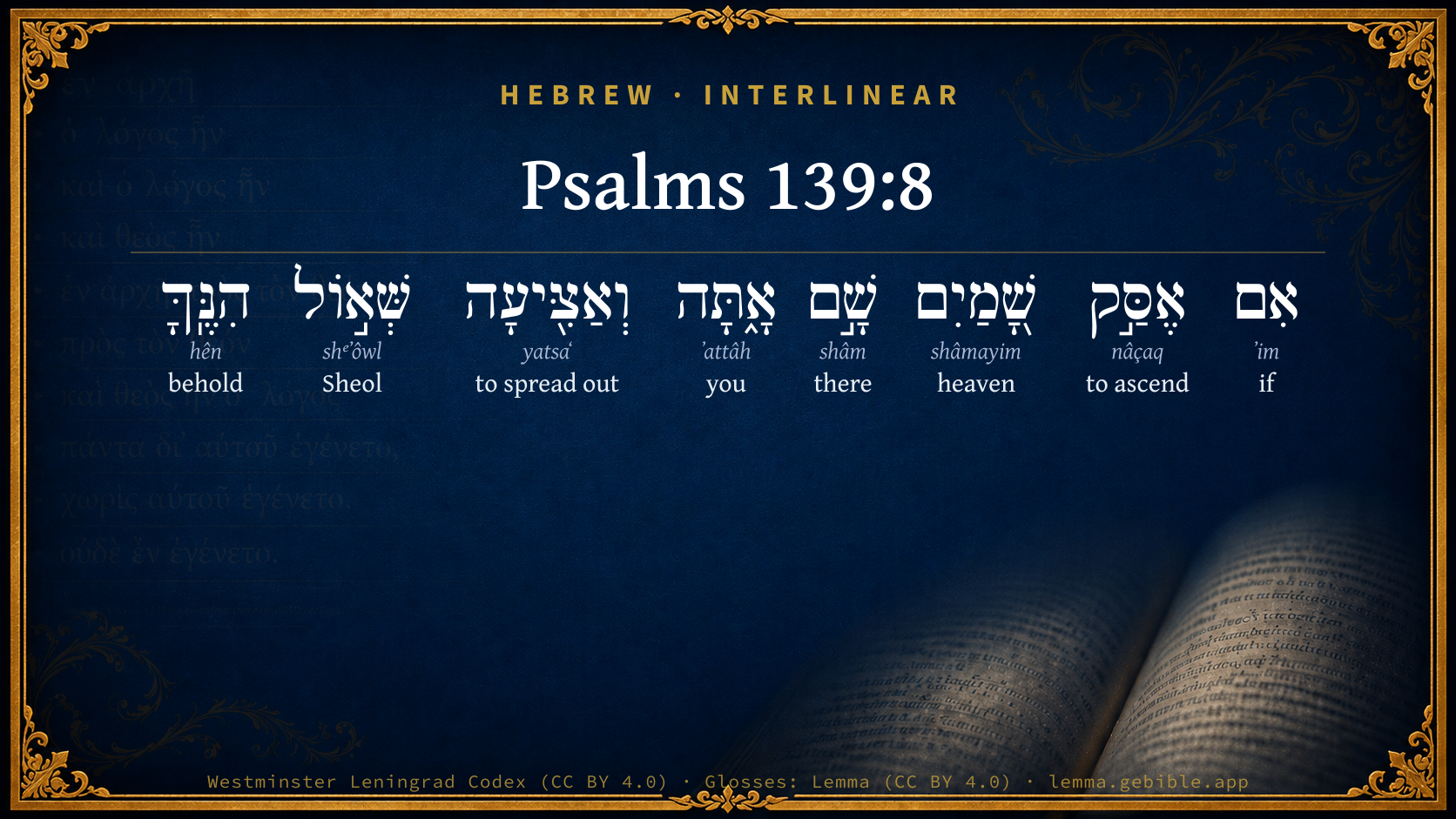
Psalms 139:8

Hebrew (Westminster Leningrad Codex) Psalms 139:8 appears in the Hebrew Old Testament. The text above is from the Westminster Leningrad Codex. Each word links to its Strong’s number, a concise gloss, and parsing drawn from the Open Scriptures Hebrew Bible morphology. Click any word for its full Brown-Driver-Briggs (BDB) entry.
Download image
Cite this verse

Psalms 139:8 (World English Bible). Public Domain. Lemma interlinear Bible study tool, https://lemma.gebible.app/v/psalms/139/8.

Show BibTeX & RIS
BibTeX
RIS
English Translation
If I ascend up into heaven, you are there. If I make my bed in Sheol, behold, you are there!
World English Bible · Public Domain
Highlights
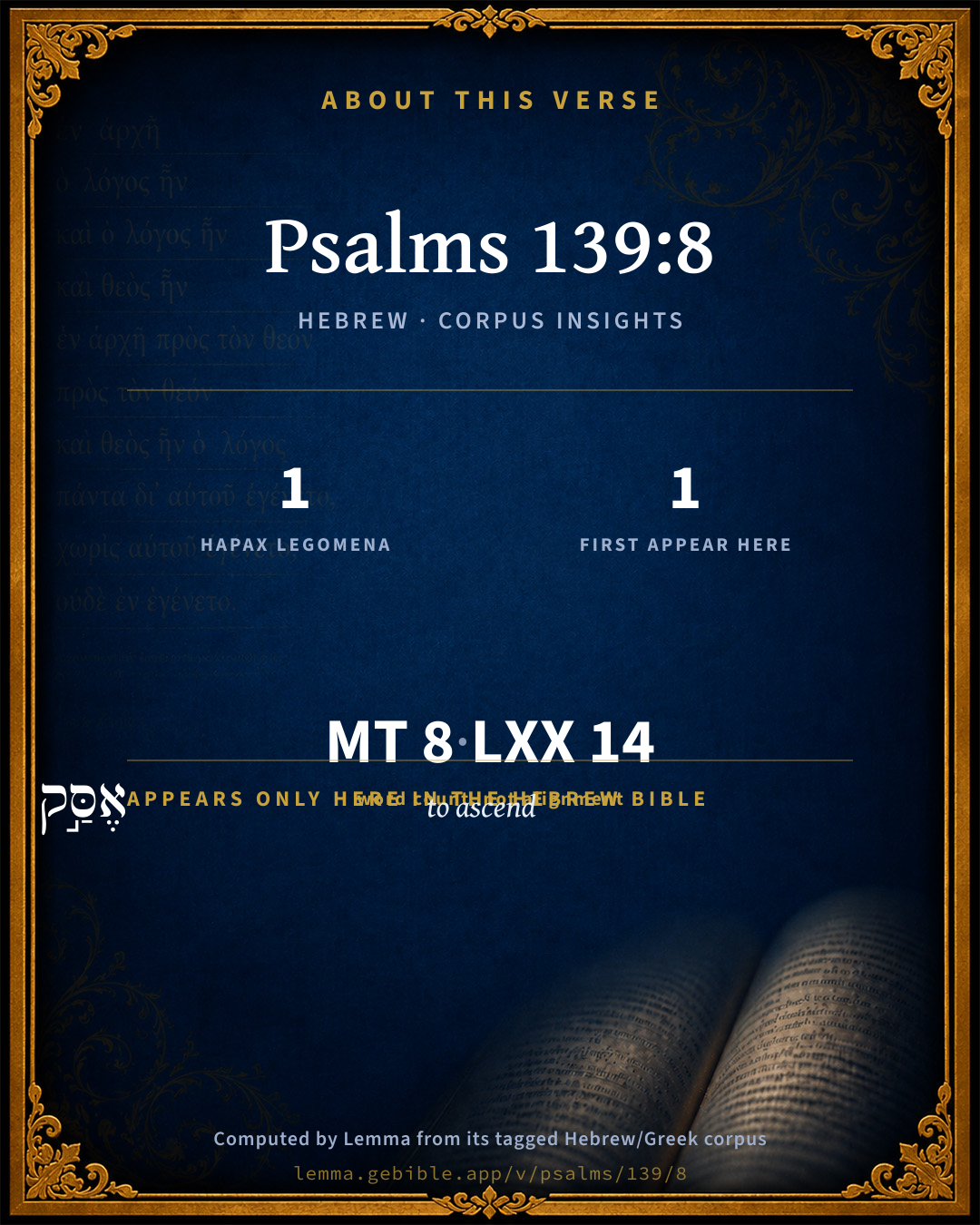
  • 1 hapax legomenon — only here in the Hebrew Bible
  • 1 first appearance in the Hebrew Bible
Full analysis ↓
Download a study sheet

One document with this verse’s original text, its word-by-word gloss line, the meaning frame, cross-references with their text, attributed commentary, and full source and license credits — printable, and it pastes into notes with its structure intact.

This verse Autodidact and up

Study sheet (.html) Plain text (.txt)

A passage Seminary Student

Up to 50 verses in one chapter. A passage sheet keeps up to 6 commentary sources and 12 cross-references per verse, in the order this page ranks them, and says so on the sheet whenever that leaves anything out. Ask for a single verse and you get the Autodidact verse sheet above.

Everything on this page stays free to read, with no account — the sheet is a download of what is already on screen, not access to it.

Want to remove ads? Support Godless Engineer
Compare translations 3

The same verse in 3 English versions, stacked beneath the original-language interlinear above. Click any original word for its lexicon entry.

Each is an independent rendering of the whole verse — the interlinear is not word-aligned to these translations.

Highlighted words mark where these versions differ — a whole-verse word diff, not a word-by-word alignment.

  • World English Bible Public Domain
    If I ascend up into heaven, you are there. If I make my bed in Sheol, behold, you are there!
  • King James Version Public Domain
    If I ascend up into heaven, thou art there: if I make my bed in hell, behold, thou art there.
  • unfoldingWord Literal Text CC BY-SA 4.0
    If I ascend the heavens, you there, and I spread out Sheol, behold, you!

unfoldingWord Literal Text — © unfoldingWord, licensed CC BY-SA 4.0. Word-aligned USFM3 via Door43 (git.door43.org/unfoldingWord/en_ult).

Versions to compare (up to 4)

3 of 4 selected

Show all 18 translations

Every available English version of this verse, each an independent rendering of the whole verse.

  • World English Bible Public Domain
    If I ascend up into heaven, you are there. If I make my bed in Sheol, behold, you are there!
  • Berean Standard Bible Public Domain
    If I ascend to the heavens, You are there; if I make my bed in Sheol, You are there.
  • Majority Standard Bible Public Domain
    If I ascend to the heavens, You are there; if I make my bed in Sheol, You are there.
  • King James Version Public Domain
    If I ascend up into heaven, thou art there: if I make my bed in hell, behold, thou art there.
  • American Standard Version (1901) Public Domain
    If I ascend up into heaven, thou art there: If I make my bed in Sheol, behold, thou art there.
  • Revised Version (1885) Public Domain
    If I ascend up into heaven, thou art there: if I make my bed in Sheol, behold, thou art there.
  • Geneva Bible (1599) Public Domain
    If I ascende into heauen, thou art there: if I lye downe in hell, thou art there.
  • Douay-Rheims (1899) Public Domain
    The Lord will repay for me: thy mercy, O Lord, endureth for ever: O despise not the work of thy hands.
  • Young's Literal Translation Public Domain
    If I ascend the heavens -- there Thou `art', And spread out a couch in Sheol, lo, Thee!
  • Literal Standard Version CC BY-SA 4.0
    If I ascend the heavens—You [are] there, || And spread out a bed in Sheol, behold, You!
  • Unlocked Literal Bible CC BY-SA 4.0
    If I ascend up to the heavens, you are there; if I make my bed in Sheol, behold, you are there.
  • unfoldingWord Literal Text CC BY-SA 4.0
    If I ascend the heavens, you there, and I spread out Sheol, behold, you!
  • Darby Bible Public Domain
    If I ascend up into the heavens thou art there; or if I make my bed in Sheol, behold, thou [art there];
  • World Messianic Bible Public Domain
    If I ascend up into heaven, you are there. If I make my bed in Sheol, behold, you are there!
  • Webster's Bible Public Domain
    If I ascend into heaven, thou art there: if I make my bed in hell, behold, thou art there.
  • Free Bible Version CC BY-SA 4.0
    If I go up to heaven, you are there. If I lie down in Sheol, look—you are there too!
  • Bible in Basic English Public Domain
    If I go up to heaven, you are there: or if I make my bed in the underworld, you are there.
  • JPS Tanakh (1917) Public Domain
    If I ascend up into heaven, Thou art there; if I make my bed in the nether-world, behold, Thou art there.

Literal Standard Version (2020), Covenant Press — licensed CC BY-SA 4.0. Text via the HelloAO Bible API (eBible.org). Unlocked Literal Bible (unfoldingWord) — licensed CC BY-SA 4.0. Text via the HelloAO Bible API (eBible.org). unfoldingWord Literal Text — © unfoldingWord, licensed CC BY-SA 4.0. Word-aligned USFM3 via Door43 (git.door43.org/unfoldingWord/en_ult). Free Bible Version, Dr. Jonathan Gallagher — licensed CC BY-SA 4.0. Text via the HelloAO Bible API (eBible.org).

Word by word

More ways to search: Search by grammar → Find every occurrence → Compare this word →

Practice this passage: Drill this verse → Learn its vocabulary →

About this verse

These counts appear in no published source. They are computed here, from the morphology-tagged text and Lemma’s own curated glosses. What Lemma adds →

8
words
8
distinct lemmas
Wisdom
section

Notable vocabulary

1 hapax legomenon — a word that appears only here in the entire Hebrew Bible:

  • אֶסַּ֣ק to ascend H5266

First appearance in Scripture

This word makes its first canonical appearance in the Hebrew Bible here:

  • אֶסַּ֣ק to ascend H5266

Shared distinctive vocabulary

וְאַצִּ֖יעָה to spread out H3331 occurs in 4 verses of the Hebrew Bible. Also found in:

Grammatical profile

  • 2 verbs
  • 2 nouns
  • 1 pronoun
  • 1 conjunction
  • 1 adverb
  • 1 particle

Verb forms

  • אֶסַּ֣ק Qal · Imperfect
  • וְאַצִּ֖יעָה Hiphil · Cohortative

Hebrew & Septuagint length

In English translation the verse runs 20 words from the Hebrew and 20 from the Septuagint (LXX English) — the same length.

A rough comparison of the two English renderings, which tokenize alike — not a word-level alignment.

Word counts can differ between the Hebrew and the Greek without any difference in meaning — e.g. the Hebrew direct-object marker אֵת has no separate Greek word, and Greek often adds the article ὁ.

In the original languages it is 8 Hebrew tokens and 14 Greek tokens — but the two are counted differently (Hebrew bundles its prefixes and suffixes into one token; the Greek is in lemma form), so that isn’t a like-for-like length.

Cross-references

6

Topical passages linked to Psalms 139:8 in the Treasury of Scripture Knowledge — connected by theme and wording, ordered by reader-vote popularity; previews shown in the World English Bible.

  • Amos 9:2–4 Though they dig into Sheol, there my hand will take them; and though they climb up to heaven, there I will bring them down.
  • Job 34:21–22 "For his eyes are on the ways of a man, He sees all his goings.
  • Jonah 2:2 He said, "I called because of my affliction to Yahweh. He answered me. Out of the belly of Sheol I cried. You heard my voice.
  • Proverbs 15:11 Sheol and Abaddon are before Yahweh-- How much more then the hearts of the children of men!
  • Obadiah 1:4 Though you mount on high as the eagle, and though your nest is set among the stars, I will bring you down from there, says Yahweh.
  • Job 26:6 Sheol is naked before God, And Abaddon has no covering.

Cross-references courtesy of OpenBible.info (CC BY 4.0).

Hebrew and Greek witnesses Masoretic Hebrew ↔ Greek Septuagint

The same verse in the two great witnesses to the Old Testament, shown verse-for-verse.

You’re reading Greek Psalm 138 (Hebrew Psalm 139). The Septuagint counts the superscription, so verse numbers can differ from the Hebrew — chapter-level alignment, not verse-by-verse. Numbering follows Rahlfs.

These are two independent witnesses, not word-aligned to each other, and the Septuagint is shown in lemma (dictionary) form.

Hebrew Psalms 139:8 Masoretic · Westminster Leningrad Codex

אִם אֶסַּ֣ק שָׁ֭מַיִם שָׁ֣ם אָ֑תָּה וְאַצִּ֖יעָה שְּׁא֣וֹל הִנֶּֽךָּ

If I ascend up into heaven, you are there. If I make my bed in Sheol, behold, you are there!

World English Bible · Public Domain

Greek LXX Greek Psalm 138:8 Septuagint · lemma form

ἐάν ἀναβαίνω εἰς ὁ οὐρανός σύ εἰμί ἐκεῖ ἐάν καταβαίνω εἰς ὁ ᾅδης παραεἰμί

If I should go up to heaven, you are there: if I should go down to hell, you are present.

LXX2012 (modern English Septuagint) · Public Domain

On this verse, Keil & Delitzsch discusses the Septuagint’s reading. Read the note in Commentary ↓

Hebrew: Westminster Leningrad Codex (CC BY 4.0). Greek: Septuagint (public domain); English from LXX2012 (modern English Septuagint) (Public Domain). How the Septuagint differs from the Hebrew →

Commentary

Notes on Psalms 139:8 from classic Christian and Jewish commentators (each source and its license shown beneath its notes). The classic Christian expositions comment on the surrounding passage and are grouped to its opening verse, so a note may address several verses; the Jewish commentaries on the Tanakh (Rashi and others) are per-verse, so they appear only where the commentator wrote on this verse.

Lemma curates 59 commentaries, every one of them public domain or Creative Commons licensed, each selected and text-cleaned for this edition rather than reprinted as found. About our sources →

Trapp's Complete Commentary

John Trapp

Psa 139:8 If I ascend up into heaven, thou [art] there: if I make my bed in hell, behold, thou [art there].

Ver. 8. If I ascend up into heaven, thou art there] That is thy proper place; and there Aristotle, in his Book of the World, ad Alexandrum affirmeth that God is only essentialiter et actu. This was to proclaim himself an arrant atheist; for God filleth all places, and is comprehended of no place, being totally present wheresoever present; for we must not conceive that God is commensurable by the place, as if he were partly here and partly elsewhere; but everywhere, all present.

John Trapp, A Commentary or Exposition upon All the Books of the Old and New Testament (1647–1656) — public domain. Text from a community e-Sword module.

The Biblical Illustrator

Joseph S. Exell

Psa_139:8

If I make my bed in hell, behold, Thou art there.

Gods presence in the under-world

We are told that the Jew had no knowledge of a heaven for the soul, that the only future he knew was that of a mysterious under-world where the spirits of the dead reposed. It is this under-world which the psalmist here designates by the word translated hell; it is the universal Old Testament name for the place of the dead. But, in the hands of this writer, the under-world becomes well-nigh as fair as the upper; it receives the very glory of heaven. What is the glory of heaven? Is it not the fact that to depart is to be with God? The heaven of Christianity is not beautiful to its votaries by reason of its pearly streets and golden gates; it is beautiful because it is conceived to be the home of God. Now, this is the thought which the psalmist makes his own. He, too, recognizes that the joy of heaven is the joy of being with God; but, to him, God is everywhere. To say that at death the soul does not ascend is not necessarily to say that it is banished from heaven. God is in the under as well as in the upper world; and the pure soul will find Him there as in all places. Death cannot rob a good man of his God; whither can he flee from His presence? That presence will follow him equally whether he ascend up into heaven or whether he make his bed in the unknown under-world. However unknown it may be, it is not outside of Him; and whatever is not outside of Him may be the heaven of the soul. Such is the thought of the psalmist, a thought which flashes a ray of glory around the Jewish vision of death and throws back its light on the Jewish doctrine of immortality. We see that the Judaic faith in God had enclosed within itself a hope of eternal life. The Jew did not, like the Greek, conjure up the images of a locality which the disembodied soul would inhabit after death; he had no figure in his imagination wherewith to body forth his conception of the dark vale. But he knew of a Presence that belonged alike to his own world and the under-world, the Being of the Eternal God; and, in that knowledge, death itself ceased to be a foreign land. It lost much of its strangeness. It held something which the earth held, and that the source of all that is in earth or heaven, the very life of the universe. (G. Matheson, D. D.)

Gods omnipresence

If you were called to take some such awful journey as Virgil and Dante have fabled in their poems when their heroes descended into the dread Avernus, you need not tremble, though it were said of you, as of them:--

Along the illuminated shade,

Darkening and lone, their way they made.

If, I say, you were bound to traverse the sepulchral vaults, and all the gloomy dungeons of Hades, yet you need not fear, for underneath are the everlasting arms. (C. H. Spurgeon.)

The Biblical Illustrator, edited by Joseph S. Exell (c. 1880s–1900s) — public domain. Text from a community e-Sword module.

J. A. Alexander on Psalms

Joseph Addison Alexander

8. (Psa 139:8) If I scale the heavens, there (art) thou; and if I spread the grave, lo thou (art there). The word scale is used to represent a Hebrew verb occurring only here, and no doubt belonging to the dialect of poetry. The verb translated spread means specifically to spread a couch or make a bed. If I make sheol my bed, i.e. lie down in the grave or hell, in the wide old English sense. See above, on Psa 6:5.

Joseph Addison Alexander, The Psalms Translated and Explained (1850) — public domain. Text from a community e-Sword module.

Tyndale Open Study Notes

Tyndale Open Resources

139:8 down to the grave: God has total access to his entire creation—even the most hard-to-reach places.

Tyndale Open Study Notes — © Tyndale Open Resources, licensed CC BY-SA 4.0. Text via the HelloAO Bible API.

Adam Clarke's Commentary

Verse 8. If I ascend] Thou art in heaven, in thy glory; in hell, in thy vindictive justice; and in all parts of earth, water, space, place, or vacuity, by thy omnipresence. Wherever I am, there art thou; and where I cannot be, thou art there. Thou fillest the heavens and the earth.

Adam Clarke's Commentary on the Bible (1810–1826) — public domain. Text from a community e-Sword/MySword module.

Ellicott's Commentary for English Readers

(8) If I make my bed in hell.—Literally, If I make Sheôl my bed. (For the thought see Amo_9:2, and comp. Pro_15:11; Job_26:6.)

This conviction that the underworld was not exempt from the vigilance and even from the visitation of Jehovah makes an advance in thought from Psa_6:5 (where see Note), &c, where death is viewed as cutting off the Hebrew altogether from his relation to the Theocracy.

A Bible Commentary for English Readers, edited by Charles John Ellicott (1878–1897) — public domain. Text from a community e-Sword module.

The Cambridge Bible for Schools and Colleges

gen. ed. J. J. S. Perowne

8. Cp. Amo_9:2 ff.; Jer_23:24.

If I should ascend up] Another Aramaic word.

if I make my bed in hell] Render, and if I should make Sheol my couch.

The Cambridge Bible for Schools and Colleges (gen. ed. J. J. S. Perowne; Cambridge University Press, 1878–1918) — public domain. Text from a community e-Sword module.

John Gill's Exposition

If I take the wings of the morning,.... And fly as swift as the morning light to the east, to the extremity of it, as Ben Melech; as far as he could go that way, as swiftly as the wings of the morning could carry him thither; so the morning is represented by the Heathens as having wings (f); or as the rays of the rising sun, called wings for the swiftness of them, Mal 4:2;

and dwell in the uttermost parts of the sea; in the most distant isles of it, in the farthest parts of the world, the sea being supposed the boundary of it: or "in the uttermost parts of the west" (g), as opposed to the morning light and rising sun, which appear in the east; and the sea is often in Scripture put for the west, the Mediterranean sea being to the west of the land of Palestine; and could he go from east to west in a moment, as the above writer observes, there would God be. The Heathens represent Jupiter, their supreme god, as having three eyes, because he reigns in heaven, and in earth, and under the earth (h).

(f) Vid. Cuperi Apotheos. Homeri, p. 177. (g) "in novissimo occidentis", Pagninus. (h) Pausan. Corinthiaca, sive l. 2. p. 129.

John Gill's Exposition of the Whole Bible (1746–1763) — public domain (CC PDM 1.0). Text via the HelloAO Bible API.

Albert Barnes' Notes on the Bible

If I ascend up into heaven - The word “heaven” here, in the original is in the plural number - “heavens,” - and includes all that there is above the earth - the highest worlds.

If I make my bed - Properly, “If I strew or spread my couch.” If I should seek that as the place where to lie down.

In hell - Hebrew, “Sheol.” See the notes at Isa 14:9, where the word is fully explained. The word here refers to the under-world - the abodes of the dead; and, in the apprehension of the psalmist, corresponds in depth with the word “heaven” in height. The two represent all worlds, above and below; and the idea is, that in neither direction, above or below, could he go where God would not be.

Thou art there - Or, more emphatically and impressively in the original, “Thou!” That is, the psalmist imagines himself in the highest heaven, or in the deepest abodes of the dead - and lo! God is there also! he has not gone from “him”! he is still in the presence of the same God!

Albert Barnes' Notes on the Bible (1834–1885) — public domain. Text from a community e-Sword/MySword module.

Matthew Poole's English Annotations

If I make my bed in hell; if I should or could repose and hide myself in the grave, or in the lowest parts of the earth, which are at the farthest distance from heaven.

Matthew Poole's English Annotations on the Holy Bible (1683–1685) — public domain. Text from a community e-Sword/MySword module.

The Treasury of David

Charles H. Spurgeon

Ver. 8. If I ascend up into heaven, thou art there. Filling the loftiest region with his yet loftier presence, Jehovah is in the heavenly place, at home, upon his throne. The ascent, if it were possible, would be unavailing for purposes of escape; it would, in fact, be a flying into the centre of the fire to avoid the heat. There would he be immediately confronted by the terrible personality of God. Note the abrupt words"THOU, THERE."

If I make my bed in hell, behold, thou art there. Descending into the lowest imaginable depths among the dead, there should we find the Lord. THOU! says the Psalmist, as if he felt that God was the one great Existence in all places. Whatever Hades may be, or whoever may be there, one thing is certain, Thou, O Jehovah, art there. Two regions, the one of glory and the other of darkness, are set in contrast, and this one fact is asserted of both"thou art there." Whether we rise up or lie down, take our wing or make our bed, we shall find God near us. A "behold" is added to the second clause, since it seems more a wonder to meet with God in hell than in heaven, in Hades than in Paradise. Of course the presence of God produces very different effects in these places, but it is unquestionably in each; the bliss of one, the terror of the other. What an awful thought, that some men seem resolved to take up their night's abode in hell, a night which shall know no morning.

Ver. 8. If I make my bed. Properly, "If I strew or spread my couch." If I should seek that as a place to lie down. Albert Barnes.

Ver. 8. Hell in some places in Scripture signifies the lower parts of the earth, without relation to punishment: If I ascend up into heaven, thou art there; if I make my bed in hell, behold, thou art there. By "heaven" he means the upper region of the world, without any respect to the state of blessedness; and "hell" is the most opposite and remote in distance, without respect to misery. As if he had said, Let me go whither I will, thy presence finds me out. Joseph Caryl.

Ver. 8. Thou art there. Or, more emphatically and impressively in the original, "Thou!" That is, the Psalmist imagines himself in the highest heaven, or in the deepest abodes of the dead, and lo! God is there also; he has not gone from him! he is still in the presence of the same God! Albert Barnes.

Ver. 8. Thou art there. This is not meant of his knowledge, for that the Psalmist had spoken of before: Ps 139:2-3, "Thou understandest my thought afar off: thou art acquainted with all my ways." Besides, "thou art there"; not thy wisdom or knowledge, but thou, thy essence, not only thy virtue. For having before spoken of his omniscience, he proves that such knowledge could not be in God unless he were present in his essence in all places, so as to be excluded from none. He fills the depths of hell, the extension of the earth, and the heights of the heavens. When the Scripture mentions the power of God only, it expresses it by hand or arm; but when it mentions the spirit of God, and doth not intend the third person of the Trinity, it signifies the nature and essence of God; and so here, when he saith, "Whither shall I go from thy spirit?" he adds exegetically, "whither shall I flee from thy presence?" or Hebrew, "face"; and the face of God in Scripture signifies the essence of God: Ex 33:20, 23, "Thou canst not see my face", and "my face shall not be seen"; the effects of his power, wisdom, providence, are seen, which are his back parts, but not his face. The effects of his power and wisdom are seen in the world, but his essence is invisible, and this the Psalmist elegantly expresses. Stephen Charnook.

Ver. 8. The glory of heaven and the terror of hell: "Thou."

Psalms 139:9*

Charles H. Spurgeon's The Treasury of David (1869–1885) — public domain. Psalms only. Text from a community e-Sword/MySword module.

Whedon's Commentary on the Bible

Daniel D. Whedon

8. Heaven—Hebrew, heavens. The celestial heights, however far.

Hell— Hebrew, sheol, the lowest depths, the under world. The ideas of power and of omnipresence are continued. Amo_9:2

Daniel D. Whedon (gen. ed.), Commentary on the Old and New Testaments (1874–1909) — public domain. Text from a community e-Sword module.

The Pulpit Commentary

If I ascend up into heaven, thou art there; i.e. "if I were to ascend up into heaven, if I could do so, thou wouldst still be there I should not find myself where thou wert not; no, nor even if I went down to hell ( Sheol), should I escape thee thou wouldst be there also." If I make my bed in hell means, "if I go down and take my rest in hell the place of departed spirits. Behold, thou art there; literally, behold, thou!

The Pulpit Commentary (1880–1919), ed. H.D.M. Spence-Jones & Joseph S. Exell — public domain. Text from a community e-Sword module.

John Wesley's Explanatory Notes

Hell - If I could hide myself in the lowest parts of the earth.

John Wesley, Explanatory Notes Upon the Whole Bible (1754–1765) — public domain. Text via the GEBible commentary corpus.

Keil & Delitzsch

C. F. Keil & F. Delitzsch

The future form אסּק, customary in the Aramaic, may be derived just as well from סלק (סלק), by means of the same mode of assimilation as in יסּב = יסבּב, as from נסק (נסק), which latter is certainly only insecurely established by Dan 6:24, להנסקה (cf. להנזקת, Ezr 4:22; הנפּק, Dan 5:2), since the Nun, as in להנעלה, Dan 4:3, can also be a compensation for the resolved doubling (vid., Bernstein in the Lexicon Chrestom. Kirschianae, and Levy s.v. נסק). אם with the simple future is followed by cohortatives (vid., on Psa 73:16) with the equivalent אשּׂא among them: et si stratum facerem (mihi) infernum (accusative of the object as in Isa 58:5), etc. In other passages the wings of the sun (Mal 4:2) and of the wind (Psa 18:11) are mentioned, here we have the wings of the morning's dawn. Pennae aurorae, Eugubinus observes (1548), est velocissimus aurorae per omnem mundum decursus. It is therefore to be rendered: If I should lift wings (נשׂא כנפים as in Eze 10:16, and frequently) such as the dawn of the morning has, i.e., could I fly with the swiftness with which the dawn of the morning spreads itself over the eastern sky, towards the extreme west and alight there. Heaven and Hades, as being that which is superterrestrial and subterrestrial, and the east and west are set over against one another. אחרית ים is the extreme end of the sea (of the Mediterranean with the "isles of the Gentiles"). In Psa 139:10 follows the apodosis: nowhere is the hand of God, which governs everything, to be escaped, for dextera Dei ubique est. ואמר (not ואמר, Eze 13:15), "therefore I spake," also has the value of a hypothetical protasis: quodsi dixerim. אך and חשׁך belongs together: merae tenebrae (vid: Psa 39:6.); but ישׁוּפני is obscure. The signification secured to it of conterere, contundere, in Gen 3:15; Job 9:17, which is followed by the lxx (Vulgate) καταπατήσει, is inappropriate to darkness. The signification inhiare, which may be deduced as possible from שׁאף, suits relatively better, yet not thoroughly well (why should it not have been יבלעני?). The signification obvelare, however, which one expects to find, and after which the Targum, Symmachus, Jerome, Saadia, and others render it, seems only to be guessed at from the connection, since שׁוּף has not this signification in any other instance, and in favour of it we cannot appeal either to נשׁף - whence נשׁף, which belongs together with נשׁב, נשׁם, and נפשׁ - or to עטף, the root of which is עת (עתה), or to צעף, whence צעיף, which does not signify to cover, veil, but according to Arab. ḍ‛f, to fold, fold together, to double. We must therefore either assign to ישׁוּפני the signification operiat me without being able to prove it, or we must put a verb of this signification in its place, viz., ישׂוּכני (Ewald) or יעוּפני (Bttcher), which latter is the more commendable here, where darkness (חשׁך, synon. עיפה, מעוּף) is the subject: and if I should say, let nothing but darkness cover me, and as night (the predicate placed first, as in Amo 4:13) let the light become about me, i.e., let the light become night that shall surround and cover me (בּעדני, poetic for בּעדי, like תּחתּני in 2 Sam. 22) - the darkness would spread abroad no obscurity (Psa 105:28) that should extend beyond (מן) Thy piercing eye and remove me from Thee. In the word יאיר, too, the Hiphil signification is not lost: the night would give out light from itself, as if it were the day; for the distinction of day and night has no conditioning influence upon God, who is above and superior to all created things (der Uebercreatrliche), who is light in Himself. The two כ are correlative, as e.g., in Kg1 22:4. חשׁיכה (with a superfluous Jod) is an old word, but אורה (cf. Aramaic אורתּא) is a later one.

Keil & Delitzsch — Biblical Commentary on the Old Testament (1861–1891) — public domain (CC PDM 1.0). Text via the HelloAO Bible API. (Old Testament only.)

Scofield Reference Notes

C. I. Scofield

hell

Heb. "Sheol," (See Scofield "Hab 2:5").

The Scofield Reference Bible (1917 edition), notes by C. I. Scofield — public domain. Text from a community e-Sword module.

Rashi

Rabbi Shlomo Yitzchaki (Rashi)

and if I make my bed Heb. ואציעה, an expression of a spread (מצע) and a bed.

Rashi on the Tanakh — English translations: “The Judaica Press complete Tanach with Rashi, translated by A. J. Rosenberg” (CC BY 4.0); “Pentateuch with Rashi's commentary by M. Rosenbaum and A.M. Silbermann, 1929-1934” (public domain); “The Metsudah Tanach series, Lakewood, N.J” (CC BY 4.0); and “The Book of Joshua, Metsudah Publications, 1997” (CC BY 4.0). Text via Sefaria.

Lesson kit

Teaching starters — assembled from the data on this page, not authored interpretation. Every prompt links to the verse data it draws on. Edit before teaching.

Psalms, in the Wisdom, opens this verse with 8 words (8 distinct Hebrew lemmas). Its most distinctive word is nâçaq (“to ascend”). A historical commentator’s framing appears above. Read the whole chapter for the surrounding context.

Discussion questions

  1. The word nâçaq carries the sense “to ascend.” How does it shape the verse?
  2. 1 word here appears nowhere else in the Hebrew Bible. Why might the author reach for such rare wording?
  3. This is the first place “to ascend” appears in Scripture (first appears here). What does its debut here establish?
  4. How does Esther 4:3, which shares the word «to spread out», read alongside this verse?
  5. These translations render this verse differently; the difference is in the English rendering, not the original. What questions does that raise?
  6. «אֶסַּ֣ק» is a Qal Imperfect verb. How does that grammatical form shape the action described?
  7. Compare how Trapp's Complete Commentary and The Biblical Illustrator read this verse. Where do they agree or differ?

Things to notice

Reading settings

Reading text

Shown beneath each verse's original-language words.

Old Testament
Old Testament edition

Read the OT as the Masoretic Hebrew (MT) or the Greek Septuagint (LXX).

English shown for the Greek Septuagint (in the Hebrew ↔ Greek comparison).

Comparing translations? Open the Compare panel on any verse page to stack up to four side by side.