Jeremiah 2:35

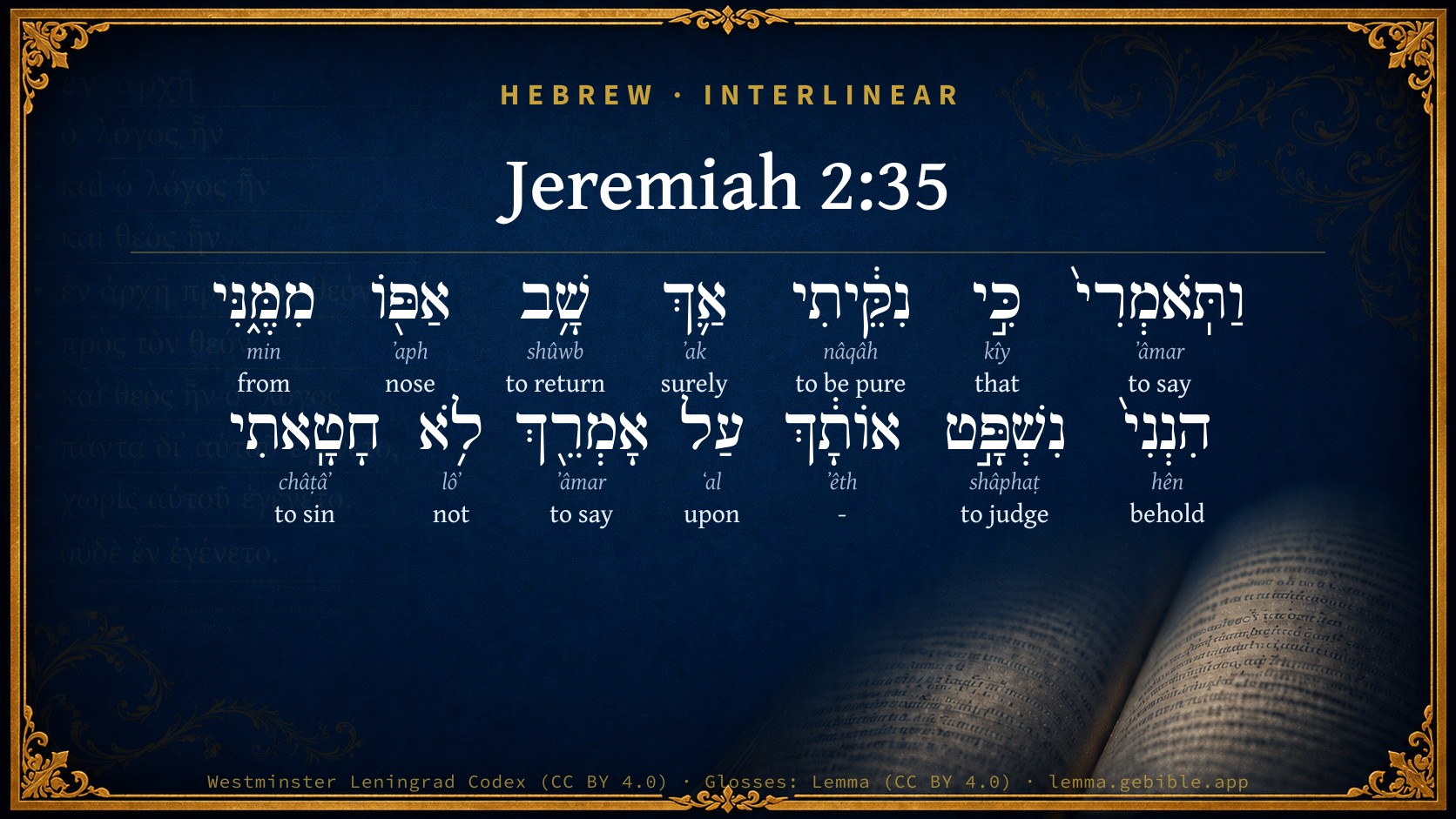
Hebrew (Westminster Leningrad Codex) Jeremiah 2:35 appears in the Hebrew Old Testament. The text above is from the Westminster Leningrad Codex. Each word links to its Strong’s number, a concise gloss, and parsing drawn from the Open Scriptures Hebrew Bible morphology. Click any word for its full Brown-Driver-Briggs (BDB) entry.
Download image
Cite this verse

Jeremiah 2:35 (World English Bible). Public Domain. Lemma interlinear Bible study tool, https://lemma.gebible.app/v/jeremiah/2/35.

Show BibTeX & RIS
BibTeX
RIS
English Translation
Yet you said, I am innocent; surely his anger is turned away from me. Behold, I will enter into judgment with you, because you say, I have not sinned.
World English Bible · Public Domain
Download a study sheet

One document with this verse’s original text, its word-by-word gloss line, the meaning frame, cross-references with their text, attributed commentary, and full source and license credits — printable, and it pastes into notes with its structure intact.

This verse Autodidact and up

Study sheet (.html) Plain text (.txt)

A passage Seminary Student

Up to 50 verses in one chapter. A passage sheet keeps up to 6 commentary sources and 12 cross-references per verse, in the order this page ranks them, and says so on the sheet whenever that leaves anything out. Ask for a single verse and you get the Autodidact verse sheet above.

Everything on this page stays free to read, with no account — the sheet is a download of what is already on screen, not access to it.

Want to remove ads? Support Godless Engineer
Compare translations 3

The same verse in 3 English versions, stacked beneath the original-language interlinear above. Click any original word for its lexicon entry.

Each is an independent rendering of the whole verse — the interlinear is not word-aligned to these translations.

Highlighted words mark where these versions differ — a whole-verse word diff, not a word-by-word alignment.

  • World English Bible Public Domain
    Yet you said, I am innocent; surely his anger is turned away from me. Behold, I will enter into judgment with you, because you say, I have not sinned.
  • King James Version Public Domain
    Yet thou sayest, Because I am innocent, surely his anger shall turn from me. Behold, I will plead with thee, because thou sayest, I have not sinned.
  • unfoldingWord Literal Text CC BY-SA 4.0
    you also say, ‘But I am innocent; surely his nose has turned away from me.’ Behold, I shall judge you because you say, ‘I have not sinned.’

unfoldingWord Literal Text — © unfoldingWord, licensed CC BY-SA 4.0. Word-aligned USFM3 via Door43 (git.door43.org/unfoldingWord/en_ult).

Versions to compare (up to 4)

3 of 4 selected

Show all 18 translations

Every available English version of this verse, each an independent rendering of the whole verse.

  • World English Bible Public Domain
    Yet you said, I am innocent; surely his anger is turned away from me. Behold, I will enter into judgment with you, because you say, I have not sinned.
  • Berean Standard Bible Public Domain
    you say, ‘I am innocent. Surely His anger will turn from me.’ Behold, I will judge you, because you say, ‘I have not sinned.’
  • Majority Standard Bible Public Domain
    you say, ‘I am innocent. Surely His anger will turn from me.’ Behold, I will judge you, because you say, ‘I have not sinned.’
  • King James Version Public Domain
    Yet thou sayest, Because I am innocent, surely his anger shall turn from me. Behold, I will plead with thee, because thou sayest, I have not sinned.
  • American Standard Version (1901) Public Domain
    Yet thou saidst, I am innocent; surely his anger is turned away from me. Behold, I will enter into judgment with thee, because thou sayest, I have not sinned.
  • Revised Version (1885) Public Domain
    Yet thou saidst, I am innocent; surely his anger is turned away from me. Behold, I will enter into judgment with thee, because thou sayest, I have not sinned.
  • Geneva Bible (1599) Public Domain
    Yet thou saiest, Because I am giltles, surely his wrath shall turne from mee: beholde, I will enter with thee into iudgement, because thou saiest, I haue not sinned.
  • Douay-Rheims (1899) Public Domain
    And thou hast said: I am without sin and am innocent: and therefore let thy anger be turned away from me. Behold, I will contend with thee in judgement, because thou hast said: I have not sinned.
  • Young's Literal Translation Public Domain
    And thou sayest, `Because I have been innocent, Surely turned back hath His anger from me?' Lo, I have been judged with thee, Because of thy saying, `I have not sinned.'
  • Literal Standard Version CC BY-SA 4.0
    And you say, Because I have been innocent, || Surely His anger has turned back from me? Behold, I have been judged with you, || Because of your saying, I have not sinned.
  • Unlocked Literal Bible CC BY-SA 4.0
    Yet you say, 'I am innocent; surely his anger has turned away from me.' But look! I will bring down judgment on you because you say, 'I have not sinned.'
  • unfoldingWord Literal Text CC BY-SA 4.0
    you also say, ‘But I am innocent; surely his nose has turned away from me.’ Behold, I shall judge you because you say, ‘I have not sinned.’
  • Darby Bible Public Domain
    And thou sayest, Indeed I am innocent; his anger will turn from me. Behold, I will enter into judgment with thee because thou sayest, I have not sinned.
  • World Messianic Bible Public Domain
    “Yet you said, ‘I am innocent. Surely his anger has turned away from me.’ “Behold, I will judge you, because you say, ‘I have not sinned.’
  • Webster's Bible Public Domain
    Yet thou sayest, Because I am innocent, surely his anger will turn from me. Behold, I will plead with thee, because thou sayest, I have not sinned.
  • Free Bible Version CC BY-SA 4.0
    you go on saying, “I'm innocent! Surely he can't still be upset with me!” Watch out! I'm going to punish you because you go on saying, “I haven't sinned.”
  • Bible in Basic English Public Domain
    And still you said, I have done no wrong; truly, his wrath is turned away from me. See, I will take up the cause against you, because you say, I have done no wrong.
  • JPS Tanakh (1917) Public Domain
    Thou saidst: 'I am innocent; surely His anger is turned away from me' — behold, I will enter into judgment with thee, because thou sayest: 'I have not sinned.'

Literal Standard Version (2020), Covenant Press — licensed CC BY-SA 4.0. Text via the HelloAO Bible API (eBible.org). Unlocked Literal Bible (unfoldingWord) — licensed CC BY-SA 4.0. Text via the HelloAO Bible API (eBible.org). unfoldingWord Literal Text — © unfoldingWord, licensed CC BY-SA 4.0. Word-aligned USFM3 via Door43 (git.door43.org/unfoldingWord/en_ult). Free Bible Version, Dr. Jonathan Gallagher — licensed CC BY-SA 4.0. Text via the HelloAO Bible API (eBible.org).

Word by word

More ways to search: Search by grammar → Find every occurrence → Compare this word →

Practice this passage: Drill this verse → Learn its vocabulary →

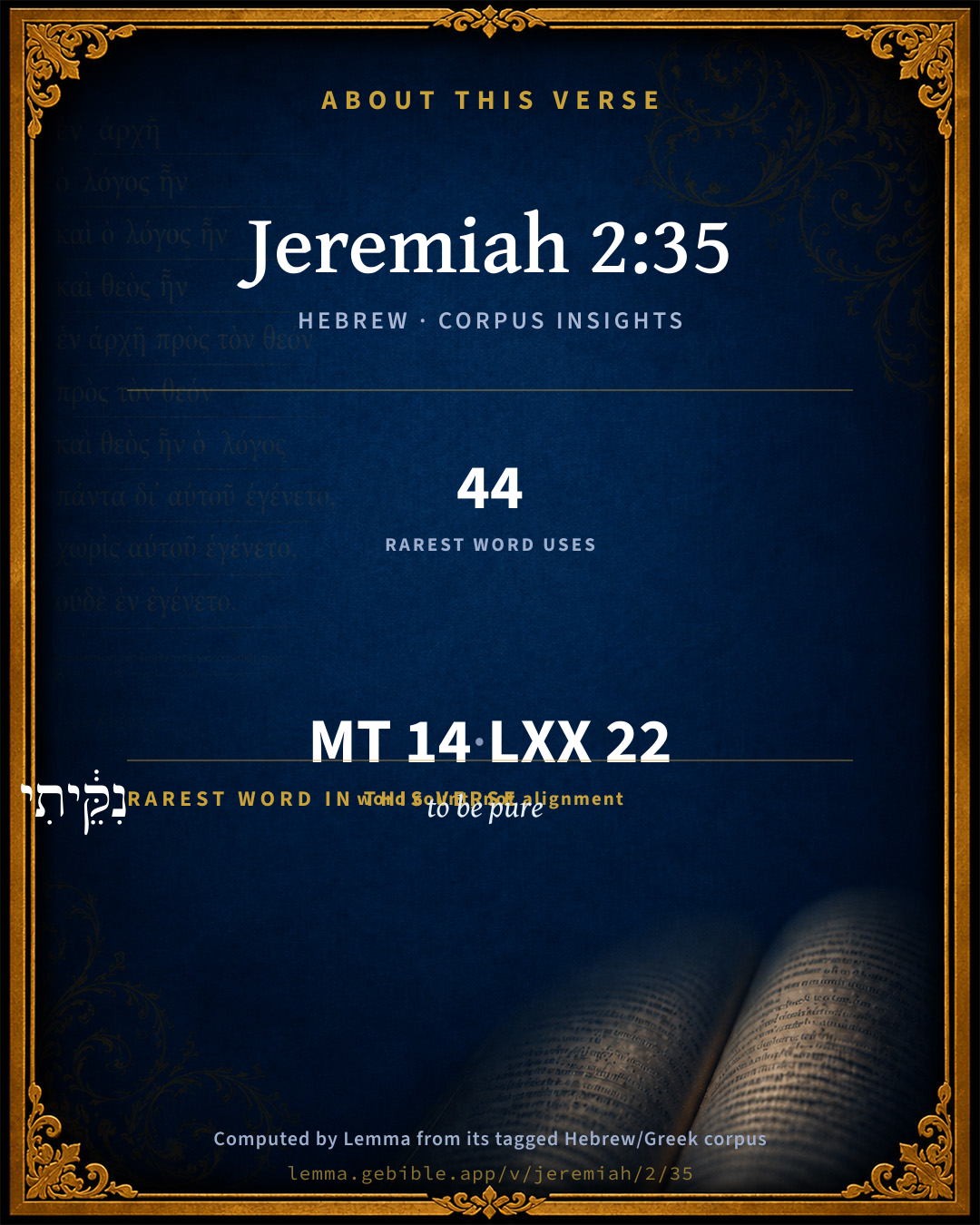
נִקֵּ֔יתִי
nâqâh
H5352
“to be pure”
Verb, Niphal, Perfect, 1st Person, Common, Singular
Part of Speech
Verb
Stem
Niphal
Form
Perfect
Person
1st Person
Gender
Common
Number
Singular
Full BDB Definition

Origin: a primitive root

TWOT: 1412

to be empty, be clear, be pure, be free, be innocent, be desolate, be cut off - (Qal) to be empty, be clean, be pure - (Niphal) - to be cleaned out, be purged out - to be clean, be free from guilt, be innocent - to be free, be exempt from punishment - to be free, be exempt from obligation - (Piel) - to hold innocent, acquit - to leave unpunished
  1. וַתֹּֽאמְרִי֙ ʼâmar H559 “and · to say” Conjunction + Verb, Qal, Sequential Imperfect, 2nd Person, Feminine, Singular
  2. כִּ֣י kîy H3588 “that” Conjunction
  3. אַ֛ךְ ʼak H389 “surely” Particle, Accusative
  4. שָׁ֥ב shûwb H7725 “to return” Verb, Qal, Perfect, 3rd Person, Masculine, Singular
  5. אַפּ֖וֹ ʼaph H639 “nose · his” Noun, Common, Masculine, Singular, Construct + Suffix, Personal, 3rd Person, Masculine, Singular
  6. מִמֶּ֑נִּי min H4480 “from · me” Preposition + Suffix, Personal, 1st Person, Common, Singular
  7. הִנְנִי֙ hên H2005 “behold · me” Particle, Demonstrative + Suffix, Personal, 1st Person, Common, Singular
  8. נִשְׁפָּ֣ט shâphaṭ H8199 “judging” Verb, Niphal, Participle Active, Masculine, Singular, Absolute
  9. אוֹתָ֔ךְ ʼêth H853 “- · you” Particle, Direct Object + Suffix, Personal, 2nd Person, Feminine, Singular
  10. עַל ʻal H5921 “upon” Preposition
  11. אָמְרֵ֖ךְ ʼâmar H559 “to say · you” Verb, Qal, Infinitive Construct + Suffix, Personal, 2nd Person, Feminine, Singular
  12. לֹ֥א lôʼ H3808 “not” Particle, Negative
  13. חָטָֽאתִי châṭâʼ H2398 “to sin” Verb, Qal, Perfect, 1st Person, Common, Singular

About this verse

These counts appear in no published source. They are computed here, from the morphology-tagged text and Lemma’s own curated glosses. What Lemma adds →

14
words
13
distinct lemmas
Prophets
section

Shared distinctive vocabulary

נִקֵּ֔יתִי to be pure H5352 occurs in 33 verses of the Hebrew Bible. Also found in:

Grammatical profile

  • 6 verbs
  • 1 noun
  • 2 prepositions
  • 1 conjunction
  • 4 particles

Verb forms

  • וַתֹּֽאמְרִי֙ Qal · Sequential Imperfect
  • נִקֵּ֔יתִי Niphal · Perfect
  • שָׁ֥ב Qal · Perfect
  • נִשְׁפָּ֣ט Niphal · Participle Active
  • אָמְרֵ֖ךְ Qal · Infinitive Construct
  • חָטָֽאתִי Qal · Perfect

Repetition

A word recurs within this verse — often emphatic in Hebrew:

  • וַתֹּֽאמְרִי֙ to say H559 ×2

Hebrew & Septuagint length

In the original languages it is 14 Hebrew tokens and 22 Greek tokens — but the two are counted differently (Hebrew bundles its prefixes and suffixes into one token; the Greek is in lemma form), so that isn’t a like-for-like length.

Cross-references

9

Topical passages linked to Jeremiah 2:35 in the Treasury of Scripture Knowledge — connected by theme and wording, ordered by reader-vote popularity; previews shown in the World English Bible.

  • Proverbs 28:13 He who conceals his sins doesn't prosper, But whoever confesses and renounces them finds mercy.
  • 1 John 1:8–10 If we say that we have no sin, we deceive ourselves, and the truth is not in us.
  • Job 33:9 'I am clean, without disobedience. I am innocent, neither is there iniquity in me:
  • Isaiah 58:3 Why have we fasted, [say they], and you don't see? [why] have we afflicted our soul, and you take no knowledge? Behold, in the day of your fast you find [your own] pleasure, and exact all your labors.
  • Jeremiah 2:9 Therefore I will yet contend with you, says Yahweh, and with your children's children will I contend.
  • Jeremiah 2:23 How can you say, I am not defiled, I have not gone after the Baals? see your way in the valley, know what you have done: [you are] a swift dromedary traversing her ways;
  • Jeremiah 2:29 Why will you contend with me? you all have transgressed against me, says Yahweh.
  • Jeremiah 25:31 A noise shall come even to the end of the earth; for Yahweh has a controversy with the nations; he will enter into judgment with all flesh: as for the wicked, he will give them to the sword, says Yahweh.
  • Romans 7:9 I was alive apart from the law once, but when the commandment came, sin revived, and I died.

Cross-references courtesy of OpenBible.info (CC BY 4.0).

Hebrew and Greek witnesses Masoretic Hebrew ↔ Greek Septuagint

The same verse in the two great witnesses to the Old Testament, shown verse-for-verse.

These are two independent witnesses, not word-aligned to each other, and the Septuagint is shown in lemma (dictionary) form.

Hebrew Jeremiah 2:35 Masoretic · Westminster Leningrad Codex

וַתֹּֽאמְרִי֙ כִּ֣י נִקֵּ֔יתִי אַ֛ךְ שָׁ֥ב אַפּ֖וֹ מִמֶּ֑נִּי הִנְנִי֙ נִשְׁפָּ֣ט אוֹתָ֔ךְ עַל אָמְרֵ֖ךְ לֹ֥א חָטָֽאתִי

Yet you said, I am innocent; surely his anger is turned away from me. Behold, I will enter into judgment with you, because you say, I have not sinned.

World English Bible · Public Domain

Greek LXX Structure differs

In the Septuagint, Jeremiah is about an eighth shorter than the Hebrew and arranges its material differently — the Oracles Against the Nations (Hebrew chapters 46–51) appear in the middle of the Greek book, after 25:13. Because the chapter and verse boundaries do not line up, a verse-for-verse comparison with the Hebrew is not shown.

A verse-for-verse comparison isn’t shown here because the chapters and verses don’t line up. Switch to the LXX edition with the MT / LXX toggle above to read the Greek directly.

On this verse, John Gill's Exposition discusses the Septuagint’s reading. Read the note in Commentary ↓

Hebrew: Westminster Leningrad Codex (CC BY 4.0). Greek: Septuagint (public domain); English from a public-domain English Septuagint. How the Septuagint differs from the Hebrew →

Targum (Aramaic paraphrase)

1

The Targum is the ancient Jewish Aramaic paraphrase of the Hebrew Scriptures — an interpretive translation, not the Hebrew text itself. Onkelos (literal) and Pseudo-Jonathan (expansive) render the Torah, and Jonathan the Prophets. Coverage is partial: where no permissively-licensed English translation exists for a verse, only the Aramaic is shown. This is verse-level text, not a word-by-word alignment to the Hebrew.

  1. Targum Jonathan Prophets (Joshua–Malachi)
    וַאֲמַרְתָּ אֲרֵי זְכֵיתִי בְּרַם תָּב רוּגְזֵיהּ מִנִי הָא אֲנָא עָבֵיד עִמִיךְ פּוּרְעָנוּת דִין עַל דַאֲמַרְתָּ לָא חֲטִיתִי:

    (no public-domain English translation for this verse)

    Targum Jonathan — Aramaic: “Mikraot Gedolot” (public domain). English: “Sefaria Community Translation” (CC0 1.0 (public-domain dedication)); “London "Chaldee Paraphrase," 1871” (public domain). Text via Sefaria.

Commentary

Notes on Jeremiah 2:35 from classic Christian and Jewish commentators (each source and its license shown beneath its notes). The classic Christian expositions comment on the surrounding passage and are grouped to its opening verse, so a note may address several verses; the Jewish commentaries on the Tanakh (Rashi and others) are per-verse, so they appear only where the commentator wrote on this verse.

Lemma curates 59 commentaries, every one of them public domain or Creative Commons licensed, each selected and text-cleaned for this edition rather than reprinted as found. About our sources →

Trapp's Complete Commentary

John Trapp

Jer 2:35 Yet thou sayest, Because I am innocent, surely his anger shall turn from me. Behold, I will plead with thee, because thou sayest, I have not sinned.

Ver. 35. Yet thou sayest, Because I am innocent.] Antiquum obtines; thou standest still upon thy justification. This doubleth thy fault. Homo agnoscit, Deus ignoseit. The best way is to plead guilty: confess, and go free.

John Trapp, A Commentary or Exposition upon All the Books of the Old and New Testament (1647–1656) — public domain. Text from a community e-Sword module.

The Biblical Illustrator

Joseph S. Exell

Jer_2:35-37

Thou sayest, I have not sinned.

Obstinate impenitence

1. Blind to its own guilt.

2. Blasphemes God by accusing Him of unjust anger.

3. Will not escape just punishment. (Naegelsbach.)

Denial of guilt

At one of our seaside resorts, a cab proprietor was fined £10 and costs for not having licences for twenty-seven carriages. His excuse was that they were relics of antiquity, kept to lend out while others underwent repair. Some make a like plea when their sins are discovered: they do not sin as a regular business, though it is true they keep some of the old relics of antiquity. If we keep the devils carriages, even under such a pretence, we will find them turn into funeral cars ere long. Do not keep wine in the cellar, and you will not drink it. He who has a pistol may shoot. Make not provision for the flesh (Rom_13:14). Neither give place to the devil (Eph_4:27). Do not keep even an old stool for him. Away with all his furniture. Old things are passed away.

The Biblical Illustrator, edited by Joseph S. Exell (c. 1880s–1900s) — public domain. Text from a community e-Sword module.

Joseph Benson's Commentary

Jer 2:35-36. Yet thou sayest — Or interrogatively, Darest thou say? Hast thou the impudence to affirm it? Because I am innocent — Clear of this whole charge; surely his anger shall turn from me — Shall not break out against me, Isa 5:25. Behold, I will plead with thee — I will proceed in my judgment against thee; because thou sayest, I have not sinned — Because thou continuest to justify thyself, as if I had no cause to be angry with thee. Why gaddest thou about so much to change thy way? — That is, thy actions. Why hast thou recourse to so many different expedients for relief? Why dost thou seek auxiliaries anywhere rather than cleave to me? Or act like those adulterous women, whose love is never fixed, but sometimes set on one, sometimes on another. This is rendered by the Vulgate, “How vile art thou become, changing or repeating thy ways!” Continuing still to seek new succours from strangers, though thou hast been so often deceived! Egypt now shall fail thee, as Assyria has done before. Blaney renders this last clause, “By means of Egypt also shalt thou be put to shame, even as thou hast been put to shame by Assyria.” “The people of Judah,” he observes, “seem to have courted the assistance of foreign nations, by a sinful compliance with their idolatrous customs. But this measure had already failed them, and they had been disappointed in their expectations from Assyria in the time of King Ahaz, who, as we read 2Ch 28:16-21, called upon the king of Assyria to help him in his need; but he distressed him only, instead of helping him. In the same manner, also, it is here prophesied they would be served by the Egyptians, whose alliance would only disappoint them, and make them ashamed of having trusted to so ineffectual a support; and it turned out accordingly.” See Jer 37:7-8.

Joseph Benson's Commentary on the Old and New Testaments (1811–1818) — public domain. Text from a community e-Sword module.

Tyndale Open Study Notes

Tyndale Open Resources

2:35 Israel’s sinful condition was evident in the people’s arrogant retort. They claimed that they were innocent, and that God was needlesslyhad needless angry with them. God responded to the people’s denial of guilt by decreeing that he would be severe in his punishment and that he would not tolerate their denial of wrongdoing (Prov 23:13; Mal 2:17; 3:8; 1 Jn 1:8, 10).

Tyndale Open Study Notes — © Tyndale Open Resources, licensed CC BY-SA 4.0. Text via the HelloAO Bible API.

Jamieson, Fausset & Brown

Robert Jamieson, A. R. Fausset & David Brown

(Jer 2:23, Jer 2:29).

Jamieson, Fausset & Brown — Commentary Critical and Explanatory on the Whole Bible (1871) — public domain (CC PDM 1.0). Text via the HelloAO Bible API.

Adam Clarke's Commentary

Verse 35. Because I am innocent] They continued to assert their innocence, and therefore expected that God's judgments would be speedily removed!

I will plead with thee] I will maintain my process, follow it up to conviction, and inflict the deserved punishment.

Adam Clarke's Commentary on the Bible (1810–1826) — public domain. Text from a community e-Sword/MySword module.

John Calvin's Commentaries

The Prophet here shews that the Jews were possessed of such a brazen front, that they could not be led by any admonitions to feel any shame. Though then they were like adulterous women, and though they gave meretricious hire to such as they ran to in all parts, and though also they had murdered the prophets and the pious ministers of God, yet they boasted, as persons conscious of no evil, that they were innocent.

Thou hast yet said; that is, “How darest thou to pretend to be innocent, since thou art proved to be guilty, not by allegations, but by manifest and glaring proofs?” In short, the Prophet shews that the condition of the people was past remedy, for they would not receive any admonition; nay, they dared, as it were with the front of brass, obstinately to boast that they were innocent: Thou hast said, (he still speaks of a woman, in the feminine gender,) Thou hast yet said, surely I am clean Thus hypocrites not only excuse themselves, and allege vain pretences, but dare to come forth publicly, and to fly as it were above the clouds, elated by their own self — confidence. “Who will dare to allege anything against me?” Thus hypocrites willfully and impertinently challenge all the servants of God and seek by their own presumption to close the mouth of all. The Prophet now condemns this petulancy in the Jews; for though they were manifestly proved guilty, yet they boastingly asserted that they were innocent. Only (אך, ak, I take here to mean only) depart, etc. The Prophet upbraids the Jews with another crime, — that they said, that wrong was done to them by God in seeking to bring them to a right mind by punishment and by reproofs. For God, as it is well known, had inflicted many punishments on the Jews, and had also added serious reproofs. He tried by these means to find out whether they were capable of being healed. What did they say? “I am innocent; and God is angry with me without a cause. Let him remove his anger from me;” that is, “only let not God deal severely with us, nor use his supreme authority, and we shall be able to prove our innocency.” Thus ungodly men, when urged with severe warnings, vomit forth their blasphemies against God, — “O what can I do? I know that I am not able to resist; God fights with a shadow when he afflicts me; his violence I must indeed bear though he may overwhelm me; yet he doeth me wrong: but were he to deal justly and fairly with me, I could prove that I do not deserve these evils.” Such then was the language of the Jews, — only depart let his fury from me, we could then shew that we are just, or at least excusable.

Now also in this part we perceive the design of the Prophet: it was to shew, that the Jews not only dared dishonestly and proudly to claim innocency for themselves, but hesitated not to contend with God, and to intimate that he with too much severity oppressed them, and did not treat them justly, but announced a cruel sentence for the purpose of overwhelming them.

Behold, he says, I will judge thee, because thou hast said, I have not sinned Some give this version, “I judge, or, condemn thee.” But there is here no doubt a contrast between the fury of God and his judgment. The people said, that God was too rigorous; this was his fury: God now mentions his judgment. “There is no reason,” he says, “for you to allege such a pretext as this, as it will vanish into nothing; for I will in judgment contend with you;” that is, “I will really prove that I am a just judge and not a tyrant, that I execute just punishments and according to the law, and that I am not like a man in anger, who takes vengeance on his enemies and does so precipitantly and rashly: I will shew,” he says, “that I am a just judge.”

We may hence gather a profitable instruction. Let it in the first place be observed, that nothing is so displeasing to God as this headstrong presumption, that is, when we seek to appear innocent, while our own conscience condemns us. Then in the second place observe, that all who thus perversely rebel and strive dishonestly and shamelessly to defend their own vices, contend at the same time with God: for false excuses have ever this tendency — to charge God with unjust severity. But we see what such men gain for themselves; for God shews that he will be at length their judge, and that he will openly discover the vices of those who thought that they could excuse themselves by evasions and by false charges against himself. They then who thus obstinately resist God, must at length, according to what the Prophet declares, come to this end, — that they will be constrained to acknowledge that God has not been too violently angry with them, but has only executed a just punishment.

John Calvin's Commentaries (1540-1563) — public domain. Text from the Calvin Translation Society English edition (1840s-50s) via the Christian Classics Ethereal Library (ccel.org). Calvin's coverage is partial (roughly two-thirds of the Bible); uncommented books and verses are honest gaps, never fabricated. The 19th-century editor's footnotes and remarks are omitted so the notes are faithfully Calvin's own voice.

Ellicott's Commentary for English Readers

(35) Yet thou sayest . . .—Once again we have the equivocating plea of the accused. She takes up the word that had been used by the accuser: “You speak of the innocents; I, too, am innocent. His anger has turned away from me. Here, as in Jer_2:33, there is an implied reference to the partial reformation under Josiah. The accuser retorts, and renews his pleadings against her. Confession might have led to forgiveness, but this denial of guilt excluded it, and was the token of a fatal blindness (comp. 1Jn_1:8).

A Bible Commentary for English Readers, edited by Charles John Ellicott (1878–1897) — public domain. Text from a community e-Sword module.

The Cambridge Bible for Schools and Colleges

gen. ed. J. J. S. Perowne

35. Israel protests that her innocence is proved by her prosperity, which marks Jehovah’s favour. He replies that judgement awaits her for her denial of guilt.

The Cambridge Bible for Schools and Colleges (gen. ed. J. J. S. Perowne; Cambridge University Press, 1878–1918) — public domain. Text from a community e-Sword module.

John Gill's Exposition

Why gaddest thou about so much to change thy way?.... Or, "by changing thy way" (t); sometimes going one way, and sometimes another; sometimes to Egypt, and then to Assyria; seeking sometimes to the one for help, and sometimes to the other; at one time serving the gods of the one, in order to curry favour with them, and then the gods of the other, like a lascivious woman that gads about from place to place to increase her lovers, and satisfy her lust. The Vulgate Latin version is, "how exceeding vile art thou become, changing thy ways"; and so Jarchi says, the word signifies "contempt", or "vileness": deriving it from or to be "vile" or "contemptible"; and to this sense are the Septuagint and Arabic versions; but Kimchi derives it from to go; to which our version and others agree:

thou also shalt be ashamed of Egypt; as they were in the times of Jehoahaz and Jehoiakim, when Pharaohnecho king of Egypt took the former, and put him in bands, and carried him into Egypt; and set the latter upon the throne, and took tribute of him, for which the land was taxed, Kg2 23:33.

as thou wast ashamed of Assyria; in the times of Ahaz, who sent to the king of Assyria for help, when Judah was smitten by the Edomites, and invaded by the Philistines; but when he came to him, he distressed him, and strengthened and helped him not, Ch2 28:16.

(t) "mutando viam tuam", Vatablus, Piscator, Junius & Tremellius.

John Gill's Exposition of the Whole Bible (1746–1763) — public domain (CC PDM 1.0). Text via the HelloAO Bible API.

Albert Barnes' Notes on the Bible

Because I am innocent - Rather, But “I am innocent,” or, “I am acquitted.” Those blood-stains cannot be upon my skirts, because now, in king Josiah’s days, the idolatry of Manasseh has been put away.

Shall turn from me - Or, has turned away “from me.”

Plead - Or, enter into judgment.

Albert Barnes' Notes on the Bible (1834–1885) — public domain. Text from a community e-Sword/MySword module.

Matthew Poole's English Annotations

Yet thou sayest; or interrogatively, Darest thou say? hast thou the impudence to affirm it?

Innocent; clear of this whole charge. Shall turn; shall not break out against me, Isa 5:25.

I will plead with thee; I will proceed in my judgment against thee, Jer 2:9; Jer 25:31. Or it is a soft expression, wherein he shows that he will not act like a tyrant, carried on rashly and furiously; but as a judge, regularly and righteously, Eze 20:35; and it shows that he will convince her.

Because thou sayest, I have not sinned; because thou dost justify thyself, as if I had no cause to be angry with thee. God is not angry with her so much because she hath sinned, as because she will not acknowledge her sin.

Matthew Poole's English Annotations on the Holy Bible (1683–1685) — public domain. Text from a community e-Sword/MySword module.

Whedon's Commentary on the Bible

Daniel D. Whedon

35. Yet thou sayest, etc. — The language seems to imply some such outward phariseeism as the reformation of Josiah might have produced. It is not unlikely that this reformation may have supplied the background of this verse.

Daniel D. Whedon (gen. ed.), Commentary on the Old and New Testaments (1874–1909) — public domain. Text from a community e-Sword module.

The Pulpit Commentary

Because. This "because" is misleading; there is no argument, but the statement of a supposed fact. The particle so rendered merely serves to introduce the speech of the Jews (like oti ). Shall turn; rather, hath turned. Judah had so long been undisturbed by any foreign power, that the people fancied the promises of Deuteronomy were being fulfilled, and that they, on their part, had pleased God by their formal obedience. (2Ki_22:17) I will plead with thee. Here, as in some other passages, (e.g. Isa_66:16 Eze_38:22) the word includes the sense of punishing.

Vers. 35-37. False confidence.

I THE GROUNDS OF FALSE CONFIDENCE.

1. Assumed innocence. Israel says, "I am innocent;" "I have not sinned." This assumption may result from

(1.) self-deception, or

(2.) hypocrisy.

2. A claim to be favored by God. Israel says again, "His anger has turned from me." Present peace is taken as a warrant for expecting continued security, so that the very forbearance of God is converted into an excuse for presumption and indifference. Perhaps, too, pride comes in and aids the assumption that the guilty people are special favorites of Heaven and will be protected, whatever wrong they do. This was the mistake of the contemporaries of our Lord when they relied on the mere fact that they were Abraham"s children. (Joh_8:39)

3. Trust in human aid. Judah turned first to Assyria, and then to Egypt. So men look to worldly associations for security in trouble.

4. Reliance on diplomatic skill. Israel turned from Assyria to Egypt when the former power failed and the latter was in the ascendancy. Men think to protect themselves by their own ingenuity.

II THE FAILURE OF FALSE CONFIDENCE. The reasons of this may be noted:

1. The reality of sin. This is not the less real because it is denied. God still sees it. It still bears its necessary fruits.

2. The rejection of God. Israel turned from God to man. How then could he expect God"s continued protection?

3. Lack of principle. Israel turned about from Egypt to Assyria. There was no settled policy. When expediency is the sole guide of conduct we are sure to be landed in ultimate failure.

4. The character and fate of the human objects of confidence. These were rejected by God. They who trust them must share their doom. It is always vain to "put confidence in princes". (Psa_118:9) But when these are bad men, godless men, rejected by God, the consequences of trust in them will be fatal. We are always involved in the fate of what we trust ourselves to. If we trust to the world, to human aid, to errors and falsehoods, to evil things, the certain overthrow of these must involve us in its ruin.

The plea of innocence a culminating sin.

We do not know to which particular charge this reply is given. Perhaps the key is contained in 2Ki_23:26. An external reformation was considered enough in the reign of Josiah, and it was assumed that the anger of God was thereby turned away. The prophet assures them that this was a mistake, and more than this, a sin in itself.

I DEADLY SIN MAY EXIST IN THE MIND WHICH IS NOT SPECIALLY CONSCIOUS OF IT.

II SUCH UNCONSCIOUSNESS EXHIBITS PERVERTED MORAL NATURE AND CALLOUSNESS OF HEART.

III IT PROVOKES THE MORE SEVERE JUDGMENT FROM GOD. M.

The Pulpit Commentary (1880–1919), ed. H.D.M. Spence-Jones & Joseph S. Exell — public domain. Text from a community e-Sword module.

John Wesley's Explanatory Notes

Behold - I will proceed in my judgment against thee. Because - Because thou justifiest thyself.

John Wesley, Explanatory Notes Upon the Whole Bible (1754–1765) — public domain. Text via the GEBible commentary corpus.

Keil & Delitzsch

C. F. Keil & F. Delitzsch

Yet withal the people holds itself to be guiltless, and deludes itself with the belief that God's wrath has turned away from it, because it has for long enjoyed peace, and because the judgment of devastation of the land by enemies, threatened by the earlier prophets, had not immediately received its fulfilment. For this self-righteous confidence in its innocence, God will contend with His people (אותך for אתּך as in Jer 1:16).

Keil & Delitzsch — Biblical Commentary on the Old Testament (1861–1891) — public domain (CC PDM 1.0). Text via the HelloAO Bible API. (Old Testament only.)

unfoldingWord translationNotes

Door43 World Missions Community

surely his anger has turned away from me

Here anger is spoken of as if it were a person that could turn away from Israel. Its turning represents Yahweh's stopping be angry with Israel. AT: "surely Yahweh has stopped being angry with me" (See: Personification)

I will bring down judgment on you

Here "judgment" represents punishment. AT: "I will punish you" (See: Metonymy)

Why do you treat so very lightly this change in your ways?

Yahweh is scolding the Israelites because they changed from one kingdom to another for help but did not rely on God for help. (See: Rhetorical Question and Assumed Knowledge and Implicit Information)

lightly

without care or concern

You will also be disappointed by Egypt

This can be stated in active form. AT: "Egypt will also disappoint you"

You will also be disappointed by Egypt

The people of Israel will be sad because the army of Egypt will not be able protect them. AT: "You will be disappointed when Egypt does not protect you" (See: Assumed Knowledge and Implicit Information)

just as you were by Assyria

The word "disappointed" is understood from the previous phrase. This can be stated in active form. AT: "just as you were disappointed by Assyria" or "just as Assyria disappointed you" (See: Ellipsis)

You will also go out from there

"You will go out from Egypt"

with your hands on your head

This is a symbol of shame. (See: Symbolic Action)

so you will not be helped by them

This can be stated in active form. AT: "so they will not help you" (See: Active or Passive)

translationWords

blameless

Yahweh

anger

turn

judge

Egypt

Assyria

reject

unfoldingWord translationNotes — © Distant Shores Media and the Door43 World Missions Community, licensed CC BY-SA 4.0. Source: git.door43.org/Door43/en_tn.

Rashi

Rabbi Shlomo Yitzchaki (Rashi)

And you said i.e., you said in your heart.

But I am innocent That I have purified my soul.

I contend with you I will come with you in judgment.

Rashi on the Tanakh — English translations: “The Judaica Press complete Tanach with Rashi, translated by A. J. Rosenberg” (CC BY 4.0); “Pentateuch with Rashi's commentary by M. Rosenbaum and A.M. Silbermann, 1929-1934” (public domain); “The Metsudah Tanach series, Lakewood, N.J” (CC BY 4.0); and “The Book of Joshua, Metsudah Publications, 1997” (CC BY 4.0). Text via Sefaria.

Lesson kit

Teaching starters — assembled from the data on this page, not authored interpretation. Every prompt links to the verse data it draws on. Edit before teaching.

Jeremiah, in the Prophets, opens this verse with 14 words (13 distinct Hebrew lemmas). Its most distinctive word is nâqâh (“to be pure”). A historical commentator’s framing appears above. Read the whole chapter for the surrounding context.

Discussion questions

  1. The word nâqâh carries the sense “to be pure.” How does it shape the verse?
  2. How does Genesis 24:8, which shares the word «to be pure», read alongside this verse?
  3. What does the repetition of “to say” (2× in this one verse) do in this verse?
  4. The translations on this page render this verse differently — a whole-verse word diff, not a word-by-word alignment. What might account for the different wordings?
  5. «וַתֹּֽאמְרִי֙» is a Qal Sequential Imperfect verb. How does that grammatical form shape the action described?
  6. Compare how Trapp's Complete Commentary and The Biblical Illustrator read this verse. Where do they agree or differ?

Things to notice

Reading settings

Reading text

Shown beneath each verse's original-language words.

Old Testament
Old Testament edition

Read the OT as the Masoretic Hebrew (MT) or the Greek Septuagint (LXX).

English shown for the Greek Septuagint (in the Hebrew ↔ Greek comparison).

Comparing translations? Open the Compare panel on any verse page to stack up to four side by side.