
Song of Solomon 1:16

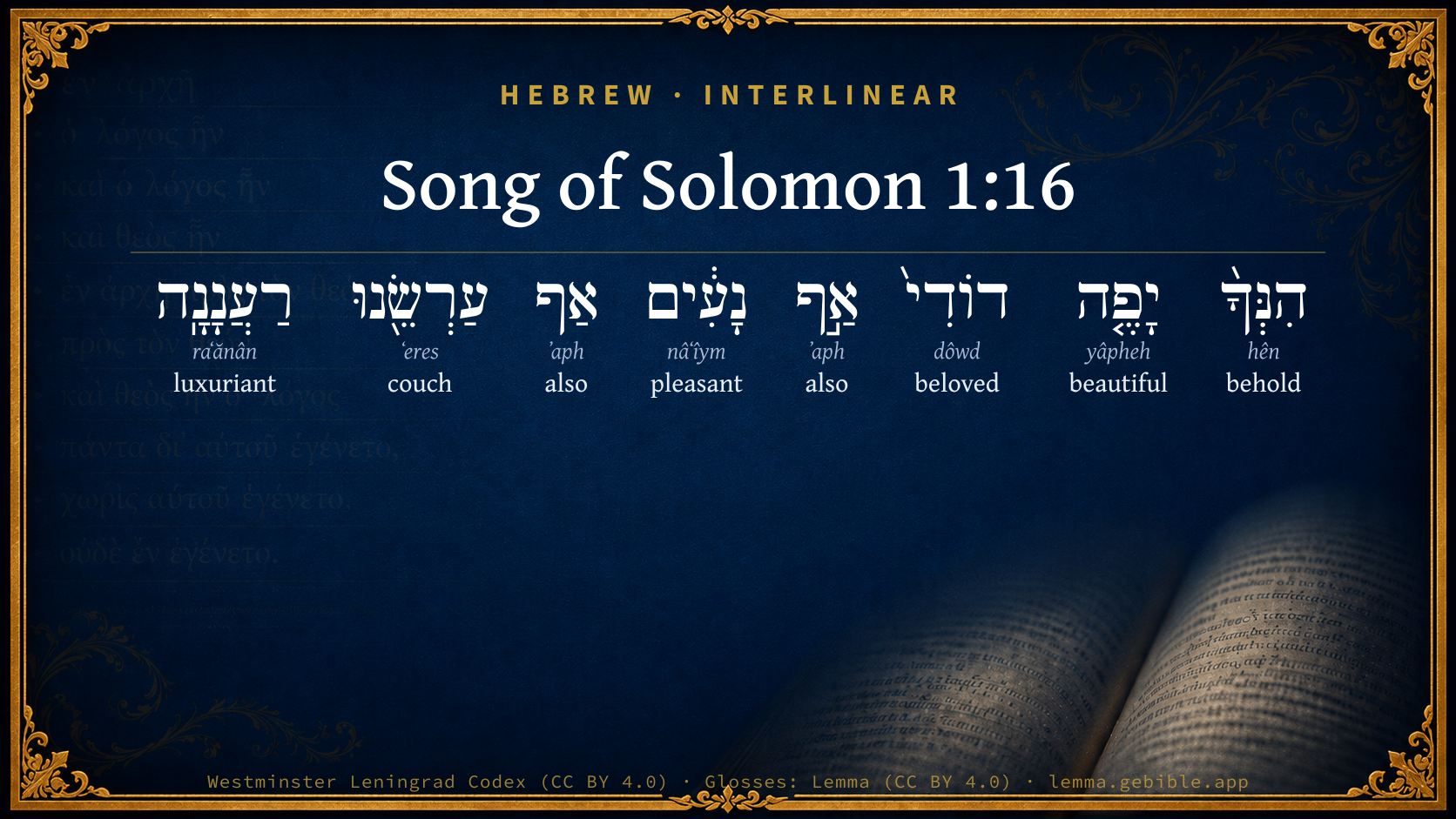
Hebrew (Westminster Leningrad Codex) Song of Solomon 1:16 appears in the Hebrew Old Testament. The text above is from the Westminster Leningrad Codex. Each word links to its Strong’s number, a concise gloss, and parsing drawn from the Open Scriptures Hebrew Bible morphology. Click any word for its full Brown-Driver-Briggs (BDB) entry.
Download image
Cite this verse

Song of Solomon 1:16 (World English Bible). Public Domain. Lemma interlinear Bible study tool, https://lemma.gebible.app/v/song-of-solomon/1/16.

Show BibTeX & RIS
BibTeX
RIS
English Translation
Behold, you are beautiful, my beloved, yes, pleasant; And our couch is verdant. Lover
World English Bible · Public Domain
Download a study sheet

One document with this verse’s original text, its word-by-word gloss line, the meaning frame, cross-references with their text, attributed commentary, and full source and license credits — printable, and it pastes into notes with its structure intact.

This verse Autodidact and up

Study sheet (.html) Plain text (.txt)

A passage Seminary Student

Up to 50 verses in one chapter. A passage sheet keeps up to 6 commentary sources and 12 cross-references per verse, in the order this page ranks them, and says so on the sheet whenever that leaves anything out. Ask for a single verse and you get the Autodidact verse sheet above.

Everything on this page stays free to read, with no account — the sheet is a download of what is already on screen, not access to it.

Want to remove ads? Support Godless Engineer
Compare translations 3

The same verse in 3 English versions, stacked beneath the original-language interlinear above. Click any original word for its lexicon entry.

Each is an independent rendering of the whole verse — the interlinear is not word-aligned to these translations.

Highlighted words mark where these versions differ — a whole-verse word diff, not a word-by-word alignment.

  • World English Bible Public Domain
    Behold, you are beautiful, my beloved, yes, pleasant; And our couch is verdant. Lover
  • King James Version Public Domain
    Behold, thou art fair, my beloved, yea, pleasant: also our bed is green.
  • unfoldingWord Literal Text CC BY-SA 4.0
    Behold you! handsome, my beloved, truly pleasant. Indeed, our couch is leafy.

unfoldingWord Literal Text — © unfoldingWord, licensed CC BY-SA 4.0. Word-aligned USFM3 via Door43 (git.door43.org/unfoldingWord/en_ult).

Versions to compare (up to 4)

3 of 4 selected

Show all 18 translations

Every available English version of this verse, each an independent rendering of the whole verse.

  • World English Bible Public Domain
    Behold, you are beautiful, my beloved, yes, pleasant; And our couch is verdant. Lover
  • Berean Standard Bible Public Domain
    How handsome you are, my beloved! Oh, how delightful! The soft grass is our bed.
  • Majority Standard Bible Public Domain
    How handsome you are, my beloved! Oh, how delightful! The soft grass is our bed.
  • King James Version Public Domain
    Behold, thou art fair, my beloved, yea, pleasant: also our bed is green.
  • American Standard Version (1901) Public Domain
    Behold, thou art fair, my beloved, yea, pleasant: Also our couch is green.
  • Revised Version (1885) Public Domain
    Behold, thou art fair, my beloved, yea, pleasant: also our couch is green.
  • Geneva Bible (1599) Public Domain
    The beames of our house are cedars, our rafters are of firre.
  • Douay-Rheims (1899) Public Domain
    The beams of our houses are of cedar, our rafters of cypress trees.
  • Young's Literal Translation Public Domain
    Lo, thou `art' fair, my love, yea, pleasant, Yea, our couch `is' green,
  • Literal Standard Version CC BY-SA 4.0
    Behold, you [are] beautiful, my love, indeed, pleasant, || Indeed, our bed [is] green,
  • Unlocked Literal Bible CC BY-SA 4.0
    Listen, you are handsome, my beloved, how handsome. The lush plants are our bed.
  • unfoldingWord Literal Text CC BY-SA 4.0
    Behold you! handsome, my beloved, truly pleasant. Indeed, our couch is leafy.
  • Darby Bible Public Domain
    Behold, thou art fair, my beloved, yea, pleasant; Also our bed is green.
  • World Messianic Bible Public Domain
    Behold, you are beautiful, my beloved, yes, pleasant; and our couch is verdant.
  • Webster's Bible Public Domain
    Behold, thou art fair, my beloved, yes, pleasant: also our bed is green.
  • Free Bible Version CC BY-SA 4.0
    And you, my love, are so handsome—how charming you are! The green grass is our bed,
  • Bible in Basic English Public Domain
    See, you are fair, my loved one, and a pleasure; our bed is green.
  • JPS Tanakh (1917) Public Domain
    Behold, thou art fair, my beloved, yea, pleasant; also our couch is leafy.

Literal Standard Version (2020), Covenant Press — licensed CC BY-SA 4.0. Text via the HelloAO Bible API (eBible.org). Unlocked Literal Bible (unfoldingWord) — licensed CC BY-SA 4.0. Text via the HelloAO Bible API (eBible.org). unfoldingWord Literal Text — © unfoldingWord, licensed CC BY-SA 4.0. Word-aligned USFM3 via Door43 (git.door43.org/unfoldingWord/en_ult). Free Bible Version, Dr. Jonathan Gallagher — licensed CC BY-SA 4.0. Text via the HelloAO Bible API (eBible.org).

Word by word

More ways to search: Search by grammar → Find every occurrence → Compare this word →

Practice this passage: Drill this verse → Learn its vocabulary →

About this verse

These counts appear in no published source. They are computed here, from the morphology-tagged text and Lemma’s own curated glosses. What Lemma adds →

8
words
7
distinct lemmas
Wisdom
section

Notable vocabulary

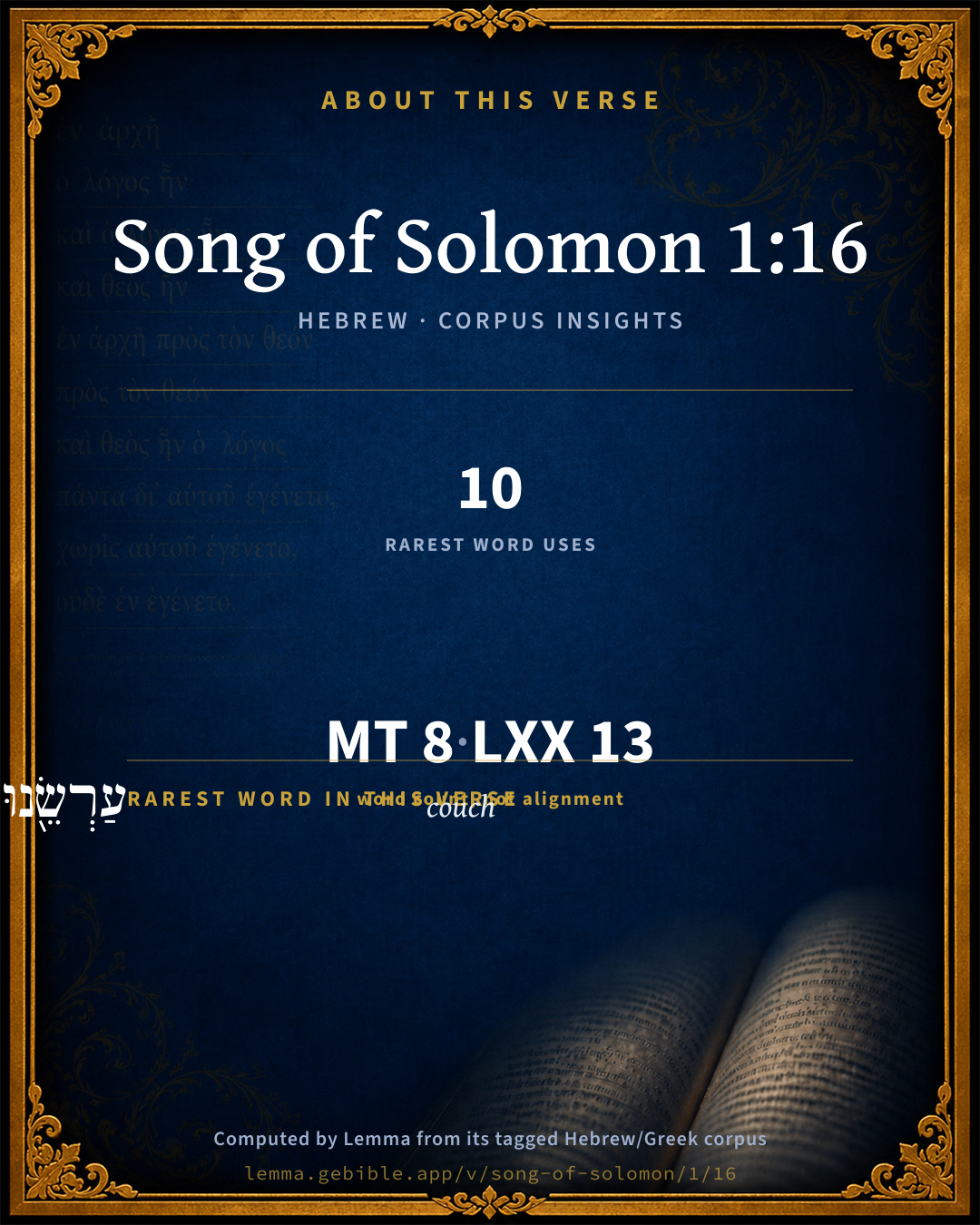
The rarest word here is עַרְשֵׂ֖נוּ couch H6210 — appearing just 10 times in the whole Hebrew Bible.

Shared distinctive vocabulary

עַרְשֵׂ֖נוּ couch H6210 occurs in 9 verses of the Hebrew Bible. Also found in:

Grammatical profile

  • 2 nouns
  • 3 adjectives
  • 3 particles

Repetition

A word recurs within this verse — often emphatic in Hebrew:

  • אַ֣ף also H637 ×2

Hebrew & Septuagint length

In English translation the verse runs 14 words from the Hebrew and 11 from the Septuagint (LXX English) — closely comparable.

A rough comparison of the two English renderings, which tokenize alike — not a word-level alignment.

Word counts can differ between the Hebrew and the Greek without any difference in meaning — e.g. the Hebrew direct-object marker אֵת has no separate Greek word, and Greek often adds the article ὁ.

In the original languages it is 8 Hebrew tokens and 13 Greek tokens — but the two are counted differently (Hebrew bundles its prefixes and suffixes into one token; the Greek is in lemma form), so that isn’t a like-for-like length.

Cross-references

8

Topical passages linked to Song of Solomon 1:16 in the Treasury of Scripture Knowledge — connected by theme and wording, ordered by reader-vote popularity; previews shown in the World English Bible.

  • Song of Solomon 2:3 As the apple tree among the trees of the wood, So is my beloved among the sons. I sat down under his shadow with great delight, His fruit was sweet to my taste.
  • Psalms 45:2 You are the most excellent of the sons of men. Grace has anointed your lips, Therefore God has blessed you forever.
  • Zechariah 9:17 For how great is his goodness, And how great is his beauty! Grain will make the young men flourish, And new wine the virgins.
  • Psalms 110:3 Your people offer themselves willingly in the day of your power, in holy array. Out of the womb of the morning, you have the dew of your youth.
  • Song of Solomon 3:7 Behold, it is Solomon's carriage! Sixty mighty men are around it, Of the mighty men of Israel.
  • Song of Solomon 5:10–16 My beloved is white and ruddy. The best among ten thousand.
  • Philippians 3:8–9 Yes most assuredly, and I count all things to be loss for the excellency of the knowledge of Christ Jesus, my Lord, for whom I suffered the loss of all things, and count them nothing but refuse, that I may gain Christ
  • Revelation 5:11–13 I saw, and I heard something like a voice of many angels around the throne, the living creatures, and the elders; and the number of them was ten thousands of ten thousands, and thousands of thousands;

Cross-references courtesy of OpenBible.info (CC BY 4.0).

Hebrew and Greek witnesses Masoretic Hebrew ↔ Greek Septuagint

The same verse in the two great witnesses to the Old Testament, shown verse-for-verse.

These are two independent witnesses, not word-aligned to each other, and the Septuagint is shown in lemma (dictionary) form.

Hebrew Song of Solomon 1:16 Masoretic · Westminster Leningrad Codex

הִנְּךָ֨ יָפֶ֤ה דוֹדִי֙ אַ֣ף נָעִ֔ים אַף עַרְשֵׂ֖נוּ רַעֲנָנָֽה

Behold, you are beautiful, my beloved, yes, pleasant; And our couch is verdant. Lover

World English Bible · Public Domain

Greek LXX Song of Solomon 1:16 Septuagint · lemma form

ἰδού εἰμί καλός ὁ ἀδελφιδός ἐγώ καί γέ ὡραῖος πρός κλίνη ἐγώ σύσκιος

Behold, you are fair, my kinsman, yes, beautiful, overshadowing our bed.

LXX2012 (modern English Septuagint) · Public Domain

On this verse, The Pulpit Commentary discusses the Septuagint’s reading. Read the note in Commentary ↓

Hebrew: Westminster Leningrad Codex (CC BY 4.0). Greek: Septuagint (public domain); English from LXX2012 (modern English Septuagint) (Public Domain). How the Septuagint differs from the Hebrew →

Commentary

Notes on Song of Solomon 1:16 from classic Christian and Jewish commentators (each source and its license shown beneath its notes). The classic Christian expositions comment on the surrounding passage and are grouped to its opening verse, so a note may address several verses; the Jewish commentaries on the Tanakh (Rashi and others) are per-verse, so they appear only where the commentator wrote on this verse.

Lemma curates 59 commentaries, every one of them public domain or Creative Commons licensed, each selected and text-cleaned for this edition rather than reprinted as found. About our sources →

Trapp's Complete Commentary

John Trapp

Son 1:16 Behold, thou [art] fair, my beloved, yea, pleasant: also our bed [is] green.

Ver. 16. Behold thou art fair, my beloved, yea, pleasant.] Behold thou art fair, my love, &c., said he to her {a} It were fitter a fair deal for me to say so to thee, saith she here to him, since all my beauty is but borrowed of thee; it is but a spark of thy flame, a drop of thine ocean. If I shine at all, it is with thy beams only; if I be any whit comely, it is with the comeliness that thou hast put upon me. Christ as a man (how much more as God blessed for ever?) was "fairer" by far "than all the children of men," {Psa 45:2} because free from sin, and "full of grace and truth," as in Eze 28:7 there is mentioned "beauty of wisdom." And the heathen philosopher {b} could say, that if moral wisdom (how much more spiritual?) could be seen with mortal eyes, it would draw all men’s hearts unto itself. But besides his inward beauty, which was inconceivable, inasmuch as in him, as in a temple, the fulness of the Godhead dwelt bodily, that is, personally, in the body of Christ, there was a most fair form and a divine face. He had a good complexion, and such a comely countenance as did express a divinity in him. If St Stephen’s face, when he stood before the council, shone like an angel’s face, {Act 6:15} and if his eye could pierce the heavens, {Act 7:55} how much more may we think Christ did? True it is, that by reason of his sufferings in the flesh, "his visage was marred more than any man’s, and his form more than the sons of men." {Isa 52:14} And "he had no form nor comeliness" - viz., in the eyes of his perverse countrymen, who when they saw him they could discern no such beauty wherefore they should so desire him; "He was despised and rejected of men," For what reason? "He was a man of sorrows, and acquainted with grief," which had so drank up his spirits, and furrowed his fair face, that at little past thirty years of age he was reckoned to be towards fifty; he seemed to the Jews to be much older than he was indeed, as some are of the opinion. See Joh 8:57.

Yea, pleasant.] Sweet as a flower, sweet as a honeycomb, {c} Mell in ore, melos in aure, iubilum in corde, "sweet to the soul, and health to the bones." {Pro 16:24} He that hath once but lightly tasted how sweet the Lord Christ is, doth soon disrelish, yea, loathe, in comparison, all this world’s homely fare, tasteless fooleries.

“ Clitorio quicunque sitim de lento levarit,

Vina fugit, gaudetque meris abstemius undis. ”

- Ovid. Met. lib. 15.

Yea, our bed is green.] Our bridal bed, which was wont to be decked with garlands and green boughs. Or, "our bedstead" - so it may be rendered - "is green," made of green and growing timber, as Christ’s house is built of living and thriving stones. {1Pe 2:5} There is a perpetual greenness - the fruit of the vegetative Spirit of God within them - upon all Christ’s olive trees. {Psa 52:8} And these "green things must not be hurt." {Rev 9:4} Or if they be by a wound at the root, so as that they suffer a fit of barrenness, or seem to be sapless, yet they shall revirescere, recover their former greenness, as the Philippians did, and had a new spring after a sharp winter; they had deflourished for a time, but now reflourised. {ανεθαλετε, Php 4:16}

{a} Inter Romanos dicebatur, Tu Caius ego Caia. Between Romans it was said, You are Gaius since I am Gaia. So here the spouse, I am Japha, because thou art Japhe. Joppa, a fair haven town, had its name from this root; like as "the fair heavens," {Act 27:8} and the beautiful "gate." {Act 3:2}

{b} Plato.

{c} ωραιος, Sept., The spring or flower of beauty.

John Trapp, A Commentary or Exposition upon All the Books of the Old and New Testament (1647–1656) — public domain. Text from a community e-Sword module.

Joseph Benson's Commentary

Son 1:16-17. Behold, thou art fair — The church here again speaks, and retorts Christ’s words; thou, and thou only, art fair indeed; yea, pleasant — As thou art beautiful in thyself, so thou art amiable and pleasant in thy condescension to me. Also, our bed — This seems to denote the place where the church enjoys sweet fellowship with Christ, by his Spirit accompanying his ordinances; is green — Is pleasant, as that colour to the eye. The beams of our house are cedar — Not only strong, but also fragrant and delightful; and our rafters of fir — Or, rather, as the ancients and others render ברותים, of cypress; which also was strong and fragrant, and therefore suits well with cedar.

Joseph Benson's Commentary on the Old and New Testaments (1811–1818) — public domain. Text from a community e-Sword module.

Tyndale Open Study Notes

Tyndale Open Resources

1:16-17 grass is our bed . . . branches are the beams . . . firs are the rafters: The lovers imagine that their luxurious surroundings of grass and overhanging trees are their house. She does not need the royal, palatial surroundings of a king since these God-created natural surroundings are more than enough for her and her true lover. • In a number of the poems the countryside is the place of happy intimacy. The man and the woman make their bed in the great outdoors and enjoy each other’s company.

Tyndale Open Study Notes — © Tyndale Open Resources, licensed CC BY-SA 4.0. Text via the HelloAO Bible API.

Adam Clarke's Commentary

Verse 16. Also our bed is green.] ערס eres, from its use in several places of the Hebrew Bible, generally signifies a mattress; and here probably a green bank is meant, on which they sat down, being now on a walk in the country. Or it may mean a bower in a garden, or the nuptial bed.

Adam Clarke's Commentary on the Bible (1810–1826) — public domain. Text from a community e-Sword/MySword module.

Ellicott's Commentary for English Readers

(16) Our bed is green.—The heroine replies in similar terms of admiration, and recalls “the happy woodland places” in which they were wont to meet.

A Bible Commentary for English Readers, edited by Charles John Ellicott (1878–1897) — public domain. Text from a community e-Sword module.

The Cambridge Bible for Schools and Colleges

gen. ed. J. J. S. Perowne

16. our bed is green] R.V. rightly, our couch. She recalls the green sward of the meadows, or possibly some leafy arbour where she had reclined with her beloved. Siegfried would understand the words of the marriage bed, sprinkled with sweet smelling substances; but that is incompatible with the following verse, and is moreover not supported by Psa_92:10, where the word translated ‘green’ here is rendered by ‘fresh,’ for in all probability it ought to be translated ‘green’ there also, since the best kind of olive oil is green. Cp. Riehm’s Hdwb. 11. p. 1123.

The Cambridge Bible for Schools and Colleges (gen. ed. J. J. S. Perowne; Cambridge University Press, 1878–1918) — public domain. Text from a community e-Sword module.

Haydock's Catholic Bible Commentary

Beams. Prelates. --- Rafters. Virtuous subjects. (Menochius) --- Cypress. The are both odoriferous and incorruptible. The cypress has leaves from top to bottom, and grows not so large as the cedar. (Pliny, [Natural History?] xii. 17.)

George Leo Haydock (1774–1849), Haydock's Catholic Family Bible and Commentary, 1859 edition — public domain. Excludes Psalms (Douay-Rheims chapter numbering differs from Protestant) and Deuterocanonical books (Catholic canon only).

Matthew Poole's English Annotations

Behold, thou art fair, my beloved. The church here again speaks, and retorts Christ’s words upon himself: If I am fair, it is only by thy grace and favourable acceptation; thou, and thou only, art fair indeed, thy beauty is exquisite and perfect.

Pleasant; as thou art beautiful in thyself, so thou art amiable and pleasant in thy condescension to me, and converse with me, in communicating thy blessed counsels, and graces, and comforts to me. Our bed; either,

1. Upon which we sit at meat, as the manner then was, Est 1:5,6; Eze 23:41. Or rather,

2. Upon which we lie, our nuptial bed; for the union and communion between Christ and his church is here represented under the notion of marriage. And accordingly the bed seems to denote the place or places where the church enjoyeth sweet fellowship with Christ, by his Spirit accompanying his ordinances, and imparting his merits, and graces, and comforts to her.

Is green; is pleasant, as that colour is to the eye; is prepared for us, being adorned with green garlands, or boughs and herbs, as the manner seems to have been with country brides, such as the spouse in this book is represented to be. Or, as others, both ancient and later interpreters, render it, is flourishing, i.e. fruitful. So it is a happy presage, that the church should not be barren, but bring forth many children to Christ; of which see Isa 54:1, &c. By these and the following words the church invites Christ to her bed and house, where she may freely and fully enjoy spiritual communion with him.

Matthew Poole's English Annotations on the Holy Bible (1683–1685) — public domain. Text from a community e-Sword/MySword module.

The Pulpit Commentary

Ver. 16-ch. Son_2:1, "I am not at ease in this palatial splendour; I am by nature a rose of Sharon, a lily of the valley. Take me to the green couch, and let me lie under the cedars and the firs." The couch is the divan, (cf. Amo_6:4) from a root "to cover over" (like "canopy" in Greek, kwnwpeion , so called from its protecting the person under it from the kwnepev , or "gnats). It is not that the nuptial bed is particularly intended, or even the bridal bower, but the home itself as a bowery resting place. "Our home is a sweet country home; take me, there, beloved one." The word "green" is very suggestive in the Hebrew. It is said to "combine in itself the ideas of softness and juicy freshness, perhaps of bending and elasticity, of looseness and thus of overhanging ramification, like weeping willow." Beams, from a root "to meet," "to lay crosswise," "to hold together." But the meaning depends upon the idea of the whole description. Some would render "fretted ceilings," or "galleries;" but Dr. Ginsburg gives it, "our bower is of cedar arches," which excludes the idea of a formal structure made of cedar beams. The same meaning is conveyed in the last clause, "our rafters are firs." The word rendered "rafters" (fyjiy) literally signifies "a place upon which one runs" (like qWv, a "street"), i.e. a charming or pleasant spot. The beroth is the cypress tree, an Aramaic word, or one used in the north of Palestine. The meaning is, "our pleasant retreat is cypresses is beautiful and fragrant with the cypress tree. Delitzsch, however, and others would take it differently as describing the panels or hollows of a wainscoted ceiling, like fatnai , lacunae, lacunaria, and the LXX, fatnwmata : Symmachus, fatnwseiv : Jerome, laquearii . (cf. Isa_60:13) But the concluding words would then be unfitting. The bride is not describing a splendid palace, but a country home. "I am a tender maiden," she says, "who has been brought up in retirement; take me to a forest palace and to the green, fragrant surroundings, where the meadow flower, the valley lily will be happy." We are so accustomed to the rendering of Son_2:1, which our Revised Version has adopted from the Authorized, that it would be wrong to destroy the effect which it borrows from long familiarity unless it were absolutely necessary. The word chavatseleth, however, has been differently translated; it is literally any wild flower rose, saffron crocus (Colchieum autumnale), tulip, narcissus, lily. The crocus is, perhaps, nearest. to the meaning, as the name is probably derived from a root "to form bulbs" or bulbous knolls. It occurs only once again, in Isa_35:1, where it is rendered "rose" in the Authorized Version; LXX, anyov : Vulgate, flos. Some derive it from the root chavaz, "to be bright," with l as termination. Sharon may be here a general denomination of the open field or plain, from vry, "to be straight, plain." There was a district called Sharon on the coast from Joppa to Caesarea.

There was another Sharon beyond the Jordan. (see 1Ch_5:16) According to Eusebius and Jerome, there was yet another, between Tabor and Tiberias, and this, as being in the north, may be referred to. Aquila renders "a rosebud of Sharon." The lily (shoshannah) is only found as here in the feminine form in the Apocrypha. The red and white lily were both known. Some would derive the word from the numeral (shesh) "six," because the liliaceae are six-leaved, while the rosaceae are five-leaved; but it is probably akin to shesh, "byssus," shayish, "white marbles". (cf. Hos_14:5, "He shall bloom as a lily Our Lord"s reference to "the lilies of the field" reminds us that they were in Palestine both very beautiful and very abundant. Zockler thinks it is not the strongly scented white lily (Lilium candidam) to which reference is made, but the red lily (Lilium rubens ); but either will convey the same idea of a flower of the field which is meant. "My beauty is the beauty of nature artless and pure.

Vers. 16, 17, and ch. Ps 23, "Thou makest me to lie down in green pastures," etc., tells substantially of the same spiritual rest. And the house of the Lord is the place of such blessed rest of heart and soul and mind. Because of this, we find those many impassioned expressions in the Psalms as to the psalmist"s delight in the house of the Lord; how he had rather be a doorkeeper there than hold any place of worldly honour or pleasure, however exalted. (Ps 84) The agitations and cares of the mind hush themselves to rest there. The psalmist tells in one place how the mystery of the Divine rule over men wicked men often prospering and good men cast down how this distressed, dismayed, and all but destroyed his faith in God, "until," he says, "I went into the sanctuary; then I understood." Yes, the house of the Lord should be, and often is to his people, what this beautiful picture of rest on the green grass, beneath the cool, refreshing shade of fragrant and stately trees, presents to us a place of pure delight, rest, and refreshment of heart.

III ITS PROVISIONS. It is a "banqueting house." It is so when the Lord brings us there and is with us there (cf. on ver. 12).

IV ITS DEFENCE. "His banner over me is love." That is, the soul"s protection and guard, so sure and strong as that of a banner-led host, is the Lord"s love. Is it not so? What guards us there and everywhere but his love? What is the defence of the home but the father"s love? What the safeguard of the wife but her husband"s love? Love is always a mighty protector, a sure defence, a strong bulwark. "How doth the hen protect her brood," but by her love? And love ever guards the beloved ones. And so with our souls, the Lord"s love is their defence. S.C.

The Pulpit Commentary (1880–1919), ed. H.D.M. Spence-Jones & Joseph S. Exell — public domain. Text from a community e-Sword module.

John Wesley's Explanatory Notes

Behold - The church here again speaks, and retorts Christ's words; thou, and thou only art fair indeed. Pleasant - As thou art beautiful in thyself, so thou art amiable and pleasant in thy condescention to me. Bed - This seems to denote the place where the church enjoys sweet fellowship with Christ, by his spirit accompanying his ordinances. Green - Is pleasant, as that colour to the eye.

John Wesley, Explanatory Notes Upon the Whole Bible (1754–1765) — public domain. Text via the GEBible commentary corpus.

unfoldingWord translationNotes

Door43 World Missions Community

Listen, you

"Pay attention, because what I am about to say is both true and important: you"

handsome

Use the word in your language that describes a good-looking man.

my beloved

This phrase refers to the man whom the woman loves. In some languages it may be more natural for her to refer to him as "my lover." See how you translated this in Song of Songs 1:13. AT: "my dear one" or "my lover"

lush plants are our bed

This speaks of the lush plants as if they were a bed. AT: "lush plants are what we lie down on to sleep" (See: Metaphor)

The lush plants

plants that are green, moist, and grow abundantly

The beams of our house are cedars; our rafters are firs

The woman describes the forest as though it were a house in which they were lying down. (See: Metaphor)

beams ... rafters

Possible meanings are 1) "beams" refers to large logs used to support everything above the walls and "rafters" refers to the large pieces of wood to which the roof is attached or 2) "beams" refers to the rafters and "rafters" refers to the strips attached to the beams, onto which the builders attached the roofing materials.

cedars ... firs

Cedars were large and strong trees. The word translated "firs" is a general term for trees like cedars but smaller. If cedar and fir trees are unknown in your area, you could use general terms for the tallest and strongest trees. (See: Translate Unknowns)

translationWords

cedar

unfoldingWord translationNotes — © Distant Shores Media and the Door43 World Missions Community, licensed CC BY-SA 4.0. Source: git.door43.org/Door43/en_tn.

Rashi

Rabbi Shlomo Yitzchaki (Rashi)

Behold, you are comely, my beloved, yea pleasant The beauty is not mine, but yours; you are the comely one.

yea pleasant For You overlooked my transgression and caused Your Shechinah to rest in our midst, and this is the praise of the descent of the fire (Lev. 9:24): “and all the people saw and shouted for joy.”

also our couch is leafy Through your pleasantness, behold our couch is leafy with our sons and with our daughters, all of whom gather to You here, as it is said (ibid. 8:4): “and the congregation gathered [to the entrance of the Tent of Meeting].” The Tabernacle is called a bed, as it is said (below 3:7): “Behold, the litter of Solomon,” and the Temple is called a bed, as it is said concerning Joash (II Chron. 22:11, II Kings 11:2): “in the bed chamber” which was in the “House of the Lord” (ibid. 3), because they [the Sanctuaries] are the source of Israel’s fruitfulness and procreation.

Rashi on the Tanakh — English translations: “The Judaica Press complete Tanach with Rashi, translated by A. J. Rosenberg” (CC BY 4.0); “Pentateuch with Rashi's commentary by M. Rosenbaum and A.M. Silbermann, 1929-1934” (public domain); “The Metsudah Tanach series, Lakewood, N.J” (CC BY 4.0); and “The Book of Joshua, Metsudah Publications, 1997” (CC BY 4.0). Text via Sefaria.

Lesson kit

Teaching starters — assembled from the data on this page, not authored interpretation. Every prompt links to the verse data it draws on. Edit before teaching.

Song of Solomon, in the Wisdom, opens this verse with 8 words (7 distinct Hebrew lemmas). Its most distinctive word is ʻeres (“couch”). A historical commentator’s framing appears above. Read the whole chapter for the surrounding context.

Discussion questions

  1. What does “couch” (ʻeres) contribute to the verse as a whole?
  2. How does Deuteronomy 3:11, which shares the word «couch», read alongside this verse?
  3. What does the repetition of “also” (2× in this one verse) do in this verse?
  4. The translations on this page render this verse differently — a whole-verse word diff, not a word-by-word alignment. What might account for the different wordings?
  5. Compare how Trapp's Complete Commentary and Joseph Benson's Commentary read this verse. Where do they agree or differ?

Things to notice

Reading settings

Reading text

Shown beneath each verse's original-language words.

Old Testament
Old Testament edition

Read the OT as the Masoretic Hebrew (MT) or the Greek Septuagint (LXX).

English shown for the Greek Septuagint (in the Hebrew ↔ Greek comparison).

Comparing translations? Open the Compare panel on any verse page to stack up to four side by side.