
2 Kings 22:20

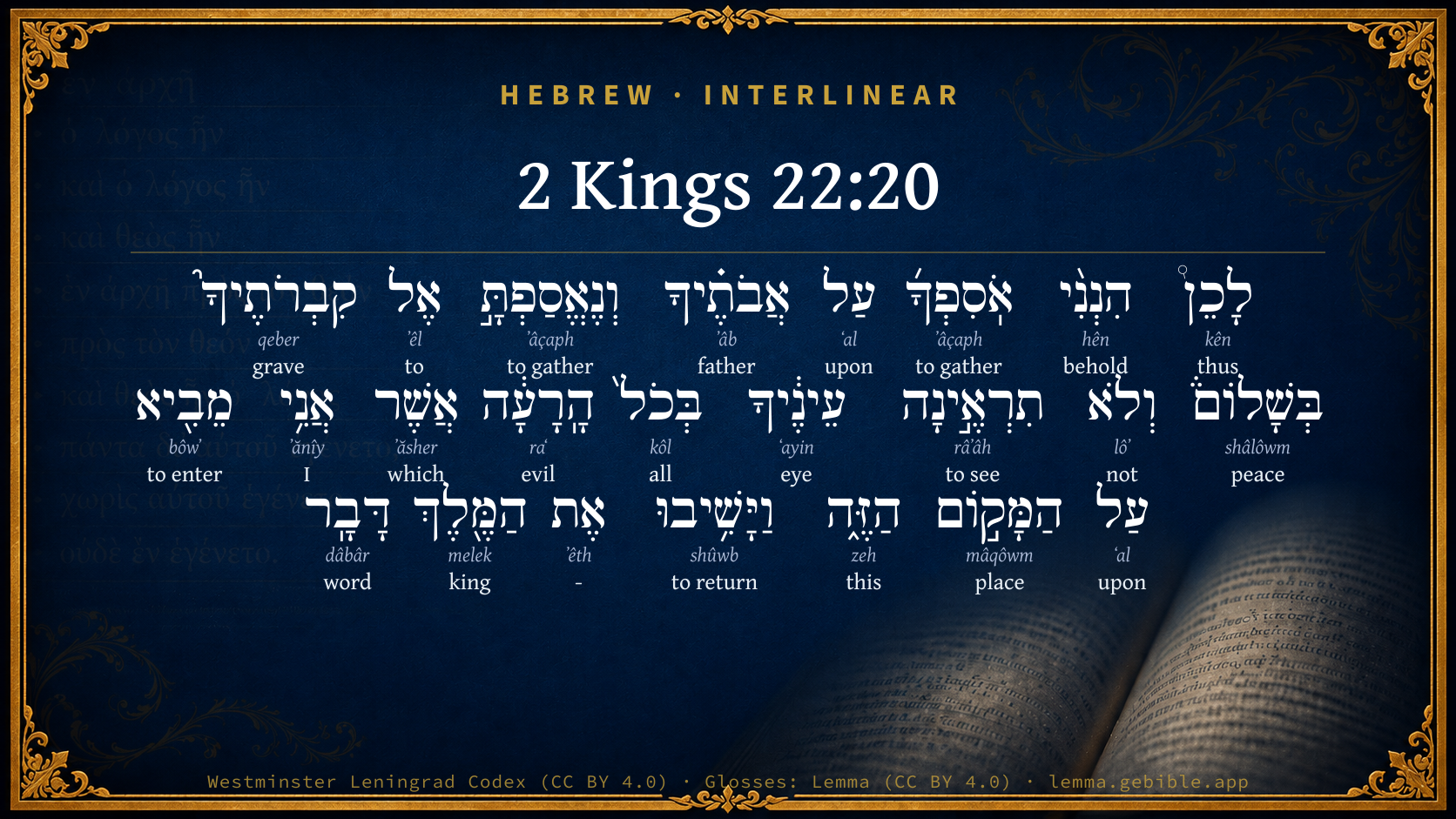
Hebrew (Westminster Leningrad Codex) 2 Kings 22:20 appears in the Hebrew Old Testament. The text above is from the Westminster Leningrad Codex. Each word links to its Strong’s number, a concise gloss, and parsing drawn from the Open Scriptures Hebrew Bible morphology. Click any word for its full Brown-Driver-Briggs (BDB) entry.
Download image
Cite this verse

2 Kings 22:20 (World English Bible). Public Domain. Lemma interlinear Bible study tool, https://lemma.gebible.app/v/2-kings/22/20.

Show BibTeX & RIS
BibTeX
RIS
English Translation
Therefore, behold, I will gather you to your fathers, and you shall be gathered to your grave in peace, neither shall your eyes see all the evil which I will bring on this place. They brought the king word again.
World English Bible · Public Domain
Download a study sheet

One document with this verse’s original text, its word-by-word gloss line, the meaning frame, cross-references with their text, attributed commentary, and full source and license credits — printable, and it pastes into notes with its structure intact.

This verse Autodidact and up

Study sheet (.html) Plain text (.txt)

A passage Seminary Student

Up to 50 verses in one chapter. A passage sheet keeps up to 6 commentary sources and 12 cross-references per verse, in the order this page ranks them, and says so on the sheet whenever that leaves anything out. Ask for a single verse and you get the Autodidact verse sheet above.

Everything on this page stays free to read, with no account — the sheet is a download of what is already on screen, not access to it.

Want to remove ads? Support Godless Engineer
Compare translations 3

The same verse in 3 English versions, stacked beneath the original-language interlinear above. Click any original word for its lexicon entry.

Each is an independent rendering of the whole verse — the interlinear is not word-aligned to these translations.

Highlighted words mark where these versions differ — a whole-verse word diff, not a word-by-word alignment.

  • World English Bible Public Domain
    Therefore, behold, I will gather you to your fathers, and you shall be gathered to your grave in peace, neither shall your eyes see all the evil which I will bring on this place. They brought the king word again.
  • King James Version Public Domain
    Behold therefore, I will gather thee unto thy fathers, and thou shalt be gathered into thy grave in peace; and thine eyes shall not see all the evil which I will bring upon this place. And they brought the king word again.
  • unfoldingWord Literal Text CC BY-SA 4.0
    “Therefore, behold me, gathering you to your fathers, and you will be gathered to your graves in peace, and your eyes will not see all of the disaster that I am bringing upon this place.”’” And they brought a word back the king.

unfoldingWord Literal Text — © unfoldingWord, licensed CC BY-SA 4.0. Word-aligned USFM3 via Door43 (git.door43.org/unfoldingWord/en_ult).

Versions to compare (up to 4)

3 of 4 selected

Show all 18 translations

Every available English version of this verse, each an independent rendering of the whole verse.

  • World English Bible Public Domain
    Therefore, behold, I will gather you to your fathers, and you shall be gathered to your grave in peace, neither shall your eyes see all the evil which I will bring on this place. They brought the king word again.
  • Berean Standard Bible Public Domain
    ‘Therefore I will indeed gather you to your fathers, and you will be gathered to your grave in peace. Your eyes will not see all the calamity that I will bring on this place.’” So they brought her answer back to the king.
  • Majority Standard Bible Public Domain
    ‘Therefore I will indeed gather you to your fathers, and you will be gathered to your grave in peace. Your eyes will not see all the calamity that I will bring on this place.’” So they brought her answer back to the king.
  • King James Version Public Domain
    Behold therefore, I will gather thee unto thy fathers, and thou shalt be gathered into thy grave in peace; and thine eyes shall not see all the evil which I will bring upon this place. And they brought the king word again.
  • American Standard Version (1901) Public Domain
    Therefore, behold, I will gather thee to thy fathers, and thou shalt be gathered to thy grave in peace, neither shall thine eyes see all the evil which I will bring upon this place. And they brought the king word again.
  • Revised Version (1885) Public Domain
    Therefore, behold, I will gather thee to thy fathers, and thou shalt be gathered to thy grave in peace, neither shall thine eyes see all the evil which I will bring upon this place. And they brought the king word again.
  • Geneva Bible (1599) Public Domain
    Beholde therefore, I wil gather thee to thy fathers, and thou shalt be put in thy graue in peace, and thine eyes shall not see all the euil, which I will bring vpon this place. Thus they brought the King worde againe.
  • Douay-Rheims (1899) Public Domain
    Therefore I will gather thee to thy fathers, and thou shalt be gathered to thy sepulchre in peace, that thy eyes may not see all the evils which I will bring; upon this place.
  • Young's Literal Translation Public Domain
    therefore, lo, I am gathering thee unto thy fathers, and thou hast been gathered unto thy grave in peace, and thine eyes do not look on any of the evil that I am bringing in on this place;' and they bring the king back word.
  • Literal Standard Version CC BY-SA 4.0
    therefore, behold, I am gathering you to your fathers, and you have been gathered to your grave in peace, and your eyes do not look on any of the calamity that I am bringing in on this place”; and they bring the king back word.
  • Unlocked Literal Bible CC BY-SA 4.0
    See, I will gather you to your ancestors, and you will be gathered to your grave in peace. Your eyes will not see all the disaster that I will bring upon this place.'”'” So the men took this message back to the king.
  • unfoldingWord Literal Text CC BY-SA 4.0
    “Therefore, behold me, gathering you to your fathers, and you will be gathered to your graves in peace, and your eyes will not see all of the disaster that I am bringing upon this place.”’” And they brought a word back the king.
  • Darby Bible Public Domain
    Therefore, behold, I will gather thee unto thy fathers, and thou shalt be gathered to thy grave in peace; and thine eyes shall not see all the evil that I will bring upon this place. And they brought the king word again.
  • World Messianic Bible Public Domain
    ‘Therefore behold, I will gather you to your fathers, and you will be gathered to your grave in peace. Your eyes will not see all the evil which I will bring on this place.’”’” So they brought this message back to the king.
  • Webster's Bible Public Domain
    Behold therefore, I will gather thee to thy fathers, and thou shalt be gathered into thy grave in peace; and thy eyes shall not see all the evil which I will bring upon this place. And they brought the king word again.
  • Free Bible Version CC BY-SA 4.0
    All this will not happen until after you have died, and you will die in peace. You will not see all the disaster that I'm going to bring down on this place.” They went back to the king and gave him her response.
  • Bible in Basic English Public Domain
    For this cause I will let you go to your fathers and be put in your last resting-place in peace, and your eyes will not see all the evil which I will send on this place. So they took this news back to the king.
  • JPS Tanakh (1917) Public Domain
    Therefore, behold, I will gather thee to thy fathers, and thou shalt be gathered to thy grave in peace, neither shall thine eyes see all the evil which I will bring upon this place.' And they brought back word unto the king.

Literal Standard Version (2020), Covenant Press — licensed CC BY-SA 4.0. Text via the HelloAO Bible API (eBible.org). Unlocked Literal Bible (unfoldingWord) — licensed CC BY-SA 4.0. Text via the HelloAO Bible API (eBible.org). unfoldingWord Literal Text — © unfoldingWord, licensed CC BY-SA 4.0. Word-aligned USFM3 via Door43 (git.door43.org/unfoldingWord/en_ult). Free Bible Version, Dr. Jonathan Gallagher — licensed CC BY-SA 4.0. Text via the HelloAO Bible API (eBible.org).

Word by word

More ways to search: Search by grammar → Find every occurrence → Compare this word →

Practice this passage: Drill this verse → Learn its vocabulary →

קִבְרֹתֶיךָ֮
qeber
H6913
“graves · your”
Noun, Common, Masculine, Plural, Construct + Suffix, Personal, 2nd Person, Masculine, Singular
Part of Speech
Noun
Type
Common
Gender
Masculine
Number
Plural
State
Construct
Full BDB Definition

Origin: from H6912

TWOT: 1984a

grave, sepulchre, tomb
  1. לָכֵן֩ kên H3651 “to/for · thus” Preposition + Adverb
  2. הִנְנִ֨י hên H2005 “behold · me” Particle, Demonstrative + Suffix, Personal, 1st Person, Common, Singular
  3. אֹֽסִפְךָ֜ ʼâçaph H622 “gathering · you” Verb, Qal, Participle Active, Masculine, Singular, Construct + Suffix, Personal, 2nd Person, Masculine, Singular
  4. עַל ʻal H5921 “upon” Preposition
  5. אֲבֹתֶ֗יךָ ʼâb H1 “fathers · your” Noun, Common, Masculine, Plural, Construct + Suffix, Personal, 2nd Person, Masculine, Singular
  6. וְנֶאֱסַפְתָּ֣ ʼâçaph H622 “and · to gather” Conjunction + Verb, Niphal, Sequential Perfect, 2nd Person, Masculine, Singular
  7. אֶל ʼêl H413 “to” Preposition
  8. בְּשָׁלוֹם֒ shâlôwm H7965 “in/at · peace” Preposition + Noun, Common, Masculine, Singular, Absolute
  9. וְלֹא lôʼ H3808 “and · not” Conjunction + Particle, Negative
  10. תִרְאֶ֣ינָה râʼâh H7200 “to see” Verb, Qal, Imperfect, 3rd Person, Feminine, Plural
  11. עֵינֶ֔יךָ ʻayin H5869 “eyes · your” Noun, Common, Both, Dual, Construct + Suffix, Personal, 2nd Person, Masculine, Singular
  12. בְּכֹל֙ kôl H3605 “in/at · all of” Preposition + Noun, Common, Masculine, Singular, Construct
  13. הָֽרָעָ֔ה raʻ H7451 “the · evil” Particle, Definite Article + Noun, Common, Feminine, Singular, Absolute
  14. אֲשֶׁר ʼăsher H834 “which” Particle, Relative
  15. אֲנִ֥י ʼănîy H589 “I” Pronoun, Personal, 1st Person, Common, Singular
  16. מֵבִ֖יא bôwʼ H935 “entering” Verb, Hiphil, Participle Active, Masculine, Singular, Absolute
  17. עַל ʻal H5921 “upon” Preposition
  18. הַמָּק֣וֹם mâqôwm H4725 “the · place” Particle, Definite Article + Noun, Common, Masculine, Singular, Absolute
  19. הַזֶּ֑ה zeh H2088 “the · this” Particle, Definite Article + Pronoun, Demonstrative, Masculine, Singular
  20. וַיָּשִׁ֥יבוּ shûwb H7725 “and · to return” Conjunction + Verb, Hiphil, Sequential Imperfect, 3rd Person, Masculine, Plural
  21. אֶת ʼêth H853 “-” Particle, Direct Object
  22. הַמֶּ֖לֶךְ melek H4428 “the · king” Particle, Definite Article + Noun, Common, Masculine, Singular, Absolute
  23. דָּבָֽר dâbâr H1697 “word” Noun, Common, Masculine, Singular, Absolute

About this verse

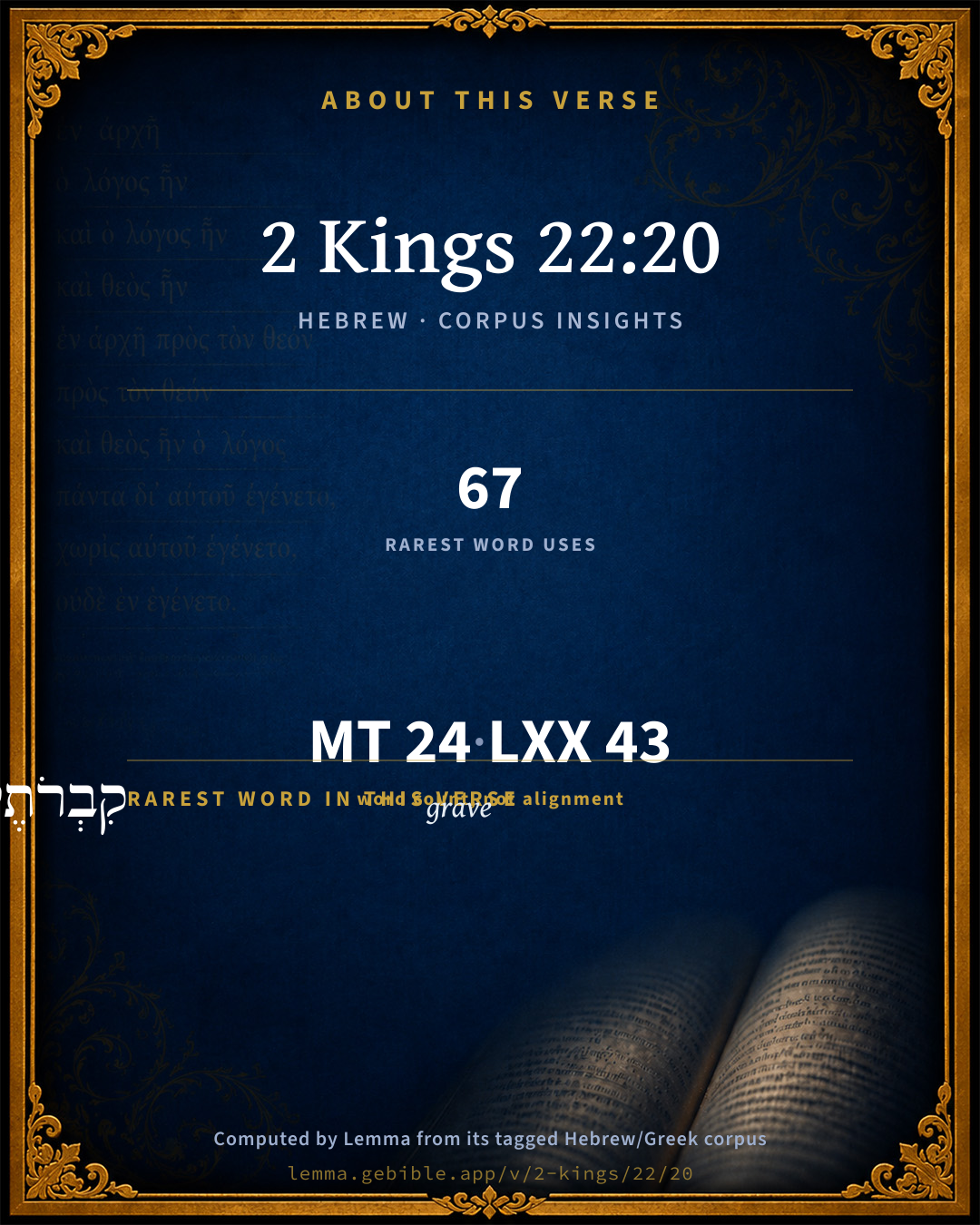
These counts appear in no published source. They are computed here, from the morphology-tagged text and Lemma’s own curated glosses. What Lemma adds →

24
words
22
distinct lemmas
Historical
section

Grammatical profile

  • 5 verbs
  • 9 nouns
  • 2 pronouns
  • 3 prepositions
  • 1 adverb
  • 4 particles

Verb forms

  • אֹֽסִפְךָ֜ Qal · Participle Active
  • וְנֶאֱסַפְתָּ֣ Niphal · Sequential Perfect
  • תִרְאֶ֣ינָה Qal · Imperfect
  • מֵבִ֖יא Hiphil · Participle Active
  • וַיָּשִׁ֥יבוּ Hiphil · Sequential Imperfect

Repetition

Words recur within this verse — often emphatic in Hebrew:

  • אֹֽסִפְךָ֜ to gather H622 ×2
  • עַל upon H5921 ×2

Hebrew & Septuagint length

In English translation the verse runs 40 words from the Hebrew and 41 from the Septuagint (LXX English) — closely comparable.

A rough comparison of the two English renderings, which tokenize alike — not a word-level alignment.

Word counts can differ between the Hebrew and the Greek without any difference in meaning — e.g. the Hebrew direct-object marker אֵת has no separate Greek word, and Greek often adds the article ὁ.

In the original languages it is 24 Hebrew tokens and 43 Greek tokens — but the two are counted differently (Hebrew bundles its prefixes and suffixes into one token; the Greek is in lemma form), so that isn’t a like-for-like length.

Cross-references

9

Topical passages linked to 2 Kings 22:20 in the Treasury of Scripture Knowledge — connected by theme and wording, ordered by reader-vote popularity; previews shown in the World English Bible.

  • Psalms 37:37 Mark the perfect man, and see the upright, For there is a future for the man of peace.
  • Isaiah 57:1–2 The righteous perishes, and no man lays it to heart; and merciful men are taken away, none considering that the righteous is taken away from the evil [to come].
  • 1 Chronicles 17:11 It shall happen, when your days are fulfilled that you must go to be with your fathers, that I will set up your seed after you, who shall be of your sons; and I will establish his kingdom.
  • Genesis 25:8 Abraham gave up the spirit, and died in a good old age, an old man, and full of years, and was gathered to his people.
  • Jeremiah 22:15–16 Shall you reign, because you strive to excel in cedar? Didn't your father eat and drink, and do justice and righteousness? then it was well with him.
  • 2 Kings 23:29–30 In his days Pharaoh Necoh king of Egypt went up against the king of Assyria to the river Euphrates: and king Josiah went against him; and [Pharaoh Necoh] killed him at Megiddo, when he had seen him.
  • Jeremiah 22:10 Don't you weep for the dead, neither bemoan him; but weep sore for him who goes away; for he shall return no more, nor see his native country.
  • Deuteronomy 31:16 Yahweh said to Moses, Behold, you shall sleep with your fathers; and this people will rise up, and play the prostitute after the strange gods of the land, where they go to be among them, and will forsake me, and break my covenant which I have made with them.
  • 2 Chronicles 34:28 Behold, I will gather you to your fathers, and you shall be gathered to your grave in peace, neither shall your eyes see all the evil that I will bring on this place, and on the inhabitants of it. They brought back word to the king.

Cross-references courtesy of OpenBible.info (CC BY 4.0).

Hebrew and Greek witnesses Masoretic Hebrew ↔ Greek Septuagint

The same verse in the two great witnesses to the Old Testament, shown verse-for-verse.

These are two independent witnesses, not word-aligned to each other, and the Septuagint is shown in lemma (dictionary) form.

Hebrew 2 Kings 22:20 Masoretic · Westminster Leningrad Codex

לָכֵן֩ הִנְנִ֨י אֹֽסִפְךָ֜ עַל אֲבֹתֶ֗יךָ וְנֶאֱסַפְתָּ֣ אֶל קִבְרֹתֶיךָ֮ בְּשָׁלוֹם֒ וְלֹא תִרְאֶ֣ינָה עֵינֶ֔יךָ בְּכֹל֙ הָֽרָעָ֔ה אֲשֶׁר אֲנִ֥י מֵבִ֖יא עַל הַמָּק֣וֹם הַזֶּ֑ה וַיָּשִׁ֥יבוּ אֶת הַמֶּ֖לֶךְ דָּבָֽר

Therefore, behold, I will gather you to your fathers, and you shall be gathered to your grave in peace, neither shall your eyes see all the evil which I will bring on this place. They brought the king word again.

World English Bible · Public Domain

Greek LXX 2 Kings 22:20 Septuagint · lemma form

οὐ οὕτως ἰδού ἐγώ προςτίθημι σύ πρός ὁ πατήρ σύ καί συνἄγω εἰς ὁ τάφος σύ ἐν εἰρήνη καί οὐ ὁράω ἐν ὁ ὀφθαλμός σύ ἐν πᾶς ὁ κακός ὅς ἐγώ εἰμί ἐπιἄγω ἐπί ὁ τόπος οὗτος καί ἐπιστρέφω ὁ βασιλεύς ὁ ῥῆμα

It shall not be so therefore: behold, I will add you to your fathers, and you shall be gathered to your tomb in peace, and your eyes shall not see any among all the evils which I bring upon this place.

LXX2012 (modern English Septuagint) · Public Domain

On this verse, Haydock's Catholic Bible Commentary discusses the Septuagint’s reading. Read the note in Commentary ↓

Hebrew: Westminster Leningrad Codex (CC BY 4.0). Greek: Septuagint (public domain); English from LXX2012 (modern English Septuagint) (Public Domain). How the Septuagint differs from the Hebrew →

Targum (Aramaic paraphrase)

1

The Targum is the ancient Jewish Aramaic paraphrase of the Hebrew Scriptures — an interpretive translation, not the Hebrew text itself. Onkelos (literal) and Pseudo-Jonathan (expansive) render the Torah, and Jonathan the Prophets. Coverage is partial: where no permissively-licensed English translation exists for a verse, only the Aramaic is shown. This is verse-level text, not a word-by-word alignment to the Hebrew.

  1. Targum Jonathan Prophets (Joshua–Malachi)
    בְּכֵן הָא אֲנָא כָנִישׁ לָךְ לְוַת אֲבָהָתָךְ וְתִתְכְּנֵישׁ לְקִבְרָךְ בִשְׁלָם וְלָא יְחַזְיַן עֵינָךְ בְּכָל בִּישְׁתָא דִי אֲנָא מַיְתֵי עַל אַתְרָא הָדֵין וַאֲתִיבוּ יַת מַלְכָּא פִּתְגָמָא:

    (no public-domain English translation for this verse)

    Targum Jonathan — Aramaic: “Mikraot Gedolot” (public domain). English: “Sefaria Community Translation” (CC0 1.0 (public-domain dedication)); “London "Chaldee Paraphrase," 1871” (public domain). Text via Sefaria.

Commentary

Notes on 2 Kings 22:20 from classic Christian and Jewish commentators (each source and its license shown beneath its notes). The classic Christian expositions comment on the surrounding passage and are grouped to its opening verse, so a note may address several verses; the Jewish commentaries on the Tanakh (Rashi and others) are per-verse, so they appear only where the commentator wrote on this verse.

Lemma curates 59 commentaries, every one of them public domain or Creative Commons licensed, each selected and text-cleaned for this edition rather than reprinted as found. About our sources →

Trapp's Complete Commentary

John Trapp

2Ki 22:20 Behold therefore, I will gather thee unto thy fathers, and thou shalt be gathered into thy grave in peace; and thine eyes shall not see all the evil which I will bring upon this place. And they brought the king word again.

Ver. 20. And thou shalt be gathered unto thy grave in peace.] And yet he died in battle; but (1.) He died before the general deluge of desolation on the land: and so the next words expound these: "And thine eyes shall not see all the evil that I will bring upon this place." So he died "in peace," comparatively with a worse state of life; {Isa 57:1} or, (2.) He was gathered to the spirits of his fathers who enjoyed peace; or, (3.) He died in God’s favour, though by the hand of an enemy. His weeping and humiliation had altered the very nature of trouble, and made war to be peace to him. Hereupon one crieth out, Oh, the safe condition of God’s children, whom very pain easeth, whom death reviveth, whom dissolution uniteth, whom, lastly, their sin and temptation glorifieth!

John Trapp, A Commentary or Exposition upon All the Books of the Old and New Testament (1647–1656) — public domain. Text from a community e-Sword module.

Joseph Benson's Commentary

2Ki 22:20. Behold, therefore, I will gather thee to thy fathers — It is justly observed here by Henry, that the saints in those days had doubtless a comfortable prospect of happiness on the other side of death, otherwise the being gathered to their fathers would not have been so often made the matter of a promise as we find it was. Josiah could not prevail to prevent the judgment itself, but God promised him he should not live to see it; which, especially considering that he died in the midst of his days, before he was forty years of age, would have been but a small reward for his eminent piety, if there had not been another world, in which he should be abundantly recompensed, Heb 11:16. When the righteous is taken away from the evil to come, he enters into peace, Isa 58:1-2. This is promised to Josiah here, Thou shalt go to thy grave in peace — Which refers not to the manner of his death, for he was killed in battle, but to the time of it; it was a little time before the captivity in Babylon, that great trouble, in comparison with which other troubles were as nothing: so that he might be truly said to die in peace, that did not live to share in that. He died in the love and favour of God, which secures such a peace as no circumstances of dying, no, not dying in the field of war, could alter the nature of, or break in upon. They may well be said to die in peace, who, after their dissolution here, are numbered among the children of God, and have their lot among the saints.

Joseph Benson's Commentary on the Old and New Testaments (1811–1818) — public domain. Text from a community e-Sword module.

Geneva Bible (1599)

Geneva Bible translators

Whereupon we may gather that the anger of God is ready against the wicked, when God taketh his servants out of this world.

Geneva Bible (1599) marginal notes — public domain. Text via Bolls.life.

Adam Clarke's Commentary

Verse 20. Thou shalt be gathered into thy grave in peace] During thy life none of these calamities shall fall upon the people, and no adversary shall be permitted to disturb the peace of Judea, and thou shalt die in peace with God. But was Josiah gathered to the grave in peace? Is it not said, 2Kg 23:29, that Pharaoh-nechoh slew him at Megiddo? On this we may remark, that the Assyrians and the Jews were at peace; that Josiah might feel it his duty to oppose the Egyptian king going against his friend and ally, and endeavour to prevent him from passing through his territories; and that in his endeavours to oppose him he was mortally wounded at Megiddo: but certainly was not killed there; for his servants put him in his second chariot and brought him to Jerusalem, where he died in peace. See 2Ch 35:24. So that, however we take the place here, we shall find that the words of Huldah were true: he did die in peace, and was gathered to his fathers in peace.

FROM the account in the above chapter, where we have this business detailed, we find that Josiah should not have meddled in the quarrel between the Egyptian and the Assyrian kings, for God had given a commission to the former against the latter; but he did it in error, and suffered for it. But this unfortunate end of this pious man does not at all impeach the credit of Huldah; he died in peace in his own kingdom. He died in peace with God, and there was neither war nor desolation in his land: nor did the king of Egypt proceed any farther against the Jews during his life; for he said, "What have I to do with thee, thou king of Judah? I come not against thee, but the house wherewith I have war; for God commanded me to make haste: forbear then from meddling with God, who is with me, that he destroy thee not. Nevertheless, Josiah would not turn his face from him, and hearkened not to the words of Nechoh, from the mouth of God. And the archers shot at King Josiah: and the king said, Bear me away, for I am sore wounded. And his servants took him out of that chariot, and put him in the second chariot, and they brought him to Jerusalem, and he died and was buried in the sepulchre of his fathers;" 2Ch 35:21-24.

It seems as if the Egyptian king had brought his troops by sea to Caesarea, and wished to cross the Jordan about the southern point of the sea of Tiberias, that he might get as speedily as possible into the Assyrian dependencies; and that he took this road, for God, as he said, had commanded him to make haste.

Adam Clarke's Commentary on the Bible (1810–1826) — public domain. Text from a community e-Sword/MySword module.

Ellicott's Commentary for English Readers

(20) Thy grave.—So some MSS. and the old versions. But the ordinary Hebrew text, thy graves, may be right, as referring to the burial-place formed by Manasseh, which would contain a number of chambers and niches (2Ki_21:18).

In peace.—These words are limited by those which follow: “thine eyes shall not see all the evil,” &c. Josiah was slain in battle, as the next chapter relates (2Ki_23:29); but he was spared the greater calamity of witnessing the ruin of his people.

A Bible Commentary for English Readers, edited by Charles John Ellicott (1878–1897) — public domain. Text from a community e-Sword module.

The Cambridge Bible for Schools and Colleges

gen. ed. J. J. S. Perowne

20. into thy grave in peace] i. e. None of these evils denounced against the nation shall come to pass in thy days. As far as they are concerned thou shalt die in peace. The promise has no reference to the war with Egypt (2Ki_23:29) in which Josiah was slain at Megiddo.

The Cambridge Bible for Schools and Colleges (gen. ed. J. J. S. Perowne; Cambridge University Press, 1878–1918) — public domain. Text from a community e-Sword module.

John Gill's Exposition

Behold therefore, I will gather thee unto thy fathers,.... To his godly ancestors, to share with them in eternal life and happiness; otherwise it could be no peculiar favour to die in common, as his fathers did, and be buried in their sepulchres:

and thou shall be gathered into thy grave in peace; in a time of public peace and tranquillity; for though he was slain in battle with the king of Egypt, yet it was what he was personally concerned in, and it was not a public war between the two kingdoms, and his body was carried off by his servants, and was peaceably interred in the sepulchre of his ancestors, Kg2 23:29, as well as he died in spiritual peace, and entered into eternal peace, which is the end of the perfect and upright man, as he was, Psa 37:37 but this chiefly regards his not living to be distressed with the calamities of his nation and people, as follows:

and thine eyes shall not see all the evil which I will bring upon this place: he being removed first, though it came upon it in the days of his sons:

and they brought the king word again; of what Huldah the prophetess had said unto them.

Next: 2 Kings Chapter 23

John Gill's Exposition of the Whole Bible (1746–1763) — public domain (CC PDM 1.0). Text via the HelloAO Bible API.

Albert Barnes' Notes on the Bible

In peace - The death of Josiah in battle 2Ki 23:29 is in verbal contradiction to this prophecy, but not in real opposition to its spirit, which is simply that the pious prince who has sent to inquire of the Lord, shall be gathered to his fathers before the troubles come upon the land which are to result in her utter desolation. Now those troubles were to come, not from Egypt, but from Babylon; and their commencement was not the invasion of Necho in 608 B.C., but that of Nebuchadnezzar three years later. Thus was Josiah “taken away from the evil to come,” and died “in peace” before his city had suffered attack from the really formidable enemy.

Albert Barnes' Notes on the Bible (1834–1885) — public domain. Text from a community e-Sword/MySword module.

Haydock's Catholic Bible Commentary

CHAPTER XXII.

Peace, before these horrors overtake the city. Josias was interred with all the usual honours, have[having?] fallen in battle, chap. xxiii. 29. (Calmet) --- Instead of peace, the Alexandrian Septuagint reads, "in Jerusalem," to which city Josias was brought from Mageddo, where he had perhaps rashly attacked the king of Egypt, with whom he had not been engaged in war. (Haydock) --- This last good king was given to Juda, that he people might not pretend that they were forced to embrace idolatry by the royal power. (St. Jerome) (Du Hamel)

George Leo Haydock (1774–1849), Haydock's Catholic Family Bible and Commentary, 1859 edition — public domain. Excludes Psalms (Douay-Rheims chapter numbering differs from Protestant) and Deuterocanonical books (Catholic canon only).

Matthew Poole's English Annotations

In peace, i.e. in a time of public peace, and the tranquility of thy kingdom; or so as

thou shalt not see all the evil which I will bring upon this place, as the following words explain it; for otherwise he died in battle, 2Ki 23:29. Besides, he died in peace with God, and was by death translated to everlasting peace.

Matthew Poole's English Annotations on the Holy Bible (1683–1685) — public domain. Text from a community e-Sword/MySword module.

Whedon's Commentary on the Bible

Daniel D. Whedon

20. Gathered into thy grave in peace — For although slain by the king of Egypt, he was brought to Jerusalem, and peacefully buried in his own family tomb, (2 Kings 23:39, 40,) mourned by all the people. And he was spared the bitter woe of living to see all the evil which subsequently befel his people, and of which the law gave warning and the prophets spoke.

Daniel D. Whedon (gen. ed.), Commentary on the Old and New Testaments (1874–1909) — public domain. Text from a community e-Sword module.

The Pulpit Commentary

Behold therefore, I will gather thee unto thy fathers, and thou shalt be gathered into thy grave in peace. There is a seeming contradiction between these words and the fact of Josiah"s violent death in battle against Pharaoh-Nechoh. (2Ki_23:29) But the contradiction is not a real one. Huldah was commissioned to assure Josiah that, though the destruction of his kingdom and the desolation of Judaea and Jerusalem, threatened in the Law, were at hand, yet they would not come in his day. He would not see the evil time. Before it came he would be "gathered to his fathers" i.e. , in Jerusalem, as his predecessors had been, (2Ki_23:30) and not hurried off into captivity, to die in a foreign land, or given "the burial of an ass, drawn and east forth before the gates of Jerusalem". (Jer_22:19) The promise given him was fulfilled. He died in battle; but he was buried in peace; (2Ch_35:24, 2Ch_35:25) and the fated enemy who was to destroy Jerusalem, and carry the Jewish nation into captivity, did not make any attack upon the land until three years later, when he was departed to his rest, and the throne was occupied by Jehoiakim. (see 2Ki_24:1) And thine eyes shall not see all the evil which I will bring upon this place; e.g. the three sieges of Nebuchadnezzar, the destruction of the temple and city by Nebuzaradan, (2Ki_25:9, 2Ki_25:10) the deportation of the bulk of the inhabitants, (2Ki_25:11) and the calamities which happened to the remnant left. (2Ki_25:22-26) Josiah did not witness any of this. He was "taken away from the evil to come." And they brought the king word again; i.e. Hilkiah, Shaphan, and their companions (ver. 14) reported to Josiah the message which Huldah had sent by them.

The Pulpit Commentary (1880–1919), ed. H.D.M. Spence-Jones & Joseph S. Exell — public domain. Text from a community e-Sword module.

John Wesley's Explanatory Notes

In peace - That is, in a time of public peace: for otherwise he died in battle. Besides, he died in peace with God, and was by death translated to everlasting peace.

John Wesley, Explanatory Notes Upon the Whole Bible (1754–1765) — public domain. Text via the GEBible commentary corpus.

Keil & Delitzsch

C. F. Keil & F. Delitzsch

To gather to his fathers means merely to let him die, and is generally applied to a peaceful death upon a sick-bed, like the synonymous phrase, to lie with one's fathers; but it is also applied to a violent death by being slain in battle (Kg1 22:40 and Kg1 22:34), so that there is no difficulty in reconciling this comforting assurance with the slaying of Josiah in battle (Kg2 23:29). בּשׁלום, in peace, i.e., without living to witness the devastation of Jerusalem, as is evident from the words, "thine eyes will not see," etc.

Keil & Delitzsch — Biblical Commentary on the Old Testament (1861–1891) — public domain (CC PDM 1.0). Text via the HelloAO Bible API. (Old Testament only.)

unfoldingWord translationNotes

Door43 World Missions Community

General Information:

This is the end of the message from Yahweh to King Josiah through the prophetess Huldah.

See, I will gather you to your ancestors, and you will be gathered to your grave in peace

Both statements mean basically the same thing. They are polite ways of saying he will die. AT: "So I will allow you to die and be buried peacefully" (See: Parallelism and Euphemism)

Your eyes will not see

Here "will not see" represents not experiencing something. AT: "You will not experience" (See: Metonymy)

Your eyes

Here "eyes" represents the whole person. (See: Synecdoche)

the disaster that I will bring upon this place

Yahweh causing terrible things to happen is spoken of as if disaster were an object that Yahweh would bring to a place. AT: "the terrible things I will cause to happen in this place" (See: Metaphor)

translationWords

grave

peace

king

unfoldingWord translationNotes — © Distant Shores Media and the Door43 World Missions Community, licensed CC BY-SA 4.0. Source: git.door43.org/Door43/en_tn.

Rashi

Rabbi Shlomo Yitzchaki (Rashi)

And you will be gathered into your grave in peace. And what is the peace? "Your eyes will not see," the destruction of the Beis [Hamikdosh].

Rashi on the Tanakh — English translations: “The Judaica Press complete Tanach with Rashi, translated by A. J. Rosenberg” (CC BY 4.0); “Pentateuch with Rashi's commentary by M. Rosenbaum and A.M. Silbermann, 1929-1934” (public domain); “The Metsudah Tanach series, Lakewood, N.J” (CC BY 4.0); and “The Book of Joshua, Metsudah Publications, 1997” (CC BY 4.0). Text via Sefaria.

Lesson kit

Teaching starters — assembled from the data on this page, not authored interpretation. Every prompt links to the verse data it draws on. Edit before teaching.

2 Kings, in the Historical, opens this verse with 24 words (22 distinct Hebrew lemmas). Its most distinctive word is qeber (“grave”). A historical commentator’s framing appears above. Read the whole chapter for the surrounding context.

Discussion questions

  1. The word qeber carries the sense “grave.” How does it shape the verse?
  2. Psalms 37:37 shares this passage’s theme. How do the two illuminate each other?
  3. “to gather” occurs 2× in this one verse. What is the effect of the repetition?
  4. These translations render this verse differently; the difference is in the English rendering, not the original. What questions does that raise?
  5. The verb «אֹֽסִפְךָ֜» is Qal Participle Active. How does its form color the action?
  6. Reading how Trapp's Complete Commentary and Joseph Benson's Commentary read this verse, where do the two commentators agree and where do they part?

Things to notice

Reading settings

Reading text

Shown beneath each verse's original-language words.

Old Testament
Old Testament edition

Read the OT as the Masoretic Hebrew (MT) or the Greek Septuagint (LXX).

English shown for the Greek Septuagint (in the Hebrew ↔ Greek comparison).

Comparing translations? Open the Compare panel on any verse page to stack up to four side by side.