Job 31:35

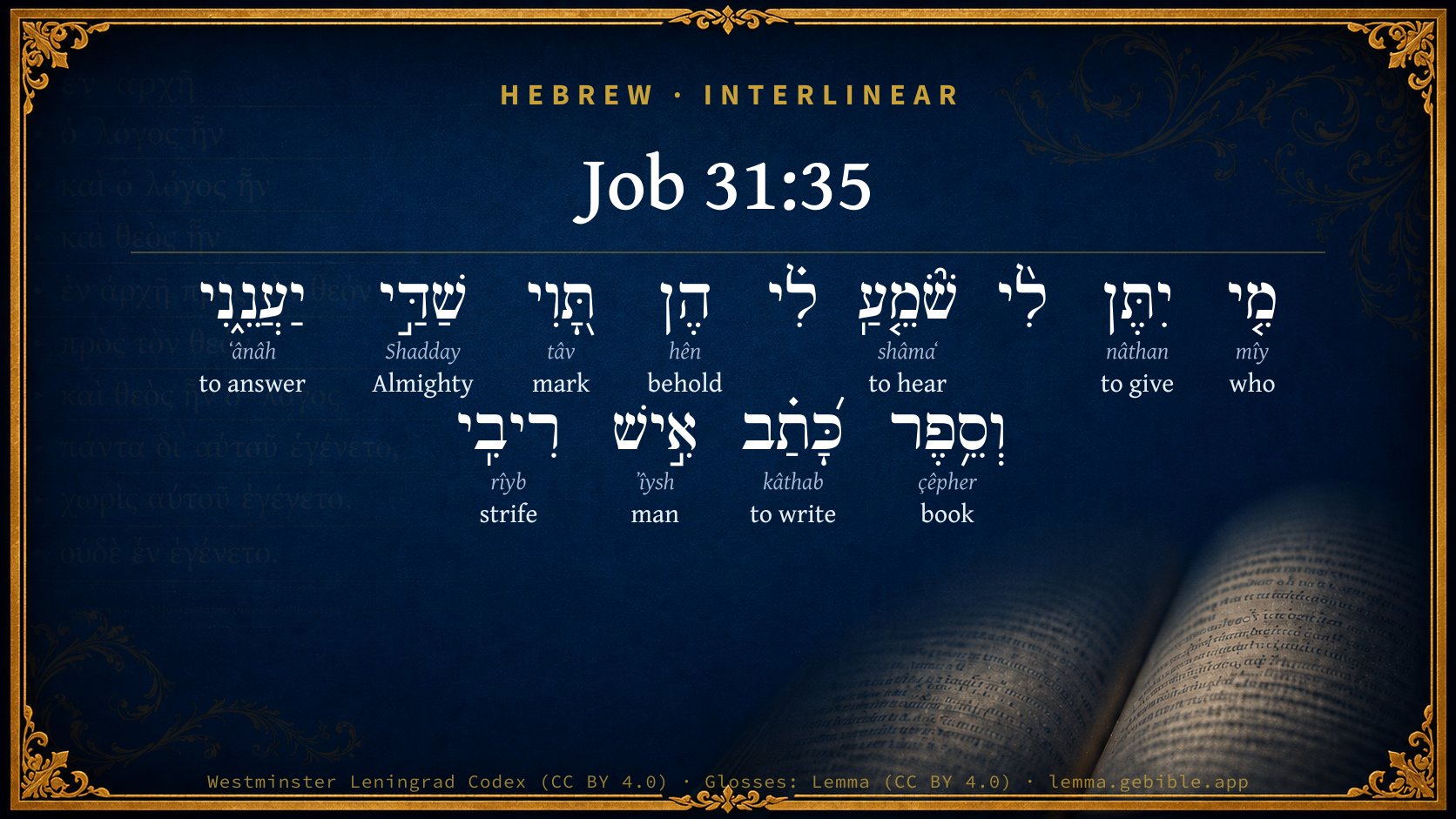
Hebrew (Westminster Leningrad Codex) Job 31:35 appears in the Hebrew Old Testament. The text above is from the Westminster Leningrad Codex. Each word links to its Strong’s number, a concise gloss, and parsing drawn from the Open Scriptures Hebrew Bible morphology. Click any word for its full Brown-Driver-Briggs (BDB) entry.
Download image
Cite this verse

Job 31:35 (World English Bible). Public Domain. Lemma interlinear Bible study tool, https://lemma.gebible.app/v/job/31/35.

Show BibTeX & RIS
BibTeX
RIS
English Translation
Oh that I had one to hear me! (Behold, here is my signature, let the Almighty answer me); Let the accuser write my indictment!
World English Bible · Public Domain
Highlights
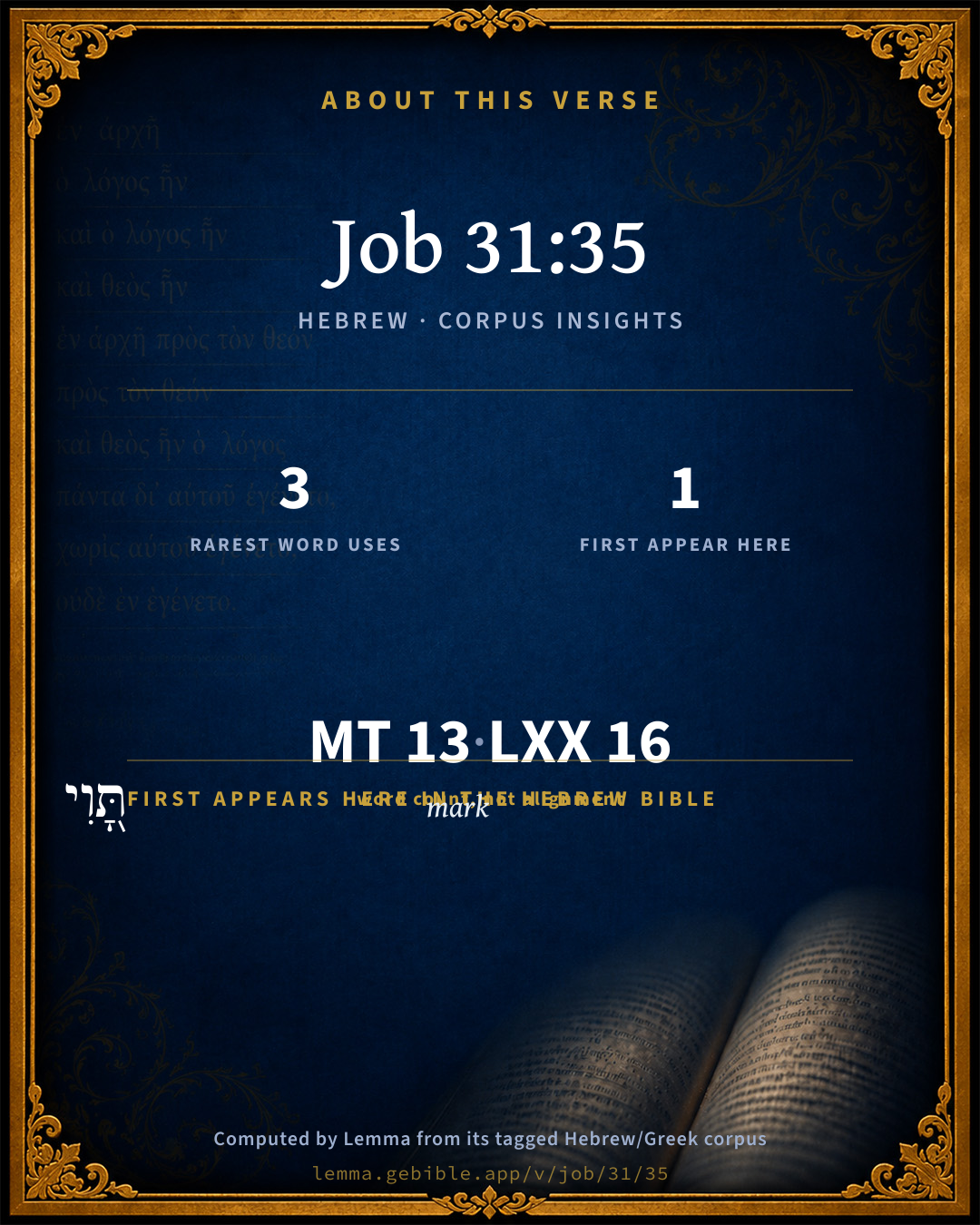
  • 1 first appearance in the Hebrew Bible
Full analysis ↓
Download a study sheet

One document with this verse’s original text, its word-by-word gloss line, the meaning frame, cross-references with their text, attributed commentary, and full source and license credits — printable, and it pastes into notes with its structure intact.

This verse Autodidact and up

Study sheet (.html) Plain text (.txt)

A passage Seminary Student

Up to 50 verses in one chapter. A passage sheet keeps up to 6 commentary sources and 12 cross-references per verse, in the order this page ranks them, and says so on the sheet whenever that leaves anything out. Ask for a single verse and you get the Autodidact verse sheet above.

Everything on this page stays free to read, with no account — the sheet is a download of what is already on screen, not access to it.

Want to remove ads? Support Godless Engineer
Compare translations 3

The same verse in 3 English versions, stacked beneath the original-language interlinear above. Click any original word for its lexicon entry.

Each is an independent rendering of the whole verse — the interlinear is not word-aligned to these translations.

Highlighted words mark where these versions differ — a whole-verse word diff, not a word-by-word alignment.

  • World English Bible Public Domain
    Oh that I had one to hear me! (Behold, here is my signature, let the Almighty answer me); Let the accuser write my indictment!
  • King James Version Public Domain
    Oh that one would hear me! behold, my desire is, that the Almighty would answer me, and that mine adversary had written a book.
  • unfoldingWord Literal Text CC BY-SA 4.0
    Who will give to me one hearing me? Behold, my mark! May the Almighty answer me! And the scroll that the man of my case has written?

unfoldingWord Literal Text — © unfoldingWord, licensed CC BY-SA 4.0. Word-aligned USFM3 via Door43 (git.door43.org/unfoldingWord/en_ult).

Versions to compare (up to 4)

3 of 4 selected

Show all 18 translations

Every available English version of this verse, each an independent rendering of the whole verse.

  • World English Bible Public Domain
    Oh that I had one to hear me! (Behold, here is my signature, let the Almighty answer me); Let the accuser write my indictment!
  • Berean Standard Bible Public Domain
    (Oh, that I had one to hear me! Here is my signature. Let the Almighty answer me; let my accuser compose an indictment.
  • Majority Standard Bible Public Domain
    (Oh, that I had one to hear me! Here is my signature. Let the Almighty answer me; let my accuser compose an indictment.
  • King James Version Public Domain
    Oh that one would hear me! behold, my desire is, that the Almighty would answer me, and that mine adversary had written a book.
  • American Standard Version (1901) Public Domain
    Oh that I had one to hear me! (Lo, here is my signature, let the Almighty answer me); And `that I had' the indictment which mine adversary hath written!
  • Revised Version (1885) Public Domain
    Oh that I had one to hear me! (lo, here is my signature, let the Almighty answer me;) and that I had the indictment which mine adversary hath written!
  • Geneva Bible (1599) Public Domain
    Oh that I had some to heare me! beholde my signe that the Almightie will witnesse for me: though mine aduersary should write a booke against me,
  • Douay-Rheims (1899) Public Domain
    Who would grant me a hearer, that the Almighty may hear my desire; and that he himself that judgeth would write a book,
  • Young's Literal Translation Public Domain
    Who giveth to me a hearing? lo, my mark. The Mighty One doth answer me, And a bill hath mine adversary written.
  • Literal Standard Version CC BY-SA 4.0
    Who gives to me a hearing? Behold, my mark. The Mighty One answers me, || And my adversary has written a bill.
  • Unlocked Literal Bible CC BY-SA 4.0
    Oh, if only I had someone to hear me! See, here is my signature; let the Almighty answer me! If only I had the indictment that my opponent has written!
  • unfoldingWord Literal Text CC BY-SA 4.0
    Who will give to me one hearing me? Behold, my mark! May the Almighty answer me! And the scroll that the man of my case has written?
  • Darby Bible Public Domain
    Oh that I had one to hear me! Behold my signature: let the Almighty answer me! And let mine opponent write an accusation!
  • World Messianic Bible Public Domain
    oh that I had one to hear me! Behold, here is my signature! Let the Almighty answer me! Let the accuser write my indictment!
  • Webster's Bible Public Domain
    Oh that one would hear me! behold, my desire is, that the Almighty would answer me, and that my adversary had written a book.
  • Free Bible Version CC BY-SA 4.0
    Why won't anyone listen to what I'm saying! I'm signing my name to endorse everything I've said. Let the Almighty answer me. Let my accuser write down what he is charging me with.
  • Bible in Basic English Public Domain
    If only God would give ear to me, and the Ruler of all would give me an answer! or if what he has against me had been put in writing!
  • JPS Tanakh (1917) Public Domain
    Oh that I had one to hear me! — Lo, here is my signature, let the Almighty answer me — and that I had the indictment which mine adversary hath written!

Literal Standard Version (2020), Covenant Press — licensed CC BY-SA 4.0. Text via the HelloAO Bible API (eBible.org). Unlocked Literal Bible (unfoldingWord) — licensed CC BY-SA 4.0. Text via the HelloAO Bible API (eBible.org). unfoldingWord Literal Text — © unfoldingWord, licensed CC BY-SA 4.0. Word-aligned USFM3 via Door43 (git.door43.org/unfoldingWord/en_ult). Free Bible Version, Dr. Jonathan Gallagher — licensed CC BY-SA 4.0. Text via the HelloAO Bible API (eBible.org).

Word by word

More ways to search: Search by grammar → Find every occurrence → Compare this word →

Practice this passage: Drill this verse → Learn its vocabulary →

תָּ֭וִי
tâv
H8420
“mark · my”
Noun, Common, Masculine, Singular, Construct + Suffix, Personal, 1st Person, Common, Singular
Part of Speech
Noun
Type
Common
Gender
Masculine
Number
Singular
State
Construct
Full BDB Definition

Origin: from H8427

TWOT: 2496a

desire, mark - mark (as a sign of exemption from judgment)
  1. מִ֤י mîy H4310 “who” Particle, Interrogative
  2. יִתֶּן nâthan H5414 “to give” Verb, Qal, Imperfect, 3rd Person, Masculine, Singular
  3. שֹׁ֘מֵ֤עַֽ shâmaʻ H8085 “hearing” Verb, Qal, Participle Active, Masculine, Singular, Absolute
  4. הֶן hên H2005 “behold” Particle, Interjection
  5. שַׁדַּ֣י Shadday H7706 “Almighty” Noun, Proper
  6. יַעֲנֵ֑נִי ʻânâh H6030 “to answer · me” Verb, Qal, Imperfect, 3rd Person, Masculine, Singular + Suffix, Personal, 1st Person, Common, Singular
  7. וְסֵ֥פֶר çêpher H5612 “and · book” Conjunction + Noun, Common, Masculine, Singular, Absolute
  8. כָּ֝תַ֗ב kâthab H3789 “to write” Verb, Qal, Perfect, 3rd Person, Masculine, Singular
  9. אִ֣ישׁ ʼîysh H376 “man of” Noun, Common, Masculine, Singular, Construct
  10. רִיבִֽי rîyb H7379 “strife · my” Noun, Common, Both, Singular, Construct + Suffix, Personal, 1st Person, Common, Singular

About this verse

These counts appear in no published source. They are computed here, from the morphology-tagged text and Lemma’s own curated glosses. What Lemma adds →

13
words
11
distinct lemmas
Wisdom
section

Notable vocabulary

The rarest word here is תָּ֭וִי mark H8420 — appearing just 3 times in the whole Hebrew Bible.

First appearance in Scripture

This word makes its first canonical appearance in the Hebrew Bible here:

  • תָּ֭וִי mark H8420

Shared distinctive vocabulary

תָּ֭וִי mark H8420 occurs in 3 verses of the Hebrew Bible. Also found in:

Grammatical profile

  • 4 verbs
  • 5 nouns
  • 2 prepositions
  • 2 particles

Verb forms

  • יִתֶּן Qal · Imperfect
  • שֹׁ֘מֵ֤עַֽ Qal · Participle Active
  • יַעֲנֵ֑נִי Qal · Imperfect
  • כָּ֝תַ֗ב Qal · Perfect

Hebrew & Septuagint length

In English translation the verse runs 24 words from the Hebrew and 29 from the Septuagint (LXX English) — closely comparable.

A rough comparison of the two English renderings, which tokenize alike — not a word-level alignment.

Word counts can differ between the Hebrew and the Greek without any difference in meaning — e.g. the Hebrew direct-object marker אֵת has no separate Greek word, and Greek often adds the article ὁ.

In the original languages it is 13 Hebrew tokens and 16 Greek tokens — but the two are counted differently (Hebrew bundles its prefixes and suffixes into one token; the Greek is in lemma form), so that isn’t a like-for-like length.

Cross-references

17

Topical passages linked to Job 31:35 in the Treasury of Scripture Knowledge — connected by theme and wording, ordered by reader-vote popularity; previews shown in the World English Bible.

  • Job 13:21–22 Withdraw your hand far from me; And don't let your terror make me afraid.
  • Job 40:4–5 "Behold, I am of small account. What shall I answer you? I lay my hand on my mouth.
  • Job 13:3 "Surely I would speak to the Almighty. I desire to reason with God.
  • Job 13:24 Why hide you your face, And hold me for your enemy?
  • Job 17:3 "Now give a pledge, be collateral for me with yourself. Who is there who will strike hands with me?
  • Job 19:7 "Behold, I cry out of wrong, but I am not heard: I cry for help, but there is no justice.
  • Job 19:23–24 "Oh that my words were now written! Oh that they were inscribed in a book!
  • Job 23:3–7 Oh that I knew where I might find him! That I might come even to his seat!
  • Job 33:6 Behold, I am toward God even as you are: I am also formed out of the clay.
  • Job 35:14 How much less when you say you don't see him. The cause is before him, and you wait for him!
  • Job 38:1–3 Then Yahweh answered Job out of the whirlwind,
  • Job 19:11 He has also kindled his wrath against me. He counts me among his adversaries.
  • Job 27:7 "Let my enemy be as the wicked, Let him who rises up against me be as the unrighteous.
  • Job 30:28 I go mourning without the sun. I stand up in the assembly, and cry for help.
  • Job 33:10–11 Behold, he finds occasions against me, He counts me for his enemy:
  • Psalms 26:1 Judge me, Yahweh, for I have walked in my integrity. I have trusted also in Yahweh without wavering.
  • Matthew 5:25 Agree with your adversary quickly, while you are with him in the way; lest perhaps the prosecutor deliver you to the judge, and the judge deliver you to the officer, and you be cast into prison.

Cross-references courtesy of OpenBible.info (CC BY 4.0).

Hebrew and Greek witnesses Masoretic Hebrew ↔ Greek Septuagint

The same verse in the two great witnesses to the Old Testament, shown verse-for-verse.

These are two independent witnesses, not word-aligned to each other, and the Septuagint is shown in lemma (dictionary) form.

Hebrew Job 31:35 Masoretic · Westminster Leningrad Codex

מִ֤י יִתֶּן לִ֨י שֹׁ֘מֵ֤עַֽ לִ֗י הֶן תָּ֭וִי שַׁדַּ֣י יַעֲנֵ֑נִי וְסֵ֥פֶר כָּ֝תַ֗ב אִ֣ישׁ רִיבִֽי

Oh that I had one to hear me! (Behold, here is my signature, let the Almighty answer me); Let the accuser write my indictment!

World English Bible · Public Domain

Greek LXX Job 31:35 Septuagint · lemma form

τίς δίδωμι ἀκούω ἐγώ χείρ δέ κύριος εἰ μή δείδω συγγραφή δέ ὅς ἔχω κατά τις

(Oh that I had a hearer,) and if I had not feared the hand of the Lord; and as to the written charge which I had against any one,

LXX2012 (modern English Septuagint) · Public Domain

Hebrew: Westminster Leningrad Codex (CC BY 4.0). Greek: Septuagint (public domain); English from LXX2012 (modern English Septuagint) (Public Domain). How the Septuagint differs from the Hebrew →

Commentary

Notes on Job 31:35 from classic Christian and Jewish commentators (each source and its license shown beneath its notes). The classic Christian expositions comment on the surrounding passage and are grouped to its opening verse, so a note may address several verses; the Jewish commentaries on the Tanakh (Rashi and others) are per-verse, so they appear only where the commentator wrote on this verse.

Lemma curates 59 commentaries, every one of them public domain or Creative Commons licensed, each selected and text-cleaned for this edition rather than reprinted as found. About our sources →

Ellicott's Commentary for English Readers

(35) Oh that one would hear me!—The rendering noticed in the margin is probably the right one—Oh that I had one to hear me! Lo, here is my mark! i.e., my signature, my declaration, which I am ready to subscribe; and oh that mine adversary had written a book! More correctly, perhaps, “That I had the book or indictment that my adversary hath written; would that I had it in black and white before me, that I might deal with it accordingly, and answer it point to point.” Here, then, is the same deviation from strict sequence of order that we observed in Job_29:18. Job_31:35-37 ought to come after Job_31:38-40; but the writer’s ideas of symmetry and order were not as ours, and this, in some respects, may be more natural, though, strictly speaking, less correct.

A Bible Commentary for English Readers, edited by Charles John Ellicott (1878–1897) — public domain. Text from a community e-Sword module.

Trapp's Complete Commentary

John Trapp

Job 31:35 Oh that one would hear me! behold, my desire [is, that] the Almighty would answer me, and [that] mine adversary had written a book.

Ver. 35. Oh that one would hear me] Quis det mihi auscultantem mihi? Oh that after all this purging and praising of myself (wherein I take no pleasure, but that I must do it, unless I will betray mine innocence, and lie under heavy imputations), some one would help me to a fair trial! that God, who is best able, would undertake the business, and effectually vindicate me from these calumnies and contumelies that are cast upon me.

That the Almighty would answer me] i.e. That he would give a reason why he dealt so harshly with me. This was Job’s desire, or mark he aimed at, with confidence enough, Hac in re petenda nimis importunus est (Merl.); but sure he should have carried this matter with more modesty and lowly mindedness, with more reverence and godly fear, since our God is a consuming fire; since he is greater than our consciences; neither may we ever forget the infinite distance and disproportion that is between him and ourselves.

And that mine adversary had written a book] Heb. The man of my contention; mine antagonist, that he had made his declaration, and set down his charge. By these and the following expressions, Job denoteth his innocence and plerophory of faith, wherewith he was well acquainted, and whereby he was exceedingly supported. Oh that we could as bravely bear all contumelies and contempts for our consciences; wearing them as crowns and confirmations of our conformity to Christ.

John Trapp, A Commentary or Exposition upon All the Books of the Old and New Testament (1647–1656) — public domain. Text from a community e-Sword module.

Joseph Benson's Commentary

Job 31:35. O that one would hear me! — O that I might have my cause heard by any just and impartial judge! Behold, my desires, &c. — So the Vulgate and the Targum understand תוי, tavi, here, deriving it from אוה, ivvah, he desired, he coveted. Some, however, deriving it from תוה, tivvah, to mark, to design, to define, render the clause, Lo, here is my sign, mark, or pledge, namely, that I will stand the trial. But the former seems to be the true sense, and is approved by A. Ezra and R. Levi. That the Almighty would answer me — Answer my desire herein, either by hearing me himself, or by appointing some impartial person to judge whether I be such a hypocrite as my friends make me, or an upright person. And that mine adversary — Whosoever he be that shall contend with, or accuse me; had written a book — Had put down in writing the charges he has against me, and brought them in. He alludes to what is usual in judicial proceedings. This shows that letters were in use in Job’s time.

Joseph Benson's Commentary on the Old and New Testaments (1811–1818) — public domain. Text from a community e-Sword module.

Whedon's Commentary on the Bible

Daniel D. Whedon

Fifth strophe — The statement he has made, Job would dare to sign in the presence of God, and carry about as a triumphant declaration that he has not been guilty of deceit and hypocrisy. Nor, in conclusion, has he been guilty of the certain nameless sin which his friends had cowardly insinuated, but dared not mention. See note, Job_13:23.

In view of the infliction of a like curse upon Adam because of his sin, (compare Job_31:40; Job_31:33 with Gen_3:17-18,) the final imprecation of a curse upon the ground, his widespread domain, which was his only remaining wealth, forms a pre-eminent climax to Job’s defence, and more especially to this series of imprecations, Job_31:35-40.

35. The most probable reading is, Oh that I had one who would hear me! Behold my signature! Let the Almighty answer me.

My desire — תוי, tavi: literally, my sign, (tav,) as in the margin. Compare Eze_9:4. In the opinion of some this mark was cruciform, as in the Phoenician letter Taw, which, being the last of the letters, served as the signature of the alphabet. Job now declares that he is ready to sign all the protestations he has just made. The ancient Egyptian courts required the accused to sign his reply. Mine adversary, etc. — Some read, “Oh that I had the charge mine adversary had written!” Comp. Job_19:23. Job speaks of God, who he assumes has “written bitter things against him,” Job_13:26. Job has made his statement; conscious of his innocence, he would now see the divine statement. With the ancient Egyptian it was necessary that the charge of the accuser should be a written one, and read in open court. If it were not that Job, like all human beings, was frail and sinful, this challenge of God to judgment, with which he crowns his defence, would partake of the morally sublime. “Bolder words than these Job had not uttered in the whole dispute. These provoked Elihu to renew the debate; and these are the expressions for which the Almighty chiefly reprimanded him.” — Michaelis on Lowth.

Book — See note on Job_19:23.

Daniel D. Whedon (gen. ed.), Commentary on the Old and New Testaments (1874–1909) — public domain. Text from a community e-Sword module.

Tyndale Open Study Notes

Tyndale Open Resources

31:35 sign my name: Job wanted to make the proceedings official (19:23-24).

Tyndale Open Study Notes — © Tyndale Open Resources, licensed CC BY-SA 4.0. Text via the HelloAO Bible API.

Geneva Bible (1599)

Geneva Bible translators

This is a sufficient token of my righteousness, that God is my witness and will justify my cause.

Geneva Bible (1599) marginal notes — public domain. Text via Bolls.life.

Jamieson, Fausset & Brown

Robert Jamieson, A. R. Fausset & David Brown

Job returns to his wish (Job 13:22; Job 19:23). Omit "is"; "Behold my sign," that is, my mark of subscription to the statements just given in my defense: the mark of signature was originally a cross; and hence the letter Tau or T. Translate, also "Oh, that the Almighty," &c. He marks "God" as the "One" meant in the first clause.

adversary--that is, he who contends with me, refers also to God. The vagueness is designed to express "whoever it be that judicially opposes me"--the Almighty if it be He.

had written a book--rather, "would write down his charge."

Jamieson, Fausset & Brown — Commentary Critical and Explanatory on the Whole Bible (1871) — public domain (CC PDM 1.0). Text via the HelloAO Bible API.

Adam Clarke's Commentary

Verse 35. O that one would hear me!] I wish to have a fair and full hearing: I am grievously accused; and have no proper opportunity of clearing myself, and establishing my own innocence.

Behold, my desire is] Or, הן תוי hen tavi, "There is my pledge." I bind myself, on a great penalty, to come into court, and abide the issue.

That the Almighty would answer me] That he would call this case immediately before himself; and oblige my adversary to come into court, to put his accusations into a legal form, that I might have the opportunity of vindicating myself in the presence of a judge who would hear dispassionately my pleadings, and bring the cause to a righteous issue.

And that mine adversary had written a book] That he would not indulge himself in vague accusations, but would draw up a proper bill of indictment, that I might know to what I had to plead, and find the accusation in a tangible form.

Adam Clarke's Commentary on the Bible (1810–1826) — public domain. Text from a community e-Sword/MySword module.

The Cambridge Bible for Schools and Colleges

gen. ed. J. J. S. Perowne

35. The words “one that would hear me,” though spoken generally, refer of course to God. It is He that Job desires to hear him. In the third clause he names Him his adversary, i. e. opponent in the plea concerning his innocence. And he desires that he had the charge, Heb. book, i. e. the libellus, libel or indictment, which his accuser had written and handed in against him. The middle clause consists of two exclamations which force themselves in between the two parts of the wish which he expresses. By the first, behold my signature, Job means to say that he affixes his signature to all the protestations of his innocence just made in the preceding verses of the chapter, and attests them as his plea on his side. By the other, let the Almighty answer me, he challenges God, his accuser, to put in His plea in answer to his own. The language is evidently taken from the judicial practice of the time, according to which both charge and defence were laid before the court in writing. This is known to have been the practice in Egypt, though perhaps in many parts of the East the proceedings may have been oral. The word signature or sign (Eze_9:4) is tav in Heb. This is the name of the letter T, the old form of which was a cross, but the inference that Job’s signature, or that signatures in his time, had the form of a cross is scarcely warranted.

The Cambridge Bible for Schools and Colleges (gen. ed. J. J. S. Perowne; Cambridge University Press, 1878–1918) — public domain. Text from a community e-Sword module.

John Gill's Exposition

I would declare to him the number of my steps,.... To his judge, or to him that contended with him, and drew up the bill against him; he would forward it, assist in it, furnish materials for it, give an account of all the transactions of his life that he could remember; this he says not as though he thought that God stood in need of any such declaration, since he better knows the actions of men than they themselves, compasses their paths, and is acquainted with all their ways; but to show how confident he was of his innocence, and how little he feared the strictest and closest examination of his ways and works, knowing that he had lived with all good conscience unto that day:

and as a prince would I go near unto him; either he should consider such an hearer and judge of his cause he desired as a prince, and reverence and respect him as such; he should be as dear unto him, though his adversary that contended with him, as a prince; and he should be as ambitious of an acquaintance with him as with a prince: or rather he means that he himself as a prince, in a princely manner, and with a princely spirit, should draw nigh to his judge, to answer to the bill in writing against him; that he should not come up to the bar like a malefactor, that shows guilt in his countenance, and by his trembling limbs, and shrinking back, not caring to come nigh, but choosing rather to stand at a distance, or get off and escape if he could; but on the other hand, Job would go up to his judge, and to the judgment seat, with all the stateliness of a prince, with an heroic, intrepid, and undaunted spirit; like a "bold prince", as Mr. Broughton renders the word; see Job 23:3.

John Gill's Exposition of the Whole Bible (1746–1763) — public domain (CC PDM 1.0). Text via the HelloAO Bible API.

Albert Barnes' Notes on the Bible

O that one would hear me! - This refers undoubtedly to God. It is, literally, “Who will give to me one hearing me;” and the wish is that which he has so often expressed, that he might get his cause fairly before God. He feels assured that there would be a favorable verdict, if there could be a fair judicial investigation; compare the notes at Job 13:3.

Behold, my desire is - Margin, “Or, my sign is that ‘the Almighty will answer me.’” The word rendered in the text desire, and in the margin sign, (תו tâv), means properly a mark, or sign, and is also the name of the last letter of the Hebrew alphabet. Then the word means, according to Gesenius (Lex.), a mark, or cross, as subscribed to a bill of complaint; hence, the bill itself, or, as we should say, the pleading. According to this, Job means to say that he was ready for trial, and that there was his bill of complaint, or his pleading, or his bill of defense. So Herder renders it, “See my defense.” Coverdale, “Lo, this is my cause.” Miss Smith renders it, “Behold my gage!” Umbreit, Meinel Kagschrift - My accusation. There can be no doubt that it refers to the forms of a judicial investigation, and that the idea is, that Job was ready for the trial. “Here” says he, “is my defense, my argument, my pleading, my bill! I wait that my adversary should come to the trial.” The name used here as given to the bill or pleading (תו tâv, mark, or sign), probably had its origin from the fact that some mark was affixed to it - of some such significance as a seal - by which it was certified to be the real bill of the party, and by which he acknowledged it as his own. This might have been done by signing his name, or by some conventional mark that was common in those times.

That the Almighty would answer me - That is, answer me as on trial; that the cause might be fairly brought to an issue. This wish he had frequently expressed.

And that mine adversary - God; regarded as the opposite party in the suit.

Had written a book - Or, would write down his charge. The wish is, that what God had against him were in like manner entered in a bill or pleading that the charge might be fairly investigated. On the word book, compare the notes at Job 19:23. It means here a pleading in court, a bill, or charge against anyone. There is no irreverence in the language here. Job is anxious that his true character should be investigated, and that the great matter at issue should be determined; and he draws his language and illustrations from well-known practices in courts of law.

Albert Barnes' Notes on the Bible (1834–1885) — public domain. Text from a community e-Sword/MySword module.

Haydock's Catholic Bible Commentary

He himself. Hebrew, "my adversary would write a book." His very accusation would establish my cause, provided he adhered to the truth. (Calmet) --- I would carry it about as a trophy. (Haydock) --- A book. The judge wrote down the sentence. Job appeals to God, and fears not being condemned.

George Leo Haydock (1774–1849), Haydock's Catholic Family Bible and Commentary, 1859 edition — public domain. Excludes Psalms (Douay-Rheims chapter numbering differs from Protestant) and Deuterocanonical books (Catholic canon only).

Matthew Poole's English Annotations

Oh that one would hear me! Oh that I might have my cause heard by any just and impartial judge!

That the Almighty would answer me, i.e. answer my desire herein; either by hearing me himself, or by appointing some indifferent person to judge whether I be such a hypocrite as my friends make me, or an upright person, and whether I have not cause to complain.

Mine adversary; whosoever he be that shall contend with me, or accuse me, God himself not excepted, nay, possibly being chiefly intended, though for reverence to him he forbore to express it. So this is another of Job’s irreverent and presumptuous expressions, for which he is so sharply reproved afterwards.

Had written a book, i.e. had given me his charge written in a book or paper, as the manner was in judicial proceedings, that I might put in my answer into the court, which I am ready to do.

Matthew Poole's English Annotations on the Holy Bible (1683–1685) — public domain. Text from a community e-Sword/MySword module.

The Pulpit Commentary

Oh that one would hear me! i.e. Oh that I had an opportunity of plea, ling my cause before a just judge l of having charges openly brought against me, and having "one" to hear my reply to them! Job does not regard his "comforters" as such persons. They are prejudiced; they have even made themselves his accusers. Behold, my desire is, that the Almighty would answer me; rather, behold" here is my signature I let the Almighty answer me. This passage is parenthetic. Job would prefer to be judged by God, if it were possible, and therefore throws out the wish. Here is his plea in ch. 29-31; and here is his attestation by word of mouth, which is equivalent to his signature. And that mine adversary had written a book; or, had penned an indictment against me. Job would have matters brought to an issue. In default of a Divine trial and sentence, which he cannot expect, it would suffice tot him that his arraigner should formally draw out his list of charges, and present him with a copy, and so give him an opportunity of making answer to it. If this were done, then (he says)

The indictment.

Job desires something like a legal indictment. His experience suggests confusion, uncertainty, irregularity. He sets "his mark," and now he wants his Adversary who, to Job"s thought, can be none other than his Judge, God to draw up an indictment that he may know once for all what charges are brought against him.

I MAN CANNOT UNDERSTAND GOD"S DEALINGS WITH HIM. This thought repeatedly recurs in the Book of Job; it is one of the great lessons of the poem. We can now see that Job was almost as much misjudging God as the three friends were misjudging Job. But at the time it was not possible for the patriarch to comprehend the Divine purpose in his sufferings. Had he known all, much of the gracious design of his trial would have been frustrated. The very obscurity was a necessary condition for the testing of faith. While we are enduring trial we can rarely see the issue of it. Our view is almost limited to the immediate present. Moreover, there are future consequences of God"s present treatment of us which we could not truly comprehend if they were visible to us. The child is not capable of valuing his education and appreciating the good results of it. The patient is not able to understand the medical or surgical treatment he is made to undergo. While we walk by faith, we must learn to expect dispensations of providence that are quite beyond our comprehension.

II IT IS NATURAL TO DESIRE AN EXPLANATION OF GOD"S TREATMENT OF MAN.

1. That doubts may be removed. It is difficult not to distrust God when he seems to be dealing hardly with us. If only he would roll back the clouds we should be at rest.

2. For our own guidance. Is God accusing us of sin? Are we to take his chastisements as punishments? Then what are the sins in us that he most disapproves of?

III GOD DOES NOT PUNISH WITHOUT ALLOWING US TO SEE THE GROUNDS OF HIS ACTION. Job craved an indictment. He wanted to see the charges against him in black and white,

1. When we are guilty conscience will reveal the fact. It would be monstrous to condemn and punish the criminal without even letting him know of the offence with which he is charged. We dare not ascribe such injustice to God. He has implanted within us an accusing voice that echoes his accusations. If we seek for light and the guidance of conscience, we must be able to see how we have sinned and come under the wrath of God.

2. When no consciousness of guilt is to be found" the suffering cannot be for the punishment of sin. We are all conscious of sin, but sin may be forgiven; we may not be falling away from God, but cleaving to him though with weakness and sin in our hearts, still with faithful adhesion. Then God will not punish. If, therefore, the blow falls, it is for some other than a penal reason. Consequently, we need not search about anxiously for some unseen and unsuspected wickedness. Job made a mistake in asking for an indictment. There was none, simply because there was not any ground for one. Over-scrupulous consciences suspect the wrath of Heaven when the gracious purging of the fruitful branch is really a sign of the husbandman"s appreciation of it. W.F.A.

The Pulpit Commentary (1880–1919), ed. H.D.M. Spence-Jones & Joseph S. Exell — public domain. Text from a community e-Sword module.

John Wesley's Explanatory Notes

Had written - Had given me his charge written in a book or paper, as the manner was in judicial proceedings. This shews that Job did not live, before letters were in use. And undoubtedly the first letters were those wrote on the two tables, by the finger of God. He wishes, his friends, who charged him with hypocrisy, would draw up the charge in writing.

John Wesley, Explanatory Notes Upon the Whole Bible (1754–1765) — public domain. Text via the GEBible commentary corpus.

Keil & Delitzsch

C. F. Keil & F. Delitzsch

35 O that I had one who would hear me!

Behold my signature-the Almighty will answer me -

And the writing which my opponent hath written!

36 Truly I will carry it upon my shoulder,

I will wind it about me as a crown.

37 The number of my steps I will recount to Him,

As a prince will I draw near to Him.

The wish that he might find a ready willing hearer is put forth in a general way, but, as is clear in itself, and as it becomes manifest from what follows, refers to Him who, because it treats of a contradiction between the outward appearance and the true but veiled fact, as searcher of the heart, is the only competent judge. It may not be translated: et libellum (the indictment, or even: the reply to Job's self-defence) scribat meus adversarius (Dachselt, Rosenm., Welte) - the accentuation seems to proceed from this rendering, but it ought to be וכתב ספר; if כּתב governed by יענני were intended to be equivalent to יכתּב, and referred to God, the longing would be, as it runs, an unworthy and foolish one - nor: (O that I had one who would hear me ... ) and had the indictment, which my adversary has written (Ew., Hirz., Schlottm.) - for וספר is too much separated from מי יתּן by what intervenes - in addition to which comes the consideration that the wish, as it is expressed, cannot be referred to God, but only to the human opponent, whose accusations Job has no occasion to wish to hear, since he has already heard amply sufficient even in detail. Therefore הן (instead of הן with a conjunctive accent, as otherwise with Makkeph) will point not merely to תּוי, but also to liber quem scripsit adversarius meus as now lying before them, and the parenthetical שׁדּי יענני will express a desire for the divine decision in the cause now formally prepared for trial, ripe for discussion. By תּוי, my sign, i.e., my signature (comp. Eze 9:4, and Arab. tiwa, a branded sign in the form of a cross), Job intends the last word to his defence which he has just spoken, Job 31:1; it is related to all his former confessions as a confirmatory mark set below them; it is his ultimatum, as it were, the letter and seal to all that he has hitherto said about his innocence in opposition to the friends and God. Moreover, he also has the indictment of the triumvirate which has come forward as his opponent in his hands. Their so frequently repeated verbal accusations are fixed as if written; both - their accusation and his defence - lie before him, as it were, in the documentary form of legal writings. Thus, then, he wishes an observant impartial hearer for this his defence; or more exactly: he wishes that the Almighty may answer, i.e., decide. Hahn interprets just as much according to the syntax, but understanding by תוי the witness which Job carries in his breast, and by ספר וגו the testimony to his innocence written by God in his own consciousness; which is inadmissible, because, as we have often remarked already, אישׁ ריבי (comp. Job 16:21) cannot be God himself.

In Job 31:36 Job now says how he will appear before Him with this indictment of his opponent, if God will only condescend to speak the decisive word. He will wear it upon his shoulder as a mark of his dignity (comp. Isa 22:22; Isa 9:5), and wind it about him as a magnificent crown of diadems intertwined and heaped up one above another (Rev 19:12, comp. Khler on Zac 6:11) - confident of his victory at the outset; for he will give Him, the heart-searcher, an account of all his steps, and in the exalted consciousness of his innocence, he will approach Him as a prince (קרב intensive of Kal). How totally different from Adam, who was obliged to be drawn out of his hiding-place, and tremblingly, because conscious of guilt, underwent the examination of the omniscient God! Job is not conscious of cowardly and slyly hidden sins; no secret accursed thing is cherished in the inmost recesses of his heart and home.

Keil & Delitzsch — Biblical Commentary on the Old Testament (1861–1891) — public domain (CC PDM 1.0). Text via the HelloAO Bible API. (Old Testament only.)

Kretzmann's Popular Commentary

Paul E. Kretzmann

Job’s Appeal to be Heard

v. 35. Oh, that one would hear me! namely, as he here asserted his innocence, for his complaint had been all along that God paid no attention to his crying. Behold, my desire is that the Almighty would answer me, or, "Behold my signature: let the Almighty answer me!" Job had, as it were, set forth his vindication in writing; he was now ready to hear the verdict of God. And that mine adversary had written a book! That God would write down and fix against him the definite charge on account of which He laid this suffering upon him, was Job’s great wish.

v. 36. Surely I would take it upon my shoulder, as atrophy, as a badge of honor and dignity, and bind it as a crown to me, as a diadem, since he is confident of victory in advance, sure of his vindication.

v. 37. I would declare unto Him the number of my steps, concealing none of his actions before the divine Judge; as a prince would I go near unto Him, with a stately dignity, proud of his innocence, not like an accused person, trembling in the consciousness of his guilt.

v. 38. If my land cry against me, if his field should cry out for vengeance against its owner, or that the furrows likewise thereof complain, weeping in impotent pleading against Job’s abuse;

v. 39. if I have eaten the fruits thereof without money, having taken some one’s land in injustice, without payment, or have caused the owners thereof to lose their life, either directly or indirectly:

v. 40. let thistles grow instead of wheat, briars, which would spoil the productiveness of the soil, and cockle, noxious, stinking weeds, instead of barley. Thus boldly did Job assert his innocence of any specific wickedness over against the friends who were casting the suspicion of evil upon him. The words of Job, namely, those in which he vindicated his innocence over against his former friends, are ended.

Paul E. Kretzmann, Popular Commentary of the Bible (1921–1924) — public domain. Text from a community e-Sword module.

unfoldingWord translationNotes

Door43 World Missions Community

Oh, if only I had someone to hear me!

This exclamation expresses Job's wish. AT: "I wish I had someone to hear me" or "I wish that someone would listen to me" (See: Exclamations)

here is my signature

Here "my signature" represents Job's promise that everything he is saying is true. He speaks of his complaint as if he had written a legal document. AT: "I solemnly promise that all I have said is true" (See: Metaphor)

let the Almighty answer me!

Here an answer probably refers to telling Job what wrong he accuses Job of doing. AT: "let the Almighty tell me what I have done wrong" or "I wish the Almighty would say what I have done wrong" (See: Assumed Knowledge and Implicit Information)

If only I had the indictment that my opponent has written!

This expresses Job's wish. Job speaks as though his troubles are evidence that someone has written something accusing him of terrible sin. AT: "I wish I had the accusation that my opponent has written" or "If only I could read my opponent's complaint against me"

my opponent

Possible meanings are 1) this refers to God or 2) this refers to someone else.

Surely I would carry it openly on my shoulder; I would put it on like a crown

This represents putting it where everyone could read it. (See: Metaphor)

I would declare to him an accounting for my steps

Here "my steps" represents Job's actions. AT: "I would declare to him an accounting for all I have done" or "I would tell him everything I have done" (See: Metaphor)

as a confident prince I would go up to him

This means Job would approach God without any fear. Job implies that he could do this because he was not guilty. AT: "I would approach him boldly" (See: Simile)

translationWords

Almighty

written

crown

declare

confidence

prince

unfoldingWord translationNotes — © Distant Shores Media and the Door43 World Missions Community, licensed CC BY-SA 4.0. Source: git.door43.org/Door43/en_tn.

Rashi

Rabbi Shlomo Yitzchaki (Rashi)

behold my inscription; may the Almighty bear witness for me Would that the Omnipresent bear witness for me in judgment, as He wrote concerning me (1:8): “For there is none like him on earth, a sincere and upright man, God-fearing.” Also Moses, who wrote his Book and my Book, will bear witness concerning me. (Another explanation:) This is what Job says, “Give it to inscribe me and my virtue.”

may the Almighty answer me for this request.

and may my opponent write a book May he too write a book to contend with me.

Rashi on the Tanakh — English translations: “The Judaica Press complete Tanach with Rashi, translated by A. J. Rosenberg” (CC BY 4.0); “Pentateuch with Rashi's commentary by M. Rosenbaum and A.M. Silbermann, 1929-1934” (public domain); “The Metsudah Tanach series, Lakewood, N.J” (CC BY 4.0); and “The Book of Joshua, Metsudah Publications, 1997” (CC BY 4.0). Text via Sefaria.

Lesson kit

Teaching starters — assembled from the data on this page, not authored interpretation. Every prompt links to the verse data it draws on. Edit before teaching.

Job, in the Wisdom, opens this verse with 13 words (11 distinct Hebrew lemmas). Its most distinctive word is tâv (“mark”). A historical commentator’s framing appears above. Read the whole chapter for the surrounding context.

Discussion questions

  1. How does “mark” (tâv) shape what this verse is saying?
  2. This is the first place “mark” appears in Scripture (first appears here). What does its debut here establish?
  3. How does Ezekiel 9:4, which shares the word «mark», read alongside this verse?
  4. These translations render this verse differently; the difference is in the English rendering, not the original. What questions does that raise?
  5. «יִתֶּן» is a Qal Imperfect verb. How does that grammatical form shape the action described?
  6. Compare how Ellicott's Commentary for English Readers and Trapp's Complete Commentary read this verse. Where do they agree or differ?

Things to notice

Reading settings

Reading text

Shown beneath each verse's original-language words.

Old Testament
Old Testament edition

Read the OT as the Masoretic Hebrew (MT) or the Greek Septuagint (LXX).

English shown for the Greek Septuagint (in the Hebrew ↔ Greek comparison).

Comparing translations? Open the Compare panel on any verse page to stack up to four side by side.