
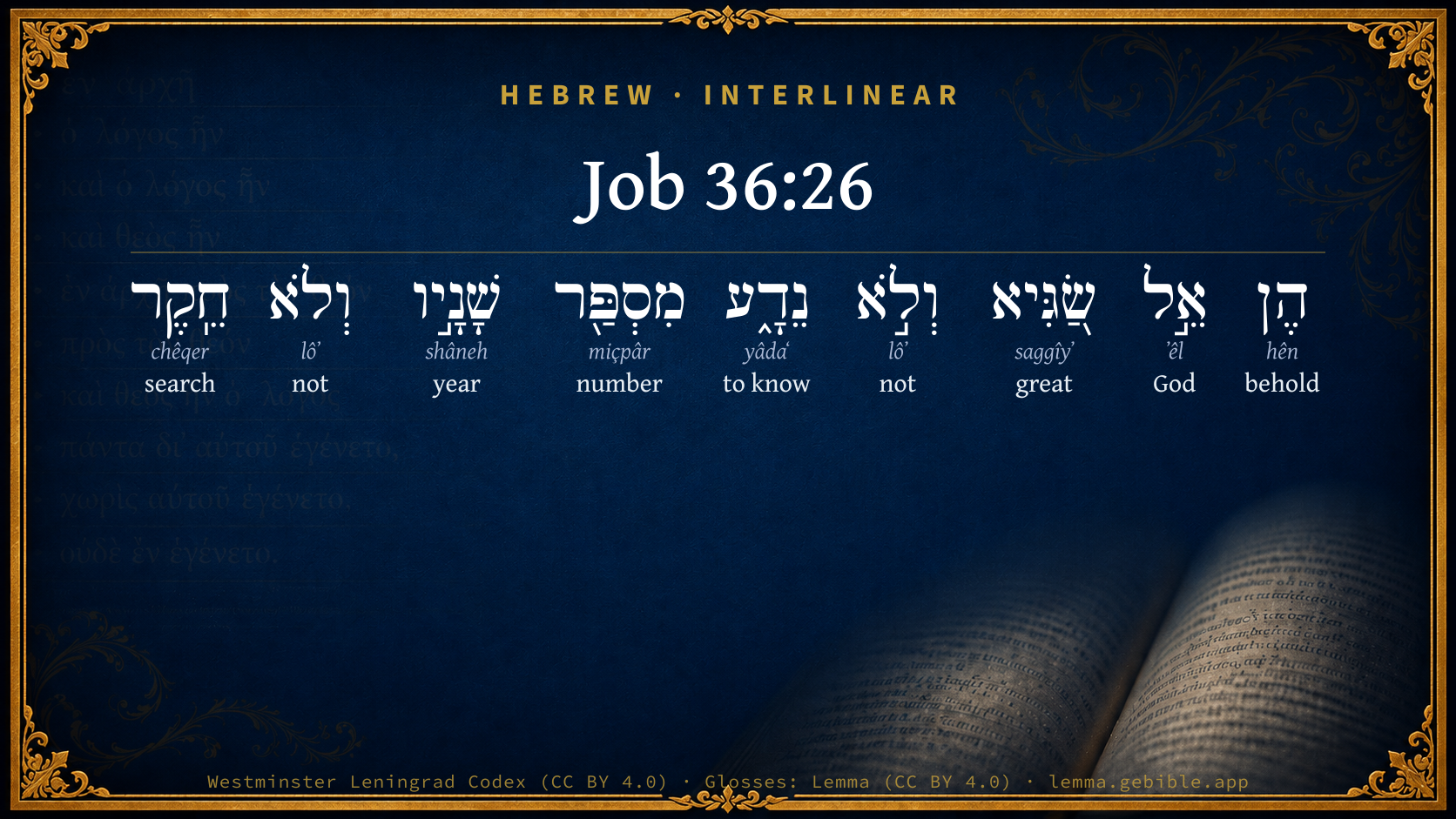
Job 36:26

Hebrew (Westminster Leningrad Codex) Job 36:26 appears in the Hebrew Old Testament. The text above is from the Westminster Leningrad Codex. Each word links to its Strong’s number, a concise gloss, and parsing drawn from the Open Scriptures Hebrew Bible morphology. Click any word for its full Brown-Driver-Briggs (BDB) entry.
Download image
Cite this verse

Job 36:26 (World English Bible). Public Domain. Lemma interlinear Bible study tool, https://lemma.gebible.app/v/job/36/26.

Show BibTeX & RIS
BibTeX
RIS
English Translation
Behold, God is great, and we don't know him. The number of his years is unsearchable.
World English Bible · Public Domain
Highlights
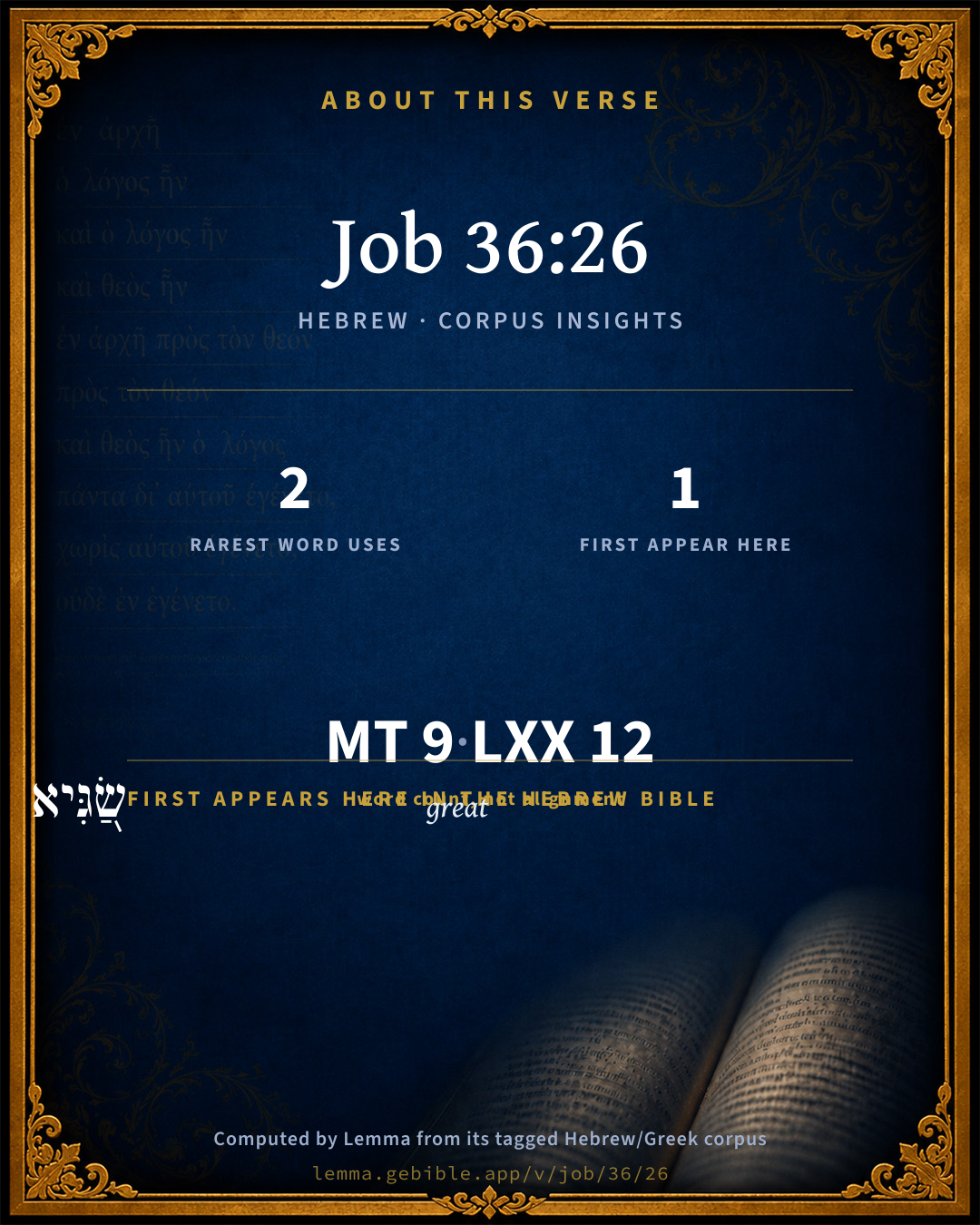
  • 1 first appearance in the Hebrew Bible
Full analysis ↓
Download a study sheet

One document with this verse’s original text, its word-by-word gloss line, the meaning frame, cross-references with their text, attributed commentary, and full source and license credits — printable, and it pastes into notes with its structure intact.

This verse Autodidact and up

Study sheet (.html) Plain text (.txt)

A passage Seminary Student

Up to 50 verses in one chapter. A passage sheet keeps up to 6 commentary sources and 12 cross-references per verse, in the order this page ranks them, and says so on the sheet whenever that leaves anything out. Ask for a single verse and you get the Autodidact verse sheet above.

Everything on this page stays free to read, with no account — the sheet is a download of what is already on screen, not access to it.

Want to remove ads? Support Godless Engineer
Compare translations 3

The same verse in 3 English versions, stacked beneath the original-language interlinear above. Click any original word for its lexicon entry.

Each is an independent rendering of the whole verse — the interlinear is not word-aligned to these translations.

Highlighted words mark where these versions differ — a whole-verse word diff, not a word-by-word alignment.

  • World English Bible Public Domain
    Behold, God is great, and we don't know him. The number of his years is unsearchable.
  • King James Version Public Domain
    Behold, God is great, and we know him not, neither can the number of his years be searched out.
  • unfoldingWord Literal Text CC BY-SA 4.0
    Behold, God great, but we do not know; the number of his years, indeed, no searching.

unfoldingWord Literal Text — © unfoldingWord, licensed CC BY-SA 4.0. Word-aligned USFM3 via Door43 (git.door43.org/unfoldingWord/en_ult).

Versions to compare (up to 4)

3 of 4 selected

Show all 18 translations

Every available English version of this verse, each an independent rendering of the whole verse.

  • World English Bible Public Domain
    Behold, God is great, and we don't know him. The number of his years is unsearchable.
  • Berean Standard Bible Public Domain
    Indeed, God is great—beyond our knowledge; the number of His years is unsearchable.
  • Majority Standard Bible Public Domain
    Indeed, God is great—beyond our knowledge; the number of His years is unsearchable.
  • King James Version Public Domain
    Behold, God is great, and we know him not, neither can the number of his years be searched out.
  • American Standard Version (1901) Public Domain
    Behold, God is great, and we know him not; The number of his years is unsearchable.
  • Revised Version (1885) Public Domain
    Behold, God is great, and we know him not; the number of his years is unsearchable.
  • Geneva Bible (1599) Public Domain
    Beholde, God is excellent, and we knowe him not, neither can the nomber of his yeres bee searched out.
  • Douay-Rheims (1899) Public Domain
    Behold, God is great, exceeding our knowledge: the number of his years is inestimable.
  • Young's Literal Translation Public Domain
    Lo, God `is' high, And we know not the number of His years, Yea, there `is' no searching.
  • Literal Standard Version CC BY-SA 4.0
    Behold, God [is] high, || And we do not know the number of His years, || Indeed, there [is] no searching.
  • Unlocked Literal Bible CC BY-SA 4.0
    See, God is great, but we do not understand him well; the number of his years is incalculable.
  • unfoldingWord Literal Text CC BY-SA 4.0
    Behold, God great, but we do not know; the number of his years, indeed, no searching.
  • Darby Bible Public Domain
    Lo, ùGod is great, and we comprehend [him] not, neither can the number of his years be searched out.
  • World Messianic Bible Public Domain
    Behold, God is great, and we don’t know him. The number of his years is unsearchable.
  • Webster's Bible Public Domain
    Behold, God is great, and we know him not, neither can the number of his years be searched out.
  • Free Bible Version CC BY-SA 4.0
    See how great God is—more than we can understand! No one can count his years.
  • Bible in Basic English Public Domain
    Truly, God is great, greater than all our knowledge; the number of his years may not be searched out.
  • JPS Tanakh (1917) Public Domain
    Behold, God is great, beyond our knowledge; the number of His years is unsearchable.

Literal Standard Version (2020), Covenant Press — licensed CC BY-SA 4.0. Text via the HelloAO Bible API (eBible.org). Unlocked Literal Bible (unfoldingWord) — licensed CC BY-SA 4.0. Text via the HelloAO Bible API (eBible.org). unfoldingWord Literal Text — © unfoldingWord, licensed CC BY-SA 4.0. Word-aligned USFM3 via Door43 (git.door43.org/unfoldingWord/en_ult). Free Bible Version, Dr. Jonathan Gallagher — licensed CC BY-SA 4.0. Text via the HelloAO Bible API (eBible.org).

Word by word

More ways to search: Search by grammar → Find every occurrence → Compare this word →

Practice this passage: Drill this verse → Learn its vocabulary →

About this verse

These counts appear in no published source. They are computed here, from the morphology-tagged text and Lemma’s own curated glosses. What Lemma adds →

9
words
8
distinct lemmas
Wisdom
section

Notable vocabulary

The rarest word here is שַׂ֭גִּיא great H7689 — appearing just 2 times in the whole Hebrew Bible.

First appearance in Scripture

This word makes its first canonical appearance in the Hebrew Bible here:

  • שַׂ֭גִּיא great H7689

Shared distinctive vocabulary

שַׂ֭גִּיא great H7689 occurs in 2 verses of the Hebrew Bible. Also found in:

Grammatical profile

  • 1 verb
  • 4 nouns
  • 1 adjective
  • 3 particles

Verb forms

  • נֵדָ֑ע Qal · Imperfect

Repetition

A word recurs within this verse — often emphatic in Hebrew:

  • וְלֹ֣א not H3808 ×2

Hebrew & Septuagint length

In English translation the verse runs 16 words from the Hebrew and 20 from the Septuagint (LXX English) — closely comparable.

A rough comparison of the two English renderings, which tokenize alike — not a word-level alignment.

Word counts can differ between the Hebrew and the Greek without any difference in meaning — e.g. the Hebrew direct-object marker אֵת has no separate Greek word, and Greek often adds the article ὁ.

In the original languages it is 9 Hebrew tokens and 12 Greek tokens — but the two are counted differently (Hebrew bundles its prefixes and suffixes into one token; the Greek is in lemma form), so that isn’t a like-for-like length.

Cross-references

12

Topical passages linked to Job 36:26 in the Treasury of Scripture Knowledge — connected by theme and wording, ordered by reader-vote popularity; previews shown in the World English Bible.

  • Psalms 90:2 Before the mountains were brought forth, Or ever you had formed the earth and the world, Even from everlasting to everlasting, you are God.
  • Psalms 145:3 Great is Yahweh, and greatly to be praised! His greatness is unsearchable.
  • Job 11:7–9 "Can you fathom the mystery of God? Or can you probe the limits of the Almighty?
  • 1 Kings 8:27 But will God in very deed dwell on the earth? behold, heaven and the heaven of heavens can't contain you; how much less this house that I have built!
  • Job 37:5 God thunders marvelously with his voice. He does great things, which we can't comprehend.
  • Job 37:23 We can't reach the Almighty, He is exalted in power; In justice and great righteousness he will not oppress.
  • 1 Corinthians 13:12 For now we see in a mirror, dimly, but then face to face. Now I know in part, but then I will know fully, even as I was also fully known.
  • Job 26:14 Behold, these are but the outskirts of his ways. How small a whisper do we hear of him! But the thunder of his power who can understand?"
  • Psalms 102:24–27 I said, "My God, don't take me away in the midst of my days. Your years are throughout all generations.
  • Job 10:5 Are your days as the days of mortals, Or your years as man's years,
  • Hebrews 1:12 As a mantle you will roll them up, And they will be changed; But you are the same. Your years will not fail."
  • 2 Peter 3:8 But don't forget this one thing, beloved, that one day is with the Lord as a thousand years, and a thousand years as one day.

Cross-references courtesy of OpenBible.info (CC BY 4.0).

Hebrew and Greek witnesses Masoretic Hebrew ↔ Greek Septuagint

The same verse in the two great witnesses to the Old Testament, shown verse-for-verse.

These are two independent witnesses, not word-aligned to each other, and the Septuagint is shown in lemma (dictionary) form.

Hebrew Job 36:26 Masoretic · Westminster Leningrad Codex

הֶן אֵ֣ל שַׂ֭גִּיא וְלֹ֣א נֵדָ֑ע מִסְפַּ֖ר שָׁנָ֣יו וְלֹא חֵֽקֶר

Behold, God is great, and we don't know him. The number of his years is unsearchable.

World English Bible · Public Domain

Greek LXX Job 36:26 Septuagint · lemma form

ἰδού ὁ ἰσχυρός πολύς καί οὐ γιγνώσκω ἀριθμός ἔτος αὐτός καί ἀπέραντος

Behold, the Mighty One is great, and we shall not know him: the number of his years is even infinite.

LXX2012 (modern English Septuagint) · Public Domain

Hebrew: Westminster Leningrad Codex (CC BY 4.0). Greek: Septuagint (public domain); English from LXX2012 (modern English Septuagint) (Public Domain). How the Septuagint differs from the Hebrew →

Commentary

Notes on Job 36:26 from classic Christian and Jewish commentators (each source and its license shown beneath its notes). The classic Christian expositions comment on the surrounding passage and are grouped to its opening verse, so a note may address several verses; the Jewish commentaries on the Tanakh (Rashi and others) are per-verse, so they appear only where the commentator wrote on this verse.

Lemma curates 59 commentaries, every one of them public domain or Creative Commons licensed, each selected and text-cleaned for this edition rather than reprinted as found. About our sources →

The Cambridge Bible for Schools and Colleges

gen. ed. J. J. S. Perowne

26. we know him not] He is so great as to transcend all knowledge of man. The Eternity of God is referred to in the second clause in order to fill the mind more completely with the sense of His greatness.

Chap. Job_36:26-33. The greatness and unsearchableness of God, seen in His marvellous operations in the skies; and exhortation to Job to allow these wonders duly to impress him, and to bow beneath the greatness of God, who surpasses all comprehension

The passage has two sections:

First, ch. Job_36:26 to Job_37:13, the incomprehensible greatness of God, seen in the phenomena of the atmosphere: in the formation of the rain-drops (ch. Job_36:26-28); in the thunder-storm (ch. Job_36:29 to Job_37:5); in snow and ice, which seals up the hand of man and makes him powerless before the mighty power of God (Job_36:6-10); in His lading the cloud with moisture, and guiding it to the fulfilment of His varied behests upon the whole earth (Job_36:11-13).

Second, ch. Job_37:14-21, Elihu exhorts Job to consider these marvels of Him which is wonderful in counsel and excellent in working, and to let them duly impress him; bidding him behold the wonderful balancing of the summer cloud in the heavens, when the earth is still with the south wind (Job_36:14-17), and the burnished sky is stretched out like a molten mirror (Job_36:18). With what words shall man come before the Omnipotent to contend with Him! Man, who is dazzled by the light of the sky, how should he behold the terrible glory around God! Therefore all men do fear Him; and He hath not respect to those that are wise in their own understanding (Job_36:19-21).

Ch. Job_36:26 to Job_37:13, The greatness of God and the wonderfulness of His operations in the phenomena of the atmosphere.

The Cambridge Bible for Schools and Colleges (gen. ed. J. J. S. Perowne; Cambridge University Press, 1878–1918) — public domain. Text from a community e-Sword module.

Trapp's Complete Commentary

John Trapp

Job 36:26 Behold, God [is] great, and we know [him] not, neither can the number of his years be searched out.

Ver. 26. Behold, God is great] Yea, he is maximus in minimis, greatest and most of all seen in the meanest creatures; as in ants more than in elephants, &c. God showeth in his works of all sorts, se aliquantum esse; sed quantus sit rursus operibus involvit; that he is very great, but how great he is that appears not (Brent.).

Neither can the number of his years be searched out] How should they say, when as his countenance is beyond all count, Psa 102:24; Psa 102:27. Years are here ascribed unto him, and he is elsewhere called "Ancient of days," Dan 7:9, and the hairs of his head are said to be white like snow, Rev 1:14; but all this is spoken of God after the manner of men; and should teach us, neither curiously to inquire into his counsels, nor discontentedly to complain of his doings.

John Trapp, A Commentary or Exposition upon All the Books of the Old and New Testament (1647–1656) — public domain. Text from a community e-Sword module.

The Biblical Illustrator

Joseph S. Exell

Job_36:26-27

God is great, and we know Him not.

The knowledge of God

These words recall the supreme questions which divide hostile philosophies. Even Christian apologists have maintained that God is inaccessible to human thought, and that our highest knowledge of Him can have only a relative truth. Many who are antagonistic to the. Christian faith maintain that mans knowledge is necessarily limited to the universe of phenomena, and that all attempts to pass beyond it are the result of an ambitious discontent with the eternal limitations of our intellectual power. The words of the text cannot mean that God is absolutely unknown. We know God, and therefore we worship Him; but there is infinitely more to know. His greatness passes beyond the widest limits, not only of our actual knowledge, but of all knowledge possible to us. This truth is pressed upon us in whatever direction thought may travel.

1. Our hearts should be filled with awe when we meet to worship Him.

2. That God is great, and we know Him not, should encourage the largest and freest confidence in His ability and willingness to meet and to satisfy all the exigencies of our personal life.

3. It is the infinite greatness of God--a greatness that can never be defined or exhausted by created thought--which alone enables us to accept calmly, and without dread, the gift of immortality.

4. If this is the strength and joy of those who are conscious that through His infinite mercy their sins are forgiven, and they are restored to the light and blessedness of His love, it is full of terror to all with whom He is not at peace, and who are exposed to His eternal condemnation. (R. W. Dale, D. D. , LL. D.)

The unknowable God

Unknown, unknowable--truly; yet not on that account unusable and unprofitable. That is a vital distinction. The master of science humbly avows that he has not a theory of magnetism; does he, therefore, ignore it, or decline to inquire into its uses? Does he reverently write its name with a big M, and run away from it, shaken and whitened by a great fear? Verily, he is no such fool. He actually uses what he does not understand. I will accept his example, and bring it to bear upon the religious life. I do not, scientifically, know God; the solemn term does not come within the analysis which is available to me; God is great, and I know Him not; yet the term has its practical uses in life, and into those broad and obvious uses all men may inquire. What part does the God of the Bible play in the life of the man who accepts Him and obeys Him with all the inspiration and diligence of love? Any creed that does not Come down easily into the daily life to purify and direct it, is by so much, imperfect and useless. I cannot read the Bible without seeing that God (as there revealed) ever moved His believers in the direction of courage and sacrifice. These two terms are multitudinous, involving others of kindred quality, and spreading themselves over the whole space of the upper life. In the direction of courage--not mere animal courage, for then the argument might be matched by gods many, yet still gods, though their names be spelt without capitals; but moral courage, noble heroism, fierce rebuke of personal and national corruption, sublime and pathetic judgment of all good and all evil. The God-idea made mean men valiant soldier-prophets; it broadened the piping voice of the timid inquirer into the thunder of the national teacher and leader; for brass it brought gold; and for iron, silver; and for wood, brass; and for stones, iron; instead of the thorn it brought up the fir tree, and instead of the brier the myrtle tree, and it made the bush burn with fire. Wherever the God-idea took complete possession of the mind, every faculty was lifted up to a new capacity, and borne on to heroic attempts and conquests. The saints who received it subdued kingdoms, wrought righteousness, obtained promises, stopped the mouths of lions, quenched the violence of fire; out of weakness were made strong, waxed valiant in fight, turned to flight the armies of the aliens. Any idea that so inspired in man life and hope, is to be examined with reverent care. The quality of the courage determines its value and the value of the idea which excited and sustained it. What is true of the courage is true also of the sacrifice which has ever followed the acceptance of the God-idea. Not the showy and fanatical sacrifice of mere blood letting: many a Juggernaut, great and small, drinks the blood of his devotees; but spiritual discipline, self-renunciation, the esteeming of others better than ones self, such a suppression of the self-thought as to amount to an obliteration of every motive and purpose that can be measured by any single personality--such are the practical uses of the God-idea. It is not a barren sentiment. It is not a coloured vapour or a scented incense, lulling the brain into partial stupor or agitating it with mocking dreams; it arouses courage; it necessitates self-sacrifice; it touches the imagination as with fire; it gives a wide and solemn outlook to the whole nature; it gives a deeper tone to every thought; it sanctifies the universe; it makes heaven possible. Unknown--unknowable! Yes; but not therefore unusable or unprofitable. Say this God was dreamed by human genius. Be it so. Make Him a creature of fancy. What then? The man who made, or dreamed, or otherwise projected such a God, must be the author of some other Work of equal or approximate importance. Produce it! That is the sensible reply to so bold a blasphemy. Singular if man has made a Jehovah, and then has taken to the drudgery of making oil paintings and ink poems, and huts to live in. Where is the congruity? A man says he kindled the sun, and when asked for his proof, he strikes a match which the wind blows out! Is the evidence sufficient? Or a man says that he has covered the earth with all the green and gold of summer, and when challenged to prove it, he produces a wax flower which melts in his hands! Is the proof convincing? The God of the Bible calls for the production of other gods--gods wooden, gods stony, gods ill-bred, gods well shaped, and done up skilfully for market uses: from His heavens He laughs at them, and from His high throne He holds them in derision. He is not afraid of competitive gods. They try to climb to His sublimity, and only get high enough to break their necks in a sharp fall. Again and again I demand that the second effort of human genius bear some obvious relation to the first. The sculptor accepts the challenge, so does the painter, so does the musician--why should the Jehovah-dreamer be an exception to the common rule of confirmation and proof? We wait for the evidence. We insist upon having it; and that we may not waste our time in idle expectancy, we will meanwhile call upon God, saying, Our leather which art in heaven, hallowed be Thy name, Thy kingdom come, Thy will be done on earth, as it is done in heaven. (Joseph Parker, D. D.)

The greatness of God

I. The greatness of God infinitely surpasses our knowledge of Him. Behold, God is great, and we know Him not. Consider how imperfect our knowledge is--l. Of the Divine nature. We are greatly to seek in the first notion of God, that He is a Spirit; then, that He is a Trinity in Unity.

2. Of the Divine decrees and counsels. We must conjecture uncertainly about His decrees, because we are so distant and so incompetent in all our speculations about the Divine nature.

3. Of the Divine work in creation and providence.

II. Useful inferences.

1. What an inestimable treasure the Holy Scriptures ought to be esteemed by us.

2. How reasonable a thing it is for us to love one another in some differences of opinion and thought while we are on this side heaven.

3. How justly the wise and the good mind may be longing after that state where their knowledge of God may be advanced to such unspeakable degrees, suitably both to the nature of God and the capacious nature of our souls. (Nathanael Resbury, A. M.)

For He maketh small the drops of water.--

Gods greatness in small things

We lose God in His greatness, and it is well for us to be told that the great God can do small things, and that small things are often the illustrations of His greatness.

I. God illustrates His greatness in doing small things. Illustrate from the statesman, who can find time to contribute to the literature of his country; the great builder, who cares for minute ornament. Or from Gods attention in creation to every detail. Or from the ritualism of the old dispensation, which included the elaborate and minute. It is to reduce God to our littleness, to suppose that He measures all things by our scale. He does not even measure time by our computation. Great and small are terms which have not the same meaning with God as with man. How can anything be great to Him but Himself? He regulates the ripples on the sea of human life, caused by trivial circumstances, as well as the lifting up of the floods, when the angry waves threaten us with shipwreck. God is great, and He is so great that He is gentle; there are no hands so strong, and none so tender. God does great things, but He does them silently. The greatest forces operate without bustle and noise. Gentleness is the perfection of strength.

II. Christ, the manifested God, does all things beautifully, small as well as great things. He comes, as all the race come, by birth. He grew in wisdom and stature. No one but a teacher, in whom were hid all the treasures of wisdom and knowledge, could have discoursed with such beautiful simplicity on the highest themes, The doctrine of providence tie brings down to the little things of daily life. What a Gospel He gives us in a few words. His conduct to childhood illustrates the singular beauty with which He did everything.

III. The way to greatness is to do small things. Men who have obtained greatness have begun with the beginning of things. Great men have always been men of detail--great works are done by careful attention to little things. To overlook the importance of small things, is to forget that these give birth to great things. Life, to a great extent, is made up of small things. It is with small things we build up character. (H. J. Bevis.)

Gods incomprehensible greatness illustrated by little things

I. Man cannot comprehend it. God is great, and we know Him not, neither can the number of His years be searched out.

1. Man cannot comprehend His nature. Great in Himself. All His attributes transcend our understanding.

2. Man cannot comprehend His history. Neither can the number of His years be searched out. In the presence of His greatness--

(1) All the glories of man, kind dwindle into insignificance. In the presence of His greatness--

(2) With what profound reverence should we ever think and speak of Him.

II. Little things illustrate it. For He maketh small the drops of water; or, as some render it, He draweth up the drops of water. Elihu seems to connect Gods greatness with His attention to the drops of water.

1. The greatness of His wisdom is seen in the small. Take the microscope and examine life in its minutest form, and what wonderful skill you discover in the organisation: as much wisdom as the telescope will show you amongst the rolling worlds of space.

2. The greatness of His goodness is seen in the small.

3. The greatness of His taste is seen in the small. Take the wing of the smallest insect, or the smallest grain of ore, and what exquisite forms and what beautiful combinations of colour.

4. The greatness of His power is seen in the small (Homilist.)

.

The Biblical Illustrator, edited by Joseph S. Exell (c. 1880s–1900s) — public domain. Text from a community e-Sword module.

Joseph Benson's Commentary

Job 36:26. Behold, God is great — Infinite in majesty, and power, and wisdom, and all perfections, and therefore just in all his ways; and we know him not — Namely, perfectly. Though we see something of him in his works, it is but little in comparison of that which is in him. He is incomprehensibly great in his essence, in his attributes, in his works, and in his ways; and therefore be not so inconsiderate and rash, O Job, as to censure those of his dispensations which thou canst not fully understand. Neither can the number of his years be searched out — He is eternal, as in his being, so in all his counsels, which must be infinitely wise, and therefore above the comprehension of short-lived men.

Joseph Benson's Commentary on the Old and New Testaments (1811–1818) — public domain. Text from a community e-Sword module.

Whedon's Commentary on the Bible

Daniel D. Whedon

Strophe b — The infinitely exalted and eternal God displays his beneficence in the subtle elaboration of rain, a work which blends together wisdom and power, providence and love, and which can be fully comprehended only by him who spreads out the clouds and sends forth the crashing thunder from the thick cloud, which is his pavilion, Job_36:26-29.

26. Behold, God is great — The greatness of God is indicated by his unsearchableness and eternity. “Elihu shows that Job’s allegation that he has been unrighteously handled, and his impeachment of God’s righteousness, are contraventions of his nature as manifested in creation. The omnipotence and wisdom of God, which are everywhere apparent in the universe, furnish a testimony to God’s righteousness… Every witness, therefore, in nature to God’s greatness as a Creator rises against an arraignment of God’s righteousness. Whoso will bring a charge against God’s justice must measure himself with the divine omnipotence.” — Wordsworth.

Daniel D. Whedon (gen. ed.), Commentary on the Old and New Testaments (1874–1909) — public domain. Text from a community e-Sword module.

Keil & Delitzsch

C. F. Keil & F. Delitzsch

26 Behold, God is exalted-we know Him not entirely;

The number of His years, it is unsearchable.

27 For He draweth down the drops of water,

They distil as rain in connection with its mist,

28 Which the clouds do drop,

Distil upon the multitude of men.

29 Who can altogether understand the spreadings of the clouds,

The crash of His tabernacle?

The Waw of the quasi-conclusion in Job 36:26 corresponds to the Waw of the train of thought in Job 36:26 (Ges. 145, 2). מספּר שׁניו is, as the subject-notion, conceived as a nominative (vid., on Job 4:6), not as in similar quasi-antecedent clauses, e.g., Job 23:12, as an acc. of relation. שׂגּיא here and Job 37:23 occurs otherwise only in Old Testament Chaldee. In what follows Elihu describes the wondrous origin of rain. "If Job had only come," says a Midrash (Jalkut, 518), "to explain to us the matter of the race of the deluge (vid., especially Job 22:15-18), it had been sufficient; and if Elihu had only come to explain to us the matter of the origin of rain (מעשׂה ירידת גשׁמים), it had been enough." In Gesenius' Handwrterbuch, Job 36:27 is translated: when He has drawn up the drops of water to Himself, then, etc. But it is יגרע, not גּרע; and גּרע neither in Hebr. nor in Arab. signifies attrahere in sublime (Rosenm.), but only attrahere (root גר) and detrahere; the latter signification is the prevailing one in Hebr. (Job 15:8; Job 36:7). With כּי the transcendent exaltation of the Being who survives all changes of creation is shown by an example: He draws away (draws off, as it were) the water-drops, viz., from the waters that are confined above on the circle of the sky, which pass over us as mist and cloud (vid., Genesis, S. 107); and these water-drops distil down (זקק, to ooze, distil, here not in a transitive but an intransitive signification, since the water-drops are the rain itself) as rain, לאדו, with its mist, i.e., since a mist produced by it (Gen 2:6) fills the expanse (רקיע), the downfall of which is just this rain, which, as Job 36:28 says, the clouds (called שׁחקים on account of its thin strata of air, in distinction from the next mist-circle) cause to flow gently down upon the multitude of men, i.e., far and wide over the mass of men who inhabit the district visited by the rain; both verbs are used transitively here, both נזל as Isa 45:8, and רעף, as evidently Pro 3:20. אף אם, Job 36:29, commences an intensive question: moreover, could one understand = could one completely understand; which certainly, according to the sense, is equivalent to: how much less (אף כּי). אם is, however, the interrogative an, and אף אם corresponds to האף in the first member of the double question, Job 34:17; Job 40:8. מפרשׂי are not the burstings, from פּרשׂ = פּרס, frangere, findere, but spreadings, as Eze 27:7 shows, from פּרשׂ, expandere, Psa 105:39, comp. supra on Job 36:9. It is the growth of the storm-clouds, which collect often from a beginning "small as a man's hand" (Kg1 18:44), that is intended; majestic omnipotence conceals itself behind these as in a סכּה (Psa 18:12) woven out of thick branches; and the rolling thunder is here called the crash (תּשׁאות, as Job 39:7, is formed from שׁוא, to rumble, whence also שׁואה, if it is not after the form גּולה, migration, exile, from שׁאה morf ,, vid., on Job 30:3) of this pavilion of clouds in which the Thunderer works.

Keil & Delitzsch — Biblical Commentary on the Old Testament (1861–1891) — public domain (CC PDM 1.0). Text via the HelloAO Bible API. (Old Testament only.)

Geneva Bible (1599)

Geneva Bible translators

Our infirmity hindereth us so, that we cannot attain to the perfect knowledge of God.

Geneva Bible (1599) marginal notes — public domain. Text via Bolls.life.

Jamieson, Fausset & Brown

Robert Jamieson, A. R. Fausset & David Brown

(Job 37:13). God's greatness in heaven and earth: a reason why Job should bow under His afflicting hand.

know him not--only in part (Job 36:25; Co1 13:12).

his years-- (Psa 90:2; Psa 102:24, Psa 102:27); applied to Jesus Christ (Heb 1:12).

Jamieson, Fausset & Brown — Commentary Critical and Explanatory on the Whole Bible (1871) — public domain (CC PDM 1.0). Text via the HelloAO Bible API.

Adam Clarke's Commentary

Verse 26. God is great] He is omnipotent.

We know him not] He is unsearchable.

Neither can the number of his years be searched out.] He is eternal.

These three propositions are an ample foundation for endless disquisition. As to paraphrase and comment, they need none in this place; they are too profound, comprehensive, and sublime.

Adam Clarke's Commentary on the Bible (1810–1826) — public domain. Text from a community e-Sword/MySword module.

John Gill's Exposition

Behold, God is great,.... In his power and might, in his wisdom and knowledge, in his truth and faithfulness, in his love, grace, and mercy, and that to admiration; and it is worthy of notice and attention, which the word "behold", prefixed hereunto, is expressive of: or is "much" or "many" (f); as he is in his persons: for though his essence is one, his persons are more, they are three, Father, Son, and Spirit; in his perfections, of which there is a fulness; in his thoughts, counsels, purposes? and decrees, which respect other persons and things; in his works of creation, providence, and grace, and in the blessings of his goodness, which are so many as not to be reckoned up;

and we know him not; God is to be known by the works of creation, and even by the very Heathen; though such is their inattention to them, that they are said not to know God; yea, even the wisest among them, by all their wisdom, knew not God, Co1 1:21; for though they might know there was a God, they knew not who and what he was. God is known by his word among those who are favoured with a divine revelation of him, and especially by true believers in Christ, who know God in Christ, whom to know is life eternal; and yet these know but in part, there is no finding out the Almighty to perfection; God is not known clearly, fully, and perfectly, by any: or "we know it not"; the greatness of God; he is great, but we know not how great he is; his greatness is beyond all conception and expression;

neither can the number of his years be searched out; years are ascribed to God, after the manner of men, otherwise, properly speaking, they are not applicable to him; by which time is measured, and which belongs not to the eternal God; however, the number of his years in an eternity past, and of those to come, cannot be searched out and reckoned up: it requires no great skill in arithmetic to reckon up the years of the oldest man that ever lived; yea, the months, the days, the hours, and minutes, of his life may be counted; but the years of the Most High cannot; this is a phrase expressive of the eternity of him which is, and was, and is to come, and who from everlasting to everlasting is God. He was before the world was, as the creation of it out of nothing shows. Jehovah the Father had a Son, and he loved him before the foundation of the world, and all his people in him; he made an everlasting choice of them in him, before the world began; he made an everlasting covenant with them in him, and gave them grace in him as early as that; he set him up as Mediator from everlasting, from the beginning, or ever the earth was; and will be the everlasting and unchangeable portion of his people to all eternity. Cocceius thinks that these words are expressive of the constant love of God to the church, and the continuance of his kingdom in it; and of his most fixed purpose of love to men, and indefatigable care of them.

(f) Sept. "multus", Mercerus, Drusius.

John Gill's Exposition of the Whole Bible (1746–1763) — public domain (CC PDM 1.0). Text via the HelloAO Bible API.

Albert Barnes' Notes on the Bible

Behold, God is great, and we know him not - That is, we cannot fully comprehend him; see the notes at Job 11:7-9.

Neither can the number of his years be searched out - That is, he is eternal. The object of what is said here is to impress the mind with a sense of the greatness of God, and with the folly of attempting fully to comprehend the reason of what he does. Man is of a few days, and it is presumption in him to sit in judgment on the doings of one who is from eternity. We may here remark that the doctrine that there is an Eternal Being presiding over the universe, was a doctrine fully held by the speakers in this book - a doctrine far in advance of all that philosophy ever taught, and which was unknown for ages in the lands on which the light of revelation never shone.

Albert Barnes' Notes on the Bible (1834–1885) — public domain. Text from a community e-Sword/MySword module.

Matthew Poole's English Annotations

God is great; infinite in majesty, and power, and wisdom, and all perfections, and therefore just in all his ways. We

know him not, to wit, perfectly. Though we see something of him in his works, as was now said, yet we see and know but little of him in comparison of that which is in him. He is incomprehensibly great in his essence and in his works, and therefore be not so rash, O Job, as to censure those ways of God which thou canst not fully understand. He is from everlasting to everlasting, eternal, as in his being, so in all his counsels; which therefore must be infinitely wise, and above the comprehension of short-lived men.

Matthew Poole's English Annotations on the Holy Bible (1683–1685) — public domain. Text from a community e-Sword/MySword module.

The Pulpit Commentary

Vers. 26-33. Elihu passes now to a description, which must be allowed to be eloquent, of the power and providence of God, and especially of his power in the natural world. It is suggested that the storm, which ultimately broke at the theophania, (Job_38:1) was already beginning to gather, and turned the thoughts of Elihu in this direction. He begins with the consideration of how rain is generated, passes rapidly to the gathering of the clouds from all quarters, and thence to the loud crashing of the thunder, and the dazzling flashes of the lightning, which illumine even the lowest depths of the sea (ver. 30). The effects of the storm are then spoken of, in words the exact meaning of which is very obscure (vers. 31-33).

Behold, God is great, and we know him not. This is the final lesson which Elihu seeks to impress on his hearers. God is so great their fully to comprehend him transcends the power of the human understanding. However much we know of him, there is more that we do not know. His nature is unsearchable; his depths (1Co_2:10) are inscrutable; try as we may, we can never "find him out". (Job_37:23) Neither can the number of his years be searched out. Even his duration, being eternal, is beyond us. We cannot realize the thought of pre- and post-eternity.

"God is great.

This is the Mussulman creed, and a truth of great force in Mohammedanism. Christianity also contains it, and simple as may be the conception when set forth in bare words, there are depths and wide reaches of inferences flowing from it that can never be exhausted.

I GOD IS IRRESISTIBLE. This is the Mohammedan inference, and of course a necessary and true one, although it dues not describe all that we know of God. We know that it is simply foolish to run against the laws of nature. We cannot deflect one of them by a bait"s breadth. But the laws of nature are the ways of God. Therefore there can be but one end to our opposition to God; it must fail. The sooner we own this obvious truth and act upon it the better for ourselves. If we cease to run madly against the will of God, we may repent and turn to the better way; if we still hurl ourselves headlong against it, we can but dash ourselves to pieces.

II GOD IS UNFATHOMABLE. If we could measure God, he would cease to be God, for he would be no longer infinite. Therefore, instead of being surprised that we meet with mysteries in him, we should expect it, and take it as a sign that we are dealing with One who is vastly greater than we are. The child cannot understand all the actions of his earthly father. How, then, can any man think to understand God? This does not mean that we can know nothing of God. For God may be known as far as he has revealed himself to us, and as far as we are able to rise to a comprehension of some things in his nature. We may know God truly; but we cannot know him adequately. Before the awful mystery of his greatness we tremble, humbled and abashed.

1. Therefore we are not in a position to judge of God"s actions. We.see but a minute fraction of them. Their roots lie in dark depths beyond the reach of our inquiry; their purposes stretch far beyond the utmost rim of our horizon.

2. Therefore we should learn to trust God. We must walk by faith, for we cannot see all.

III GOD IS ALMIGHTY TO SAVE. The Christian God is more than the Mussulman Allah. He is not like an inexorable Oriental despot. He is full of sympathy for his children, listening to their cry and coming to save them in their need. If he is great, that is the more reassuring for us when we put our trust in him. It is vain for us to resist him; but it is safe for us to trust him. Even the mysteriousness of God invites our confidence when once we are assured of his love. His almighty power is able to save unto the uttermost, and his great and wonderful thought invites us to repose in his wisdom. Henry Vaughan, in "Silex Scintillans," says There is a God, some say A deep, but dazzling darkness; As men here Say it is late and dusky, because they See not all clear. Oh for that night! where I in him Might live invisible and dim! W.F.A.

The Pulpit Commentary (1880–1919), ed. H.D.M. Spence-Jones & Joseph S. Exell — public domain. Text from a community e-Sword module.

John Wesley's Explanatory Notes

Neither - He is eternal, as in his being, so in all his counsels; which therefore must be infinitely above the comprehension of short-lived men.

John Wesley, Explanatory Notes Upon the Whole Bible (1754–1765) — public domain. Text via the GEBible commentary corpus.

Rashi

Rabbi Shlomo Yitzchaki (Rashi)

the number of His years is unfathomable Therefore man must look from afar to ask what happened to the first people, and he will learn from them.

Rashi on the Tanakh — English translations: “The Judaica Press complete Tanach with Rashi, translated by A. J. Rosenberg” (CC BY 4.0); “Pentateuch with Rashi's commentary by M. Rosenbaum and A.M. Silbermann, 1929-1934” (public domain); “The Metsudah Tanach series, Lakewood, N.J” (CC BY 4.0); and “The Book of Joshua, Metsudah Publications, 1997” (CC BY 4.0). Text via Sefaria.

Lesson kit

Teaching starters — assembled from the data on this page, not authored interpretation. Every prompt links to the verse data it draws on. Edit before teaching.

Job, in the Wisdom, opens this verse with 9 words (8 distinct Hebrew lemmas). Its most distinctive word is saggîyʼ (“great”). A historical commentator’s framing appears above. Read the whole chapter for the surrounding context.

Discussion questions

  1. What does “great” (saggîyʼ) contribute to the verse as a whole?
  2. The word “great” first appears here in Scripture. What is being introduced at this debut?
  3. Job 37:23 shares the word «great» with this verse. How do the two illuminate each other?
  4. “not” occurs 2× in this one verse. What is the effect of the repetition?
  5. The translations on this page render this verse differently — a whole-verse word diff, not a word-by-word alignment. What might account for the different wordings?
  6. The verb «נֵדָ֑ע» is Qal Imperfect. How does its form color the action?
  7. Reading how The Cambridge Bible for Schools and Colleges and Trapp's Complete Commentary read this verse, where do the two commentators agree and where do they part?

Things to notice

Reading settings

Reading text

Shown beneath each verse's original-language words.

Old Testament
Old Testament edition

Read the OT as the Masoretic Hebrew (MT) or the Greek Septuagint (LXX).

English shown for the Greek Septuagint (in the Hebrew ↔ Greek comparison).

Comparing translations? Open the Compare panel on any verse page to stack up to four side by side.