Numbers 17:12

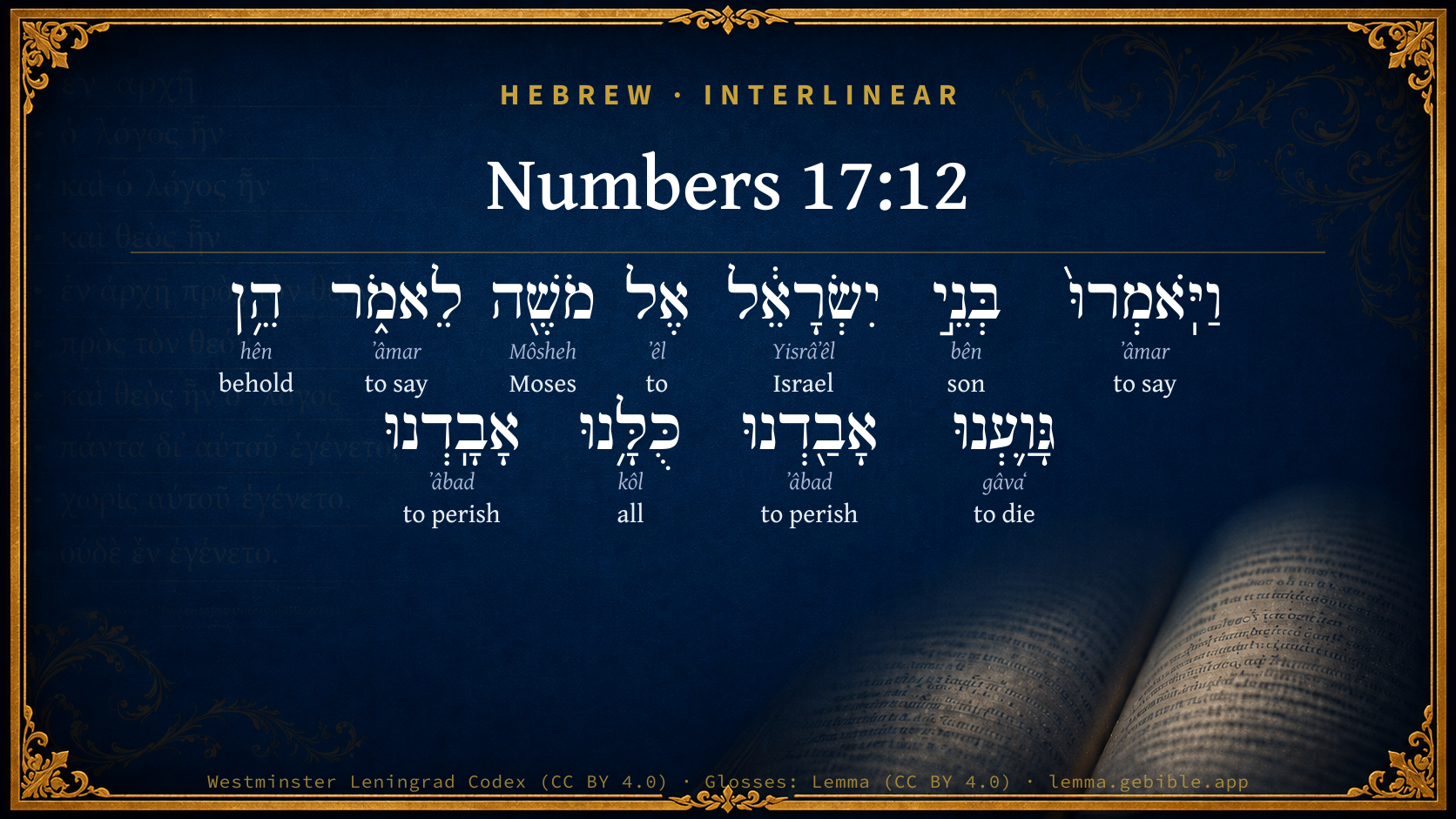
Hebrew (Westminster Leningrad Codex) Numbers 17:12 appears in the Hebrew Old Testament. The text above is from the Westminster Leningrad Codex. Each word links to its Strong’s number, a concise gloss, and parsing drawn from the Open Scriptures Hebrew Bible morphology. Click any word for its full Brown-Driver-Briggs (BDB) entry.
Download image
Cite this verse

Numbers 17:12 (World English Bible). Public Domain. Lemma interlinear Bible study tool, https://lemma.gebible.app/v/numbers/17/12.

Show BibTeX & RIS
BibTeX
RIS
English Translation
The children of Israel spoke to Moses, saying, Behold, we perish, we are undone, we are all undone.
World English Bible · Public Domain
Download a study sheet

One document with this verse’s original text, its word-by-word gloss line, the meaning frame, cross-references with their text, attributed commentary, and full source and license credits — printable, and it pastes into notes with its structure intact.

This verse Autodidact and up

Study sheet (.html) Plain text (.txt)

A passage Seminary Student

Up to 50 verses in one chapter. A passage sheet keeps up to 6 commentary sources and 12 cross-references per verse, in the order this page ranks them, and says so on the sheet whenever that leaves anything out. Ask for a single verse and you get the Autodidact verse sheet above.

Everything on this page stays free to read, with no account — the sheet is a download of what is already on screen, not access to it.

Want to remove ads? Support Godless Engineer
Compare translations 3

The same verse in 3 English versions, stacked beneath the original-language interlinear above. Click any original word for its lexicon entry.

Each is an independent rendering of the whole verse — the interlinear is not word-aligned to these translations.

Highlighted words mark where these versions differ — a whole-verse word diff, not a word-by-word alignment.

  • World English Bible Public Domain
    The children of Israel spoke to Moses, saying, Behold, we perish, we are undone, we are all undone.
  • King James Version Public Domain
    And the children of Israel spake unto Moses, saying, Behold, we die, we perish, we all perish.
  • unfoldingWord Literal Text CC BY-SA 4.0
    And the sons of Israel said to Moses, saying, “Behold, we expire! We perish; all of us perish!

unfoldingWord Literal Text — © unfoldingWord, licensed CC BY-SA 4.0. Word-aligned USFM3 via Door43 (git.door43.org/unfoldingWord/en_ult).

Versions to compare (up to 4)

3 of 4 selected

Show all 18 translations

Every available English version of this verse, each an independent rendering of the whole verse.

  • World English Bible Public Domain
    The children of Israel spoke to Moses, saying, Behold, we perish, we are undone, we are all undone.
  • Berean Standard Bible Public Domain
    Then the Israelites declared to Moses, “Look, we are perishing! We are lost; we are all lost!
  • Majority Standard Bible Public Domain
    Then the Israelites declared to Moses, “Look, we are perishing! We are lost; we are all lost!
  • King James Version Public Domain
    And the children of Israel spake unto Moses, saying, Behold, we die, we perish, we all perish.
  • American Standard Version (1901) Public Domain
    And the children of Israel spake unto Moses, saying, Behold, we perish, we are undone, we are all undone.
  • Revised Version (1885) Public Domain
    And the children of Israel spake unto Moses, saying, Behold, we perish, we are undone, we are all undone.
  • Geneva Bible (1599) Public Domain
    And the children of Israel spake vnto Moses, saying, Behold, we are dead, we perish, we are all lost:
  • Douay-Rheims (1899) Public Domain
    And the children of Israel said to Moses: Behold we are consumed, we all perish.
  • Young's Literal Translation Public Domain
    And the sons of Israel speak unto Moses, saying, `Lo, we have expired; we have perished; we have all of us perished;
  • Literal Standard Version CC BY-SA 4.0
    And the sons of Israel speak to Moses, saying, “Behold, we have expired, we have perished, all of us have perished!
  • Unlocked Literal Bible CC BY-SA 4.0
    The people of Israel spoke to Moses and said, “We will die here. We will all perish!
  • unfoldingWord Literal Text CC BY-SA 4.0
    And the sons of Israel said to Moses, saying, “Behold, we expire! We perish; all of us perish!
  • Darby Bible Public Domain
    And the children of Israel spoke to Moses, saying, Lo, we expire, we perish, we all perish.
  • World Messianic Bible Public Domain
    The children of Israel spoke to Moses, saying, “Behold, we perish! We are undone! We are all undone!
  • Webster's Bible Public Domain
    And the children of Israel spoke to Moses, saying, Behold, we die, we perish, we all perish.
  • Free Bible Version CC BY-SA 4.0
    Then the Israelites came and told Moses, “Can't you see we're all going to die? We'll be destroyed! We're all going to be killed!
  • Bible in Basic English Public Domain
    And the children of Israel said to Moses, Truly, destruction has come on us; an evil fate has overtaken us all.
  • JPS Tanakh (1917) Public Domain
    (17-27) And the children of Israel spoke unto Moses, saying: 'Behold, we perish, we are undone, we are all undone.

Literal Standard Version (2020), Covenant Press — licensed CC BY-SA 4.0. Text via the HelloAO Bible API (eBible.org). Unlocked Literal Bible (unfoldingWord) — licensed CC BY-SA 4.0. Text via the HelloAO Bible API (eBible.org). unfoldingWord Literal Text — © unfoldingWord, licensed CC BY-SA 4.0. Word-aligned USFM3 via Door43 (git.door43.org/unfoldingWord/en_ult). Free Bible Version, Dr. Jonathan Gallagher — licensed CC BY-SA 4.0. Text via the HelloAO Bible API (eBible.org).

Word by word

More ways to search: Search by grammar → Find every occurrence → Compare this word →

Practice this passage: Drill this verse → Learn its vocabulary →

גָּוַ֛עְנוּ
gâvaʻ
H1478
“to die”
Verb, Qal, Perfect, 1st Person, Common, Plural
Part of Speech
Verb
Stem
Qal
Form
Perfect
Person
1st Person
Gender
Common
Number
Plural
Full BDB Definition

Origin: a primitive root

TWOT: 328

to expire, die, perish, give up the ghost, yield up the ghost, be dead, be ready to die - (Qal) to expire, die, be about to die
  1. וַיֹּֽאמְרוּ֙ ʼâmar H559 “and · to say” Conjunction + Verb, Qal, Sequential Imperfect, 3rd Person, Masculine, Plural
  2. בְּנֵ֣י bên H1121 “sons of” Noun, Common, Masculine, Plural, Construct
  3. יִשְׂרָאֵ֔ל Yisrâʼêl H3478 “Israel” Noun, Proper
  4. אֶל ʼêl H413 “to” Preposition
  5. מֹשֶׁ֖ה Môsheh H4872 “Moses” Noun, Proper
  6. לֵאמֹ֑ר ʼâmar H559 “to say” Preposition + Verb, Qal, Infinitive Construct
  7. הֵ֥ן hên H2005 “behold” Particle, Demonstrative
  8. אָבַ֖דְנוּ ʼâbad H6 “to perish” Verb, Qal, Perfect, 1st Person, Common, Plural
  9. כֻּלָּ֥נוּ kôl H3605 “all · our” Noun, Common, Masculine, Singular, Construct + Suffix, Personal, 1st Person, Common, Plural
  10. אָבָֽדְנוּ ʼâbad H6 “to perish” Verb, Qal, Perfect, 1st Person, Common, Plural

About this verse

These counts appear in no published source. They are computed here, from the morphology-tagged text and Lemma’s own curated glosses. What Lemma adds →

11
words
9
distinct lemmas
Pentateuch
section

Notable vocabulary

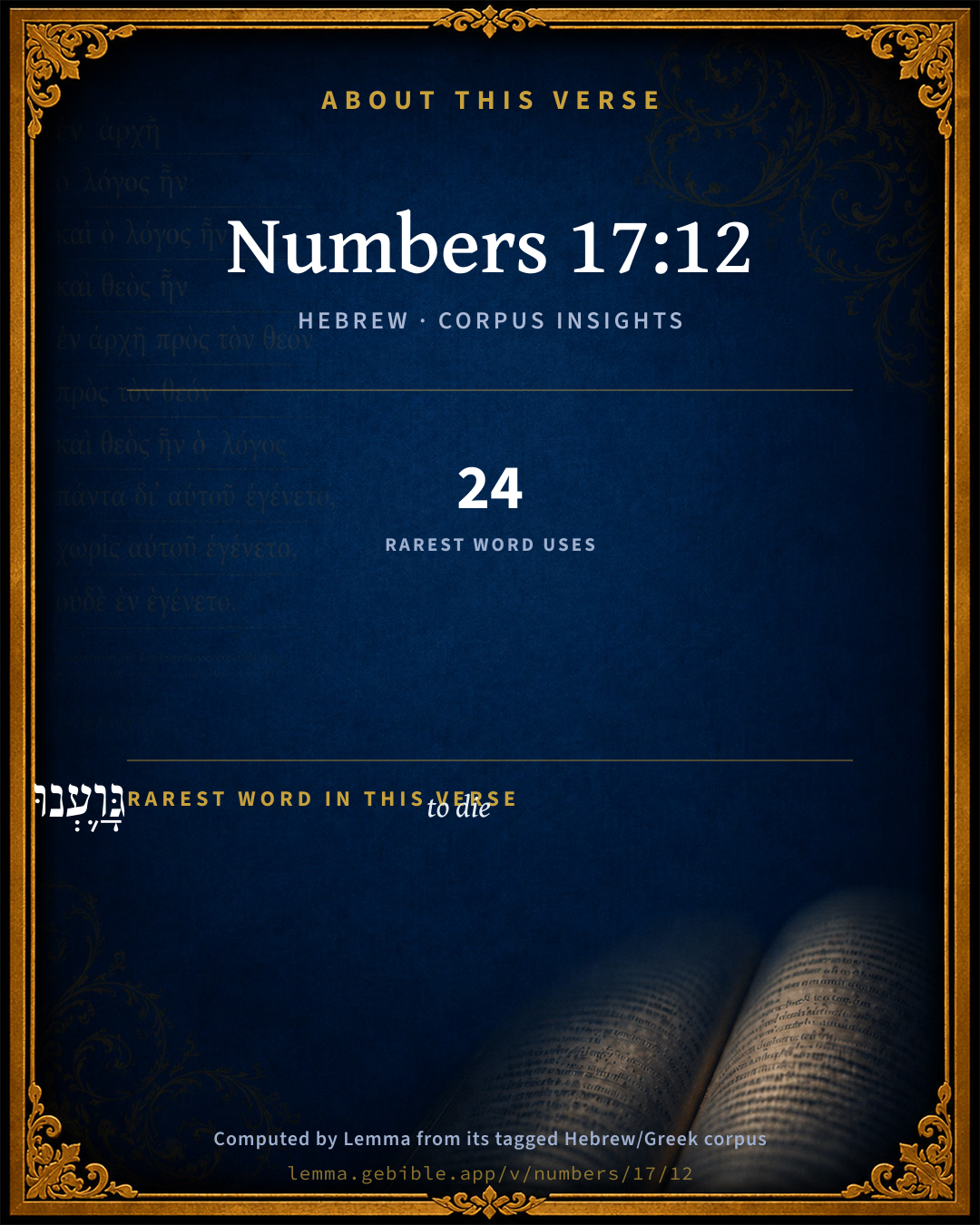
The rarest word here is גָּוַ֛עְנוּ to die H1478 — appearing just 24 times in the whole Hebrew Bible.

Shared distinctive vocabulary

גָּוַ֛עְנוּ to die H1478 occurs in 23 verses of the Hebrew Bible. Also found in:

Grammatical profile

  • 5 verbs
  • 4 nouns
  • 1 preposition
  • 1 particle

Verb forms

  • וַיֹּֽאמְרוּ֙ Qal · Sequential Imperfect
  • לֵאמֹ֑ר Qal · Infinitive Construct
  • גָּוַ֛עְנוּ Qal · Perfect
  • אָבַ֖דְנוּ Qal · Perfect
  • אָבָֽדְנוּ Qal · Perfect

Repetition

Words recur within this verse — often emphatic in Hebrew:

  • וַיֹּֽאמְרוּ֙ to say H559 ×2
  • אָבַ֖דְנוּ to perish H6 ×2

Hebrew & Septuagint length

In English translation the verse runs 18 words from the Hebrew and 20 from the Septuagint (LXX English) — closely comparable.

A rough comparison of the two English renderings, which tokenize alike — not a word-level alignment.

Word counts can differ between the Hebrew and the Greek without any difference in meaning — e.g. the Hebrew direct-object marker אֵת has no separate Greek word, and Greek often adds the article ὁ.

Cross-references

6

Topical passages linked to Numbers 17:12 in the Treasury of Scripture Knowledge — connected by theme and wording, ordered by reader-vote popularity; previews shown in the World English Bible.

  • Numbers 26:11 Notwithstanding, the sons of Korah didn't die.
  • Psalms 90:7 For we are consumed in your anger. We are troubled in your wrath.
  • Proverbs 19:3 The foolishness of man subverts his way; His heart rages against Yahweh.
  • Isaiah 6:5 Then I said, "Woe is me! For I am undone, because I am a man of unclean lips, and I dwell in the midst of a people of unclean lips: for my eyes have seen the King, Yahweh of Hosts!"
  • Isaiah 57:16 For I will not contend forever, neither will I be always angry; for the spirit would faint before me, and the souls who I have made.
  • Hebrews 12:5 and you have forgotten the exhortation which reasons with you as with children, "My son, don't take lightly the chastening of the Lord, Nor faint when you are reproved by him;

Cross-references courtesy of OpenBible.info (CC BY 4.0).

Hebrew and Greek witnesses Masoretic Hebrew ↔ Greek Septuagint

The same verse in the two great witnesses to the Old Testament, shown verse-for-verse.

These are two independent witnesses, not word-aligned to each other, and the Septuagint is shown in lemma (dictionary) form.

Hebrew Numbers 17:12 Masoretic · Westminster Leningrad Codex

וַיֹּֽאמְרוּ֙ בְּנֵ֣י יִשְׂרָאֵ֔ל אֶל מֹשֶׁ֖ה לֵאמֹ֑ר הֵ֥ן גָּוַ֛עְנוּ אָבַ֖דְנוּ כֻּלָּ֥נוּ אָבָֽדְנוּ

The children of Israel spoke to Moses, saying, Behold, we perish, we are undone, we are all undone.

World English Bible · Public Domain

Greek LXX Numbers 17:12 Septuagint · lemma form

καί λαμβάνω ἀαρών καθάπερ λαλέω αὐτός μωυσῆς καί τρέχω εἰς ὁ συναγωγή καί ἤδη ἐνἄρχω ὁ θραῦσις ἐν ὁ λαός καί ἐπιβάλλω ὁ θυμίαμα καί ἐκἱλάσκομαι περί ὁ λαός

And the children of Israel spoke to Moses, saying, Behold, we are cut off, we are destroyed, we are consumed.

LXX2012 (modern English Septuagint) · Public Domain

Hebrew: Westminster Leningrad Codex (CC BY 4.0). Greek: Septuagint (public domain); English from LXX2012 (modern English Septuagint) (Public Domain). How the Septuagint differs from the Hebrew →

Targum (Aramaic paraphrase)

2

The Targum is the ancient Jewish Aramaic paraphrase of the Hebrew Scriptures — an interpretive translation, not the Hebrew text itself. Onkelos (literal) and Pseudo-Jonathan (expansive) render the Torah, and Jonathan the Prophets. Coverage is partial: where no permissively-licensed English translation exists for a verse, only the Aramaic is shown. This is verse-level text, not a word-by-word alignment to the Hebrew.

  1. Targum Onkelos Torah (Genesis–Deuteronomy)
    וּנְסֵיב אַהֲרֹן כְּמָא דְמַלֵיל משֶׁה וּרְהַט לְגוֹ קְהָלָא וְהָא שָׁרֵי מוֹתָנָא בְּעַמָא וִיהַב יָת קְטּוֹרֶת בּוּסְמַיָא וְכַפֵּר עַל עַמָא

    (no public-domain English translation for this verse)

    Targum Onkelos — Aramaic: “Onkelos Genesis” (public domain); “Onkelos Exodus” (public domain); “Onkelos Leviticus” (public domain); “Onkelos Numbers” (public domain); “Onkelos Deuteronomy” (public domain). English: “Sefaria Community Translation” (CC0 1.0 (public-domain dedication)); “J.W. Etheridge. The Targums of Onkelos and Jonathan Ben Uzziel on the Pentateuch. London: Longmans, Green, 1862” (public domain). Text via Sefaria.

  2. Targum Pseudo-Jonathan Torah (Genesis–Deuteronomy)
    וּנְסֵיב אַהֲרן הֵיכְמָא דְמַלֵיל משֶׁה וּרְהַט לְמִיצַע קְהָלָא וְהָא שָׁרֵי קֶצֶף מְחַבְּלָא לְחַבְּלָא בְּעַמָא וִיהַב יַת קְטוֹרֶת בּוּסְמִין וְכַפֵּר עַל עַמָא

    And Aharon took, as Mosheh had said, and ran into the midst of the congregation, and, behold the destructive burning had begun to destroy the people: but he put on incense, and made atonement for the people.

    Targum Pseudo-Jonathan — Aramaic: “Targum Jonathan on Genesis” (public domain); “Targum Jonathan on Exodus” (public domain); “Targum Jonathan on Leviticus” (public domain); “Targum Jonathan on Numbers” (public domain); “Targum Jonathan on Deuteronomy” (public domain). English: “The Targum of Jonathan ben Uzziel, trans. J. W. Etheridge, London, 1862” (public domain). Text via Sefaria.

Commentary

Notes on Numbers 17:12 from classic Christian and Jewish commentators (each source and its license shown beneath its notes). The classic Christian expositions comment on the surrounding passage and are grouped to its opening verse, so a note may address several verses; the Jewish commentaries on the Tanakh (Rashi and others) are per-verse, so they appear only where the commentator wrote on this verse.

Lemma curates 59 commentaries, every one of them public domain or Creative Commons licensed, each selected and text-cleaned for this edition rather than reprinted as found. About our sources →

Joseph Benson's Commentary

Num 17:12-13. Behold we die, we perish — Words of consternation, arising from the remembrance of these severe and repeated judgments, from the threatening of death upon any succeeding murmurings, and from the sense of their own guilt and weakness, which made them fear lest they should relapse into the same miscarriages, and thereby bring the vengeance of God upon themselves. Near — Nearer than he should do; an error which we may easily commit. Will God proceed with us according to his strict justice, till all the people be cut off?

Joseph Benson's Commentary on the Old and New Testaments (1811–1818) — public domain. Text from a community e-Sword module.

Tyndale Open Study Notes

Tyndale Open Resources

17:12-13 The Lord and his Tabernacle were holy, and because of God’s holiness, his sanctuary could be a dangerous place for those who were not qualified to enter it. Moses’ efforts to make the people understand and respect the God of Israel were bearing fruit.

Tyndale Open Study Notes — © Tyndale Open Resources, licensed CC BY-SA 4.0. Text via the HelloAO Bible API.

Geneva Bible (1599)

Geneva Bible translators

The Chaldea text describeth thus their murmuring: We die by the sword, the earth swalloweth us up, the pestilence doth consume us.

Geneva Bible (1599) marginal notes — public domain. Text via Bolls.life.

Jamieson, Fausset & Brown

Robert Jamieson, A. R. Fausset & David Brown

Behold, we die, we perish--an exclamation of fear, both from the remembrance of former judgments, and the apprehension of future relapses into murmuring.

Jamieson, Fausset & Brown — Commentary Critical and Explanatory on the Whole Bible (1871) — public domain (CC PDM 1.0). Text via the HelloAO Bible API.

Adam Clarke's Commentary

Verse 12. Behold, we die, we perish, we all perish.] גוענו gavaenu signifies not so much to die simply, as to feel an extreme difficulty of breathing, which, producing suffocation, ends at last in death. See the folly and extravagance of this sinful people. At first, every person might come near to God, for all, they thought, were sufficiently holy, and every way qualified to minister in holy things. Now, no one, in their apprehension, can come near to the tabernacle without being consumed, Nu 17:13. In both cases they were wrong; some there were who might approach, others there were who might not. God had put the difference. His decision should have been final with them; but sinners are ever running into extremes.

Adam Clarke's Commentary on the Bible (1810–1826) — public domain. Text from a community e-Sword/MySword module.

Ellicott's Commentary for English Readers

(12, 13) And the children of Israel spake unto Moses . . . —The special manifestations of Divine power which the Israelites had witnessed excited within them salutary emotions of awe and of anxious apprehension, but do not seem to have awakened within them any corresponding sense of gratitude either for their deliverance from the plague, or for the privileges which they enjoyed by reason of the Divine presence amongst them. The true answer to their inquiry whether they were doomed utterly to perish is contained in the following chapter, in which the priesthood of Christ is typically set forth as bearing the iniquity of the sanctuary, and thus making reconciliation for the sins and securing the acceptance of the imperfect service of His people.

A Bible Commentary for English Readers, edited by Charles John Ellicott (1878–1897) — public domain. Text from a community e-Sword module.

The Cambridge Bible for Schools and Colleges

gen. ed. J. J. S. Perowne

12. we expire, we perish, we all perish] This and the following verse form a transition to ch. 18, in which the Levites guard the Tent, lest any layman should perish by approaching it, as Korah and his company had attempted to do.

The Cambridge Bible for Schools and Colleges (gen. ed. J. J. S. Perowne; Cambridge University Press, 1878–1918) — public domain. Text from a community e-Sword module.

Albert Barnes' Notes on the Bible

A new section should begin with these verses. They are connected retrospectively with Num. 16; and form the immediate introduction to Num. 18. The people were terror-stricken by the fate of the company of Korah and by the plague. Presumption passed by reaction into despair. Was there any approach for them to the tabernacle of the Lord? Was there any escape from death, except by keeping aloof from His presence? The answers are supplied by the ordinances which testified that the God of judgment was still a God of grace and of love.

Albert Barnes' Notes on the Bible (1834–1885) — public domain. Text from a community e-Sword/MySword module.

Haydock's Catholic Bible Commentary

All perish. Many had been already destroyed. Those who remained, and were conscious of their seditious practices, feared a similar treatment. (Haydock)

George Leo Haydock (1774–1849), Haydock's Catholic Family Bible and Commentary, 1859 edition — public domain. Excludes Psalms (Douay-Rheims chapter numbering differs from Protestant) and Deuterocanonical books (Catholic canon only).

Matthew Poole's English Annotations

Words of consternation arising, partly, from the remembrance of these severe and repeated judgments; partly, from the threatening of death upon ally succeeding murmurings; partly, from the sense of their own guilt and weakness, which made them fear lest they should relapse into the same miscarriages, and thereby bring the vengeance of God upon themselves.

Matthew Poole's English Annotations on the Holy Bible (1683–1685) — public domain. Text from a community e-Sword/MySword module.

Whedon's Commentary on the Bible

Daniel D. Whedon

12. We all perish — This miracle made a deeper impression upon the people than any other wrought in the wilderness except the terrific display of power at the giving of the law on Mount Sinai. Nor were they so alarmed by the supernatural judgments of Jehovah: such as the slaying of Nadab and Abihu, of the ten faithless spies, the engulfing of a part of Korah’s conspirators, and the burning of the 250 at the tabernacle, and the recent plague-stroke that swept away 14,700 of Israel at once.

Daniel D. Whedon (gen. ed.), Commentary on the Old and New Testaments (1874–1909) — public domain. Text from a community e-Sword module.

The Pulpit Commentary

And the children of Israel spake unto Moses. It is a mistake to unite these verses specially with the following chapter, for they clearly belong to the story of Korah"s rebellion, although not particularly connected with the miracle of the rod. These are the last wailings of the great storm which had raged against Moses and Aaron, which had roared so loudly and angrily at its height, which was now sobbing itself out in the petulant despair of defeated and disheartened men, cowed indeed, but not convinced, fearful to offend, yet not loving to obey.

The Pulpit Commentary (1880–1919), ed. H.D.M. Spence-Jones & Joseph S. Exell — public domain. Text from a community e-Sword module.

John Wesley's Explanatory Notes

We perish - Words of consternation, arising from the remembrance of these severe and repeated judgments, from the threatening of death upon any succeeding murmurings, and from the sense of their own guilt and weakness, which made them fear lest they should relapse into the same miscarriages, and thereby bring the vengeance of God upon themselves.

John Wesley, Explanatory Notes Upon the Whole Bible (1754–1765) — public domain. Text via the GEBible commentary corpus.

unfoldingWord translationNotes

Door43 World Missions Community

We will die here. We will all perish!

These two phrases mean basically the same thing and are combined for emphasis. (See: Parallelism)

translationWords

perish

tabernacle

unfoldingWord translationNotes — © Distant Shores Media and the Door43 World Missions Community, licensed CC BY-SA 4.0. Source: git.door43.org/Door43/en_tn.

Lesson kit

Teaching starters — assembled from the data on this page, not authored interpretation. Every prompt links to the verse data it draws on. Edit before teaching.

Numbers, in the Pentateuch, opens this verse with 11 words (9 distinct Hebrew lemmas). Its most distinctive word is gâvaʻ (“to die”). A historical commentator’s framing appears above. Read the whole chapter for the surrounding context.

Discussion questions

  1. How does “to die” (gâvaʻ) shape what this verse is saying?
  2. How does Genesis 6:17, which shares the word «to die», read alongside this verse?
  3. What does the repetition of “to say” (2× in this one verse) do in this verse?
  4. These translations render this verse differently; the difference is in the English rendering, not the original. What questions does that raise?
  5. «וַיֹּֽאמְרוּ֙» is a Qal Sequential Imperfect verb. How does that grammatical form shape the action described?
  6. Compare how Joseph Benson's Commentary and Tyndale Open Study Notes read this verse. Where do they agree or differ?

Things to notice

  • These translations choose different wording for 9 words in this verse.
  • “to say” occurs 2× in this single verse.
  • 9 distinct Hebrew lemmas span 11 words in this verse.

Reading settings

Reading text

Shown beneath each verse's original-language words.

Old Testament
Old Testament edition

Read the OT as the Masoretic Hebrew (MT) or the Greek Septuagint (LXX).

English shown for the Greek Septuagint (in the Hebrew ↔ Greek comparison).

Comparing translations? Open the Compare panel on any verse page to stack up to four side by side.