Ezekiel 29:8

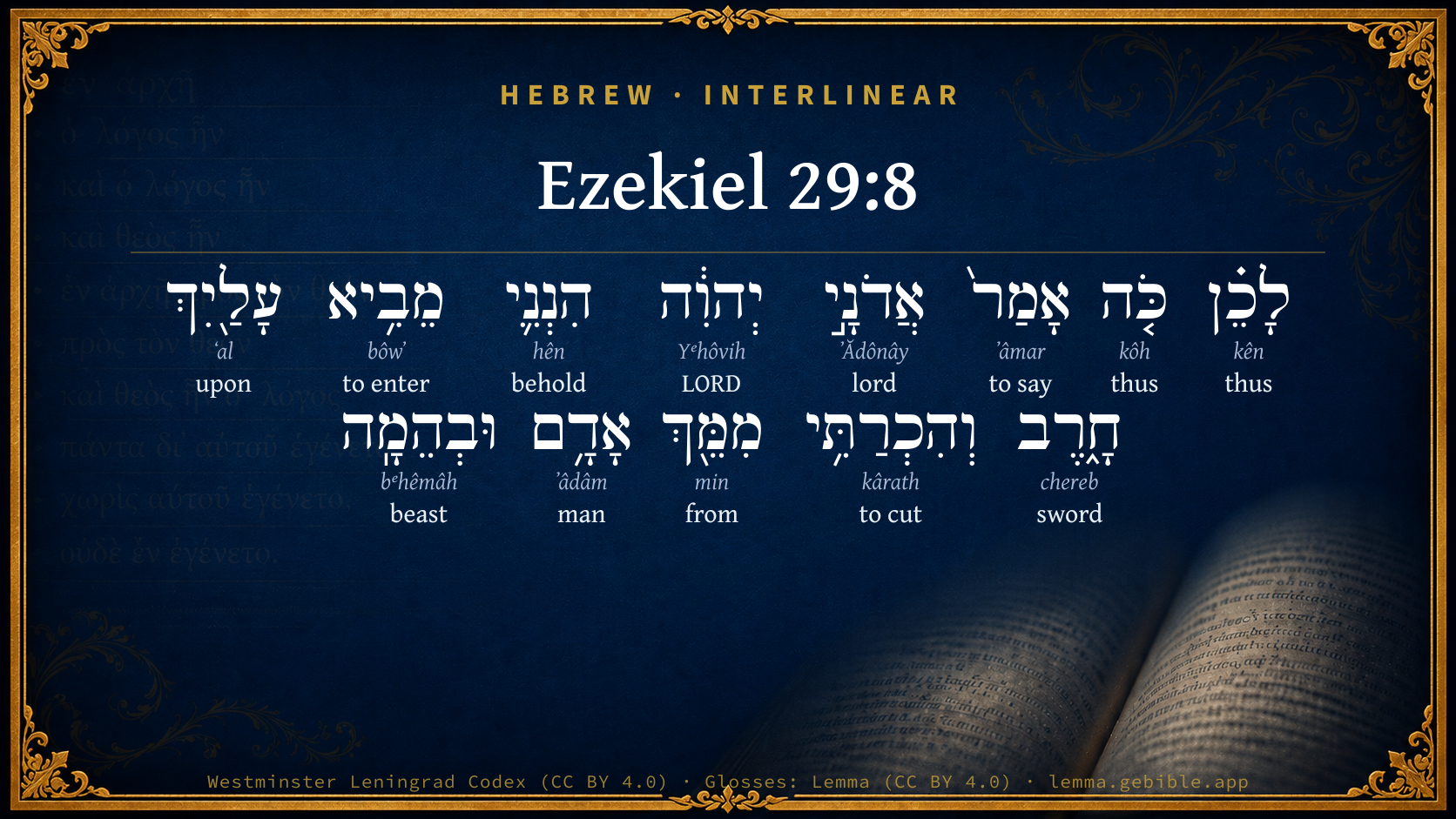
Hebrew (Westminster Leningrad Codex) Ezekiel 29:8 appears in the Hebrew Old Testament. The text above is from the Westminster Leningrad Codex. Each word links to its Strong’s number, a concise gloss, and parsing drawn from the Open Scriptures Hebrew Bible morphology. Click any word for its full Brown-Driver-Briggs (BDB) entry.
Download image
Cite this verse

Ezekiel 29:8 (World English Bible). Public Domain. Lemma interlinear Bible study tool, https://lemma.gebible.app/v/ezekiel/29/8.

Show BibTeX & RIS
BibTeX
RIS
English Translation
Therefore thus says the Lord Yahweh: Behold, I will bring a sword on you, and will cut off from you man and animal.
World English Bible · Public Domain
Download a study sheet

One document with this verse’s original text, its word-by-word gloss line, the meaning frame, cross-references with their text, attributed commentary, and full source and license credits — printable, and it pastes into notes with its structure intact.

This verse Autodidact and up

Study sheet (.html) Plain text (.txt)

A passage Seminary Student

Up to 50 verses in one chapter. A passage sheet keeps up to 6 commentary sources and 12 cross-references per verse, in the order this page ranks them, and says so on the sheet whenever that leaves anything out. Ask for a single verse and you get the Autodidact verse sheet above.

Everything on this page stays free to read, with no account — the sheet is a download of what is already on screen, not access to it.

Want to remove ads? Support Godless Engineer
Compare translations 3

The same verse in 3 English versions, stacked beneath the original-language interlinear above. Click any original word for its lexicon entry.

Each is an independent rendering of the whole verse — the interlinear is not word-aligned to these translations.

Highlighted words mark where these versions differ — a whole-verse word diff, not a word-by-word alignment.

  • World English Bible Public Domain
    Therefore thus says the Lord Yahweh: Behold, I will bring a sword on you, and will cut off from you man and animal.
  • King James Version Public Domain
    Therefore thus saith the Lord GOD; Behold, I will bring a sword upon thee, and cut off man and beast out of thee.
  • unfoldingWord Literal Text CC BY-SA 4.0
    Therefore the Lord Yahweh says this: Behold! I will bring a sword against you. I will cut off both man and beast from you.

unfoldingWord Literal Text — © unfoldingWord, licensed CC BY-SA 4.0. Word-aligned USFM3 via Door43 (git.door43.org/unfoldingWord/en_ult).

Versions to compare (up to 4)

3 of 4 selected

Show all 18 translations

Every available English version of this verse, each an independent rendering of the whole verse.

  • World English Bible Public Domain
    Therefore thus says the Lord Yahweh: Behold, I will bring a sword on you, and will cut off from you man and animal.
  • Berean Standard Bible Public Domain
    Therefore this is what the Lord GOD says: I will bring a sword against you and cut off from you man and beast.
  • Majority Standard Bible Public Domain
    Therefore this is what the Lord GOD says: I will bring a sword against you and cut off from you man and beast.
  • King James Version Public Domain
    Therefore thus saith the Lord GOD; Behold, I will bring a sword upon thee, and cut off man and beast out of thee.
  • American Standard Version (1901) Public Domain
    Therefore thus saith the Lord Jehovah: Behold, I will bring a sword upon thee, and will cut off from thee man and beast.
  • Revised Version (1885) Public Domain
    Therefore thus saith the Lord GOD: Behold, I will bring a sword upon thee, and will cut off from thee man and beast.
  • Geneva Bible (1599) Public Domain
    Therefore thus sayeth the Lord God, Beholde, I will bring a sworde vpon thee, and destroy man and beast out of thee,
  • Douay-Rheims (1899) Public Domain
    Therefore thus saith the Lord God: Behold, I will bring the sword upon thee: and cut off man and beast out of thee.
  • Young's Literal Translation Public Domain
    Therefore, thus said the Lord Jehovah: Lo, I am bringing in against thee a sword, And have cut off from thee man and beast.
  • Literal Standard Version CC BY-SA 4.0
    Therefore, thus said Lord YHWH: Behold, I am bringing in a sword against you, || And have cut off man and beast from you.
  • Unlocked Literal Bible CC BY-SA 4.0
    Therefore the Lord Yahweh says this: Behold! I will bring a sword against you. I will cut off both man and beast from you.
  • unfoldingWord Literal Text CC BY-SA 4.0
    Therefore the Lord Yahweh says this: Behold! I will bring a sword against you. I will cut off both man and beast from you.
  • Darby Bible Public Domain
    Therefore thus saith the Lord Jehovah: Behold, I will bring a sword upon thee, and cut off man and beast from thee.
  • World Messianic Bible Public Domain
    “‘Therefore the Lord GOD says: “Behold, I will bring a sword on you, and will cut off man and animal from you.
  • Webster's Bible Public Domain
    Therefore thus saith the Lord GOD; Behold, I will bring a sword upon thee, and cut off man and beast out of thee.
  • Free Bible Version CC BY-SA 4.0
    So this is what the Lord God says: I will attack you with a sword and kill both people and animals.
  • Bible in Basic English Public Domain
    For this cause the Lord has said: See, I am sending a sword on you, cutting off from you man and beast.
  • JPS Tanakh (1917) Public Domain
    Therefore thus saith the Lord GOD: Behold, I will bring a sword upon thee, and will cut off from thee man and beast.

Literal Standard Version (2020), Covenant Press — licensed CC BY-SA 4.0. Text via the HelloAO Bible API (eBible.org). Unlocked Literal Bible (unfoldingWord) — licensed CC BY-SA 4.0. Text via the HelloAO Bible API (eBible.org). unfoldingWord Literal Text — © unfoldingWord, licensed CC BY-SA 4.0. Word-aligned USFM3 via Door43 (git.door43.org/unfoldingWord/en_ult). Free Bible Version, Dr. Jonathan Gallagher — licensed CC BY-SA 4.0. Text via the HelloAO Bible API (eBible.org).

Word by word

More ways to search: Search by grammar → Find every occurrence → Compare this word →

Practice this passage: Drill this verse → Learn its vocabulary →

וּבְהֵמָֽה
bᵉhêmâh
H929
“and · beast”
Conjunction + Noun, Common, Feminine, Singular, Absolute
Part of Speech
Conjunction + Noun
Type
Common
Gender
Feminine
Number
Singular
State
Absolute
Full BDB Definition

Origin: from an unused root (probably meaning to be mute)

TWOT: 208a

beast, cattle, animal - beasts (collective of all animals) - cattle, livestock (of domestic animals) - wild beasts
  1. לָכֵ֗ן kên H3651 “to/for · thus” Preposition + Adverb
  2. כֹּ֤ה kôh H3541 “thus” Adverb
  3. אָמַר֙ ʼâmar H559 “to say” Verb, Qal, Perfect, 3rd Person, Masculine, Singular
  4. אֲדֹנָ֣י ʼĂdônây H136 “Lord · my” Noun, Common, Masculine, Plural, Construct + Suffix, Personal, 1st Person, Common, Singular
  5. יְהוִ֔ה Yᵉhôvih H3069 “LORD” Noun, Proper
  6. הִנְנִ֛י hên H2005 “behold · me” Particle, Demonstrative + Suffix, Personal, 1st Person, Common, Singular
  7. מֵבִ֥יא bôwʼ H935 “entering” Verb, Hiphil, Participle Active, Masculine, Singular, Absolute
  8. עָלַ֖יִךְ ʻal H5921 “upon · you” Preposition + Suffix, Personal, 2nd Person, Feminine, Singular
  9. חָ֑רֶב chereb H2719 “sword” Noun, Common, Feminine, Singular, Absolute
  10. וְהִכְרַתִּ֥י kârath H3772 “and · to cut” Conjunction + Verb, Hiphil, Sequential Perfect, 1st Person, Common, Singular
  11. מִמֵּ֖ךְ min H4480 “from · you” Preposition + Suffix, Personal, 2nd Person, Feminine, Singular
  12. אָדָ֥ם ʼâdâm H120 “man” Noun, Common, Masculine, Singular, Absolute

About this verse

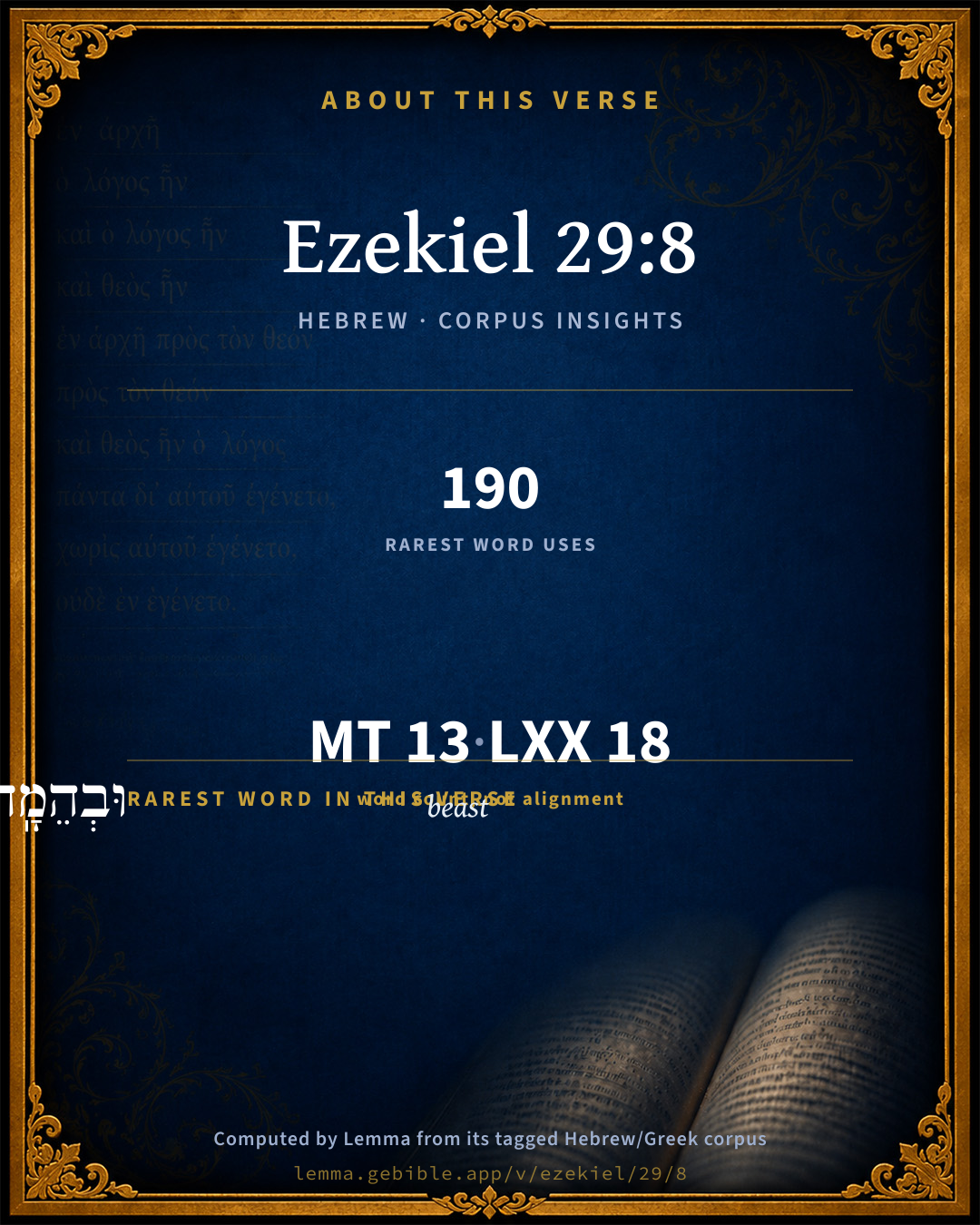
These counts appear in no published source. They are computed here, from the morphology-tagged text and Lemma’s own curated glosses. What Lemma adds →

13
words
13
distinct lemmas
Prophets
section

Grammatical profile

  • 3 verbs
  • 5 nouns
  • 2 prepositions
  • 2 adverbs
  • 1 particle

Verb forms

  • אָמַר֙ Qal · Perfect
  • מֵבִ֥יא Hiphil · Participle Active
  • וְהִכְרַתִּ֥י Hiphil · Sequential Perfect

Hebrew & Septuagint length

In English translation the verse runs 23 words from the Hebrew and 22 from the Septuagint (LXX English) — closely comparable.

A rough comparison of the two English renderings, which tokenize alike — not a word-level alignment.

Word counts can differ between the Hebrew and the Greek without any difference in meaning — e.g. the Hebrew direct-object marker אֵת has no separate Greek word, and Greek often adds the article ὁ.

In the original languages it is 13 Hebrew tokens and 18 Greek tokens — but the two are counted differently (Hebrew bundles its prefixes and suffixes into one token; the Greek is in lemma form), so that isn’t a like-for-like length.

Cross-references

11

Topical passages linked to Ezekiel 29:8 in the Treasury of Scripture Knowledge — connected by theme and wording, ordered by reader-vote popularity; previews shown in the World English Bible.

  • Ezekiel 14:17 Or if I bring a sword on that land, and say, Sword, go through the land; so that I cut off from it man and animal;
  • Genesis 6:7 Yahweh said, "I will destroy man whom I have created from the surface of the ground; man, along with animals, creeping things, and birds of the sky; for I am sorry that I have made them."
  • Exodus 12:12 For I will go through the land of Egypt in that night, and will strike all the firstborn in the land of Egypt, both man and animal. Against all the gods of Egypt I will execute judgments: I am Yahweh.
  • Jeremiah 7:20 Therefore thus says the Lord Yahweh: Behold, my anger and my wrath shall be poured out on this place, on man, and on animal, and on the trees of the field, and on the fruit of the ground; and it shall burn, and shall not be quenched.
  • Jeremiah 32:43 Fields shall be bought in this land, about which you say, It is desolate, without man or animal; it is given into the hand of the Chaldeans.
  • Jeremiah 46:13–26 The word that Yahweh spoke to Jeremiah the prophet, how that Nebuchadrezzar king of Babylon should come and strike the land of Egypt.
  • Ezekiel 25:13 therefore thus says the Lord Yahweh, I will stretch out my hand on Edom, and will cut off man and animal from it; and I will make it desolate from Teman; even to Dedan shall they fall by the sword.
  • Ezekiel 29:19–20 Therefore thus says the Lord Yahweh: Behold, I will give the land of Egypt to Nebuchadrezzar king of Babylon; and he shall carry off her multitude, and take her spoil, and take her prey; and it shall be the wages for his army.
  • Ezekiel 30:4 A sword shall come on Egypt, and anguish shall be in Ethiopia, when the slain shall fall in Egypt; and they shall take away her multitude, and her foundations shall be broken down.
  • Ezekiel 30:10 Thus says the Lord Yahweh: I will also make the multitude of Egypt to cease, by the hand of Nebuchadrezzar king of Babylon.
  • Ezekiel 32:10–13 Yes, I will make many peoples amazed at you, and their kings shall be horribly afraid for you, when I shall brandish my sword before them; and they shall tremble at every moment, every man for his own life, in the day of your fall.

Cross-references courtesy of OpenBible.info (CC BY 4.0).

Hebrew and Greek witnesses Masoretic Hebrew ↔ Greek Septuagint

The same verse in the two great witnesses to the Old Testament, shown verse-for-verse.

These are two independent witnesses, not word-aligned to each other, and the Septuagint is shown in lemma (dictionary) form.

Hebrew Ezekiel 29:8 Masoretic · Westminster Leningrad Codex

לָכֵ֗ן כֹּ֤ה אָמַר֙ אֲדֹנָ֣י יְהוִ֔ה הִנְנִ֛י מֵבִ֥יא עָלַ֖יִךְ חָ֑רֶב וְהִכְרַתִּ֥י מִמֵּ֖ךְ אָדָ֥ם וּבְהֵמָֽה

Therefore thus says the Lord Yahweh: Behold, I will bring a sword on you, and will cut off from you man and animal.

World English Bible · Public Domain

Greek LXX Ezekiel 29:8 Septuagint · lemma form

διά οὗτος ὅδε λέγω κύριος ἰδού ἐγώ ἐπιἄγω ἐπί σύ ῥομφαία καί ἀποὀλλύω ἄνθρωπος ἀπό σύ καί κτῆνος

Therefore thus says the Lord; Behold, I will bring a sword upon you, and will cut off from you man and beast;

LXX2012 (modern English Septuagint) · Public Domain

Hebrew: Westminster Leningrad Codex (CC BY 4.0). Greek: Septuagint (public domain); English from LXX2012 (modern English Septuagint) (Public Domain). How the Septuagint differs from the Hebrew →

Targum (Aramaic paraphrase)

1

The Targum is the ancient Jewish Aramaic paraphrase of the Hebrew Scriptures — an interpretive translation, not the Hebrew text itself. Onkelos (literal) and Pseudo-Jonathan (expansive) render the Torah, and Jonathan the Prophets. Coverage is partial: where no permissively-licensed English translation exists for a verse, only the Aramaic is shown. This is verse-level text, not a word-by-word alignment to the Hebrew.

  1. Targum Jonathan Prophets (Joshua–Malachi)
    בְּכֵן כִּדְנַן אֲמַר יְיָ אֱלֹהִים הָא אֲנָא מַיְתֵי עֲלָךְ דְקַטְלִין בְּחַרְבָּא וֶאֱשֵׁיצֵי מִנָךְ אֱנָשָׁא וּבְעִירָא:

    (no public-domain English translation for this verse)

    Targum Jonathan — Aramaic: “Mikraot Gedolot” (public domain). English: “Sefaria Community Translation” (CC0 1.0 (public-domain dedication)); “London "Chaldee Paraphrase," 1871” (public domain). Text via Sefaria.

Commentary

Notes on Ezekiel 29:8 from classic Christian and Jewish commentators (each source and its license shown beneath its notes). The classic Christian expositions comment on the surrounding passage and are grouped to its opening verse, so a note may address several verses; the Jewish commentaries on the Tanakh (Rashi and others) are per-verse, so they appear only where the commentator wrote on this verse.

Lemma curates 59 commentaries, every one of them public domain or Creative Commons licensed, each selected and text-cleaned for this edition rather than reprinted as found. About our sources →

Trapp's Complete Commentary

John Trapp

Eze 29:8 Therefore thus saith the Lord GOD; Behold, I will bring a sword upon thee, and cut off man and beast out of thee.

Ver. 8. And cut off man and beast.] With both which thou aboundest exceedingly, as being a very fruitful country; populosa et pecorosa.

John Trapp, A Commentary or Exposition upon All the Books of the Old and New Testament (1647–1656) — public domain. Text from a community e-Sword module.

Joseph Benson's Commentary

Eze 29:8-9. Behold, I will bring a sword upon thee — This was fulfilled, first by the civil wars which broke out in Egypt, and next by the invasion of it by Nebuchadnezzar, who carried his victorious arms through the whole country, destroying wherever he came; and will cut off man and beast — That is, destroy a vast number both of men and beasts. And the land of Egypt shall be desolate — A great part of Egypt was, without doubt, laid waste and made desolate by the ravages of war. Because he hath said, The river is mine — Arrogance and self-confidence are always spoken of in Scripture as highly displeasing to God. Whenever any one thinks, speaks, or acts as if he were self-dependent, and had safety, prosperity, and happiness in his own power, then do the Scriptures represent God as giving up such a one to calamity, to convince him how little reason he had to think highly of, or to trust in himself.

Joseph Benson's Commentary on the Old and New Testaments (1811–1818) — public domain. Text from a community e-Sword module.

Tyndale Open Study Notes

Tyndale Open Resources

29:8-13 God’s solution was to devastate the land of Egypt, making it into a desolate wasteland. The threatened destruction would stretch from Migdol in the northeast down to Aswan in the south, leaving the whole of Egypt uninhabited for an entire generation of forty years (cp. 4:6). Egypt’s fate would be like Judah’s, as God would first scatter the Egyptians to distant lands and then bring the Egyptians home. The Babylonians seem to have invaded Egypt successfully in 568 or 567 BC and carried off Egyptian prisoners of war who remained in exile until the time of Cyrus, a generation later.

Tyndale Open Study Notes — © Tyndale Open Resources, licensed CC BY-SA 4.0. Text via the HelloAO Bible API.

Matthew Henry's Commentary

This explains the foregoing prediction, which was figurative, and looks something further. Here is a prophecy,

I. Of the ruin of Egypt. The threatening of this is very full and particular; and the sin for which this ruin shall be brought upon them is their pride, Eze 29:9. They said, The river is mine and I have made it; therefore their land shall spue them out. 1. God is against them, both against the king and against the people, against thee and against thy rivers. Waters signify people and multitudes, Rev 17:15. 2. Multitudes of them shall be cut off by the sword of war, a sword which God will bring upon them to destroy both man and beast, the sword of civil war. 3. The country shall be depopulated. The land of Egypt shall be desolate and waste (Eze 29:9), the country not cultivated, the cities not inhabited. The wealth of both was their pride, and that God will take away. It shall be utterly waste (wastes of waste, so the margin reads it), and desolate (Eze 29:10); neither men nor beasts shall pass through it, nor shall it be inhabited (Eze 29:11); it shall be desolate in the midst of the countries that are so, Eze 29:12. This was the effect not so much of those wars spoken of before, which were made by them, but of the war which the king of Babylon made upon them. It shall be desolate from one end of the land to the other, from the tower of Syene even unto the border of Ethiopia. The sin of pride is enough to ruin a whole nation. 4. The people shall be dispersed and scattered among the nations (Eze 29:12), so that those who thought the balance of power was in their hand should now become a contemptible people. Such a fall does a haughty spirit go before.

II. Of the restoration of Egypt after awhile, Eze 29:13. Egypt shall lie desolate forty years (Eze 29:12) and then I will bring again the captivity of Egypt, Eze 29:14. Some date the forty years from Nebuchadnezzar's destroying Egypt, others from the desolation of Egypt some time before; however, they end about the first year of Cyrus, when the seventy years' captivity of Judah ended, or soon after. Then this prediction was accomplished, 1. That God will gather the Egyptians out of all the countries into which they were dispersed, and make them to return to the land of their habitation, and give them a settlement there again, Eze 29:14. Note, Though God will find out a way to humble the proud, yet he will not contend for ever, no, not with them in this world. 2. That yet they shall not make a figure again as they have done. Egypt shall be a kingdom again, but it shall be the basest of the kingdoms (Eze 29:15); it shall have but little wealth and power, and shall not extend its conquests as formerly; it shall be the tail of the nations, and not the head. It is a mercy that it shall become a kingdom again, but, to humble it, it shall be a despicable kingdom; it shall be a long time before it recover any thing like its ancient lustre. For two reasons it shall be thus mortified: - (1.) That it may not domineer over its neighbours, that it may not exalt itself above the nations, nor rule over the nations, as it has done, but that it may know what it is to be low and despised. Note, Those who abuse their power will justly be stripped of it; and God, as King of nations, will find out a way to maintain the injured rights and liberties, not only of his own, but of other nations. (2.) That it may not deceive the people of God (Eze 29:16): It shall no more be the confidence of the house of Israel; they shall no more be in temptation to trust in it as they have done, which is a sin that brings their iniquity to remembrance, that is, provokes God to punish them not for that only, but for all their other sins. Or it puts them in mind of their idolatries to return to them, when they look to the idolaters, to repose a confidence in them. Note, The creatures we confide in are often therefore ruined, because there is no other way effectually to cure us of our confidence in them. Rather than Israel shall be ensnared again, the whole land of Egypt shall be laid waste. He that once gave Egypt for their ransom (Isa 43:3) will now give Egypt for their cure; and it shall be destroyed rather than Israel shall not in this particular be reformed. God, not only in justice, but in wisdom and goodness to us, breaks those creature-stays which we lean too much upon, and makes them to be no more, that they may be no more our confidence.

Matthew Henry's Commentary on the Whole Bible (1708–1710) — public domain (CC PDM 1.0). Text via the HelloAO Bible API.

Jamieson, Fausset & Brown

Robert Jamieson, A. R. Fausset & David Brown

a sword--Nebuchadnezzar's army (Eze 29:19). Also Amasis and the Egyptian revolters who after Pharaoh-hophra's discomfiture in Cyrene dethroned and strangled him, having defeated him in a battle fought at Memphis [JUNIUS].

Jamieson, Fausset & Brown — Commentary Critical and Explanatory on the Whole Bible (1871) — public domain (CC PDM 1.0). Text via the HelloAO Bible API.

The Cambridge Bible for Schools and Colleges

gen. ed. J. J. S. Perowne

8. The name of the conqueror of Egypt is not indicated in this preliminary threatening. The sword that comes on Egypt is the sword of the Lord, cf. Eze_14:17, Eze_32:11-13. The land shall be utterly desolated, man and beast swept away. It need not be said that these prophetic threatenings have always an element of the ideal in them.

8–12. For this irreligious self-exaltation Egypt shall be made a desolation from Migdol to Syene, even to the border of Ethiopia.

The Cambridge Bible for Schools and Colleges (gen. ed. J. J. S. Perowne; Cambridge University Press, 1878–1918) — public domain. Text from a community e-Sword module.

John Gill's Exposition

Therefore thus saith the Lord God,.... Because of the pride of the king of Egypt, asserting the river to be his own, and made by him for himself; and because of his perfidy to the house of Israel:

behold, I will bring a sword upon thee; or those that kill with the sword, as the Targum; first a cival war, occasioned by the murmurs of the people, on account of the defeat of their army at Cyrene; which issued in the dethroning and strangling of this king, as before observed and setting up another; which cival commotions Nebuchadnezzar took the advantage of, and came against Egypt with a large army:

and cut off man and beast out of thee; for what with the civil wars among themselves, and what with the devastations of the king of Babylon's army, putting men to the sword, and seizing upon the beasts for their food, to support such an army in a foreign land, it was pretty well stripped of both.

John Gill's Exposition of the Whole Bible (1746–1763) — public domain (CC PDM 1.0). Text via the HelloAO Bible API.

Matthew Poole's English Annotations

Therefore, for thy atheistical pride, and thy perfidious mischief to the house of Israel, and other thy sins,

I will bring a sword upon thee; war, and the effects of it. First, a civil war arose against this king Hophra, who, weak and contemned, and fallen under the jealousies and disgusts of his subjects after his overthrow in the deserts of Libya and Cyrene, was again overthrown by his rebel subjects in a bloody battle at Memphis, was taken in his flight towards Sain, his royal seat, and some time after strangled by the enraged rout. The next sword, brought on Hophra’s successor, and on the land of Egypt, was the sword of Nebuchadnezzar, in the same year after the overthrow of Tyre; the civil war of Egypt inviting him to take the occasion, and some few requests, it is likely, from the rebellious to assist them.

Cut off man, by the sword in battle and sieges, and by famine.

And beast; eaten up by a numerous army invading and prevailing, and which will drive away what they eat not. The same phrase you have Eze 14:13,17.

Matthew Poole's English Annotations on the Holy Bible (1683–1685) — public domain. Text from a community e-Sword/MySword module.

Whedon's Commentary on the Bible

Daniel D. Whedon

8. I will bring a sword — It is Jehovah’s sword, even though Nebuchadnezzar holds it.

Daniel D. Whedon (gen. ed.), Commentary on the Old and New Testaments (1874–1909) — public domain. Text from a community e-Sword module.

The Pulpit Commentary

Behold, I will bring a sword upon thee. The words are probably addressed to the nation personified rather than to the king. The sentence of doom is now pronounced, no longer figuratively. And the special guilt for which it was inflicted, a guilt which the nation shared with its ruler, is emphatically repeated in Ver. 9.

Vers. 8-12. The humiliation of Egypt"s pride.

It certainly gives a reader a somewhat dark and gloomy view of the state of the world in the time of Ezekiel, to read, as we have to do in his prophecies, one almost uninterrupted series of reproaches and condemnations. The prophet spares no man and no nation; and his writings are a monument to human iniquity, and especially to the faults and errors of the nations that flourished and fell in pre-Christian antiquity. In this passage he foretells the approaching humiliation of Egypt.

I THE GROUNDS OF THIS HUMILIATION. It is a law of eternal justice that they who exalt themselves shall be made low and brought to the ground. The faults with which Egypt, as a state, are particularly charged are the faults of self-confidence, pride, and boasting sins peculiarly offensive to the Most High, who will be acknowledged as God alone, and who will not give his honor to another.

II THE POWER AND CAUSE OF THIS HUMILIATION. We are taught by the prophet and the lesson is in harmony with the teaching of Scripture generally to attribute this to the Eternal King and Judge, who is supreme over all nations. His sway is sometimes questioned and disputed, and is too often forgotten and practically repudiated. But behind and above all human powers there is a Power supreme and universal, not cognizable by sense, but discerned by the reason and the conscience. To this the working of moral law in the affairs of individual men and of nations is to be referred; to leave this out of sight is to leave much that we meet with in history and experience obscure and perplexing.

III THE INSTRUMENT OF THIS HUMILIATION. The sword that was to cut off man and beast out of the land of Egypt, that was to lay waste and desolate the cities, was the sword of Nebuchadnezzar King of Babylon, himself a heathen, doubtless stained with the errors and crimes of heathenism, yet employed as a suitable agent in the chastisement of many rebellious peoples. It is remarkable that the same power should be employed to chasten Israel, Israel"s allies, and Israel"s foes!

IV THE CHARACTER OF THIS HUMILIATION. The armies of Egypt were defeated; the land was laid waste; the cities were dismantled; and the Egyptians themselves were scattered and dispersed among the nations. Scarcely an element of disgrace was omitted; the chastisement was complete.

V THE EXTENT AND DURATION OF THIS HUMILIATION. It was to affect the whole land, from the mouth of the Nile to the southernmost boundary. And it was to last for the space of forty years a limit of time which is not, perhaps, to be taken literally, but, as is usual in Hebrew writings, as representing a long period.

VI THE LESSONS OF THIS HUMILIATION.

1. It was a rebuke to haughty self-confidence.

2. It was a summons to penitence and contrition on account of sin.

3. It was an inducement to submission.

4. It was a clear voice from heaven, calling the nations to put their trust, not in an arm of flesh, but in the living God. "Some put their trust in chariots, and some in horses; but we will remember the Name of the Lord, our God T.

Vers. 8-16. God"s frown, a chill of death.

Men have very erroneous ideas of God when they think lightly of making him their foe. They have a vague idea that he is as impotent as one of their idols. Did they but know the magnitude of his power, and his complete supremacy over human affairs, they would feel that his frown was blackest death. The fruits of God"s hostility are

I DISASTROUS WAR. "I will bring a sword upon thee." It would not be true to say that God takes part in every war. In many cases both combatants are to blame, and God cannot take sides with either. But, in every case in which one of the combatants is impelled to fight for an unrighteous cause, clearly God will aid the other side. Not always then. For although a combatant may have a righteous cause to defend, he may defend it in a vindictive spirit and with unhallowed weapons. It is well to note that God does fight with his trusty servants against evildoers. He does employ the sword of men in his cause; and when he is behind the sword, "it will cut off man and beast.

II WIDESPREAD DESOLATION. "The land of Egypt shall be desolate and waste." Nothing is easier with God than to make waste the land of Egypt. He has but to diminish the water-supply of the Nile, and the territory becomes a desert. To him it must be a grievous pain to make the fair face of nature desolate. He who delights in beauty, and caused the "sons of God to sing for joy" when earth was first robed in leafy vesture, must be pained when the verdure of forests and cornfields is blasted. Yet his desire for human good, and for the development of righteousness in the earth, is stronger far. This gives him a deeper joy; and, in order to promote moral loveliness, it is sometimes worth while to sacrifice the fair face of nature.

III EQUITABLE REPRISALS. "Because he hath said, The river is mine therefore I am against thy rivers." This is language which men everywhere can understand. This is argument which leaves deep impression in the human breast. If men despise and treat with contempt God"s messages sent in the form of human speech, God will speak to them in language they will not contemn. The strict equity of God"s dealings has often been written in largest capitals. The prohibited thing has become a scourge. The quails lusted after became disease in the intestines. The Nile, worshipped as a god, was changed into blood. God is never in haste to vindicate his rights, because at any moment he can cast a bombshell of alarm in his enemies" comp. If men must needs trifle, let them trifle with Satan never with God.

IV ANOTHER FRUIT OF GOD"S DISPLEASURE IS TEMPORARY DISPERSION. "I will scatter the Egyptians among the nations I will bring again the captivity of Egypt." Compulsory banishment is a serious disgrace, a heavy calamity. The poor, no less than the rich, have tender attachment to their homes. The tendrils of strong affection twine round the cottage in which one is born. To be compelled to turn away from the familiar scenes to be compelled by a foreign conqueror is galling to every sentiment,is like a fire in one"s bones. Such enforced separation means loss, hardship, uncertainty, dishonor. Defeat in war is affliction sore enough; banishment is tenfold worse. How insane on the part of men to provoke God into such necessity of chastisement!

V ANOTHER EFFECT OF GOD"S ANGER IS, PERPETUAL DEGRADATION. "It shall be the basest of the kingdoms, neither shall it exalt itself any more above the nations." To have a friend who is cultured and refined is to have an elevating power at our side, lifting us up to a better life. God is wise; and to have God as a Friend is to gain wisdom steadily. God is pure; and to have God"s friendship is to become pure also. God is love; and he who is much in God"s society becomes lovely and loving. All good flows from God as its Fount; and to cut off one"s self willfully from that fount is to sink into ignorance and misery. The friends of God must rise; the foes of God must deteriorate. Today this prophecy is signally fulfilled. For centuries past Egypt has been the tool and the slave of other empires. She has been ground to the dust by the oppressor, nor is there at present any prospect that she will rise again. The word of the Lord by Ezekiel, although then improbable, has been performed. D.

The Pulpit Commentary (1880–1919), ed. H.D.M. Spence-Jones & Joseph S. Exell — public domain. Text from a community e-Sword module.

unfoldingWord translationNotes

Door43 World Missions Community

General Information:

Yahweh continues giving Ezekiel his message to Pharaoh.

Behold!

"Look!" or "Listen!" This word adds emphasis to what is said next. This is the Lord's message to Pharaoh. AT: "Pay attention to what I am about to tell you!"

I will bring a sword against you

Here "sword" is a metonym for battle, and "bring a sword against you" is a metaphor for causing an enemy army to come fight against Egypt. AT: "I will cause your enemies to come fight against you" (See: Metonymy)

a sword against you

The word "you" refers to the nation of Egypt. (See: Forms of You)

I will cut off both man and beast from you

Here "cut off man and beast" is a metaphor for destroying the people and animals. God would do this by causing the enemy army to do it. (See: Metaphor)

I am against you and against your river

The word "you" refers to Pharaoh. God speaks to Pharaoh as if Pharaoh were a monster in the river.

I will give the land of Egypt over to desolation and waste

"I will put Egypt into the power of desolation and waste." Desolation and waste are spoken of as if they were people who could be given power over Egypt. AT: "I will cause Egypt to become a desolate waste" (See: Personification)

you will become a wasteland

Here "you" refers to Pharaoh and represents Egypt, the country he rules over. AT: "your country will become a wasteland" (See: Metonymy)

from the Migdol to Syene and the borders of Cush

This refers to all of Egypt. Where these places are can be stated clearly. AT: "throughout all of Egypt, from Migdol in the north to Syene in the south and the borders of Cush further south" (See: Merism and Assumed Knowledge and Implicit Information)

Migdol

This is the name of a place in the far northern part of Egypt. (See: How to Translate Names)

Syene

This the name of a town in southern Egypt. It is now called Aswan. (See: How to Translate Names)

the borders of Cush

These borders of Cush were south of Syene. Some versions say Sudan or Ethiopia, the modern names of countries south of Egypt. (See: How to Translate Names)

translationWords

Lord Yahweh

sword

desolate

ruin

waste

Cush

unfoldingWord translationNotes — © Distant Shores Media and the Door43 World Missions Community, licensed CC BY-SA 4.0. Source: git.door43.org/Door43/en_tn.

Lesson kit

Teaching starters — assembled from the data on this page, not authored interpretation. Every prompt links to the verse data it draws on. Edit before teaching.

Ezekiel, in the Prophets, opens this verse with 13 words (13 distinct Hebrew lemmas). Its most distinctive word is bᵉhêmâh (“beast”). A historical commentator’s framing appears above. Read the whole chapter for the surrounding context.

Discussion questions

  1. What does “beast” (bᵉhêmâh) contribute to the verse as a whole?
  2. Ezekiel 14:17 shares this passage’s theme. How do the two illuminate each other?
  3. These translations render this verse differently. What is at stake in choosing one wording over another?
  4. The verb «אָמַר֙» is Qal Perfect. How does its form color the action?
  5. Reading how Trapp's Complete Commentary and Joseph Benson's Commentary read this verse, where do the two commentators agree and where do they part?

Things to notice

Reading settings

Reading text

Shown beneath each verse's original-language words.

Old Testament
Old Testament edition

Read the OT as the Masoretic Hebrew (MT) or the Greek Septuagint (LXX).

English shown for the Greek Septuagint (in the Hebrew ↔ Greek comparison).

Comparing translations? Open the Compare panel on any verse page to stack up to four side by side.